



What is National Council for Transgender Persons(NCTP)?
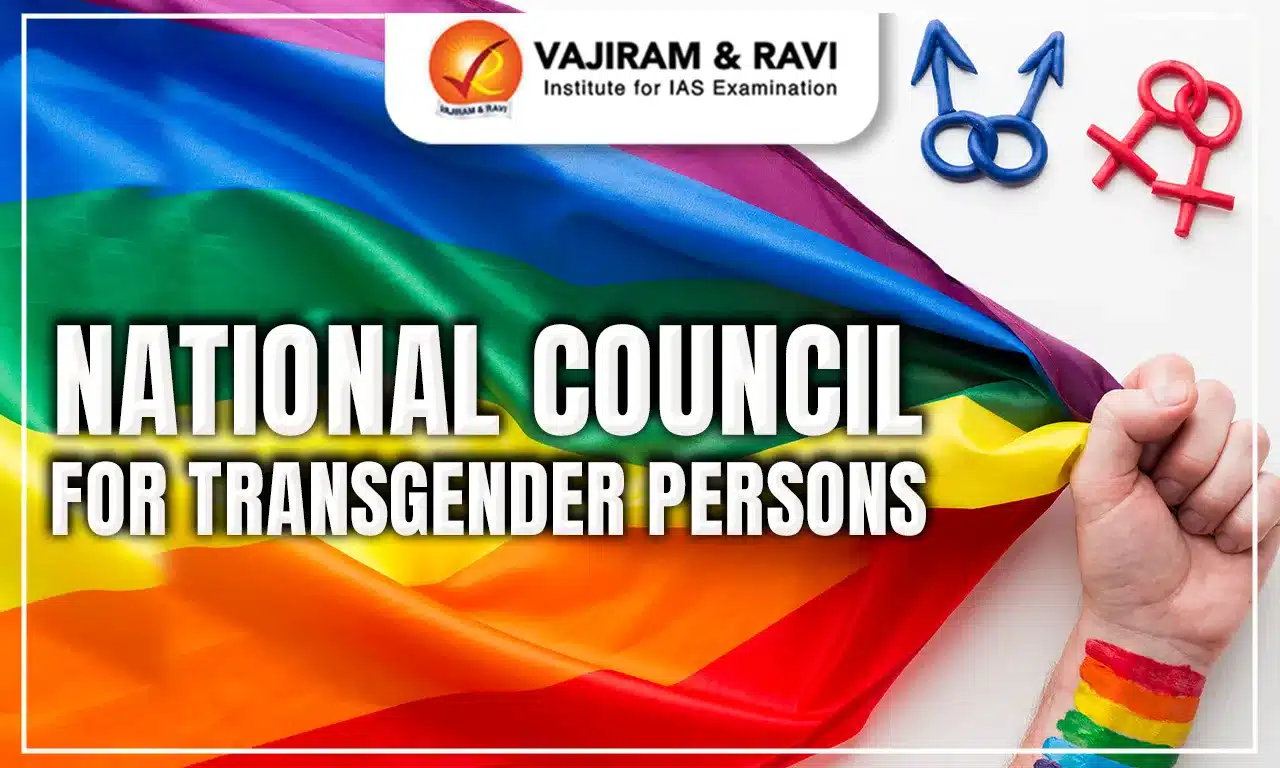
The National Council for Transgender Persons (NCTP) is a statutory body constituted under the Transgender Persons (Protection of Rights) Act 2019 to safeguard the rights of transgender persons in India.
- The NCTP is responsible for monitoring and evaluating the implementation of the provisions of the Transgender Persons (Protection of Rights) Act, 2019 and making recommendations to the government on measures to promote and protect the rights of transgender persons.
- It aims to:
- Focus on livelihood issues as well as to raise awareness about the trans community for achieving the goal of social justice so that transpersons are accepted within families and in the larger society.
- Ensure to set up of transgender welfare boards in all states and also ensure that essential needs of the transgender community, like housing, food, healthcare, and education, are met.
What is the genesis of the formation of NCTP?
The genesis of its formation can be traced back to several significant developments in recent years:
- The government set up an expert committee in 2013 for studying the problems of transgenders and recommending solutions.
- In the NALSA v. Union of India case (2014), the Supreme Court of India declared transgender people to be a 'third gender'.
- The Supreme Court also upheld that the fundamental rights granted under the Constitution of India will be equally applicable to transgender people and gave them the right to self-identification of their gender as male, female, or third-gender.
- A private member Bill, the Rights of Transgender Persons Bill, was introduced in the Rajya Sabha in 2014 for the range of entitlements in health, education, skill development, employment opportunities, and protection from abuse and torture. However, this Bill got lapsed.
- The Government introduced the public bill in the Lok Sabha in 2016, and it was referred to a Standing Committee.
- Finally, the Parliament passed the Transgender Persons (Protection of Rights) Bill, 2019.
- Later in 2020, the Government established the National Council for Transgender Persons under the Transgender Persons (Protection of Rights) Act, 2019.





What are the salient features of the Transgender Persons (Protection of Rights) Act, 2019?
The salient feature of the Act includes
- NCTP: The Act establishes the National Council for Transgender Persons (NCTP).
- Definition: The Act defines a transgender person as one whose gender does not match the gender assigned at birth. It includes transmen and trans-women, persons with intersex variations, gender-queers, and persons with socio-cultural identities, such as kinnar and hijra.
- Right of residence: The Act has a provision that provides transgender the right of residence with parents and immediate family members.
- Certificate of identity: The Act states that a transgender person shall have the right to self-perceived gender identity. A certificate of identity can be obtained at the District Magistrate's office, and a revised certificate is to be obtained if sex is changed.
- Prohibition against discrimination: The Act prohibits discrimination against a transgender person in various sectors such as education, employment, healthcare, etc.
- Punishment: It states that the offenses against transgender persons will attract imprisonment between six months and two years, in addition to a fine.
What is the composition of NCTP?
| Provisions | Description |
| Chairperson (ex-officio member) |
|
| Vice Chairperson (ex-officio member) |
|
| Representation from central government |
|
| Representation from states |
|
| Transgender community representation |
|
| Additional members |
|
- Term of the members: Members of NCTP, other than ex-officio members, shall hold office for a term of three years from the date of their nomination.
What are the powers and functions of NCTP?
The main functions of NCTP are to:
- Monitor and evaluate the impact of programmes and policies designed for achieving equality and full participation of transgender persons.
- Advise the central government on the formulation of programmes, policies, legislation, and projects with respect to transgender persons.
- Review and coordinate the activities of all the departments.
- Redress the grievances of transgender persons.
- Perform such other functions as prescribed by the central government.
- The council also has the power to inquire into complaints regarding violations of the rights of transgender persons and take appropriate action.
What is the significance of NCTG in empowering Transgender Persons?
It was established in 2020 to promote the welfare and empowerment of the transgender community in the country. Here are some of the key points of significance of the NCTP:
- Enables legal recognition: The establishment of the NCTP is a crucial step towards the legal recognition of transgender people in India. It acknowledges their existence as a distinct community and recognizes their right to equal treatment and protection under the law.
- Provides for representation: The NCTP provides a platform for transgender people to be represented at the national level. This allows their voices to be heard and their needs to be addressed by the government.
- Policy development: The NCTP can help develop public policy and programs that promote the welfare and empowerment of transgender people in India. The council can make recommendations to the government on issues such as education, healthcare, employment, and legal protection.
- Creates awareness: The NCTP can help raise awareness about the issues faced by transgender people in India. This can help combat the stigma and discrimination they face and promote greater acceptance and understanding in society.
- Ensures support and resources: The NCTP can help provide support and resources to transgender people, such as access to healthcare, legal aid, and vocational training. This can promote a dignified life and contribute to society.
What are the limitations of NCTP?
- Certificate of identification: The NCTP has no power regarding the procedure of issuance of a certificate of identification.
- Reservation: The Transgender Persons (Protection of Rights) Act, 2019 does not provide reservations to transgender persons. NCTP can only advise the government to grant the reservation to the transgender community.
- Lack of representation: The NCTP is not representative of the diverse transgender community in India. The council primarily comprises government officials, and only five transgender people are part of the council.
- Limited powers: The NCTP has limited powers to implement policies and programs for the welfare of transgender people. It can only make recommendations to the government, which may or may not be implemented.
- Social stigma: Despite the legal recognition of transgender people in India, social stigma and discrimination against them remain prevalent. This can limit the effectiveness of the NCTP in empowering transgender people.

 Last updated on March, 2026
→ UPSC Final Result 2025 is now out.
→ UPSC has released UPSC Toppers List 2025 with the Civil Services final result on its official website.
→ Anuj Agnihotri secured AIR 1 in the UPSC Civil Services Examination 2025.
→ UPSC Marksheet 2025 is now out.
→ UPSC Notification 2026 & UPSC IFoS Notification 2026 is now out on the official website at upsconline.nic.in.
→ UPSC Calendar 2026 has been released.
→ Check out the latest UPSC Syllabus 2026 here.
→ UPSC Prelims 2026 will be conducted on 24th May, 2026 & UPSC Mains 2026 will be conducted on 21st August 2026.
→ The UPSC Selection Process is of 3 stages-Prelims, Mains and Interview.
→ Prepare effectively with Vajiram & Ravi’s UPSC Prelims Test Series 2026 featuring full-length mock tests, detailed solutions, and performance analysis.
→ Enroll in Vajiram & Ravi’s UPSC Mains Test Series 2026 for structured answer writing practice, expert evaluation, and exam-oriented feedback.
→ Join Vajiram & Ravi’s Best UPSC Mentorship Program for personalized guidance, strategy planning, and one-to-one support from experienced mentors.
→ Shakti Dubey secures AIR 1 in UPSC CSE Exam 2024.
→ Also check Best UPSC Coaching in India
National Council for Transgender Persons FAQs
Q1. Under which ministry does the National Council for Transgender Persons fall?+
Q2. Who is the chairperson of NCTP?+
Tags: national council for transgender persons quest