



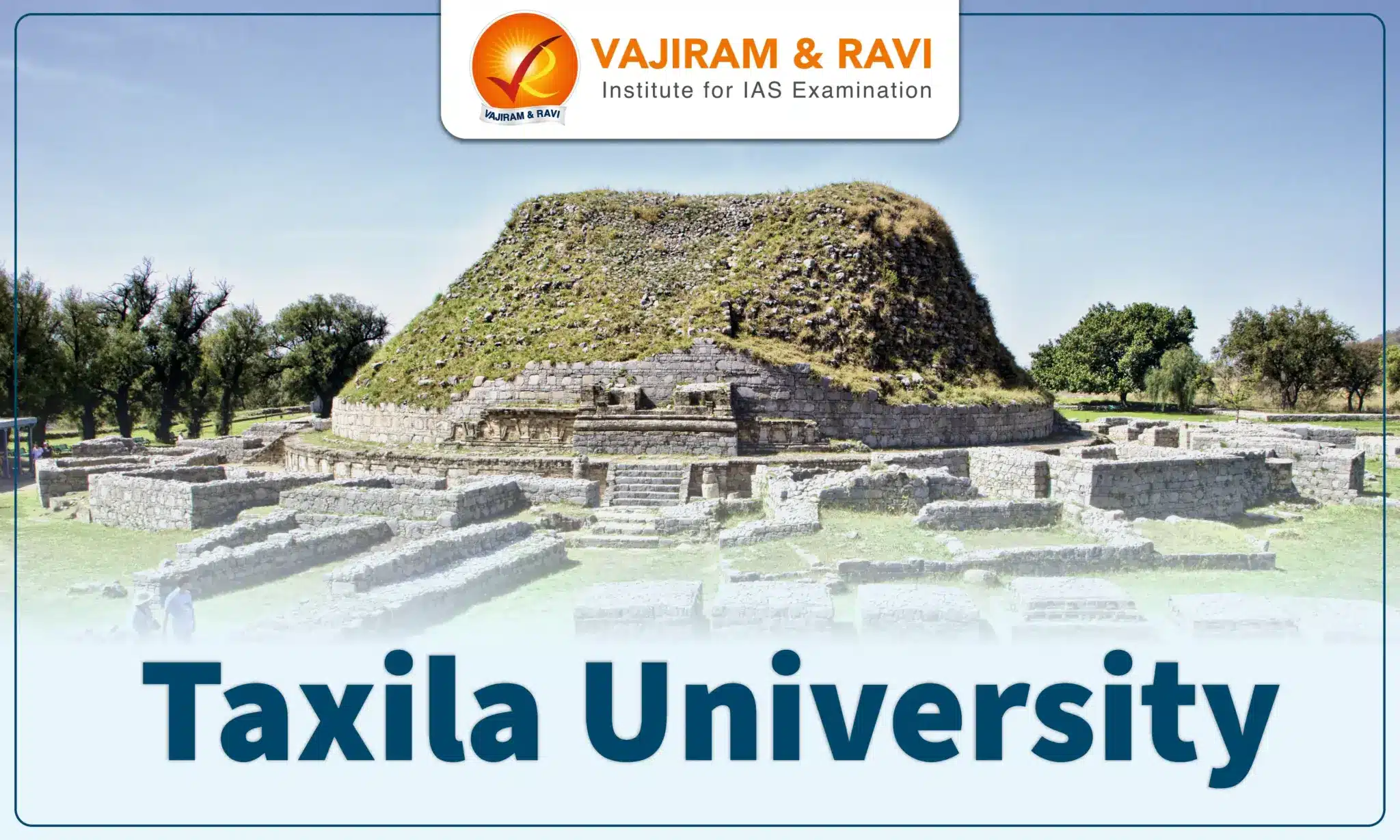
Taxila University, also known as Takshashila University, is an ancient centre of learning that flourished for several centuries, particularly known for its religious teachings of Buddhism. Located in Taxila, Punjab (present-day Pakistan), near the banks of the Indus River, it is renowned for attracting students from around the world until its destruction in the 5th century CE.
The Taxila University provided a comprehensive curriculum encompassing ancient scriptures, law, medicine, astronomy, military science, and the eighteen silpas or arts. Moreover, the university was renowned for its esteemed faculty, producing notable scholars such as the grammarian Panini, physician Jivaka, and Chanakya (Kautilya).
Taxila University History
Taxila University is a renowned ancient centre of learning that significantly contributed to education and scholarship in the region. The site's earliest archaeological remains date back to the 5th century BC. According to the Ramayana, Taxila was founded by Bharata, the younger brother of Lord Rama.
- Due to its geographical location, Taxila emerged as a centre of learning after the Persian conquests, initially beginning as a Brahmanical learning centre
- Taxila's importance as a knowledge centre grew during the Maurya Empire and Greek rule (Indo-Greeks) in the third and second centuries BCE. It was also a prominent centre of Buddhist scholarship in the early centuries CE.
- Destruction: Due to its strategic location, Taxila changed hands frequently throughout history.
- It surrendered to Alexander in 326 BCE, was annexed by the Maurya Empire around 317 BCE, and later became part of the Indo-Greek Kingdom around 200 BCE.
- The Indo-Scythians took control around 80 BCE, followed by the Kushan Empire, which conquered and destroyed Taxila around 30 CE, establishing a new city that became a centre of Buddhist learning.
- However, this prominence ended when the Hunas conquered and abandoned it in the 5th century CE.
The archaeologist Alexander Cunningham rediscovered the ruins of Taxila in the mid-19th century.
Taxila University Features
Taxila University is frequently mentioned in early Buddhist literature, particularly in the Jatakas, as a prominent centre of learning. It offered students instruction in a wide range of subjects, including religious and secular topics, from the Vedas to mathematics, medicine, astrology, and archery.
- Consequently, students journeyed to Taxila University from Kashi, Kosala, Magadha, and other countries.
- The ruins of Taxila University contain buildings and Buddhist stupas located over a large area.
- Some of the important ruins belonging to the Taxila area include the ruins of the stupa at Dharmarajika, the monastery at Jaulian, and the monastery at Mohra Muradu in addition to several stupas.
- Tale of three cities: The main ruins of Taxila are divided into three major cities, each belonging to a distinct period.
- The oldest of these is the Hathial area, which yielded surface shards similar to burnished red wares recovered between the 6th century BCE and the late 2nd millennium BCE. Bhir Mound dates from the 6th century BCE.
- Taxila's second city, Sirkap, was built in the second century BCE by Greco-Bactrian kings.
- Taxila's third city, Sirsukh, is associated with the Kushan kings.
- Association with Mahabharata: In the Mahabharata, the Kuru heir Pariksit was enthroned at Taxila.
- According to tradition, the Mahabharata was first recited at Taxila by Vaishampayana, a disciple of Vyasa at the behest of the seer Vyasa.
- Buddhism: The Taxila University is very significant in Buddhist tradition since it is believed that the Mahayana sect of Buddhism took shape there.
- Notable Personalities: Taxila is renowned for its association with Chanakya, the famous scholar and strategist. The notable workArthashastra(which translates to "The Knowledge of Economics") is said to have been written in Taxila.
- Apart from Chanakya, Chandragupta of the Maurya dynasty, and the Ayurvedic physician Charaka (Indian Father of Medicine) were among the scholars who studied at Taxila University.
- Panini: He was an expert in language and grammar and authored one of the greatest works on grammar called Ashtadhyayi.
- Jivaka: One of the most renowned physicians in ancient India studied here.





Taxila University UPSC PYQs
Question 1: Taxila University was one of the oldest universities of the world which was associated with a number of renowned learned personalities of different disciplines. Its strategic location caused its fame to flourish, but unlike Nalanda, it is not considered as a university in the modern sense. Discuss. (UPSC Mains 2014)

 Last updated on March, 2026
→ UPSC Final Result 2025 is now out.
→ UPSC has released UPSC Toppers List 2025 with the Civil Services final result on its official website.
→ Anuj Agnihotri secured AIR 1 in the UPSC Civil Services Examination 2025.
→ UPSC Marksheet 2025 is now out.
→ UPSC Notification 2026 & UPSC IFoS Notification 2026 is now out on the official website at upsconline.nic.in.
→ UPSC Calendar 2026 has been released.
→ Check out the latest UPSC Syllabus 2026 here.
→ UPSC Prelims 2026 will be conducted on 24th May, 2026 & UPSC Mains 2026 will be conducted on 21st August 2026.
→ The UPSC Selection Process is of 3 stages-Prelims, Mains and Interview.
→ Prepare effectively with Vajiram & Ravi’s UPSC Prelims Test Series 2026 featuring full-length mock tests, detailed solutions, and performance analysis.
→ Enroll in Vajiram & Ravi’s UPSC Mains Test Series 2026 for structured answer writing practice, expert evaluation, and exam-oriented feedback.
→ Join Vajiram & Ravi’s Best UPSC Mentorship Program for personalized guidance, strategy planning, and one-to-one support from experienced mentors.
→ Shakti Dubey secures AIR 1 in UPSC CSE Exam 2024.
→ Also check Best UPSC Coaching in India
Taxila University FAQs
Q1. Where was ancient Taxila University located?+
Q2. Who destroyed Taxila University?+
Q3. Is Taxila the oldest university in the world?+
Q4. Who is a famous scholar who studied at Taxila University?+
Q5. Who rediscovered the ruins of Taxila University in the 19th century?+
Tags: quest taxila university