Joint Forest Management Committee, Benefits, Challenges

Joint Forest Management

The Joint Forest Management (JFM) initiative marks a paradigm shift in India’s forest governance, moving from a purely state-controlled model to one that actively involves local communities. Introduced in the 1990s, JFM was designed to recognize the vital role that forest-dependent communities play in protecting and regenerating forests. 

The program is built on the principle of partnership, where responsibilities and benefits of forest conservation are shared between the government and village-level institutions. Over the years, JFM has not only improved forest cover but has also contributed to livelihood generation, biodiversity conservation, and participatory decision-making in forest management.

Joint Forest Management

Joint Forest Management (JFM) in India is built on the principle that forests thrive when local communities become active partners in their care. It arose as a response to growing forest degradation and the realization that state-centric management alone was not enough for long-term conservation. Rooted in the National Forest Policy of 1988, JFM encourages cooperation between state forest departments and forest-dependent communities by ensuring shared responsibilities, costs, and benefits. 

Unlike earlier revenue-based entitlements, this model grants communities a clear share in both the final harvest and intermediate forest products, creating stronger incentives for protection. At the ground level, village-based Joint Forest Management Committees (JFMCs) serve as the backbone of this initiative, driving collective decision-making and sustainable use of forest resources.

Joint Forest Management Committee

  • The Joint Forest Management Committee (JFMC) serves as a democratic institution at the village level, where the Forest Department and village communities work together as partners. 
  • The General Body of the Committee includes all willing adult members of the village and is chaired by a President, elected through majority consensus. For day-to-day operations, the Committee elects an Executive Body, with the President of the General Body also acting as the President of the EB.
  • To ensure inclusive participation, policy guidelines mandate representation of women and marginalized sections of society. JFMCs are known by different names across states, such as Forest Protection Committee (FPC), Village Forest Committee (VFC), and Van Sanrakshan Samiti (VSS).
  • A key function of the JFMC is the preparation of a Micro Plan. This document includes baseline information about the village and outlines activities proposed for the next five to ten years, based on local community needs and priorities.
  • The activities undertaken by the Committee range from forest conservation, afforestation, and nursery raising to soil and moisture conservation, awareness generation, entry point development activities, livelihood enhancement, and overall forest management. 
  • Through these initiatives, JFMCs act as vital institutions linking ecological protection with community welfare.

Joint Forest Management Committee Benefits

  • Economic Benefits
    • Provides access to fuelwood, timber, and non-timber forest produce (NTFPs) that support marginalized communities.
    • Acts as a substitute income source for farmers during times of agricultural distress.
    • Enhances employment opportunities through wage work, creation of assets, and alternative livelihood options.
  • Ecological Benefits
    • Contributes to ecological restoration by increasing forest cover.
    • Improves the soil moisture regime, safeguards crops in adjoining farms, and reduces soil erosion.
    • Helps balance the trade-off between development and conservation of forests.
  • Livelihood Security
    • Promotes Self Help Groups (SHGs), enabling communities to harness their skills and resources effectively.
    • Encourages income-generating activities like leaf plate making, silkworm rearing, bamboo crafts, honey collection and processing, vermicomposting, and eco-tourism.
  • Social Empowerment
    • Facilitates greater participation of women in the workforce, leading to more equitable growth.
    • Strengthens community ownership, ensuring that forest conservation and development go hand in hand.

Joint Forest Management Committee Challenges

  • Weak Gram Panchayats: Many Gram Panchayats lack adequate capacity and resources to effectively coordinate, monitor, and manage JFM activities. This often limits their role in ensuring accountability and smooth functioning.
  • Benefit Sharing Issues: Disputes over the equitable distribution of benefits remain a persistent challenge. In several cases, marginalized groups or women are excluded from fair access to forest produce and revenue sharing.
  • Lack of Technical Expertise: Local communities usually do not possess the scientific and technical knowledge needed for sustainable forest management, which makes them dependent on external agencies for planning and implementation.
  • External Pressures: Illegal activities like encroachment, timber smuggling, and deforestation continue to threaten the success of JFM. Such pressures reduce community motivation and undermine conservation efforts.
Also Check Other Posts
Coastal Regulation Zone Global Plastic Treaty
Nitrogen Cycle Carbon Cycle

Joint Forest Management Committee FAQs

Q1: Who are the members of the Joint Forest Management Committee (JFMC)?

Ans: The JFMC generally includes representatives from the local village community (Gram Sabha members), forest department officials, and elected executive committee members. It ensures participation of villagers especially women and marginalized groups in forest protection and management.

Q2: What is a Joint Forest Management program?

Ans: Joint Forest Management (JFM) is a collaborative initiative between the forest department and local communities to protect, regenerate, and manage degraded forests. In return, communities receive benefits like fuelwood, fodder, non-timber forest produce, and a share in timber revenue.

Q3: Who launched the Joint Forest Management?

Ans: The Government of India launched JFM in 1990 through a resolution by the Ministry of Environment and Forests (MoEF).

Q4: Which state first passed JFM?

Ans: West Bengal pioneered JFM in 1972 in the Arabari forest range of Midnapore district under the leadership of A.K. Banerjee, a forest officer.

Q5: Who can become a member of JFMC?

Ans: Any resident of the concerned village (often through the Gram Sabha) can become a member. Representation is usually given to households, with special provisions for women and weaker sections of society.
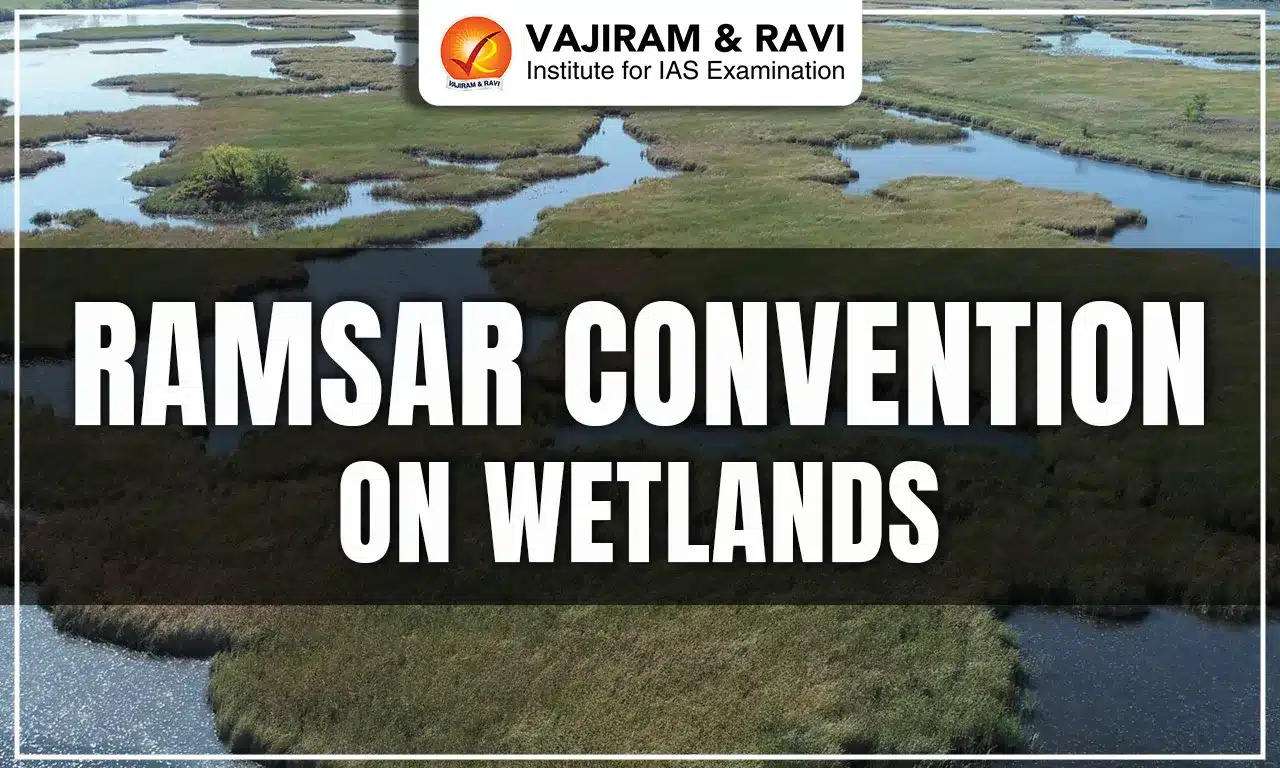

Ramsar Convention on Wetlands, History, Objectives, Pillars

Ramsar Convention on Wetlands

The Ramsar Convention on Wetlands, adopted in 1971, is a landmark international treaty dedicated to the conservation and sustainable use of wetlands. Wetlands are vital ecosystems that support biodiversity, regulate water cycles, and help mitigate climate change impacts. The Convention provides a global framework for identifying, designating, and managing wetlands of international importance.

Wetlands

Wetlands are among the planet’s most productive and ecologically rich environments, serving as cradles of biodiversity that sustain countless species of plants and animals. They provide essential ecosystem services critical to human survival, including freshwater supply, food, building materials, flood control, groundwater recharge, and climate change mitigation. Despite their importance, Wetlands face widespread degradation and conversion for other uses, threatening both biodiversity and human well-being. This urgent situation underscores the need for the wise use, management, and conservation of Wetlands globally.

Ramsar Convention on Wetlands

The Ramsar Convention on Wetlands is an intergovernmental treaty that sets the framework for both national action and international cooperation to conserve and ensure the wise use of wetlands and their resources. One of its strengths lies in its broad and inclusive definition of wetlands. 

Under Ramsar, Wetlands are not limited to swamps and marshes alone but extend to lakes, rivers, underground aquifers, peatlands, oases, estuaries, deltas, tidal flats, mangroves, and coral reefs. The definition even covers human-made ecosystems such as rice fields, reservoirs, salt pans, and fish ponds, recognizing their ecological and livelihood importance.

Ramsar Convention on Wetlands History

The Ramsar Convention, also known as the Convention on Wetlands, emerged in response to the growing global concern over wetland degradation and loss. During the 1960s, environmentalists and waterfowl conservationists recognized the urgent need for an international framework to safeguard these ecosystems. This led to the formal adoption of the Ramsar Convention on February 2, 1971, in the Iranian city of Ramsar, from which it derives its name.

The treaty came into force on December 21, 1975, marking a significant milestone in international environmental cooperation. Its initial focus was on protecting wetlands as vital habitats for waterfowl, but over time, the scope expanded to cover the broader ecological, economic, and cultural significance of wetland ecosystems. Today, with nearly 172 contracting parties, the Ramsar Convention stands as one of the most widely endorsed global agreements, reflecting its central role in biodiversity conservation and sustainable development.

Ramsar Convention on Wetlands Objectives

The Ramsar Convention sets out clear objectives to guide the conservation and sustainable use of wetlands worldwide. These include:

  • Protection and Management: Safeguard, restore, and ensure the wise use of wetlands to maintain their ecological character and long-term health.
  • International Cooperation: Promote collaboration between countries, particularly for transboundary wetlands, through sharing knowledge, resources, and best practices.
  • Biodiversity Conservation: Protect Wetland ecosystems as vital habitats for waterfowl, aquatic life, and countless other species, ensuring the survival of global biodiversity.
  • Climate Regulation: Strengthen wetland’s role in carbon sequestration, flood control, and water cycle regulation to enhance resilience against climate change.
  • Public Awareness: Promotes education and understanding about the ecological, cultural, and economic importance of wetlands for both people and nature.

Ramsar Convention Selection Criteria

Ramsar Sites are wetlands of international importance, identified under the Ramsar Convention for their ecological, cultural, and socio-economic value. The selection is based on well-defined criteria, ensuring the protection of globally significant wetland habitats and species. Key criteria include:

  • Unique Wetlands: Sites that represent rare or unique examples of natural or near-natural wetland ecosystems.
  • Biodiversity Value: Wetlands that support threatened, endangered, or critically endangered species and serve as vital habitats for their survival.
  • Waterfowl Populations: Areas that regularly support large numbers of waterfowl, especially during migration, breeding, or wintering seasons.
  • Species Life Cycle Support: Wetlands that provide refuge or critical support for plant and animal species at sensitive stages of their life cycle.
  • Fish and Aquatic Life: Sites essential for sustaining fish populations, including breeding, spawning, and nursery grounds that support livelihoods and ecosystems.

Ramsar Convention on Wetlands Pillars

The Ramsar Convention’s mission is “the conservation and wise use of all wetlands through local and national actions and international cooperation, as a contribution towards achieving sustainable development throughout the world.”

To achieve this, Contracting Parties commit to three key pillars:

  • Wise Use of Wetlands: Integrating wetlands into national policies, plans, and legislation while promoting sustainable management and public awareness.
  • Designation of Ramsar Sites: Identifying and protecting suitable wetlands under the “Ramsar List of Wetlands of International Importance” and ensuring their effective management.
  • International Cooperation: Collaborating on transboundary wetlands, shared species, and projects that impact wetlands across borders.

Beyond national commitments, many countries and donors support Ramsar’s mission by funding global wetland conservation projects. The Conference of the Parties (COP) provides a core budget every three years, administered by the Secretariat, with contributions proportionate to each nation’s share in the UN budget.

The Convention also works with five officially recognised International Organization Partners (IOPs), which provide expertise, technical guidance, and advocacy:

  • BirdLife International
  • International Union for Conservation of Nature (IUCN)
  • International Water Management Institute (IWMI)
  • Wetlands International
  • WWF International

Ramsar Sites in India

Ramsar Sites in India are Wetlands of international importance, recognised under the Ramsar Convention for their unique biodiversity and ecological significance. At present, India has 49 Ramsar Sites, spread across different states and ecological regions. Prominent examples include Chilika Lake in Odisha, Keoladeo National Park in Rajasthan, and the Sundarbans in West Bengal.

These sites serve as critical habitats for migratory birds, aquatic species, and diverse plant life, making them vital for the country’s ecological balance. Beyond biodiversity, Ramsar Sites provide ecosystem services such as flood regulation, groundwater recharge, and water purification. They also sustain local communities by supporting livelihoods through fishing, agriculture, and eco-tourism.

By conserving Ramsar Sites, India not only safeguards its natural heritage but also strengthens climate resilience and promotes sustainable development.

Ramsar Convention on Wetlands Importance

Ramsar Sites hold immense ecological, social, and economic significance. Their importance can be understood through the following points:

  • Protecting Biodiversity: These wetlands serve as critical habitats for migratory birds, fish, amphibians, and numerous plant species, safeguarding global biodiversity.
  • Supporting Ecosystems: Ramsar Sites provide essential ecological services such as water purification, flood regulation, and nutrient cycling, which help maintain ecosystem balance.
  • Mitigating Climate Change: Wetlands act as natural carbon sinks, regulating local climates and contributing to both climate change mitigation and adaptation.
  • Supporting Livelihoods: Local communities rely on Ramsar Sites for food, water, fishing, agriculture, and cultural practices, linking conservation with human well-being.
  • Promoting Ecotourism: Many Ramsar Sites are hotspots for eco-tourism, offering scenic landscapes and rich biodiversity that generate income and support conservation initiatives.

Montreux Record on Ramsar Sites

The Montreux Record is a register maintained under the Ramsar Convention, listing wetland sites where the ecological character has undergone, is undergoing, or is likely to undergo change due to factors such as technological development, pollution, or other human interference. It serves as a monitoring tool to identify and prioritize sites that need urgent conservation attention.

Currently, India has two wetlands included in the Montreux Record:

  • Keoladeo National Park (Rajasthan)
  • Loktak Lake (Manipur)

These inclusions highlight the need for focused conservation measures to restore and maintain the ecological balance of these fragile ecosystems.

Also Check Other Posts
Coastal Regulation Zone Global Plastic Treaty
Nitrogen Cycle Carbon Cycle

Ramsar Convention on Wetlands FAQs

Q1: What are wetlands according to Ramsar Convention?

Ans: Wetlands include marshes, peatlands, rivers, lakes, mangroves, coral reefs, and man-made sites like reservoirs, crucial for biodiversity, water regulation, and climate balance.

Q2: Where is the Ramsar Convention on Wetlands headquarters?

Ans: The Ramsar Convention Secretariat is headquartered in Gland, Switzerland, shared with IUCN offices.

Q3: In which year Ramsar Convention on Wetlands was adopted?

Ans: It was adopted in 1971 at Ramsar, Iran, and came into force in 1975.

Q4: What are the three pillars of the Ramsar Convention?

Ans: Wise use of all wetlands, List and conserve Ramsar sites, International cooperation on transboundary wetlands and species

Q5: Which is the first Ramsar Site in India?

Ans: Chilika Lake (Odisha) and Keoladeo National Park (Rajasthan) were the first Indian Ramsar sites, designated in 1981.

Transparency and Accountability, Mechanisms, Operationalisation, Challenges

Transparency and Accountability

Transparency and Accountability are core principles of good governance. They ensure that government functions remain open to public scrutiny and that decision-makers are held responsible for their actions. By incorporating trust, curbing corruption, and improving administrative efficiency, these principles strengthen the democratic process.

Transparency and Accountability in Governance

In a democracy, Transparency and Accountability form the foundation of fair and effective governance. Transparency ensures that citizens have access to information about government decisions and actions, while accountability makes public officials answerable for their conduct. Together, they strengthen trust between the state and the people, curb corruption, and enhance the efficiency of governance.

Transparency and Accountability Mechanisms

The table discusses the Transparency and Accountability Mechanisms which are adopted along with their purpose, establishment and core features providing an overview how these instruments function to make the government answerable to citizens and promote efficient, corruption-free administration.

Transparency and Accountability Mechanisms

Mechanism

Year/Establishment

Purpose

Key Features

Parliamentary Oversight

-

Ensure executive accountability and financial propriety

Question Hour, Cut Motions, Committees, Auditing of government expenditures

Central Vigilance Commission (CVC)

1964

Apex vigilance body to monitor government institutions

Advises on vigilance matters; lacks punitive authority; set up following Santhanam Committee recommendations

Comptroller and Auditor General (CAG)

-

Audit government expenditures and safeguard public resources

Audits alignment with approved purposes; exposed major scams like 2G Spectrum and Commonwealth Games

Social Audits

After 73rd Constitutional Amendment Act

Assess impact of government initiatives on communities

Community participation, fund utilization monitoring, strengthening grassroots democracy

E-Governance

-

Enhance transparency and efficiency in service delivery

Digital platforms like Bhoomi (Karnataka), E-Mitra (Rajasthan), Lokvani (UP); online access to public services; reduces bureaucratic inefficiencies

Transparency and Accountability Operationalisation

The effectiveness of Transparency and Accountability mechanisms depends on how well they are implemented in practice. Several initiatives highlight their operational success:

  • Right to Information (RTI): Empowers citizens to access information from public authorities, promoting transparency at all levels. RTI has been instrumental in ensuring accountability in programs such as MGNREGA.
  • Lokayuktas: Independent anti-corruption institutions, such as the Karnataka Lokayukta, have successfully exposed systemic corruption in sectors like mining and public works.
  • Voluntary Organisations: Civil society groups, including Parivartan in Delhi, have leveraged RTI to address citizen grievances, monitor government programs, and enhance service delivery.

Transparency and Accountability Challenges

Despite notable progress, implementing Transparency and Accountability mechanisms faces several challenges:

  • Political Will: Effective reforms require sustained commitment from leadership, which is sometimes lacking.
  • Administrative Resistance: Bureaucratic inertia and reluctance can undermine the enforcement of transparency measures.
  • Citizen Awareness: Limited understanding of tools like RTI and social audits reduces their impact and accessibility.
  • Technological Gaps: Uneven digital infrastructure and connectivity hinder the full potential of e-governance initiatives.

Suggested Measures for Strengthening Transparency and Accountability

To overcome these challenges and strengthen governance, several measures can be implemented:

  • Information Dissemination: Follow the 3R principle, Regular, Reliable, and Relevant dissemination of information to empower citizens with timely and accurate knowledge.
  • Community Mobilization: Involve Community-Based Organizations (CBOs) and NGOs to encourage grassroots participation in governance and accountability initiatives.
  • Capacity Building: Train public officials and citizens on the importance and 
  • functioning of accountability tools such as Gram Sabhas and the RTI Act.
  • Grievance Redressal: Establish efficient and timely mechanisms for addressing citizen complaints, promoting trust in governance systems.
  • Feedback Mechanisms: Institutionalize processes to gather and act upon feedback, ensuring continuous evaluation and improvement of governance practices.

Role of Civil Society and Media in Governance

Civil society and the media are pivotal in advancing transparency and accountability:

  • Civil Society Movements: Initiatives like Anna Hazare’s Lokpal movement demonstrate the power of collective action in pushing for accountability reforms and policy changes.
  • Media’s Role: Acting as a watchdog, the media ensures the free flow of information, exposes corruption, and fosters public debate, holding authorities accountable for their actions.
Also Check Other Posts
Civil Society FCRA
India's Ranking in Different Indexes 1st ARC Report

Transparency and Accountability FAQs

Q1: What is accountability and transparency?

Ans: Accountability is being answerable for actions; transparency is openness in decisions and processes, ensuring stakeholders can review, understand, and trust the system.

Q2: What is transparency and accountability in a relationship?

Ans: In relationships, transparency means honesty about intentions and actions, while accountability involves taking responsibility for mistakes and commitments, fostering trust and reliability.

Q3: What is transparency and accountability in financial management?

Ans: It ensures clear reporting, proper auditing, and responsible use of funds, reducing corruption, errors, and misuse in public or corporate finances.

Q4: What is the transparency and accountability process?

Ans: It involves monitoring, reporting, auditing, and evaluating actions to ensure openness, responsibility, and compliance with rules and standards.

Q5: What is meant by accountability?

Ans: Accountability is the obligation to justify actions, decisions, and outcomes, taking responsibility for successes and failures, especially in governance or organizations.

Indirect Tax, Meaning, Types, Features, Advantages & Disadvantages.

Indirect Tax

Indirect Taxes are an important part of a country’s Taxation System and Fiscal Policy. It is a major source of government revenue that helps regulate the economy. Money collected by these taxes helps fund important public services. In this article, we are going to cover Indirect taxes in detail, along with its meaning, types, features, advantages and related terms. 

Tax  

  • Taxes are compulsory payments made by individuals, businesses or corporations to the government at local, state and national level. 
  • It is the main source of government income, used to fund defence, healthcare, education and infrastructure like roads, highways and dams. 

Indirect Tax

  • Indirect Tax is the tax paid where the burden of the tax and the person who ultimately pays it are different. 
  • This tax is usually imposed on goods and services. 
  • While direct taxes are paid straight to the government, indirect taxes are not paid straight to the government by the taxpayer. It is collected by sellers and passed on to the government. 
  • In India, Indirect Taxes are managed by the Central Board of Indirect Taxes and Customs under the Ministry of Finance. 

Indirect Tax Features

Features of Indirect Taxes include: 

  • Tax on Consumption: This tax is levied on goods and services instead of the income of the person. 
  • Paid Indirectly: collected by intermediaries like sellers/service providers.
  • Regressive Nature: Indirect taxes affect rich and poor equally for the same product/service as both have to pay the same tax despite the income difference. 
  • Broad Base/; These taxes cover a wide range of goods and services.
  • Impacts Spending :  Indirect Taxes affect consumer behavior since tax is included in final prices.

Indirect Tax Types

Indirect Taxes are of the following types: 

  • Excise Duty
  • Customs Duty
  • Sales Tax
  • Service Tax
  • Goods and Services Tax (GST)
  • Octroi and Entry Tax
  • Toll Tax
  • Stamp Duty

Excise Duty

  • Excise Duty was a tax charged on goods for their production, licensing and sale in India. It was the charge that the manufacturers had to pay on certain goods they made.
  • While the manufacturer paid it at first, the tax was eventually collected from customers through higher prices by retailers and intermediaries. 
  • The tax was imposed by the Central Government and hence also known as Central Excise Duty or Central Value Added Tax (CENVAT). 
  • Excise Duties were also collected by the state government like on Alcohol and Narcotics. 
  • At present, almost all excise duties have been merged in Goods and Services Tax while some excise duties have been still kept independent. This include: 
    • Excise Duty on Liquor (charged by state government)
    • Excise duty on Petroleum Products (charged by Central Government)

Customs Duty

Custom Duty is charged on goods that are either imported or exported. This applies to all goods brought into India, and levied on only some goods that are exported that are mentioned in the Second Schedule of the Customs Tariff Act, 1975. This duty is levied and collected by the Central Government. The key objectives of Customs Duty are:

  • To stop illegal trade of goods.
  • To protect domestic industries.
  • To control imports and maintain a stable exchange rate.

Customs Duty Types in India

Some important types of Customs Duty charged in India are given below.

  • Basic Customs Duty

This is the duty charged on imported goods under the Customs Act, 1962.

  • Additional Customs Duty or Countervailing Duty (CVD)
    • This is an extra import duty charged on goods that receive benefits like subsidies or tax reliefs in their country of origin.
    • It is applied only on selected imported goods, not on all.
    • The Ministry of Finance decides its use based on the recommendation of the Director General of Trade Remedies (DGTR).
  • Anti-Dumping Duty
    • Dumping happens when goods are exported at prices lower than those charged in their home market.
    • This creates unfair competition and harms trade.
    • Anti-Dumping Duty is a tax imposed on such dumped goods to correct the imbalance.
    • It differs from Countervailing Duty in this way:
      • Countervailing Duty offsets the effect of subsidies.
      • Anti-Dumping Duty checks artificially low prices set to capture markets.
        The WTO allows Anti-Dumping Duty as a tool for fair trade.

Export Duty

Export Duty is a customs duty charged on goods leaving the country. Its main purpose is to limit the export of certain items.

Sales Tax

Sales Tax was an indirect tax on the purchase of goods and services.
It was charged at the point of sale, collected by retailers, and passed on to the government.

In India, both central and state governments collected sales tax:

State Sales Tax

Charged by state governments on sales happening within their boundaries.

Central Sales Tax (CST)

  • Applied to sales of goods between states.
  • It was levied by the central government to ensure smoother trade across states.Most Sales Taxes have now been merged into the Goods and Services Tax (GST).

Service Tax

Service Tax was a tax imposed by the Central Government on certain services provided or promised within India.
It was collected by service providers and then deposited with the Central Government.
Now, this tax has also been merged into the Goods and Services Tax (GST).

Goods and Services Tax (GST)

  • The Goods and Services Tax (GST) is an indirect tax charged on most goods and services consumed in India.
  • It works on the principle of Value Added Tax (VAT) and applies across the entire country.
  • Though paid by consumers, it is handed over to the government by the sellers.
  • GST was launched nationwide on 1st July 2017.
  • It has replaced multiple indirect taxes earlier levied by central and state governments.

Entry Tax and Octroi

  • Entry Tax was charged when goods entered a state or area from another state for sale, use, or consumption.
  • Octroi was a local tax collected on goods when they entered a municipal area for sale, use, or consumption.

Toll Tax

Toll Tax is a fee charged for using roads, bridges, tunnels, or similar infrastructure.
It helps cover the cost of building, maintaining, and running the infrastructure, ensuring users contribute to its expenses.

Stamp Duty

  • Stamp Duty is a tax charged by state governments on legal documents linked to property transactions.
  • It is named so because a stamp is affixed on the document as proof that the duty has been paid.

Indirect Tax Advantages

Implementation of Indirect Taxes have the following advantages: 

  • Indirect Taxes are easier to collect because they are collected at the point of sale or consumption. This reduces administrative costs and compliance burdens for both taxpayers and government. 
  • Taxes are included in prices of goods and services and hence cannot be skipped by the consumers. This helps decrease the evasions. 
  • Indirect taxes ensure revenue stability as it is not impacted by individual income levels and corporate profits. 
  • Promotes transparency in taxation systems as the prices are mentioned on the price tags. 

Indirect Tax Disadvantages 

Despite the advantages, indirect taxes have the following disadvantages as well: 

  • Indirect tax is charged equally on a product or service, no matter the income of the buyer. Hence, it affects poor people more. 
  • These taxes are often added into the prices of goods and services, which increases their cost for buyers. 
  • Indirect taxes can change consumer habits by making some goods and services costlier.
  • Sometimes, indirect taxes lead to a situation where tax is added on an amount that already has tax, thus increasing the overall burden on buyers.
  • Heavy indirect taxes make Indian goods more expensive, reducing their competitiveness in foreign markets. This ultimately harms exports.

Cascading Effect

  • The Cascading Effect happens when a tax is charged on an amount that already includes a previous tax.
    This causes a chain reaction where the tax burden grows at every step of production or sale.
  • Example includes Cotton Shirt Production:
  • First, a spinning mill owner buys cotton and pays sales tax on it.
    Purchasing cost = cotton price + sales tax on cotton.
  • The mill spins yarn and sells it to a weaver. The weaver then pays sales tax on the total value.
  • Purchasing cost = cotton price + sales tax on cotton + value added by spinner + sales tax on whole value.
  • Thus, the tax already paid also gets taxed again at every step until the final product. This is known as the Cascading Effect.

Principle of Value Added Tax or VAT Principle

  • The Value Added Tax (VAT) principle prevents the cascading effect by giving refunds to producers in the chain for taxes paid on inputs. This refunded tax is called Input Tax Credit.
  • Example: In the cotton case, the spinner gets back the sales tax already paid on cotton.
    So, the weaver pays tax only on the value added by the spinner, not on the whole amount.

Central Board of Indirect Taxes and Customs (CBIC)

The Central Board of Indirect Taxes and Customs (CBIC) is the top authority managing indirect taxes and customs duties in India. It works under the Department of Revenue in the Ministry of Finance. The CBIC frames and enforces policies for the collection of indirect taxes like GST, Central Excise duty, Customs duty, and Service Tax.

Also Check Other Posts
Care Economy Mutual Funds
Alternative Investment Funds - AIF GDP Deflator

Indirect Tax FAQs

Q1: What are indirect taxes?

Ans: Indirect taxes are taxes collected by intermediaries (like sellers) from consumers and paid to the government.

Q2: What is an example of an indirect tax?

Ans: Goods and Services Tax (GST) is the most common example of an indirect tax.

Q3: What are the 4 indirect taxes?

Ans: The four indirect taxes are GST, Customs Duty, Excise Duty, and Stamp Duty.

Q4: What is the cascading effect?

Ans: The cascading effect is when tax is levied on an amount that already includes tax, increasing the total burden.

Q5: What is excise duty?

Ans: Excise duty is a tax charged on the production and sale of certain goods within a country.

Atmospheric Circulation, Air Pressure, Types, Significance, Causes

Atmospheric Circulation

Atmospheric Circulation and Air Pressure form the backbone of Earth’s climate system. Powered by solar energy, they govern how heat and moisture move across the planet. High- and low-pressure systems, influenced by Earth’s rotation and the Coriolis effect, give rise to global wind belts, ocean currents, and shifting weather patterns. Together, these processes not only shape regional climates but also sustain ecosystems by maintaining the planet’s energy balance.

Atmospheric Circulation and Air Pressure

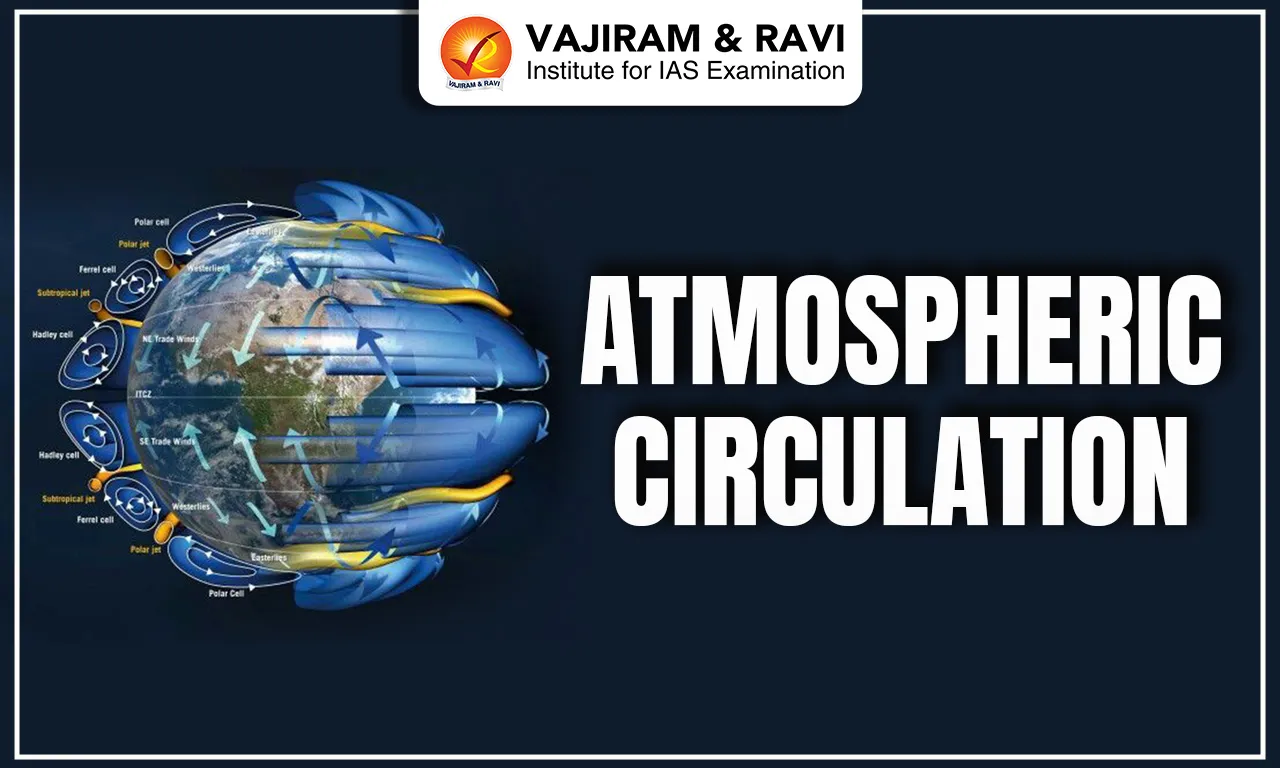
Atmospheric Circulation and Air Pressure are core drivers of Earth’s climate system, controlling how air moves across the planet. These processes begin with uneven solar heating, which creates temperature contrasts between the equator and the poles. Warm air rising near the equator forms low-pressure zones, while cooler, denser air sinking at the poles generates high-pressure zones.

This pressure gradient fuels global wind patterns that shape weather systems and influence ocean currents. In each hemisphere, circulation is organized into three key cells Hadley, Ferrel, and Polar that work together to redistribute heat and maintain climate balance. The Coriolis effect, caused by Earth’s rotation, bends these winds, giving rise to trade winds, westerlies, and polar easterlies.

Fluctuations in Air Pressure also underpin day-to-day weather. High-pressure systems usually bring clear, stable conditions, while low-pressure areas often trigger storms, rainfall, and atmospheric instability.

In essence, Atmospheric Circulation and Air Pressure link the atmosphere, oceans, and ecosystems in a dynamic cycle that sustains Earth’s climate.

Atmospheric Circulation Types

Atmospheric Circulation refers to the large-scale movement of air across the Earth, driven by unequal heating of the planet’s surface by the Sun. This circulation redistributes heat and moisture between the equator and the poles, maintaining the global energy balance. It operates at three levels: global, regional, and local, each playing a key role in shaping weather and climate patterns.

Atmospheric Circulation Types

Level

Type

Description

Key Impact

Global

Hadley Cell

Warm air rises at the equator, moves poleward aloft, sinks at ~30° latitude.

Creates trade winds, deserts in subtropics.


Ferrel Cell

Transitional zone (30°–60° latitude); surface winds move poleward, upper winds equatorward.

Produces westerlies, storm systems in mid-latitudes.


Polar Cell

Cold air sinks at poles, moves equatorward, meets westerlies at ~60°.

Forms polar easterlies, stormy polar fronts.

Regional

Monsoons

Seasonal reversal of winds due to land-sea heating contrasts.

Heavy summer rainfall in South Asia, Africa.


Jet Streams

Narrow, fast-moving winds at tropopause level.

Influence weather systems, monsoon onset.

Local

Land & Sea Breezes

Daily reversal of winds between land and sea.

Regulate coastal weather, moderate temperatures.


Mountain & Valley Breezes

Daytime upslope winds (valley breeze) and nighttime downslope winds (mountain breeze).

Affect microclimates in hilly regions.

Air Pressure Types

Air Pressure is the weight of the atmosphere exerted on the Earth’s surface. Variations in air pressure create different weather systems and drive Atmospheric Circulation. Pressure differences arise due to temperature variations, movement of air masses, and the Earth’s rotation. These systems influence local weather patterns as well as global climate.

Air Pressure Types

Type

Description

Weather Impact

High Pressure (Anticyclone)

Descending air compresses and warms, inhibiting cloud formation.

Clear skies, dry, and stable conditions.

Low Pressure (Cyclone)

Rising air expands and cools, leading to condensation and cloud formation.

Cloudy skies, precipitation, and storms.

Dynamic Pressure

Caused by movement of air masses due to Earth’s rotation and wind systems.

Influences trade winds, westerlies, and jet streams.

Thermal Pressure

Created by temperature differences altering air density (warm air rises, cold air sinks).

Responsible for equatorial low and polar high zones.

Atmospheric Circulation Significance

Atmospheric Circulation and Air Pressure are central to the functioning of Earth’s climate system. Their role goes beyond day-to-day weather and extends to regulating global climate stability.

  • Heat Distribution: They redistribute solar energy from the equator toward the poles, preventing extreme temperature differences and maintaining balance across latitudes.
  • Weather Formation: Pressure variations drive the movement of air masses, leading to rainfall, storms, cyclones, and periods of fair weather.
  • Ocean Currents: Winds influence major ocean currents, aiding in the transport of heat and nutrients vital for marine life.
  • Ecosystem Support: By shaping rainfall and temperature patterns, they sustain agriculture, forests, and biodiversity.
  • Global Wind Belts: Systems like trade winds and westerlies are products of circulation, guiding navigation and human activities.
  • Climate Regulation: Long-term circulation patterns determine climate zones, ensuring ecological balance on the planet.

Atmospheric Circulation Causes

The movement of air across the globe is driven by a set of interconnected natural factors. Major causes include:

  • Uneven Solar Heating: The Earth’s spherical shape leads to unequal heating, maximum at the equator and minimum at the poles creating strong temperature gradients.
  • Pressure Differences: Rising warm air forms low-pressure zones, while sinking cool air creates high-pressure zones. These differences initiate air circulation.
  • Earth’s Rotation (Coriolis Effect): The rotation of the Earth deflects moving air masses, giving rise to global wind systems such as trade winds, westerlies, and polar easterlies.
  • Differential Heating of Land and Water: Land responds faster to heating and cooling than oceans, producing local circulations like land-sea breezes and monsoons.
  • Altitude Variations: Air Pressure decreases with height, influencing vertical movements of air and the development of pressure systems.
  • Seasonal Changes: The axial tilt of the Earth alters solar heating patterns across seasons, shifting circulation systems and pressure belts.

Factors Affecting Atmospheric Circulation

Several interlinked factors control Atmospheric Circulation and Air Pressure, shaping global climate and regional weather. The major ones are:

  • Solar Radiation: Unequal heating between equator and poles creates temperature gradients that set large-scale convection currents in motion.
  • Earth’s Rotation (Coriolis Effect): The spinning of Earth deflects moving air, giving rise to trade winds, westerlies, and polar easterlies.
  • Pressure Gradients: Air always flows from high-pressure to low-pressure zones, establishing wind systems across scales.
  • Altitude: As elevation increases, air pressure decreases, influencing vertical circulation and cloud formation.
  • Land-Sea Contrast: Land heats and cools faster than oceans, producing local and regional systems like monsoons, land-sea breezes, and cyclones.
  • Topography: Mountains block, channel, or uplift winds, creating rain shadows and distinct microclimates.
  • Earth’s Tilt: Seasonal variation in solar energy due to axial tilt shifts global circulation belts like the ITCZ north and south.
  • Ocean Currents: Heat exchange between oceans and atmosphere redistributes energy, affecting pressure zones and circulation patterns.
Also Check Other Posts
Soils of India Western Disturbances
Geomorphology Coastal States of India

Atmospheric Circulation FAQs

Q1: What is the atmospheric circulation?

Ans: Atmospheric circulation is the large-scale movement of air that distributes heat and moisture across Earth, balancing energy between equator and poles.

Q2: What is atmospheric circulation (UPSC)?

Ans: In UPSC context, atmospheric circulation refers to global wind patterns—Hadley, Ferrel, Polar cells driven by solar heating, Earth’s rotation, and pressure differences.

Q3: What are the two main causes of atmospheric circulation?

Ans: Uneven solar heating of Earth’s surface and rotation of Earth (Coriolis effect) are the two main causes.

Q4: What is atmospheric circulation in GCSE?

Ans: In GCSE, atmospheric circulation is described as worldwide air movement creating cells (Hadley, Ferrel, Polar) and influencing climate zones.

Q5: What are the three types of atmospheric circulation called?

Ans: The three types are Hadley Cell, Ferrel Cell, and Polar Cell, forming the global circulation system.

Types of Rocks, Formation Process, Significance, Raw Material Obtained

Types of Rocks

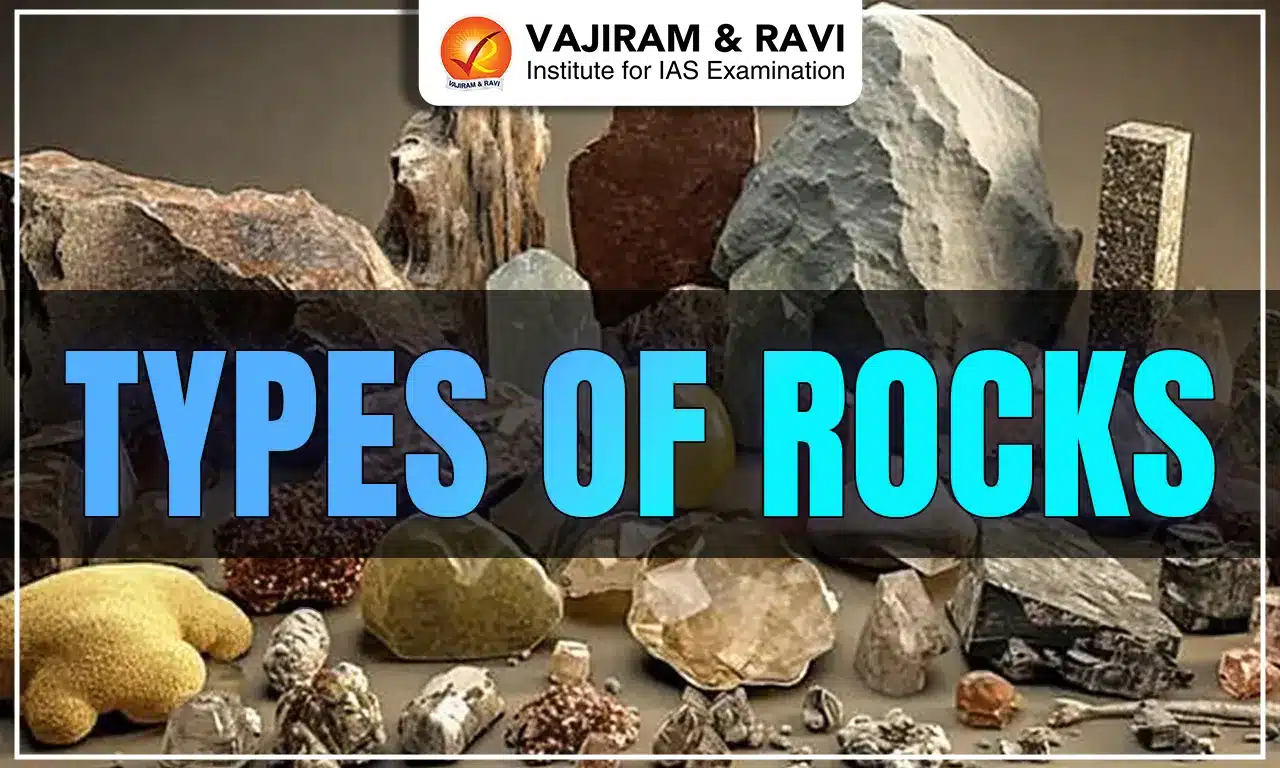
Rocks are naturally occurring solid substances made up of one or more minerals, and sometimes organic material. They form the very foundation of the Earth’s crust and are broadly classified into three Types of Rocks, igneous, sedimentary, and metamorphic. Beyond shaping landscapes and influencing ecosystems, rocks play a central role in human life, serving as raw materials for construction, energy resources, tools, and even cultural artifacts.

Rocks

Rocks are natural objects made up of minerals, organic matter, or a combination of both. They form the Earth’s crust and play a central role in shaping geological landscapes. Broadly, rocks are classified into three types: igneous, sedimentary, and metamorphic.

Igneous Rocks are formed when molten material cools and solidifies. Sedimentary Rocks are produced when sediments such as sand, clay, or organic matter accumulate and compress over long periods of time. Examples include sandstone and limestone.

Whereas Metamorphic Rocks arise when existing rocks undergo transformation under high temperature, pressure, or chemical processes. For instance, limestone changes into marble, and shale becomes slate.

Rocks are vital to geological processes. They not only provide essential resources like minerals and fossil fuels but also contribute to soil formation. Studying rocks helps us understand the Earth’s history and the dynamic forces that have shaped its surface over time.

Types of Rocks

Rocks are broadly classified into three categories based on their mode of formation: igneous, sedimentary, and metamorphic. Each Types of Rocks reflects different geological processes and carries unique features.

Types of Rocks

Type of Rock

Formation Process

Key Characteristics

Examples

Igneous

Solidification of molten material (magma or lava)

  • Texture depends on cooling rate (coarse or fine-grained)
  • Generally hard and crystalline

Granite, Basalt, Obsidian

Sedimentary

Accumulation, compaction, and cementation of sediments (sand, clay, organic matter)

  • Found in layers (strata) 
  • May contain fossils 
  • Softer compared to igneous

Limestone, Sandstone, Shale

Metamorphic

Transformation of existing rocks under heat, pressure, or chemically active fluids

  • Can be foliated (layered) or non-foliated 
  • New minerals may form
  • Denser and harder than parent rocks

Marble, Slate, Schist

Rocks Formation Process

Before we dive into the table, it helps to understand that rocks are not static; they are continuously formed, altered, and recycled through natural geological processes. Based on how they originate, all rocks on Earth are broadly classified into three groups, igneous, sedimentary, and metamorphic. Each type has its own unique formation process, subcategories, and examples. The table below provides a clear comparison of these three Rocks Formation Process, subtypes, and common examples.

Rocks Formation Process

Rock Type

Formation Process

Subtypes

Examples

Igneous

Cooling and solidification of molten rock (magma or lava)

  • Intrusive (Plutonic): Slow cooling of magma beneath Earth’s surface - large crystals 
  • Extrusive (Volcanic): Rapid cooling of lava on the surface - fine-grained/glassy texture

Granite, Diorite (Intrusive) Basalt, Pumice, Obsidian (Extrusive)

Sedimentary

Accumulation, compaction, and cementation of sediments or organic/chemical deposits

  • Clastic: From fragments of pre-existing rocks 
  • Chemical: From mineral precipitation/evaporation 
  • Organic: From remains of plants and animals

Sandstone, Shale (Clastic) Limestone, Rock Salt (Chemical) Coal, Chalk (Organic)

Metamorphic

Transformation of existing rocks under high temperature, pressure, or chemically active fluids

  • Foliated: Layered/banded structure due to mineral alignment 
  • Non-Foliated: No layering; homogenous composition

Schist, Slate (Foliated) Marble, Quartzite (Non-Foliated)

Rocks Significance

Rocks are active participants in shaping our planet and supporting human civilization. From forming the Earth’s crust to serving as vital resources, their importance is both practical and cultural. The Significance of Rocks are discussed below:

  • Formation of Earth’s Crust: Rocks constitute the very foundation of the Earth’s crust. They shape the surface through interactions that give rise to mountains, valleys, plateaus, and other landforms. Without them, the planet’s structure and landscape would not exist.
  • Natural Resources: 
    • Minerals: Rocks are the source of precious metals like gold, silver, copper, and iron, as well as non-metallic resources such as limestone and gypsum.
    • Fossil Fuels: Coal, petroleum, and natural gas are found in sedimentary rocks, powering industries, transportation, and homes.
    • Building Materials: Granite, sandstone, and limestone have long been used in construction, from roads to monuments.
  • Soil Formation: Through the process of weathering, rocks break down to form soil. This soil becomes the medium for plant growth, making it essential for agriculture and sustaining ecosystems.
  • Historical and Scientific Records: Rocks serve as time capsules of Earth’s past.
    • Fossils: Preserved remains of plants and animals in rocks reveal ancient life forms and past climates.
    • Stratigraphy: Layers of sedimentary rocks help scientists determine the relative age of Earth’s history and past geological events.
  • Environmental Protection: Some rocks directly support environmental balance. Volcanic rocks enrich the soil with minerals, boosting agriculture. Limestone absorbs carbon dioxide, helping regulate atmospheric carbon levels and the global carbon cycle.
  • Economic Significance: Entire industries depend on rocks, whether through mining, quarrying, or manufacturing. The raw materials extracted form the backbone of infrastructure, tools, and industrial machinery.
  • Aesthetic and Cultural Importance: Rocks also hold cultural and artistic value. Marble and sandstone have been used for centuries in sculptures, temples, and monuments. In modern times, they also enhance landscaping and design in parks and urban spaces.
  • Geothermal Energy: Certain rock formations in geothermal regions, such as basalt, enable us to harness geothermal energy, providing a clean and renewable source of power for the future.

Raw Materials Obtained from Rocks

Rocks are the foundation of countless industries because they supply the raw materials needed for energy, construction, technology, and daily life. Mining and quarrying are the two primary methods used to extract these resources. The Raw Materials Obtained from Rocks can be broadly grouped into different categories:

Minerals

  • Metallic Minerals
    • Iron Ore: Extracted from rocks such as hematite and magnetite, iron is the backbone of steel production.
    • Copper: Found in chalcopyrite and other ores, copper is essential for electrical wiring, plumbing, and construction.
    • Gold: Typically obtained from quartz veins and placer deposits, gold is valued in jewelry and also used in electronics.
    • Silver: Extracted from ores like argentite, silver has applications in jewelry, coinage, and electronic devices.
    • Aluminum: Produced from bauxite, a sedimentary rock, aluminum is prized for its lightweight strength in manufacturing.
  • Non-Metallic Minerals
    • Limestone: A key ingredient in cement production, also used in construction and agriculture.
    • Gypsum: Widely used to make plaster and drywall.
    • Salt: Obtained from evaporated rock salt deposits, it serves purposes ranging from food seasoning to de-icing.
    • Phosphate: Extracted from phosphate rock, it plays a central role in fertilizer production.

Fossil Fuels

  • Coal: Formed from plant remains within sedimentary rocks, coal is a traditional source of energy for electricity generation.
  • Oil and Natural Gas: These are trapped within porous rocks such as sandstone and limestone, and extracted through drilling. They power transportation and industry worldwide.
  • Shale Oil: A growing energy source, shale oil is released from shale rocks through hydraulic fracturing.

Construction Materials

  • Sandstone: A durable sedimentary rock used in buildings and concrete production.
  • Granite: An igneous rock known for its strength and beauty, often used in monuments, flooring, and countertops.
  • Marble: A metamorphic rock derived from limestone, prized for sculpture, flooring, and decorative use.
  • Limestone: Beyond cement production, it remains a staple building material in its natural form.

Industrial Minerals

  • Clay: Extracted from sedimentary rocks and used in ceramics, tiles, and bricks.
  • Talc: A soft mineral from metamorphic rocks, used in cosmetics, paper, and soap.
  • Asbestos: Once popular for insulation and roofing, asbestos is now restricted due to serious health risks.

Gemstones

  • Diamonds: Formed in kimberlite pipes, diamonds are both decorative and industrial, used in jewelry and cutting tools.
  • Sapphires, Rubies, Emeralds: Found in igneous and metamorphic rocks, these gemstones are valued for jewelry and ornaments.

Aggregates

  • Gravel, Sand, and Crushed Stone: Produced by weathering and crushing rocks such as granite, basalt, and limestone, these materials are indispensable for road building, concrete, and infrastructure projects.
Also Check Other Posts
Soils of India Western Disturbances
Geomorphology Coastal States of India

Types of Rocks FAQs

Q1: What are the 3 main types of rocks?

Ans: The three main types are igneous, sedimentary, and metamorphic, classified based on their formation process.

Q2: What is rock?

Ans: A rock is a naturally occurring solid composed of one or more minerals, forming Earth’s crust.

Q3: What are the examples of igneous, metamorphic, and sedimentary rocks?

Ans: Granite (igneous), marble (metamorphic), and sandstone (sedimentary) are common examples.

Q4: What are the 12 common rock-forming minerals?

Ans: Quartz, feldspar, mica, pyroxene, amphibole, olivine, calcite, dolomite, gypsum, halite, clay minerals, and magnetite.

Q5: What is the most common type of rock?

Ans: Igneous rocks, especially basalt, are the most common, forming most of Earth’s crust.

Indigenization of Technology, Meaning, Importance and Prospects

Indigenization of Technology

Technological indigenisation is the creation, application and advancement of local skills, resources and expertise with a focus on designing, manufacturing and maintaining technological solutions within the boundaries of a country. It mainly focuses on self-reliance, minimising dependency on external technological imports and encouraging innovations tailored to domestic requirements as well as cultural contexts. In this article, we are going to cover the topic of Indigenization of Technology.

Indigenisation of Technology 

The use of one's own country's technologies forms an important part of a country’s heritage. Indigenisation of technology means having the ability to design, develop, and produce tools or equipment within the nation by using the available skills and materials. True self-reliance comes when people can also repair and maintain not only homegrown but also foreign-made machines without outside help. This level of self-sufficiency ensures that the country can meet its needs from within.The term does not just mean copying a product using foreign blueprints. It means the local industry should understand the science behind a product, improve it when needed, and make it better suited for new requirements. This shift makes a country not just a user but also a creator of technology.

Indigenization of Technology Knowledge and Innovations

Indigenization of Technology knowledge is the wisdom and experience of local communities, built up over hundreds of years and adapted to their culture and environment. This knowledge is very important for remote and rural societies because it helps them survive, farm, heal, and educate themselves. It is also a base for their cultural identity. But modernisation, colonisation, and the world’s lack of value for traditional systems are causing much of this knowledge to fade away. Saving and improving this knowledge, while combining it with modern science, can lead to powerful and sustainable innovations. This not only benefits local communities but also offers solutions for global issues.

Indigenisation of Technology Importance and Prospects

Indigenisation of Technology is important both economically and strategically. Economically, it cuts costs because products can be repaired and maintained locally for years. Strategically, it is even more important in areas like defence, where having a local supply base provides safety and quick access Local manufacturers also have the benefit of upgrading products regularly with newer technology from their own research. Programmes such as Make in India aim to grow India’s industries, attract investment, and build local strength in sensitive areas like defence.

India’s achievements include:

  • The Indian Air Force has made a roadmap till 2025 to adopt new technologies and weapon systems.
  • The BrahMos missile, built with Russia, is one of the fastest cruise missiles in the world.
  • INS Vikrant, the first indigenous aircraft carrier, is a major step in naval self-reliance.
  • The Agni-5 missile gave India a place in the select group of nations with intercontinental missiles.
  • ISRO’s Mars Orbiter Mission proved India’s strength by succeeding on its first attempt at a very low cost.
  • These examples show that indigenisation is not just useful but necessary for India’s progress and global standing.

National Innovation Foundation (NIF)

The National Innovation Foundation (NIF) was set up in March 2000, inspired by the Honey Bee Network, to encourage grassroots innovations and traditional knowledge in India. The goal is to create a knowledge-driven society by giving recognition, support, and opportunities to local innovators. Till now, NIF has collected more than 225,000 ideas and practices from over 585 districts, showing the creativity present all over the country.

It has honoured over 800 innovators through national awards, including the Dr. A.P.J. Abdul Kalam Ignite Awards for children. NIF has also built a Fab Lab with MIT and supported herbal technology labs at SRISTI. Its Grassroots to Global model promotes local innovations worldwide, proving that small community-driven ideas can solve big problems in sustainable ways.

Technology Information, Forecasting and Assessment Council (TIFAC)

Technology Information, Forecasting and Assessment Council (TIFAC) was set up in 1988 under the Department of Science and Technology, based on the recommendation of the Technology Policy Implementation Committee. Its goal was to study existing technology, predict future needs, and suggest the right path for India’s growth in key areas.

It works as a knowledge network, filling important gaps in India’s science and technology system. TIFAC has conducted foresight exercises, promoted new technologies, prepared business opportunity reports, and carried out mission-mode projects that directly support development.

India Technology Vision 2020

In 1998, Dr. A.P.J Abdul Kalam proposed Technology Vision 2020 with the aim of making India a developed country through science and technology within 20 years.

The vision focused on food security, higher farm yields, and sustainable practices in states like Bihar and Uttar Pradesh. It also talked about the importance of education and literacy as the foundation for development.

Mission REACH was launched to build Centres of Relevance and Excellence (CORE) with partnerships between universities and industries. The vision also focused on improving health facilities, better diagnostics for diseases, and using ICT to create an information society.

Nine institutions were linked through CORE to improve manpower and provide knowledge for industry and society.

Technology Vision 2035

TIFAC later prepared Technology Vision 2035 to ensure that India becomes technologically strong by 2035.

It identifies twelve major sectors that need focus, such as agriculture, healthcare, water, energy, and ICT. It suggests roadmaps for achieving goals like nutritional security, clean water, better education, and decentralised energy.

It also points out new issues, like ethical challenges caused by the mixing of nanotechnology, IT, biology, and cognitive sciences. Still, the vision represents the hopes of people and promises prosperity, security, and dignity for every Indian through technology.

Classification of Technology

The Technology of India can be classified into the following types:

  1. Technology Leadership: Areas where India is strong (like nuclear energy).
  2. Technology Independence: Areas where local development is needed (like defence).
  3. Technology Innovation: Using breakthroughs to make new solutions (like solar power).
  4. Technology Adoption: Changing imported technology to suit Indian needs (like rainwater harvesting).
  5. Technology Constraints: Risky or harmful technologies (like GM crops).
  6. Technology Dependence: Technologies that still rely on imports but need localisation.

Indigenisation of Technology Call to Action

To succeed in indigenisation, India needs to:

  • Improve technical education and training.
  • Increase government funding for research and innovation.
  • Involve the private sector in new projects.
  • Strengthen partnerships between industry, research, and universities.
Also Check Other Posts
Science and Technology in Ancient India Famous Chemistry Scientists of India and Their Contributions
Women in Science Information and Communication Technology

Indigenisation of Technology  FAQs

Q1: What is the meaning of indigenization of technology?

Ans: Indigenization of technology means developing, producing, and maintaining technologies within a country using its own resources and skills.

Q2: What is the meaning of indigenous technology?

Ans: Indigenous technology refers to traditional or locally developed knowledge, skills, and practices adapted to a community’s environment and culture.

Q3: What are the benefits of indigenization of technology?

Ans: It promotes self-reliance, reduces foreign dependence, lowers costs, boosts innovation, and strengthens national security.

Q4: What is indigenous technology example in India?

Ans: Examples include ISRO’s Mars Orbiter Mission, Agni-5 missile, and the indigenous aircraft carrier INS Vikrant.

Q5: What is Technology Vision 2035?

Ans: Technology Vision 2035 is a TIFAC roadmap aiming to make India technologically self-reliant by 2035 in key areas like agriculture, health, energy, water, and ICT.

UPSC Daily Quiz 11 September 2025

UPSC Daily Quiz

The Daily UPSC Quiz by Vajiram & Ravi is a thoughtfully curated initiative designed to support UPSC aspirants in strengthening their current affairs knowledge and core conceptual understanding. Aligned with the UPSC Syllabus 2025, this daily quiz serves as a revision resource, helping candidates assess their preparation, revise key topics, and stay updated with relevant issues. Whether you are preparing for Prelims or sharpening your revision for Mains, consistent practice with these Daily UPSC Quiz can significantly enhance accuracy, speed, and confidence in solving exam-level questions.

[WpProQuiz 67]

UPSC Daily Quiz FAQs

Q1: What is the Daily UPSC Quiz?

Ans: The Daily UPSC Quiz is a set of practice questions based on current affairs, static subjects, and PYQs that help aspirants enhance retention and test conceptual clarity regularly.

Q2: How is the Daily Quiz useful for UPSC preparation?

Ans: Daily quizzes support learning, help in revision, improve time management, and boost accuracy for both UPSC Prelims and Mains through consistent practice.

Q3: Are the quiz questions based on the UPSC syllabus?

Ans: Yes, all questions are aligned with the UPSC Syllabus 2025, covering key areas like Polity, Economy, Environment, History, Geography, and Current Affairs.

Q4: Are solutions and explanations provided with the quiz?

Ans: Yes, each quiz includes detailed explanations and source references to enhance conceptual understanding and enable self-assessment.

Q5: Is the Daily UPSC Quiz suitable for both Prelims and Mains?

Ans: Primarily focused on Prelims (MCQ format), but it also indirectly helps in Mains by strengthening subject knowledge and factual clarity.

Guild System in Ancient India, Origin, Types, Importance

The Guild System in Ancient India

The Guild System in ancient India was an organised association of traders and craftsmen that regulated economic activity and craftsmanship across regions. Its importance lies in its contributions to economic organisation, social welfare, political authority, and cultural enrichment. In this article, we are going to cover the origins, role and impacts of guilds. 

Guild System

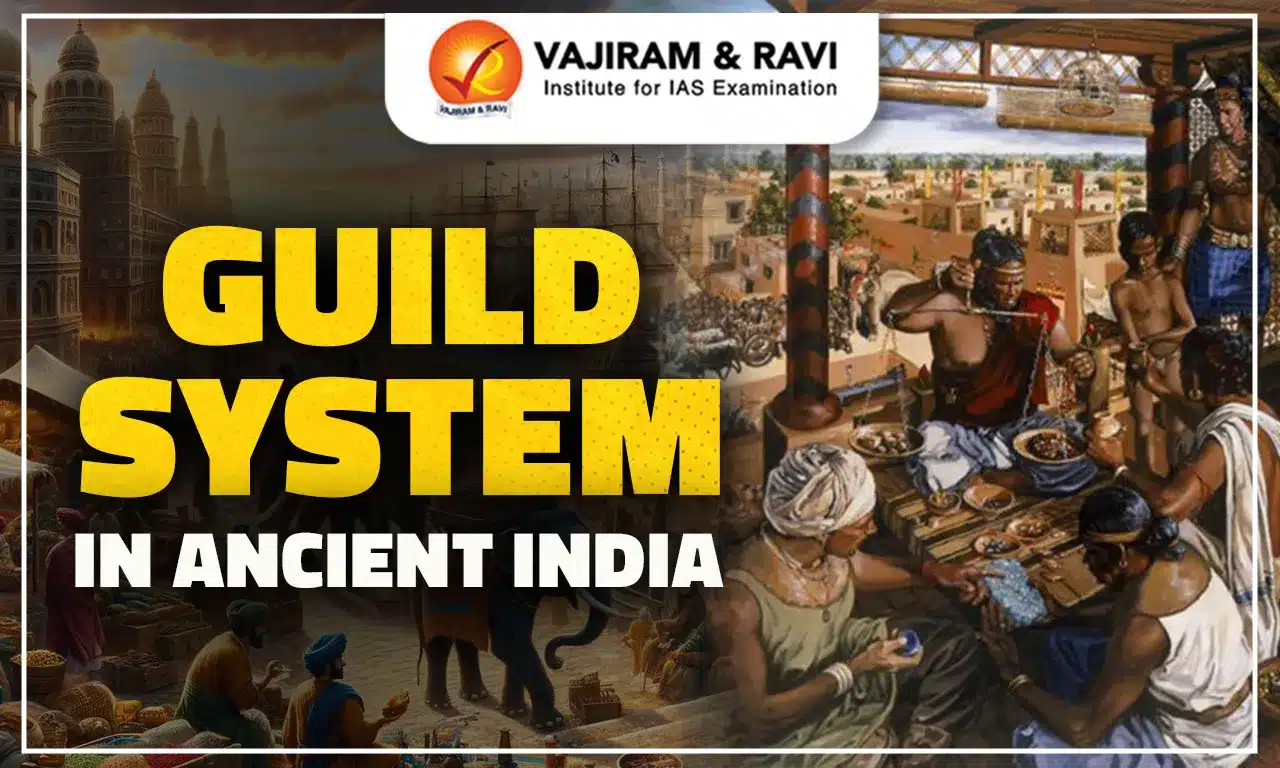
A guild is a collective of merchants or artisans supervising the practice of a craft within a defined area. In ancient India, the guild system (called “Shreni” or “Gana”) represented a vital socio-economic institution that coordinated different trades and skills.  These guilds brought together craftsmen, merchants, and professionals to manage their industries collectively.

Guild System Origin in Ancient India

The start of the guild system in India can be traced back to ancient times when socio-economic life started to become more organised. Guilds evolved gradually across different historical phases:

  • Vedic Period (1500–500 BCE): References in the Rigveda and later texts suggest the presence of organised groups of craftsmen such as weavers, carpenters, and metal workers. Although informal, these groups ensured cooperation, division of labour, and exchange of goods. The seeds of the guild system lay in this early collective organisation.
  • Mauryan Period (322–185 BCE): Under the Mauryan Empire, guilds transformed into formal institutions. They were registered with the state, paid taxes, and participated in administration. Kautilya’s Arthashastra vividly describes their regulation of trade, fixation of prices, supervision of weights and measures, and even their judicial powers in disputes. Guilds became pivotal intermediaries between the state and the economy.
  • Post-Mauryan Period: With the decline of Mauryan central authority, guilds acquired increasing autonomy. They became custodians of local trade, sometimes commanding their militias to protect caravans and trade routes. Inscriptions mention guilds granting donations to temples, constructing infrastructure, and maintaining town life.
  • Gupta Period (320–550 CE): This era marked the zenith of guild activity. Guilds not only regulated trade and crafts but also emerged as wealthy corporate bodies with banks, endowments, and political influence. They issued coins, maintained seals, and acted as financial institutions. Their autonomy and wealth made them vital agents in the cultural and economic flowering of the Gupta age.

Guild System Types in Ancient India

The guilds in ancient India were highly diverse, reflecting the range of professions and trades that flourished in society. Broadly, they can be divided into the following categories:

  • Merchant Guilds: These were the most influential, comprising traders engaged in both inland and overseas commerce. Merchant guilds such as the Shrenis of the Deccan or the South Indian guild Manigramam regulated long-distance trade, established trade networks across Asia, ensured safe passage of caravans, and negotiated privileges with rulers. They controlled marketplaces, enforced quality, and had the financial clout to donate to temples or fund urban development.
  • Craft Guilds: These were organised around particular trades like weaving, metalworking, carpentry, pottery, ivory carving, or jewellery-making. They set strict production standards, trained apprentices, and protected craft secrets. The rise of Indian textiles, metallurgy, and fine arts owes much to the organisational strength of these guilds, which promoted both skill and innovations.
  • Professional Guilds: These included groups of scholars, physicians, teachers, and other professionals bound by common ethical standards. They helped regulate intellectual and service-based professions, creating a sense of accountability and prestige. For example, physician guilds maintained codes of conduct and training, while scholarly guilds supported the transmission of learning.
  • Regional and Religious Guilds: In addition to occupational divisions, some guilds were regionally based, protecting the interests of traders or craftsmen in a particular locality. Many were also religiously oriented, patronising temples and monasteries, which in turn reinforced their social prestige and moral authority.

Guilds System Functions in Ancient India

  • Regulating Trade: Guilds framed codes of conduct, set fair prices, and managed markets and routes, sustaining commerce.
  • Quality Assurance: They ensured production met defined standards before reaching buyers.
  • Market Oversight: Guilds supervised trade centres, routes, and at times currency, influencing economic stability.
  • Mutual Aid: Members received financial and social help during illness, funerals, or emergencies.
  • Welfare Activities: Guilds cared for dependents, offered training, and supported widows and orphans.
  • Governance Role: They advised rulers, shaped local policies, and occasionally held administrative positions.
  • Autonomy: Guilds managed internal laws, elections, and rules, with royal recognition of their self-governing status.

Guild System in Ancient India Importance

Guild System in Ancient India has the following importance:

  • Economic Role: By regulating markets and quality, guilds fostered stability and fair trade practices.
  • Social Contribution: They provided security nets, strengthened community bonds, and ensured collective welfare.
  • Political Power: Guilds influenced governance through wealth and organisation, often impacting regional policies.
  • Self-Governance: Operating independently, guilds represented unique autonomous institutions in Indian polity.
  • Cultural Growth: They nurtured craftsmanship, encouraged innovation, and contributed to regional arts and industries like textiles and metallurgy.

Guild System in Ancient India FAQs

Q1: What was the guild system?

Ans: The guild system was an organised association of artisans and merchants in ancient India that regulated trade, crafts, and professions.

Q2: What were the three levels of the guild system?

Ans: The three levels were apprentice, journeyman, and master, representing stages of skill and responsibility.

Q3: What were guilds also known as?

Ans: Guilds in ancient India were also known as Shreni or Gana.

Q4: When did the guild system in ancient India originate?

Ans: The guild system originated during the Vedic period (1500–500 BCE) and developed further under the Mauryas and Guptas.

Q5: Who are merchant guilds?

Ans: Merchant guilds were powerful associations of traders who controlled commerce, managed markets, and expanded long-distance trade.

Soil Degradation, Types, Causes, Effects, Conservation Methods

Soil Degradation

Soil Degradation is the decline in the quality, fertility and productivity of soil because of physical, chemical and biological processes, caused by human activities and natural factors. Soils are important assets that provide the base for all terrestrial ecosystems, making the control of soil degradation important for human survival. In this article, we are going to cover soil degradation, its types, effects and conservation efforts. 

Soil Degradation 

Soil Degradation means the decline in the soil health like its quality, fertility and productivity due to physical, chemical and biological processes. Soil degradation can be biological, chemical and physical. Currently, about 33% of the world’s soils are severely degraded. About 40% of these degraded soils are in Africa, with remaining concentrated in areas plagued by poverty and hunger. This degradation of soil is linked with food production and nutrition and in order to control this degradation, it is important to adopt localised strategies to reverse degradation, boost agricultural output and fight hunger specially in climate-vulnerable areas. 

Soil Degradation can be seen at the physical, chemical and biological level of soils. Examples include declining fertility, loss of organic content, poor structure, erosion from wind or water, salinity shifts from irrigation or urban activities, rising acidity or alkalinity, compaction, sealing of the surface, landslides and contamination from pollutants and toxic substances. 

Soil Degradation Types

Soil Degradation happens due to multiple processes. These types include: 

  • Water Erosion: Activities like sheet erosion, rill, or gully erosion result in a heavy water runoff of soil along with the water. 
  • Wind erosion leads to the erosion of soil when soil particles are displaced by air currents. 
  • Salinity develops through salt accumulation in arid lands, high irrigation or urban processes. Due to this the decline of organic matter reduces fertility and water retention. 
  • Soil acidity and alkalinity imbalances become a restriction in the growth of crops. 
  • Structural degradation through compaction affects water flow and root penetration. 
  • The top soil gets replaced by gravity driven movement. Soil contamination from chemicals undermines ecosystems and endangers human health. 

Soil Degradation Causes

Soil Degradation is caused due to many many factors:

  • Physical Causes: Rainfall, flooding, runoff, wind erosion, tillage, and slope movements strip away fertile topsoil.
  • Biological Causes: Human and plant-related activities, microbial imbalance, and poor farming practices reduce productivity.
  • Chemical Causes: Alkalinity, acidity, waterlogging, and nutrient depletion alter soil chemistry, weakening its fertility.
  • Deforestation: Tree removal disrupts soil stability, binding capacity, and fertility, heightening erosion risks.
  • Excess Fertilizers & Pesticides: Overuse disrupts soil organisms, destroys minerals, and creates toxic buildup.
  • Mining & Industry: These strip crop cover, pollute soil, and alter its structure, chemistry, and biology.
  • Faulty Cultivation: Deep plowing, mono-cropping, and irrigation mismanagement reduce fertility and regeneration.
  • Urbanization: Construction causes compaction, altered drainage, erosion, and pollutant-laden runoff.
  • Overgrazing: Livestock pressure erodes topsoil, removes vegetation, and reduces crop productivity.

Soil Degradation Effects

Soil Degradation affects the environment and human health in many ways: 

  • Land Degradation: Fertile soil loss makes 40% of agricultural land severely degraded.
  • Desertification: Overgrazing, deforestation, and poor tillage drive aridity, drought, and biodiversity loss.
  • Loss of Arable Land: Topsoil erosion leaves productive land barren, threatening food security.
  • Increased Flooding: Soil’s diminished water-holding capacity causes higher runoff and flood frequency.
  • Waterway Pollution: Sediments, fertilizers, and pesticides clog rivers, damage aquatic ecosystems, and reduce usable water.

Soil Degradation Conservation Methods

Soil Degradation can be controlled by adopting the following strategies:

  • Curbing Deforestation: Encourage afforestation, forest protection, and sustainable forestry.
  • Land Reclamation: Restore organic matter, manage rangelands, and rehabilitate salinized soils.
  • Preventing Salinization: Use salt-tolerant crops, efficient irrigation, and reduced waterlogging.
  • Conservation Tillage: Limit deep plowing, retain crop residues, and reduce structural damage.
  • Agroforestry: Integrate crops with trees and hedges to prevent erosion, enhance biodiversity, and stabilize soils.
  • Permaculture: Adopt sustainable farming by creating interdependent systems, avoiding harmful chemicals, and recycling nutrients.
Also Check Other Posts
Soils of India Western Disturbances
Geomorphology Coastal States of India

Soil Degradation FAQs

Q1: What is meant by soil degradation?

Ans: Soil degradation is the decline in soil quality, fertility, and productivity due to physical, chemical, and biological factors.

Q2: What are the 4 causes of soil degradation?

Ans: Deforestation, overgrazing, improper agricultural practices, and industrial or mining activities.

Q3: How to control soil degradation?

Ans: Soil Degradation can be controlled by adopting afforestation, conservation tillage, proper irrigation, and sustainable land management practices.

Q4: What are the types of soil degradation?

Ans: Physical, chemical, biological degradation, along with erosion by water and wind.

Q5: What is wind erosion?

Ans: Wind erosion is the removal and transport of the top layer of soil particles by strong winds.

Jute Industry in India, Production, Cultivation, Distribution

The Jute Industry in India

The Jute Industry in India is one of the most valuable industries as this fibre crop is known for its wide range of applications and its economic value. The crop is used in producing gunny bags, ropes, carpets, rugs and tarpaulins and is highly in demand due to its affordability, softness and durability. In this article, we are going to cover the Jute crop, its growth conditions, production and distribution in India. 

Jute Crop

The Jute crop is the second most important fibre crop in India after cotton. It is used in multiple ways like for making ropes, gunny bags, rugs, carpets, tarpaulins and many other products. The demand has traditionally been strong due to its low price, softness and strength. However, the arrival of synthetic substitutes has highly impacted its demand.  Jute continues to remain an important part of India’s agricultural economy and rural livelihood, despite facing stiff competition from synthetics. Its role as a revenue generator, employment provider, and export earner highlights its enduring relevance. 

Jute Conditions for Growth 

  • Jute is grown in a hot (24°C–35°C) and humid climate, with annual rainfall of 120–150 cm and relative humidity of 80–90%.
  • Requires abundant water. Sowing and nursery raising are usually done in the pre-monsoon months, with rainfall ranging between 25–55 cm.
  • This timing helps maximise the benefits of the monsoon rains.

Jute Cultivation in India

The ideal Jute Cultivation conditions include: 

  • Generally sown in February and harvested in October; the crop matures in 8–10 months.
  • Best suited to fertile alluvial soils, especially light sandy or clayey loams.
  • Rapidly exhausts soil fertility, like cotton, making annual replenishment through silt-laden floods necessary.

Jute Production in India

  • After Partition, nearly 75% of jute-growing areas went to Bangladesh, while most mills remained in India.
  • Between 1950-1980, the area under cultivation, production, and yield rose significantly.
  • From 1981 onwards, declining trends have been observed due to erratic weather, expansion of rice farming, and synthetic fibre competition.
  • India still leads globally, contributing about 56% of world jute output, followed by Bangladesh with 25%.

Jute Distribution in India

Over 99% of India’s jute is produced in five states including West Bengal, Bihar, Assam, Odisha, and Andhra Pradesh.

  • West Bengal (81% share): favourable climate, fertile alluvial soil, dense labour availability, and the Hugli industrial belt with numerous mills.
  • Bihar (8.67%)
  • Assam (7.78%)
  • Odisha and Andhra Pradesh (delta regions are important contributors).

Jute Trade in India 

Jute is an important crop in terms of both imports and exports of the country:

  • Imports raw jute from Bangladesh to feed domestic mills, as internal production is insufficient.
  • Exports processed products like hessian cloth, bags, carpets, and ropes, boosting its international market reach.
  • Export surpluses in processed items help balance raw jute imports, strengthening foreign exchange earnings.

Jute Development and Promotion Industry

Jute crop plays an important role in the economy of eastern India, especially West Bengal.

  • India is the world’s largest producer of both raw jute and jute goods.
  • The National Jute Policy has been extremely important in modernisation, technology upgradation, and improving competitiveness.
  • Rising awareness of eco-friendly products has accelerated the demand for biodegradable jute goods such as carry bags and packaging.

Jute Crop Economic Importance

  • An important revenue-generating crop, Jute strengthens agricultural GDP and serves as a major cash crop.
  • The crop supports allied industries producing bags, ropes, rugs, and tarpaulins, thus stimulating rural economies.
  • Export value of jute products contributes positively to trade balances.
  • Provides extensive employment to farmers, labourers, and industrial workers across the jute belt.
  • Acts as a stable source of income for millions of farmers, improving rural standards of living.

National Jute Board (NJB)

  • The National Jute Board was set up as an Act in 2008, as an apex body that was responsible for overseeing jute development. 
  • The organisation operates under the Ministry of Textiles and manages competitiveness through schemes on productivity, market expansion and innovation. 
  • The board promotes eco-friendly products and particularly biodegradable jute items, aligning jute industry with global sustainability trends.
Also Check Other Posts
Soils of India Western Disturbances
Geomorphology Coastal States of India

The Jute Industry in India FAQs

Q1: Which is the largest jute industry in India?

Ans: The largest jute industry in India is concentrated in West Bengal, particularly around the Hugli River basin.

Q2: Who started the first jute industry in India?

Ans: The first jute mill in India was started in 1855 by George Acland at Rishra near Kolkata.

Q3: What is the problem of jute industry in India?

Ans: The main problems are competition from synthetic fibres, raw jute shortage, obsolete machinery, and fluctuating demand.

Q4: Which Indian state has the highest jute production?

Ans: West Bengal is the leading jute-producing state, contributing over 80% of India’s output.

Q5: What is the ideal temperature to grow jute?

Ans: The ideal temperature for jute cultivation is 24°C to 35°C in hot and humid conditions.

JAM Trinity (Jan Dhan-Aadhaar-Mobile), Features, Objectives, Significance

JAM Trinity

The JAM Trinity, Jan Dhan, Aadhaar, and Mobile represents a key initiative of the Indian government aimed at achieving financial inclusion and efficient governance. This integration has revolutionized the delivery of subsidies, welfare schemes, and other financial services by making them more direct, transparent, and efficient. It has minimized leakages, reduced middlemen, and strengthened the government’s vision of inclusive growth.

JAM Trinity

The JAM Trinity is a landmark initiative of the Government of India designed to advance financial inclusion and improve the delivery of subsidies and welfare benefits.

  • Jan Dhan Yojana ensures universal access to bank accounts, bringing the unbanked population into the formal financial system.
  • Aadhaar, the world’s largest biometric identification system, provides each citizen with a unique identity, enabling targeted and transparent delivery of services.
  • Mobile connectivity acts as the technological backbone, linking beneficiaries to banking and digital platforms in real time.

By integrating these three pillars, the JAM framework removes intermediaries, reduces leakages, and enhances accountability. Linking bank accounts with Aadhaar and mobile numbers has enabled direct benefit transfers (DBT) of subsidies such as LPG, pensions, and scholarships.

Beyond efficient welfare delivery, the JAM Trinity has also empowered marginalized groups, promoted digital payments, and accelerated India’s transition toward a less-cash economy, contributing to inclusive growth and poverty reduction.

JAM Trinity Features

The JAM Trinity is a transformative framework introduced by the Government of India to strengthen financial inclusion, enhance transparency, and improve efficiency in the delivery of public services. It integrates three critical components, Jan Dhan bank accounts, Aadhaar biometric identification, and mobile connectivity to create a unified platform for welfare delivery and financial empowerment.

  • Financial Inclusion: Through the Pradhan Mantri Jan Dhan Yojana (PMJDY), millions of previously unbanked individuals gained access to zero-balance bank accounts with facilities like overdraft, micro-credit, insurance, and pensions.
  • Aadhaar-Based Authentication: Aadhaar acts as a unique biometric identifier, ensuring accurate targeting of beneficiaries. Its authentication mechanism reduces duplication, ghost beneficiaries, and fraud in welfare schemes.
  • Direct Benefit Transfers (DBT): JAM enables subsidies and welfare benefits (LPG, pensions, MNREGA wages, etc.) to be transferred directly into beneficiaries’ bank accounts, cutting out intermediaries and minimizing leakages.
  • Mobile Connectivity: The rapid spread of mobile phones has strengthened access to financial services and government schemes, even in remote areas. Services like mobile banking and SMS alerts promote transparency and digital literacy.
  • Cost Efficiency and Transparency: Digitized transactions lower administrative costs and strengthen accountability in public expenditure.
  • Empowering the Underserved: By expanding financial access and ensuring targeted delivery of welfare, JAM empowers marginalized communities and integrates them into the formal economy.

JAM Trinity Objectives

  • Financial Inclusion: By linking Jan Dhan accounts with Aadhaar and mobile numbers, JAM ensures universal access to basic financial services such as savings, credit, insurance, and pensions, particularly in rural and underserved areas.
  • Direct Benefit Transfer (DBT): Subsidies, pensions, and welfare benefits are transferred directly into beneficiaries’ bank accounts, cutting out intermediaries and reducing leakages.
  • Transparency and Accountability: Aadhaar-based biometric verification prevents duplication, ghost beneficiaries, and corruption, ensuring that resources reach the intended recipients.
  • Efficiency in Governance: The use of digital platforms improves service delivery, reduces administrative delays, and lowers costs of implementing welfare programs.
  • Economic Empowerment: By enabling secure and accessible digital transactions, JAM integrates citizens into the digital economy, enhancing resilience and financial independence.

JAM Trinity Significance

The JAM Trinity, Jan Dhan, Aadhaar, and Mobile  is a landmark framework that has redefined financial inclusion and welfare delivery in India. By integrating universal bank accounts, biometric identification, and mobile connectivity, the government has built a robust mechanism to transfer benefits directly to citizens, cutting out intermediaries and minimizing leakages.

  • Jan Dhan Yojana has brought millions of unbanked individuals into the formal financial system through zero-balance accounts, promoting savings, financial literacy, and access to credit and insurance.
  • Aadhaar provides every citizen with a unique biometric identity, enabling accurate identification and ensuring that welfare schemes reach the intended beneficiaries without duplication or fraud.
  • Mobile connectivity serves as the digital backbone, bridging communication gaps and enabling smooth transactions, notifications, and access to services even in remote areas.

The Trinity has greatly strengthened the Direct Benefit Transfer (DBT) system, making subsidies such as LPG transfers, pensions, and MGNREGA payments faster, more transparent, and less prone to corruption. By reducing inefficiencies, it has saved significant public resources.

Beyond welfare delivery, JAM has also fueled India’s transition to a digital economy. It has expanded access to microcredit, insurance, and digital payment systems, empowering rural communities, women, and marginalized groups with financial autonomy and greater participation in economic life.

JAM Trinity Limitations

While the JAM Trinity has been a game-changer in advancing financial inclusion, several challenges limit its full potential:

  • Digital Divide: Large sections of the rural and marginalized population still lack smartphones, reliable internet, and digital literacy. This weakens JAM’s inclusivity and reach.
  • Aadhaar-Related Issues: Biometric authentication errors and technical glitches often result in the exclusion of genuine beneficiaries. Concerns over data privacy and potential misuse of Aadhaar data remain unresolved.
  • Banking Infrastructure Deficit: Many Jan Dhan accounts remain inactive or dormant due to poor branch penetration, inadequate financial awareness, and limited accessibility in remote areas.
  • Exclusion Errors: Tying subsidies and welfare schemes strictly to Aadhaar and Jan Dhan has sometimes denied benefits to eligible individuals because of documentation mismatches or technical lapses.
  • Data Security Risks: Linking Aadhaar with mobile numbers and bank accounts raises vulnerabilities of data breaches, identity theft, and unauthorized access at an unprecedented scale.
  • Overdependence on Technology: Power cuts, weak connectivity, and system crashes can disrupt JAM’s functioning, affecting time-sensitive welfare transfers.
Also Check Other Posts
Civil Society FCRA
India's Ranking in Different Indexes 1st ARC Report

JAM Trinity FAQs

Q1: What do you mean by JAM Trinity?

Ans: JAM Trinity refers to Jan Dhan accounts, Aadhaar, and Mobile numbers, enabling financial inclusion, direct benefit transfer, and reduced leakages in subsidies.

Q2: What is the Trinity of JAM?

Ans: The Trinity of JAM stands for Jan Dhan Yojana, Aadhaar identification, and Mobile connectivity, forming a backbone for digital governance and welfare delivery.

Q3: What is the success of JAM Trinity?

Ans: It improved subsidy delivery, reduced leakages, promoted financial inclusion, and enabled millions to access government benefits directly through bank accounts linked with Aadhaar and mobile.

Q4: What does JAM stand for in banking?

Ans: In banking, JAM stands for Jan Dhan, Aadhaar, and Mobile—tools integrating citizens into the financial system for digital payments and subsidies.

Q5: What is the full form of JAM?

Ans: JAM stands for Jan Dhan–Aadhaar–Mobile, the three pillars driving digital inclusion and efficient governance in India.

Accountability in Governance, Meaning, Transparency, Emergence of Social Accountability

Accountability in Governance

Accountability in Governance is the principle that those who hold power must answer for the way they use it. It ensures that decisions and actions taken by public officials are transparent, lawful, and in line with the expectations of citizens. By making authority answerable, accountability builds trust between the government and the people, prevents misuse of power, and promotes efficiency in administration. 

In a democracy like India, Accountability in Governance is not just a safeguard against corruption but also a vital tool to ensure that governance remains people-centric.

Transparency and Accountability in Governance

Transparency and Accountability in Governance form the backbone of good governance. They are not abstract ideals but practical tools that keep governments answerable to the people. As societies undergo rapid socio-economic changes, these values have become even more critical. They help in regulating corruption, strengthening public trust, and ensuring that public services reach citizens effectively. Without them, governance risks becoming opaque and detached from the very people it is meant to serve.

Accountability in Governance Meaning

Accountability in Governance ensures that those exercising authority are held responsible for their decisions and actions. It is essentially a principal-agent relationship, where the government (agent) remains answerable to the citizens (principal). Broadly, accountability operates in two dimensions:

  • Internal Accountability: This works within the government machinery through mechanisms such as constitutional checks and balances, judicial review, audits, and vigilance bodies like the CAG and Anti-Corruption Bureaus.
  • External Accountability: This involves direct interaction with citizens via elections, public consultations, social audits, and participatory governance platforms.

Transparency in Governance

Transparency in Governance is the principle of openness in government decisions, policies, and actions. It ensures that information is not just available but also accessible and understandable to the public. When citizens are well-informed, they can actively participate in governance and hold authorities accountable.

Several mechanisms have been designed to promote transparency:

  • Right to Information (RTI): Gives citizens the legal right to access government records, creating a culture of openness.
  • Citizen Charters: Define service delivery standards and make administrative bodies answerable for delays or lapses.
  • Social Audits: Allow communities to examine government programs, expenditure, and outcomes directly.

Social Accountability Emergence

Social Accountability has reshaped modern governance by placing citizens at the center of oversight. Unlike traditional mechanisms that rely mainly on institutions, Social Accountability emphasizes active civic participation in monitoring and evaluating government actions and public service delivery.

Some of the key tools include:

  • Participatory Budgeting: Citizens directly engage in planning and allocating public resources, ensuring funds align with local priorities.
  • Community Scorecards: Local communities assess the quality of public services and provide structured feedback to authorities.
  • Role of Media and NGOs: By exposing discrepancies and mobilizing public opinion, they strengthen demands for transparency and accountability.

Transparency and Accountability Need

The Transparency and Accountability Need has grown stronger with the evolving role of the state in modern society. Several factors highlight why these principles are indispensable:

  • Expanded Role of Government: As governments take on broader socio-economic responsibilities, overlapping functions make it vital to establish clear lines of accountability.
  • Delegated Legislation: With executives playing a growing role in law-making, scrutiny is essential to prevent arbitrary or unchecked use of power.
  • Politics-Bureaucracy Nexus: Safeguarding bureaucratic neutrality and limiting political interference ensures fairness and efficiency in governance.
  • Curbing Corruption: Transparency acts as a strong deterrent against corrupt practices, ensuring that public resources are used effectively for collective welfare.
  • Active Citizenry: Citizen’s participation in decision-making processes helps guarantee that development outcomes reach their intended beneficiaries.

Addressing Accountability Failures

Despite the presence of institutional mechanisms, traditional models of accountability often struggle with limitations such as narrow scope, absence of second-order accountability, and inadequate resources. To overcome these gaps, more inclusive and participatory approaches have emerged:

  • Co-Governance Spaces: These platforms allow citizens to engage directly in policymaking and oversight, ensuring that governance is not a one-way process but a shared responsibility.
  • Hybrid Accountability: Citizen-led movements like the Mazdoor Kisan Shakti Sangathan (MKSS) in India have pioneered efforts to make government records accessible, thereby empowering communities to question officials and demand transparency.
Also Check Other Posts
Civil Society FCRA
India's Ranking in Different Indexes 1st ARC Report

Accountability in Governance FAQs

Q1: What is the concept of accountability?

Ans: Accountability means being answerable for actions, decisions, and outcomes, ensuring transparency, responsibility, and trust in institutions or individuals.

Q2: What are the 4 principles of accountability?

Ans: Transparency, answerability, responsibility, and enforceability are the four core principles of accountability.

Q3: What are the 5 points of accountability?

Ans: Integrity, transparency, fairness, responsibility, and responsiveness are the five points of accountability in governance and institutions.

Q4: What is the meaning of accountable government?

Ans: An accountable government is one that answers to the people, ensures transparency, and upholds democratic principles by justifying its actions.

Q5: What is accountability in governance?

Ans: Accountability in governance means holding public officials and institutions responsible for policies, actions, and resource use to maintain trust and efficiency.

Abraham Accords, Party Involved, Significance, Impact on India

Abraham Accords

The Abraham Accords represent a historic agreement between Israel, the United States, and the United Arab Emirates, first announced on August 13, 2020. The term also covers the subsequent agreements involving Bahrain, alongside Israel and the UAE, aimed at normalising diplomatic relations.

The official signing took place on September 15, 2020, with UAE Foreign Minister Abdullah bin Zayed Al Nahyan, Bahrain’s Foreign Minister Abdullatif bin Rashid Al Zayani, and Israeli Prime Minister Benjamin Netanyahu as signatories. Following this, the UAE appointed its first ambassador to Israel, Mohammed Al Khaja, who arrived on March 1, 2021.

The name “Abraham Accords” symbolises the shared reverence for the patriarch Abraham, regarded as a prophet in both Judaism and Islam, reflecting the spirit of interfaith recognition behind the agreements.

Abraham Accords

The Abraham Accords are a landmark series of agreements signed in the second half of 2020, marking a turning point in Middle Eastern diplomacy. They established formal diplomatic and economic ties between Israel and several Arab nations, including the United Arab Emirates and Bahrain. The accords signaled a major realignment in regional politics, as Arab states moved towards open cooperation with Israel after decades of strained relations.

The accords are named after Abraham, a revered figure in Judaism, Christianity, and Islam. Often called the “Father of Many Nations,” Abraham is seen as a patriarch in all three Abrahamic religions. Since both Israel and Arab states trace religious and cultural roots back to him, the name reflects a shared heritage. It was chosen to highlight the spirit of reconciliation, mutual respect, and the possibility of lasting cooperation between the signatories.

Abraham Accords Parties Involved

The Abraham Accords are a set of diplomatic agreements signed between Israel and several Arab nations, including the United Arab Emirates (UAE), Bahrain, Sudan, and Morocco. These groundbreaking accords were brokered with the support of the United States and marked a major shift in Middle Eastern geopolitics.

The name “Abraham Accords” was chosen to honor Abraham, a central figure in Judaism, Christianity, and Islam. It symbolizes the shared cultural and spiritual heritage of the signatory nations and underscores the possibility of building cooperation and peace on that common foundation.

Abraham Accords Details

Under the Abraham Accords, the UAE and Bahrain agreed to take several key steps:

  • Diplomatic exchanges: Establish embassies in each other’s countries and appoint ambassadors.
  • Collaboration across sectors: Work with Israel in areas like trade, tourism, healthcare, technology, and security.
  • Access to religious sites: Allow Muslims from around the world to visit historic sites in Israel and offer prayers at Jerusalem’s Al-Aqsa Mosque, the third holiest site in Islam.

Abraham Accords Significance

  • The Abraham Accords highlight the readiness of Arab states to look beyond the long-standing Palestine issue and establish direct relations with Israel. This marks a strategic departure from past policies in the region.
  • The agreement promotes cordial ties between Israel and Arab nations, paving the way for greater diplomatic goodwill. This shift has the potential to reduce tensions, encourage dialogue, and promote cooperation in West Asia.

Abraham Accords Impact on India

  • The Abraham Accords provide India with much-needed diplomatic space to engage both Israel and Arab states without appearing tilted towards either side. This helps reduce earlier frictions in balancing ties.
  • With Israel and Arab nations opening up to collaboration, India can strengthen partnerships in trade, investments, energy, defence, and technology. These accords create fresh opportunities for multi-sectoral cooperation.
  • Overall, the agreements work in India’s favour by easing its diplomatic challenges in West Asia. They allow India to deepen ties with both blocs while safeguarding its strategic and economic interests in the region.

Abraham Accords Declaration

  • The Abraham Accords aim to strengthen peace in the Middle East and globally, rooted in mutual understanding, coexistence, and respect for human dignity and freedom, including religious freedom.
  • Efforts are encouraged to promote interfaith and intercultural dialogue, particularly among the three Abrahamic religions, Judaism, Christianity, and Islam to advance a culture of peace for all humanity.
  • The Abraham Accords emphasize that cooperation and dialogue are the most effective ways to resolve challenges, while friendly relations among states contribute to lasting peace.
  • They advocate for tolerance and respect for every individual, regardless of race, faith, or ethnicity, aiming for a world where everyone can live with dignity and hope.
  • The signatories pledge support for science, art, medicine, and commerce as means to inspire humanity, unlock human potential, and strengthen ties between nations.
  • A strong focus is placed on ending radicalization and conflict, ensuring a safer and more secure environment for future generations.
  • The Abraham Accords put forward a vision of peace, security, and prosperity not only for the Middle East but also for the world at large.

Abraham Accords Challenges

  • The Hamas attack on Israel has exposed the fragile foundation of the Accords. Such escalations threaten to undo the limited progress made in normalizing ties, as violence reinforces mistrust among the parties.
  • Palestinians view the Accords as being tilted in Israel’s favor, sidelining their struggle for statehood. This perception weakens the legitimacy of the agreements in the wider Arab world.
  • Saudi Arabia’s reaction, particularly through recent statements by Crown Prince Mohammed bin Salman, reflects the fluid stance of the Arab bloc. Any hardening of Saudi Arabia’s position can influence the future trajectory of Arab–Israel relations under the Accords.
Also Check Other Posts
Indus Water Treaty Kartarpur Corridor
String of Pearls Doklam Issue

Abraham Accords FAQs

Q1: What are the Abraham Accords?

Ans: The Abraham Accords are 2020 agreements normalizing relations between Israel and Arab nations, notably UAE and Bahrain, later joined by Sudan and Morocco.

Q2: What are Abraham's accords in UPSC?

Ans: In UPSC, Abraham Accords refer to landmark peace agreements between Israel and Arab states, highlighting regional diplomacy, U.S. mediation, and West Asian geopolitics.

Q3: Which Arab countries made peace with Israel?

Ans: UAE, Bahrain, Sudan, and Morocco signed peace deals with Israel under the Abraham Accords, marking a historic shift in Arab Israeli relations.

Q4: Are the Abraham Accords biblical?

Ans: No, they aren’t biblical. The name reflects shared Abrahamic heritage Judaism, Christianity, Islam signifying interfaith symbolism rather than a direct religious or biblical treaty.

Q5: What are the three Abrahamic religions?

Ans: The three Abrahamic religions are Judaism, Christianity, and Islam monotheistic faiths tracing spiritual lineage to Abraham, a central patriarch in their traditions.

Adi Sanskriti Platform

Adi Sanskriti Platform

Adi Sanskriti Platform Latest News

Recently, the Ministry of Tribal Affairs unveiled the Beta Version of Adi Sanskriti at Bharat Mandapam, New Delhi, during the National Conference on Adi Karmayogi Abhiyan.

About Adi Sanskriti Platform

  • It is a pioneering digital learning platform for tribal artforms, preserving heritage, enabling livelihoods, and connecting India’s tribal communities with the world,
  • Objective
    • It is envisioned as the world’s first Digital University to preserve and promote the culture and traditional knowledge of tribal communities.
    • It functions as an online marketplace for the world to access products made by tribal artisans.
  • The platform integrates three major components:
    • Adi Vishwavidyalaya (Digital Tribal Art Academy): It is currently offering 45 immersive courses on tribal dance, painting, crafts, music, and folklore.
    • Adi Sampada (Socio-Cultural Repository): It is a collection of over 5,000 curated documents across five themes, covering paintings, dance, clothing & textiles, artefacts and livelihood.
    • Adi Haat (Online marketplace): It is currently linked with TRIFED, this will evolve into a dedicated online marketplace for tribal artisans, enabling sustainable livelihoods and direct consumer access.
  • It is being built in close partnership with State Tribal Research Institutes (TRIs).
  • States involved in its first phase: TRIs from Andhra Pradesh, Assam, Bihar, Chhattisgarh, Goa, Gujarat, Kerala, Madhya Pradesh, Maharashtra, Meghalaya, Odisha, Rajasthan, Tamil Nadu, Telangana, and Uttar Pradesh.
  • These states have contributed to the documentation, content curation, and digital mapping of tribal artforms.

Source: PIB

Adi Sanskriti Platform FAQs

Q1: What is Tribal Cooperative Marketing Development Federation of India Limited?

Ans: It is an organization under the Ministry of Tribal Affairs, dedicated to the socio-economic development of tribal communities through the marketing development of tribal products.

Q2: Where is the National Tribal Research Institute situated?

Ans: New Delhi

Langkhun Festival

Langkhun Festival

Langkhun Festival Latest News

Recently, Tiwa tribesmen celebrated the Langkhun festival in Umsowai village in Karbi Anglong district of Assam.  

About Langkhun Festival

  • It is a socio-religious event celebrated by the Tiwa community in Assam.
  • During this festival the people pray for a good crop in the upcoming Rabi crop season. 
  • The members of the community make offerings and pray to the gods for a good harvest during this festival.
  • Cultural events including music and dance are also part of the event.
  • Significance: The Tiwa Langkhun festival has great cultural significance and the community prays for a good harvest

Key Facts about Tiwa Tribe

  • The Tiwa people are also called Lalung and they live in Assam and Megalahaya states in northeastern India.
  • There are Hill Tiwas and Plains Tiwas.
    • Hill Tiwas: They live in the Karbi Anglong District of Assam and in Megalahaya. They speak a Tibeto Burman language.
    • Plains Tiwas: They live in the southern bank of the Brahmaputra Valley. They speak Assamese.
  • Society: They have a matrilineal system of society where a Tiwa boy goes to a girl to marry her. This system is called “Kobea Liwa."
  • The main festivals of Tiwa tribes are: Tiwa Bihu, Jon Beel Mela, Sagramisawa, Langkhunpuja etc.

Source: TH

Langkhun Festival FAQs

Q1: What is the festival of Tiwa tribe in Assam?

Ans: The main festivals of the Tiwa ethnic groups are: Three Pisû (Bihu), Borot Kham (Borot Utsav), Kablâ Phûja.

Q2: Who are the Tiwa tribes in Assam?

Ans: The Tiwas otherwise known as the Lalungs are of the major ethnic groups in Assam.

Aspergillus Section Nigri

Aspergillus Section Nigri

Aspergillus Section Nigri Latest News

Agharkar Research Institute in Pune, an autonomous institute of the Department of Science & Technology, recently identified two novel species of Aspergillus section Nigri (commonly known as black aspergillus), Aspergillus dhakephalkarii and Aspergillus patriciawiltshireae.

About Aspergillus Section Nigri

  • Aspergillus section Nigri comprises filamentous fungi.
  • It is a taxonomic group within the genus Aspergillus, characterized by its black-pigmented conidia (spores) and diverse metabolic capabilities. 
  • Their colonies usually appear black due to pigmented conidia.
  • This section includes species that are significant in food spoilage, industrial applications, and human health, particularly in relation to mycotoxin production and opportunistic infections.
  • While primarily sourced from soil, certain members of this group have been observed in various environments such as decaying organic material and on the surfaces of plants, contributing to food spoilage and diseases in maize, onions, grapes, and peanuts. 
  • Strains of Aspergillus section Nigri can colonize maize and small grains (which include wheat, triticale, spelt, etc.) during pre-harvest, harvest, or post-harvest storage phases. 
  • Their ability to colonize diverse substrates underscores the importance of understanding their taxonomy, ecology, and potential impacts on agricultural, and food safety.
  • Some strains of Aspergillus niger are known to secrete ochratoxins –mycotoxins which can give rise to nephrotoxicity and renal tumours in a variety of animal species and are potentially hazardous to human health through their consumption. 
  • A. niger is one of the most widely used fungi in biotechnology.
    • Production of citric acid, gluconic acid, and various enzymes (amylases, proteases, and cellulases).
    • Used in food processing, pharmaceuticals, and bioengineering.

Source: DDN

Aspergillus Section Nigri FAQs

Q1: What is Aspergillus section Nigri?

Ans: Aspergillus section Nigri comprises filamentous fungi.

Q2: Why the colonies of fungi belonging to Aspergillus section Nigri appear black?

Ans: Their colonies usually appear black due to pigmented conidia.

Q3: What is the primary ecological source of Aspergillus section Nigri fungi?

Ans: Soil

Financial Market, Classification, Functions, Differences, Purpose

Financial Market

The Financial Markets act as the foundation of a country’s economic system. It manages the financial resources from individuals and institutions that have surplus funds to those who are in the need of capital. By providing investments, it not only drives business growth but also plays an important role in strengthening the overall economy. In this article, we are going to cover the Financial Markets, its functions, classification and structure.

Financial Market

The Financial Market is referred to as the arrangement, institution or platform where buyers and sellers meet to trade financial assets such as equities, bonds, currencies and derivatives. Its main purpose is to transfer funds from surplus holders, also known as investors, to deficit units that are to the borrowers who require capital. Financial markets are marked by transparent pricing mechanisms, regulatory norms on trading, transaction costs and the influence of market forces in determining security prices. 

Financial Market Classification 

Financial Markets can be classified on the basis of maturity of securities traded. The financial market is classified in the following categories: Money Market and Capital Market

Money Market

The Money Market is a segment of Financial Market where short term and highly liquid financial instruments are bought and sold along with a maturity period of up to one year. The main goal is to meet the immediate credit requirements of the economy, particularly working capital for industries. The money market covers major institutes like commercial banks, regional rural banks and the bill market. The instruments traded in the money market include call money, treasury bills, commercial papers and the Certificates of Deposits. 

Capital Market

The Capital Market is an area of the financial market where securities with a maturity of more than one year are traded. It provides a platform of raising medium to long term funds that are able to fund projects and investments on a larger scale. 

The capital market includes institutions like Stock Exchanges and Development Financial Institutions. The key instruments include shares, bonds, debentures and derivatives. 

Money Market and Capital Market

Money Market and Capital Market both are components of the financial market but both cater to different requirements of the economy. 

Money Market and Capital Market Similarities

  1. Complementary Nature: Both Money market and capital markets complement each other instead of compete, providing balanced economic development by meeting short-term and long-term financial needs.
  2. Common Institutions: Some institutions operate in both markets. For example, commercial banks, while traditionally focused on short-term credit, have increasingly extended long-term loans.
  3. Interdependence: The functioning of one market influences the other. For example, a surge in capital market demand for funds often impacts interest rates in the money market. Similarly, changes in monetary policy affect both markets simultaneously.

Money Market and Capital Market Differences 

The Money Market and the Capital Market has the following differences:

Basis

Money Market

Capital Market

Definition

Market for short-term instruments with maturity up to 1 year.

Market for medium and long-term instruments above 1 year.

Maturity Period

Up to 1 year.

More than 1 year.

Institutions

RBI, Commercial Banks, NBFCs, RRBs.

Stock Exchanges, Insurance Companies, Pension Funds.

Instruments

Call Money, T-Bills, CPs, CDs.

Shares, Bonds, Debentures, Government Securities.

Purpose

Meets short-term borrowing needs like working capital.

Provides fixed capital for long-term investments.

Risks

Lower risks due to short-term exposure.

Higher risks due to long-term nature.

Merit

Enhances liquidity in the economy.

Mobilizes savings for long-term development.

Return

Lower returns.

Higher comparative returns.

Formality

Less formal, fewer compliance requirements.

Highly formalized and regulated transactions.

Regulating Body

Regulated by RBI.

Regulated by SEBI.

Financial Market Functions

Financial Markets have the following functions in the economy:

  • Mobilization of Savings: They redirect household and institutional savings into productive investments.
  • Liquidity Provision: Financial Markets provide liquidity by giving the options of easy buying and selling of assets without drastic price changes.
  • Risk Management: Derivative instruments within markets help investors and businesses hedge against uncertainties like currency fluctuations.
  • Price Discovery: Markets establish fair prices for securities through demand and supply dynamics, providing efficient resource allocation.
  • Information Integration: Market prices reflect collective information, helping coordinate economic activities and decisions.

Financial Market FAQs

Q1: What do you mean by financial market?

Ans: A financial market is a platform where buyers and sellers trade financial instruments like stocks, bonds, currencies, and derivatives.

Q2: What are the three main financial markets?

Ans: The three main financial markets are the Money Market, Capital Market, and Foreign Exchange Market.

Q3: What is a money market?

Ans: The money market is a segment of the financial market that deals with short-term, highly liquid instruments with a maturity of up to one year.

Q4: What is a capital market?

Ans: The capital market is a financial market where medium to long-term securities like shares, debentures, and bonds are traded.

Q5: What are the functions of financial market?

Ans: The functions of a financial market include mobilizing savings, providing liquidity, facilitating price discovery, managing risk, and channeling funds efficiently.

Permafrost

Permafrost

Permafrost Latest News

In a groundbreaking discovery in Siberia, scientists recently uncovered a 44,000-year-old wolf, nearly perfectly preserved in permafrost.

About Permafrost

  • Permafrost is any ground that remains completely frozen—32°F (0°C) or colder—for at least two years straight. 
  • Where are they found?
    • These permanently frozen grounds are most common in regions with high mountains and in Earth’s higher latitudesnear the North and South Poles.
    • Permafrost can be found on land and below the ocean floor. 
    • Permafrost thickness can range from one meter (about three feet) to more than 1,000 meters (about 3,281 feet), covering entire regions, such as the Arctic tundra, or a single, isolated spot, such as a mountaintop of alpine permafrost.
    • Permafrost covers large regions of the Earth. Almost a quarter of the land area in the Northern Hemisphere has permafrost underneath. 
    • While two years is the minimum for permafrost consideration, some regions have had frozen ground for hundreds of thousands of years. 
    • Scientists discovered the oldest known permafrost in Siberia, which has been frozen for the past 650,000 years. 

What Is Permafrost Made Of?

  • Permafrost is made of a combination of soil, rocks, and sand that are held together by ice. 
  • The soil and ice in permafrost stay frozen all year long.
  • Although the ground is frozen, permafrost regions are not always covered in snow.
  • Near the surface, permafrost soils also contain large quantities of organic carbon—a material leftover from dead plants that couldn’t decompose, or rot away, due to the cold.
  • Lower permafrost layers contain soils made mostly of minerals.
  • A layer of soil on top of permafrost does not stay frozen all year. This layer, called the active layer,thaws during the warm summer months and freezes again in the fall. 
  • In colder regions, the ground rarely thaws—even in the summer. There, the active layer is very thin—only 4 to 6 inches (10 to 15 centimeters). In warmer permafrost regions, the active layer can be several meters thick.
  • A thawing permafrost layer can lead to severe impacts on people and the environment. 
    • For instance, as ice-filled permafrost thaws, it can turn into a muddy slurry that cannot support the weight of the soil and vegetation above it. 
    • Infrastructure such as roads, buildings, and pipes could be damaged as permafrost thaws.
    • Additionally, organic matter (like the remains of plants) currently frozen in the permafrost will start to decompose when the ground thaws, resulting in the emission of methane and carbon dioxide into the atmosphere. This contributes to further global climate change.

Source: IDR

Permafrost FAQs

Q1: What is a Permafrost?

Ans: Permafrost is any ground that remains completely frozen—32°F (0°C) or colder—for at least two years straight.

Q2: What country has the most permafrost?

Ans: Russia

Q3: What is permafrost made of?

Ans: Permafrost is made of a combination of soil, rocks, and sand that are held together by ice.

Q4: Approximately what fraction of the Northern Hemisphere’s land area has permafrost underneath?

Ans: One-quarter

National Cooperative Exports Limited

National Cooperative Exports Limited

National Co-operative Exports Limited Latest News

Recently, the National Co-operative Exports Limited (NCEL) and the Agricultural and Processed Food Products Export Development Authority (APEDA) signed a Memorandum of Understanding (MoU) which is aimed at elevating India’s cooperative-led agricultural export.

About National Co-operative Exports Limited

  • It is set up by the Ministry of Cooperation under the Multi-State Cooperative Societies (MSCS) Act, 2002.
  • It is an umbrella organization to give thrust to exports from the cooperative sector.
  • Aim: It aims to enhance the global competitiveness of cooperative-produced goods and services.
  • Promoters of NCEL: Major cooperative institutions namely; AMUL (GCMMF), IFFCO, KRIBHCO, NAFED, and NCDC.
  • Member eligibility: All cooperative societies from the level of primary to apex that are interested in exports are eligible to become members. 
  • Headquarters: New Delhi, India.

Functions of National Co-operative Exports Limited

  • It promotes exports through various activities including procurement, storage, processing, marketing, branding, labelling, packaging, certification, research & development, and trading of all types of goods and services produced by cooperative societies.
  • It also helps in arranging finance, provide technical guidance, help in training and capacity building, develop and maintain market intelligence systems.
  • It focuses on exporting the surpluses available in the Indian cooperative sector by accessing wider markets beyond the geographical contours of the country.

Source: PIB

National Co-operative Exports Limited FAQs

Q1: Who are the promoters of NCEL?

Ans: The NCEL is jointly promoted by four leading co-operatives viz. GCMMF, IFFCO, KRIBHCO and NAFED; and statutory corporation NCDC.

Q2: When was the National Cooperative Exports Limited established?

Ans: 25th of January, 2023

India’s Shipbuilding Sector – Poised to Enter Global Top 5

Shipbuilding Sector

Shipbuilding Sector Latest News

  • The Union government has announced plans to make the country one of the world’s top five shipbuilding nations by 2047, with shipbuilding and repair driving the Blue Economy.

Introduction

  • India’s maritime strength is integral to its economic and strategic ambitions. 
  • Despite currently holding less than 1% share of the global shipbuilding market, the government has charted a clear path to position the country among the top five shipbuilding nations by 2047. 
  • With initiatives under Maritime India Vision 2030 and large-scale infrastructure investments, India seeks to transform shipbuilding and repair into central pillars of its Blue Economy, generating employment, fostering sustainability, and boosting global competitiveness.

Current Status of Shipbuilding in India

  • India is the world’s 16th largest maritime nation, contributing around 4% to its GDP but less than 1% to global tonnage. 
  • Indian shipyards, both public and private, primarily cater to domestic defence and commercial shipping demands, with limited global market penetration.
  • Key indicators include:
    • Global Market Share: India accounts for under 1% of the $200 billion global shipbuilding industry.
    • Tonnage Contribution: Around 18 million deadweight tonnage, ranking 16th globally.
    • Seafarers’ Share: Indian seafarers represent 12% of the global maritime workforce.

Government Measures to Promote Shipbuilding

  • The Government of India has adopted a multi-pronged approach to support the sector:
  • Financial Support Schemes
    • Shipbuilding Finance Assistance Scheme to provide capital support.
    • Shipbreaking Credit Note Scheme to promote the recycling of ships.
    • Upfront subsidies of up to 30% for non-conventional (green) ships.
  • Development Funds and Missions
    • $3 billion Maritime Development Fund, with 45% allocated to shipbuilding and repair, and 20% to enhance Indian tonnage.
    • National Shipbuilding Mission for industry-wide modernisation.
  • Policy and Infrastructure Initiatives
    • 100% FDI under the automatic route in shipping and shipbuilding.
    • $82 billion investment plan to expand port capacity by 2035.
    • Promotion of shipbuilding and repair clusters.

Strategic Goals for Shipbuilding Growth

  • The government has set ambitious targets for the sector:
    • By 2030: Enter the top 10 maritime nations globally.
    • By 2047: Secure a position among the top 5 shipbuilding powers.
    • GDP Contribution: Increase maritime sector’s share from 4% to 12% of GDP.
    • Seafarers’ Expansion: Raise India’s share of the global workforce from 12% to 25%.

News Summary

  • At the INMEX SMM India 2025 event in Mumbai, Shantanu Thakur, Minister of State for Ports, Shipping and Waterways, highlighted India’s trajectory toward becoming a top-five shipbuilding nation by 2047. 
  • He emphasised shipbuilding and repair as growth engines of the Blue Economy.
  • The Director General of Shipping underscored that with India’s current maritime contribution at 4% of GDP, government schemes such as subsidies, financial assistance, and green shipbuilding efforts are vital to scaling up.
  • Chairman of the INMEX Advisory Board noted that nearly 45% of the Maritime Development Fund is dedicated to shipbuilding and repair, showing unprecedented state commitment. 
  • Meanwhile, private sector engagement, supported by liberalized FDI norms and public-private partnerships, has accelerated investments in maritime infrastructure.
  • MD of Informa Markets India, added that with $82 billion planned investment in ports by 2035, India’s maritime sector is poised to become a cornerstone of national economic growth.

Source: TH

Shipbuilding Sector FAQs

Q1: What is India’s current share in global shipbuilding?

Ans: India holds less than 1% share in the $200 billion global shipbuilding industry.

Q2: What is the government’s target for India’s shipbuilding sector by 2047?

Ans: India aims to be among the world’s top five shipbuilding nations by 2047.

Q3: What financial support schemes exist for shipbuilding in India?

Ans: Schemes include the Shipbuilding Finance Assistance Scheme, Shipbreaking Credit Note scheme, and subsidies up to 30% for non-conventional ships.

Q4: How is India promoting green shipbuilding?

Ans: India is incentivizing non-conventional builds with upfront subsidies and aligning shipyards with global green shipping initiatives.

Q5: What role do Indian seafarers play in the global workforce?

Ans: Indian seafarers make up 12% of the global workforce, with a target to expand to 25% by 2047.

Geotagging in India’s 2027 Census: Process, Benefits & Implementation

Geotagging in Census

Geotagging in Census Latest News

  • India’s 2027 Census will introduce several firsts, including digital enumeration, self-enumeration, and caste counting after 1931. 
  • A major innovation will be geotagging of all buildings across the country. Each structure will be assigned precise GPS coordinates using mobile devices, ensuring accurate mapping of households and institutions. 
  • This will help remove duplication, improve coverage, and create a reliable spatial database to aid urban planning, infrastructure development, and better targeting of welfare schemes.

About Geotagging

  • Geotagging is the process of marking a building’s exact latitude-longitude coordinates on a Geographic Information System (GIS) map
  • A GIS is a computer system that records, checks, and displays data linked to specific positions on Earth’s surface. 
  • Latitudes (horizontal lines) measure north-south distance from the equator, while longitudes (vertical lines) measure east-west distance from the prime meridian in Greenwich, UK. 
  • Together, these create a grid that allows any location to be uniquely identified. 
  • Through this system, geotagging assigns each building a precise locational identity that can be accurately pinpointed.

Number of Buildings in India (Census 2011)

  • In Census 2011, a ‘Census House’ was defined as any building or part of a building with a separate main entrance, used as a distinct unit. 
  • Such houses could be occupied or vacant, and used for residential, non-residential, or mixed purposes. 
  • The Census recorded 330.84 million houses across India, of which 306.16 million were occupied and 24.67 million vacant
  • Rural areas accounted for 220.70 million houses, while 110.14 million were in urban areas.

How Geotagging Will Be Conducted in Census 2027

  • Geotagging will take place during the Houselisting Operations (HLO), the first phase of the Census scheduled for April–September 2026. 
  • The second phase, Population Enumeration (will begin in February 2027) will record demographic, socioeconomic, and cultural details.
    • In Ladakh, Jammu & Kashmir, Himachal Pradesh, and Uttarakhand, it will begin earlier in September 2026.

Role of Enumerators

  • Enumerators will visit all buildings within their assigned Houselisting Blocks (HLBs) — clearly demarcated areas in villages or town wards with notional maps. 
  • Using Digital Layout Mapping (DLM) and smartphone apps, they will switch on location services and geotag each building.
  • The exercise will record the number of Census Houses and Households in each building. 
  • Buildings will be classified as residential, non-residential, partly residential, or landmarks.

Definition of Household

  • As per Census 2011, a household is a group of people normally living together and sharing meals from a common kitchen, unless prevented by work conditions.

Benefits of Geotagging in the Census

  • Geotagging during the Census will provide accurate estimates of Census houses and households, ensuring better workload distribution for enumerators. 
  • Unlike earlier Censuses that relied on hand-drawn sketches, digital geotagging offers precision and efficiency. 
  • The government already uses geotagging on a smaller scale, such as for tracking houses built under Pradhan Mantri Awaas Yojana (PMAY) in rural and urban areas, demonstrating its practical usefulness.

Source: IE | JJ

Geotagging in Census FAQs

Q1: What is geotagging in Census?

Ans: Geotagging marks each building’s latitude and longitude on a GIS map, giving it a unique identity and ensuring precise data for Census operations.

Q2: How many buildings were recorded in Census 2011?

Ans: Census 2011 recorded 330.84 million houses in India, with 306.16 million occupied and 24.67 million vacant, spread across rural and urban areas.

Q3: When will geotagging be carried out?

Ans: Geotagging will take place during Houselisting Operations (April–September 2026), the first phase of Census 2027, using smartphones and Digital Layout Mapping.

Q4: How will enumerators conduct geotagging?

Ans: Enumerators will visit assigned Houselisting Blocks, switch on smartphone location, and geotag buildings while classifying them as residential, non-residential, or landmarks.

Q5: What are the benefits of geotagging in Census?

Ans: Geotagging ensures accurate workload distribution, eliminates duplication, and creates a spatial database useful for urban planning, infrastructure, and welfare targeting.

Himachal Pradesh Declared Fully Literate: Meaning, ULLAS Programme & Literacy Trends

Fully Literate State in India

Fully Literate State in India Latest News

  • Himachal Pradesh has been declared ‘fully literate’, joining Goa, Ladakh, Mizoram, and Tripura. However, ‘fully literate’ does not imply 100% literacy. 
  • It means the state has achieved a literacy rate above 95%, with Himachal recording 99.3%. 
  • Other states also fall in this category, though none have absolute universal literacy.

Defining Literacy and Full Literacy in India

  • The Ministry of Education defines literacy as the ability to read, write, and compute with comprehension, including skills like digital and financial literacy
  • A State/UT is considered ‘fully literate’ when it achieves 95% literacy. 
  • These definitions were issued in August 2023 for the ULLAS programme, launched in 2022 to promote adult education for those above 15. 
  • Aimed at achieving 100% literacy by 2030, ULLAS aligns with the UN’s Sustainable Development Goals and India’s National Education Policy 2020.

ULLAS Programme

  • ULLAS (Understanding Lifelong Learning for All in Society) is a national adult education initiative launched in 2022 by the Ministry of Education. 
  • It targets individuals aged 15 and above who missed formal schooling, aiming to equip them with reading, writing, numeracy, digital skills, and financial literacy. 
  • The programme aligns with the National Education Policy 2020 and the UN Sustainable Development Goal of achieving 100% literacy by 2030.

How Literacy is Attained under ULLAS

  • Under the ULLAS programme, adults are taught basic reading, writing, and arithmetic (up to Class 3 level), along with practical skills like reading time, using calendars, handling money, writing cheques, and making safe digital transactions. 
  • Training is delivered via a mobile app or offline by students and community volunteers. 
  • Learners then take the Functional Literacy Numeracy Assessment Test (FLNAT), a 150-mark test in their chosen language. 
  • Successful candidates are certified by the National Institute of Open Schooling (NIOS) as having achieved foundational literacy and numeracy.

Process of Becoming a ‘Fully Literate’ State

  • To achieve the ‘fully literate’ tag, states first identify adults lacking literacy through door-to-door surveys or data records. 
  • These individuals are trained under the ULLAS programme and tested through the Functional Literacy Numeracy Assessment Test (FLNAT)
  • States where the number of illiterate adults is relatively small — due to already high literacy levels or smaller populations — achieve the milestone more quickly. 
  • For example, according to the 2011 Census, Goa, Himachal Pradesh, Mizoram, and Tripura already had literacy rates well above the national average of 74%.

Measuring Literacy in India

  • In the 2011 Census, literacy was defined as the ability to read and write with understanding in any language for those aged seven and above. 
  • The literacy rate stood at 80.9% for men and 64.6% for women, while adult literacy (15+) was 69.3%. 
  • Subsequent surveys have tracked progress. The NSS 71st round (2014) reported 71% adult literacy nationally, with Mizoram at 96%, Goa at 90%, Himachal at 83%, and Tripura at 86%. 
  • The PLFS 2023-24 estimated a national literacy rate of 77.5%, with Mizoram (98.2%), Goa (93.6%), Tripura (93.7%), and Himachal (88.8%) among the top performers. 
  • However, 22.3% of Indians aged 15+ were still not literate, with the highest levels in Bihar (33.1%), Andhra Pradesh (31.5%), and Madhya Pradesh (28.9%).

Source: IE | TH | NPI

Fully Literate State FAQs

Q1: What does ‘fully literate state’ mean?

Ans: A state is declared fully literate when it achieves over 95% literacy, though not necessarily 100%. Himachal Pradesh reached 99.3% literacy in 2025.

Q2: What is the ULLAS programme?

Ans: ULLAS, launched in 2022, is an adult literacy scheme for individuals above 15, offering basic literacy, numeracy, and skills like digital and financial literacy.

Q3: How is literacy attained under ULLAS?

Ans: Adults are trained in reading, writing, arithmetic, and practical skills, then tested via FLNAT. Successful learners are certified by the National Institute of Open Schooling.

Q4: How do states become fully literate?

Ans: States identify illiterate adults through surveys, provide ULLAS training, and conduct FLNAT. States with higher baseline literacy or smaller populations achieve this milestone faster.

Q5: How has literacy been measured in India?

Ans: Census 2011 defined literacy as the ability to read and write with understanding. Later NSS and PLFS surveys tracked progress, with PLFS 2023-24 estimating 77.5% literacy nationally.

Hellfire Missile

Hellfire Missile

Hellfire Missile Latest News

A never-before-seen video has left Washington in disbelief after it appeared to show a US Hellfire missile bouncing harmlessly off an unidentified flying object (UFO) off the coast of Yemen.

About Hellfire Missile

  • It is an air-to-ground, laser-guided, subsonic tactical missile with significant anti-tank capacity. 
  • It can also be used as an air-to-air weapon against helicopters or slow-moving fixed-wing aircraft.
  • It is used by the United States military as well as 30 US allies.
  • The United States began developing the AGM-114 Hellfire in 1972 to address the Army’s requirement for a helicopter-launched antitank missile to counter Soviet armor formations.
  • The Air-to-Ground (AGM)-114 provides precision striking power against tanks, structures, bunkers, and helicopters. 
  • The Hellfire missile is capable of defeating any known tank in the world today. 
  • It is the missile of choice for several kinds of unmanned aerial vehicles (UAVs), such as the MQ-1B Predator, MQ-9 Reaper, and MQ-1C Grey Eagle.

Hellfire Missile Features

  • AGM-114 missiles measure between 1.63-1.75 m in length, 0.178 m in diameter, and weigh 45-48.5 kg. 
  • They have a range of 7-11 km while carrying a payload of 8-11 kg. 
  • The missile flies at subsonic speeds to a maximum of Mach 1.3 (450 m/s).
  • It is propelled by a single-stage solid-propellant solid-fuel rocket motor. 
  • The missile can be guided towards the objective either from inside the aircraft or by lasers outside the aircraft.
  • The AGM-114R multipurpose missile is the latest in the Hellfire II missile range.
    • Also known as the Hellfire Romeo, the missile integrates the capabilities of all previous Hellfire II variants.
    • It can be launched from several different kinds of fixed-wing aircraft and helicopters, surface ships, and military ground vehicles.
    • It uses a semi-active laser guidance system and an integrated blast fragmentation sleeve warhead to engage targets that previously needed several Hellfire variants to destroy.

Source: HT

Hellfire Missile FAQs

Q1: The Hellfire missile was developed by which country?

Ans: It is an air-to-ground, laser-guided, subsonic tactical missile with significant anti-tank capacity.

Q2: What is the range of the Hellfire missile?

Ans: 7–11 km

Q3: What type of propulsion system does the Hellfire missile use?

Ans: Single-stage solid-propellant rocket motor.

Daily Editorial Analysis 11 September 2025

Daily Editorial Analysis

The Way Forward on Katchatheevu, Palk Strait Disputes

Context

  • India’s foreign policy has long been shaped by principles of peaceful coexistence and regional cooperation.
  • From the Panchsheel framework to the Non-Aligned Movement and the South Asian Association for Regional Cooperation (SAARC), India has consistently emphasised interdependence and stability in South Asia.
  • Bilateral relations with Sri Lanka continue to be tested by unresolved concerns, particularly the fisheries crisis in the Palk Strait and the sovereignty of Katchatheevu island.
  • Addressing these challenges demands a careful balance of livelihoods, ecological sustainability, and legal commitments.

The Fisheries Dispute: Livelihoods and Conservation at Odds

  • The Issue at Hand

    • Fishing communities in Tamil Nadu and Sri Lanka’s Northern Province have shared the Palk Strait for centuries.
    • However, today’s disputes stem largely from Indian mechanised bottom trawling in Sri Lankan waters.
    • Such practices, though profitable for trawler operators, are ecologically destructive, damaging coral beds and depleting fish stocks.
    • Both the United Nations Convention on the Law of the Sea (UNCLOS) and the FAO’s Code of Conduct for Responsible Fisheries condemn destructive methods such as bottom trawling.
  • Sri Lanka’s Concern

    • Sri Lanka banned bottom trawling in 2017, but hundreds of Indian trawlers continue to cross the maritime boundary.
    • This not only harms Sri Lanka’s marine ecology but also jeopardises the livelihoods of Tamil Nadu’s small-scale artisanal fishers.
    • Ironically, these traditional fishers, who follow sustainable methods, also suffer from resource depletion caused by trawler operations, compelling them to enter contested waters.
    • Thus, the issue is not merely interstate; it reflects a deeper livelihood conflict within Tamil fishing communities themselves.

The Katchatheevu Question: Myths and Realities

  • Public debate in India often portrays Katchatheevu, a small barren islet in the Palk Strait, as the crux of the fisheries conflict.
  • In reality, the 1974 India–Sri Lanka Maritime Boundary Treaty, which placed the islet within Sri Lankan territory, settled the issue.
  • Under international law, boundary treaties are sacrosanct (pacta sunt servanda) and cannot be unilaterally repudiated.
  • Contrary to popular belief, the island was not gifted by Prime Minister Indira Gandhi.
  • Historical records demonstrated Sri Lanka’s stronger claim, with evidence of administrative control dating back to the Portuguese and Dutch periods, and earlier to the Tamil kings of Jaffna.
  • International precedents, such as the ICJ’s 1953 ruling in the Minquiers and Ecrehos case (France vs United Kingdom), reinforce that sovereignty rests on effective jurisdiction rather than rhetoric.
  • India’s concession was therefore consistent with legal precedent and international norms.
  • It is important to distinguish between sovereignty over Katchatheevu and fishing rights.
  • While the former is legally settled, the latter remains a matter of negotiation.
  • The Palk Strait has historically been recognised as historic waters where sovereign rights are stronger than in normal territorial seas.
  • Joint management under UNCLOS provisions, particularly Article 123 on semi-enclosed seas, is both necessary and legally mandated.

Models for Cooperation

  • The Baltic Sea Fisheries Convention demonstrates how neighbouring states can share quotas to conserve marine resources.
  • India and Sri Lanka could adopt similar frameworks by:
  • Establishing equitable quotas for fishing days and catch.
  • Creating a joint marine research station on Katchatheevu to monitor ecological health.
  • Encouraging deep-sea fishing in India’s Exclusive Economic Zone to reduce pressure on near-shore waters.
  • These measures would simultaneously protect livelihoods, conserve resources, and strengthen bilateral trust.

The Way Forward

  • Toward a Good Neighbourhood Policy

    • India’s regional leadership rests not only on geography but also on shared cultural and civilisational bonds.
    • With Sri Lanka, these ties are particularly deep.
    • To preserve them, disputes must be insulated from populist rhetoric and addressed through quiet diplomacy, legal recognition, and livelihood security.
    • Solutions require multiple layers: government-to-government negotiations to maintain treaty obligations, state- and provincial-level engagement to address local concerns, and people-to-people dialogue to counter misinformation.
  • Community Sensitisation and Mutual Empathy

    • Resolving the fisheries dispute also requires social understanding.
    • Sri Lankan Tamil families in the Northern Province, many of whom suffered economic loss during the decades-long civil war, should not be portrayed as adversaries.
    • Rather, they are fellow victims of historical hardship. Sri Lankan Tamil politicians and media can play an important role in sensitising Tamil Nadu about these realities.
    • This approach would revive the bonds of fraternity that once enabled Tamil Nadu to receive Sri Lankan Tamil refugees with compassion.

Conclusion

  • The fisheries crisis and the Katchatheevu issue call for pragmatic solutions rooted in law, sustainability, and compassion.
  • By distinguishing between legitimate subsistence needs and unsustainable practices, developing community empathy, and embracing cooperative frameworks, both nations can turn points of contention into opportunities for deeper partnership.
  • In doing so, India reaffirms its commitment to a Neighbourhood First Policy that balances regional leadership with shared prosperity.

The Way Forward on Katchatheevu, Palk Strait Disputes FAQs

Q1. What is the main cause of the fisheries dispute between India and Sri Lanka?
Ans. The main cause is Indian mechanised bottom trawling in Sri Lankan waters, which depletes marine resources and harms both Sri Lankan and Tamil Nadu artisanal fishers.

Q2. Why is bottom trawling considered problematic?
Ans. Bottom trawling is destructive because it damages coral reefs, destroys shrimp habitats, and depletes fish stocks, threatening long-term marine sustainability.

Q3. Is Katchatheevu the root of the fisheries conflict?
Ans. No, Katchatheevu is not the root cause; it is a legally settled issue under the 1974 India–Sri Lanka Maritime Boundary Treaty, while fishing rights are a separate matter.

Q4. How can India and Sri Lanka resolve the fisheries crisis sustainably?
Ans. They can resolve it by regulating fishing access, sharing quotas, setting seasonal limits, and encouraging deep-sea fishing in India’s Exclusive Economic Zone.

Q5. Why is community sensitisation important in this dispute?
Ans. Community sensitisation is important because it fosters empathy between Tamil fishers on both sides, highlighting their shared struggles instead of portraying them as adversaries.

Source: The Hindu


A Joint and New Journey Along the SCO Pathway

Context:

  • At the Shanghai Cooperation Organisation (SCO) Summit in Tianjin, Prime Minister Narendra Modi joined President Xi Jinping and leaders from 23 countries and 10 international organisations.
  • Marking the largest SCO gathering since its inception 24 years ago, the summit highlighted solidarity, friendship, and cooperation, aiming to advance the organisation into a new phase of high-quality development.
  • This article highlights the outcomes of the Tianjin SCO Summit, the 75th anniversary of China-India diplomatic ties, and the shared vision of both nations in shaping global governance and regional cooperation.

Tianjin SCO Summit Yields Key Outcomes

  • The SCO Tianjin Summit produced significant results, including the creation of four security centres and the decision to establish an SCO Development Bank.
  • Leaders endorsed a new decade-long development strategy and pledged support for multilateral trading and global peace.
  • President Xi announced major cooperation platforms in energy, green industry, and the digital economy, alongside centres for innovation, higher education, and vocational training.
  • Highlighting his Global Governance Initiative, Xi called for equality, rule of law, and people-centered multilateralism.
  • Since joining in 2017, India has played a vital role in SCO, with China acknowledging Prime Minister Modi’s support and seeking deeper collaboration in security, finance, and sustainable development.

75 Years of China-India Diplomatic Ties

  • As India and China mark the 75th anniversary of diplomatic relations, Prime Minister Narendra Modi and President Xi Jinping reaffirmed their commitment to partnership, emphasizing that the two nations are partners, not rivals.
  • Both leaders agreed that cooperation outweighs differences.
  • Xi urged India and China to be good-neighbourly partners, symbolised as the “dragon and elephant dancing together.”
  • Modi echoed this, calling for a long-term perspective in developing ties.

Pathways for Strengthening Relations

  • Consolidating Strategic Trust - Both countries must learn from the past, build mutual respect and trust, and gradually resume dialogue mechanisms between governments to ensure peaceful coexistence and common development.
  • Expanding Exchanges and Cooperation - Development should remain the central focus.
    • China expressed readiness to work with India in areas like technology, education, culture, tourism, and poverty alleviation, while also enhancing people-to-people exchanges across political, academic, media, and youth platforms.
  • Enhancing Good-Neighbourliness - The two sides should uphold the Five Principles of Peaceful Coexistence, respect each other’s core concerns, and not let the unresolved boundary issue define bilateral relations. Instead, cooperation should ensure stability and mutual growth.
  • The diamond jubilee of ties marks a renewed effort to build trust, deepen cooperation, and strengthen friendship between India and China, laying the foundation for more stable and constructive relations.

China and India’s Shared Global Role

  • As leading members of the Global South, India and China share interests in development, peace, and global governance.
  • With both nations set to hold successive BRICS presidencies, China expressed readiness to work with India to strengthen cooperation, implement the Global Governance Initiative, oppose hegemony, uphold fairness and justice, and build a shared future for humanity.

Conclusion

  • India and China, through the SCO platform and their bilateral ties, aim to strengthen cooperation, uphold fairness, and jointly build a stable and inclusive global order.

A Joint and New Journey Along the SCO Pathway FAQs

Q1. What was the significance of the Tianjin SCO Summit?

Ans. The Tianjin SCO Summit was the largest since inception, producing key outcomes such as new security centres, a development bank, and enhanced cooperation initiatives.

Q2. What major initiatives did President Xi announce at the SCO Summit?

Ans. Xi proposed platforms for cooperation in energy, green industry, and digital economy, alongside centres for innovation, higher education, and vocational training.

Q3. How did India and China mark their 75th diplomatic anniversary?

Ans. Modi and Xi reaffirmed that India and China are partners, not rivals, stressing long-term cooperation, mutual respect, and peaceful coexistence for regional stability.

Q4. What are the key pathways for strengthening China-India relations?

Ans. Both sides aim to consolidate strategic trust, expand development-based cooperation, enhance people-to-people exchanges, and uphold the Five Principles of Peaceful Coexistence.

Q5. What global role do India and China envision together?

Ans. As Global South leaders and successive BRICS presidents, they pledge to support global governance reforms, oppose hegemony, and promote fairness, justice, and sustainable growth.

Source: TH

Daily Editorial Analysis 11 September 2025 FAQs

Q1: What is editorial analysis?

Ans: Editorial analysis is the critical examination and interpretation of newspaper editorials to extract key insights, arguments, and perspectives relevant to UPSC preparation.

Q2: What is an editorial analyst?

Ans: An editorial analyst is someone who studies and breaks down editorials to highlight their relevance, structure, and usefulness for competitive exams like the UPSC.

Q3: What is an editorial for UPSC?

Ans: For UPSC, an editorial refers to opinion-based articles in reputed newspapers that provide analysis on current affairs, governance, policy, and socio-economic issues.

Q4: What are the sources of UPSC Editorial Analysis?

Ans: Key sources include editorials from The Hindu and Indian Express.

Q5: Can Editorial Analysis help in Mains Answer Writing?

Ans: Yes, editorial analysis enhances content quality, analytical depth, and structure in Mains answer writing.

Vembanad Lake

Vembanad Lake

Vembanad Lake Latest News

Recently, it is observed that unchecked tourism, luxury houseboats, and decades of encroachment are pushing Vembanad Lake into ecological crisis.

About Vembanad Lake

  • Vemband is the largest lake in Kerala and the longest Lake in India.
  • Other names: It is also known as Vembanad Kayal, Vembanad Kol, Punnamada Lake (in Kuttanad) and Kochi Lake (in Kochi).
  • Source: The lake has its source in four rivers, Meenachil, Achankovil, Pampa and Manimala.
  • It is separated from the Arabian Sea by a narrow barrier island and is a popular backwater stretch in Kerala.
  • Famous Boat race in Lake: Vallam Kali (i.e Nehru Trophy Boat Race) is a Snake Boat Race held every year in the month of August in Vembanad Lake.
  • In 2002, it was included in the list of wetlands of international importance, as defined by the Ramsar Convention.
  • The Government of India has identified this lake under the National Wetlands Conservation Programme.
  • The Kumarakom Bird Sanctuary is located on the east coast of the lake.

Source: DTE

Vembanad Lake FAQs

Q1: Where is Vembanad Lake located?

Ans: Vembanad Lake is situated in the state of Kerala and is the longest lake in India and the largest in the state.

Q2: Which major rivers drain into Vembanad Lake?

Ans: The Meenachil, Pamba, Manimala, and Achankovilrivers drain into Vembanad Lake.

Reunion Island

Reunion Island

Reunion Island Latest News

Ships of the Indian Navy’s first training squadron (1TS), INS Tir and ICGS Sarathi, arrived at Réunion Island, while INS Shardul reached Port Louis, Mauritius, recently, as part of their long-range training deployment in the southwest Indian Ocean Region.

About Reunion Island

  • It is a French island in the Western Indian Ocean.
  • It lies about 680 km east of Madagascar and 180 km southwest of Mauritius.
  • It covers an area of 2,511 sq. km.
  • It is almost elliptical in shape, about 40 miles (65 km) long and 30 miles (50 km) wide. 
  • With Mauritius and Rodrigues Islands, they form the Mascarene Archipelago. 
  • Of volcanic origin, Réunion consists mostly of rugged mountains in an advanced state of dissection by short torrential rivers. 
  • The Marsouins and Galet Rivers are the two largest in the territory. 
  • It is home to the highest peak in the Indian Ocean, the Piton des Neiges, and one of the most active volcanoes on the planet, the Piton de la Fournaise. 
  • The capital is Saint-Denis, on the northern coast.
  • Réunion’s coast has no good natural harbours.
  • It has a tropical climate.
  • People:
    • Réunion was first settled in the 17th century by colonists from France.
    • Slave labourers were brought in from East Africa to work on plantations, and later Malays, Annamites, Chinese, and Malabar Indians were imported as indentured labourers.
    • Today the greatest proportion of the population is of mixed descent (African, European, and South Asian). 
  • As a French overseas territory, it has the same political status as other departments in mainland France. It is a key French military base for the Indian Ocean region.
  • Languages: French, plus Reunion Creole
  • Its economy is based largely on the export of sugar. Other products include meat and milk products, rum, molasses, tobacco, geranium essence, and vanilla.

Source: TH

Reunion Island FAQs

Q1: Réunion Island is part of which country?

Ans: It is a French island in the Western Indian Ocean.

Q2: What is the capital of Réunion Island?

Ans: The capital is Saint-Denis, on the northern coast.

Q3: What languages are spoken in Réunion Island?

Ans: French and Réunion Creole

Melioidosis

Melioidosis

Melioidosis Latest News

Recently, health authorities have confirmed melioidosis in a patient from Turakapalem village in Andhra Pradesh.

About Melioidosis

  • It is caused by an infectious disease caused by the environmental Gram-negative bacterium Burkholderia pseudomallei. 
  • It is seasonal, with 75–85% of cases occurring during the rainy season.
  • It has a high case fatality rate (CFR) ranging from 16% to 50% in known endemic regions.
  • It is an infectious disease endemic in Southeast Asia, northern Australia, much of the Indian subcontinent, southern China, Hong Kong, and Taiwan.
  • It is common in people living with: Diabetes, Alcohol use disorder, Chronic kidney disease Chronic lung disease (like cystic fibrosis or COPD).
  • Symptoms: Fever, headache, trouble breathing and Stomach or chest pain etc.

Transmission of Melioidosis

  • Touching contaminated soil with the hands or feet, especially if there are small cuts in the skin.
  • Drinking contaminated water that has not been chlorinated
  • Breathing in contaminated dust or water droplets
  • Exposure to severe weather events such as tropical monsoon storms, cyclones, hurricanes and typhoons.
  • Treatment: At present, there is no vaccine available for melioidosis.

Source: DTE

Melioidosis FAQs

Q1: What is another name for melioidosis?

Ans: Whitmore's disease

Q2: Is melioidosis transmitted human to human?

Ans: It's very rare for people to get the disease from another person.

Enquire Now