
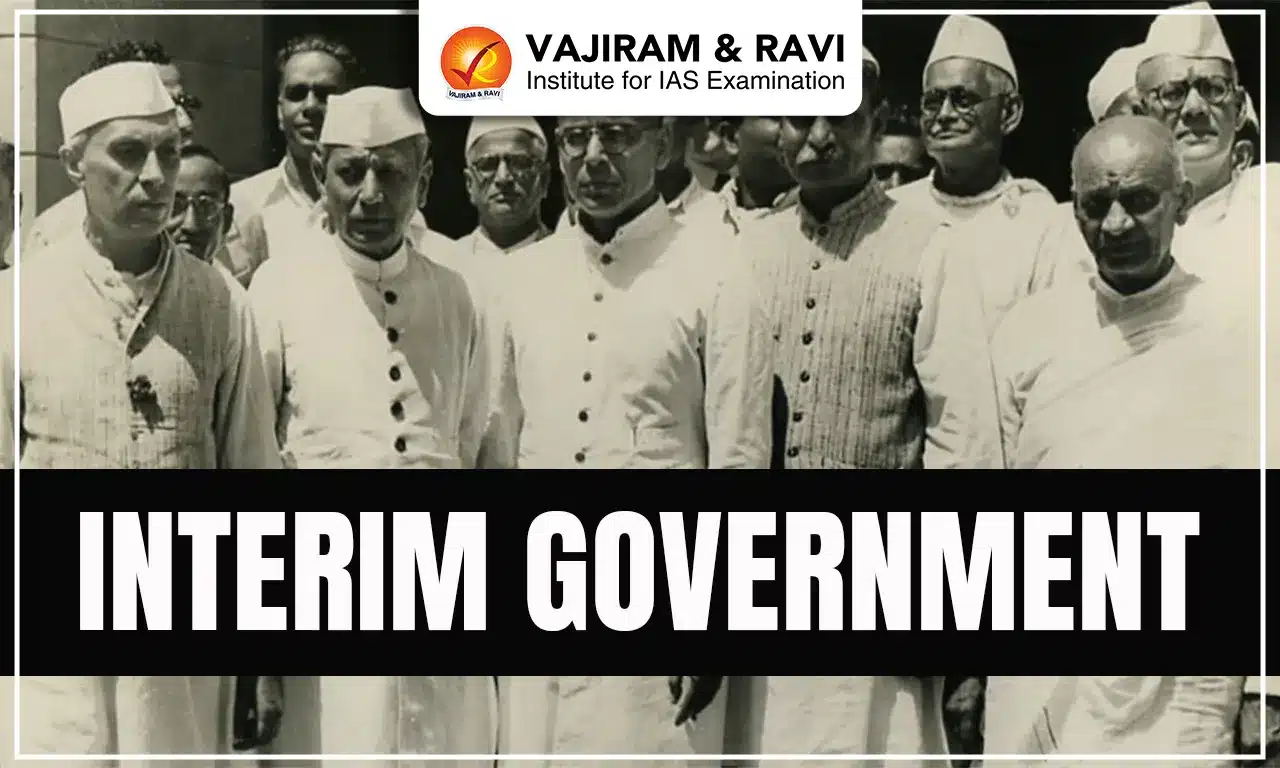
This was the only cabinet in India’s history where the Muslim League and the Congress shared power at the national level. The Interim Government enjoyed considerable autonomy and remained in office until the end of British rule, when the independent dominions of India and Pakistan were established. In modern Indian history, this period represents a significant and pivotal chapter.
Interim Government History
The Interim Government was established as a temporary administration bridging the imperial structure and a democratic framework. It functioned from August 1946 until India’s independence on August 15, 1947, when the subcontinent was partitioned into India and Pakistan.
Its formation came from the newly elected Constituent Assembly, whose representatives were indirectly chosen by provincial legislatures. In these elections, the Indian National Congress (INC) won a plurality with 208 seats (about 69%), while the Muslim League secured 73 seats. The Interim Government replaced the Viceroy’s Executive Council with a Council of Ministers as the administrative branch.
Pandit Jawaharlal Nehru served as its Vice President and de facto Prime Minister. Although initially opposed to joining the Interim Government, the Muslim League eventually participated to gain political leverage, as Muhammad Ali Jinnah described, “entering the Interim Government to get a foothold to fight for… the cherished objective of Pakistan.”
Interim Government Formation
The Second World War significantly influenced the establishment of the Interim Government. Following the war, a pivotal development occurred with the release of all political prisoners associated with the Quit India Movement. The Indian National Congress, by announcing its participation in forming the Constituent Assembly, laid the foundation for a new administrative structure.
In 1946, the British government, led by the newly elected Prime Minister Clement Attlee, sent the Cabinet Mission to India. Its purpose was to propose a framework for establishing a government that would eventually lead to India’s independence.
Interim Government Members
The Cabinet of the Interim Government of India, formed in 1946, consisted of key leaders from the Indian National Congress and the Muslim League. This cabinet was responsible for administering the country during the transitional period leading up to independence. Below is the list of prominent Interim Government Members and their respective portfolios:
| Interim Government Members | |
|
Pt. Jawaharlal Nehru |
Vice President of the Executive Council, External Affairs and Commonwealth Relations |
|
Home, Information and Broadcasting |
|
|
Baldev Singh |
Defence |
|
Dr. John Mithai |
Industries and supplies |
|
C. Rajagopalachari |
Education |
|
C.H Bhabha |
Works, Mines and Power |
|
Food and Agriculture |
|
|
Asaf Ali |
Railways |
|
Jagjivan Ram |
Labour |
|
Liaqat Ali |
Finance |
|
TT Chundrigar |
Commerce |
|
Abdur Rab Nistar |
Communication |
|
Gazanfar Ali khan |
Health |
|
Jogendra Nath Mandal |
Law |
Interim Government FAQs
Q1: What is meant by Interim Government?
Ans: An Interim Government is a temporary government formed before full independence, managing administration and transition during political change, like pre-independence India in 1946.
Q2: Who was the first interim government of India?
Ans: The first Interim Government of India was formed in September 1946, under Jawaharlal Nehru, preparing for India’s independence and transfer of power.
Q3: Who was PM in Interim Government?
Ans: Jawaharlal Nehru served as the Prime Minister of the Interim Government of India from 1946 to 1947.
Q4: Who was the head of the Interim Government?
Ans: Lord Mountbatten was the Governor-General of India, heading and supervising the Interim Government during the transition to independence.
Q5: Who elects the Interim Government?
Ans: The Interim Government was formed by the Indian National Congress and other major parties nominated by the British Viceroy under the Cabinet Mission Plan.
