
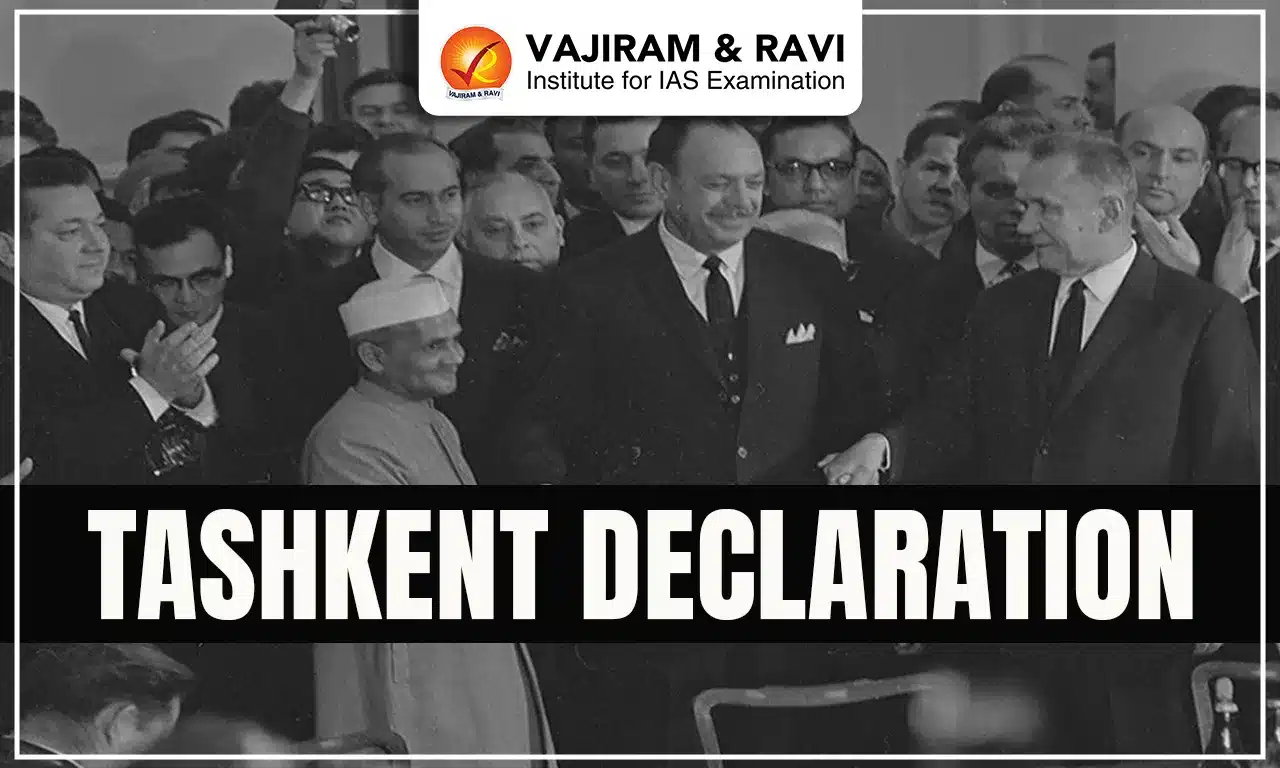
The Tashkent Declaration was a significant diplomatic agreement aimed at restoring peace between India and Pakistan following the war of 1965. It laid down key terms related to ceasefire, withdrawal of forces, and the normalization of diplomatic and economic relations between the two countries.
Tashkent Declaration
The Tashkent Declaration, signed to end the Indo-Pakistan War of 1965 (August 5 – September 23, 1965), was a landmark peace agreement between India and Pakistan. Concluded in Tashkent, the capital of the then Uzbek SSR in the USSR, its primary objective was to restore economic and diplomatic relations between the two countries. The agreement emphasized non-interference in each other’s internal and external affairs and sought to promote bilateral cooperation for mutual progress and stability.
Tashkent Declaration Overview
The Tashkent Declaration was a peace agreement signed between India and Pakistan on January 10, 1966, to formally end the Indo-Pakistan War of 1965. The agreement outlined key commitments, including the withdrawal of military forces and a pledge of non-interference in each other’s internal affairs. The table below summarizes its main aspects, outcomes, and consequences.
| Tashkent Declaration Overview | |
|
Aspect |
Details |
|
Date |
January 10, 1966 |
|
Location |
Tashkent, Uzbekistan (USSR at the time) |
|
Parties |
India and Pakistan |
|
Purpose |
To end the Indo-Pakistan War of 1965 and restore peace between the two nations |
|
Key Points |
|
|
Outcome |
Temporarily halted hostilities but did not resolve deep-rooted issues between the two countries |
|
Consequences |
Marked a brief pause in conflicts; underlying tensions remained, leading to renewed hostilities in 1970 |
Tashkent Declaration Background
- First Indo-Pakistani War (1947-1949): Fought shortly after independence, it ended in a ceasefire and led to the establishment of the Line of Control (LOC) in Kashmir.
- Operation Gibraltar (April 1965): Pakistan’s unsuccessful attempt to capture Kashmir by infiltrating forces disguised as locals.
- Indo-Pakistan War (August-September 1965): Sparked by the failure of Operation Gibraltar, this conflict risked drawing in Cold War superpowers.
- Diplomatic Intervention: The United States and the USSR pushed for peace talks to prevent further escalation.
- UN Resolution (September 22, 1965): The UN called for a ceasefire, temporarily halting hostilities.
- Tashkent Declaration (January 1966): Mediated by the USSR, leaders Lal Bahadur Shastri and Muhammad Ayub Khan signed the declaration to restore peace and rebuild diplomatic ties.
Tashkent Declaration Features
- Restoration of Pre-War Positions: Both India and Pakistan agreed to return to the territorial positions held before the outbreak of the 1965 conflict, helping to ease tensions.
- Non-Interference in Internal Affairs: Each country pledged not to interfere in the other’s internal matters and to avoid harmful propaganda, fostering mutual respect.
- Orderly Transfer of Prisoners of War: The declaration called for the systematic and humane repatriation of prisoners captured during the war.
- Commitment to Bilateral Improvement: Leaders of both nations committed to dialogue and cooperation aimed at rebuilding trust and improving diplomatic relations.
- Restoration of Trade and Economic Relations: Both sides agreed to reinstate trade and economic ties to pre-war levels, promoting stability and shared prosperity.
Tashkent Declaration Outcomes
- Ceasefire: Both nations agreed to an immediate ceasefire along the Line of Control and international borders.
- Withdrawal of Forces: India and Pakistan committed to returning to the positions held before August 5, 1965.
- No Use of Force: Both sides pledged to resolve disputes peacefully, avoiding military action.
- Respect for Sovereignty: The declaration emphasized mutual respect for territorial integrity and sovereignty.
- Economic and Diplomatic Relations: India and Pakistan agreed to restore trade and diplomatic ties.
Prisoners of War: Both countries consented to release and repatriate captured soldiers.
Tashkent Declaration FAQs
Q1: What is the Tashkent Declaration?
Ans: The Tashkent Declaration was a peace agreement signed on 10 January 1966 between India and Pakistan, mediated by the USSR, after the Indo-Pak War of 1965.
Q2: Who signed the Tashkent Agreement?
Ans: It was signed by Lal Bahadur Shastri (Prime Minister of India) and Ayub Khan (President of Pakistan) in Tashkent, with Soviet Premier Alexei Kosygin mediating.
Q3: What is the Tashkent Agreement of UPSC?
Ans: For UPSC, it refers to the 1966 peace pact resolving the 1965 war, highlighting India-Pakistan relations, Cold War geopolitics, and India’s foreign policy under Shastri.
Q4: Which Indian prime minister died during the Tashkent Agreement?
Ans: Lal Bahadur Shastri, India’s second Prime Minister, died on 11 January 1966 in Tashkent, just hours after signing the peace agreement with Pakistan.
Q5: Was the Tashkent Agreement successful?
Ans: The agreement restored status quo ante (return to pre-war positions) and temporarily reduced tensions, but failed to resolve Kashmir, so its success was limited.
