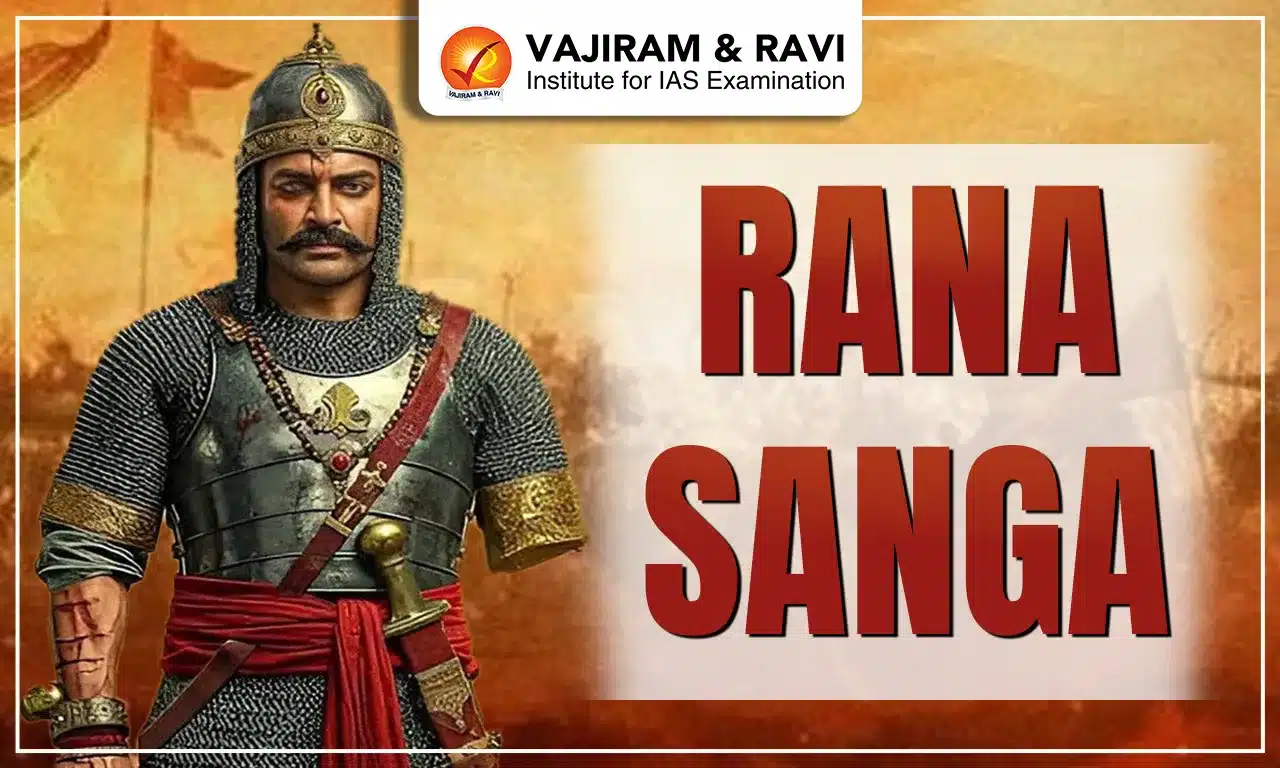
Rana Sanga, also known as Maharana Sangram Singh, was one of the most powerful Rajput rulers of medieval India. He ruled over Mewar during the early 16th century and became a symbol of Rajput valor and resistance against foreign powers. His reign is remembered for military achievements, political alliances, and fierce battles, particularly against the Delhi Sultanate and the Mughal forces. Rana Sanga’s legacy continues to inspire Indian historical memory.
Rana Sanga
Rana Sanga (1482-1528) was the king of Mewar and a leading figure among the Rajput rulers of his time. He expanded Mewar’s influence across North India and united several Rajput clans under his leadership. Despite being injured multiple times in battle, he displayed extraordinary courage and strategic brilliance. His defeat at the Battle of Khanwa against Babur in 1527 marked a turning point in Indian history, paving the way for Mughal dominance.
Rana Sanga Biography
Rana Sanga’s life reflected both political ambition and heroic resistance. His biography is filled with stories of sacrifice, alliances, and power struggles. He was respected not only by his allies but also feared by his enemies. His leadership laid the foundation for Rajput unity during a period of immense political transformation in India.
| Rana Sanga Biography |
| Aspect |
Description |
|
Full Name
|
Maharana Sangram Singh I (Rana Sanga)
|
|
Birth
|
1482 CE
|
|
Dynasty
|
Sisodia Dynasty of Mewar
|
|
Capital
|
Chittorgarh
|
|
Reign
|
1508-1528 CE
|
|
Major Battle
|
Battle of Khanwa (1527 CE)
|
|
Death
|
1528 CE
|
Rana Sanga Physical Features
Rana Sanga was tall, strong, and had an imposing presence. During his early family disputes, his elder brother Prithviraj blinded one of his eyes to eliminate him from succession. Later, in battles against Delhi Sultanate and regional sultans, he lost an arm. Despite these injuries, Sanga continued to lead armies personally, displaying extraordinary courage. His scars became symbols of resilience and heroism in Rajput folklore and historical accounts.
Rana Sanga Family Dispute
Rana Sanga’s succession to the throne was not straightforward, as he faced disputes within his family. After the death of Rana Raimal (1473-1508 CE), a fierce struggle for the Mewar throne ensued. Prithviraj, the elder son, sought to secure power and even blinded Rana Sanga in one eye. Sanga fled to Ajmer for safety. Following Prithviraj’s death, Rana Sanga ascended the throne in 1508 CE, restoring Mewar’s power through military campaigns and uniting Rajput clans against neighboring sultans and emerging Mughal forces. Eventually, Rana Sanga overcame these rivalries with strong political maneuvering and military support. These disputes highlight the instability in Rajput families at the time, where succession wars were common.
Rana Sanga Mewar Dynasty
Rana Sanga belonged to the prestigious Sisodia Dynasty of Mewar, known for its valor and resistance against external powers. The dynasty had a long history of protecting Rajput honor and sovereignty. Under Sanga’s leadership, the Sisodias reached the height of their influence, commanding respect across North India. The dynasty’s traditions of bravery and sacrifice deeply influenced his policies, administration, and military campaigns, making him one of the most iconic rulers of Rajputana history.
Administration under Rana Sanga
Rana Sanga’s administration was based on Rajput traditions, emphasizing justice, loyalty, and protection of subjects. Agricultural reforms and fortification of cities like Chittorgarh strengthened his rule. Rana Sanga combined diplomacy and military strategy to protect and expand Mewar. During his rule, many neighboring kingdoms attempted to capture his territory, but he successfully defended it. Under his leadership, Mewar’s boundaries grew: North up to the Sutlej River (Punjab), South to the Narmada (after conquering Malwa), West to the Indus, and East to Bayana, Bharatpur, and Gwalior, reflecting his administrative and military acumen.
- Reign: 1509 to 1527 CE
- Expansion: Rajasthan, Punjab, Parts of Madhya Pradesh, Gujarat, Haryana and Uttar Pradesh
- Capital: Chittorgarh
- Alliance: Formed Confederacy Alliance by uniting 120 Rajputs
Military Conquest of Rana Sanga
Rana Sanga’s military campaigns expanded Mewar’s territory and influence significantly. He defeated the Delhi Sultanate’s armies under Ibrahim Lodi multiple times and established supremacy in Rajasthan and Malwa. His tactics involved alliance-building, guerrilla strikes, and large-scale open battles. Despite heavy injuries, he personally commanded his troops.
| Military Conquest of Rana Sanga |
| Battle |
Year |
Opponent |
Outcome |
Significance |
|
Khatoli
|
1518
|
Ibrahim Lodi (Delhi Sultanate)
|
Rajput victory; Sanga lost an arm and eye
|
Weakened Delhi Sultanate
|
|
Dholpur
|
1519
|
Ibrahim Lodi with Malwa support
|
Rajput victory
|
Expanded Rajput control in Rajasthan
|
|
Idar
|
1520
|
Malik Hussain (Gujarat)
|
Rajput victory, Malik’s Gujarat army defeated
|
Secured Rajputana borders, looted wealth
|
|
Gagron
|
1519-20
|
Mahmud Khilji II (Malwa) & Asaf Khan (Gujarat)
|
Rajput victory; Sultan captured
|
Enhanced Sanga’s prestige with crown and belt
|
Rana Sanga’s War against Mughals
The most decisive conflict of Rana Sanga’s life was against Babur, founder of the Mughal Empire. Initially, he seized Bayana Fort, challenging Babur’s growing influence. However, his most significant battle was fought at Khanwa in 1527, where his large Rajput confederacy clashed with Babur’s modern army. Despite Rajput bravery, Babur’s superior artillery and Afghan defection shifted the tide. Khanwa’s outcome marked the rise of Mughal supremacy and ended the dream of a united Rajput-led North India.
| Rana Sanga’s War against Mughals |
| Battle |
Year |
Opponent |
Location |
Outcome & Significance |
|
Bayana
|
~1526-27
|
Nizam Khan (Afghan chief) & Babur indirectly
|
Bayana Fort, Rajasthan
|
Rajput victory; displayed siege tactics and territorial expansion
|
|
Khanwa
|
March 1527
|
Babur (Mughal Empire)
|
Near Agra, Uttar Pradesh
|
Mughal victory; Babur’s Tulughma tactics, artillery, and Afghan betrayal led to Sanga’s defeat
|
|
Chanderi
|
1528
|
Babur vs Rajputs
|
Present Day Ashoknagar, Madhya Pradesh
|
Decline of Rajput power
|
Rana Sanga’s Army
Rana Sanga’s army was considered one of the strongest Rajput forces of its time. It comprised around 80,000 cavalry, 500 war elephants, and a large infantry. His soldiers were trained in traditional Rajput warfare, emphasizing valor and close combat. Though powerful, his forces lacked modern artillery, which became a major disadvantage against Babur’s gunpowder weapons. Despite this, Sanga’s disciplined army was admired for loyalty and courage in the face of overwhelming odds.
Economy during Rana Sanga Reign
The economy of Mewar under Rana Sanga was primarily agrarian, relying on fertile plains and irrigation systems. Revenue came from agriculture, trade routes, and tributes from allied states. Chittorgarh became a hub of commerce. However, constant wars strained resources and disrupted stability. Despite challenges, Rana Sanga managed to sustain his economy, funding large armies and fortification projects. His reign showed the balance between economic growth and the cost of continuous warfare.
Political Landscape during Sanga’s Reign
Rana Sanga’s era witnessed political fragmentation in North India. The Delhi Sultanate was declining, Afghan chiefs were struggling, and new powers like the Mughals were emerging. Regional rulers included Medini Rai in Malwa, Ibrahim Lodi in Delhi, and Bahadur Shah in Gujarat.
| Political Landscape and Contemporary Rulers during Rana’s Reign |
| Year |
Region |
Ruler |
Significance |
|
1517
|
Delhi
|
Ibrahim Lodi
|
Defeated by Babur in 1526
|
|
1520s
|
Malwa
|
Medini Rai
|
Ally of Rana Sanga
|
|
1526
|
Central Asia/ India
|
Babur
|
Established Mughal power
|
Historical Sources of Rana’s Life
The life of Rana Sanga is documented through a mix of Mughal records, Rajput traditions, and later historical works. The Baburnama offers first-hand Mughal perspectives on his battles. Persian texts like Tarikh-i-Firishta and Ain-i-Akbari also mention him. Rajput bardic chronicles such as Rajprashasti Mahakavyam and regional inscriptions glorify his valor. Modern historians like Satish Chandra and R.C. Majumdar further analyzed his reign, blending contemporary evidence with later Rajput accounts.
Rana Sanga’s Alliance
Rana Sanga formed a powerful Rajput Confederacy to strengthen Mewar and resist external threats. This alliance included 7 kings, 9 chieftains, and 104 nobles, uniting the Rajput states under his leadership. The confederacy enabled coordinated military campaigns, territorial expansion, and defense against the Delhi Sultanate and emerging Mughals. However, these alliances often faced internal distrust.
Few of the notable alliances of Rana Sanga are:
| Rana Sanga’s Alliance |
| Year |
Alliance Partner |
Purpose |
Outcome |
|
1519
|
Medini Rai (Malwa)
|
Strengthen Rajput unity and secure Malwa borders
|
Successful; enhanced Rajput influence in central India
|
|
1520
|
Marwar (Raja of Jodhpur)
|
Consolidate Rajput support for northern campaigns
|
Strengthened military coordination against Delhi Sultanate
|
|
1520-26
|
Amber (Raja of Jaipur) & Ajmer
|
Build Rajput confederacy to resist foreign invasions
|
Unified Rajput clans under Sanga’s leadership
|
|
1526-27
|
Afghan chiefs in Bayana & Northern India
|
Counter Ibrahim Lodi and Babur’s influence
|
Temporary military support; helped capture Bayana Fort
|
|
1527
|
Rajput Confederacy at Khanwa
|
Confront Babur and defend Rajput territories
|
Defeated due to artillery advantage of Mughals and betrayal by some allie
|
Death of Rana Sanga
Rana Sanga died in 1528 under contested circumstances. Some accounts suggest he was poisoned to death while others cite illness. Although mostly accepted reason states- during his final confrontation with Babur, Rana Sanga was severely injured and taken unconscious from the battlefield by Prithviraj Singh I Kachwaha and Maldeo Rathore of Marwar. After regaining consciousness, he vowed not to return to Chittor until he defeated Babur and captured Delhi. However, due to resistance from his nobles who opposed another war, he was poisoned by nobles. His death marked the end of an era of Rajput resistance.
Succession After Rana Sanga
Following Rana Sanga’s death, his son Ratan Singh II ascended the throne of Mewar in 1528. The transition occurred during a period of instability, as Babur consolidated Mughal power after victories at Khanwa and Chanderi. Sanga’s vassals, including Medini Rai, faced Mughal conquests, with Rajput resistance severely weakened.
Rana Sanga UPSC
A recent controversy emerged after a political remark referred to Rana Sanga as a “traitor” claiming that Sanga had invited Babur to India, sparking strong reactions from Rajput groups such as the Karni Sena. The statement was perceived as undermining Sanga’s historical legacy, leading to protests and subsequent clashes with police in Agra. Historians largely dismiss the claim, emphasizing his opposition to Babur, especially at the Battle of Khanwa (1527 CE).
Rana Sanga FAQs
Q1: Who was Rana Sanga?
Ans: Rana Sanga, also known as Maharana Sangram Singh, was a powerful Rajput ruler of Mewar (1482-1528 CE) renowned for uniting Rajput clans and resisting the Delhi Sultanate and Mughal invasions.
Q2: What were the major battles of Rana Sanga?
Ans: Rana Sanga fought key battles including Khatoli (1518), Dholpur (1519), Idar (1520), Gagron (1519-20), Bayana, and Khanwa (1527), showcasing Rajput valor and military strategy.
Q3: What were Rana Sanga’s Physical Features?
Ans: Rana Sanga, according to historical accounts, was tall, strong, and imposing, with one eye blinded by his brother and an arm lost in battle.
Q4: Who succeeded Rana Sanga?
Ans: After his death in 1528, Ratan Singh II became the ruler of Mewar, inheriting a kingdom weakened by battles against Babur and the Delhi Sultanate.
Q5: What were the political alliances of Rana Sanga?
Ans: Rana Sanga formed a Rajput confederacy with 7 kings, 9 chieftains, and 104 nobles, strengthening Mewar’s military and political position against neighboring sultans and the Mughal Empire.