UPSC Daily Quiz 6 October 2025

UPSC Daily Quiz

The Daily UPSC Quiz by Vajiram & Ravi is a thoughtfully curated initiative designed to support UPSC aspirants in strengthening their current affairs knowledge and core conceptual understanding. Aligned with the UPSC Syllabus 2025, this daily quiz serves as a revision resource, helping candidates assess their preparation, revise key topics, and stay updated with relevant issues. Whether you are preparing for Prelims or sharpening your revision for Mains, consistent practice with these Daily UPSC Quiz can significantly enhance accuracy, speed, and confidence in solving exam-level questions.

[WpProQuiz 88]  

UPSC Daily Quiz FAQs

Q1: What is the Daily UPSC Quiz?

Ans: The Daily UPSC Quiz is a set of practice questions based on current affairs, static subjects, and PYQs that help aspirants enhance retention and test conceptual clarity regularly.

Q2: How is the Daily Quiz useful for UPSC preparation?

Ans: Daily quizzes support learning, help in revision, improve time management, and boost accuracy for both UPSC Prelims and Mains through consistent practice.

Q3: Are the quiz questions based on the UPSC syllabus?

Ans: Yes, all questions are aligned with the UPSC Syllabus 2025, covering key areas like Polity, Economy, Environment, History, Geography, and Current Affairs.

Q4: Are solutions and explanations provided with the quiz?

Ans: Yes, each quiz includes detailed explanations and source references to enhance conceptual understanding and enable self-assessment.

Q5: Is the Daily UPSC Quiz suitable for both Prelims and Mains?

Ans: Primarily focused on Prelims (MCQ format), but it also indirectly helps in Mains by strengthening subject knowledge and factual clarity.

Bay of Bengal, Location, Map, Geographic & Economic Importance

Bay of Bengal

The Bay of Bengal is the second-largest part of the Indian Ocean, surpassed only by the Arabian Sea in terms of size. Covering an expansive area of approximately 2,600,000 square kilometers, the bay stretches about 2,090 kilometers in length and 1,610 kilometers in width. Its average depth is around 2,600 meters, while the deepest point reaches 4,694 meters. Globally, it is recognized as the largest body of water referred to as a "bay." In this article, we are going to cover the Bay of Bengal, its geographical location, features, geographical and economic importance.

Bay of Bengal 

The Bay of Bengal is much more than a water body; it is a lifeline for agriculture, a regulator of regional climate, a biodiversity hotspot, an economic driver, and a strategic maritime corridor. Its coastal regions support millions of livelihoods through agriculture, fisheries, forestry, and tourism. With its fertile deltas, abundant marine resources, and potential for renewable energy and hydrocarbon exploration, the bay holds immense importance for India, Bangladesh, Myanmar, and other neighboring countries.

As a natural barrier and trade conduit, it has historically shaped the socio-economic and cultural landscapes of the region. In the modern era, the Bay of Bengal continues to play a pivotal role in trade, climate studies, resource management, and strategic planning. 

Bay of Bengal Geographical Location

Bay of Bengal is situated in the northeastern part of the Indian Ocean and bordered by many countries. To the northwest and west lies India; to the north is Bangladesh; Myanmar occupies the eastern boundary; Sri Lanka is positioned to the southwest; and Indonesia lies to the southeast. Along its eastern side, the bay is flanked by the Andaman and Nicobar Islands, a group of islands important both strategically and ecologically. The bay is nourished by many important rivers, including the Ganges, Brahmaputra, Godavari, Krishna, and Mahanadi, which form extensive delta systems and feed fertile plains along the coast.

The Bay of Bengal has a wide continental shelf in the north, gradually narrowing toward the south. Coastal slopes are different across the northwest, north, and northeast, shaped largely by river canyons and sediment deposits. These features influence both marine navigation and coastal resource availability. 

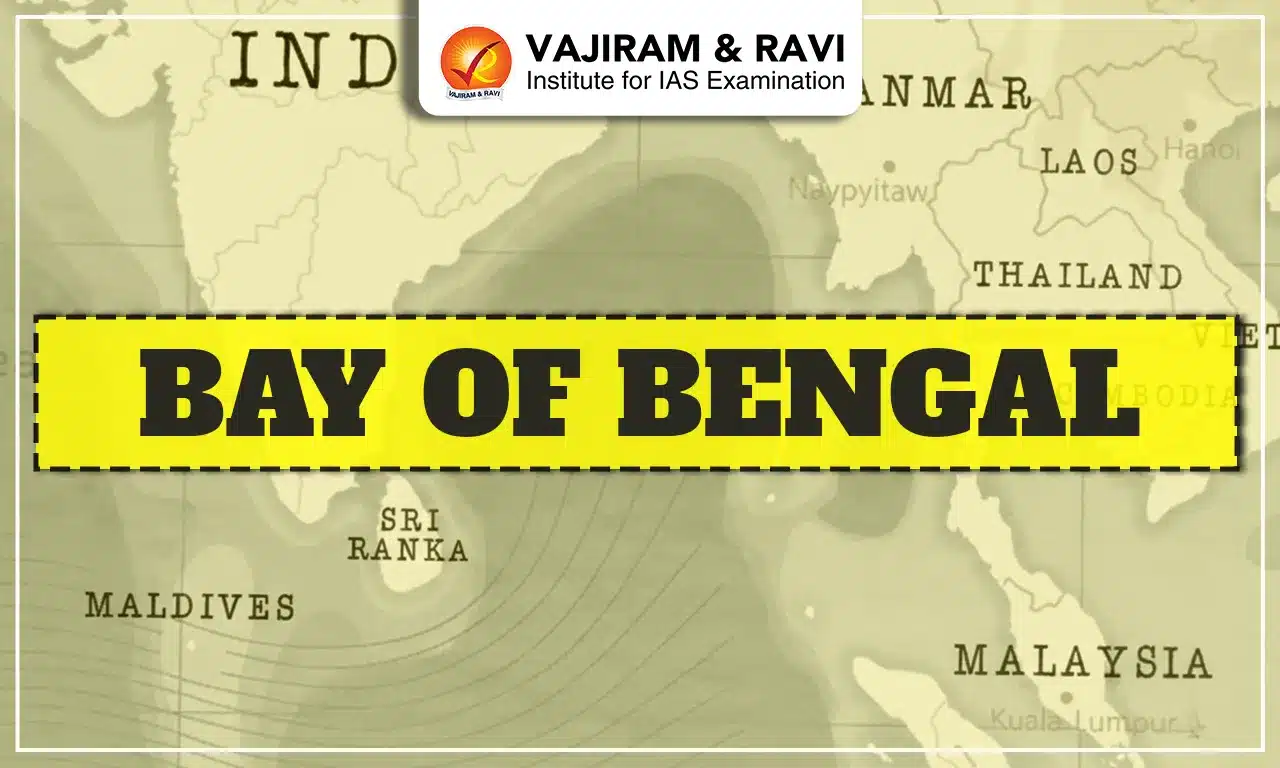
Bay of Bengal Map

Bay of Bengal ecological, economic, and geopolitical importance makes it important for the sustainable development and security of South and Southeast Asia.

[my_image src="https://vajiramandravi.com/current-affairs/wp-content/uploads/2025/10/Bay.webp" size="full" align="none" alt="Bay of Bengal Map" title="Bay of Bengal Map"]


Bay of Bengal Islands and Coastal Features

The Bay of Bengal has many islands, many of which were historically above water but now exist as submerged features visible through satellite imagery. The most important islands are the Andaman and Nicobar Islands, which separate the Bay of Bengal from the Andaman Sea. The Andaman Islands lie approximately 130.4 kilometers from Myanmar's southwest coast. The island group comprises 572 islands spanning roughly 6,407 square kilometers, with a population of about 343,000 as of 2011. The Great Andaman, consisting of 200 islands, includes seven major islands and covers 4,825 square kilometers.

Other important islands and coastal regions surrounding the Bay of Bengal include:

  • Sri Lanka, to the southwest, an independent island nation.
  • Rakhine State, a southwestern coastal region of Myanmar.
  • Bangladesh, to the north, with its deltaic plains.
  • Sumatra, part of Indonesia, located southeast of the bay.
  • The Irrawaddy Delta in Myanmar, at the mouth of the Irrawaddy River.

These islands and coastal regions support unique ecosystems, diverse cultures, and economies largely based on agriculture, fishing, and tourism.

Bay of Bengal Geographic Importance 

Bay of Bengal has the following geographic importance: 

  1. Lifeline for Agriculture

The Bay of Bengal plays an important role in sustaining agriculture in the region. In India and Bangladesh, agriculture heavily depends on monsoon rainfall, which is largely influenced by the south-eastern winds from the bay. The river deltas draining into the bay create fertile plains that support a variety of crops, including rice, wheat, maize, sugarcane, jute, and oilseeds.

Additionally, the bay's coastal waters facilitate aquaculture, including fish, shrimp, and crab farming, which is a major source of income for local communities. The consistent water supply from rivers and rainfall ensures irrigation for millions of hectares, making the bay region a vital contributor to national food security.

  1. Influence on Climate and Heat Balance

The Bay of Bengal regulates regional climate by moderating temperatures and facilitating monsoon patterns. Warm surface waters store heat, which interacts with monsoon winds, river runoff, ocean currents, and evaporation to influence precipitation, humidity, and temperature across South and Southeast Asia. By distributing heat and moisture, the bay provides more stable weather conditions, preventing extreme heat events and supporting agricultural productivity.

  1. Biodiversity Hotspot

The Bay of Bengal is a tropical wetland rich in biodiversity. Its diverse ecosystems include:

  • Marine Mammals: Dolphins, whales, and dugongs inhabit the bay’s waters.
  • Fish Species: Tuna, mackerel, sharks, and numerous other species provide livelihoods for coastal communities.
  • Mangrove Forests: The Sundarbans, the world’s largest mangrove forest, supports a wide range of birds, fish, and crustaceans.
  • Coral Reefs: Located around the Andaman and Nicobar Islands, these reefs are among India’s most diverse marine ecosystems.
  • Seagrass Beds: Found in shallow waters, they provide habitats for fish and invertebrates.
  • Salt Marshes: These tidal flats are crucial for shorebirds and other wildlife.

These ecosystems not only contribute to ecological balance but also provide resources for food, medicine, and livelihoods, highlighting the bay's environmental and economic significance.

  1. Natural Defense Barrier

The Bay of Bengal acts as a natural barrier against invasions from the east, complementing India’s mountainous northern boundaries. Coastal and maritime defenses provided a buffer, enabling trade and cultural exchange while protecting inland territories from external threats.

Bay of Bengal Economic Importance

The Bay of Bengal is central to the regional economy due to its strategic location and natural resources:

  1. Maritime Trade: The bay serves as a crucial corridor for sea trade with Southeast Asia and the Asia-Pacific region. Major ports along the bay facilitate domestic and international commerce.
  2. Agricultural and Forest Resources: Heavy rainfall supports tropical evergreen forests, which supply timber, bamboo, fodder, and medicinal plants. Coastal fertile lands sustain crop cultivation and aquaculture.
  3. Fisheries: The bay is home to abundant marine resources, providing food security and livelihoods for millions.
  4. Hydrocarbons: Offshore basins have potential for oil and gas exploration.
  5. Energy Potential: The bay’s tidal and wind currents provide opportunities for renewable energy projects, such as wind and tidal power plants.
  6. Mineral Resources: Heavy mineral sands, including ilmenite, garnet, sillimanite, zircon, rutile, and manganite, are found near Chennai, Vishakhapatnam, and Nagapattinam, contributing to industrial raw materials.

The Bay of Bengal also enables the transportation of industrial runoff and other resources, reducing costs and enhancing regional trade efficiency.

Bay of Bengal Strategic and Geopolitical Importance

The Bay of Bengal has functioned as a hub of commerce and cultural exchange in the Indian Ocean. Its waters link South Asia with Southeast Asia and the broader Asia-Pacific region, facilitating trade, fisheries, and strategic naval movements. The Indo-Pacific orientation of global economic and military power further emphasizes the bay’s role as a maritime corridor.

The surrounding countries leverage the bay for trade routes, shipping lanes, and resource exploration, making it geopolitically important. Its location improves India’s maritime security, supports energy and trade logistics, and offers potential for strategic partnerships with neighboring countries.

Bay of Bengal Cultural and Tourism Significance

Beyond its economic and ecological value, the Bay of Bengal region has unique cultural landscapes and tourist destinations:

  • Cox’s Bazar in Bangladesh is the world’s longest natural beach.
  • Sundarbans offers wildlife tourism, including the famous Bengal tiger.
  • Andaman and Nicobar Islands attract eco-tourists with coral reefs, beaches, and indigenous communities. Tourism contributes substantially to local economies, promoting cultural preservation and sustainable development initiatives.
Other Related Posts
Chota Nagpur Plateau Interior of the Earth
Malwa Plateau Continental Drift Theory
Soils of India Paleomagnetism
Largest State in India Convectional Current Theory
Godavari River System Tsunami
Big Bang Theory Western Disturbances in India
Latitude and Longitude The Universe
Asteroid

Bay of Bengal FAQs

Q1: Why is it called the Bay of Bengal?

Ans: It is named after the historical region of Bengal, which lies along its northern coast.

Q2: Is Bay of Bengal a sea or river?

Ans: It is a bay, which is a large body of water connected to an ocean, not a river or sea.

Q3: In which state is Bay of Bengal?

Ans: It borders multiple states, including West Bengal, Odisha, Andhra Pradesh, Tamil Nadu, and the Union Territory of Andaman and Nicobar Islands.

Q4: What is the importance of tourism in Bay of Bengal?

Ans: Tourism thrives due to beaches, coral reefs, mangroves, and wildlife, generating income and employment for local communities.

Q5: What is the geographical importance of Bay of Bengal?

Ans: It influences monsoon patterns, supports agriculture, maintains regional climate stability, and provides strategic maritime and trade routes.

Pakistan Occupied Kashmir (PoK), History, Map, Developments

Pakistan Occupied Kashmir (PoK)

Pakistan-Occupied Kashmir (PoK), referred to by Pakistan as Azad Jammu & Kashmir (AJK) and Gilgit-Baltistan (GB), lies at the heart of the Kashmir dispute between India and Pakistan. PoK is administered by Pakistan and claimed in full by India, making it one of the most contested territories in South Asia. In 2025, especially after the tragic Pahalgam terror attack in April and escalating incidents along the Line of Control (LoC), renewed attention has fallen on PoK’s role as a terror hub, its strategic geography, and India’s ongoing stance on its reclamation. In this article, we are going to cover about Pakistan Occupied Kashmir, its historical background, India’s constitutional and legal position and strategic importance.

Pakistan Occupied Kashmir 

Pakistan Occupied Kashmir is the area of the princely state of Jammu and Kashmir that came under Pakistani control following the first India-Pakistan war of 1947-48. It includes two administrative regions under Pakistan:

  • Azad Jammu & Kashmir (AJK): The southern portion, with Muzaffarabad as its capital.
  • Gilgit-Baltistan (GB): The northern region, which is geographically larger and borders China and Afghanistan.

Though Pakistan administers both, India maintains that they remain integral parts of the Indian union, and their control by Pakistan is illegal.

Pakistan Occupied Kashmir Historical Background

The dispute over PoK started during the time of partition period: 

  • In 1947, the princely state of Jammu & Kashmir agreed to join India.
  • Between 1947 and 1948, India and Pakistan fought the first war over Kashmir. A UN-brokered ceasefire led to the establishment of the Line of Control (LoC), effectively splitting the formerly unified princely state.
  • The Karachi Agreement (1949) between India and Pakistan formalized the ceasefire line.
  • Subsequent wars in 1965 and 1971 did not significantly alter the Kashmir boundary.
  • The eruption of insurgency in Indian-administered Kashmir since 1989 added complexity by inflaming separatist violence and cross-border militant activity.
  • The Kargil conflict of 1999 was fought across high-altitude terrain in Jammu & Kashmir, again showing the fragility of peace along contested zones. To this day, the region known as PoK remains under Pakistani administration, though contested by India.

PoK Constitutional and Legal Position in India

India firmly holds that:

  1. PoK is an important part of India, a position enshrined in Indian political declarations and constitutional claims.
  2. In 1994, the Indian Parliament passed a unanimous resolution declaring PoK as sovereign Indian territory.
  3. India does not recognize any “Azad Kashmir” government, and considers elections, institutions, or laws instituted there by Pakistan to be null and void.
  4. Any Pakistani actions or developments in PoK are viewed by India as encroachments on its sovereignty.

PoK Strategic Importance

Pakistan Occupied Kashmir importance in the India-Pakistan equation is multifaceted:

  • Gateway to China- CPEC: The China-Pakistan Economic Corridor (CPEC), a multibillion-dollar flagship project of China’s Belt and Road Initiative, passes through Gilgit-Baltistan. India has consistently objected, arguing that any infrastructure in PoK violates its sovereignty.
  • Terror Launchpads: PoK is frequently cited as a safe zone for militant groups like Lashkar-e-Taiba (LeT), Jaish-e-Mohammed (JeM), and Hizbul Mujahideen, who are believed to run training camps in PoK’s varied terrain (e.g. Neelum Valley, Kotli, Bhimber).
  • Geopolitical Leverage: Control over PoK gives Pakistan leverage in Kashmir, and its proximity to China gives strategic depth.
  • Resource and terrain control: The region’s rivers, mountain corridors, and high-altitude terrain also hold military and hydrological advantages. 

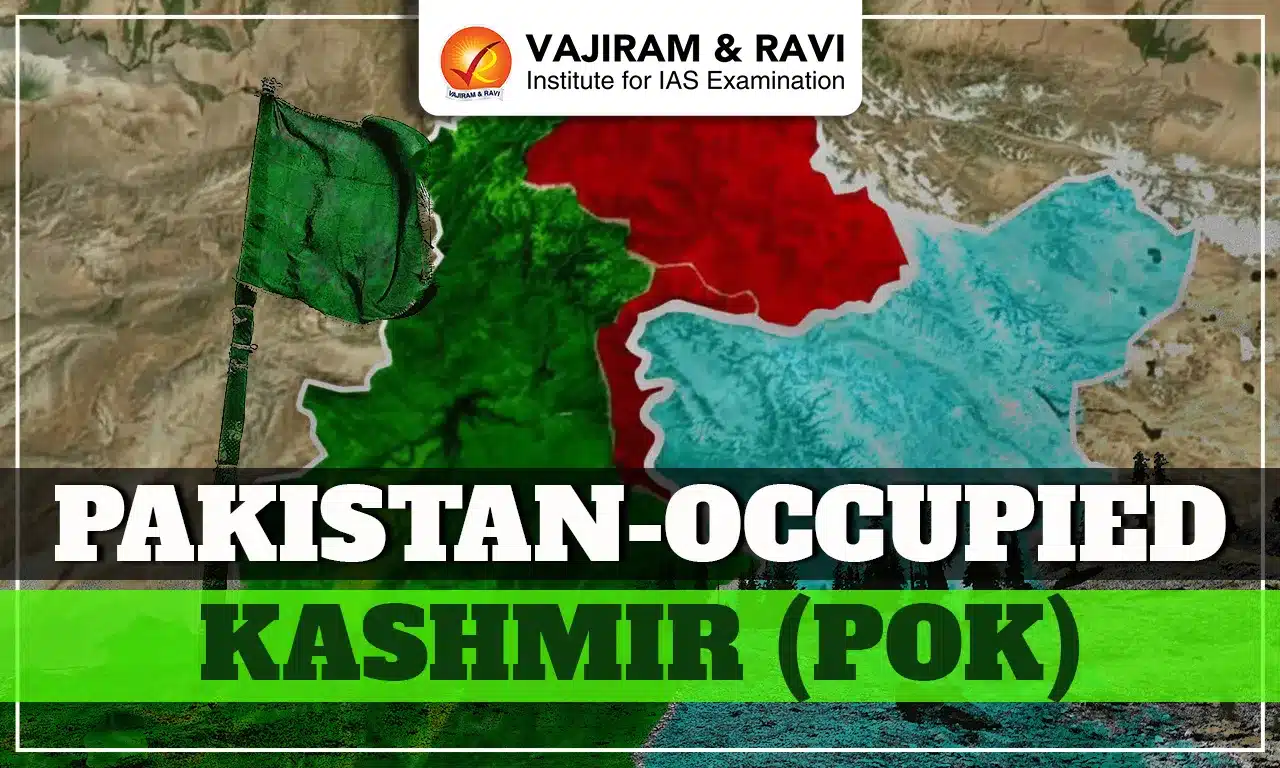
Pakistan Occupied Kashmir Map

Check out the Pakistan Occupied Kashmir map included here for a clear visual of the region and its boundaries.

[my_image src="https://vajiramandravi.com/current-affairs/wp-content/uploads/2025/10/kashmir-1.webp" size="full" align="none" alt="Pakistan Occupied Kashmir Map" title="Pakistan Occupied Kashmir Map"]

Pakistan Occupied Kashmir (PoK) Developments in 2025

On 22 April 2025, terrorists struck in the Baisaran Valley, Pahalgam, killing 26 people, most of them tourists. The assailants reportedly used AK-47s and M4 carbines, infiltrating through adjacent forests. Investigations pointed to militants crossing from PoK, and Indian authorities held Pakistan responsible for providing sanctuary and infrastructure support to such groups. The Resistance Front, believed to be an offshoot of LeT, initially claimed responsibility.

India’s Renewed Assertiveness

In the wake of the attack, India intensified surveillance, drone operations, and counter-militant strikes near the LoC. In May 2025, India launched Operation Sindoor, targeting terror infrastructure in PoK, making airstrikes across nine locations. Indian leadership also sternly reiterated the objective of recovering PoK. 

Diplomatic and Military Fallout

India summoned Pakistan’s High Commissioner and demanded dismantling of terrorist infrastructure. In response, Pakistan reportedly suspended key agreements, including aspects of the Shimla Accord, raising tensions at the diplomatic level. Pakistan, however, continues to portray PoK as a self-governing entity rather than an instrument of Pakistani control. Meanwhile, allegations of human rights suppression and lack of press freedom in Gilgit-Baltistan have drawn international criticism. 

Internationally, the UN continues to classify Jammu & Kashmir as a disputed territory, calling for peaceful resolution via bilateral dialogue. Yet, no significant country recognizes PoK as an independent or sovereign Pakistani territory. China’s active presence in Gilgit-Baltistan through the CPEC further complicates the issue.

Pakistan Occupied Kashmir (PoK) FAQs

Q1: How did Pakistan occupy part of Kashmir?

Ans: Pakistan occupied part of Kashmir during the 1947–48 war following tribal invasions backed by its army after the Maharaja of Jammu and Kashmir acceded to India.

Q2: What is the difference between Pak and PoK?

Ans: Pakistan is a sovereign country, while Pakistan-Occupied Kashmir (PoK) is the region of Jammu and Kashmir illegally occupied and administered by Pakistan.

Q3: Are Azad Kashmir and Pakistan-Occupied Kashmir the same?

Ans: Yes, “Azad Jammu and Kashmir” is the term Pakistan uses for the part of Jammu and Kashmir under its occupation, commonly known in India as Pakistan-Occupied Kashmir (PoK).

Protected Area Network (PAN) in India, Definition, Importance

Protected Area Network (PAN) in India

Protected Area Network in India is an example of ecological foresight and environmental governance. From the snow-clad Himalayan National Parks to the coastal mangroves of the Sundarbans, these protected areas show the deep-rooted ethos of India of living in harmony with nature. Challenges like encroachment, poaching and climate change exist but the National Parks, Sanctuaries, Biosphere Reserves, Conservation and Community Reserves and Sacred Groves continue to balance conservation and sustainable use. In this article, we are going to cover the Protected Area Network and how they make sure that the natural wealth of the nation remains protected for generations to come.

Protected Area Network 

India, one of the 17 mega-biodiverse countries in the world, has made important strides in conserving its rich flora and fauna through the establishment of a Protected Area Network (PAN). This network forms the cornerstone of India’s biodiversity conservation strategies, providing the long-term preservation of ecological systems, habitats, and species diversity across different types of ecosystems from the high Himalayas to the coastal mangroves.

Under this network, a robust system of protected areas with varying objectives and legal safeguards has been created across the country. These include National Parks, Wildlife Sanctuaries, Biosphere Reserves, Conservation Reserves, Community Reserves, Sacred Groves, and Marine Protected Areas, each with a distinct conservation focus.

What are Protected Areas?

Protected Areas, also known as conservation areas, are designated geographical zones managed to conserve ecosystems, safeguard biodiversity, and promote sustainable ecological balance. They help maintain genetic diversity, protect endangered species, and ensure the continuation of ecosystem services such as carbon storage, soil fertility, and water regulation.

Together these areas constitute the Protected Area Network, a framework that enables India to meet both its national conservation objectives and international commitments such as the Convention on Biological Diversity (CBD) and the Aichi Biodiversity Targets.

IUCN Definition of a Protected Area

According to the International Union for Conservation of Nature (IUCN), a protected area is:

“A clearly defined geographical space, recognised, dedicated, and managed, through legal or other effective means, to achieve the long-term conservation of nature with associated ecosystem services and cultural values.”

This definition highlights the importance of integrating human, ecological, and cultural dimensions into conservation planning.

Protected Area Network in India

India’s Wildlife (Protection) Act, 1972 acts as the legislative foundation for establishing and managing protected areas. The Act enables both Central and State Governments to notify and manage these regions for biodiversity conservation.

The major categories of Protected Areas in India are:

  1. National Parks
  2. Wildlife Sanctuaries
  3. Biosphere Reserves
  4. Conservation Reserves
  5. Community Reserves
  6. Sacred Groves
  7. Coastal and Marine Protected Areas

All categories serve a unique ecological and social purpose and collectively strengthens India’s commitment to sustainable environmental management.

National Parks 

A National Park is a strictly protected area set aside primarily for the conservation of biodiversity and the maintenance of ecological integrity. These parks aim to protect natural habitats, ecosystems, and wildlife from any form of human interference.

Introduced under the Wildlife (Protection) Act, 1972, National Parks can be declared by either the Central or State Governments. Their boundaries are legally defined and cannot be altered without a resolution passed by the respective State Legislature.

Key features include:

  • No human activity such as grazing, private ownership, or resource extraction is permitted.
  • National Parks are maintained through structured conservation plans.
  • They represent the most pristine and ecologically sensitive zones in India.

India currently has 106 National Parks, covering approximately 44,372 sq km. Examples include Jim Corbett National Park (Uttarakhand) India’s first National Park, and Kaziranga National Park (Assam) a UNESCO World Heritage Site known for the one-horned rhinoceros.

Wildlife Sanctuaries

A Wildlife Sanctuary is an area designated for the protection of specific species or groups of species and their habitats. Like National Parks, they are notified under the Wildlife (Protection) Act, 1972. However, sanctuaries are relatively less restrictive. Many human activities like regulated collection of minor forest produce, grazing, or timber extraction, may be allowed provided they do not disturb the wildlife. Unlike National Parks, Wildlife Sanctuaries boundaries are not rigidly fixed and may be altered by state governments when necessary. Sanctuaries thus act as important buffer zones and corridors linking major ecosystems. India has 573 Wildlife Sanctuaries, such as the Mhadei Wildlife Sanctuary (Goa) and Tamor Pingla Wildlife Sanctuary (Chhattisgarh).

National Parks and Wildlife Sanctuaries Differences

National Parks and Wildlife Sanctuaries have the following differences: 

Basis of Difference National Park Wildlife Sanctuary

Objective

Protection of entire ecosystems and biodiversity with minimal human interference.

Protection of specific species and their habitats.

Human Activity

All human activities are strictly prohibited.

Limited human activities like grazing or firewood collection may be allowed.

Boundary Alteration

Boundaries can be changed only with the approval of the State Legislature.

Boundaries can be altered by the State Government.

Level of Protection

Provides a higher level of legal protection.

Offers less stringent protection compared to National Parks.

Ownership Rights

Private ownership and rights are not allowed.

Certain private or community rights may exist.

Biosphere Reserves (BRs)

Biosphere Reserves are special conservation areas that integrate the protection of biodiversity with sustainable use by local communities. They encompass terrestrial, marine, and coastal ecosystems. Created under UNESCO’s Man and the Biosphere (MAB) Programme, these reserves promote a balanced relationship between humans and nature through zoning systems like Core Zone (strictly protected), Buffer Zone (limited human activity), and Transition Zone (sustainable use). India has 18 Biosphere Reserves, including Nilgiri (Tamil Nadu, Kerala, Karnataka), Sundarbans (West Bengal), and Nanda Devi (Uttarakhand). Ten of these are part of the UNESCO World Network of Biosphere Reserves.

Conservation Reserves

Conservation Reserves were introduced through the Wildlife (Protection) Amendment Act, 2002 to protect landscapes and seascapes lying between established National Parks or Wildlife Sanctuaries. These reserves are typically government-owned lands located near existing protected areas and are established after consultation with local communities. Managed by a Conservation Reserve Management Committee (CRMC), they serve as ecological corridors that ensure species migration and genetic exchange.

India currently hosts over 115 Conservation Reserves, such as the Tiruppadaimarathur Conservation Reserve (Tamil Nadu) and Sorsan Conservation Reserve (Rajasthan).

Community Reserves

Community Reserves show an innovative approach that integrates local community participation in conservation efforts. They were also introduced through the 2002 Amendment to the Wildlife Act. These reserves can be declared on private or community lands where local residents voluntarily dedicate their areas to conserve wildlife, ecosystems, and traditional practices. Management lies with a Community Reserve Management Committee, ensuring community ownership and decision-making. No change in land use is allowed without the consent of the committee and approval from the State Government.

India has around 220 Community Reserves, including Keshopur Chamb (Punjab). India’s first wetland-based community reserve and Gogabeel (Bihar), an important bird habitat.

Sacred Groves

Sacred Groves are ancient patches of forest protected by local communities due to religious or cultural beliefs. Dedicated to deities or ancestral spirits, they are among the oldest forms of community-based conservation in India.

These groves vary in size from a cluster of trees to dense forests and act as important repositories of biodiversity, harboring many rare, endemic, and medicinal plant species. They play an important role in soil conservation, groundwater recharge, and maintaining microclimatic balance.

Sacred Groves are of two main types:

  • Traditional Sacred Groves: Natural forests believed to be the abode of village deities.
  • Temple Groves: Forest patches surrounding temples or burial grounds.

Prominent examples include the Kavus of Kerala, Devarakadus of Karnataka, and Sarna forests of Jharkhand.

Coastal and Marine Protected Areas (MPAs)

Marine and Coastal Protected Areas form an important part of India’s PAN, safeguarding its rich marine biodiversity. As per IUCN, these are defined as “any area of intertidal or subtidal terrain along with its overlaying water and associated flora, fauna, and cultural features protected by law.” These areas protect delicate ecosystems such as mangroves, coral reefs, estuaries, lagoons, and seagrass beds, which act as breeding grounds for several marine species.

Currently, India has 31 Marine Protected Areas, including:

  • Gulf of Kachchh Marine National Park (Gujarat) - India’s first Marine National Park known for coral reefs and dugongs.
  • Wandoor Marine National Park (Andaman & Nicobar Islands) is a hotspot for coral diversity and marine life.

Marine protected areas are crucial in mitigating overfishing, protecting coastal livelihoods, and adapting to the impacts of climate change such as rising sea levels and ocean acidification.

Protected Area Network Ecological and Socio-Economic Importance

The Protected Area Network is not just about wildlife but is a holistic system that sustains the very foundation of India’s ecological and cultural heritage.
Some key benefits include:

  • Biodiversity Conservation: Safeguards endangered species such as tigers, elephants, rhinos, and marine turtles.
  • Ecological Balance: Maintains ecosystem services like pollination, water purification, and carbon sequestration.
  • Climate Regulation: Forests and wetlands under PAN act as carbon sinks, helping mitigate global warming.
  • Livelihood Support: Ecotourism, sustainable harvesting, and local employment opportunities benefit rural economies.
  • Research and Education: Provides natural laboratories for scientific research and environmental awareness.

Protected Area Network (PAN) in India FAQs

Q1: What is the Protected Area Network in India?

Ans: The Protected Area Network (PAN) in India is a system of designated regions like National Parks, Wildlife Sanctuaries, Biosphere Reserves, and others established to conserve biodiversity and natural ecosystems.

Q2: How many protected areas are there in India in 2025?

Ans: As of 2025, India has over 990 protected areas, covering around 5% of the country’s total geographical area.

Q3: Which is the first protected area in India?

Ans: Jim Corbett National Park in Uttarakhand, established in 1936, is the first protected area in India.

Q4: Which Indian state has the highest number of protected areas?

Ans: Madhya Pradesh has the highest number of protected areas in India.

Q5: Is Tiger Reserve a protected area?

Ans: Yes, a Tiger Reserve is a type of protected area established under Project Tiger to ensure the conservation of tigers and their habitats.


Manjeera River

Manjeera River

Manjeera River Latest News

In a dramatic rescue operation near Edupayala temple in Medak, two youths from Kukatpally were saved after being swept away by the swollen Manjeera river.

About Manjeera River

  • The Manjeera also spelled Manjiira is a tributary of the river Godavari. 
  • It passes through the states of Maharashtra, Karnataka and Telangana. 
  • Course:
    • It originates in the Balaghat range of hills near Ahmednagar District, Maharashtra, at an altitude of 823 metres (2,700 ft).
    • The final stretch of the River forms the border between Maharashtra to the West and Telangana to the East.
    • Ultimately, it drains into Godavari River at Basara near Nizamabad, Telangana.
  • Total Length : 724 km
  • It has a total catchment area of 30,844 sq.km.
  • Some of its notable tributaries are Haldi (Haridra), Lendi, Nalla, Manyad, Terna, Tawarja, Gharni, etc.
  • Key Projects on Manjeera:
    • Singur Dam/Singur Reservoir
    • Nizam Sagar Project

Source: TT

Manjeera River FAQs

Q1: The Manjeera River is a tributary of which major river?

Ans: Godavari River

Q2: Manjeera River flows through which state?

Ans: It passes through the states of Maharashtra, Karnataka and Telangana.

Q3: Where does the Manjeera River originate?

Ans: It originates in the Balaghat range of hills near Ahmednagar District, Maharashtra.

Q4: What is the approximate total length of the Manjeera River?

Ans: 724 km

PM-SETU Scheme

PM-SETU Scheme

PM-SETU Scheme Latest News

During the Kaushal Deekshant Samaroh which is being held at Vigyan Bhawan in New Delhi, the Prime Minister launched the  Pradhan Mantri Skilling and Employability Transformation through Upgraded ITIs- PM – SETU.

About PM-SETU Scheme

  • Pradhan Mantri Skilling and Employability Transformation through Upgraded ITIs (PM-SETU) scheme  is a centrally sponsored scheme with an investment of Rs 60,000 crore.
  • The scheme aims to transform 1,000 Government ITIs across India into modern, industry-aligned training institutions.
  • PM-SETU will follow a hub-and-spoke model, with 200 hub ITIs linked to 800 spoke ITIs. 
  • Each hub will be equipped with advanced infrastructure, innovation and incubation centres, production units, training of trainer facilities, and placement services, while the spokes will extend access and outreach. 
  • The scheme will: 
    • Introduce new, demand-driven courses and revamp existing ones in collaboration with industry;
    • Set up Special Purpose Vehicles (SPVs) with credible Anchor Industry Partners to manage clusters and ensure outcome-based training;
    • Create pathways for long-term diplomas, short-term courses, and executive programs;
    • Strengthen 5 National Skill Training Institutes in – Bhubaneswar (Odisha), Chennai (Tamil Nadu), Hyderabad (Telangana), Kanpur (Uttar Pradesh), Ludhiana (Punjab), as Centres of Excellence with global partnerships.
  • The initiative is backed by global co-financing from the World Bank and Asian Development Bank, with the first phase focusing on Patna and Darbhanga ITIs.

Source: NOA

PM-SETU Scheme FAQs

Q1: What is the objective of PM-SETU Scheme?

Ans: he scheme aims to transform 1,000 Government ITIs across India into modern, industry-aligned training institutions.

Q2: What is the total investment outlay for the PM-SETU scheme?

Ans: Rs 60,000 crore.

Q3: How many hub ITIs and spoke ITIs are planned under the PM-SETU scheme?

Ans: 200 hub ITIs linked to 800 spoke ITIs.

Ortolan Bunting

Ortolan Bunting

Ortolan Bunting Latest News

The rare European bird,  the Ortolan Bunting, with just a single recorded sighting in Bengal, was spotted at Baruipur, situated in the southern periphery of the city, recently.

About Ortolan Bunting

  • It is a small Palearctic migrant songbird.
  • Scientific Name: Emberiza hortulana
  • Distribution: The bird is found in most of Europe, with populations found as far west as Mongolia and as far north as the Arctic Circle.

Ortolan Bunting Habitat

  • Its habitat consists of open, cultivated, or uncultivated areas with sparse woody vegetation, up to an altitude of 2500 metres locally.
  • It absolutely avoids forested areas, including during migration. 
  • The oceanic climate is not suitable for it.

Ortolan Bunting Features

  • It is small, with a length of 6.3 to 6.7 inches and a wingspan of about 10 inches. 
  • The males have a greenish-gray head along with a yellow throat, swooping mustache, and ring around the eye. 
  • Its belly is brown and its back and rump are brown and streaked. 
  • The females and juveniles are smaller, have spots on the belly, and are duller overall. 
  • Like most buntings, the ortolan has a conical beak that’s good for cracking seeds.

Ortolan Bunting Conservations Status

It is classified as 'Least Concerned' under the IUCN Red List.

Source: TELE

Ortolan Bunting FAQs

Q1: What is Ortolan Bunting?

Ans: It is a small Palearctic migrant songbird.

Q2: What is the IUCN Red List status of the Ortolan Bunting?

Ans: It is classified as 'Least Concerned' under the IUCN Red List.

Q3: What is the habitat of Ortolan Bunting?

Ans: Its habitat consists of open, cultivated, or uncultivated areas with sparse woody vegetation, up to an altitude of 2500 metres locally.

Laurentian Climate, Distribution, Map, Characteristics, Season

Laurentian Climate

The Laurentian Climate, also called the Cool Temperate Eastern Margin Climate, occurs between 45° and 65° North. It is characterized by cold winters, warm summers, and moderate rainfall throughout the year. This climate is mainly found in the northern hemisphere around the St. Lawrence River basin in Canada, after which it is named.

Laurentian Climate

The Laurentian Climate represents a transitional climatic type between the temperate maritime (western margin) and continental (interior) climates. It is influenced by both oceanic and continental air masses, leading to sharp seasonal variations. The regions under this climate experience warm, short summers and long, severe winters. It is classified as Dfb in the Köppen Climate Classification, meaning a humid continental climate with warm summers.

Laurentian Climate Distribution

The Laurentian Climate occurs primarily on the eastern margins of temperate continents in the Northern Hemisphere. These areas lie between 4°N and 65°N latitudes, where the influence of both warm ocean currents and cold continental winds creates a distinct climatic balance. Major regions include:

  • North America: St. Lawrence River valley, Great Lakes region, Nova Scotia, and New England.
  • Asia: North-eastern China (Manchuria), North and South Korea, and northern Japan (Hokkaido region).

Read About: Equatorial Climate

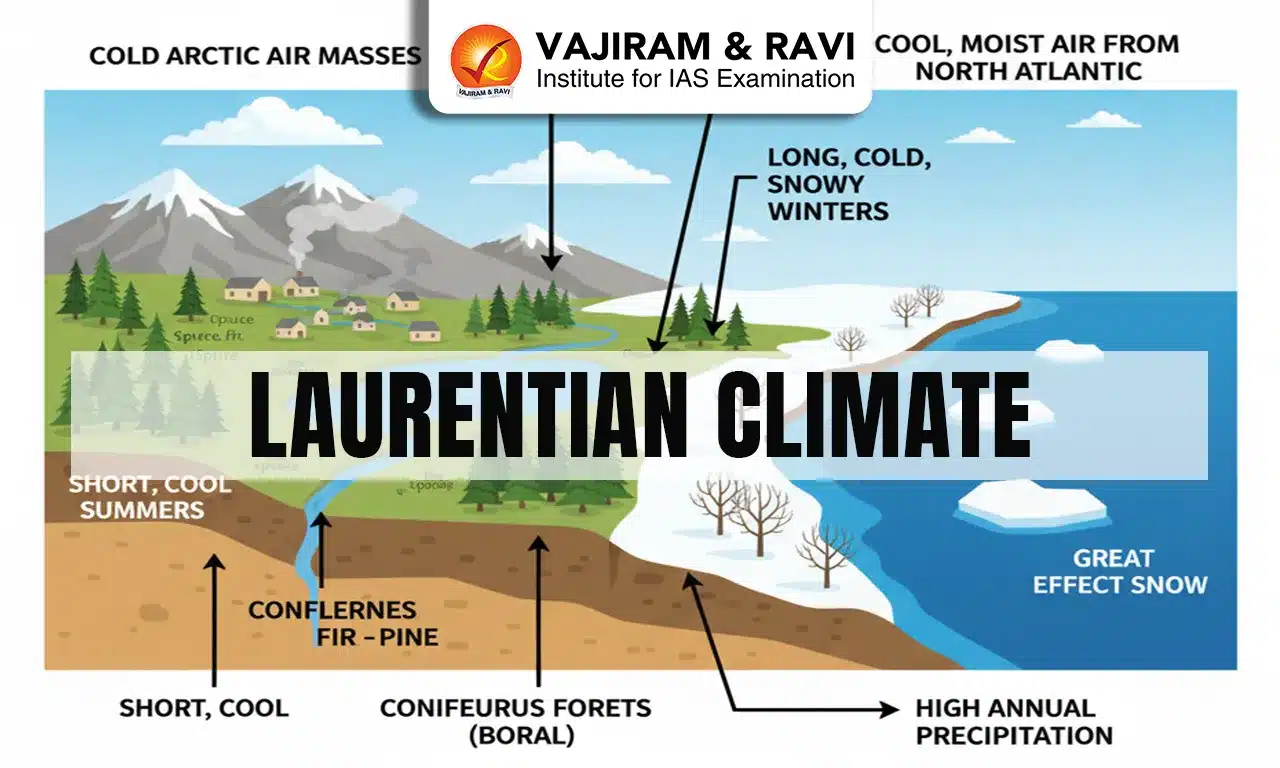
Laurentian Climate Map

[my_image src="https://vajiramandravi.com/current-affairs/wp-content/uploads/2025/10/Laurentian-Climate-Map.jpg" size="full" align="none" alt="Laurentian Climate Map" title="Laurentian Climate Map"]

On a world map, the Laurentian Climate zones appear as narrow belts along the eastern coasts of continents. The St. Lawrence basin, north-eastern United States, north-eastern China, and northern Japan are the most prominent examples. These regions lie along the westerly wind belt, receiving moist air from nearby oceans, but are also affected by cold continental air in winter.

Laurentian Climate Characteristics

The Laurentian Climate displays strong seasonal contrasts due to its mid-latitude location and exposure to both maritime and continental influences.

  • Temperature:
    • Summer temperature: 15°C to 25°C.
    • Winter temperature: often below 0°C, with heavy snowfall.
  • Rainfall:
    • Annual rainfall ranges between 750 mm and 1500 mm.
    • Rainfall is evenly distributed but slightly higher in summer.
  • Humidity: Moderate to high due to proximity to oceanic air masses.
  • Winds: Dominated by westerlies, bringing moist maritime air from oceans.
  • Precipitation Type: Rain during summer; snow in winter.

Factors Affecting Laurentian Climate

The Laurentian Climate is influenced by a combination of geographical, atmospheric, and oceanic factors that shape its distinct seasonal pattern and temperature range. These factors determine the rainfall, vegetation, and economic activities of the region.

  1. Latitude
    • Located between 45° N and 65° N, this region receives moderate solar radiation, causing warm summers and cold winters.
    • The tilt of the Earth’s axis leads to significant seasonal variations.
  1. Proximity to Oceans
    • Coastal areas near the Atlantic and Pacific Oceans experience maritime influence, resulting in mild winters and cool summers.
    • Inland areas like central Canada and northeastern China show continental characteristics with greater temperature extremes.
  1. Ocean Currents
    • The meeting of warm Gulf Stream and cold Labrador Current near Newfoundland moderates coastal temperatures and enriches marine life, making it one of the world’s best fishing zones.
    • Similar effects are seen in Japan, where the Kuroshio and Oyashio currents influence temperature and precipitation.
  1. Topography
    • Mountain ranges like the Rockies and the Appalachians affect rainfall distribution, creating wet coastal and drier inland zones.
    • Valleys and plains support settlements and agriculture due to fertile soils and moderate rainfall.
  1. Wind Systems and Air Masses
    • Westerlies dominate this region, bringing moist oceanic air and precipitation throughout the year.
    • Seasonal shifts in continental and maritime air masses cause noticeable temperature and weather variations.
  1. Human Influence
    • Urbanization, deforestation, and industrialization have begun altering the local climate through urban heat islands and pollution, subtly modifying temperature and rainfall trends.

Read About: Tropical Climate

Laurentian Climate Vegetation

The Laurentian regions support mixed forests, a combination of deciduous and coniferous trees, due to varied temperature and precipitation.

  1. Plants and Trees
    • Dominant deciduous trees: Oak, Maple, Birch, Elm.
    • Coniferous trees: Pine, Spruce, Fir, Hemlock.
    • Mixed forests change seasonally: deciduous trees shed leaves in winter, while conifers remain green.
  1. Herbs and Shrubs
    • Understory vegetation includes ferns, mosses, and small flowering herbs.
    • Shrubs like hazel and viburnum thrive in the moist forest floor.
  1. Species and Wildlife
    • Common animals: Deer, fox, bear, rabbit, raccoon, and squirrel.
    • Bird species: Woodpecker, robin, owl, and duck.
    • In Asia, animals like sika deer and Japanese macaques are typical.
  1. Soil
    • The soil is podzolic and brown forest soil, acidic and low in humus due to slow decomposition in cold weather.
    • Fertility improves when mixed with organic matter and used for agriculture.

Economic Activity in Laurentian Climate Region

The regions under the Laurentian Climate are highly developed and economically significant due to their natural resources, industrialization, and favorable geographical conditions. The economy here is diversified:

  • Lumbering: The vast mixed forests of North America and East Asia form the backbone of the timber and paper industries. Lumbering is a major occupation in Canada, Japan, and North-eastern China, where wood is used for pulp, furniture, and export.
  • Fishing: Coastal regions such as Newfoundland (Canada) and the Japanese coast are among the world’s richest fishing grounds, benefiting from the meeting of warm and cold currents that encourage plankton growth. Cod, salmon, herring, and tuna are the main catches.
  • Forestry: Large-scale timber extraction supports pulp and paper industries, especially in Nova Scotia, Ontario, and Hokkaido.
  • Industry: Hydropower from rivers like the St. Lawrence drives industries such as steel, shipbuilding, automobiles, and chemicals.
  • Trade and Ports: Ice-free ports like Halifax, Yokohama, and Boston facilitate international trade throughout the year.

Laurentian Climate Agriculture

Agriculture in the Laurentian region is limited by short growing seasons but remains productive through mechanization and scientific methods.

  • Crops: Wheat, oats, barley, maize, potatoes, and vegetables.
  • Dairy Farming: Highly developed due to availability of fodder crops and advanced infrastructure.
  • Fruit Cultivation: Apples, cherries, and berries are common in temperate orchards.
  • Livestock: Poultry and cattle farming are integral to rural economies.
  • Technology Use: Greenhouse farming and irrigation improve yields despite climatic constraints.

Laurentian Climate Seasons

The Laurentian Climate experiences four well-defined seasons:

  1. Spring (March-May): Temperatures gradually rise, snow melts, and vegetation regrows. Rainfall increases, supporting crop planting.
  2. Summer (June-August): Warm and humid, with temperatures ranging 15-22 °C. Thunderstorms and occasional heatwaves occur, ideal for agriculture.
  3. Autumn (September-November): Cooling temperatures, trees shed leaves, and harvest occurs. Rainfall decreases, famous for colorful foliage and winds become stronger.
  4. Winter (December-February): Long, cold, and snowy; temperatures often fall below 0 °C. Rivers freeze, snowfall is heavy, and outdoor activities are limited.

Human Adaptations in Laurentian Climate

People living in the Laurentian Climate have developed unique adaptations to cope with cold winters, warm summers, and variable rainfall. Human settlements, industries, and lifestyles have evolved with the environment to ensure comfort, productivity, and sustainability.

  1. Housing and Infrastructure
    • Houses are well-insulated with heating systems to withstand long, cold winters.
    • Sloped roofs prevent snow accumulation, and double-glazed windows retain heat.
  1. Clothing and Lifestyle
    • People wear layered woolen clothing in winter and lighter fabrics in summer.
    • Seasonal lifestyles include winter sports like skiing and summer farming or fishing.
  1. Transportation and Energy
    • Snow-clearing systems, heated roads, and underground transport ensure mobility.
    • Widespread use of hydropower and renewable energy supports sustainable living.
  1. Economic and Agricultural Practices
    • Adaptation through seasonal farming and greenhouse cultivation during cold months.
    • Lumbering and fishing industries thrive year-round, adjusted to seasonal cycles.

Laurentian Climate Challenges

Regions under the Laurentian Climate face several environmental and socio-economic challenges due to extreme winters, short growing seasons, and human activity. Addressing these challenges requires sustainable practices, technological adaptation, and policy support.

  1. Severe Winters
    • Challenge: Long, harsh winters limit agriculture, disrupt transport, and increase energy demand.
    • Way Forward: Promote climate-resilient crops, greenhouse farming, and efficient heating systems to sustain productivity and daily life.
  1. Short Growing Seasons
    • Challenge: Limited agricultural window restricts crop variety and yield.
    • Way Forward: Use cold-tolerant crop varieties, extend cultivation with greenhouses, and adopt advanced farming techniques.
  1. Snowstorms and Blizzards
    • Challenge: Heavy snowfall disrupts transport, trade, and daily activities.
    • Way Forward: Develop infrastructure for snow removal, strengthen roads and railways, and implement disaster preparedness measures.
  1. Soil Erosion and Deforestation
    • Challenge: Clearing forests for agriculture and urbanization causes soil degradation and reduces forest cover.
    • Way Forward: Implement afforestation programs, sustainable logging practices, and soil conservation methods to protect ecosystems.
  1. Pollution and Industrial Impact
    • Challenge: Industrialization and urban growth increase air and water pollution in cities like Montreal, Boston, and Sapporo.
    • Way Forward: Enforce emission standards, promote green industries, and increase use of renewable energy like hydropower and wind.
  1. Overfishing and Resource Depletion
    • Challenge: Excessive fishing threatens marine biodiversity in coastal areas.
    • Way Forward: Regulate fishing zones, adopt sustainable fishing practices, and monitor marine ecosystems.

Laurentian Climate UPSC

In 2025, northeastern North America and eastern Canada have begun facing widespread drought; many cities recorded 50% or less of normal summer rainfall since June. Simultaneously, a record heatwave struck the Northeast U.S. and eastern Canada in June, with temperatures exceeding 35°C and made 2-5 times more likely by climate change.

Also Check Other Posts
Coastal Regulation Zone Global Plastic Treaty
Nitrogen Cycle Carbon Cycle

Laurentian Climate FAQs

Q1: What is Laurentian Climate?

Ans: The Laurentian Climate is a cool temperate eastern margin climate with cold winters, warm summers, and moderate rainfall throughout the year.

Q2: Where is Laurentian Climate found?

Ans: It occurs in eastern North America, north-eastern China, Korea, and northern Japan, mainly between 45° and 65° latitude.

Q3: What are the main characteristics of Laurentian Climate?

Ans: Key features include four distinct seasons, heavy snowfall in winter, moderate summer rainfall, and mixed forest vegetation.

Q4: How does the Laurentian Climate affect agriculture?

Ans: Agriculture depends on short growing seasons, with crops like wheat, maize, oats, vegetables, and fruits such as apples and cherries.

Q5: What are the major species of plants found in Laurentian Climate?

Ans: The major plant species in Laurentian Climate include oak, maple, birch, pine, spruce, fir, hemlock, and mixed deciduous-coniferous trees.

Sea Floor Spreading Theory (1962), History, Causes, Evidences, Impact

Sea Floor Spreading Theory

The Sea Floor Spreading Theory is a foundational concept in geology that explains the creation and lateral movement of the oceanic crust. Proposed by Harry Hess in 1962, this theory provided the missing mechanism for Alfred Wegener’s Continental Drift Theory. Sea floor spreading explains the widening of ocean basins, the formation of mid-ocean ridges, and recycling of crust at trenches. According to the US Geological Survey (USGS), mid-ocean ridges account for over 65,000 km of undersea mountain chains worldwide, making sea floor spreading a key driver of Earth’s tectonics.

Sea Floor Spreading Theory

Seafloor Spreading Theory is a geological concept that explains how new oceanic crust forms at mid-ocean ridges and moves laterally away from the ridge. As magma rises from the mantle and solidifies, it creates a new basaltic crust, which gradually pushes the older crust outward. The older crust is eventually recycled into the mantle at deep-sea trenches, driving plate tectonics, ocean basin expansion, and volcanic and seismic activity.

Sea Floor Spreading Theory Historical Development

The development of sea floor spreading theory addressed the lack of a mechanism in Continental Drift Theory. Global organizations like NOAA, USGS, and INCOIS have verified these observations, providing authentic evidence of sea floor spreading worldwide.

  • 1912: Alfred Wegener proposed continental drift, suggesting continents move over time. However, he could not explain the driving force.
  • 1950s: Detailed sonar mapping of the ocean floor revealed mid-ocean ridges, trenches, and fracture zones, highlighting the dynamic nature of the ocean floor.
  • 1962: Harry Hess proposed that new oceanic crust forms at ridges and moves outward, providing the missing mechanism for continental drift.
  • 1963: Frederick Vine and Drummond Matthews correlated magnetic anomalies with crust formation, showing symmetrical stripes along ridges corresponding to geomagnetic reversals.
  • Later, ocean drilling programs confirmed that oceanic crust near ridges is younger and gradually becomes older away from the ridge.

Sea Floor Spreading Causes

Sea floor spreading occurs due to movements in the Earth's mantle, forces at tectonic plate boundaries, and volcanic activity at ridges. Key Causes:

  • Mantle Convection Currents: Hot mantle material rises at mid-ocean ridges and cooler material sinks at trenches, driving crustal movement.
  • Ridge Push: Elevated mid-ocean ridges push the newly formed crust outward due to gravity.
  • Slab Pull: Dense, older oceanic crust sinks into subduction zones, pulling plates along.
  • Volcanic Activity: Rising magma at ridges forms new crust, promoting lateral displacement.
  • Tectonic Plate Interaction: Divergent boundaries allow plates to separate, facilitating spreading.
  • Earth’s Heat Flow: High heat at ridges reduces crust density, aiding upward magma movement.
  • Gravity and Lithospheric Dynamics: Buoyancy differences between new and old crust assist lateral motion.

Sea Floor Spreading Theory Mechanism

The mechanism of sea floor spreading can be understood as a continuous cycle of creation and recycling of oceanic crust:

  1. Magma Upwelling at Mid-Ocean Ridges: Mantle material rises through cracks at the ridges due to convection currents, forming magma chambers beneath the ridge axis.
  2. Formation of New Crust: The magma cools and solidifies as basaltic rock, forming a new oceanic crust. This newly formed crust is initially thin and hot.
  3. Lateral Movement: The new crust moves laterally away from the ridge due to gravitational forces, ridge push, and mantle convection. Older crust moves farther from the ridge over time.
  4. Subduction at Trenches: As the crust ages, it becomes denser and sinks into deep-sea trenches, recycling into the mantle. Subduction zones are often associated with deep-focus earthquakes and volcanic arcs.
  5. Expansion of Ocean Basins: The continuous creation and lateral movement of crust gradually widens oceans over millions of years, shaping global geography.
  6. Seismic and Volcanic Activity: The process generates shallow earthquakes at ridges and deep-focus earthquakes at trenches, while subduction and rising magma produce underwater and island volcanoes.

Sea Floor Spreading Evidence

Multiple lines of evidence confirm sea floor spreading:

  • Magnetic Anomalies: Basaltic rocks at mid-ocean ridges contain magnetic minerals that record Earth’s magnetic field at the time of formation. Symmetrical patterns of magnetic stripes on both sides of the ridge correspond to geomagnetic reversals, confirming the creation of new crust and lateral movement.
  • Age of Oceanic Crust: Radiometric dating shows that rocks at mid-ocean ridges are youngest, while those farther from the ridge are older. For example, the Atlantic Ocean crust ranges from 0-180 million years. This age gradient supports the continuous creation and outward movement of oceanic crust.
  • Sediment Thickness: Sediments accumulate over time on the ocean floor. Sediment layers are thinner near ridges and thicker farther away, indicating the progressive age of the oceanic crust and validating spreading rates.
  • Heat Flow: The flow of geothermal heat is highest at mid-ocean ridges (~200 mW/m²) and decreases with distance from the ridge. High heat flow indicates rising magma and active crust formation.
  • Seismic Activity: Shallow earthquakes occur along ridges due to crustal formation and movement. Deep-focus earthquakes occur at trenches where subduction recycles old crust.
  • Volcanic Activity: Mid-ocean ridges host underwater volcanoes, producing basaltic crust. Subduction zones along trenches create volcanic arcs, showing the link between spreading and tectonic activity.
  • Ocean Drilling Data: Deep-sea drilling programs show a systematic increase in crustal age with distance from ridges and confirm sediment accumulation patterns, providing direct verification of sea floor spreading.

Sea Floor Spreading Theory and Paleomagnetism

Paleomagnetism is the study of ancient magnetic fields preserved in rocks. INCOIS and NOAA surveys have mapped magnetic anomalies in Indian and global oceans, validating predicted spreading rates and directions. This evidence connects the Earth’s magnetic history with the dynamic movement of oceanic crust. It is crucial in validating sea floor spreading:

  • Basaltic rocks at ridges record the Earth’s magnetic polarity at the time of solidification.
  • Symmetrical magnetic stripes on either side of ridges correspond with periods of geomagnetic reversals.
  • Paleomagnetic data show that new crust forms at ridges and spreads outward symmetrically, confirming lateral movement of oceanic plates.

Role of Convection Currents in Sea Floor Spreading Theory

Mantle Convection Currents act as the engine of Sea Floor Spreading. Convection Currents explain variations in spreading rates. For example, the East Pacific Rise spreads at ~15 cm/year, whereas the Central Indian Ridge spreads at 2-4 cm/year, reflecting differences in mantle flow intensity. These currents also cause volcanic activity and influence the distribution of earthquakes globally.

  • Hot mantle material rises beneath ridges, forming a new crust.
  • Cooling and denser crust sinks at trenches, creating subduction zones.
  • The cyclical flow of mantle material drives lateral movement of oceanic plates.

Sea Floor Spreading Impact

Sea floor spreading has significant geological and environmental impacts:

  • Formation and Expansion of Ocean Basins: Continuous spreading widens oceans like the Atlantic, Indian, and Pacific over millions of years.
  • Plate Movements and Continental Drift: Drives the motion of tectonic plates, formation of rift valleys, mountain ranges, and ocean trenches.
  • Seismic Activity: Shallow earthquakes at ridges and deep earthquakes at subduction zones are a direct consequence of crustal movement.
  • Volcanism: Underwater and island volcanoes form at ridges and subduction zones, releasing basaltic magma.
  • Mineral Formation: Hydrothermal vents and oceanic crust are rich in copper, zinc, silver, and polymetallic nodules.
  • Long-Term Climate Influence: By altering ocean basin geometry and circulation patterns, sea floor spreading indirectly affects global climate over geological timescales.

Sea Floor Spreading Theory UPSC

In 2025, significant advancements in seafloor spreading research have emerged. These developments underscore the dynamic nature of seafloor spreading research and its evolving understanding in the scientific community.

  • Global Oceanic Asthenosphere Imaging: New imaging techniques reveal a global oceanic asthenosphere modulated by seafloor spreading, enhancing our understanding of mantle dynamics. 
  • Magmatic Pulses in Rifting: Studies identify three major magmatic pulses facilitating the transition from continental rifting to seafloor spreading, providing insights into crust formation processes. 

Hydrothermal Vent Eruption Observation: A rare seafloor eruption at the Tica hydrothermal vent along the East Pacific Rise offers critical insights into seafloor dynamics and crust formation.

Other Related Posts
Chota Nagpur Plateau Interior of the Earth
Malwa Plateau Continental Drift Theory
Soils of India Paleomagnetism
Largest State in India Convectional Current Theory
Godavari River System Tsunami
Big Bang Theory Western Disturbances in India
Latitude and Longitude The Universe
Asteroid

Sea Floor Spreading Theory FAQs

Q1: Who proposed the Sea Floor Spreading Theory?

Ans: The theory was introduced by Harry Hess in 1962.

Q2: Where is the new Oceanic Crust formed?

Ans: At mid-ocean ridges, where magma rises and solidifies.

Q3: What drives Sea Floor Spreading?

Ans: Mantle convection currents, ridge push, slab pull, and volcanic activity.

Q4: How does Paleomagnetism support the Sea Floor Spreading Theory?

Ans: Symmetrical magnetic stripes record geomagnetic reversals, confirming lateral movement of the new crust.

Q5: Why is Sea Floor Spreading important?

Ans: It explains plate tectonics, continental drift, earthquakes, volcanism, and ocean basin formation.

Exercise KONKAN-25

Exercise KONKAN-25

Exercise KONKAN-25 Latest News

Recently, Exercise KONKAN-25 commenced on 05 Oct 2025, off the western coast of India. 

About Exercise KONKAN-25

  • It is a bilateral naval exercise between the Indian Navy and Royal Navy of UK.
  • The exercise will be conducted in two phases.
  • The harbour phase of the Exercise will include professional interactions between naval personnel, cross deck visits, sports fixtures, and cultural engagements.
  • The sea phase will encompass complex maritime operational drills focusing on anti-air, anti-surface, and anti-submarine exercises, flying operations and other seamanship evolutions.
  • Both participating nations will deploy frontline assets, including aircraft carriers, destroyers, frigates, submarines, and integral and shore based air assets.
  • The Indian side will be represented by the carrier battle group of the indigenous aircraft carrier INS Vikrant in company with other surface, sub-surface and air combatants.
  • This exercise is a reaffirmation of the shared commitment to ensuring secure, open and free seas and will exemplify the Comprehensive Strategic Partnership outlined in ‘India-UK Vision 2035’.
  • Significance: Exercise Konkan 2025 will serve as a platform to consolidate strategic ties, enhance interoperability and contribute to regional maritime stability.

Source: PIB

Exercise KONKAN-25 FAQs

Q1: Which navies are participating in Exercise KONKAN-25?

Ans: Indian Navy and Royal Navy (UK).

Q2: Where did Exercise KONKAN-25 commence?

Ans: Western coast of India.

Chlorophytum Vanapushpam

Chlorophytum Vanapushpam

Chlorophytum Vanapushpam 

Researchers during a field exploration in Idukki district’s Vagamon hills have identified a new species of the genus Chlorophytum and named the new species as Chlorophytum vanapushpam.       

About Chlorophytum Vanapushpam

  • It is a perennial herb belonging to the genus Chlorophytum (family Asparagaceae).
  • It is a close relative of the safed musli.
  • It has been found in the rocky hills of Vagamon and Neymakkad - parts of the Western Ghats regions of Idukki district - at elevations between 700 m and 2124 m.
  • The species name vanapushpam is a composite of ‘Vanam’ and ‘Pushpam,’ the Malayalam for forest and flower respectively.
  • Features of Chlorophytum vanapushpam
    • It has white flowers in small clusters and slender leaves and grows up to 90 cm in height.
    • But unlike its more famous cousin Chlorophytum borivilianum, Chlorophytum vanapushpam lacks tubers.
    • Its seeds are about 4 to 5 mm across. Flowering and fruiting occurs from September to December.
  • The Western Ghats region is thought to be a centre of origin of the genus Chlorophytum.
  • A total of 18 species have been identified here so far, with many of them exhibiting  medicinal properties.
  • One of these is the Chlorophytum borivilianum, more familiar to Indians as the ‘safed musli,’ a herb widely used in traditional medical preparations and also popular as a leaf vegetable.

Source: TH

Chlorophytum Vanapushpam FAQs

Q1: What are the primary uses of Safed Musli?

Ans: Safed Musli is used to enhance strength, stamina, and overall well-being

Q2: What is the meaning of perennial plant?

Ans: A plant that persists for several years, usually with new herbaceous growth from a part that survives from growing season to growing season.

Drafting Committee, Formation, Members, Challenges, Criticism

Drafting Committee

The Drafting Committee was one of the major committees of the Constituent Assembly of India. It was tasked with framing the Constitution of independent India, ensuring that the nation became a sovereign and democratic republic. The committee embedded the core values of justice, liberty, equality, and fraternity into the governance structure, while also considering India’s cultural, linguistic, and religious diversity.

Drafting Committee

The Committee served as the central body that synthesized proposals from various sub-committees, analyzed suggestions from members of the Constituent Assembly, and prepared drafts for discussion. The committee laid the foundation for a legal framework of India. It was part of the Constituent Assembly.

Drafting Committee Formation

The Drafting Committee was formed on 29 August 1947, shortly after India gained independence on 15 August 1947. The formation was recommended by the Constituent Assembly’s Steering Committee, chaired by Dr. Rajendra Prasad. The decision was formalized to assign the task of preparing a draft Constitution to a smaller, focused group with expertise in law, governance, and public administration.

Members of the Drafting Committee

The Drafting Committee had seven members, chaired by Dr. B. R. Ambedkar, considered the “Father of the Indian Constitution.” Each member contributed uniquely to different aspects of the Constitution:

Members of the Drafting Committee
Member Role & Contributions

Dr. B. R. Ambedkar

Chairman; led drafting of fundamental rights, directive principles, and social justice provisions

Alladi Krishnaswami Ayyar

Legal expert; contributed to judicial and administrative provisions

N. Gopalaswami Ayyangar

Worked on federal structure and state reorganization

K. M. Munshi

Advocated for cultural preservation and fundamental rights

Mohammad Saadulla

Focused on minority rights and regional interests

B. L. Mitter / N. Madhava Rau

Legal and administrative contributions, replaced resigning members

D. P. Khaitan / T. T. Krishnamachari

Assisted in drafting, replaced members as necessary

Drafting Committee Objectives

The Drafting Committee was guided by the following objectives:

  • Draft a Constitution suitable for India’s socio-political diversity.
  • Safeguard individual rights through Fundamental Rights and Directive Principles of State Policy.
  • Ensure a federal structure balancing central and state powers.
  • Promote social justice, minority rights, and affirmative action.
  • Establish strong governance institutions with checks and balances between Executive, Legislature, and Judiciary.

Process of Drafting of the Constitution

The drafting of the Indian Constitution was carried out in well-defined stages, beginning with the Objectives Resolution in 1946 and culminating in its adoption in 1949. The timeline below highlights the major steps:

Drafting of the Indian Constitution
Stage Title Date Key Highlights

Stage 1

First Session of Constituent Assembly

13 Dec 1946 - 22 Jan 1947

Nehru moved the Objectives Resolution on 13 Dec 1946; adopted on 22 Jan 1947, setting guiding principles for the Constitution.

Stage 2

Committee Stages & Second Session

27 Feb 1947 - 30 Aug 1947

Advisory Committee, Union Powers Committee, Provincial Constitution Committee submitted reports; debates concluded on 30 Aug 1947.

Stage 3

Draft by Constitutional Adviser (B. N. Rau)

1 Feb 1947 - 31 Oct 1947

B. N. Rau prepared the Draft Constitution, completed by Oct 1947 and submitted to Drafting Committee.

Stage 4

First Draft by Drafting Committee

27 Oct 1947 - 21 Feb 1948

Drafting Committee, chaired by Ambedkar, revised Rau’s draft; First Draft submitted on 21 Feb 1948.

Stage 5

Public Circulation of Draft

21 Feb 1948 - 26 Oct 1948

Draft Constitution circulated for feedback; Special Committee reviewed suggestions; revised draft re-submitted on 26 Oct 1948.

Stage 6

Draft Presented to Assembly

4 Nov 1948

Dr. B. R. Ambedkar introduced the Draft Constitution in the Constituent Assembly.

Stage 7

First Reading (Clause-by-Clause Debates)

15 Nov 1948 - 17 Oct 1949

Assembly held extensive debates, with over 2,000 amendments proposed and discussed article by article.

Stage 8

Revision & Second Reading

3 Nov 1949 - 16 Nov 1949

Drafting Committee revised Constitution as per debates; Second Reading held from 14–16 Nov 1949.

Stage 9

Third Reading

17 Nov 1949 - 26 Nov 1949

Final speeches and general comments; Constitution adopted on 26 Nov 1949.

Stage 10

Enactment & Adoption

24 Jan 1950 - 26 Jan 1950

Constitution signed by members on 24 Jan 1950; came into effect on 26 Jan 1950 (Republic Day).

First Draft (21 February 1948)

The Drafting Committee, chaired by Dr. B.R. Ambedkar, presented the first draft on 21 February 1948. It had 315 Articles and 8 Schedules. This draft was circulated for public discussion, attracting over 7,000 comments from provincial assemblies, legal experts, and the public, shaping future revisions.

Second Draft (21 October 1948)

The second draft was introduced in the Constituent Assembly on 21 October 1948. It reflected changes from public feedback and Assembly debates. Members deliberated extensively on fundamental rights, the federal system, and emergency provisions. This draft remained open for detailed discussions until November 1949.

Third Draft (Feb - Oct, 1949)

Between February and October 1949, the Drafting Committee submitted the third draft after considering nearly 2,000 amendments moved in the Assembly. Key debates covered the national language, separation of powers, minority rights, and the judiciary’s role, bringing the Constitution close to its final shape.

Final Draft (26 November 1949)

On 26 November 1949, the Constituent Assembly formally adopted the final Constitution with 395 Articles, 22 Parts, and 8 Schedules. The process had taken 2 years, 11 months, and 18 days. This date is now observed as Constitution Day in India.

Signature (24 January 1950)

On 24 January 1950, 284 of 299 members of the Constituent Assembly signed the final handwritten copies in English and Hindi. Two days later, on 26 January 1950, the Constitution came into effect, marking India’s transition to a sovereign democratic republic.

Challenges Faced by Drafting Committee

The drafting committee although being filled with the members belonging to Political and Legal backgrounds faced several challenges while drafting of the constitution as given below:

  • Balancing linguistic, religious, and cultural differences.
  • Fundamental Rights vs Directive Principles while Ensuring social justice without compromising liberty.
  • Confusion in Federal vs Unitary Structure while determining power distribution between Union and States.
  • Adapting and integrating ideas from other constitutions to suit Indian context.
  • Drafting amid post-independence economic and political instability.

Criticism of Drafting Committee

In spite of various features and successful implementation of final draft, the drafting committee faced several backlashes including:

  • Limited representation, with only seven members, potentially reducing diversity of perspectives.
  • Dominant influence of the Chairman, Dr. Ambedkar, though positive for efficiency.
  • Too complex for the Public to understand.
  • Domination of Advocates and Politicians.
  • No representation of Woman.
  • Borrowing of Provisions
  • Excessive Restrictions on Fundamental Rights

Drafting Committee FAQs

Q1: Who chaired the Drafting Committee of India?

Ans: Dr. B. R. Ambedkar served as the Chairman of the Drafting Committee.

Q2: When was the Drafting Committee formed?

Ans: It was established on August 29, 1947.

Q3: How many members were initially in the Drafting Committee?

Ans: The committee initially had seven members.

Q4: When was the final draft of the Constitution completed?

Ans: The final draft was completed on October 17, 1949.

Q5: What was the main objective of the Drafting Committee?

Ans: To prepare a Constitution reflecting India’s diversity, ensuring justice, equality, liberty, and social welfare.

Carbon Accounting, Meaning, Purpose, Methods, Challenges

Carbon Accounting

Carbon accounting is the systematic method of measuring, recording, and reporting greenhouse gas (GHG) emissions generated by activities at the individual, organizational, or national level. With climate change becoming a critical global issue, carbon accounting helps monitor and mitigate environmental impact. According to the IPCC Sixth Assessment Report 2023, global CO₂ emissions must fall by 48% by 2030 as compared to 2019, to limit warming to 1.5°C. In India, carbon accounting is integral to achieving its Nationally Determined Contributions (NDCs) under the Paris Agreement. 

Carbon Accounting

Carbon accounting, also called Greenhouse Gas Accounting, involves calculating the amount of carbon dioxide (CO₂) and other GHGs emitted by human activities. It includes direct emissions from fuel combustion, indirect emissions from electricity use, and other indirect emissions across supply chains. Carbon accounting enables transparent reporting and informed decision-making for sustainability initiatives.

Carbon Accounting Purpose

The primary purposes of carbon accounting are listed below. According to the Global ESG Data Survey 2022, over 66% of Indian companies now disclose emissions data, showing rising adoption of carbon accounting.

  • To measure environmental impact accurately and identify emission hotspots.
  • To support policy formulation and compliance with national and international climate agreements.
  • To enable organizations to participate in carbon credit markets and trading.
  • To promote corporate social responsibility (CSR) and ESG reporting.
  • To reduce costs by improving energy efficiency and adopting low-carbon technologies.

Carbon Accounting Methods

Various methodologies are used for carbon accounting:

  1. GHG Protocol Corporate Standard- For organizations to report Scope 1, 2, and 3 emissions.
  2. ISO 14064 Standard- International standard for quantifying, reporting, and verifying GHG emissions.
  3. Life Cycle Assessment (LCA)- Calculates emissions across the entire lifecycle of products or services.
  4. Carbon Footprint Calculators- Used by individuals or small organizations to estimate emissions.
  5. Activity-Based Accounting- Emissions are calculated based on energy usage, transport, and material consumption.

Carbon Accounting Process

Carbon accounting divides emissions into three scopes as per the GHG Protocol:

Carbon Accounting Process
Scope Description Examples

Scope 1

Direct emissions from owned or controlled sources

Factory boilers, company vehicles

Scope 2

Indirect emissions from purchased energy

Electricity, heat, or steam

Scope 3

Other indirect emissions

Supply chain, business travel, product disposal

Carbon Accounting Standards

Carbon accounting follows globally recognized standards to ensure consistency and transparency. According to MoEFCC 2023, India encourages ISO 14064 certification for organizations reporting emissions under voluntary programs.

  • GHG Protocol- Developed by the World Resources Institute (WRI) and World Business Council for Sustainable Development (WBCSD), widely used for corporate reporting.
  • ISO 14064- Provides international guidelines for GHG quantification, reporting, and verification.
  • PAS 2050- UK-based standard for product carbon footprinting.
  • CDP (Carbon Disclosure Project)- Encourages companies to publicly disclose emissions and climate risks.

Applications of Carbon Accounting

Carbon accounting is applied across sectors in India and globally:

  • Corporate Reporting- Companies like Infosys, Tata Steel, and Reliance Industries disclose emissions for ESG compliance.
  • Renewable Energy Planning- Tracks carbon reductions in solar, wind, and hydro energy projects.
  • Agriculture- Estimates emissions from fertilizers, livestock, and crop management.
  • Transport- Monitors vehicle fleet and logistics emissions to implement greener mobility.
  • Policy and Governance- Supports India’s climate targets under NDCs and promotes low-carbon development.

Carbon Accounting Advantages and Disadvantages

There are several advantages and disadvantages of Carbon accounting:

  • Advantages of Carbon Accounting:
    • Helps reduce environmental impact and GHG emissions.
    • Supports compliance with national and international climate regulations.
    • Enables participation in carbon credit and trading markets.
    • Improves operational efficiency and cost savings.
    • Enhances corporate image and investor confidence through ESG reporting.
  • Disadvantages of Carbon Accounting:
    • Requires technical expertise and trained personnel.
    • Implementation can be costly, especially for SMEs.
    • Data collection may be difficult in supply chains or small industries.
    • Lack of uniform standards in some sectors can create reporting inconsistencies.

Carbon Accounting Challenges

The Carbon Accounting has various challenges in the process and implementation as given below:

Challenges:

  • Data Gaps- Limited availability of accurate emissions data.
  • Technical Expertise- Shortage of trained professionals.
  • High Costs- Monitoring and reporting expenses are significant.
  • Policy Integration- Difficulties in linking carbon accounting with regulations.

Way Forward:

  • Capacity Building- Train professionals in carbon auditing and GHG reporting.
  • Standardization- Align reporting with GHG Protocol and ISO 14064.
  • Digital Monitoring- Use AI, IoT, and blockchain for real-time emission tracking.
  • Incentives- Provide subsidies or tax benefits for implementing carbon accounting.
  • Policy Integration- Link accounting with carbon credit systems and renewable energy targets.

Carbon Footprints

A carbon footprint is the total GHG emissions caused directly or indirectly by an individual, organization, or product. It is measured in CO₂-equivalent (CO₂e). Carbon footprints help identify high-emission activities and guide reduction strategies. According to the International Energy Agency, India’s per capita carbon emission is 1.776 tonnes CO₂e, below the global average of 4.8 tonnes.

Need for Carbon Accounting

India aims to reduce emissions intensity of GDP by 45% by 2030 from 2005 levels (NDC target). Accurate carbon accounting is crucial to monitor progress. The major requirement for the Carbon Accounting is listed below:

  • To meet India’s Paris Agreement targets.
  • To identify emission hotspots and take mitigation measures.
  • To access global carbon markets and attract sustainable investment.
  • To improve corporate sustainability reporting and stakeholder trust.

Carbon Accounting in India

India uses carbon accounting for both voluntary and regulatory purposes. Carbon accounting helps India track emission reductions and plan climate-resilient strategies. Key highlights:

Carbon Accounting in India
Aspect Detail

Per Capita CO₂e Emissions

1.776  tonnes CO₂e; Global Ranking of 98th

CO2 emission by sector, India, 2022; Source: IEA

  • Electricity and Heat Producer (52.7%)
  • Transport Sector (12.9%)
  • Industry Sector (24.1%)
  • Residential (3.9%)
  • Other Industries (6.4%)

Corporate Adoption

66% of top 100 companies report emissions (Global ESG Survey 2022)

Policy Framework

National Action Plan on Climate Change (NAPCC), National Carbon Trading Pilot (2023)

Global Aspects of Carbon Accounting

Globally, carbon accounting is integral to climate policy and international agreements.

  • Top Emission Reporting Countries- USA, EU, China, Japan have mandatory corporate and national emissions reporting.
  • Carbon Credit Mechanisms- Accurate carbon accounting allows participation in emissions trading systems (ETS).
  • International Standards- ISO, GHG Protocol, CDP reporting ensure transparency and comparability across borders.

Carbon Accounting UPSC

India has made notable progress in integrating carbon accounting into its policies and business practices, strengthening transparency, compliance, and alignment with global standards. Several key initiatives in recent years have advanced India’s carbon management framework. Key Developments:

  • Carbon Credit Trading Scheme (CCTS)- July 2024: Government adopted detailed regulations introducing a compliance-based carbon market.
  • Emissions Trading System (ETS): Rate-based ETS launched under CCTS, covering nine energy-intensive industrial sectors, with expansion planned by mid-2026.
  • PCAF India Chapter- September 2025: Partnership for Carbon Accounting Financials launched guidelines for financial institutions to measure and disclose Scope 3 emissions.

Focus on Transparency and Accountability: These initiatives enhance accurate reporting, align India with global standards, and support national climate goals.

Also Check Other Posts
Coastal Regulation Zone Global Plastic Treaty
Nitrogen Cycle Carbon Cycle

Carbon Accounting FAQs

Q1: What is Carbon Accounting?

Ans: Carbon accounting measures, tracks, and reports greenhouse gas emissions from activities or organizations.

Q2: Why is Carbon Accounting important for India?

Ans: It helps India meet climate targets, reduce emissions, and report under the Paris Agreement.

Q3: What are the main methods of Carbon Accounting?

Ans: GHG Protocol, ISO 14064, Life Cycle Assessment (LCA), and carbon footprint calculators are widely used.

Q4: Which sectors use Carbon Accounting in India?

Ans: Energy, transport, industry, agriculture, and corporate organizations.

Q5: What is a Carbon Footprint?

Ans: It is the total GHG emissions caused directly or indirectly by an individual, organization, or product.

National Initiative on Climate Resilient Agriculture (NICRA)

National Initiative on Climate Resilient Agriculture (NICRA)

NICRA was implemented in the year 2011. The agricultural sector in India is one of the most climate-sensitive sectors of the economy, providing livelihood to many and providing the nation’s food security. However, climate change has increasingly posed serious threats to agriculture, ranging from erratic rainfall and rising temperatures to extreme weather events such as floods, droughts, and heatwaves. Understanding the urgent need to safeguard agricultural productivity and sustainability, the Indian Council of Agricultural Research launched the National Initiative on Climate Resilient Agriculture (NICRA) in 2011, with funding support from the Ministry of Agriculture, Government of India. This initiative aims to strengthen the resilience of Indian agriculture in the face of climate variability, promote sustainable farming practices, and empower farmers to adapt to changing environmental conditions. In this article, we are going to cover the National Initiative on Climate Resilient Agriculture, its objectives, components, features, outcomes and challenges. 

NICRA Objectives

NICRA was introduced with the goal of transforming Indian agriculture into a climate-resilient system by addressing vulnerabilities across crops, livestock, and fisheries. Its key objectives include:

  1. Improving Agricultural Resilience: Developing and deploying improved production technologies and risk management strategies to help agriculture withstand climatic variability and extreme weather events.
  2. Showing Adaptive Technologies: Implementing site-specific technology packages on farmers’ fields to showcase practical solutions for managing current and emerging climate risks.
  3. Capacity Building: Strengthening the skills and knowledge of scientists, extension workers, and stakeholders in climate-resilient agricultural research, technology dissemination, and field-level application.

By focusing on these objectives, NICRA makes sure that agriculture in India continues to thrive under difficult climate conditions, hence contributing to national food security and rural livelihoods.

NICRA Components

NICRA operates through a multi-pronged approach, with four main components designed to address climate risks in agriculture:

  1. Strategic Research: Conducting research on adaptation and mitigation strategies for crops, livestock, and fisheries, aimed at generating solutions to climate-related challenges.
  2. Technology Demonstration: Implementing adaptive technologies in 100 climate-vulnerable districts across India to show best practices and site-specific solutions for farmers.
  3. Capacity Building: Training scientists, extension personnel, and farmers in climate-resilient technologies and practices, while promoting knowledge sharing and awareness.
  4. Sponsored Competitive Research: Supporting targeted research projects to address critical knowledge gaps in climate-resilient agriculture.

The research component of NICRA is facilitated by the 21 institutes under ICAR, which serve as strategic centres for developing innovative technologies and conducting climate-focused agricultural research.

NICRA Important Features

NICRA incorporates many advanced strategies and features to promote climate-resilient agriculture:

  • Vulnerability Assessment: Analysing crops and agro-climatic zones across India to identify susceptibility to climate stress and extreme weather events, with particular attention to intra-seasonal rainfall variability.
  • State-of-the-Art Equipment: Installing flux towers and other advanced tools to measure greenhouse gas (GHG) emissions in field conditions, enabling scientists to understand the impact of management practices on emissions.
  • Rapid Germplasm Screening: Large-scale evaluation of crop germplasm, including wild relatives, for drought and heat tolerance using phenomics platforms, allowing early identification of promising lines for cultivation.
  • Innovative Paddy Cultivation Practices: Checking emerging approaches such as aerobic rice cultivation and the System of Rice Intensification (SRI) to reduce GHG emissions, conserve water, and enhance productivity.
  • Focus on Livestock and Fisheries: Addressing the overlooked impacts of climate change on livestock and aquaculture, and developing resilient management strategies for these sectors.
  • Pest and Pathogen Management: Studying the effect of climate change on pest-crop interactions and monitoring the emergence of new pest and pathogen biotypes.
  • Upscaling of Outputs: Upgrading the proven technologies through Krishi Vigyan Kendras (KVKs) and the National Mission on Sustainable Agriculture and wider adoption by farmers.

NICRA Outcomes

NICRA has delivered many results since its implementation, contributing to both scientific knowledge and practical agricultural solutions:

  • Climate-Resilient Crop Varieties and Livestock Breeds: Identification of high-performing crop genotypes and livestock breeds capable of tolerating drought, heat, and other climatic stresses.
  • Demonstration of Best Practices: Successful implementation of adaptive farming techniques in 100 vulnerable districts, providing a model for wider adoption.
  • Strengthened Research Infrastructure: Upgrading research facilities at key institutes to better monitor, study, and address climate risks in agriculture.
  • Skilled Scientific Workforce: Training of scientists, extension personnel, and farmers in climate-resilient agriculture practices, fostering expertise in this critical field.
  • Empowered Farmers: Increased awareness and capacity among farmers to cope with climate variability, enabling more resilient and productive farming systems.

Challenges in Implementing NICRA

Irrespective of the successes, NICRA faces many challenges that need to be addressed to fully realise its potential:

  1. Less Resources: Adequate funding is necessary to scale up research, demonstrations, and farmer outreach activities across diverse agro-climatic zones.
  2. Infrastructure Limitations: Some regions lack the necessary infrastructure for implementing advanced climate-resilient technologies.
  3. Institutional Coordination: Effective collaboration between government departments, research institutions, and farmers’ organisations remains essential for seamless execution.
  4. Scaling Up: Expanding the reach of successful technologies to a larger number of farmers is a persistent challenge.
  5. Policy Integration: Translating research findings into actionable policy recommendations at both national and state levels requires stronger integration mechanisms.

Way Forward

To further strengthen NICRA and ensure its long-term impact, the following measures are critical:

  • Increased Funding: Securing additional support from both government and private sectors to expand the initiative’s scope and reach.
  • Improved Infrastructure: Investing in state-of-the-art research and field-level infrastructure, particularly in rural and climate-vulnerable regions.
  • Enhanced Institutional Coordination: Promoting better collaboration among government agencies, research organisations, and farmer groups to facilitate knowledge sharing and implementation.
  • Policy Mainstreaming: Ensuring that NICRA’s findings and recommendations are integrated into national and state-level agricultural development plans.

Climate-Resilient Agriculture

NICRA exemplifies the broader concept of climate-resilient agriculture, which refers to farming systems capable of withstanding climatic shocks while maintaining productivity and sustainability. Practices such as crop diversification, soil conservation, water management, and agroforestry play a crucial role in building resilience against droughts, floods, and other extreme events. By promoting biodiversity, improving soil health, and adopting sustainable production techniques, climate-resilient agriculture safeguards food production, strengthens rural livelihoods, and ensures communities are better equipped to face an uncertain climate future.

Also Check Other Posts
Coastal Regulation Zone Global Plastic Treaty
Nitrogen Cycle Carbon Cycle

National Initiative on Climate Resilient Agriculture FAQs

Q1: What is NICRA?

Ans: NICRA (National Initiative on Climate Resilient Agriculture) is a program by ICAR to enhance the resilience of Indian agriculture to climate change.

Q2: What was the aim of NICRA?

Ans: The aim of NICRA is to develop and promote climate-resilient technologies for crops, livestock, and fisheries to ensure sustainable agriculture.

Q3: What is NICRA in agriculture?

Ans: In agriculture, NICRA focuses on research, technology demonstration, and capacity building to help farmers adapt to climate variability.

Q4: What is climate-resilient agriculture?

Ans: Climate-resilient agriculture involves farming practices that maintain productivity and sustainability despite climate stresses like droughts and floods.

Q5: What are the components of NICRA?

Ans: The components of NICRA are strategic research, technology demonstration, capacity building, and sponsored competitive research.

INS Sahyadri

INS Sahyadri

INS Sahyadri Latest News

Recently, Indian Navy's indigenous stealth frigate INS Sahyadri made a port call at Kemaman port in Malaysia.

About INS Sahyadri

  • It is the third ship of the Shivalik Class Guided Missile Stealth Frigates which was built by Mazagon Dock Ltd in Mumbai.
  • It is indigenously designed, constructed and commissioned in 2012.

Features of INS Sahyadri

  • It is equipped with cutting-edge weapons and sensors, enabling her to identify and eliminate threats from the air, the surface, and the subsurface.
  • Capacity: It has a displacement capacity of 6,800 tons and has a massive surface speed of 32 knots.
  • The vessel is a member of the Eastern Fleet of the Indian Navy, which is located in Visakhapatnam.
  • The ship is capable of carrying Barak-1 and Shtil-1 3S90M missiles, BrahMos anti-ship missiles, anti-submarine rocket launchers
  • It is equipped with a versatile array of weapons and sensors, can carry multi-role helicopters and represent the ‘coming of age’ of India’s warship building capabilities.
  • Stealth Frigates under the Shivalik class series namely INS Shivalik, INS Sahyadri, and INS Satpura are the first stealth warships built in India (by Mazagon Dock Limited).

Source: PIB

INS Sahyadri FAQs

Q1: What is INS Sahyadri?

Ans: A guided missile stealth frigate of the Indian Navy.

Q2: What class of warships does INS Sahyadri belong to?

Ans: Shivalik-class frigates.

Coral Triangle

Coral Triangle

Coral Triangle Latest News

The Philippines is preparing to host Southeast Asia’s first coral larvae cryobank which links research institutions in the Philippines, Taiwan, Indonesia, Malaysia, and Thailand to create a network of cryobanks across the Coral Triangle.

About Coral Triangle

  • It is often referred to as the ‘Amazon of the seas’, is a huge marine area spanning over 10 million square kilometres.
  • Countries of coral Triangle: It includes countries like Indonesia, Malaysia, Papua New Guinea, Singapore, the Philippines, Timor-Leste, and the Solomon Islands.
  • Significance: The Triangle is home to more than three-quarters of the world’s coral species, a third of all reef fish, the vast mangrove forests, and six of the seven marine turtle species.
  • It also sustains the food security and livelihoods of more than 120 million people.
  • Threats: Growing carbon emissions, destructive fishing, air, water, and soil pollution, and the accelerating effects of climate change are all driving coral bleaching, habitat loss, and species decline.

What are Corals?

  • Corals are essentially animals, which are sessile, meaning they permanently attach themselves to the ocean floor.
  • Corals share a symbiotic relationship with single-celled algae called zooxanthellae.
  • The algae provide the coral with food and nutrients, which they make through photosynthesis, using the sun’s light.
  • They use their tiny tentacle-like hands to catch food from the water and sweep into their mouth.
  • Each individual coral animal is known as a polyp and it lives in groups of hundreds to thousands of genetically identical polyps that form a ‘colony’.

Source: TH

Coral Triangle FAQs

Q1: What is the Coral Triangle?

Ans: The Coral Triangle is a marine region that includes the waters of Indonesia, Malaysia, the Philippines, Papua New Guinea, the Solomon Islands, and Timor-Leste

Q2: What is the primary threat to coral reefs in the Coral Triangle?

Ans: The coral reefs in the Coral Triangle face multiple threats, including overfishing, climate change, pollution, and habitat destruction

Reducing Judicial Backlogs in India – Explained

Judicial Backlogs

Judicial Backlogs Latest News

  • The government has renewed its focus on strengthening Alternative Dispute Resolution (ADR) mechanisms such as mediation, arbitration, and Lok Adalats to address India’s growing judicial backlog and promote faster, cost-effective justice delivery.

Introduction

  • India’s justice delivery system faces an unprecedented backlog, with more than 4.5 crore cases pending across various courts, as per the National Judicial Data Grid (NJDG)
  • This rising pendency has raised serious concerns about accessibility, timeliness, and efficiency of justice. 
  • In response, the government has been emphasising the strengthening of Alternative Dispute Resolution (ADR) mechanisms, such as arbitration, mediation, conciliation, and Lok Adalats, as a means to promote faster, cost-effective, and socially inclusive justice delivery.
  • Recently, the Union Law Ministry reiterated the government’s focus on legal reforms rooted in India’s civilisational ethos, drawing inspiration from the doctrine of Panch Parmeshwar, which embodies collective consensus in dispute resolution. 
  • The revival of ADR mechanisms thus signifies a blend of traditional wisdom and modern legal frameworks to ease the burden on India’s overworked judiciary.

The Concept and Constitutional Basis of ADR

  • ADR refers to a range of mechanisms that enable disputing parties to resolve conflicts outside formal court systems. It includes arbitration, mediation, conciliation, negotiation, and Lok Adalats.
  • The constitutional foundation of ADR is enshrined in Article 39A of the Indian Constitution, which mandates the State to ensure equal access to justice and provide free legal aid.
  • The statutory backing for ADR is found in Section 89 of the Code of Civil Procedure (CPC), 1908, which explicitly empowers courts to refer disputes for settlement through arbitration, mediation, or Lok Adalats. 
  • The Arbitration and Conciliation Act, 1996, amended several times, most recently in 2021, further strengthens ADR by providing a legal framework for arbitration and conciliation proceedings.
  • Under this law, civil and compoundable offences (such as theft, trespass, or adultery) can be resolved through binding awards within a maximum period of 180 days, ensuring time-bound justice. 
  • The Indian Arbitration Council, created under the 2021 amendment, standardises processes and enhances institutional arbitration quality.

About Lok Adalats

  • One of the most effective ADR mechanisms in India is the Lok Adalat, established under the Legal Services Authorities Act, 1987
  • Guided by the principle of access to justice for all, Lok Adalats provide free, informal, and speedy resolution of disputes, particularly for economically weaker sections.
  • The first Lok Adalat was held in Gujarat in 1999, and since then, several forms have emerged, Permanent Lok Adalat, National Lok Adalat, and e-Lok Adalat, to expand reach and efficiency.
  • A key feature of Lok Adalat judgments is their finality; decisions are binding, and no appeal lies against them. 
  • However, dissatisfied parties retain the right to approach regular courts, ensuring checks against arbitrariness. 
  • These forums help settle disputes before litigation, thereby preventing case inflow into regular courts and easing judicial workloads.

Mediation as a Tool for Social Transformation

  • According to former Chief Justice of India D.Y. Chandrachud, mediation is not merely a legal tool but a platform for social change. It aligns social norms with constitutional values, allowing individuals and communities to resolve disputes through mutual understanding rather than adversarial litigation.
  • Mediation’s key advantage lies in its flexibility and interpersonal approach. It allows parties to communicate directly, maintain relationships, and reach mutually acceptable solutions. 
  • The recent institutionalisation of pre-litigation mediation under the Mediation Act, 2023, has further expanded ADR’s reach by making it mandatory for certain civil and commercial disputes. 
  • This approach not only reduces pendency but also fosters community harmony and social cohesion.

The State of India’s Judicial Backlog

  • The India Justice Report (2024) paints a worrying picture of India’s judicial backlog. With over 5 crore cases pending, courts are under severe stress, especially at the district level, where vacancy rates exceed 20%
  • High Courts face a 33% judge vacancy, and many States like Uttar Pradesh, Bihar, and Andhra Pradesh have some of the highest pendency levels.
  • Judges in States such as Uttar Pradesh, Himachal Pradesh, and Kerala reportedly handle workloads of over 4,000 cases each, making timely disposal nearly impossible. 
  • In several High Courts and subordinate courts, a significant number of cases have been pending for over 10 years.
  • This structural imbalance between case inflow and disposal rate underscores the urgent need for robust ADR mechanisms to divert manageable disputes from the formal court system.

Importance of Strengthening ADR

  • Strengthening ADR offers three-fold benefits to India’s justice system:
    • Reducing Pendency and Delays: ADR diverts civil and commercial disputes away from the courts, allowing judges to focus on complex and high-stakes cases.
    • Promoting Access and Inclusivity: Mechanisms like Lok Adalats and community mediation bring justice closer to citizens, especially in rural and marginalised areas.
    • Enhancing Global Confidence: Efficient ADR frameworks can boost India’s global image as an investor-friendly destination by ensuring quicker commercial dispute resolution.

Source: TH

Judicial Backlogs FAQs

Q1: What is Alternative Dispute Resolution (ADR)?

Ans: ADR refers to methods like arbitration, mediation, and Lok Adalats that help resolve disputes outside traditional courts.

Q2: What is the constitutional basis of ADR in India?

Ans: ADR is supported by Article 39A of the Constitution, which ensures equal access to justice and free legal aid.

Q3: How do Lok Adalats contribute to the justice system?

Ans: Lok Adalats provide quick, cost-free resolution of disputes and help reduce court case pendency.

Q4: What is the maximum time limit for arbitration under Indian law?

Ans: The Arbitration and Conciliation Act mandates that disputes be resolved within 180 days.

Q5: Why is ADR important for India’s judiciary?

Ans: ADR reduces pendency, improves access to justice, and aligns dispute resolution with India’s socio-constitutional ethos.

Daily Editorial Analysis 6 October 2025

Daily Editorial Analysis

Treat Employment as a National Priority 

 Context

  • As the world’s most populous nation and one of its youngest, India possesses an unprecedented opportunity to harness its demographic dividend.
  • Estimates by the Confederation of Indian Industry (CII) project that India will add around 133 million individuals to its working-age population over the next quarter century, constituting nearly 18% of the incremental global workforce.
  • However, this window of advantage is finite; the working-age population is expected to peak around 2043.
  • To convert this potential into sustained economic growth, India must prioritise employment generation through coherent, long-term policy frameworks that promote inclusion, productivity, and resilience.

Employment Generation as the Foundation of Inclusive Growth

  • Employment creation is not merely an economic necessity but also a moral and social imperative.
  • Quality jobs have the power to lift millions out of poverty, narrow regional and social disparities, and democratise the benefits of growth.
  • In a consumption-driven economy like India’s, robust employment serves a dual role: it strengthens aggregate demand and enhances macroeconomic stability.
  • Employment, therefore, is both an outcome and a driver of economic progress.
  • Yet, despite numerous government schemes, ranging from skill development to social security, India lacks a unified, national employment framework.
  • Current approaches remain fragmented and reactive, often addressing symptoms rather than structural causes.

Proposed Policy Framework

  • Towards an Integrated National Employment Policy

    • An Integrated National Employment Policy (INEP) would consolidate existing programs, coordinate between the Centre and States, and align employment objectives with industrial, trade, education, and labour policies.
    • The proposed governance model is multi-layered: an Empowered Group of Secretaries would oversee implementation, while District Planning Committees would address local labour market realities.
    • The INEP would set time-bound targets and identify high-employment-potential sectors, ensuring that skilling and educational reforms keep pace with technological advancements such as Artificial Intelligence and robotics.
  • Sectoral Focus: Engines of Employment Growth

    • To translate policy into tangible outcomes, there is a need for several labour-intensive sectors that can drive large-scale job creation: textiles, tourism, agro-processing, real estate, and healthcare.
    • The Micro, Small, and Medium Enterprises (MSME) sector, already employing over 250 million people, emerges as a linchpin in this strategy.
    • Comprehensive support for MSMEs, including access to finance, technology, and markets, can develop growth with jobs.
    • Simultaneously, the gig economy as an emerging frontier of employment.
    • With current participation between 8–18 million workers and projections of 90 million by 2030, the gig sector could become a cornerstone of India’s labour market if appropriately regulated.
  • Enhancing Job Quality and Inclusion

    • Employment quantity must be matched by quality; Better wages, safer working conditions, and reliable social security are prerequisites for sustainable livelihoods.
    • Affordable housing near industrial zones, for example, can improve worker mobility and productivity.
    • Furthermore, regional balance in employment can be achieved by targeting underdeveloped districts, promoting rural internships, and expanding remote work opportunities in smaller towns.
    • Particular emphasis is placed on increasing female labour force participation, which remains a persistent challenge.
    • There is urgent need for a multi-pronged approach: incentivising women’s employment through the Employment-Linked Incentive (ELI) scheme, formalising community health and childcare roles such as Anganwadi and ASHA workers, and investing in childcare and eldercare infrastructure.
    • Beyond policy, societal attitudes that constrain women’s economic participation must be actively addressed through awareness and behavioural change campaigns.

The Data Imperative

  • The absence of reliable statistics impedes effective policymaking and evaluation.
  • To address this issue, the government should establish a dedicated task force to improve data methodologies, extend coverage to the informal and rural workforce, and minimise time lags between data collection and publication.
  • Data transparency is not merely as a technical issue but as a foundation for accountability and responsive governance.

Conclusion

  • Employment generation is not an isolated policy challenge but the central pillar upon which equitable and resilient growth rests.
  • If India can successfully integrate employment priorities across economic, educational, and technological domains, it will not only harness its demographic dividend but also redefine its global competitiveness.
  • India needs a comprehensive blueprint for transforming India’s employment landscape, anchored in long-term policy coherence, sectoral dynamism, social inclusion, and evidence-based governance.

Treat Employment as a National Priority FAQs

Q1. What is India’s main demographic advantage?
Ans. India’s main demographic advantage is its large and growing working-age population, which can drive global workforce growth and economic development if properly utilised.

Q2. Why is employment generation described as essential for inclusive growth?
Ans. Employment generation is essential because it helps reduce poverty, bridge social and regional gaps, and ensure that the benefits of economic growth reach all sections of society.

Q3. What is the purpose of the proposed Integrated National Employment Policy (INEP)?
Ans. The INEP aims to unify various government schemes, coordinate with States and industries, and align policies to create sustainable, long-term employment opportunities.

Q4. Which sectors are highlighted as key to large-scale job creation?
Ans. Sectors such as textiles, tourism, agro-processing, real estate, healthcare, and the MSME and gig economy sectors are highlighted for their high employment potential.

Q5. How can female labour force participation be improved according to the text?
Ans. Female participation can be improved through incentives like the Employment-Linked Incentive scheme, formalising care work, investing in childcare facilities, and addressing societal barriers to women’s employment.

Source: The Hindu


India’s Direction for Disaster Resilience

 Context

  • India, one of the most hazard-prone countries in the world, faces a growing spectrum of climate-related threats, from heatwaves and extreme rainfall to cyclones, floods, and landslides.
  • Over the past decade, India has significantly expanded its disaster risk reduction (DRR) framework, guided by the Prime Minister’s Ten Point Agenda on Disaster Risk Reduction (2016) and operationalised through the Ministry of Home Affairs (MHA) and the National Disaster Management Authority (NDMA).
  • This evolution reflects a strategic shift from a reactive, post-disaster focus toward a holistic system encompassing prevention, preparedness, mitigation, and resilience building.

A Paradigm Shift in Financing Disaster Risk Reduction

  • A landmark development in India’s DRR framework came with the 15th Finance Commission’s 2021–26 recommendations, which integrated financial planning with technological and institutional innovations.
  • The Commission allocated ₹2.28 lakh crore ($30 billion) over five years, marking a decisive shift from post-disaster relief toward a balanced approach covering the entire disaster management cycle.
  • The allocation model was carefully structured: 30% for preparedness and mitigation, divided into 10% for capacity building and 20% for mitigation measures, and 70% for post-disaster response and reconstruction.
  • This represented a significant institutional recognition that long-term resilience requires investment not just in recovery, but in risk prevention and systemic strengthening.

Building a Process Chain for Nature-Based DRR

  • To implement this framework effectively, the government established a budget-to-project process chain with five priority areas:
  • Evaluating and prioritising India’s multi-hazard challenges;
  • Integrating scientific mitigation and reconstruction concepts into public finance;
  • Avoiding duplication with existing programmes;
  • Strengthening inter-ministerial and Centre-State coordination; and
  • Developing light-touch regulatory mechanisms for efficiency.
  • By the final year of the Commission’s award period, clear procedures, standards, and appraisal systems were in place.

Strengthening Preparedness and Capacity Building

  • At the heart of the pre-disaster phase lies India’s investment in preparedness and capacity development.
  • A major portion of this funding, ₹5,000 crore, has been devoted to modernising fire safety systems.
  • Meanwhile, two massive volunteer groups, Apda Mitra and Yuva Apda Mitra, comprising 5 lakh trained individuals, have been established to enhance community-level response capacity.
  • The National Institute of Disaster Management (NIDM) has also expanded its role, introducing geo-spatial training labs, faculty-led research, and a standardised 36-stream course on disaster management.
  • These initiatives aim to mainstream disaster education down to the panchayat level, ensuring that preparedness becomes an integral part of local governance.

Mitigation through Nature-Based and Technological Innovations

  • India’s mitigation strategy now increasingly relies on nature-based solutions (NbS) and scientific interventions to address the long-term effects of climate change.
  • Projects worth ₹10,000 crore ($1.2 billion) are being implemented across states, following the successful National Cyclone Mitigation Programme (2011–2022), which reduced coastal vulnerability through cyclone shelters, embankments, and early warning systems.
  • The NDMA’s ongoing mitigation agenda emphasises:
  • Revitalising water bodies and green spaces to reduce urban flooding;
  • Using remote sensing and automated weather stations for glacial lake monitoring;
  • Applying bio-engineering solutions for slope stabilisation in landslide-prone regions;
  • Rejuvenating “beels” (natural water bodies) along the Brahmaputra; and
  • Creating fire breaks and reviving water systems to prevent forest fires.
  • These measures collectively signal a move toward ecosystem-based disaster risk management, which strengthens both environmental sustainability and community resilience.

Enhancing Early Warning and Community Awareness

  • India’s advancements in early warning systems have significantly reduced disaster-related casualties.
  • The Common Alerting Protocol, which issues regionally tailored multimedia alerts, exemplifies the country’s progress in inclusive communication.
  • Furthermore, educational initiatives, mock drills, school safety programmes, and public servant training through institutions like the NDRF Academy, National Fire Service College, and NIDM, ensure that awareness and preparedness penetrate all levels of society.

International Leadership and Cooperation

  • India’s DRR strategy also extends to the global stage.
  • As the founder of the Coalition for Disaster Resilient Infrastructure (CDRI) and an active leader in platforms such as the G20, SCO, BIMSTEC, and IORA, India not only learns from international best practices but also contributes its own innovations.
  • These collaborations demonstrate India’s ambition to be a knowledge hub for climate resilience, leveraging both public and private expertise to de-risk its complex hazard landscape.

Conclusion

  • India’s evolving approach to disaster management represents a transition from reactive relief to proactive resilience.
  • By aligning fiscal policy with science, community engagement, and ecosystem restoration, the nation is building a sustainable, locally grounded, and globally connected DRR framework.
  • As climate change intensifies, India’s comprehensive model, combining policy, technology, and nature-based innovation, offers not only protection for its citizens but also a template for other developing nations facing similar challenges.

India’s Direction for Disaster Resilience FAQs

Q1. What major shift has occurred in India’s disaster management approach?
Ans. India has shifted from a reactive, post-disaster relief approach to a proactive system focused on prevention, preparedness, mitigation, and resilience.

Q2. How did the 15th Finance Commission contribute to disaster risk reduction?
Ans. The 15th Finance Commission allocated ₹2.28 lakh crore over five years to strengthen all phases of disaster management, including preparedness, mitigation, response, and reconstruction.

Q3. What role does the National Institute of Disaster Management (NIDM) play?
Ans. The NIDM develops training, research, and documentation on disaster management and aims to integrate disaster preparedness into local governance and education.

Q4. How is India using nature-based solutions in its mitigation strategy?
Ans. India promotes nature-based solutions like restoring water bodies, stabilising slopes with bio-engineering, and rejuvenating wetlands to reduce disaster risks and enhance climate resilience.

Q5. What is India’s role in international disaster risk reduction efforts?
Ans. India leads global initiatives such as the Coalition for Disaster Resilient Infrastructure and actively contributes to DRR discussions in forums like the G20 and BIMSTEC.

 Source: The Hindu

Daily Editorial Analysis 6 October 2025 FAQs

Q1: What is editorial analysis?

Ans: Editorial analysis is the critical examination and interpretation of newspaper editorials to extract key insights, arguments, and perspectives relevant to UPSC preparation.

Q2: What is an editorial analyst?

Ans: An editorial analyst is someone who studies and breaks down editorials to highlight their relevance, structure, and usefulness for competitive exams like the UPSC.

Q3: What is an editorial for UPSC?

Ans: For UPSC, an editorial refers to opinion-based articles in reputed newspapers that provide analysis on current affairs, governance, policy, and socio-economic issues.

Q4: What are the sources of UPSC Editorial Analysis?

Ans: Key sources include editorials from The Hindu and Indian Express.

Q5: Can Editorial Analysis help in Mains Answer Writing?

Ans: Yes, editorial analysis enhances content quality, analytical depth, and structure in Mains answer writing.

Ensuring Drug Safety in India – Union Health Ministry Push for Revised Schedule M Norms

Ensuring Drug Safety in India

Ensuring Drug Safety in India Latest News

  • The Union Health Ministry has intensified regulatory measures following reports of adulterated cough syrup leading to child deaths in Rajasthan and Madhya Pradesh. 
  • The move underscores India’s efforts to strengthen pharmaceutical quality standards under the revised Schedule M norms of the Drugs and Cosmetics Act, 1940.

Key Developments

  • Trigger event: 
    • Over 10 children died in Rajasthan and Madhya Pradesh after consuming cough syrups.
    • Investigations ruled out infectious diseases, and out of 10 samples tested, one—Coldrif cough syrup—was found with diethylene glycol (DEG) beyond permissible limits.
  • Regulatory action taken:
    • Tamil Nadu Drugs Control Department ordered an immediate stop to production of Coldrif.
    • Inspection by the Central Drugs Standard Control Organisation (CDSCO) recommended cancellation of the manufacturing license.
    • Criminal proceedings initiated against the concerned unit in Kancheepuram.

Revised Schedule M Norms

  • About Schedule M: Schedule M defines the minimum standards for Good Manufacturing Practices (GMP) for pharmaceutical products in India under the Drugs and Cosmetics Act, 1940, and Rules, 1945, aligning with international standards.
  • Revised norms:
    • Notified in (Jan) 2024, the revised norms introduce a comprehensive Pharmaceutical Quality System (PQS), Quality Risk Management (QRM), and Product Quality Review (PQR).
    • Key updates also cover mandatory computerised storage systems, equipment and process validation, more specific rules for hazardous drug products, etc. 
    • It aims to improve product quality, safety, and international harmonisation, with phased implementation timelines based on manufacturer turnover.  
  • Implementation deadline: December 31, 2025.

Government’s Directives

  • Strict compliance: Licenses of non-compliant drug manufacturers will be cancelled.
  • Enhanced surveillance: All States/UTs to ensure timely reporting of adverse drug reactions and deaths.
  • Integrated monitoring: Use of the Integrated Disease Surveillance Programme (IDSP) and Integrated Health Information Platform (IHIP) for community-level reporting.
  • Rational use of cough syrups: Awareness promoted among doctors and parents, especially for children, since most coughs are self-limiting.
  • Inter-state coordination: Strengthened cooperation for early detection and joint action.

Way Forward

  • Strengthening drug regulation: Ensure uniform enforcement of Schedule M norms across States.
  • Capacity building: Training drug inspectors, upgrading labs, and digital monitoring systems.
  • Industry compliance: Support pharmaceutical units in infrastructure upgrade for GMP compliance.
  • Public awareness: Promote safe drug usage and discourage irrational consumption of cough syrups.
  • International image: Restoring trust in Indian pharma exports by aligning with WHO standards.

Conclusion

  • The Coldrif incident highlights recurring lapses in drug quality monitoring in India. 
  • The Union Health Ministry’s push for strict compliance under revised Schedule M is a crucial step to safeguard public health, particularly children. 
  • A coordinated approach will be essential to prevent future tragedies and strengthen India’s pharmaceutical reputation globally.

Source: TH

Ensuring Drug Safety in India FAQs

Q1: What led to the Union Health Ministry’s directive for strict compliance with revised Schedule M norms?

Ans: The deaths of over 10 children in Rajasthan and Madhya Pradesh due to adulterated cough syrup (Coldrif) containing diethylene glycol triggered the directive.

Q2: What regulatory actions were taken against the manufacturer of Coldrif cough syrup?

Ans: The Tamil Nadu Drugs Control Department ordered a stop to production, CDSCO recommended license cancellation, and criminal proceedings were initiated.

Q3: What are the key features of the revised Schedule M norms under the Drugs and Cosmetics Act, 1940?

Ans: They mandate Pharmaceutical Quality Systems, Quality Risk Management, computerised storage, equipment validation, etc.

Q4: Why has the Union Health Ministry emphasised the rational use of cough syrups?

Ans: Because most coughs are self-limiting and do not require pharmacological treatment, irrational use increases risks of adverse effects.

Q5: How is the Union Health Ministry strengthening surveillance and reporting mechanisms for drug safety?

Ans: By enhancing State-level surveillance, using IDSP and IHIP platforms for community reporting, and promoting inter-State coordination for early detection and joint action.

Sir Creek Dispute: Why India and Pakistan Can’t Resolve the Boundary

Sir Creek Dispute

Sir Creek Dispute Latest News

  • During Vijaya Dashami celebrations at the Bhuj Military Station in Gujarat, Defence Minister Rajnath Singh issued a strong warning to Pakistan, stating that “any misadventure in the Sir Creek sector will invite a decisive response.”
  • Referring to the strategic location, he remarked that “the road to Karachi passes through the Creek,” signalling India’s readiness to counter any provocation.

The Sir Creek Dispute: A Legacy of Colonial-Era Boundaries

  • Sir Creek is a narrow, less than 100 km-long tidal estuary located between Gujarat’s Rann of Kutch (India) and Sindh (Pakistan). 
  • It forms the westernmost border between the two countries, but control over it remains unresolved due to conflicting interpretations of maritime boundaries.

Colonial Roots of the Dispute

  • The origins of the dispute trace back to pre-Independence India, when the Maharaja of Kutch ruled the region. 
  • Differing interpretations of colonial-era maps and agreements led to overlapping territorial claims after Partition, sowing the seeds of the present conflict.
  • India claims that the boundary should lie along the mid-channel of Sir Creek, effectively dividing the creek and adjacent marshlands equally. 
    • This claim is supported by a 1925 map and the Thalweg principle, which defines the border along the deepest navigable channel of a waterway.
  • Pakistan, however, cites a 1914 resolution between the Rao of Kutch and the Sindh government, asserting that the eastern bank of the creek marks the boundary—giving it greater access toward Gujarat’s coastal region. 
  • Pakistan also disputes India’s reliance on the Thalweg principle, arguing that Sir Creek is non-navigable and hence exempt from that rule.

An Unresolved Boundary

  • Despite multiple rounds of talks, the Sir Creek dispute remains unsettled, largely because resolving it would directly influence the maritime boundary and exclusive economic zone (EEZ) claims in the Arabian Sea.

Why Sir Creek Matters: Strategic and Economic Stakes for India and Pakistan

  • Though small in size, Sir Creek lies at the heart of an unresolved border dispute between India and Pakistan. 
  • Its strategic location and economic potential make it vital for both nations, preventing a lasting settlement despite decades of dialogue.

Strategic Importance: A Gateway to Karachi and Beyond

  • Defence Minister Rajnath Singh underscored Sir Creek’s strategic value, calling it critical to Pakistan’s defence of Karachi, the country’s economic and naval hub. 
  • Following Operation Sindoor, Pakistan has strengthened its military presence in the region by constructing bunkers, radars, and forward bases capable of launching drones and infantry operations.
  • India has responded by maintaining a strong defensive deployment to deter any misadventure. 
  • Beyond military concerns, Sir Creek poses a terrorism risk — the 2008 Mumbai attacks exposed vulnerabilities in coastal surveillance, as the attackers infiltrated India via sea routes from Pakistan.

Economic Importance: Energy, Fishing, and Maritime Rights

  • Sir Creek’s economic value further complicates the dispute. 
  • The region is believed to contain untapped oil and gas reserves, which could be crucial for both economies. 
  • For India, currently diversifying away from Russian oil, such reserves represent a strategic energy alternative.
  • The creek also supports rich fishing grounds, sustaining communities in Gujarat and Sindh. 
  • However, the absence of a defined boundary leads to frequent arrests of fishermen who unintentionally cross into each other’s waters, creating humanitarian and diplomatic tensions.

Impact on Maritime Claims

  • The definition of the Sir Creek boundary directly affects the delimitation of the Exclusive Economic Zones (EEZs) of both nations in the Arabian Sea. 
  • EEZs, extending 200 nautical miles (370 km) from a country’s coast, determine control over marine resources and seabed minerals. 
  • Hence, settling the Sir Creek dispute is not merely a territorial issue—it is key to defining sovereign maritime rights and accessing significant energy and resource wealth in the northern Arabian Sea.

Source: IE | NDTV | TH

Sir Creek Dispute FAQs

Q1: Where is Sir Creek located?

Ans: Sir Creek is a 100-km-long tidal estuary between Gujarat’s Rann of Kutch (India) and Sindh (Pakistan), marking the westernmost border.

Q2: What is the origin of the Sir Creek dispute?

Ans: The dispute stems from conflicting colonial-era maps and agreements — India cites a 1925 map, while Pakistan relies on a 1914 resolution.

Q3: Why is Sir Creek strategically important?

Ans: It’s crucial for Pakistan’s defence of Karachi and for India’s coastal security, given its proximity to sensitive maritime zones.

Q4: What is the economic significance of Sir Creek?

Ans: The region holds untapped oil and gas reserves and supports rich fishing grounds vital for local livelihoods in Gujarat and Sindh.

Q5: How does the dispute affect maritime boundaries?

Ans: Defining Sir Creek directly impacts both nations’ Exclusive Economic Zones (EEZs) and access to marine and seabed resources in the Arabian Sea.

India’s Nuclear Reforms Set Stage for Private-Led SMR Revolution

SMR in India

SMR in India Latest News

  • Six major private sector companies — Reliance Industries, Tata Power, Adani Power, Hindalco Industries, JSW Energy, and Jindal Steel & Power — have formally expressed interest in setting up small modular nuclear reactor (SMR) projects under the ‘Bharat Small Modular Reactors (BSMRs)’ initiative by Nuclear Power Corporation of India Ltd (NPCIL).
  • Around 16 sites across six statesGujarat, Madhya Pradesh, Odisha, Andhra Pradesh, Jharkhand, and Chhattisgarh — have been identified for these projects. 
  • The SMRs will be built and operated under NPCIL’s supervision, with the public sector retaining operational control and ownership, while private firms receive beneficial rights over the generated electricity for captive use.
  • The private partners will fully finance the projects, including capital and lifecycle costs, and reimburse NPCIL for its role in project execution and decommissioning. In exchange, they will secure long-term, reliable power supply for their energy-intensive industrial operations.

SMRs – The Future of Compact Nuclear Power

  • Small Modular Reactors (SMRs), typically ranging from 30 MWe to 300 MWe per unit, are emerging as a promising solution to make nuclear power commercially competitive amid growing delays in large-scale nuclear projects worldwide. 
  • With roughly one-third the capacity of conventional reactors, SMRs can still generate substantial low-carbon electricity, making them ideal for energy-intensive industries such as steel, aluminium, and cement
  • They also offer the flexibility to be installed at decommissioned thermal power plant sites, helping India reuse existing infrastructure while advancing its clean energy goals.

Global Momentum and Technological Interest

  • The global SMR ecosystem is steadily expanding, with two operational projects so far: 
    • Russia’s Akademik Lomonosov floating power unit (two 35 MWe modules, operational since May 2020) and 
    • China’s HTR-PM demonstration project, grid-connected in December 2021 and commercially operational by December 2023. 
  • Leading international players such as Holtec International (USA), Rolls-Royce SMR (UK), NuScale’s VOYGR SMR, Westinghouse Electric’s AP300, and GE-Hitachi’s BWRX-300 are actively developing and marketing SMR technologies.

Nuclear Power for the AI and Data Revolution

  • Globally, technology giants including Google and Microsoft are exploring nuclear power, including SMRs, to meet the massive and round-the-clock electricity demands of data centres driving the AI boom. 
  • While renewables remain their primary energy choice, intermittency issues—such as the lack of sunlight or wind—and insufficient grid-scale storage have limited scalability. 
  • SMRs, offering clean, reliable, and continuous power, could bridge this critical gap, complementing renewables in future power grids.

Commercial Viability and Ongoing Challenges

  • Despite their potential, SMRs remain largely unproven commercially, with high costs, complex regulatory hurdles, and public concerns over nuclear safety posing challenges to widespread adoption. 
  • Questions persist over whether these compact reactors can achieve economies of scale or attract sustained private investment. 
  • Yet, India’s recent policy shift—allowing private participation under NPCIL supervision in its proposed ‘Bharat Small Modular Reactor (BSMR)’ initiative—signals a significant step toward harnessing SMRs’ promise while cautiously managing associated risks.

India’s SMR Ambitions: A New Chapter in Nuclear Innovation

  • The Bharat Small Modular Reactor (BSMR) project marks India’s strategic move to enter the manufacturing and innovation value chain of small modular reactors (SMRs). 
  • India aims to leverage SMRs not only to advance its clean energy transition but also to position itself as a global technology leader, using nuclear innovation as a pillar of its foreign policy and industrial diplomacy.
  • New Delhi envisions SMRs as a technology of promise capable of driving industrial decarbonisation while offering baseload power essential for grid stability. 

Technological Limitations and the PHWR Challenge

  • Despite India’s proven capability in building small 220 MWe Pressurised Heavy Water Reactors (PHWRs), its existing reactor technology is increasingly seen as outdated. 
  • The PHWR design, based on natural uranium and heavy water, contrasts with the Pressurised Water Reactor (PWR) systems that now dominate global nuclear power. 
    • These PWRs, which use light water as both coolant and moderator, have become the international standard for efficiency, safety, and scalability. 
  • This technological gap underscores the need for India to upgrade its nuclear reactor designs to remain globally competitive and fully harness the promise of SMRs.

India’s SMR Technology Mix: Balancing Innovation and Self-Reliance

  • To address its technological limitations and align with global standards, India is developing a diverse mix of small modular reactor (SMR) designs under the Bhabha Atomic Research Centre (BARC).
  • The lineup includes three prototypes — the Bharat Small Modular Reactor (BSMR, 200 MWe), the Bharat Small Reactor (BSR, 220 MWe), and a smaller SMR-55 (55 MWe) unit.
    • The BSR continues India’s legacy of Pressurised Heavy Water Reactor (PHWR) technology.
    • However, both the BSMR and SMR-55 are based on Pressurised Water Reactor (PWR) or light-water designs, aligning India’s nuclear technology with the global mainstream. 

SMR in Union Budget 2025–26

  • A major announcement in the Union Budget 2025–26 was the launch of a Nuclear Energy Mission dedicated to advancing R&D of SMRs. 
  • The government has earmarked ₹20,000 crore for this initiative, with the goal of developing and commissioning at least five indigenously designed SMRs by 2033.

Source: IE | PIB

SMR in India FAQs

Q1: What are Small Modular Reactors (SMRs)?

Ans: SMRs are compact nuclear reactors generating 30–300 MWe, offering clean, reliable power for industries and balancing renewable energy’s limitations.

Q2: Which companies have shown interest in India’s SMR projects?

Ans: Reliance Industries, Tata Power, Adani Power, Hindalco, JSW Energy, and Jindal Steel & Power have expressed interest under NPCIL’s BSMR initiative.

Q3: What is the goal of India’s Nuclear Energy Mission?

Ans: The mission aims to develop five indigenously designed and operational SMRs by 2033, with a ₹20,000 crore government investment in R&D.

Q4: Why are SMRs important for India’s energy future?

Ans: SMRs can provide low-carbon baseload power, reduce dependence on fossil fuels, and support industrial decarbonisation and energy security.

Q5: What challenges do SMRs face globally?

Ans: High costs, safety concerns, and unproven commercial models make SMRs a promising yet complex path toward sustainable nuclear energy.

Phosphine

Phosphine

Phosphine Latest News

Recently, astronomers using the James Webb Space Telescope have detected phosphine (PH3) in the atmosphere of brown dwarf Wolf 1130C. 

About Phosphine

  • It is a chemical compound made of one phosphorus atom and three hydrogen atoms.
  • Formation: Phosphine on Earth is developed naturally by bacteria that live in very low-oxygen environments.
  • To produce phosphine, Earth bacteria take up phosphate from minerals or biological material and add hydrogen.
  • It is also found in the atmospheres of Jupiter and Saturn.
  • It is also called hydrogen phosphide.
  • Uses of Phosphine: It is used in semiconductor and plastics industries, in the production of a flame retardant, and as a pesticide in stored grain.

Properties of Phosphine

  • It is a colourless, flammable, extremely toxic gas with a disagreeable garlic like odour.
  • It is slightly soluble in water.
  • It is formed by the action of a strong base or hot water on white phosphorus or by the reaction of water with calcium phosphide (Ca3P2).
  • It is structurally similar to ammonia (NH3), but phosphine is a much poorer solvent than ammonia and is much less soluble in water.

Source: SN

Phosphine FAQs

Q1: Why is phosphine highly toxic?

Ans: Phosphine is highly toxic because it disrupts cellular respiration, leading to cellular damage and potentially fatal outcomes

Q2: What is phosphine used for?

Ans: Phosphine is used as a fumigant for stored grains and as a reducing agent in chemical synthesis.

Asola Bhatti Wildlife Sanctuary

Asola Bhatti Wildlife Sanctuary

Asola Bhatti Wildlife Sanctuary Latest News

Delhi’s Forest and Wildlife Department recently announced six days of daily bird walks at Asola Bhatti Wildlife Sanctuary as part of Wildlife Week celebration.

About Asola Bhatti Wildlife Sanctuary

  • Asola-Bhatti Wildlife Sanctuary covering 32.71 sq.km. area on the Southern Delhi Ridge of Aravalli hill range on Delhi-Haryana border lies in Southern Delhi as well as northern parts of Faridabad and Gurugram districts of Haryana state.
  • The sanctuary is part of the Southern Ridge and has biodiversity significance as it merges with the Indo-Gangetic Plain.
  • It covers an area of 32 sq.km.
  • It is an important part of the North Aravalli Leopard Wildlife Corridor, which starts from Sariska National Park in Rajasthan, passes through various districts of Haryana, and finally meets the Delhi Ridge. 
  • Vegetation:
    • As per Champion & Seth (1968), the vegetation falls under the Northern Tropical Thorn Forests type.
    • The native plants exhibit xerophytic adaptations such as thorny appendages, wax-coated, succulent, and tomentose leaves. 
  • Flora
    • The sanctuary’s flora includes trees like the Neem, Peepal, and Jamun. 
    • The sanctuary is also known for its huge collection of medicinal plantations.
  • Fauna:
    • The sanctuary is also home to mammals like the Nilgai, Indian Porcupine, Indian Hare, and Indian Grey Mongoose.
    • The sanctuary has over 200 species of birds, including the Indian Peafowl, Red Junglefowl, and the Indian Grey Hornbill.

Source: IS

Asola Bhatti Wildlife Sanctuary FAQs

Q1: In which state is Asola Bhatti Wildlife Sanctuary located?

Ans: It lies in Southern Delhi as well as northern parts of Faridabad and Gurugram districts of Haryana state.

Q2: What is the total area of Asola Bhatti Wildlife Sanctuary?

Ans: It covers an area of 32 sq.km.

Q3: What is the vegetation of Asola Bhatti Wildlife Sanctuary?

Ans: Northern Tropical Thorn Forests

Tikhir Tribe

Tikhir Tribe

Tikhir Tribe Latest News

The Tikhir Tribal Council (TTC) recently submitted a representation to the Nagaland Director General of Police, urging the inclusion of aspirants from Tikhir tribe residing in Noklak district in the now-declared Nagaland Police constable recruitment.

About Tikhir Tribe

  • The Tikhir tribe is one of the indigenous Naga tribes found in the northeastern Indian state of Nagaland.
  • According to the 2011 census, the population of the Tikhir people in Nagaland was 7,537.
  • Some live across the border in Myanmar.
  • They are listed as a Scheduled Tribe, in the official Census of India.
  • They speak a language called Naga Yimchungru, which is part of the Tibeto-Burman language family, like most Naga languages.
  • At one time, the Tikhir were headhunters and a man’s prestige depended upon the number of enemies he had killed.
  • Tikhirs are an agricultural community whose livelihood depends on agricultural cultivation.
  • Since the Tikhir are a small tribe in Nagaland, some of the larger tribes harass them. 
  • Beliefs:
    • With the coming of the Christian missionaries to Nagaland, most Tikhirs converted to Christianity.
    • Many of the Tikhir practice elements of folk religion with their Christianity.
  • Tsonglaknyi” , the main Tikhir Festival, is observed from 9th to 12th Oct. every year. It is basically a festival of the sanctification of Shield.

Source: EM

Tikhir Tribe FAQs

Q1: The Tikhir tribe is primarily found in which Indian state?

Ans: Nagaland

Q2: Which language is spoken by the Tikhir tribe?

Ans: Naga Yimchungru

Q3: What is the primary occupation of the Tikhir tribe?

Ans: Tikhirs are an agricultural community whose livelihood depends on agricultural cultivation.

Q4: What is the name of the main festival celebrated by the Tikhir tribe?

Ans: Tsonglaknyi

Enquire Now