INS Savitri

INS Savitri

INS Savitri Latest News

Indian Naval Ship (INS) Savitri recently arrived at Port Louis, Mauritius as part of a Long-Range Operational Deployment to the South West Indian Ocean Region.

About INS Savitri

  • It is an indigenously built Offshore Patrol Vessel of the Indian Navy.
  • It was built by Mazagon Dock Limited, Mumbai, and commissioned on 7 June 1990.
  • It is under the Eastern Naval Command based at Visakhapatnam.
  • The ship has wide-ranging operational roles, including aerial surveillance and in search & rescue roles. 
  • With a top speed of 15 knots (30 km/h), the ship boasts impressive features such as the 40×60 Bofors Gun and a helicopter deck capable of operating the Chetak helicopter. 
  • In the past, INS Savitri has been deployed for various expeditionary missions.  
  • It has taken part in patrols off the Maldives, Seychelles and Mauritius.

Source: PIB

INS Savitri FAQs

Q1: INS Savitri is classified as which type of naval vessel?

Ans: Offshore Patrol Vessel

Q2: INS Savitri was built by which Indian shipyard?

Ans: Mazagon Dock Limited (MDL), Mumbai

Q3: In which year was INS Savitri commissioned into the Indian Navy?

Ans: 1990

Q4: INS Savitri operates under which Naval Command?

Ans: Eastern Naval Command

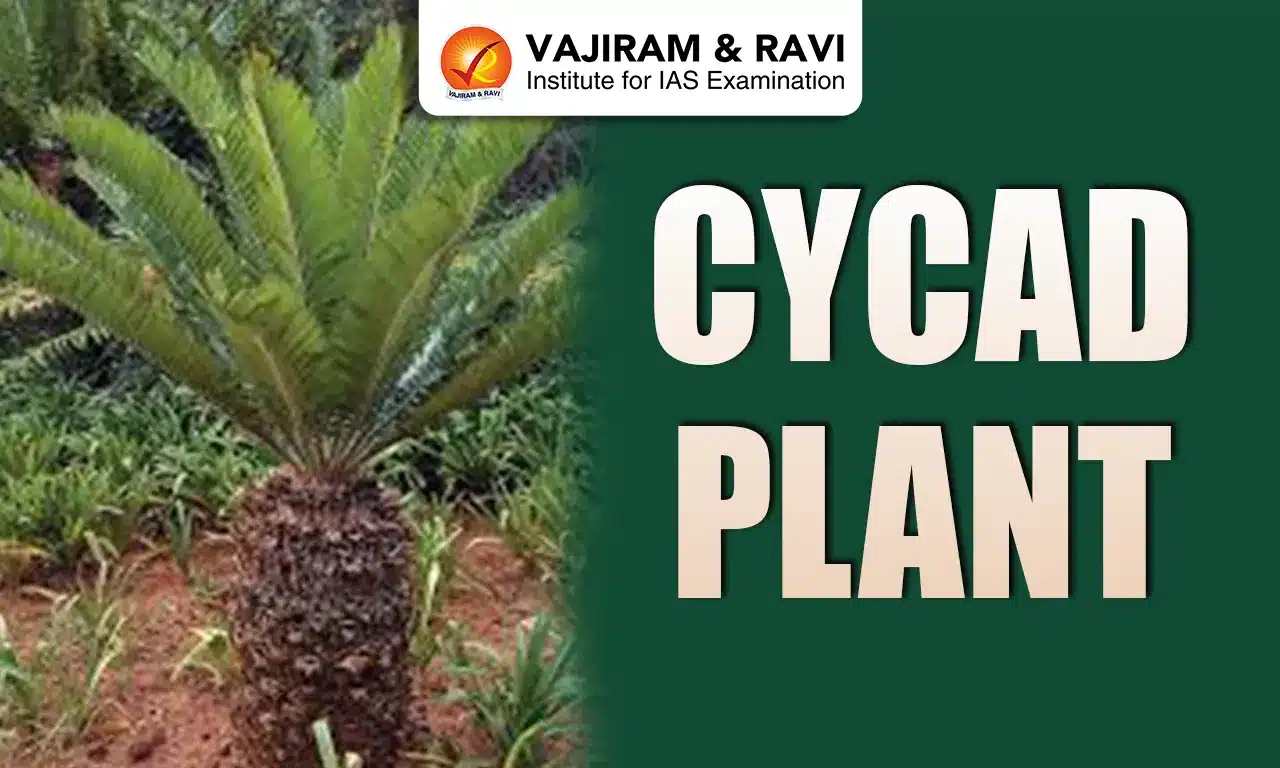
Cycad Plant

Cycad Plant

Cycad Plant Latest News

The All India Institute of Medical Sciences (AIIMS), Bhubaneswar has initiated a research on Cycad, over concerns that the plant contains BMAA, a potential neurotoxin.

About Cycad Plant

  • It is the palmlike woody gymnospermous plants.
  • It is an ancient plant species that is believed to have coexisted with dinosaurs for over 300 million years.
  • Habitat: They occupy a variety of habitats. Some are native to wet rainforests while others are from semidesert climates; others grow in grasslands or seasonally dry forests.
  • Distribution: Tropical and subtropical latitudes in the Americas, Caribbean, sub-Saharan Africa, Madagascar, eastern India, China, Japan, southeast Asia, Oceania and Australia. 

Features of Cycad Plant

  • They are woody, long-lived, unisexual plants and their main roots thickened, fleshy and often tuberous.
  • They are distinguished by crowns of large pinnately compound leaves and by cones.
  • Cycads in general are fire-adapted, losing leaves to the blaze but soon restoring them in a growth flush.
  • Soil: They may be found growing in rich, organic soils, sand, or rock, in swampy soils or even in halophytic (salty) soils.
  • Cycads are long-lived, don’t reproduce frequently, and most populations are small, putting them at risk of extinction.
  • Threats:   Habitat conversion through agriculture or development, illegal removal of wild plants for horticultural collection, and climate change.

Source: TOI

Cycad Plant FAQs

Q1: What is the primary habitat of Cycad plants?

Ans: Tropical and subtropical regions

Q2: What is a characteristic feature of Cycad plants?

Ans: They are gymnosperms

Ramman Festival

Ramman Festival

Ramman Festival Latest News

Recently, the President of India was presented with a Ramman mask at a special session of the Uttarakhand Assembly.

About Ramman Festival

  • It is an annual religious festival celebrated in late April in the twin villages of Saloor-Dungra, Uttarakhand, in honour of the local deity Bhumiyal Devta. 
  • In 2009, Ramman was inscribed in the list of UNESCO’s Intangible Cultural Heritage of Humanity.

Features of Ramman Festival

  • It features complex rituals, recitations of the Ramayana, songs, and masked dances, with each caste and group playing distinct roles.
  • Divine Storytelling: The performances include recitations of the Rama Katha (episodes from the Ramayana), combined with masked dances of deities and local legends, blending mythic and local narrative layers.
  • Sacred Space: It is held in the courtyard of the Bhumiyal Devta temple in Saloor Dungra.
  • Community Participation: Entire village households contribute: roles are caste-based (priests, mask-makers, drum players), funding comes from the village, and participation spans elders to youth.
  • Transmission of Knowledge & Values: Oral transmission of epic songs, dance forms, and ritual lore across generations. 
  • Fusion of Art Forms: It blends narration, masked dances, ritual drama, music, and mask craft into one integrated festival.
  • The festival involves theatrical performances of the Ramayana and local legends, in which people sing songs and wear masks while dancing.
  • There are 18 different types of masks made of Bhojpatra, Himalayan birch, that performers wear during the event.
  • Some of the instruments documented include: Dhol (a type of drum) Damau (smaller percussion drum), Manjira (small hand cymbals), Jhanjhar (larger cymbals), Bhankora (a kind of trumpet).

Source: IE

Ramman Festival FAQs

Q1: Where is the Ramman festival primarily celebrated?

Ans: Uttarakhand

Q2: What is the Ramman festival dedicated to?

Ans: Local deity Bhumiyal Devta

River Umngot

River Umngot

River Umngot Latest News

Recently, a concern has been raised that the pristine waters of River Umngot are turning murky due to massive dumping of soil and construction debris into river systems.

About River Umngot

  • It is popularly known as Dawki river which flows through the West Jaintia Hills district of Meghalaya. 
  • Origin: It originates from the Eastern Shillong Peak, which is located 1,800 m above sea level.
  • It is famous for its picturesque crystal-clear water.
  • The water is so transparent that it often creates an illusion of boats floating in mid-air.
  • This surreal phenomenon has earned it the reputation of being the cleanest river in India.
  • The river builds up an innate boundary between two hills district of Meghalaya one being the Jaintia Hills and other being the Khasi hills.
  • Umngot River is also known for the annual boat race in the month of March-April.
  • It also helps in building a natural one of the international boundary between India (Meghalaya) and Bangladesh.
  • Transportation: The suspension bridge over the Dawki River on NH-40 was constructed way back in 1932 and it is one of the busiest bilateral trade routes between India and Bangladesh. 

Source: IE

River Umngot FAQs

Q1: Where is the River Umngot located?

Ans: Meghalaya

Q2: What is a notable feature of the River Umngot?

Ans: It's known for its crystal-clear waters.

Tanzania

Tanzania

Tanzania Latest News

Tanzanian President Samia Suluhu Hassan played down days of bloody protest as she was inaugurated recently, with an internet blackout still in place as the opposition says hundreds were killed.

About Tanzania

  • It is an East African country situated just south of the Equator.
  • It encompasses an area of approximately 945,087 sq.km. 
  • Bordering Countries: 
    • It shares borders with eight countries: Kenya and Uganda to the north, Rwanda, Burundi, and the Democratic Republic of the Congo to the west, and Zambia, Malawi, and Mozambique to the south. 
    • The eastern border of Tanzania meets the Indian Ocean.
  • Capital: Dar es Salaam (administrative captial), Dodoma (legislative capital).
  • The separate states of Tanganyika and Zanzibar gained independence from Britain in the early 1960s and merged to form the United Republic of Tanzania in 1964. 
  • Form of Government: Presidential Republic
  • Official Language: Kiswahili or Swahili, English
  • Currency: Tanzanian shilling
  • Climate type: Tropical, with a long dry season and two rainy seasons.
  • Major lakes: Lake Victoria (the world's second-largest freshwater lake, shared with Uganda and Kenya) in the north, Lake Tanganyika in the west, and Lake Nyasa in the southwest.
  • Highest Peak: Mount Kilimanjaro – Highest in Africa, and a dormant volcano
  • Major rivers:  Several rivers course through Tanzania, including the Great Ruaha, Rufiji, and Kagera rivers. 
  • Islands
    • The country also includes a number of major islands and archipelagos. 
    • The most significant are Zanzibar, Pemba, and Mafia, all located off the eastern coast in the Indian Ocean.

Source: TH

Tanzania FAQ's

Q1: Tanzania is located in which part of Africa?

Ans: Eastern Africa

Q2: Which is the capital of Tanzania?

Ans: Dodoma (legislative), Dar es Salaam (administrative)

Q3: Which is the highest peak in Africa, located in Tanzania?

Ans: Mount Kilimanjaro

Q4: Which ocean lies to the east of Tanzania?

Ans: Indian Ocean

Q5: What are the major rivers flowing through Tanzania?

Ans: Several rivers course through Tanzania, including the Great Ruaha, Rufiji, and Kagera rivers.

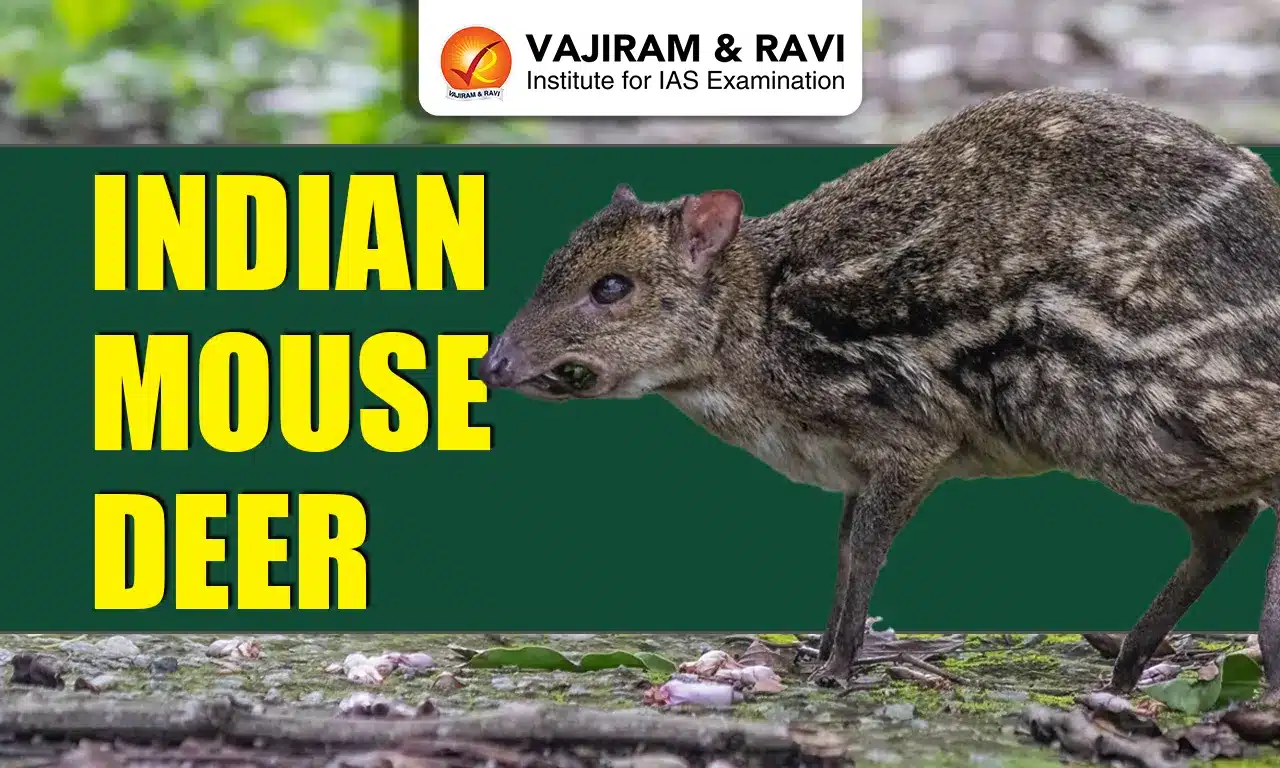
Indian Mouse Deer

Indian Mouse Deer

Indian Mouse Deer Latest News

A rare Indian mouse deer was recently photographed at Tungareshwar Wildlife Sanctuary in Vasai.

About Indian Mouse Deer

  • The Indian Mouse Deer, or Indian Spotted Chevrotain, is a species of even-toed ungulate belonging to the family Tragulidae. 
  • Scientific Name: Moschiola indica
  • It is the smallest deer species found in India and is known for its elusive and shy nature.

Indian Mouse Deer Distribution

  • It is endemic to the Indian Subcontinent.
  • It is mainly found in peninsular India, with some old records from Nepal.
  • Sri Lanka has a separate species called the spotted chevrotain (Moschiola meminna).
  • Within India, it is commonly encountered in a number of forest areas along the Western Ghats, in the Eastern Ghats up to Orissa, and in the forests of central India.

Indian Mouse Deer Features

  • It is small, 25-30 cm at shoulder height, and weighs from two to four kg.
  • The fur color is dark brown with white underparts.
  • There are four or five light rows of white spots on the back. 
  • Males of this species have tusk-like upper canines.
  • A unique feature of this group is that instead of a four-chambered stomach like in other ruminants, they have a three-chambered stomach.
  • Diet: It forages on the forest floor for fruits, roots, leaves, and herbs. It has occasionally been observed eating insects, crustaceans, and even small mammals.
  • Life Span: 8 to 12 years.

Indian Mouse Deer Conservation Status

It is classified as 'Least Concern' under the IUCN Red List. 

Source: MD

Indian Mouse Deer FAQs

Q1: What is the scientific name of the Indian Mouse Deer?

Ans: Moschiola indica

Q2: The Indian Mouse Deer is endemic to which region?

Ans: Indian Subcontinent

Q3: What is the IUCN conservation status of the Indian Mouse Deer?

Ans: Least Concern

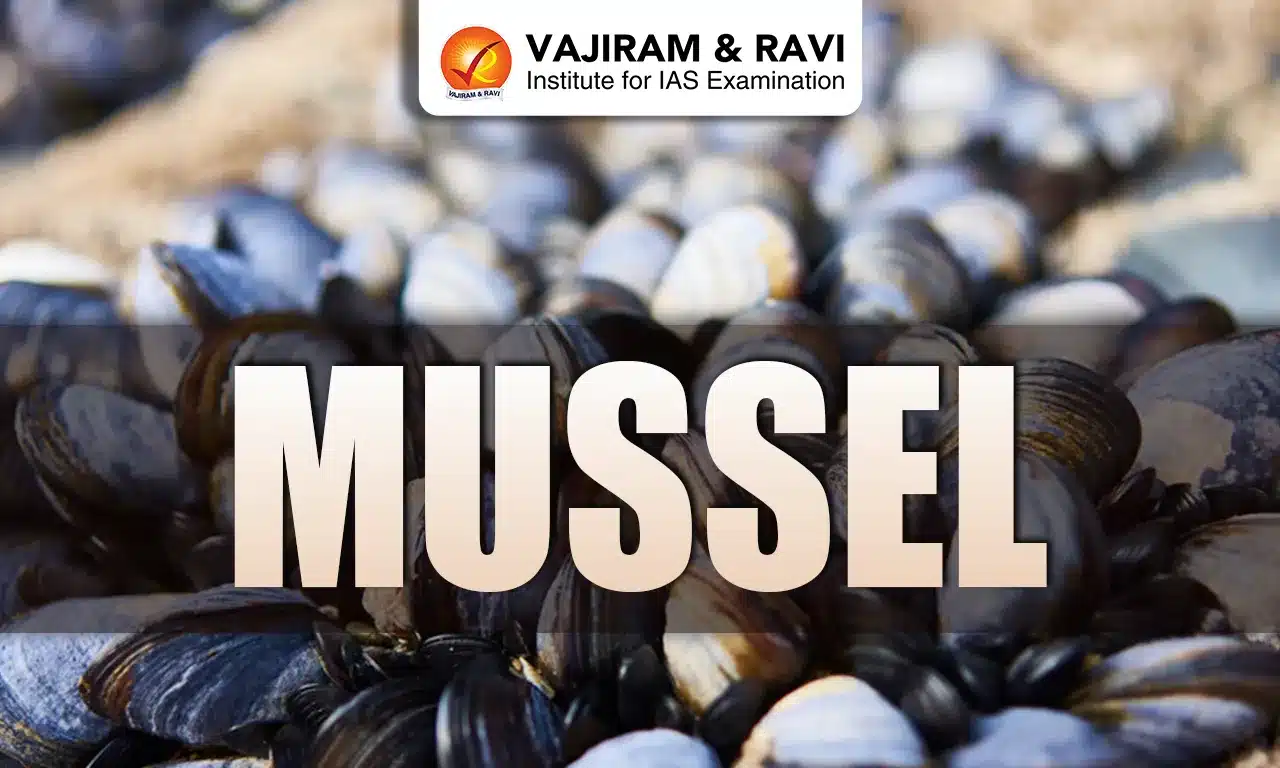
Mussel

Mussel

Mussel Latest News

Recently, Greek scientists have deployed thousands of mussels on the seafloor to help detect microplastics.

About Mussel

  • It is a bivalve of mollusks belonging to the marine family Mytilidae and to the freshwater family Unionidae. 
  • Distribution: They are most common in cool seas. Freshwater mussels known as naiads inhabit streams, lakes, and ponds over most of the world.

Features of Mussel

  • Appearance: Marine mussels are usually wedge-shaped or pear-shaped and range in size from about 5 to 15 centimetres. 
  • They may be smooth or ribbed and often have a hairy covering.
  • The shells of many species are dark blue or dark greenish brown on the outside; on the inside they are often pearly.
  • They attach themselves to solid objects or to one another by proteinaceous threads called byssus threads.
  • They often occur in dense clusters.
  • Ecological Role: These species are filter-feeding organisms that absorb a range of contaminants into their tissue, including invisible microplastics.
  • They have been used globally for decades as a barometer of marine pollution.

Benefits of Mussel

  • Food Source: They are edible and considered nutritious, rich in protein, omega-3 fatty acids, and various vitamins and minerals.
  • Pearl Production: Freshwater mussels are used for pearl cultivation.
  • Ecological Role: These species are filter-feeding organisms that absorb a range of contaminants into their tissue, including invisible microplastics.
  • They have been used globally for decades as a barometer of marine pollution.

 Source: Reuters

Mussel FAQs

Q1: What type of creature is a mussel?

Ans: Mollusk

Q2: What is the term for the process by which mussels filter water to obtain food?

Ans: Filter feeding

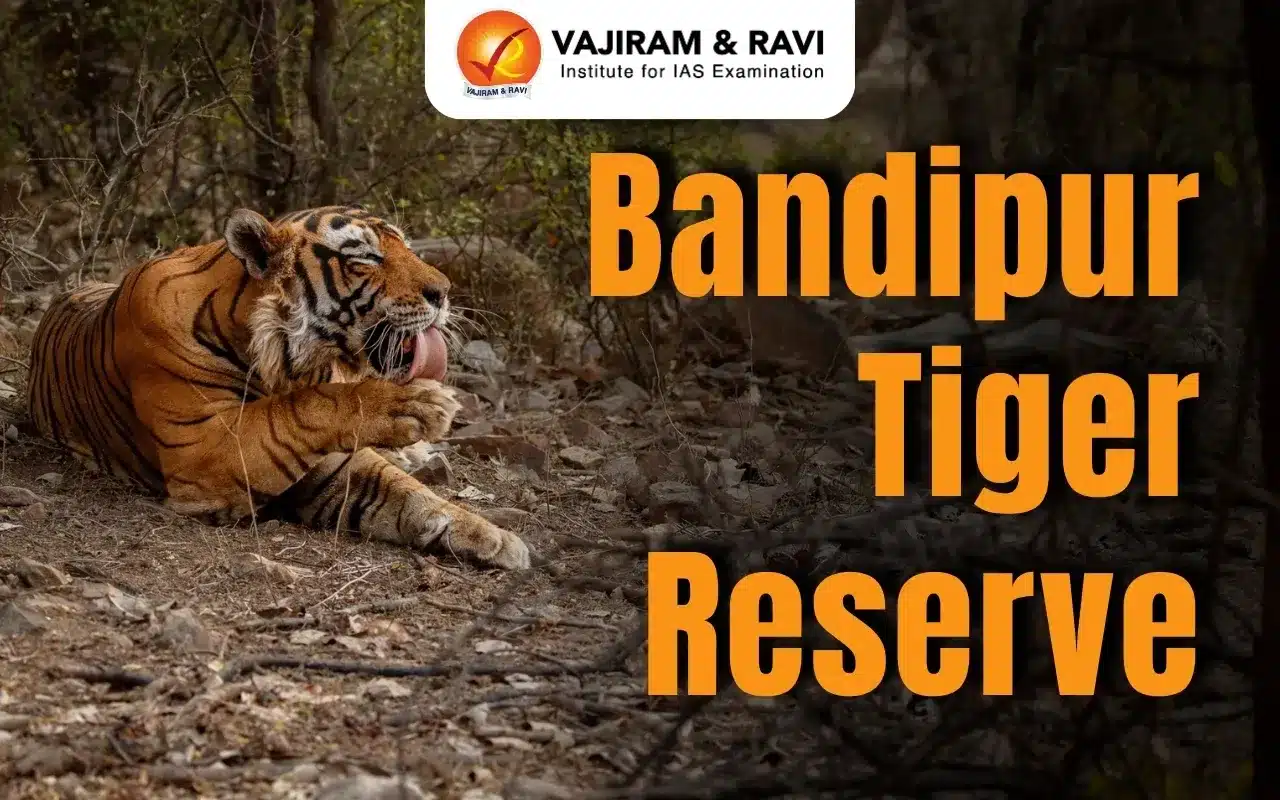
Bandipur Tiger Reserve

Bandipur Tiger Reserve (BTR)

Bandipur Tiger Reserve Latest News

As per the order by Minister for Environment, Ecology and Forests Eshwar B Khandre, one late evening safari trip - each in jeep and bus - are being stopped at Bandipur Tiger Reserve (BTR), in the first phase.

About Bandipur Tiger Reserve 

  • It is situated in the Mysore and Chamarajanagar revenue districts of southern Karnataka. 
  • It is located at the tri-junction area of the States of Karnataka, Tamil Nadu, and Kerala.
  • Geographically, it is an “ecological confluence” of the Western and Eastern Ghats.
  • It was once a hunting ground for the rulers of the neighbouring kingdom of Mysore.
  • It is part of the larger Nilgiri Biosphere Reserve, which is recognized as a UNESCO World Heritage Site.
  • BTR is surrounded by:
    • Nagarahole Tiger Reserve (Tamil Nadu) in the North West (Kabini Reservoir separates the two).
    • Mudumalai Tiger Reserve (Tamil Nadu) in the South.
    • Wayanad Wildlife Sanctuary (Kerala) in the South West.
  • Rivers: It is surrounded by River Kabini in its north and River Moyar in its south.
  • Climate: Bandipur has a typical tropical climate with distinct wet and dry seasons.
  • Flora:
    • It comprises diverse vegetation of dry deciduous to tropical mixed deciduous.
    • It includes rosewood, Indian kino tree, sandalwood, Indian laurel, clumping bamboo, and giant clumping bamboo, etc.
  • Fauna:
    • It is a shelter for the largest population of wild Asian elephants in South Asia. 
    • It comprises other mammals such as the Bengal tiger, gaur, sloth bear, golden jackal, dhole, and four-horned antelope, etc.

Source: DH

Bandipur Tiger Reserve FAQs

Q1: Bandipur Tiger Reserve lies at the tri-junction of which three states?

Ans: Karnataka, Kerala, and Tamil Nadu

Q2: Bandipur Tiger Reserve represents an ecological confluence of which two major mountain ranges?

Ans: Western Ghats and Eastern Ghats

Q3: Bandipur Tiger Reserve forms part of which UNESCO-recognized Biosphere Reserve?

Ans: Nilgiri Biosphere Reserve

Q4: Which river forms the northern boundary of Bandipur Tiger Reserve?

Ans: Kabini River

Q5: Which river forms the southern boundary of Bandipur Tiger Reserve?

Ans: Moyar River

Scrub Typhus

Scrub Typhus

Scrub Typhus Latest News

A Gulf Keralite’s impulsive decision to return home to treat a persistent fever turned out to be life-saving after he was diagnosed with scrub typhus — a potentially fatal infection that requires early treatment.

About Scrub Typhus

  • It is an infectious disease caused by bacteria called Orientia tsutsugamushi.
  • It is transmitted through infected chiggers (young mites).
  • Several factors, like vector abundance, climatic factors, exposures like farming and owning domestic animals, outdoor activities and sanitation, affect its prevalence.
  • This disease is more prevalent in cooler months.
  • It will not spread from person to person.
  • Symptoms:
    • The symptoms typically include fever, headache, body ache, and sometimes a rash.
    • In severe cases, the infection can lead to respiratory distress, brain and lung inflammation, kidney failure, and multi-organ failure, ultimately resulting in death.
  • Treatment
    • It is treated with doxycycline, which is most effective when administered early.
    • There is no vaccine available for this disease.

Key Facts about Typhus Fever

  • Typhus (or typhus fever) is the name used for several different types of bacterial infections spread by bug bites that cause similar symptoms, like high fever and rash. 
  • These symptoms can be severe and lead to serious complications if left untreated.
  • There are three types of illnesses commonly called typhus:
    • Epidemic Typhus: It is caused by Rickettsia prowazeki and it is spread to people through contact with infected body lice. 
    • Scrub Typhus: It is caused by Orientia tsutsugamushi and spread by chiggers.
    • Murine Typhus: It is caused by Rickettsia typhi spread by fleas. It occurs in tropical and subtropical climates around the world.

Source: NIE

Scrub Typhus FAQs

Q1: What is the causative organism of Scrub Typhus?

Ans: It is caused by bacteria called Orientia tsutsugamushi.

Q2: Through which vector is Scrub Typhus transmitted to humans?

Ans: It is transmitted through infected chiggers (young mites).

Q3: Can Scrub Typhus spread from person to person?

Ans: It will not spread from person to person.

Q4: What are the common symptoms of Scrub Typhus?

Ans: The symptoms typically include fever, headache, body ache, and sometimes a rash.

Interstellar Comet 3I/ATLAS

Interstellar Comet 3I/ATLAS

Interstellar Comet 3I/ATLAS Latest News

Recently, NASA astronomers have confirmed the detection of water’s chemical fingerprint on the interstellar comet 3I/ATLAS.

About Interstellar Comet 3I/ATLAS

  • It is the third known interstellar object from outside our solar system after 1I/ʻOumuamua(2017) and 2I/Borisov (2019). 
  • It has hyperbolic orbit and travels at 57–68 km/s speed relative to the Sun.
  • It will exit the solar system permanently after a brief interaction with the Sun.
  • This interstellar comet was first seen by a NASA-supported telescope in Rio Hurtado, Chile, which is part of the ATLAS (Asteroid Terrestrial-impact Last Alert System) survey.

Physical Characteristics of Interstellar  Comet 3I/ATLAS

  • 3I/ATLAS is confirmed to be an active comet, with a visible coma, a cloud of ice particles and dust surrounding the nucleus.
  • As it nears the Sun, it is expected to develop a tail, a characteristic cometary feature formed by solar heating.
  • Photometric analysis shows a reddish hue suggests the surface may be rich in complex organic compounds or water ice.
  • The nucleus is estimated to be 10–30 km wide.

What are interstellar Objects?

  • These are celestial bodies that originate outside the solar system, and travel through it. These objects are not gravitationally bound to a star.
  • They can come from other solar systems and be thrown into interstellar space (the area between the stars) due to collisions or be slingshotted by a planet’s or star’s gravity.
  • The trajectory of these objects is basically open-ended hyperbolic orbit, where there is a perihelion point (closest to the Sun) but no aphelion.

Source: ET

Interstellar Comet 3I/ATLAS FAQs

Q1: What is the origin of the Interstellar Comet 3I/ATLAS?

Ans: Outside our solar system

Q2: What is unique about the orbit of 3I/ATLAS?

Ans: It is hyperbolic.

CITES Report Urges India to Halt Wildlife Imports Pending Stronger Checks

CITES Report

CITES Report Latest News

  • A CITES verification mission has advised India to halt imports of critically endangered species — including gorillas, orangutans, chimpanzees, and snow leopards — until stronger checks and due diligence measures are implemented.
  • The report warned of illegal harvesting of wild animals falsely declared as captive-bred and asked India to provide credible evidence to the CITES Secretariat in Geneva proving its compliance with global wildlife trade safeguards.

About CITES

Structure and Mechanism

  • Species protected under CITES are classified into three Appendices:
    • Appendix I: Species threatened with extinction; trade permitted only in exceptional circumstances.
    • Appendix II: Species not necessarily threatened but whose trade must be controlled to avoid overexploitation.
    • Appendix III: Species protected in at least one country that has asked other Parties for assistance in controlling trade.
  • Trade in CITES-listed species requires export and import permits issued by designated national CITES authorities in each member country.

India and CITES

  • India joined CITES in 1976, and no international wildlife trade is permitted without export and import permits issued by designated CITES authorities.
  • The Directorate of Wildlife Preservation under the Ministry of Environment, Forest and Climate Change (MoEFCC) serves as India’s CITES Management Authority.
  • CITES implementation in India aligns with the Wildlife (Protection) Act, 1972, which governs the trade, acquisition, and possession of wildlife species and derivatives.

CITES Mission Flags Gaps in India’s Wildlife Import Procedures

  • A CITES verification mission has urged India to suspend imports of critically endangered species — such as gorillas, orangutans, chimpanzees, and snow leopards — until it strengthens due diligence and verification systems to prevent illegal wildlife trade.
  • The mission warned against the illegal capture of wild animals falsely declared as captive-bred and asked India to provide evidence of compliance to the CITES Secretariat in Geneva.

Background: Inspection Triggered by Gujarat Zoo Imports

  • At a CITES Standing Committee meeting in Geneva (February 2025), member countries raised concerns about wildlife imports to the Greens Zoological Rescue & Rehabilitation Center (GZRRC) in Jamnagar, Gujarat, operated by Vantara.
  • This led to a CITES inspection mission, which also visited the Radha Krishna Temple Elephant Welfare Trust (RKTEWT).

Key Findings of the Report

  • The mission found that while all imports had valid CITES permits, questions remained about:
    • The true origin of animals,
    • The accuracy of source (captive-bred) and purpose (zoo) codes, and
    • The extent of India’s due diligence in verifying imports.
  • Under India’s Wildlife Protection Act, zoos can only acquire or transfer animals from other recognised zoos.
  • However, many imports came from commercial breeding facilities, not zoos — raising concerns about wild-caught animals being mislabelled as captive-bred.

Animal Holdings and Facility Standards

  • The CITES Secretariat noted that both facilities - GZRRC and RKTEWT - maintain exceptionally high welfare standards and that their representatives denied buying any animals.

Contradictory Records on Czech Republic Imports

  • The Czech CITES authority told the Secretariat that animals sent to GZRRC were sold, not rescued, contradicting India’s claim.

Questionable Origins of Animals from Africa and South America

  • Three African elephants imported from Tunisia were found to be wild-caught from Burkina Faso.
  • 363 animals, including primates, crocodilians, and anteaters, exported from Guyana, were marked as wild (source code W) and for zoos (purpose code Z) — raising concerns of misclassification.

Imports from Unlikely or Unverified Sources

  • The report listed multiple imports via the UAE claiming “captive-bred” origins from countries with no breeding programs — such as:
    • Chimpanzees from Egypt, Iraq, Kuwait
    • Bonobo from Iraq
    • Gorilla from Haiti
    • Cheetahs from Syria
  • It also noted imports of Appendix-I species under “confiscation” (code I) — including jaguars, ocelots, margays, jaguarundis, chimpanzees, orangutans, and cheetahs — with unknown origins from Mexico and the UAE.

CITES Recommendations for India

  • The CITES Secretariat recommended that India:
    • Review and strengthen its import procedures urgently to ensure authenticity of captive-bred claims.
    • Verify all flagged imports with source or transit countries — including Congo, Germany, Guyana, Iraq, Mexico, Syria, and the UAE — to confirm origins.
    • Take corrective action if animals were found to be sourced from the wild under false captive-bred claims.

Next Steps and Reporting Deadline

  • The CITES Standing Committee, meeting in Samarkand, Uzbekistan, on November 23, will review India’s case.
  • The Secretariat has asked India to take corrective measures and submit a detailed compliance report within 90 days.

Source: IE | CNBC | CITES

CITES Report FAQs

Q1: What did the CITES report recommend for India?

Ans: It advised India to halt imports of critically endangered species until it strengthens verification systems to prevent illegal wildlife trade and mislabelled captive-bred claims.

Q2: Which species are affected by the CITES recommendation?

Ans: The report highlighted gorillas, orangutans, chimpanzees, snow leopards, and other Appendix-I animals at risk of illegal capture and trade.

Q3: Why was India’s wildlife import process under scrutiny?

Ans: Imports to Gujarat’s Greens Zoological Rescue & Rehabilitation Center raised questions about origin, source codes, and India’s due diligence in verifying trade legality.

Q4: What gaps did the CITES mission identify?

Ans: It found inconsistencies in import documentation, unclear animal origins, and weak follow-up verification with exporting countries such as Congo and the UAE.

Q5: What action must India take now?

Ans: CITES asked India to review all imports, verify authenticity with source nations, and submit a compliance report within 90 days to the Standing Committee.

Supreme Court Relief on AGR Dues Gives Vodafone Idea a Lifeline

AGR Dues

AGR Dues Latest News

  • Recently, the Supreme Court permitted the government to review and recalculate Vodafone Idea’s adjusted gross revenue (AGR) dues up to FY 2016–17, including interest and penalties. This marks a significant relief for the cash-strapped telecom company, as it could reduce its financial liabilities.
  • AGR refers to the basis on which telecom operators pay licence fees and spectrum usage charges to the government.

Supreme Court Clarification on Vodafone Idea’s AGR Dues

  • The recent Supreme Court’s clarification followed its earlier order, allowing Vodafone Idea (Vi) to seek a review and reassessment of AGR dues up to FY17.
  • The Department of Telecommunications (DoT) had earlier raised an additional demand of ₹5,600 crore for that period, adding to Vi’s total AGR dues of around ₹83,400 crore.

Why the Clarification Matters

  • The Court’s clarification ensures that Vi’s relief extends to the full AGR reassessment up to FY17 — not just the ₹5,600 crore additional demand.
  • Had the relief been limited, the financial benefit would have been minimal. 
  • Vi’s petition had sought cancellation of the extra demand and a comprehensive reconciliation of all dues.
  • Following the Court’s oral observation, Vodafone Idea’s share price surged nearly 10%, reflecting renewed investor optimism over the potential reduction in liabilities.

Government’s Stake and Industry Implications

  • The government, now holding nearly 49% equity in Vodafone Idea after converting ₹36,950 crore in dues into shares, remains the largest shareholder.
  • It has a strategic interest in keeping Vi afloat, as the company is one of India’s three private telecom operators, crucial for maintaining a competitive three-player market.

Outlook

  • The clarification acts as a lifeline for Vi, giving it room to restructure debt, attract investors, and stabilise operations, while aligning with the government’s goal of ensuring a balanced telecom ecosystem in India.

Vodafone Idea’s AGR Burden and Survival Challenge

  • Vodafone Idea (Vi) owes the government ₹83,400 crore in adjusted gross revenue (AGR) dues, with annual instalments of ₹18,000 crore starting March next year.
  • Including penalties and interest, Vi’s total government liabilities could reach ₹2 trillion, creating an unsustainable financial burden for the debt-laden telecom operator.

Financial Distress and Weak Cash Flows

  • With shrinking revenues and subscriber losses, Vi faces severe cash flow constraints, making it nearly impossible to meet AGR payments on schedule.
  • The Supreme Court’s order allowing reassessment of dues offers crucial relief, as investors have avoided the company due to its overwhelming liabilities.

Warning of Potential Collapse

  • In its earlier petition, Vi cautioned that without bank funding, it cannot operate beyond FY 2025–26, as it lacks the resources to pay the ₹18,000 crore AGR instalment due in March 2026.
  • The company said that without fresh capital, planned network investments would stall, halting its capex cycle and eroding the value of government equity acquired through the ₹36,950 crore dues-to-equity conversion.

No Scope for Further Infusion

  • Vi also told the Court that promoters and shareholders cannot inject additional funds, and banks are unwilling to lend given its precarious finances.
  • If forced to continue ₹18,000 crore annual payments for six years, the company warned it would face “extreme financial stress” and possibly collapse, undermining both private and government stakes in the firm.

Government’s Equity Lifeline Keeps Vodafone Idea Afloat

  • The Indian government now owns nearly 49% of Vodafone Idea (Vi) after converting ₹36,950 crore of the company’s dues into equity in March 2025.
  • Before this conversion, the government’s stake stood at around 23%, making it now the single-largest shareholder in the debt-ridden telecom firm.
  • The equity was acquired at a premium exceeding 47%, due to existing legal and pricing regulations.

Second Major Lifeline from the Centre

  • This is the second rescue measure extended to Vi.
  • Earlier, under the 2021 telecom relief package, the government had in February 2023 converted ₹6,133 crore of interest dues into equity — marking the first phase of its intervention to stabilise the company.

Mounting Debt and Liabilities

  • As of December 2024, Vodafone Idea’s total debt stood at approximately ₹2.3 lakh crore, including:
    • ₹77,000 crore in AGR dues, and
    • ₹1.4 lakh crore in spectrum liabilities.
  • The company’s massive debt load has hindered its ability to invest and compete effectively with larger rivals like Jio and Airtel.

Purpose of the Equity Conversion

  • The equity conversion was crucial for Vi to manage its spectrum repayment obligations.
  • Without it, the company would have faced an annual payment of around ₹40,000 crore once the moratorium on spectrum dues expires in September 2025, threatening its operational continuity.

Conclusion

  • The move underscores the government’s intent to preserve a three-player private telecom market and protect its substantial financial exposure in the sector.
  • While the equity conversion offers short-term relief, Vodafone Idea’s survival hinges on raising fresh capital and restoring investor confidence in the coming years.


Source: IE | FE

AGR Dues FAQs

Q1: What relief did the Supreme Court give Vodafone Idea?

Ans: The Court allowed the government to review and recalculate Vodafone Idea’s AGR dues up to FY 2016–17, including interest and penalties.

Q2: Why is this clarification important?

Ans: It enables a full reassessment of dues, not just additional ₹5,600 crore demands, providing significant financial relief to the struggling telecom operator.

Q3: How large are Vodafone Idea’s total liabilities?

Ans: Vi owes around ₹83,400 crore in AGR dues and faces total government liabilities near ₹2 trillion including penalties and spectrum costs.

Q4: How much stake does the government hold in Vodafone Idea?

Ans: After converting ₹36,950 crore dues into equity, the government now owns nearly 49% — becoming Vi’s largest shareholder and key stabilising partner.

Q5: What challenges does Vodafone Idea still face?

Ans: Despite relief, Vi must raise fresh capital, repay ₹18,000 crore annually from March 2026, and expand network capacity to regain market confidence.

BRICS Pay – Redefining Global Financial Architecture

BRICS Pay

BRICS Pay Latest News

  • BRICS nations are advancing plans to operationalise BRICS Pay, a cross-border payment system aimed at reducing dependence on the U.S.-controlled SWIFT network and promoting financial sovereignty among member countries.

Introduction

  • The BRICS grouping, comprising Brazil, Russia, India, China, and South Africa, has embarked on an ambitious mission to challenge the global financial dominance of the U.S.-led SWIFT system. 
  • The recent unveiling of the BRICS Cross-Border Payments Initiative, or “BRICS Pay,” marks a decisive step in their long-standing quest to establish a more inclusive, multipolar financial order. 
  • This effort aims to promote local currency settlements, protect member nations from Western sanctions, and strengthen the group’s financial sovereignty.
  • The motivation behind this move has intensified since Russia faced sweeping Western sanctions in 2014 and 2022, leading the bloc to pursue alternative transaction mechanisms insulated from U.S. influence.

Evolution of BRICS Financial Cooperation

  • The journey towards financial independence for BRICS began at the Fortaleza Summit (2014), where member nations established the New Development Bank (NDB) and the Contingent Reserve Arrangement (CRA), the first financial institutions created by developing nations to rival Western-dominated entities like the IMF and World Bank.
  • In 2015, after the U.S. and EU imposed sanctions on Russia following the annexation of Crimea, BRICS members intensified discussions on using local currencies for trade and investment. 
  • By 2017, the grouping had agreed to strengthen currency cooperation through swap arrangements and local currency settlements.
  • This groundwork culminated in the Kazan Summit (2024), where the leaders launched the BRICS Cross-Border Payments Initiative, BRICS Pay, and underscored the importance of “strengthening correspondent banking networks within BRICS and enabling settlements in local currencies.”

The BRICS Pay Initiative

  • BRICS Pay represents the grouping’s most concrete step to reduce reliance on the SWIFT network, a Belgium-based system used by over 11,000 banks for global money transfers. 
  • SWIFT’s control by G-10 central banks, especially under U.S. influence, has long been criticised for allowing the weaponisation of the global financial system through sanctions.
  • The prototype of BRICS Pay was demonstrated in Moscow in October 2024, marking a milestone in the bloc’s efforts to build an independent payment ecosystem.
  • The project is being developed by the BRICS Payment Task Force (BPTF), which aims to ensure interoperability between national payment systems. 
  • Each BRICS nation already possesses a robust digital payment infrastructure:
    • India - Unified Payments Interface (UPI)
    • China - Cross-Border Interbank Payment System (CIPS)
    • Russia - System for Transfer of Financial Messages (SPFS)
    • Brazil - Pix Instant Payment System
    • South Africa - South African Multiple Option Settlement (SAMOS)
  • Together, these systems form the technological backbone of BRICS Pay, offering a credible alternative to SWIFT within the bloc and potentially to other developing economies.

Strategic Motivation and Political Context

  • The desire to establish BRICS Pay stems from three key motivations:
    • Financial Sovereignty: Reducing dependency on the U.S. dollar and mitigating exposure to Western sanctions.
    • Economic Efficiency: Lowering transaction costs and settlement times for trade among member nations.
    • Geopolitical Assertion: Establishing the BRICS bloc as a counterweight to Western economic dominance.
  • The inclusion of Iran, a nation long targeted by Western sanctions, in BRICS in 2024 further emphasised the grouping’s goal of building a sanctions-proof global payments system.
  • However, this initiative has drawn strong reactions. 
  • Former U.S. President Donald Trump threatened 100% tariffs on BRICS members if they attempted to “create a new currency or back any other currency to replace the mighty U.S. dollar,” underscoring the geopolitical sensitivity of the move.

Challenges in Implementing BRICS Pay

  • Despite its promise, BRICS Pay faces multiple hurdles:
    • Divergent National Interests: Each member is promoting its own payment system globally. For instance, India’s UPI is expanding into Asia and Africa, while China’s CIPS operates in over 120 countries. Aligning these platforms under one interoperable framework remains a major challenge.
    • Technical Interoperability: Integrating five distinct digital payment ecosystems requires harmonised regulatory and security standards.
    • Currency Coordination: The absence of a unified BRICS currency limits the system’s potential to function seamlessly.
    • Trust Deficit: Smaller BRICS members may fear Chinese dominance, given the internationalisation of the yuan and its inclusion in the IMF’s Special Drawing Rights (SDR) basket.
  • Moreover, the creation of a common BRICS currency remains distant. 

Global Implications

  • If successful, BRICS Pay could fundamentally alter the global financial landscape. It would provide developing nations with an alternative to SWIFT, fostering multipolarity in global finance and reducing the dollar’s overwhelming dominance.
  • Experts suggest that even a regionalised adoption, covering intra-BRICS trade and transactions, would signal a significant geopolitical shift. 
  • The growing popularity of local currency settlements, especially in energy trade between India, Russia, and China, aligns with this vision.
  • However, the initiative’s success depends on sustained political will, technical integration, and trust among the members, factors that will determine whether BRICS Pay becomes a global disruptor or remains a regional experiment.

Source: TH

BRICS Pay FAQs

Q1: What is BRICS Pay?

Ans: BRICS Pay is a proposed cross-border digital payment system that enables transactions in local currencies among BRICS nations, reducing reliance on the SWIFT network.

Q2: Why did BRICS develop BRICS Pay?

Ans: It was developed to promote financial sovereignty, enable trade in local currencies, and reduce exposure to U.S.-led sanctions.

Q3: Which countries’ systems will support BRICS Pay?

Ans: The initiative will build on Russia’s SPFS, China’s CIPS, India’s UPI, and Brazil’s Pix systems.

Q4: Why is a BRICS currency unlikely soon?

Ans: Differences in macroeconomic policies and China’s dominance in currency internationalization make a common currency difficult to achieve in the near term.

Q5: How does BRICS Pay challenge SWIFT?

Ans: By creating an interoperable alternative payment system independent of Western control, BRICS Pay challenges SWIFT’s monopoly over international money transfers.

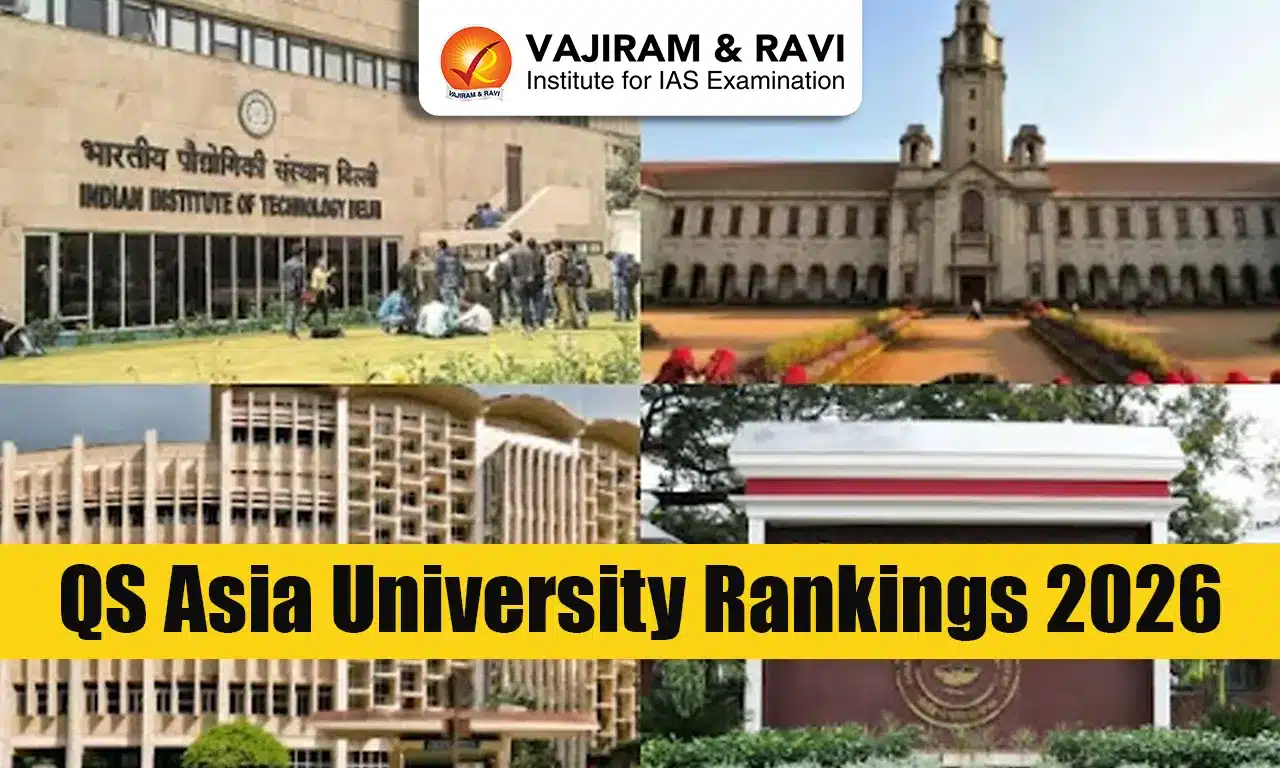
QS Asia University Rankings 2026 – Indian Institutions Slip Amid Rising East and Southeast Asian Competition

QS Asia University Rankings 2026

QS Asia University Rankings 2026 Latest News

  • The QS World University Rankings: Asia 2026, released by global higher education analyst QS Quacquarelli Symonds, revealed a decline in the rankings of most top Indian institutions.
  • Despite improvement in absolute scores, 9 out of 10 leading Indian universities—including seven IITs—fell in rank due to stronger performance by universities from China, Singapore, Hong Kong, South Korea, and Malaysia.

Key Highlights of QS Asia Rankings 2026

  • Top performers in Asia:
    • The University of Hong Kong topped the rankings, overtaking Peking University (China), which slipped to second place.
    • National University of Singapore (NUS) and Nanyang Technological University (NTU) shared the third position.
    • East and Southeast Asian universities—especially from China, South Korea, and Malaysia—showed consistent upward mobility, driven by investment in research collaboration and internationalisation.
  • Performance of Indian institutions:
    • Among the top Indian universities, IIT Delhi retained its position as India’s best institution but fell 15 places to 59th (from 44th in 2025).
    • IIT Bombay witnessed the sharpest decline, dropping 23 places to 71st.
    • Other IITs—Madras, Kanpur, and Kharagpur—also recorded their lowest ranks in recent years.
    • The only Indian institution showing improvement was Chandigarh University, rising from 120 to 109.

Reasons Behind India’s Relative Decline

  • Intensifying regional competition:
    • Universities in China, Hong Kong, Singapore, South Korea, and Malaysia have significantly improved in research productivity, faculty resources, and global engagement.
    • QS noted a “clear eastward concentration” of top performance in higher education.
  • Expanded ranking scope and competition:
    • The 2026 rankings included 1,529 institutions, adding 552 new entrants.
    • China added 261 new institutions—more than any other country—while India added 137, bringing its total to 294.
    • The expansion increased competition and volatility in the results.

Decline in Key Performance Metrics of Indian Institutes

  • Citations per paper (research impact):
    • IIT Delhi (31.5), IIT Bombay (20.0), and IIT Madras (20.3) scored significantly below Asian peers scoring in the high 90s.
    • Indicates lower research visibility and fewer highly cited publications.
  • Faculty-student ratio:
    • IITs face resource constraints and large class sizes.
    • Scores range from 16.5 (IIT Kharagpur) to 40.9 (IIT Delhi), compared to 80–90 among top Asian universities.
  • Internationalisation metrics:
    • Poor performance in International Student Ratio (ISR) and International Faculty indicators.
    • IITs scored between 2.5 (IIT Kharagpur) and 12.3 (IIT Roorkee).
    • Lack of foreign student or faculty participation limits global exposure and cross-border collaboration.

Positive Aspects

  • Indian institutions maintained strong scores (80–90 range) in:
    • Academic reputation
    • Employer reputation
    • Staff with PhD
    • Papers per faculty
  • India continues to expand its footprint with 294 universities represented in the 2026 rankings, the second highest in Asia after China.

Comparative Regional Trends

  • China and Hong Kong: Sustained dominance with large-scale investment in R&D.
  • South Korea: Universities like Yonsei and Korea University show upward mobility due to strategic investment in international partnerships.
  • Malaysia: Institutions such as Universiti Malaya and Universiti Putra Malaysia improved rankings, aided by faculty-student ratio and international faculty/student metrics.

Way Forward for Indian Institutions

  • Enhance research impact: Focus on high-quality publications and internationally co-authored research to improve citations per paper.
  • Improve faculty-student ratio: Recruit more faculty and expand infrastructure to reduce student load per teacher.
  • Promote internationalisation: Facilitate foreign student exchange, visiting faculty, and global academic collaborations.
  • Strengthen research ecosystem: Incentivise interdisciplinary and industry-linked research, ensuring global visibility.
  • Policy support: Government and institutions must align policies with National Education Policy (NEP) 2020 goals of global competitiveness and innovation.

Conclusion

  • The QS Asia Rankings 2026 underscore a concerning trend for Indian higher education—while absolute performance has improved, relative standing has fallen due to stronger regional competitors. 
  • To climb the global ladder, India must bridge gaps in research impact, faculty resources, and internationalisation, aligning with the NEP 2020 vision of making Indian universities globally competitive and innovation-driven.

Source: IE

QS Asia University Rankings 2026 FAQs

Q1: What is the key finding of the QS Asia University Rankings 2026?

Ans: Nine of the top ten Indian institutions, including seven IITs, saw a decline in their rankings.

Q2: Which metrics have contributed most to the decline of Indian institutions in the QS Asia Rankings 2026?

Ans: Indian institutions lagged in citations per paper, faculty-student ratio, and internationalisation metrics such as international student and faculty ratios.

Q3: In which areas have Indian institutions performed well according to the 2026 rankings?

Ans: Indian institutions scored highly in academic reputation, employer reputation, staff with PhD, and papers per faculty.

Q4: What factors have led to improved performance by East and Southeast Asian universities?

Ans: Sustained investment in research collaboration, faculty resources, and international engagement.

Q5: What measures can Indian institutions adopt to enhance their global competitiveness in future rankings?

Ans: They should strengthen research impact, faculty recruitment, and international partnerships, aligning with NEP 2020 goals.

Guru Nanak Jayanti 2025, Date, History, Significance, Celebration

Guru Nanak Jayanti 2025

Guru Nanak Jayanti 2025, also known as Gurpurab, is one of the most sacred festivals in Sikhism, celebrating the birth anniversary of Guru Nanak Dev Ji, the founder of the Sikh faith. In 2025, Guru Nanak Jayanti will be celebrated on Wednesday, November 5, 2025. The day marks not only the birth of a spiritual leader but also the beginning of Sikh philosophy, emphasizing equality, compassion, and devotion to one God.

Guru Nanak Jayanti 2025

Guru Nanak Jayanti is observed on the full moon day (Purnima) of the Kartik month, as per the Hindu lunar calendar. The day holds immense spiritual significance for Sikhs across the globe. In 2025, it marks the 556th birth anniversary of Guru Nanak Dev Ji. The festival symbolizes the message of peace, unity, and the remembrance of divine truth. Guru Nanak’s teachings continue to inspire millions, focusing on removing social divisions of caste, creed, and religion, and promoting the idea that “There is no Hindu, there is no Muslim; all are children of one God.”

Guru Nanak Dev Ji Biography

Guru Nanak Dev Ji, the founder of Sikhism and the first of the ten Sikh Gurus, was born on 15 April 1469 in Rai Bhoi Ki Talwandi (now Nankana Sahib, Pakistan). From childhood, he displayed deep spirituality and questioned social inequalities. He travelled across India, Tibet, and Arabia spreading the message of one God, truth, and equality. Guru Nanak composed 974 hymns, later included in the Guru Granth Sahib. He established Kartarpur Sahib and passed away in 1539, leaving a timeless legacy of peace, service, and devotion.

Guru Nanak Dev Ji Early Life

Guru Nanak Dev Ji, from an early age, questioned social injustices, ritualistic practices, and discrimination prevalent in society. Guru Nanak travelled extensively across India and foreign lands, including Tibet, Arabia, and Persia, spreading his teachings of equality, truth, and compassion. His message laid the foundation for Sikhism, later formalized by the subsequent nine Gurus. His spiritual message revolved around three core principles:

  • Naam Japna: Remembering God through meditation and prayer.
  • Kirat Karni: Earning an honest living through hard work.
  • Vand Chakna: Sharing one’s wealth and blessings with others.

Guru Nanak Jayanti 2025 Celebration

Guru Nanak Jayanti is celebrated with deep devotion across India and in Sikh communities worldwide. The celebrations usually last for three days, beginning with Akhand Path, a continuous 48-hour reading of the Guru Granth Sahib.

On the day preceding the Gurpurab, a Nagar Kirtan (religious procession) is carried out. The procession is led by the Panj Pyare (Five Beloved Ones) and accompanied by hymn singing, martial art displays (Gatka), and spiritual chants.

On the main day, devotees gather at Gurdwaras to offer prayers, listen to hymns (Kirtan), and participate in Langar, a community meal open to all, symbolizing equality and humility. Prominent Gurdwaras like Golden Temple (Amritsar), Gurdwara Bangla Sahib (Delhi), and Nankana Sahib (Pakistan) host grand celebrations attended by thousands of devotees.

Guru Nanak Jayanti 2025 Historical Background

The celebration of Guru Nanak Jayanti dates back centuries, initiated by the Sikh Gurus to honor the founder’s birth. The tradition of Akhand Path and Nagar Kirtan evolved over time, emphasizing the collective reading of scriptures and spreading the Guru’s teachings to the masses. The festival gained further prominence after the establishment of the Khalsa Panth in 1699 by Guru Gobind Singh Ji, the tenth Guru.

The continuity of the Gurpurab celebration reflects the unbroken spiritual lineage of Sikhism and its emphasis on collective community life (Sangat and Pangat).

Guru Nanak Dev Ji Teachings

Guru Nanak’s teachings remain timeless and globally relevant. His spiritual philosophy promotes universal brotherhood and moral integrity. His verses, enshrined in the Guru Granth Sahib, form the core of Sikh philosophy and continue to guide followers globally. Some of his major teachings include:

  1. Oneness of God: There is only one universal creator.
  2. Equality of Humanity: All humans are equal irrespective of caste, creed, gender, or religion.
  3. Service to Humanity: True worship lies in serving others.
  4. Rejection of Superstition: Faith should be rooted in truth, not rituals.
  5. Environmental Respect: Guru Nanak regarded air, water, and earth as sacred elements of creation.
  6. Honest Living: Earning through righteous means is an act of worship.

Guru Nanak Jayanti 2025 at Gurdwaras

Guru Nanak Dev Ji’s life is associated with several sacred sites that hold immense historical and spiritual value. These Gurdwaras witness lakhs of devotees each year during Guru Nanak Jayanti.

  • Nankana Sahib (Pakistan): Birthplace of Guru Nanak Dev Ji.
  • Gurdwara Kartarpur Sahib (Pakistan): Established by Guru Nanak in 1522, where he spent his final years.
  • Gurdwara Nanak Jhira Sahib (Bidar, Karnataka): Associated with his southern travels.
  • Golden Temple (Amritsar): The holiest Sikh shrine, where Guru Granth Sahib is enshrined permanently.

Guru Nanak Jayanti 2025 Social Relevance

Guru Nanak’s message of social equality, tolerance, and humility holds deep relevance in modern India. His teachings counter challenges such as caste discrimination, gender inequality, and religious intolerance. The principles of community service (Seva) and equality reflected in Langar remain symbols of inclusiveness.

Government institutions and educational bodies across India celebrate Guru Nanak Jayanti through cultural events, seminars, and awareness drives promoting interfaith harmony. The Ministry of Culture and the Punjab Government regularly fund heritage projects related to Guru Nanak’s legacy, including the preservation of historical Gurdwaras and digitization of Sikh manuscripts.

Guru Nanak’s Influence on Literature and Philosophy

Guru Nanak’s teachings form an integral part of Indian spiritual literature. His verses, composed in Punjabi, Hindi, Persian, and Sanskrit, are compiled in the Guru Granth Sahib. These hymns reflect deep philosophical and ethical insights, influencing Bhakti and Sufi traditions.

In the Japji Sahib, his primary composition, Guru Nanak emphasizes that spiritual liberation comes through truthful living, not mere rituals. His emphasis on reason, morality, and compassion has influenced reform movements and philosophers across India.

Guru Nanak Dev Ji Teachings on Environment

Guru Nanak’s teachings extend beyond social justice to include ecological awareness. He described the Earth as a nurturing mother, urging humans to maintain harmony with nature. His hymn “Pavan Guru, Pani Pita, Mata Dharat Mahat” (Air is the Guru, Water the Father, and Earth the Great Mother) is considered one of the earliest articulations of environmental ethics.

Today, many Gurdwaras are adopting sustainable practices such as solar panels, organic farming, and zero-waste community kitchens in alignment with Guru Nanak’s environmental vision.

Guru Nanak Jayanti 2025 in India

In 2025, grand celebrations will take place across India. Major processions, devotional music events, and Langars will be organized at Gurdwaras nationwide. Special arrangements are expected in Punjab, Delhi, Haryana, and Maharashtra, where large Sikh populations reside.

The Golden Temple in Amritsar will be decorated with lights, flowers, and continuous Kirtans. In Delhi, Gurdwara Bangla Sahib will host community service programs emphasizing Guru Nanak’s message of peace and humility.

Guru Nanak Jayanti 2025 Observance India and World

The Government of India commemorates Guru Nanak Jayanti with national celebrations. The 550th birth anniversary in 2019 was marked by the release of commemorative coins and stamps. The Kartarpur Corridor, inaugurated in 2019, stands as a symbol of cross-border peace, allowing Indian pilgrims visa-free access to Nankana Sahib in Pakistan.

Globally, Sikh communities in countries like Canada, the UK, and the USA organize special prayers, parades, and seminars promoting Guru Nanak’s message of universal harmony. The United Nations and UNESCO have recognized his contributions to world peace and social reform.

Guru Nanak Jayanti 2025 UPSC

Guru Nanak Dev Ji’s life and message continue to guide humanity towards truth, simplicity, and service. His teachings transcend religious boundaries and promote universal peace. Institutions like the Guru Nanak Dev University (Amritsar) and Punjab School Education Board actively promote his philosophy through research and education.

The essence of Guru Nanak Jayanti lies in selfless service, remembrance of the Divine, and unity among people. As India celebrates Guru Nanak Jayanti 2025, the nation reaffirms its commitment to his timeless message- “Ek Onkar Satnam”, there is one God, and truth is His name.

Guru Nanak Jayanti 2025 FAQs

Q1: When will Guru Nanak Jayanti 2025 be celebrated?

Ans: Guru Nanak Jayanti 2025 will be celebrated on Wednesday, November 5, 2025, marking the 556th birth anniversary of Guru Nanak Dev Ji.

Q2: Why is Guru Nanak Jayanti 2025 celebrated?

Ans: The day honors the birth and teachings of Guru Nanak Dev Ji, the founder of Sikhism and the first of the ten Sikh Gurus.

Q3: How is Guru Nanak Jayanti 2025 celebrated in India?

Ans: Devotees participate in Akhand Path, Nagar Kirtans, community Langars, and prayers at Gurdwaras across India and worldwide.

Q4: What was the main message of Guru Nanak Dev Ji?

Ans: Guru Nanak preached equality, truth, service, and remembrance of God while rejecting caste and ritual-based divisions.

Q5: What are the main places associated with Guru Nanak Dev Ji?

Ans: Important sites include Nankana Sahib (birthplace), Kartarpur Sahib, and Golden Temple, which are central to Sikh heritage.


Daily Editorial Analysis 5 November 2025

Daily Editorial Analysis

India’s Forests Hold the Future

Context

  • As India charts its path toward sustainable development while pursuing rapid economic growth, forests are gaining renewed prominence in the country’s climate and ecological agenda.
  • The revised Green India Mission (GIM) aims to restore 25 million hectares of degraded forest and non-forest land by 2030, aligning with India's pledge to create an additional carbon sink of up to 3.39 billion tonnes of CO₂ equivalent.
  • However, the success of this mission will depend not only on the number of trees planted, but also on how restoration is conceptualised, implemented, and sustained.
  • With climate change reducing forest productivity and communities increasingly demanding participation, India stands at a defining moment in shaping its forest-restoration paradigm.

India’s Restoration Context and Climate Urgency

  • Recent scientific research underscores the need for high-quality ecological restoration.
  • A 2025 study by IIT Kharagpur, supported by IIT Bombay and BITS Pilani, revealed a 12% decline in photosynthetic efficiency in dense forests due to rising temperatures and drying soils.
  • This finding challenges the simplistic idea that more trees equal more carbon sinks, instead highlighting the need for resilient, climate-adaptive forests.
  • India has made measurable progress over the last decade, with forest and tree cover increasing from 16% in 2015 to 25.17% in 2023.
  • Yet, this growth has often prioritised plantation numbers over ecological integrity, making quality of restoration central to future success.

Pillars of Forest Restoration Efforts in India

  • Community Participation: The Social Foundation

    • Forest restoration in India is inseparable from the lives of nearly 200 million people who depend on forests for subsistence.
    • Laws such as the Forest Rights Act (2006) empower communities to protect and manage their landscapes.
    • However, many plantation initiatives continue to bypass local consent, creating social conflict, legal challenges, and mistrust.
    • Examples from states like Odisha, where Joint Forest Management Committees participate in planning and share revenues, and Chhattisgarh, which integrates biodiverse plantations and supports tribal livelihoods, illustrate that community-centred restoration strengthens both ecological and social outcomes.
  • Ecological Design and Native Species

    • India’s earlier afforestation programmes relied heavily on monocultures of eucalyptus and acacia, fast-growing but ecologically harmful, water-depleting, and biodiversity-suppressing.
    • The revised GIM advocates a shift toward native, site-specific species, a crucial step in building ecosystem resilience.
    • States like Tamil Nadu, which has nearly doubled its mangrove cover, demonstrate the value of well-designed, ecologically informed restoration.
    • Yet, success will require skilled forest personnel, ecological training, and improved capacity in state forest departments.
  • Financing and Institutional Alignment

    • India’s restoration ambitions are backed by substantial resources; the CAMPA Fund alone holds ₹95,000 crore.
    • However, utilisation remains uneven and inefficient, with Delhi using only 23% of its approved funds between 2019 and 2024. The challenge is not funding alone, but smart, accountable deployment.
    • Innovative financing initiatives—such as Himachal Pradesh’s biochar-carbon credits programme and Uttar Pradesh’s carbon-market-linked village plantation efforts, signal emerging models for climate financing and local economic integration.
    • To strengthen implementation, India needs:
      • Transparent public monitoring dashboards
      • Training for frontline forest staff
      • Community-led planning and monitoring
      • Flexible use of CAMPA funds for people-centric restoration

Conclusion

  • India possesses strong laws, institutional frameworks, financial resources, and promising state-level models. What it needs now is alignment, capacity, and inclusive governance.
  • As India moves toward Viksit Bharat 2047, forests must be understood not as environmental luxuries, but as economic and ecological capital essential for the country’s future.
  • The restoration of 25 million hectares will not be easy; Yet, pursued with scientific rigour, social inclusion, and ecological wisdom, it has the potential to redefine global restoration practices, empower communities, and build forests that are resilient, biodiverse, and climate-adaptive.

India’s Forests Hold the Future FAQs

 Q1. What is the primary goal of the revised Green India Mission?

Ans. The primary goal of the revised Green India Mission is to restore 25 million hectares of degraded land by 2030.

Q2. Why is planting more trees alone not sufficient for carbon sequestration?

Ans. Planting more trees alone is not sufficient because climate change is reducing forest photosynthetic efficiency, making ecological resilience more important than tree numbers.

Q3. What role do communities play in India’s forest restoration efforts?

Ans. Communities play a crucial role because nearly 200 million people depend on forests, and their participation ensures legal, social, and ecological success.

Q4. Why are native species prioritized in the new restoration approach?

Ans. Native species are prioritized because they support biodiversity, conserve water, and make forests more resilient to climate stress.

Q5. What major challenge exists despite large funds like CAMPA being available?

Ans. A major challenge is the inefficient and inconsistent utilization of funds, which prevents effective implementation of restoration projects.

Source: The Hindu


Trump Seems More in Control of Israel Than Hamas

Context

  • The current ceasefire between Israel and Hamas stands on uncertain and unstable ground, shaped by unresolved humanitarian obligations, rising geopolitical pressure, and competing strategic interests.
  • While the agreement aims to de-escalate hostilities following the October 7, 2023 attacks, deep mistrust and reluctant compliance threaten to unravel progress.
  • The situation highlights a striking paradox: Israel, though militarily dominant, is politically constrained, while Hamas, despite military weakness, retains ideological and strategic freedom.
  • Amid this ongoing situation, it is important to examine the evolving ceasefire, the role of U.S. diplomacy, and the factors that make lasting peace elusive.

Body Returns and the Ceasefire’s First Test

  • A major stipulation of the ceasefire is the return of Israelis’ bodies held by Hamas in Gaza.
  • As of now, 13 bodies remain unreturned, with Hamas either unable or unwilling to locate them, raising suspicions this delay may be strategic. 
  • Egypt and the International Committee of the Red Cross have been mediating, reflecting the sensitivity and international scrutiny around this phase.
  • The return of these bodies is not just humanitarian; it is a precondition for the next stage, Hamas’s disarmament, which is poised to be the real test of the ceasefire.

Escalation amid Negotiation, U.S. Involvement and Strategic Pressure

  • Escalation amid Negotiation

    • Despite the ceasefire, hostilities have persisted.
    • Recent incidents, such as the killing of an Israeli soldier by Hamas in northern Gazaand subsequent Israeli retaliation resulting in more than 100 Palestinian deaths in a day, underscore the fragility of the agreement. 
    • Qatar’s support for Israel, paired with condemnation of Hamas’s actions, signals a shifting regional stance and highlights the challenge of unity among ceasefire guarantors.
  • Involvement and Strategic Pressure

    • A distinctive feature of the current scenario is the unusually direct American involvement.
    • President Trump’s decision to send 200 military personnel, deploy drones for surveillance, and initiate high-level visits to Jerusalem demonstrates U.S. intent to enforce the ceasefire personally.
    • This level of intervention is intended as a show of support and a lever to exert pressure on Israeli Prime Minister Benjamin Netanyahu.
    • The assertive U.S. presence and the threat to withdraw support if Israel pursues West Bank annexation have rattled the Israeli government, especially right-wing factions opposed to external constraints.

Limited Influence on Hamas

  • While the U.S. exercises considerable influence over Israel, it has less leverage over Hamas.
  • Hamas, having weathered American threats, is emboldened by its ability to extract political concessions and delay major steps like hostage releases for maximum advantage.
  • Although Qatar and Turkey have pushed Hamas towards compliance, it is uncertain how long Hamas will heed their influence.

The Paradox of Power Dynamics and Implications for Israeli and Regional Politics

  • The Paradox of Power Dynamics

    • This situation illustrates a paradox: Israel, despite its military dominance, finds itself politically constrained by American demands, whereas Hamas, though militarily inferior, enjoys ideological independence and greater negotiating latitude. 
    • Trump’s forceful diplomatic style may provide a short-term halt to violence but risks sowing seeds of lasting regional resentment.
  • Implications for Israeli and Regional Politics

    • For Netanyahu, U.S. involvement is both beneficial and humiliating, shifting responsibility for peace onto America while exposing the extent to which Israeli sovereignty is subject to U.S. politics.
    • As U.S. elections approach, Israel’s dependency on its most powerful ally becomes increasingly pronounced.
    • Hamas and regional backers are capitalising on the perception that Israel is acting under external duress, which may enhance Hamas’s standing regardless of military setbacks.

The Path Forward: Beyond Deal Diplomacy

  • President Trump’s ceasefire deal may achieve a temporary reduction in violence, but authentic peace remains elusive.
  • The asymmetry of power and the transactional approach dominated by current American diplomacy are unlikely to nurture lasting stability.
  • Sustainable peace in Gaza will require restraint, reconciliation, and genuine regional cooperation, elements extending beyond any leader’s deal-making prowess.
  • The risk is that, once the immediate crisis passes and international attention fades, underlying tensions will persist and the region will remain primed for renewed conflict.

Trump Seems More in Control of Israel Than Hamas FAQs

 Q1. What issue is delaying the progress of the Israel–Hamas ceasefire?

Ans. The progress of the ceasefire is delayed because Hamas has not yet returned the remaining Israeli bodies taken on October 7, 2023.

Q2. Why is U.S. involvement in the ceasefire considered unusual?

Ans. U.S. involvement is considered unusual because American troops and drones are directly monitoring Gaza, which has not happened in the last two years of the conflict.

Q3. What political challenge does Prime Minister Netanyahu face due to U.S. pressure?

Ans. Prime Minister Netanyahu must balance maintaining U.S. support while reassuring Israelis that their nation remains sovereign and not controlled by Washington.

Q4. Why does Hamas resist moving to the next phase of the ceasefire?

Ans. Hamas resists moving to the next phase because it would require the group to disarm, which it is unwilling to do.

Q5. What is the paradox in Israel-Palestine ceasefire situation?

Ans. The paradox is that Israel, despite being militarily stronger, is politically constrained, while Hamas, though weaker militarily, operates with more ideological freedom.

Source: The Hindu

Daily Editorial Analysis 5 November 2025 FAQs

Q1: What is editorial analysis?

Ans: Editorial analysis is the critical examination and interpretation of newspaper editorials to extract key insights, arguments, and perspectives relevant to UPSC preparation.

Q2: What is an editorial analyst?

Ans: An editorial analyst is someone who studies and breaks down editorials to highlight their relevance, structure, and usefulness for competitive exams like the UPSC.

Q3: What is an editorial for UPSC?

Ans: For UPSC, an editorial refers to opinion-based articles in reputed newspapers that provide analysis on current affairs, governance, policy, and socio-economic issues.

Q4: What are the sources of UPSC Editorial Analysis?

Ans: Key sources include editorials from The Hindu and Indian Express.

Q5: Can Editorial Analysis help in Mains Answer Writing?

Ans: Yes, editorial analysis enhances content quality, analytical depth, and structure in Mains answer writing.

Enquire Now