UPSC Daily Quiz 11 November 2025

UPSC Daily Quiz

The Daily UPSC Quiz by Vajiram & Ravi is a thoughtfully curated initiative designed to support UPSC aspirants in strengthening their current affairs knowledge and core conceptual understanding. Aligned with the UPSC Syllabus 2025, this daily quiz serves as a revision resource, helping candidates assess their preparation, revise key topics, and stay updated with relevant issues. Whether you are preparing for Prelims or sharpening your revision for Mains, consistent practice with these Daily UPSC Quiz can significantly enhance accuracy, speed, and confidence in solving exam-level questions.

[WpProQuiz 19]

UPSC Daily Quiz FAQs

Q1: What is the Daily UPSC Quiz?

Ans: The Daily UPSC Quiz is a set of practice questions based on current affairs, static subjects, and PYQs that help aspirants enhance retention and test conceptual clarity regularly.

Q2: How is the Daily Quiz useful for UPSC preparation?

Ans: Daily quizzes support learning, help in revision, improve time management, and boost accuracy for both UPSC Prelims and Mains through consistent practice.

Q3: Are the quiz questions based on the UPSC syllabus?

Ans: Yes, all questions are aligned with the UPSC Syllabus 2025, covering key areas like Polity, Economy, Environment, History, Geography, and Current Affairs.

Q4: Are solutions and explanations provided with the quiz?

Ans: Yes, each quiz includes detailed explanations and source references to enhance conceptual understanding and enable self-assessment.

Q5: Is the Daily UPSC Quiz suitable for both Prelims and Mains?

Ans: Primarily focused on Prelims (MCQ format), but it also indirectly helps in Mains by strengthening subject knowledge and factual clarity.

Primary Sector in India, Components, Role, Global Aspects

Primary Sector in India

The Primary Sector in India is the foundation of the country’s economy. It includes all activities that involve extracting and producing raw materials from nature- such as agriculture, forestry, fishing, and mining. These activities form the base for industrial and service sectors. Although its share in India’s GDP has declined over time, the primary sector continues to be a major source of employment and a key driver of rural development.

Primary Sector in India

The Primary Sector is one of the three major economic sectors, alongside the Secondary Sector (manufacturing) and Tertiary Sector (services). It deals with natural resources and raw material production.

This sector plays a larger role in developing countries like India compared to developed economies, where it contributes less than 1% to GDP. According to the IMF and CIA World Factbook (2018), India ranks second globally in agricultural output, producing around USD 1.4 trillion (in PPP terms), only behind China at USD 2.1 trillion.

In 2024-25, the primary sector’s share in India’s Gross Value Added (GVA) was estimated at around 16.4%, while it provided employment to nearly 43.5% of the total workforce (MOSPI data).

Primary Sector Components

The primary sector includes various activities that directly use natural resources. The major components are:

Agriculture and Allied Activities:

  • India is among the largest producers of rice, wheat, sugarcane, and cotton in the world.
  • The sector also includes horticulture, floriculture, sericulture, and organic farming.
  • India is the largest milk producer globally, contributing over 24% of world milk output (FAO, 2023).

Forestry and Logging:

  • Forestry involves the management and use of forest resources for timber, fuelwood, bamboo, and medicinal plants.
  • Forests cover about 21.7% of India’s total geographical area (India State of Forest Report, 2021).

Fishing and Aquaculture:

  • India ranks third in global fish production, contributing nearly 8% of global output.
  • The fisheries sector supports more than 2.8 crore fishers and fish farmers (Department of Fisheries, 2024).

Mining and Quarrying:

  • India produces a wide variety of minerals, including coal, iron ore, bauxite, limestone, and mica.
  • The mining sector contributes about 1.97% to India’s GDP (2024-25).

Primary Sector Role

Role of the Primary Sector in India’s Economy has been discussed below:

  • Source of Livelihood: Nearly half of India’s population depends on agriculture and related activities for their income. The sector is the backbone of rural India.
  • Contribution to GDP: Though the share has declined from over 50% in 1950–51 to around 19.6% in 2024-25, it remains a crucial contributor to India’s growth.
  • Supply of Raw Materials: Industries like textiles, sugar, paper, and food processing rely on raw materials from the primary sector.
  • Food Security: The sector ensures the availability of staple foods such as rice, wheat, and pulses for India’s large population.
  • Export Earnings: Agricultural and mineral exports form an important part of India’s trade. Products like spices, tea, marine products, and iron ore contribute significantly to foreign exchange earnings.

Primary Sector Global Context

The importance of the primary sector varies globally:

  • In developed countries, such as the U.S. and Canada, it contributes less than 1% to GDP.
  • In developing nations, such as India and Sub-Saharan African countries, it contributes 15-20% of GDP.

Largest Global Producers (in PPP, IMF 2018):

  1. China- USD 2,101 billion
  2. India- USD 1,400 billion
  3. Indonesia- USD 486 billion

India thus remains a global leader in agricultural and raw material output, largely driven by a massive rural workforce and diverse climatic conditions.

Primary Sector Government Policies

The Government Scheme, Policies and Initiatives supporting the Primary Sector in India are:

Agriculture and Rural Development:

  • Pradhan Mantri Krishi Sinchai Yojana (PMKSY): Expands irrigation coverage.
  • PM-Kisan Samman Nidhi: Direct income support to small farmers.
  • Pradhan Mantri Fasal Bima Yojana (PMFBY): Crop insurance against natural disasters.
  • National Mission on Sustainable Agriculture (NMSA): Promotes climate-resilient farming.
  • Soil Health Card Scheme: Ensures balanced use of fertilizers and improved yields.

Fisheries and Livestock:

  • Pradhan Mantri Matsya Sampada Yojana (PMMSY): Enhances fish production and export.
  • National Livestock Mission: Boosts productivity and animal healthcare.

Forestry and Mining:

  • Green India Mission: Restores degraded forests and increases carbon sinks.
  • National Mineral Policy (2019): Encourages sustainable and transparent mining.

Primary Sector Challenges

Various Challenges faced by the Primary Sector in the Indian Economy have been listed below along with their suggested reforms:

Challenge:

  • Small and fragmented landholdings
  • Dependence on monsoon rainfall
  • Low productivity and outdated methods
  • Soil degradation and overuse of chemicals
  • Market inefficiencies and middlemen
  • Climate change risks
  • Limited rural credit access
  • Storage and wastage
  • Poor price realization
  • Youth migration from farming

Way Forward:

  • Promote land consolidation and cooperative farming.
  • Expand irrigation and adopt water-saving technologies.
  • Encourage mechanization and research-based farming.
  • Promote organic farming and soil conservation.
  • Strengthen e-NAM and direct farmer-buyer linkages.
  • Develop drought- and flood-resistant crop varieties.
  • Expand financial inclusion via Kisan Credit Cards.
  • Build rural warehouses and cold chain networks.
  • Ensure fair Minimum Support Prices (MSP) and better procurement.
  • Promote agri-entrepreneurship and rural employment programs.

Primary Sector Future Aspects

The primary sector’s future depends on technology, sustainability, and policy integration. India’s focus should shift from traditional crop farming to diversified agriculture involving horticulture, dairy, fisheries, and forestry.

Key priorities include:

  • Increasing farm income through productivity gains.
  • Strengthening value chains and food processing.
  • Promoting green and climate-smart agriculture.
  • Integrating digital technologies to improve rural market access.
  • Ensuring inclusive growth for small and marginal farmers.
  • With the right reforms, the sector can become more resilient and globally competitive.

Primary Sector UPSC

The primary sector in India has undergone rapid transformation in recent years due to:

  • Mechanization: Use of tractors, harvesters, and drip irrigation.
  • Digital Agriculture: Platforms like e-NAM and satellite-based crop monitoring.
  • Precision Farming: Data-driven techniques to improve soil and water efficiency.
  • Agri-Startups: Innovations in logistics, organic farming, and market linkage.
  • However, compared to developed nations, India’s use of high-end technology remains limited, leading to productivity gaps.

Primary Sector FAQs

Q1: What is the Primary Sector in India?

Ans: The primary sector includes activities like farming, forestry, fishing, and mining that involve using natural resources directly.

Q2: What is the contribution of the Primary Sector to India’s GDP?

Ans: As of 2024-25, it contributes about 16.4% to India’s Gross Value Added (GVA).

Q3: How many people are employed in the Primary Sector in India?

Ans: Nearly 43.5% of India’s total workforce works in the primary sector.

Q4: Why is the Primary Sector important?

Ans: It ensures food security, rural livelihood, and raw materials for industries.

Q5: Which country ranks first in global agricultural output?

Ans: According to the IMF (2018), China ranks first, followed by India in second place.

Forest Rights Act 2006, Objectives, Provisions, Constitutional, Legal Aspects

Forest Rights Act 2006

The Forest Rights Act, 2006 (FRA), officially known as the Scheduled Tribes and Other Traditional Forest Dwellers (Recognition of Forest Rights) Act, 2006, is one of India’s most significant social and environmental legislations. It aims to recognize and protect the traditional rights of forest-dwelling communities over forest land and resources. Before this Act, many forest dwellers lived in forests for generations but lacked legal ownership, often facing eviction and exploitation. FRA thus serves as a landmark step toward ensuring both social justice and sustainable forest management. The Act was passed in December 2006 and came into force on December 31st, 2007.

Forest Rights Act 2006

The Forest Rights Act, 2006 formally acknowledges that tribal people and other traditional forest dwellers (who have resided in forests for generations) possess customary rights over land and forest resources. It recognizes both individual rights (for cultivation and settlement) and community rights (for grazing, collection of minor forest produce, and management of community forest resources). The Act empowers Gram Sabhas (village assemblies) to initiate claims and play a central role in recognizing these rights. (Text and provisions: Ministry of Tribal Affairs / India Code).

Forest Rights Act 2006 Objectives

The main objective of the Forest Rights Act 2006 is to correct historical injustices faced by tribal and forest-dwelling communities. It provides them legal rights over forest land, access to forest produce, and the authority to manage and protect the forest resources they depend upon. The key objectives are:

  • To recognize the rights of forest dwellers over forest land and produce.
  • To ensure livelihood security for Scheduled Tribes (STs) and Other Traditional Forest Dwellers (OTFDs).
  • To empower local communities in forest governance.
  • To promote sustainable use and conservation of forests.
  • To strengthen the link between environmental protection and social justice.

Forest Rights Act 2006 Historical Background

For centuries, forest-dwelling communities lived in harmony with nature. However, colonial forest laws like the Indian Forest Act of 1878 and 1927 transferred control of forests from local people to the government. This alienated tribal populations and restricted their traditional practices.

Even after independence, post-1950 forest policies continued to prioritize commercial forestry over community rights. By the late 20th century, large-scale displacements caused by development projects and forest enclosures led to growing protests.

Recognizing this injustice, the government passed the Forest Rights Act in December 2006, which came into force on 1 January 2008. The law was a response to decades of neglect, aimed at returning legal rights and dignity to those who had been the natural custodians of forests.

Forest Rights Act 2006 Provisions

The FRA 2006 lays down several provisions to ensure that forest dwellers receive fair recognition and protection under the law. These provisions ensure that forest dwellers are legally empowered while promoting forest sustainability. The key provisions of the Forest Rights Act 2006 are:

  • Eligibility: Forest rights are recognised for forest-dwelling Scheduled Tribes and other traditional forest dwellers who had occupied and were dependent on forest land before 13 December 2005; while the ‘three generations/ 75-year’ yardstick is often used as guidance, the Ministry’s guidelines advise that it must not be applied as a rigid cutoff and claims should be assessed by the Gram Sabha on available local evidence.
  • Maximum Area of Land: Individual titles are confined to the area of actual occupation as on commencement of the Act and in no case shall exceed four hectares (Section 4(6)).
  • Authority: Rights are vested in individuals or communities based on recommendations of Gram Sabhas.
  • Gram Sabha: Implementation follows a bottom-up route: Gram Sabhas receive, consolidate and verify claims and forward recommendations to the Sub-Divisional Level Committee (SDLC) and the District Level Committee (DLC) for final approval, with State and Central monitoring thereafter.
  • Record of Rights: Titles issued are heritable but cannot be transferred or sold.
  • Protection from Eviction: Section 4(5) protects claimants from eviction, no member of a forest-dwelling community shall be evicted from forest land under occupation until recognition and verification procedures are complete.
  • Focus on Conservation: Recognizes rights to protect and conserve community forest resources.

Forest Rights Act 2006 Types of Rights

The Forest Rights Act 2006 provides a wide range of rights to forest-dwelling communities. These rights can be broadly divided into four categories:

  • Individual Forest Rights (IFR)
    • Ownership rights over forest land cultivated prior to December 13, 2005.
    • Limited to 4 hectares per family.
    • Heritable but non-transferable.
  • Community Forest Rights (CFR)
    • Rights to use and manage forest resources like timber, bamboo, medicinal plants, and minor forest produce (MFP).
    • Empower communities to conserve and protect forest areas.
  • Rights of Habitat and Settlement
    • Special rights for Particularly Vulnerable Tribal Groups (PVTGs) and pastoral communities to access traditional habitats.
  • Rights to Rehabilitation and Development
    • Protection from eviction without proper resettlement.
    • Rights to basic facilities such as schools, healthcare, and roads in forest areas.

Forest Rights Act 2006 Implementation Mechanism

The implementation of the Forest Rights Act 2006 follows a bottom-up approach. It ensures that decision-making begins at the grassroots level and passes through higher authorities for validation. As reported by States/ UTs, cumulatively till 31 May 2025, 51,23,104 claims have been filed at Gram Sabha level, of which 25,11,375 (49.02%) titles have been distributed (MoTA / PIB). States like Odisha, Chhattisgarh, and Madhya Pradesh have made notable progress, while others are still catching up.

Institutional Structure:

Forest Rights Act 2006 Implementation Mechanism
Level Authority/ Body Function

Village Level

Gram Sabha

Receives, verifies, and consolidates claims.

Sub-Divisional Level

Sub-Divisional Level Committee (SDLC)

Examines Gram Sabha recommendations.

District Level

District Level Committee (DLC)

Final authority to approve and issue titles.

State Level

State Monitoring Committee

Supervises implementation and reports to the Centre.

Forest Rights Act 2006 Constitutional Framework

The Forest Rights Act 2006 is supported by both constitutional directives and existing forest laws. Key Constitutional Provisions related to the FRA 2006 are:

  • Article 46: Directs the State to protect the interests of Scheduled Tribes and weaker sections.
  • Article 244: Provides for the administration of Scheduled Areas and Tribal Areas.
  • Fifth and Sixth Schedules: Empower local self-governance in tribal regions.
  • Article 48A & 51A(g): Mandate the State and citizens to protect forests and the environment.

Forest Rights Act 2006 Legal Provisions

The major legal support is provided to the Forest Rights Act 2006 through the following acts:

  • PESA Act, 1996 (Panchayats Extension to Scheduled Areas): Grants self-governing powers to Gram Sabhas in tribal areas.
  • Indian Forest Act, 1927: Defines forest classification and offences.
  • Forest Conservation Act, 1980: Regulates diversion of forest land for non-forest purposes.

Forest Rights Act 2006 Government Initiatives

Several government programs complement the Forest Rights Act 2006 to strengthen forest management and tribal welfare:

  1. Vanbandhu Kalyan Yojana (VKY): Promotes holistic tribal development, including land rights.
  2. Tribal Sub-Plan (TSP): Ensures dedicated budget allocation for tribal welfare schemes.
  3. Green India Mission (GIM): Enhances forest cover while involving local communities.
  4. Compensatory Afforestation Fund (CAMPA): Supports reforestation linked with FRA titles.
  5. Digital Forest Monitoring Portals (e-Green Watch, PARIVESH): Increase transparency in land record verification.
  6. Recognition of Community Forest Resource (CFR) Titles Programme: Promotes collective ownership of forests.
  7. Skill Development Schemes: Empower forest dwellers with alternative livelihoods like eco-tourism and forest produce processing.

Forest Rights Act 2006 Challenges

Despite its success, the Forest Rights Act 2006 faces several challenges in implementation. Addressing these through reform and awareness can strengthen its impact.

Challenges

  • Delay in Claim Settlement
  • Lack of Awareness
  • Bureaucratic Resistance
  • Conflicts with Forest Department
  • Political Interference
  • Gender Inequality in Rights Distribution
  • Weak Community Institutions
  • Overlapping Laws and Policies
  • Incomplete Demarcation of Forest Land
  • Climate and Development Pressures

Way Forward

  • Simplify procedures, use digital verification, and set strict deadlines for approvals.
  • Conduct awareness drives through NGOs and Gram Sabhas on rights and procedures.
  • Train forest officials and promote coordination between Tribal and Forest Departments.
  • Encourage joint forest management and participatory decision-making.
  • Ensure transparency through public access to claim data and reports.
  • Enforce mandatory inclusion of women’s names in joint titles.
  • Strengthen Gram Sabhas through training and local capacity-building.
  • Harmonize FRA with forest, wildlife, and environment laws for clarity.
  • Use GIS mapping and satellite data to avoid disputes and overlaps.
  • Balance ecological needs with livelihood rights through adaptive forest planning.

Forest Rights Act 2006 UPSC

The Forest Rights Act 2006 stands as a historic law that bridges social justice with environmental conservation. It recognizes that forest-dwelling communities are not threats to forests but their natural guardians. By giving them ownership and management rights, the Act restores balance between human rights and ecological sustainability.

However, for the FRA to achieve its full potential, it requires strong political will, administrative efficiency, and continuous participation from local communities. With better awareness, technology, and accountability, the Act can lead India toward a more inclusive and sustainable future, where forests and people coexist in harmony. Recent Developments as of 2025

  • Official progress update (May 31, 2025): As noted earlier, 51.23 lakh claims filed and 25.11 lakh titles distributed (cumulative). This is the latest consolidated national figure released by the Ministry of Tribal Affairs (PIB / MoTA).
  • District FRA Cells expanded: MoTA sanctioned 324 district-level FRA cells across 18 States/UTs under special tribal development drives to accelerate processing and outreach.
  • Focus on Community Forest Resource (CFR) rights: Several states have launched drives to recognise CFRs; for example, a large CFR push in Madhya Pradesh aims to cover thousands of villages. (State initiatives reported in national media and state portals).
  • International review & policy lessons: UNDP and other agencies published analyses (2024-25) highlighting best practices and recommending scaling up community governance to improve both rights and conservation outcomes. 
  • FRA implementation remains dynamic, for the most current state-wise figures and latest government orders, refer to the Ministry of Tribal Affairs monthly reports and the official FRA portal.

Forest Rights Act 2006 FAQs

Q1: What is the Forest Rights Act 2006?

Ans: The Forest Rights Act 2006 recognizes the rights of Scheduled Tribes and Other Traditional Forest Dwellers over forest land and resources, aiming to correct historical injustices.

Q2: Who is eligible under the Forest Rights Act?

Ans: Scheduled Tribes and Other Traditional Forest Dwellers who have lived in forest areas for at least three generations (75 years) before December 13, 2005, are eligible.

Q3: What types of rights are provided under FRA 2006?

Ans: The Act provides individual forest rights, community forest rights, habitat rights, and rights to rehabilitation and basic amenities.

Q4: How is the Forest Rights Act implemented?

Ans: Implementation begins at the Gram Sabha level, followed by verification and approval at the Sub-Divisional and District levels.

Q5: What is the significance of the Forest Rights Act?

Ans: The Act empowers forest communities, ensures livelihood security, and promotes participatory forest conservation, making it vital for social and environmental justice.

Biodiversity Act 2002, Objectives, Features, Significance, History

Biodiversity Act 2000

The Biodiversity Bill 2000 after enactment refers to the Biodiversity Act 2000 or Biological Diversity Act 2002, in response to the UN Convention on Biological Diversity (CBD) signed in 1992. India is one of the world’s richest countries in terms of biological diversity. Even though it covers only 2% of the world’s land area, it supports around 7-8% of all recorded species. To protect this natural wealth, the Biodiversity Act 2000 was enacted. It focuses on the conservation of biodiversity, sustainable use of biological resources, and fair sharing of benefits that come from their use.

Biodiversity Act 2002

India’s forests, wetlands, and coastal areas host thousands of unique species. However, issues like biopiracy, habitat destruction, and illegal exploitation of natural resources threatened this rich biodiversity. To address these problems and meet global commitments under the Convention on Biological Diversity (CBD), India passed the Biodiversity Act 2002, which received President’s assent in February 2003.

According to CBD Country Profile, India has about 91,200 species of animals and 45,500 species of plants. It is also home to four global biodiversity hotspots, the Western Ghats, Eastern Himalayas, Indo-Burma region, and Sundaland.

Biological Diversity Act 2002 Historical Background

The history and evolution of the Biodiversity Act 2002 is discussed below:

  • United Nations Convention on Biological Diversity (CBD) (1992): The impetus for the Act was India's signing of the CBD, which recognized sovereign rights over biological resources and aimed to conserve biodiversity, ensure its sustainable use, and promote fair and equitable sharing of benefits.
  • Economic liberalisation: The opening of the Indian economy in the 1990s led to concerns about the potential for biopiracy and the overexploitation of resources without adequate legal protection.
  • National Biodiversity Strategy and Action Plan (1999): In 2000, the government drafted a Biodiversity Bill based on the recommendations of a civil society-formed committee tasked with developing this plan.
  • Parliamentary approval (2002): The Bill was passed by the Lok Sabha on December 2, 2002, and by the Rajya Sabha on December 11, 2002.
  • Presidential assent (2003): The Act was formally enacted on February 5, 2003, after receiving Presidential assent.
  • Implementation rules (2004): Rules to implement the Act were developed in 2004.

Biological Diversity Act 2002 Objectives

The Biodiversity Act 2002 was designed to achieve the following major objectives:

  • To conserve biological diversity in India.
  • To promote sustainable use of natural and biological resources.
  • To ensure fair and equitable sharing of benefits arising from biological materials and associated knowledge.
  • To protect traditional knowledge and rights of local communities.
  • To regulate access to Indian biological resources by foreign and national entities.

Biodiversity Act 2002 Features

The Biodiversity Act 2002 is one of the most comprehensive environmental laws in India. Its main features include:

  • Regulation of Access: Any person or company, especially foreigners, must seek prior approval from the National Biodiversity Authority (NBA) before accessing India’s biological resources.
  • Benefit Sharing: It mandates fair benefit sharing between resource users and local communities.
  • Traditional Rights: Local people, farmers, and artisans are allowed to use biological materials traditionally.
  • Penalties: Violations are treated as criminal offences with up to five years imprisonment or fine up to 10 lakhs or more depending on the damage.
  • Documentation: Local bodies prepare People’s Biodiversity Registers (PBRs) to record species and traditional knowledge.

Biological Diversity Act 2002 Framework

The Biodiversity Act 2002 created a three-tier system for implementation and monitoring. This three-level structure ensures that biodiversity is managed efficiently from the grassroots to the national level.

Biological Diversity Act 2002 Framework
Level Institution Key Role

National

National Biodiversity Authority (NBA)

Grants approvals, regulates access and benefit sharing.

State

State Biodiversity Boards (SBBs)

Controls access within states and ensures conservation.

Local

Biodiversity Management Committees (BMCs)

Maintains local biodiversity registers and ensures community participation.

Access and Benefit Sharing (ABS) Mechanism

One of the most important parts of the Biodiversity Act 2002 is the Access and Benefit Sharing (ABS) system. It ensures that when researchers or companies use India’s biological resources, the profits or benefits are shared with local communities who have traditionally conserved them.

Examples of benefits include:

  • Royalty payments to local bodies.
  • Funding for conservation and research projects.
  • Technology transfer and capacity-building for local groups.

People’s Biodiversity Registers (PBRs)

Every Biodiversity Management Committee (BMC) prepares a PBR to record local species, traditional practices, and indigenous knowledge. These registers help:

  • Identify rare and threatened species.
  • Prevent biopiracy of traditional knowledge.
  • Promote local conservation planning.

However, according to Down to Earth, many states still lag in completing PBRs, affecting grassroots implementation.

Biodiversity Act 2002 Provisions

The Act contains several important legal rules:

  1. Approval Required: Foreign nationals or companies need NBA’s permission to obtain biological resources.
  2. Intellectual Property Rights (IPR): Any patent related to Indian biological material must get NBA’s approval.
  3. Prohibited Activities: Collection or export of endangered species without approval is banned.
  4. Funds: NBA and SBBs maintain funds to promote research, conservation, and local awareness.

Biodiversity Act 2002 Amendment

Since its enactment, the Biological Diversity Act 2002 has been amended to simplify compliance, promote research, and strengthen conservation. The major changes include- Biodiversity (Amendment) Bill 2023. The Biodiversity (Amendment) Bill 2023 aims to strengthen implementation by:

  • Encouraging Ayush industries to use biodiversity sustainably.
  • Simplifying approvals for domestic researchers.
  • Promoting digital recordkeeping and easing business procedures while maintaining conservation goals.

Biodiversity Act 2002 Significance

The Biological Diversity Act 2002 has made a huge difference by:

  • Recognizing the sovereign rights of India over its biological resources.
  • Giving legal power to local communities to protect and benefit from biodiversity.
  • Promoting conservation through documentation and research.
  • Preventing misuse and commercial exploitation of genetic resources.
  • Supporting India’s global commitments under the Convention on Biological Diversity (CBD) and Nagoya Protocol.

Biodiversity Act 2002 Challenges

The Biological Diversity Act 2002 faces several backlashes despite being advanced and beneficial in various aspects:

Challenges:

  • Incomplete formation of Biodiversity Management Committees (BMCs)
  • Lack of awareness among local people
  • Delay in approval for access and benefit sharing
  • Poor coordination among NBA, SBBs, and BMCs
  • Limited benefit-sharing agreements
  • Weak enforcement of penalties
  • Overlapping laws and policies
  • Lack of updated data
  • Climate change impact on habitats
  • Decline in research and documentation

Way Forward:

  • Ensure all local bodies establish and update BMCs regularly.
  • Conduct training and awareness programs in rural and tribal areas.
  • Simplify the application and approval process through digital platforms.
  • Create an integrated biodiversity database for better monitoring.
  • Encourage industries to collaborate fairly with local communities.
  • Strengthen legal actions against biopiracy and illegal resource use.
  • Harmonize biodiversity laws with forest and environmental acts.
  • Regularly update biodiversity registers and species databases.
  • Promote eco-restoration and climate-resilient biodiversity plans.
  • Increase funding for biodiversity research and conservation institutions.

Biological Diversity Act 2002 UPSC

The Biodiversity Act 2002 is one of India’s most important environmental laws. It ensures that natural resources are used wisely and that benefits reach local communities who protect them. To make it fully effective, awareness, coordination, and stronger enforcement are essential. With better participation and digital monitoring, the Act can help India preserve its biological heritage for future generations.

These statistics highlight the growing importance of biodiversity documentation and community participation:

  • The National Biodiversity Authority (NBA) is a statutory body headquartered in Chennai, established in 2003 under the Biological Diversity Act, 2002 to regulate access to biological resources and equitable benefit-sharing.
  • As of November 2023, India has approximately 277,688 Biodiversity Management Committees (BMCs) constit­uted across 28 States and 8 Union Territories, and 268,031 People’s Biodiversity Registers (PBRs) prepared. 
  • While the exact number of State Biodiversity Boards (SBBs) varies, many states have established functional SBBs under the Act.
  • ABS Regulations 2025: The NBA notified new Access and Benefit Sharing Regulations, 2025, covering Digital Sequence Information, simplifying AYUSH permissions, and introducing clear benefit-sharing slabs for industries using biological resources.
  • Benefit-Sharing Funds Released: In 2025, the NBA disbursed over ₹1.36 crore to Biodiversity Management Committees in Maharashtra and Uttar Pradesh, strengthening grassroots biodiversity conservation and ensuring equitable benefit-sharing.
  • New Biodiversity Heritage Site: Tamil Nadu declared Elathur Lake in Erode as its third Biodiversity Heritage Site in September 2025, recognizing its rich wetland ecosystem and over 180 recorded bird species.

Biodiversity Act 2002 FAQs

Q1: What is the main purpose of the Biodiversity Act 2002?

Ans: It aims to conserve biodiversity, ensure sustainable use of natural resources, and share benefits fairly among users and local communities.

Q2: When was the Biodiversity Act passed in India?

Ans: The Act was passed in 2002 and came into force on 5 February 2003.

Q3: Who implements the Biodiversity Act?

Ans: It is implemented through the National Biodiversity Authority (NBA), State Biodiversity Boards (SBBs), and Biodiversity Management Committees (BMCs).

Q4: What is a People’s Biodiversity Register (PBR)?

Ans: A PBR records local plants, animals, and traditional knowledge maintained by BMCs at village or municipal levels.

Q5: Why is the Biodiversity Act 2002 important for India?

Ans: It protects India’s vast biological wealth, prevents biopiracy, and ensures that local people get fair benefits from natural resources

National Education Day 2025, Theme, Significance, History

National Education Day 2025

Every year on 11 November, India observes National Education Day to mark the birth anniversary of Maulana Abul Kalam Azad (born 11 November 1888), the country’s first Education Minister (1947-58). In 2025, this day takes on new significance as India accelerates its education reform agenda and embraces digital and inclusive learning. The day provides an opportunity to reflect on Azad’s vision of accessible, value-based education and to reaffirm our commitment to quality learning for all.

National Education Day 2025

National Education Day was formally declared by the Ministry of Human Resource Development (now Ministry of Education) in September 2008, to be celebrated each year on 11 November beginning from 2008 onwards. The primary aim of the day is to honour Maulana Azad’s contribution to education, and to raise awareness about the pivotal role of learning in national development, equality and social progress. On this day, schools, colleges and universities across India organize seminars, debates, essay-writing and other activities around the importance of education.

National Education Day 2025 Historical Background

The Historical background and evolution of the National Education Day 2025 has been listed below in the chronological order:

  1. 1888: Maulana Abul Kalam Azad was born on 11 November 1888 in Mecca, Saudi Arabia. His early education was deeply rooted in Islamic studies and classical learning.
  2. 1890s: His family moved to Calcutta, where he continued his education and developed a strong interest in literature, philosophy, and reformist thought.
  3. 1912: Azad founded the Urdu weekly Al-Hilal, which became a powerful medium to promote education, freedom, and social awareness among Indians.
  4. 1920s-1930s: During the freedom struggle, Azad emphasized education as a key to national unity and progress, participating in movements led by Mahatma Gandhi.
  5. 1947: After independence, he became India’s first Minister of Education, setting the foundation for a modern, inclusive education system.
  6. 1948-1956: Azad played a central role in establishing key educational bodies like the University Grants Commission (UGC), Indian Institute of Technology (IIT) Kharagpur, and All India Council for Technical Education (AICTE).
  7. 1958: Maulana Azad passed away on 22 February 1958, leaving behind a strong educational legacy.
  8. 2008: The Government of India declared 11 November as National Education Day to honour his contribution and vision for education.

Maulana Abul Kalam Azad Biography

Maulana Abul Kalam Azad (1888-1958) was a scholar, freedom fighter, and visionary educationist who helped shape modern India’s learning system. Born in Mecca and raised in Calcutta, he mastered Arabic, Persian, and Urdu at an early age. As India’s first Education Minister, he focused on expanding access to scientific and technical education. His efforts led to the creation of premier institutions like IITs and UGC. Azad believed that education was the foundation of national progress and unity.

Maulana Abul Kalam Azad Legacy

The Nov 11 date coincides with Azad’s birthday and was chosen to commemorate his lifelong commitment to education. By celebrating on this date, India reaffirms that education must form part of every citizen’s life, not merely schooling.

  • Azad served as India’s first Education Minister from 15 August 1947 until 2 February 1958.
  • Under his leadership, landmark institutions were founded: the University Grants Commission (UGC), the Indian Institutes of Technology (IITs), and the All India Council for Technical Education (AICTE) were established or strengthened.
  • He championed the ideals of universal education, scientific temper, national integration and social equity through schooling and higher education.

National Education Day 2025 Theme

For 2025, the theme of National Education Day is “AI and Education- Preserving Human Agency in a World of Automation”. This theme brings into focus the growing role of artificial intelligence, digital platforms and automation in learning, while emphasising that human agency, creativity, ethics and values must remain central to education. It challenges us to ensure technology serves learning and belonging, not replace it.

National Education Day 2025 Observance

On National Education Day 2025, educational institutions and communities across India will engage in:

  • Seminars, debates and workshops on the theme of inclusive, digital and value-based education; 
  • Essay writing, poster-making and quiz competitions for students on topics like right to education, AI in classrooms, equity;
  • Teacher-recognition programmes, since teachers are foundational to Azad’s vision of education as human-centred and reformative;
  • Awareness-campaigns for lifelong learning and adult literacy, aligning with the goal of “education for all” and the need to reach out to marginalised groups;
  • Digital-education initiatives, especially around AI, e-learning, and bridging rural-urban divides in access and infrastructure.

National Education Day 2025 Challenges

Despite progress, India’s education system continues to confront key challenges:

  • Persistent out-of-school children and learning losses, especially after disruptions such as the pandemic;
  • Quality and outcome gaps- enrolment may be high, but learning levels remain uneven;
  • Teacher shortage and training- especially in rural and remote areas;
  • Digital divide- access to technology, internet and devices still inconsistent;
  • Inclusivity barriers- girls, children with disabilities, marginalised communities often face structural impediments;
  • Infrastructure deficits- inadequate classrooms, toilets, labs, libraries;
  • Mismatch between education and employability- many youths find it difficult to convert learning into jobs;
  • Fragmented governance and funding- ULBs, states and Central roles need sync;
  • Over-emphasis on exams rather than holistic learning;
  • Rapid technological change- AI, automation, and digital tools evolving fast; education systems must adapt.

Way Forward:

  • Strengthening foundational literacy and numeracy by class III, ensuring every child can read, write and compute;
  • Leveraging technology and AI for personalised, adaptive learning, while ensuring human values and agency remain central;
  • Upskilling and reskilling teachers, providing continuous professional development and promoting teacher leadership;
  • Bridging the digital divide by ensuring access to devices, connectivity and high-quality digital content in rural regions;
  • Promoting equity and inclusion through scholarships, targeted interventions for girls, children with disabilities and the marginalised;
  • Improving infrastructure and amenities in schools, safe buildings, labs, libraries, toilets, playgrounds;
  • Linking learning to livelihoods, strengthen vocational, skill-based pathways, entrepreneurship and industry-education linkages;
  • Encouraging lifelong learning, adult literacy programmes, continuing education, community learning centres;
  • Fostering values-based education, ethics, citizenship, critical thinking and sustainability reflected in curricula;
  • Monitoring, assessment and reform, use data, learning outcomes, and continuous review to evaluate progress and reform policy.

National Education Day 2025 Significance

National Education Day serves several key functions:

  • Emphasising education as a fundamental right and means of social empowerment; 
  • Reflecting on progress and challenges in India’s education system;
  • Inspiring stakeholders, teachers, students, policymakers, to drive reforms;
  • Reconnecting with Azad’s vision of education beyond literacy: nurturing critical thinking, values, and national development.

National Education Day 2025 UPSC

National Education Day 2025 is more than a date on the calendar, it is a call to reaffirm our collective promise that every child, every youth and every adult in India has a right and opportunity to learn, grow and contribute. Commemorating the legacy of Maulana Abul Kalam Azad, this day reminds us that education is not solely about access but about transforming lives, building values, bridging divides, and equipping citizens for the future. As India stands on the threshold of rapid change, digital classrooms, AI-powered learning, global linkages, the spirit of National Education Day challenges us to ensure that technology empowers but does not override human agency; that education remains inclusive, humane, creative and emancipatory. Let 11 November 2025 be a moment of reflection, celebration and renewed action for quality education for all.

National Education Day 2025 Recent Developments

India’s education landscape has undergone remarkable changes in recent years, aligning with the aspirations of National Education Day. Some noteworthy facts:

  • The National Education Policy (NEP) 2020 places children at the centre, emphasises foundational literacy and numeracy, flexible curricula, inclusion, vocational pathways and digital integration;
  • Digital education platforms, online schooling, blended learning models and increased access to remote areas, crucial in recent years;
  • Improved enrolment levels, especially in primary and secondary schools, narrowing gender and rural-urban gaps;
  • Strengthening of school infrastructure through programmes like Saṁgrah (Samagra Shiksha) and the National Digital Library.

National Education Day 2025 FAQs

Q1: When is National Education Day celebrated in India?

Ans: It is celebrated on 11 November every year, the birth anniversary of Maulana Abul Kalam Azad.

Q2: Why is National Education Day celebrated?

Ans: To honour Azad’s contribution as first Education Minister of India and to highlight the importance of education in national development.

Q3: What is the theme of National Education Day 2025?

Ans: The theme for 2025 is “AI and Education- Preserving Human Agency in a World of Automation”.

Q4: How do schools celebrate National Education Day 2025?

Ans: By organising seminars, essay-competitions, digital learning showcases, teacher recognition and outreach for adult education.

Q5: What was Maulana Azad’s vision for education?

Ans: He envisioned an India where education would be universal, inclusive, value-based and grounded in scientific temper and social unity.


Coronary Artery Disease (CAD)

Coronary Artery Disease (CAD)

Coronary Artery Disease Latest News

New research from Seoul scientists reveals how gut microbes may influence the development of coronary artery disease, the world’s leading killer.

About Coronary Artery Disease

  • It is a common type of heart disease. CAD also may be called coronary heart disease. 
  • It affects the main blood vessels that supply blood to the heart, called the coronary arteries. 
  • In CAD, there is reduced blood flow to the heart muscle.

What Causes Coronary Artery Disease?

  • A buildup of fats, cholesterol and other substances in and on the artery walls, a condition called atherosclerosis, usually causes CAD. 
  • The buildup, called plaque, makes the arteries narrow.
  • CAD often develops over many years. 

Coronary Artery Disease Symptoms

  • Symptoms are from the lack of blood flow to the heart. 
  • They may include chest pain and shortness of breath. 
  • A complete blockage of blood flow can cause a heart attack.
  • Common heart attack symptoms include:
    • Chest pain that may feel like pressure, tightness, squeezing or aching.
    • Pain or discomfort that spreads to the shoulder, arm, back, neck, jaw, teeth or sometimes the upper belly.
    • Cold sweats.
    • Fatigue.
    • Heartburn.
    • Nausea.
    • Shortness of breath.
    • Lightheadedness or sudden dizziness.

Coronary Artery Disease Treatment

  • Treatment for CAD may include medicines and surgery. 
  • Eating a nutritious diet, getting regular exercise and not smoking can help prevent CAD and the conditions that can cause it.

Source: SCTD

Coronary Artery Disease FAQs

Q1: What is the main cause of Coronary Artery Disease?

Ans: A buildup of fats, cholesterol and other substances in and on the artery walls, a condition called atherosclerosis, usually causes CAD.

Q2: What happens when blood flow to the heart is completely blocked?

Ans: A complete blockage of blood flow can cause a heart attack.

Q3: What type of treatment may be used for Coronary Artery Disease (CAD)?

Ans: Treatment for CAD may include medicines and surgery.

Lake Turkana

Lake Turkana

Lake Turkana Latest News

A drying climate in East Africa reduced the amount of water in Kenya’s Lake Turkana over thousands of years, which unleashed earthquakes and volcanoes from underneath it.

About Lake Turkana

  • Lake Turkana, formerly Lake Rudolf, is a vast, shallow lake located in the arid part of northern Kenya, with its northern end extending into Ethiopia. 
  • It lies along the Eastern Rift Valley, separated from Lake Logipi on the south by a group of young volcanoes known as the Barriers. 
  • The three main rivers flowing into the lake are Omo, Kerio, and Turkwel, with the Omo River contributing about 90% of the inflow annually.
  • It is Africa’s 4th largest lake by surface area and the world’s largest permanent desert lake. 
  • It has a surface area of 6,405 sq.km. 
  • It is 248 km long, only 16–32 km wide, and relatively shallow, its greatest recorded depth being 240 feet (73 meters). 
  • It is designated as a UNESCO World Heritage site and is renowned for its unique biodiversity and cultural significance.
  • It is lying in a hot, arid, and remote region and provides resources for communities on the lakeshore and surrounding areas.
  • It is the most saline lake in East Africa, full of brackish water with high levels of fluoride that make it largely unsuitable for drinking.
  • Sudden storms are frequent, rendering navigation on the lake treacherous.

Source: NS

Lake Turkana FAQs

Q1: Where is Lake Turkana located?

Ans: Northern Kenya, extending into Ethiopia.

Q2: Lake Turkana lies along which major geological feature?

Ans: It lies along the Eastern Rift Valley.

Q3: Which river contributes nearly 90% of the inflow into Lake Turkana?

Ans: Omo River

Q4: What is the approximate surface area of Lake Turkana?

Ans: 6,405 sq.km

Rift Valley Fever

Rift Valley Fever

Rift Valley Fever Latest News

Recently, the World Health Organization (WHO) confirmed an outbreak of Rift Valley Fever (RVF) affecting Mauritania and Senegal in Western Africa. 

About Rift Valley Fever

  • It is caused by a Phlebovirus belonging to the Phenuiviridae family.
  • It primarily affects animals such as sheep, goats, cattle, and camels.
  • Humans become infected through close contact with infected animals or by the bite of infected mosquitoes.
  • The virus has not been shown to spread from person to person.
  • Transmission: Multiple mosquito species can transmit the Rift Valley fever virus, and the predominant vector differs from one region to another.

Origin and History of Rift Valley Fever

  • It derives its name from Kenya’s Rift Valley, where the disease was first recognised in the early 1930s.
  • Since then, the infection has appeared across sub-Saharan Africa.
  • In 1977, it spread northwards to Egypt, and by 2000, it had crossed the Red Sea into Saudi Arabia and Yemen, marking its first confirmed appearance outside the African continent.

Symptoms of Rift Valley Fever

  • In about 90 % of cases, RVF presents as a mild, flu-like illness that begins two to six days after infection.
  • The onset is marked by high fever, muscle and joint pain, headache, weakness, and backache, sometimes accompanied by nausea, vomiting, and sensitivity to light.
  • In a small proportion of patients, disease progresses to a severe form affecting the eyes, brain, or liver. 
  • Treatment: Currently, there is no specific antiviral treatment. Medical care is primarily supportive.

Source: TH

Rift Valley Fever FAQs

Q1: What is the causative agent of Rift Valley Fever (RVF)?

Ans: Virus

Q2: Which animals are primarily affected by RVF?

Ans: Sheep, goats, cattle, and camels

Exercise MITRA SHAKTI-2025

Exercise MITRA SHAKTI-2025

Exercise MITRA SHAKTI-2025 Latest News

The “Exercise MITRA SHAKTI-2025” is being conducted at Foreign Training Node, Belagavi, Karnataka.  

About Exercise MITRA SHAKTI-2025

  • It is the eleventh edition of joint military exercise between India and Sri Lanka.
  • Aim: To jointly rehearse conduct of Sub Conventional Operations under Chapter VII of United Nations Mandate.
  • Participating Forces from India: The Indian contingent is being represented mainly by troops from the RAJPUT Regiment and personnel from the Indian Air Force are also participating in the exercise.

Key Highlights of Exercise MITRA SHAKTI – 2025

  • The scope of the exercise includes synergising joint responses during counter-terrorist operations.
  • Both sides will practice tactical actions such as raid, search and destroy missions, heliborne operations, etc.
  • It will also involve employment of Drones and Counter Unmanned Aerial Systems besides helicopters.
  • It also involves drills to secure helipads and undertake casualty evacuation during counter-terrorist operations will also be rehearsed jointly by both sides.
  • Both sides will exchange views and practices of joint drills on a wide spectrum of combat skills.
  • Significance: Sharing of best practices will further enhance the level of defence cooperation between Indian Army and Sri Lankan Army.

Source: PIB

Exercise MITRA SHAKTI-2025 FAQs

Q1: Exercise Mitra Shakti is a joint military exercise between India and which country?

Ans: Sri Lanka

Q2: What is the primary focus of Exercise Mitra Shakti?

Ans: Counter-terrorism and counter-insurgency operations.

Molasses

Molasses

Molasses Latest News

Recently, the Central government has decided to allow export of 1.5 million tonnes (MT) of sugar for the 2025-26 and also remove 50 per cent export duty on molasses.

About Molasses

  • It is a byproduct which comes from crushed sugar cane or sugar beets.
  • It is a dense, viscous liquid of dark brown tint, rich in sugars, and containing a small percentage of water. 
  • It contains more vitamins and minerals than other sweeteners but is still high in sugar.
  • The different types of molasses vary in color, consistency, flavor, and sugar content.
    • Light molasses: This is the syrup that results from the first boiling of the sugar syrup. It has the lightest color and the sweetest taste. People commonly use it in baking.
    • Dark molasses: It results from the second boiling. It is thicker, darker, and less sweet.
    • Blackstrap molasses: This is the syrup that results from the third boiling. It is the thickest and darkest type of molasses and tends to have a bitter taste.

Applications of Molasses

  • It is traditionally used in animal feed and for the production of ethanol, yeast, and lactic acid.
  • Molasses is also used in the production of ethyl alcohol and as an additive in livestock feed.

Source: ET

Molasses FAQs

Q1: What is molasses?

Ans: A byproduct of sugar refining process

Q2: What is molasses commonly used for?

Ans: In baking and cooking

Indian Laburnum

Indian Laburnum

Indian Laburnum Latest News

According to SeasonWatch -a citizen science project that monitors tree phenology observed that over the last few years, Indian laburnum trees flowers have been blooming earlier than usual.

About Indian Laburnum

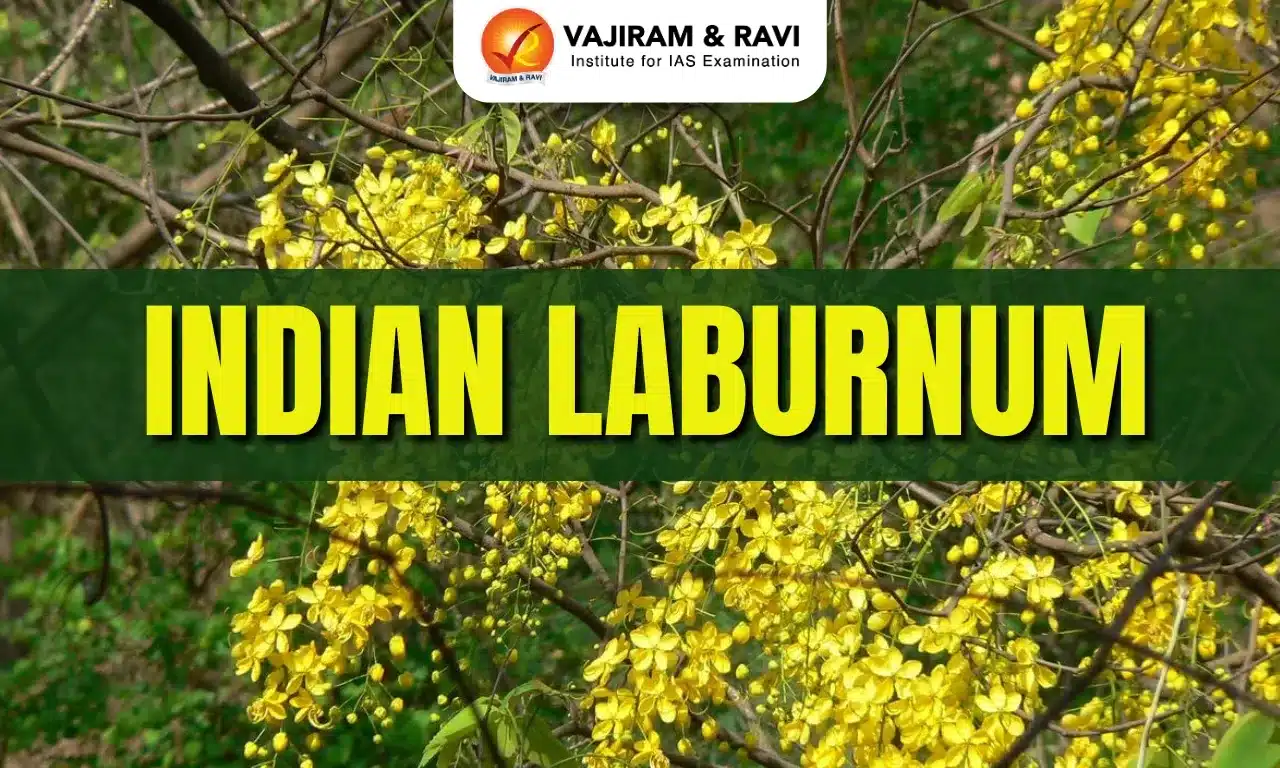
  • Indian laburnum (Cassia fistula) is called “amaltas” in northern India and “kanikonna” in south India.
  • It is a species of flowering plant in the Fabaceae family.
  • It is also known as Golden Shower Tree, Amaltas, Purging Fistula, Pudding-pipe tree.
  • It is native to India and is the State tree of Kerala and Delhi.
  • Appearance:  It is a medium to large deciduous tree that can reach heights of up to 10 to 20 meters (approximately 30 to 65 feet).
  • Distribution: It is native to the Indian subcontinent, but it is also found in other parts of Asia, including Southeast Asia and the Middle East.
  • It is commonly cultivated as an ornamental tree in tropical and subtropical regions worldwide.

Features of Indian laburnum

  • This middle-sized deciduous tree is leafless only for a brief time, between March and May. 
  • The new leaves are glossy, a trait that they lose on maturing, and are mostly bright green, though sometimes a rich copper too.
  • It produces clusters of pendulous, cylindrical, yellow flowers that hang from the branches and bloom in abundance during the flowering season.

Uses of Indian laburnum

  • Its extracts from the bark, leaves, flowers, and seeds have been used to treat a variety of ailments, including constipation, skin conditions, digestive issues, and respiratory problems.
  • Its bark is used to make dye and the pulp in the fruit pod also serves as a strong purgative agent, which helps animals that feed on it.

Source: TH

Indian Laburnum FAQs

Q1: What is the scientific name of Indian Laburnum?

Ans: Cassia fistula

Q2: Which part of Indian Laburnum is used to make a natural dye?

Ans: Pods

Cornea

Cornea

Cornea Latest News

The Union Ministry of Health and Family Welfare recently amended the Transplantation of Human Organs and Tissues (Amendment) Rules, 2025, to boost cornea donation and transplant services across the country.

About Cornea

  • The cornea is the clear outer layer at the front of the eye
  • It covers the pupil (the opening at the center of the eye), iris (the colored part of the eye), and anterior chamber (the fluid-filled inside of the eye). 
  • Viewed from the front of the eye, the cornea appears slightly wider than it is tall. This is because the sclera (the "white" of the eye) slightly overlaps the top and bottom of the anterior cornea.
  • The cornea’s main function is to refract, or bend light. The cornea is responsible for focusing most of the light that enters the eye.
  • As light passes through the cornea, it is partially refracted before reaching the lens.
  • The curvature of the cornea, which is spherical in infancy but changes with age, gives it its focusing power.
  • The cornea provides approximately 65 to 75 percent of the focusing power of the eye.
    • The remainder of the focusing power of the eye is provided by the crystalline lens, located directly behind the pupil.
  • Cornea’s specific shape plays a key role in how your eyesight works and filters some ultraviolet (UV) rays.
  • Except at its margins, the cornea contains no blood vessels, but it does contain many nerves and is very sensitive to pain or touch. 
  • Since there are no nutrient-supplying blood vessels in the cornea, tears and the aqueous humor (a watery fluid) in the anterior chamber provide the cornea with nutrients.
  • Most refractive errorsnearsightedness, farsightedness, and astigmatism — are due to a less-than-optimal curvature or symmetry of the cornea.
  • The cornea is incredibly sensitive, helping you instinctively and immediately react to stop anything from harming your eyes further.
  • Because corneas are the first line of defense for the surface of your eye, they’re also prone to injuries and damage. 
  • The cornea tends to repair itself quickly from minor abrasions.
  • However, deeper abrasions may cause scars to form on the cornea, which causes the cornea to lose its transparency, leading to visual impairment.

Source: TH

Cornea FAQs

Q1: What is the cornea?

Ans: The clear outer layer at the front of the eye.

Q2: What is the main function of the cornea?

Ans: To refract and focus light entering the eye.

Q3: How much of the eye’s focusing power does the cornea provide?

Ans: 65–75 percent

Q4: How does the curvature of the cornea affect vision?

Ans: It determines how light is refracted and focused.

Booker Prize

Booker Prize

Booker Prize Latest News

Recently, David Szalay won the 2025 Booker Prize for his novel ‘Flesh’ becoming the first Hungarian-British author to win one of top awards in the English-speaking world. 

About Booker Prize

  • It is the world’s leading literary award for a single work of fiction.
  • It was founded in the UK in 1969, the Booker Prize initially rewarded Commonwealth writers and now spans the globe: it is open to anyone regardless of origin.
  • It aims to promote the finest in fiction by rewarding the best novel of the year written in English.

Eligibility for Booker Prize

  • The Booker Prize awards any novel originally written in English and published in the UK and Ireland in the year of the prize, regardless of the nationality of their author.
  • The novel must be an original work in English (not a translation)
  • It must be published by a registered UK or Irish imprint; self-published novels are not eligible.
  • The winner receives £50,000 and each of the shortlisted authors will be given £2,500.

Booker Prize Laureates from India and Indian-Origin Writers 

  • VS Naipaul for Free State
  • Salman Rushdie for Midnight’s Children
  • Arundhati Roy for The God of Small Things
  • Kiran Desai for The Inheritance of Loss (2006),
  • Aravind Adiga for The White Tiger (2008).

Source: DD News

Booker Prize FAQs

Q1: What is the prize money for the International Booker Prize?

Ans: £50,000

Q2: Who won the International Booker Prize 2025?

Ans: Banu Mushtaq

SC Seeks Implementation of Women’s Reservation Law

Reservation Law

Reservation Law Latest News

  • The Supreme Court has described women as the “largest minority” and sought the Centre’s response on enforcing the Women’s Reservation Act, 2023, which remains unimplemented pending the next Census and delimitation.

Political Representation of Women in India

  • Women constitute 48.4% of India’s population (Census 2011), yet their political representation remains disproportionately low.
  • Currently, women hold only 14.94% of seats in the Lok Sabha and 13% in State Assemblies, a figure far below the global average of 26.5%. 
  • At the local governance level, women’s representation is significantly higher, about 46% in Panchayati Raj Institutions, owing to the 73rd and 74th Constitutional Amendments (1993) mandating one-third reservation for women.
  • India ranks 141st out of 186 countries in the Inter-Parliamentary Union’s 2024 ranking on women’s representation in national parliaments.

Women’s Reservation Act, 2023

  • The Women’s Reservation Act received Presidential assent in 2023, thereby becoming the Constitution (106th Amendment) Act, 2023.
  • The amendment inserted Article 334A into the Constitution, which provides for 33% reservation of seats for women in the Lok Sabha, State Legislative Assemblies, and the Delhi Assembly
  • However, the implementation of this reservation is tied to the completion of the next Census and the subsequent delimitation process, the redrawing of constituencies based on updated population data.
  • The petitioner has challenged this condition, calling it “unjustified and dilatory.” 
  • She contends that the Act should be implemented immediately, arguing that other constitutional amendments, such as the 73rd and 74th Amendments, which introduced one-third reservation for women in Panchayati Raj and urban local bodies, were enforced without linking them to Census data.

Supreme Court’s Observations

  • During the hearing, Justice Nagarathna observed that women, despite constituting nearly half of India’s population, remain underrepresented in legislative bodies
  • She described them as the “largest minority”, invoking the Preamble’s guarantee of political and social equality and citing Article 15(3) of the Constitution, which empowers the State to make special provisions for women’s advancement.
  • “Who is the largest minority in this country? It is the woman, almost 48 per cent. This is about political equality of the woman,” Justice Nagarathna remarked.
  • The Bench questioned the rationale behind delaying implementation, especially since political justice, along with social and economic justice, is a core principle of the Constitution’s preamble
  • It also noted that the underrepresentation of women in Parliament and Assemblies continues even after 75 years of independence.
  • The advocate representing the petitioner argued that the government should not defer the reservation until the Census and delimitation are completed, as no timeline for these exercises has been defined.

Case for Immediate Implementation

  • The petition urged the court to declare the words “after an exercise of delimitation is undertaken for this purpose after the relevant figures for the first census are published” in Article 334A as void ab initio, allowing immediate implementation of the reservation.
  • The petitioner also drew parallels with other constitutional amendments that were implemented without preconditions:
    • 73rd & 74th Amendments (1993): Introduced one-third reservation for women in local governance.
    • 77th Amendment (1995): Provided reservation in promotions for the Scheduled Castes and the Scheduled Tribes.
    • 103rd Amendment (2019): Enabled 10% reservation for the Economically Weaker Sections (EWS) in education and employment.
  • The petitioner argued that the delay in women’s representation in Parliament and Assemblies was contrary to the constitutional principles of equality and justice.
  • Justice Nagarathna underscored that Article 15(3) and Article 39(a) of the Directive Principles of State Policy (DPSPs) empower the State to ensure equal participation of women in public life. 
  • Political representation, she noted, is integral to women’s empowerment and a precondition for achieving genuine democracy.
  • She further emphasised that political justice, as envisioned by the framers of the Constitution, is incomplete without equal representation for women in lawmaking bodies.

Way Ahead

  • While the Supreme Court refrained from issuing directions that could override the executive’s domain, it urged the Centre to clarify its stance and timeline for implementation.
  • The Union government has maintained that the reservation will take effect only after the next Census and delimitation exercise, which have been pending since 2021. 
  • However, no definitive schedule has been announced for these processes, leading to concerns that the law could be indefinitely delayed.
  • Experts suggest that an interim framework, such as the temporary allocation of reserved constituencies, could be introduced to operationalise the law before the next general election. 
  • Political analysts also note that early implementation would not only enhance women’s participation but could also reshape the political landscape, fostering more inclusive policymaking.

Source: TH | PRS

Reservation Law FAQs

Q1: What does the Women’s Reservation Act, 2023 mandate?

Ans: The Act reserves one-third of seats in the Lok Sabha, State Legislative Assemblies, and Delhi Assembly for women.

Q2: When will the reservation for women be implemented?

Ans: It will take effect only after the next Census and subsequent delimitation exercise are completed.

Q3: What did the Supreme Court observe about women’s representation?

Ans: The Court termed women the “largest minority” in India and highlighted their declining representation in Parliament.

Q4: What was the petitioner’s plea in the Supreme Court?

Ans: The petitioner sought immediate implementation of the Act without waiting for delimitation, arguing the delay was unjustified.

Q5: What constitutional provisions support women’s political empowerment?

Ans: Articles 15(3) and 39(a) empower the State to promote equality and ensure women’s participation in governance.

Tropical Forest Forever Facility: Brazil’s $125 Billion Fund to Protect Forests

Tropical Forest Forever Facility

Tropical Forest Forever Facility Latest News

  • At the COP30 climate summit in Belém, Brazil unveiled the Tropical Forest Forever Facility (TFFF) — a new $125 billion fund to reward developing countries for conserving tropical forests.
  • President Luiz Inácio Lula da Silva called it an “unprecedented initiative”, emphasising that it gives Global South nations a leading role in forest conservation efforts.
  • While the TFFF is expected to reshape global environmental policy, experts remain uncertain about its implementation mechanisms and how funds will be distributed and managed in practice.

Tropical Forest Forever Facility: A Global Investment for Conservation

  • The Tropical Forest Forever Facility (TFFF) is a self-sustaining investment fund aimed at rewarding up to 74 developing countries for preserving old-growth tropical forests.
  • The fund seeks to raise $125 billion — including $25 billion from governments and philanthropists and $100 billion in private investments. 
  • The money will be invested in public and corporate bonds, with the annual returns distributed as payments to forest nations based on satellite-tracked canopy data.
  • Initial contributions include $1 billion each from Brazil and Indonesia, $250 million from Colombia, $3 billion over a decade from Norway, $5 million from the Netherlands, and €1 million from Portugal.

TFFF Aims to Make Forest Conservation More Valuable

  • The Tropical Forest Forever Facility (TFFF) was launched to reverse the economic incentives driving deforestation, where forests are often worth more dead than alive.
  • By rewarding countries and landowners for keeping forests intact, the fund seeks to make conservation financially competitive with deforestation-based activities like soy and timber production.
  • The TFFF marks a turning point in tropical forest protection, as it creates a global, permanent incentive mechanism recognising the true value of forest ecosystem services, including carbon storage and climate regulation.

Concerns Over Financial Stability and Accountability of the TFFF

  • Vulnerability to Market Fluctuations
    • Critics warn that the Tropical Forest Forever Facility (TFFF) is highly exposed to financial market volatility, as it relies on bond investments—including in developing nations prone to instability.
    • A major market crash, like during COVID-19 or the 2008–09 financial crisis, could jeopardise returns and disrupt payments to forest-conserving countries.
  • Weakening of Developed Nations’ Obligations
    • Experts argue that the TFFF could dilute the legal responsibility of developed countries to provide climate finance.
    • Since the fund is not part of the UNFCCC framework, it is not bound by international accountability standards governing climate finance commitments.
  • Risk of Undermining UN Climate Mechanisms
    • According to the climate finance experts, the TFFF might undermine existing global climate finance systems under the UNFCCC and Paris Agreement, by shifting focus away from public funding obligations toward market-based mechanisms.

Source: IE | TH

Tropical Forest Forever Facility FAQs

Q1: What is the Tropical Forest Forever Facility (TFFF)?

Ans: The TFFF is a $125 billion global investment fund rewarding developing countries for preserving tropical forests through annual payments based on satellite-tracked canopy data.

Q2: Who launched the TFFF and where?

Ans: Brazil launched the TFFF during the COP30 summit in Belém to promote forest conservation and give Global South nations a leading role in climate protection.

Q3: How will the TFFF raise and use funds?

Ans: The fund seeks $25 billion from governments and philanthropists and $100 billion from private investors, investing in bonds to generate returns for forest rewards.

Q4: What problem is the TFFF addressing?

Ans: It aims to make forest conservation financially more rewarding than deforestation, compensating countries for preserving carbon-rich, biodiversity-rich tropical ecosystems.

Q5: What concerns have experts raised about the TFFF?

Ans: Critics warn of financial instability due to market risks and fear it may weaken developed nations’ climate finance obligations under the UNFCCC and Paris Agreement.

How Quality Control Orders Hurt India’s MSMEs and Export Competitiveness

Quality Control Orders

Quality Control Orders Latest News

  • Industry representatives have cautioned that Quality Control Orders (QCOs), originally intended to improve product quality and curb substandard imports, are increasingly being used as protectionist tools. 
  • Experts noted that QCOs have become non-tariff barriers, raising compliance costs and regulatory burdens for Micro, Small & Medium Enterprises (MSMEs), especially as India faces added pressure from U.S. trade tariffs.

About Quality Control Orders

  • Quality Control Orders (QCOs), issued under the Bureau of Indian Standards (BIS) Act, 2016, mandate that no product can be manufactured, imported, or sold without a BIS certification once notified.
  • Originally meant to enhance product quality and restrict substandard imports, QCOs have been aggressively expanded since 2019 to reduce import dependence and boost domestic manufacturing under the self-reliance agenda.
  • Their number has surged from 88 in 2019 to 765 by December 2024, with metals, machinery, and electronics together accounting for over 60% of all QCOs issued between 1987 and 2025.

Quality Control Orders: A Costly Misstep for India’s MSMEs and Export Competitiveness

  • While India opens its markets through new Free Trade Agreements (FTAs), its parallel drive to impose Quality Control Orders (QCOs) has backfired. 
  • Instead of improving product quality, the move has hurt MSMEs and weakened export competitiveness by increasing costs and regulatory hurdles.

NITI Aayog’s Findings on QCOs

  • A NITI Aayog report by the High-Level Committee on Non-Financial Regulatory Reforms found that most QCOs target raw materials and intermediate products, not finished goods.
  • It also noted that many standards are misaligned with global benchmarks, leading to higher input costs, production delays, and limited access to accredited testing facilities.
  • These bottlenecks have eroded cost competitiveness for downstream manufacturers.

CSEP Study: No Long-Term Export Gains

  • A Centre for Social and Economic Progress (CSEP) study revealed that imports fell sharply after QCO implementation — down 13% in the first year and 24% over the long term.
  • While exports briefly rose by 10.6%, they fell by 12.8% in the following year, showing no sustained benefits.
  • For intermediate goods, imports plunged by 30% in the long run, undermining domestic production capacity and challenging QCOs’ effectiveness as a competitiveness tool.

Quality Norms Hurt Export Sectors and Boost Market Concentration

  • NITI Aayog has warned that QCOs have hurt export-oriented and labour-intensive sectors like footwear and electronics, which employ around 4.5 million people. 
  • These industries depend on imported intermediate materials crucial for product quality and design flexibility.
  • QCOs on such inputs have restricted access to globally sourced materials, as foreign suppliers struggle to obtain BIS certification, leading to market concentration among a few domestic producers. 
  • This has allowed them to raise prices by 15–30% above global benchmarks for products like polyester yarn and steel, reducing India’s cost competitiveness in global markets — notably in apparel exports.
  • According to CSEP, MSMEs face heavy compliance costs (₹10,000–₹15,000 per consignment) and approval delays, while limited testing infrastructure and non-alignment with global standards worsen trade frictions. 
  • Larger firms, better equipped to absorb these costs, often gain at the expense of smaller players, deepening market inequality and export inefficiency.

MSMEs Bear the Brunt of Quality Control Compliance Burden

  • According to NITI Aayog, Micro, Small, and Medium Enterprises (MSMEs) are the worst hit by the implementation of Quality Control Orders (QCOs) due to high certification costs, testing delays, and stringent inspection requirements.
  • Testing backlogs at BIS-approved labs often stretch for months, while the expense of obtaining and renewing licences is prohibitive for small firms with tight margins. 
  • Unlike exporters in Special Economic Zones (SEZs), MSMEs in the Domestic Tariff Area (DTA) lack access to duty-free import channels, reducing their competitiveness in both domestic and global markets.
  • The report also urged the government to revoke the Steel Import Monitoring System (SIMS) and No Objection Certificate (NOC) process for non-BIS steel grades, noting that the Directorate General of Foreign Trade (DGFT) already has systems to effectively monitor imports and exports.

Source: IE | TP

Quality Control Orders FAQs

Q1: What are Quality Control Orders (QCOs)?

Ans: QCOs are government directives under the BIS Act, 2016, requiring manufacturers and importers to meet BIS-certified quality standards before selling products in India.

Q2: How have QCOs expanded in recent years?

Ans: The number of QCOs rose from 88 in 2019 to 765 by 2024, mainly targeting metals, machinery, and electronics to promote self-reliant manufacturing.

Q3: What has been their impact on exports?

Ans: Studies show QCOs reduce imports but fail to boost exports, instead increasing production costs and reducing competitiveness in sectors like footwear and electronics.

Q4: Why are MSMEs most affected by QCOs?

Ans: MSMEs face high certification costs, long testing delays, and limited access to BIS-approved labs, making compliance financially and logistically burdensome.

Q5: What reforms have been suggested?

Ans: Experts recommend aligning QCOs with global standards, easing compliance for MSMEs, and revoking overlapping monitoring systems like SIMS and redundant NOC requirements.

India AI Governance Guidelines 2025 – Towards Safe, Inclusive and Accountable AI Ecosystem

India AI Governance Guidelines

India AI Governance Guidelines 2025 Latest News

  • The Ministry of Electronics and Information Technology (MeitY) released the India AI Governance Guidelines 2025, a comprehensive document aimed at regulating, promoting, and governing the use of Artificial Intelligence (AI) in India.
  • The guidelines mark a major step in India’s preparation for hosting the AI Impact Summit 2026 in New Delhi and align with global AI governance trends emerging from summits at Bletchley Park (U.K.), Seoul, and Paris.

Objectives of the Guidelines

  • Harnessing AI for inclusive growth:
    • India’s goal is to leverage AI for inclusive development and global competitiveness, while mitigating risks to individuals and society.
    • India is now the world’s 2nd-largest user of Large Language Models (LLMs) after the U.S.
  • Establishing a consistent regulatory framework:
    • The guidelines aim to provide a coherent policy mechanism for AI governance across government, industry, and academia.
    • The framework was finalized by a MeitY committee led by Prof. Balaraman Ravindran, head of the Centre for Responsible AI (CeRAI), IIT Madras.

Key Recommendations

  • Foundational principles:
    • The framework is built on people-centricity, accountability, fairness, and explainability of AI systems.
    • It stresses transparency, ethical AI deployment, and risk-based oversight.
  • Institutional mechanisms: Establishment of an AI Governance Group as an inter-ministerial body to coordinate between -
    • Ministries and sectoral regulators
    • NITI Aayog and Bureau of Indian Standards (BIS)
    • Regulatory agencies like RBI (which has already released the FREE-AI Committee report for the financial sector).
  • Role of private sector: Firms are encouraged to -
    • Ensure compliance with Indian laws
    • Adopt voluntary ethical AI frameworks
    • Publish transparency reports and establish grievance redressal systems
    • Implement techno-legal risk mitigation tools
  • AI Safety Institute (AISI):
    • While no physical institute exists yet, an online AISI under the IndiaAI Mission will oversee safety standards and risk management.
    • Similar institutes operate in other countries to ensure responsible AI deployment.

Unique India-specific Features

  • Infrastructure and accessibility:
    • State governments are advised to expand AI infrastructure, enhance data and compute access, and promote AI adoption at local levels.
    • This aligns with the IndiaAI Mission’s (Graphics Processing Unit) GPU procurement initiative to provide shared computing resources.
  • Cultural and linguistic representation: The guidelines advocate development of AI models in Indian languages using locally relevant datasets, to ensure cultural inclusivity and regional relevance.
  • Intellectual property and legal reforms: Calls for copyright law amendments to address AI-generated content and intellectual property disputes.

Alignment with Broader Government Initiatives

  • Complementing ongoing programs:
    • Deepfake regulation: MeitY has proposed mandatory labelling of AI-generated images/videos for authenticity.
    • Digital Public Infrastructure (DPI) integration: Recommends linking AI with Aadhaar, UPI, and other DPI for enhanced public service delivery.
    • Institutional coordination: Unique Identification Authority of India (UIDAI) has already formed a committee to integrate AI capabilities with Aadhaar systems.
  • Policy flexibility: The government will act swiftly if the evolving AI landscape demands legislative intervention beyond the framework.

Way Forward

  • Establish legal backing: Enact a comprehensive AI regulation law ensuring accountability, privacy, and data security.
  • Promote research collaboration: Strengthen ties between academia, startups, and government to advance ethical AI innovations.
  • Capacity building: Upskill public and private sector personnel to understand AI governance, risk, and compliance.
  • Public awareness: Launch campaigns to educate citizens about AI usage, risks, and grievance mechanisms.

Conclusion

  • The India AI Governance Guidelines 2025 represent a balanced approach between innovation and regulation. 
  • By focusing on ethical use, risk management, and inclusion, India aims to emerge as a global leader in responsible AI governance.
  • The document lays the foundation for safe, equitable, and transparent AI integration into governance and the economy — reflecting the government’s vision of “AI for All” in the spirit of Digital India.

Source: TH

India AI Governance Guidelines 2025 FAQs

Q1: What are the primary objectives of the India AI Governance Guidelines 2025?

Ans: The guidelines aim to harness AI for inclusive development and global competitiveness, while ensuring accountability, fairness, and risk mitigation.

Q2: What institutional mechanism has been proposed under the AI Governance Guidelines?

Ans: An overarching AI Governance Group has been proposed to coordinate among Ministries, regulators like RBI, NITI Aayog, etc.

Q3: How do the India AI Governance Guidelines differ from similar global frameworks?

Ans: India’s guidelines emphasize AI infrastructure development, data access, and culturally representative AI models in Indian languages.

Q4: What role does the AI Safety Institute (AISI) play in India’s AI governance?

Ans: The AISI, established virtually under the IndiaAI Mission, is tasked with promoting AI safety research, risk classification, etc.

Q5: How are the AI Governance Guidelines aligned with India’s broader digital initiatives?

Ans: They complement initiatives like Digital Public Infrastructure (Aadhaar, UPI), deepfake regulation, and AI-enabled governance.

Daily Editorial Analysis 11 November 2025

Daily Editorial Analysis

What South Asia Wants from COP30

Context

  • South Asia, home to nearly two billion people, stands at the frontline of escalating environmental disasters, monsoon floods, landslides, glacial melt, and extreme heatwaves.
  • This crisis unfolds amid a world where multilateralism is under strain, climate pledges are weakened, and trade protectionism is rising.
  • Yet, despite the fractures in global cooperation, collective action remains indispensable.
  • In this shifting landscape, South Asia’s role is expanding, not only as a region of vulnerability but as a centre of climate leadership shaped by necessity, experience, and a moral imperative to act.

The Global Context: Eroding Trust and Emerging Leadership

  • Global climate governance has been weakened by broken promises and political withdrawal, including the repeated exit of the United States from the Paris Agreement.
  • Such actions have undermined trust and tested the credibility of international processes. Yet, smaller and more vulnerable states have stepped forward to fill the void.
  • Small island nations, emerging economies, and coalitions of the willing have become the new drivers of climate ambition.
  • Within this dynamic, South Asia has emerged as a pragmatic and collaborative force.

South Asia’s Climate Priorities

  • Implementation- The Achilles Heel of Climate Action

    • The greatest gap in global climate governance lies between pledges and performance. Promised action and finance often fail to materialize.
    • Out of 203 initiatives launched since 2015, only 5% have achieved their stated goals. This failure highlights the need for regional cooperation to strengthen delivery.
    • South Asian countries are calling for robust governance, clear timelines, and inclusive participation that gives a voice to local communities, women, and subnational governments.
    • Platforms such as the G-20, BIMSTEC, and BRICS can serve as regional anchors for a common climate stance.
  • Adaptation on Par with Mitigation

    • In South Asia, climate adaptation must stand shoulder-to-shoulder with emission mitigation.
    • The region faces a future where days exceeding 35°C may double by 2100, intensifying existing vulnerabilities.
    • Nepal’s glacial lake outburst floods, coastal erosion in the Maldives, India’s extreme heatwaves, and Sri Lanka’s emerging drylands reveal the diversity and urgency of threats.
    • To respond effectively, countries require technical, institutional, and financial support for adaptation plans.
  • Rebuilding Trust through Ambitious Action

    • Trust is the cornerstone of global climate cooperation, yet it has been eroded by delayed finance, diluted commitments, and geopolitical tension.
    • Developed nations are off-track to meet their 2030 Nationally Determined Contribution (NDC) targets, weakening faith in collective processes.
      Fulfilling existing pledges, aligning new commitments with the 1.5°C goal, and ensuring accountability are essential to restore credibility.
    • Without genuine delivery, every unkept promise widens the divide between developed and developing worlds and undermines multilateralism itself.
  • Climate Finance- From Promises to Predictability

    • For South Asia, finance is the lifeblood of action. Effective climate finance must be predictable, adequate, fairly distributed, easily accessible, and non-debt inducing.
    • Vague targets such as the $300 billion adaptation goal by 2035 will remain meaningless without clear pathways outlining who delivers, how much, by when, and with what accountability.
    • The proposed Baku to Belém Roadmap to $1.3 trillion must be grounded in operational clarity.
    • South Asia’s Least Developed Countries (LDCs) are calling for a tripling of adaptation finance and dedicated regional allocations from funds such as the Green Climate Fund, the Loss and Damage Fund, and the Adaptation Fund.
  • Mobilising Non-State Actors as Engines of Scale

    • The climate transition cannot be achieved by nation-states alone. Non-state actors, including local governments, the private sector, civil society, youth, academia, and businesses, must become engines of scale.
    • The private sector can unlock new sources of finance; subnational entities can implement and align with national goals; civil society can conduct independent assessments; youth movements can inject innovation and intergenerational equity; and businesses can integrate sustainability into markets and supply chains.
    • This distributed model of action reinforces a cycle of accountability, innovation, and trust, helping rebuild confidence in multilateral processes.

The Path Forward: From Promises to Delivery

  • The time for rhetoric has passed. Delivery is now the only currency of trust. Effective climate action must rest on three foundations:
  • Mutual clarity — defining responsibilities and transparent pathways;
  • Mutual cooperation — acknowledging both vulnerabilities and opportunities;
  • Mutual implementation — turning promises into practice across borders and sectors.
  • South Asia’s climate leadership demonstrates that even in an era of political division, progress is possible through collaboration, innovation, and accountability.
  • The region’s message to the world is unequivocal: multilateralism must be restored to credibility through delivery.

Conclusion

  • In an age where the global climate regime struggles with credibility, South Asia stands out as a voice of pragmatic hope.
  • Its leadership embodies collective responsibility, regional solidarity, and moral urgency.
  • By prioritising implementation, adaptation, trust, finance, and participation, South Asia signals a transformation in climate diplomacy, one that values action over rhetoric and inclusion over isolation.

What South Asia Wants from COP30 FAQs

 Q1. What makes South Asia a key player in global climate action?
Ans. South Asia is a key player because it faces severe climate risks affecting nearly two billion people and has developed pragmatic, collaborative responses driven by necessity and moral responsibility.

Q2. Why is implementation called the Achilles heel of climate action?
Ans. Implementation is called the Achilles heel because there is a wide gap between climate promises and actual delivery, with very few initiatives meeting their stated goals.

Q3. How does South Asia aim to balance adaptation and mitigation?
Ans. South Asia aims to balance adaptation and mitigation by integrating locally-led adaptation strategies with scientific innovation and ensuring that adaptation receives equal priority in global discussions.

Q4. What kind of climate finance does South Asia demand?
Ans. South Asia demands climate finance that is predictable, adequate, fairly distributed, easily accessible, and non-debt inducing, supported by clear timelines and accountability.

Q5. Why are non-state actors important in the climate transition?
Ans. Non-state actors such as civil society, youth, businesses, and local governments are important because they can drive innovation, expand financing, ensure accountability, and reinforce trust in climate governance.

Source: The Hindu


Celebrating a Sage King, a Celebration of India-Bhutan Ties

Context

  • Bhutan’s former King, Jigme Singye Wangchuck (K4), father of the current monarch Jigme Khesar Namgyel Wangchuck (K5), turns 70 on November 11, 2025.
  • Revered as the “Bodhisattva King,” he ruled from the age of 17 until his abdication in 2006, guiding Bhutan into modernity with wisdom and integrity.
  • Celebrations marking his milestone birthday are being held in Thimphu, with Prime Minister Narendra Modi attending to honour Bhutan’s deeply respected former ruler.
  • This article highlights the 70th birthday celebration of Bhutan’s former King Jigme Singye Wangchuck (K4) and how the event reflects the deep-rooted friendship between India and Bhutan.
  • It explores the historic leadership of K4, the strengthening of bilateral ties under PM Modi’s Neighbourhood First policy, the pivotal role of hydropower cooperation, and Bhutan’s security partnership with India, built on trust, respect, and shared strategic vision.

India and Bhutan: A Bond Strengthened by Trust and Vision

  • PM Modi’s visit to Bhutan for former King Jigme Singye Wangchuck’s 70th birthday underscores the deep and enduring friendship between the two nations.
  • Modi, who made Bhutan his first foreign visit in 2014, continues to prioritise this partnership under the Neighbourhood First policy.
  • During his reign, King Jigme Singye Wangchuck (K4) strengthened Bhutan’s ties with India, recognising India as a trusted partner and protector of Bhutan’s sovereignty.
  • He invited India’s Border Roads Organisation (BRO) to build the country’s road network and pioneered the idea of hydropower generation for export to India — creating a sustainable source of national income and further deepening bilateral cooperation.

Hydropower: The Cornerstone of India–Bhutan Partnership

  • Hydropower cooperation has long been a key pillar of India–Bhutan relations, symbolising mutual trust and economic interdependence.
  • During PM Modi’s current visit, he and King Jigme Khesar Namgyel Wangchuck (K5) will inaugurate the 1,020 MW Punatsangchhu II hydroelectric project, which has already begun generating power and boosting Bhutan’s economy.
  • Funded initially by India, the project’s costs are repaid through electricity sales to India at mutually adjusted rates.
  • While this government-to-government model has been successful, future projects will involve private investment — with Indian companies like Tata Power and Adani Power collaborating with Bhutanese firms.
  • Beyond hydropower, India’s development assistance to Bhutan extends to infrastructure, education, community projects, and heritage restoration, reinforcing an enduring partnership grounded in progress and shared prosperity.

Bhutan’s Security Vision and India’s Enduring Gratitude

  • King Jigme Khesar Namgyel Wangchuck (K5) continues to consult his father, King Jigme Singye Wangchuck (K4), on key national security matters, including Bhutan’s territorial integrity and the preparedness of the Royal Bhutan Army (RBA).
  • K4 possesses deep insight into both India’s democratic system and China’s strategic motives, making his guidance crucial to Bhutan’s foreign and security policies.
  • India remains particularly grateful for Operation All Clear (2003), when K4 personally led the RBA in expelling Indian insurgent groups from Bhutanese territory, enabling Indian forces to capture them across the border.
  • Prime Minister Narendra Modi’s presence at K4’s 70th birthday celebration in Thimphu thus symbolises not only honour for a revered monarch but also the strength and trust underpinning India–Bhutan relations.

Celebrating a Sage King, a Celebration of India-Bhutan Ties FAQs

Q1. Who is Jigme Singye Wangchuck and why is he revered in Bhutan?

Ans. Known as the “Bodhisattva King,” Jigme Singye Wangchuck modernised Bhutan with wisdom, integrity, and compassion during his reign from 1972 to 2006.

Q2. What does PM Modi’s visit to Bhutan signify?

Ans. It reflects India’s commitment to its Neighbourhood First policy and reaffirms the close friendship and mutual respect shared between the people of India and Bhutan.

Q3. Why is hydropower cooperation central to India–Bhutan relations?

Ans. Hydropower projects, like Punatsangchhu II (1,020 MW), symbolise economic interdependence and mutual growth, providing Bhutan revenue and India clean, renewable energy.

Q4. How did K4 contribute to Bhutan’s security and India–Bhutan cooperation?

Ans. K4 led Operation All Clear (2003) to expel Indian insurgents from Bhutan, strengthening bilateral security cooperation and India’s trust in Bhutan’s commitment.

Q5. What are India’s future plans for hydropower projects in Bhutan?

Ans. Future projects will involve private investment, with Indian companies like Tata Power and Adani Power partnering Bhutanese firms for sustainable energy collaboration.

Source: TH

Daily Editorial Analysis 11 November 2025 FAQs

Q1: What is editorial analysis?

Ans: Editorial analysis is the critical examination and interpretation of newspaper editorials to extract key insights, arguments, and perspectives relevant to UPSC preparation.

Q2: What is an editorial analyst?

Ans: An editorial analyst is someone who studies and breaks down editorials to highlight their relevance, structure, and usefulness for competitive exams like the UPSC.

Q3: What is an editorial for UPSC?

Ans: For UPSC, an editorial refers to opinion-based articles in reputed newspapers that provide analysis on current affairs, governance, policy, and socio-economic issues.

Q4: What are the sources of UPSC Editorial Analysis?

Ans: Key sources include editorials from The Hindu and Indian Express.

Q5: Can Editorial Analysis help in Mains Answer Writing?

Ans: Yes, editorial analysis enhances content quality, analytical depth, and structure in Mains answer writing.

Monthly Current Affairs September 2025 for UPSC Prelims & Mains

Current Affairs September 2025

UPSC Current Affairs for September 2025 are one of the common and crucial components of the UPSC CSE syllabus. Current affairs are the events and issues that are happening in the present time, both in India and around the world. They cover various domains, such as politics, economy, society, culture, environment, science, technology, sports, etc. In this article, we are going to cover the UPSC Current Affairs for September 2025 for both Prelims and Mains. 

UPSC Current Affairs September 2025 

Current affairs September 2025 are an important part of UPSC CSE preparation, and to assist aspirants, Vajiram & Ravi publish Monthly Current Affairs Magazine, The Recitals, daily prelims pointers, mains articles, editorial analysis, daily newspaper analysis video- The Analyst. These sources consolidate and simplify all the important current affairs topics from the month into high-quality, well-researched magazines. Drawing from reliable sources like PIB, Yojana, Kurukshetra, The Hindu, Indian Express, Economic Times, and Down to Earth, the content is presented through text, infographics, charts, and tables, ensuring easy understanding and effective learning.

UPSC Current Affairs September 2025 for Prelims & Mains

UPSC Current Affairs September 2025 for Prelims & Mains includes Daily Prelims Pointers and Mains Articles as well as Daily Editorial Analysis that are carefully curated by experts and updated on our website on a daily basis. These topics, derived from The Hindu and Indian Express, simplify the preparation process by providing a thorough analysis of current affairs . They cover both backward and forward linkages, offering a comprehensive understanding of each topic. Designed as concise daily notes, they ensure that aspirants efficiently address all the key subjects. While Prelims Pointers have a more concise and focused approach, the Mains Articles are crafted to enable students to effectively utilize the information for answer writing in the Mains exam. The Daily Editorial Analysis analyses the daily editorial news in the Indian Express and The Hindu Newspaper.The Analyst – Daily Newspaper Analysis Video by Vajiram & Ravi provides a thorough and insightful breakdown of the most significant news stories from The Hindu and Indian Express. Each video is paired with a handout summarizing the key points, presented in a clear, bullet-point format for easy comprehension and effective research.

UPSC September Current Affairs 2025

We publish ten Prelims Pointers, four Main Articles and three Editorial Analysis on a daily basis. Here is a link to our Daily Prelims Pointers and Mains Articles, Editorial Analysis and The Analyst Video created using multiple sources to ease UPSC preparation for the aspirants: 

September 2025 Date Prelims Pointers Link Mains Articles Link Daily Editorial Analysis The Analyst

1 September 2025

Link

Link

Link

Link

2 September 2025

Link

Link

Link

Link

3 September 2025

Link

Link

Link

Link

4 September 2025

Link

Link

Link

Link

5 September 2025

Link

Link

Link

Link

6 September 2025

Link

Link

Link

Link

7 September 2025

Link

Link

Link

Link

8 September 2025

Link

Link

Link

Link

9 September 2025

Link

Link

Link

Link

10 September 2025

Link

Link

Link

Link

11 September 2025

Link

Link

Link

Link

12 September 2025

Link

Link

Link

Link

13 September 2025

Link

Link

Link

Link

14 September 2025

Link

Link

Link

Link

15 September 2025

Link

Link

Link

Link

16 September 2025

Link

Link

Link

Link

17 September 2025

Link

Link

Link

Link

18 September 2025

Link

Link

Link

Link

19 September 2025

Link

Link

Link

Link

20 September 2025

Link

Link

Link

Link

21 September 2025

Link

Link

Link

Link

22 September 2025

Link

Link

Link

Link

23 September 2025

Link

Link

Link

Link

24 September 2025

Link

Link

Link

Link

25 September 2025

Link

Link

Link

Link

26 September 2025

Link

Link

Link

Link

27 September 2025

Link

Link

Link

Link

28 September 2025

Link

Link

Link

Link

29 September 2025

Link

Link

Link

Link

30 September 2025

Link

Link

Link

Link

Importance of Current Affairs September 2025 for UPSC Aspirants 

Current affairs remain one of the most crucial components of the UPSC CSE syllabus, covering events and issues of present relevance in India and across the world. They span diverse areas such as politics, economy, society, culture, environment, science, technology, and sports. The importance of current affairs for September 2025 lies in their direct role in shaping the knowledge base and analytical ability of aspirants, making them indispensable for exam success.

  • Testing Awareness and Understanding of the Contemporary World
    Current affairs September 2025 are not just about memorizing facts but about analyzing events and their wider implications. They test your awareness of global and national happenings, along with your ability to understand causes, consequences, and possible solutions. For aspirants, this builds global perspective and critical thinking qualities central to civil services.
  • Connecting Static and Dynamic Portions of the Syllabus
    Current affairs September 2025 act as a bridge between static knowledge and real-time developments. Events such as policy changes, international summits, or socio-economic shifts can be linked to static subjects like history, polity, geography, and economy. This integration strengthens conceptual clarity and improves answer writing by enabling aspirants to connect theory with practice.
  • Unpredictable and Dynamic Nature of UPSC Preparation
    The importance of current affairs for September 2025 also lies in their dynamic and evolving nature. Unlike static subjects, they change daily and require consistent updates. This unpredictability challenges aspirants to remain alert and well-informed, while also adding variety to UPSC preparation. It ensures that aspirants do not rely solely on rote learning but instead develop adaptability and analytical flexibility.

Relevance to Civil Services and Real-World Administration
Above all, current affairs September 2025 are vital as they reflect the realities future civil servants must deal with. They highlight governance challenges, policy decisions, and social issues that administrators directly engage with. Moreover, they are critical during the interview stage, where aspirants are tested on their opinions and depth of understanding regarding contemporary issues.

Current Affairs September 2025 FAQs

Q1: How to prepare current affairs for UPSC CSE?

Ans: By consistently reading newspapers, using standard monthly magazines, and revising through reliable compilations with answer writing practice.

Q2: What is the importance of studying current affairs for UPSC CSE?

Ans: Current Affairs link static subjects with real-time issues, test analytical skills, and form a significant part of Prelims, Mains, and Interview.

Q3: What are Vajiram & Ravi Prelims Pointers?

Ans: They are concise, exam-focused current affairs notes prepared by Vajiram & Ravi for UPSC Prelims revision uploaded on their website on a daily basis.

Q4: Which newspaper to read to prepare UPSC Current Affairs?

Ans: The Hindu and The Indian Express are the most recommended newspapers for UPSC preparation.

Q5: How to prepare newspaper notes for UPSC CSE?

Ans: By focusing on exam-relevant issues, summarizing in bullet points, and organizing under GS syllabus topics for quick revision.

Altermagnets

Altermagnets

Altermagnetism Latest News

The discovery of altermagnetism represents a step forward in physicists’ understanding of the magnetic world.

What is Ferromagnetism and Antiferromagnetism?

  • Magnetism has long been categorised into two primary types: ferromagnetism and antiferromagnetism.
  • Ferromagnetism is responsible for the behaviour of materials like iron and nickel, where all magnetic moments align in the same direction, producing strong magnetisation – such as the force that makes fridge magnets stick.
  • Antiferromagnetism occurs when magnetic moments align in a regular pattern but point in opposite directions, cancelling each other out and resulting in no external magnetic field.

About Altermagnetism

  • Altermagnetism is a type of magnetism where magnetic moments (tiny magnetic fields created by electrons) align in opposite directions but follow a distinct rotated pattern.
  • This unique arrangement creates properties that combine key elements of both ferromagnets and antiferromagnets.
  • Like antiferromagnets, altermagnets have magnetic moments that align in opposite directions, cancelling out any overall magnetisation. 
  • However, like ferromagnets, altermagnets still allow spin-polarised currents. In ferromagnets, spin-polarised currents can only occur because all electron spins or moments align in one direction (producing a magnetic field).
  • The key distinction in altermagnets is that the larger, crystal-like structures holding these magnetic moments are rotated relative to each other, creating distinct electronic behaviours. 
  • It is the rotation of these larger structures that allows for spin-polarised currents to still occur in altermagnets.
  • This makes altermagnets potentially valuable for a variety of applications, particularly in electronics and data storage.
  • They eliminate the possibility of stray magnetic fields while still allowing for a spin-polarised current – a highly useful combination for modern electronics.

Source: TH

Altermagnetism FAQs

Q1: What is altermagnetism?

Ans: A type of magnetism where magnetic moments align oppositely but with a rotated pattern.

Q2: Why can altermagnets still allow spin-polarised currents?

Ans: Because their crystal structures are rotated relative to each other.

Q3: In which field could altermagnetism have valuable applications?

Ans: Electronics and data storage.

Improvised Explosive Device (IED)

IED

Improvised Explosive Device Latest News

J&K Police recently arrested seven locals linked to a terror module, seizing 2900 kg of IED-making materials and arms.

About Improvised Explosive Device

  • An IED is a type of unconventional explosive weapon that can take any form and be activated in a variety of ways.
  • IEDs are used by criminals, vandals, terrorists, suicide bombers, and insurgents.
  • Because they are improvised, IEDs can come in many forms, ranging from a small pipe bomb to a sophisticated device capable of causing massive damage and loss of life.
  • The extent of damage caused by an IED depends on its size, construction, and placement and whether it incorporates a high explosive or propellant.
  •  IEDs can be carried or delivered in a vehicle; carried, placed, or thrown by a person; delivered in a package; or concealed on the roadside. 
  • The term IED came into common usage during the Iraq War that began in 2003.
  • IEDs are inexpensive and can be easily manufactured, concealed and detonated.
  • Further, IEDs can be manufactured by using commonly available material or chemicals.
  • Elements of an IED:
    • It consists of a variety of components that include an initiator, switch, main charge, power source, and container.
    • IEDs may be surrounded by or packed with additional materials or “enhancements” such as nails, glass, or metal fragments designed to increase the amount of shrapnel propelled by the explosion.
    • An IED can be initiated by a variety of methods depending on the intended target.
  • Materials Used as Explosives in IEDs:
    • Many commonly available materials, such as fertilizer, gunpowder, and hydrogen peroxide, are used as explosive materials in IEDs.
    • Explosives must contain a fuel and an oxidizer, which provides the oxygen needed to sustain the reaction. 
    • A common example is ANFO, a mixture of ammonium nitrate, which acts as the oxidizer, and fuel oil (the fuel source).

Source: TH

Improvised Explosive Device FAQs

Q1: What is an Improvised Explosive Device (IED)?

Ans: A type of unconventional explosive weapon made from improvised components.

Q2: Which groups are known to use IEDs?

Ans: Criminals, terrorists, insurgents, suicide bombers and vandals.

Q3: What primarily determines the extent of damage caused by an IED?

Ans: The extent of damage caused by an IED depends on its size, construction, and placement and whether it incorporates a high explosive or propellant.

Q4: What does an IED usually contain?

Ans: Initiator, switch, main charge, power source, and container.

Enquire Now