Difference between Left Wing and Right Wing, Key Points

Difference between Left Wing and Right Wing

Left wing and right wing are two different ideologies in regards to society, the role of the government, and economics. The "left wing" advocates for equality-oriented reforms, greater government involvement, and welfare policies to eliminate social and economic disparities; while the "right wing" supports tradition, limited government, free-market economics, and individuals have more freedom. These two Ideologies differ in their perception of Nationalism, Religion, Regulations on the economy and the balance between collective welfare and individual freedom. The Difference between Left Wing and Right Wing, highlighting important ideologies have been shared below in the article.

Difference between Left Wing and Right Wing

Left-wing ideology promotes social equality, welfare-driven governance, and progressive reforms. Right-wing ideology focuses on tradition, hierarchy, economic freedom, and limited state interference. The Difference between Left Wing and Right Wing ideologies have been highlighted below in the table.

Difference between Left Wing and Right Wing
Aspect Left-Wing Right-Wing

Political Stand

Parties seeking to overhaul the current system; include Liberals, Socialists, Democrats, and Communists.

Parties supporting the existing system; includes Conservatives, Nationalists, and Republicans.

Nature of Ideology

Radical political ideology.

Reactionary political ideology.

Outlook

More liberal in methods and outlook.

More conservative than the left wing.

Historical Origin

Originated when anti-monarchy revolutionaries sat on the left during the French Revolution.

Originated when pro-monarchy supporters sat on the right in the National Assembly.

Economic Policy

Supports reducing income inequality, higher taxes on the wealthy, and increased social/welfare spending.

Supports low taxes, minimal regulation, and reduced government involvement in businesses.

Core Values

Emphasizes equality, fraternity, development, and reform.

Emphasizes authority, hierarchy, tradition, and nationalism.

Role of Government

Advocates larger government involvement for collective welfare.

Prefers limited government, prioritizing individual rights and freedoms.

Nationalism Type

Based on equality, popular sovereignty, and national self-determination; linked to liberation movements.

Influenced by Romantic nationalism rooted in culture, language, race, and traditional customs.

Religion

Favors secularism and separation of state and religion.

Supports stronger role of religion in society.

Populism

Left populism focuses on egalitarian, inclusive values without exclusion.

Right-wing populism appeals to common citizens who feel their rights are ignored.

What is Left Wing?

The Left Wing is the branch of politics that advocates for equal opportunity to live free and equally among the poor. The Left Wing believes that it is the duty of the government to provide an opportunity for everyone, supporting weaker sections of society without discrimination, and to achieve their fullest potential. 

  • Left-wing politics promotes progressive changes to create a fair and inclusive society.
  • The left wing promotes equality through the reduction of economic and class disparities.
  • Believes that the wealthy must pay higher tax rates to support public services.
  • Believes in Social Justice, Human rights, and the protection of marginalised groups.
  • Encourages Reforms/Progressive policies towards a better society.
  • Believes in keeping religion separate from government. 
  • Believes in strong labour rights, fair wages, and employment-friendly labour laws.

What is Right Wing?

The Right Wing perspective is strongly influenced by the idea of preserving tradition and culturally-aligned identity, with a focus on Individual freedom with minimal governmental involvement. It values individual liberty and freedom of choice as well as preserving traditional and cultural values & morality as the foundation of right-wing philosophy.

  • Right wing believes in limited government and more personal and economic freedom.
  • It supports lower taxes and fewer regulations on businesses.
  • The right wing gives importance to national identity, security, and patriotism.
  • It focuses on individual rights over collective government control.
  • It also encourages free-market policies and private sector growth.
  • It believes that religion and cultural values can guide society.
Also Check Related Articles
Difference between NITI Aayog and Inter-State Council Difference Between Economic Survey and Union Budget
Difference Between Tropical Evergreen and Tropical Deciduous Forests Difference Between Ordinary Bill and Money Bill
Difference Between Legislative and Executive Difference between Himalayan and Peninsular Plateau
Difference Between Vedas and Upanishads Difference Between Scheduled and Non-Scheduled Banks
Difference Between Written and Unwritten Constitution Difference between NITI Aayog and Planning Commission
Difference between Colonialism and Imperialism Difference between Fundamental Rights and Directive Principles of State Policy
Difference between Procedure Established by Law and Due Process of Law Difference Between Democracy and Republic
Difference between Creamy Layer and Non-Creamy Layer of OBC Difference between Rajya Sabha and Vidhan Sabha
Difference Between Western Ghats and Eastern Ghats

Difference between Left Wing and Right Wing FAQs

Q1: What is the main difference between the Left Wing and the Right Wing?

Ans: The left wing focuses on equality and social welfare, while the right wing emphasises tradition, individual liberty, and limited government.

Q2: Which ideology supports higher taxes on the rich?

Ans: Left-wing ideology supports higher taxation on wealthy groups to reduce inequality.

Q3: Which side supports free markets and low government regulation?

Ans: The right wing promotes free markets, lower taxes, and minimal state control over businesses.

Q4: Which ideology promotes secularism?

Ans: Left-wing ideologies generally advocate strict separation of religion from the state.

Q5: Why are they called “Left” and “Right”?

Ans: The terms originated during the French Revolution when anti-monarchy revolutionaries sat on the left, and monarchy supporters sat on the right.

UPSC Daily Quiz 27 November 2025

UPSC Daily Quiz

The Daily UPSC Quiz by Vajiram & Ravi is a thoughtfully curated initiative designed to support UPSC aspirants in strengthening their current affairs knowledge and core conceptual understanding. Aligned with the UPSC Syllabus 2025, this daily quiz serves as a revision resource, helping candidates assess their preparation, revise key topics, and stay updated with relevant issues. Whether you are preparing for Prelims or sharpening your revision for Mains, consistent practice with these Daily UPSC Quiz can significantly enhance accuracy, speed, and confidence in solving exam-level questions.

[WpProQuiz 33]

UPSC Daily Quiz FAQs

Q1: What is the Daily UPSC Quiz?

Ans: The Daily UPSC Quiz is a set of practice questions based on current affairs, static subjects, and PYQs that help aspirants enhance retention and test conceptual clarity regularly.

Q2: How is the Daily Quiz useful for UPSC preparation?

Ans: Daily quizzes support learning, help in revision, improve time management, and boost accuracy for both UPSC Prelims and Mains through consistent practice.

Q3: Are the quiz questions based on the UPSC syllabus?

Ans: Yes, all questions are aligned with the UPSC Syllabus 2025, covering key areas like Polity, Economy, Environment, History, Geography, and Current Affairs.

Q4: Are solutions and explanations provided with the quiz?

Ans: Yes, each quiz includes detailed explanations and source references to enhance conceptual understanding and enable self-assessment.

Q5: Is the Daily UPSC Quiz suitable for both Prelims and Mains?

Ans: Primarily focused on Prelims (MCQ format), but it also indirectly helps in Mains by strengthening subject knowledge and factual clarity.

Political Ideologies, Definition, Major List, Types, Characteristics

Political Ideologies

Political Ideologies are collective beliefs, morals, ethics, valuations, government administration approaches, and social responsibilities of a nation (hereafter referred to as 'Ideological Frameworks'). 

The development of the Ideological Frameworks consists of influences from personal history, culture, and previous experience. These Influences vary from person to person, community to community, and Nation to Nation. 

The Major Ideologies of Liberalism, Conservatism, Socialism, Nationalism, and Feminism all provide distinct visions of society, administration, and structure for the governance of society. The details of the Ideological Framework of Political Ideologies can be read in the Article provided below.

Political Ideologies

The Ideological Framework of Political Ideologies describes the way power, authority, and resources should be shared among all members of a given culture/community, by creating a Social Order, Administrator, and Understanding of Citizens' Rights, Whether They Have Those Rights or not. Each ideology has unique principles, values, and methods for addressing societal issues and guiding political action.

List of Political Ideologies

Political ideologies are sets of beliefs that guide how society should be organised and governed. Major ideologies include liberalism, conservatism, socialism, nationalism, feminism, secularism, and environmentalism. The List of Political Ideologies is given below.

List of Political Ideologies
Political Ideology  Subtypes of Political Ideology

Anarchism

  • Classical anarchism
  • Individualist anarchism
  • Libertarianism
  • Social anarchism
  • Insurrectionary anarchism

Authoritarianism

  • Absolute monarchism
  • Autocracy
  • Despotism
  • Dictatorship
  • Imperialism
  • Oligarchy
  • Police-State
  • Totalitarianism
  • Plutocracy
  • Theocracy

Communitarianism

  • Communitarian corporatism
  • Mutualism
  • Distributism
  • Eurasianism

Communism

  • Barracks communism
  • Leninism
  • Stalinism
  • Marxism
  • Naxalism

Conservatism

  • Authoritarian conservatism
  • Bioconservatism
  • Black conservatism
  • Civic conservatism
  • Classical conservatism

Corporatism

  • Absolutist corporatism
  • Communitarian corporatism
  • Conservative corporatism
  • Economic corporatism
  • Mutualist movement
  • National syndicalism
  • Neo-feudalism

Democracy

  • Associative democracy
  • Bioregional democracy
  • Bourgeois democracy
  • Cellular democracy
  • Majoritarianism
  • Producerism
  • Sortitionism

Environmentalism

  • Bright green environmentalism
  • Deep green environmentalism
  • Light green environmentalism
  • Free-market environmentalism

Fascism and Nazism

  • Classical fascism
  • Crypto-fascism
  • Eco-fascism
  • Neo-fascism
  • Neo-Nazism

Identity politics

  • Age-related rights movements
  • Animal-related rights movements
  • Disability-related rights movements

Feminism

  • Neo-feminism
  • Radical feminism
  • First-wave feminism
  • Second-wave feminism
  • Third-wave feminism
  • Fourth-wave feminism

Liberalism

  • Neoclassical liberalism
  • Neo-liberalism
  • Ordoliberalism
  • Secular liberalism
  • Social liberalism
  • Technoliberalism
  • Secularism

Libertarianism

  • Classical liberal radicalism
  • Eco-socialism
  • Free-market anarchism
  • Paleolibertarianism
  • Propertarianism

Nationalism

  • Bourgeois nationalism
  • Civic nationalism
  • Cultural nationalism
  • Diaspora nationalism

Populism

  • Conservative populism
  • Economic populism
  • Liberal populism
  • Reactionary populism
  • Social populism

Progressivism

  • Economic progressivism
  • Social progressivism
  • Techno-progressivism
  • Transnational progressivism

Socialism

  • Democratic socialism
  • Reformist socialism
  • Marxist revisionism
  • Revolutionary socialism
  • Ba’athism
  • Nasserism

Major Political Ideologies

1. Anarchism

Anarchism is a political philosophy that opposes all forms of authority and hierarchical control, advocating for a society free from the government, which they see as both unnecessary and harmful. Anarchists have historically been involved with the anti-capitalist and socialist movements.

2. Authoritarianism

Authoritarianism is a political ideology that centralises power through political ideas and rejects political pluralism. Authoritarianism uses forceful and coercive means to create order and govern society. Dictatorships run by soldiers (military) and autocracy are examples of authoritarianism.

3. Communitarianism

Communitarianism places importance on the complex relationship between individuals and their communities. Individual identity and values come from the community through social relationships. Therefore, while communitarianism is not as focused on individual welfare as individualism is, it does place a higher priority on the welfare of the community and shared responsibilities among all members of the community.

4. Communism

Communism is a socio-political and economic ideology that supports the idea that the means of production should be owned collectively by the people. The ultimate goal of communism is to create a society without inequality, private property, and money, and to promote collective welfare. It advocates for a society free of class divisions.

5. Conservatism

Conservatism as a political philosophy emphasises the preservation of traditional values and social institutions. Conservatism tends to oppose both radical changes and modern policy. The specific principles of conservatism vary by region, according to the cultural values of that area and historical events in that area's past.

6. Corporatism

Corporatism promotes organising society through corporate groups based on shared interests, such as labour, business, agriculture, or military. It emphasises collective decision-making within these groups. Corporatism seeks to align social and economic structures with the common good.

7. Democracy

Democracy is a system of government where power rests with the people. Citizens have the right to elect representatives and participate in law-making. It is founded on principles of equality, freedom, and accountability in governance.

8. Environmentalism

Environmentalism is a social and political ideology which focuses on protecting nature and creating a healthy balance between living creatures and the environment. Environmentalists advocate for protecting natural resources through sustainable development of industries and their products by promoting harmony between humans, animal life and the environment.

9. Fascism and Nazism

Fascism is an authoritarian ideology characterised by ultranationalism, dictatorial power, and suppression of opposition. Nazism is a variant of fascism with a strong disdain for liberal democracy and parliamentary governance. Both prioritise rigid societal control and state supremacy.

10. Identity Politics

Identity politics focuses on political agendas based on shared characteristics like race, religion, gender, or social background. It aims to address inequalities and representation issues affecting specific groups. This ideology often contrasts “the people” against dominant societal elites.

11. Feminism

Feminism encompasses movements and ideologies that advocate for gender equality. It seeks political, economic, personal, and social rights for women and marginalised genders. Feminism challenges patriarchal norms and promotes empowerment across societies.

12. Liberalism

Liberalism is a philosophy emphasises individual liberty, equality before the law, and consent of the governed. It supports democracy, free expression, and the protection of fundamental rights. Liberalism forms the foundation of many modern democratic states.

13. Libertarianism

Libertarianism is a political ideology rooted in liberal principles, emphasising personal freedom and minimal government intervention. It advocates for individual choice in both economic and social spheres. Libertarianism seeks to maximise liberty while limiting state control.

14. Nationalism

Nationalism is the belief that a nation should have sovereignty over its own affairs. It promotes unity and prioritises the interests of the nation. Nationalism often inspires movements for independence, self-governance, or national pride.

15. Populism

Populism is a political stance that emphasises the power and voice of the common people. It often portrays a struggle between the “people” and a perceived elite group. Populist movements can influence both policies and political rhetoric significantly.

16. Progressivism

Progressivism supports social reform and advocates for progress through science, technology, and economic development. It aims to improve society by addressing social inequalities and promoting modernisation. Progressives focus on enhancing human welfare and societal advancement.

Political Ideologies in India

India is a diverse country where multiple political ideologies coexist and compete, shaping its democratic governance and policy-making. These ideologies guide political parties, social movements, and governance approaches, reflecting the country’s historical, social, and cultural diversity. Some of the political ideologies in India are:

  1. Secularism

Secularism is the ideology that emphasises the separation of religion from the state. It ensures that religion remains a personal choice and does not interfere in governance or public affairs. In India, secularism also promotes pluralism, tolerance, and respect for all religions. Secularism is the basic structure doctrine of the Indian Constitution.

  1. Hindutva

Hindutva is an ideology that asserts the primacy of Hinduism and Hindu culture in India. It promotes the idea that India is fundamentally a Hindu nation, and policies should reflect Hindu values.

  1. Socialism

Socialism advocates social ownership and equitable control over production and distribution. Socialists argue that capitalism leads to inequality, exploitation, and alienation, and emphasise social justice, cooperation, and solidarity. Socialism has been influential in India since independence, particularly among the Congress and Left parties.

  1. Gandhism

Gandhism is based on the teachings of Mahatma Gandhi, emphasising non-violence, truth, simplicity, and self-reliance. Gandhians advocate for rural development, swadeshi (local production), sarvodaya (welfare for all), and gram swaraj (village self-rule). This ideology inspired movements like the Quit India Movement, the Chipko Movement, and Anna Hazare’s campaigns.

  1. Ambedkarism

Ambedkarism is based on the ideas and activism of Dr B.R. Ambedkar, the chief architect of the Indian Constitution. Ambedkarites prioritise equality, liberty, and fraternity, and advocate for the rights and dignity of oppressed castes, especially Dalits. The ideology has influenced parties like the BSP and movements for social justice.

  • Advocates for social justice and caste equality.
  • Supports constitutional safeguards for marginalised groups.
  • Influences Dalit empowerment movements and policies.
  1. Liberalism

Liberalism emphasises individual liberty, equality before the law, and consent of the governed. It supports democratic institutions, freedom of expression, and protection of human rights.

  • Protects individual freedoms.
  • Promotes democratic governance.
  • Encourages pluralism and tolerance.
  1. Feminism

Feminism seeks gender equality and empowerment of women across social, political, and economic spheres. It challenges patriarchal norms and advocates legal reforms to ensure equal opportunities for all genders.

  • Gender equality in all domains.
  • Eliminates discrimination and patriarchal bias.
  • Promotes women’s political, social, and economic empowerment.
  1. Environmentalism

Environmentalism focuses on ecological conservation and sustainable development. It emphasises harmony between humans and nature and advocates policies to protect natural resources.

  • Protection of natural resources.
  • Promotes sustainable development.
  • Encourages ecological balance and climate action.
  1. Nationalism

Nationalism emphasises unity, sovereignty, and the interests of the nation above all. It often fosters patriotism, pride in national identity, and policies prioritising national development.

  • Promotes national unity and sovereignty.
  • Prioritises national interests in governance.
  • Encourages citizen participation in nation-building.

Political Ideologies FAQs

Q1: What are political ideologies?

Ans: Political ideologies are sets of beliefs and values that explain how society should be organized, how power should be distributed, and what policies or principles should guide governance.

Q2: What are the different types of ideologies in politics?

Ans: The major political ideologies, including liberalism, conservatism, socialism, nationalism, and feminism, offer distinct visions of society and propose different ways in which it should be governed.

Q3: What is Secularism?

Ans: Secularism is the separation of religion from the state, promoting equality, tolerance, and pluralism, ensuring religion does not influence public affairs or governance.

Q4: Is secularism part of the Indian Constitution?

Ans: Yes, secularism is a basic feature of the Indian Constitution. It guarantees freedom of religion, equality before the law, and non-discrimination based on religion.

Q5: What are four types of politics?

Ans: The four common types of political systems are democracy, monarchy, oligarchy, and dictatorship, each defining how power is structured and exercised within a society.


Difference Between Money Bill & Financial Bill, Articles, Key Points

Difference Between Money Bill & Financial Bill

Understanding the difference between Money Bills and Financial Bills is essential because these bills form the backbone of India’s budgeting and taxation process. While both deal with government revenue and expenditure, the Constitution lays down distinct procedures, powers, and limitations for each. Money Bills enjoy a special status under Article 109 and Article 110, whereas Financial Bills are governed by Article 117 with broader legislative implications. The Difference Between Money Bill & Financial Bill have been discussed below in detail.

What is Money Bill?

Money Bill refers to a special category of legislation that deals exclusively with financial matters such as taxation, borrowing, expenditure from the Consolidated Fund of India, and other related fiscal provisions. It is defined under Article 110, which clearly states what qualifies as a Money Bill. The unique feature of a Money Bill is that it can be introduced only in the Lok Sabha, and the Rajya Sabha has limited powers, as explained under Article 109, which allows the Upper House only to make recommendations but not to amend or reject it. 

What is Finance Bill?

A Finance Bill is a legislative proposal presented every year to implement the government’s financial measures announced in the Union Budget. It deals with taxation, alteration of existing tax laws, and other revenue-related provisions. Unlike a Money Bill, a Finance Bill can include both financial and non-financial matters depending on its category (Finance Bill I or II).

Types of Finance Bill

The Constitution classifies Finance Bills into two types, based on the nature of provisions they contain and the procedure required for their passage. All Finance Bills deal with taxation or revenue matters, but not all qualify as Money Bills.

1. Financial Bills (i): Article 117 (1)

This category contains all Money Bill provisions as defined under Article 110, but it also includes additional matters that do not strictly fall under the Money Bill definition. Since it contains non-Money Bill provisions, it is not treated as a Money Bill, even if a large part is financial.

  • Introduced under Article 117(1)
  • Requires President’s recommendation
  • Rajya Sabha can amend or reject (unlike a Money Bill)
    Must be passed in both Houses

2. Financial Bills (ii): Article 117 (3)

This category contains provisions related to taxation or expenditure, but none of the provisions fall under Article 110 (Money Bill definition). Therefore, it is simply an Ordinary Bill dealing with finances and follows the normal legislative procedure.

  • Introduced under Article 117(3)
  • the recommendation of the President is not required at the introduction stage but is required at the consideration stage
  • Must be passed by both Houses of Parliament
  • Rajya Sabha has full powers to amend, reject, or delay

Difference Between Money Bill & Financial Bill

The difference between a Money Bill and a Financial Bill lies in their scope and constitutional treatment: Money Bills contain only Article 110 matters, while Financial Bills may include additional legislative provisions.

Difference Between Money Bill & Financial Bill
Feature Money Bill Finance Bill – I Finance Bill – II

President’s Recommendation

Required before introduction.

Required before introduction.

the recommendation of the President is not required at

the introduction stage but is required at the consideration stage

Role of Rajya Sabha

Cannot amend or reject; can only recommend changes.

Can amend or reject the bill.

Can amend or reject the bill.

Speaker’s Certification

Speaker of Lok Sabha decides whether it is a Money Bill.

No certification from Speaker is needed.

No certification from Speaker is needed.

Place of Introduction

Can be introduced only in Lok Sabha.

Can be introduced only in Lok Sabha.

Can be introduced in Lok Sabha or Rajya Sabha.

Joint Sitting Provision

No joint sitting allowed for resolving deadlock.

Joint sitting can be summoned by the President.

Joint sitting can be summoned by the President.

Constitutional Article

Governed by Article 110.

Governed by Article 117(1).

Governed by Article 117(3).

Scope of Provisions

Contains only matters listed in Article 110.

Contains Article 110 provisions + general legislative matters.

Relates to expenditure from Consolidated Fund of India but not covered under Article 110.

Constitutional Provisions Related to Money and Financial Bills

The Constitution of India lays down a structured framework to regulate how Parliament introduces, debates, and passes Money Bills and Financial Bills. Articles 110 and 117 clearly define the nature, scope, and conditions attached to each category of financial legislation.

Constitutional Provisions Related to Money and Financial Bills
Articles Category What It Defines / Regulates Key Points

Article 110

Money Bill

Specifies which subjects qualify a bill as a Money Bill.

Covers taxation, government borrowings, appropriation of funds, Consolidated Fund withdrawals, and audit-related provisions.

Article 109

Money Bill

Outlines the special procedure in Rajya Sabha for Money Bills.

Rajya Sabha cannot amend or reject; may only recommend changes within 14 days.

Article 117(1)

Finance Bill - I

Financial Bills containing provisions of Article 110 plus other matters.

Requires President’s recommendation and can be introduced only in Lok Sabha.

Article 117(3)

Finance Bill - II

Financial Bills that involve expenditure from Consolidated Fund but do not fall under Article 110.

Can be introduced in either House; requires President’s recommendation if expenditure is involved.

Article 117(2)

General Financial Procedure

Restricts introduction of certain amendment bills without President’s recommendation.

Ensures executive oversight on proposals involving increased expenditure.

Article 111

Assent to Bills

Lays down the President’s power to give, withhold, or return a bill.

Money Bills cannot be returned for reconsideration.

Article 265

Taxation

States that no tax can be levied or collected without authority of law.

Forms constitutional basis for taxation powers exercised through these bills.

Article 114

Appropriation Bills

Deals with withdrawal of money from Consolidated Fund for government expenditure.

Appropriation Bills must follow the passage of the Budget.

Article 112

Annual Financial Statement

Presents the government's estimated receipts and expenditures (Union Budget).

Forms the foundation for subsequent Money and Financial Bills.

Similarities Between Money Bills and Financial Bills

Money Bills and Financial Bills share a common purpose in shaping India’s financial governance and ensuring that public revenue and expenditure follow constitutional norms. Both types of bills deal with subjects that affect the nation’s fiscal structure, such as taxation, spending, and usage of the Consolidated Fund of India.

Similarities Between Money Bills and Financial Bills
Similarity Explanation

Financial Nature

Both relate to financial matters such as taxation, government spending, borrowings, or fiscal administration.

Introduction During Budget Cycle

Both are commonly introduced as part of the government’s annual financial exercise and align with budget-related proposals.

Parliamentary Approval Required

Both must pass through parliamentary scrutiny and cannot become law without approval from Parliament.

Impact on Consolidated Fund of India

Both can include provisions that affect the Consolidated Fund, either by imposing charges or authorizing withdrawals.

President’s Assent Required

Both types of bills require the assent of the President before becoming law.

Can Be Government Bills

Both are introduced by the government, since financial legislation is primarily an executive responsibility.

Lok Sabha’s Primacy in Finance

In both cases, the Lok Sabha plays a central role because financial accountability is anchored in the directly elected House.

Cannot Be Ordinances Without Financial Justification

If promulgated as ordinances, both require clear financial justification and constitutional backing.

Difference Between Money Bill & Financial Bill FAQs

Q1: Can a Money Bill be introduced in the Rajya Sabha?

Ans: No. A Money Bill can be introduced only in the Lok Sabha.

Q2: Is every Finance Bill a Money Bill?

Ans: No. Only those Finance Bills that contain exclusively Article 110 provisions can be certified as Money Bills. The moment a bill includes even one clause outside Article 110, it becomes a Finance Bill Category I, not a Money Bill.

Q3: Who certifies a bill as a Money Bill?

Ans: The Speaker of the Lok Sabha certifies a bill as a Money Bill, and this decision is final and cannot be challenged in Parliament.

Q4: Can the Rajya Sabha amend a Money Bill?

Ans: No. Rajya Sabha can only make recommendations, which the Lok Sabha may accept or reject. For Finance Bills (Category I and II), Rajya Sabha can amend, reject or delay the bill like any ordinary bill.

Q5: What happens if the Rajya Sabha does not return a Money Bill within 14 days?

Ans: If Rajya Sabha does not return the Money Bill within 14 days, the bill is considered passed by both Houses, exactly in the form approved by the Lok Sabha.

Mekedatu Dam Project

Mekedatu Dam Project

Mekedatu Dam Project Latest News

Recently, the Karnataka government decided that it would submit a “revised” Detailed Project Report (DPR) to the Centre on the Mekedatu balancing reservoir across the interstate river Cauvery.

About Mekedatu Dam Project

  • It is a multi-purpose (drinking water and power) project involving the construction of a balancing reservoir near Kanakapura in the Ramanagara district, Karnataka
  • It is about 90 km away from Bengaluru and 4 km ahead of the border with Tamil Nadu.
  • The project is proposed at the confluence of the Cauvery River with its tributary Arkavathi.
  • The plan involves building a 99-metre-high, 735-metre-long concrete gravity dam, an underground powerhouse, and a water conductor system.
  • While the dam will have a capacity of holding about 66 thousand million cubic feet (tmcft) of water, it would generate 400 MW of hydroelectricity once operational. 
  • Once completed, it is expected to supply over 4 TMC (thousand million cubic feet) of water to Bengaluru city for drinking purposes.
  • Issue:
    • Tamil Nadu, the lower riparian state, has been opposing the project, raising apprehensions that the state would be affected if the project takes shape. 
    • Tamil Nadu says, Mekedatu area represents the last free point in Karnataka from where Cauvery water flows unrestricted into Tamil Nadu, and the Mekedatu dam project is an attempt by Karnataka to block this free flow of water.

Source: TH

Mekedatu Dam Project FAQs

Q1: The Mekedatu Dam Project is proposed to be constructed in which location?

Ans: Near Kanakapura in the Ramanagara district, Karnataka.

Q2: The Mekedatu project is planned at the confluence of which two rivers?

Ans: The project is proposed at the confluence of the Cauvery River with its tributary Arkavathi.

Q3: What is the primary purpose of the Mekedatu Dam Project?

Ans: To provide drinking water to the Bengaluru city and to generate hydroelectric power.

Hawfinch

Hawfinch

Hawfinch Latest News

A Hawfinch bird, a species native to Europe, North Africa, and East Asia, was recently recorded at Jim Corbett National Park in Uttarakhand.

About Hawfinch

  • It is a large passerine bird native to Europe, North Africa, and East Asia.
  • It is the biggest bird of the Fringillidae family.
  • Scientific Name: Coccothraustes coccothraustes

Hawfinch Distribution

  • Hawfinches are found across Europe, Eastern Asia (the Palearctic including North Japan), and North Africa (Morocco, Tunisia, and Algeria). 
  • They are mainly resident in Europe, but many Asian birds migrate further south in the winter.
  • Habitat: The hawfinch frequents deciduous and mixed forests, orchards, parks, and also the vegetation along the streams.

Hawfinch Features

  • It is a robust, heavy-billed finch about 18 cm long, with a wingspan of 29–33 cm. 
  • It has a thick neck, a large round head, and a wide, strong conical beak with a metallic appearance. 
  • It has short pinkish legs with a light hue, and it has a short tail. It has brown eyes. 
  • The plumage of the female is slightly paler than that of the male. 
  • The overall color is light brown, its head having an orange hue to it.
  • Its eyes have a black circle around them.
  • Its powerful beak allows it to crack hard seeds, nuts, and berries. 

Hawfinch Conservation Status

It is classified as 'Least Concern' under the IUCN Red List.

Key Facts about Jim Corbett National Park

  • It is located in the Nainital district of Uttarakhand.
  • It is part of the larger Corbett Tiger Reserve.
  • It is part of the sub-Himalayan ecosystem.
  • It is India’s oldest national park.
    • It was established in 1936 as Hailey National Park.
    • It was later renamed in 1957 in memory of Jim Corbett, a famous hunter and conservationist who played a key role in the establishment of the park.
  • It covers an area of over 520 sq.km.
  • Rivers:
    • The eastern periphery of Corbett National Park is entirely fed by the Kosi River.
    • The Ramganga River (West), along with its significant tributaries Sonanadi, Palain, and Mandal, forms the prominent hydrological resource for the Corbett.
  • Flora: Almost three-quarters of the park is encompassed by deciduous forest, including peepal, rohini, and mango trees. Another 10% of the park is accounted for by grasslands. 
  • Fauna: Bengal tigers, Indian elephants, leopards, sloth bears, deer, and over 600 species of birds.

Source: HT

Hawfinch FAQs

Q1: The Hawfinch is native to which of the following regions?

Ans: Europe, North Africa, and East Asia.

Q2: What is the scientific name of the Hawfinch?

Ans: Coccothraustes coccothraustes

Q3: What is the IUCN conservation status of the Hawfinch?

Ans: Least Concern

Bnei Menashe

Bnei Menashe Community

Bnei Menashe Latest News

Israel's government recently approved a proposal to bring all the remaining 5,800 Jews from India's north-eastern region, commonly referred to as Bnei Menashe, over the next five years.

About Bnei Menashe

  • Bnei Menashe is an ethnic community that hails from the northeastern states of Mizoram and Manipur. 
  • They claim to be the descendants of the biblical tribe of Manasseh, considered one of the "lost tribes" of Israel. 
  • They are Christians converted into Jews and observe traditional Jewish practices and celebrate holidays such as Sukkot. 
  • Historians believe this community may have arrived in India within the last 300–500 years.
  • Their ancestors were exiled long before the Roman dispersion, but they continued to practice Judaism across the generations, even if not in a contemporary Orthodox way. 
  • Once they  came into contact with Israel and global Jewry in the 1980s, they embraced modern Jewish learning and practice.
  • Nearly half of the 'Bnei Menashe' population migrated to Israel over a period of time and became its citizens.
  • According to the recent Israeli Government plan, approximately 1,200 community members are expected to immigrate to Israel by the end of 2026. 
  • A second stage, slated for completion by 2030, will bring an additional 4,600 people, effectively completing the arrival of the entire community. 

Source: TH

Bnei Menashe FAQs

Q1: The Bnei Menashe community primarily hails from which Indian states?

Ans: Mizoram and Manipur

Q2: Which biblical tribe do the Bnei Menashe claim to descend from?

Ans: Bnei Menashe claim to be the descendants of the biblical tribe of Manasseh, considered one of the "lost tribes" of Israel.

Q3: When do historians believe the Bnei Menashe may have arrived in India?

Ans: Historians believe this community may have arrived in India within the last 300–500 years.

Entrepreneur-in-Residence Programme

Entrepreneur-in-Residence Programme

Entrepreneur-in-Residence Programme Latest News

Recently, the Union Minister of State for Science & Technology said that the Entrepreneur-in-Residence (EIR) Programme is gaining popularity among young startups, innovators.

About Entrepreneur-in-Residence Programme

  • It is one of the programs introduced under National Initiative for Developing and Harnessing Innovations (NIDHI).
  • It aims to encourage graduate students to take to entrepreneurship as a prospective career option by providing financial and non-financial support in the form of a fellowship. 

Features of Entrepreneur-in-Residence (EIR) Programme

  • Financial Support: Recipient is eligible to get financial support of up to INR 30,000/- monthly.
  • It is offered to graduate students for a maximum period of 12 months.
  • The Programme includes access to the infrastructure facilities at the TBI, mentoring support and guidance, technical and financial advice, industry connections etc.
  • Implementation: It is implemented by the Dept. of Science and Technology, Govt. of India in association with NCL Venture Centre, Pune.

What is the NIDHI Programme ?

  • National Initiative for Developing and Harnessing Innovations (NIDHI) as an umbrella programme for nurturing ideas and innovations (knowledge-based and technology-driven) into successful startups.

 Source: PIB

Entrepreneur-in-Residence Programme FAQs

Q1: What is the primary objective of the EIR Programme?

Ans: To encourage graduate students to pursue entrepreneurship as a career option

Q2: What is the financial support provided to EIR fellows?

Ans: Up to ₹30,000 monthly for 12 months

Young Stellar Objects

Young Stellar Objects

Young Stellar Objects Latest News

Recently, a team of researchers has decoded the early lives of young stars called Young Stellar Objects (YSO) using a decade of data from NASA satellites Wide-field Infrared Survey Explorer (WISE) and its extended mission NEOWISE.

About Young Stellar Objects

  • These are stars in the earliest stages of their lives where stars stably fuse hydrogen in their cores.
    • This is the stage before the stars enter the main sequence of what is called the Hertzsprung-Russell diagram (a plot showing stars in various stages of evolution based on their temperature and brightness).
  • These objects typically reside within dense molecular clouds rich in gas and interstellar material.
  • Formation: YSOs form from the collapse of dense molecular clouds, triggered by events like nearby supernova explosions, stellar radiation, or turbulence in the interstellar medium.
  • Types: There are two principal kinds of YSOs: Protostars and Pre-main sequence stars.

Stages of Young Stellar Objects

  • Class 0 and Class I phases: These are mostly visible in infrared and radio wavelengths due to their thick dust envelopes.
  • Class II and Class III: In this phase the object becomes visible in optical wavelengths as it clears away its surrounding envelope.

Significance of studying Young Stellar Objects

  • Understanding Star Formation: They provide insights into the processes that lead to star formation, including magnetic activity, stellar winds, and outflows.
  • Planet Formation: They help in understanding the conditions that lead to planet formation and the early solar system.

Source: PIB

Young Stellar Objects FAQs

Q1: Where are Young Stellar Objects typically found?

Ans: Dense molecular clouds

Q2: What are the stages of YSOs in order?

Ans: Class 0, Class I, Class II, Class III

Finn’s Weaver Bird

Finn’s Weaver Bird

Finn’s Weaver Bird Latest News

Recently, Ornithologists have been alerted that the Finn’s Weaver bird is silently disappearing from the marshy lowlands of the Terai region in India.

About Finn’s Weaver Bird

  • Finn's weaver (Ploceus megarhynchus ) is also known as Finn's baya and yellow weaver is a weaver bird species.
  • The weaver bird was named Finn’s Weaver after Frank Finn, the British officer.
  • Distribution: It is native to the Ganges and Brahmaputra valleys in India and Nepal.
  • Habitat: They live close to dams and reservoirs. Water, marshy soil, tall grasses, Semal (silk cotton) and Shisham (rosewood) trees make up its natural habitat.
  • These birds build their nests on tall grass and these trees.
  • Weaver birds are largely granivorous birds, with adults feeding mainly on seeds, supplemented with invertebrates
  • Threats: Human activities including expansion of agriculture, grass cutting, construction work, residential buildings, and increase in industrial units across the Terai has disrupted the natural habitat of these birds. 

Conservation Status of Finn’s Weaver Bird

Source: DTE

Finn’s Weaver Bird FAQs

Q1: What is the scientific name of Finn's Weaver Bird?

Ans: Ploceus megarhynchus

Q2: Where is Finn's Weaver Bird primarily found?

Ans: Ganges and Brahmaputra valleys in India and Nepal

Scheme to Promote Manufacturing of Sintered Rare Earth Permanent Magnets

Scheme to Promote Manufacturing of Sintered Rare Earth Permanent Magnets

Scheme to Promote Manufacturing of Sintered Rare Earth Permanent Magnets Latest News

Recently, the Union Cabinet approved the 'Scheme to Promote Manufacturing of Sintered Rare Earth Permanent Magnets' with a financial outlay of Rs.7280 crore.

About Scheme to Promote Manufacturing of Sintered Rare Earth Permanent Magnets

  • It aims to establish 6,000 Metric Tons per Annum (MTPA) of integrated Rare Earth Permanent Magnet (REPM) manufacturing in India.
  • It will support the creation of integrated REPM manufacturing facilities, involving conversion of rare earth oxides to metals, metals to alloys, and alloys to finished REPMs.

Features of Scheme to Promote Manufacturing of Sintered Rare Earth Permanent Magnets

  • Total financial outlay: Rs. 7,280 crore
    • Sales-linked incentives: Rs. 6,450 crore (5 years)
    • Capital subsidy: Rs. 750 crore
  • Capacity allocation: 6,000 MTPA to 5 beneficiaries (up to 1,200 MTPA each) via global competitive bidding process.
  • Duration: 7 years (2 years for setting up an integrated REPM manufacturing facility + 5 years incentive disbursement on the sale of REPM.)
  • With this initiative, India will establish its first ever integrated REPM manufacturing facilities in India.

 What are Rare Earth Magnets?

  • These are a type of permanent magnet made from alloys of rare earth elements. 
  • Properties: Exceptional magnetic strength, high energy density, and superior performance compared to other types of magnets.
  • Types: 
    • Neodymium (Nd-Fe-B) and Samarium Cobalt (SmCo) are the two most common types of rare earth magnet materials. Both types are extremely strong.
    • Neo magnets are composed primarily of neodymium, boron and iron, and samarium cobalt is composed of samarium and cobalt.
  • Applications: These are used in electric vehicles, renewable energy, electronics, aerospace, and defence applications.

Source: PIB

Scheme to Promote Manufacturing of Sintered Rare Earth Permanent Magnets FAQs

Q1: What is the primary objective of the Scheme to Promote Manufacturing of Sintered Rare Earth Permanent Magnets?

Ans: To establish 6,000 MTPA of integrated REPM manufacturing in India

Q2: What is the total financial outlay for the scheme?

Ans: ₹7,280 crore

International Astronomical Union (IAU)

International Astronomical Union

International Astronomical Union (IAU) Latest News

A 3.5-billion-year-old Martian crater has been named after pioneering Indian geologist M.S. Krishnan, following the International Astronomical Union’s (IAU’s) approval of this and several other Kerala-proposed names for Martian landforms.

About International Astronomical Union (IAU)

  • It was founded in 1919 as a senior body governing international professional astronomical activities worldwide.
  • Its mission is to promote and safeguard the science of astronomy in all its aspects, including research, communication, education, and development, through international cooperation. 
  • Activities:
  • Definition of fundamental astronomical and dynamical constants and unambiguous astronomical nomenclature
  • Rapid dissemination of new discoveries
  • Organization of international observing campaigns
  • Promotion of educational activities in astronomy to early informal discussions of possible future international large-scale facilities.
  • It is the only organization recognized professionally for the naming of astronomical bodies, which it does solely on the basis of merit, history, or discoverer’s privilege. 
  • The IAU holds a general assembly every three years in varying parts of the world. The long-term policy of the IAU is defined by the General Assembly.
  • Headquarters: Paris, France.
  • A key activity of the IAU is the organization of scientific meetings. Every year the IAU sponsors 9 international IAU Symposia. 
  • Membership:
    • Its individual Members — structured into Divisions, Commissions, and Working Groups — are professional astronomers from all over the world, at the Ph.D. level and beyond, who are active in professional research, education and outreach in astronomy. 
    • The IAU also has Junior Members. 
    • The IAU has a total membership of 12742. 
    • These members are labeled as "active" in the IAU database, meaning they have a valid email (are able to vote and stay connected to the IAU activities) and are affiliated to at least one Division. 
    • IAU membership spans 92 countries. Out of those countries, 85 are National Members.

Source: TH

International Astronomical Union (IAU) FAQs

Q1: In which year was the International Astronomical Union (IAU) founded?

Ans: It was founded in 1919.

Q2: What is the primary mission of the IAU?

Ans: Promote and safeguard the science of astronomy through international cooperation.

Q3: Where is the headquarters of the International Astronomical Union (IAU) located?

Ans: Paris, France

Q4: How often does the International Astronomical Union (IAU) hold its General Assembly?

Ans: The IAU holds a general assembly every three years in varying parts of the world.

Rare Earth Magnet Scheme to Build Domestic Supply Chain

Rare Earth Magnet

Rare Earth Magnet Latest News

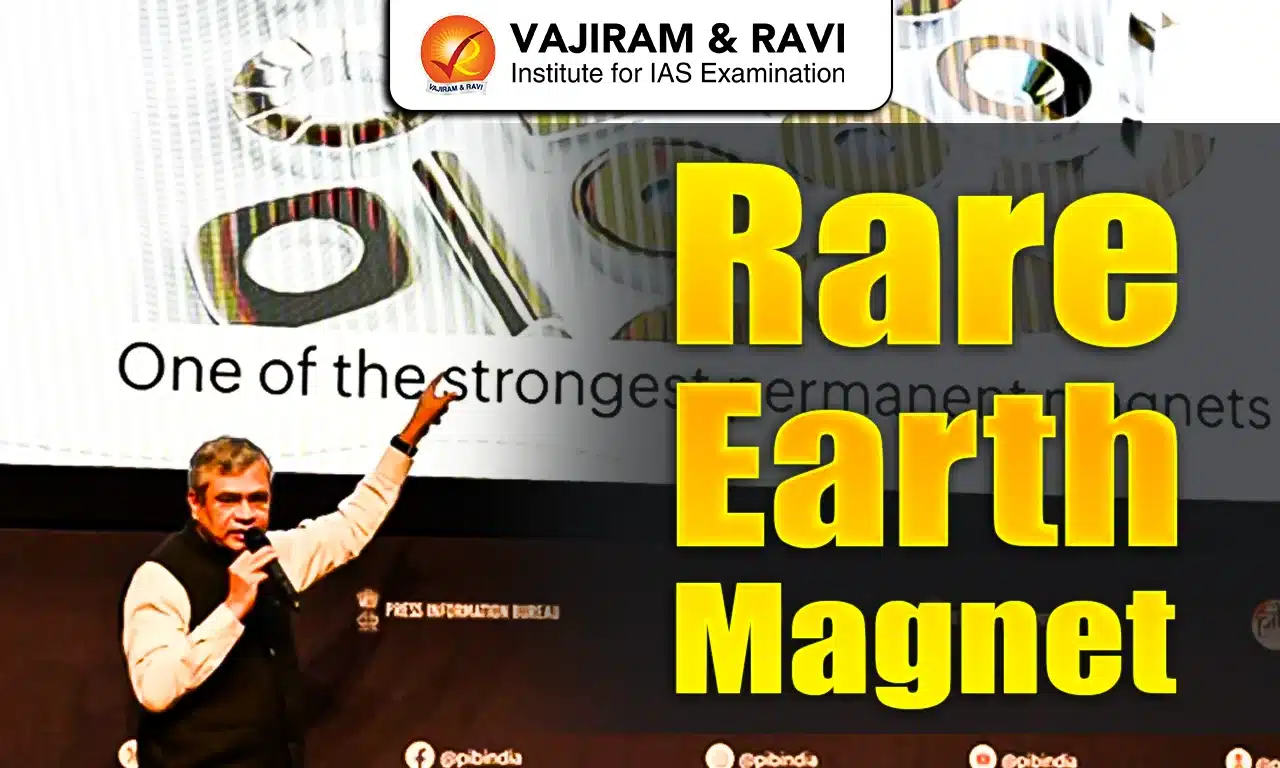
  • The Union Cabinet has approved a Rs. 7,280-crore scheme to establish India’s first integrated manufacturing ecosystem for Sintered Rare Earth Permanent Magnets (REPMs).

Rationale for the Rare Earth Magnet Scheme

  • India currently imports almost all the rare earth permanent magnets it uses, around 900 tonnes annually, despite having the world's 5th largest rare earth reserves. 
  • These magnets are among the strongest permanent magnets and are indispensable to high-tech systems:
    • EV traction motors, power steering, wiper motors, braking systems,
    • Wind turbine generators,
    • Consumer electronics and industrial equipment,
    • Aerospace and defence applications.
  • Demand is expected to double by 2030, driven primarily by the EV and renewable energy sectors. 
  • The disruptions caused by Chinese export controls in 2024-25 further underlined the need for India to develop secure, domestic REPM capabilities. 

Key Features of the Approved Scheme

  • Rs. 7,280-Crore Outlay with Dual Incentive Structure
    • As detailed across the three reports, the financial structure includes:
      • Rs. 6,450 crore in sales-linked incentives (spread over five years),
      • Rs. 750 crore in capital subsidy for setting up facilities. 
      • This is part of a seven-year scheme period, two years for plant establishment and five years for incentive disbursement. 
  • 5 Beneficiaries via Global Competitive Bidding
    • The total capacity of 6,000 million tonnes per annum (MTPA) will be allocated to five selected manufacturers, each eligible for up to 1,200 MTPA. 
    • Applicants will be chosen through a transparent international bidding process. 
  • End-to-End Integrated Manufacturing
    • Beneficiaries must build full-stack facilities capable of converting:
    • rare earth oxides > metals > alloys > finished magnets
    • This integration is central to reducing India's reliance not only on finished REPMs but also on upstream value chains currently controlled by foreign markets. 

Strategic Importance for India’s Clean-Tech and Defence Ecosystem

  • Boosting Electric Mobility & Renewable Energy
    • REPMs, especially Neodymium-Iron-Boron (NdFeB) magnets, are crucial for efficient and powerful EV motors. 
    • The auto sector welcomed the scheme as a major step toward a stable, localised component supply chain, reducing risks of shortages and preventing EV price escalation. 
  • Strengthening Defence and Aerospace Capabilities
    • Magnets are critical in precision-guided munitions, unmanned systems, avionics, and radar technologies. Local manufacturing enhances India’s defence security and reduces dependence on geopolitically sensitive supply chains.
  • Alignment with Net Zero and Critical Minerals Strategy
    • The scheme aligns with India’s target of Net Zero by 2070 and builds on the National Critical Minerals Mission, which identifies REPMs as strategic components for energy transition and advanced manufacturing. 
    • Experts highlighted that this initiative will catalyse mining, processing, alloying, and high-value materials research. 

Industry Response and Global Context

  • Automobile & Component Manufacturers
    • Automotive bodies termed the decision pivotal for India’s long-term competitiveness and integration into global value chains. They emphasised that local REPM production would:
      • reduce import dependence,
      • protect manufacturers from Chinese export restrictions,
      • unlock investments in advanced mobility technologies. 
  • China’s Dominance and Supply Chain Constraints
    • Globally, China controls over 80% of REPM processing and has increasingly tightened export controls, impacting EV and electronics manufacturers worldwide. 
    • Indian automakers faced procurement delays due to prolonged Chinese approval procedures requiring end-user licences and bureaucratic clearance. 
    • This backdrop makes India’s initiative not merely economic but geostrategic, ensuring insulation from external shocks.

Implementation Challenges and Considerations

  • Experts caution that success depends on:
    • securing advanced technologies for processing and sintering,
    • building high-purity oxide-to-metal conversion capabilities,
    • maintaining ESG standards, responsible mining, and sustainable extraction,
    • ensuring disciplined execution and adherence to global quality benchmarks. 
  • These are essential for India to eventually compete in the global REPM market.

Source: TH | IE

Rare Earth Magnet FAQs

Q1: What is the target capacity under the REPM scheme?

Ans: The scheme aims to create 6,000 MTPA of domestic rare earth magnet manufacturing capacity.

Q2: How many companies will be selected?

Ans: Five beneficiaries will be chosen via global competitive bidding.

Q3: What incentives does the scheme offer?

Ans: Rs. 6,450 crore in sales-linked incentives and Rs. 750 crore as capital subsidy.

Q4: Why does India need this scheme?

Ans: India imports almost all REPMs despite rising demand and large rare earth reserves.

Q5: Which sectors benefit the most?

Ans: EVs, renewable energy, defence, aerospace, and advanced electronics.

Daily Editorial Analysis 27 November 2025

Daily Editorial Analysis

Presidential Opinion Versus the Federal Structure

Context

  • In the political life of any nation, there are defining moments when institutions must act as guardians of foundational principles. India faces such a moment today.
  • The recent Supreme Court opinion on the 16th Presidential reference concerning the powers of Governors and the President has reshaped the delicate federal compact envisioned by the Constitution.
  • This shift risks transforming States into subordinate entities and accelerating the consolidation of power within the Union government, thereby striking at the heart of democratic governance.

Federalism as the Backbone of India’s Constitutional Design

  • Federalism forms a core element of India’s constitutional architecture.
  • Although often described as quasi-federal, the constitutional scheme clearly distributes powers between the Union and the States, granting full autonomy to States in areas listed under the State List, such as law and order and land.
  • The Union was envisioned as first among equals, not a superior political sovereign.
  • This constitutional balance is endangered when State legislation can be indefinitely stalled or overridden by Governors and, in turn, by the President.
  • When elected legislatures pass laws only to have them delayed, returned, or reserved without clear timelines, democratic will is subordinated to unelected functionaries.
  • Such an arrangement undermines the equality of partners within the federation and reduces State autonomy to a mere formality.

The Crisis of Gubernatorial Power

  • The controversy centres on the undefined and unchecked powers exercised by Governors in withholding assent to bills.
  • Allowing Governors, who are appointed by the Union government and often politically aligned with the ruling party at the Centre, to delay or obstruct legislation distorts democratic norms.
  • Without constitutionally mandated timelines, their role effectively becomes that of an unelected veto-holder, capable of stalling laws indefinitely.
  • Constitutional values of fairness, reasonableness, and non-arbitrariness require that all state action be bounded by clear limits.
  • The absence of such limits for Governors contradicts the spirit of these principles.
  • Judicial review, another element of the Constitution’s basic structure, demands that all exercises of authority, including those of Governors and the President, be subject to scrutiny.
  • Insulating their decisions or delays from judicial oversight erodes accountability and departs from long-standing constitutional doctrine.
  • The Court’s endorsement of a limited direction framework risks conferring vast discretionary power on Governors without adequate checks.
  • Allowing important State legislation to be kept pending for extended periods creates a de facto pocket veto, leaving States vulnerable to political interference and forcing them into repeated litigation merely to secure constitutional compliance.

A Pattern of Centralisation: Contextualising the Shift

  • This dilution of federal principles gains deeper significance when viewed against broader patterns of centralisation in recent years. Multiple actions by the Union government have strained the federal equilibrium.
  • First, the refusal to compensate producing States for GST losses undermined their fiscal stability.
  • Second, the use of cess collections, whose proceeds the Centre is not obligated to share—has effectively reduced the revenue available for devolution.
  • Third, the Centre has failed to fully implement Finance Commission recommendations, weakening predictable fiscal transfers.
  • Fourth, centrally sponsored schemes increasingly require States to contribute up to half the funding, placing heavy pressure on already-stressed State finances.
  • Fifth, financial allocations have been used as political tools, with selective transfers tied to electoral or partisan considerations.
  • Sixth, investigative agencies such as the CBI, ED, and Income Tax Department have been deployed in ways that destabilise Opposition-led State governments.
  • Finally, increasing gubernatorial interference in legislative processes completes this pattern of central dominance.
  • Together, these actions mark a profound distortion of the federal structure, risking a future in which the Union government wields unrestrained authority while States function as administrative outposts rather than sovereign constitutional units.

Implications of Centralisation: Democracy at Stake

  • The conflict between elected representatives and unelected authorities lies at the centre of the crisis.
  • Allowing Governors or the President to override, delay, or neutralise the decisions of State Assemblies undermines democratic legitimacy.
  • Federalism itself is a democratic safeguard: it disperses power to prevent centralised arbitrariness.
  • When this safeguard weakens, the system becomes vulnerable to authoritarian tendencies.

Conclusion

  • If the erosion of federalism continues unchecked, the balance of power will tilt decisively toward the Union, placing democracy in jeopardy.
  • It is crucial that constitutional institutions correct course and reaffirm the foundational principles that sustain India’s unity and diversity.
  • Preserving federalism is essential for preserving India itself.

Presidential Opinion Versus the Federal Structure FAQs

 Q1. What core constitutional principle is currently at risk?
Ans. Federalism is the core constitutional principle currently at risk.

Q2. Why is unchecked gubernatorial power considered dangerous?
Ans. Unchecked gubernatorial power is dangerous because it allows unelected officials to obstruct the decisions of elected State legislatures.

Q3. How is the relationship between the Union and the States described?
Ans. The Union and the States are described as equal partners, with the Union being only “first among equals.”

Q4. What broader political trend contributes to the weakening of federalism?
Ans. Increasing centralisation by the Union government contributes to the weakening of federalism.

Q5. What is essential for safeguarding Indian democracy?
Ans. Preserving federalism is essential for safeguarding Indian democracy.

Source: The Hindu


The INO that wasn’t and the JUNO that is 

Context

  • The completion of China’s Jiangmen Underground Neutrino Observatory (JUNO) marks a major milestone in global particle physics, but for India it carries a bittersweet resonance.
  • While China releases its first scientific results, the India-based Neutrino Observatory (INO) remains stalled.
  • The contrast between the two projects reveals differing national trajectories in Big Science, shaped by public trust, administrative foresight, and political conditions.

The Promise of Underground Neutrino Experiments

  • Neutrinos are among the most elusive particles in the universe.
  • Their ability to pass through matter almost entirely unhindered requires immense underground detectors shielded from background noise.
  • Both JUNO and INO were designed to study neutrino oscillations and determine the neutrino mass ordering, one of the most important open questions in modern physics.
  • While JUNO has reached completion after a delay, INO’s progress has stagnated.
  • JUNO’s success reflects sustained national commitment, whereas INO illustrates how scientific potential can be derailed by administrative missteps and sociopolitical conflict.

The Stalling of INO

  • INO’s ambitious 50-kilotonne detector demanded installation inside a mountain in Theni, Tamil Nadu, using natural rock as shielding.
  • However, the combination of large-scale excavation, involvement of the Department of Atomic Energy, and political mobilisation sparked local fears.
  • The project suffered from:
  • Insufficient early community engagement
  • Unanticipated environmental and social sensitivities
  • Bureaucratic delays and litigation
  • These failures coincided with China’s rapid progress, reducing INO’s ability to attract international collaboration and funding.

JUNO’s Advancement

  • JUNO’s first scientific papers showcase its technological sophistication and a broad global collaboration involving many countries.
  • The absence of Indian researchers is striking, considering India’s longstanding contributions to neutrino physics.
  • JUNO has already produced a high-precision measurement of θ₁₂, one of the key parameters governing neutrino oscillations.
  • This places JUNO in a strong position to determine the neutrino mass hierarchy and explore physics beyond the Standard Model.
  • As JUNO spokesperson Yifang Wang stated, the project is poised for transformative discoveries.

Consequences of Missing the Moment

  • INO’s stagnation shows that in frontier science, missing one opportunity can mean missing an entire generation of discovery. The next major questions in neutrino physics will require:
  • More specialised technology
  • Greater international cooperation
  • Larger financial commitments
  • Without renewed investment in scientific infrastructure, India risks losing its place in the global pursuit of fundamental physics.
  • Yet optimism persists. India’s young scientists are skilled, creative, and ambitious. What they need is a supporting system that matches their potential, administratively, politically, and socially.

The Way Forward: Rethinking Readiness for Big Science

  • Large-scale scientific initiatives rely not only on technical expertise but also on the ecosystems around them. Successful Big Science requires:
  • Regulatory clarity
  • Environmental responsibility
  • Transparent communication
  • Community participation
  • Citing resource constraints often masks deeper issues. India already operates major observatories and conservation projects, showing that capability is not the problem, coordination and planning

Conclusion

  • The stories of JUNO and INO highlight how nations shape their scientific futures.
  • China’s persistence has led to a world-leading neutrino experiment, while India’s project remains entangled in avoidable obstacles.
  • Recovering from this setback demands that India strengthen public engagement, long-term planning, and administrative agility.
  • India’s scientific talent is undeniable but the challenge now is ensuring that national systems, political, bureaucratic, social, and infrastructural, rise to support that talent so the country can participate fully in the next era of fundamental scientific discovery.

The INO That Wasn’t and the JUNO That Is FAQs

 Q1. Why was the INO detector planned inside a mountain in Tamil Nadu?
Ans. It was planned inside a mountain because the rock would provide natural shielding for the massive neutrino detector.

Q2. What caused major delays in the progress of the INO project?
Ans. Major delays were caused by political controversy, local community fears, and administrative missteps.

Q3. What major scientific goal do both JUNO and INO aim to achieve?
Ans. Both aim to determine the ordering of neutrino masses through precise studies of neutrino oscillations.

Q4. What significant achievement has JUNO already reported?
Ans. JUNO has reported a highly precise measurement of the neutrino oscillation parameter θ₁₂.

Q5. Why is India’s absence from JUNO’s international team notable?
Ans. It is notable because India has a long history in neutrino research and expected to contribute significantly to such global projects.

Source: The Hindu


Reversing India’s Brain Drain - A Strategic Push to Repatriate Star Faculty

Context

  • The Government of India is considering a new scheme to attract “star faculty” and researchers of Indian origin back to the country.
  • This comes at a time when the US academic environment is witnessing rising political interference, prompting globally mobile scholars to explore more stable and autonomous research ecosystems.
  • The initiative aims to strengthen India’s R&D ecosystem, boost STEM capacity, and enhance India’s position as a global knowledge economy.

Need for the Scheme

  • Emerging global opportunity

    • Increasing political intervention, threats to university autonomy and academic freedom in the US.
    • Global academic talent actively seeking stable and supportive research environments.
  • Addressing India’s long-standing “Brain Drain”

    • Chronic outflow of Indian-origin scientists, especially in STEM.
    • Critical need to strengthen national innovation capacity and build world-class research institutions.
  • Strategic focus areas

    • Initial emphasis on priority STEM sectors essential for national capability building.

Key Features of the Proposed Scheme

  • Set-up grant: Substantial financial assistance for star faculty to build labs, teams, and research ecosystems in premier institutions. Supports operational autonomy and smoother onboarding.
  • Creating a seamless experience: Returning academics require far more than monetary incentives—intellectual freedom, cultural alignment, and ease of doing research are crucial.

Challenges

  • Salary and compensation gaps

    • Indian full professors earn approximately $40,000/year, significantly lower than the US ($130,000–$200,000/year) and China (~$100,000/year).
    • India, unlikely to match global salary benchmarks, must compensate with intellectual, cultural and research ecosystem returns.
  • Administrative and structural barriers

    • Bureaucratic hurdles in logistics, procurement, funding flows, recruitment.
    • Previous programmes (e.g., VAJRA Faculty Programme) suffered from procedural delays, funding uncertainty, and fragmented short-term engagement mechanisms.
  • Lack of institutional preparedness

    • Many public institutions lack experience in onboarding international faculty.
    • Persistent hierarchical structures, limited interdisciplinary collaboration, and inadequate academic freedom.
  • Personal and social ecosystem gaps

    • Challenges in spousal employment, housing, schooling for children, and lack of well-defined tenure-track pathways.
  • Competition from other countries

    • India must undertake deeper reforms to stay competitive with -
      • Europe - Strengthening academic freedom
      • China - Aggressive recruitment and high funding
      • Taiwan - Rapid internationalisation of universities
  • Limited scope of proposed institutions

    • Reports suggest the scheme may be confined to a small set of public research institutes, ignoring the rising research capacity of Central-State-Private universities.

Institutional Reforms Needed

  • Administrative autonomy and red carpet mandate: Ensure seamless procurement, funding flows, hiring processes, lab setup. Use expanded autonomy for non-government procurement.
  • Clear tenure-track and career security: Move beyond fragmented fellowship-type programs. Establish explicit tenure-track conversion pathways.
  • Strong protection of academic freedom: High-level government assurance of autonomy, non-interference, freedom from excessive monitoring, essential to attract global researchers.
  • Intellectual Property (IP) clarity: Standardised and clear IP ownership policies, especially for scientific research.
  • Building a supportive social ecosystem: Institutional support for spousal employment, housing facilities, quality schooling.
  • Cultural transformation: Shift from rigid hierarchies to interdisciplinary collaboration; merit-based advancement; open, critical inquiry; and integration of international pedagogic practices.
  • Broadening institutional participation: Include capable central, state, and private universities to maximise the scheme’s impact.

Conclusion

  • The proposal to repatriate Indian-origin star faculty is a timely intervention that aligns with India’s ambition to become a global research and innovation hub.
  • However, success will depend not on grants alone but on the depth of structural, administrative, and cultural reforms undertaken by India’s premier institutions.
  • If implemented holistically, the initiative could reverse the country’s brain drain, catalyse a world-class research ecosystem, and position India as a global leader in knowledge production.
  • The moment is strategic, and India must seize it.

Reversing India’s Brain Drain FAQs

Q1. What is the relevance of India’s proposed “star faculty repatriation scheme”?

Ans. The scheme leverages declining academic freedom in the US to attract Indian-origin scholars back to India.

Q2. What challenges may hinder the successful implementation of India’s star faculty repatriation initiative?

Ans. Bureaucratic delays, lack of institutional autonomy, weak tenure pathways, and inadequate support systems.

Q3. How can India bridge the compensation gap between domestic and international academic positions?

Ans. By offering strong intellectual autonomy, supportive research environments, cultural incentives, and long-term career security.

Q4. Why did previous programmes have limited success?

Ans. Initiatives like the VAJRA Faculty Programme failed due to procedural delays and short-term engagements.

Q5. What is the importance of broad-based institutional participation?

Ans. Including central, state, and private universities maximises research impact and reflects India’s diversified and evolving higher education landscape.

Source: IE 

Daily Editorial Analysis 27 November 2025 FAQs

Q1: What is editorial analysis?

Ans: Editorial analysis is the critical examination and interpretation of newspaper editorials to extract key insights, arguments, and perspectives relevant to UPSC preparation.

Q2: What is an editorial analyst?

Ans: An editorial analyst is someone who studies and breaks down editorials to highlight their relevance, structure, and usefulness for competitive exams like the UPSC.

Q3: What is an editorial for UPSC?

Ans: For UPSC, an editorial refers to opinion-based articles in reputed newspapers that provide analysis on current affairs, governance, policy, and socio-economic issues.

Q4: What are the sources of UPSC Editorial Analysis?

Ans: Key sources include editorials from The Hindu and Indian Express.

Q5: Can Editorial Analysis help in Mains Answer Writing?

Ans: Yes, editorial analysis enhances content quality, analytical depth, and structure in Mains answer writing.

How Delhi’s Air Quality Monitors Work: Methods, Errors & CAG Findings Explained

Air Quality

Air Quality Latest News

  • The Supreme Court has asked authorities to justify whether Delhi’s air-quality monitoring equipment is appropriate for the city’s conditions. 
  • Delhi currently operates 40 Continuous Ambient Air Quality Monitoring Stations (CAAQMS), each functioning as a compact, automated laboratory housed in a temperature-controlled cabin. 
  • These stations, positioned across the city for representative measurement, monitor eight key pollutants — PM2.5, PM10, NO₂, SO₂, CO, O₃, ammonia and lead — as mandated by CPCB’s 2012 guidelines. 
  • Inside each dust-proof, air-conditioned unit, racks of analysers, pumps and data loggers process samples drawn through inlets mounted on masts above the station roof.

How Delhi’s AQI Stations Measure Pollutants

  • Delhi’s air-quality monitors use specialised, CPCB-approved techniques to measure each pollutant. 
  • Particulate matter (PM2.5 and PM10) is tracked using Beta Attenuation Monitors, which gauge how dust collected on filter tape reduces beta-ray transmission. 
  • Gaseous pollutants are measured through optical and chemical methods: 
    • sulphur dioxide via UV fluorescence, 
    • ozone by UV photometry, and 
    • carbon monoxide with Non-dispersive infrared (NDIR) absorption. 
      • NDIR absorption is a gas sensing technology that measures the concentration of a specific gas by analyzing how much infrared light it absorbs.
  • Nitrogen oxides are detected through chemiluminescence, while ammonia is measured using optical spectroscopy. 
    • Chemiluminescence is the emission of light as a result of a chemical reaction.
    • Optical spectroscopy is a scientific technique that studies the interaction of light with matter to determine a sample's physical and chemical properties.
  • These instrument-based techniques comply with the National Ambient Air Quality Standards to ensure uniform, reliable data nationwide.

Factors That Distort Air-Quality Readings

  • AQI accuracy depends on equipment reliability and the volume of validated data recorded daily. 
  • Stations often miss CPCB’s 16-hour data requirement due to shutdowns caused by calibration, power cuts, extreme weather or transmission failures. 
  • A recent CAG report found many Delhi stations failed to log complete data or measure key pollutants like lead, weakening daily AQI assessments. 
  • Technical issues also distort readings: high humidity inflates particulate measurements, instruments drift without frequent calibration, and poor station siting near buildings or vents skews airflow. 
  • Together, these operational and environmental challenges reduce the precision of Delhi’s air-quality readings.

What Research Reveals About PM Measurement Errors

  • Multiple studies show that Delhi’s particulate readings — especially from Beta Attenuation Monitors (BAM) — can significantly overestimate pollution under certain weather and loading conditions. 
  • A 2021 CSIR–NPL and AcSIR study found that beta gauge accuracy declines sharply when relative humidity (RH) exceeds 60%, causing particles to absorb moisture and appear heavier. 
  • The study reported more than 30% overestimation, with bias rising up to fivefold during high-pollution events when particle mass loading is high. 
  • Seasonal effects worsen errors, particularly in winter and post-monsoon months.
  • Researchers advised using site-specific correction factors, which lowered biases from 46% to below 2%. 
  • The U.S. EPA similarly warns that heavy particle accumulation can disrupt airflow and destabilise readings. 
  • These issues help explain why Delhi’s stations experienced data dropouts on Diwali night, when sudden pollution spikes overloaded the instruments.

Ensuring Reliable Air-Quality Data: Calibration, Compliance & Oversight

  • Calibration and Maintenance Are Crucial
    • Continuous Ambient Air Quality Monitoring Stations (CAAQMS) must follow strict calibration schedules.
    • CPCB’s 2012 guidelines mandate maintaining detailed calibration records for every particulate monitor.
    • Regular checks are essential because even minor instrument drift affects readings — especially for gases measured through sensitive optical methods.
  • Major Gaps in Data Reporting
    • The CAG audit exposed serious shortcomings in Delhi’s monitoring network:
      • None of DPCC’s 24 stations measured lead (Pb), despite its mandatory inclusion in AQI calculations.
      • Monthly AQI data was incomplete for 12% of months (2014–2021), meaning many stations failed to produce the minimum required valid data.
  • Need to Upgrade and Reposition Stations
    • CAG recommendations include:
      • Relocating stations obstructed by buildings, trees or improper siting.
      • Upgrading or replacing equipment unable to measure all mandated pollutants.
      • Ensuring daily data availability for all pollutants to provide a complete air-quality picture.
  • Third-Party Audits for Accountability
    • Experts, including Anumita Roychowdhury (CSE), stress the need for regular independent audits to verify:
      • Whether stations follow CPCB protocols,
      • Equipment calibration accuracy,
      • Data generation and reporting standards.

Source: IE | CNBC

Air Quality FAQs

Q1: How do Delhi’s AQI monitors measure particulate matter?

Ans: Stations use Beta Attenuation Monitors that measure how dust collected on filter tape reduces beta-ray transmission, enabling automated PM2.5 and PM10 quantification.

Q2: What causes inaccurate air-quality readings in Delhi?

Ans: High humidity, poor calibration, power issues, incorrect station placement, and data gaps often distort readings and reduce compliance with CPCB’s minimum data requirements.

Q3: What did recent studies find about PM measurement errors?

Ans: A CSIR–NPL study found PM2.5 readings can be overestimated by over 30% when humidity exceeds 60%, with biases rising fivefold during high-pollution episodes.

Q4: What gaps did the CAG report highlight?

Ans: CAG found Delhi’s stations often failed to record adequate valid data, didn’t measure lead, and lacked proper calibration or suitable siting, weakening AQI reliability.

Q5: How can Delhi improve AQI data quality?

Ans: Regular calibration, equipment upgrades, better station siting, mandatory third-party audits, and ensuring complete pollutant data are essential to strengthen AQI accuracy.

Euthanasia

Euthanasia

Euthanasia Latest News

The Supreme Court recently asked the Noida district hospital to constitute a primary medical board to examine the option of passive euthanasia for a 31-year-old who has been in a vegetative state for over a decade because of quadriplegia.

About Euthanasia

  • The word ‘Euthanasia’ is derived from the Greek, ‘Eu’ meaning ‘good’ and ‘thanatos’ meaning ‘death’, put together it means ‘good death’. 
  • Euthanasia is defined as the hastening of death of a patient to prevent further sufferings. 
  • Types:
    • Active euthanasia refers to the physician's deliberate act, usually the administration of lethal drugs, to end an incurably or terminally ill patient’s life. 
    • There are three types of active euthanasia in relation to giving consent for euthanasia, namely 
      • voluntary euthanasiaat patient request, 
      • nonvoluntary – without patient consent, 
      • involuntary euthanasia – the patient is not in a position to give consent. 
    • Passive euthanasia refers to withholding or withdrawing treatment which is necessary for maintaining life. 
  • Common conditions which make patients seek euthanasia are terminally ill cancer patients, acquired immune deficiency syndrome (AIDS), and other terminally ill conditions where there is no active treatment. 
  • Legality:
    • Passive euthanasia is generally accepted worldwide. 
    • Active involuntary euthanasia is illegal in almost all countries. 
    • Practicing active voluntary euthanasia is illegal and considered criminal homicide in most of the countries.
  • Legality in India:
    • Passive Euthanasia:
      • A five-judge bench of the Supreme Court in Common Cause vs. Union of India (2018) recognised a person’s right to die with dignity.
      • It said that a terminally ill person can opt for passive euthanasia and execute a living will to refuse medical treatment. 
      • The Court permitted an individual to draft a living will specifying that she or he will not be put on life support if they slip into an incurable coma.
      • The Court recognised the right to die with dignity as a fundamental right and an aspect of Article 21 (Right to Life).
    • Active euthanasia: In India, active euthanasia is a crime.

What is Quadriplegia?

  • Quadriplegia, or Tetraplegia, is a condition of paralysis that affects all the limbs and body from the neck to the down. 
  • The most common cause of quadriplegia is an injury to the spinal cord at the level of the neck. 
  • Quadriplegia is sometimes treatable, but in most cases injury results in permanent paralysis.
  • Quadriplegia is when the person can’t deliberately control or move his muscles, and it can affect a person from the neck to down. 
  • Depending on how and why it happens, it can affect the ability to move parts of the body, as well as some of the body’s automatic processes that keep the person alive.

Source: TELE

Euthanasia FAQs

Q1: What is euthanasia?

Ans: Euthanasia is defined as the hastening of death of a patient to prevent further sufferings.

Q2: What is meant by active euthanasia?

Ans: Active euthanasia refers to the physician's deliberate act, usually the administration of lethal drugs, to end an incurably or terminally ill patient’s life.

Q3: What is passive euthanasia?

Ans: It refers to withholding or withdrawing treatment which is necessary for maintaining life.

Q4: Is passive euthanasia legal in India?

Ans: Yes, passive euthanasia is legal in India.

Higher Education Commission of India Bill 2025: Key Provisions, Concerns & NEP 2020 Link

Higher Education Commission of India Bill 2025

Higher Education Commission of India Bill 2025 Latest News

  • Five years after NEP 2020 proposed it, the government is set to table the Higher Education Commission of India (HECI) Bill 2025 in the upcoming Winter Session. 
  • The Bill aims to merge the regulatory roles of the UGC, AICTE, and NCTE into one unified authority, marking the second attempt to establish a single higher education regulator in India.

HECI: India’s Proposed Single Regulator for Higher Education

  • The Higher Education Commission of India (HECI) Bill draws directly from NEP 2020, which recommended replacing the fragmented regulatory structure with a single overarching authority.
  • Currently, India’s higher education landscape is regulated by multiple statutory bodies: 
    • the University Grants Commission (UGC) oversees higher education, 
    • the All India Council for Technical Education (AICTE) regulates technical and professional education, and 
    • the National Council for Teacher Education (NCTE) governs teacher education.

Four Verticals Under HECI

  • NEP 2020 outlines four specialised bodies within HECI:
    • National Higher Education Regulatory Council (NHERC): Regulates all higher education except medical and legal fields.
    • National Accreditation Council (NAC): Serves as the accrediting authority.
    • General Education Council (GEC): Frames academic learning outcomes and standards.
    • Higher Education Grants Council (HEGC): Handles funding and grants (though officials indicate funding may still rest with the government).
  • HECI itself will function as a compact body of eminent experts overseeing the four verticals.

Reducing Red Tape and Conflict of Interest

  • NEP 2020 criticised the existing system for being “mechanistic and disempowering”, with concentrated powers, regulatory overlap, and conflicts of interest. 
  • The new commission aims to streamline governance, ensure accountability, and eliminate bureaucratic hurdles.

Autonomy and Quality Focus

  • The Bill seeks to empower higher education institutions to operate as “independent self-governing institutions” while ensuring excellence through a transparent accreditation system and enhanced institutional autonomy.

The 2018 HECI Bill: Key Provisions and Why It Stalled

  • The government’s first attempt to replace the UGC came through the Higher Education Commission of India (HECI) Bill, 2018. 
  • It proposed a new commission with a chairperson, vice-chairperson, and 12 members appointed by the Centre. 
  • Since the Bill did not merge AICTE and NCTE, their chairpersons were included as members.
  • The 2018 draft limited HECI’s powers to setting academic standards and granting autonomy while leaving funding authority with the Ministry of Human Resource Development. 
  • It also planned an advisory council headed by the HRD Minister and comprising state higher education council heads.
  • However, the Bill drew criticism for potentially centralising authority and creating excessive overregulation
  • Following strong pushback during public consultations, it was shelved and revisited for alignment with the NEP 2020 framework.

Opposition to HECI: Concerns Over Centralisation and Autonomy

  • Fears of Excessive Centralisation
    • Critics argue that the HECI framework concentrates too much authority with the Union government. 
    • The 2018 Bill shifted UGC’s financial powers to the MHRD, raising concerns that universities could lose autonomy and become dependent on central directives.
  • Lack of Diverse Representation
    • Opposition leaders objected to the commission’s composition. 
    • They noted the absence of representation from disadvantaged groups — women, Dalits, Adivasis, OBCs, minorities, and persons with disabilities — while industry stakeholders were prominently included.
  • Apprehensions From States
    • The then CM of Tamil Nadu warned that centralised funding could lead to biased resource allocation. 
    • He feared that replacing UGC grants with ministry-controlled funding might shift to a 60:40 Centre-state share, reducing states’ financial autonomy.
  • Parliamentary Panel’s Warning
    • A parliamentary standing committee flagged “excess centralisation” concerns. 
    • The panel noted that while multiple regulators create inconsistency, the proposed HECI model risks trapping state universities between national and state rules, with insufficient state representation in decision-making.
  • Overall Concern
    • Across political and academic circles, the prevailing worry is that HECI could weaken federalism, dilute institutional autonomy, and marginalise key stakeholders in higher education governance.

Source: IE | IT

Higher Education Commission of India Bill 2025 FAQs

Q1: What is the Higher Education Commission of India Bill 2025?

Ans: It is a proposed legislation to merge UGC, AICTE and NCTE into a single higher education regulator, as recommended by NEP 2020, to streamline governance and standards.

Q2: Why is the HECI Bill being introduced now?

Ans: Five years after NEP 2020 suggested regulatory unification, the government is pushing the Bill to modernise oversight, reduce overlaps and improve accountability in higher education.

Q3: What are the four verticals proposed under HECI?

Ans: HECI will include NHERC for regulation, NAC for accreditation, GEC for learning outcomes, and HEGC for grants, though funding may remain with the government.

Q4: Why did the earlier 2018 HECI Bill fail?

Ans: The 2018 Bill faced criticism for centralising power, excluding key stakeholders, and removing UGC's funding role, prompting the government to withdraw it for revision

Q5: What are major concerns about the new HECI structure?

Ans: Opposition parties fear excessive centralisation, limited state representation, weakened federalism, and potential constraints on university autonomy and equitable resource distribution.

Amylotropic Lateral Sclerosis

Amylotropic Lateral Sclerosis

Amyotrophic Lateral Sclerosis Latest News

A research paper highlighted that the number of cases of Amyotrophic Lateral Sclerosis (ALS) in the world will increase from 222,801 in 2015 to 376,674 in 2040, representing an increase of 69%. 

About Amyotrophic Lateral Sclerosis

  • It is also known as Lou Gehrig’s disease, is a progressive neurological disorder that affects muscle movement. 
  • It can occur at any age but symptoms commonly develop between the age of 55 and 75, with men more than women likely to develop the condition.
  • Causes: In few people with ALS, a genetic cause can be identified. For the rest, the cause is not known.

How does ALS Affect the Body?

  • In people with ALS, the motor neurons degenerate and die and messages sent by the brain do not reach the muscles which results in muscle atrophy (lose strength and become weak).
  • Eventually, the brain loses control over voluntary movements including walking, chewing and even breathing, as the condition progresses. 

Symptoms and Progression of ALS

  • It includes muscle twitches in the arms, leg, shoulders or tongue; muscle cramps;
  • Tightness or stiffness of muscles; muscle weakness in a limb or the neck; and difficulty in chewing or swallowing. 

Treatment for Amyotrophic Lateral Sclerosis

  • There is no treatment to reverse nerve degeneration, but some therapy may help to delay progression.
  • A treatment would include physical, occupational and speech therapy to improve quality of life. 

Source: TH

Amyotrophic Lateral Sclerosis FAQs

Q1: Which type of neurons are affected in ALS?

Ans: Motor neurons

Q2: What is another name for Amyotrophic Lateral Sclerosis (ALS)?

Ans: Lou Gehrig's disease

Enquire Now