UPSC Daily Quiz 6 December 2025

UPSC Daily Quiz

The Daily UPSC Quiz by Vajiram & Ravi is a thoughtfully curated initiative designed to support UPSC aspirants in strengthening their current affairs knowledge and core conceptual understanding. Aligned with the UPSC Syllabus 2025, this daily quiz serves as a revision resource, helping candidates assess their preparation, revise key topics, and stay updated with relevant issues. Whether you are preparing for Prelims or sharpening your revision for Mains, consistent practice with these Daily UPSC Quiz can significantly enhance accuracy, speed, and confidence in solving exam-level questions.

[WpProQuiz 39]

UPSC Daily Quiz FAQs

Q1: What is the Daily UPSC Quiz?

Ans: The Daily UPSC Quiz is a set of practice questions based on current affairs, static subjects, and PYQs that help aspirants enhance retention and test conceptual clarity regularly.

Q2: How is the Daily Quiz useful for UPSC preparation?

Ans: Daily quizzes support learning, help in revision, improve time management, and boost accuracy for both UPSC Prelims and Mains through consistent practice.

Q3: Are the quiz questions based on the UPSC syllabus?

Ans: Yes, all questions are aligned with the UPSC Syllabus 2025, covering key areas like Polity, Economy, Environment, History, Geography, and Current Affairs.

Q4: Are solutions and explanations provided with the quiz?

Ans: Yes, each quiz includes detailed explanations and source references to enhance conceptual understanding and enable self-assessment.

Q5: Is the Daily UPSC Quiz suitable for both Prelims and Mains?

Ans: Primarily focused on Prelims (MCQ format), but it also indirectly helps in Mains by strengthening subject knowledge and factual clarity.

Moon, Phases of Moon, Lunar & Solar Eclipse, Earth’s Tides

Moon

The Moon is Earth’s only natural satellite and influences many natural phenomena. Its phases change as it orbits Earth, creating new, crescent, quarter, gibbous, and full moons. Lunar and solar eclipses occur when the Sun, Earth, and Moon align, blocking light. The Moon’s gravity also causes tides in Earth’s oceans and helps stabilize the planet’s climate.

Geological Features of the Moon

The Moon, Earth’s only natural satellite, has a fascinating surface marked by craters, plains, and mountains. Its geological features tell the story of its violent past and the processes shaping it.

  • Craters: The Moon’s surface is dotted with impact craters formed by collisions with asteroids and meteoroids. Famous craters include Tycho, Copernicus, and Aristarchus.
  • Maria (Lunar Plains): These are dark, flat regions formed by ancient volcanic activity. The largest lunar maria is Oceanus Procellarum.
  • Highlands: Light-colored, heavily cratered areas are older than the maria. They are composed mainly of anorthosite rocks.
  • Rilles: Long channels or valleys formed by volcanic activity or surface collapse.
  • Regolith: A layer of loose dust and fragmented rock covering the Moon’s surface, created by continuous meteorite impacts.

Also Read: Interior of the Earth

Phases of the Moon

[my_image src="https://vajiramandravi.com/current-affairs/wp-content/uploads/2025/12/Artboard-3.webp" size="full" align="none" width="auto" height="411px" alt="Phases of the Moon" title="Phases of the Moon"]

The Moon does not produce its own light; it reflects sunlight. The changing positions of the Sun, Earth, and Moon create different phases, which repeat every 29.5 days, forming the lunar cycle.

1. New Moon

During the new moon, the Moon is positioned between Earth and the Sun, so the side facing Earth is completely dark.

  • The Moon is not visible from Earth.
  • Marks the beginning of the lunar month.
  • Gravitational pull contributes to spring tides.
  • Often used in traditional calendars for setting festivals.

2. Waxing Crescent

A thin crescent becomes visible after the new moon, gradually increasing in illumination.

  • Appears as a sliver of light on the Moon’s right side (in the Northern Hemisphere).
  • Symbolizes growth and new beginnings in cultural contexts.
  • The crescent increases daily until the first quarter.
  • Early evening visibility makes it ideal for skywatching.

3. First Quarter

Half of the Moon is illuminated, appearing as a semi-circle.

  • Occurs about 7–8 days after the new moon.
  • The right half is visible in the Northern Hemisphere.
  • Tidal forces start to stabilize after the new moon.
  • Popular phase for observing lunar surface details.

4. Waxing Gibbous

More than half of the Moon is visible as it approaches full illumination.

  • The Moon appears larger and brighter each night.
  • Marks a period of growth and fruition in cultural symbolism.
  • Provides longer visibility in the evening sky.
  • The Moon’s surface features are easier to observe with a telescope.

5. Full Moon

The entire face of the Moon is illuminated by sunlight.

  • Occurs when Earth is between the Sun and the Moon.
  • Most visible and brightest phase of the lunar cycle.
  • Causes spring tides due to the combined Sun-Moon gravitational pull.
  • Associated with cultural festivals and rituals worldwide.

6. Waning Gibbous

The Moon starts decreasing in illumination after the full moon.

  • More than half of the Moon is still visible.
  • Light gradually shifts from the left side (Northern Hemisphere).
  • Marks a period of reflection and release in symbolism.
  • Evening visibility decreases gradually.

7. Last (Third) Quarter

Half of the Moon is visible again, opposite to the first quarter.

  • Occurs about 21–22 days after the new moon.
  • The left half is illuminated in the Northern Hemisphere.
  • Tidal effects decrease compared to the full moon.
  • Important for observing lunar surface features with minimal shadows.

8. Waning Crescent

Only a small crescent remains visible before returning to the new moon.

  • Appears as a thin crescent on the left side (Northern Hemisphere).
  • Marks the end of the lunar cycle.
  • Low visibility, best seen early morning.
  • Symbolizes closure and preparation for a new lunar month.

Eclipses of the Moon

An eclipse occurs when a planet or a moon blocks the Sun’s light. When the light of the Sun or the Moon is obstructed by another celestial body, it is called an eclipse. 

On Earth, we can observe two main types of eclipses: solar eclipses, when the Sun is obscured, and lunar eclipses, when the Moon is covered by Earth’s shadow.

Solar Eclipse

[my_image src="https://vajiramandravi.com/current-affairs/wp-content/uploads/2025/12/Artboard-5.webp" size="full" align="none" width="auto" height="275px" alt="Solar Eclipse" title="Solar Eclipse"]

A Solar Eclipse occurs when the Moon comes between the Sun and the Earth, blocking sunlight either partially or completely. Solar eclipses can only happen during a new moon, and their visibility depends on the alignment of the three celestial bodies.

  1. Total Solar Eclipse
  • In a total solar eclipse, the Moon completely covers the Sun as seen from a specific region on Earth.
  • The sky becomes dark as if it were twilight.
  • The Sun’s corona (outer atmosphere) becomes visible.
  • Lasts for a few minutes in a given location.
  • Observers must be within the path of totality to witness it fully.
  1. Partial Solar Eclipse
  • During a partial solar eclipse, only a part of the Sun is obscured by the Moon.
  • The Sun appears as a crescent shape.
  • Can be seen from a wider area compared to a total eclipse.
  • Safe viewing still requires protective glasses.
  • Occurs when the alignment is not perfectly straight.
  1. Annular Solar Eclipse
  • An annular solar eclipse happens when the Moon covers the center of the Sun, but its edges remain visible as a bright ring.
  • Creates the famous “ring of fire” effect.
  • Happens when the Moon is farther from Earth and appears smaller.
  • Does not cause complete darkness.
  • Requires special eye protection to observe safely.
  1. Hybrid Solar Eclipse
  • A hybrid solar eclipse is a rare combination of a total and an annular eclipse.
  • Appears as total in some locations and annular in others along the path of the eclipse.
  • Occurs due to Earth’s curvature and varying distances of the Moon.
  • Very rare compared to other types of eclipses.
  • Can be partially observed outside the main path.

Lunar Eclipse

[my_image src="https://vajiramandravi.com/current-affairs/wp-content/uploads/2025/12/Artboard-4.webp" size="full" align="none" width="auto" height="278px" alt="Lunar Eclipse" title="Lunar Eclipse"]

A lunar eclipse occurs when the Earth comes between the Sun and the Moon, blocking sunlight from directly reaching the Moon. This happens only during a full moon, when the Sun, Earth, and Moon are nearly in a straight line.

  1. Total Lunar Eclipse
  • In a total lunar eclipse, the entire Moon passes through Earth’s umbra (the darkest part of its shadow).
  • The Moon appears reddish or copper-colored, often called a “blood moon.”
  • Occurs when Earth’s shadow completely covers the Moon.
  • Can last for a few hours, depending on the Moon’s path.
  • Safe to observe with the naked eye.
  1. Partial Lunar Eclipse
  • In a partial lunar eclipse, only a part of the Moon enters Earth’s umbra.
  • Part of the Moon appears dark while the rest remains bright.
  • The shadow gradually moves across the lunar surface.
  • Less dramatic than a total lunar eclipse but still noticeable.
  • Visibility depends on the observer’s location.
  1. Penumbral Lunar Eclipse
  • A penumbral lunar eclipse occurs when the Moon passes through the Earth’s penumbral shadow, which is the lighter outer part.
  • The Moon appears slightly dimmed, often hard to notice.
  • No red color or sharp shadow is visible.
  • Can be observed with careful observation or photography.
  • Happens more frequently than total or partial lunar eclipses.

Also Read: Asteroid

Moon in Earth’s Tides and Climate

The Moon plays a crucial role in shaping Earth’s tides and stabilizing its climate. Its gravitational pull on Earth causes the oceans to bulge, resulting in the regular rise and fall of sea levels known as tides.

Role in Tides

  • The Moon’s gravity creates high tides in the areas of Earth facing toward and away from the Moon.
  • Low tides occur in regions perpendicular to the Moon’s position.
  • The combined effect of the Moon and the Sun produces spring tides and neap tides.
  • Tides influence coastal ecosystems, marine life, and human activities such as fishing and navigation.

Types of Tides

[my_image src="https://vajiramandravi.com/current-affairs/wp-content/uploads/2025/12/Artboard-2-1.webp" size="full" align="none" width="auto" height="398px" alt="Types of Tides" title="Types of Tides"]

  1. Spring Tides
  • Occur during full moon and new moon phases.
  • The Sun, Moon, and Earth are in a straight line (syzygy).
  • Result in higher high tides and lower low tides.
  • Represent the maximum tidal range.
  1. Neap Tides
  • Occur during first and last quarter moon phases.
  • The Sun and Moon are at right angles relative to Earth.
  • Result in lower high tides and higher low tides.
  • Represent the minimum tidal range.
  1. Diurnal Tides
  • Characterized by one high tide and one low tide per day.
  • Common in certain shallow seas and bays.
  1. Semidiurnal Tides
  • Characterized by two high tides and two low tides per day of roughly equal height.
  • Most common along continental coasts.
  1. Mixed Tides
  • Characterized by two high tides and two low tides per day of unequal height.
  • Observed in many parts of the Pacific coast.

Role in Climate

  • The Moon stabilizes Earth’s axial tilt, maintaining a relatively stable climate over long periods.
  • Without the Moon, Earth would experience extreme seasonal variations and irregular weather patterns.
  • The Moon’s gravitational influence indirectly affects ocean currents, which play a key role in regulating global climate.

Moon FAQs

Q1: How far is the Moon from Earth?

Ans: The average distance between the Earth and the Moon is about 384,400 km.

Q2: Does the Moon have an atmosphere?

Ans: The Moon has a very thin layer called an exosphere, which cannot support life.

Q3: What is the Moon made of?

Ans: The Moon is primarily composed of silicate rocks, including basalt in the maria and anorthosite in the highlands.

Q4: Can humans live on the Moon?

Ans: Currently, humans cannot live permanently on the Moon due to extreme temperatures, lack of atmosphere, and absence of water.

Q5: Why does the Moon appear red during a total lunar eclipse?

Ans: During a total lunar eclipse, Earth’s atmosphere scatters sunlight, allowing only red wavelengths to reach the Moon, giving it a reddish hue.


Social Impact Assessment, Process, History, Significance

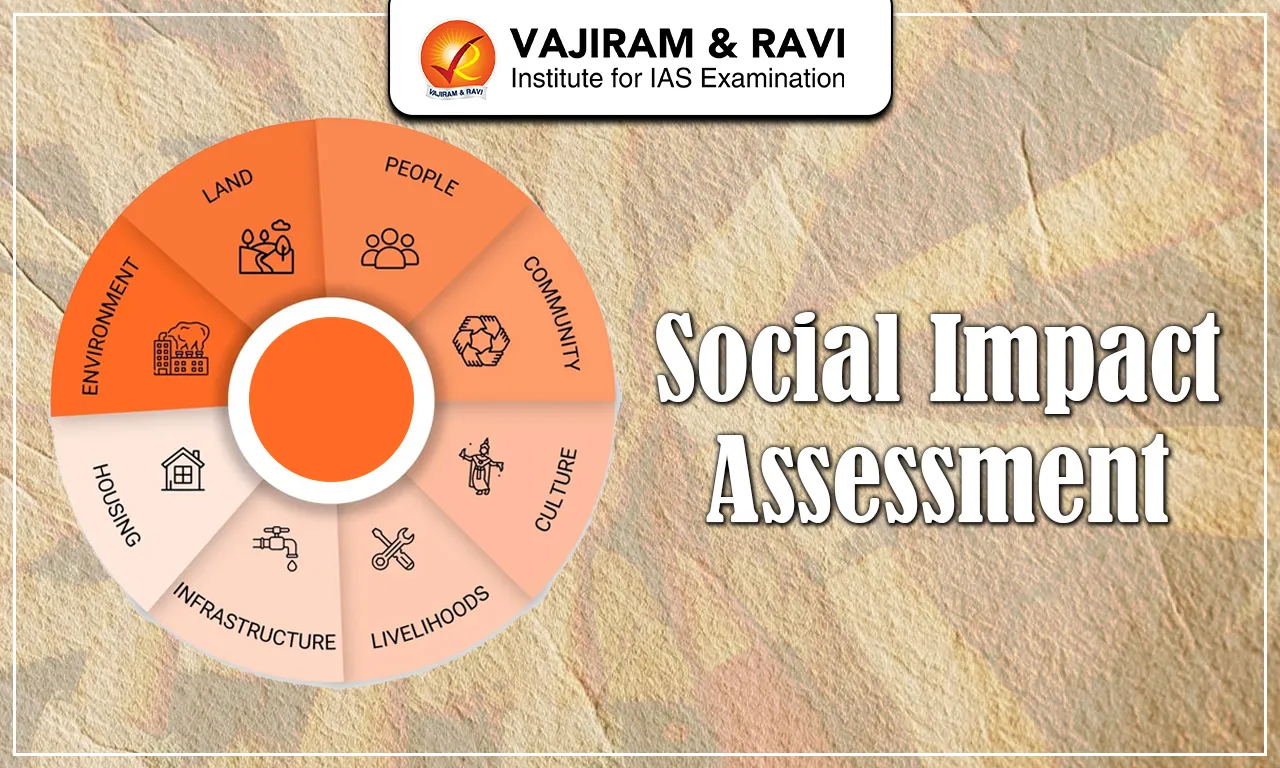
Social Impact Assessment

The Social Impact Assessment (SIA) has become an essential tool in evaluating how development projects, public policies, and major infrastructure plans influence people, communities, and social systems. It examines changes in living conditions, cultural practices, health, livelihoods, demographic patterns, and community relationships. It emerged in the 1970s alongside environmental assessment frameworks, today it helps governments and organizations ensure that economic development does not harm social well-being. It also provides mechanisms to identify long-term effects, guide mitigation, and protect vulnerable groups.

Social Impact Assessment

Social Impact Assessment systematic methodology used to identify, analyze, and manage the social effects of planned and unplanned interventions. While traditionally applied to large infrastructure and industrial projects, SIA is also used to study the impacts of disasters, epidemics, demographic transitions, and policy reforms. SIA also links closely with applied anthropology, drawing on cultural and social analysis pioneered by scholars like Franz Boas and Ruth Benedict.

Social Impact Assessment Historical Background

The historical evolution of the Social Impact Assessment is discussed below:

  • The roots of Social Impact Assessment lie in Environmental Impact Assessment (EIA), first mandated under the U.S. National Environmental Policy Act (1970). 
  • By the mid-1990s, several countries, especially in Europe and North America, integrated SIA into their planning processes. 
  • Today, new integrated models such as Environmental Social Impact Assessment (ESIA) give equal weight to environmental and social dimensions. 

Social Impact Assessment Process

A Social Impact Assessment uses structured steps to identify effects, collect data, assess risks, and propose solutions. SIA methodology relies on systematic procedures that identify stakeholder groups, evaluate present conditions, predict future impacts, and recommend mitigation measures for sustainable outcomes, as detailed below:

  • Formulating a public plan or policy that involves all affected parties, ensuring early participation.
  • Describing the proposal clearly, including its objectives, scale, and expected outcomes.
  • Profiling the project area, covering demographic data, cultural setting, land use, economic conditions, and existing social institutions.
  • Communicating expected changes to affected people through transparent consultations.
  • Identifying potential social impacts, such as displacement, livelihood changes, cultural disruption, or access to services.
  • Determining consequences by assessing who benefits, who loses, and the scale and duration of impacts.
  • Forecasting future and cumulative impacts, especially on vulnerable groups, workers, and indigenous communities.
  • Exploring alternative plans or policies to reduce negative impacts while achieving development goals.
  • Developing mitigation strategies, including compensation, livelihood restoration, or community-strengthening measures.
  • Setting up monitoring systems to track implementation and adjust plans in response to changing needs.
  • Use of additional tools such as the IMMPACT Model, OECD guidelines, and Seedkit for structured evaluation and data-driven analysis.

Social Impact Assessment Significance

Social Impact Assessment provides critical insights for designing responsible development that balances growth with societal well-being. The significance of SIA lies in its ability to protect communities, enhance social benefits, minimize risks, and support long-term sustainable and equitable development.

  • Prevention of negative impacts: Helps identify displacement risks, livelihood disruption, social conflicts, and public health issues before they occur.
  • Enhancing project acceptability: Projects with strong SIA processes gain higher community trust and smoother implementation.
  • Protection of vulnerable groups: Ensures marginalized groups, indigenous communities, and workers receive safeguards and compensation.
  • Improved decision-making: Provides evidence-based insights for policymakers, planners, and industries.
  • Promoting cultural preservation: Helps protect heritage, traditions, and community relationships that may be disturbed by large projects.
  • Strengthening governance: Encourages participatory planning, transparency, and accountability in public decision-making.
  • Facilitating sustainable development: Ensures long-term benefits outweigh short-term economic gains by balancing social, environmental, and economic factors.
  • Better monitoring and evaluation: Establishes clear indicators for tracking outcomes over the project lifecycle.
  • Supporting conflict resolution: Early identification of social tensions prevents disputes and enhances cooperation.
  • Legal compliance: Helps governments and institutions meet national and international regulatory requirements.

Social Impact Assessment Recent Developments

Recent global research shows growing interest in expanding the scope, tools, and ethical foundations of Social Impact Assessment. New trends in SIA focus on resilience building, technology-enabled measurement, climate vulnerability assessment, and social dimensions of circular economy transitions.

  • Community-based and regional planning approaches: SIA is now used in regional development and urban planning to reduce risks, strengthen governance, and build resilience. Research by Imperiale and Vanclay (2024) emphasizes shifting SIA from a project-management tool to a resilience-enhancement framework.
  • Technological innovations: AI-driven tools improve measurement quality, reduce biases, and enhance scalability in assessing social outcomes. They also strengthen Social Return on Investment (SROI) calculations.
  • Climate vulnerability integration: Studies emphasize incorporating exposure, sensitivity, and adaptive capacity into SIA. A 2023 coastal community study highlights how vulnerability indices can reflect political, historical, and socioeconomic factors for equitable planning.
  • Circular economy transitions: A review of 60 studies shows that while worker safety and wages are addressed, aspects such as community acceptance, transition support, and impacts on marginalized groups remain underrepresented. There is also a need for harmonized indicators for Social Life Cycle Assessment (S-LCA).
  • Growing use in disaster impact studies: SIA is increasingly applied to examine the social effects of epidemics, pandemics, earthquakes, and large-scale displacement.
  • Shift toward integrated ESIA frameworks: Equal emphasis on environment and society ensures balanced development decision-making.
  • Higher global policy acceptance: More nations now legally mandate SIA for large-scale industrial, mining, and energy-sector projects.

Social Impact Assessment FAQs

Q1: What is Social Impact Assessment?

Ans: Social Impact Assessment is a structured process used to identify and manage the social effects of development projects, policies, or unplanned events.

Q2: Why is Social Impact Assessment important in project planning?

Ans: It helps prevent negative effects such as displacement, livelihood loss, and cultural disruption, ensuring projects benefit communities fairly.

Q3: How is Social Impact Assessment different from EIA?

Ans: While EIA studies environmental impacts, SIA focuses on social impacts; modern ESIA frameworks combine both for balanced assessment.

Q4: What are examples of impacts assessed in Social Impact Assessment?

Ans: Changes in housing, employment, health, cultural practices, community relations, land use, and access to public services.

Q5: Who uses Social Impact Assessment?

Ans: Governments, industries, planners, NGOs, and researchers use SIA to guide responsible and socially sustainable decision-making.

India-EAEU Free Trade Agreement, Members, Aim, Significance

India–EAEU Free Trade Agreement

India and the Eurasian Economic Union (EAEU) FTA talks gained momentum after President Vladimir Putin’s State Visit to India on 4-5 December 2025. During the 23rd India-Russia Summit, both sides pushed for accelerating the India-EAEU Free Trade Agreement as part of their new 2030 Economic Roadmap.

What is the Eurasian Economic Union (EAEU)?

The EAEU is a regional economic union created to promote economic integration among member countries. It ensures free movement of goods, services, capital, and labour, and supports coordinated economic policies for stable development.

  • Established: 2015 (via the Treaty on the Eurasian Economic Union)
  • Members: Armenia, Belarus, Kazakhstan, Kyrgyzstan, Russia
  • Headquarters: Moscow, Russia
  • Aim: Strengthen economic cooperation, modernize economies, raise competitiveness, and improve living standards.

Also Read: RELOS Agreement

India-EAEU Free Trade Agreement Significance

  • Big Market Access: The FTA will open access to a USD 6.5 trillion Eurasian market, helping India increase exports in pharmaceuticals, engineering goods, textiles, and agriculture.
  • Reduced Dependence on the West: India-EAEU trade touched USD 69 billion in 2024, growing 7% from 2023. This helps India diversify away from the US and EU amid rising tariff pressures.
  • Stronger Energy Security: Russia already supplies 35-40% of India’s crude oil imports. An FTA can ensure stable and long-term access to oil, gas, coal, and other minerals at competitive prices.
  • Lower Costs for Indian Businesses: Removing or reducing tariffs across EAEU countries can make Indian MSME exports cheaper and more competitive, especially in textiles, pharma, and machine parts.
  • Boost to Connectivity: The FTA will support major trade routes like the International North-South Transport Corridor (INSTC), which can reduce transit time between India and Russia from 40 days to nearly 20 days.

India-EAEU Free Trade Agreement Challenges

  • Complex Tariff Structures: India and EAEU (Russia, Belarus, Kazakhstan, Armenia & Kyrgyzstan) have very different tariff regimes; harmonizing these across 5 countries slows negotiations.
  • Sanctions on Russia: Over 14,000+ Western sanctions on Russia complicate payment systems, logistics, and compliance for Indian companies.
  • Trade Imbalance: India’s trade with EAEU is about $16-17 billion, and over 85% is dominated by Russia, creating dependency and imbalance.
  • Connectivity Barriers: INSTC and Chabahar routes are still not fully operational; cargo movement takes 35-45 days, increasing cost and reducing competitiveness.
  • Regulatory & Standards Issues: India and EAEU follow different standards for pharma, engineering goods, and food products, requiring alignment before tariff cuts.
  • Limited Market Awareness: Indian exporters have low awareness of EAEU demand patterns; only 3-4% of India’s global exports currently go to this region, limiting immediate gains.

How India-EAEU Engagement Can Be Strengthened

  • India and EAEU should quickly implement the 2025-2030 economic cooperation plan to boost trade and investment.
  • India should increase exports like medicines, textiles, machinery, and food products to reduce its trade gap.
  • Both sides should expand local currency trade to reduce dependence on the US dollar and avoid payment problems.
  • Strengthen ties through groups like BRICS and SCO to improve coordination and build wider economic links.
  • Improve transport routes such as INSTC and the Chennai-Vladivostok Corridor to make trade faster and cheaper.
  • Reduce customs delays and strict standards by simplifying rules and recognizing each other's certificates for smoother trade.

India-EAEU Free Trade Agreement FAQs

Q1: What is the India–EAEU Free Trade Agreement (FTA)?

Ans: It is a proposed trade pact between India and the Eurasian Economic Union to reduce tariffs, boost trade, and deepen economic cooperation.

Q2: Which countries are part of the Eurasian Economic Union (EAEU)?

Ans: Russia, Belarus, Kazakhstan, Armenia, and Kyrgyzstan.

Q3: Why is the India–EAEU FTA important?

Ans: It can expand India’s market access to a region with a combined GDP of over $2 trillion and reduce trade costs.

Q4: What connectivity projects support India–EAEU trade?

Ans: The International North–South Transport Corridor (INSTC) and Chabahar Port route.

Q5: How can the FTA boost India’s energy security?

Ans: It can allow long-term contracts for discounted Russian oil, gas, coal, and nuclear cooperation.

Water (Prevention and Control of Pollution) Act, 1974

Water (Prevention and Control of Pollution) Act, 1974

The Water (Prevention and Control of Pollution) Act, 1974 is one of India’s earliest environmental laws aimed at controlling water pollution and maintaining the wholesomeness of water. It was enacted after increasing concerns about industrial discharge and polluted rivers in the 1960s–70s. The Act provides a legal framework for preventing and regulating water pollution through central and state authorities.

Water Act, 1974 Historical Background

The Water Act was introduced in the 1970s when India faced rising water pollution due to unregulated industrialisation and rapid urban growth. After growing national concern over river pollution, especially the Ganga and Yamuna, the government enacted a central law in 1974, which became fully effective nationwide by 1976.

  • Post-Independence Industrialisation: Rapid industrial growth in the 1950s-70s led to untreated effluents being discharged into rivers, lakes and groundwater.
  • Urbanisation Pressure: Indian cities generated large amounts of sewage without adequate treatment facilities; by 1970, over 75% of urban wastewater flowed untreated into water bodies.
  • Major River Pollution Incidents: Rivers like Ganga, Yamuna, Damodar, Hooghly, and Sabarmati showed high levels of BOD, COD, and heavy metal contamination during the late 1960s.
  • Absence of Regulatory Framework: Before 1974, India had no dedicated national law to regulate industrial discharge or enforce water standards.
  • Recommendations from International Forums: The 1972 Stockholm Conference on Human Environment pushed India to adopt strong environmental laws, including water protection.
  • Need for a Central Authority: States struggled to control cross-boundary river pollution, leading to the idea of establishing Central and State Pollution Control Boards.
  • Passed under Article 252: Since water is a State subject, the Act was enacted when 12 states passed resolutions requesting Parliament to legislate on water pollution.

Water (Prevention and Control of Pollution) Act, 1974 Objectives

The Water (Prevention and Control of Pollution) Act, 1974, has clear and specific objectives to protect India’s water bodies. These can be explained in simple terms:

  • Prevent and control water pollution in rivers, lakes, ponds, and groundwater.
  • Maintain or restore the quality of water for domestic, industrial, and agricultural use.
  • Establish Central and State Pollution Control Boards for monitoring and regulation.
  • Regulate sewage and industrial effluent discharge into water bodies.
  • Promote scientific research on water pollution problems and solutions.
  • Set water quality standards for various uses.

Central Pollution Control Board (CPCB)

The Central Pollution Control Board, established under Water (Prevention and Control of Pollution) Act, 1974, is the apex pollution monitoring institution in India.

  • Headquartered in New Delhi under the Ministry of Environment, Forest & Climate Change (MoEFCC).
  • The CPCB was given powers and responsibilities under the Air (Prevention and Control of Pollution) Act, 1981, making it the central authority for regulating both air and water pollution in India.
  • Coordinates with 29 State Pollution Control Boards (SPCBs).
  • Monitors water quality through the National Water Quality Monitoring Programme (NWQMP) covering 4,000+ monitoring stations across India.
  • Prepares national reports on water pollution, river health, and industrial compliance.
  • CPCB identifies 351 polluted river stretches across India (2022 report).
  • Around 70% of India’s surface water is polluted due to untreated sewage and industrial waste (CPCB estimate).

Powers and Functions of the Pollution Control Boards

  • Setting Water Quality and Effluent Standards (Water Act, 1974): PCBs fix permissible limits for pollutants such as BOD, COD, pH, and heavy metals under Section 17 of the Water Act.
  • Granting Consent to Establish and Operate (Water Act, 1974 & Air Act, 1981): Industries must obtain CTE/CTO before setup or operation. This ensures that effluent treatment plants (ETPs) and air pollution control devices are installed.
  • Inspection, Monitoring, and Sample Collection (Section 21 & 23): PCBs can inspect premises, collect samples, and verify compliance through lab analysis.
  • Issuing Directions and Taking Legal Action (EPA, 1986 Powers and Water Act): Boards can order closure of polluting units, stop electricity/water supply, and prosecute violators.
  • Promoting Research, Awareness, and Pollution Control Technologies: PCBs support studies on pollution abatement, ZLD technology, and municipal wastewater management.
  • Advising Central and State Governments (Water Act, 1974 & Air Act, 1981): Boards provide expert recommendations on environmental standards, river conservation, and industrial regulation.

Achievements and Impact of the Water Act, 1976

The Water Act, 1976 helped India build a proper system to control water pollution by creating national and state-level boards. It improved monitoring, industrial regulation, and water quality efforts using clearer rules and scientific data.

  • It led to the formation of CPCB and SPCBs, which now monitor 4,000+ water quality stations across India.
  • Sewage treatment improved from less than 10% in the 1970s to about 40% today, showing better wastewater management.
  • CPCB identified 351 polluted river stretches, helping the government plan cleaning programmes more effectively.
  • Over 2.5 lakh industries now need consent from the boards, ensuring they install treatment plants before operating.
  • Industrial pollution flowing into major rivers like the Ganga has reduced by more than 90% since strict monitoring began in 2014.
  • The Act helped launch key programmes like Ganga Action Plan and Namami Gange by providing scientific data on river health.

Amendments to the Water Act, 1974

Water (Prevention and Control of Pollution) Cess Act, 1977

  • The Act imposed a water cess on industries and local authorities to discourage excessive water consumption and generate dedicated funds for pollution control activities of CPCB and SPCBs.
  • Industries that installed approved Effluent Treatment Plants (ETPs) or adopted water-saving methods were given up to 70% rebate, promoting cleaner production and wastewater treatment.
  • The Act was repealed in 2017 when GST was introduced, and the cess collection system was discontinued, shifting focus to real-time monitoring and stricter consent regulations.

Water (Prevention and Control of Pollution) Amendment, 1988

  • Enhanced Penalties: The amendment increased fines and imprisonment terms for water pollution offences, making violations punishable with up to 7 years of imprisonment for repeated offences.
  • Stronger Enforcement Powers: Pollution Control Boards were given more authority to close polluting industries, cut water and electricity supply, and issue binding directions under Section 33A.
  • Improved Legal Procedures: The amendment allowed faster prosecution by enabling Boards to file complaints directly in courts, reducing delays in taking action against industries.
  • Greater Accountability of Polluters: The “polluter pays” principle was strengthened by enabling Boards to recover the cost of cleaning polluted water bodies from industries responsible for contamination.

Water (Prevention and Control of Pollution) Amendment, 2024

  • Decriminalisation of Minor Offences: Jail terms for minor violations were removed and replaced with monetary penalties ranging from ₹10,000 to ₹15 lakh.
  • Exemptions for Low-Risk Industries: The government can exempt certain categories of industries from prior consent for discharge, reducing regulatory burden.
  • Central Oversight of SPCBs: The central government can prescribe guidelines for appointment of State Pollution Control Board heads and standardize consent procedures.
  • Faster Penalty and Adjudication Mechanism: Adjudicating officers can now impose penalties quickly, streamlining enforcement and reducing dependence on courts.

Criticism of the Water Act, 1974

  • Weak Enforcement: Many State Pollution Control Boards (SPCBs) are understaffed and underfunded, with over 40% posts vacant, limiting inspections and follow-ups.
  • Low Penalties: Fines and punishments are considered too low compared to industrial profits, making them less effective as a deterrent.
  • Limited Sewage and Effluent Treatment: India treats only ~40% of sewage; untreated discharge continues to pollute rivers and lakes.
  • Fragmented Legal Framework: Overlaps with the Environment Protection Act 1986, Air Act 1981, and Water Cess Act create confusion in enforcement.
  • Minimal Public Participation: The Act focuses mainly on government monitoring, with little role for communities or citizens in reporting violations.
  • Poor Groundwater Regulation: The Act primarily addresses surface water; groundwater contamination is rising but remains inadequately regulated.

Way Forward

  • Increase staff and technical support in CPCB and SPCBs to monitor pollution better; for example, Tamil Nadu and Maharashtra improved river monitoring by adding more officers and labs.
  • Make fines bigger so polluters pay more; for example, industries polluting the Ganga have been fined up to ₹50 lakh.
  • Build more sewage and industrial treatment plants; for example, Namami Gange added over 2,500 MLD of treatment capacity to clean rivers.
  • Use modern technology like sensors and drones to check water pollution in rivers such as Yamuna and Sabarmati.
  • Involve people and NGOs in monitoring; for example, NGOs in Uttarakhand report pollution hotspots in the Ganga.
  • Protect groundwater by monitoring industrial discharge; for example, Gujarat tracks and reduces pollution in underground water.

Water (Prevention and Control of Pollution) Act 1974 FAQs

Q1: What is the Water (Prevention and Control of Pollution) Act, 1974?

Ans: The Water (Prevention and Control of Pollution) Act, 1974 is an Indian law enacted to prevent and control water pollution and maintain water quality for domestic, industrial, and agricultural use.

Q2: Which authority was established under the water Prevention and Control of pollution Act 1974?

Ans: The Central Pollution Control Board (CPCB) was established under the Water (Prevention and Control of Pollution) Act, 1974.

Q3: What are the main causes of water pollution?

Ans: The main causes of water pollution are industrial effluents, domestic sewage, agricultural runoff, and improper disposal of solid and hazardous waste.

Q4: What is the latest amendment of the water Act 1974?

Ans: The latest amendment is the Water (Prevention and Control of Pollution) Amendment Act, 2024, which decriminalizes minor offences and introduces higher monetary penalties.

Q5: Which act is called the Umbrella Act?

Ans: The Environment (Protection) Act, 1986 is called the Umbrella Act because it covers all environmental issues and provides overarching powers for pollution control.

Centre for Chronic Disease Control (CCDC)

Centre for Chronic Disease Control

Centre for Chronic Disease Control Latest News

A new study by the Centre for Chronic Disease Control (CCDC) for the first time concurrently estimated the daily salt and iodine consumption levels of the adult population in India and examined the effect of the World Health Organization (WHO) recommended salt intake levels on iodine levels.

About Centre for Chronic Disease Control 

  • Established in 2000, CCDC is an independent, not-for-profit, biomedical research organization based in New Delhi.
  • It aims to reduce the burden of chronic diseases in India and low- and middle-income countries through surveillance, capacity building, and translational research in cardio-metabolic diseases. 
  • It is a Scientific & Industrial Research Organization recognized by the Department of Scientific & Industrial Research, Ministry of Science and Technology, Government of India.
  • It has been designated as a WHO Collaborating Centre for Surveillance, Capacity Building, and Translational Research in Cardio-Metabolic Diseases. 
  • Recently, CCDC received the recognition of a collaborating Centre of Excellence (CoE) by the Indian Council of Medical Research.
  • It also holds registration under the Foreign Contribution (Regulation) Act, 1976.
  • CCDC undertakes clinical research with special emphasis on chronic non-communicable diseases (NCD). 
    • Within the spectrum of chronic diseases, CCDC’s main focus areas are: cardiology, diabetes and metabolic disease, vascular diseases, cancers, and mental health. 
  • In addition, basic science research in diet/nutrition and cardiac biochemistry are also carried out.

Source: ANI

Centre for Chronic Disease Control FAQs

Q1: Where is the Centre for Chronic Disease Control (CCDC) headquartered?

Ans: New Delhi

Q2: Centre for Chronic Disease Control (CCDC) has been designated as a WHO Collaborating Centre in which field?

Ans: Surveillance and translational research in cardio-metabolic diseases.

Q3: Recently, Centre for Chronic Disease Control (CCDC) was recognized as a Centre of Excellence (CoE) by which Indian institution?

Ans: Recently, CCDC received the recognition of a collaborating Centre of Excellence (CoE) by the Indian Council of Medical Research.

Terrorist and Disruptive Activities Act 1985, Provisions, Impact

Terrorist and Disruptive Activities Act 1985

The Terrorist and Disruptive Activities Act, officially known as Terrorist and Disruptive Activities (Prevention) Act (TADA), was India’s first national anti-terror law. It was enacted in 1985 in response to escalating militant violence, especially during the Punjab insurgency. It remained in force between 1985-1995, undergoing major revisions in 1987, and was applied across India. TADA introduced the earliest statutory definition of terrorism, significantly enhanced police powers, and created special courts for speedy trials. However, widespread allegations of misuse, low conviction rates and human rights concerns led to its lapse in 1995.

Terrorist and Disruptive Activities Act Historical Background

The Terrorist and Disruptive Activities Act emerged from a decade of rising militant activities and evolving national security concerns, prompting a special legal framework for terrorism-specific offences. Key historical development and evolution has been given below:

  • 23 May 1985: President assented to the first TADA law; enforced from 24 May 1985 to counter separatist violence in Punjab.
  • 1985-1987: Initial Act had a two-year sunset clause, lapsing on 24 May 1987; renewed through an ordinance due to Parliament’s non-session status.
  • 3 September 1987: A new, more detailed TADA Act (1987) enacted; came into force retrospectively from 24 May 1987.
  • Renewed in 1989, 1991 and 1993, extending its operation until 1995.
  • Repealed in 1995 after rising criticism, later replaced by the POTA Act (2002).

Terrorist and Disruptive Activities Act Provisions

The Terrorist and Disruptive Activities Act provided exceptional powers to the police and special courts, creating a distinct system for terrorism cases beyond ordinary criminal law. The major provisions of the TADA act are:

  • Introduced one of the earliest legal definitions of terrorism, covering acts using explosives, chemicals or hazardous substances intended to intimidate the State or population.
  • Allowed detention up to one year without formal charges, exceeding the limits of ordinary criminal procedure.
  • Confessions made to police (SP rank and above) were admissible as evidence, reversing traditional evidentiary safeguards.
  • Police were not required to produce detainees before a magistrate within 24 hours, departing from CrPC norms.
  • Special TADA Courts established nationwide; trials could be conducted in camera with protected witness identities.
  • Under Section 7A, police could attach property of the accused.
  • Burden of proof shifted to the accused in several terror-related circumstances under Section 21.

Also Read: Indian Forest Act 1927

Terrorist and Disruptive Activities Act Criticism

Terrorist and Disruptive Activities Act faced persistent criticism for enabling human rights violations, weak due-process safeguards, and an exceptionally low rate of conviction.

  • Allowed year-long detention without charges, contrary to global fair-trial standards.
  • 60-day police custody increased risk of custodial abuse; detainees could be produced before an executive magistrate, not a judicial magistrate.
  • Reversed the presumption of innocence, making suspects responsible for proving they were not involved in terrorism.
  • Allowed secret trials and concealed witness identities, undermining transparency.
  • Penalised even indirect advocacy of secession, seen as excessively broad and vague.
  • Confessions to police officers were admissible, raising concerns about coercion.
  • Section 19 restricted appeals to only the Supreme Court, limiting judicial oversight.

Also Read: Wetland (Conservation and Management) Rules 2010 & 2017

Terrorist and Disruptive Activities Act Impact

The operational data of the Terrorist and Disruptive Activities Act showed large-scale arrests but extremely low conviction rates, raising questions about effectiveness and proportionality.

  • By 30 June 1994, more than 76,000 individuals were arrested under TADA.
  • 25% of cases were dropped without formal charges by the police.
  • Only 35% of cases went to trial, and among these, 95% ended in acquittals.
  • Less than 2% of all arrested persons were ultimately convicted.
  • Repealed in 1995 after mounting public and institutional criticism.
  • Replaced later by POTA (2002-2004), which was also repealed due to similar concerns.
  • Many individuals arrested under TADA continued to remain incarcerated due to procedural delays and unresolved cases.

Terrorist and Disruptive Activities Act 1985 FAQs

Q1: What was the Terrorist and Disruptive Activities (Prevention) Act?

Ans: TADA was a special anti-terrorism law in force from 1985 to 1995, enacted to counter rising terror activities, especially in Punjab and other conflict-affected areas. It provided enhanced powers to police and security agencies for arrest, detention, and prosecution of terror-related offences.

Q2: Why was Terrorist and Disruptive Activities Act considered controversial?

Ans: TADA was criticised for its broad definitions of terrorism, admissibility of confessions made to police, and long detention without filing charges. Reports by NHRC and independent committees highlighted misuse, leading to its eventual lapse in 1995.

Q3: What were the key features of Terrorist and Disruptive Activities Act?

Ans: Major features included special courts for speedy trials, extended detention up to 180 days, police-recorded confessions as admissible evidence, and provisions for declaring areas as "disturbed" for applying stricter security measures.

Q4: How many people were detained under Terrorist and Disruptive Activities Act?

Ans: According to official government data, around 76,000 individuals were detained under TADA, but only about 1% were ultimately convicted, indicating concerns of misuse and over-application.

Q5: Which Act replaced Terrorist and Disruptive Activities Act after it lapsed?

Ans: After TADA expired in 1995, the Prevention of Terrorism Act (POTA) was enacted in 2002 but was repealed in 2004 due to similar misuse concerns. Currently, anti-terror provisions are mainly governed by the Unlawful Activities (Prevention) Act (UAPA).

Dolomedes indicus

Dolomedes indicus

Dolomedes indicus Latest News

In the evergreen rainforests of the Western Ghats, researchers recently identified a new species of spider named Dolomedes indicus.

About Dolomedes indicus

  • It is a new species of spider.
  • It was discovered in the evergreen rainforests of the Western Ghats, in the Wayanad district of Kerala.
  • It marks the first time a spider of the Dolomedes genus, commonly known as raft or fishing spiders, has been described in India. 
    • Unlike the common house spiders that wait passively in webs, Dolomedes indicus is an active, semi-aquatic predator that uses the water’s surface tension to its advantage. 
    • These spiders rest their legs on the water to detect the tiny vibrations from struggling insects or small fish, then launch themselves across the surface to capture prey with lightning speed. 
    • They are also capable swimmers and divers. 
  • The new species is distinguished by specific physical traits, particularly in males, which sport a striking snow-white marking running from their faces down to the centre of their backs. 
  • Females are larger and greenish-brown, allowing them to blend perfectly with the mossy rocks and foliage along the stream banks.
  • It appears to be highly sensitive to its environment, thriving only in pristine, cool waters under a forest canopy.
  • It could serve as a vital indicator species, helping conservationists monitor the health of freshwater ecosystems.

Source: RM

Dolomedes indicus FAQs

Q1: What is Dolomedes indicus?

Ans: It is a new species of spider.

Q2: Dolomedes indicus was discovered in which region of India?

Ans: It was discovered in the evergreen rainforests of the Western Ghats, in the Wayanad district of Kerala.

Q3: What type of predator is Dolomedes indicus?

Ans: Semi-aquatic active predator.

Q4: Dolomedes indicus thrives in which type of habitat?

Ans: Pristine, cool forest streams.

INTERPOL Red Notice

INTERPOL Red Notice

INTERPOL Red Notice Latest News

Recently, the Madhya Pradesh State Tiger Strike Force in a coordinated operation with the Wildlife Crime Control Bureau has successfully apprehended an international wildlife offender wanted under an INTERPOL Red Notice (RN). 

About INTERPOL Red Notice

  • A Red Notice is a request to law enforcement worldwide to locate and provisionally arrest a person pending extradition, surrender, or similar legal action.
  • It is based on an arrest warrant or court order issued by the judicial authorities in the requesting country.
  • Member countries apply their own laws in deciding whether to arrest a person.
  • Purpose: International alert for a wanted person, but it is not an arrest warrant.
  • It contains two main types of information:
    • Information to identify the wanted person, such as their name, date of birth, nationality, hair and eye colour, photographs and fingerprints if available.
    • Information related to the crime they are wanted for, which can typically be murder, rape, child abuse or armed robbery.
  • Issuance: Red Notices are published by INTERPOL at the request of a member country, and must comply with INTERPOL’s Constitution and Rules.
  • Red Notices are issued for fugitives wanted either for prosecution or to serve a sentence in relation to serious ordinary law crimes such as murder, rape and fraud. 
  • Interpol cannot compel the law enforcement authorities in any of the countries to arrest someone who has a RN issued.
  • The Central Bureau of Investigation is India's National Central Bureau (NCB) for INTERPOL, handling Red Notices for all crimes, including wildlife offenses.

Source: PIB

INTERPOL Red Notice FAQs

Q1: What is an INTERPOL Red Notice?

Ans: A request to law enforcement to locate and provisionally arrest a person

Q2: Where is INTERPOL headquartered?

Ans: Lyon, France

Shani Shingnapur Temple

Shani Shingnapur Temple

Shani Shingnapur Temple Latest News

The Ahilyanagar police cyber cell recently arrested two Shani Shingnapur Temple Trust employees for allegedly diverting over ₹50 lakh each into their personal accounts by manipulating online applications used for booking pooja services.

About Shani Shingnapur Temple

  • It is a Hindu temple located in the Ahmednagar district, Maharashtra.
  • It is dedicated to Lord Shanidev, the popular Hindu god associated with the planet Saturn.
  • The deity here is a five-and-a-half-feet-high black rock standing on a platform and is believed to be swayambhu (self-emerged). 
  • Apart from the temple, Shingnapur is a small village which is also famous for the fact that in the whole village no house has doors, and despite this, no theft has been reported in the village.

Shani Shingnapur Temple Architecture

  • It has no roofs, doors, or walls around. 
  • The temple is unique, as it is the only one where Lord Shani is worshipped in an open-sky setting.  
  • On the idol of Lord Shani, mustard oil is poured continuously from a copper vessel which hangs just above the idol. 
  • There is a Trishul alongside the stone as well as a Nandi on its south. In front are the small images of Shiva and Hanuman. 
  • An east-facing multi-deity temple was built west of the Shani idol later. 
  • The premises also contain a tomb of Saint Udasi Baba and a temple dedicated to Dattatreya.

Source: HT

Shani Shingnapur Temple FAQs

Q1: Shani Shingnapur Temple is located in which Indian State?

Ans: Maharashtra

Q2: Shani Shingnapur Temple is dedicated to which deity?

Ans: It is dedicated to Lord Shanidev, the popular Hindu god associated with the planet Saturn.

Q3: Which feature makes the village of Shingnapur famous?

Ans: It is famous for the fact that in the whole village no house has doors.

Q4: What is unique about the architecture of Shani Shingnapur Temple?

Ans: It has no roofs, doors, or walls.

Organization for Security and Cooperation in Europe

Organization for Security and Cooperation in Europe

Organization for Security and Cooperation in Europe Latest News

Recently, foreign minister of Ukraine said at the Organization for Security and Cooperation in Europe that Ukraine wants "real peace, not appeasement" with Russia.

About Organization for Security and Cooperation in Europe

  • It is a dynamic organization that is dedicated to promoting peace, stability, and security throughout Europe and Central Asia. 
  • It is the world’s largest regional security organization.
  • Origin: The OSCE’s origins date back to the early 1970s, to the Helsinki Final Act (1975) and the creation of the Conference on Security and Co-operation in Europe (CSCE), which during the Cold War served as an important multilateral forum for dialogue and negotiations between East and West.
    • In 1994, the CSCE was renamed the Organization for Security and Cooperation in Europe (OSCE) to reflect these changes more accurately.
  • Member Countries: It consists of 57 participating States in North America, Europe and Asia. (India is not a member country).
  • Objective: It works for stability, peace and democracy through political dialogue about shared values and through practical work that makes a lasting difference.
  • Decision-making bodies of OSCE: There are four decision-making bodies with delineated, distinct mandates namely;
    • Summits: It is the highest decision-making body of the OSCE
    • Ministerial Councils: The OSCE’s central decision-making and governing body
    • Permanent Council:  It is responsible for the day-to-day business of the Organization
    • Forum for Security Co-operation: It  deals with the politico-military dimension of security
  • Leadership: The OSCE’s leadership includes the Chairperson-in-Office, the Secretary General, and the heads of its institutions and field operations.
  • Headquarter: Vienna

Source: Reuters

Organization for Security and Cooperation in Europe FAQs

Q1: Where is the headquarters of OSCE located?

Ans: Vienna, Austria

Q2: What is the primary objective of OSCE?

Ans: To ensure security and stability in Europe

Afar Region

Afar Region

Afar Region Latest News

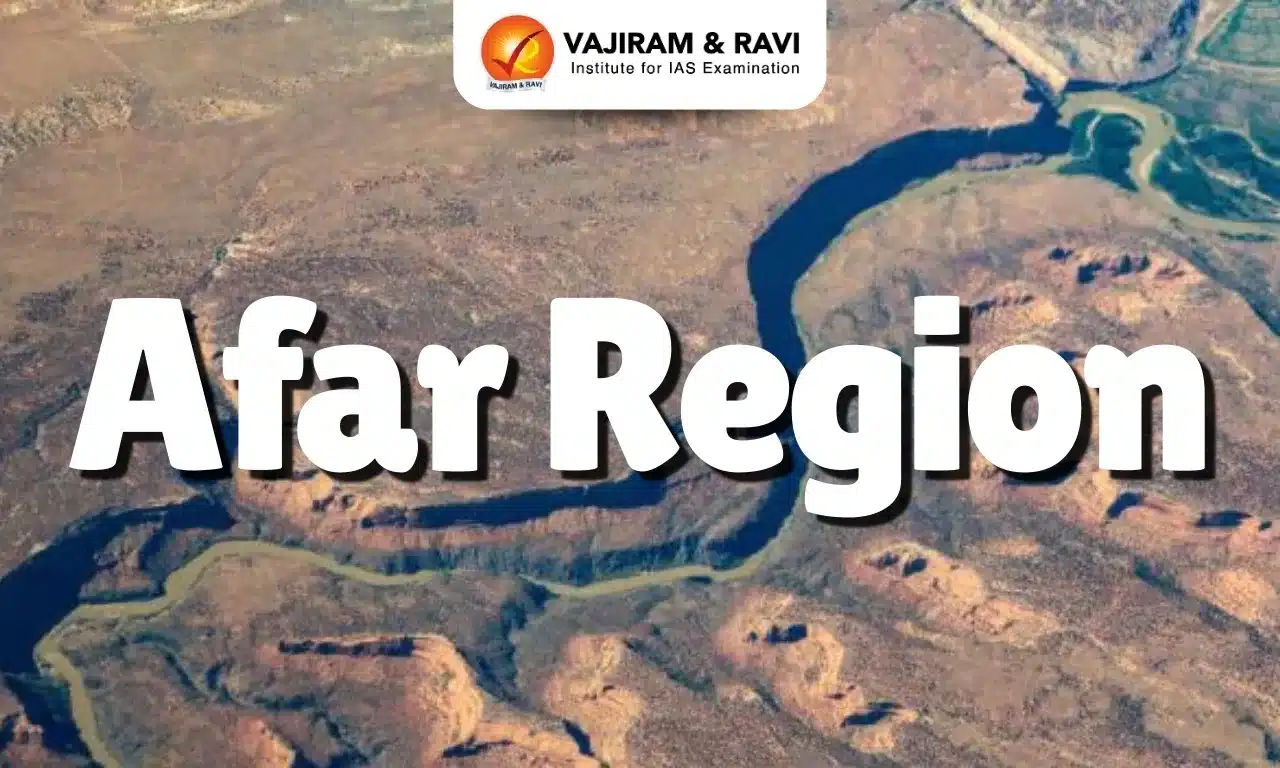
Scientists predict that Africa’s Afar region could become Earth’s next ocean basin.

About Afar region

  • Location: It is the northeastern part of Ethiopia, where the Red Sea meets the Gulf of Aden. 
  • The Afar depression, also known as the Danakil depression, forms the northern part of the region and is largely desert scrubland with shallow salty lakes and long chains of volcanoes. 
  • The Awash River valley forms the southern part of the area.
  • Tectonic Significance: It is situated at a unique triple junction where the Red Sea, Gulf of Aden, and East African Rift converge.
  • Terrain: The region’s landscape is marked by deep rift valleys, volcanic plateaus, and extensive fissures, reflecting the dynamic forces reshaping the Earth’s crust. 
  • It offers scientists a rare opportunity to observe the processes of continental break-up and ocean genesis in action.
  • The region is well known for its early hominid fossil finds including 'Lucy', an Australopithecus afarensis, discovered in 1974.

Source: IE

Afar Region FAQs

Q1: What is the climate of the Afar region like?

Ans: Arid and hot

Q2: What is significant about the Afar region in terms of human evolution?

Ans: It is home to the oldest known human fossils (e.g., Lucy, Australopithecus afarensis).

Emergency Provisions in Indian Constitution, List, Types, Advantages

Emergency Provisions in Indian Constitution

The Emergency Provisions in the Indian Constitution give powers to deal with exceptional situations like war, financial instability, or a breakdown of the Indian Constitution. Emergency Provisions allow the President of India to act beyond normal constitutional limits during exceptional situations. These powers are defined under Articles 352 (National Emergency), 356 (President’s Rule), and 360 (Financial Emergency).

Emergency Provisions in Indian Constitution

The Indian Constitution authorizes the President to declare three types of emergencies, National Emergency under Article 352, State Emergency (also known as President’s Rule) under Article 356, and Financial Emergency under Article 360. These Emergency Provisions in Indian Constitution are borrowed from the Weimar Constitution of Germany and are designed to safeguard the sovereignty, stability, and constitutional machinery of the country during extraordinary situations. 

List of Emergency Provisions in Indian Constitution

Articles 352 to 360, contained in Part XVIII of the Indian Constitution, deal with Emergency Provisions. These articles lay down the legal framework for declaring and managing different types of emergencies in India. Each article covers a specific aspect, from the proclamation of National Emergency to the imposition of President’s Rule in states and the declaration of Financial Emergency. A detailed overview of these provisions is provided in the table below.

List of Emergency Provisions in Indian Constitution
Articles Subject-Matter 

Article 352

Proclamation of Emergency

Article 353

Effect of Proclamation of Emergency

Article 354

Application of provisions relating to the distribution of revenues while a Proclamation of Emergency is in operation

Article 355

Duty of the Union to protect States against external aggression and internal disturbance

Article 356

Provisions in case of failure of constitutional machinery in States

Article 357

Exercise of legislative powers under proclamation issued under Article 356

Article 358

Suspension of provisions of Article 19 during Emergencies

Article 359

Suspension of the enforcement of the rights conferred by Part III during Emergencies

Article 360

Provisions as to Financial Emergency

Emergency Provisions in Indian Constitution Types

The Indian Constitution provides for three types of emergencies, each introduced to handle different types of crises.

Emergency Provisions in Indian Constitution Types

Basis of Classification

National Emergency

Constitutional Emergency

Financial Emergency

Grounds of Declaration

War, external aggression.

Armed rebellion

Failure of constitutional machinery.

Also known as President’s Rule

Financial instability

Parliamentary Approval

Approval by both the houses by special majority within 1 month of issue of proclamation.

Approval by both the houses by special majority within 2 months of issue of proclamation.

Approval by both the houses by special majority within 2 months of issue of proclamation.

Revocation of Proclamation

By the President.

By resolution of Lok Sabha.

By the President.

By the President.

Implementation

It has been invoked three times in India during 1962, 1971 and 1975.

President’s Rule has been invoked more than 115 times in India.

Not Yet Invoked

Judicial review

Allowed

Allowed

Allowed

Article

Article 352

Article 356

Article 360

National Emergency (Article 352)

A National Emergency is declared by the President of India when the security of the country or any part of it is threatened by war, external aggression, or armed rebellion. Initially, the term “internal disturbance” was used, but it was replaced with “armed rebellion” by the 44th Constitutional Amendment Act, 1978. 

The National Emergency significantly brought changes in the federal structure. The Centre gains greater control over the states, the Parliament can legislate on any subject from the State List, and Fundamental Rights under Article 19 automatically get suspended. The emergency must be approved by both Houses of Parliament within one month and can continue for six months at a time with repeated approvals.

President’s Rule (Article 356)

President’s Rule, or State Emergency, is imposed when a state government fails to function according to constitutional provisions. This could be due to political instability, loss of majority, or failure of law and order. Based on the report of the Governor or otherwise, the President can assume control of the state’s administration. 

During this period, the state legislature is either dissolved or suspended, and the Parliament assumes legislative powers over the state. While commonly referred to as a “State Emergency,” the Constitution doesn’t use the term "emergency" for this provision. President’s Rule must be approved by both Houses of Parliament within two months and can continue for six months at a time, up to a maximum of three years with proper justifications and approvals.

Financial Emergency (Article 360)

A Financial Emergency can be declared when the financial stability or credit of India or any part of its territory is under threat. Though this has never been invoked in India's history, the provision gives powers to the Centre once in effect. 

The President can direct states to follow specific economic policies, reduce salaries of government employees (including judges), and reserve all financial and money bills for his approval. Unlike the other emergencies, a Financial Emergency remains in force until it is revoked by the President and does not require repeated parliamentary approval.

Emergency Provisions in Indian Constitution Analysis

Emergency Provisions in Indian Constitution are legal mechanisms that give power to the government to act decisively during the national crisis. These provisions are introduced to protect the sovereignty, unity and stability of the nation during severe situations when normal governance may prove inadequate. 

Emergency Provisions in Indian Constitution Advantages

  • Emergency Provisions in Indian Constitution enable the central government to act quickly during times of war, rebellion, or financial breakdown.
  • By centralizing power temporarily, these provisions help maintain political stability and national integrity, especially when state machinery fails.
  • In situations like internal rebellion or state-level political instability, emergency provisions help restore governance and law enforcement mechanisms, ensuring the safety of citizens.
  • During wartime or external threats, these powers allow the government to safeguard the country’s sovereignty without being hindered by procedural delays.
  • Financial Emergency (though never used) offers a legal mechanism to manage fiscal crises by directing both Union and State governments to prioritize essential expenditures.

Emergency Provisions in Indian Constitution Criticism 

  • Emergency Provisions in Indian Constitution shifted the balance heavily in favor of the Union, reducing states to administrative units with little autonomy.
  • History has shown that emergency powers can be misused for political gain. The 1975 Emergency under Indira Gandhi is a prime example, where democratic institutions were curtailed for personal and political reasons.
  • National Emergency suspends Article 19 rights, and other rights can also be restricted. This compromises civil liberties and freedom of expression, often affecting dissenters and opposition voices.
  • With Parliament and state assemblies under control, the checks and balances between organs of the state are weakened. The executive can dominate without sufficient scrutiny or accountability.
  • Excessive concentration of authority in the hands of the Union executive dilutes the role of state governments and may lead to arbitrary governance.

Emergency Provisions in Indian Constitution FAQs

Q1: What are Emergency Provisions in India?

Ans: Special constitutional measures taken by the President during national crises to protect sovereignty, security, and governance.

Q2: How many types of emergencies are there?

Ans: Three: National Emergency, State Emergency (President’s Rule), and Financial Emergency.

Q3: Which articles deal with emergencies?

Ans: Articles 352 to 360 of the Indian Constitution.

Q4: What is a National Emergency?

Ans: Declared under Article 352 when there's war, external aggression, or armed rebellion.

Q5: What is President’s Rule?

Ans: Declared under Article 356 when a state's constitutional machinery fails.

AstroSat

AstroSat

AstroSat Latest News

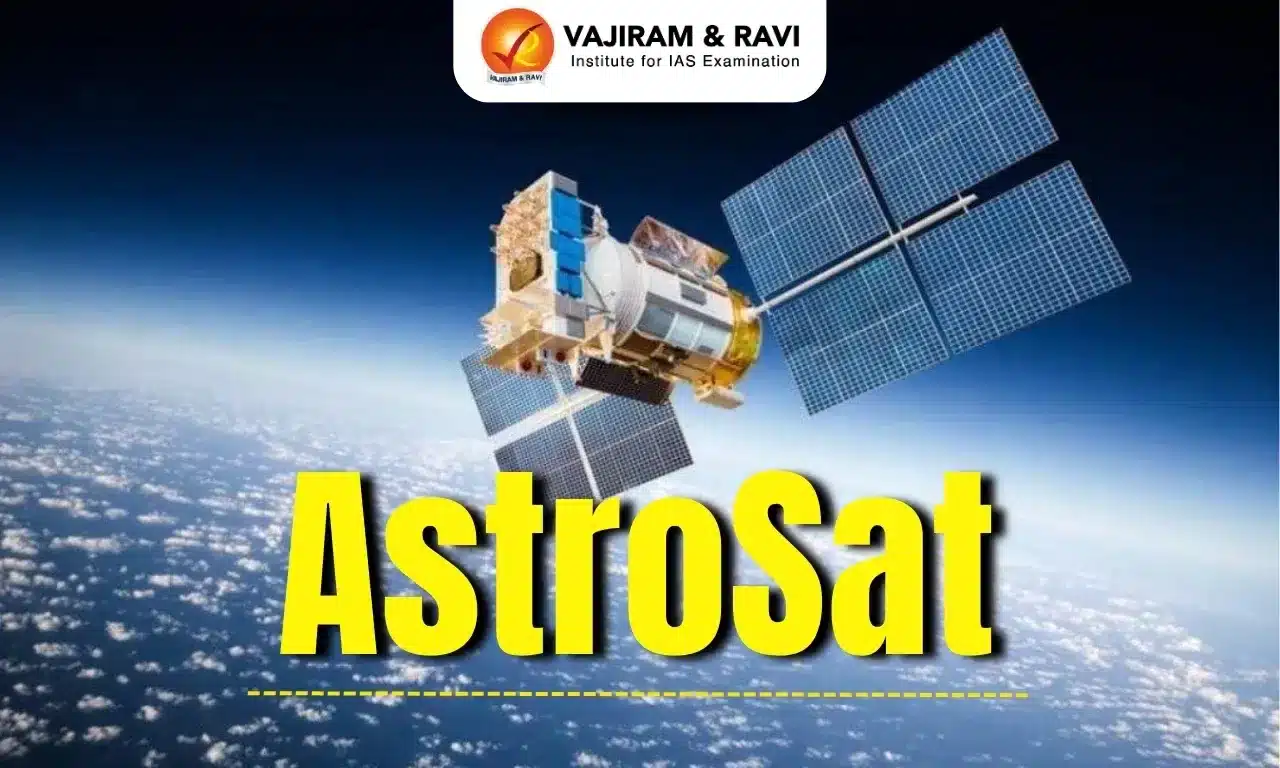
Recently, the Indian Institute of Astrophysics (IIA) celebrated a decade of successful operation of the UltraViolet Imaging Telescope (UVIT) on AstroSat.

About AstroSat

  • It is the first dedicated Indian astronomy mission aimed at studying celestial sources in X-ray, optical and UV spectral bands simultaneously.
  • The payloads cover the energy bands of Ultraviolet (Near and Far), limited optical and X-ray regime (0.3 keV to 100keV).
  • It enables the simultaneous multi-wavelength observations of various astronomical objects with a single satellite.
  • Payloads of Astrosat: Ultra Violet Imaging Telescope (UVIT), Large Area X-ray Proportional Counter (LAXPC), Cadmium–Zinc–Telluride Imager (CZTI), Soft X-ray Telescope (SXT) and Scanning Sky Monitor (SSM).
    • UVIT consists of two telescopes: one dedicated to near-ultraviolet and visible wavelengths, and the other to far-ultraviolet observations.
  • The spacecraft control centre at Mission Operations Complex (MOX) of ISRO Telemetry, Tracking and Command Network (ISTRAC), Bengaluru manages the satellite during its entire mission life.

Objectives of AstroSat

  • To understand high energy processes in binary star systems containing neutron stars and black holes.
  •  Estimate magnetic fields of neutron stars.
  • Study star birth regions and high energy processes in star systems lying beyond our galaxy.
  •  Detect new briefly bright X-ray sources in the sky.
  •  Perform a limited deep field survey of the Universe in the Ultraviolet region.

Source: DD News

AstroSat FAQs

Q1: What is Astrosat?

Ans: It is India's first dedicated multi-wavelength space observatory.

Q2: When was Astrosat launched?

Ans: in the year 2015

Nuclear Power Plants in India, List, Location, Capacity, Reactor Type

Nuclear Power Plants in India

The fifth largest source of electricity in India is Nuclear Power after thermal, hydroelectric and renewable sources of electricity. Currently, there are 22 Nuclear Power Plants in India operating in seven states with 6780 MegaWatt (MWe) out of which 18 reactors are Pressurised Heavy Water Reactors (PHWRs) and 4 are Light Water Reactors (LWRs). The responsibility for generating nuclear power in India lies with the Nuclear Power Corporation of India Limited (NPCIL), a public sector enterprise headquartered in Mumbai. NPCIL functions under the administrative control of the Department of Atomic Energy, Government of India.

Nuclear Power Plants in India

Nuclear Power Plants in India play an important role in energy resources which ensure a balanced and sustainable power supply. Recognised as a clean and environment-friendly option, Nuclear Power serves as a reliable energy source available. As of 2021, the country operates 22 nuclear reactors with a combined installed capacity of 6,780 MWe, maintaining an operational efficiency of more than 80% plant load factor. 

Of these, 18 are Pressurised Heavy Water Reactors (PHWRs) and 4 are Light Water Reactors (LWRs). The First Nuclear Reactor of Asia was Apsara commissioned in Mumbai, marking a significant milestone in the atomic journey of India.

List of Nuclear Power Plants in India

Nuclear Power Plants in India span multiple states, with all commercial nuclear power plants operated by the Nuclear Power Corporation of India Limited (NPCIL). These facilities employ a range of reactor technologies, including Pressurised Heavy Water Reactors (PHWRs), Light Water Reactors (LWRs), and Fast Breeder Reactors (FBRs). Below is a List of Nuclear Power Plants in India currently in operation.

List of Nuclear Power Plants in India

Nuclear Power Plant

Location

Reactor Type

Capacity (MW)

Tarapur Atomic Power Station Units 1 and 2

Maharashtra

Pressurized Heavy Water Reactor (PHWR)

2 x 160

Tarapur Atomic Power Station Units 3 and 4

Maharashtra

PHWR

2 x 540

Rajasthan Atomic Power Station Units 1 and 2

Rajasthan

PHWR

2 x 100

Rajasthan Atomic Power Station Units 3 and 4

Rajasthan

PHWR

2 x 220

Kakrapar Atomic Power Station Units 1 and 2

Gujarat

PHWR

2 x 220

Kudankulam Nuclear Power Plant Units 1 and 2

Tamil Nadu

Pressurized Water Reactor (PWR)

2 x 1,000

List of Nuclear Power Plants in India (Under Construction)

Below are the List of Nuclear Power Plants in India currently under construction in India. The table includes key details such as the location of each plant, reactor type, installed capacity, and the expected year of completion. 

List of Nuclear Power Plants in India (Under Construction)

Name

Location

Reactor Type

Capacity (MW)

Expected Completion

Kakrapar Atomic Power Plant Units 3&4

Gujarat

Pressurized Heavy Water Reactor

700

2024

Kalpakkam Power Plant

Tamil Nadu

Prototype Fast Breeder Reactor

500

20244

Rajasthan Atomic Power Plant Units 7&8

Rajasthan

Pressurized Heavy Water Reactor

700

2023-24

Kudankulam Nuclear Power Plant Units 3&4

Tamil Nadu

VVER-1000

1000

2026-27

Gorakhpur Nuclear Power Plant Units 1&2

Haryana

Pressurized Heavy Water Reactor

700

2029-30

Nuclear Power Plants In India (To Be Constructed)

Below are the Nuclear Power Plants In India that are planned for future development in India. The list includes the location of each site and the planned power generation capacity.

Nuclear Power Plants In India (To Be Constructed)

Nuclear Power Plant

Location

Capacity (MW)

Status

Chutka Nuclear Power Plant

Madhya Pradesh

2 x 700

Planned, site clearance obtained

Mahi Banswara Nuclear Power Plant

Rajasthan

2 x 700

Planned, site clearance obtained

Kaiga Nuclear Power Plant Units 5 and 6

Karnataka

2 x 700

Planned, environmental clearance obtained

Bhimpur Nuclear Power Plant

Madhya Pradesh

4 x 700

Planned, pre-project activities underway

Kovvada Nuclear Power Plant

Andhra Pradesh

6 x 1,000

Planned, Pre-Project activities underway

Haripur Nuclear Power Plant

West Bengal

6 x 1,000

Planned, pre-project activities underway

Nuclear Power Plants in India Advantages

  • Low Carbon Emissions: Generates minimal greenhouse gases, helping reduce environmental impact and mitigate climate change.
  • High Energy Efficiency: Produces large amounts of electricity from small quantities of nuclear fuel.
  • Enhanced Energy Security: Decreases dependence on imported fossil fuels, supporting national energy independence.
  • Reliable Baseload Supply: Offers a steady and uninterrupted power output, unlike variable sources like solar or wind.
  • Cost-Effective Over Time: While capital-intensive initially, nuclear plants have low long-term operating and fuel costs.
  • Drives Technological Innovation: Promotes R&D in advanced nuclear technologies, including thorium-based reactors.
  • Generates Employment: Creates job opportunities in plant construction, operations, safety, and maintenance.
  • Utilization of Indigenous Resources: Supports India's three-stage nuclear programme through efficient use of domestic thorium reserves.

Also Check: India Nuclear Power 2047

Nuclear Power Plants in India Recent Development

  • Bharat Small Reactors (BSR): India is working on compact, modular reactors designed for flexible deployment and lower costs. These small reactors represent a shift from conventional large plants and involve greater participation from private industry in design and innovation.
  • Expansion of Capacity: The government has set a target to triple the country’s nuclear power capacity by 2032. Currently, six reactors are under construction, with several new large-scale projects in the pipeline.
  • Global Partnerships: India is strengthening international cooperation by securing uranium supplies and partnering with countries like France and Russia for advanced reactor technologies.
  • Focus on Sustainability: The Union Budget 2024 discusses investments in clean energy, including research into low-emission technologies such as ultra-supercritical thermal systems, in line with climate goals.
  • Energy and Climate Alignment: These initiatives collectively aim to address India’s growing energy needs while maintaining commitments to reduce greenhouse gas emissions and promote sustainable development.

Nuclear Power Plants in India Challenges

  • High Capital Investment: Setting up nuclear power plants requires significant upfront costs for infrastructure, advanced technology, and safety systems.
  • Public Resistance: Concerns over radiation, environmental impact, and past global nuclear incidents often lead to local opposition and protests.
  • Fuel Supply Constraints: India's limited domestic uranium reserves make the sector heavily reliant on imports, exposing it to supply chain risks.
  • Radioactive Waste Management: Safely storing and disposing of nuclear waste remains a major technical and environmental challenge.

Project Delays: Nuclear projects frequently face execution delays due to regulatory clearances and acquisition issues.

Nuclear Power Plants in India FAQs

Q1: How many nuclear power plants are there in India (2025)?

Ans: India has 8 nuclear power stations with 23 operational reactors as of 2025.

Q2: Which is India’s first nuclear power plant?

Ans: Tarapur Atomic Power Station (Maharashtra) was India’s first nuclear power plant, commissioned in 1969.

Q3: Which is the largest nuclear power plant in India?

Ans: Kudankulam Nuclear Power Plant in Tamil Nadu is India’s largest, with planned capacity of 6000 MW.

Q4: Who operates nuclear power plants in India?

Ans: All nuclear plants are operated by the Nuclear Power Corporation of India Limited (NPCIL).

Q5: Which Indian state has the most nuclear reactors?

Ans: Tamil Nadu has the highest number of operational nuclear reactors.

India-Russia Summit 2025 – Strengthening Ties

India-Russia Summit

India-Russia Summit Latest News

  • Russian President Vladimir Putin’s official state visit to India has resulted in major breakthroughs in areas like labour mobility, trade expansion, nuclear energy cooperation, defence manufacturing and tourism.

India-Russia Strategic Partnership

  • India and Russia share a long-standing strategic partnership built on defence cooperation, energy security, and technological collaboration. 
  • The 2025 summit reaffirmed the relevance of this relationship amid shifting global geopolitics. 
  • Despite Western sanctions on Russia, bilateral trade between the two nations crossed USD 65 billion in 2024, driven largely by discounted Russian crude oil imports.
  • The summit aimed to rebalance trade, diversify cooperation, and build long-term frameworks that benefit India’s economic and strategic interests.

Key Announcements from the India-Russia Summit

  • New Labour Mobility Pathway
    • One of the most significant outcomes of the summit was the signing of a labour mobility agreement, enabling Indian workers, particularly from construction, healthcare and services sectors, to take up jobs in Russia under regulated frameworks. This initiative is expected to
      • provide safer migration pathways,
      • address Russia’s labour shortages, and
      • generate new employment opportunities for Indian youth.
    • The agreement mirrors India’s wider strategy of formalising migration channels with key partner nations.
  • Advancement in Nuclear Energy Cooperation
    • India and Russia are committed to expanding cooperation in the nuclear energy sector, including:
      • joint development of small modular reactors (SMRs),
      • progress on additional units at Kudankulam, and
      • collaboration in fuel supply, nuclear safety, and training.
    • SMRs are seen as central to India’s long-term low-carbon energy strategy, making Russia a valuable technological partner.
  • Boost to Defence Production and Technology Sharing
    • Defence remained a core pillar of the summit. Major takeaways included:
      • proposals for the co-production of military equipment in India,
      • discussions on supply chain stabilisation for spare parts, and
      • a roadmap for long-term defence industrial cooperation.
    • With India diversifying its procurement sources, Russia emphasised readiness for deeper technology sharing and joint manufacturing under ‘Make in India’.
  • Focus on Expanding Bilateral Trade
    • Both leaders acknowledged that trade remains heavily skewed in Russia’s favour due to oil imports. To correct this imbalance, the summit saw discussions on:
      • expanding Indian exports of pharmaceuticals, textiles, machinery, automotive parts and food products,
      • establishing a bilateral payment settlement mechanism insulated from geopolitical disruptions,
      • promoting direct shipping routes via the Chennai-Vladivostok maritime corridor.
    • Industry bodies noted that the agreements could unlock new market opportunities for textiles, engineering goods, FMCG and agritech companies.

India Announces Free 30-Day e-Tourist Visa for Russians

  • A major policy announcement was India’s decision to grant a free 30-day, double-entry e-tourist visa to all Russian nationals. Expected Benefits:
    • Increased Russian tourist inflow to India’s coastal and wellness destinations.
    • Strengthening people-to-people ties amid rising Russian outbound travel.
    • Support to India’s hospitality and retail sectors.
  • The move comes at a time when visa-friendly tourism policies are becoming a tool of economic diplomacy. 
  • Russia is also expected to ease travel norms for Indian tourists as part of reciprocal arrangements.

Technology, Space and Energy-Sector Outcomes

  • Technology Collaboration
    • India and Russia discussed joint projects in cybersecurity, digital public infrastructure, and artificial intelligence. Russian firms expressed interest in collaborating with Indian IT and fintech start-ups.
  • Space Cooperation
    • The summit reaffirmed cooperation in space research, satellite navigation, and training of Indian astronauts, continuing a decades-long partnership.
  • Energy Security
    • Beyond nuclear energy, both sides reviewed:
      • long-term crude oil supply agreements,
      • LNG procurement possibilities, and
      • Indian investments in Russian petroleum projects.
  • Energy remains the backbone of bilateral engagement and a critical factor in India’s economic strategy.

Geopolitical Significance of the Summit

  • The India-Russia summit showcased India’s strategic autonomy. India continues to maintain strong ties with Russia while deepening relations with the United States, Europe and East Asia. 
  • The agreements signalled:
    • India’s need for stable energy access,
    • Russia’s search for reliable economic partners, and
    • A shared interest in building multipolar global institutions.

Source: IE | ET | Mint

India-Russia Summit FAQs

Q1: What is the major labour-related outcome of the India–Russia summit?

Ans: A regulated labour mobility pathway allowing Indian workers to take up jobs in Russia.

Q2: What new visa facility has India announced for Russians?

Ans: A free 30-day, double-entry e-tourist visa.

Q3: Which energy sector cooperation was emphasised?

Ans: Expansion of nuclear energy collaboration, including small modular reactors.

Q4: What defence cooperation was discussed?

Ans: Co-production of military equipment and long-term defence industrial integration.

Q5: Why is the summit significant for trade?

Ans: It aims to diversify and rebalance trade while creating secure payment and logistics channels.

RBI Rate Cut Explained: Why India Is in a Rare Goldilocks Phase

Goldilocks Phase

Goldilocks Phase Latest News

  • As the current RBI Governor completes his first year, the Indian economy finds itself in an unexpectedly strong position despite global turmoil — including trade wars, steep U.S. tariffs, and geopolitical conflicts.
  • The Governor described the moment as a “rare goldilocks period,” with inflation at just 2.2% and GDP growth at 8% in the first half of 2025–26. 
  • Reflecting this strength, the Monetary Policy Committee cut the repo rate by 25 bps to 5.25%.
  • This favourable phase has been building over time: retail inflation has fallen for three consecutive years, and GDP growth has averaged 8.2% over four-and-a-half years. 
  • Even excluding the high-base recovery year of 2021–22, growth has averaged 7.8% between 2022–23 and Q2 of 2025–26.

Goldilocks Conditions: Low Inflation, Strong Growth, and Policy Consistency

  • India’s economy is enjoying a rare goldilocks phase with falling inflation and robust growth, even though the rupee has weakened over 5% in 2025 and recently crossed the 90-per-dollar mark. 
  • Economists say the depreciation is not a monetary policy concern, and the RBI has rightly avoided the temptation to defend the currency.
  • By cutting the repo rate by 25 bps — bringing total easing in 2025 to 125 bps — the RBI has demonstrated policy consistency. 
  • Analysts note that just as the central bank would tighten policy if inflation stayed above 6% for six months, it should ease when inflation remains below 2% for a similar period.
  • With inflation currently well under the lower tolerance limit of the RBI’s 2–6% target band, the rate cut aligns with the central bank’s mandate to anchor inflation around 4% in the medium term.

Why Inflation Trends Created Room for Aggressive Easing

  • The document shows that inflation in 2025 collapsed faster than expected, breaching the lower tolerance band for the first time under the flexible inflation-targeting framework.
  • This broad-based disinflation expanded the RBI’s policy space dramatically, allowing the MPC to cut rates without risking overheating.
  • The December cut was positioned as a continuation of measured easing, not the start of an open-ended cycle.

RBI’s Strategic Logic Behind the Additional Rate Cut

  • Disinflation Is Durable, Not Temporary - The RBI believes the sharp decline in inflation is structural enough to justify further easing.
  • Support Domestic Demand Amid Global Weakness - With global trade slowing, financial volatility rising, and geopolitical tensions persisting, the RBI used its policy room to buffer the economy.
  • Maintain Policy Consistency - After pausing in October to confirm the durability of disinflation, the December cut aligns cumulative easing with evolving macro data.

More Rate Cuts Likely as Inflation Eases and Growth Set to Slow

  • Despite stronger-than-expected 8.2% GDP growth in July–September, the RBI delivered a unanimous rate cut, lowered its 2025–26 inflation forecast to 2%, and signalled flexibility in its forward guidance.
  • This prompted economists to expect another rate cut in February.
  • RBI Governor Malhotra noted that underlying price pressures are even weaker than headline inflation suggests. 
  • Economists anticipate growth moderation in the second half of 2025–26 due to factors such as reduced government spending and the impact of the 50% U.S. tariff on Indian exports. 
  • RBI also acknowledged that growth will “soften somewhat”. It now projects GDP growth to drop to 7% in Q3 and 6.5% in Q4 of 2025–26.

RBI’s New Approach to the Rupee: More Flexibility, Less Intervention

  • While growth and inflation have been favourable, the rupee’s sharp depreciation remains a challenge. 
  • RBI Governor avoided commenting directly on the currency’s slide during his policy statement, insisting that market fluctuations are normal and the RBI intervenes only to curb “abnormal” volatility.
  • Despite his remarks, India’s exchange rate management has shifted significantly under his tenure
  • The IMF recently reclassified India’s regime from “stabilised” to a “crawl-like arrangement,” noting that increased flexibility will help the economy absorb external shocks.
  • Economists broadly agree that the RBI need not aggressively defend the rupee. 
  • However, whether the current growth–inflation goldilocks phase will persist once India unveils its new GDP and inflation series in February 2026 remains an open question.

Balancing Growth Momentum and Future Risks

  • The document emphasises that the RBI’s move is best understood against a backdrop of:
    • Tariff-related risks from the U.S.
    • Ongoing geopolitical tensions
    • Volatile global markets
    • Potential balance-of-payments pressures
  • By cutting rates now, the RBI strengthened domestic demand while acknowledging uncertain global headwinds.

Source: IE | FE | ET

Goldilocks Phase FAQs

Q1: Why does the RBI call this a ‘goldilocks’ period?

Ans: Because India simultaneously enjoys benign inflation near 2% and robust GDP growth near 8%, giving policymakers unusual flexibility for supportive monetary action.

Q2: Why did the RBI cut rates despite strong GDP data?

Ans: Sharp, broad-based disinflation created room for easing. With inflation below the 2–6% target band, policy consistency required cutting rates to maintain credibility.

Q3: What is the logic behind further rate cuts?

Ans: RBI lowered inflation forecasts to 2% and signalled flexibility. Economists expect slowing growth ahead, making another cut likely to support domestic demand.

Q4: How has RBI’s approach to the rupee changed?

Ans: The central bank now allows greater exchange-rate flexibility, intervening only to curb abnormal volatility. IMF reclassified India’s regime as a “crawl-like arrangement.”

Q5: What risks still weigh on RBI policy?

Ans: Geopolitical tensions, U.S. tariffs, global slowdown, and potential balance-of-payments pressures could challenge the sustainability of the goldilocks phase.

Exercise Harimau Shakti

Exercise Harimau Shakti

Exercise Harimau Shakti Latest News

Recently, the Fifth edition of “Exercise Harimau Shakti -2025” commenced in Mahajan Field Firing Range, Rajasthan.

About Exercise Harimau Shakti

  • It is a joint military exercise conducted between India and Malaysia.
  • The Indian contingent is being represented mainly by troops from the DOGRA Regiment.
  • The aim of the exercise is to jointly rehearse conduct of Sub Conventional Operations under Chapter VII of United Nations Mandate.
  • Both sides will practice tactical actions such as cordon, search and destroy missions, heliborne operations, etc.

Key Facts about Exercise Harimau Shakti – 2025

  • In this exercise both sides will rehearse drills to secure helipads and undertake casualty evacuation during counter-terrorist operations.
  • Both sides will exchange views and practices of joint drills on a wide spectrum of combat skills that will facilitate the participants to mutually learn from each other.
  • Sharing of best practices will further enhance the level of defence cooperation between Indian Army and Royal Malaysian Army.
  • Significance: The exercise will also foster strong bilateral relations between the two nations.

Source: PIB

Exercise Harimau Shakti FAQs

Q1: What is Exercise Harimau Shakti?

Ans: A bilateral military exercise between India and Malaysia.

Q2: Where is the 5th edition of Exercise Harimau Shakti being held?

Ans: India (Mahajan Field Firing Range, Rajasthan)

DRDO Rocket-Sled Ejection Test: How India Boosted Fighter Pilot Safety

Rocket-Sled Ejection Test

Rocket-Sled Ejection Test Latest News

  • The DRDO successfully conducted a high-speed rocket-sled test on December 2 to evaluate a fighter aircraft’s escape (ejection) system under controlled conditions. 
  • This milestone places India among the few nations with the capability to test such systems indigenously and at high speeds.
  • The test demonstrates India’s growing self-reliance in advanced aerospace safety technologies and highlights the importance of having a dynamic test facility to validate and improve pilot-escape mechanisms essential for fighter aircraft operations.

How DRDO Conducted the Rocket-Sled Ejection Test

  • The test was jointly carried out by DRDO, the Aeronautical Development Agency (ADA), and Hindustan Aeronautics Limited (HAL) at DRDO’s Rail Track Rocket Sled (RTRS) facility in Chandigarh.
  • The rocket-sled system replicates high-speed, in-flight aerodynamic conditions on the ground. 
  • Using a dual-sled setup, the forebody of the indigenous LCA was mounted and accelerated along rail tracks. 
  • Through the phased firing of multiple solid rocket motors, the system achieved a precisely controlled speed of 800 km/h, enabling accurate evaluation of the aircraft’s escape system under realistic conditions.

Why Dynamic Ejection Tests Are More Challenging

  • Dynamic ejection tests simulate real flight conditions, unlike static tests conducted at zero altitude and zero speed. 
  • They are the true benchmark for validating pilot escape systems because they must replicate complex, high-speed aerodynamic forces.
  • These tests evaluate:
    • Ejection seats powered by explosive cartridges and rocket motors
    • Canopy severance systems that safely clear the cockpit before ejection
    • Perfect sequencing of seat firing, stabilisation, and parachute deployment
  • Survival depends on millisecond-level precision, making the process extremely sensitive.

Extreme Aerodynamic Forces and Real-World Scenarios

  • Emergency ejections may occur during:
    • Low or high altitude
    • Zero speed or supersonic flight
    • Aircraft spin or inverted flight
  • The systems must function flawlessly across all conditions, as incorrect sequencing or timing can cause severe injuries. 
  • Hence, flight-like testing is essential to meet global safety standards.

Use of Human-Like Test Dummies for High-Fidelity Data

  • The test employed instrumented anthropomorphic dummies equipped with sensors to measure:
    • Physical loads
    • Rotational forces (moments)
    • Accelerations experienced during ejection
  • This helps simulate the full sequence of pilot ejection and recovery under realistic conditions.

A Major Strategic Leap in Fighter Aircraft Safety

  • India’s successful indigenous test of a fighter aircraft escape system marks a significant strategic milestone.
  • Ejection systems are among the most critical life-saving mechanisms in combat aircraft, directly determining pilot survivability during emergencies.

Reduced Dependence on Foreign Testing Ecosystems

  • Previously, India relied on foreign test facilities to assess ejection systems—an expensive and time-consuming process.
  • Indigenous testing now costs one-fourth to one-fifth of overseas testing, making development more economical and efficient.

Faster Development and Certification for Current and Future Aircraft

  • By possessing an in-house dynamic ejection test facility, India can now:
    • Design and certify escape systems domestically
    • Upgrade mechanisms for future fighter platforms
    • Shorten development cycles and reduce external bottlenecks
  • This enhances India’s aerospace self-reliance.

High-Fidelity Safety Data Through Realistic Simulation

  • Instrumented anthropomorphic dummies allow India to precisely measure:
    • Loads
    • Accelerations
    • Impact forces
  • Such data is crucial for optimising pilot safety across different emergency scenarios.

Advanced RTRS Capabilities Already Supporting National Missions

  • The Rail Track Rocket Sled (RTRS) at TBRL, operational since 2014, can test systems at supersonic speeds.
  • Earlier in February, the facility successfully tested Gaganyaan drogue parachutes, firing two parachutes simultaneously to simulate real descent conditions.
  • The upgraded escape system test facility now includes:
    • High-speed cameras
    • State-of-the-art measurement systems
    • A dynamic test environment matching global benchmarks

Source: IE | PIB | NDTV

Rocket-Sled Ejection Test FAQs

Q1: What did DRDO’s rocket-sled ejection test achieve?

Ans: The high-speed test validated India’s indigenous fighter escape system, proving critical mechanisms like ejection sequencing and canopy severance under realistic aerodynamic conditions.

Q2: How was the test conducted at the RTRS facility?

Ans: Using a dual-sled system, DRDO propelled an LCA forebody to 800 km/h through phased rocket firing, simulating in-flight stresses during emergency ejection.

Q3: Why are dynamic ejection tests essential?

Ans: They replicate high-speed, high-force conditions—unlike static tests—ensuring ejection seats and safety systems function millisecond-perfect across altitude, speed, and aircraft attitude variations.

Q4: What strategic benefits does indigenous testing provide?

Ans: India reduces dependence on foreign facilities, cuts testing costs to one-fourth, accelerates certification, and enhances self-reliance in fighter safety technologies.

Q5: How does the RTRS contribute to national missions?

Ans: The RTRS supports supersonic testing and previously validated Gaganyaan parachutes, offering advanced imaging and measurement systems for aerospace safety development.

Daily Editorial Analysis 6 December 2025

Daily Editorial Analysis

A Growing Shadow Over Digital Constitutionalism

Context

  • The Indian government’s abrupt decision to revoke its directive mandating the pre-installation of the Sanchar Saathi application exposed growing tensions between digital governance and constitutional freedoms.
  • The rollback, prompted by criticism over privacy risks, opaque data collection, lack of consent, and potential surveillance, underscored the fragile balance between technological efficiency and civil liberties.
  • The episode also highlighted the urgent need for a framework that embeds constitutional values within digital systems, an idea captured by digital constitutionalism.

The Case of Sanchar Saathi: A Trigger for Debate

  • The Sanchar Saathi initiative was framed as a response to rising cybercrime, which increased from 15.9 lakh cases in 2023 to 20.4 lakh in 2024.
  • Yet the requirement for mandatory installation raised concerns about state overreach.
  • Pushback from privacy advocates, civil society, and global technology providers signalled growing unease with digital policies implemented without transparency or citizen consent.
  • The incident demonstrated how digital interventions, even when introduced as public safety measures, can threaten individual autonomy when unchecked by constitutional safeguards.

Understanding Digital Constitutionalism

  • Digital constitutionalism extends core constitutional values, liberty, dignity, equality, non-arbitrariness, accountability, and rule of law, into the digital sphere.
  • This framework becomes essential as modern governance increasingly depends on biometric systems, artificial intelligence, predictive algorithms, and automated decision-making.
  • These technologies influence daily life, from welfare distribution and KYC verification to job applications and political expression.
  • Without oversight, power becomes concentrated in the hands of technology creators, enforcement agencies, and private corporations.
  • Citizens are transformed into passive data subjects rather than active rights-holders, eroding democratic participation and transparency.

The New Architecture of Surveillance

  • Contemporary surveillance is increasingly invisible and pervasive. Metadata collection, facial recognition, geolocation tracking, and behavioural analytics allow monitoring without physical presence.
  • Such systems can discourage dissent, promote self-censorship, and undermine democratic culture.
  • Although the Puttaswamy judgment established privacy as a fundamental right, the Digital Personal Data Protection Act, 2023 provides broad government exemptions, weak oversight, and limited remedies.
  • The spread of facial recognition technologies adds further risks. Studies show these systems disproportionately misidentify women, minorities, and people of colour, leading to discrimination and wrongful targeting.
  • Despite international caution and restrictions, such technologies are expanding in India without strict legal limits, transparency mandates, or judicial review.

Algorithmic Power and the Crisis of Accountability

  • Algorithms now influence welfare eligibility, law enforcement profiling, content moderation, and access to jobs or credit.
  • These black box systems often operate without explanations, accountability, or avenues for appeal. Errors can lead to wrongful exclusion from welfare, unfair policing, or suppression of legitimate speech.
  • India’s current legal framework, dominated by the Information Technology Act, 2000, focuses more on platform regulation than on safeguarding individual liberties.
  • Existing judicial guidelines are fragmented, and remedies remain inaccessible for most citizens.
  • This legal vacuum creates an environment where algorithmic systems can quietly violate equality, fairness, and due process.

The Democratic Paradox of the Digital Age

  • Digital systems now shape rights and state power as profoundly as traditional institutions, yet they remain outside constitutional discipline.
  • This mismatch threatens democratic accountability. As governance becomes more data-driven, constitutional values must be embedded directly into digital infrastructures to prevent the unchecked expansion of surveillance and administrative power.

Towards a Model of Digital Constitutionalism

  • A meaningful framework for digital constitutionalism requires institutional safeguards:
  • Creation of an independent digital rights commission empowered to audit algorithms and investigate surveillance practices.
  • Strict limits on surveillance based on necessity, proportionality, and judicial oversight.
  • Mandatory public transparency reports, parliamentary scrutiny, and regular audits of high-risk AI systems.
  • Guaranteed rights to explanation and appeal for automated decisions.
  • Strong enforcement of purpose limitation, data minimisation, and penalties for misuse.
  • Promotion of digital literacy as a tool for democratic empowerment.
  • These measures would ensure that technology strengthens rather than weakens constitutional rights.

Conclusion

  • As governance becomes increasingly algorithmic, freedom, equality, and privacy require stronger protection than ever before.
  • Digital constitutionalism offers a pathway to ensure that technology remains a servant of the people, not an instrument of unregulated power.
  • Embedding constitutional principles into digital systems is essential to preserving democratic life in the data-driven era.

A Growing Shadow Over Digital Constitutionalism FAQs

 Q1. What prompted the discussion on digital constitutionalism?
Ans. The government's rollback of the Sanchar Saathi mandate prompted the discussion on digital constitutionalism.

Q2. Why is digital constitutionalism necessary?
Ans. Digital constitutionalism is necessary to ensure that constitutional values such as liberty, dignity, and equality are protected in digital governance.

Q3. How does modern surveillance threaten democracy?
Ans. Modern surveillance threatens democracy by encouraging self-censorship and reducing citizens’ freedom of expression.

Q4. What problem arises from algorithmic decision-making systems?
Ans. Algorithmic decision-making systems create problems because they often operate without transparency, accountability, or avenues for appeal.

Q5. What institutional reform is suggested to safeguard digital rights?
Ans. The analysis suggests creating an independent digital rights commission to safeguard digital rights.

Source: The Hindu


Chile’s Lesson for India’s Coal Conundrum

Context

  • India’s sharp drop in the Climate Change Performance Index (CCPI) underscores a central contradiction in its energy landscape: significant renewable-energy growth alongside continued deep dependence on coal.
  • This dependence has become India’s largest obstacle to decarbonisation, with severe implications for climate, health, and economic stability.
  • A comparison with Chile highlights both possibilities and constraints in accelerating a coal phaseout.

India’s Coal Conundrum

  • Despite rapid expansion of clean energy, coal remains the dominant source of India’s electricity.
  • Renewables represent half of installed capacity but produce only one-fifth of total electricity, while coal accounts for nearly 75% of power generation.
  • Domestic coal production continues to increase, reinforcing the dependence.
  • This creates a severe policy dilemma. Phasing out coal risks job losses and higher electricity costs for coal-dependent States.
  • Yet retaining it heightens the threat of climate-induced economic damage, projected to cut 3%-10% of India’s GDP by 2100, and worsens public health risks.
  • A one-gigawatt increase in coal-fired capacity corresponds to a 14% rise in infant mortality in nearby districts.
  • Coal phaseout is therefore a no regrets strategy essential for protecting long-term economic and social welfare.

Chile’s Accelerated Shift: A Contrast and a Lesson

  • Chile demonstrates how clear policy signals and market reform can drive rapid energy transformation.
  • Between 2016 and 2024, coal’s share in electricity generation fell from 43.6% to 17.5%, while renewables, mainly solar and wind, exceeded 60% of the power mix.
  • This shift was enabled by a carbon tax, strict emission standards that increased coal-plant costs by 30%, and competitive renewable auctions that delivered cheaper clean power.
  • Large-scale investments in storage strengthened grid reliability, and the country committed to a complete coal phaseout by 2040.
  • Chile’s transition was made easier by a smaller coal sector, fewer workers to reskill, and a political context that supported swift reforms.
  • Pre-existing alternative industries helped absorb displaced labour. In contrast, India’s coal sector spans entire districts of Jharkhand, Chhattisgarh, Odisha, and West Bengal, making transition more complex and socially sensitive.

A Road Map for India’s Decarbonisation

  • Strengthening Renewable Integration

    • Addressing renewable limitations is essential for reducing coal dependence.
    • This includes expanding storage capacity, modernising the grid, and supporting electrification of transport, industry, and households to increase renewable power demand.
  • Reforming Energy Markets and Regulations

    • Market reform must disincentivise coal and reward clean energy.
    • Priority steps include carbon pricing, removal of coal subsidies, clean-dispatch rules that prioritise renewable power, and procurement contracts that favour flexible, clean-energy supply.
    • Such reforms can replicate the competitive environment that accelerated Chile’s transition.
  • Ensuring a Just Transition for Workers and Regions

    • A coal exit must be socially inclusive. This requires reskilling programmes, income support, and new livelihood opportunities for workers in coal-dependent regions.
    • A national mechanism such as the Green Energy Transition India Fund can coordinate support efforts, while the District Mineral Foundation can promote local entrepreneurship and diversification in mining districts.
  • Financing the Transition

    • A blended finance model will be crucial. Public funds should target community welfare, worker protection, and enabling infrastructure, while private capital drives renewables deployment, storage expansion, and technological innovation.
    • Aligning financial incentives with decarbonisation will strengthen execution and investor confidence.

Conclusion

  • India’s renewable-energy progress provides a strong foundation, but without a clear and actionable coal-exit plan, climate ambition will remain incomplete.
  • A national coal phaseout road map must now be a top political priority, integrating timelines, financing mechanisms, regulatory reform, and robust social protection.
  • Learning from Chile’s experience, India can build a transition that is economically resilient, socially just, and aligned with its long-term climate goals.

Chile’s Lesson for India’s Coal Conundrum

Q1. Why did India drop in the Climate Change Performance Index?
Ans. India dropped in the index because it has made little progress in phasing out coal.

 Q2. What major contrast exists between India and Chile’s energy transition?
Ans. Chile has rapidly reduced coal use and expanded renewables, while India remains heavily dependent on coal.

 Q3. Why is coal phaseout described as a “no regrets” strategy?
Ans. It prevents climate-related economic damage and reduces severe health risks for communities near coal plants.

Q4. What is one key reform needed to reduce India’s coal dependence?
Ans. India needs to reform energy markets by introducing carbon pricing and reducing coal subsidies.

Q5. How can India ensure a just transition for coal-dependent regions?
Ans. India can ensure a just transition by reskilling workers and creating alternative livelihood opportunities.

Source: The Hindu


India’s Labour Codes - Reforming a Restrictive Legacy for a Modern Workforce

Context

  • India’s labour market has long been shaped by post-Independence labour laws aimed at protecting workers but which eventually discouraged formalisation, scaling of enterprises, and labour-intensive manufacturing.
  • The government’s consolidation of 29 labour laws into four labour codes seeks to simplify compliance, expand social protection, and create a flexible and growth-oriented labour ecosystem.

Background - A Legacy of Rigid Labour Regulation

  • Industrial Disputes Act (IDA), 1947

    • It created powerful disincentives for firms to expand, leading to sub-optimal firm size, and resulted in -
      • Fragmentation into micro and small informal units.
      • Low productivity and limited access to technology and capital.
      • Benefits accruing only to a small minority of formal, unionised workers, leaving most workers outside legal protection.
  • Contract Labour Act (CLA), 1970, and Amendments (1976, 1982)

    • It increased compliance requirements for contract labour.
    • Lowered thresholds for government permission for layoffs.
    • Reinforced the rigid regulatory environment even after 1991 economic liberalisation.

Structural Consequences of Past Laws

  • India became a country of numerous informal, small-scale enterprises.
  • Firms avoided hiring due to fear of crossing regulatory thresholds.
  • Job creation lagged behind economic growth, widening the informal sector.

The Four Labour Codes - A Paradigm Shift

  • Code on Wages, 2019 – Universal wage protection

    • Key provisions:
      • Establishes a uniform national framework for minimum wages.
      • Ensures timely wage payments across all sectors.
      • Mandatory appointment letters to boost formalisation and transparency.
    • Significance: Extends wage protection to workers previously excluded (informal sector, unorganised segments).
  • Code on Social Security, 2020 – Inclusive social protection

    • Key provisions:
      • Extends social security to gig workers, platform workers, and other modern workforce categories.
      • Recognises delivery workers, ride-share drivers, and freelancers in labour law.
    • Significance: Modernises the safety net in line with changing work patterns in a digital economy.
  • Industrial Relations Code, 2020 – Flexibility with safeguards

    • Key provisions:
      • Simplifies procedures for layoffs and retrenchment for medium-sized firms.
      • Provides dispute-resolution mechanisms.
      • Maintains worker protection against arbitrary dismissal.
    • Significance: Reduces uncertainty and encourages scaling and formal hiring.
  • Occupational Safety, Health and Working Conditions Code, 2020 – Safer workplaces

    • Key provisions:
      • Consolidates fragmented safety and working condition norms.
      • Applicable across sectors like construction, mining, and manufacturing.
    • Significance: Promotes safer workplaces, investment in modern technology, and worker dignity.

Simplified Compliance and Ease of Doing Business

  • Merges multiple registrations, licences, inspections, and returns into -
    • One registration
    • One licence
    • One return
  • Reduces bureaucratic friction, particularly benefiting MSMEs. Encourages formalisation and scaling.

Role of States in Labour Reform Outcomes

  • Empirical evidence - States implementing flexible labour reforms benefited more from trade liberalisation.
  • Most state-level reforms historically have been limited.
  • Full implementation of labour codes by states will determine investments, job creation, and industrial competitiveness.

Challenges

  • Implementation delays: States have been slow to finalise rules, limiting the nationwide rollout of the codes.
  • Capacity constraints: Smaller firms may struggle to adapt to digital compliance systems.
  • Balancing flexibility and worker protection: Ensuring that flexibility does not lead to worker exploitation.
  • Awareness and outreach: Gig/platform workers often lack awareness of their new entitlements under the codes.
  • Political economy constraints: Labour is a Concurrent List subject; state-level political variations hinder uniform adoption.

Way Forward

  • Fast-track state-level implementation: Harmonise rules across states for predictable labour regulation.
  • Strengthen digital infrastructure: User-friendly compliance portals for MSMEs.
  • Robust social security systems for gig workers: Clear mechanisms for contributions, benefits, and dispute resolution.
  • Employer–worker dialogue: Strengthen industrial relations bodies for faster dispute resolution and trust-building.
  • Continuous monitoring: Real-time evaluation of the codes’ impact on hiring, productivity, and formalisation.

Conclusion

  • India’s labour codes mark a historic shift from rigid, protectionist labour laws to a modern, flexible, and inclusive labour governance framework.
  • By simplifying compliance, expanding social protections, recognising new forms of work, and enabling firms to scale, the codes aim to unlock India’s employment and industrial growth potential.
  • Successful implementation—particularly by states—will determine whether India can transition from a fragmented, informal labour system to a productive, formal, and globally competitive labour market, thereby harnessing the full potential of its vast workforce.

India’s Labour Codes FAQs

Q1. How did the Industrial Disputes Act (IDA), 1947 create structural distortions in India’s labour market?

Ans. The IDA incentivised firms to stay small, encouraging informal micro-units, leading to low productivity and widespread informality.

Q2. What is the significance of the Code on Wages, 2019 in promoting inclusive labour protection?

Ans. It establishes a uniform national minimum wage framework and universal wage protection, bringing informal workers under legal coverage.

Q3. How do the new labour codes improve ease of doing business for Indian firms?

Ans. They simplify compliance through single registration, single licence, and single return, reducing bureaucratic hurdles for MSMEs.

Q4. Why is the inclusion of gig and platform workers under the Social Security Code important?

Ans. It legally recognises emerging workforce categories and extends social security benefits to digital-era workers for the first time.

Q5. Why is state-level implementation crucial for realising the benefits of labour reforms?

Ans. Labour is a Concurrent List subject, and states that fully enforce the codes are more likely to attract investment, and generate jobs.

Source: IE

Daily Editorial Analysis 6 December 2025 FAQs

Q1: What is editorial analysis?

Ans: Editorial analysis is the critical examination and interpretation of newspaper editorials to extract key insights, arguments, and perspectives relevant to UPSC preparation.

Q2: What is an editorial analyst?

Ans: An editorial analyst is someone who studies and breaks down editorials to highlight their relevance, structure, and usefulness for competitive exams like the UPSC.

Q3: What is an editorial for UPSC?

Ans: For UPSC, an editorial refers to opinion-based articles in reputed newspapers that provide analysis on current affairs, governance, policy, and socio-economic issues.

Q4: What are the sources of UPSC Editorial Analysis?

Ans: Key sources include editorials from The Hindu and Indian Express.

Q5: Can Editorial Analysis help in Mains Answer Writing?

Ans: Yes, editorial analysis enhances content quality, analytical depth, and structure in Mains answer writing.

Putin’s India Visit, India-Russia Summit 2025, Impact on India-Russia Ties

Putin's India Visit 2025

Russian President Vladimir Putin visited India on 4-5 December 2025, coinciding with the 23rd India-Russia Annual Summit. This visit comes amid shifting global geopolitics, including sanctions on Russia, U.S. tariff pressures on India, and global energy volatility. 

During the summit, both nations reaffirmed their Special and Privileged Strategic Partnership, a cornerstone of bilateral relations since 2000.

Putin's India Visit 2025 Why Now?

The timing of Putin's India Visit 2025 is significant for several reasons:

Institutionalised Annual Summits: India and Russia have held annual summits since the 2000 Strategic Partnership Declaration to reinforce long-term cooperation.
First Visit Since 2021: This is Putin’s first visit to India after a gap of four years, underlining renewed engagement.

Recent Developments:

  • Russia acknowledges U.S. pressure on India regarding trade and tariffs.
  • Russia seeks a “third-country-proof” payment mechanism to facilitate smoother bilateral trade.

Historical Anchoring:

  • The 1971 Treaty of Peace, Friendship and Cooperation laid the foundation for a strategic partnership.
  • Since the Soviet era, India and Russia have maintained deep defence, energy, and nuclear synergies.

Also Read: RELOS Agreement

India-Russia Bilateral Relations Evolution

India-Russia Bilateral Relations have evolved from strategic and defence-focused ties during the Cold War to multi-dimensional cooperation today. The partnership has strengthened through defence deals, energy trade, nuclear collaboration, and regional/global forum coordination.

  • 1971: USSR supported India during the Bangladesh Liberation War, using its UNSC veto three times in India’s favour.
  • Cold War Era: Transfer of advanced military platforms to India strengthened defence capability.
  • 2000: Strategic Partnership formalised, leading to annual summits.
  • 2010: Upgraded to Special & Privileged Strategic Partnership, signalling deeper trust.
  • 2019 onwards: Renewed engagement through initiatives like the Eastern Economic Forum and India’s “Act Far East Policy.”
  • Post-2022: Russia became India’s largest crude oil supplier via discounted oil arrangements amid sanctions.

Also Read: India-Russia Relations

India-Russia Summit 2025 Outcomes

India and Russia held the 23rd Annual Summit in New Delhi on 4–5 December 2025, marking 25 years of the Strategic Partnership (2000–2025). The visit reaffirmed the Special and Privileged Strategic Partnership, emphasizing continuity, trust, and strategic alignment despite global uncertainties.

Political & Diplomatic Engagement

  • High-level exchanges across parliaments, ministries, and NSA-level talks.
  • Opening of new Indian Consulates in Yekaterinburg and Kazan.
  • Active cooperation in UN, SCO, BRICS, G20, and support for UNSC reforms with Russia backing India’s permanent seat.

Trade & Economic Partnership

  • Revised trade target: USD 100 billion by 2030.
  • Adoption of “Programme 2030” for expanding bilateral economic cooperation.
  • Progress on India–EAEU Free Trade Agreement and Investment Protection Agreement.

Key Areas

  • Cooperation in energy, fertilizers, precious metals, minerals, critical raw materials.
  • Push for smooth payment systems, national currency settlements, CBDC cooperation.
  • Joint efforts to remove logistics bottlenecks, tariff/non-tariff barriers, and insurance issues.

Energy Partnership

  • One of the strongest pillars of the relationship.
  • Broad cooperation in:
    • Oil & gas, LNG, petrochemicals, refineries
    • Underground coal gasification
    • Nuclear energy (Kudankulam NPP; India’s 100 GW nuclear capacity goal by 2047)
  • Agreement to resolve pending investment issues.

Connectivity & Transport

  • Major push for three strategic corridors:
    • International North–South Transport Corridor (INSTC)
    • Chennai–Vladivostok Maritime Corridor
    • Northern Sea Route (NSR)
  • MoU on training Indian specialists for polar water navigation.

Russian Far East & Arctic Cooperation

  • Framework: India–Russia Far East Cooperation Programme (2024–29).
  • Areas: agriculture, mining, manpower, diamonds, pharmaceuticals, shipping.
  • India ready to expand role as Observer in Arctic Council.

Defence & Military-Technical Cooperation

  • Defence cooperation shifting from “buyer–seller” to co-development & co-production.
  • Joint manufacturing of spare parts for Russian-origin weapons in India.
  • Expansion of INDRA joint exercises and military delegations.
  • Emphasis on Make-in-India and joint development of high-tech systems.

India-Russia Annual Summit 2025 Significance

The 23rd India-Russia Annual Summit 2025 on 4-5 December 2025 holds major diplomatic, economic, and defence importance at a time of shifting global geopolitics, energy volatility, and Western sanctions on Russia.

Diplomatic Significance

  • Reaffirmation of Strategic Partnership despite global tensions and sanctions.
  • Strengthens India’s strategic autonomy by maintaining balanced ties with Russia, the U.S., Europe, and the Global South.
  • Russia’s continued support for India’s bid for a UNSC permanent seat.
  • Reinforces cooperation in BRICS, SCO, RIC, G-20, and the Arctic.
  • Helps India maintain influence in Eurasia and Central Asia, where Russia remains a major player.

Economic & Energy Significance

  • Russia remains India’s largest crude supplier, providing discounted oil post-2022.
  • Expected creation of a non-USD, “third-country-proof” payment mechanism to bypass sanctions.
  • Push for long-term oil & gas supply contracts for price stability.
  • Discussion on expanding civil nuclear projects, possibly Kudankulam Units 7-8 or SMR cooperation.
  • Boost to connectivity projects like INSTC and the Chennai-Vladivostok maritime corridor.

Defence Significance

  • Ensures continuity in major defence deliveries including S-400, spare parts, engines.
  • Expansion of joint defence manufacturing, including localisation of components for Su-30, T-90, and helicopters.
  • Strengthens BrahMos cooperation and potential upgrades in air defence systems.
  • Discussions on joint R&D in hypersonic systems, UAVs, aircraft engines, etc.
  • Establishment of joint MRO hubs to reduce dependency and delays.
  • Helps India maintain operational readiness, as 60-70% of India’s defence equipment is Russian-origin.

Challenges in India-Russia Relations

  • Severe Trade Imbalance: Russia-India trade is heavily skewed in Russia’s favour (imports ~$63.8 bn vs exports ~$4.9 bn), creating long-term sustainability concerns and limiting India’s bargaining power.
  • Sanctions & Payment Mechanism Issues: Western sanctions complicate rupee-ruble settlements, banking channels, and large defence/energy payments, slowing trade and creating financial uncertainty.
  • Defence Dependence & Delivery Delays: With 60-70% of India’s military equipment being Russian-origin, supply delays after the Ukraine conflict and reduced production capacity affect India’s operational readiness.
  • Russia’s Growing Proximity to China: Deepening Russia-China strategic and defence ties, especially amid India-China border tensions, reduce India’s leverage and introduce new security challenges.
  • Diverging Geopolitical Alignments: India’s closer partnerships with the U.S., QUAD, and Indo-Pacific frameworks diverge from Russia’s Eurasian and China-centric approach, creating diplomatic friction.

Way Forward

  • Rebuild Strategic Trust: Regular high-level consultations and transparency on defence ties with China can prevent strategic misperceptions.
  • Expand Non-Defence Trade: Prioritise trade in pharma, IT, agriculture, and logistics to reduce overdependence on energy and defence sectors.
  • Secure Long-Term Energy Deals: Finalise multi-year contracts on discounted oil, LNG, nuclear fuel, and critical minerals to stabilise India’s energy basket.
  • Advance Connectivity Projects: Fast-track INSTC, Chennai–Vladivostok Maritime Corridor, and Eurasian Economic Union FTA to cut logistics costs and boost market access.
  • Strengthen People-Centric Engagement: Improve medical education standards for Indian students in Russia, boost tourism, and increase cultural/academic exchanges for durable ties.

Putin's India Visit 2025 FAQs

Q1: Why is Vladimir Putin visiting India in 2025?

Ans: Putin is visiting India to participate in the India–Russia Annual Summit 2025, aimed at strengthening strategic, defence, energy, and economic cooperation.

Q2: What is the main agenda of the India–Russia Annual Summit 2025?

Ans: The agenda includes discussions on defence modernisation, long-term energy cooperation, nuclear projects, trade expansion, and geopolitical coordination on regional security.

Q3: How often do India and Russia hold Annual Summits?

Ans: India and Russia hold annual leaders’ summits since 2000, making it one of India’s most institutionalised strategic dialogues.

Q4: What are the key defence outcomes expected from the visit?

Ans: Expected outcomes include progress on Su-30MKI upgrades, joint production of spare parts, BrahMos expansion, and new agreements on air defence and maintenance support.

Q5: How will this visit impact India’s energy security?

Ans: India aims to secure discounted crude supplies, expand LNG trade, boost nuclear reactor cooperation, and explore investments in Arctic energy projects.

Repo Rate, Meaning, Importance, Impact, Current Rate, Latest News

Repo Rate

Repo Rate News

Recently, The RBI has cut the repo rate to 5.25%, easing borrowing costs for homebuyers and boosting real estate sentiment. The RBI has kept the reverse repo rate unchanged to 3.35%.

Basis Points Meaning

  • Basis points (bps) are a standard financial unit used to measure small changes in interest rates, yields, or other percentage-based values.
  • They provide precision when expressing movements in financial indicators. For example, a 25 bps hike means a 0.25% increase.
  • Basis points are widely used to describe changes in interest rates on loans, savings, bonds, and other financial instruments, ensuring clarity where even minor shifts matter.

RBI Repo Rate

  • The repo rate is the interest rate at which the RBI lends short-term funds to commercial banks against government securities. 
  • It serves as a primary tool for the RBI to regulate liquidity, control inflation, and influence overall economic activity.
  • By adjusting the repo rate, RBI can either encourage banks to borrow more (by lowering the rate) or discourage borrowing (by raising the rate), thus influencing the money supply in the economy.
  • The reverse repo rate is the interest rate at which the central bank (such as the RBI) borrows surplus funds from commercial banks, thereby absorbing excess liquidity from the system. 
    • It is the opposite of the repo rate, where commercial banks borrow from the central bank.

Also Read: RBI Monetary Policy 2025

Impact of RBI Repo Rate Cut

  • Lower Borrowing Costs: Commercial banks benefit from reduced borrowing costs, enabling them to offer loans at more competitive interest rates.
  • Fixed Deposit (FD) Interest Rates: Banks likely lower FD rates after a repo rate cut, as their own cost of funds decreases. This means new FDs may offer lower returns, while existing FDs remain unaffected until maturity
  • Enhanced Credit Flow: Lower interest rates encourage increased borrowing by businesses and consumers, stimulating investment and consumption.
  • Boost to Real Estate and Infrastructure: Due to more affordable financing options, sectors like real estate and infrastructure may see heightened activity.
  • Support Amid Global Challenges: The RBI's accommodative stance aims to bolster the Indian economy against global uncertainties, such as increased U.S. tariffs impacting exports.

Repo Rate FAQs

Q1: What is the repo rate?

Ans: The repo rate is the interest rate at which commercial banks borrow money from the RBI by pledging government securities.

Q2: What is the current repo rate?

Ans: As of December 05, 2025, the RBI repo rate is 5.25%.

Q3: What is the repo rate of RBI in 2025?

Ans: In December 2025, the RBI reduced the repo rate to 5.25% during its December Monetary Policy Committee meeting.

Q4: What is the current reverse repo rate?

Ans: As of December 05, 2025, the reverse repo rate is 3.35%.

Powai Lake

Powai Lake

Powai Lake Latest News

Flagging a series of non-compliances by the Brihanmumbai Municipal Corporation (BMC) in checking untreated sewage flowing into Powai Lake, a National Green Tribunal (NGT)-mandated committee recently recommended that the BMC face a penalty of Rs 5 lakh per month per inlet if the new action plan is violated.

About Powai Lake

  • It is an artificial lake situated in the northern suburb of Mumbai, Maharashtra.
  • The lake was built by the British in 1890, after constructing two dams about ten metres high across two hillocks, to augment the water supply to Bombay.
  • The hillocks seen on the south end of the lake are the lowest slopes of the Western Ghats.
  • The catchment area of the lake is 6.6 sq.km., with the depth varying from 3 to 12 metres.
  • Around Powai Lake are two famed institutions-Indian Institute of Technology-Bombay (IIT-B) and the National Institute of Industrial Engineering (NITIE).
  • The Padmavati Devi Temple, situated on the bank of the lake inside IIT Bombay campus dates back to the 10th century AD.
  • The lake is surrounded by the Powai Bird Sanctuary.
  • It is an important resting, feeding, and breeding site of several bird species, resident and migratory. 
  • Among some of the lake’s rare and distinguished residents and visitors are the Watercock, Pheasant-tailed Jacana, Slaty-legged Crake, Ruddy-breasted Crake, Woolly-necked Stork, Caspian Tern, and Peregrine Falcon.
  • In recent times, 40% of the lake has disappeared. The lake has deteriorated due to accelerated growth of residential, commercial, and industrial areas around the lake.

Source: DH

Powai Lake FAQs

Q1: Powai Lake is located in which Indian state?

Ans: Maharashtra

Q2: Powai Lake was constructed in which year?

Ans: 1890

Q3: Powai Lake was originally built by the British for what purpose?

Ans: Drinking water supply to Bombay.

Q4: Which two major institutions are located around Powai Lake?

Ans: Indian Institute of Technology-Bombay (IIT-B) and the National Institute of Industrial Engineering (NITIE)

RELOS Agreement and India-Russia Relations, Objectives, News

RELOS Agreement and India-Russia Relations

Why in News?

Russia has officially approved the Reciprocal Exchange of Logistics Support (RELOS) agreement with India ahead of President Vladimir Putin’s India Visit 2025.

Reciprocal Exchange of Logistics Agreement (RELOS) Agreement

The Reciprocal Exchange of Logistics Agreement (RELOS) is a bilateral military logistics pact between India and Russia that allows their armed forces to access each other's military facilities for refuelling, repairs, supplies, berthing, and maintenance.

This agreement significantly strengthens India–Russia defence cooperation and expands India’s strategic reach from the Indo-Pacific to the Arctic and Eurasian regions.

Also Read: India-Russia Relations

RELOS Agreement Objectives

  • Provide reciprocal access to each other’s military bases, ports, and airfields for refuelling, repairs, and logistical support.
  • Strengthen defence cooperation by enabling smoother logistics during joint exercises and coordinated operations.
  • Enhance operational efficiency by reducing deployment time and costs, especially for long-range naval missions.
  • Support faster and more coordinated humanitarian assistance and disaster relief (HADR) operations during emergencies.

RELOS and India-Russia Defence Cooperation

The RELOS Agreement represents a strategic leap in India-Russia defence ties, complementing decades of military collaboration. It formalizes logistics support, allowing reciprocal access to over 40 Russian naval and air bases, including key Arctic and Pacific facilities, which significantly extends India’s operational reach beyond the Indian Ocean.

  • Boosts Interoperability: RELOS facilitates seamless coordination during joint exercises such as INDRA (tri-service), enabling Indian and Russian forces to deploy over 20 ships, multiple aircraft, and ground units simultaneously.
  • Enhances Naval Reach: Indian Navy access to Russian ports like Vladivostok, Petropavlovsk-Kamchatsky, and Murmansk allows for long-range maritime patrols, Arctic missions, and monitoring of strategic sea lanes covering over 70% of India’s maritime trade.
  • Supports Defence Supply Chains: With RELOS, maintenance, repairs, and refuelling of critical platforms like Su-30MKI, T-90 tanks, MiG and Sukhoi fleets, and S-400 air defence systems can be coordinated more efficiently, reducing delays caused by logistics gaps.
  • Strengthens Strategic Trust: Logistic support under RELOS complements joint projects such as BrahMos cruise missile development and submarine cooperation, reinforcing a bilateral defence trade worth over USD 13 billion in the last decade.

RELOS vs India’s Other Logistics Agreements (LEMOA, COMCASA, BECA)

India has multiple logistics and defence cooperation agreements with different countries to enhance operational reach and interoperability. RELOS with Russia complements these pacts but offers unique strategic advantages.

LEMOA (Logistics Exchange Memorandum of Agreement)

  • Allows India and the U.S. to use each other’s military bases for refuelling, replenishment, and repairs.
  • Primarily focuses on the Indo-Pacific and Indian Ocean regions.
  • Supports joint naval and air exercises, enhancing operational interoperability.

COMCASA (Communications Compatibility and Security Agreement)

  • Enables secure encrypted communications between Indian and U.S. military forces.
  • Supports integration of Indian platforms into advanced U.S. defence networks.
  • Facilitates real-time coordination during joint operations and exercises.

BECA (Basic Exchange and Cooperation Agreement)

  • Grants access to geospatial, satellite, and navigation data for improved targeting and situational awareness between Indian and U.S.
  • Enhances accuracy of precision-guided weapons and missile systems.
  • Strengthens surveillance and reconnaissance capabilities during long-range missions.

RELOS Agreement and India-Russia Relations FAQs

Q1: What is the RELOS Agreement?

Ans: The Reciprocal Exchange of Logistics Support (RELOS) is a bilateral military pact that allows India and Russia to use each other’s bases, ports, and airfields for refuelling, repairs, berthing, and other logistical support.

Q2: Why is RELOS important for India?

Ans: It expands India’s operational reach to Russia’s Arctic, Far East, and Pacific bases, enhances defence interoperability, reduces deployment costs by 20–25%.

Q3: How does RELOS differ from LEMOA, COMCASA, and BECA?

Ans: Unlike the U.S.-aligned agreements, RELOS provides India access to Russian territories, Arctic routes, and long-range deployment support, balancing India’s logistics network between Western and Eurasian partners.

Q4: Will RELOS impact India’s other defence partnerships?

Ans: No. RELOS complements India’s multi-aligned strategy by diversifying logistics support, maintaining operational flexibility, and reinforcing strategic autonomy.

Q5: What are the key operational benefits of RELOS?

Ans: It enables faster joint exercises, coordinated maritime patrols, humanitarian missions, and maintenance of Russian-origin platforms that constitute 60–70% of India’s military inventory.

RBI Monetary Policy 2025, Repo Rate Reduced, Impact on Indian Economy

RBI Monetary Policy 2025

The Reserve Bank of India (RBI) reduced the repo rate to 5.25% while maintaining a neutral stance. This move makes borrowing cheaper for individuals and businesses, encouraging spending and investment. 

Lower rates are expected to boost economic growth, increase credit flow, and support key sectors such as SMEs, agriculture, and housing. At the same time, the RBI aims to maintain price stability and keep inflation under control.

Why RBI Monetary Policy 2025 in News?

The Reserve Bank of India (RBI), through its Monetary Policy Committee (MPC) chaired by Governor Sanjay Malhotra, announced a reduction in the repo rate by 25 basis points, bringing it down from 5.50% to 5.25%.

What is Repo Rate?

  • Definition: Repo rate is the interest rate at which the Reserve Bank of India (RBI) lends short-term funds to commercial banks against government securities.
  • Purpose: It is a monetary policy tool used to control liquidity, inflation, and credit flow in the economy.
  • Mechanism: When banks need short-term funds, they borrow from RBI by pledging government securities; the interest charged is the repo rate.
  • Significance: Changes in repo rate directly affect borrowing costs, lending rates, and overall economic activity.

Impact of Repo Rate in Indian Economy

The repo rate is the interest rate at which RBI lends to banks. Changes in this rate affect loans, savings, investment, and overall economic growth.

Impact of Reducing Repo Rate

Cheaper Loans: Banks borrow at lower costs and offer loans at lower interest rates to people and businesses.

  • Increases Spending: Low loan rates encourage households to buy homes, cars, and goods.
  • Encourages Business Investment: Companies can invest in new projects and expand operations due to cheaper credit.
  • Supports SMEs and Agriculture: Small businesses and farmers get affordable loans for working capital and production.
  • Improves Liquidity: More money circulates in the economy, helping banking operations and credit flow.
  • Promotes Economic Growth: Increased borrowing, spending, and investment stimulate GDP growth.
  • Enhances Consumer Confidence: Cheaper credit encourages people to spend and invest, strengthening demand.

Impact of Increasing Repo Rate

  • Expensive Loans: Banks pay more to borrow, making loans costlier for consumers and businesses.
  • Controls Inflation: High loan costs reduce excessive spending, helping stabilize prices.
  • Reduces Credit Growth: Slower borrowing ensures economy doesn’t overheat.
  • Attracts Foreign Investment: Higher interest rates may draw foreign capital, strengthening the rupee.
  • Encourages Savings: People may prefer saving more in banks as returns rise.
  • Maintains Macro Stability: Prevents rapid economic growth from causing inflationary pressures.
  • Strengthens Currency: Reduced money supply can support the value of the Indian rupee in international markets.

About Monetary Policy Committee (MPC)

The Monetary Policy Committee (MPC) is a six-member body of the RBI responsible for formulating India’s monetary policy, mainly deciding the repo rate, reverse repo rate, and stance to maintain price stability and support growth. 

The MPC meets at least four times a year to review economic conditions and recommend policy actions. It plays a key role in balancing inflation control with economic growth.

Members of the MPC

  1. Governor of RBI - Chairperson
  2. Deputy Governor of RBI in charge of monetary policy – Member
  3. One more RBI official appointed by the central board – Member
  4. Three external experts nominated by the Government of India, usually economists or finance specialists

RBI Monetary Policy 2025 FAQs

Q1: What is the repo rate announced in December 2025?

Ans: The RBI reduced the repo rate to 5.25% in its December 2025 monetary policy meeting.

Q2: What is the stance of the RBI in this policy?

Ans: The RBI has maintained a neutral stance, indicating neither aggressive easing nor tightening.

Q3: What is the significance of reducing the repo rate?

Ans: A lower repo rate makes loans cheaper for banks, which can reduce borrowing costs for individuals and businesses, boost spending, investment, and support economic growth.

Q4: How does repo rate affect inflation?

Ans: Reducing repo rate can increase spending, but RBI monitors inflation closely. If inflation rises, the RBI may increase rates to control price growth.

Q5: How does this policy support economic growth?

Ans: Lower borrowing costs encourage consumption and investment, leading to higher demand, production, and employment generation.

Open Market Operations (OMO)

Open Market Operations (OMO)

Open Market Operations (OMO) Latest News

The Reserve Bank of India (RBI) recently said it will conduct Open Market Operation (OMO) purchases of government securities worth ₹1 trillion and a three-year dollar–rupee buy/sell swap of $5 billion to inject further durable liquidity into the financial system.

About Open Market Operations 

  • OMOs refer to a central bank selling or purchasing securities in the open market in an effort to influence the money supply.
  • In India, the Reserve Bank of India (RBI) uses OMOs to manage liquidity and ensure financial stability. 
  • By influencing the availability of funds in the banking system, OMOs play a critical role in shaping interest rates and controlling inflation. 
    • When the RBI buys government securities, it injects money into the banking system, increasing liquidity and lowering interest rates.
    • When the RBI sells government securities, it reduces liquidity by absorbing money, leading to higher interest rates.
  • OMOs are used to:
    • Control inflation: By selling government securities, the RBI reduces liquidity, causing interest rates to rise. This, in turn, helps control inflation by curbing excess demand.
    • Boost economic growth: During economic slowdowns, the RBI can buy securities to inject liquidity into the system. Lower interest rates encourage borrowing and investment, which can help stimulate growth.
    • Manage exchange rates: OMOs can influence the exchange rate of the Indian Rupee by impacting the supply of money. This can be particularly relevant in maintaining stability amidst volatile foreign exchange markets.

Source: BS

Open Market Operations FAQs

Q1: What is the primary purpose of Open Market Operations (OMOs)?

Ans: Managing money supply and liquidity.

Q2: Which institution conducts Open Market Operations in India?

Ans: Reserve Bank of India (RBI)

Q3: What happens to liquidity when the RBI buys government securities?

Ans: When the RBI buys government securities, it injects money into the banking system, increasing liquidity and lowering interest rates.

Q4: What effect does selling government securities have on interest rates?

Ans: When the RBI sells government securities, it reduces liquidity by absorbing money, leading to higher interest rates.

Difference between Creamy Layer and Non-Creamy Layer of OBC

Difference between Creamy Layer and Non-Creamy Layer of OBC

The Indian Constitution provides special provisions for the upliftment of the Other Backward Classes (OBCs). However, not all OBCs are eligible for reservations and benefits under government schemes. This distinction is made through the classification of Creamy Layer and Non-Creamy Layer within the OBC category. Understanding this classification is crucial for aspirants preparing for competitive exams and for those seeking government benefits.

Creamy Layer of OBC

The Creamy Layer refers to the wealthier and better-educated segment within the OBC category. These individuals are considered socially advanced and thus not eligible for reservation benefits in jobs, education, or government schemes meant for socially and educationally backward classes.

Eligibility Criteria for Creamy Layer (As of 2024)

  • Annual family income exceeds ₹8 lakh (some states consider ₹8 lakh–₹15 lakh for revision).
  • Parents employed in Group A or Group B central or state government services.
  • Professionals and high-income earners, including doctors, engineers, and entrepreneurs.

These individuals are excluded from reservation quotas under the OBC category.

Non-Creamy Layer of OBC

The Non-Creamy Layer refers to the economically and socially backward segment of OBCs. This group qualifies for reservation benefits in education, employment, and other government welfare schemes.

Eligibility Criteria for Non-Creamy Layer:

  • Annual family income is less than ₹8 lakh.
  • Parents are not in senior government posts or high-earning private positions.
  • Considered economically weaker and socially disadvantaged within the OBC category.

This classification enables the government to target affirmative action more effectively.

Difference Between Creamy Layer and Non-Creamy Layer of OBC

The classification of OBCs into Creamy Layer and Non-Creamy Layer is essential for equitable distribution of reservation benefits. It ensures that only the genuinely disadvantaged sections receive affirmative action support. The table below includes the Difference Between Creamy Layer and Non-Creamy Layer of OBC:

Difference between Creamy Layer and Non-Creamy Layer of OBC
Aspect Creamy Layer of OBC Non-Creamy Layer of OBC

Eligibility for Reservation

Not eligible

Eligible

Annual Income Limit

Above ₹8 lakh (as per current criteria)

Below ₹8 lakh

Social Status

Economically and socially advanced

Economically and socially backward

Government Job Criteria

Parents in Group A/Group B jobs

Parents in lower categories or unemployed

Purpose of Classification

To exclude affluent OBCs from reservation benefits

To provide benefits to the truly backward

Proof Required

No Non-Creamy Layer certificate needed

Must obtain a Non-Creamy Layer Certificate

Example

Doctor earning ₹15 lakh annually

Farmer with annual income of ₹4 lakh

Difference Between Creamy Layer and Non-Creamy Layer Key Points

  • The Creamy Layer concept was introduced in 1993 by the Supreme Court to ensure that the benefits of reservation reach the needy among OBCs.
  • Income and social status both play a role in determining whether an individual falls into the creamy or non-creamy category.
  • The Non-Creamy Layer Certificate is mandatory to avail of reservation in government jobs and educational institutions.
  • While SC/ST categories do not have a creamy layer criterion for reservation benefits, OBCs are divided into creamy and non-creamy layers.
Also Check Related Articles
Difference between NITI Aayog and Inter-State Council Difference Between Economic Survey and Union Budget
Difference Between Tropical Evergreen and Tropical Deciduous Forests Difference Between Ordinary Bill and Money Bill
Difference Between Legislative and Executive Difference between Himalayan and Peninsular Plateau
Difference Between Vedas and Upanishads Difference Between Scheduled and Non-Scheduled Banks
Difference Between Written and Unwritten Constitution Difference between NITI Aayog and Planning Commission
Difference between Colonialism and Imperialism Difference between Fundamental Rights and Directive Principles of State Policy
Difference between Procedure Established by Law and Due Process of Law Difference Between Democracy and Republic
Difference between Creamy Layer and Non-Creamy Layer of OBC Difference between Rajya Sabha and Vidhan Sabha
Difference Between Western Ghats and Eastern Ghats

Difference between Creamy Layer and Non-Creamy Layer of OBC FAQs

Q1: What is the income limit for determining the creamy layer of OBC?

Ans: As per current rules, the annual family income limit is ₹8 lakh. Above this, OBC individuals fall under the creamy layer and are not eligible for reservations.

Q2: Who issues the Non-Creamy Layer Certificate?

Ans: The Tahsildar or Revenue Officer of the concerned district issues the certificate after verifying the family’s income and occupational status.

Q3: Is the creamy layer concept applicable to SC/ST candidates?

Ans: No. The creamy layer criterion is only applicable to OBCs, not to Scheduled Castes (SC) or Scheduled Tribes (ST).

Q4: Is the income of siblings and spouses considered in determining the creamy layer?

Ans: No. Only the income of parents (mother and father) is considered, not of the individual, spouse, or siblings.

Q5: Can someone from the creamy layer apply under the general category?

Ans: Yes. Individuals belonging to the creamy layer of OBCs can apply under the general (unreserved) category in competitive exams or job recruitment.

Enquire Now