UPSC Daily Quiz 24 September 2025

UPSC Daily Quiz

The Daily UPSC Quiz by Vajiram & Ravi is a thoughtfully curated initiative designed to support UPSC aspirants in strengthening their current affairs knowledge and core conceptual understanding. Aligned with the UPSC Syllabus 2025, this daily quiz serves as a revision resource, helping candidates assess their preparation, revise key topics, and stay updated with relevant issues. Whether you are preparing for Prelims or sharpening your revision for Mains, consistent practice with these Daily UPSC Quiz can significantly enhance accuracy, speed, and confidence in solving exam-level questions.

[WpProQuiz 78]  

UPSC Daily Quiz FAQs

Q1: What is the Daily UPSC Quiz?

Ans: The Daily UPSC Quiz is a set of practice questions based on current affairs, static subjects, and PYQs that help aspirants enhance retention and test conceptual clarity regularly.

Q2: How is the Daily Quiz useful for UPSC preparation?

Ans: Daily quizzes support learning, help in revision, improve time management, and boost accuracy for both UPSC Prelims and Mains through consistent practice.

Q3: Are the quiz questions based on the UPSC syllabus?

Ans: Yes, all questions are aligned with the UPSC Syllabus 2025, covering key areas like Polity, Economy, Environment, History, Geography, and Current Affairs.

Q4: Are solutions and explanations provided with the quiz?

Ans: Yes, each quiz includes detailed explanations and source references to enhance conceptual understanding and enable self-assessment.

Q5: Is the Daily UPSC Quiz suitable for both Prelims and Mains?

Ans: Primarily focused on Prelims (MCQ format), but it also indirectly helps in Mains by strengthening subject knowledge and factual clarity.

Kyoto Protocol 1997, History, Principles, Targets, Member Countries

Kyoto Protocol 1997

The Kyoto Protocol was adopted on December 11, 1997, at the third session of the Conference of Parties (COP3) to the UNFCCC in Kyoto, Japan. However, it came into force only after a lengthy ratification process, officially taking effect on February 16, 2005. At present, 192 Parties are signatories to the protocol.

The primary aim of the Kyoto Protocol is to reduce carbon dioxide emissions and curb the concentration of greenhouse gases (GHGs) in the atmosphere. Its core principle rests on the idea that industrialized nations, being the largest historical contributors to emissions, bear greater responsibility for cutting down their GHG output.

Kyoto Protocol 1997

The Kyoto Protocol is a global agreement that gives effect to the United Nations Framework Convention on Climate Change (UNFCCC). The UNFCCC itself, adopted at the 1992 Earth Summit and enforced from March 21, 1994, was the first multilateral environmental treaty aimed at addressing climate change. Its primary objective was to stabilize atmospheric greenhouse gas (GHG) concentrations at a level that would prevent dangerous anthropogenic interference with the climate system.

The Kyoto Protocol builds on the UNFCCC’s annex-based framework, adhering to its rules and provisions. It recognizes that industrialized nations are historically responsible for the bulk of existing GHG emissions, and therefore places binding commitments on them in line with the principle of common but differentiated responsibilities and respective capabilities (CBDR-RC).

Through these commitments, the Kyoto Protocol became the key instrument for operationalizing the UNFCCC’s vision of reducing global warming by lowering greenhouse gas emissions. Today, 192 parties are part of the Protocol, reflecting near-universal participation.

Kyoto Protocol History

The Kyoto Protocol was adopted at the third Conference of Parties (COP3) to the United Nations Framework Convention on Climate Change (UNFCCC), held in Kyoto, Japan, in 1997. It was formally approved on December 11, 1997, but only came into force on February 16, 2005, after Russia ratified the agreement, ensuring it met the required threshold of global emissions for activation. The protocol takes its name from the city of Kyoto, where the negotiations were held, and has since become synonymous with international efforts to combat climate change.

Kyoto Protocol Principles

The Kyoto Protocol is built on the principle of Common But Differentiated Responsibilities (CBDR). This principle recognizes that while climate change is a global challenge, countries share different levels of responsibility based on their historical and present contributions to greenhouse gas (GHG) emissions. Industrialized nations, having contributed the most to the current high concentration of GHGs, are expected to take the lead in reducing emissions.

Under CBDR, responsibilities are categorized as:

  • Historical Polluters - Countries that have been emitting GHGs for a long time, primarily the developed, industrialized nations. They bear the greatest responsibility for addressing the problem.
  • Recent Polluters - Countries whose emissions have risen more significantly in recent decades, often the developing economies. While they are expected to contribute to mitigation efforts, their obligations are lighter compared to the historical polluters.
Kyoto Protocol Principles

Historical Polluter - Developed Countries

Recent Polluters - Developing Countries

Since the Industrial Revolution, developed nations such as the US, UK, France, Japan, and Russia have been the largest contributors to global emissions.

Developing countries like China, India, and Brazil have seen rapid growth in emissions, particularly since the 1950s.

Under CBDR, industrialized countries are required to make greater contributions to GHG reduction strategies.

These nations are encouraged to adopt measures to reduce emissions, but their commitments are voluntary rather than legally binding.

They must accept specific, legally binding caps on emissions.

They take action according to national capacity and developmental priorities.

They are also expected to provide financial and technological support to developing and least-developed nations for emission reduction projects.

Their role is to gradually shift toward cleaner growth pathways while addressing poverty and development needs.

Kyoto Protocol Targets and Responsibility

The Kyoto Protocol was designed to help nations confront the harmful effects of climate change by encouraging strategies that strengthen resilience and reduce vulnerabilities. A central feature of the agreement is its legally binding commitment requiring the European Union and 37 industrialized countries to cut down their greenhouse gas (GHG) emissions.

The protocol is rooted in the principle that nations historically responsible for high levels of emissions must take the lead in solving the problem. For this reason, it does not impose mandatory reduction targets on developing countries. At the same time, it acknowledges that rapidly growing economies, particularly China and India, will play an increasingly important role in shaping future global emissions trends.

Kyoto Protocol Member Countries

The Kyoto Protocol, approved by 184 countries, gained wide international support and created strong global momentum in the fight against climate change. Its broad acceptance highlighted a shared recognition that addressing rising greenhouse gas emissions required coordinated action across nations.

Member Countries of Kyoto Protocol

Particulars

Details

Annexe I

Includes countries as

  • Developed Countries (US, UK, Russia etc.)
  • Economies in Transition (Eastern European Countries, Turkey, Ukraine etc.)

Annexe II

  • Developed countries (Annex II is a subset of Annex I).
  • Required to provide financial and technical support to the EITs and developing countries to assist them in reducing their greenhouse gas emissions.

Annexe B

  • Annexe I Parties with first or second-round Kyoto protocol greenhouse gas emissions targets.
  • The first-round targets apply over the years 2008–2012, and the second-round Kyoto targets apply from 2013 to 2020.
  • Compulsory binding targets reduce GHG emissions.

Non-Annexe I

  • Parties to the UNFCCC are not listed in Annex I of the Convention (mostly low-income developing countries).
  • No binding targets to reduce GHG emissions.

Least Developed Countries

No binding targets to reduce GHG emissions.

Kyoto Protocol Mechanisms

The Kyoto Protocol offers flexible, market-based mechanisms to help countries meet their greenhouse gas (GHG) reduction targets. These mechanisms encourage sustainable development, promote investment in green technologies, and create economic incentives for emission reductions. The three main mechanisms are Clean Development Mechanism (CDM), Joint Implementation (JI), and International Emissions Trading (IET).

Kyoto Protocol Mechanisms

Mechanism

How It Works

Benefits

Clean Development Mechanism (CDM)

Developed countries invest in emission-reduction projects (solar, wind, etc.) in developing nations and earn carbon credits.

Supports sustainable energy in poorer nations; helps developed nations meet Kyoto targets.

Joint Implementation (JI)

A country with binding targets funds emission-reduction projects in another Annex B country and receives Emission Reduction Units (ERUs).

Lowers compliance costs; promotes technology transfer and infrastructure development.

International Emissions Trading (IET)

Countries with surplus emission units sell them to countries exceeding their limits.

Turns emission reductions into tradable assets; creates economic incentives to reduce emissions.

Kyoto Protocol Doha Amendment

The Doha Amendment to the Kyoto Protocol established a second commitment period from 2013 to 2020. It was adopted on December 8 in Doha, Qatar, and entered into force on December 31, 2020, after 147 Parties submitted their instruments of acceptance, exceeding the required threshold of 144.

During the first commitment period, 37 developed countries and economies in transition participated, with the European Community pledging an average reduction of 5% in GHG emissions compared to 1990 levels. For the second commitment period, Parties agreed to cut emissions by at least 18% below 1990 levels, reinforcing global efforts to combat climate change.

Kyoto Protocol and Paris Agreement

Both the Kyoto Protocol and the Paris Agreement aim to curb greenhouse gas emissions, but they differ in approach, obligations, and scope. While the Kyoto Protocol legally binds developed countries to reduce emissions based on scientific consensus, the Paris Agreement adopts a more flexible, inclusive framework under the UNFCCC, encouraging all nations to set voluntary targets and take climate action. The table below highlights the key differences between these two landmark agreements.

Kyoto Protocol and Paris Agreement

Aspect

Kyoto Protocol

Paris Agreement

Year Established

1997

2016

Targeted Nations

Primarily industrialized nations; developing nations were exempt

Both developed and developing nations are required to reduce emissions

Primary Objective

Reduce greenhouse gas emissions by 5.2% below 1990 levels

Prevent the average global temperature from rising more than 2°C above pre-industrial levels

Focus

Six major greenhouse gases: CO₂, methane, nitrous oxide, HFCs, PFCs, SF₆

All anthropogenic greenhouse gases

Duration/Timeline

First phase lasted until 2012

Goals to be achieved between 2025 and 2030

Also Check Other Posts
Coastal Regulation Zone Global Plastic Treaty
Nitrogen Cycle Carbon Cycle

Kyoto Protocol 1997 FAQs

Q1: What is the Kyoto Protocol?

Ans: The Kyoto Protocol is an international treaty (1997) under UNFCCC aiming to reduce greenhouse gas emissions and combat global climate change.

Q2: Who started the Kyoto Protocol?

Ans: The Protocol was adopted by 192 UNFCCC member countries in Kyoto, Japan, in 1997, following negotiations led by the United Nations Framework Convention on Climate Change.

Q3: Which country held the conference Kyoto Protocol?

Ans: The Kyoto Protocol conference was held in Kyoto, Japan, in December 1997, where countries agreed on binding emission reduction targets.

Q4: Is the Kyoto Protocol still active?

Ans: Yes, it is partially active, but largely replaced by the Paris Agreement (2015), which continues global efforts to limit greenhouse gas emissions.

Q5: What is Kyoto Protocol UPSC?

Ans: For UPSC, it is an international environmental treaty under UNFCCC, focused on binding emission reduction targets for developed countries to fight climate change.

Anticyclones & Cyclones, Formation, Characteristics, Types, Significance

Anticyclones & Cyclones

Anticyclones are large-scale high-pressure systems where air is descending, creating stable and calm weather conditions. Unlike cyclones, which are low-pressure systems with rising air, anticyclones bring dry, warm, and gentle winds. Their rotation is influenced by the Earth’s spin: clockwise in the Northern Hemisphere and counter-clockwise in the Southern Hemisphere. These systems can persist for days or weeks and often block or redirect storms, earning them the nickname “Blocking Highs.”

Anticyclones & Cyclones

Anticyclones are high-pressure systems characterized by a central area of high pressure surrounded by closed isobars, with pressure decreasing outward. Air flows outward from the centre, rotating clockwise in the Northern Hemisphere and anticlockwise in the Southern Hemisphere. This circular motion occurs because winds are deflected by the Coriolis force to the right in the Northern Hemisphere and to the left in the Southern Hemisphere.

The pressure difference between the centre and periphery of an anticyclone is usually 10-20 mb, though it can be higher. Anticyclones are larger than temperate cyclones, often about 75% wider, covering a much larger area.

Temperate anticyclones are particularly expansive, sometimes covering nearly half of the United States. They can shift direction frequently and may remain in one location for up to four days, moving at an average speed of 30-50 km/h.

Anticyclones form when either cold polar air or warm tropical air sinks from the upper atmosphere to the lower atmosphere. These systems are most commonly found in subtropical and polar regions and are almost never present near the equator.

Anticyclones Formation

As Cyclones move away, an active Anticyclone often develops over the affected area in the cold air zone behind it. This type of system is called a cold anticyclone, forming before the arrival of the next cyclone.

In an Anticyclone, the descending air compresses as it moves downward. This compression causes the air to warm gradually. When this process occurs at altitudes of 2 to 5 km (1 to 3 miles) above the ground, the initially cold anticyclone transforms into a warm anticyclone.

Warm Anticyclones can persist for a week or longer. Some of these, called blocking Anticyclones, are strong enough to alter the course of an entire season by diverting or slowing weather systems.

Blocking or sun-blocking Anticyclones are commonly observed over Europe, the eastern Atlantic, and Alaska, where they can significantly affect seasonal weather patterns.

Anticyclones Characteristics

Anticyclones are high-pressure systems where air descends and diverges at the surface, leading to generally clear skies and stable weather. Their characteristics vary with seasons, influencing temperature, wind, and local weather phenomena. Understanding these seasonal traits is crucial for weather prediction and climate studies.

Anticyclones Characteristics

Season

Sky Conditions

Temperature

Wind

Other Effects

Summer

Few or no clouds; strong sunshine

Hot weather

Light winds

Morning mist; rising warm, moist air may cause thunderstorms

Winter

Clear, cloudless skies

Cold days; very cold nights

Light and stable

Fog and frost formation at night

Anticyclones Types

Anticyclones are high-pressure systems characterized by descending air that generally produces clear and stable weather. They are classified into different types based on their formation region, temperature, and influence on weather patterns. Understanding these types helps in predicting seasonal weather and climate behavior.

Anticyclones Types

Type of Anticyclone

Other Name

Formation Region

Characteristics

Examples/Regions

Cold Anticyclone

Thermal Anticyclone

Polar regions

Formed by sinking polar air; moves east and southeast; brings very cold, stable weather

Polar areas; Arctic and Antarctic regions

Warm Anticyclone

Dynamic Anticyclone

Warm subtropical regions

Air sinks from upper to lower atmosphere; spreads outward; causes clear skies and dry weather

Subtropical belts; parts of North Africa, Middle East

Blocking Anticyclone

Mid-latitudes

Blocks movement of temperate cyclones; brings steady, clear, and dry conditions

Canada, USA, northern Eurasia

Anticyclones Significance

  • Dry Weather - When combined with blocking highs, anticyclones can lead to prolonged periods of little or no rainfall, lasting from days to weeks.
  • Groundwater Recharge - By influencing weather patterns, they indirectly aid in the replenishment of aquifers.
  • Ocean Temperature Regulation - Anticyclones help in stabilizing sea surface temperatures by affecting wind and evaporation patterns.
  • Nutrient Transport to Seas - Increased river and stream flows during anticyclonic conditions can carry organic matter and nutrients into the oceans, supporting marine ecosystems.

Difference Between Anticyclones & Cyclones

Anticyclones & Cyclones are two contrasting atmospheric systems that influence global and regional weather patterns. While cyclones are associated with low-pressure conditions, storms, and heavy rainfall, anticyclones bring high-pressure conditions, calm weather, and clear skies. The table below highlights the key Difference Between Anticyclones & Cyclones:

Difference Between Anticyclones & Cyclones

Cyclones

Anticyclones

Low pressure at the centre, surrounded by high pressure on all sides.

High pressure at the centre, surrounded by low pressure on all sides.

Winds blow towards the centre.

Winds radiate outward from the centre.

Winds are violent and destructive.

Winds are mild and generally harmless.

In the Northern Hemisphere, winds blow anti-clockwise; in the Southern Hemisphere, they blow clockwise.

In the Northern Hemisphere, winds blow clockwise; in the Southern Hemisphere, they blow anti-clockwise.

Associated with cloudy weather, thunderstorms, lightning, and heavy rainfall.

Associated with calm, dry, and clear weather.

Anticyclones & Cyclones FAQs

Q1: What is the difference between an anticyclone and a temperate cyclone?

Ans: An anticyclone involves high-pressure, sinking air, and clear skies, while a temperate cyclone is a low-pressure system with rising air, storms, and precipitation.

Q2: What are anticyclones?

Ans: Anticyclones are large high-pressure weather systems where air descends and diverges outward, usually bringing dry, calm, and clear weather conditions over wide areas.

Q3: What are the causes and effects of cyclones and anticyclones?

Ans: Cyclones form from low-pressure, warm moist air, causing storms. Anticyclones form from high pressure, sinking air, leading to clear skies but droughts or heat waves.

Q4: Where are cyclones and anticyclones found?

Ans: Cyclones occur in tropical and temperate regions near oceans, while anticyclones appear in mid-latitudes and subtropics, influencing long-term weather patterns.

Q5: What are the three differences between cyclones and anticyclones?

Ans: Cyclones: low pressure, rising air, cloudy/stormy, Anticyclones: high pressure, sinking air, clear/dry, Cyclones rotate counterclockwise in the Northern Hemisphere, anticyclones rotate clockwise.

Antyodaya Diwas 2025, History, Importance, Details

Antyodaya Diwas

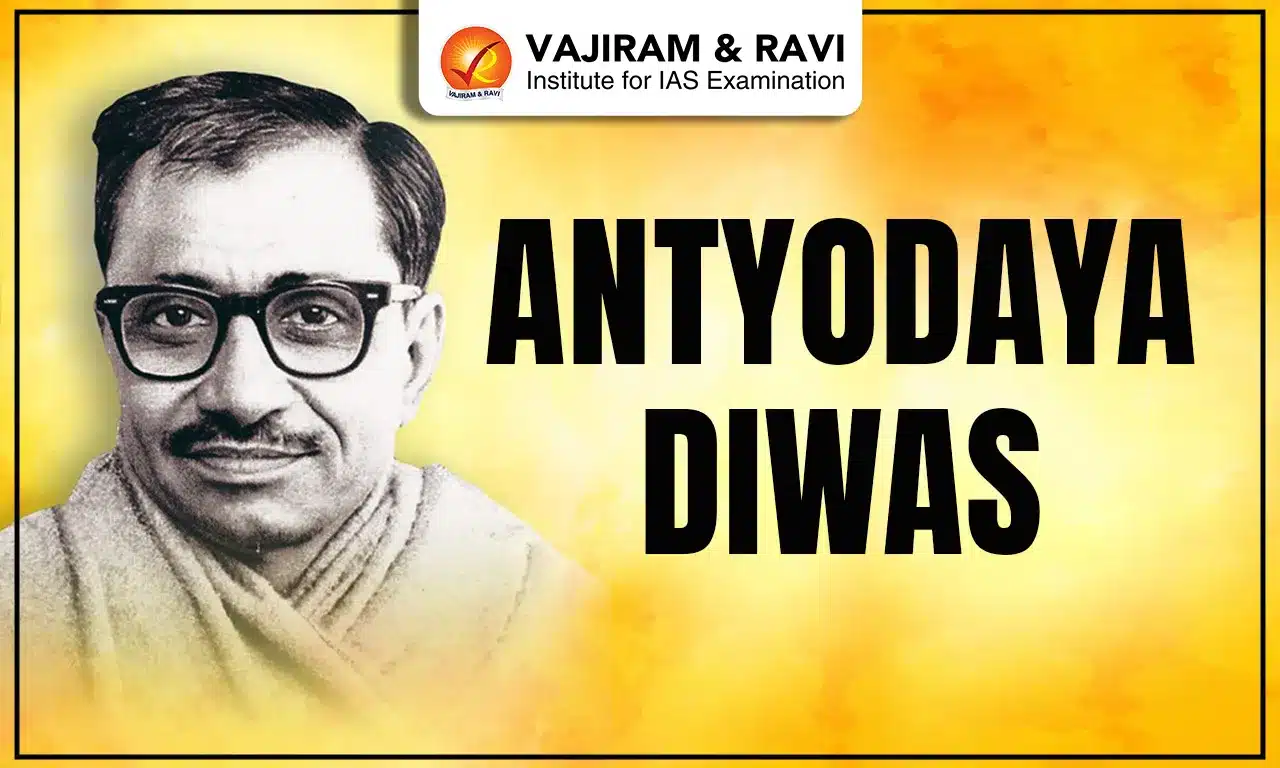
Antyodaya Diwas 2025 is celebrated on 25 September 2025 as a day dedicated to Pandit Deendayal Upadhyaya, a visionary leader who emphasised the progress of the poorest and most marginalised. The term Antyodaya means the rise of the last person, underlining the idea that true development is only achieved when the weakest members of society are uplifted. For the youth today, this day spreads the lessons of compassion, social responsibility and fairness. Antyodaya Diwas reminds Indians to build a nation where inclusivity prevails and no individual is left behind. In this article, we are going to cover Antyodaya Diwas 2025, its history and significance. 

Antyodaya Diwas 2025

Antyodaya Diwas 2025 is observed on 25th September 2025, marking the birth anniversary of Pandit Deendayal Upadhyaya who worked tirelessly for social equality and harmony. Every year, the government of India decides the theme for Antyodaya Diwas, guiding awareness drives and welfare activities. The word Antyodaya comes from two Sanskrit roots: Aunty (poorest or the last) and Udaya (rise). Therefore, Antyodaya Diwas is about empowerment of the weakest sections of society. Pandit Deendayal upadhyaya always believed that the main measure of governance lies in how a state treats its most vulnerable citizens. If the poor, hungry and helpless are uplifted then the society as a whole becomes stronger. Antyodaya Diwas is a reminder to show kindness, share resources and extend support to those who need it the most. 

Antyodaya Diwas 2025 History 

The Antyodaya Diwas 2025 history can be traced back to the life of Pandit Deendayal Upadhyaya, a philosopher thinker and political leader born on September 25, 1916 in Mathura District, Uttar Pradesh. His philosophy of Antyodaya focused on the rise of the poorest and the last man in society. As a respect to his vision, the Government of India declared September 25 as Antyodaya Diwas in 2014. 

Since then, the day has been commemorated annually with programs centered on social justice, equality, and welfare for the weaker sections. The history of this day proves how one leader’s ideology continues to guide future generations towards building a just and equal society.

Pandit Deendayal Upadhyaya Life and Vision

Born in Nagla Chandrabhan, Mathura, in 1916, Pandit Deendayal Upadhyaya’s early life was full of hardships. He lost his father at the age of two and his mother when he was just eight. Despite these struggles, he pursued education with dedication.

He excelled academically, securing a gold medal at Government High School in Sikar, Rajasthan. Later, he graduated from Sanatan Dharma College, Kanpur, and studied political science further.

Deeply rooted in Indian traditions and culture, he joined the Rashtriya Swayamsevak Sangh (RSS) and later played a crucial role in shaping the Bharatiya Jana Sangh, precursor to today’s BJP.His ideology of Integral Humanism stressed balanced development of body, mind, intellect, and soul. According to him, real progress meant ensuring the upliftment of every individual, especially the marginalized. His concept of Antyodaya directly inspired several government welfare schemes. Although he passed away in 1968 at just 51 years of age, his thoughts on equality and welfare still inspire India’s social and economic policies.

Antyodaya Diwas 2025 Importance 

The Antyodaya Diwas 2025 celebration is important due to an important message it spreads that is about inclusive growth. It talks about how development is incomplete until the poorest are uplifted. This includes: 

  • It reminds us that true growth is measured by how the weak are supported.
  • The day spreads awareness about government welfare schemes, including the Antyodaya Anna Yojana and the Deendayal Antyodaya Yojana.
  • These schemes focus on food security, livelihood generation, skills, and self-reliance.
  • The day highlights that development must be people-centric, not wealth-centric.
  • It fosters values of compassion, empathy, and care for the marginalized.
  • By ensuring that no citizen is left behind, Antyodaya Diwas teaches the essence of equitable and just progress.

Antyodaya Yojana

The Antyodaya Anna Yojana was launched in 2000 and was designed to translate Pandit Upadhyaya’s vision into reality. The scheme gives wheat and rice at subsidized prices to Below Poverty Line families. This initiative makes sure that no family goes to bed hungry, giving them affordable access to food grains. The Antyodaya Yojana is a step towards ensuring food security and reflects the principle that the poorest must be prioritized for progress.

Deendayal Antyodaya Yojana

To further expand the idea of Antyodaya, the government introduced the Deendayal Antyodaya Yojana (DAY), covering both rural and urban poor. It focuses not just on food or shelter, but on livelihood opportunities and dignity of life.

  • DAY-NRLM (National Rural Livelihoods Mission): Empowers poor women in villages by forming Self-Help Groups (SHGs), enabling them to save collectively, start micro-businesses, and achieve financial independence.
  • DAY-NULM (National Urban Livelihoods Mission): Targets the urban poor by offering skill training, employment support, and small loans to help them find jobs or set up businesses.

Together, these programs show that Antyodaya is not just about survival, but about creating opportunities for self-reliance.

Antyodaya Diwas 2025 FAQs

Q1: Why is Antyodaya Diwas celebrated?

Ans: Antyodaya Diwas is celebrated to honor Pandit Deendayal Upadhyaya’s vision of uplifting the poorest and most marginalized in society.

Q2: What is the meaning of Antyodaya?

Ans: Antyodaya means the rise of the last person or the upliftment of the poorest in society.

Q3: Whose birth anniversary does the Antyodaya Diwas mark?

Ans: It marks the birth anniversary of Pandit Deendayal Upadhyaya.

Q4: Who was Deen Dayal Upadhyaya?

Ans: Deendayal Upadhyaya was an Indian thinker, philosopher, and political leader who propounded the idea of Integral Humanism and Antyodaya.

Q5: What is DAY-NRLM?

Ans: DAY-NRLM (Deendayal Antyodaya Yojana–National Rural Livelihoods Mission) is a program that empowers rural poor, especially women, by forming self-help groups and providing livelihood support.

Broad Money and Narrow Money, Difference, Definition, Examples

Broad Money and Narrow Money

Broad Money and Narrow Money are two important measures used to understand the money supply in an economy.  Narrow Money helps assess immediate liquidity and daily transactional capacity, board money provides a money comprehensive picture of the total financial resources circulating in the economy, influencing long-term monetary policy, economic growth and financial stability.  In this article, we are going to cover Broad Money and Narrow Money and differences between them. 

Broad Money and Narrow Money 

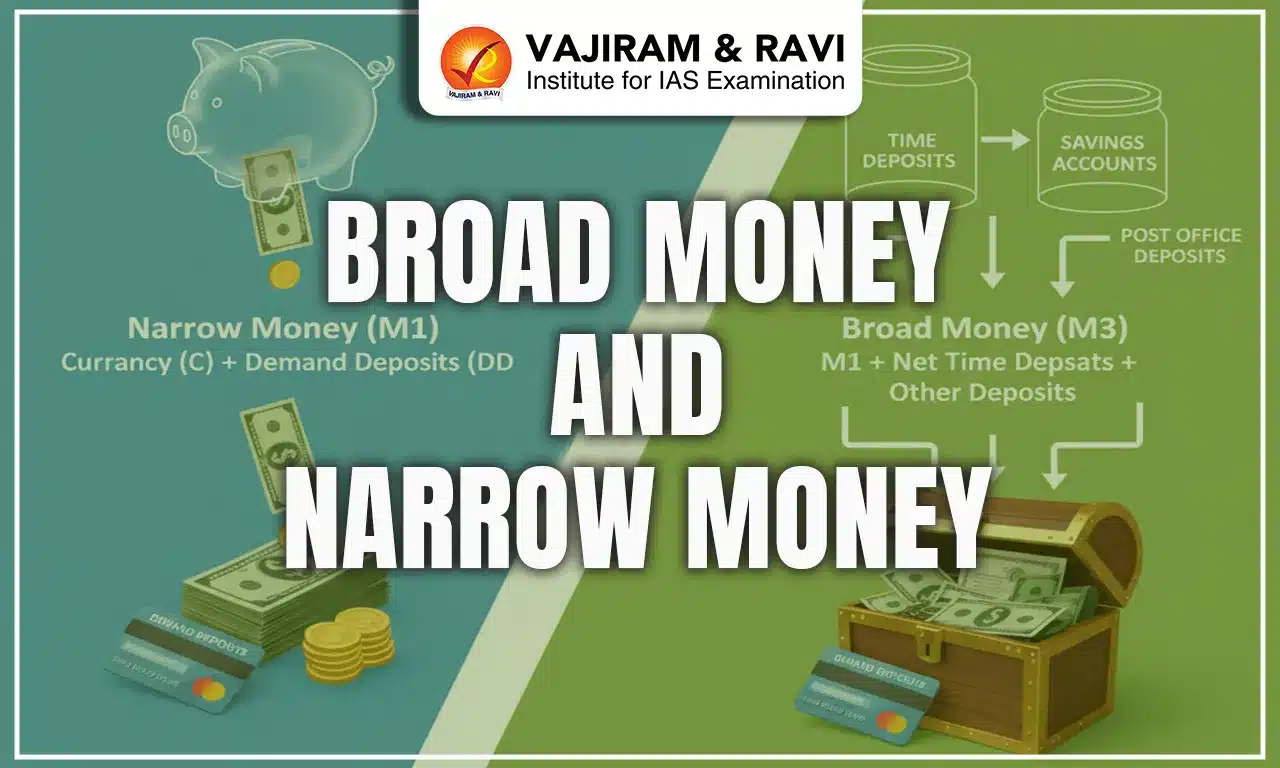
Broad and narrow money are important concepts in economics, representing different layers of money supply within an economy.   Narrow Money also known as M1 is the most liquid form of money that is easily available for immediate transaction, such as physical currency, coins and demand deposits held in banks. It shows the short-term spending power within the economy. On the other hand, Broad Money also known as M3 and M4 money is the one that has less liquid assets like the savings account, fixed deposits and other financial instruments that cannot be used immediately for transactions but contribute to the overall money available in the economy. 

Broad Money and Narrow Money Difference

Broad Money and Narrow Money are different in terms of liquidity. While Narrow Money is highly liquid and readily usable for daily transactions, broad money includes all forms of money, both liquid and semi-liquid reflecting the total value of money accessible to households and businesses. 

Aspect Broad Money Narrow Money

Definition

Encompasses all forms of money, including less liquid assets like savings and term deposits.

Covers the most liquid money, instantly available for spending.

Indicated as

M3 and M4

M1

Liquidity

Lower liquidity compared to narrow money.

High liquidity, immediately usable.

Economic Assessment

Evaluates overall liquidity and stability of the financial system.

Focuses on short-term liquidity and immediate spending ability.

Sensitivity to Changes

Less responsive to short-term shifts in consumer expenditure.

Closely tied to fluctuations in consumer confidence and spending.

Examples

Deposits with maturity up to 2 years, redeemable deposits, repurchase agreements, money market funds, short-term debt securities.

Physical cash, coins, demand deposits, traveler’s checks, and other highly liquid assets.

Narrow Money

Narrow money, often referred to as M1, represents the segment of a nation’s money supply that is instantly available for transactions. It typically consists of physical currency in circulation and demand deposits with banks. Globally, narrow money is considered a vital benchmark for economic activity and is a central component of monetary policy management.

Central banks monitor M1 closely, influencing its supply through tools like interest rate adjustments, reserve requirements, and open market operations.

Narrow Money (M1) Characteristics 

  • Highly liquid and immediately usable for payments.
  • Includes physical cash, coins, and demand deposits in checking accounts.
  • Easily accessible and widely used in day-to-day transactions.
  • Instantly convertible without any loss in value.
  • Limited scope, covering only immediately spendable funds.
  • Serves routine payments, purchases, and withdrawals.
  • Examples: cash in hand, traveler’s checks, and bank demand deposits.

Role of Narrow Money in Economies

  • Liquidity Indicator: Reflects the availability of money for immediate expenditure.
  • Inflation Control: Rising M1 can push inflation; falling M1 can cause deflation.
  • Growth Stimulus: An increase in M1 can fuel demand, encouraging production and growth.
  • Interest Rate Management: Narrow money supply influences interest rates—less M1 raises rates, while more M1 lowers them.

Broad Money

Broad money represents the total supply of money in the economy, combining narrow money (M1) with less liquid forms such as savings deposits, time deposits, and financial instruments. Sometimes termed M2/M3, broad money is a critical measure of a nation’s overall liquidity and the long-term stance of its monetary policy.

Characteristics of Broad Money (M3):

  • Includes both liquid and semi-liquid assets that require time to convert into cash.
  • Covers savings accounts, fixed deposits, and market funds.
  • Less liquid than narrow money; cannot be directly used for payments.
  • Encompasses a much larger share of total money supply.
  • Primarily used for investments, savings, and long-term economic stability.
  • Strongly linked to long-term monetary policy, affecting inflation, interest rates, and credit flow.
  • Examples: fixed deposits, savings accounts, and money market instruments.

Role of Broad Money in Economies:

  • Broad money is vital for assessing the overall financial health of an economy.
  • Central banks regulate its growth to control inflation, stabilize exchange rates, and influence GDP growth.

  • Since it includes less-liquid assets, it impacts investment behavior and capital availability.
  • Economists rely on M3 to study monetary expansion and formulate policies for medium- to long-term stability.
  • For instance, the Reserve Bank of India adjusts interest rates to influence broad money supply, promoting growth when more liquidity is needed or slowing inflation when excess money is circulating.
  • Higher availability of broad money accelerates credit access and boosts growth, while lower supply contracts spending and investment.
  • Thus, monitoring broad money is crucial for balancing inflation control with sustainable economic growth, making it a cornerstone of global financial systems.
Also Check Other Posts
Care Economy Mutual Funds
Alternative Investment Funds GDP Deflator

Broad Money and Narrow Money FAQs

Q1: Is broad money M3 or M4?

Ans: Broad money is commonly represented by M3 (and in some cases, M4 depending on the country).

Q2: What are examples of broad money?

Ans: Examples of broad money include savings accounts, fixed deposits, money market funds, and other less liquid financial assets.

Q3: Which is narrow money, M1 or M2?

Ans: Narrow money is M1, which consists of the most liquid forms of money.

Q4: What is Narrow Money?

Ans: Narrow money refers to the portion of the money supply readily available for transactions, including cash, coins, and demand deposits.

Q5: What is M1 and M2?

Ans: M1 represents narrow money, including cash and demand deposits, while M2 represents broad money, including M1 plus savings deposits, fixed deposits, and other near-money assets.

Difference between Organised and Unorganised Sector

Difference between Organised and Unorganised Sector

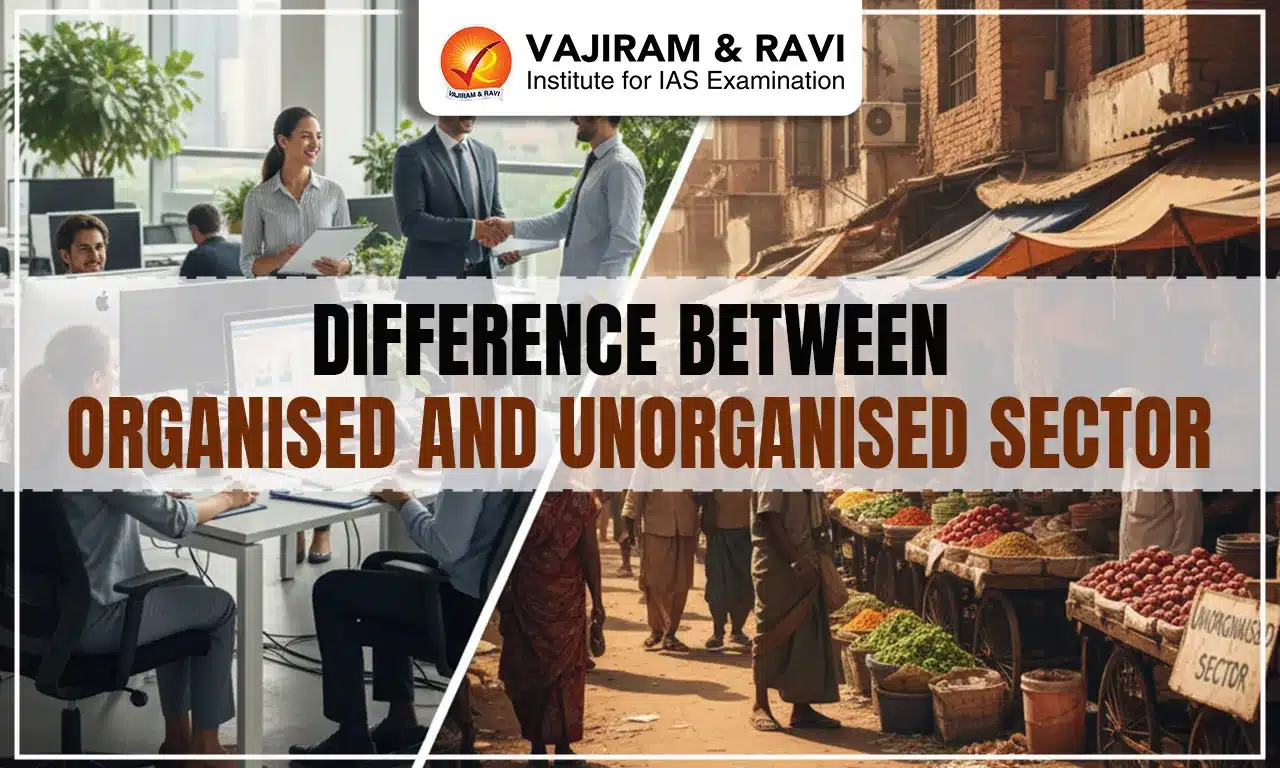
Differences between the Organised and the Unorganised Sector forms an important part of understanding the economy. The organised sector covers enterprises that are officially registered, follow government regulations and comply with labour laws and provide employees with job security, fixed wages and social benefits like provident fund and insurance. In comparison, the unorganised sector consists of smaller, mostly informal businesses that operate with minimal or no regulation. These enterprises usually don't provide formal contracts, legal protection or social security to workers. Employment in this sector is usually unstable, with irregular wages and lack of additional benefits. In this article we are going to cover the differences between the organised and the unorganised sector. 

Differences Between the Organised and the Unorganised Sector

The difference between the organised and the unorganised sector lies in their structure, operations, and the level of security they provide to workers. While the organised sector ensures stability, structured growth, and regulated practices, the unorganised sector, despite its vulnerabilities, plays an important role in employing a large section of the population and sustaining the informal economy.

Aspect Organized Sector Unorganized Sector

Definition

Refers to the formal sector of the economy

Comprises the informal sector of the economy

Registration

Registered and regulated by government authorities

Not officially registered or regulated

Size of Enterprises

Typically larger and well-established companies

Mostly small and micro-sized enterprises

Labor Relations

Follows formal labor contracts and regulations

Informal and flexible labor arrangements

Job Security

Generally higher job security for employees

Low job security, higher vulnerability to job loss

Wages and Benefits

Standardized wages and employee benefits

Wages may be lower, limited or no benefits provided

Working Conditions

More likely to adhere to labor laws and standards

Working conditions may be less regulated and unsafe

Productivity

Generally higher productivity levels

Lower productivity due to limited resources

Technology Adoption

More likely to adopt modern technology

Limited access to advanced technology

Skill Development

Focus on skill enhancement and training programs

Skill development may be limited or on-the-job training

Social Security

Employees entitled to social security benefits

Lack of social security benefits for workers

Unionization

Unionized workforce in many cases

Less unionization and weaker collective bargaining

Formal Records

Maintains formal records and accounting practices

Lack of proper record-keeping

Tax Compliance

Regular tax payment and compliance

Often lacks tax compliance and informal transactions

Market Share

May hold a significant market share

Smaller market share due to informal nature

Economic Impact

Contributes significantly to the formal economy

Plays a vital role in the informal sector of the economy

Government Oversight

Subject to government regulations and oversight

Limited government oversight

Access to Finance

Easier access to formal financial institutions

Limited access to formal financial services

Business Stability

More stable and less susceptible to fluctuations

Vulnerable to economic changes and uncertainties

Employee Benefits

Extensive benefits such as medical, leave, etc.

Limited or no additional benefits for employees

Innovation and Research

May invest in research and innovation activities

Limited scope for research and innovation

Mobility and Advancement

Opportunities for career growth and mobility

Limited opportunities for career advancement

Informal Economy Linkage

Limited engagement with the informal economy

Tends to be closely linked with the informal economy

Compliance with Labor Law

Adheres to labor laws and regulations

May not comply with all labor laws

Formality of Operations

Formal structure and clear business processes

Informal operations with flexible structures

Training Programs

Regular training and skill development initiatives

Minimal or no formal training programs

Market Access

Often has easier access to formal markets

Faces challenges in accessing formal markets

Job Stability

Employees enjoy greater job stability

Frequent job insecurity and turnover

Key Differences Between Organised and Unorganised Sector

The organised and unorganised sectors differ in terms of structure, regulation, and the security they provide to workers.

  • Structure: The organised sector is formally registered, regulated by government authorities, and operates with a well-defined framework. In contrast, the unorganised sector lacks formal registration and operates with minimal regulation.
  • Labour Laws: The organised sector adheres to labour laws, offering formal employment contracts, legal protections, and defined rights to employees. The unorganised sector, however, has limited or no adherence to such laws, leaving workers vulnerable and without legal safeguards.
  • Job Security and Income: Employment in the organised sector ensures greater job security, stable incomes, and better working conditions. In the unorganised sector, job security is uncertain, and income is often irregular and unpredictable.
  • Size and Scale: The organised sector generally comprises large corporations, government institutions, and public-sector undertakings, operating on a large scale. The unorganised sector, by contrast, includes small businesses, casual labour, and self-employed individuals operating on a smaller scale.
  • Social Security Benefits: Workers in the organised sector often receive social security benefits such as pensions, health coverage, and insurance. In the unorganised sector, such provisions are rare or entirely absent.
  • Formality of Employment: Employment in the organised sector is formal, with contracts, defined working hours, and clear employment policies. The unorganised sector functions informally, with no standardised work conditions or contracts.

These differences create disparities in income stability, legal protection, social welfare, and overall working conditions between the two sectors.

Organised Sector in India Examples

The Organised Sector in India covers formal employment, legal regulation and large scale operations. Examples include: 

  • Banking sector jobs
  • Government employees
  • Large manufacturing companies

  • Financial institutions
  • Aviation industry
  • Information Technology (IT) sector

Unorganised Sector in India Examples

The unorganised sector forms a large part of India’s workforce, operating without formal structures or adequate worker protection. Examples include:

  • Street vendors: Operating informally without fixed locations or formal business structures.
  • Small-scale manufacturing units: Informal businesses often unregistered with the government.
  • Domestic workers: Employment such as household cleaning and cooking, largely unregulated.
  • Agriculture: Many farmers operate informally without formal registration or adherence to regulations.
  • Self-employed workers: Carpenters, electricians, plumbers, and similar tradespeople usually work without official registration or regulation.
Also Check Related Articles
Difference between NITI Aayog and Inter-State Council Difference Between Economic Survey and Union Budget
Difference Between Tropical Evergreen and Tropical Deciduous Forests Difference Between Ordinary Bill and Money Bill
Difference Between Legislative and Executive Difference between Himalayan and Peninsular Plateau
Difference Between Vedas and Upanishads Difference Between Scheduled and Non-Scheduled Banks
Difference Between Written and Unwritten Constitution Difference between NITI Aayog and Planning Commission
Difference between Colonialism and Imperialism Difference between Fundamental Rights and Directive Principles of State Policy
Difference between Procedure Established by Law and Due Process of Law Difference Between Democracy and Republic
Difference between Creamy Layer and Non-Creamy Layer of OBC Difference between Rajya Sabha and Vidhan Sabha
Difference Between Western Ghats and Eastern Ghats

Difference between Organised and Unorganised Sector FAQs

Q1: What is the difference between Organised and Unorganised sectors?

Ans: The organised sector is regulated, registered, and offers job security with benefits, while the unorganised sector operates informally with little regulation and lacks worker protections.

Q2: What is the organised sector?

Ans: The organised sector refers to formally registered enterprises that follow government regulations, provide contracts, job security, and social security benefits.

Q3: What are examples of organised sector?

Ans: Examples include banks, government jobs, IT companies, aviation, finance institutions, and large manufacturing firms.

Q4: What is the unorganised sector?

Ans: The unorganised sector includes small, informal enterprises and self-employed workers that operate without registration, contracts, or formal worker benefits.

Q5: What are examples of unorganised sector?

Ans: Examples include street vendors, small-scale manufacturing, domestic work, agriculture, carpenters, plumbers, and other self-employed workers.

Mid-Oceanic Ridges, Formation, Types, Global Distribution, Impact

Mid-Oceanic Ridges

Mid-Oceanic Ridges are important for the study of plate tectonics and ocean relief. They mark divergent boundaries, where new ocean floors are continuously created. The ridges rise to heights of 2,500 metres, some breaching the ocean surface as volcanic islands. Seafloor spreading rates vary globally, from as little as 1 cm per year to as much as 20 cm per year, influencing oceanic geography and even global climate patterns. In this article, we are going to cover Mid-Oceanic Ridges, its formation, types and major distributions. 

Mid-Oceanic Ridges

Plate tectonics has created one of the most striking underwater features of our planet that is the Mid-Oceanic Ridge. This global submarine mountain system is composed of two parallel chains separated by a deep central depression. Some peaks rise nearly 2,500 metres from the ocean floor, and in certain locations, even emerge above the sea surface to form islands.

Explorations of the ocean floor have shown extraordinary geological structures and processes linked to these ridges. Most underwater earthquakes, some capable of triggering tsunamis, occur along plate boundaries in these regions. Modern seafloor mapping has improved our understanding of tectonic activity, ocean relief features, and the dynamic processes shaping Earth’s crust. 

Mid-Oceanic Ridges Formation

Mid-Oceanic Ridges represent some of the most distinctive structures on Earth’s surface. Located predominantly in the middle of ocean basins, these ridges coincide with divergent plate boundaries, where tectonic plates move apart.

According to the Theory of Plate Tectonics, convection currents in the mantle drive this movement, leading to the upwelling of magma that solidifies to form a new oceanic crust. This process, called seafloor spreading, is continuous and has been central to reshaping Earth’s geology over millions of years. The birth of ridges, growth of ocean basins, and recycling of crust are ongoing processes that define the dynamic nature of our planet.

Mid-Indian Ridge

The Mid-Indian Ridge is an important section of the global mid-ocean ridge system. Spreading northwards from the South Atlantic Ocean, it continues into the Indian Ocean and eventually reaches near Rodrigues Island, where it splits into two branches:

  • One branch runs northward toward the Gulf of Aden, linking with the East African Rift System.
  • The other moves southeast toward the Macquarie Islands.
  • An important feature of this system is the Carlsberg Ridge, lying in between the Gulf of Aden and Rodrigues Island. This ridge is seismically active, marked by frequent earthquakes due to its association with tectonic fault zones.

Mid-Ocean Ridges Types

The morphology of mid-ocean ridges varies depending on their spreading rates, volcanic activity, and tectonic faulting. Mid- Oceanic Ridges are of two types:

1. Fast-Spreading Mid-Ocean Ridges

    • Found at locations such as the East Pacific Rise, these ridges spread at rapid rates.
    • High magma supply makes them geologically “hot,” resulting in frequent volcanic eruptions.
    • The crust at the ridge crest is ductile, responding to tension much like hot taffy being stretched.

2. Slow-Spreading Mid-Ocean Ridges

      • Seen at ridges like the Mid-Atlantic Ridge, where spreading occurs at slower rates.
      • The crust behaves more rigidly, fracturing into ridges and valleys, resembling cold chocolate breaking apart.
      • These ridges display rugged topography with deep rift valleys.

Mid-Ocean Ridges Principal Characteristics

Mid-Oceanic Ridges are not only visually beautiful but also geologically important. These characteristics include: 

  • Formation of new crust: At ridge crests, fresh basaltic lava emerges, creating new oceanic crust, which later gets buried under sediments.
  • Heat flow: Ridges show abnormally high geothermal activity compared to other regions, indicating mantle upwelling.
  • Seismicity: Frequent earthquakes and transform faults reveal the tension and fracturing in the crust.
  • Depth-age relationship: As the newly formed crust moves away from the ridge, it cools and sinks deeper. Oceanic crust reaches depths of 5–5.5 km after about 70–80 million years.
  • Width and spreading rate: Fast-spreading ridges such as the East Pacific Rise are wider and smoother, while slow-spreading ridges like the Mid-Atlantic Ridge are narrow with rougher topography.
  • Global sea-level connection: Variations in spreading rates influence ocean basin depths, indirectly affecting continental sea levels.

Mid-Ocean Ridges Major Distribution

Mid-ocean ridges are present in all ocean basins. The Mid-Oceanic Ridges are distributed in the following types:

Atlantic Ocean

  • The Mid-Atlantic Ridge runs from Iceland to about 60° S latitude in the South Atlantic.
  • Initially identified in the mid-19th century, it was later mapped in detail during the 20th century by oceanographers Bruce Heezen and Maurice Ewing.
  • The ridge crest displays axial highs at fast-spreading sections.
  • Slow-spreading flanks are rugged and faulted, whereas fast-spreading sections are smoother.
  • Iceland’s unique geology results from its position above both a spreading ridge and a mantle hotspot.

Indian Ocean

  • The Southwest Indian Ridge, located between Africa and Antarctica, is among the slowest-spreading ridges.
  • The Carlsberg Ridge, at the northern end of the Mid-Indian Ridge, connects to spreading centres in the Gulf of Aden and the Red Sea.
  • The Southeast Indian Ridge, spreading at moderate rates, runs between Australia and Antarctica.
  • Asymmetric seafloor spreading near Australia shows unequal spreading rates over the last 50-60 million years.
  • Topography varies from rugged, rifted crests in the Southwest Indian Ridge to smoother forms in the Southeast Indian Ridge.

Pacific Ocean

  • The Pacific-Antarctic Ridge extends northeastward before merging with the East Pacific Rise.
  • The East Pacific Rise is the fastest-spreading ridge on Earth, with rates exceeding 150 mm per year off South America.
  • Instead of a deep rift valley, this ridge has a low topographic rise, reflecting intense volcanic activity.
  • Oceanographic studies in the 20th century showed overlapping spreading centres due to interruptions in magma supply.
  • More spreading centres occur near the Galapagos Islands, Woodlark Basin, Fiji Plateau, and Scotia Sea.

Spreading Centre Zones and Discoveries

Since the 1970s, detailed surveys of spreading centres using sonar, photography, and submersibles have provided new insights. Key discoveries include:

  • Hydrothermal vents: Also called “black smokers,” these mineral-rich vents occur where seawater interacts with hot magma beneath ridges.

Unique ecosystems: Entire biological communities thrive around hydrothermal vents, independent of sunlight, relying on chemosynthesis.
These findings have transformed our understanding of seafloor geology and life in extreme environments.

Also Check Other Posts
Geomorphology Major Dams in India
Composition and Structure of Atmosphere Major Ports in India
Types of Forests in India Coastal States of India
Ocean Acidification Migration in India
Deep Ocean Mission Natural Vegetation of India

Mid Oceanic Ridges FAQs

Q1: What is the mid-ocean ridge?

Ans: A mid-ocean ridge is an underwater mountain range formed at divergent plate boundaries where new oceanic crust is created.

Q2: What is a mid-Indian ridge?

Ans: The Mid-Indian Ridge is a submarine ridge in the Indian Ocean, part of the global mid-ocean ridge system, linked to the Mid-Atlantic Ridge.

Q3: How are Mid-Oceanic ridges formed?

Ans: Mid-oceanic ridges are formed by tectonic plates diverging, where magma rises and solidifies to create a new oceanic crust.

Q4: What are the types of Mid-Oceanic Ridges?

Ans: They are classified into fast-spreading ridges and slow-spreading ridges based on their spreading rates and morphology.

Q5: How are plate tectonics created?

Ans: Plate tectonics are created by convection currents in the Earth’s mantle that drive the movement of lithospheric plates.

National Development Council, Establishment, Objectives, Functions

National Development Council

The National Development Council (NDC), also called Rashtriya Vikas Parishad, is the apex body for decision-making and deliberation on matters related to development in India. It is chaired by the Prime Minister of India, with Chief Ministers of all states, administrators of Union Territories, and members of the Planning Commission (now replaced by NITI Aayog) as its participants.

Established on 6 August 1952, the NDC was created to strengthen and mobilize national efforts and resources in support of the Five-Year Plans. Its primary aim was to ensure balanced and rapid development across all regions of the country by promoting coordinated economic policies and resolving inter-state or center-state developmental issues.

National Development Council Establishment

The National Development Council (NDC) occupies an important place in India’s planning system. It embodies a federal approach to planning, bringing together the Union government, state governments, and other stakeholders to shape a comprehensive national perspective. Over the years, the role and influence of the NDC have fluctuated depending on the political climate, the priorities of the central government, and the assertiveness of the states.

Despite these ups and downs, the NDC has consistently remained a part of India’s apex policy framework for over six decades. The idea of such a coordinating body was first suggested by the Planning Advisory Board (1946) under the chairmanship of K.C. Neogi. Although the proposal could not be implemented before independence, its importance was well recognized.

The Draft First Five Year Plan prepared by the Planning Commission highlighted the need for a forum like the NDC. Given India’s vast size and the federal structure granting autonomy to the states, it was considered essential to create a body where the Prime Minister and Chief Ministers could periodically review, evaluate, and coordinate planning efforts.

Based on this rationale, the National Development Council was formally established in August 1952 through a resolution of the Cabinet Secretariat of the Government of India. Since then, it has served as a platform for fostering cooperation between the Centre and the states in matters of national development.

National Development Council Objectives

As an advisory body to the Planning Commission, the NDC was set up with the following objectives:

  • Mobilization of resources - To channelize and consolidate the nation’s collective effort and resources for the successful implementation of development plans.
  • Policy coordination - To encourage the adoption of uniform economic policies across crucial sectors, ensuring harmony between the Centre and the states.
  • Balanced development - To promote equitable and rapid growth across all regions of the country, reducing inter-state and regional disparities.
  • Platform for states - To provide states with a forum to voice their developmental needs and concerns and to seek support for their priorities.
  • Cooperation and collaboration - To strengthen Centre–state and inter-state cooperation in planning and execution of national development programmes.

National Development Council Functions

  • Guideline Prescription - Sets the broad guidelines for the formulation of the National Plan and assesses the resources needed for its execution.
  • Plan Consideration - Reviews the draft National Plan, taking into account key social and economic policy issues that influence development.
  • Plan Review & Recommendation - Periodically evaluates the progress of the Plan, recommending measures to meet targets, improve administration, ensure public participation, and promote balanced regional growth.
  • Advisory Role - Advises both the Central and State Governments, functioning as a high-level consultative body on development policy.
  • Problem Solving - Discusses major challenges beyond the Five Year Plans, including issues like food security, land reforms, and institutional measures such as the creation of the State Trading Corporation.
  • Coordination & Exchange - Serves as a bridge between the Union Government, Planning Commission, and State Governments, enabling policy coordination and free exchange of views.
  • Responsibility Sharing - Provides a platform for shared responsibility between the Centre and States in the planning process.
  • Composition - Chaired by the Prime Minister, it includes Union Cabinet Ministers, Chief Ministers of all States, Chief Ministers/Administrators of Union Territories, and members of the Planning Commission.
  • Consensus Decision-Making - Decisions are made through consensus; while no formal resolutions are passed, records of discussions are maintained, and even dissenting opinions are taken into account.

National Development Council Compositions

The National Development Council is a broad-based body that brings together representatives from both the Union and State governments. Its composition ensures inclusivity and cooperative federalism in the process of national planning. The members include:

  • Prime Minister of India: Serves as the Chairperson of the NDC.
  • Union Cabinet Ministers: All Cabinet Ministers are ex-officio members.
  • Chief Ministers of States: Every State is represented through its Chief Minister or a nominated substitute.
  • Representatives of Union Territories: Heads or nominated representatives of Union Territories are also members.
  • Members of NITI Aayog (earlier Planning Commission): These members contribute to policy formulation and planning.

The Secretary of the Planning Commission functions as the Secretary of the NDC, while the Planning Commission/NITI Aayog provides administrative and technical support.

To improve its efficiency, a Standing Committee was created in November 1954. This smaller body included nine Chief Ministers and select Union Ministers, allowing more focused deliberations.

Additionally, the NDC could invite experts such as the Governor of the Reserve Bank of India to its sessions. It also had the power to constitute committees for in-depth examination of specific issues, ensuring a more effective planning process.

National Development Council New Role

With the establishment of NITI Aayog in 2015, the Planning Commission was abolished, and the National Development Council (NDC) was restructured into the Governing Council of NITI Aayog. In this new form, it continues to act as a crucial platform for cooperative federalism in India.

The Governing Council brings together the Prime Minister, Chief Ministers of all States, heads of Union Territories, and other senior officials to deliberate on issues of national importance.

  • Identifying Policy Priorities: Setting long-term goals and strategies for national development.
  • Review and Monitoring: Assessing the progress of ongoing schemes and flagship programs.
  • Guidance and Recommendations: Advising on major policy issues and development challenges.
  • Implementation Oversight: Ensuring that central and state governments work in sync for effective execution of initiatives.

This transformation has strengthened the federal structure, promoting closer collaboration between the Centre and States. It has also introduced a more inclusive and participatory approach to planning, where states have a direct voice in shaping development strategies.

Also Check Other Posts
Care Economy Mutual Funds
Alternative Investment Funds - AIF GDP Deflator

National Development Council FAQs

Q1: Who established the National Development Council?

Ans: The National Development Council (NDC) was established in 1952 by a Government of India resolution to strengthen planning and ensure cooperation between Centre and States.

Q2: Is NDC merged with Niti Aayog?

Ans: Yes, the NDC was dissolved in 2015 and its functions were transferred to NITI Aayog, which replaced the Planning Commission as India’s policy think tank.

Q3: What do you mean by National Development Council?

Ans: The NDC was a policy-making body chaired by the Prime Minister, including Union Ministers, Chief Ministers, and Governors, to approve and review Five-Year Plans.

Q4: Is NDC a constitutional body?

Ans: No, the NDC was neither a constitutional nor statutory body. It was an executive body created by a Government of India resolution in 1952.

Q5: Where is the headquarter of NDC?

Ans: The headquarters of the NDC was located in New Delhi, functioning under the Planning Commission until it was dissolved in 2015 and replaced by NITI Aayog.

Daily Editorial Analysis 24 September 2025

Daily Editorial Analysis

Getting GST 2.0 to Run Like a Well-Oiled Machine  

Context

  • The clearance of GST 2.0 reforms by the Goods and Services Tax (GST) Council at its 56th meeting on September 3, 2025, marks a transformative moment in India’s indirect tax framework.
  • The reform is not merely a technical restructuring of tax slabs but a sweeping simplification that directly impacts consumers, micro, small, and medium enterprises (MSMEs), industry, and the broader economy.
  • Its implications stretch from easing compliance burdens to moderating inflation and boosting consumption, making it one of the most significant fiscal interventions since the GST’s inception in 2017.

The Road to Reform and Simplification of Tax Slabs

  • The Road to Reform

    • The Confederation of Indian Industry (CII) played a pivotal role in advocating for change.
    • Since December 2024, it has consistently highlighted the inefficiencies of the old system, cumbersome compliance requirements, inverted duty structures, and classification disputes.
    • MSMEs, in particular, bore the brunt of these challenges, often struggling with high tax burdens on essential goods and procedural bottlenecks.
    • The reforms announced in September 2025 represent the fruition of years of policy advocacy, industry engagement, and economic analysis, including repeated recommendations from the Economic Survey.
  • Simplification of Tax Slabs

    • At the heart of GST 2.0 lies a fundamental restructuring of tax rates.
    • The previous four-tier system (5%, 12%, 18%, and 28%) has been collapsed into three simplified slabs: 5% for essentials, 18% as the standard rate, and 40% for luxury and sin goods.
    • This move not only reduces confusion and litigation but also directly benefits consumers.
    • The finance minister emphasized that 99% of goods and services will now fall under zero, 5%, or 18%, a shift that translates into tangible savings for households, particularly middle- and lower-income families.
    • The decision to move several daily-use goods, household items, toiletries, and small appliances, into lower tax brackets represents a deliberate attempt to ease the cost-of-living burden and curb inflationary pressures.
    • By simplifying classification and reducing rates, the reform enhances predictability and fairness in the tax system.

Gains for Industry and MSMEs

  • While consumers gain from lower prices, industries, especially MSMEs, stand to benefit structurally.
  • The new regime reduces input costs, minimises litigation, and lightens compliance burdens.
  • Sectors such as fast-moving consumer goods (FMCG), textiles, cement, farm equipment, and small vehicles, which were previously hampered by higher rates or inverted duty structures, are expected to experience significant relief.
  • The CII has already signalled industry’s commitment to ensuring that savings are passed on to consumers, with many companies planning benefits beyond the mandated tax cuts.
  • Simultaneously, the organisation is working with authorities on labelling, packaging, and inventory transition to ensure smooth implementation.
  • Capacity-building programs and awareness campaigns, particularly targeted at MSMEs, are central to this transition.

Broader Economic Implications

  • Reduced costs for households will spur demand, especially in rural and semi-urban areas where price sensitivity is high.
  • Analysts estimate that the reforms could add over one percentage point to GDP growth, largely through heightened consumption and improved business confidence.
  • Inflation moderation, particularly in essential commodities, will provide additional relief to households.
  • For the government, however, the reforms entail short-term revenue sacrifices running into tens of thousands of crores.
  • Yet, these costs may be offset in the medium term by increased consumption, greater formalisation, improved compliance, and fiscal buoyancy.
  • The reform thus reflects a strategic trade-off between immediate fiscal pressures and long-term economic gains.

The Challenges Ahead

  • Despite its promise, GST 2.0’s success hinges on effective implementation.
  • Ensuring that tax cuts are passed on to consumers, rather than absorbed upstream, will require vigilance.
  • Administrative readiness across the Goods and Services Tax Network (GSTN), State revenue departments, and metrology and labelling authorities will be crucial.
  • For MSMEs, which often lack sophisticated legal or accounting support, targeted assistance and simplified guidance are essential.
  • Feedback mechanisms must also be strengthened to address transitional challenges, classification disputes, handling of old stock, and packaging adjustments.
  • The reform must remain dynamic, capable of fine-tuning based on the lived experiences of businesses and consumers alike.

Conclusion

  • GST 2.0 represents a defining moment in India’s economic reform journey.
  • By simplifying tax structures, easing compliance, and lowering the burden on households, it strengthens the trust between government, industry, and consumers.
  • While challenges of execution remain, the collaborative approach signalled by both the government and industry offers a strong foundation for success.

Getting GST 2.0 to Run Like a Well-Oiled Machine FAQs

Q1. What is the central change introduced by GST 2.0?
Ans. GST 2.0 simplifies the tax structure by collapsing four slabs into three: 5% for essentials, 18% standard, and 40% for luxury and sin goods.

Q2. How will consumers benefit from GST 2.0?
Ans. Consumers will pay lower taxes on many daily-use goods, leading to direct savings and moderation of inflation.

Q3. Why are the reforms especially significant for MSMEs?
Ans. MSMEs will face reduced input costs, fewer compliance burdens, and less litigation, improving their margins and ease of doing business.

Q4. What broader economic impact is expected from the reforms?
Ans. The reforms are likely to boost consumption, especially in rural and semi-urban areas, and may add over one percentage point to GDP growth.

Q5. What is the key challenge for ensuring the success of GST 2.0?
Ans. Effective implementation is crucial, particularly ensuring that tax cuts reach consumers and that MSMEs receive adequate support during the transition.

Source: The Hindu


Lessons From India’s Vaccination Drive 

Context

  • Vaccination is widely regarded as one of the most effective, cost-efficient, and sustainable public health measures, responsible for saving millions of lives worldwide.
  • India, home to one-sixth of the global population, operates the world’s largest immunisation programme, reaching both infants and pregnant women on an unprecedented scale.
  • Over the past decade, the country has made remarkable progress in improving immunisation coverage, introducing new vaccines, and integrating digital innovations into public health infrastructure.
  • However, despite these successes, challenges such as vaccine hesitancy, disruptions from the COVID-19 pandemic, and gaps in last-mile delivery persist.

Expanding Coverage and Impact

  • The Universal Immunisation Programme (UIP) has been the backbone of India’s vaccine strategy.
  • Each year, it provides free immunisation to approximately 2.6 crore infants and 2.9 crore pregnant women, helping to reduce the under-five mortality rate from 45 per 1,000 live births in 2014 to 31 in 2021.
  • The UIP protects against 12 diseases, including polio, measles, rubella, and tetanus, and has expanded in recent years to include vaccines for rotavirus, pneumococcal disease, and Japanese encephalitis.
  • Recognising gaps in coverage, India launched Mission Indradhanush (MI) in 2014 with the ambitious goal of reaching 90% full immunisation.
  • Its intensified phases (IMI) targeted underserved populations, including remote, migratory, and hesitant communities.
  • By 2023, these campaigns had successfully vaccinated over 5.46 crore children and 1.32 crore pregnant women.
  • Their integration with initiatives such as Gram Swaraj Abhiyan demonstrated how immunisation could be woven into broader community development agendas.

Achievements and Global Recognition

  • India’s vaccination efforts have produced several historic milestones.
  • The country has maintained polio-free status since 2011, eliminated maternal and neonatal tetanus by 2015, and was declared Yaws-free in 2016.
  • The nationwide Measles-Rubella campaign between 2017 and 2019 vaccinated nearly 35 crore children, making it one of the largest catch-up campaigns ever conducted.
  • The COVID-19 pandemic tested India’s resilience, but also highlighted its capacity.
  • The COVID-19 vaccination programme, launched in January 2021, rapidly scaled to deliver more than 220 crore doses by January 2023, covering nearly the entire eligible population.
  • This achievement underscored India’s manufacturing strength and innovation, bolstered by domestic vaccine development and global solidarity initiatives like Vaccine Maitri, which supplied doses to low- and middle-income countries.
  • In recognition of these efforts, India received the Measles and Rubella Champion Award in 2024, reflecting its global leadership in immunisation.

Persistent Challenges

  • Despite progress, several obstacles hinder universal coverage. Hard-to-reach geographies, migratory populations, and low-awareness clusters remain under-served.
  • Moreover, vaccine hesitancy, often fuelled by misinformation, creates pockets of vulnerability.
  • The COVID-19 pandemic also disrupted routine services, contributing to measles outbreaks between 2022 and 2024, exposing immunity gaps.
  • Addressing these challenges requires innovative strategies such as zero-dose outreach, strengthened community engagement, and the monitoring of anti-vaccine narratives.

The Way Forward

  • Technology and System Strengthening

    • A defining feature of India’s immunisation strategy has been the integration of digital platforms and logistics systems.
    • Building on the success of Co-WIN, the government launched U-WIN, a platform for end-to-end digital vaccination management, ensuring seamless record-keeping for children and pregnant women.
    • Supporting systems such as the electronic Vaccine Intelligence Network (eVIN) and the National Cold Chain Management Information System help track stocks and monitor cold chains in real-time, while the SAFE-VAC module ensures vaccine safety reporting.
    • These advances not only streamline operations but also extend coverage to migratory populations and underserved regions, making immunisation more inclusive and efficient.
  • Towards a One-Health Future

    • Looking ahead, India’s immunisation programme must be closely integrated with disease surveillance and pandemic preparedness.
    • The experience of COVID-19 and recent measles outbreaks has underscored the importance of adopting a One-Health approach, linking human, animal, and environmental surveillance systems.
    • By aligning immunisation with broader health security frameworks, India can both safeguard its population and contribute to global epidemic preparedness.

Conclusion

  • India’s immunisation journey reflects an extraordinary combination of political commitment, technological innovation, and global solidarity.
  • From eliminating polio and tetanus to rolling out the world’s largest COVID-19 vaccination drive, the country has set benchmarks for others to follow.
  • Yet, to sustain and expand these gains, India must tackle persistent gaps in awareness, last-mile delivery, and vaccine hesitancy, while embedding immunisation efforts into a broader One-Health paradigm.
  • As the world’s largest vaccine producer and a leader in public health, India’s path forward will not only determine its own population’s health outcomes but also influence the global vaccine landscape.

Lessons From India’s Vaccination Drive FAQs 

Q1. What is the Universal Immunisation Programme (UIP) in India?
Ans. The Universal Immunisation Programme is the world’s largest vaccination initiative, providing free immunisation against 12 diseases to millions of infants and pregnant women every year.

Q2. What was the main goal of Mission Indradhanush launched in 2014?
Ans. Mission Indradhanush aimed to increase full immunisation coverage in India to 90% by targeting low-coverage and underserved populations.

Q3. Which major diseases has India successfully eliminated through vaccination?
Ans. India has eliminated polio, maternal and neonatal tetanus, and Yaws through strong vaccination efforts.

Q4. How did digital technology strengthen India’s vaccination system?
Ans. Digital platforms like Co-WIN, U-WIN, and eVIN improved record-keeping, vaccine stock tracking, cold chain monitoring, and outreach to migratory populations.

Q5. Why is the One-Health approach important for future immunisation efforts?
Ans. The One-Health approach is important because it links human, animal, and environmental disease surveillance, making immunisation more effective for pandemic preparedness.

Source: The Hindu

Daily Editorial Analysis 24 September 2025 FAQs

Q1: What is editorial analysis?

Ans: Editorial analysis is the critical examination and interpretation of newspaper editorials to extract key insights, arguments, and perspectives relevant to UPSC preparation.

Q2: What is an editorial analyst?

Ans: An editorial analyst is someone who studies and breaks down editorials to highlight their relevance, structure, and usefulness for competitive exams like the UPSC.

Q3: What is an editorial for UPSC?

Ans: For UPSC, an editorial refers to opinion-based articles in reputed newspapers that provide analysis on current affairs, governance, policy, and socio-economic issues.

Q4: What are the sources of UPSC Editorial Analysis?

Ans: Key sources include editorials from The Hindu and Indian Express.

Q5: Can Editorial Analysis help in Mains Answer Writing?

Ans: Yes, editorial analysis enhances content quality, analytical depth, and structure in Mains answer writing.

Direct Broadcast Network

Direct Broadcast Network

Direct Broadcast Network Latest News

Recently, the National Centre for Medium Range Weather Forecasting (NCMRWF) signed a Memorandum of Understanding (MoU) with New Space India Limited (NSIL) to establish two Direct Broadcast Network (DBNet) stations in Delhi/NCR and Chennai. 

About Direct Broadcast Network

  • The DBNet is a global operational framework designed for the real-time acquisition of satellite data from Low Earth Orbit (LEO) satellites.
  • It plays a critical role in Numerical Weather Prediction (NWP) and supports a wide range of applications, including weather forecasting, cyclone monitoring, and climate research.
  • DBNet stations ensure rapid data availability, hence significantly improving the accuracy and timeliness of weather forecasts and related services.
  • The proposed DBNet stations will be capable of receiving direct broadcast data from various existing Indian and international Earth Observing System (EOS) satellites, including Oceansat, NOAA, and MetOp.
  • Key Benefits:
    • Timeliness for NWP: It provides the near real-time availability of LEO satellite data, which is essential for generating high-resolution, short- to medium-range weather forecasts.
    • Reduced Data Latency: DBNet captures data directly as satellites pass overhead, overcoming latency issues and enabling faster data delivery.
    • Rapid Processing: NCMRWF will complete the full data processing chain within 5 minutes of a satellite overpass, ensuring timely ingestion of these datasets into MoES’s NWP models for across-scale forecasting.

Source: PIB

Direct Broadcast Network FAQs

Q1: What is a broadcast network?

Ans: A Broadcast Network is a type of network where a machine can send data to all other machines within the network simultaneously.

Q2: Which organization is responsible for coordinating the DBNet?

Ans: World Meteorological Organization (WMO)

Communication Security Certification Scheme

Communication Security Certification Scheme

Communication Security Certification Scheme Latest News

Recently, the National Centre for Communication Security (NCCS) has designated M/s Compliance International Pvt. Ltd., Noida as a Telecom Security Testing Laboratory (TSTL) for testing IP Routers under the Communication Security Certification (ComSec) Scheme.

About Communication Security Certification Scheme

  • It is applicable for Security Certification of all telecommunication equipment for which Mandatory Testing and Certification of Telecom Equipment (MTCTE) applies.
  • This scheme falls under broader ‘Mandatory Testing and Certification of Telecom Equipment (MTCTE)’, rules notified in September 2017.
    • These rules have now been superseded by Telecommunications (Framework to Notify Standards, Conformity Assessment and Certification) Rules, 2025.
  • It mandates every OEM/importer/dealer who wishes to sell, import or use any telecom equipment in India, shall have to get their equipment security tested and certified under this scheme.
  • It is also applicable to such other Telecom Equipment, Hardware, Software or System as notified by the Government.
  • Implementing agency: National Centre for Communication Security (NCCS). 
  • Scheme mainly comprises of three major activities
    • Development of country specific Security assurance standards called Indian Telecom Security Assurance Requirements (ITSAR) for every Telecom equipment.
    • Designation of third-party Telecom Security Test Laboratories (TSTL) meeting the specified requirements.
    • The Designated TSTLs will be responsible for carrying out the security testing of telecom equipment as per ITSAR’s requirements
    • Evaluation and Certification of the telecom equipment against ITSAR by NCCS.

Source: PIB

Communication Security Certification Scheme FAQs

Q1: Which organization is responsible for implementing the Communication Security Certification Scheme?

Ans: National Security Council Secretariat

Q2: What is telecom security?

Ans: It is a field of cybersecurity focused on protecting telecommunications infrastructure, data, and communications from unauthorized access, attack or damage.

Subansiri River

Subansiri River

Subansiri River Latest News

An expert panel of the Union Environment Ministry has recommended environmental clearance for the 2,220 MW Oju hydroelectric project proposed on the Subansiri river in Taksing near the China border. 

About Subansiri River

  • It is a Trans-Himalayan river originating from the western part of Mount Porom (5059 m) in the Tibetan Himalaya. (Kangig glacier range in Tibet)
  • It is also called the Gold River, the Subansiri River is famous for its gold dust.
  •  It enters into the plains of Assam through a gorge near Gerukamukh. 
  • It is the right-bank tributary of the Brahmaputra. It joins the Brahmaputra River in the Lakhimpur district of Assam.
  • Tributaries: Major tributaries of the river are Laro, Nye, Yume, Tsari, Kamla, Jiyadhol, Ranganadi and Dikrong.
  • Course:
    • It originates from the Himalayas in China and flows towards the east and southeast into India.
    • It flows through Assam, Arunachal Pradesh, and the Tibet Autonomous Region of China.

Key Facts about Oju Hydroelectric Project

  • It is proposed on the Subansiri river in Upper Subansiri district, Assam.
  • It will be developed by Oju Subansiri Hydro Power Corporation Pvt Ltd.
  • The main power plant will have a capacity of 2,100 MW while the dam-toe plant will have a capacity of 120MW. 

Source: IE

Subansiri River FAQs

Q1: What does the Subansiri River originates?

Ans: Himalayas

Q2: Is Subansiri an antecedent river?

Ans: Yes, it is an antecedent river.

SPARSH Pension System

SPARSH Pension System

SPARSH Pension System Latest News

Recently, System for Pension Administration – Raksha (SPARSH) has resolved legacy discrepancies—upto the extent of 5.60 lakh out of 6.43 lakh cases (87%).

About SPARSH Pension System

  • It is an initiative of the Ministry of Defence, Government of India.
  • SPARSH is world’s largest pension system for defence personnel which aims to provide comprehensive solution to the defence pensioners
  • Objective: Meeting the pension sanction and disbursement requirements for Armed Forces viz. Army, Navy, Air Force and Defence Civilians.
  • It is administered by the Defence Accounts Department through the Principal Controller of Defence Accounts (Pensions), Prayagraj and shall cater to all the three Services and allied organisations.

Features of SPARSH Pension System

  • Without relying on a third-party intermediary, this web-based system handles pension claims, and deposits pension payments into the bank accounts of defence pensioners.
  • It is a centralized sanction, claim and pension disbursement system with easy validation and rectification of data through self-verification. 
  • It uses a digital process for pensioner identification, removing the requirement of multiple visits by pensioners to the pension offices.
  • The defence pensioner will be given a completely transparent view of his pension account through this platform.
  • It will capture and maintain a complete history of events and entitlements the pensioner right from the date of commencement of pension to the date of cessation of pension due to his/her last eligible beneficiary.
  • The system would cater to all activities of the pension cycle namely
    • Initiation and Sanction
    • Disbursement
    • Revision
    • Service and Grievance Request Management

Source: PIB

SPARSH Pension System FAQs

Q1: Which ministry is responsible for implementing the SPARSH system?

Ans: Ministry of Defence

Q2: What is the SPARSH payment system?

Ans: System for Pension Administration (RAKSHA) (SPARSH) is being implemented for meeting the pension sanction and disbursement requirements for Armed Forces.

Maitri 2.0 Cross-Incubation Programme

Maitri 2.0 Cross-Incubation Programme

Maitri 2.0 Cross-Incubation Programme Latest News

Recently, the Indian Council of Agricultural Research (ICAR) launched the second edition of the Brazil–India Cross-Incubation Programme in Agritech (Maitri 2.0) at New Delhi.

About Maitri 2.0 Cross-Incubation Programme

  • It is the second edition of the Brazil–India Cross-Incubation Programme in Agritech. 
  • It is a two-way learning platform for co-creation between Indian and Brazilian innovators to build a stronger, innovative, and inclusive agri-food ecosystem for global food security.
  • It was launched by the Indian Council of Agricultural Research.
  • The Maitri 2.0 programme aims to:
    • Strengthen incubator linkages between India and Brazil.
    • Promote co-incubation models and exchange of best practices.
    • Open new opportunities in sustainable agriculture, digital technologies, and agri-value chains.
    • Foster inclusive innovation ecosystems that directly benefit farmers.
  • It reflects the broader Brazil–India strategic partnership, aligning with the leaders’ shared vision for cooperation in agriculture, emerging technologies, and food and nutritional security.
  • This initiative not only strengthens bilateral ties in agri-tech but also positions both nations as leading voices in global discussions on sustainable agriculture and climate resilience.

Source: PIB

Maitri 2.0 Cross-Incubation Programme FAQs

Q1: Which organization launched the Maitri 2.0 programme?

Ans: Indian Council of Agricultural Research (ICAR)

Q2: Where was the Maitri 2.0 programme launched?

Ans: New Delhi

Combined Operational Review and Evaluation Programme

Combined Operational Review and Evaluation Programme

Combined Operational Review and Evaluation Programme Latest News

The Combined Operational Review and Evaluation (CORE) Programme is being organised by Headquarters Integrated Defence Staff (HQ IDS) in New Delhi.

About Combined Operational Review and Evaluation Programme

  • It serves as a unique platform for civil-military engagement on national security.
  • Organisations involved: It brings together senior officers of the Indian Armed Forces along with officers from the ministries of Defence, External Affairs, and Home Affairs.
  • Organised by: Headquarters Integrated Defence Staff
  • Theme: The themes of CORE include evolving regional and global security challenges like,
    • The impact of technological transformation on the nature of warfare, 
    • The importance of strategic communication, and the growing need for enhanced synergy between civil and military stakeholders in addressing complex and multidimensional threats.

Features of CORE Programme

  • This programme will provide comprehensive exposure to contemporary national and regional security issues through insightful interactions with distinguished subject matter experts 
  • It is designed to enhance strategic awareness and equip participating officers with fresh perspectives, enabling them to make pragmatic, well-informed, and balanced decisions in their future leadership roles.

Source: PIB

Combined Operational Review and Evaluation Programme FAQs

Q1: What is a key feature of the CORE Programme?

Ans: It emphasis on joint operations and civil-military dialogue

Q2: Which organization is responsible for launching the CORE Programme?

Ans: Integrated Defence Staff (IDS)

Tripura Sundari Temple

Tripura Sundari Temple

Tripura Sundari Temple Latest News

Recently, the Prime Minister of India inaugurated newly developed infrastructure and beautification works at the Tripura Sundari Temple complex at Udaipur in Tripura.

About Tripura Sundari Temple

  • Location:  It is located in the state of Tripura. (The name Tripura is believed to derive from Goddess Tripura Sundari).
  • Built by: It was established in 1501 A.D. by Maharaja Dhanya Manikya of Tripura Kingdom
  • It holds a distinguished place among the 51 Shakti Peethas of the subcontinent.
  • It is fondly known as Matabari, is one of the most sacred landmarks of Northeast India. It is also revered as Kurma Pith, for its base shaped like the hump of a tortoise.

Architecture of Tripura Sundari Temple

  • Its square plan and sloping roof echo the style of rural Bengal huts, blending local aesthetics with spiritual symbolism.
    • Within the sanctum rest two idols—the principal deity, Goddess Tripura Sundari, and an idol, smaller in size, known as Chhoto-Ma or Goddess Chandi are worshipped.
    • The smaller idol once held special significance for the Tripura kings, who carried it on hunting expeditions and into battles.
  • It is celebrated as a symbol of syncretism, it unites Shaktism, Vaishnavism, and diverse communities, with Hindus, Muslims, and tribal groups all participating in its rituals.

Source: TH

Tripura Sundari Temple FAQs

Q1: Where is the Tripura Sundari Temple located?

Ans: Tripura

Q2: Who constructed the Tripura Sundari Temple?

Ans: Maharaja Dhanya Manikya

Key Facts About Morocco

Morocco

Morocco Latest News

Recently, India and Morocco signed a Memorandum of Understanding (MoU) on defence cooperation in Rabat, with the Defence Minister of India.

About Morocco

  • Location: It is located in the Maghreb region in the Northern and Western Hemisphere regions of the Earth.
  • Bordering countries: It is bordered by Western Sahara to the south and Algeria to the east.
    • It has coastlines on the Atlantic Ocean to the west and the Mediterranean Sea to the north.
    • It is the only African country with coastlines on both the Atlantic Ocean and the Mediterranean Sea.
    • Two small Spanish enclaves, Ceuta and Melilla, are situated on the country’s northern coast.
  • Climate: Most of Morocco north of Western Sahara, particularly along the coasts, experiences a typical Mediterranean climate, with mild wet winters and hot dry summers. 
  • River: The Mououya River is the most significant source of water in Morocco. Its source is located in the Atlas Mountains and flows into the Mediterranean Sea.
  • Highest point: Jebel Toubkal is the highest point of Morocco and is also the highest peak of the Atlas Mountains.
  • Political System: It has a constitutional monarchy with two legislative houses. 
  • Economy: It remains heavily dependent on the export of raw materials.
  • Language: Morocco’s official languages are Arabic and Tamazight (Berber). Arabic is spoken by about two-thirds of the population.
  • Capital City: Rabat.

Source: TH

Morocco FAQs

Q1: What is the capital of Morocco?

Ans: Rabat

Q2: What is the official language of Morocco?

Ans: Arabic is the official language, while Berber languages and French are also widely spoken

Bonnet Macaques

Bonnet Macaques

Bonnet Macaques Latest News

Recently, the Forest department has registered a case into the mysterious deaths of nine Bonnet macaques near Palode in Thiruvananthapuram, Kerala.

About Bonnet Macaques

  • The bonnet macaque (Macaca radiata ), also known as zati, is a species of macaque endemic to southern India. 
  • Behavior: These species are arboreal and terrestrial quadrupeds, live in multimale-multifemale troops. They are diurnal, meaning they are active during daylight hours. 
  • They are highly arboreal and are strong swimmers.
  • Communication: They have adopted a wide array of communication methods through gestures, facial expressions, and sounds. 
  • Habitat: They are found in a variety of habitats, including evergreen high forest and dry deciduous forest of the Western Ghat Mountains.
  • Distribution: The presence of the species has been recorded in Andhra Pradesh, Goa, Karnataka, Kerala, Maharashtra, Tamil Nadu and Gujarat,
  • Diet: They are omnivorous and eat fruits, nuts, seeds, leaves, insects, soil, small invertebrates, eggs, and reptiles. 
  • Reproduction: The bonnet macaque gestation period (pregnancy) lasts around 5-6 months.
  • Ecological Role: Bonnet macaques that live within forests involuntarily help with tree reproduction by spreading their seeds throughout the landscape.
  • Conservation Status of 
    • IUCN: Vulnerable 
    • Wildlife Protection Act, 1972: Schedule I.

Source: TH

Bonnet Macaques FAQ's

Q1: What is the conservation status of Bonnet Macaques according to the IUCN?

Ans: Vulnerable

Q2: What is the primary habitat of Bonnet Macaques?

Ans: Southern India, including forests, grasslands, and urban areas

Betla National Park

Betla National Park

Betla National Park Latest News

A first of its kind AI-enabled nature experience centre is set to come up at Betla National Park.

About Betla National Park

  • Location: It is located in the Chota Nagpur Plateau of the Latehar district of the Indian state of Jharkhand.
  • It is the only National Park of the State and was notified in 1986.
  • It is part of the core area of Palamau Tiger Reserve. It is one of India’s first national parks to reserve tigers under the project Tiger.
  • The Mahuadanr Wolf Sanctuary is part of this national park.
  • It falls under the lndo-Malayan realm and is distinguished for its flora and fauna.
  • Vegetation: It consists of tropical wet evergreen forests, temperate alpine forests, and mixed (moist and dry) deciduous forests.
  • The region has been inhabited for centuries, with indigenous tribes like the Oraon and Munda calling it home. 
  • River: The North Koel River flows through the park, creating scenic waterfalls during the monsoon.
  • Flora:  It boasts dense tropical forests, including sal, bamboo, mahua, semal, and medicinal plants. 
  • Fauna: Tigers, Leopards, Wolves, Wild dogs and Jungle cats, Chital, Deer and Bison etc.
  • Rare and endemic species like the Malabar pied hornbill and Indian pitta can be spotted here.

Source: New Indian Express

Betla National Park FAQs

Q1: Where is Betla National Park located?

Ans: Jharkhand

Q2: Which rivers flow through Betla National Park?

Ans: North Koel River

France Recognises Palestine: Global Shift and Gaza War Implications

Recognition of Palestine

Recognition of Palestine Latest News

  • At the UN General Assembly, France joined the UK, Canada, Australia, and several European nations in recognising Palestine statehood. 
  • Israel strongly criticised the move, calling it a reward for terrorism.

Impact of Palestine Recognition on Gaza War

  • Palestine enjoys wide international recognition, has diplomatic missions, and competes in global events. 
  • Yet, it lacks agreed borders, a capital, and full sovereignty due to Israel’s occupation of the West Bank and Gaza. 
  • Recognition is thus symbolic, signaling moral and political support rather than immediate change on the ground.
  • The growing recognition of Palestinian statehood adds diplomatic pressure but has little effect on the Gaza war. 
  • Israel continues its offensive, with Netanyahu declaring the war will persist regardless of hostage releases. 
  • While some European states are restricting military exports, the US maintains unconditional support, recently approving $6.4 billion in arms sales. 
    • Germany also remains a key supplier, alongside Washington, together accounting for over 90% of Israel’s defence imports. 
  • Thus, despite international momentum, recognition alone has minimal impact on halting the conflict.

The Question of Palestinian Statehood

  • Under the 1933 Montevideo Convention, statehood requires defined territory, a permanent population, a government, and capacity for international relations. 
  • For Palestine, these pillars remain contested under Israeli occupation.

Territory

  • Palestinian lands — West Bank, East Jerusalem, and Gaza — are effectively under Israel’s control. 
  • Settlement expansion and annexation efforts further erode prospects of territorial sovereignty.

Permanent Population

  • The Gaza war has devastated the population, with over 65,000 deaths estimated and widespread famine. 
  • Such conditions threaten the very survival of Palestinians as a people.

Government

  • The Palestinian Authority (PA) governs limited West Bank areas, while Hamas controls Gaza under blockade. 
  • Calls for PA reform and Hamas’ disarmament highlight governance challenges, leaving sovereignty curtailed.

International Recognition

  • Global recognition strengthens Palestine’s ability to engage diplomatically, even as effective control of land, population, and governance remains compromised. 
  • Recognition thus primarily boosts Palestine’s lobbying capacity on the world stage.

Israel’s Response to Growing Recognition of Palestine

  • Israel has reacted to increasing global recognition of Palestine by intensifying military action and deepening its occupation. 
  • After the UK’s recognition, Prime Minister Netanyahu vowed that a Palestinian state “will never be established” and claimed credit for blocking it despite international pressure. 
  • Similar defiance followed the UNGA’s vote for a two-state solution. 
  • Each escalation on the ground in Gaza and the West Bank strengthens Israel’s control, further diminishing the feasibility of a Palestinian state.

India’s Stand on Palestine

  • India has long supported the Palestinian cause as part of its foreign policy.
  • In 1974, India became the first non-Arab state to recognize the Palestine Liberation Organization (PLO).
  • In 1988, India was among the first to recognize the State of Palestine.
  • In 1996, India opened its Representative Office in Gaza, later moved to Ramallah in 2003.

Support at Multilateral Fora

  • India has actively supported Palestine at global platforms.
  • Backed UN resolutions affirming Palestinians’ right to self-determination and urging Israeli compliance with international law.
  • Supported Palestine’s status as a UN non-member state and, in 2011, voted for its full membership in UNESCO.

Policy Approach

  • India advocates a negotiated Two-State solution, seeking a sovereign, independent, and viable Palestinian state coexisting peacefully with Israel. 
    • The Two-State solution refers to establishing a Palestinian state in the West Bank and Gaza, with East Jerusalem as its capital, based on pre-1967 borders.
  • It emphasizes diplomacy, dialogue, de-escalation, and early resumption of peace talks.

Source: IE | BBC

Recognition of Palestine FAQs

Q1: What does “recognition of Palestine” mean in international law?

Ans: It signals a country’s formal acceptance of Palestine as a state, enabling diplomatic relations and reinforcing support for its right to statehood.

Q2: Why has France decided to recognise Palestine now?

Ans: France’s move follows other Western nations and reflects growing diplomatic pressure and consensus around the two-state solution.

Q3: How has Israel responded to countries recognising Palestine?

Ans: Israel has criticised the recognitions, calling them rewards for terrorism, and stated that a Palestinian state will never be established.

Q4: Will recognition of Palestine by many countries stop the Gaza war?

Ans: Not directly. Recognition offers diplomatic pressure but lacks the power to alter military or occupation dynamics without stronger actions.

Q5: What is India’s policy on recognition of Palestine?

Ans: India supports a negotiated two-state solution, has long recognised the State of Palestine, and calls for dialogue, de-escalation, and peace.

India-US Trade Deal Nears Final Stage Amid Tariff and Visa Challenges

India-US trade deal

India-US Trade Deal Latest News

  • After prolonged delays, the India-US trade deal is back on track. A high-level Indian delegation has reached Washington to resume talks, with signs that negotiations are entering the final stage.

India-US Trade Talks Resume With Renewed Push

  • Commerce Minister Piyush Goyal is leading India’s trade team in Washington, where talks on the long-delayed India-US trade deal appear to be regaining momentum. 
  • Earlier attempts had collapsed after the White House demanded more concessions despite a draft agreement being cleared by both sides. 
  • This time, India is likely to offer additional sweeteners — including major defence purchases and nuclear cooperation — to frame the deal within the broader strategic partnership. 
  • The negotiations follow recent meetings between US and Indian trade officials and come after tensions escalated when President Trump doubled tariffs on Indian goods, citing India’s purchase of Russian crude.

India’s Messaging in Trade Negotiations

  • Firm Stand Against Tariff Pressure
    • Indian officials believe Washington now recognises that India will not bow to tariff threats, unlike South Korea, Japan, or the EU. 
    • New Delhi has consistently flagged its red lines and indicated it would not compromise, even if that meant no trade deal.
  • Key Expectations
    • India expects reciprocal and punitive tariffs to be removed in a single step and replaced with one consolidated tariff rate. 
    • The earlier draft deal is likely to serve as the basis for fresh talks, with some additional concessions included.
  • H-1B Visa Issue as Leverage
    • The Trump administration’s recent H-1B visa fee decision, which primarily impacts India, is viewed as a negotiating tool. 
    • Trade experts suggest its timing signals additional leverage against India, much like secondary tariffs over Russian oil imports.
  • The Challenge Ahead
    • India’s main challenge will be balancing the removal of tariff barriers on goods while addressing the H-1B issue, without letting non-tariff concerns derail the core trade deal.

Mixed Signals in India-US Trade Talks

  • Optimism Over Tariff Removal
    • Chief Economic Adviser V Anantha Nageswaran stated that the additional 25% US tariffs imposed on India over Russian oil imports would not continue beyond November 30, indicating positive backchannel progress.
  • Leaders Express Confidence
    • Trump recently said he was “certain” trade negotiations with India would succeed, while PM Modi responded by calling the two countries “natural partners” committed to a brighter, more prosperous future.
  • Renewed Pressure on Russian Oil Purchases
    • Soon after, the US urged G7 nations to intensify pressure on countries buying Russian oil, highlighting India and China as the largest importers. The move complicates trade discussions.
  • India’s Firm Position
    • India has defended its Russian oil imports, citing economic and commercial needs. 
    • Finance Minister Sitharaman reiterated this stance, while PM Modi affirmed India will not compromise farmers’, fisherfolk’s, and cattle keepers’ well-being.

Source: IE

India-US Trade Deal FAQs

Q1: Why are India-US trade talks resuming now?

Ans: Talks resumed after prolonged delays, with India sending a high-level team to Washington to restart negotiations on a long-pending trade agreement.

Q2: What is India offering to push the deal forward?

Ans: India may offer defence purchases and nuclear cooperation to frame the deal strategically and encourage US concessions on tariffs.

Q3: How is the H-1B visa issue linked to trade talks?

Ans: The $100,000 H-1B fee decision, mainly affecting India, is seen as leverage in trade talks, similar to tariffs over Russian oil imports.

Q4: What signals optimism in the trade negotiations?

Ans: Statements by Trump and Modi calling both nations “natural partners,” along with CEA’s assurance on tariff rollback, show positive momentum.

Q5: What challenges remain in finalising the deal?

Ans: Balancing tariff removal with non-tariff concerns like H-1B visas and Russian oil purchases remains India’s key challenge in sealing the trade deal.

Indian Tea Sector – Scope for Global Opportunities

Indian Tea Sector

Indian Tea Sector Latest News

  • India’s tea sector is in the news after experts highlighted its vast potential to become a tea superpower by focusing on quality, new export markets, and boosting domestic consumption.

Introduction

  • India’s tea sector holds a unique position in the global economy, being one of the world’s largest producers and consumers of tea. 
  • With tea deeply ingrained in the country’s cultural fabric and economy, the industry plays a vital role in rural livelihoods, exports, and domestic consumption. 
  • Recent assessments by global experts point toward vast untapped potential, particularly in improving quality standards, exploring emerging markets, and enhancing per capita consumption within India.

The Indian Tea Sector: An Overview

  • India is the second-largest producer and consumer of tea and the third-largest exporter globally. 
  • Tea cultivation spans across Assam, West Bengal, Kerala, and Tamil Nadu, providing employment to over 1.2 million workers directly and sustaining millions more indirectly.
  • Production: In 2024, India produced 1.303 billion kg of tea, contributing significantly to the global production of 7.074 billion kg.
  • Consumption: Domestic consumption stood at 1.22 billion kg, highlighting India’s centrality in balancing global supply and demand.
  • Exports: India exported 255 million kg, valued at nearly $800 million, positioning itself after Kenya, China, and Sri Lanka.

Challenges in the Sector

  • Low realisation per export unit compared to Sri Lanka and Kenya due to quality inconsistencies.
  • Stagnant domestic per capita consumption of 840 grams per year, compared with Turkey’s 3 kg per year, the highest globally.
  • Pressure from climate change, ageing tea bushes, and rising labour costs is affecting productivity.

Recent Steps by the Government and Industry

  • Initiatives under the Tea Development Board to modernise tea estates.
  • Promotional efforts through the India Tea brand to improve recognition in global markets.
  • Incentives for organic and speciality tea production to capture premium markets.

News Summary

  • At the India International Tea Convention in Kochi, experts underscored India’s untapped potential in the global tea trade.
  • Focus on Quality: India must improve quality standards to secure better prices in international markets.
  • Exploring New Markets: India needs to expand exports beyond traditional buyers to newer markets such as South America and Africa, where demand is rising.
  • Domestic Market Potential: Indian consumers are increasingly willing to pay for quality. The participants noted that if per capita consumption rises even to 1 kg annually, India could absorb its entire production domestically.
  • Comparative Position: While Kenya exports almost its entire tea output and Sri Lanka earns $1.4 billion from 245 million kg exports, India earns significantly less despite exporting a higher volume.
  • The experts concluded that with its scale, heritage, and growing consumer sophistication, India has all the “ingredients to become a tea superpower.”

Conclusion

  • The Indian tea sector stands at a critical juncture. While it enjoys the advantage of scale and deep-rooted cultural demand, the focus must shift toward quality enhancement, brand positioning, and diversification into new global markets. 
  • Rising domestic consumer aspirations also present opportunities to boost per capita consumption. 
  • If these challenges are addressed, India has the potential to transform from being a large producer into a true global tea superpower.

Source: TH

Indian Tea Sector FAQs

Q1: What is India’s rank in global tea production?

Ans: India is the second-largest producer of tea globally.

Q2: How much tea did India produce in 2024?

Ans: India produced 1.303 billion kg of tea in 2024.

Q3: What is India’s current per capita tea consumption?

Ans: India’s per capita consumption is 840 grams per year.

Q4: Which new markets are suggested for India’s tea exports?

Ans: South America and Africa are identified as emerging opportunities.

Q5: Why is India’s tea export revenue lower than Sri Lanka’s despite higher volumes?

Ans: India faces lower realization per unit due to quality inconsistencies and weaker premium market positioning.

Enquire Now