Lord Minto I (1751-1814), Biography, Contributions, Events

Lord Minto I

Lord Minto I, formally known as Gilbert Elliot Murray Kynynmound, was a British statesman, diplomat and administrator who served as Governor General of India from 31 July 1807 to 4 October 1813. His tenure in India coincided with the Napoleonic Wars, making foreign threats and diplomatic balance his primary concern. Lord Minto I is remembered for restraining French expansion in Asia, strengthening British strategic influence and maintaining relative peace within India through cautious and strategic means of governance.

Lord Minto I Biography

Lord Minto I was born on 23 April 1751 in Edinburgh to Sir Gilbert Elliot, 3rd Baronet in a prominent Scottish family deeply connected with colonial administration and British politics. He was educated under the guidance of philosopher David Hume in Paris before studying at the University of Edinburgh and Christ Church, Oxford. He was called to the Bar in 1774 and entered Parliament in 1776 as an independent, serving until 1795. He later became Viceroy of the Anglo-Corsican Kingdom, Envoy to Austria, President of the Board of Control and finally Governor General of India in 1807, governing until 1813. Minto died at the age of 63 on 21 June 1814 at Stevenage, Hertfordshire.

Read about: Lord Reading

Lord Minto I Contributions

The contributions of Lord Minto I were more external and geopolitical than territorial within India as highlighted below:

  • Diplomatic Stabilisation of Northern India: Lord Minto avoided aggressive expansion in India and followed a non-interventionist approach, ensuring internal stability while focusing British resources on countering European threats rather than Indian warfare.
  • Treaty with Ranjit Singh in 1809: The Treaty of Amritsar formally ended Sikh expansion east of the Sutlej and secured British possessions without military conflict, ensuring frontier stability for decades.
  • Containment of French Influence: Lord Minto systematically reduced French political and military influence in Asia by targeting their overseas bases rather than engaging in costly continental wars within India.
  • Expansion into the East Indies: Under his leadership, British forces occupied Dutch and French possessions such as Java, Amboina and the Moluccas, significantly expanding British control in Southeast Asia during the Napoleonic period.
  • Strategic Naval Dominance: By capturing key islands like Mauritius and Bourbon in 1810, Minto ensured British naval supremacy in the Indian Ocean, safeguarding trade routes vital for the East India Company.
  • Diplomatic Missions to West Asia: He sent missions to Persia, Afghanistan and Sind to block any potential Franco-Russian invasion routes into India, strengthening India’s external security through alliances.
  • Release of Matthew Flinders: In 1810, Lord Minto successfully secured the release of British navigator Matthew Flinders from six years of imprisonment by French authorities in Mauritius, reflecting his diplomatic effectiveness.
  • Administration: His governance emphasised moderation, financial discipline and avoidance of unnecessary military campaigns, aligning with the cautious policies earlier followed by Lord Cornwallis.

Events During Lord Minto I Tenure

Lord Minto I’s tenure was marked by significant diplomatic, military and geopolitical events shaped by global conflicts rather than internal Indian revolts or wars.

  • Appointment as Governor General in 1807: He assumed office on 31 July 1807 under King George III, succeeding Sir George Barlow, at a time when British India faced external threats from Napoleonic France.
  • Napoleonic Wars: European wars directly influenced Indian policy, as Lord Minto stated that events in Europe prevented forward expansion in India, while Indian responsibilities prevented withdrawal from Asian affairs.
  • Treaty of Amritsar 1809: He concluded a crucial treaty with Maharaja Ranjit Singh, recognising the Sutlej River as the boundary between Sikh territories and British India, preventing conflict and ensuring long term peace on the north-west frontier.
  • Persian and Afghan Missions: John Malcolm was sent to Persia and Mountstuart Elphinstone to Kabul to secure assurances against French military access, successfully neutralising continental threats to India.
  • Sind Diplomacy: Agreements with the Amirs of Sind ensured denial of passage to French forces, strengthening India’s western defensive buffer without direct annexation.
  • Conquest of Bourbon and Mauritius 1810: British forces captured these French islands, dismantling French naval bases in the Indian Ocean and ending their capacity to threaten British maritime trade.
  • Annexation of Dutch Possessions: The British occupied Amboina and the Spice Islands, crucial for global trade in spices, weakening Napoleonic allies and strengthening Company revenues.
  • Capture of Java in 1811: The successful British invasion of Java marked one of the largest overseas operations of the East India Company, extending British dominance deep into Southeast Asia.
  • Control over Pindari Threats: Lord Minto restrained the Pindari leader Amir Khan from interfering in Berar through diplomatic pressure and limited force, avoiding a wider conflict.

Lord Minto I FAQs

Q1: Who was Lord Minto I?

Ans: Lord Minto I was Gilbert Elliot Murray Kynynmound, a British diplomat who served as Governor-General of India from 1807 to 1813.

Q2: What was the Treaty of Amritsar 1809 signed under Lord Minto I?

Ans: It was an agreement between the British and Maharaja Ranjit Singh that fixed the Sutlej River as the boundary between Sikh territory and British India.

Q3: What territories were captured during Lord Minto I’s tenure?

Ans: British forces captured Mauritius, Bourbon (Réunion), Java, Amboina, and the Moluccas from French and Dutch control.

Q4: What policy did Lord Minto I follow in India?

Ans: He followed a non-interventionist policy, avoided major wars in India, and focused on diplomacy and external security.

Q5: How did Lord Minto I counter the French threat to India?

Ans: He used diplomacy with Persia, Afghanistan, and Sind and captured French and Dutch bases in the Indian Ocean and East Indies.

UGC Act, New UGC Rules 2026, Provisions, Key Details

New UGC Rule 2026

The University Grants Commission (UGC) notified the Promotion of Equity in Higher Education Institutions Regulations, 2026 to strengthen fairness, inclusion, and equal treatment across Indian universities and colleges. These rules aim to eliminate discrimination on campuses and ensure that students, teachers, and staff from all backgrounds feel safe, respected, and supported. The detailed UGC Act and New UGC Rules 2026 have been discussed below in detail.

What is University Grants Commission?

The University Grants Commission (UGC) is a statutory body responsible for the coordination, funding, and maintenance of standards in higher education in India. It was established to ensure uniform quality and systematic development of universities across the country.

  • The idea of a national higher education system originated from the Sargeant Report, 1944.
  • A University Grants Committee was formed in 1945 to supervise Aligarh, Banaras, and Delhi universities.
  • By 1947, its jurisdiction was extended to all existing universities in India.
  • The University Education Commission (1948) chaired by Dr. S. Radhakrishnan recommended restructuring it on the British model.
  • In 1952, the Union Government designated the University Grants Commission to oversee grants for higher education institutions.
  • The UGC was formally inaugurated in 1953 by Maulana Abul Kalam Azad.
  • It became a statutory body in 1956 under the UGC Act, 1956.
  • The UGC is headquartered in New Delhi.
  • It consists of a Chairman, Vice-Chairman, and ten members appointed by the Central Government.
  • Its main functions include grant allocation, advising on higher education reforms, and maintaining academic standards.

University Grants Commission (Promotion of Equity in Higher Education Institutions) Regulations, 2026 Provisions

  • Comprehensive Coverage of Caste-Based Discrimination: The regulations clearly define caste-based discrimination to include unfair or biased treatment against Scheduled Castes (SCs), Scheduled Tribes (STs), and Other Backward Classes (OBCs). This explicitly extends legal protection to OBCs and addresses a major gap in earlier policy frameworks.
  • Expanded and Inclusive Definition of Discrimination: Discrimination is broadly defined as any unfair, biased, or differential treatment, whether direct or indirect, based on caste, religion, race, gender, place of birth, or disability. It also includes actions that undermine equality in education or violate human dignity.
  • Mandatory Establishment of Equal Opportunity Centres (EOCs): All higher education institutions are required to establish an Equal Opportunity Centre (EOC) to promote equity, social inclusion, and equal access, and to handle complaints related to discrimination on campus.
  • Formation of Equity Committees under EOCs: Each institution must constitute an Equity Committee under the EOC, chaired by the head of the institution, with compulsory representation from SCs, STs, OBCs, women, and persons with disabilities, ensuring inclusive and balanced decision-making.
  • Reporting and Compliance Framework: Equal Opportunity Centres must submit bi-annual reports, and institutions are required to file an annual report on equity-related measures with the UGC, strengthening transparency and institutional accountability.
  • Institutional Responsibility and Leadership Accountability: The regulations place a clear obligation on institutions to eliminate discrimination and promote equity, with the head of the institution held directly responsible for effective implementation and compliance.
  • National-Level Monitoring Mechanism: The UGC will set up a national monitoring committee comprising representatives from statutory bodies and civil society to oversee implementation, review complaints, and recommend preventive measures. The committee will meet at least twice a year.
  • Strict Penalties for Non-Compliance: Institutions that violate the regulations may face debarment from UGC schemes, restrictions on offering degree, distance, or online programmes, or withdrawal of UGC recognition, making the regulations legally enforceable rather than merely advisory

What is Ombudsperson in New UGC Rules 2026

An Ombudsperson is an independent authority responsible for hearing appeals related to equity-based grievances when a complainant is not satisfied with the decision taken by the institution’s internal mechanisms.

  • The Ombudsperson acts as a neutral and impartial appellate authority.
  • Students or staff can approach the Ombudsperson if their complaint regarding discrimination, exclusion, or unfair treatment is not adequately resolved by the Equity Committee.
  • The Ombudsperson ensures transparency, fairness, and timely justice.
  • Decisions of the Ombudsperson are binding on the institution.

Role of Equal Opportunity Centre

The Equal Opportunity Centre (EOC) is the core institutional mechanism under the 2026 regulations. It functions as the nodal body for promoting equity and inclusion on campus.

  1. Promotion of Equity and Social Inclusion: Ensure equity and equal opportunity for all stakeholders in the HEI and foster social inclusion across the campus.
  2. Elimination of Discrimination: Promote fairness among students, teaching, and non-teaching staff while removing actual and perceived discrimination.
  3. Inclusive and Conducive Campus Environment: Create a socially harmonious atmosphere that encourages healthy academic interaction among students from diverse social backgrounds.
  4. Awareness and Sensitisation: Sensitise students, faculty, and staff on issues of social inclusion, equity, and non-discrimination.
  5. Support and Protection for Disadvantaged Groups: Provide assistance to individuals or groups from disadvantaged sections and protect complainants from retaliation.
  6. Information Dissemination and Reporting Mechanisms: Disseminate information on welfare schemes and maintain an online portal for reporting incidents of discrimination.
  7. Institutional Coordination and Inclusive Processes: Develop inclusive admission procedures and coordinate with government and other agencies to mobilise academic and financial support for disadvantaged students.

Equity Committee Composition

Every Higher Education Institution must constitute an Equity Committee under the Equal Opportunity Centre. The committee examines complaints, recommends action, and ensures compliance with equity norms.

  1. The Head of the Institution shall be the ex-officio Chairperson
  2. Three Professors/Senior Faculty Members of the HEI, as Members
  3. One Staff Member, other than a teacher, of the HEI, as a Member
  4. Two representatives from civil society having relevant experience, as Members
  5. Two student representatives, to be nominated based on academic merit/excellence in sports/performance in co-curricular activities, as Special Invitees.
  6. The Coordinator of the Equal Opportunity Centre shall act as the ex-officio Member Secretary

Representation Requirement

The committee must ensure adequate representation of:

  • Scheduled Castes (SC)
  • Scheduled Tribes (ST)
  • Other Backward Classes (OBC)
  • Women
  • Persons with Disabilities

Legal Provisions Against Caste Discrimination

India has a strong constitutional and legal framework to prevent caste-based discrimination and ensure equality, dignity, and social justice. These provisions protect historically disadvantaged communities, especially Scheduled Castes (SCs) and Scheduled Tribes (STs), from exclusion and abuse.

  • Article 14 (Right to Equality): Guarantees equality before law and equal protection of laws to all persons, prohibiting arbitrary discrimination.
  • Article 15 (Prohibition of Discrimination): Prohibits discrimination by the State on grounds of religion, race, caste, sex, or place of birth and allows affirmative action for socially and educationally backward classes.
    Article 16 (Equality of Opportunity in Public Employment): Ensures equal opportunity in public employment and permits reservation for SCs, STs, and OBCs.
  • Article 17 (Abolition of Untouchability): Abolishes untouchability in all forms and declares its practice a punishable offence.
  • Article 46 (Directive Principle of State Policy): Directs the State to promote the educational and economic interests of SCs, STs, and other weaker sections and protect them from social injustice and exploitation.
    Protection of Civil Rights Act, 1955: Enforces Article 17 by prescribing penalties for practising untouchability and denying civil rights.
  • Scheduled Castes and Scheduled Tribes (Prevention of Atrocities) Act, 1989: Provides stringent punishment for offences against SCs and STs and aims to prevent social, economic, and physical exploitation.
  • Right to Education Act, 2009: Promotes inclusive and non-discriminatory access to elementary education for all children.
  • University Grants Commission Regulations: Mandate higher education institutions to prevent caste-based discrimination and establish grievance redressal and equity mechanisms.
  • Judicial Safeguards: Indian courts have consistently upheld constitutional values of equality and dignity and expanded protections through progressive interpretations.

Impact of Caste-Based Discrimination on Access to Education

  • Erosion of Constitutional Values: Caste discrimination undermines equality, dignity, and fraternity, weakening trust in affirmative action and democratic institutions.
  • Restricted Access to Quality Education: Prejudice and poor schooling outcomes reduce the representation of SC/ST/OBC students in elite institutions, limiting social mobility.
  • Higher Dropout Rates: Combined academic, financial, and psychological pressures result in disproportionately higher dropout rates among marginalised communities.
  • Psychological Exclusion: Stigma associated with “reserved category” status causes anxiety, low self-esteem, and adverse academic outcomes.
  • Weak Grievance Redressal: SC/ST Cells in many institutions lack autonomy and effective enforcement powers, often prioritising institutional reputation.
  • Campus Segregation: The Thorat Committee (2007) highlighted segregation in hostels, dining spaces, and sports facilities, leading to isolation of marginalised students.

UGC Rules 2026 FAQs

Q1: What are the UGC Promotion of Equity Regulations, 2026?

Ans: These are regulations notified by the University Grants Commission to prevent caste-based discrimination and promote equity, inclusion, and equal access in higher education institutions.

Q2: Why were the UGC Equity Regulations, 2026 introduced?

Ans: They were introduced to address persistent caste-based discrimination on campuses and to strengthen institutional accountability through enforceable mechanisms.

Q3: Who are covered under caste-based discrimination in the 2026 regulations?

Ans: The regulations explicitly cover Scheduled Castes (SCs), Scheduled Tribes (STs), and Other Backward Classes (OBCs).

Q4: How do the 2026 regulations define discrimination?

Ans: Discrimination includes any direct or indirect, explicit or implicit unfair treatment based on caste, religion, gender, race, place of birth, or disability that undermines equality or human dignity.

Q5: What is the role of the Equal Opportunity Centre (EOC)?

Ans: The EOC promotes equity and inclusion, handles discrimination complaints, provides support to affected persons, and conducts awareness programmes within institutions.

Lord George Barlow (1763-1846), Biography, Contributions, Events

Lord George Barlow

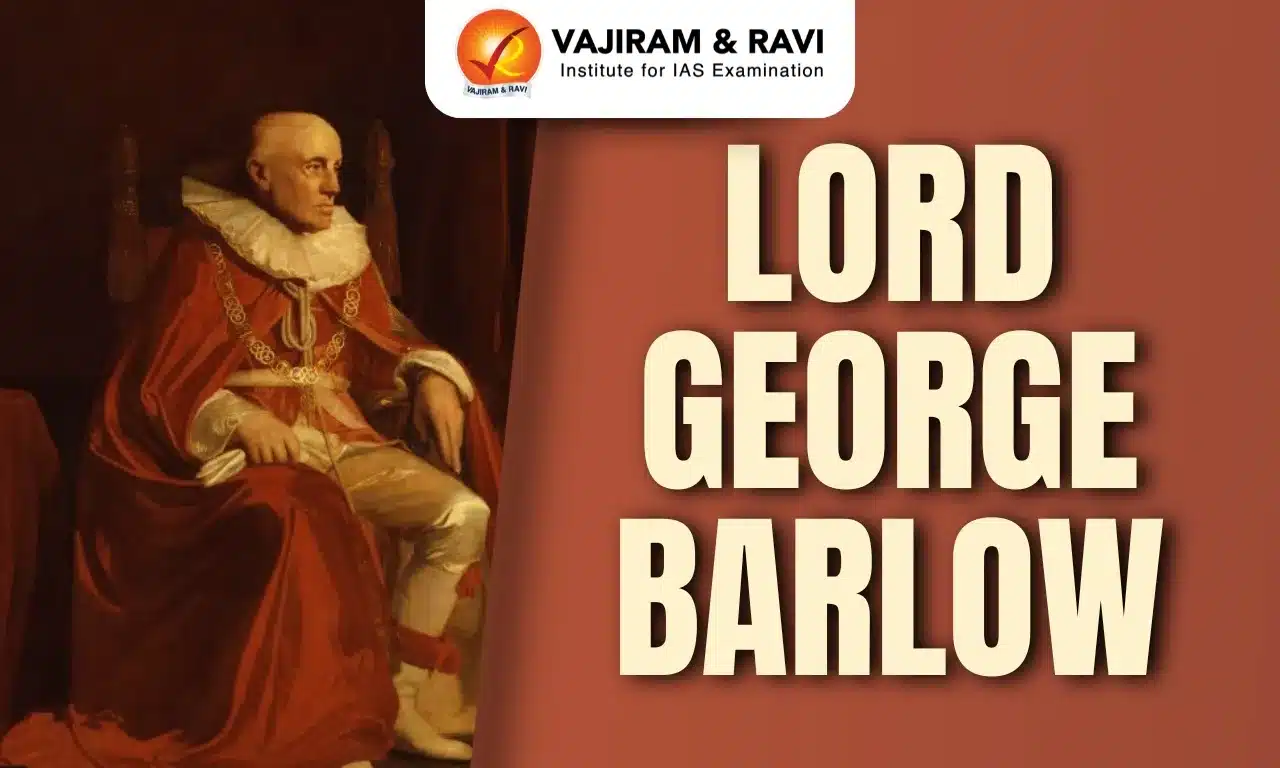
Lord George Barlow, formally known as Sir George Hilaro Barlow, 1st Baronet, was a senior British administrator of the East India Company who played a crucial role in Indian governance during the early nineteenth century. He served as Acting Governor General of India from October 1805 to July 1807 and later as Governor of Madras from 1807 to 1813. His tenure is remembered for financial prudence, administrative discipline and controversy arising from inflexible governance.

Lord George Barlow Biography

Lord George Barlow was born on 20 January 1763 in England. He entered the Bengal Civil Service of the East India Company in 1778 and arrived in Calcutta in 1779. He became secretary to the Board of Revenue and later Chief Secretary of the Supreme Government. He was created a baronet in 1803. Due to ongoing unrest and criticism of his rigid methods, the Court of Directors recalled him in 1813. After recall, he retired permanently from Indian administration and returned to England. He was appointed Knight Grand Cross of the Order of the Bath in 1815 for his long administrative service. He died on 18 December 1846 at the age of 83 at Farnham, Surrey. 

Lord George Barlow Contributions

The major contributions of Lord George Barlow during his tenure as the Provisional Governor General of India and the Governor of Madras has been listed below:

  • Permanent Settlement Framework: He played a central role in drafting and implementing regulations for the Permanent Settlement of Bengal in 1788-1793 while acting as the sub-secretary of Cornwallis
  • Revenue Administration Expertise: As secretary to the Board of Revenue, he helped standardize land assessments across Bengal, Bihar and Orissa, strengthening fiscal predictability for the Company.
  • Chief Secretary Reforms: Appointed Chief Secretary in 1796, he streamlined correspondence, improved record keeping and coordinated policy execution between the Governor General and provincial governments.
  • Supreme Council Membership: Joining the Supreme Council in 1801, he influenced high level decisions on finance, diplomacy and internal administration during a period of post war financial strain.
  • Fiscal Retrenchment Policy: As Acting Governor General, he reduced military expenditure, disbanded irregular forces and converted inherited deficits into budgetary surpluses within two years.
  • Non-Interventionist Diplomacy: He reversed aggressive expansion policies by dissolving subsidiary alliances and restoring territories to Maratha rulers like Daulat Rao Sindhia and Jaswant Rao Holkar.
  • Administrative Economy: His governance emphasized cost control, making him the only Governor General noted for reducing the territorial and financial burden of British rule in India.
  • Madras Anti-Corruption Drive: As Governor of Madras, he attempted to curb corruption in civil and military departments, targeting illicit contracts and misuse of public funds.
  • Military Discipline Enforcement: He imposed strict obedience standards within the Madras Army, believing strong discipline essential for administrative stability.
  • Institutional Order Emphasis: Across postings, he consistently prioritized legal regulation, financial order and administrative hierarchy over political popularity.

Events During Lord George Barlow Tenure

Lord George Barlow’s tenure coincided with several notable events that shaped British administration and military relations in India:

  • Acting Governor General Appointment: He assumed office in October 1805 following Lord Cornwallis’s death, governing India until Lord Minto’s arrival in July 1807.
  • Territorial Retrenchment: During this period, he reduced British commitments beyond the Jumna River and withdrew protection from several allied princely states.
  • Treaty with Sindhia: In December 1805, he negotiated a treaty restoring territories to Daulat Rao Sindhia and setting the Chambal River as a political boundary.
  • Holkar Settlement: In January 1806, he concluded an agreement with Jaswant Rao Holkar, reinstating his domains in exchange for non aggression assurances.
  • Vellore Mutiny 1806: A major sepoy revolt erupted due to religiously offensive dress regulations, resulting in over 100 European casualties before suppression. After the mutiny, he restricted missionary activities temporarily to prevent religious tensions and restore confidence among Indian troops.
  • Governor of Madras Appointment: He took charge of Madras Presidency in December 1807, inheriting financial disorder and military indiscipline.
  • Abolition of Officer Privileges: His removal of tent contracts and field allowances angered European officers who relied on these benefits for income.
  • Madras Army Mutiny 1809: Nearly 90% of European officers resisted his orders, leading to widespread unrest across southern India.
  • Disciplinary Response: He suspended, dismissed and transferred numerous officers, enforcing loyalty declarations to restore authority.
  • Use of Loyal Forces: He relied on loyal sepoys and reinforcements from Bengal and Bombay to suppress unrest without widespread bloodshed.
  • Administrative Breakdown Risk: The crisis exposed deep civil-military tensions and the fragility of Company governance when European officers rebelled.

Lord George Barlow FAQs

Q1: Who was Lord George Barlow?

Ans: Lord George Barlow was a British East India Company administrator who served as Acting Governor General of India from 1805 to 1807 and Governor of Madras from 1807 to 1813.

Q2: What is Lord George Barlow best known for?

Ans: He is best known for his role in implementing the Permanent Settlement of Bengal and for his strict policies of fiscal retrenchment and administrative economy.

Q3: Why was Lord George Barlow’s tenure controversial?

Ans: His rigid enforcement of cost cutting measures led to the Madras Army Mutiny of 1809 and widespread opposition from European officers.

Q4: What major event occurred during the tenure of Lord George Barlow as provisional Governor General?

Ans: The Vellore Mutiny of 1806 occurred during his tenure, triggered by religiously insensitive military dress regulations.

Q5: When did Lord George Barlow die?

Ans: Lord George Barlow died on 18 December 1846 at Farnham, Surrey, in England.

UPSC Daily Quiz 27 January 2026

UPSC Daily Quiz

[WpProQuiz 77]

UPSC Daily Quiz FAQs

Q1: What is the Daily UPSC Quiz?

Ans: The Daily UPSC Quiz is a set of practice questions based on current affairs, static subjects, and PYQs that help aspirants enhance retention and test conceptual clarity regularly.

Q2: How is the Daily Quiz useful for UPSC preparation?

Ans: Daily quizzes support learning, help in revision, improve time management, and boost accuracy for both UPSC Prelims and Mains through consistent practice.

Q3: Are the quiz questions based on the UPSC syllabus?

Ans: Yes, all questions are aligned with the UPSC Syllabus 2025, covering key areas like Polity, Economy, Environment, History, Geography, and Current Affairs.

Q4: Are solutions and explanations provided with the quiz?

Ans: Yes, each quiz includes detailed explanations and source references to enhance conceptual understanding and enable self-assessment.

Q5: Is the Daily UPSC Quiz suitable for both Prelims and Mains?

Ans: Primarily focused on Prelims (MCQ format), but it also indirectly helps in Mains by strengthening subject knowledge and factual clarity.

India-EU Free Trade Agreement 2026, Objectives, Benefits

India-EU Free Trade Agreement (FTA)

Why India-EU FTA in News?

India and the European Union have concluded the negotiation on a free trade agreement, “Mother of all Deals”, which is expected to boost India’s export and strength India’s vision of Viksit Bharat at 2047.

India-EU Free Trade Agreement (FTA) Objectives

The objectives of the India-EU Free Trade Agreement have been discussed below:

  • To reduce or eliminate tariffs on goods to improve market access for Indian exports in the EU.
  • To liberalise trade in services, especially IT, digital, healthcare, and professional services.
  • To promote easier movement of skilled professionals between India and the EU.
  • To attract high-quality European investment by ensuring regulatory certainty and transparency.
  • To strengthen regulatory cooperation and reduce non-tariff barriers.
  • To integrate India into global and European value chains as a reliable manufacturing hub.
  • To boost export-led growth in line with Make in India and PLI schemes.
  • To diversify India’s trade partnerships and enhance economic resilience.

India-EU Free Trade Agreement (FTA) Benefits

  • Boost to Exports: The EU is India’s largest export market bloc, accounting for about 17% of India’s total exports. Duty-free or reduced tariffs will benefit labour-intensive sectors like textiles, apparel, leather, and footwear, as well as pharmaceuticals, engineering goods, and chemicals. Indian goods worth USD 75-80 billion were exported to the EU in 2024-25.
  • Expansion of Services Trade: India exported around USD 50 billion in services to the EU in 2024-25, mainly in IT, telecom, digital, and business services. Easier mobility of skilled professionals and regulatory alignment under the FTA will further increase India’s services footprint.
  • Increased Foreign Investment: Enhanced investment protection and regulatory certainty can attract high-quality FDI from Europe. Europe accounted for USD 70 billion of FDI inflows into India in 2023-24.
  • Integration into Global Value Chains: The FTA positions India as a “China-plus-one” destination, helping Indian manufacturers integrate into European supply chains and strengthen export competitiveness.
  • Industrial Growth and Make in India: Access to the 450-million-strong European market will promote industrial upgrading in pharmaceuticals, engineering goods, auto components, and chemicals, complementing Make in India and PLI schemes.
  • Employment Generation: Growth in manufacturing and services exports is expected to create jobs in sectors such as textiles, leather, IT services, and pharmaceuticals. Labour-intensive exports could see 10-15% growth under duty-free access.
  • Strategic and Geopolitical Gains: Strengthened economic ties with the EU reduce dependence on a few trade partners and enhance India’s influence in global trade forums.
  • Technology and Knowledge Transfer: FDI and collaboration with EU firms will accelerate adoption of advanced technologies, boosting competitiveness of domestic industries and innovation capacity.

Challenges Associated with the Free Trade Agreement

  • High Environmental and Labour Standards: The EU’s stringent environmental and labour norms increase compliance costs for Indian exporters and act as non-tariff barriers.
  • Carbon Border Adjustment Mechanism (CBAM): The proposed carbon tax on imports like steel, cement, and aluminium may reduce the competitiveness of Indian exports.
  • Intellectual Property Rights (IPR) Issues: EU demands for stronger IPR protection, especially data exclusivity in pharmaceuticals, could affect India’s generic drug industry.
  • Digital Trade and Data Protection: Differences over data localisation and cross-border data flows remain unresolved.
  • Tariff Reduction on Sensitive Sectors: Pressure to cut duties on automobiles, wines, spirits, and dairy could impact domestic industries and MSMEs.
  • Public Procurement Access: The EU’s demand for access to India’s government procurement market conflicts with India’s local-preference policies.
  • Regulatory and Standards Compliance: Meeting EU technical, sanitary, and phytosanitary standards is challenging for small Indian exporters.
  • Adjustment Costs: Domestic industries may face short-term disruptions due to increased competition from European imports.

Way Forward

  • Phased Tariff Liberalisation - Gradually reduce tariffs, giving sensitive sectors like agriculture, dairy, and MSMEs time to adjust.
  • Safeguard Domestic Industries - Use protective carve-outs to prevent disruption to small-scale manufacturers and local producers.
  • Align with Make in India & PLI - Leverage the FTA to boost high-value manufacturing, technology transfer, and industrial growth.
  • Protect Digital Sovereignty - Negotiate data-sharing rules that balance trade facilitation with privacy and national digital infrastructure.
  • Address IPR & CBAM Issues - Safeguard India’s generic pharmaceutical industry and ensure competitiveness under EU carbon-related regulations.
  • Enhance Strategic & Services Gains - Expand IT, telecom, and professional services exports, attract European FDI, and strengthen India’s global economic resilience.

About Eurpoean Union

The European Union (EU) is a political and economic union of 27 European countries that work together on trade, governance, and regional development. It has a single market allowing free movement of goods, services, people, and capital among member states.

  • Formation and Members: Established in 1993 by the Maastricht Treaty, the EU consists of 27 member states, including Germany, France, Italy, Spain, and the Netherlands.
  • Single Market: Promotes free movement of goods, services, people, and capital across member countries, creating one of the largest economic zones in the world.
  • Common Policies: The EU coordinates on trade, agriculture, competition, environment, energy, and foreign policy to maintain regional stability and growth.
  • Euro Currency: 19 of the 27 member states use the euro as their official currency, facilitating economic integration.
  • Global Economic Influence: The EU is one of the largest trading blocs, contributing around 15-17% of global exports and a major source of FDI worldwide.

Institutions: Key EU institutions include the European Commission, European Parliament, European Council, and Court of Justice, which oversee policy, legislation, and enforcement.

[youtube url="https://www.youtube.com/watch?v=naqsu4LXhbY" width="560" height="315"]

India-EU Free Trade Agreement (FTA) FAQs

Q1: Why is the India-EU FTA important for India?

Ans: It boosts exports, attracts high-quality European investment, promotes industrial growth, and strengthens India’s integration into global value chains.

Q2: Which sectors are expected to benefit the most?

Ans: Labour-intensive sectors like textiles, apparel, leather, and footwear, as well as pharmaceuticals, engineering goods, IT, telecom, and renewable energy.

Q3: What are the key challenges in the FTA?

Ans: Challenges include intellectual property rights (IPR) issues, Carbon Border Adjustment Mechanism (CBAM), data and digital trade rules, tariff reductions on sensitive products, and EU access to public procurement.

Q4: How will services trade benefit India?

Ans: Regulatory cooperation and professional mobility provisions will expand India’s IT, telecom, digital, and business services exports, which were around USD 50 billion in 2024–25.

Q5: How does the FTA align with India’s development vision?

Ans: It supports Viksit Bharat@2047, Make in India, and PLI schemes by promoting export-led growth, industrial upgrading, and strategic economic partnerships.

Lord Mayo (1822-1872), Biography, Viceroy, Contributions, Events

Lord Mayo

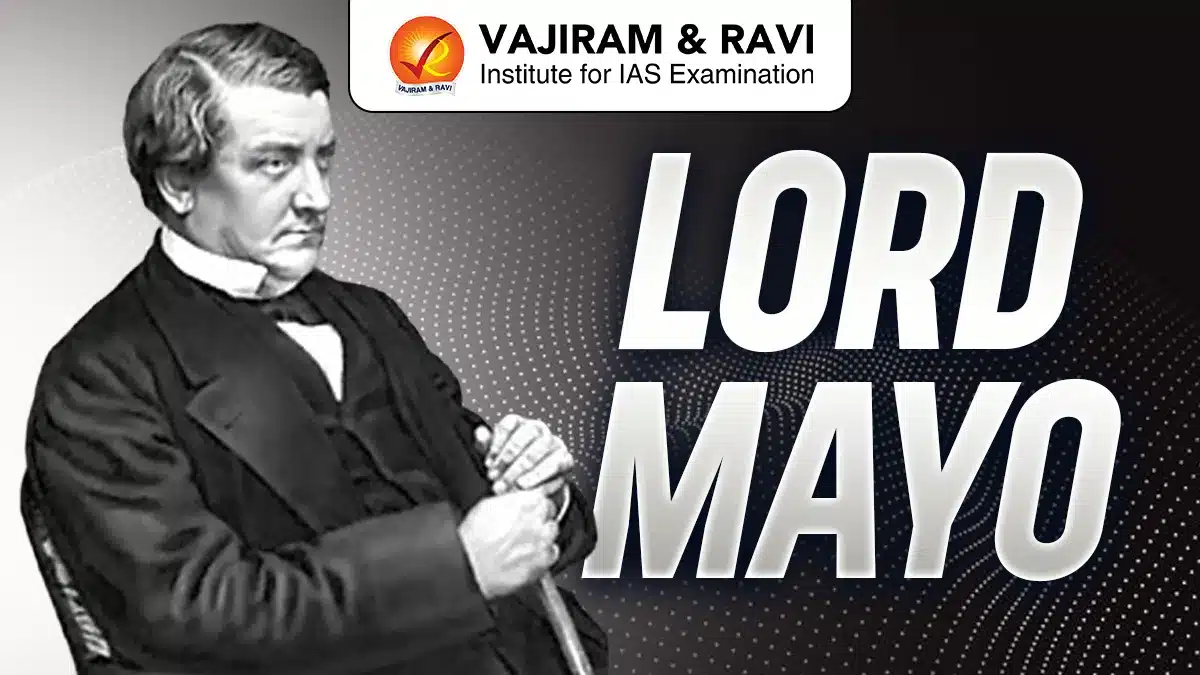
Lord Mayo, formally known as Richard Southwell Bourke, was a British statesman and colonial administrator. He served as the fourth Viceroy of India from January 1869 to February 1872. His tenure was short but marked a decisive phase in administrative reorganisation, financial decentralisation and data driven governance in colonial India. He was the first and only Viceroy of India to be assassinated while in office. He is widely considered as the father of Financial Decentralization in India.

Lord Mayo Biography

Lord Mayo was born on 21 February 1822 in Dublin, Ireland, into an aristocratic Anglo-Irish family headed by Robert Bourke, the 5th Earl of Mayo. He was educated at Trinity College, Dublin and earned a BA in 1844, MA in 1851 and LLD in 1852. Before India, he built a long political career in Britain and Ireland, serving three times as Chief Secretary for Ireland and representing constituencies like Kildare, Coleraine and Cockermouth in the British Parliament. While serving as the Viceroy of India, he was assassinated by Sher Ali Afridi in February 1872.

Read about: Lord Reading

Lord Mayo Contributions

The contributions of Lord Mayo as the Viceroy of India has been listed below:

  • Financial Decentralisation Policy: Lord Mayo introduced financial decentralisation in 1870, allowing provincial governments to raise and manage local revenues. This reduced central burden, improved fiscal accountability and enabled provinces to fund education, roads, sanitation and health services according to regional needs.
  • Indian Evidence Act 1872: The Indian Evidence Act, passed in 1872, standardised rules of evidence across India. It replaced community based legal practices with a uniform legal framework, ensuring equal application of evidentiary rules irrespective of caste, religion, or social status.
  • First Census of India: Under Lord Mayo’s direction, India conducted its first systematic census in 1871. This exercise generated population, occupational and demographic data, laying the foundation for modern statistical governance and long term administrative planning in British India.
  • Statistical Survey of India: He established the Statistical Survey of India under William Wilson Hunter. The survey produced district wise records detailing economic, social and cultural conditions, regarded as the most comprehensive documentation since the Mughal Ain-i-Akbari.
  • Educational Initiatives for Indian Elites: Lord Mayo promoted elite education by conceptualising Mayo College at Ajmer. Funded by Indian princes with a contribution of £70,000, the institution aimed to educate future rulers in modern administration while preserving aristocratic traditions.
  • Infrastructure Development Policy: His administration expanded roads, railways, canals and irrigation systems. Mayo insisted that public works must be productive and revenue generating, rejecting unviable loans and reinforcing state control over major infrastructure projects.
  • Military and Sanitary Reforms: Lord Mayo improved troop hygiene and living conditions, reducing mortality rates in cantonments. He introduced modern weaponry like the Snider rifle and rifled artillery guns, strengthening the military’s operational efficiency.
  • Prison Reforms: He showed special interest in prison reforms, especially in Andaman convict settlements. Mayo sought structured administration, better supervision and codified procedures to manage convicts and reduce disorder in penal colonies.
  • Administrative Departments Creation: In 1871, he established separate Departments of Revenue, Agriculture and Commerce. This institutional separation improved policy focus, economic planning and administrative specialisation within colonial governance.
  • Non-Intervention Foreign Policy: Lord Mayo followed the policy of Masterly Inactivity in foreign affairs, especially in Afghanistan. He avoided direct intervention, preferring diplomatic engagement to maintain frontier stability and reduce military expenditure.

Read about: Afonso de Albuquerque

Events During Lord Mayo Tenure

The tenure of Lord Mayo witnessed several critical political, administrative and historical events that shaped colonial India’s governance trajectory.

  • Appointment as Viceroy of India: Lord Mayo assumed office on 12 January 1869 in Calcutta, succeeding Lord John Lawrence. He became the fourth Viceroy of India, bringing extensive Irish administrative experience to imperial governance.
  • Afghan Policy and Ambala Durbar: He hosted Sher Ali Khan, the Amir of Kabul, at Ambala, affirming British recognition without military interference. This reinforced the Masterly Inactivity doctrine in northwest frontier diplomacy.
  • Launch of India’s First Census: The 1871 census was initiated during his tenure, providing the first official population count and socio-economic data, which became essential for taxation, administration and policy formulation.
  • Establishment of Mayo College: Though formally opened in 1875 after his death, Mayo College was conceptualised during his rule to educate Indian princes, with Colonel Sir Oliver St John later appointed as its first principal.
  • Indian Evidence Act: The enactment of the Indian Evidence Act in 1872 was the most significant legislative milestone of his administration, creating uniformity and legal clarity across British Indian courts.
  • Expansion of Statistical Governance: The Statistical Survey initiated during his tenure produced district gazetteers detailing agriculture, trade, population and social life, transforming colonial knowledge systems and governance precision.
  • Inspection of Andaman Penal Colony: Lord Mayo personally inspected the Andaman convict settlement in February 1872, reflecting his administrative activism and concern for prison reforms in remote colonial territories.
  • Assassination at Port Blair: On 8 February 1872, Lord Mayo was killed at Port Blair by Sher Ali Afridi, an Afghan convict. This made him the first and only Viceroy of India killed while in office.
  • Execution of Assassin: Sher Ali Afridi was executed on 11 March 1872. The incident led to heightened security protocols and later contributed to the strengthening of colonial intelligence mechanisms.
  • Administrative Succession: Following his death, John Strachey served as Acting Viceroy, ensuring continuity in governance. Lord Mayo’s body was returned to Ireland and buried in County Kildare.

Lord Mayo FAQs

Q1: Who was Lord Mayo?

Ans: Lord Mayo, Richard Southwell Bourke, was the fourth Viceroy of India from 1869 to 1872 and an Irish-born British statesman.

Q2: What are the major contributions of Lord Mayo during his tenure as the Viceroy of India?

Ans: He introduced financial decentralisation, supervised India’s first census, strengthened statistical administration and passed the Indian Evidence Act 1872.

Q3: What was Lord Mayo’s role in India’s first census?

Ans: He ordered the first systematic census in 1871 to collect population and socio-economic data for effective governance and planning.

Q4: Which major educational institution is associated with Lord Mayo?

Ans: Mayo College, Ajmer, established to educate Indian princes and aristocrats, was founded in his honour.

Q5: How was Lord Mayo Assassinated?

Ans: He was assassinated on 8 February 1872 at Port Blair in the Andaman Islands by Sher Ali Afridi while inspecting the convict settlement.

Republic Day Tableau 2026, Meaning, List, Theme, Winners

Republic Day Tableau 2026

Republic Day tableau is an important cultural feature of the Republic Day Parade showcasing India’s rich Culture, heritage, historical legacy, achievements and vision. 

On 26 January 2026, India celebrated its 77th Republic Day and the tableaux mainly focused on commemorating 150 years of Vande Mataram and the vision of Atmanirbhar Bharat

What is the Republic Day Tableau? 

Republic Day tableaux are thematic and artistic displays presented by States, Union Territories, and Central Ministries during the Republic Day Parade on 26 January at Kartavya Path, New Delhi. It visually represents India’s cultural heritage, historical legacy, constitutional values, social achievements, or future vision. Through art, models, music, and performers, each tableau communicates a distinct message.

Republic Day Tableau’s History in India

  • Republic Day tableaus have been part of the parade since India became a republic in 1950.
  • Early tableaus highlighted freedom fighters and national unity. 
  • Over the years, the themes of the tableaus broadened to include culture, science, tribal heritage, environmental conservation, and various government initiatives.

Republic Day Tableau 2026 Theme

The theme of the The 77th Republic Day tableaux centred around two main themes : “Svatantrata Ka Mantra – Vande Mataram” and “Samriddhi Ka Mantra – Aatmanirbhar Bharat”.

  • Swatantrata ka Mantra : Vande Mataram : Celebrating 150 years of the national song Vande Mataram (composed by Bankim Chandra Chattopadhyay in 1875).
  • Samriddhi ka Mantra : Aatmanirbhar Bharat : Highlighting India's journey toward self-reliance and economic prosperity.

Who decides the theme of  Republic Day Tableau 2026? 

The theme of the Republic Day Tableau is decided by the Ministry of Defence in consultation with other central agencies.

List of Republic Day Tableaux 2026 State and UT Wise and their Themes

This year, 30 tableaux were selected from various States, Union Territories, and Central Ministries-17 tableaux from States / Union Territories and 13 tableaux from Ministries / Departments / Services. Each tableau showcased the culture and progress of its region or sector.

Gujarat and Chhattisgarh focused on the theme of “Vande Mataram,” highlighting its role in strengthening national unity while Assam’s tableau featured Ashirakandi, a village known for its traditional crafts. Maharashtra presented Ganeshotsav, while West Bengal highlighted the state’s contribution to India’s freedom struggle.  The Department of Military Affairs presented the Tri-Services Tableau – showcasing  Victory of Operation Sindoor through Joint coordination of three forces. 

States / UTs & Ministry / Department  Theme

Assam 

Asharikandi – Terracotta Craft Village of Assam

Chattisgarh 

The Mantra of Freedom – Vande Mataram

Gujarat 

Mantra of Swadeshi – Self-Reliance – Freedom: Vande Mataram

Himachal Pradesh 

Dev Bhoomi, Veer Bhoomi

Jammu & Kashmir 

Handicrafts and Folk Dances of Jammu & Kashmir

Kerala 

Water Metro and 100% Digital Literacy: Aatmanirbhar Kerala for Aatmanirbhar Bharat

Maharashtra 

Ganeshotsav: A Symbol of Aatmanirbharta

Manipur 

Towards Prosperity: From Agricultural Fields to International Markets

Nagaland 

The Hornbill Festival – Celebrating Culture, Tourism & Self-Reliance

Odisha 

Soil to Silicon: Rooted in Tradition, Rising with Innovation

Puducherry 

Rich Heritage of Craft, Culture and Auroville’s Vision

Rajasthan 

Golden Touch of the Desert: Bikaner Gold Art (Usta Art)

Tamil Nadu

Mantra of Prosperity: Self-Reliant India

Uttar Pradesh 

Culture of Bundelkhand 

West Bengal 

Bengal in the Freedom Movement of India

Madhya Pradesh 

Punyashlok Lokmata Devi Ahilyabai Holkar

Punjab 

350th Year of Martyrdom of Sri Guru Tegh Bahadur Sahib Ji

Air HQs 

Veteran Tableau – Nation Building through War

Naval HQs 

Samudra Se Samriddhi

Department of Military Affairs 

Tri-Services Tableau – Operation Sindoor, Victory through Jointness

Ministry of Culture

Vande Mataram – The Soul Cry of a Nation

Department of School Education and Literacy 

National Education Policy 2020: Rocketing Indian School Education on the Path to Viksit Bharat

Ministry of AAYUSH

AYUSH KA TANTRA, SWASTHYA KA MANTRA

Ministry of Home Affairs 

(NDMA & NDRF)

Bhuj Earthquake: 25 Years of Resilience

Ministry of Home Affairs 

(BPRD) 

Jan Kendrit Nyay Pranali - Enactment of the Three New Criminal Laws – 2023

Ministry of Housing and Urban Affairs 

Vande Mataram – Commemoration of 150 Years

Ministry of Information and Broadcasting 

Bharat Gatha: Shruti, Kriti, Drishti

Ministry of Panchayati Raj

SVAMITVA Scheme – Aatmanirbhar Panchayat se Samriddh evam Aatmanirbhar Bharat

Ministry of Power 

Prakash Ganga: Powering an Aatmanirbhar and Viksit Bharat

Ministry of Skill Development & Entrepreneurship 

Powered by Skills: Building a Self-Reliant, Future-Ready India

Republic Day Tableau 2026 Winners

  • The winners of the Republic Day tableaux are decided by an expert jury constituted by the Ministry of Defence. 
  • This jury includes eminent artists, cultural experts, architects, and senior government officials who evaluate the tableaux on the basis of adherence to the annual theme, creativity and innovation, visual appeal, clarity of message, and overall presentation. 
  • In addition to the jury awards, a Popular Choice Award is also given, which is determined through public voting, usually conducted via the MyGov platform or other online and SMS-based mechanisms.

Republic Day Tableaux Selection Process 

  • Republic Day Tableaux are selected through a two-stage selection by an expert committee under the Ministry of Defence.
  • States, Union Territories, and various departments submit design sketches for their proposed tableaux. An expert committee evaluates these proposals. 
  • This committee comprises experts in fields such as arts, culture, painting, sculpture, music, architecture, and choreography. 
  • The selection involves two main phases : 
  • First, the committee assesses initial sketches, suggesting modifications if needed. 
  • Second, approved designs move to a 3D model stage for final selection. 

States not selected for the main parade can still display their tableaux at Bharat Parv. This alternative event takes place at the Red Fort from January 26-31.

Further, the government has finalized a rotational plan to ensure that every State and Union Territory gets an opportunity to present their tableaux at the Republic Day parade within a three-year cycle (2024-2026).

Republic Day Tableau 2026 Purpose 

  • It highlights unity in diversity by showcasing traditions, languages, and lifestyles of different regions.
  • It highlights progress in defense, technology, and social welfare (e.g., Space missions or Green energy).
  • It brings rare folk arts, crafts, and historical stories into the national spotlight.
  • It promotes awareness of government policies and national missions like Aatmanirbhar Bharat.

Republic Day Tableau 2026 FAQs

Q1: What is Republic Day Tableau?

Ans: A Republic Day tableau is a thematic float displayed during the Republic Day Parade (26 January) at Kartavya Path, New Delhi, showcasing India’s cultural heritage, Historical events, Developmental achievements and Government initiatives.

Q2: What is the theme of Republic Day Tableau 2026?

Ans: Svatantrata Ka Mantra – Vande Mataram” and “Samriddhi Ka Mantra – Aatmanirbhar Bharat.

Q3: Who composed Vande Mataram?

Ans: Vande Mataram was composed by Bankim Chandra Chattopadhyay in 1875.

Q4: Who participates in the Republic Day Tableau?

Ans: States / Union Territories and Ministries / Departments / Services of Central government and Defence Forces.

Q5: Who selects the Republic Day tableaux?

Ans: Selection is done by an Expert Committee under the Ministry of Defence.

Afonso de Albuquerque (1453-1515), Biography, Expeditions, Contributions

Afonso de Albuquerque

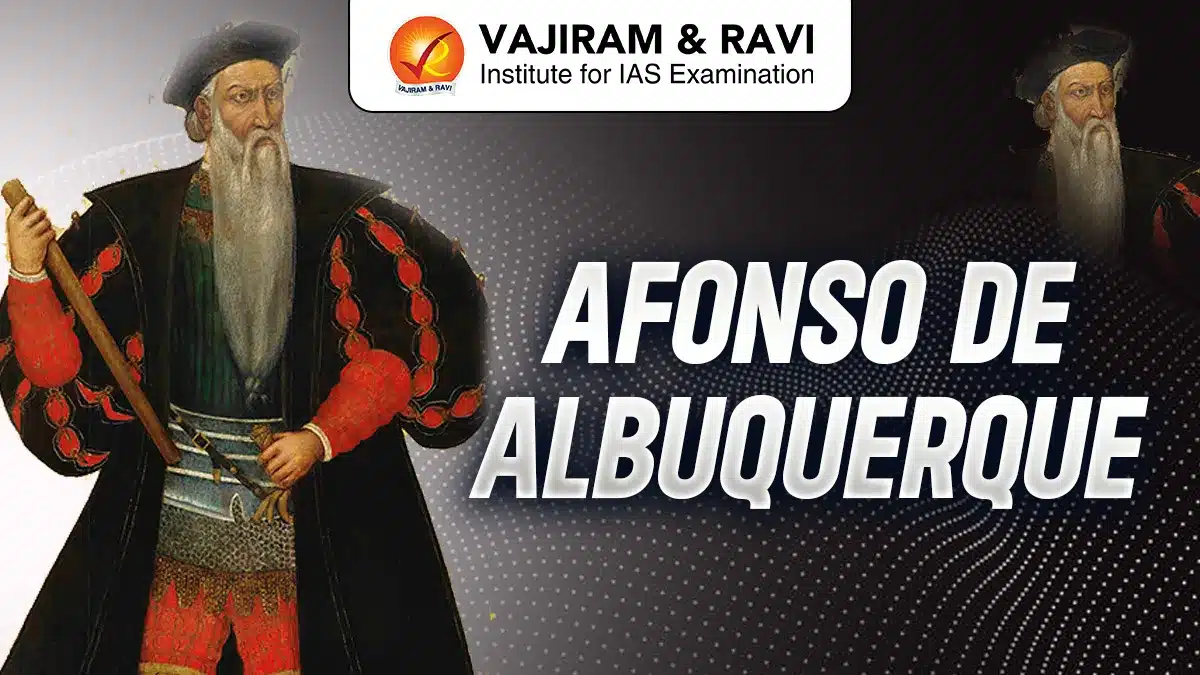
Afonso de Albuquerque was a Portuguese military commander and statesman who played a decisive role in establishing Portuguese power in Asia during the early sixteenth century. Albuquerque served as the second Governor of Portuguese India for six years and transformed Portugal from a trading nation into a territorial imperial power. Through carefully planned military campaigns, permanent forts, naval control and strict trade regulations, he laid the foundations of Portuguese dominance in the Indian Ocean and beyond which made Portugal a major Asian power by 1515.

Afonso de Albuquerque Biography

Afonso de Albuquerque was born in 1453 at Alhandra, near Lisbon, into a noble family closely connected with the Portuguese royal court. He received training in mathematics, Latin and military arts. He gained early experience during campaigns in North Africa against Muslim strongholds which shaped his later strategies in Asia. He entered the Indian Ocean world in 1503 and rose to become Governor of Portuguese India in 1509. By the time of his death in 1515, his conquests had secured Portuguese supremacy across key Asian maritime routes.

Afonso de Albuquerque Expeditions to India

The two major expeditions by Afonso de Albuquerque to India laid the military and administrative foundations of Portuguese India and reshaped the balance of power in the Indian Ocean. The two expeditions are:

First Expedition to India (1503)

  • Albuquerque arrived with the Portuguese fleet on the Malabar Coast and allied with the Maharaja of Kochi against the Zamorin of Calicut. He secured permission to build Fort Emmanuel at Kochi, the first Portuguese fort in Asia, establishing a permanent military and trading base.
  • Kochi provided the Portuguese with a friendly ruler, safe harbour and access to pepper trade. This base helped Portugal counter Muslim traders dominating Calicut and marked the beginning of a fortified Portuguese presence in India.

Second Expedition to India (1506-1509)

  • Albuquerque returned with a broader mission covering Arabia, the Persian Gulf and India. He aimed to control maritime choke points by capturing strategic locations like Socotra and Hormuz before asserting authority in India.
  • After political conflict with Francisco de Almeida, Albuquerque formally became Governor of Portuguese India in 1509. He shifted Portuguese policy from naval raids to territorial conquest and permanent settlement along Asian coasts.
  • Albuquerque captured Goa from the Sultan of Bijapur in 1510 after intense fighting. Goa became the capital of Portuguese India, a major naval base and the administrative centre supporting further expansion in Asia.
  • From Goa, Albuquerque planned naval operations against Muslim powers, redirected spice trade flows and supplied Persian horses to Indian rulers, integrating military, economic and diplomatic objectives into one strategic hub.

Afonso de Albuquerque Contributions

Afonso de Albuquerque ensured Portugal’s control over trade routes, administration and cultural influence across the Indian Ocean. Major contributions were:

  • Creation of Portuguese Asian Empire: Albuquerque transformed Portugal into an Asian imperial power by capturing Goa in 1510 and Malacca in 1511, securing control over both the western and eastern gateways of Asian maritime trade.
  • Social Reform: He worked through the eradication of various social customs and norms including the Sati System.
  • Spice Trade: By conquering Malacca, he gained control over the Strait of Malacca, through which most Southeast Asian spice trade passed, enabling Portuguese access to the Spice Islands and East Asian markets.
  • Network of Fortresses: He established a chain of fortified bases at strategic ports such as Kochi, Goa, Hormuz and Malacca, ensuring Portuguese military dominance and protection of merchant fleets across vast sea routes.
  • Naval Supremacy in Indian Ocean: Albuquerque enforced Portuguese naval power by controlling major sea lanes linking the Atlantic, Red Sea, Persian Gulf and Indian Ocean, reducing Muslim and regional rivals’ influence over maritime trade.
  • Diplomatic Relations: He established diplomatic relations with Ayutthaya in Thailand, Pegu in Myanmar, Timor, Ethiopia and Persia, expanding Portuguese political influence beyond India into Southeast Asia and East Africa.
  • Opening Trade with China: Under his leadership, Portuguese contacts with China expanded, leading to the establishment of the first European trade post on the Chinese coast at Canton in 1517.

Afonso de Albuquerque Policies

Afonso de Albuquerque introduced comprehensive policies covering political, military, economic, social, cultural and religious spheres as given below:

  • Military Policy: He focused on permanent fortifications and direct control of maritime routes, building forts such as Fort Emmanuel at Kochi and maintaining a strong navy to dominate Asian waters.
  • Blue Water Policy: Following Francisco de Almeida, Albuquerque strengthened the Blue Water Policy, aiming to control seas rather than inland territories, turning the Indian Ocean into a Portuguese dominated maritime zone.
  • Economic Policy: His economic strategy focused on monopolising spice trade routes and shipbuilding centres, ensuring that Portuguese ports became compulsory trade points for Asian merchants.
  • Cartaz System: Albuquerque enforced the Cartaz system, as implemented by Almeida. It required all ships to carry Portuguese issued permits. Ships without cartaz were seized, cargo confiscated and crews enslaved, generating significant revenue for Portugal.
  • Social Policy: He encouraged intermarriage between Portuguese men and local women due to the absence of Portuguese women overseas, leading to cultural assimilation and creation of a loyal Indo-Portuguese community.
  • Cultural Policy: Albuquerque respected local customs and village systems, avoided interference in indigenous traditions and introduced Western elements such as Portuguese coinage minted in Goa using local designs.
  • Religious Policy: His religious policy aimed at weakening Islamic influence and spreading Christianity, often targeting Muslim populations harshly while maintaining pragmatic alliances with Hindu rulers for political stability.

Afonso de Albuquerque FAQs

Q1: Who was Afonso de Albuquerque?

Ans: Afonso de Albuquerque was a Portuguese general and statesman, and the second Governor of Portuguese India, who played a key role in establishing Portuguese colonial rule in the Indian Ocean during the early 16th century.

Q2: Why is Afonso de Albuquerque called the “Founder of the Portuguese Empire in the East”?

Ans: He laid the foundations of Portuguese power in Asia by capturing key ports like Goa, Malacca, and Hormuz, controlling major sea trade routes.

Q3: Which territories were conquered by Afonso de Albuquerque?

Ans: He captured Goa in 1510, Malacca in 1511, and established Portuguese dominance over Hormuz in the Persian Gulf.

Q4: How did Afonso de Albuquerque strengthen Portuguese naval power?

Ans: He fortified strategic ports, built strong naval bases, and aimed to control choke points like the Red Sea and Persian Gulf.

Q5: When did Afonso de Albuquerque die?

Ans: Afonso de Albuquerque died in 1515 while returning from India, shortly after being removed from his post as Governor of Portuguese India.

Bharat Ratna Award Winners List from 1954 to 2026, Recipients Name

Bharat Ratna Award Winners

The Bharat Ratna is India’s most prestigious civilian honour award which was established in 1954. This award recognizes individuals who have made extraordinary contributions to the nation, whether through public service or exceptional achievements in literature, science, art, or other fields. Each year, a maximum of 3 individuals may be honoured with this title. Below, we present a Bharat Ratna Award Winners List from 1954 to 2026, along with their important contribution in the history of the nation.

Bharat Ratna Award Winners

The recommendation for the most prestigious Bharat Ratna Award is given by the Prime Minister of India and is presented by the President of India. Till 2026, 48 aspiring personalities have been awarded with the Bharat Ratna Award, including 14 posthumously.

As per Article 18(1) of the Indian Constitution, no titles related to the award can be used as prefixes or suffixes to a person’s name. This rule also applies to the Bharat Ratna, meaning awardees cannot add the award to their names officially. The award doesn’t hold any monetary rewards. Recipients are given a certificate (Sanad) signed by the President and a peepal-leaf-shaped medal. This medal displays the state emblem of India and the national motto, “Satyamev Jayate” (Truth Alone Triumphs).

Bharat Ratna Award Winners List from 1954 to 2026

The Bharat Ratna, India’s highest civilian honour, has a rich history associated with its recipients and nominations. For instance, in 1992, the Government of India decided to present the award posthumously to Netaji Subhas Chandra Bose. However, his family and supporters opposed it, questioning the circumstances surrounding his death. Similarly, the legendary hockey player Major Dhyan Chand’s name has frequently surfaced for this honour, yet he has not been awarded to date.

No Bharat Ratna awards were presented in 2021 or 2022. Below is a year-wise Bharat Ratna Award Winners List from 1954 to 2026, with posthumous recipients marked by an asterisk (*).

Bharat Ratna Award Winners List from 1954 to 2026

Recipients (State/UT)

Year    

Key Notes

C. Rajagopalachari/ Rajaji 

(Tamil Nadu)

1954

He was the last Governor General of India and also founder of the Swatantra Party. He was the conscience keeper of MK Gandhi.

Sarvapalli Radhakrishnan 

(Tamil Nadu)

1954

He was the first Vice President of India and the country's second President. 

C. V. Raman 

(Tamil Nadu)

1954

He became the first Asian scientist to receive a Nobel Prize in any branch of science, also famous for his discoveries in physics like Raman Scattering.

Bhagwan Das 

(Uttar Pradesh)

1955

He co-founded the Mahatma Gandhi Kashi Vidyapith, also contributed to the foundation of Banaras Hindu University. 

M. Visvesvaraya 

(Karnataka)

1955

He was a civil engineer who contributed much to the country's dam development.

Jawaharlal Nehru 

(Uttar Pradesh)

1955

Jawaharlal Nehru became the first and longest tenure Prime Minister (PM) of India, He was PM at the time of receiving this award.

Govind Ballabh Pant 

(Uttarakhand)

1957

He was elected to be the first chief minister of the state of Uttar Pradesh who was a huge supporter of making Hindi a national language.

Dhondo Keshav Karve 

(Maharashtra)

1958

Dhondo Keshav Karve was a great social reformer and was famous for women's education, and widow remarriage also founded the Widow Marriage Association.

Bidhan Chandra Roy 

(West Bengal)

1961

Bidhan Chandra Roy is recognized as the Maker of Modern West Bengal. 

Purushottam Das Tandon 

(Uttar Pradesh)

1961

Purushottam Das Tandon was titled Rajarshi. He became the speaker in Uttar Pradesh Legislative Assembly. 

He supported the Hindi language making it the official language.

Rajendra Prasad 

(Bihar)

1962

Rajendra Prasad swore as the first President of India. 

He was actively involved in the non-cooperation movement with Mahatma Gandhi Ji. 

Zakir Husain 

(Andhra Pradesh)

1963

Zakir Husain was elected to be the second Vice President and third President of India. 

He became the Vice Chancellor of Aligarh Muslim University.

Pandurang Vaman Kane 

(Maharashtra)

1963

He was a great Indologist and Sanskrit scholar who was well known for his works like ‘History of Dharmasastra: Ancient and Mediaeval Religious and Civil Laws in India’.

Lal Bahadur Shastri 

(Uttar Pradesh) *

1966

Lal Bahadur Shastri became the first posthumous recipient of the Bharat Ratna Award, He was elected to be the second PM of India. He is popular in the country for his slogan ‘Jai Jawan Jai Kisan’.

Indira Gandhi 

(Uttar Pradesh)

1971

Indira Gandhi was the first female recipient of the Bharat Ratna Award, She was PM during the Indo-Pak War of 1971.

V. V. Giri 

(Odisha)

1975

V. V. Giri, 4th President of India, was a trade union leader and freedom fighter championing workers' rights and democracy.

K. Kamaraj 

(Tamil Nadu) *

1976

K. Kamaraj, "Kingmaker," played a pivotal role in Indian politics by supporting Lal Bahadur Shastri and Indira Gandhi as Prime Ministers.

Mother Teresa 

(West Bengal, born in North Macedonia)

1980

Mother Teresa, a Bharat Ratna recipient and Nobel Laureate, founded the Missionaries of Charity, dedicating her life to humanitarian service.

Vinoba Bhave 

(Maharashtra) *

1983

Vinoba Bhave, a Gandhian, is renowned for the Bhoodan Movement and received the Ramon Magsaysay Award for his humanitarian efforts.

Khan Abdul Ghaffar Khan 

(Pakistan) 

1987

Khan Abdul Ghaffar Khan, "Frontier Gandhi," founded the Red Shirt Movement and was the first non-citizen Bharat Ratna recipient.

M. G. Ramachandran 

(Tamil Nadu) *

1988

M. G. Ramachandran, the first actor to receive Bharat Ratna, founded AIADMK and became the first actor-turned-Chief Minister.

B.R. Ambedkar 

(Maharashtra) 

1990

B.R. Ambedkar, chief architect of the Indian Constitution and first Law Minister, strongly opposed the caste system in Hinduism.

B.R. Ambedkar 

(South Africa)

1990

B.R. Ambedkar, known as the "Gandhi of South Africa," was the second non-citizen Bharat Ratna recipient and Nobel laureate.

Rajiv Gandhi 

(Uttar Pradesh) 

1991

Rajiv Gandhi, India’s youngest PM at 40, passed landmark laws like the Anti-defection Law during his tenure from 1984.

Vallabhbhai Patel 

(Gujarat) 

1991

Vallabhbhai Patel, the "Iron Man of India," served as Deputy Prime Minister and led the Bardoli Satyagraha and All India Services.

Morarji Desai (Gujarat)

1991

Morarji Desai, India's first non-Congress PM and oldest PM, is the only Indian awarded Pakistan's Nishan-e-Pakistan honour.

Abul Kalam Azad 

(West Bengal) 

1992

Maulana Abul Kalam Azad, India's first Education Minister, is honoured on his birth anniversary (11th November) as National Education Day.

J. R. D. Tata 

(Maharashtra)

1992

J. R. D. Tata, an industrialist and aviation pioneer, founded Air India and established institutes like TIFR, TCS, and Tata Motors.

Satyajit Ray 

(West Bengal)

1992

Satyajit Ray, renowned for bringing Indian cinema global recognition, directed Pather Panchali and received the Dadasaheb Phalke Award.

Gulzarilal Nanda 

(Punjab)

1997

Gulzarilal Nanda served twice as interim PM and deputy chairman of the Planning Commission, advocating labor issues nationally.

Aruna Asaf Ali 

(West Bengal) 

1997

Aruna Asaf Ali, the first post-independence Mayor of Delhi, played a key role in the Quit India Movement of 1942.

A.P.J Abdul Kalam 

(Tamil Nadu)

1997

A.P.J. Abdul Kalam, the "Missile Man of India," advanced missile technology, served as 11th President, and authored notable works.

M. S. Subbulakshmi 

(Tamil Nadu)

1998

M. S. Subbulakshmi, the Queen of Songs, was India's first musician awarded the Ramon Magsaysay for her charity work.

Chidambaram Subramaniam 

(Tamil Nadu)

1998

Chidambaram Subramaniam contributed to the Green Revolution in India and the International Rice Research Institute of Manila, Philippines. 

Jayaprakash Narayan 

(Bihar) 

1999

Jayaprakash Narayan, known as Loknayak, led the Total Revolution Movement against the Congress government, advocating for political and social reforms.

Amartya Sen 

(West Bengal)

1999

Amartya Sen, Nobel Laureate in Economics, contributed to welfare economics, social justice, and social choice theory, influencing global policies.

Gopinath Bordoloi 

(Assam) 

1999

Gopinath Bordoloi, Assam's first chief minister, is honored as Lokapriya for his dedication to Assam's development and progress.

Ravi Shankar 

(Uttar Pradesh)

1999

Ravi Shankar, the world’s leading Hindustani classical musician, is renowned for his mastery and received a Grammy Award for his work.

Lata Mangeshkar 

(Maharashtra)

2001

Lata Mangeshkar, the Nightingale of India, honoured with the Dadasaheb Phalke Award, is celebrated as the Queen of Melody.

Bismillah Khan 

(Uttar Pradesh)

2001

Bismillah Khan, a renowned shehnai virtuoso, popularised the instrument in Indian music and became the third classical musician honoured with Bharat Ratna.

Bhimsen Joshi 

(Karnataka)

2009

Bhimsen Joshi, a renowned Hindustani classical singer from Kirana Gharana, was celebrated for his mastery in the Khyal genre.

C. N. R. Rao 

(Karnataka)

2014

C. N. R. Rao, an eminent chemist, contributed to solid-state chemistry and received numerous prestigious awards, including the Marlow Medal.

Sachin Tendulkar 

(Maharashtra)

2014

Sachin Tendulkar is known as the Master Blaster in cricket history. He is the only batsman to score more than 30,000 runs in entire forms of international cricket matches. 

Madan Mohan Malaviya 

(Uttar Pradesh) 

2015

Madan Mohan Malaviya was the founder of the Banaras Hindu University and Akhil Bharatiya Hindu Mahasabha. 

Atal Bihari Bajpayee 

(Madhya Pradesh)

2015

Atal Bihari Vajpayee, a three-time PM and 1994 Best Parliamentarian, was also a renowned poet and statesman.

Pranab Mukherjee 

(West Bengal)

2019

Pranab Mukherjee, the 13th President of India and former Lok Sabha leader, passed away in 2020 due to COVID-19.

Nanaji Deshmukh 

(Maharashtra) 

2019

Nanaji Deshmukh, also known as Chandikadas Deshmukh, contributed to education, rural development, health, and led Bharatiya Jana Sangh.

Bhupen Hazarika 

(Assam) 

2019

Bhupen Hazarika, known as Sudhakantha, was an influential filmmaker, poet, lyricist, playback singer, and musician in India.

Karpoori Thakur

(Bihar)*

2024

Karpoori Thakur, Bihar's former CM and Jan Nayak, passed away on 17th February 1988; award recognized 35 years later.

Lal Krishna Advani

2024

He served as Home Minister and later Deputy Prime Minister in Atal Bihari Vajpayee's cabinet from 1999 to 2004.

MS Swaminathan

(Thiruvananthapuram)

2024

Conferred with the Bharat Ratna - the country's highest civilian honour.

Chaudhary Charan Singh

(Uttar Pradesh)*

2024

He dedicated his life to farmers' welfare, opposed the Emergency, and inspired through his unwavering commitment to farmers.

PV Narasimha Rao

(Andhra Pradesh)

2024

Narasimha Rao led major economic reforms in the 1990s, transforming India's economy while heading a Congress government at Centre.

First Three Bharat Ratna Award Winners

The Bharat Ratna, India’s highest civilian honour, was first awarded in 1954. Among the inaugural recipients were C. Rajagopalachari, C.V. Raman, and Dr. Sarvepalli Radhakrishnan, all from Tamil Nadu. 

  1. Rajagopalachari, a multifaceted leader, was a prominent activist, statesman, and lawyer. 
  2. Dr. Radhakrishnan, renowned for his contributions to education, served as India's first Vice-President and later became its second President. 
  3. C.V. Raman, a distinguished physicist and mathematician, is celebrated for his groundbreaking work in the field of physics, particularly for the discovery of Raman Scattering. His remarkable achievements led him to become the first Asian scientist to win a Nobel Prize in a scientific field.

Bharat Ratna Award Winner Indian Presidents

Between 1954 and 2026, several Indian Presidents have been honoured with the Bharat Ratna Award. Out of the 48 individuals who have received this esteemed recognition, six of them have served as Presidents of India. Below is a table listing the names of these Presidents and the years they were awarded the Bharat Ratna.

Bharat Ratna Award Winner Indian Presidents

Presidents of India

Year of Award

Sarvapalli Radhakrishnan

1954

Rajendra Prasad

1962

Zakir Hussain

1963

A. P. J. Abdul Kalam

1997

Dr. V V Giri

1975

Pranab Mukherjee

2019

What Are The Benefits For Bharat Ratna Award

  1. Bharat Ratna awardees are placed at Position 7A in the Table of Precedence, alongside top dignitaries like Governors, Former Presidents, and the Deputy Prime Minister, ensuring high-level recognition during official events.
  2. Awardees receive a diplomatic passport, granting them access to separate immigration counters, VIP lounges at airports, and other privileges reserved for top government officials.
  3. Recipients enjoy lifetime free air travel in executive class across domestic routes, sponsored by the Government of India.
  4. They receive the same treatment as senior government dignitaries during official travels, including protocol services and access to government guest houses.
  5. The Bharat Ratna Award includes a bronze medallion shaped like a peepal leaf, a miniature replica, and a certificate signed by the President of India.
  6. Any financial rewards or accompanying honors received by Bharat Ratna Awardees are exempt from income tax under Indian tax laws.
  7. Bharat Ratna recipients are revered across the country. Their names are often associated with public institutions, and they hold a permanent place of respect in Indian history and society.

Youngest Recipient of Bharat Ratna Award

The Youngest Recipient of Bharat Ratna Award is Sachin Tendulkar, who received the honour in 2014 at the age of 40. He made history not only as the youngest awardee but also as the first sportsperson to receive India’s highest civilian honour. Tendulkar was recognised for his exceptional contribution to Indian cricket, having inspired millions through his sporting achievements and discipline.

Oldest Recipient of Bharat Ratna Award

The Oldest Recipient of Bharat Ratna Award is Dhondo Keshav Karve, who was honoured in 1958 at the age of 100. A renowned social reformer and educator, Karve played a crucial role in women’s education and widow remarriage in India during the early 20th century. His lifetime of service to society earned him this prestigious recognition at a remarkably advanced age.

Bharat Ratna Award Winners FAQs

Q1: Who became the first Bharat Ratna Award winner?

Ans: The first recipients of the Bharat Ratna Award were C Rajagopalachari, CV Raman, and S Radhakrishnan in 1954. Interestingly all first recipients were from the state of Tamil Nadu.

Q2: Who became the youngest Bharat Ratna Awardee?

Ans: The youngest recipient of the Bharat Ratna award is Sachin Tendulkar who was awarded in 2014.

Q3: Who were the first three recipients of Bharat Ratna?

Ans: The first three recipients of Bharat Ratna were C Rajagopalachari, CV Raman, and S Radhakrishnan. All three were awarded with the Bharat Ratna award in 1954.

Q4: Who are the recipients of the Bharat Ratna Award 2019?

Ans: The latest recipients of the Bharat Ratna Award are Pranab Mukherjee, Nanaji Deshmukh, and Bhupen Hazarika who were awarded in 2019.

Q5: How many people have received the Bharat Ratna Award till now?

Ans: The total number of recipients of the Bharat Ratna Award is 48 as of now.

Lord Reading (1860-1935), Biography, Contributions, Events

Lord Reading

Lord Reading, formally known as Rufus Daniel Isaacs, was one of the most remarkable figures in British imperial and legal history. He rose from a modest Jewish family background to hold some of the highest offices of the British Empire. He served as Lord Chief Justice of England, Viceroy and Governor General of India from 1921 to 1926 and later as Foreign Secretary.

Lord Reading Biography

Lord Reading was born on 10 October 1860 in London, England to a Jewish fruit importer from Spitalfields. After the completion of his education, he entered the family business at 15 and worked as a ship’s boy and stock exchange jobber before studying law. He entered politics as a Liberal, became Attorney General in 1910, Lord Chief Justice in 1913 and in 1921 assumed office as Viceroy of India. He participated in several hunting events organised by Rana Rulers in Nepal. He died at the age of 75 on 30 December 1935 in London, England.

Lord Reading Contributions

Lord Reading’s contributions spanned law, politics, imperial governance and diplomacy, marked by attempts to balance reform, authority and stability during periods of unrest.

  • Implementation of Government of India Act 1919: As Viceroy, he actively worked to enforce the Montagu Chelmsford Reforms, introducing dyarchy in provinces and expanding Indian participation in administration while maintaining British control at the centre.
  • Conciliatory Approach to Indian Leaders: Reading personally engaged with Indian political figures like Mahatma Gandhi and Muhammad Ali Jinnah, aiming to reduce hostility through dialogue rather than relying only on repression.
  • Opposition to Racial Discrimination: He opposed overt racial discrimination in administration and public life, believing that exclusion would deepen resentment and hostility toward British rule.
  • Relations with Indian Princes: Reading maintained cooperative ties with princely states, though he compelled two maharajas to abdicate when their conduct was deemed incompatible with British standards of governance.
  • Imperial Honours and Recognition: During his viceroyalty, he was appointed GCSI and GCIE in 1921 and elevated to GCVO in 1922, reflecting imperial confidence in his administrative capabilities.
  • Elevation to Marquess: In 1926, he became the 1st Marquess of Reading, the first commoner to rise to this rank since the Duke of Wellington, symbolising his extraordinary rise in British public life.
  • Participation in Constitutional Reforms: He played a key role in Round Table Conferences from 1930 to 1932 and served on the committee drafting the Government of India Act 1935, shaping future constitutional frameworks.

Events during Lord Reading Tenure

Lord Reading’s tenure as Viceroy coincided with intense political unrest, mass movements and revolutionary activity across India.

  • Non-Cooperation and Khilafat Movements: His tenure began when Non-Cooperation and Khilafat movements were at their peak, mobilising millions across India through boycotts, strikes and protests against British rule after World War I.
  • Arrest of Ali Brothers 1921: In 1921, his government arrested Muhammad Ali and Shaukat Ali, leading Khilafat leaders, to curb growing Muslim mobilisation and prevent the movement from merging fully with revolutionary nationalism.
  • Malabar (Moplah) Rebellion 1921: The Moplah Muslims of Malabar rose against British authority after Congress and Khilafat meetings were banned, which soon turned into a violent communal conflict between tenant Moplahs and Hindu landlords, forcing the government to create the Malabar Special Police to suppress it.
  • Prince of Wales Visit 1921: The visit of the Prince of Wales in 1921 faced nationwide hartals and boycotts, reflecting widespread hostility toward British authority during Reading’s early viceroyalty.
  • Chauri Chaura Incident 1922: In February 1922, violent protesters in Chauri Chaura burned a police station, killing 22 policemen, which led Mahatma Gandhi to withdraw the Non-Cooperation Movement and prompted the colonial government to impose severe punishments. Following the withdrawal of Non-Cooperation, Lord Reading’s administration arrested Gandhi on charges of sedition, sentencing him to six years’ imprisonment, marking a decisive shift from conciliation to repression
  • Suppression of Sikh Unrest in Punjab 1922: The government used force to suppress Sikh agitation in Punjab, reflecting British fears that religious movements could destabilise northern India during a volatile period.
  • Visit to Amritsar: Reading visited Amritsar as a symbolic gesture of reconciliation after the 1919 massacre, attempting to rebuild trust between Indians and the colonial government.
  • Civil Services Reforms 1923: The Royal Commission on Superior Civil Service in India was established in 1923 which laid several reforms on civil services.
  • Formation of Swaraj Party 1923: After the suspension of mass movements, leaders like Motilal Nehru and C R Das formed the Swaraj Party to enter legislative councils under the Government of India Act 1919 and press for reforms from within. Nationalist politics split between Pro-changers (Swarajist) supporting council entry and No-changers emphasizing constructive work under Gandhian leadership philosophy. 
  • Kakinada Congress Session 1923: At the Kakinada Session, Maulana Mohammad Ali resigned from Congress, highlighting the deepening Hindu-Muslim divide following the withdrawal of mass movements.
  • Rise of Communal Organisations: Pandit Madan Mohan Malviya revived the Akhil Bharat Hindu Mahasabha in 1921 and Keshav Baliram Hedgewar founded the Rashtriya Swayamsevak Sangh in 1925, alongside Muslim Tablighi Movements in 1926.
  • Peshawar Conspiracy Case 1922-1927: It was the set of 5 legal cases, influenced by the Russian Revolution, several Muslims returning from Moscow were arrested near Peshawar, tried and imprisoned for attempting to spread communist ideology.
  • Formation of Communist Party of India 1925: The Communist Party of India was founded in 1925 at Kanpur, Uttar Pradesh.
  • Kanpur Bolshevik Conspiracy Case 1924: Leaders like S A Dange, Muzaffar Ahmad, Shaukat Usmani and Nalini Gupta were tried for spreading communist ideology, popularising communism in India through extensive press coverage.
  • Communal Violence and Assassinations 1926: Communal riots increased across India, culminating in the assassination of Swami Shraddhanand in Delhi, symbolising entrenched communalism.
  • Kakori Train Conspiracy 1925: Members of the Hindustan Republican Association carried out the Kakori train robbery, leading to executions of Ram Prasad Bismil, Ashfaqullah Khan, Rajendra Lahiri and Roshan Singh.

Lord Reading FAQs

Q1: Who was Lord Reading?

Ans: Lord Reading was Rufus Daniel Isaacs, a British Liberal politician and judge who served as Lord Chief Justice of England and Viceroy of India from 1921 to 1926.

Q2: When did Lord Reading serve as Viceroy of India?

Ans: He served as Viceroy and Governor General of India from 1921 to 1926, succeeding Lord Chelmsford.

Q3: What major challenges did Lord Reading face in India?

Ans: His tenure faced the Non-Cooperation Movement, Khilafat agitation, Malabar Rebellion, communal tensions and revolutionary activities like the Kakori Conspiracy.

Q4: How did Lord Reading deal with Mahatma Gandhi in India?

Ans: Lord Reading initially followed a conciliatory approach and personally met Mahatma Gandhi, but later ordered his arrest in 1922 on charges of sedition after the suspension of the Non-Cooperation Movement due to Chauri Chaura Incident.

Q5: What was Lord Reading’s role in Indian administrative reforms?

Ans: During his tenure, the Federal Public Service Commission was established in 1922 and civil service examinations began to be held in India, promoting gradual Indian participation in administration.

Union Budget 2026-27, Constitutional Provisions, Stages

Union Budget 2026-27

The Union Budget 2026-27 is India’s annual financial statement presented by the Central Government that lays down plans for revenue and expenditure for the next financial year from 1 April 2026 to 31 March 2027. It is the most important financial instrument of the government, reflecting priority sectors, economic strategy, taxation policy, social welfare, and fiscal discipline.

The budget determines how India mobilises resources, spends on defence, health, education, infrastructure, and social sectors, and balances growth with fiscal prudence.

What is Union Budget of India?

The Union Budget of India is the annual financial statement of the Government of India, which presents a detailed account of the estimated revenues and expenditures of the Central Government for a particular financial year, running from 1st April to 31st March.

The Union Budget is presented every year by the Union Finance Minister in the Lok Sabha, usually on 1st February, and it requires approval from Parliament before implementation.

Union Budget 2026 Date

Union Budget 2026 will be presented by Finance Minister Nirmala Sitharaman on 1st Februaury, 2026 (Sunday). The upcoming Union Budget presented by Finance Minister Nirmala Sitharaman is expected to prioritise tax relief, infrastructure expansion, and overall economic growth, even as India navigates global tariff disputes and regional diplomatic challenges. Aligned with the Viksit Bharat@2047 vision, the budget seeks to balance fiscal discipline with strategic investments that promise strong long-term economic returns.

Union Budget Constitutional Provisions

The Union Budget of India is prepared, presented, and implemented strictly according to the constitutional framework laid down in the Indian Constitution. These provisions ensure financial accountability, legislative control, and transparency in the use of public money.

Note: The term ‘budget’ is nowhere mentioned in the Constitution of India.

Union Budget Constitutional Provisions
Article Provision Explanation

Article 112

Annual Financial Statement

Mandates the presentation of the Union Budget showing estimated receipts and expenditures of the Government of India for the financial year.

Article 113

Voting on Demands for Grants

Requires Lok Sabha approval for all expenditure demands of ministries; Rajya Sabha has no voting power.

Article 114

Appropriation Bill

Authorizes withdrawal of money from the Consolidated Fund of India after demands are passed.

Article 110

Finance Bill (Money Bill)

Contains tax proposals; can be introduced only in Lok Sabha and cannot be rejected by Rajya Sabha.

Article 117

Financial Bills

Deals with bills involving expenditure from the Consolidated Fund other than Money Bills.

Article 266

Consolidated Fund of India

All revenues, loans, and repayments go into this fund; money can be withdrawn only with parliamentary approval.

Article 267

Contingency Fund of India

Used to meet unforeseen expenditure, placed at the disposal of the President.

Article 109

Role of Rajya Sabha

Rajya Sabha can only discuss the Budget and must return Money Bills within 14 days.

Article 111

Presidential Assent

Budget becomes law only after President gives assent to Appropriation and Finance Bills.

Article 116

Vote on Account

Allows government to meet expenses temporarily if Budget is not passed in time.

Stages of Budget Session in Indian Parliament

The Budget Session of the Indian Parliament is a special session conducted to discuss, scrutinize, and approve the Union Budget for the upcoming financial year. The stages of Budget Session 2026-27 have been discussed below.

  1. Presentation of the Budget: The Union Budget is presented in the Lok Sabha on 1st February every year by the Finance Minister of India. During the presentation, the Finance Minister delivers the budget speech. After the speech, the budget is formally laid before both Houses of Parliament.
  2. General Discussion: Members of the Lok Sabha discuss the budget as a whole or on any principle involved in it. However, no cut motions can be moved, and the budget is not submitted to a vote at this stage. The Finance Minister has the right to reply at the end of the discussion, clarifying policies and addressing members’ concerns.
  3. Scrutiny by Departmental Committees: Each departmental standing committee conducts an in-depth examination of the Demands for Grants of its respective ministry. This process lasts three to four weeks, during which the House remains in recess. At the end of this period, the committees submit their reports to Parliament, suggesting reductions, modifications, or reallocations if necessary.
  4. Voting on Demands for Grants: The Lok Sabha votes on the individual demands for grants of each ministry. Only Lok Sabha members can vote on these demands. Expenditure charged on the Consolidated Fund of India is excluded and does not require voting.
  5. Passing of Appropriation Bill: No money can be withdrawn from the Consolidated Fund of India except through an Appropriation Bill. This bill authorises the government to withdraw funds and meet its approved expenditures for the financial year.
  6. Passing of Finance Bill: The Finance Bill is introduced to give legal effect to the financial proposals of the government, including taxation and revenue measures, for the upcoming year. It is presented as a Money Bill under Article 110 and requires Lok Sabha approval followed by Presidential assent to become the Finance Act.

Documents Presented in Parliament Along with the Union Budget

When the Union Budget is presented in Parliament, it is accompanied by several mandatory documents that provide detailed information on government finances, allocations, and fiscal policies. These documents ensure transparency, accountability, and detailed scrutiny of government expenditure and revenue.

Budget Documents:

  • Annual Financial Statement (AFS): The primary budget document detailing the estimated receipts and expenditures of the Government of India, prepared under Article 112 of the Constitution.
  • Demands for Grants (DGs): Ministry-wise requests for funds for specific services and schemes, which must be voted upon by the Lok Sabha.
  • Finance Bill: Introduces new taxes or amendments to existing tax laws to implement the government’s revenue proposals.
  • Appropriation Bill: Authorizes the withdrawal of funds from the Consolidated Fund of India to meet expenditure approved through the budget.

FRBM Act Mandated Statements (Fiscal Responsibility and Budget Management)

  • Macro-Economic Framework Statement (MEFS): Evaluates economic growth prospects, fiscal balance, and external sector position for the upcoming year.
  • Fiscal Policy Strategy Statement (FPSS): Outlines the government’s fiscal policies and priorities for the financial year.
  • Medium-Term Fiscal Policy Statement (MTFPS): Presents medium-term fiscal targets and strategies to ensure sustainable public finances over the next 3 years.

Union Budget 2026-27 FAQs

Q1: What is the Union Budget 2026-27?

Ans: The Union Budget 2026-27 is the annual financial statement of the Government of India for the fiscal year 1st April 2026 to 31st March 2027.

Q2: Who presents the Union Budget 2026-27?

Ans: The Finance Minister of India, currently Nirmala Sitharaman, presents the budget in the Lok Sabha.

Q3: When is the Union Budget 2026-27 presented?

Ans: It is scheduled to be presented on 1st February 2026, keeping the tradition of presenting the budget before the start of the new financial year.

Q4: Under which Article of the Constitution is the Union Budget presented?

Ans: The budget is presented under Article 112 (Annual Financial Statement) of the Indian Constitution.

Q5: What are Demands for Grants?

Ans: Demands for Grants (DGs) are ministry-wise requests for funds for specific services or schemes. The Lok Sabha votes on them to authorise spending; the Rajya Sabha can only discuss them.

Hemileccinum Indicum

Hemileccinum Indicum

Hemileccinum Indicum Latest News 

Researchers exploring the temperate forests of the Indian Himalayas have discovered a previously unknown species of mushroom named Hemileccinum indicum.

About Hemileccinum Indicum

  • It is a new species of mushroom.
  • It was found growing among oak trees in the Bageshwar district of Uttarakhand.
  • It marks the first time the genus Hemileccinum has been documented in India.
  • To confirm the find, the team performed a multigene molecular phylogenetic analysis, a genetic test that helps map the evolutionary tree of a species.
  • Features:
    • Physically, Hemileccinum indicum is a bolete, a type of mushroom that has pores instead of gills under its cap.
    • It features a wrinkled, violet-brown cap that fades to a leathery brown as it matures, and a pastel yellow pore surface that does not change colour when bruised.
    • It has tiny, intricate pits on its spores. 
    • These microscopic pinholes and its smooth stem surface distinguish Hemileccinum indicum from its American and Asian relatives, which often have larger, smooth spores or scaly stems.
    • Ecologically, these mushrooms are ectomycorrhizal, meaning they form a vital symbiotic partnership with the roots of trees, such as the Quercus (oak) species they were found under, helping the forest exchange nutrients and stay healthy.

Source: RM

Hemileccinum Indicum FAQs

Q1: What is Hemileccinum indicum?

Ans: It is a newly discovered species of mushroom.

Q2: Where was Hemileccinum indicum found?

Ans: It was found growing among oak trees in the Bageshwar district of Uttarakhand.

Q3: What type of mushroom is Hemileccinum indicum based on its structure?

Ans: It is a bolete mushroom with pores instead of gills under the cap.

Q4: What unique microscopic feature is observed on the spores of Hemileccinum indicum?

Ans: The spores have tiny, intricate pits or microscopic pinholes.

Strategic Asset Allocation and Risk Governance (SAARG) Committee

Strategic Asset Allocation and Risk Governance (SAARG) Committee

Strategic Asset Allocation and Risk Governance (SAARG) Committee Latest News

The PFRDA recently constituted a committee of Investment Experts for Strategic Asset Allocation and Risk Governance (SAARG) to review, recommend and modernize the investment framework under the NPS.

About Strategic Asset Allocation and Risk Governance (SAARG) Committee

  • It is a high-level committee of investment experts to review, recommend, and modernise the investment framework under the National Pension System (NPS).
  • It was constituted by the Pension Fund Regulatory and Development Authority (PFRDA).
  • Objective: Strengthening the long-term investment architecture of NPS by improving diversification, enhancing risk management practices, and expanding investment choices available to subscribers.
  • SAARG has been tasked with undertaking a comprehensive review of existing NPS investment guidelines for both government and non-government sectors. 
    • The review will include benchmarking India’s pension investment framework with leading global pension systems as well as the evolving domestic investment ecosystem.
  • The committee will examine a wide range of issues, including strategic asset allocation frameworks, introduction and review of asset classes, performance measurement systems, accountability mechanisms, asset-liability management (ALM) practices, valuation standards for alternative investments, portfolio stability and liquidity optimisation. 
    • Governance structures, intermediary architecture, and integration of sustainability considerations into investment decision-making will also fall within its scope.
  • The nine-member committee will be chaired by Shri Narayan Ramachandran, former Country Head and CEO of Morgan Stanley India, and comprises eminent experts from the fields of capital markets, asset management and securities law.
  • The committee shall have a time of 9 months to examine and submit its report to PFRDA with its recommendations.

Source: CNBC

Strategic Asset Allocation and Risk Governance (SAARG) Committee FAQs

Q1: What is the Strategic Asset Allocation and Risk Governance (SAARG) Committee?

Ans: It is a high-level committee of investment experts constituted to review, recommend, and modernise the investment framework under the National Pension System (NPS).

Q2: Which authority constituted the Strategic Asset Allocation and Risk Governance (SAARG) Committee?

Ans: The Pension Fund Regulatory and Development Authority (PFRDA).

Q3: Who chairs the Strategic Asset Allocation and Risk Governance (SAARG) Committee?

Ans: Shri Narayan Ramachandran, former Country Head and CEO of Morgan Stanley India.

Bacillus Subtilis

Bacillus Subtilis

Bacillus Subtilis Latest News

Recently, Kerala officially declared Bacillus subtilis as ‘State microbe’.

About Bacillus Subtilis

  • Bacillus subtilis (B. subtilis) is a type of probiotic ("good" bacteria) found naturally in the human gut.
  • It's also found in fermented foods.

Characteristics of Bacillus Subtilis

  • It is a spore forming, motile, rod-shaped, Gram-positive, facultative aerobe.
  • It is mostly found in soil and vegetation with an optimal growth temperature from 25-35 degrees Celsius. 
  • B. subtilis has the ability to produce and secrete antibiotics.
  • The genomic structure of this microorganism contains five signal peptidase genes that are important for the secretion of these antibiotics. 
  • It has shown to be capable of secreting polymyxin, difficidin, subtilin, and mycobacillin.
  • It is used as a model organism for studying endospore formation in bacteria.
  • Endospores of B. subtilis can tolerate harsh environmental conditions, such as UV exposure and high temperatures.
  • Bacillus subtilis Transmission and Disease: B.subtilis is non-pathogenic but can contaminate food and be considered an opportunistic pathogen among the immuno-compromised.

Applications Bacillus Subtilis 

  • They are used on seeds, vegetables, and plants as a fungicide because of their ability to produce antibiotics. 
  • It inhabits the root system of the plant competing with disease causing organisms. Some B. subtilis strains are capable of producing toxins for insects. These strains are used by farms to protect their crops.
  • B. subtilis endopores serve as one of the models for evaluating the effectiveness of sporicides and sterilants.

Source: TH

Bacillus Subtilis FAQs

Q1: What is Bacillus subtilis commonly known as?

Ans: Hay bacterium

Q2: What is the shape of Bacillus subtilis?

Ans: Rod-shaped

Chatergala Pass

Chatergala Pass

Chatergala Pass Latest News

Recently, the Border Roads Organisation (BRO) successfully carried out a high-altitude rescue and road restoration operation under Project Sampark at Chatergala Pass.

 About Chatergala Pass

  • Location: It is situated at an altitude of 10,500 ft. in the Bhaderwah–Chatergala axis in Jammu region of Union Territory of Jammu and Kashmir.
  • It is a high mountain pass that connects Bani in the Kathua district to Bhaderwah in the Doda district. 
  • It is tucked in the Chamba-doda ranges of the greater Himalayas. 
  • Terrain: It is surrounded by alpine meadows, snow-covered peaks, and dense forest
  • Fauna: Himalayan monals, ibex, and musk deer are found here.

Key Facts about Border Roads Organisation

  • It is a road construction executive force in India that provides support to the Indian Armed Forces.
  • BRO was entirely brought under the Ministry of Defence in 2015.
  • Establishment: It was formed on 7 May 1960 to secure India’s borders and develop infrastructure in remote areas of the north and northeastern states of the country.
  • It develops and maintains road networks in India’s border areas and friendly neighboring countries.
  • The executive head of the BRO is the Director General of Border Roads (DGBR), who holds the rank of Lieutenant General. 
  • Officers and personnel from the General Reserve Engineer Force (GREF) form the parent cadre of the BRO.
  • It is also staffed by officers and troops drawn from the Indian Army’s Corps of Engineers on extra-regimental employment (on deputation).
  • BRO also employs more than two lakh (200,000) local workers in the task of ensuring employment in far-flung areas.
  • Motto: Shramena Sarvam Sadhyam (everything is achievable through hard work).

Source: PIB

Chatergala Pass FAQs

Q1: Chatergala Pass is located in which Union Territory?

Ans: Jammu and Kashmir

Q2: Which organization conducted the rescue operation at Chatergala Pass?

Ans: Border Roads Organisation

Padma Awards 2026 Winners List, Name, Field, State

Padma Awards 2026 Winners List

The Padma Awards are among India’s highest civilian honours and are presented in three categories: Padma Vibhushan, Padma Bhushan, and Padma Shri. These awards recognise excellence and distinguished service across a wide range of fields, including art, social work, public affairs, science and engineering, trade and industry, medicine, literature and education, sports, and civil service. The Padma Vibhushan is conferred for exceptional and outstanding service, the Padma Bhushan for distinguished service of a high order, and the Padma Shri for notable contributions in any area of activity. The awards are traditionally announced every year on the occasion of Republic Day.

The Padma Awards 2026 Winners List has been shared below, along with the field in which it has been awarded.

Padma Awards 2026 Winners List

The Padma Awards 2026 recognise 131 individuals for their exceptional contributions across various fields such as art, public affairs, medicine, literature, science, social work, sports, and trade. The awards include Padma Vibhushan, Padma Bhushan, and Padma Shri, with some honours given posthumously. Notable recipients include Dharmendra Singh Deol, Mammootty, Alka Yagnik, Rohit Sharma, and Uday Kotak. These awards are announced every year on Republic Day to honour distinguished service to the nation.

Padma Vibhushan Winners 2026

The Padma Vibhushan 2026 was awarded to five individuals for their exceptional and distinguished service in fields like art and public affairs. The  Padma Vibhushan Winners 2026 List has been tabulated below.

Padma Vibhushan Winners 2026
SN Name Field State

1

Shri Dharmendra Singh Deol (Posthumous)

Art

Maharashtra

2

Shri K T Thomas

Public Affairs

Kerala

3

Ms. N. Rajam

Art

Uttar Pradesh

4

Shri P. Narayanan

Literature & Education

Kerala

5

Shri V. S. Achuthanandhan (Posthumous)

Public Affairs

Kerala

Padma Bhushan Winners 2026

The Padma Bhushan 2026 was conferred on 13 individuals for distinguished service of a high order in fields such as art, public affairs, medicine, social work, sports, and trade & industry. The Padma Bhushan Winners 2026 List has been shared below.

Padma Bhushan Winners 2026
SN Name Field State / Country

1

Ms. Alka Yagnik

Art

Maharashtra

2

Shri Bhagat Singh Koshyari

Public Affairs

Uttarakhand

3

Shri K. R. Palaniswamy

Medicine

Tamil Nadu

4

Shri Mammootty

Art

Kerala

5

Dr. Nori Dattatreyudu

Medicine

United States of America

6

Shri Piyush Pandey (Posthumous)

Art

Maharashtra

7

Shri S. K. M. Maeilanandhan

Social Work

Tamil Nadu

8

Shri Shatavadhani R. Ganesh

Art

Karnataka

9

Shri Shibu Soren (Posthumous)

Public Affairs

Jharkhand

10

Shri Uday Kotak

Trade & Industry

Maharashtra

11

Shri V. K. Malhotra (Posthumous)

Public Affairs

Delhi

12

Shri Vellappally Natesan

Public Affairs

Kerala

13

Shri Vijay Amritraj

Sports

United States of America

Padma Shri Winners 2026

The Padma Shri 2026 was awarded to 113 individuals for their distinguished contributions in diverse fields including art, literature and education, medicine, science and engineering, social work, sports, and others. Padma Shri Winners 2026 List is given below.

Padma Shri Winners 2026
SN Name Field State / Country

1

Shri A E Muthunayagam

Science and Engineering

Kerala

2

Shri Anil Kumar Rastogi

Art

Uttar Pradesh

3

Shri Anke Gowda M.

Social Work

Karnataka

4

Ms. Armida Fernandez

Medicine

Maharashtra

5

Shri Arvind Vaidya

Art

Gujarat

6

Shri Ashok Khade

Trade and Industry

Maharashtra

7

Shri Ashok Kumar Singh

Science and Engineering

Uttar Pradesh

8

Shri Asok Kumar Haldar

Literature and Education

West Bengal

9

Shri Baldev Singh

Sports

Punjab

10

Shri Bhagwandas Raikwar

Sports

Madhya Pradesh

11

Shri Bharat Singh Bharti

Art

Bihar

12

Shri Bhiklya Ladakya Dhinda

Art

Maharashtra

13

Shri Bishwa Bandhu (Posthumous)

Art

Bihar

14

Shri Brij Lal Bhat

Social Work

Jammu and Kashmir

15

Shri Buddha Rashmi Mani

Others – Archaeology

Uttar Pradesh

16

Dr. Budhri Tati

Social Work

Chhattisgarh

17

Shri Chandramouli Gaddamanugu

Science and Engineering

Telangana

18

Shri Charan Hembram

Literature and Education

Odisha

19

Shri Chiranji Lal Yadav

Art

Uttar Pradesh

20

Ms. Deepika Reddy

Art

Telangana

21

Shri Dharmiklal Chunilal Pandya

Art

Gujarat

22

Shri Gadde Babu Rajendra Prasad

Art

Andhra Pradesh

23

Shri Gafruddin Mewati Jogi

Art

Rajasthan

24

Shri Gambir Singh Yonzone

Literature and Education

West Bengal

25

Shri Garimella Balakrishna Prasad (Posthumous)

Art

Andhra Pradesh

26

Ms. Gayatri Balasubramanian & Ms. Ranjani Balasubramanian (Duo)

Art

Tamil Nadu

27

Shri Gopal Ji Trivedi

Science and Engineering

Bihar

28

Shri Guduru Venkat Rao

Medicine

Telangana

29

Shri H V Hande

Medicine

Tamil Nadu

30

Shri Hally War

Social Work

Meghalaya

31

Shri Hari Madhab Mukhopadhyay (Posthumous)

Art

West Bengal

32

Shri Haricharan Saikia

Art

Assam

33

Ms. Harmanpreet Kaur Bhullar

Sports

Punjab

34

Shri Inderjit Singh Sidhu

Social Work

Chandigarh

35

Shri Janardan Bapurao Bothe

Social Work

Maharashtra

36

Shri Jogesh Deuri

Others – Agriculture

Assam

37

Shri Juzer Vasi

Science and Engineering

Maharashtra

38

Shri Jyotish Debnath

Art

West Bengal

39

Shri K Pajanivel

Sports

Puducherry

40

Shri K Ramasamy

Science and Engineering

Tamil Nadu

41

Shri K Vijay Kumar

Civil Service

Tamil Nadu

42

Shri Kabindra Purkayastha (Posthumous)

Public Affairs

Assam

43

Shri Kailash Chandra Pant

Literature and Education

Madhya Pradesh

44

Ms. Kalamandalam Vimala Menon

Art

Kerala

45

Shri Kewal Krishan Thakral

Medicine

Uttar Pradesh

46

Shri Khem Raj Sundriyal

Art

Haryana

47

Ms. Kollakal Devaki Amma G

Social Work

Kerala

48

Shri Krishnamurty Balasubramanian

Science and Engineering

Telangana

49

Shri Kumar Bose

Art

West Bengal

50

Shri Kumarasamy Thangaraj

Science and Engineering

Telangana

51

Prof. (Dr.) Lars-Christian Koch

Art

Germany

52

Ms. Liudmila Viktorovna Khokhlova

Literature and Education

Russia

53

Shri Madhavan Ranganathan

Art

Maharashtra

54

Shri Maganti Murali Mohan

Art

Andhra Pradesh

55

Shri Mahendra Kumar Mishra

Literature and Education

Odisha

56

Shri Mahendra Nath Roy

Literature and Education

West Bengal

57

Shri Mamidala Jagadesh Kumar

Literature and Education

Delhi

58

Ms. Mangala Kapoor

Literature and Education

Uttar Pradesh

59

Shri Mir Hajibhai Kasambhai

Art

Gujarat

60

Shri Mohan Nagar

Social Work

Madhya Pradesh

61

Shri Narayan Vyas

Others – Archaeology

Madhya Pradesh

62

Shri Naresh Chandra Dev Varma

Literature and Education

Tripura

63

Shri Nilesh Vinodchandra Mandlewala

Social Work

Gujarat

64

Shri Nuruddin Ahmed

Art

Assam

65

Shri Othuvaar Thiruthani Swaminathan

Art

Tamil Nadu

66

Dr. Padma Gurmet

Medicine

Ladakh

67

Shri Palkonda Vijay Anand Reddy

Medicine

Telangana

68

Ms. Pokhila Lekthepi

Art

Assam

69

Dr. Prabhakar Basavprabhu Kore

Literature and Education

Karnataka

70

Shri Prateek Sharma

Medicine

USA

71

Shri Praveen Kumar

Sports

Uttar Pradesh

72

Shri Prem Lal Gautam

Science and Engineering

Himachal Pradesh

73

Shri Prosenjit Chatterjee

Art

West Bengal

74

Dr. Punniamurthy Natesan

Medicine

Tamil Nadu

75

Shri R Krishnan (Posthumous)

Art

Tamil Nadu

76

Shri R V S Mani

Civil Service

Delhi

77

Shri Rabilal Tudu

Literature and Education

West Bengal

78

Shri Raghupat Singh (Posthumous)

Others – Agriculture

Uttar Pradesh

79

Shri Raghuveer Tukaram Khedkar

Art

Maharashtra

80

Shri Rajastapathi Kaliappa Goundar

Art

Tamil Nadu

81

Shri Rajendra Prasad

Medicine

Uttar Pradesh

82

Shri Rama Reddy Mamidi (Posthumous)

Others – Animal Husbandry

Telangana

83

Shri Ramamurthy Sreedher

Others – Radio Broadcasting

Delhi

84

Shri Ramchandra Godbole & Ms. Suneeta Godbole (Duo)

Medicine

Chhattisgarh

85

Shri Ratilal Borisagar

Literature and Education

Gujarat

86

Shri Rohit Sharma

Sports

Maharashtra

87

Ms. S G Susheelamma

Social Work

Karnataka

88

Shri Sangyusang S Pongener

Art

Nagaland

89

Sant Niranjan Dass

Others – Spiritualism

Punjab

90

Shri Sarat Kumar Patra

Art

Odisha

91

Shri Saroj Mandal

Medicine

West Bengal

92

Shri Satish Shah (Posthumous)

Art

Maharashtra

93

Shri Satyanarayan Nuwal

Trade and Industry

Maharashtra

94

Ms. Savita Punia

Sports

Haryana

95

Prof. Shafi Shauq

Literature and Education

Jammu and Kashmir

96

Shri Shashi Shekhar Vempati

Literature and Education

Karnataka

97

Shri Shrirang Devaba Lad

Others – Agriculture

Maharashtra

98

Ms. Shubha Venkatesha Iyengar

Science and Engineering

Karnataka

99

Shri Shyam Sundar

Medicine

Uttar Pradesh

100

Shri Simanchal Patro

Art

Odisha

101

Ms. Sivasankari

Literature and Education

Tamil Nadu

102

Dr. Suresh Hanagavadi

Medicine

Karnataka

103

Swami Brahmdev Ji Maharaj

Social Work

Rajasthan

104

Shri T T Jagannathan (Posthumous)

Trade and Industry

Karnataka

105

Shri Taga Ram Bheel

Art

Rajasthan

106

Shri Tarun Bhattacharya

Art

West Bengal

107

Shri Techi Gubin

Social Work

Arunachal Pradesh

108

Shri Thiruvaarur Bakthavathsalam

Art

Tamil Nadu

109

Ms. Tripti Mukherjee

Art

West Bengal

110

Shri Veezhinathan Kamakoti

Science and Engineering

Tamil Nadu

111

Shri Vempaty Kutumba Sastry

Literature and Education

Andhra Pradesh

112

Shri Vladimer Mestvirishvili (Posthumous)

Sports

Georgia

113

Shri Yumnam Jatra Singh (Posthumous)

Art

Manipur

Padma Awards 2026 Winners List FAQs

Q1: What are the Padma Awards?

Ans: The Padma Awards are among India’s highest civilian honours, bestowed annually to individuals for distinguished service in various fields such as art, public affairs, science, social work, medicine, sports, and literature.

Q2: When were the Padma Awards 2026 announced?

Ans: The Padma Awards 2026 were announced by the Government of India in January ahead of Republic Day, recognising achievements across diverse fields.

Q3: How many categories are there in the Padma Awards?

Ans: There are three main categories: Padma Vibhushan (second highest civilian award), Padma Bhushan (third highest civilian award) and Padma Shri (fourth highest civilian award)

Q4: How many recipients were named in the Padma Awards 2026?

Ans: A total of 131 recipients were conferred with Padma honours in 2026 across the three categories.

Q5: Which category includes the largest number of recipients?

Ans: The Padma Shri category has the most recipients, honouring individuals from a wide range of professions and regions.

Remount and Veterinary Corps

Remount and Veterinary Corps

Remount and Veterinary Corps Latest News

Recently, during the Republic Day Parade more animals were represented the Indian Army's Remount and Veterinary Corps.

About Remount and Veterinary Corps

  • It is a specialised Corps of the Indian Army responsible for the breeding, rearing, and training of Army animals, including horses, mules and Army dogs.
  • It ensures the operational readiness of these animals for combat, reconnaissance, and logistics and also provides veterinary care and supporting counter-terrorism operations.
  • Headquarters: Meerut
  • Motto: ‘Pashu Seva Asmakam Dharma (Service to animals is our duty)’.

Historical Background of Remount and Veterinary Corps

  • The RVC is one of the oldest branches of the Indian Army, tracing its foundation to the Stud Department established in Bengal in 1779.
  • It was reorganised — from Army Veterinary Corps (India) in 1920 to Indian Remount and Veterinary Corps in 1950.
  • It was formally established as the Remount and Veterinary Corps in 1960.

Achievements of Remount and Veterinary Corps

  • It has played a vital role in all conflicts before and after Independence, including the First and Second World Wars.
  • In 1989, it was awarded the President’s Flag for its meritorious service.
  • It is also involved in strengthening military diplomacy by providing horse riding training under the NCC, veterinary assistance in remote areas, participation in United Nations missions and providing trained animals to friendly countries.

Source: IE

Remount and Veterinary Corps FAQs

Q1: What is the motto of Remount and Veterinary Corps (RVC)?

Ans: Pashu Seva Asmakam Dharma

Q2: Where is the headquarters of Remount and Veterinary Corps (RVC) located?

Ans: Meerut

Jeevan Raksha Padak Awards

Jeevan Raksha Padak Awards

Jeevan Raksha Padak Awards Latest News

Recently, the President of India has conferred the Jeevan Raksha Padak Series of Awards-2025 to 30 persons. 

About Jeevan Raksha Padak Awards

  • It is awarded to a person for a meritorious act of human nature in saving the life of a person. 
  • The Jeevan Raksha Padak Award is given in three categories, namely,
    • Sarvottam Jeevan Raksha Padak: It is awarded for conspicuous courage in saving life under circumstances of very great danger to the life of the rescuer.
    • Uttam Jeevan Raksha Padam: It is awarded for courage and promptitude in saving life under circumstances of great danger to the life of the rescuer.
    • Jeevan Raksha Padak: It is awarded for courage and promptitude in saving life under circumstances of grave bodily injury to the rescuer.

Jeevan Raksha Padak Awards Eligibility

  • Persons of all walks of life are eligible for these awards.  The award can also be conferred posthumously.
  • It is presented to the awardees by the respective Union Ministries/Organizations/State Government to which the awardee belongs. 

Jeevan Raksha Padak Awards Features

  • Its nominations are invited annually from States/UTs and Union Ministries.
  • The recommendations of the award are considered by the Awards Committee within a period of two calendar years from the date of performance of the act.
  • Final approval is given by the Prime Minister and the President of India.
  • Award: The decoration of the award consists of a Medal, Certificate, along with a one-time monetary allowance: Sarvottam Jeevan Raksha Padak (₹2 lakh), Uttam Jeevan Raksha Padam (₹1.5 lakh) and Jeevan Raksha (₹1 lakh).
  • No other facility/benefit in terms of any concession in Railways, Airfare etc. is provided by the Government.

Source: News On Air

Jeevan Raksha Padak Awards FAQs

Q1: What is the primary purpose of Jeevan Raksha Padak Awards?

Ans: To acknowledge selfless acts of saving lives

Q2: What is the highest category of Jeevan Raksha Padak Awards?

Ans: Sarvottam Jeevan Raksha Padak

Mir Alam Tank

Mir Alam Tank

Mir Alam Tank Latest News

Nine workers and engineers working on the bridge across the Mir Alam tank were rescued by the Hyderabad Disaster Management and Asset Protection Agency (HYDRAA) after their boat malfunctioned in the middle of the lake recently.

About Mir Alam Tank

  • Mir Alam Tank, located in Hyderabad, Telangana, is a historic reservoir to the south of the Musi river
  • It covers an area of approximately 260 acres and has a capacity of 21 million cubic meters of water.
  • The tank is fed by several streams and springs that flow down from the nearby hills.
  • It was the primary source of drinking water for Hyderabad before the Osman Sagar and Himayat Sagar reservoirs were built by the last Nizam of Hyderabad between 1913-25.
  • The tank is adjacent to the Nehru Zoological Park.
  • History:
    • The tank was named after Mir Alam Bahadur, then the Prime Minister of Hyderabad during Asaf Jah III’s reign, the third Nizam of Hyderabad state. 
    • Mir Alam Bahadur is believed to have laid the foundation for the tank on July 20, 1804, which was then completed in a period of two years and declared open on June 8, 1806.
    • Mir Alam had led the forces of Nizam against the battle with Tipu Sultan
    • It is believed that Mir Alam built the lake from part of the treasure that he grabbed from Srirangapatna after defeating Tipu Sultan.
    • The tank was designed by a French engineer and features 21 semi-circular arches, making it an architectural marvel of its time.

Source: TH

Mir Alam Tank FAQs

Q1: What is Mir Alam Tank?

Ans: Mir Alam Tank is a historic reservoir located in Hyderabad, Telangana.

Q2: What role did Mir Alam Tank play in Hyderabad’s water supply?

Ans: It was the primary source of drinking water for Hyderabad before the construction of Osman Sagar and Himayat Sagar reservoirs.

Q3: After whom is Mir Alam Tank named?

Ans: It was named after Mir Alam Bahadur, then the Prime Minister of Hyderabad during Asaf Jah III’s reign, the third Nizam of Hyderabad state.

Q4: When was Mir Alam Tank completed and opened?

Ans: It was completed and declared open on June 8, 1806.

Sepahijala Wildlife Sanctuary

Sepahijala Wildlife Sanctuary

Sepahijala Wildlife Sanctuary Latest News

The Tripura Forest Minister recently announced that the state has received over Rs 57 crore for the modernization and further development of the Sepahijala Wildlife Sanctuary in the Sepahijala district.

About Sepahijala Wildlife Sanctuary

  • It is located around 25 km from Agartala, Tripura.
  • It is divided into five sections, basically to segregate the different types of animals living here.
    • They are the carnivore section, primate section, ungulate section, reptile section, and aviary section.
  • It also has two natural lakes, namely Abasarika and Amrit Sagar.
  • Clouded Leopard National Park, established in 2007, is a part of SWL.
  • Vegetation: Moist deciduous forest
  • Flora
    • It has 456 plant species. There are trees of Sal, Chamal, Garjan, and Kanak. 
    • The secondary species consist of Pichla, Kurcha, Awla, Bahera, Hargaja, Amlaki, Bamboos and grasses, are also found here. 
  • Fauna:
    • It is the habitat of different species of primates like the Rhesus macaque, Pigtailed macaque, Capped langur, Spectacled monkey, Slow loris and several other wild animals like Leopard, Clouded leopard, Jungle fowl, Civets, Barking, Deer, Wild pig, etc.
    • The crab-eating mongoose (which was last seen in the 1930s) has also been revived here.
    • The avian population of the sanctuary is also rich, with a variety of winged stork, Whistling teal, and the White ibis.

Source: MSN

Sepahijala Wildlife Sanctuary FAQs

Q1: Where is Sepahijala Wildlife Sanctuary located?

Ans: t is located about 25 km from Agartala in Tripura.

Q2: Which natural lakes are found within Sepahijala Wildlife Sanctuary?

Ans: Abasarika and Amrit Sagar.

Q3: Which national park forms a part of Sepahijala Wildlife Sanctuary?

Ans: Clouded Leopard National Park.

Q4: What type of forest vegetation is found in Sepahijala Wildlife Sanctuary?

Ans: Moist deciduous forest.

Indian Ocean Naval Symposium

Indian Ocean Naval Symposium

Indian Ocean Naval Symposium Latest News

Boosting maritime engagement with Indonesia, a key member of the Indian Ocean Naval Symposium (IONS), and advancing the vision of MAHASAGAR, the Indian Navy’s First Training Squadron (1TS) departed Belawan recently, after a successful three-day port call.

About Indian Ocean Naval Symposium 

  • It is a voluntary initiative that seeks to increase maritime cooperation among navies of the littoral states of the Indian Ocean Region by providing an open and inclusive forum for discussion of regionally relevant maritime issues.
  • It promotes maritime cooperation, mutual understanding, and collaboration on issues such as maritime security and humanitarian assistance and disaster relief (HADR).
  • In the process, it endeavours to generate a flow of information between naval professionals that would lead to common understanding and possibly cooperative solutions on the way ahead.
  • It was conceived by the Indian Navy in 2008.
  • The inaugural edition of IONS was held in Feb 2008 at New Delhi, with the Indian Navy as the Chair for two years (2008–2010). 
  • IONS is structured around a rotating chairmanship, biennial conclaves of chiefs, and working groups.
  • There are 36 littoral in the Indian Ocean, which have been geographically grouped into the following four sub-regions:
    • South Asian Littorals: Bangladesh, India, Maldives, Pakistan, Seychelles, Sri Lanka, and United Kingdom (British Indian Ocean Territory)
    • West Asian Littorals: Iran, Oman, Saudi Arabia, and the United Arab Emirates
    • East African Littorals: France (Reunion), Kenya, Mauritius, Mozambique, South Africa, and Tanzania.
    • South East Asian and Australian Littorals: Australia, Indonesia, Malaysia, Myanmar, Singapore, Thailand, and Timor-Leste.
    • Observers: China, Germany, Italy, Japan, Madagascar, the Netherlands, Russia, and Spain.

Indian Ocean Naval Symposium FAQs

Q1: What is the Indian Ocean Naval Symposium (IONS)?

Ans: It is a voluntary initiative aimed at enhancing maritime cooperation among navies of littoral states in the Indian Ocean Region.

Q2: What is the primary purpose of Indian Ocean Naval Symposium (IONS)?

Ans: To provide an open and inclusive forum for discussion on regionally relevant maritime issues.

Q3: Which country’s navy conceived the Indian Ocean Naval Symposium (IONS) initiative?

Ans: The Indian Navy.

Q4: Where and when was the inaugural Indian Ocean Naval Symposium (IONS) held?

Ans: It was held in February 2008 in New Delhi.

Daily Editorial Analysis 27 January 2026

Daily Editorial Analysis

Playing Hide and Seek on Employment Guarantee

Context

  • The Viksit Bharat-Guarantee for Rozgar and Ajeevika Mission (Gramin) Act (VB–G RAM G Act) has been presented as a major reform of rural employment policy.
  • Supporters portray it as an expansion of employment guarantee provisions, while critics argue that it weakens the legal and moral foundations of rural job security established under MGNREGA.
  • A closer examination of the Act and the arguments advanced in its favour reveals that the proposed changes dilute core principles, limit workers’ protections, and prioritise administrative control over social rights.

The Illusion of an Expanded Employment Guarantee

  • A central claim is that the VB-GRAMG Act enhances rural employment security by increasing the number of guaranteed workdays from 100 to 125 per household.
  • This claim, however, is undermined by the discretionary clause in Section 5(1), which restricts the applicability of the guarantee to areas notified by the Central government.
  • Such discretion contradicts the idea of a universal and enforceable right to work.
  • By contrast, MGNREGA establishes a non-negotiable entitlement to employment upon demand.
  • The possibility that the guarantee may not apply uniformly defeats its purpose and converts a legal right into an administrative privilege.
  • Moreover, extending workdays to 125 could have been achieved within the existing MGNREGA framework, as several States have already done. This change, therefore, does not justify replacing the earlier Act.

The Myth of Disentitlement Reform

  • Another defence of the VB–G RAM G Act is the removal of a so-called disentitlement provision from MGNREGA.
  • The original clause merely suspended unemployment allowance for individuals who refused work after applying.
  • It was designed to deter frivolous applications and has never been used in any significant way.
  • The removal of this redundant provision has no meaningful effect on workers’ access to employment or benefits.
  • Presenting it as a major pro-worker reform exaggerates its importance and distracts from more substantive concerns.
  • The protection of workers was neither enhanced nor diminished in practice by this change.

Normative Funding and the Abandonment of Demand-Driven Employment

  • A more consequential shift under the VB–G RAM G Act is the move from demand-driven financing to normative funding.
  • Fixed allocations determined by the Centre are promoted as a way to improve fiscal discipline and ensure fairness across States.
  • However, a genuine employment guarantee cannot coexist with predetermined expenditure limits.
  • In reality, normative allocations are likely to operate as budget caps, discouraging States from meeting actual employment demand.
  • The claim that MGNREGA spending favours better-off States lacks empirical support, as no consistent correlation exists between employment levels and poverty
  • Poorer States would be better served by higher wages, not by funding ceilings and cost-sharing arrangements.

Digital Technology and the Question of Corruption

  • Proponents also argue that the VB–G RAM G Act will reduce corruption through greater reliance on digital technology.
  • Yet MGNREGA already incorporates extensive systems for electronic payments, monitoring, and digitisation.
  • These mechanisms have delivered mixed outcomes, often producing delays, exclusions, and technical failures.
  • Such problems have sometimes weakened transparency and incentivised informal arrangements that undermine accountability.
  • Rather than correcting these shortcomings, the new Act reinforces faith in technological solutions without addressing their documented limitations.
  • Digital systems, when poorly implemented, can erode trust and harm participation.

Repackaging Rather Than Reform

  • Several provisions highlighted as innovations in the VB–G RAM G Act, such as strengthened audits and timely wage payments, closely resemble existing MGNREGA clauses.
  • Presenting these features as novel obscures the continuity between the two Acts and suggests a strategy of policy rebranding rather than substantive improvement.
  • The broader pattern points toward increased centralisation of authority, with diminished space for State initiative and community oversight.
  • In this process, workers and their rights risk being subordinated to administrative convenience and political messaging.

Conclusion

  • The VB–G RAM G Act does not convincingly strengthen India’s rural employment
  • By weakening the universality of the employment guarantee, imposing fiscal constraints incompatible with demand-based work provision, and overstating the benefits of digitisation, the Act departs from the foundational principles that made MGNREGA a landmark policy.
  • Rather than replacing an established system, meaningful reform would require reinforcing existing guarantees, addressing wage inadequacies, and prioritising workers’ rights over symbolic restructuring.

Playing Hide and Seek on Employment Guarantee FAQs

Q1. Why is the VB–G RAM G Act said to weaken the employment guarantee?
Ans. The Act makes the guarantee discretionary by limiting its applicability to areas notified by the Central government.

Q2. Why does the increase to 125 days of work not justify a new Act?
Ans. The extension could have been achieved under MGNREGA without replacing the existing law.

Q3. What was the purpose of the so-called disentitlement provision in MGNREGA?
Ans. It temporarily restricted unemployment allowance for individuals who refused work after applying.

Q4. Why is normative funding incompatible with an employment guarantee?
Ans. Fixed budget allocations prevent States from responding fully to actual demand for work.

Q5. How has excessive reliance on digital technology affected employment programmes?
Ans. Technical failures and exclusions have undermined trust and sometimes increased corruption.

Source: The Hindu


India’s Biggest Climate Gap Could Be Language

Context

  • One of the most persistent gaps in science outreach lies in Language
  • Scientific knowledge, no matter how advanced, loses impact when conveyed through dense jargon disconnected from everyday realities.
  • In climate policy, this failure of communication has serious consequences. Words shape how problems are understood and acted upon; when language narrows meaning, it weakens governance and limits the scope of possible responses.
  • The evolving use of the term Loss and Damage in climate discourse demonstrates how linguistic slippage can undermine climate action.

The Semantic Collapse of Loss and Damage

  • At international climate negotiations, Loss and Damage refers to climate impacts that exceed the limits of adaptation.
  • These include not only physical destruction, but also irreversible losses: cultural identity, ancestral lands, biodiversity, and ecosystems that cannot be restored.
  • The term is intended to capture what is permanently lost, not merely what can be repaired.
  • As this language moves into national and local administrative systems, its meaning narrows. Through bureaucratic translation, loss becomes a post-disaster assessment exercise, while damage is reduced to compensation determined by fixed norms.
  • Climate impacts are absorbed into disaster management categories designed for short-term events rather than slow, cumulative change.
  • As a result, international discussions of Loss and Damage finance are often understood locally as routine relief funding, stripping the concept of its broader ethical and political intent.
  • This semantic contraction is not trivial.
  • When language collapses into what can be quantified and closed, policy responses follow the same logic.
  • Irreversible climate harms remain unaddressed, and ambitious global commitments risk becoming abstract promises rather than transformative interventions.

The Data–Decision Paradox in Climate Science

  • Climate science capacity has expanded rapidly, producing unprecedented volumes of data on heat, floods, crops, and extreme events.
  • Yet this growth has not translated into better decisions. Instead, a paradox has emerged: more information exists, but less clarity about how to act on it.
  • Technical assessments often rely on indices and probabilistic models that remain distant from real-world decision-making.
  • Local administrators may receive complex reports yet struggle to apply them under time pressure.
  • Communities encounter fragmented climate messages that lack consistency or relevance.
  • Information alone does not drive behaviour; people act when knowledge aligns with lived experience and practical constraints.
  • This gap reveals a fundamental flaw in climate policy practice: science is prioritised as output rather than as a usable input into everyday governance.

Communication as Infrastructure, Not an Add-On

  • Climate communication is frequently treated as secondary to technology and policy. In practice, it functions as essential infrastructure.
  • Heat advisories that ignore informal labour realities, or flood alerts that assume universal access to smartphones, fail because they overlook social context.
  • Sophisticated dashboards often go unused because they are not designed around how choices are made in moments of crisis.
  • Where communication succeeds, outcomes improve dramatically. Long-term investment in credibility builds trust, enabling warnings to trigger timely action.
  • In such cases, communication becomes as critical to preparedness as physical shelters or sensors.
  • Clear messaging also strengthens responses to heat and floods by translating abstract risk into tangible consequences: health emergencies, school disruptions, water scarcity, and income loss.
  • This framing helps justify public investment and enables communities to respond proactively rather than reactively.

Towards a Use-Oriented Climate Communication Framework

  • Effective climate communication begins with use. It links projections directly to choices: changes in work schedules, public health planning, transport routes, and service delivery.
  • This requires localisation across languages and contexts, and the humanising of climate science through everyday experience.
  • Co-creation with frontline workers, local leaders, farmers, fishers, teachers, and journalists ensures that information fits decision-making realities.
  • To sustain this approach, communication capacity must be embedded within institutions, supported by strong partnerships with the media so climate risks are consistently understood and acted upon.

Conclusion

  • When communication fails, science remains trapped in reports and policies struggle to reach practice.
  • When it succeeds, resilience becomes a shared social and political outcome. Language is not neutral: it determines which losses are recognised and which actions are considered possible.
  • Turning climate knowledge into collective action therefore requires treating communication not as an afterthought, but as a central pillar of climate governance.

India’s Biggest Climate Gap Could Be Language FAQs

Q1. Why does language matter in climate governance?
Ans. Language shapes how climate risks are understood, which directly influences policy priorities and governance responses.

Q2. What does “Loss and Damage” mean in climate negotiations?
Ans. It refers to irreversible climate impacts that go beyond adaptation, including cultural, ecological, and social losses.

Q3. How does the meaning of Loss and Damage change at the local level?
Ans. It is often reduced to disaster assessment and compensation within existing administrative frameworks.

Q4. Why does more climate data not always lead to better decisions?
Ans. Data fails to drive action when it is not communicated in ways that are relevant, usable, and aligned with lived realities.

Q5. Why is climate communication considered infrastructure?
Ans. Effective communication builds trust and preparedness, enabling timely action just like physical systems and technology.

Source: The Hindu

Daily Editorial Analysis 27 January 2026 FAQs

Q1: What is editorial analysis?

Ans: Editorial analysis is the critical examination and interpretation of newspaper editorials to extract key insights, arguments, and perspectives relevant to UPSC preparation.

Q2: What is an editorial analyst?

Ans: An editorial analyst is someone who studies and breaks down editorials to highlight their relevance, structure, and usefulness for competitive exams like the UPSC.

Q3: What is an editorial for UPSC?

Ans: For UPSC, an editorial refers to opinion-based articles in reputed newspapers that provide analysis on current affairs, governance, policy, and socio-economic issues.

Q4: What are the sources of UPSC Editorial Analysis?

Ans: Key sources include editorials from The Hindu and Indian Express.

Q5: Can Editorial Analysis help in Mains Answer Writing?

Ans: Yes, editorial analysis enhances content quality, analytical depth, and structure in Mains answer writing.

Vehicle-to-Vehicle (V2V) Communication – A New Frontier in Road Safety in India

Vehicle-to-Vehicle (V2V) Communication

Vehicle-to-Vehicle (V2V) Communication Latest News

  • India records the highest number of road accident fatalities globally, far exceeding China and the United States. 
  • In this backdrop, the Government of India, through the Ministry of Road Transport and Highways (MoRTH), is planning to introduce Vehicle-to-Vehicle (V2V) communication technology as part of its broader road safety and Intelligent Transport Systems (ITS) initiative. 
  • The move aligns with India’s commitment to reduce road deaths and improve traffic management through technology-driven solutions.

Road Accident in India

  • Calendar year 2023: A total number of 4,80,583 road accidents have been reported by Police Departments of States and UTs in the country, claiming 1,72,890 lives and causing injuries to 4,62,825 persons.
  • 2024 data given by MoRTH in Parliament: The number of road accident fatalities in India rose 2.3% to over 1.77 lakh in 2024, resulting in the death of 485 persons every day.
  • Comparison with other countries: As per the World Road Statistics 2024, the fatality rate per lakh population is 4.3 in China, and 12.76 in the United States of America, as compared to India, where it is 11.89.
  • International obligation: The Stockholm Declaration on Road Safety, adopted at the 3rd Global Ministerial Conference on Road Safety (in 2020), sets a new global target to reduce road traffic deaths and injuries by 50% by 2030.

What is Vehicle-to-Vehicle (V2V) Technology

  • V2V is a wireless communication system that allows vehicles to exchange real-time data such as speed, location, acceleration, braking patterns.
  • It is a sub-set of Vehicle-to-Everything (V2X) technology and falls under the Intelligent Transport System (ITS) framework.
  • The system is inspired by aviation safety technology, where aircraft continuously broadcast their position and speed to nearby aircraft and ground stations.

Institutional and Policy Developments in India

  • 30 GHz radio frequency spectrum has been allocated by the Department of Telecommunications (DoT) under the National Frequency Allocation Plan.
  • A Joint Task Force has been constituted between MoRTH and DoT.
  • Standards are being developed in collaboration with Original Equipment Manufacturers (OEMs).
  • V2V is identified as a key initiative under MoRTH’s road safety programme.

Working of V2V

  • On-board unit (OBU): Vehicles will be fitted with an OBU costing approximately ₹5,000–₹7,000. OBUs enable wireless data exchange between nearby vehicles within a 300-metre range.
  • Functional benefits:
    • Alerts drivers about sudden braking by vehicles ahead; black spots and accident-prone zones; fog, obstacles, or parked vehicles; potential collision risks.
    • Example: If a vehicle brakes suddenly, surrounding vehicles receive an early warning, helping prevent pile-ups and crashes.

Phased Rollout Strategy

  • First phase: Mandatory installation in new vehicles.
  • Second phase: Retrofitting in older vehicles.
  • Spectrum cost: It will be provided free of cost, reducing compliance burden on OEMs. 
  • Targeted implementation: Within the current year, post notification of standards.

Global Experiences with V2V Systems

  • United States: Global leader in V2V research and regulation.
  • Europe: Germany, France, UK integrating V2V in smart city and mobility projects.
  • Japan: ITS Connect programme providing real-time traffic and emergency alerts.
  • China: Major adopter with strong integration into smart mobility.
  • Pilot stages: Like India, countries like the UAE, Saudi Arabia, Brazil, Mexico, etc., are in early pilot stages to roll out V2V communication systems.
  • Examples of V2V-enabled vehicles: Volkswagen Golf 8, Cadillac models (USA).

Challenges and Concerns

  • Technological limitations: Frequency bands may not support all vehicle categories uniformly. Risk of miscommunication or signal failure, potentially causing accidents.
  • Data privacy and surveillance: Large-scale collection of data related to vehicle movement, driver behaviour, location tracking. Raises concerns under data protection and privacy frameworks.
  • Cybersecurity risks: Vulnerability to cyberattacks. Possibility of system hijacking leading to large-scale security threats.
  • Regulatory gaps: Need for robust legal and regulatory framework; clear standards on data ownership, liability, and accountability.

Way Forward

  • Comprehensive standards: Formulation of comprehensive V2V standards aligned with global best practices.
  • Integration: With India’s Digital Public Infrastructure (DPI) and upcoming Data Protection laws.
  • Periodic audits: To strengthen cybersecurity architecture.
  • Phased and inclusive adoption: To cover commercial and private vehicles.
  • Capacity building: Of enforcement agencies and public awareness campaigns.

Conclusion

  • The introduction of Vehicle-to-Vehicle (V2V) communication technology marks a significant step towards technology-enabled road safety governance in India. 
  • While the initiative has the potential to substantially reduce road accidents and fatalities, its success will depend on effective implementation. 
  • If executed prudently, V2V can become a cornerstone of India’s transition to smart, safe, and sustainable mobility, aligning with broader goals of Vision Zero and intelligent transport ecosystems.

Source: IE

Vehicle-to-Vehicle (V2V) Communication FAQs

Q1: How does Vehicle-to-Vehicle (V2V) communication contribute to road safety in India?

Ans: By enabling real-time exchange of speed, location, and braking data between vehicles.

Q2: What is the significance of V2V technology?

Ans: V2V is a core component of ITS that enhances traffic efficiency, situational awareness.

Q3: What institutional measures have been taken to implement V2V communication systems?

Ans: The government has allocated 30 GHz spectrum, constituted a MoRTH–DoT joint task force, etc.

Q4: What are the major challenges associated with the rollout of V2V technology in India?

Ans: Spectrum limitations, data privacy concerns, cybersecurity risks, and the absence of a comprehensive regulatory framework.

Q5: How can global experiences with V2V systems inform India’s implementation strategy?

Ans: Lessons from the US, Europe, Japan, and China highlight the need for strong regulation, cybersecurity safeguards, and phased adoption.

DRDO’s Hypersonic Missile: India’s Leap in Next-Gen Warfare

Hypersonic Missile

Hypersonic Missile Latest News

  • At the 77th Republic Day Parade on Kartavya Path, the Defence Research and Development Organisation (DRDO) unveiled the Long Range Anti-Ship Hypersonic Missile (LR-AShM) for the first time.
  • This draws attention to other hypersonic missile programmes under development, signalling India’s growing focus on next-generation strategic and tactical weaponry.

LR-AShM: India’s Hypersonic Glide Missile

  • The Defence Research and Development Organisation (DRDO) showcased the Long Range Anti-Ship Hypersonic Missile (LR-AShM) along with its launcher. 
  • The system is tailored to meet the Indian Navy’s coastal battery requirements and can engage both static and moving targets at ranges of up to 1,500 km, carrying multiple payload options.

Quasi-Ballistic, Hypersonic Flight Profile

  • The LR-AShM follows a quasi-ballistic trajectory, beginning like a ballistic missile but flying at lower altitudes and manoeuvring mid-course. 
  • It reaches hypersonic speeds of Mach 10 initially and sustains average speeds of Mach 5, using multiple atmospheric skips to evade interception.

Low Detectability and High Survivability

  • Flying at low altitude with extreme speed and manoeuvrability, the missile remains largely undetectable to enemy ground- and ship-based radars. 
  • Its flight profile significantly reduces reaction time for adversary air-defence systems.

Two-Stage Propulsion and Glide Phase

  • The missile uses a two-stage solid rocket motor. 
  • Stage I boosts the missile to hypersonic velocity and then separates. 
  • After Stage II burnout, the vehicle enters an unpowered hypersonic glide phase, executing controlled manoeuvres within the atmosphere before striking the target.

High Aerodynamic Efficiency

  • According to DRDO scientists, the LR-AShM has high aerodynamic efficiency, enabling it to generate effective lift with minimal drag. 
  • This allows the missile to travel farther, faster, and more accurately using the same energy, enhancing its operational effectiveness.

Strategic Significance and Road Ahead of LR-AShM

  • The hypersonic speed of the LR-AShM makes detection and interception extremely difficult. 
  • Travelling at such velocities, it can cover a 1,500 km range in about 15 minutes, sharply reducing enemy reaction time. 
    • Extended-range variants of up to 3,500 km are already under development.

Boost to Sea Denial Capabilities

  • The missile can neutralise all classes of warships. 
  • Current and future variants are expected to become a critical asset for sea denial operations, especially in the strategically vital Indian Ocean Region, limiting an adversary’s military and commercial use of maritime spaces.

Multi-Service and Multi-Platform Potential

  • Beyond the Navy’s coastal batteries, Army and Air Force versions are under consideration, along with ship-launched variants. 
  • This versatility across platforms could firmly place India among a small group of nations with advanced hypersonic weapons capability.

Leveraging Proven Missile Technologies

  • The LR-AShM draws on key technologies from India’s existing missile programmes, including the K-15 (Sagarika) from the K-missile family and the BrahMos Aerospace supersonic cruise missile.
  • This reflects a convergence of proven propulsion and guidance systems into a next-generation hypersonic platform.

India’s Other Hypersonic Cruise Missile Efforts

  • Amid intense global competition, the DRDO is pursuing two parallel hypersonic paths: hypersonic glide and hypersonic cruise
    • A Hypersonic Glide Vehicle (HGV) is launched via rocket into high altitudes, then detaches to glide and maneuver through the atmosphere at speeds exceeding Mach 5.
    • Unlike glide vehicles, hypersonic cruise missiles fly within the atmosphere at hypersonic speeds and rely on scramjet engines for sustained, powered flight and high manoeuvrability.
  • The LR-AShM represents the glide vehicle track, showcasing major indigenous advances in materials and control systems for sustained hypersonic flight.

Ramjets vs Scramjets

  • Ramjets are air-breathing engines that compress incoming air using forward motion; they need assisted take-off and work best around Mach 3, losing efficiency at hypersonic speeds.
  • Scramjets keep airflow supersonic in the combustion chamber, enabling efficient operation above Mach 5, but are far more complex to design and operate.

Recent Breakthrough: Full-Scale Scramjet Testing

  • Earlier this month, DRDO achieved a major milestone by conducting ground tests of an Actively Cooled Scramjet Full-Scale Combustor, recording a run time of over 12 minutes. 
  • This built on a successful subscale test conducted on April 25 last year that ran for more than 1,000 seconds.
  • DRDO had earlier demonstrated hypersonic air-breathing scramjet technology with the Hypersonic Technology Demonstration Vehicle flight test in September 2020 from Dr APJ Abdul Kalam Launch Complex.
  • This marked a foundational step toward operational hypersonic cruise missiles.

Source: IE

Hypersonic Missile FAQs

Q1: What is DRDO’s hypersonic missile LR-AShM?

Ans: DRDO’s hypersonic missile LR-AShM is a long-range anti-ship system designed for naval strike missions, capable of engaging moving targets at extreme speeds and ranges.

Q2: Why is the hypersonic missile difficult to intercept?

Ans: The hypersonic missile flies at low altitude with high manoeuvrability and Mach-5-plus speeds, reducing radar detection time and overwhelming existing missile defence systems.

Q3: What is the range and speed of the hypersonic missile?

Ans: The hypersonic missile can strike targets up to 1,500 km away within about 15 minutes, with advanced variants under development for ranges up to 3,500 km.

Q4: How does the hypersonic missile support sea denial?

Ans: The hypersonic missile can neutralise all classes of warships, enabling effective sea denial operations by preventing adversaries from using key maritime zones.

Q5: What technologies power India’s hypersonic missile programme?

Ans: India’s hypersonic missile programme integrates technologies from K-15 and BrahMos, alongside indigenous advances in propulsion, materials, aerodynamics, and scramjet research.

Trump, De-Dollarisation, and the Global Gold Rush Explained

De-Dollarisation

De-Dollarisation Latest News

  • Gold prices have surged past the $5,000 per ounce mark for the first time, even as the US dollar slid to a four-month low. The rally is being driven not just by households, but by aggressive buying from central banks worldwide.
  • Major central banks have emerged as key buyers of gold, signalling a strategic shift in reserve management. 
  • While households traditionally buy gold as a hedge, it is the actions of central banks that underline a deeper structural change in the global financial system.
  • The underlying driver of this trend is Donald Trump. His trade wars, sanctions-heavy foreign policy, and use of the US dollar as a geopolitical weapon have prompted many countries to reduce reliance on dollar-denominated assets.
  • As trust in the dollar’s neutrality weakens, gold—being politically neutral and free from sanctions risk—has regained prominence as a reserve asset.

RBI’s Gold Holdings Drive Forex Reserve Growth

  • India’s central bank, Reserve Bank of India, reported a sharp rise in foreign exchange reserves, with nearly one-third of the increase coming from gains in the value of its gold holdings.
  • Although the RBI added only a small quantity of gold, the 70% rise in gold prices over the past year significantly boosted the value of its reserves, far outpacing gains from foreign currency assets.

Gold’s Rising Share in Reserves

  • What matters more than absolute purchases is gold’s share in total reserves. 
  • In India’s case, gold now accounts for 17% of forex reserves, up from 12% a year ago. Similar shifts are visible across several emerging and advanced economies.

Global Central Banks Buy More Gold

  • The RBI is not alone. Central banks in Poland, Kazakhstan, and Brazil were among the world’s largest gold buyers in 2025, according to data from the World Gold Council
  • This highlights a coordinated global trend rather than isolated national decisions.

Debasement of the US Dollar: What’s Driving the Shift

  • Experts argue that a combination of trade protectionism, sanctions, and the emergence of a multipolar world is gradually pushing global investors away from the US dollar.
  • US President Trump has repeatedly asserted the need to preserve the dollar’s global dominance, even threatening BRICS countries with punitive tariffs if they pursue alternatives to the dollar
  • Ironically, his aggressive use of tariffs, sanctions, and economic coercion has accelerated doubts about the dollar’s neutrality and reliability.
  • These dynamics have contributed to a sharp weakening of the US dollar—down about 9% in 2025, its steepest fall in nearly a decade. 
  • As confidence in the greenback erodes, investors and central banks have increasingly turned to gold as a safe-haven asset.

Why It Matters

  • De-dollarisation threatens to dilute US financial power, reducing Washington’s ability to shape global trade and financial systems. 
  • At the same time, policy uncertainty and geopolitical sabre-rattling have boosted demand for gold, reinforcing its role as a hedge against currency debasement and geopolitical risk.

Weaponising Capital Flows: De-Dollarisation Accelerates

  • De-dollarisation is most visible in commodities, with a growing share of global energy trade now priced in non-dollar contracts, weakening the dollar’s traditional dominance.
  • The trend is extending to government bond holdings. 
    • The Reserve Bank of India has steadily reduced its US Treasury exposure, with holdings falling to $186.5 billion in November 2025 from $234 billion a year earlier. 
    • China’s US government bond holdings have also dropped to a 16-year low.

Institutional Investors Start Exiting US Treasuries

  • Concerns are no longer limited to states. 
  • Denmark’s major pension funds announced plans to exit US Treasuries, citing geopolitical uncertainty, including comments by Donald Trump, andDanish pension funds have taken similar positions.
  • Earlier this month, Deutsche Bank warned that US threats against Europe could prompt the continent to cut holdings of US debt, effectively weaponising capital flows.
  • The European Union holds about $10.4 trillion in US portfolio assets, accounting for nearly 29% of foreign ownership. 
  • Trump has warned of “big retaliation” if Europe sells US bonds, underscoring how financial flows are becoming tools of geopolitical leverage.

The Past: How De-Dollarisation Gained Momentum

  • The move away from the US dollar gathered pace after United States Government froze Russia’s foreign exchange reserves following its invasion of Ukraine in February 2022. 
  • This action heightened concerns among countries about the safety of holding dollar-denominated assets.
  • De-dollarisation has been gradual but persistent. Data from the IMF show that the US dollar’s share in global foreign exchange reserves fell to a 30-year low of 58.5% in 2024, down from 71% in 1999, reflecting steady diversification by central banks.

The Future: Dominance for Now, Uncertainty Ahead

  • Despite these shifts, the US dollar remains overwhelmingly dominant, accounting for 89% of global over-the-counter foreign exchange turnover. 
  • However, if current US policies and rhetoric continue, especially under the Trump administration, the pace of diversification away from the dollar could accelerate, leading to more visible structural change in the global monetary system.

Source: IE

De-Dollarisation FAQs

Q1: How is Trump contributing to de-dollarisation?

Ans: Trump’s tariffs, sanctions, and economic coercion have undermined confidence in the dollar, accelerating de-dollarisation as countries diversify reserves away from US assets.

Q2: Why is de-dollarisation boosting gold demand?

Ans: De-dollarisation increases gold demand because gold is politically neutral, sanction-proof, and a reliable store of value during currency volatility and geopolitical uncertainty.

Q3: What role do central banks play in de-dollarisation?

Ans: Central banks are driving de-dollarisation by increasing gold reserves and reducing exposure to US Treasuries, signalling long-term diversification strategies.

Q4: How has the US dollar performed amid de-dollarisation?

Ans: Amid de-dollarisation pressures, the US dollar weakened nearly 9% in 2025, its sharpest decline in a decade, reinforcing gold’s appeal as a safe haven.

Q5: Is de-dollarisation ending dollar dominance?

Ans: De-dollarisation has not ended dollar dominance yet, but sustained policy uncertainty and geopolitical tensions could gradually erode the dollar’s central role in global finance.

Draft IT (Digital Code) Rules, 2026 – Regulating Online Content

Online Content

Online Content Latest News

  • The Union government has proposed the Draft IT (Digital Code) Rules, 2026, to regulate obscenity and introduce mandatory age-based classification for all digital content. 

Background: Regulation of Online Content in India

  • India’s digital ecosystem has expanded rapidly with the growth of OTT platforms, social media, and user-generated content. 
  • While this has strengthened freedom of expression, it has also raised concerns related to obscenity, hate speech, misinformation, and harmful content, particularly for children.
  • Online content regulation in India is primarily governed by the Information Technology Act, 2000, and the IT (Intermediary Guidelines and Digital Media Ethics Code) Rules, 2021
  • However, repeated controversies involving social media influencers and OTT content have highlighted regulatory gaps, prompting judicial scrutiny and policy reconsideration.
  • In this context, the proposed Draft IT (Digital Code) Rules, 2026 aim to introduce a more detailed content classification and compliance framework for digital platforms.

Legal Basis of the Draft IT (Digital Code) Rules, 2026

  • The draft rules have been proposed under Section 87(1) of the IT Act, 2000, read with Sections 67, 67A, and 67B, which deal with the publication and transmission of obscene, sexually explicit, and child sexual abuse material in electronic form.
  • The proposal follows a Supreme Court direction asking the government to strike a balance between:
    • Freedom of speech under Article 19(1)(a), and
    • Reasonable restrictions under Article 19(2), especially in matters of morality, public order, and decency.

Key Features of the Draft IT (Digital Code) Rules, 2026

  • Definition of Obscene Content
    • The draft borrows heavily from the Programme Code under the Cable Television Networks Rules, 1994, defining obscene content as material that is lascivious, appeals to prurient interests, or tends to deprave and corrupt viewers.
  • List of Prohibited Content
    • Attack religions, communities, caste, or nationality
    • Promote communal attitudes or violence
    • Contain defamatory or deliberately misleading material
    • Denigrate women, children, or persons with disabilities
    • Present criminality, obscenity, or violence as desirable
    • Use explicit language or scenes when targeted at children
  • These provisions significantly widen the scope of content scrutiny.

Mandatory Age-Based Classification System

  • A major structural change proposed is compulsory age classification of all digital content, similar to film certification. The age categories include:
    • U - Suitable for all ages
    • 7+, 13+, 16+
    • Adult-only content
    • Specialised categories for professional audiences (e.g., doctors, scientists)
  • Each content item must display Age rating & Content descriptors (violence, sex, nudity, drugs, language, horror)

Parental Controls and Age Verification

  • The draft mandates:
    • Parental control mechanisms for content rated 13+ and above
    • Reliable age verification systems for adult-only content
  • This places additional compliance obligations on platforms, particularly OTT services and social media intermediaries.

Applicability and Enforcement Framework

  • All provisions of the IT (Intermediary Guidelines and Digital Media Ethics Code) Rules, 2021 will continue to apply alongside the new draft code.
  • The rules are expected to introduce civil consequences for violations, increasing regulatory accountability for Online Curated Content Providers (OCCPs).

Concerns Raised by Industry and Stakeholders

  • The rules blur the distinction between linear television broadcasting and on-demand digital content.
  • OTT platforms operate on a “pull” model, where users choose content actively, unlike TV’s “push” model.
  • Applying broadcast-era obscenity standards to age-gated, password-protected platforms may reduce creative freedom.
  • Broad and subjective terms could encourage arbitrary complaints and regulatory uncertainty.
  • These concerns highlight the tension between regulation and innovation in India’s digital economy.

Significance for Governance and Society

  • The draft rules reflect the government’s attempt to:
    • Protect children and vulnerable audiences
    • Standardise content classification across platforms
    • Address judicial concerns regarding unregulated online obscenity

Source: IE

Online Content FAQs

Q1: What are the Draft IT (Digital Code) Rules, 2026?

Ans: They are proposed rules to regulate obscenity and introduce mandatory age classification for digital content in India.

Q2: Under which law are the draft rules proposed?

Ans: They are framed under the Information Technology Act, 2000.

Q3: What is the new age classification system proposed?

Ans: Content will be classified as U, 7+, 13+, 16+, adult-only, and professional categories.

Q4: Why are OTT platforms concerned about the draft rules?

Ans: They argue that broadcast-style obscenity standards are unsuitable for on-demand, age-gated digital platforms.

Q5: How do the draft rules relate to constitutional rights?

Ans: They attempt to balance free speech under Article 19(1)(a) with reasonable restrictions under Article 19(2).

Pygmy Hog

Pygmy Hog

Pygmy Hog Latest News

India’s pygmy hog is vanishing from its grasslands, just as it is needed the most

About Pygmy Hog

  • It is the smallest and rarest species of wild pig in the world.
  • It is one of the very few mammals that build its own home, or nest, complete with a ‘roof’.
  • It is an indicator species as its presence reflects the health of its primary habitat.
  • Habitat: It prefers undisturbed patches of grassland dominated by early succession riverine communities, typically comprising dense tall grass intermixed with a wide variety of herbs, shrubs and young trees.
  • Currently, they survive only in the grasslands of Assam’s Manas and Orang national parks.

Ecological Role of Pygmy Hog

  • Using its snout, it digs for roots, tubers, wild fruits, termites, earthworms, eggs and other food sources found in the grasslands.
  • This digging aerates the soil and enhances its quality.
  • It also helps disperse seeds through its dietary and foraging habits.

Conservation Status of Pygmy Hog

Source: DTE

Pygmy Hog FAQs

Q1: What is the conservation status of Pygmy Hog?

Ans: Critically Endangered

Q2: Where is the primary habitat of Pygmy Hog?

Ans: Manas National Park, Assam

Republic Day 2026, Chief Guest, Theme, History, Significance

Republic Day 2026

India celebrates Republic Day every year on 26 January to mark the historic day when the Constitution of India came into force in 1950, transforming the nation into a sovereign democratic republic. Republic Day 2026 will mark the 77th anniversary of the Republic of India and holds immense constitutional, political, and cultural importance for citizens

Republic Day 2026

Republic Day 2026 will be celebrated across the country with patriotism, discipline, and national pride. The main celebration takes place at Kartavya Path, New Delhi, featuring a grand parade that showcases India’s military strength, cultural diversity, technological achievements, and federal unity.

Schools, colleges, government institutions, and Indian missions abroad also observe the day by hoisting the national flag, singing the national anthem, and organizing cultural programs.

Why is Republic Day 2026 celebrated?

Republic Day 2026 is celebrated to commemorate the adoption and implementation of the Indian Constitution on 26 January 1950. Although India attained independence on 15 August 1947, it did not have a permanent constitution until 1950.

The date 26 January was deliberately chosen to honor the Purna Swaraj Declaration of 1929 at Lahore Session on December 19, 1929, when the Indian National Congress proclaimed complete independence from British rule. Republic Day symbolizes:

  • Supremacy of the Constitution
  • Rule of law
  • Democratic governance
  • Equality, liberty, and justice for all citizens

Republic Day 2026 Chief Guests

The Chief Guests for India’s 77th Republic Day celebrations on 26 January 2026 will be the top leadership of the European Union, namely Ursula von der Leyen, President of the European Commission, and António Costa, President of the European Council. Their presence reflects a significant deepening of India–EU strategic and diplomatic relations. The EU leaders will be on an official visit to India from 25 to 27 January 2026, during which they will also co-chair the 16th India–EU Summit, underscoring growing cooperation in areas such as trade, technology, security, and global governance.

Other leaders across various countries will also be invited to participate in India’s Republic  Day 2026 celebration.

Republic Day 2026 Theme

The Republic Day 2026 theme continues to echo India’s long-term national vision of “Viksit Bharat” (Developed India) and “Bharat – Loktantra ki Matruka” (India – The Mother of Democracy). These themes underscore India’s commitment to achieving comprehensive development by 2047 while reaffirming its deep-rooted democratic traditions that date back to ancient times.

The spirit of these themes is vividly showcased through tableaux presented by States, Union Territories, and central Ministries, highlighting governance reforms, cultural heritage, technological progress, and inclusive growth.

Republic Day History

  • Lahore Session of the INC (1929): The Indian National Congress, at its historic Lahore Session on 19 December 1929 under the leadership of Jawaharlal Nehru, formally adopted the resolution of Purna Swaraj (Complete Independence), rejecting dominion status under British rule.
  • Proclamation of Complete Independence: The Purna Swaraj resolution declared that British rule in India was illegitimate and affirmed the Indian people’s inalienable right to self-governance and sovereignty.
  • Observance of Independence Day Before 1947: Between 1930 and 1947, 26 January was observed as Independence Day by freedom fighters across India, with public meetings, oath-taking ceremonies, and hoisting of the tricolour.
  • Formation of the Constituent Assembly (1946): The Constituent Assembly of India was constituted in December 1946 to draft a permanent constitution for independent India, representing diverse regions, communities, and political ideologies.
  • Adoption of the Constitution (1949): After nearly 2 years, 11 months, and 18 days of deliberations, the Constitution of India was adopted on 26 November 1949, establishing the :framework of governance and fundamental values.
  • Choice of 26 January as Republic Day: The date 26 January 1950 was chosen for the enforcement of the Constitution to honor the historic Purna Swaraj resolution of 1930, linking constitutional governance with the freedom struggle.
  • India Becomes a Republic (1950): On 26 January 1950, the Constitution came into force, India officially became a Sovereign Democratic Republic, and Dr. Rajendra Prasad was sworn in as the first President of India.
  • First Republic Day Celebration: The first Republic Day parade was held at Rajpath (now Kartavya Path), New Delhi, symbolizing the transfer of power from colonial rule to the people of India through constitutional democracy.
  • Evolution of Republic Day Celebrations: Over the decades, Republic Day celebrations have evolved to showcase India’s military strength, cultural diversity, technological progress, and federal unity, making it a powerful symbol of national integration.
  • Constitutional and Democratic Legacy: Republic Day serves as an annual reminder of the supremacy of the Constitution, the rule of law, and the commitment to justice, liberty, equality, and fraternity enshrined in the Preamble.

Role of the Constitution in Strengthening Indian Democracy

  • The Constitution of India establishes India as a Sovereign, Socialist, Secular, Democratic Republic, ensuring that ultimate authority rests with the people, which is the foundation of democratic governance.
  • It provides Universal Adult Franchise, granting voting rights to all citizens above 18 years of age, enabling political equality and mass participation regardless of caste, gender, religion, or economic status.
  • The Constitution guarantees Fundamental Rights (Articles 12–35), including equality before law, freedom of speech and expression, and protection against discrimination, empowering citizens to actively participate in democracy.
  • It enshrines the Rule of Law, ensuring that all individuals and institutions, including the government, are subject to the Constitution, thereby preventing arbitrary exercise of power.
  • An independent judiciary with powers of judicial review safeguards the Constitution, protects citizens’ rights, and acts as a check on the legislature and executive.
  • The principle of separation of powers among the Legislature, Executive, and Judiciary creates a system of checks and balances, strengthening accountability and preventing concentration of power.
  • The federal structure divides powers between the Union and the States through the Seventh Schedule, allowing democratic governance at multiple levels while maintaining national unity.
  • The Directive Principles of State Policy (Part IV) guide the state to achieve social and economic justice, helping transform political democracy into a welfare-oriented democracy.
  • Constitutional bodies such as the Election Commission, Comptroller and Auditor General (CAG), Finance Commission, and UPSC ensure free elections, financial transparency, and administrative neutrality.
  • The 73rd and 74th Constitutional Amendments (1992) strengthened grassroots democracy by empowering Panchayats and Municipalities, bringing governance closer to the people.
  • Provisions for reservation and affirmative action for SCs, STs, OBCs, women, and minorities promote inclusive representation and social justice in democratic institutions.

Republic Day Awards and Civil Honours

Republic Day Awards and Civil Honours recognize individuals for exceptional service and achievements in fields such as public service, arts, science, social work, sports, and national security, reflecting the nation’s gratitude and constitutional values.

Civilian Awards (Highest Honours):

  • Bharat Ratna – India’s highest civilian award for exceptional service in art, literature, science, or public service; a maximum of three awards per year
  • Padma Vibhushan – Conferred for exceptional and distinguished service
  • Padma Bhushan – Awarded for distinguished service of a high order
  • Padma Shri – Given for distinguished service in any field

Gallantry and Service Awards (Police and Forces):

  • President’s Police Medal (PPM) – For distinguished service
  • Police Medal (PM) for Gallantry – For acts of exceptional bravery
  • Police Medal (PM) for Meritorious Service – For sustained dedication and service
  • Fire Services, Home Guards, and Correctional Services Awards – For bravery and distinguished service

Other Important Awards:

  • Jeevan Raksha Padak – For acts of courage and life-saving by civilians
  • Pradhan Mantri Rashtriya Bal Puraskar – For children showing exceptional achievement and bravery

Republic Day 2026 Significance

Republic Day 2026 marks the celebration of India’s constitutional governance and reaffirms the ideals of sovereignty, democracy, and rule of law as the nation progresses through the Amrit Kaal towards a developed India by 2047.

  • Celebrates the enforcement of the Indian Constitution (26 January 1950)
  • Reinforces democratic values and constitutional morality
  • Highlights unity in diversity and national integration
  • Showcases India’s defence strength and cultural heritage
  • Inspires citizens to uphold fundamental rights and duties

Republic Day 2026 FAQs

Q1: When is Republic Day 2026 celebrated?

Ans: Republic Day 2026 is celebrated on 26 January 2026.

Q2: Why is 26 January important in Indian history?

Ans: 26 January marks both the Purna Swaraj Declaration (1930) and the enforcement of the Constitution (1950).

Q3: Who drafted the Indian Constitution?

Ans: The Constitution was drafted by the Constituent Assembly, with Dr. B.R. Ambedkar as Chairman of the Drafting Committee.

Q4: What is the significance of the Republic Day parade?

Ans: The parade showcases India’s military strength, cultural diversity, and developmental progress.

Q5: Which awards are announced on Republic Day?

Ans: Major awards include Padma Awards, Bharat Ratna, and Gallantry Awards.

Enquire Now