
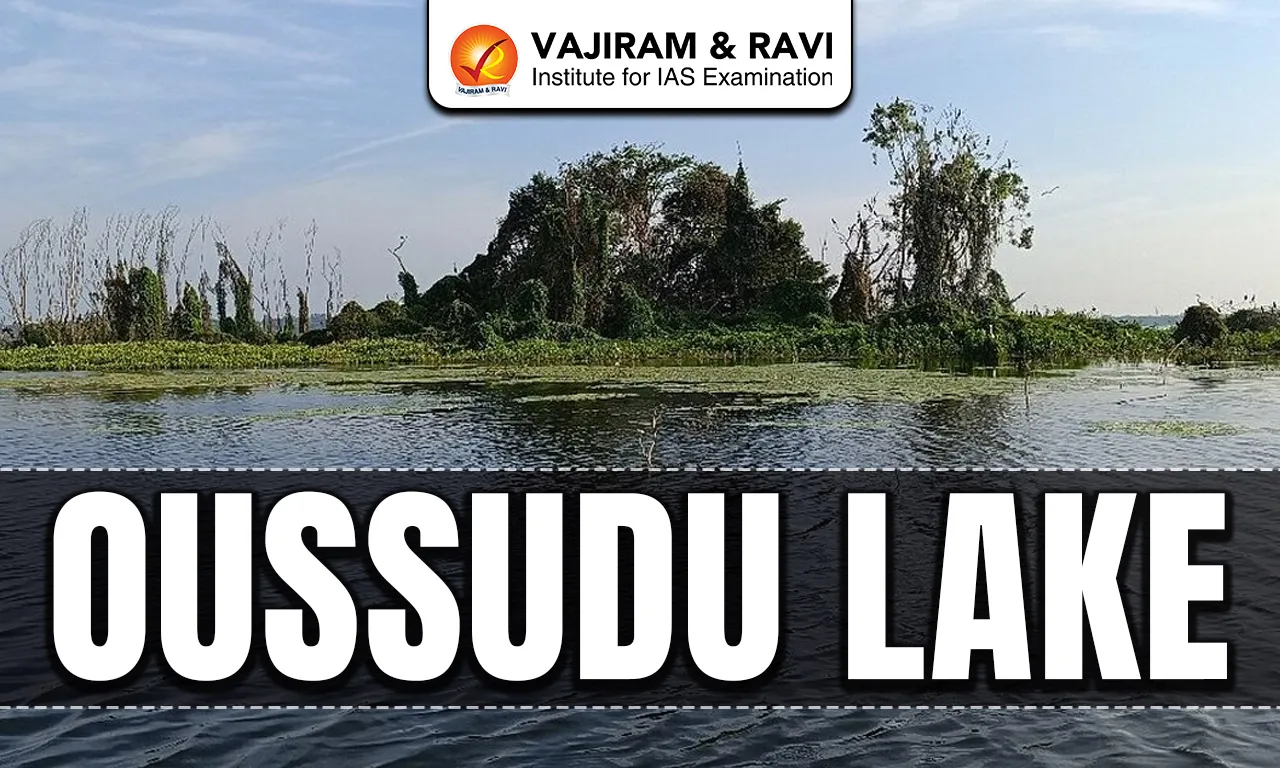
Oussudu Lake is also known as Ousteri or Lac Oustéri. It is a man made freshwater lake located about 10 kilometres from Puducherry town and shared between the Union Territory of Puducherry and Tamil Nadu. It is spread across nearly 800 hectares across Puducherry and Tamil Nadu. It is the largest lake in Puducherry and recognized as one of the important wetlands of Asia by the International Union for Conservation of Nature. The lake forms a complex ecosystem of open water, marshes and mudflats that sustain rich biodiversity.
Oussudu Lake Features
Oussudu Lake is a large transboundary freshwater wetland supporting hydrological balance and ecological stability in the Puducherry region. The major highlighting features of the lake are:
- The lake functions as the single largest freshwater catchment in Puducherry, storing monsoon runoff and regulating seasonal water availability across surrounding villages and agricultural lands.
- Of the total 800 hectare extent, 390 hectares fall under Puducherry administration while the rest lies in Tamil Nadu, making it an inter state ecological asset requiring coordinated governance.
- Constructed as an artificial reservoir, the lake evolved into a dynamic wetland system over time, integrating open water zones, shallow marshes and exposed mudflats.
- The ecosystem includes water bodies of varying depths, peripheral marsh vegetation and seasonal mudflats that provide feeding and nesting grounds for water birds.
- The lake has been recognized among significant Asian wetlands, reflecting its ecological value at a continental scale and its role in supporting migratory avifauna.
- The Puducherry Tourism Development Corporation operates a small boat club on the lake, promoting regulated boating activities for visitors.
- The Puducherry government has proposed upgrading the lake region into a National Park to strengthen legal protection and biodiversity management.
- Plans include installation of bird watching telescopes and development of eco sensitive tourism facilities to balance conservation with public engagement.
Also Read: National Parks in Tamil Nadu
Oussudu Lake Bird Sanctuary
The Oussudu Lake region is legally protected as a notified Bird Sanctuary in India across both Puducherry and Tamil Nadu jurisdictions.
- Sanctuary Declaration in Puducherry: In 2008, wetlands within Puducherry limits were officially declared as the Oussudu Bird Sanctuary, ensuring statutory protection for avifauna and habitat.
- Tamil Nadu Notification: The Tamil Nadu portion received sanctuary status in 2015, strengthening conservation efforts across the entire wetland landscape.
- Formal Establishment: On 11 August 2014, the sanctuary framework was formally recognized through government notification, marking a milestone in structured wetland conservation.
- Sanctuary Area: The protected sanctuary area in Tamil Nadu covers approximately 3.32 square kilometres or 332 hectares dedicated to wetland ecosystem preservation.
- Location: Situated in Viluppuram district and about 10 kilometres from Puducherry town.
- Avian Habitat: The sanctuary supports both resident and migratory birds, with seasonal influxes during winter months due to suitable feeding grounds and shallow water zones.
- Birdwatching Activities: Controlled boating and birdwatching are popular activities, allowing visitors to observe waterfowl without significant disturbance to nesting sites.
Oussudu Lake Biodiversity
Oussudu Lake supports diverse plant and animal communities across terrestrial and aquatic habitats. The key floral and faunal species found in the region are:
Flora
- Tree Species: The wetland landscape includes Acacia auriculiformis, Azadirachta indica (Neem), Bombax ceiba (Red Silk Cotton Tree), Borassus flabellifer (Palmyra Palm) and Ceiba pentandra (Kapok Tree).
- Native Forest: Species such as Ficus benghalensis (Banyan), Ficus religiosa (Peepal), Gmelina arborea and Dalbergia paniculata contribute to canopy cover and micro habitat formation.
- Shrubs and Understory Plants: Plants like Abutilon hirtum, Abutilon indicum, Barleria cristata and Cassia auriculata thrive along moist margins of the lake.
- Invasive and Adaptive Species: Lantana camara and Jatropha species are present in certain stretches, indicating ecological pressure and habitat transformation trends.
- Grassland Vegetation: Grasses such as Chloris barbata and Chrysopogon asper stabilize soil in shallow zones and support invertebrate life.
- Aquatic Support: The mixed vegetation ranging from herbs to tall trees provides roosting, nesting and feeding support for migratory birds during both summer and winter seasons.
Fauna
- Mammalian Species: Terrestrial fauna include Spotted Deer, Jackal, Jungle Cat, Grey Mongoose, Black naped Hare, Asian Palm Civet, Short nosed Fruit Bat and Indian Pangolin.
- Water Birds: Species such as Great White Pelican, Greater Flamingo and Lesser Flamingo are recorded, especially during migratory seasons.
- Raptors and Eagles: Crested Serpent Eagle, White bellied Sea Eagle and Osprey use the wetland for hunting fish and small vertebrates.
- Waders and Shorebirds: Bronze winged Jacana, Grey headed Lapwing, Dunlin and Ruff forage along exposed mudflats rich in invertebrates.
- Woodland Birds: Chestnut winged Cuckoo, Crested Tree Swift, Black capped Kingfisher and Stork billed Kingfisher occupy vegetated zones near water.
- Reptilian Diversity: Reptiles such as Indian Black Turtle, Indian Rock Python, Common Vine Snake, Indian Wolf Snake and Indian Monitor Lizard inhabit surrounding habitats.
- Amphibians: The freshwater system sustains fish, amphibians and aquatic invertebrates that form the base of the wetland food web.
Oussudu Lake Challenges
The Oussudu Lake faces ecological stress due to anthropogenic pressure and environmental degradation affecting its hydrology and biodiversity.
- Plastic Pollution: Vulnerability assessment studies highlight large scale dumping of plastic bags, thermocol, cups, plates, bottles and pipes into canals feeding the lake.
- Disrupted Water Flow: Accumulated plastic waste obstructs monsoon runoff channels, reducing natural water inflow and altering seasonal hydrological cycles.
- Slow Degradation: Nearly two thirds of plastic waste degrades slowly, releasing harmful substances into soil and water bodies over time.
- Ecological Damage: Plastic pollution contaminates water, soil and air, disturbing aquatic organisms and affecting the broader wetland ecosystem.
- Health Risks: Exposure to plastic pollutants is linked to eye irritation, breathing difficulty, liver dysfunction and increased cancer risks in surrounding populations.
Way Forwards
Sustainable management strategies are essential to conserve this inter state Oussudu Lake Wetland ecosystem for future generations.
- Alternative Packaging Promotion: Before enforcing plastic bans, adoption of eco friendly packing materials should be encouraged at household and commercial levels.
- Leaf Based Serving Practices: Hotels and eateries can shift to banana leaf, teak leaf, vanathula leaf and mantharai leaf for food serving and packaging.
- Skill Development: Training programmes should promote local production of biodegradable packaging materials to create livelihood opportunities.
- Strict Enforcement: Strong regulation of plastic production, sale and disposal is required to prevent further accumulation in canals and wetland zones.
- Litter Free Zone Plan: Government renovation initiatives aim to make the lake surroundings plastic free and noise free to improve conditions for migratory birds.
- Conservation Upgradation: Proposal to declare the lake as a National Park can enhance institutional protection, research support and long term ecosystem monitoring.
Oussudu Lake FAQs
Q1: Where is Oussudu Lake located?
Ans: Oussudu Lake is situated about 10 kilometres from Puducherry town and lies across Puducherry and Tamil Nadu, mainly in Viluppuram district of Tamil Nadu.
Q2: How large is Oussudu Lake?
Ans: The lake spreads over nearly 800 hectares, with around 390 hectares in Puducherry and the remaining area in Tamil Nadu.
Q3: When was Oussudu Lake declared a bird sanctuary?
Ans: The Puducherry portion was declared a bird sanctuary in 2008, while the Tamil Nadu section received sanctuary status in 2015.
Q4: What is the major environmental threat to Oussudu Lake?
Ans: Plastic pollution is a key concern, as waste dumped in canals blocks monsoon runoff and contaminates soil and water systems.
Q5: Which international body has recognized Oussudu Lake as an important wetland?
Ans: Oussudu Lake has been recognized as one of the important wetlands of Asia by the International Union for Conservation of Nature, highlighting its ecological significance.

