Important Economic Curves, Concepts, Uses, and Role

Important Economic Curves

Economic curves are graphical tools that represent relationships between key economic variables. They help economists, policymakers, and students visualize trends, understand economic behavior, and make policy decisions. The following are some of the most important economic curves for UPSC aspirants:

Phillips Curve

The Phillips Curve shows the inverse relationship between inflation and unemployment in an economy. It suggests that when unemployment is low, inflation tends to be high, and when unemployment is high, inflation is low.

Significance: It is crucial for monetary and fiscal policy decisions, especially when balancing inflation control and employment generation.

Laffer Curve

The Laffer Curve illustrates the relationship between tax rates and tax collection.

  • It shows that starting from a 0% tax rate, increasing taxes raises revenue, but beyond a certain point, higher tax rates discourage work, investment, and production, leading to lower revenue.
  • The curve is inverted-U shaped, and the point of maximum revenue is called the optimal tax rate.

Significance: It is used in fiscal policy to design tax rates that maximize revenue without reducing economic incentives.

Lorenz Curve

The Lorenz curve, is a graphical representation of income inequality or wealth inequality.

  • It plots the cumulative percentage of total income received by the cumulative percentage of population, starting from the poorest to the richest.
  • The line of equality is a 45-degree line indicating perfect equality. The further the Lorenz curve bends away from this line, the greater the inequality.

Significance: It helps measure economic inequality and is closely related to the Gini coefficient, a quantitative measure of income inequality.

Kuznets Curve

The Kuznets Curve depicts the relationship between economic growth and  inequality.

  • It is inverted-U shaped, suggesting that in the early stages of economic development, inequality increases, but as the economy matures, inequality tends to decrease.

Significance: It is important for understanding development economics and the trade-offs between growth and equity.

Engel Curve

The Engel Curve shows the relationship between income and consumption of a particular good.

  • For normal goods, consumption increases with income, resulting in an upward-sloping curve.
  • For inferior goods, consumption decreases as income rises, resulting in a downward-sloping curve.

Significance: It helps in analyzing consumer behavior, income distribution, and demand patterns, and is fundamental in microeconomics.

Rahn Curve

The Rahn Curve illustrates the relationship between government spending and economic growth.

Similar to the Laffer Curve, it is inverted-U shaped, suggesting that moderate government spending can stimulate growth, but excessive spending reduces growth due to inefficiencies or crowding out of private investment.

Significance: It is used in fiscal policy to determine the optimal size of government expenditure for promoting economic growth.

Beveridge Curve

The Beveridge Curve shows the relationship between unemployment and job vacancies in an economy.

  • It is downward sloping, indicating that when unemployment is high, job vacancies are low, and when unemployment is low, job vacancies are high.
  • Shifts in the curve can indicate structural changes in the labor market, such as mismatches between skills and jobs.

Significance: It helps in analyzing labor market efficiency, unemployment types (frictional, structural), and the effectiveness of employment policies.

J-Curve

The J-Curve is used in international trade to illustrate the effect of currency depreciation on a country’s trade balance.

  • Initially, a currency devaluation worsens the trade balance due to higher import costs.
  • Over time, exports increase and imports decrease, improving the trade balance → curve shaped like the letter “J”.

Significance: Important for exchange rate policy and trade strategy.

Important Economic Curves FAQs

Q1: What is the Phillips Curve?

Ans: It shows an inverse relationship between inflation and unemployment, guiding policymakers on the trade-off between price stability and employment.

Q2: What is the Laffer Curve?

Ans: It depicts the relationship between tax rates and revenue, showing that beyond a certain rate, higher taxes reduce revenue, helping design optimal tax policy.

Q3: What is the Lorenz Curve?

Ans: It represents income or wealth inequality, with deviation from the line of equality indicating the degree of inequality, and is linked to the Gini coefficient.

Q4: What is the Kuznets Curve?

Ans: It shows an inverted-U relationship between economic growth and inequality, suggesting inequality rises in early development stages and falls as the economy matures.

Q5: What is the Engel Curve?

Ans: It depicts how consumption of goods changes with income, rising for normal goods and falling for inferior goods, explaining consumer behavior patterns.


Difference between World Bank and IMF, Objectives, Functions

Difference between World Bank and IMF

The World Bank and the International Monetary Fund (IMF) are often called the “Bretton Woods twins”, as both were established at the Bretton Woods Conference in 1944. While both aim to promote global economic stability, development, and financial cooperation, their objectives, functions, and methods of assistance differ significantly. The Difference between World Bank and International Monetary Fund (IMF) is discussed below in the article.

Difference between World Bank and International Monetary Fund (IMF)

The Difference between World Bank and International Monetary Fund (IMF) has been highlighted below in the table.

Difference between World Bank and International Monetary Fund (IMF)
Aspect World Bank IMF

Establishment

The World Bank was established in 1944 at the Bretton Woods Conference to support post-war reconstruction and development.

The International Monetary Fund was established in 1944 at the Bretton Woods Conference to promote international monetary cooperation.

Objective

The World Bank aims to promote long-term development, reduce poverty, raise living standards, and provide finance and technical assistance for infrastructure, environment, and human capital in developing countries.

The IMF aims to maintain exchange rate stability, ensure balanced international trade, assist countries facing balance of payments problems, provide policy advice, and monitor financial and economic risks.

Membership 

Membership of the World Bank generally requires prior membership of the IMF, although there can be exceptions.

The World Bank has 189 members.

Membership of the IMF is independent, but the quota of each country determines its voting rights, borrowing capacity, and share of Special Drawing Rights.

The IMF has 190 members. 

Headquarters 

Washington DC 

Washington DC 

Source of Funds

The World Bank raises funds through share capital subscribed by member countries based on their GDP and by issuing bonds in international financial markets, which is its main source of funds.

The IMF receives its funds primarily from member quotas, which are calculated based on GDP, openness, economic variability, and reserves. Twenty-five percent is paid in SDRs or widely accepted currencies, while the remaining 75 percent is paid in domestic currency.

Lending / Assistance

The World Bank provides long-term loans, usually 25 to 30 years, and grants for development projects in developing countries. Most of its loans are concessional and are intended for projects that improve infrastructure, human capital, or the environment.

The IMF provides short-term, conditional loans to member countries, primarily to support policy reforms and stabilize economies. Its loans are generally non-concessional and are not intended for specific development projects.

Voting and Leadership

Voting in the World Bank is based on basic votes plus one vote per share held by a member, with basic votes equally allocated to all countries. The highest decision-making body is the Board of Governors, under which is the Board of Directors, and the Bank is headed by a President, who is traditionally from the United States.

Voting in the IMF is based on basic votes plus one vote per quota held in Special Drawing Rights, with basic votes equally allocated to all countries. The Board of Governors is the highest authority, under which is the Executive Board, and the IMF is headed by a Managing Director, who is traditionally from Europe.

Organisational Structure 

All powers of the Bank are vested with the Board of Governors, which is the highest decision-making body under which there is Board of Directors, while the Bank is headed by the President.

It is a convention that the President is always from the US. Every member country appoints a governor (Finance minister) and an alternate governor (RBI governor). The board of governors usually meet once in a year.

All powers of the Bank are vested with the Board of Governors, which is the highest decision-making body under whom there is Board of Directors, while the Bank is headed by the Managing Director.

It is a convention that the Managing Director is always from Europe. Every member country appoints a governor (Finance minister) and an alternate governor (RBI governor). Board of

governors usually meet once in a year.

Reports

The World Bank publishes reports such as the World Development Report, International Debt Statistics,and Global Economic Prospects.

The IMF publishes reports including the World Economic Outlook, Global Financial Stability Report, and Fiscal Monitor.

Role 

The World Bank primarily acts as a financier of long-term development projects aimed at improving living standards and reducing poverty in developing countries.

The IMF primarily acts as a lender of last resort to help countries overcome short-term financial crises and stabilize their economies.

Difference between World Bank and International Monetary Fund FAQs

Q1: What is the difference between the World Bank and IMF?

Ans: The primary difference between the World Bank and IMF is that the World Bank provides long-term financial assistance for development projects, while the IMF provides short-term financial support to stabilize economies and manage balance of payments.

Q2: What are the main objectives of the World Bank and IMF?

Ans: The World Bank aims to promote long-term development, reduce poverty, and finance infrastructure, social, and environmental projects in developing countries. The IMF aims to maintain monetary stability, ensure balanced international trade, and provide policy advice to member countries.

Q3: How do they get their funds?

Ans: The World Bank raises funds through member share capital and bonds in international markets. The IMF receives funds mainly from member quotas, paid partly in SDRs or foreign currency and partly in domestic currency.

Q4: What type of financial assistance do they provide?

Ans: The World Bank provides long-term loans and grants for development projects, mostly concessional. The IMF provides short-term, conditional loans to support policy reforms and stabilize economies.

Q5: How are they governed?

Ans: The World Bank is governed by a Board of Governors and Board of Directors, led by a President (traditionally from the US). The IMF is governed by a Board of Governors and Executive Board, led by a Managing Director (traditionally from Europe).

Convertible Bonds, Types, Advantages, Disadvantages, Work

Convertible bonds

Convertible bonds are a type of investment that have features of both bonds and shares. They give regular income like a bond, but they can also be converted into company shares later. This means investors get the safety of a bond along with the chance to benefit if the company performs well.

About Convertible bonds

  • A convertible bond is a type of investment that works like a mix of a bond and a share. It pays regular interest like a normal bond, but it also gives the investor an option to convert it into a fixed number of company shares after a certain period.
  • This means an investor can first earn steady income and later choose to become a shareholder if the company performs well. The rules for conversion, such as when and how many shares can be received, are decided at the time of issuing the bond.
  • Convertible bonds are usually safer than shares because they provide fixed returns, but they also offer the chance to benefit from rising stock prices. However, the interest rate on these bonds is generally lower than regular corporate bonds because of this added benefit of conversion.

Also Read: Incremental Capital Output Ratio (ICOR)

Types of Convertible Bonds

Convertible bonds come in different forms, but all of them combine features of both bonds and shares. Here are the main types explained in simple terms:

  • Regular Convertible Bonds: These are the most common type. They pay interest at regular intervals and have a fixed maturity date. At the end of the period, investors can choose either to convert the bond into company shares at a fixed price or get back their original investment amount. This gives flexibility to the investor depending on market conditions.
  • Mandatory Convertible Bonds: In this type, conversion into shares is compulsory. Investors do not have the option to get their money back in cash at maturity. These bonds still pay interest, and usually the interest rate is slightly higher because of the compulsory conversion. They are more like a mix leaning towards equity.
  • Reverse Convertible Bonds: These are a bit different. Here, the company (issuer) usually has the right to decide whether the bond will be converted into shares. This decision depends on the company’s share price at maturity. If the share price is favourable, the issuer may convert the bond into shares instead of paying cash. These bonds may offer higher interest rates but can involve higher risk for investors.

Also Read: Capital Adequacy Ratio

Advantages of Convertible Bonds

  • Regular Income through Interest: Convertible bonds provide fixed interest payments at regular intervals, just like normal bonds. In many cases, this interest is higher than the dividends paid by shares, making them a good option for investors who want steady and predictable income.
  • Benefit from Rising Share Prices: These bonds give investors the option to convert them into company shares. If the company’s stock price increases, investors can convert their bonds into shares and benefit from the rise in value. This gives them a chance to earn more compared to a regular bond.
  • Lower Risk Compared to Stocks: Convertible bonds are considered safer than direct investment in shares because they still have bond value. Even if the stock price falls, the investor continues to receive interest, and the bond retains some value. This helps reduce the overall risk.
  • One of the advantages of convertible bonds is that the option to convert to equity affords the bondholder a degree of indexation to rising consumer prices.

Convertible Bonds Disadvantages

  • Lower Interest (Yield): Convertible bonds usually offer lower interest compared to regular bonds of the same quality. This is because they come with an extra benefit the option to convert into shares so investors accept lower returns in exchange for that flexibility.
  • Conversion Premium: Investors often pay a higher price for convertible bonds because of the conversion option. This extra cost is called a conversion premium. It reduces the overall return from the bond, making it slightly less attractive in terms of income.
  • Dilution of Shares: When investors convert their bonds into company shares, the total number of shares in the market increases. This can reduce the value of existing shares and affect current shareholders, as their ownership gets slightly diluted.

How Do Convertible Bonds Work?

Convertible bonds change their behavior depending on how the company’s share price moves. This makes them a flexible and strategic investment.

When the Share Price Falls

  • If the company’s stock price goes down, the bond acts more like a regular bond. In this situation, investors usually keep the bond to continue receiving fixed interest payments and get their money back at maturity.
  • There is also something called the bond floor, which is the minimum value of the bond based on its interest and repayment amount. This ensures that even if the share price drops a lot, the bond does not lose too much value.

When the Share Price Rises

  • If the company’s stock price starts increasing, the bond becomes more valuable. As the share price gets closer to the conversion price (the price at which the bond can be converted into shares), investors may find it more attractive to convert.
  • Once the share price goes above the conversion price, the bond’s value starts rising along with the stock. This allows investors to benefit from stock market gains while still having the safety of a bond if they choose not to convert.

Conversion Ratio of Convertible Bonds

  • A convertible bond gives the investor the option to convert the bond into shares of the company. The conversion ratio tells us how many shares an investor will get when they choose to convert the bond.
  • It is usually fixed in advance and can be shown as the number of shares per bond. For example, one bond may be converted into a certain number of shares based on this ratio.
  • The conversion ratio is very important because it affects how attractive the bond is:
    • If the ratio is low, the investor gets fewer shares, so conversion may not be very appealing.
    • If the ratio is high, the investor gets more shares, making conversion more attractive, especially if the share price is rising.

Convertible Bonds Significance

  • Balance Between Safety and Growth: Convertible bonds provide the safety of regular bonds through fixed interest, while also offering the chance to earn higher returns if the company’s share price increases.
  • Flexible Investment Option: They give investors a choice to either continue earning interest like a bond or convert into shares to benefit from stock market gains. This flexibility makes them attractive to different types of investors.
  • Lower Risk Compared to Stocks: Since they are partly bonds, they are less risky than directly investing in shares. Even if the stock price falls, investors still receive interest payments.
  • Cost-Effective for Companies: Companies can raise funds at lower interest rates compared to normal bonds because investors are attracted by the conversion option.
  • Supports Capital Growth: When converted into shares, these bonds help companies increase their equity base, which can support business expansion and growth.
  • Useful in Changing Market Conditions: Convertible bonds perform well in both rising and falling markets. They provide stability during downturns and growth potential during uptrends.

Convertible Bonds FAQs

Q1: What are convertible bonds?

Ans: Convertible bonds are investments that combine features of both bonds and shares. They provide regular interest and can later be converted into company shares.

Q2: How do convertible bonds work?

Ans: They act like bonds when stock prices fall (giving fixed income) and like shares when stock prices rise (offering growth through conversion).

Q3: What are the main types of convertible bonds?

Ans: The main types are Regular (optional conversion), Mandatory (compulsory conversion), and Reverse convertible bonds (conversion decided by the issuer).

Q4: What is the conversion ratio?

Ans: It is the number of shares an investor receives when converting a bond into equity. A higher ratio means more shares and better conversion value.

Q5: What are the advantages of convertible bonds?

Ans: They provide regular income, potential for higher returns through stock conversion, and lower risk compared to direct stock investment.

Post Office Act 2023, Objectives, Need, Highlights, Issues

Post Office Act 2023

The Post Office Act 2023 came into force, replacing the old Indian Post Office Act, 1898, which had been in place for more than 125 years. Although the law was passed earlier in December 2023 by both Houses of Parliament, its implementation started later in 2024. This change marks an important step in modernizing India’s postal system.

Post Office Act 2023 Objectives

  • The main aim of the new Act is to make postal services more efficient and useful for people. It focuses on improving the delivery of citizen-centric services, especially in rural and remote areas where post offices play a very important role.
  • The Act also aims to:
    • Help in better delivery of government schemes and benefits to people across the country
    • Modernize the legal framework related to postal services and stamp systems
    • Improve the overall quality of services and make them more reliable and accessible
    • Support the transformation of post offices into multi-service centers, not just mail delivery units

Post Office Act 2023 Need

  • The Indian Post Office Act, 1898 was originally made to manage basic postal services like sending letters and parcels. At that time, post offices were mainly used for communication through mail.
  • However, over the years, the role of post offices has changed a lot. Today, they provide many additional services such as:
    • Banking and financial services
    • Insurance and savings schemes
    • Delivery of government benefits and welfare schemes
    • E-commerce parcel delivery and logistics support
  • Because of these major changes, the old law became outdated and was no longer suitable for modern needs. It did not cover the expanded role of post offices or the use of new technology.

Post Office Act 2023 Key Highlights

  • Power to Intercept and Detain Postal Items (Section 9): The Act gives the Central Government the power to allow certain officers to stop, open, or detain any postal item when needed. This can be done for important reasons such as national security, maintaining public order, protecting public safety, or maintaining good relations with other countries.
  • Exemption from Liability (Section 10): The Act states that the Post Office and its officers will generally not be held responsible for any loss, delay, wrong delivery, or damage to postal items during service. However, if specific rules mention liability, then it may apply. Postal officials are only held responsible if there is intentional wrongdoing such as fraud or deliberate negligence.
  • Removal of Penalties and Offences: One major change in the new Act is that it removes all penalties and offences that existed under the old Indian Post Office Act, 1898. Earlier, there were strict punishments for actions like misconduct, fraud, or theft by postal officials, but these have now been removed from the law.
  • Payment of Postal Charges and Recovery (Section 7): The Act clearly states that anyone who uses postal services must pay the required charges. If a person refuses or fails to pay, the amount can be recovered by the government in the same way as unpaid land revenue, making it a legally enforceable payment.
  • Removal of Government’s Exclusive Rights: Earlier, the government had exclusive control over sending letters through post. The new Act removes this exclusivity, as private courier services have already become common since the 1980s. Now, private courier services are also brought under the regulatory scope of the Act, ensuring better control and oversight.
  • Role of the Director General of Postal Services: The Act gives more authority to the Director General of Postal Services. The Director General can make rules and regulations related to postal services, including setting charges and managing operations.
  • Addressing System and Use of Postcodes (Section 5): The Act allows the government to set standards for writing addresses and using postcodes. It also introduces the idea of modern systems like digital address codes based on location, which can make delivery more accurate and efficient in the future.
  • Special Powers in Certain Situations: The government can take special actions like stopping or inspecting postal items if they threaten the country’s security, public safety, or violate any law.
  • Restrictions on Sending Certain Items: The Act prohibits sending dangerous items through post. This includes explosives, harmful or dirty substances, unprotected sharp objects, and any living creature that may cause harm or damage to other postal items. This rule ensures safety in postal services.
  • Regulation of Private Courier Services: The new law recognizes the role of private courier companies and brings them under regulation. This is important because earlier the government had full control, but now the system is more open and inclusive while still being monitored.

Post Office Act 2023 Key Issues

  • Different Rules for Postal and Courier Services: One major issue is that postal services provided by India Post are not covered under the Consumer Protection Act, 2019, while private courier services are covered under it.
  • Lack of Proper Safeguards for Interception: The Act allows the government to intercept or open postal items, but it does not clearly mention proper procedures or safeguards. This raises concerns about misuse of power and may affect people’s right to privacy and freedom of speech. In the case of People’s Union for Civil Liberties vs Union of India (1996), the Supreme Court said that any such power must follow a fair and proper procedure to protect citizens' rights.
  • Vague Meaning of ‘Emergency’: The Act allows actions like interception during an “emergency,” but it does not clearly define what counts as an emergency. This makes the provision unclear and may lead to misuse, as authorities can interpret it in different ways.
  • No Strong System for Complaints or Compensation: Unlike railway services, which have proper systems under the Railway Claims Tribunal Act, 1987 to handle complaints and compensation, the Post Office Act does not provide a strong mechanism for dealing with issues like loss, delay, or damage of items.
  • Exemption from Liability: The Act protects the Post Office and its officers from being held responsible for most service failures like delay or damage. This may reduce accountability and leave customers without proper remedies.
  • Removal of Offences and Penalties: The new Act removes earlier punishments for offences like illegally opening mail, fraud, or misconduct by postal officials (which existed under the Indian Post Office Act, 1898). This can be a concern because it may weaken protection of privacy and reduce strict action against misuse.

Post Office Act 2023 Significance

  • Moves Away from Colonial Laws: Replaces the Indian Post Office Act, 1898 and removes outdated colonial provisions, making the law more relevant today.
  • Reflects Changing Role of Post Offices: Expands beyond mail services to include banking, insurance, and government services like India Post Payments Bank.
  • Greater Autonomy and Flexibility: Allows postal authorities to fix charges and manage operations without constant parliamentary approval.
  • Regulation of Private Couriers: Brings private courier services under a legal framework to ensure accountability and prevent misuse.
  • Adapts to the Digital Era: Promotes use of technology, digital addressing, and modern delivery systems.
  • Improves Service Delivery: Enhances efficiency and helps deliver services better, especially in rural and remote areas.

Post Office Act, 2023 FAQs

Q1: What is the Post Office Act, 2023?

Ans: It is a new law that replaced the Indian Post Office Act, 1898 to modernize India’s postal system.

Q2: Why was the 1898 Act replaced?

Ans: Because it only focused on mail services and became outdated as post offices now provide many other services.

Q3: What is the main objective of the Act?

Ans: To improve postal services and ensure better delivery of government services, especially in rural areas.

Q4: What powers does the Act give to the government?

Ans: It allows interception of postal items for security reasons and better control over postal services.

Q5: How does it affect private courier services?

Ans: It brings private courier services under regulation for better monitoring and accountability.

Special Drawing Rights (SDR), Meaning, Value, Currencies, Uses

Special Drawing Rights (SDR)

Special Drawing Rights (SDR) are an international reserve asset created by the International Monetary Fund (IMF) to enhance global liquidity, support financial stability, and supplement the foreign exchange reserves of member countries.

Special Drawing Rights (SDR) is not a currency, it cannot be used directly for buying goods or services; it functions as an accounting unit for IMF transactions with member countries and a stable asset in countries’ international reserves. It is not a foreign aid, an SDR allocation does not add to any country’s public debt burden.

Special Drawing Rights (SDR) Value

Special Drawing Rights (SDR) Value was initially defined in terms of gold (0.888671 grams), which was equivalent to one US dollar at that time. After the collapse of the Bretton Woods system in 1973, SDR was redefined as a basket of currencies.

  • Currently, the value of Special Drawing Rights (SDR) is based on a basket of five currencies - dollar, euro, Japanese yen, pound sterling and the Chinese Renminbi.
  • Criteria for Inclusion in SDR Basket: A currency must satisfy two key conditions: 
    • Export Criterion: A currency meets the export criterion if the issuing country is an IMF member (or a monetary union that includes IMF members) and one of the top five world exporters.
    • Freely Usable Criterion: A currency meets the freely usable criterion if it is widely used in payments for international transactions and widely traded in the principal exchange markets.
  • The value of Special Drawing Rights (SDR) is decided every day by the International Monetary Fund. It is calculated using the exchange rates of a basket of major currencies, based on market rates around noon in London. 
  • This value is published daily on the IMF website for transparency.
  • The value of Special Drawing Rights (SDR) is denominated in terms of dollars. 
  • The IMF reviews the SDR basket every five years, or earlier if required, to reflect changes in the global economy.
    • For Example: In the 2015 review, the IMF recognized the growing importance of China and included the Chinese Renminbi (RMB) in the SDR basket.
  • The IMF fixes the quantity (units) of each currency in the basket for five years. Suppose the SDR basket contains 2 US Dollars and 1 Euro. These quantities remain fixed for 5 years. However, their relative importance (weights) changes daily due to exchange rate movements. For example, if 1 US Dollar equals ₹80 and 1 Euro equals ₹90 today, and the next day the Dollar strengthens to ₹85 while the Euro weakens to ₹88, the overall value composition of the basket changes. As the US Dollar becomes stronger, it contributes more to the total value of the SDR. Consequently, the relative importance or weight of the Dollar in the SDR increases, even though the actual quantity of currencies in the basket remains unchanged.

Who can hold Special Drawing Rights (SDR)

Special Drawing Rights (SDR) are held by countries (through their central banks or governments) that are members of the International Monetary Fund. They can also be held by some international institutions, but not by individuals or private companies.

  • All member countries of the International Monetary Fund can hold SDRs as part of their official foreign exchange reserves. 
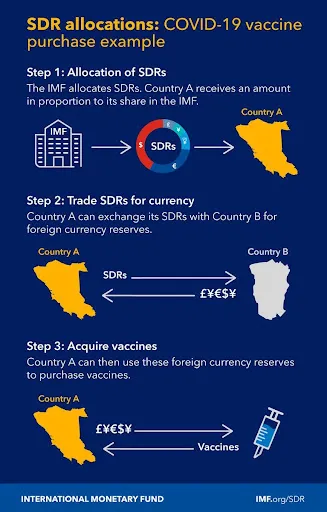
  • The IMF allocates SDRs to its members in proportion to their quota.
    • For example, If the IMF allocates $650 billion worth of SDRs globally and a country has a 2% quota, it will receive 2% of SDRs (≈ $13 billion).
  • IMF quota is the financial contribution (subscription) that each member country makes to the International Monetary Fund when it joins. IMF quota determines subscription, voting power, borrowing limits, and SDR allocation
  • IMF quota is determined by indicators like GDP, trade openness, and foreign exchange reserves, hence countries with stronger economies receive a larger share of SDRs.
  • India's share in SDR allocation (quota) is 2.75% and voting power in IMF is 2.63%
  • The first allocation was done in 1970-72. The most recent allocation of Special Drawing Rights (SDR) was made in August 2021 by the IMF to SDR 456 billion (approximately $650 billion), the largest allocation in history, to support global liquidity during the COVID-19 crisis. The allocation was distributed among member countries in proportion to their IMF quotas.

Uses and Features of Special Drawing Rights (SDR) 

Special Drawing Rights (SDR) serve as an important international reserve asset that provides liquidity, supports financial stability, and facilitates transactions within the global monetary system.

  • SDRs do not exist in the form of notes or coins; they are not a physical currency. Hence, they are often referred to as “paper gold” or a notional currency.
  • SDRs cannot be held by private individuals or entities; only governments, central banks, and approved international institutions can hold them.
  • SDRs cannot be used directly to buy goods and services in international trade.
  • Instead, countries exchange SDRs for freely usable currencies such as US Dollar, Euro, Yen, Pound, and Yuan through IMF-facilitated arrangements.
  • These exchanges take place through voluntary trading arrangements among IMF member countries, ensuring liquidity in the global system.
  • SDRs function as an interest-bearing reserve asset - If a member purchases SDRs and its holdings rise above its allocation, it earns interest on the excess. Conversely if it sells SDRs and holds fewer SDRs than allocated, it pays interest on the shortfall.
[caption id="" align="aligncenter" width="327"]sdr allocations Sourse: imf.org[/caption]
Special Drawing Rights (SDR) Significance 

Special Drawing Rights (SDR) hold significant importance in the global financial system as they enhance liquidity, strengthen reserves, and support economic stability, especially during times of crisis.

  • Special Drawing Rights (SDR) provide non-debt creating liquidity, helping countries strengthen foreign exchange reserves without increasing borrowing.
  • They play a key role in managing balance of payments crises, allowing countries to access foreign currency during external shocks.
  • SDRs contribute to global financial stability by acting as a safety net, especially during crises like the COVID-19 pandemic.
  • Being based on a basket of currencies, SDRs help reduce dependence on a single dominant currency such as the US dollar.
  • They support developing countries by providing additional reserves, though allocation remains unequal due to quota-based distribution.

Special Drawing Rights FAQs

Q1: What are Special Drawing Rights (SDR)?

Ans: Special Drawing Rights (SDR) are an international reserve asset created by the International Monetary Fund in 1969 to supplement the official reserves of member countries.

Q2: Why are Special Drawing Rights (SDR) important?

Ans: Special Drawing Rights (SDR) play a crucial role in providing global liquidity, especially during economic crises. They help countries meet balance of payments needs without increasing debt and reduce dependence on dominant currencies like the US dollar, thereby contributing to a more stable international monetary system.

Q3: How is the value of Special Drawing Rights (SDR) determined?

Ans: The value of Special Drawing Rights (SDR) is based on a basket of five major currencies - US Dollar, Euro, Chinese Yuan, Japanese Yen, and British Pound. It is calculated daily by the IMF using market exchange rates, ensuring that SDR reflects real-time global currency movements.

Q4: Can Special Drawing Rights (SDR) be used like money?

Ans: Special Drawing Rights (SDR) cannot be used directly to buy goods or services, as they are not a physical currency. However, countries can exchange SDRs with other IMF members for freely usable currencies, which can then be used for trade, payments, or debt obligations.

Q5: Who can hold and use Special Drawing Rights (SDR)?

Ans: Special Drawing Rights (SDR) are held by IMF member countries, typically through their central banks or governments, as part of official reserves. They can also be held by certain approved international institutions, but not by private individuals or companies.

Niyamgiri Movement, Causes, Importance, Dongoria Kondhs

Niyamgiri Movement

The Niyamgiri Movement refers to the struggle led by the Dongria Kondh tribe against bauxite mining in the Niyamgiri Hills of Odisha. The movement opposed the proposal by Vedanta Resources, a multinational mining company, to extract bauxite from the hills, which are considered sacred by the tribal community.

The movement began in the early 2000s and became a powerful symbol of the fight for tribal rights, environmental conservation, and sustainable development.

Niyamgiri Movement Causes

The Niyamgiri Movement emerged due to the conflict between industrial mining interests and the rights of indigenous communities over their land and resources. 

  • Violation of Tribal Rights: The mining project ignored the rights of the Dongria Kondh under the Forest Rights Act, 2006, threatening their traditional ownership of forest land.
  • Religious and Cultural Threat: The Niyamgiri Hills are sacred to the tribe, who worship Niyam Raja. Mining was seen as an attack on their faith and identity.
  • Environmental Degradation: Large-scale mining would lead to deforestation, soil erosion, and loss of biodiversity in an ecologically sensitive region.
  • Livelihood Loss: The tribal community depends on forests for food, water, and shelter. Mining would disrupt their sustainable way of life.
  • Displacement and Rehabilitation Issues: The project risked displacing thousands of tribal families without proper rehabilitation measures.
  • Corporate Exploitation Concerns: The involvement of a multinational company raised fears of exploitation of natural resources without benefiting local communities.
  • Lack of Consent (Gram Sabha Ignored): The project initially moved forward without proper consent from local Gram Sabhas, violating democratic processes.

Niyamgiri Movement Importance

The Niyamgiri Movement is highly significant as it highlights the protection of tribal rights, environmental conservation, and democratic decision-making in India.

  • Protection of Tribal Rights: It safeguarded the rights of the Dongria Kondh tribe over their ancestral land under the Forest Rights Act, 2006.
  • Environmental Conservation: The movement prevented large-scale deforestation and protected the rich biodiversity of the Niyamgiri Hills.
  • Empowerment of Gram Sabhas: It strengthened the role of village councils by giving them the authority to decide on development projects affecting their land.
  • Landmark Judicial Precedent: The Supreme Court’s decision became a milestone in promoting decentralized governance and tribal autonomy.
  • Promotion of Sustainable Development: It emphasized that development should be inclusive and not harm nature or local communities.
  • Global Recognition: The movement gained international attention as a successful example of indigenous resistance and environmental justice.
  • Model for Future Movements: It inspired similar protests across India against environmentally harmful and socially unjust projects.

Who are the Dongoria Kondhs?

The Dongria Kondh are an indigenous tribal community living in the Niyamgiri Hills of Odisha, mainly in the Rayagada and Kalahandi districts. They are known for their deep connection with nature and depend on forests for food, livelihood, and shelter. The community practices sustainable agriculture and worships Niyam Raja, considering the hills sacred. They gained national recognition for leading the Niyamgiri Movement against bauxite mining to protect their land and culture.

About Niyamgiri Hill

  • The Niyamgiri Hills are located in the Odisha, mainly across Kalahandi and Rayagada districts.
  • These hills are part of the Eastern Ghats mountain range and are known for their rich mineral deposits, especially bauxite.
  • They are home to the Dongria Kondh tribe, a Particularly Vulnerable Tribal Group (PVTG).
  • The hills are considered sacred, and the tribe worships Niyam Raja, their supreme deity.
  • Niyamgiri Hills are rich in biodiversity, including dense forests, rare wildlife, and medicinal plants.
  • They act as a water source, giving rise to important rivers like Vamsadhara and Nagavali.
  • The region supports traditional livelihoods such as shifting cultivation (podu farming), hunting, and gathering forest produce.
  • The hills are an ecologically sensitive zone, crucial for maintaining regional climate and ecology.

Niyamgiri Movement FAQs

Q1: What is the Niyamgiri Movement?

Ans: It is a tribal-led protest against bauxite mining in Odisha’s Niyamgiri Hills.

Q2: Which tribe led the movement?

Ans: The Dongria Kondh tribe led the movement.

Q3: Which company was involved in the mining project?

Ans: Vedanta Resources planned the mining project.

Q4: What was the Supreme Court’s role?

Ans: It allowed Gram Sabhas to decide on mining, leading to its rejection.

Q5: Why is the movement important?

Ans: It protects tribal rights, environment, and promotes sustainable development.

Capital Adequacy Ratio (CAR), Meaning, Importance, Purpose

Capital Adequacy Ratio

Capital Adequacy Ratio (CAR) is a key indicator of a bank’s financial health, measuring the proportion of its capital to its risk-weighted assets. It ensures that banks have sufficient capital to absorb potential losses, protect depositors, and maintain stability in the financial system. By linking capital to the riskiness of assets, CAR serves as an essential tool for regulators to monitor banking resilience and promote prudent lending practices.

Capital Adequacy Ratio (CAR) Meaning and Definition

The Capital Adequacy Ratio (CAR), also called the Capital-to-Risk Weighted Assets Ratio (CRAR), shows how much capital a bank has compared to the risk of its loans and investments. It indicates whether a bank has enough financial cushion to cover losses and stay safe without risking depositors’ money.

CAR = (Tier 1 Capital + Tier 2 Capital) ÷ Risk — Weighted Assets × 100

Tier 1 Capital (Core Capital): This is the permanent and most reliable capital of a bank, including common equity, retained earnings, and disclosed reserves. Tier 1 capital acts as the primary line of defense against losses, providing a foundation for the bank’s financial stability.

Additional Tier 1 Capital (AT1): Instruments like perpetual bonds and hybrid debt that can absorb losses while the bank continues operations. Dividends on AT1 instruments are discretionary and these are subordinate to depositors and other creditors.
Tier 2 Capital (Supplementary Capital): Capital that can absorb losses if a bank fails. It includes subordinated debt, revaluation reserves, and other hybrid instruments with a maturity greater than five years. Tier 2 provides additional but less permanent protection.
Risk-Weighted Assets (RWA): Not all assets carry the same risk. Each asset, including loans, investments, and off-balance sheet exposures, is weighted based on its risk profile. For instance Government securities have almost 0% risk weight while personal loans and unsecured lending May have 100% risk weight.

This system ensures that banks holding riskier assets must maintain a higher level of capital to safeguard depositors

Importance and Purpose of CAR

CAR serves several crucial functions in the banking and financial system:

  • Financial Stability: By maintaining an adequate capital buffer, banks can absorb losses during economic downturns or financial shocks, reducing the risk of insolvency.
  • Depositor Protection: CAR ensures that banks have sufficient capital to safeguard depositors’ funds even in adverse scenarios.
  • Regulatory Oversight: Central banks and international frameworks like Basel III use CAR to monitor banks and enforce minimum capital requirements.
  • Prudent Lending Practices: CAR discourages excessive risk-taking and encourages banks to allocate capital responsibly across assets.
  • Economic Growth: Well-capitalized banks are in a position to lend confidently, supporting businesses and the broader economy.

Example:

Suppose a bank has:

  • Tier 1 capital = ₹1,200 crore
  • Tier 2 capital = ₹800 crore
  • Risk-weighted assets = ₹15,000 crore

CAR = (Tier 1 Capital + Tier 2 Capital) ÷ Risk-Weighted Assets × 100

CAR = (1,200 + 800) ÷ 15,000 × 100 = 13.33%

If the regulatory minimum CAR is 9%, this bank is well-capitalized, indicating strong financial health.

Regulatory Standards for Capital Adequacy Ratio (CAR)

Capital Adequacy Ratio (CAR) is closely monitored by regulators to ensure that banks have sufficient capital to absorb losses and remain solvent. To maintain financial stability, minimum CAR standards are set both globally and in India.

  • Basel III Global Norms: Banks around the world are required to maintain a minimum CAR of 8%, which includes a capital conservation buffer of 2.5% bringing the effective requirement to 10.5% total. This buffer acts as an additional cushion to protect banks during financial stress or economic downturns.
  • Reserve Bank of India (RBI) Requirements: In India, the RBI enforces stricter standards to safeguard the domestic banking system. Indian banks must maintain a minimum CAR of 9%. Additionally, Systemically Important Banks (SIBs), those whose failure could disrupt the financial system, are required to hold extra capital buffers, raising their CAR requirement up to 12%.

Consequences of Non-Compliance: Banks that fall below the required CAR face regulatory restrictions. These may include:

  • Limits on lending to customers
  • Restrictions on dividend payments to shareholders
  • Restrictions on business expansion or undertaking new investments

By enforcing these standards, regulators ensure that banks maintain a strong financial base, protect depositors’ funds, and contribute to the overall stability of the financial system.

Impact of Capital Adequacy Ratio (CAR) on Banking Operations and Customers

While Capital Adequacy Ratio (CAR) is primarily a regulatory measure, it indirectly affects customers and investors:

  • Loan Availability: Banks with a strong CAR can expand credit availability, offering competitive loan rates.
  • Deposit Safety: A higher CAR reassures depositors that their funds are protected even in adverse situations.
  • Investor Confidence: For investors, a high CAR signals long-term stability and resilience of the bank.
  • Economic Stability: By ensuring banks are financially sound, CAR contributes to the overall stability of the financial system and reduces the likelihood of banking crises.

Determinants of Capital Adequacy Ratio (CAR)

Several factors affect the capital adequacy of a bank:

  • Quality of Assets: High levels of non-performing assets (NPAs) reduce capital and weaken CAR.
  • Profitability: Higher retained earnings increase Tier 1 capital and strengthen CAR.
  • Risk Management Practices: Effective monitoring and mitigation of credit, market, and operational risks influence required capital.
  • Regulatory Environment: Central banks may adjust CAR norms during economic stress periods to ensure stability.
  • Ability to Raise Capital: Access to equity, subordinated debt, or hybrid instruments impacts CAR maintenance.

Limitations of Capital Adequacy Ratio (CAR)

  • CAR does not account for liquidity risk or the possibility of sudden runs on the bank.
  • The ratio can be influenced by accounting practices, potentially understating risk exposure.
  • CAR measures capital adequacy but does not directly indicate profitability or operational efficiency.

Previous Year Question 

Consider the following statements: [2018]

(i) Capital Adequacy Ratio (CAR) is the amount that banks have to maintain in the form of their own funds to offset any loss that banks incur if the account-holders fail to repay dues.

(ii) CAR is decided by each individual bank.

Which of the statements given above is/are correct?

(a) (i) only

(b) (ii) only

(c) Both (i) & (ii)

(d) Neither (i) nor (ii)

Capital Adequacy Ratio FAQs

Q1: What is Capital Adequacy Ratio (CAR)?

Ans: Capital Adequacy Ratio (CAR) measures the proportion of a bank’s capital to its risk-weighted assets, showing its ability to absorb losses and protect depositors.

Q2: Why is Capital Adequacy Ratio (CAR) important?

Ans: CAR ensures banks maintain sufficient capital to withstand losses, promotes financial stability, and encourages prudent lending.

Q3: How is Capital Adequacy Ratio (CAR) calculated?

Ans: Capital Adequacy Ratio (CAR) = (Tier 1 Capital + Tier 2 Capital) ÷ Risk-Weighted Assets × 100. Tier 1 is core capital, Tier 2 is supplementary, and risk-weighted assets reflect the riskiness of loans and investments.

Q4: What are the regulatory requirements?

Ans: Globally, Basel III mandates minimum CAR of 8%, while RBI requires 9% for Indian banks, with higher buffers for systemically important banks.

Q5: What factors affect Capital Adequacy Ratio (CAR)?

Ans: CAR depends on asset quality, profitability, risk management, and the bank’s ability to raise capital. Poor asset quality or high NPAs reduce CAR, while strong earnings and prudent risk control improve it.

Incremental Capital Output Ratio (ICOR), Meaning, Formula, Role

Incremental Capital Output Ratio

Incremental Capital Output Ratio (ICOR) is an important macroeconomic indicator used to assess the efficiency of investment in an economy. It is widely used in economic planning, especially in developing economies, to estimate how much investment is required to achieve a desired rate of growth.

Incremental Capital Output Ratio (ICOR) Meaning

Incremental Capital Output Ratio (ICOR) refers to the amount of additional capital required to produce one additional unit of output. In simple terms, it shows how efficiently new investment is converted into economic growth.

ICOR = Change in Capital / Change in Output
ICOR is also expressed as = Investment (% of GDP) / Growth Rate (% of GDP)

It shows how much of a country’s resources need to be invested to achieve a certain rate of growth

Incremental Capital Output Ratio (ICOR) Implications

ICOR captures the productivity of capital:

  • If ICOR is low, it means the economy is able to generate more output with less investment → high efficiency.
  • If ICOR is high, it implies more investment is needed to produce the same output → low efficiency.

Example

Suppose India’s ICOR is 5. This means that ₹5 of additional capital is required to produce ₹1 of additional output.

Investment (% of GDP) = ICOR × Growth Rate. If India aims for 8% GDP growth and ICOR is 5. Then Investment needed = 5 × 8 = 40% of GDP. If efficiency improves and ICOR reduces to 4: Investment needed = 4 × 8 = 32% of GDP.
This shows that better efficiency reduces the need for high investment while achieving the same growth.

Incremental Capital Output Ratio (ICOR) Significance

The Incremental Capital Output Ratio (ICOR) is significant as it is a: 

  • Planning Tool: Helps governments estimate the level of investment required to achieve target growth rates.
  • Indicator of Efficiency: Reflects how effectively capital is being used in the economy.
  • Policy Guidance: A rising ICOR signals inefficiency and the need for reforms in infrastructure, governance, or technology.
  • Comparative Analysis: Allows comparison of investment efficiency across countries or sectors.

Determinants of Incremental Capital Output Ratio (ICOR) 

ICOR is not fixed; it depends on several structural factors:

  • Quality of Governance: Efficient policies reduce wastage of capital
  • Human Capital: Skilled labour improves productivity of machines. 
    • If workers are unskilled and unable to operate machines properly, the output produced will be lower even if investment remains the same. 
  • Technology: Better technology leads to higher output from the same capital
  • Infrastructure: Strong infrastructure ensures effective utilization of investment
  • Institutional Efficiency: Ease of doing business and regulatory environment

Incremental Capital Output Ratio FAQs

Q1: What is Incremental Capital Output Ratio (ICOR)?

Ans: Incremental Capital Output Ratio (ICOR) is a macroeconomic measure that shows how much additional capital is required to produce one additional unit of output.

Q2: Why is Incremental Capital Output Ratio (ICOR) important for economic planning?

Ans: Incremental Capital Output Ratio (ICOR) is important because it helps policymakers estimate the level of investment needed to achieve a targeted growth rate.

Q3: What does a high or low Incremental Capital Output Ratio (ICOR) indicate?

Ans: A low Incremental Capital Output Ratio (ICOR) indicates that an economy is efficient, as it is able to generate more output with less investment. In contrast, a high ICOR suggests inefficiency, meaning that more capital is required to achieve the same level of output, often due to structural issues such as poor infrastructure or low productivity.

Q4: How is Incremental Capital Output Ratio (ICOR) related to economic growth?

Ans: Incremental Capital Output Ratio (ICOR) has a direct relationship with economic growth, as it helps determine how much investment is needed to achieve a certain growth rate.

Q5: What factors influence Incremental Capital Output Ratio (ICOR)?

Ans: Incremental Capital Output Ratio (ICOR) is influenced by factors such as the quality of governance, level of technological advancement, skill level of the workforce, infrastructure development, and overall institutional efficiency.

Difference between Asteroid And Meteoroid, Origin, Impact

Difference between Asteroid And Meteoroid

Asteroids and meteoroids are both small objects found in space, but they are different in size and nature. Asteroids are larger rocky bodies that orbit the Sun, mostly found in regions like the asteroid belt. Meteoroids are much smaller pieces of rock or spatial matter, often formed from broken parts of asteroids or comets.

Difference between Asteroid And Meteoroid

The key differences between them are discussed below.

Difference between Asteroid And Meteoroid

Aspect

Asteroid

Meteoroid

Meaning

Asteroids are large rocky bodies that orbit the Sun and are often called minor planets.

Meteoroids are small pieces of rock or spatial matter that travel through space.

Size

Much larger, usually ranging from a few meters to hundreds of kilometers in diameter.

Much smaller, usually from tiny dust particles to a few meters in size.

Origin

Formed from leftover material during the formation of planets in the early solar system.

Formed from fragments of asteroids or comets that have broken apart.

Orbit

Move in stable and well-defined orbits around the Sun.

Also orbit the Sun but can easily change their path due to gravity or collisions.

Location

Mostly found in the asteroid belt between Mars and Jupiter, though some exist elsewhere.

Found throughout the solar system and may enter Earth’s atmosphere.

Behavior in Atmosphere

Remain in space and do not produce light.

Burn due to friction when entering Earth’s atmosphere, creating shooting stars (meteors).

Stability

Generally stable and do not change their paths frequently.

Less stable and more likely to collide with planets or other objects.

Composition

Mainly made of rock and metals like iron and nickel.

Made of rock, metal, or a mixture of both, depending on their origin.

Impact

Rarely collide with Earth due to their stable orbits.

Can enter Earth’s atmosphere and sometimes reach the surface as meteorites.

About Asteroids

  • Asteroids are small rocky objects that move around the Sun. They are mostly found in a region called the asteroid belt, which lies between the planets Mars and Jupiter. These objects can be very small, just a few meters wide, or very large, reaching hundreds of kilometers in size.
  • Asteroids are mainly made of rock and metal, such as iron and nickel, similar to the materials found on Earth and other rocky planets. They are often called “minor planets” because they are larger than meteoroids but smaller than planets. Most asteroids do not have an atmosphere, but larger ones have enough gravity to attract nearby objects, and some even have small moons.
  • These space rocks were formed about 4.6 billion years ago during the early formation of the solar system. At that time, dust and gas came together to form planets, but some leftover material did not become part of any planet. Over time, this leftover material broke into pieces due to collisions, forming the asteroids we see today.
  • Asteroids usually follow stable paths (orbits) around the Sun, so they rarely collide with planets. Scientists study asteroids because they provide important information about how the solar system formed and evolved over time.

About Meteoroids

  • Meteoroids are very small pieces of rock or metal that travel through space. They are much smaller than asteroids and can range in size from tiny dust particles to a few meters wide. Most meteoroids come from broken pieces of asteroids or comets due to collisions or other space forces.
  • When a meteoroid enters the Earth’s atmosphere, it heats up due to friction and burns, creating a bright streak of light in the sky. This glowing trail is called a meteor, often known as a “shooting star.” Most meteoroids burn up completely before reaching the ground. However, if a part of it survives and lands on Earth, it is called a meteorite.
  • Meteoroids are usually harmless because they are small and burn up in the atmosphere. But larger ones can cause explosions in the air, producing shock waves and sometimes damage on the ground.

Difference between Asteroid And Meteoroid

Q1: What is an asteroid?

Ans: An asteroid is a large rocky object that orbits the Sun, mostly found in the asteroid belt between Mars and Jupiter.

Q2: What is a meteoroid?

Ans: A meteoroid is a small piece of rock or metal in space, usually formed from broken parts of asteroids or comets.

Q3: What is the main difference between an asteroid and a meteoroid?

Ans: Asteroids are much larger and have stable orbits, while meteoroids are smaller and can easily change their path or enter a planet’s atmosphere.

Q4: What happens when a meteoroid enters Earth’s atmosphere?

Ans: It burns due to friction and creates a bright streak of light called a meteor (shooting star).

Q5: What is a meteorite?

Ans: A meteorite is a part of a meteoroid that survives burning and reaches the Earth’s surface.

Difference between Environment and Ecosystem, Components, Function

Difference between Environment and Ecosystem

The environment refers to everything that surrounds us, including both living and non-living things. An ecosystem, on the other hand, is a part of the environment where living organisms interact with each other and with their surroundings. In simple terms, the environment is broader, while an ecosystem focuses on interactions within a specific area. The Difference between Environment and Ecosystem has been discussed in detail in this article.

Difference between Environment And Ecosystem

The environment provides a place to live, while an ecosystem shows these interactions. The differences are given below:

Difference between Environment And Ecosystem

Aspect

Environment

Ecosystem

Meaning

The environment refers to everything that surrounds living organisms, including air, water, land, plants, animals, and human-made things.

An ecosystem is a system where living organisms interact with each other and with non-living components in a specific area.

Definition

It is the set of all external conditions that affect the life and growth of organisms.

It is a functional unit made up of living (biotic) and non-living (abiotic) components working together.

Components

Includes both physical (air, water, soil) and biological (plants, animals) elements.

Includes biotic (plants, animals, microbes) and abiotic (sunlight, water, soil) components that interact.

Focus

Focuses on providing surroundings and conditions for life to exist.

Focuses on interactions, relationships, and processes between components.

Function

Provides living space, resources, and conditions needed for survival.

Maintains balance through energy flow, food chains, and nutrient cycles.

Scale/Size

Can be very large (global) or small (local surroundings).

Usually smaller and more specific, like a forest, pond, or desert.

Type

Can be classified as micro (small) or macro (large).

Mainly classified as terrestrial (land) or aquatic (water).

Movement Effect

Changes when an organism moves from one place to another.

Remains the same system even if organisms move in or out.

Dependency

Organisms depend on the environment for basic needs like air, water, and shelter.

Organisms are interdependent and rely on each other for food and survival.

Scope

Broader concept that includes all surroundings and conditions.

Narrower concept focusing on a specific interacting system.

Study Field

Studied under environmental science.

Studied under ecosystem ecology.

Hierarchy

The environment includes many ecosystems within it.

Ecosystems are smaller units within the larger environment.

About Environment

  • The environment refers to everything around us that supports life. It includes both living components such as plants, animals, and microorganisms, and non-living components like air, water, soil, sunlight, and climate. All these elements together create the conditions necessary for life to exist and grow on Earth.
  • The environment plays a vital role in the survival and development of living organisms. It affects human health, behavior, and overall well-being. It also provides essential resources such as food, water, land, and raw materials, which are used for agriculture, housing, industries, and other human activities.
  • In addition, the environment helps maintain natural balance through processes like the water cycle, nutrient cycles, and energy flow. These processes ensure that life continues smoothly on Earth.
  • However, human activities such as industrialization, urbanization, and deforestation have negatively impacted the environment. Issues like air and water pollution, soil degradation, climate change, and loss of biodiversity are increasing. These problems not only harm nature but also affect human life.
  • Therefore, it is important to protect and conserve the environment by reducing pollution, using resources wisely, and promoting sustainable development to ensure a healthy future for all living beings.

Also Read: Soils of India

About Ecosystem

  • An ecosystem is a natural system in which living organisms such as plants, animals, and microorganisms interact with non-living elements like air, water, soil, and sunlight. These interactions help maintain balance and allow life to exist and function properly in a specific area.
  • Ecosystems exist in many forms, including forests, deserts, oceans, grasslands, and tundra. They can vary in size from small ecosystems like a pond or garden to very large ones like oceans or even the whole Earth (biosphere). Each ecosystem develops based on the physical and chemical conditions of its surroundings, such as climate, soil type, and availability of water.
  • Every ecosystem has different components that play important roles. Producers (like plants) make food using sunlight, consumers (animals) depend on other organisms for food, and decomposers (like bacteria and fungi) break down dead matter and recycle nutrients back into the environment. This process helps in maintaining the flow of energy and nutrients.
  • Ecosystems are dynamic, meaning they keep changing over time due to natural factors like seasons, climate changes, and disasters, as well as human activities. If any part of an ecosystem is disturbed such as removal of plants, pollution, or loss of species it can upset the balance and affect all living organisms within it.
  • The study of ecosystems and the interactions between living and non-living components is called Ecology. It helps us understand how natural systems work and highlights the importance of conserving ecosystems for a sustainable future.

Difference between Environment And Ecosystem FAQs

Q1: What is the environment?

Ans: The environment is everything around us, including living things (plants, animals) and non-living things (air, water, soil) that support life.

Q2: What is an ecosystem?

Ans: An ecosystem is a system where living organisms interact with each other and with non-living components in a specific area.

Q3: What is the main difference between environment and ecosystem?

Ans: The environment is a broad concept that includes all surroundings, while an ecosystem focuses on interactions between living and non-living components in a particular area.

Q4: What are the components of an ecosystem?

Ans: An ecosystem has biotic (living) components like plants and animals, and abiotic (non-living) components like sunlight, water, and soil.

Q5: Why is the environment important?

Ans: Why is the environment important?

UPSC Daily Quiz 21 March 2026

[WpProQuiz 120]

UPSC Daily Quiz FAQs

Q1: What is the Daily UPSC Quiz?

Ans: The Daily UPSC Quiz is a set of practice questions based on current affairs, static subjects, and PYQs that help aspirants enhance retention and test conceptual clarity regularly.

Q2: How is the Daily Quiz useful for UPSC preparation?

Ans: Daily quizzes support learning, help in revision, improve time management, and boost accuracy for both UPSC Prelims and Mains through consistent practice.

Q3: Are the quiz questions based on the UPSC syllabus?

Ans: Yes, all questions are aligned with the UPSC Syllabus 2025, covering key areas like Polity, Economy, Environment, History, Geography, and Current Affairs.

Q4: Are solutions and explanations provided with the quiz?

Ans: Yes, each quiz includes detailed explanations and source references to enhance conceptual understanding and enable self-assessment.

Q5: Is the Daily UPSC Quiz suitable for both Prelims and Mains?

Ans: Primarily focused on Prelims (MCQ format), but it also indirectly helps in Mains by strengthening subject knowledge and factual clarity.

Comparison of the Indian Constitution with Other Countries

Comparison of the Indian Constitution with Other Countries

The Indian Constitution is a unique blend of global constitutional ideas adapted to suit India’s diverse society and governance needs. It borrows features from countries like the United Kingdom, United States, France, Russia and Canada while maintaining its own identity. Unlike many nations, it combines federalism with a strong central authority and ensures detailed provisions for governance. The detailed comparison of the Indian Constitution with Other Countries is discussed below in the article.

Borrowed Features of the Indian Constitution

The framers drew inspiration from multiple countries to incorporate best practices. The table below provides a structured overview: 

Borrowed Features of the Indian Constitution

Source

Features Borrowed

Government of India Act, 1935

Federal Scheme, Office of Governor, Judiciary, Public Service Commissions, Emergency Provisions, Administrative Details

United Kingdom

Parliamentary Government, Rule of Law, Legislative Procedure, Single Citizenship, Cabinet System, Parliamentary Privileges, Bicameralism

United States

Fundamental Rights, Judicial Review, Independence of Judiciary, Impeachment of President, Vice-President Post

Ireland

Directive Principles of State Policy (DPSP), Election of President, Nomination to Rajya Sabha

Canada

Strong Centre, Residuary Powers with Centre, Appointment of Governors

Australia

Concurrent List, Freedom of Trade and Commerce, Joint Sitting

Germany (Weimar)

Emergency Provisions, Suspension of Fundamental Rights

Russia (USSR)

Fundamental Duties, Social Justice ideals

France

Republic system, Liberty, Equality, Fraternity

South Africa

Constitutional Amendment Procedure, Rajya Sabha Election

Japan

Procedure Established by Law

Comparison of the Indian Constitution with United States

The Indian Constitution and that of the United States are both written and federal in nature, with provisions for fundamental rights and judicial review. The similarities and differences between the indian Constitution and United States have been highlighted below.

Similarities between Indian Constitution and United States

  • Both India and the United States have written constitutions, where India’s is the most detailed and extensive, while the US Constitution is among the oldest and more concise in structure.
  • Both countries follow a federal system, where powers are divided between the central authority and states, with India specifying this division through the Seventh Schedule and the US through constitutional provisions.
  • Both provide constitutional protection of citizens’ rights, with India guaranteeing Fundamental Rights (Articles 12-35) and the US ensuring freedoms through the Bill of Rights.
  • In both systems, the judiciary has the power of judicial review, allowing courts to interpret the Constitution and invalidate laws that violate constitutional principles.
  • Both nations have a bicameral legislature, where India has Lok Sabha and Rajya Sabha, while the US has the House of Representatives and the Senate to ensure balanced law-making.
  • India and the US are republics, meaning the head of state is elected rather than hereditary, reflecting democratic governance.
  • Both constitutions begin with a Preamble, expressing core ideals and values, with the phrase “We the People” highlighting the principle of popular sovereignty.

Differences between Indian Constitution and United States

  • The Indian Constitution is extensive and highly detailed, containing numerous articles, parts, and schedules, whereas the US Constitution is brief and compact, with only a few articles and amendments.
  • The United States established its constitutional system in 1789, while India adopted its Constitution in 1950, defining itself as a sovereign, socialist, secular, and democratic republic.
  • The US follows a strict federal model, whereas India has a quasi-federal structure where the Centre can exercise overriding powers in certain situations.
  • The American federation was formed through an agreement among independent states, while India’s federation was created by the Constitution itself, not by state consent.
  • India provides for single citizenship, ensuring uniform national identity, while the US allows dual citizenship at both state and federal levels, and even internationally.
  • In India, representation in Parliament is largely population-based, whereas in the US, each state has equal representation in the Senate regardless of size.
  • The Indian Constitution divides legislative powers into Union, State, and Concurrent Lists, while in the US, powers are clearly separated between federal and state governments.
  • Indian states do not have the right to secede, whereas the US system historically emerged from a union where states had greater autonomy in theory.
  • Residuary powers lie with the Centre in India, whereas in the US, such powers are reserved for the states.
  • India operates under a single constitutional framework for both the Union and the states, while in the US, each state has its own constitution in addition to the federal Constitution.
  • India maintains uniformity in major laws, especially criminal laws, whereas in the US, laws vary significantly from state to state.
  • The Indian Parliament has the authority to alter state boundaries and names, while in the US, the federal government cannot unilaterally change state boundaries.
  • The Indian Constitution uses the term “Union of States”, while the US Constitution explicitly emphasizes the term “federal” structure.
  • India follows a parliamentary system, where the Prime Minister is the real executive, whereas the US follows a presidential system, where the President holds executive authority.
  • Judges in the US enjoy lifetime tenure, whereas in India, judges have fixed retirement ages, ensuring periodic judicial turnover.

Comparison of the Indian Constitution with United Kingdom

The Indian Constitution and that of the United Kingdom share features like a parliamentary system and rule of law, though their structural nature differs. The similarities and differences between the Indian Constitution and the United Kingdom have been highlighted below.

Similarities between Indian Constitution and United Kingdom

  • Both countries follow a cabinet form of government, where the Council of Ministers functions on the principle of collective responsibility to the lower house.
  • India and the United Kingdom adopt a parliamentary system, in which the executive is accountable to the legislature and remains in power only with majority support.
  • The presence of a nominal and real executive exists in both systems, with the President/Monarch as the ceremonial head and the Prime Minister as the real authority.
  • Both nations have a bicameral legislature, ensuring checks and balance in the law-making process through two houses.
  • The Prime Minister is typically the leader of the majority party in the lower house in both countries, and plays a central role in governance.
  • The Indian system has borrowed heavily from the British model in terms of the role and powers of the Prime Minister and cabinet functioning.
  • The civil services structure in India reflects the British system, emphasizing merit-based recruitment and neutrality in administration.
  • Judges in both countries enjoy security of tenure, with removal only through a formal parliamentary procedure.
  • Elections to the lower house in both India and the UK follow the first-past-the-post system, ensuring direct representation.

Differences between Indian Constitution and United Kingdom

  • India has a written and codified constitution, while the United Kingdom follows an uncodified constitution based on conventions and statutes.
  • The Indian Constitution was framed by a Constituent Assembly, whereas the British Constitution has evolved gradually over centuries.
  • India follows constitutional supremacy, while the UK is based on the principle of parliamentary sovereignty.
  • The amendment process in India is structured and partly rigid, while in the UK, the Constitution is highly flexible and can be changed through ordinary laws.
  • India is a republic with an elected President, whereas the UK is a constitutional monarchy with a hereditary ruler.
  • In India, the Prime Minister can be a member of either house, whereas in the UK, the Prime Minister is generally from the House of Commons.
  • India allows a non-member to become a minister temporarily, while in the UK, only elected members of Parliament can hold ministerial positions.
  • The scope of judicial review is extensive in India, whereas in the UK it is limited due to parliamentary supremacy.
  • The UK does not include Directive Principles or Fundamental Duties, whereas India incorporates both as guiding principles and citizen responsibilities.
  • The UK has a formal Shadow Cabinet system, while India does not have such an institutional arrangement.
  • The Speaker in the UK maintains strict neutrality and resigns from party affiliation, whereas in India such resignation is not compulsory.
  • In the UK, ministers may have legal obligations such as countersigning acts of the monarch, while this is not required in India.
  • The UK allows dual citizenship, whereas India follows a system of single citizenship.
  • Constitutional conventions play a dominant role in the UK, while in India, governance is largely guided by written provisions.

Comparison of the Indian Constitution with France

The Indian Constitution and that of France are both written and based on democratic principles, with provisions for rights and governance. The similarities and differences between the Indian Constitution and France have been highlighted below.

Similarities between Indian Constitution and France

  • Both India and France have written constitutions, providing a formal legal framework for governance, although France has witnessed multiple constitutional phases before establishing its present system in 1958.
  • Both countries follow a republican system, where the head of state is not hereditary but holds office under constitutional provisions.
  • India and France have a bicameral legislative structure, ensuring deliberation and balance in the law-making process.
  • Both constitutional systems provide for a structured amendment procedure, allowing adaptation to changing political and social needs.
  • The constitutions of both nations include emergency provisions, enabling the state to respond effectively to crises.
  • Both systems recognize the presence of a President and a Prime Minister, reflecting a dual executive framework in governance.

Differences between Indian Constitution and France

  • India follows a parliamentary system, whereas France operates under a semi-presidential system, where executive powers are shared between the President and the Prime Minister.
  • The Indian President performs a largely ceremonial role, while the French President exercises significant executive authority, including policy and administrative powers.
  • In India, the President is indirectly elected and can serve multiple terms, whereas in France, the President is directly elected by the people and is limited to two consecutive terms.
  • India has a federal structure with division of powers between Centre and States, whereas France follows a unitary system with centralized authority.
  • India practices inclusive secularism, allowing state interaction with all religions, while France follows strict secularism, maintaining a rigid separation between religion and the state.
  • India has an integrated judicial system, whereas France follows a dual judicial structure with separate administrative and civil courts.
  • France provides for institutional involvement of civil society through bodies like advisory councils, while India does not constitutionally mandate such structured participation.
  • France permits dual citizenship, whereas India follows a system of single citizenship.

Comparison of the Indian Constitution with Canada

The Indian Constitution and that of Canada are both written and federal in structure, with a strong central authority and parliamentary system of governance. The similarities and differences between the Indian Constitution and Canada have been highlighted below.

Similarities between Indian Constitution and Canada

  • Both countries follow a federal system with a strong central government, ensuring national unity while allowing regional governance
  • Both have a written constitution that clearly defines the structure and powers of government institutions
  • Both adopt a parliamentary form of government, where the executive is responsible to the legislature
  • Both maintain a bicameral legislature, ensuring checks and balance in law-making
  • Both provide for an independent judiciary to interpret the Constitution and safeguard rights
  • Both systems include a division of powers between the Centre and provinces/states
  • Both recognize the concept of constitutional supremacy, where laws must conform to the Constitution
  • Both allow for judicial interpretation and review of laws to maintain constitutional order
  • Both systems reflect a centralized federation, where the Centre has comparatively stronger powers
  • Both provide mechanisms to resolve Centre-State disputes through courts

Differences between Indian Constitution and Canada

  • India is a republic with an elected President, whereas Canada is a constitutional monarchy with the British monarch as the head of state
  • In Canada, the monarch is represented by the Governor General, while in India, the President is the constitutional head
  • India has a single, detailed constitutional document, whereas Canada’s Constitution is a combination of statutes, conventions, and legal documents
  • India has an integrated judicial system, while Canada follows a federal judicial structure with separate provincial courts
  • India provides single citizenship, whereas Canada allows dual citizenship
  • The Indian Parliament has the power to alter state boundaries, whereas such powers are limited in Canada
  • India includes Directive Principles of State Policy and Fundamental Duties, which are not present in the same form in Canada
  • Canada’s provinces enjoy greater practical autonomy, whereas India’s Centre is comparatively stronger
  • In India, Governors are appointed by the Centre, while in Canada, provincial arrangements function differently under federal principles
  • The Indian Constitution is more detailed and comprehensive, while Canada’s framework is relatively less elaborate

Comparison of the Indian Constitution with Other Countries FAQs

Q1: Why is the Indian Constitution compared with other countries?

Ans: The Indian Constitution is compared with other nations to understand its borrowed features, unique structure, and how it combines global best practices with Indian needs.

Q2: Which countries influenced the Indian Constitution the most?

Ans: Major influences came from the United Kingdom (parliamentary system), United States (Fundamental Rights, judicial review), Canada (federalism with strong centre), and Ireland (Directive Principles).

Q3: How is the Indian Constitution different from the US Constitution?

Ans: India follows a parliamentary system with a strong Centre and single citizenship, while the United States follows a presidential system with strict federalism and dual citizenship.

Q4: What similarities exist between India and the UK Constitution?

Ans: Both India and the United Kingdom follow a parliamentary system, cabinet responsibility, bicameral legislature, and rule of law.

Q5: How does the Indian Constitution differ from the UK Constitution?

Ans: India has a written and supreme Constitution, whereas the United Kingdom has an unwritten constitution based on parliamentary sovereignty and conventions.

Neodymium-Iron-Boron Magnet

Neodymium-Iron-Boron Magnet

Neodymium-Iron-Boron Magnet Latest News

Recently, a Pilot Plant for the manufacture of Nd-Fe-B (Neodymium-Iron-Boron) rare earth permanent magnets was established at the International Advanced Research Centre for Powder Metallurgy and New Materials (ARCI), Hyderabad.

About Neodymium-Iron-Boron Magnet

  • The NdFeB magnet is the strongest permanent magnet in the world.
  • It is a tetragonal crystal formed of neodymium, iron, and boron.
  • It is made mainly from a combination of Neodymium, Iron, Boron, Cobalt and varying levels of Dysprosium and Praseodymium.
  • Neodymium Magnets can be divided into three types: 
    • Sintered NdFeB magnets: It has the largest output and the most widely used in the NdFeB family.
    • Bonded NdFeB magnets: This has the advantages of low cost, high dimensional accuracy, a large degree of freedom of shape, good mechanical strength, light specific gravity, etc., and has been widely used in the market. 
    • Hot-pressed NdFeB magnets: They can achieve magnetic properties similar to sintered NdFeB without adding heavy rare earth elements. 
      • They have the advantages of high density, , and high coercivity, but the mechanical properties are not good. high orientation, good corrosion resistance
    • Due to different production processes, they have big differences in product magnetic properties, post-processing, and applications.
  • Applications: It is widely used in electronic products, such as hard drives, mobile phones, earphones, and battery-powered tools.

Source: PIB

Neodymium-Iron-Boron Magnet FAQs

Q1: What is a Neodymium-Iron-Boron (NdFeB) magnet?

Ans: A type of ferromagnetic material

Q2: What is a key characteristic of NdFeB magnets?

Ans: High magnetic strength

Chapchar Kut

Chapchar Kut

Chapchar Kut Latest News

Recently, Mizoram’s most important and largest spring festival Chapchar Kut concluded a week-long series of cultural festivities.

About Chapchar Kut

  • It is a spring festival celebrated in the state of Mizoram.
  • Background: It is estimated to have started in 1450–1700 A.D. in a village called Suaipui.
  • It is celebrated during March after completion of their most arduous task of jhum operation i.e., jungle-clearing (clearing of the remnants of burning).
  • During this festival, both the men and women get dressed in their traditional attire with distinguished headgears and traditional jewelry 
  • All the people gather for a huge community fest to sing and dance to the tune of flute, cymbals, drums and gongs.
  • One of the greatest highlights of Chapchar Kut is the popular bamboo dance called Cheraw
    • Bamboo dance features men tapping the bamboo sticks according to the rhythm of the dance and women adjust their dance moves with moving sticks.
    • Various movements made by the Cheraw dancers are inspired by nature. 
  • Other Festivals of Mizoram: Pawl Kut, Lyuva Khutla and Anthurium Festival

Source: News On Air

Chapchar Kut FAQs

Q1: In which state is Chapchar Kut primarily celebrated?

Ans: Mizoram

Q2: What is Chapchar Kut?

Ans: A festival in Mizoram

South Sudan

South Sudan

South Sudan Latest News

Recently, Akobo has become the latest flashpoint as fighting between the government and opposition has brought South Sudan back to the brink of all-out civil war.

About South Sudan

  • Location: It is a landlocked country located in East-Central Africa.
  • Bordering countries: It is bordered by 6 countries namely; are Sudan to the north, Ethiopia to the east, Kenya to the southeast, Uganda to the south,  Democratic Republic of the Congo to the southwest, and Central African Republic to the west.
  • Capital City: Juba

Geographical Features of South Sudan

  • Terrain:  It mainly consists of grasslands, wooded and grassy savannahs, floodplains, and wetlands.
  • One of the most interesting landforms is the Al Sudd region which is a large swampy land located in the central region of South Sudan.
  • Climate: Tropical, hot and humid.
  • Rivers: The Nile River (longest river in the world ) is the most important geographic feature of South Sudan.
  • Highest Peak: Mount Kinyeti 3,187 m tall
  • Natural Resources: It consists of oil reserves gold, diamonds, hardwoods, limestone, iron ore, copper, chromium ore, zinc, tungsten, mica, and silver.

Source: TH

South Sudan FAQs

Q1: What is the capital of South Sudan?

Ans: Juba

Q2: What is a major economic activity in South Sudan?

Ans: Oil production

National Productivity Council

National Productivity Council

National Productivity Council Latest News

Recently, the National Productivity Council (NPC) has signed an agreement with the Ministry of Environment, Forest and Climate Change (MoEF&CC) to function as the Environment Audit Designated Agency (EADA).

About National Productivity Council

  • It was established in 1958 as an autonomous organization.
  • It works under the Department for Promotion of Industry & Internal Trade, Ministry of Commerce and Industry.
  • It is a multipartite, non-profit organization with equal representation from employers’ & workers’ organizations and the Government, apart from technical & professional institutions and other interests. 
  • Headquarters: New Delhi
  • It is a constituent of the Tokyo-based Asian Productivity Organisation (APO), an Inter-Governmental Body of which the Government of India is a founding member.
  • NPC has professionals from diverse fields to provide Consultancy, Capacity Building, and Project Monitoring Unit (PMU) services to various organisations, including Central Government Ministries and State Governments.

Objectives of National Productivity Council 

  • Increase awareness of productivity concepts and techniques
  • Strengthen microeconomic foundations of economic development
  • Function as a think tank for the Government
  • Provide premier productivity consultancy and training services
  • Enhance focus on productivity

Functions of National Productivity Council

  • Consultancy to organizations on productivity improvement
  • Training of personnel at different levels
  • Dissemination of productivity information through seminars, workshops, conferences, etc
  • Productivity Research and Database
  • Productivity Publications

Source: PIB

National Productivity Council FAQs

Q1: Where is the headquarters of the National Productivity Council located?

Ans: New Delhi

Q2: What is the primary objective of the National Productivity Council?

Ans: To increase awareness of productivity concepts and techniques

Navroz

Navroz

Navroz Latest News

The Prime Minister of India greeted people on the occasion of Parsi New Year, Navroz.

About Navroz

  • Navroz is an Iranian and Persian New year.
  • The word ‘nov’ means ‘new’ and roz means ‘day’. Therefore, the word translates to a new day.’ 
  • It marks the beginning of the spring season and is celebrated with great fervour by members of the Parsi community across the globe.
  • Historical Background
    • Nowruz’s origins can be traced back to the ancient Persian empire and the Zoroastrian calendar, where it marked one of the holiest days of the year.
    • The festival of Nowruz is named after the Persian king, Jamshed, who is credited for creating the Persian or the Shahenshahi calendar. 
    • It is said that the festival came to India courtesy of an 18th-century wealthy tradesman from Surat, Nusservanji Kohyaji, who often travelled to Iran and began celebrating Nowruz in India.
  • It is listed in the list of UNESCO Intangible Cultural Heritage of Humanity of India.

Source: News On Air

Navroz FAQs

Q1: What is Navroz?

Ans: A Persian New Year festival

Q2: What is the significance of Navroz?

Ans: New year celebration

Diego Garcia

Diego Garcia Island

Diego Garcia Latest News

Iran recently fired two ballistic missiles toward the joint U.S.-U.K. military base at Diego Garcia in the Indian Ocean.

About Diego Garcia

  • Location: It is a coral atoll located in the central Indian Ocean.
  • It is the largest and southernmost member of the Chagos Archipelago.
  • It is part of the British Indian Ocean Territory (BIOT) and accounts for more than half the land area.
  • It was discovered by the Portuguese in the early 16th century, it was for most of its history a dependency of Mauritius. 
  • In 1965 it was separated from Mauritius as part of the newly created BIOT. 
  • In 1966, the UK leased Diego Garcia to the US to create an air and naval base. For constructing the defence installation, the inhabitants of the island were forcibly removed.
  • Diego Garcia is the United States’ major geostrategic and logistics support base in the Indian Ocean. 
  • A non-binding 2019 UN General Assembly vote demanded that Britain end its “colonial administration” of the Chagos Archipelago and that it be returned to Mauritius.

Source: TH

Diego Garcia FAQs

Q1: Where is Diego Garcia located?

Ans: Indian Ocean

Q2: What is Diego Garcia known for?

Ans: Military base

Caspian Sea

Key Facts about Caspian Sea

Caspian Sea Latest News

Recently, the Israeli military confirmed that its fighter jets carried out strikes on several Iranian naval vessels in the Caspian Sea.

About Caspian Sea

  • It is the world’s largest water body that is enclosed or bordered by land on all sides. 
  • It is located between Asia and Europe.
  • The sea’s name derives from the ancient Kaspi peoples, who once lived in Transcaucasia to the west.
  • It is an endorheic basin (drainage basin without an outflow).
  • Bordering countries: It is bordered by Russia and Azerbaijan on the west, Kazakhstan and Turkmenistan on the north and east, and Iran on the south. 
  • The composition of the water of the Caspian Sea also varies from almost fresh in the northern parts of the lake to saltier southwards. 
  • Three major rivers—the Volga, the Ural, and the Terek—empty into the Caspian from the north. 
  • Cities on Caspian: Baku, the capital of Azerbaijan, is the largest city on the Caspian. Another important city along the Caspian is Iran’s Nowshahr.
  • Islands: The largest are Chechen, Tyuleny, Morskoy, Kulaly, Zhiloy, and Ogurchin.
  • Resources: It is also known for its abundance of energy resources (oil and natural gas reserves in offshore fields and onshore on the coast of the sea).

Source: ET

Caspian Sea FAQs

Q1: What is the Caspian Sea a major source of?

Ans: Oil and gas

Q2: Which countries border the Caspian Sea?

Ans: Russia, Iran, Azerbaijan, Kazakhstan, Turkmenistan

Airports In India, List, Greenfield Airports, Aviation Initiatives

Airports In India

Airports in India are important transport facilities that connect different parts of the country as well as the rest of the world. They play a key role in air travel, trade, tourism, and economic development. India has a large network of airports, including international, domestic, and regional airports, which help in the movement of passengers and goods. These airports are located in major cities as well as smaller towns to improve connectivity.

Aviation Sector of India

  • In the last decade, India’s aviation sector has grown rapidly, and air travel has become more common than ever. Today, India is the third-largest domestic aviation market in the world. The number of airports has also increased significantly from 74 in 2014 to 163 in 2025. Looking ahead, the government plans to expand this number to around 350-400 airports by 2047.
  • The aviation sector is one of the fastest-growing parts of India’s economy. It not only provides air transport but also supports other sectors like tourism, trade, logistics, and manufacturing.
  • According to the International Civil Aviation Organization (ICAO), investment in aviation has a strong impact on the economy. For every rupee spent, it creates more than three times the value and generates many job opportunities in related sectors.
  • At present, the aviation sector supports over 7.7 million jobs, including around 369,000 direct jobs. In the future, the demand for skilled workers such as pilots, engineers, and ground staff is expected to increase.
  • India is also improving its global connectivity through more than 116 air service agreements with other countries. This is helping Indian airlines expand internationally and making India an important aviation hub in Asia. The sector is also attracting foreign investment (FDI) and promoting initiatives like Make in India, especially in areas like aircraft maintenance and manufacturing.
  • Over the past few years, domestic air travel in India has been growing at a steady rate of 10-12% every year. By 2040, passenger traffic is expected to increase nearly six times, reaching around 1.1 billion passengers. The number of aircraft is also expected to grow significantly, and total employment in the aviation sector may reach around 25 million.

International Airports in India 

  • International airports in India are airports that allow people to travel to other countries through direct or connecting flights. Along with international travel, these airports are also used for domestic flights.
  • These airports usually have separate terminals for domestic and international passengers. They include important facilities like customs checks, security systems, and immigration services, which are necessary for international travel.
  • Compared to domestic airports, international airports are larger and more advanced. They provide extra facilities such as duty-free shops, lounges, waiting areas, airline offices, baby care rooms, prayer rooms, and tourism help centres.
  • International airports in India follow global standards set by organizations like the International Air Transport Association and the International Civil Aviation Organization, which also assign airport codes.
  • The Indira Gandhi International Airport is the largest and busiest airport in India (2026). It is built over a large area and handles a huge number of passengers. It is followed by the Chhatrapati Shivaji Maharaj International Airport.
  • The Cochin International Airport is important because it is the first airport in India developed under the Public-Private Partnership (PPP) model. Another example is the Calicut International Airport, which has been recently included in the list of international airports.

India’s International Airports List (2026)

The list of India’s International Airports List (2026) has been shared below.

India’s International Airports List (2026)

S. No.

State / UT

City

Airport Name

1

Andaman & Nicobar

Port Blair

Veer Savarkar International Airport

2

Andhra Pradesh

Visakhapatnam

Visakhapatnam International Airport

3

Assam

Guwahati

Lokpriya Gopinath Bordoloi International Airport

4

Bihar

Gaya

Gaya Airport

5

Delhi

New Delhi

Indira Gandhi International Airport

6

Goa

Dabolim

Dabolim Airport

7

Goa

Mopa

Manohar International Airport

8

Gujarat

Ahmedabad

Sardar Vallabhbhai Patel International Airport

9

Gujarat

Surat

Surat International Airport

10

Jammu & Kashmir

Srinagar

Sheikh ul-Alam International Airport

11

Karnataka

Bengaluru

Kempegowda International Airport

12

Karnataka

Mangaluru

Mangaluru International Airport

13

Kerala

Kannur

Kannur International Airport

14

Kerala

Kochi

Cochin International Airport

15

Kerala

Kozhikode

Calicut International Airport

16

Kerala

Thiruvananthapuram

Trivandrum International Airport

17

Madhya Pradesh

Indore

Devi Ahilyabai Holkar International Airport

18

Maharashtra

Mumbai

Chhatrapati Shivaji Maharaj International Airport

19

Maharashtra

Nagpur

Dr. Babasaheb Ambedkar International Airport

20

Manipur

Imphal

Imphal International Airport

21

Odisha

Bhubaneswar

Biju Patnaik International Airport

22

Punjab

Amritsar

Sri Guru Ram Dass Jee International Airport

23

Rajasthan

Jaipur

Jaipur International Airport

24

Tamil Nadu

Chennai

Chennai International Airport

25

Tamil Nadu

Coimbatore

Coimbatore International Airport

26

Tamil Nadu

Madurai

Madurai Airport

27

Tamil Nadu

Tiruchirappalli

Tiruchirappalli International Airport

28

Telangana

Hyderabad

Rajiv Gandhi International Airport

29

Uttar Pradesh

Ayodhya

Maharishi Valmiki International Airport

30

Uttar Pradesh

Kushinagar

Kushinagar International Airport

31

Uttar Pradesh

Lucknow

Chaudhary Charan Singh International Airport

32

Uttar Pradesh

Varanasi

Lal Bahadur Shastri International Airport

33

West Bengal

Kolkata

Netaji Subhash Chandra Bose International Airport

Domestic Airports in India

  • Domestic airports in India are airports that handle flights within the country only. They connect different cities and regions of India and do not operate international flights.
  • Unlike international airports, domestic airports do not have customs and immigration facilities, so they cannot handle flights to or from other countries. However, they still follow security checks such as baggage screening and metal detectors to ensure passenger safety.
  • Domestic terminals provide many facilities for the comfort of passengers. These include waiting areas, VIP lounges with Wi-Fi, and basic travel services. Some modern airports also offer extra facilities like spas, massage centres, and showers, especially for passengers traveling long distances.

List of Domestic Airports in India (2026)

Here is the list of domestic airports in India, along with the city and state where they are located.

List of Domestic Airports in India (2026)

S. No.

State / UT

City

Airport Name

1

Andaman & Nicobar

Car Nicobar

Car Nicobar Air Force Station

2

Andhra Pradesh

Kadapa

Kadapa Airport

3

Andhra Pradesh

Kurnool

Uyyalawada Narasimha Reddy Airport

4

Andhra Pradesh

Rajahmundry

Rajahmundry Airport

5

Andhra Pradesh

Tirupati

Tirupati Airport

6

Arunachal Pradesh

Itanagar

Donyi Polo Airport

7

Arunachal Pradesh

Pasighat

Pasighat Airport

8

Arunachal Pradesh

Tezu

Tezu Airport

9

Assam

Dibrugarh

Dibrugarh Airport

10

Assam

Jorhat

Jorhat Airport

11

Assam

North Lakhimpur

Lilabari Airport

12

Assam

Silchar

Silchar Airport

13

Assam

Tezpur

Tezpur Airport

14

Bihar

Darbhanga

Darbhanga Airport

15

Bihar

Patna

Jay Prakash Narayan Airport

16

Bihar

Purnia

Purnia Airport

17

Chhattisgarh

Ambikapur

Maa Mahamaya Airport

18

Chhattisgarh

Bilaspur

Bilasa Devi Kevat Airport

19

Chhattisgarh

Raipur

Swami Vivekananda Airport

20

Daman & Diu

Diu

Diu Airport

21

Gujarat

Bhavnagar

Bhavnagar Airport

22

Gujarat

Bhuj

Bhuj Airport

23

Gujarat

Jamnagar

Jamnagar Airport

24

Gujarat

Kandla

Kandla Airport

25

Gujarat

Porbandar

Porbandar Airport

26

Gujarat

Vadodara

Vadodara Airport

27

Haryana

Hisar

Maharaja Agrasen International Airport

28

Himachal Pradesh

Kangra

Kangra Airport

29

Himachal Pradesh

Kullu

Kullu–Manali Airport

30

Himachal Pradesh

Shimla

Shimla Airport

31

Jammu & Kashmir

Jammu

Jammu Airport

32

Jharkhand

Bokaro

Bokaro Airport

33

Jharkhand

Deoghar

Deoghar Airport

34

Karnataka

Belagavi

Belagavi Airport

35

Karnataka

Hubballi

Hubballi Airport

36

Karnataka

Kalaburagi

Kalaburagi Airport

37

Karnataka

Mysuru

Mysuru Airport

38

Karnataka

Shivamogga

Rashtrakavi Kuvempu Airport

39

Karnataka

Bidar

Bidar Airport

40

Ladakh

Leh

Kushok Bakula Rimpochee Airport

41

Lakshadweep

Agatti

Agatti Airport

42

Madhya Pradesh

Bhopal

Raja Bhoj Airport

43

Madhya Pradesh

Gwalior

Rajmata Vijaya Raje Scindia Airport

44

Madhya Pradesh

Jabalpur

Jabalpur Airport

45

Madhya Pradesh

Khajuraho

Khajuraho Airport

46

Madhya Pradesh

Rewa

Rewa Airport

47

Maharashtra

Aurangabad

Aurangabad Airport

48

Maharashtra

Kolhapur

Chhatrapati Rajaram Maharaj Airport

49

Maharashtra

Nashik

Nashik Airport (Ozar)

50

Maharashtra

Nanded

Shri Guru Gobind Singh Ji Airport

51

Maharashtra

Shirdi

Shirdi Airport

52

Maharashtra

Solapur

Solapur Airport

53

Maharashtra

Sindhudurg

Sindhudurg Airport

54

Meghalaya

Shillong

Umroi Airport

55

Mizoram

Aizawl

Lengpui Airport

56

Nagaland

Dimapur

Dimapur Airport

57

Odisha

Jharsuguda

Veer Surendra Sai Airport

58

Puducherry

Puducherry

Pondicherry Airport

59

Punjab

Pathankot

Pathankot Airport

60

Rajasthan

Jaisalmer

Jaisalmer Airport

61

Rajasthan

Jodhpur

Jodhpur Airport

62

Rajasthan

Bikaner

Nal Airport

63

Rajasthan

Udaipur

Maharana Pratap Airport

64

Rajasthan

Kishangarh

Kishangarh Airport

65

Sikkim

Gangtok

Pakyong Airport

66

Tamil Nadu

Salem

Salem Airport

67

Tamil Nadu

Thoothukkudi

Tuticorin Airport

68

Tripura

Agartala

Maharaja Bir Bikram Airport

69

Uttarakhand

Dehradun

Jolly Grant Airport

70

Uttarakhand

Pantnagar

Pantnagar Airport

71

Uttarakhand

Pithoragarh

Naini Saini Airport

72

West Bengal

Siliguri

Bagdogra Airport

Greenfield Airports in India (Approved / Developed)

Out of the 21 approved greenfield airports in India, 12 airports have already become operational. These include places like Durgapur, Shirdi, Sindhudurg, Pakyong, Kannur, and others. The remaining airports are either under development or in the planning stage, and are expected to become operational in the coming years.

Greenfield Airports in India (Approved / Developed)

S. No.

State / UT

Airport / Location

Status

1

Goa

Mopa

Operational

2

Maharashtra

Navi Mumbai

Under Development

3

Maharashtra

Shirdi

Operational

4

Maharashtra

Sindhudurg

Operational

5

Karnataka

Kalaburagi

Operational

6

Karnataka

Vijayapura

Approved

7

Karnataka

Hassan

Approved

8

Karnataka

Shivamogga

Operational

9

Madhya Pradesh

Dabra (Gwalior)

Approved

10

Uttar Pradesh

Kushinagar

Operational

11

Uttar Pradesh

Noida (Jewar)

Under Development

12

Gujarat

Dholera

Approved

13

Gujarat

Rajkot

Operational

14

Puducherry

Karaikal

Approved

15

Andhra Pradesh

Dagadarthi

Approved

16

Andhra Pradesh

Bhogapuram

Approved

17

Andhra Pradesh

Oravakal (Kurnool)

Operational

18

West Bengal

Durgapur

Operational

19

Sikkim

Pakyong

Operational

20

Kerala

Kannur

Operational

21

Arunachal Pradesh

Itanagar

Operational

22

Rajasthan

Alwar

Site Cleared

23

Madhya Pradesh

Singrauli

Site Cleared

24

Himachal Pradesh

Mandi

Site Cleared

25

Kerala

Kottayam

Site Cleared

26

Odisha

Puri

Site Cleared

27

Assam

Doloo

Site Cleared

28

Tamil Nadu

Parandur

Site Cleared

29

Rajasthan

Kota

Site Cleared

30

Karnataka

Raichur

Site Cleared

Aviation Initiatives in India

  • UDAN (Ude Desh ka Aam Nagrik): This scheme aims to make air travel affordable and accessible for common people. It connects small towns and remote areas with major cities, boosting tourism and local economic development.
  • Krishi UDAN (2020): This initiative helps in the fast transport of agricultural and perishable goods, especially from rural, tribal, and northeastern regions. It also provides subsidy on freight charges, benefiting farmers.
  • Lifeline UDAN (2020): Started during the COVID-19 pandemic, this scheme ensured the delivery of medical supplies and essential goods across the country, especially to remote areas.
  • Greenfield Airports Policy: This policy promotes the development of new airports on unused land, often through public-private partnerships, to improve connectivity and reduce pressure on major airports.
  • Digi Yatra (2022): A digital initiative that allows paperless and contactless travel using facial recognition technology, making airport processes faster and smoother.
  • Flight Training and Pilot Development: The government is expanding pilot training institutes to meet future demand and is also promoting greater participation of women in aviation.
  • Drone Rules (2021) and PLI Scheme: These initiatives aim to simplify drone regulations and promote domestic manufacturing, supporting growth in the drone sector.
  • Bharatiya Vayuyan Adhiniyam (2024): A new law introduced to modernize India’s aviation sector, simplify regulations, and support Make in India and global standards.

Airports In India FAQs

Q1: What are airports and why are they important in India?

Ans: Airports are transport hubs that connect different parts of India and the world. They help in travel, trade, tourism, and economic growth by enabling movement of people and goods.

Q2: How has India’s aviation sector grown in recent years?

Ans: India’s aviation sector has grown rapidly and is now the third-largest domestic aviation market. The number of airports increased from 74 (2014) to 163 (2025), and it is expected to grow further.

Q3: What is the difference between international and domestic airports?

Ans: International airports handle flights between countries and have facilities like customs and immigration, while domestic airports handle flights within India only and do not have these facilities.

Q4: Which is the largest and busiest airport in India?

Ans: Indira Gandhi International Airport is the largest and busiest airport in India (2026), followed by Chhatrapati Shivaji Maharaj International Airport.

Q5: What are Greenfield airports in India?

Ans: Greenfield airports are new airports built on unused land. Out of 21 approved projects, 12 airports are already operational, while others are under development or planning.

Prosopis Juliflora

Prosopis Juliflora

Prosopis Juliflora Latest News

Recently, the Madras High Court issued a set of 34 directions for the eradication of the exotic and invasive species prosopis juliflora from Tamil Nadu. 

About Prosopis Juliflora

  • It is a shrub or small tree in the family Fabaceae, a kind of mesquite.
  • It is native to Mexico, South America and the Caribbean.
  • It is one of the most invasive species in arid and semi-arid areas. 
  • It was brought to Delhi by the British in the 1920s, when the national capital was being built.
  • Other names: In India it is known locally by many names such as Bellary jaali, seemai karuvelam, seemai jaali, gando baval, vilayati kikar.

Characteristics of Prosopis Juliflora

  • Adaptability: It has a very wide ecological adaptability which can grow on soils from sand dune to clay soil, and from saline to alkaline soil type.
  • Rainfall: It can grow below 200 to above 1500 m above sea level, and with a mean annual rainfall ranging from 50 to 1500 mm
  • It is considered an invasive plant.
  • It is characterized by vigorous growth which helps them to outcompete indigenous plant species.

Impacts of Prosopis Juliflora on Environment

  • This tree absorbs more than four litres of water to obtain one kilogram of biomass.
  • It cannot even shelter birds as it produces less oxygen and more carbon dioxide.
  • It can also turn the groundwater poisonous.
  • It causes land erosion due to the loss of the grasslands that are habitats for native plants and animals.

Source: TH

Prosopis Juliflora FAQs

Q1: What is the origin of Prosopis Juliflora?

Ans: South America

Q2: Why is Prosopis Juliflora considered an invasive species?

Ans: It outcompetes native vegetation

Lipulekh Pass

Lipulekh Pass

Lipulekh Pass Latest News

The historic cross-border trade between India and China through the Lipulekh Pass in Uttarakhand’s Pithoragarh district is set to resume this June.

About Lipulekh Pass

  • Location: It is a high-altitude mountain pass located in the Kumaon region of Uttarakhand, near the trijunction of India, Nepal, and China.
  • It links the Indian state of Uttarakhand with the Tibet region of China.
  • Altitude: It lies at an altitude of approximately 5,334 meters (17,500 feet).
  • Its elevation and strategic location make it a gateway to the higher reaches of the Himalayas.
  • It is the first Indian border post opened for trade with China in 1992.
  • Other passes: This was followed by the opening of Shipki La Pass, Himachal Pradesh in 1994 and Nathu La Pass, Sikkim in 2006.

Significance of Lipulekh Pass

  • Ancient Trade Route: Lipulekh Pass has been utilized for centuries as a trade route, connecting the Indian subcontinent with the Tibetan plateau.
  • Religious Significance: It is a key corridor for the Kailash Mansarovar Yatra and plays an important role in connecting border communities, especially tribal groups such as the Bhotiyas who depend on cross-border trade.

Source: NIE

Lipulekh Pass FAQs

Q1: Where is Lipulekh Pass located?

Ans: Near the trijunction of India, Nepal, and China.

Q2: What is the significance of Lipulekh Pass?

Ans: Pilgrim route to Kailash-Mansarovar

Pobitora Wildlife Sanctuary

Pobitora Wildlife Sanctuary

Pobitora Wildlife Sanctuary Latest News

The National Board for Wildlife (NBWL) has approved a proposal from the Assam Government to rationalise the boundary of Pobitora Wildlife Sanctuary (PWS).

About Pobitora Wildlife Sanctuary

  • Location: It is located in the state of Assam.
  • This wildlife sanctuary was established in 1998.
  • The sanctuary consists of the Rajamayong Reserve Forest and Pobitora Reserve Forest.
  • The region was once part of the vast floodplains of the Brahmaputra River and was known for its rich flora and fauna. 
  • The Government of India included Pobitora Wildlife Sanctuary with the association of a rhino breeding program named “Indian Rhino Vision 2020”.
  • Vegetation: The landscape is dominated by alluvial grasslands and dense patches of tall elephant grass.
  • Flora: 
    • 72% of Pabitora consists of the wet savannah of Arundo donax, Erianthus ravennae, Phragmites karka, Imperata cylindrica, and Saccharum spp.
    • Water hyacinth (Eichornia crassipes) is a major problem, especially to waterfowl, as it forms thick mats on the water surface.
  • Fauna
    • It is known for holding the highest density of Greater One Horned Rhinoceros in the country.
    • Besides rhinoceros, the other animals are leopard, wild boar, Barking deer, wild buffalo, etc. 

Source: NIE

Pobitora Wildlife Sanctuary FAQs

Q1: Where is Pobitora Wildlife Sanctuary located?

Ans: Assam

Q2: What is Pobitora Wildlife Sanctuary famous for?

Ans: Rhino sanctuary

Dhola Sadiya Bridge, Location, Features, Significance, Challenges

Dhola Sadiya Bridge

Dhola Sadiya Bridge, officially known as Bhupen Hazarika Setu, is India’s longest bridge over water. It is built across the Lohit River, a tributary of the Brahmaputra. It is constructed to improve connectivity in the Northeast. The bridge links Dhola in Assam with Sadiya near Arunachal Pradesh. It was initiated in 2011 under a public-private partnership. It plays a key role in regional development and strategic defense movement near the India-China border.

Dhola Sadiya Bridge Features

Dhola Sadiya Bridge is a major engineering structure with strategic design, long span, high load capacity and modern construction techniques. The key features of this bridge include:

  • Location: The bridge connects Dhola in Assam’s Tinsukia district to Sadiya near Arunachal Pradesh, located about 540 km from Dispur and 300 km from Itanagar, close to the China border within 100 km aerial distance.
  • Length: The total bridge length is 3.55 km which makes it the longest bridge over water in India.
  • Construction: Construction started in 2011 under the Ministry of Road Transport and Highways with Navayuga Engineering Company Limited under PPP model. 
  • Inauguration: The project was completed after 5 years in 2017 after facing delays due to several reasons. The bridge was inaugurated by Prime Minister of India Narendra Modi and Nitin Gadkari (Minister of Road Transport and Highways).
  • Naming of Bridge: It is named after an artist and filmmaker from Assam- Bhupen Hazarika.
  • Structural Design: It consists of 183 spans of 50 metres each with external post tensioned structure, supported by 182 piers equipped with seismic buffers suitable for high earthquake zone conditions.
  • Load Capacity: The bridge is designed to carry 60 tonne battle tanks, enabling heavy military vehicle movement, which no previous bridge in the region could support effectively.
  • Connectivity Improvement: It reduces travel time from 6 to 8 hours to around 30 minutes, replacing ferry dependence and cutting distance by about 165 km between key routes.

Also Read: Longest Bridge in India

Dhola Sadiya Bridge Significance

The Dhola Sadiya Bridge plays a major role in improving connectivity, boosting economy and strengthening defense preparedness in the northeastern region.

  • Strategic Importance: Located near the India-China border, it enables rapid movement of troops and artillery, strengthening India’s defense infrastructure and supporting border road development initiatives.
  • Regional Connectivity: It provides 24×7 road connectivity between Assam and Arunachal Pradesh, replacing unreliable ferry services and linking remote regions with major transport networks.
  • Economic Development: The bridge supports trade, agriculture and local industries by improving transport of goods, reducing fuel costs and promoting economic integration in backward areas.
  • Social Benefits: It improves access to healthcare, education, and markets for people of Arunachal Pradesh by connecting them quickly to railheads in Tinsukia and airport in Dibrugarh.
  • Infrastructure Expansion: The bridge is part of a larger road development plan including 73 strategic border roads, enhancing overall infrastructure growth in the Northeast region.

Dhola Sadiya Bridge Challenges

The Dhola Sadiya Bridge Project faced multiple engineering, environmental, and logistical challenges due to difficult terrain and climatic conditions.

  • Seismic Risk: The region falls under a high seismic zone, requiring advanced engineering solutions like seismic buffers in piers to ensure stability during earthquakes and long term durability.
  • Flood Conditions: Construction over the Lohit River faced strong currents and seasonal floods, making foundation work difficult and requiring use of heavy hydraulic rigs and advanced techniques.
  • Remote Location: Transporting materials and machinery to the remote Northeast region posed logistical challenges, increasing construction complexity and slowing progress during initial phases.
  • Construction Delays: Though planned earlier, actual work began in 2011 and faced delays due to environmental conditions and technical difficulties before final completion and opening in 2017.
  • Harsh Climate: Continuous rainfall, humidity, and unstable riverbed conditions affected construction pace and required specialized materials and methods to ensure structural strength and longevity.

Dhola Sadiya Bridge FAQs

Q1: Where is Dhola Sadiya Bridge located?

Ans: It is located over the Lohit River, connecting Dhola in Assam with Sadiya near Arunachal Pradesh in Northeast India.

Q2: What is the length of Dhola Sadiya Bridge?

Ans: The bridge is 9.15 kilometres long, making it the longest bridge over water in India.

Q3: When was Dhola Sadiya Bridge inaugurated?

Ans: It was inaugurated on 26 May 2017 to improve connectivity and strategic access in the region.

Q4: How does the Dhola Sadiya Bridge benefit Arunachal Pradesh?

Ans: It provides faster access to railhead in Tinsukia and airport in Dibrugarh, improving transport, connectivity, and daily life for people.

Q5: Why is Dhola Sadiya Bridge strategically important?

Ans: Its location near the India-China border helps in quick movement of troops and equipment, strengthening defense preparedness in the region.

CAPF Bill 2026 – Codifying IPS Deputation

CAPF Bill 2026

CAPF Bill Latest News

  • The Union government has proposed the Central Armed Police Forces (General Administration) Bill, 2026, to codify IPS deputation and address recent Supreme Court directions. 

Central Armed Police Forces and IPS Deputation

  • The Central Armed Police Forces (CAPFs) are key pillars of India’s internal security architecture. 
  • They include forces such as CRPF, BSF, ITBP, CISF, and SSB, which perform functions like border guarding, counter-insurgency, and maintaining internal security.
  • Historically, leadership positions in CAPFs have been shared between:
    • Cadre officers (direct recruits within CAPFs)
    • Indian Police Service (IPS) officers on deputation
  • IPS officers, being part of an All India Service under Article 312, have traditionally occupied senior leadership roles in CAPFs to ensure coordination between the Centre and States.

Existing System of Deputation

  • Before the proposed Bill, IPS deputation in CAPFs was governed by executive orders.
    • Around 20% of posts at the DIG level are reserved for IPS officers
    • Around 50% of posts at the IG level are filled through IPS deputation 
  • There was no comprehensive statutory framework governing these appointments, leading to ambiguity and litigation.

Structural Issues in CAPFs

  • The controversy also highlights deeper structural challenges:
    • Around 10 lakh personnel in CAPFs
    • Only about 13,000 Group A officers
    • Nearly 93,000 vacancies across ranks 
  • These issues point to systemic gaps in manpower planning, promotions, and cadre management.

Key Provisions of the CAPF Bill 2026

  • The proposed Bill seeks to formalise and expand IPS deputation in CAPFs.
    • 50% of Inspector General (IG) posts to be filled by IPS officers
    • At least 67% of Additional Director General (ADG) posts to be held by IPS officers
    • All posts of Special DG and DG to be reserved for IPS officers 
  • The Bill aims to create an umbrella legal framework to regulate recruitment and service conditions of Group A officers in CAPFs.

Rationale Behind the Bill

  • Administrative Clarity: The absence of a statutory law led to fragmented rules and multiple court cases. The Bill aims to bring uniformity.
  • Reducing Litigation: Frequent disputes between CAPF cadre officers and IPS officers have resulted in prolonged litigation. The Bill seeks to “avoid unnecessary litigation.” 
  • Strengthening Coordination: Since CAPFs operate closely with State police, IPS officers are considered essential for maintaining Centre-State coordination.
  • National Security Imperative: CAPFs perform critical roles such as Border security, Counter-insurgency operations and Internal security management.
  • The government argues that experienced IPS leadership enhances operational efficiency.

Supreme Court Judgment and Policy Response

  • The Bill comes in the backdrop of a May 2025 Supreme Court judgment, which directed progressive reduction of IPS deputation in CAPFs up to IG level.
  • Additionally:
    • CAPF officers were granted Organised Group A Services (OGAS) status
    • The Court called for a cadre review and new service rules
  • The government’s Bill is seen as a legislative response to balance judicial directions with administrative needs. 

Concerns Raised by CAPF Officers

  • The proposal has faced strong opposition from retired and serving CAPF officers.
  • Career Stagnation
    • Limited senior posts for cadre officers
    • First promotion often takes 15-18 years 
  • Perceived Discrimination
    • Cadre officers argue that reserving top posts for IPS officers undermines their career progression despite operational experience.
  • Ignoring Judicial Intent
    • Critics contend that the Bill contradicts the Supreme Court’s directive to reduce IPS deputation.

Significance of the Bill

  • Institutionalising Administrative Practices: The Bill converts executive practices into statutory provisions, reducing ambiguity.
  • Federal Balance: By emphasising IPS deputation, it reinforces Centre-State administrative linkages.
  • Civil Services Reform Debate: The issue has reopened debates on:
    • Role of All India Services
    • Autonomy of specialised forces
    • Career progression within uniformed services

Source: TH | TOI

CAPF Bill FAQs

Q1: What is the CAPF Bill 2026?

Ans: It is a proposed law to regulate recruitment and service conditions in CAPFs and codify IPS deputation.

Q2: Why is the Bill being introduced?

Ans: To provide legal clarity, reduce litigation, and formalise existing deputation practices.

Q3: What did the Supreme Court direct in 2025?

Ans: It asked for a gradual reduction of IPS deputation up to IG level in CAPFs.

Q4: Why are CAPF officers opposing the Bill?

Ans: Due to concerns over career stagnation and limited promotional opportunities.

Q5: What role do CAPFs play in India?

Ans: They handle border security, internal security, and counter-insurgency operations.

Digital Arrest Scams: Govt Moves to Block Devices in Digital Arrest Scam

Digital Arrest Scams

Digital Arrest Scams Latest News

  • The Union Home Ministry has asked WhatsApp to implement measures like blocking device IDs, detecting scams, and strengthening AI tools to curb the rising menace of “digital arrest” scams in India.
  • A high-level Inter-Departmental Committee (IDC), set up by the Union Home Ministry in December 2025, met with WhatsApp representatives and asked the platform to implement these measures.

What is Digital Arrest Scam

  • In a digital arrest scam, fraudsters:
    • Impersonate law enforcement officers (CBI, police, ATS, etc.) on video calls.
    • Tell victims they are under investigation for serious crimes.
    • Psychologically trap them and coerce them into transferring large sums of money to avoid "arrest".
  • These scams are entirely fake — no real agency conducts arrests over video calls.

How Big is the Problem

  • 1.23 lakh cases of digital arrest were recorded in 2024 alone — nearly three times the number in 2022.
  • Total estimated losses: nearly ₹3,000 crore.
  • The Supreme Court took suo motu cognizance (acted on its own) of the issue in October 2024, expressing "grave concern".
  • Fraudsters use mule accounts (third-party bank accounts) to move crores across banks and state borders within minutes, making them hard to trace.

Background: Government’s Response

  • The Inter-Departmental Committee (IDC) was constituted by the Union Home Ministry in December 2025
  • It brings together multiple government departments to tackle digital arrest scams in a coordinated manner
  • The third meeting of this committee took place recently, where WhatsApp representatives made detailed submissions about the platform's existing detection and enforcement mechanisms.

Key Measures WhatsApp Has Been Asked to Implement

  • WhatsApp has been asked to implement various measures to tackle the threat of digital arrest, including the impersonation of law enforcement officers to perpetrate the scam.

Blocking Device IDs of Repeat Offenders

  • WhatsApp has been asked to assess and block the Device IDs (unique identifiers of phones/devices) used in digital arrest scams.
  • This would prevent repeat offenders from simply creating new accounts on new or the same devices.
  • A detailed proposal is expected within 45 days.

Skype-like Safety Features

  • WhatsApp has been asked to introduce safety features similar to Microsoft's Skype, including: 
    • More information about who is calling
    • Warning signals for suspicious or unverified accounts
    • Better detection of scam networks
  • A proposal on these features is expected within 30 days.

Retaining Deleted Account Data

  • WhatsApp must ensure user data from deleted accounts is retained for at least 180 days, as required under IT Rules, 2021.
  • This is critical for law enforcement agencies investigating fraud cases.

Blocking Harmful APK Files

  • APK files are Android app installation files — scammers often use malicious APKs to gain access to victims' devices.
  • WhatsApp has been asked to strengthen its technology to detect and block such harmful files and similar content.
  • Technical measures are expected within one month.

AI & Machine Learning to Detect Impersonation

  • WhatsApp is expanding its AI and machine learning systems to detect: 
    • Impersonation of law enforcement officers
    • Misuse of official logos (Delhi Police, Mumbai Police, CBI, ATS, etc.)
    • Synthetic or AI-generated/deepfake content used in video call scams
  • The platform has already deployed logo detection and media matching systems to identify and remove impersonating accounts.
  • Periodic progress updates will be shared with the government.

SIM Binding Directive — A Separate but Related Order

  • In November 2025, the Department of Telecommunications (DoT) directed all app-based communication platforms — WhatsApp, Telegram, Signal, Snapchat — to implement SIM binding.
    • SIM binding (SIM linkage) means the app can only be used with one specific, active SIM card, eliminating anonymous or multi-device misuse.
  • This strengthens user traceability and national security compliance.
  • WhatsApp has committed to implementing this within 4–6 months and submitting an Action Taken Report (ATR) by March-end.

WhatsApp's Commitments to Law Enforcement

  • Timely response to flagged fraud networks and impersonation reports.
  • Compliance with updated IT Rules for identification and labelling of AI-generated or deepfake content.
  • Enhanced cooperation with investigative agencies on digital extortion cases.

Source: IE

Digital Arrest Scams FAQs

Q1: What are digital arrest scams?

Ans: Digital arrest scams involve fraudsters impersonating law enforcement officials through video calls, threatening victims with fake cases and forcing them to transfer money to avoid arrest.

Q2: How is the government tackling digital arrest scams?

Ans: The government formed an Inter-Departmental Committee and asked WhatsApp to block device IDs, improve AI detection, retain data, and implement stronger safety measures against digital arrest scams.

Q3: What is SIM binding in digital arrest scams prevention?

Ans: SIM binding links accounts to a specific active SIM, reducing anonymity and preventing misuse of multiple devices, thereby improving traceability in digital arrest scams cases.

Q4: How will AI help prevent digital arrest scams?

Ans: AI systems detect impersonation, misuse of official logos, and deepfake content, helping platforms identify and remove accounts involved in digital arrest scams more effectively.

Q5: Why are digital arrest scams a major concern in India?

Ans: Digital arrest scams have caused losses of nearly ₹3,000 crore, with over 1.23 lakh cases in 2024, prompting Supreme Court intervention and stronger government regulation.

Iran Oil Relief: How Iran Oil Relief Could Benefit India’s Energy Security

Iran Oil Relief

Iran Oil Relief Latest News

  • As the West Asia conflict chokes global oil supplies and pushes prices sharply higher, the US is considering temporarily removing sanctions on Iranian crude oil already at sea — a move that could significantly benefit India, once a major buyer of Iranian oil.

Background: How Did We Get Here

  • In response to the US-Israel offensive that began on February 28, Iran effectively choked vessel movements through the Strait of Hormuz.
  • The Strait accounts for one-fifth of global oil and LNG flows.
  • Its effective closure, combined with attacks on energy infrastructure across the region, has caused a sharp surge in global oil prices.
  • While some oil is being rerouted through alternative passages, the bulk of supply through the Strait has gone offline.

Why This is Strategically Significant

  • Amid rising oil prices due to the West Asia conflict, the US is considering easing sanctions on Iranian crude already at sea to stabilise supply.
  • This would be a temporary and partial unsanctioning, not a permanent policy shift.
  • The Iranian oil, if released, would primarily divert supplies that were previously heading to China — redirecting them to global markets.
  • It mirrors the earlier month-long universal waiver on sanctioned Russian crude, suggesting the US is willing to use sanctions policy flexibly as an economic weapon.

Can India import Iranian oil

  • With the US weighing a temporary suspension of sanctions on Iranian crude already at sea, the big question is — will India seize the opportunity? 
  • Industry analysts say Indian refiners are well-placed to act fast if a waiver is announced.

India's Historical Ties with Iranian Oil

  • India was once a major buyer of Iranian crude, importing significant volumes of Iranian Light and Heavy grades.
  • Key reasons: strong refinery compatibility and favourable commercial terms (discounted pricing).
  • Following US sanctions tightening in 2018, India stopped Iranian imports from May 2019, replacing those volumes with Middle Eastern, US, and other grades.

Current Iranian Oil Availability

  • Estimated 170 million barrels of Iranian crude currently on the water, including floating storage and in-transit cargoes (Kpler data).
  • A portion of this remains unsold — representing potential incremental supply if sanctions ease or enforcement weakens.
  • This is a significant swing factor in global crude flows.

Can Indian Refiners Handle Iranian Crude

  • Indian refiners retain the ability to re-integrate Iranian barrels with minimal operational adjustments, given: 
    • Prior experience in processing Iranian grades
    • Presence of established trading setups
  • The transition would be similar to how India rapidly scaled up Russian crude imports after Western sanctions created an opportunity.
  • India's rapid pivot to Russian oil after Western sanctions offers a clear blueprint for Iran. Analysts say a similar rapid increase could be seen with Iranian crude if conditions align.

India's Oil Import Vulnerability — The Bigger Picture

  • India depends on imports for over 88% of its crude oil requirement.
  • 2.5–2.7 million bpd of India's crude imports — roughly half of total oil imports — have transited the Strait of Hormuz in recent months (longer-term average: ~40%).
  • The Strait's effective closure has made diversification of supply sources — including potential Iranian crude — an urgent energy security priority for India.

India-Iran Oil Trade: A History of Sanctions, Deals, and Disruptions

  • India has not imported any Iranian oil since May 2019, when the US sanctions waiver for major Iranian crude buyers expired. 
  • Complying was non-negotiable — non-compliance would have exposed Indian oil companies to US secondary sanctions.

Pre-Sanctions Era: Iran as a Key Supplier

  • In 2009-10, India imported 22.1 million tonnes of Iranian crude — 14.4% of India's total oil imports of 153.6 million tonnes.
  • Iran was a regular and significant supplier even during earlier, milder sanctions periods.
  • As international sanctions tightened — hitting payment channels and logistics — import volumes steadily fell during 2010-15.

The Innovative Rupee Payment Mechanism (2012–2015)

  • During the peak sanctions period, India and Iran devised a workaround:
    • Indian refiners paid 45% of oil payments in rupees into accounts held by Iranian banks in India.
    • Iran used these rupees to buy Indian goods — effectively a barter-linked arrangement.
    • The remaining 55% was deferred until sanctions were lifted.
    • Once the Iran nuclear deal (JCPOA) formally lifted sanctions, all pending payments were cleared.
    • Major Indian buyers during this period: Essar Oil (now Nayara Energy) and MRPL (Mangalore Refinery and Petrochemicals).

The Post-Nuclear Deal Boom (2015–2017)

  • With sanctions lifted, Indian imports surged sharply:
    • 2015-16: 13.6 million tonnes
    • 2016-17: 27.1 million tonnes — Iran became India's third-largest oil source, behind only Saudi Arabia and Iraq
  • Iranian oil accounted for 12.6% of India's total crude imports of ~215 million tonnes in 2016-17.
  • Iran sweetened the deal by offering Indian refiners discounted shipping and extended credit periods.

The Second Decline: Trump, Tensions & Diversification (2017–2019)

  • Volumes began falling again from 2017-18 (22.6 million tonnes) due to three factors:
    • India-Iran tensions over development rights of a gas field in Iran.
    • India's deliberate diversification of oil supply sources.
    • Trump's withdrawal from the JCPOA and reimposition of sanctions — the defining factor.
  • A US waiver was granted to major buyers, but it expired in May 2019. Imports crashed to just 2 million tonnes in 2019-20 and went to zero thereafter.

Source: IE

Iran Oil Relief FAQs

Q1: What is Iran oil relief?

Ans: Iran oil relief refers to the US considering easing sanctions on Iranian crude already at sea to increase global supply and stabilise rising oil prices.

Q2: How can Iran oil relief benefit India?

Ans: Iran oil relief could help India access cheaper crude, diversify imports, and reduce energy costs, improving energy security amid disruptions in West Asia supply routes.

Q3: Why is the US considering Iran oil relief?

Ans: The US is considering Iran oil relief to curb rising oil prices caused by disruptions in the Strait of Hormuz and conflict-related supply constraints.

Q4: What is India’s dependence on oil imports?

Ans: India imports over 88% of its crude oil, making it highly vulnerable to global supply shocks and price fluctuations, increasing the importance of Iran oil relief.

Q5: Why did India stop importing Iranian oil earlier?

Ans: India halted Iranian oil imports in 2019 after US sanctions tightened and waiver exemptions expired, forcing a shift to other suppliers like the US and Middle East.

Daily Editorial Analysis 21 March 2026

Daily-Editorial-Analysis

India’s Iran Stance Does Fuel a Foreign Policy Debate

Context

  • A largely civilised debate in India over its response to the Israeli-American war on Iran reveals deeper tensions within foreign policy: between pragmatism, morality, ideology, and national interest.
  • The issue goes beyond a single conflict and reflects how India positions itself in an increasingly globalised and interdependent world.

Democratising Foreign Policy Discourse

  • Foreign policy is no longer the exclusive domain of professional diplomats.
  • While expertise is built through experience, research, and the ability to interpret complex developments, it is not an innate skill.
  • Public engagement is both valid and necessary in a democracy, as citizens are directly affected by global decisions.
  • Diverse opinions, even if not formally trained, contribute meaningfully to national debate and ensure that policy remains accountable.

The Centrality of National Interest

  • Foreign policy fundamentally serves to protect and promote national interest, which includes sovereignty, territorial integrity, and economic development.
  • The responsibility to define and pursue these interests lies with the government in power, making foreign policy inherently dynamic.
  • Political actors often shift positions depending on whether they are in power or opposition, demonstrating the pragmatic and adaptive nature of international decision-making.
  • Jawaharlal Nehru described foreign policy as essentially selfish, governed primarily by national priorities rather than universal moral principles.
  • This realist perspective emphasises survival and growth over idealism.

Ideology vs Pragmatism

  • Although ideological orientation can influence foreign policy, it should not dominate it.
  • Effective policy requires objective decision-making, even when choices conflict with public sentiment or ethical considerations.
  • Governments must sometimes act in ways that appear uncomfortable but are necessary for long-term national benefit.
  • At the same time, transparency and public accountability remain essential. In a democracy, governments must explain their decisions clearly, allowing citizens to understand, evaluate, and respond to foreign policy actions.

Critique of Strategic Autonomy

  • The term strategic autonomy is often used to describe India’s foreign policy but lacks clarity.
  • The concept appears unnecessarily complex, raising questions about why simpler terms like independence are not preferred.
  • Labels can obscure rather than clarify policy, creating distance between decision-makers and the public.
  • Ultimately, the effectiveness of foreign policy lies in its outcomes, not in the terminology used to describe it.

India’s Calculated Response to the Iran Conflict

  • India’s response to the Iran conflict reflects a careful calculation of its strategic and economic priorities.
  • Strong ties with the United States, its largest trading partner, are crucial for technology, defence capabilities, and broader cooperation.
  • Similarly, the Gulf states play a vital role due to the presence of millions of Indian workers, whose remittances significantly contribute to the economy, and as key suppliers of energy security.
  • These considerations justify a cautious approach, avoiding direct confrontation or strong alignment with Iran.
  • The government’s stance reflects a prioritisation of tangible interests over symbolic gestures.

The Limits of Pragmatism and Ideological Signals and Diplomatic Timing

  • The Limits of Pragmatism

    • Despite these constraints, a purely calculated approach can overlook the value of diplomatic sensitivity.
    • Expressing condolences for the assassination of Ali Khamenei could have demonstrated goodwill without undermining strategic interests.
    • Such gestures carry symbolic importance and help sustain long-standing relationships.
    • Foreign policy need not be devoid of nuance; even within a realist framework, there is room for balance between interests and relationships. Small diplomatic actions can reinforce trust and preserve historical ties.
  • Ideological Signals and Diplomatic Timing

    • The timing of Narendra Modi’s visit to Israel raised concerns about perception and alignment.
    • While the visit itself reflects growing bilateral relations, its proximity to the conflict created an impression of ideological affinity.
    • In international relations, timing can significantly influence how actions are interpreted, sometimes overshadowing their intent.

Conclusion

  • India’s foreign policy demonstrates the strengths and limits of a realist approach rooted in national interest.
  • While strategic priorities, economic ties, and security concerns justify cautious decision-making, effective diplomacy also requires attention to perception, history, and symbolism.
  • A successful foreign policy balances calculation with sensitivity, ensuring that immediate interests do not undermine long-term relationships.
  • In a complex global environment, the challenge lies in maintaining independence, exercising strategic judgment, and communicating decisions clearly to both domestic and international audiences.

India’s Iran Stance Does Fuel a Foreign Policy Debate FAQs

Q1. What is the main purpose of foreign policy?
Ans. The main purpose of foreign policy is to protect and promote a country’s national interest.

Q2. Why is public participation important in foreign policy debates?

Ans. Public participation is important because foreign policy decisions affect citizens and ensure democratic accountability.

Q3. What does Jawaharlal Nehru mean by calling foreign policy “selfish”?
Ans. He means that foreign policy is primarily driven by national interest rather than moral principles.

Q4. Why did India take a cautious stance in the Iran conflict?
Ans. India took a cautious stance to protect its strategic, economic, and energy interests with the United States and Gulf countries.

Q5. What criticism is made about the term “strategic autonomy”?
Ans. The term is criticised for being unclear and unnecessarily complex compared to simpler ideas like independence.

Source: The Hindu


NCERT Book Ban, A Chapter on Judicial Transparency

Context

  • The integrity of the judiciary is fundamental to democracy, yet it is not immune to arrogance, corruption, and inefficiency.
  • Meaningful reform must extend beyond moral reflection to include structural reform.
  • These concerns gain urgency in light of recent actions by the Supreme Court of India, where tensions between judicial authority and democratic freedoms have become increasingly visible.

Judicial Sensitivity and the Question of Censorship

  • The ban on an NCERT Class VIII textbook raises serious concerns about censorship, procedural fairness, and natural justice.
  • A complete blanket ban was imposed, and those responsible for the content were penalised without a hearing, undermining due process.
  • The passages addressed issues such as judicial delay, case backlog, and judicial corruption, all widely acknowledged realities.
  • References to ethical standards like the Bangalore Principles of Judicial Conduct and accountability mechanisms indicate informed critique rather than malicious intent.
  • However, the Court viewed such discussion as an attack on its dignity, highlighting growing institutional sensitivity to criticism.

Freedom of Speech and Constitutional Boundaries

  • The ban directly impacts the freedom of speech guaranteed under Article 19(1)(a).
  • Restrictions are permissible only under Article 19(2) on specific grounds such as public order, defamation, or contempt of court, and must be imposed through law made by the state.
  • Judicial orders do not fall within this definition, as clarified in Naresh Shridhar Mirajkar vs State of Maharashtra.
  • Under the Contempt of Courts Act, 1971, contempt requires material that scandalises the court or obstructs justice.
  • General references to systemic issues fail to meet this threshold. The absence of a rigorous constitutional scrutiny in determining contempt raises concerns about the misuse of judicial power.

The Paradox of Judicial Power

  • Courts serve as the ultimate protectors of fundamental rights, yet when they impose restrictions such as book bans, citizens are left without effective remedy.
  • This creates a paradox where the guardian of rights becomes the source of rights limitation.
  • Such actions risk weakening judicial legitimacy and public confidence in democratic institutions.

Global Lessons on Judicial Reform

  • Across democracies, judicial credibility is strengthened through transparency and accountability.
  • Organisations like Transparency International have highlighted concerns about judicial corruption.
  • In Kenya, reforms under Willy Mutunga introduced judicial ombudspersons, performance committees, and participatory mechanisms.
  • These reforms significantly improved public trust, demonstrating that acknowledging problems, rather than suppressing criticism, leads to stronger institutions. Institutional reform thrives on openness, not silence.

Acknowledgment Within the Indian Context

  • Indian courts have themselves recognized internal challenges. In K. Veeraswami vs Union of India, judges were held to fall within the scope of anti-corruption law, emphasising judicial integrity and accountability.
  • The judgment stressed that even a single act of corruption can damage the entire system.
  • The existence of in-house procedures for addressing misconduct reflects awareness of potential ethical breaches.
  • Such mechanisms affirm that maintaining public trust requires continuous vigilance and accountability.

The Imperative of Introspection and Reform

  • The argument that criticism must present a balanced view cannot justify censorship.
  • Enforcing such a standard risk making free expression conditional and ineffective.
  • Democracy depends on dissent, critical voices, and informed debate.
  • Addressing issues like systemic corruption and judicial delay requires honest acknowledgment. Suppressing criticism obstructs reform and weakens institutional credibility.
  • A judiciary open to scrutiny strengthens its own foundation and reinforces democratic values.

Conclusion

  • The textbook ban reflects a deeper tension between institutional authority and constitutional freedoms.
  • Protecting judicial dignity cannot come at the cost of civil liberties. Reform must be structural, intellectual, and moral, supported by transparency and accountability.
  • A judiciary committed to self-correction, openness, and democratic principles becomes the true guardian of justice.
  • By embracing criticism rather than silencing it, it reinforces the rule of law and sustains the vitality of democracy.

NCERT Book Ban, A Chapter on Judicial Transparency FAQs

Q1. Why is the textbook ban considered problematic?
Ans. The ban is problematic because it restricts freedom of speech and violates principles of natural justice.

Q2. What constitutional right is affected by the ban?
Ans. The ban affects the fundamental right to freedom of speech under Article 19(1)(a).

Q3. Why do general references to judicial issues not amount to contempt?
Ans. General references do not amount to contempt because they do not scandalise the court or obstruct justice.

Q4. What lesson does Kenya’s judicial reform provide?
Ans. Kenya’s reforms show that acknowledging problems improves public trust in the judiciary.

Q5. Why is introspection important for the judiciary?

Ans. Introspection is important because it helps address systemic issues and strengthens democratic institutions.

Source: The Hindu


Water Paradox in India - From Sacred Resource to Strategic Asset

Context

  • On the occasion of World Water Day (22 March), there is the need to highlight the deep contradiction in India’s relationship with water—culturally revered yet economically undervalued and environmentally mismanaged.
  • With rising population pressure, urbanisation, and climate change, India faces a looming water crisis that threatens growth, sustainability, and human well-being.

The Water Stress Reality

  • Shrinking availability:
    • India has 18% of the global population but only 4% of freshwater resources.
    • Per capita water availability declined from 1,816 cubic metres (2001) to 1,486 cubic metres (2021).
    • It is expected to approach the water scarcity threshold (1,000 cubic metres) by 2050.
  • Demand-supply imbalance:
    • Rapid urbanisation and industrialisation are pushing demand beyond sustainable supply.
    • Water scarcity is emerging as a binding constraint on economic growth and investment.

Climate Change and Hydrological Uncertainty

  • Erratic monsoon patterns:
    • For example, rainfall increased in 55% of tehsils, but in the form of intense short-duration events causing floods.
    • 11% of tehsils, especially in the Indo-Gangetic Plains, face declining rainfall during critical sowing periods.
  • Rising disaster vulnerability:
    • 80% of India’s population lives in districts vulnerable to hydro-meteorological disasters.
    • Extreme climate events (2019–2023) caused losses of around ₹5 lakh crore.

Reframing Water as a Strategic Resource

  • Recognising green water - The invisible asset:
    • Focus has been on blue water (rivers, lakes, groundwater), neglecting green water (soil moisture).
    • Around 60% of rainfall is stored in soil globally. Soil organic carbon enhances water retention.
    • Policy imperatives: Promote regenerative agriculture (mulching, no-till farming, cover cropping), protect forest ecosystems for watershed stability, and need for a National Green Water Mission.
  • Agricultural water use - Addressing structural distortions:
    • Current issues: Agriculture consumes ~90% of India’s water. Low water productivity ($0.52 per cubic metre, far below global standards). Policy bias toward water-intensive crops (rice) due to MSP and subsidies.
    • Reform strategy: Shift 3.6 million hectares from rice to millets and pulses. This will potentially save ~29 billion cubic metres of water annually.
    • Triple dividend: Nutritional security, environmental sustainability, and fiscal savings.
  • Circular water economy - From waste to wealth:
    • Current status: Only 28% of urban wastewater is treated. This means reuse remains minimal.
    • Potential gains: A treated used-water economy could unlock a market worth Rs 3.2 lakh crore by 2047, recover biogas and fertilisers, and create over 1 lakh new jobs.
    • Key measures: City-level reuse targets, public-private partnerships (PPP), and behavioural shift - “wastewater as resource”.
  • Urban water management - Sponge cities approach:
    • Challenges: Expansion of built-up areas (increased by ~33% since 2005) reduces groundwater recharge. Urban flooding due to impermeable surfaces. Loss of water bodies (e.g., over half in Delhi).
    • Solutions: Develop blue-green infrastructure (wetlands, urban forests, permeable surfaces). For example, Yamuna Biodiversity Park restoration.
    • Additional measure: Proposal for Swachh Bharat Mission 0 focusing on peri-urban waste management.
  • Water governance reforms:
    • Key issues: Inefficient pricing and distorted tariffs. Poor regulation and fragmented institutional framework. Inequity - poor pay more via informal water markets (tankers).
    • Reform agenda: Transparent water accounting using digital public infrastructure. Bulk water trading mechanisms. Rational pricing - cost-reflective tariffs for capable users, targeted subsidies for vulnerable groups.

Key Challenges and Way Forward

  • Policy inertia: In agriculture and subsidies. Integrate water-energy-food nexus into policymaking.
  • Fragmented governance: Across states and sectors. Leverage technology for real-time monitoring and efficiency.
  • Climate variability: Increasing unpredictability. Align economic incentives toward water conservation and efficiency
  • Urban mismanagement: Encroachment of water bodies. Promote nature-based solutions and ecosystem restoration.
  • Low public awareness: Behavioural issues. Encourage community participation and decentralised governance.

Conclusion

  • India stands at a critical juncture where water can either become a constraint or a catalyst.
  • Moving from viewing water as a free and infinite resource to recognising it as a finite strategic national asset is imperative.
  • A holistic approach—combining ecological wisdom, economic rationality, and institutional reform—can transform India’s water crisis into an opportunity for sustainable and inclusive growth.

Water Paradox in India FAQs

Q1. What is the paradox in India’s relationship with water?

Ans. India reveres water culturally but mismanages it economically, leading to scarcity, pollution, and inefficient utilisation.

Q2. What is the impact of climate change on India’s water resources and agricultural patterns?

Ans. Climate change has made monsoons erratic, causing floods, droughts, and disruptions in critical agricultural cycles.

Q3. Why is the concept of “green water” crucial for India’s water security?

Ans. Green water, stored as soil moisture, sustains rainfed agriculture and enhances resilience through improved soil management.

Q4. What is the need for crop diversification in addressing India’s water crisis?

Ans. Shifting from water-intensive crops like rice to millets and pulses can conserve water, improve nutrition, and reduce subsidy burden.

Q5. How can a circular water economy contribute to sustainable urban water management in India?

Ans. By treating and reusing wastewater, it reduces freshwater demand, generates economic value, and enhances urban sustainability.

Source: IE

Daily Editorial Analysis 21 March 2026 FAQs

Q1: What is editorial analysis?

Ans: Editorial analysis is the critical examination and interpretation of newspaper editorials to extract key insights, arguments, and perspectives relevant to UPSC preparation.

Q2: What is an editorial analyst?

Ans: An editorial analyst is someone who studies and breaks down editorials to highlight their relevance, structure, and usefulness for competitive exams like the UPSC.

Q3: What is an editorial for UPSC?

Ans: For UPSC, an editorial refers to opinion-based articles in reputed newspapers that provide analysis on current affairs, governance, policy, and socio-economic issues.

Q4: What are the sources of UPSC Editorial Analysis?

Ans: Key sources include editorials from The Hindu and Indian Express.

Q5: Can Editorial Analysis help in Mains Answer Writing?

Ans: Yes, editorial analysis enhances content quality, analytical depth, and structure in Mains answer writing.

NATO Countries List 2026, Members, Objectives, Capital City

NATO Countries List 2026

The North Atlantic Treaty Organization (NATO) is a political and military alliance uniting countries from North America and Europe to ensure collective security and stability. Established in 1949, NATO has continuously evolved to address global challenges. The NATO Countries List 2026 remains dynamic, with ongoing expansions and strategic adaptations. This article presents NATO Countries List 2026, details for the member nations.

North Atlantic Treaty Organization (NATO)

The North Atlantic Treaty Organization (NATO) is an intergovernmental military alliance dedicated to promoting peace and security among its member states. It operates under the principle of collective defense, as discussed in Article 5 of the NATO Treaty, which states that an attack on one member is considered an attack on all.

NATO Full Form

The full form of NATO is North Atlantic Treaty Organization. It is a military alliance established on April 4, 1949, with the signing of the North Atlantic Treaty (also known as the Washington Treaty). NATO’s main purpose is to ensure the collective defense and security of its member countries, meaning an attack against one member is considered an attack against all. The organization’s headquarters is located in Brussels, Belgium.

NATO Countries Objectives

  1. The major objective of NATO Countries is to provide safety to the members against external threats.
  2. NATO Countries focus on crisis Management using diplomatic and military strategies.
  3. The member strengthens partnerships with non-member countries for global stability.
  4. Ensures military readiness through modernization and strategic planning.

NATO Members 2026

As of 2026, the North Atlantic Treaty Organization (NATO) has expanded to 32 member countries, growing from the original 12 founding nations that signed the North Atlantic Treaty on April 4, 1949. The founding members of NATO are Belgium, Canada, Denmark, France, Iceland, Italy, Luxembourg, Netherlands, Norway, Portugal, the United Kingdom, and the United States.

NATO Countries List 2026

NATO Countries List 2026 comprises 32 member countries, expanding from its original 12 founding nations. Below is a table listing the 32 NATO Countries along with their capitals:

NATO Countries List 2026
Country Year Joined NATO
Belgium 1949 (Founding Member)
Canada 1949 (Founding Member)
Denmark 1949 (Founding Member)
France 1949 (Founding Member)
Iceland 1949 (Founding Member)
Italy 1949 (Founding Member)
Luxembourg 1949 (Founding Member)
Netherlands 1949 (Founding Member)
Norway 1949 (Founding Member)
Portugal 1949 (Founding Member)
United Kingdom 1949 (Founding Member)
United States 1949 (Founding Member)
Greece 1952
Turkey 1952
Germany (West Germany at accession) 1955
Spain 1982
Czechia (Czech Republic) 1999
Hungary 1999
Poland 1999
Bulgaria 2004
Estonia 2004
Latvia 2004
Lithuania 2004
Romania 2004
Slovakia 2004
Slovenia 2004
Albania 2009
Croatia 2009
Montenegro 2017
North Macedonia 2020
Finland 2023
Sweden 2024

NATO Countries Population

NATO Countries have diverse regions and demographics, strengthening the alliance’s cooperative efforts under the North Atlantic Treaty Organization. With a shared commitment to mutual defense and security, NATO Members work together to tackle global challenges, promote stability, and enhance international collaboration. The vast population showcases the diverse cultures, backgrounds, and contributions of its member nations, strengthening the role of NATO as a unified and interconnected security community.

NATO Countries Bordering Russia

The border between NATO Countries and Russia spans approximately 2,300 miles (3,700 kilometers). The Norway-Russia border is the longest, exceeding 1,200 miles (1,900 kilometers), while the Azerbaijan-Russia border is the shortest, at just over 20 miles (30 kilometers). 6 NATO countries share a border with Russia.

  1. Norway
  2. Finland
  3. Estonia
  4. Latvia
  5. Lithuania
  6. Poland

NATO Countries Bordering Ukraine

NATO Countries bordering Ukraine play a crucial role in the ongoing conflict, providing help  in defense efforts and supporting diplomatic solutions. These nations help counter Russian aggression while working toward peace.

  1. Poland
  2. Romania
  3. Slovakia

NATO Founder Countries

The North Atlantic Treaty, NATO's founding agreement, was signed in Washington, D.C., on April 4, 1949. These nations formed NATO to promote collective defense and security in response to post-World War II geopolitical challenges. The alliance initially comprised 12 founding members:

Belgium, Canada, Denmark, France, Iceland, Italy, Luxembourg, the Netherlands, Norway, Portugal, the United Kingdom, and the United States.

Finland Joined NATO

Finland Joined NATO as 31st member marks a significant shift in the security landscape of northeastern Europe. With an 832-mile border with Russia, Finland’s membership not only strengthens its own security but also extends NATO’s direct frontier with Russia, altering regional dynamics.

This expansion challenges Russia’s influence, potentially escalating tensions between Moscow and the West. Finland’s inclusion supports NATO’s strategic presence in the Baltic Sea region, reshaping the balance of power. Beyond Europe, it also impacts Arctic geopolitics, as Finland's military capabilities strengthen Western influence in the Nordic region. Given India’s observer role in the Arctic Council, this development could have implications for global governance in the polar north.

Sweden Joined NATO

Sweden officially joined NATO on March 7, 2024, becoming the 32nd member of the alliance. This marked a historic shift in Sweden’s long-standing policy of military neutrality, which it had maintained for over 200 years. The decision to join NATO was largely influenced by the changing security landscape in Europe following Russia’s invasion of Ukraine in 2022. Sweden’s membership aims to strengthen regional security in Northern Europe and enhance cooperation with other NATO countries, especially neighboring Finland, which joined the alliance in 2023.

NATO Expansion

In response to NATO, the Soviet Union formed the Warsaw Pact in 1955, a military alliance with seven other Eastern European communist states. After the Soviet Union collapsed in 1991, several former Warsaw Pact members, including Hungary, Poland, Bulgaria, Estonia, and Latvia, later joined NATO. The alliance has continued to expand, with North Macedonia joining in 2020, Finland in 2023, and Sweden in 2025, bringing the total number of NATO member states to 32.

NATO Countries Partnerships

NATO Countries work closely with 40 non-member countries on political and security-related issues, promoting cooperation through joint operations and missions. These partner nations engage in dialogue and practical collaboration with the alliance but do not have decision-making authority like full NATO members. The members also maintain partnerships with various international organizations to enhance global security and stability.

NATO Membership Requirements

As discussed in Article 10 of the North Atlantic Treaty, a country seeking NATO Membership must meet the following criteria:

  1. The nation be democratic nation which promotes tolerance and diversity.
  2. It should be moving toward a market-based economy.
  3. Armed forces must operate under the authority of a civilian government.
  4. The country must maintain good relations with neighbors and respect national borders.
  5. It should work toward integrating its forces with NATO’s defense systems.

Is India Part of NATO?

No, India is not a NATO Member; it maintains a close partnership with the alliance. India has contributed to NATO-led missions, including the International Security Assistance Force (ISAF) in Afghanistan. In recent years, there have been growing assumptions about India potentially joining NATO, but the Indian government has not expressed any intent to seek membership but remains open to strengthening cooperation.

In 2021, India and NATO signed a “Framework for Enhanced Cooperation”, which was a  collaboration on various security issues. While the future of India’s NATO relationship remains uncertain, both sides are expected to continue working together on global security challenges. 

NATO Countries UPSC

  1. NATO Countries collectively have a population of over 960 million, making it the largest military alliance in terms of population. 
  2. With a combined GDP exceeding $38 trillion, NATO is also the most economically powerful military coalition globally. 
  3. The alliance promotes a military force of over 3 million troops, strengthening its position as the strongest military alliance in the world.
  4. The United States is NATO’s largest and most influential member, possessing the biggest defense budget and the most advanced military technology, solidifying its leadership within the alliance.

NATO Countries List 2026 FAQs

Q1: How many countries are in the NATO Treaty?

Ans: 32 countries are in the NATO Treaty.

Q2: What is the full meaning of NATO?

Ans: North Atlantic Treaty Organization is the full form of NATO.

Q3: What countries are in NATO in 2024?

Ans: Sweden joined NATO in 2024.

Q4: Is India a member of NATO?

Ans: India is not a member of NATO.

Q5: How many countries are in BRICS?

Ans: BRICS is an intergovernmental organization consisting of ten countries.

Enquire Now