Communication Infrastructure in India, Components, Importance

Communication Infrastructure in India

Communication infrastructure refers to the physical, technological, and institutional systems that facilitate the transmission of voice, data, images, and digital information across geographical locations.

It includes mobile networks, broadband services, optical fibre cables, satellite communication systems, submarine cables, postal networks, data centres, telecom towers, and digital communication platforms.

Communication Infrastructure in India

India has over 1.2 billion telephone connections, making it one of the largest telecom markets in the world.

  • The country hosts over 100 crore internet subscribers and nearly 98 crore broadband subscribers, making it the world’s second-largest internet ecosystem.
  • India has achieved one of the world’s fastest 5G rollouts, with services covering almost all districts within a short period of launch.
  • More than 42 lakh route kilometres of Optical Fibre Cable (OFC) have been laid across the country to support high-speed connectivity.
  • Rural broadband connectivity has expanded significantly through programmes such as BharatNet.
  • India offers some of the world’s lowest mobile data tariffs, helping accelerate digital inclusion.
  • The country possesses the world’s largest postal network with nearly 1.65 lakh post offices, the majority located in rural areas.

Major Components of Communication Infrastructure

Mobile Communication Network: Mobile networks constitute the primary mode of communication in India and serve as the foundation of digital connectivity.

  • India has over 1.2 billion mobile subscribers, making mobile communication the most widely used communication medium.
  • Private operators such as Jio, Airtel, and Vodafone Idea dominate the telecom market, while BSNL and MTNL provide public-sector services.
  • Rapid deployment of 4G and 5G networks has improved internet accessibility, digital payments, online education, and e-governance services.
  • The expansion of telecom towers and Base Transceiver Stations (BTS) has significantly enhanced network coverage across urban and rural areas.

Optical Fibre Network: Optical fibre networks form the backbone of high-speed digital communication by carrying large volumes of data with minimal latency.

  • India has developed an extensive optical fibre network spanning several lakh route kilometres, supporting broadband expansion, 5G services, and Digital India initiatives.
  • Fibre connectivity is essential for supporting 5G networks, broadband services, smart cities, and digital governance platforms.
  • BharatNet has significantly expanded optical fibre connectivity to rural areas and Gram Panchayats.

Broadband Infrastructure: Broadband connectivity enables access to high-speed internet services required for economic and social development.

  • Wireless broadband dominates India’s internet ecosystem due to extensive mobile network coverage.
  • Fibre-to-the-Home (FTTH) services are expanding gradually but remain relatively limited compared to wireless broadband.
  • Broadband connectivity supports e-commerce, telemedicine, online education, cloud computing, and digital entrepreneurship.

Submarine Cable Infrastructure: Submarine cables are undersea fibre-optic networks that carry international internet traffic between countries and continents.

  • More than 95% of global internet traffic is transmitted through submarine cable systems.
  • India relies heavily on submarine cables for international digital connectivity and data exchange.
  • New systems such as India Asia Xpress (IAX) and India Europe Xpress (IEX) have significantly enhanced India’s global connectivity.
  • Submarine cables are critical for digital trade, cloud services, international communications, and data centre operations.

Satellite Communication (SATCOM): Satellite communication provides connectivity in remote, mountainous, desert, island, and border regions where terrestrial networks are difficult to establish.

  • Satellite internet services are emerging as an important solution for last-mile connectivity.
  • Satellite communication enhances disaster management, maritime communication, defence operations, and rural broadband access.
  • Recent policy developments have encouraged participation by both domestic and international satellite communication providers.

Postal Infrastructure: Postal infrastructure remains an important component of communication and service delivery, particularly in rural India.

  • India Post operates the world’s largest postal network.
  • Post offices increasingly serve as centres for banking, digital services, e-commerce logistics, and financial inclusion.
  • India Post Payments Bank has expanded the role of postal infrastructure in the digital economy.

Importance of Communication Infrastructure 

In India, communication infrastructure has become a key enabler of economic growth, digital governance, financial inclusion, education, healthcare, and national security.

  • Promotes Economic Growth: Facilitates e-commerce, digital trade, and business operations.
    • Example: Growth of platforms like Amazon, Flipkart, and ONDC has been enabled by widespread internet connectivity.
  • Strengthens Governance: Improves delivery of public services through digital platforms.
    • Example: DigiLocker, UMANG, and e-Courts provide services online, reducing time and costs.
  • Facilitates Financial Inclusion: Enables digital payments and banking services in remote areas.
    • Example: UPI processed billions of transactions monthly, transforming India’s payment ecosystem.
  • Improves Education Access: Provides access to online learning resources and virtual classrooms.
    • Example: SWAYAM, DIKSHA, and PM eVIDYA expanded educational access during and after the COVID-19 pandemic.
  • Enhances Healthcare Delivery: Supports telemedicine and digital health services.
    • Example: eSanjeevani has enabled millions of teleconsultations across the country.
  • Bridges the Digital Divide: Connects rural and remote regions to the digital economy.
    • Example: BharatNet is providing broadband connectivity to Gram Panchayats.
  • Boosts Employment and Innovation: Creates opportunities in IT, startups, and digital services.
    • Example: Growth of India’s startup ecosystem, including companies like Infosys and TCS, has been supported by robust digital infrastructure.
  • Strengthens Disaster Management: Enables timely dissemination of warnings and emergency communication.
    • Example: Mobile alerts issued during cyclones such as Cyclone Fani helped reduce casualties through early evacuation.
  • Enhances National Security: Supports secure communication and surveillance capabilities.
    • Example: High-speed communication networks improve coordination among armed forces along border regions.
  • Supports Digital India and Viksit Bharat: Acts as the foundation for digital governance and technology-led development.
    • Example: Expansion of 5G services is supporting smart cities, Industry 4.0, and emerging technologies such as AI and IoT.

Government Initiatives

To strengthen digital connectivity, bridge the digital divide, and build a robust communication ecosystem, the Government of India has launched several initiatives aimed at expanding broadband access, modernising telecom infrastructure, promoting indigenous technology, and preparing for next-generation communication networks.

  • Digital India Mission: Seeks to transform India into a digitally empowered society and knowledge economy through universal digital access and e-governance.
  • BharatNet Project : The world’s largest rural broadband connectivity programme aimed at connecting all Gram Panchayats through optical fibre networks.
    • BharatNet Phase III focuses on strengthening last-mile connectivity and improving service utilisation.
  • National Broadband Mission (NBM) 2.0: Launched to accelerate digital infrastructure expansion and improve broadband penetration across the country.
    • Emphasises fibre deployment, tower infrastructure, and streamlined Right-of-Way approvals.
  • Telecommunications Act, 2023: Replaces colonial-era telecom laws and provides a modern regulatory framework for telecommunications and satellite communication services.
    • Enables administrative spectrum assignment for satellite communication services and strengthens national security provisions.
  • PM-WANI Scheme: Promotes public Wi-Fi hotspots across the country to expand affordable internet access.
  • Production Linked Incentive (PLI) Scheme: Encourages domestic manufacturing of telecom equipment and promotes self-reliance in communication technologies.
  • India 6G Mission: Aims to position India among global leaders in next-generation communication technologies by 2030.

Communication Infrastructure in India Challenges 

Despite significant progress in digital connectivity, India continues to face several structural, technological, and regulatory challenges in developing a robust and inclusive communication infrastructure.

  • Last-Mile Connectivity Gap: Extending reliable high-speed internet services to remote villages, hilly regions, islands, and sparsely populated areas remains difficult.
  • Rural-Urban Digital Divide: Rural areas continue to lag behind urban centres in internet penetration, network quality, and digital service usage.
    • Example: Urban broadband penetration is significantly higher than rural broadband penetration.
  • Limited Wireline Broadband Penetration: India remains heavily dependent on wireless internet, while fibre-based household broadband coverage is relatively low.
  • Submarine Cable Vulnerability: Heavy dependence on a few undersea cable routes creates risks to international internet connectivity.
    • Example: Red Sea submarine cable disruptions affected internet traffic and network quality across several countries, including India.
  • Financial Stress in Telecom Sector: High spectrum costs, AGR liabilities, and network expansion expenses affect the financial health of telecom operators.
  • Right-of-Way (RoW) Issues: Delays in obtaining permissions for laying optical fibre cables increase project costs and slow network expansion.
    • Example: Fibre deployment projects often face administrative delays across states and urban local bodies.
  • Dependence on Imported Telecom Equipment: India relies substantially on foreign firms for advanced telecom network equipment.
    • Example: A significant share of telecom infrastructure equipment is sourced from companies such as Ericsson and Nokia.
  • Cybersecurity Threats: Expansion of digital networks increases vulnerability to cyberattacks, data breaches, and critical infrastructure disruptions.
    • Example: Rising incidents of ransomware attacks and data leaks highlight cybersecurity concerns.
  • Digital Literacy Deficit: Limited digital skills and awareness restrict the effective utilisation of communication infrastructure.
    • Example: Many rural users face difficulties accessing online government and financial services.
  • Satellite Communication Regulatory Challenges: Issues relating to spectrum allocation, security clearances, and regulatory certainty affect the growth of satellite broadband services.
  • Rapid Technological Obsolescence: Fast-changing communication technologies require continuous investment and infrastructure upgrades.
    • Example: The transition from 4G to 5G and future 6G technologies demands significant capital expenditure.
  • Affordability and Device Accessibility: Although data is inexpensive, access to smartphones, computers, and digital devices remains uneven.

Way Forward

  • Accelerate BharatNet Phase III to achieve universal high-speed broadband connectivity.
  • Strengthen last-mile connectivity in rural, remote, hilly, and border areas.
  • Promote indigenous telecom manufacturing under Atmanirbhar Bharat.
  • Expand optical fibre and wireline broadband infrastructure across the country.
  • Enhance cybersecurity and network resilience to protect critical communication systems.
  • Diversify submarine cable infrastructure and establish additional cable landing stations.
  • Develop a clear SATCOM framework to expand satellite-based internet services.
  • Invest in 6G, AI, and quantum communication technologies to prepare for future connectivity needs.

Communication Infrastructure in India FAQs

Q1: What is communication infrastructure?

Ans: Communication infrastructure refers to the physical, technological, and institutional systems that enable the transmission of voice, data, and digital information through telecom networks, broadband, optical fibre, satellite communication, and postal services.

Q2: What is BharatNet?

Ans: BharatNet is the Government of India’s flagship rural broadband programme aimed at providing high-speed optical fibre connectivity to all Gram Panchayats across the country.

Q3: What is the significance of the Telecommunications Act, 2023?

Ans: The Act modernises India’s telecom regulatory framework, governs satellite communication services, strengthens national security provisions, and replaces colonial-era telecom laws.

Q4: Why are submarine cables important for India?

Ans: Submarine cables carry over 95% of global internet traffic and are critical for international connectivity, digital trade, cloud services, and data transmission.

Q5: What is the National Broadband Mission 2.0?

Ans: National Broadband Mission 2.0 is a government initiative launched in 2025 to accelerate broadband expansion, fibre deployment, and digital connectivity infrastructure across India.

Low R&D Investment in India, Causes, Challenges, Initiatives

Low R&D Investment in India

India’s Gross Expenditure on Research and Development (GERD) has remained around 0.64-0.7% of GDP for nearly two decades, significantly lower than major innovation-driven economies such as China, the United States, and South Korea. Despite possessing a large pool of scientific and technical manpower, India’s innovation output and private-sector R&D investment remain relatively low. This has renewed attention on the need to strengthen the country’s research and innovation ecosystem to achieve the vision of Viksit Bharat 2047.

What is Research and Development (R&D)?

Research and Development (R&D) refers to systematic scientific, technological, and innovative activities undertaken to develop new products, processes, technologies, or improve existing ones.

R&D plays a crucial role in enhancing productivity, promoting technological self-reliance, improving industrial competitiveness, generating high-skilled employment, and driving long-term economic growth.

India’s R&D Landscape

  • India’s GERD remains around 0.64-0.7% of GDP, much lower than China (around 2.4%), the United States (around 3.5%), and South Korea (around 4.9%).
  • The private sector contributes only about 37% of India’s total R&D expenditure, whereas businesses contribute nearly 70-80% in leading innovation economies.
  • India has around 255 researchers per million population, significantly below major developed and emerging economies.
  • India ranked 38th in the Global Innovation Index 2025, reflecting progress but also highlighting substantial room for improvement.
  • Government institutions such as the Council of Scientific and Industrial Research (CSIR), Defence Research and Development Organisation (DRDO) and Indian Space Research Organisation (ISRO) account for a large share of national R&D expenditure.

Causes of Low R&D Investment in India

Low R&D investment in India results from a combination of historical, economic, institutional, and policy-related factors.

  • Large Domestic Market: Many firms can achieve growth by serving India’s vast consumer base, reducing pressure to innovate for global competition.
  • Limited Export Orientation: Lower exposure to international competition weakens incentives for technological upgrading and product innovation.
  • Colonial Industrial Legacy: Colonial deindustrialisation weakened indigenous manufacturing capabilities and fostered a greater focus on trade and intermediation than innovation.
  • Premature Financialisation: Many firms prioritize short-term financial returns, dividends, and shareholder value over long-term investment in research.
  • Short-Term Corporate Incentives: Executive performance is often linked to quarterly profits and stock prices rather than long-term innovation outcomes.
  • High Business Uncertainty: Regulatory uncertainty, policy changes, and market volatility discourage investments whose returns may take years to materialise.
  • Weak Industry–Academia Linkages: Research conducted in universities and laboratories often remains disconnected from industry requirements.
  • Limited Commercialisation of Research: Publicly funded innovations frequently fail to reach the market because of weak technology transfer mechanisms.
  • Insufficient Deep-Tech Financing: Venture capital funding remains concentrated in consumer technology, while sectors such as semiconductors, biotechnology, and advanced manufacturing receive limited support.
  • Absence of Strong Mid-Sized Innovative Firms: India lacks a large network of innovation-driven medium enterprises comparable to Germany’s Mittelstand.
  • Inadequate Research Infrastructure: Many institutions face constraints relating to laboratories, equipment, testing facilities, and funding.
  • Brain Drain: A significant number of highly skilled researchers migrate abroad in search of better research opportunities and funding.

Challenges Arising from Low R&D Investment

Low R&D expenditure creates economic, technological, industrial, and strategic challenges for India.

  • Limited Innovation Capacity: Low investment restricts the development of new technologies, products, and indigenous solutions.
    • For example: India is the world’s largest generic drug supplier but remains heavily dependent on China for Active Pharmaceutical Ingredients (APIs) — nearly 68% of API imports come from China. Indian pharma companies have historically invested in reverse engineering rather than new drug discovery. India’s New Chemical Entity (NCE) pipeline is negligible compared to the US, EU, or even Japan.
  • Dependence on Foreign Technology: India continues to rely heavily on imported technologies in sectors such as semiconductors, advanced manufacturing, and defence.
  • Weak Global Competitiveness: Indian firms face difficulty competing with innovation-driven global corporations.
    • For example: India ranks 38th on the Global Innovation Index (2025) 
  • Slow Industrial Upgradation: Manufacturing industries struggle to move towards high-value and technology-intensive production.
  • Lower Productivity Growth: Limited technological innovation constrains improvements in efficiency and productivity.
  • Reduced Export Competitiveness: India remains concentrated in low- and medium-technology exports compared to countries with strong innovation ecosystems.
    • For example: India’s export basket remains heavily concentrated in low-to-medium technology products like gems and jewellery, textiles, leather, and agricultural commodities. High-technology manufactured exports account for only about 9-10% of total merchandise exports, compared to China’s 31% and Malaysia’s 43%.
  • Missed Opportunities in Emerging Technologies: Slow progress in artificial intelligence, quantum computing, robotics, biotechnology, and semiconductor manufacturing can reduce future competitiveness.
  • Brain Drain of Talent: Researchers and innovators often contribute to foreign economies due to better research ecosystems abroad.
  • National Security Risks: Dependence on imported technologies can affect strategic autonomy in defence and critical infrastructure.
  • Challenges to Atmanirbhar Bharat: Low domestic innovation slows technological self-reliance and indigenous manufacturing.
  • Risk of Middle-Income Trap: Without innovation-led growth, India may struggle to transition into a high-income economy.
  • Lower High-Skilled Employment Generation: Innovation-intensive industries create quality jobs, and low R&D investment limits such opportunities.

Government Initiatives to Promote R&D

  • Anusandhan National Research Foundation (ANRF): Established to strengthen research and innovation across universities and research institutions.
  • Semicon India Programme: Provides incentives for semiconductor manufacturing, design, and ecosystem development.
  • National Deep Tech Startup Policy: Supports innovation in frontier technologies such as AI, quantum computing, space technology, and semiconductors.
  • Production Linked Incentive (PLI) Scheme: Encourage domestic manufacturing and technological upgradation across multiple sectors.
  • National Education Policy (NEP), 2020: Emphasises research-oriented higher education and innovation culture.
  • Startup India Initiative: Promotes entrepreneurship and innovation through financial and regulatory support.

International Best Practices

  • South Korea: Linked state support and credit access with export performance and technological advancement, leading to one of the world’s highest R&D expenditures.
  • Israel: The Yozma Programme successfully created a vibrant venture capital ecosystem and transformed the country into a global innovation hub.
  • China: Combined large-scale public investment, university-industry collaboration, and industrial policy to significantly increase R&D intensity.

Way Forward

Enhancing R&D investment requires structural reforms, stronger private-sector participation, and a long-term innovation strategy.

  • Mandate R&D Disclosure: Large listed companies should disclose R&D expenditure as a percentage of revenue to improve transparency and accountability.
  • Increase Private Sector Participation: Businesses should be encouraged to invest more in long-term research and technological innovation.
  • Reform R&D Tax Incentives: Simplify procedures and make tax benefits more accessible for startups, MSMEs, and innovative firms.
  • Build Patient Capital Institutions: Establish dedicated innovation financing mechanisms to support long-gestation deep-tech projects.
  • Effectively Operationalise ANRF: Focus on outcome-based funding and stronger university-industry partnerships.
  • Link Incentives with R&D Commitments: Firms receiving benefits under PLI schemes and public procurement programmes should undertake minimum R&D investments.
  • Strengthen Industry–Academia Collaboration: Promote technology transfer offices, collaborative research centres, and innovation clusters.
  • Expand Research Infrastructure: Develop world-class laboratories, testing facilities, incubators, and technology parks.
  • Promote Deep-Tech Startups: Increase support for startups working in semiconductors, biotechnology, quantum technologies, clean energy, and advanced manufacturing.
  • Retain and Attract Talent: Improve research funding, career opportunities, and international collaborations to reduce brain drain.
  • Enhance Export Competitiveness: Greater integration with global value chains can create stronger incentives for innovation.
  • Reduce Policy Uncertainty: Stable regulations, predictable policies, and strong institutions can encourage long-term R&D investment.

Low R&D Investment in India FAQs

Q1: What is India’s Gross Expenditure on Research and Development (GERD)?

Ans: Gross Expenditure on Research and Development (GERD) refers to the total expenditure incurred on research and development activities by the government, private sector, higher education institutions, and other organisations within a country. India’s GERD has remained around 0.64-0.7% of GDP for nearly two decades, significantly lower than major innovation-driven economies such as China, the United States, and South Korea.

Q2: Why is R&D important for India’s economic development?

Ans: R&D drives innovation, technological self-reliance, industrial competitiveness, productivity growth, high-skilled employment generation, and helps India transition towards a knowledge-based economy.

Q3: Why does India have low R&D expenditure despite having a large scientific workforce?

Ans: Low R&D investment is driven by factors such as limited private-sector participation, weak industry-academia linkages, short-term corporate priorities, inadequate deep-tech financing, and insufficient commercialization of research.

Q4: How does low R&D investment affect India’s export competitiveness?

Ans: It limits the production of high-technology goods, keeping India’s export basket concentrated in low- and medium-technology products with lower value addition.

Q5: How does low R&D investment affect India’s goal of becoming a developed nation?

Ans: Low R&D investment increases dependence on foreign technology, weakens global competitiveness, slows industrial upgrading, limits innovation-led growth, and raises the risk of India falling into the middle-income trap.

Dam Safety Act 2021, Provisions, Objectives, Authorities, Significance

Dam Safety Act

India possesses one of the largest dam networks in the world, with over 6,000 large dams supporting irrigation, drinking water supply, hydropower generation, and flood control. However, the increasing age of dams, changing climatic conditions, and absence of a uniform regulatory framework had created serious safety concerns. The Dam Safety Act, 2021 addresses this gap by establishing a comprehensive legal and institutional mechanism for surveillance, inspection, operation, and maintenance of specified dams to prevent dam-failure-related disasters.

About Dam Safety Act, 2021

The Dam Safety Act, 2021 came into force on 30 December 2021 and provides a comprehensive framework for surveillance, inspection, operation and maintenance of specified dams across the country.

A specified dam under the Act refers to a dam that is more than 15 metres in height, or between 10 and 15 metres in height if it satisfies prescribed technical criteria. The compliance of the various provisions under the Act has now become the statutory obligations of the dam owners coupled with definite timelines. 

Need for the Dam Safety Act

  • India is the world’s third-largest dam-owning nation, with 6628 specified dams, of which 6,545 are operational and 83 are under construction. 
  • The gross water storage capacity of these dams is about 330 billion cubic metres. They are critical for ensuring national food, energy, and water security.
  • More than 26% of India’s dams are over 50 years old. This includes 291 that are more than 100 years old.  About 42% fall within the 25-50 years age bracket. This highlights the urgent need for systematic rehabilitation, structural strengthening, and safety upgrades.
  • Climate change has intensified extreme rainfall events and floods, placing unprecedented stress on dam infrastructure and reservoir management systems.
  • Prior to the Act, dam safety was governed mainly through administrative guidelines without a dedicated statutory framework or uniform national standards.
  • Dam failures can cause catastrophic loss of life, property destruction, environmental damage, and long-term socio-economic disruption in downstream regions.

Key Institutional Mechanisms under the Dam Safety Act, 2021

To establish a robust, multi-tiered institutional framework for dam surveillance, inspection, regulation, and disaster prevention, the Dam Safety Act, 2021 creates dedicated bodies at both the national and state levels.

  • National Committee on Dam Safety (NCDS): The NCDS functions as the apex policy-making body responsible for evolving national dam safety policies, recommending regulations, analysing dam failures, and promoting best practices in dam engineering and safety management.
  • National Dam Safety Authority (NDSA): The NDSA serves as the central regulatory authority responsible for implementing national dam safety policies, resolving disputes among State Dam Safety Organisations, accrediting professionals, and ensuring compliance with safety standards.
  • State Dam Safety Organisations (SDSOs): Every state is required to establish an SDSO comprising experts in dam engineering, hydrology, geology, and instrumentation to undertake surveillance, inspections, and safety assessments of dams within the state.
  • State Committee on Dam Safety (SCDS): The SCDS provides state-level oversight and coordination for dam safety activities while reviewing the functioning of the State Dam Safety Organisation.

Key Provisions of the Dam Safety Act, 2021

The Dam Safety Act, 2021 introduces a comprehensive legal framework for the surveillance, inspection, operation, maintenance, and regulation of specified dams to minimise the risk of dam failures and protect lives, property, and the environment.

  • Mandatory Periodic Inspections: Every specified dam must undergo regular inspections before and after the monsoon, as well as after disasters such as earthquakes, floods, or other extreme events that may affect dam safety.
  • Dam Safety Units: Dam owners are required to establish dedicated Dam Safety Units staffed with qualified personnel to ensure continuous monitoring, maintenance, and safety management.
  • Emergency Action Plans (EAPs): Every dam must have a detailed Emergency Action Plan outlining early warning systems, evacuation procedures, communication protocols, and response mechanisms for downstream communities.
  • Comprehensive Dam Safety Evaluation: All specified dams must undergo an independent and comprehensive safety review at regular intervals to assess structural integrity, operational safety, and hydrological adequacy.
  • Risk and Hazard Classification: Dams are classified based on hazard potential and vulnerability to enable prioritised monitoring, maintenance, and resource allocation.
  • Instrumentation and Monitoring Systems: Dam owners must install and maintain appropriate instrumentation to continuously monitor structural behaviour, seepage, deformation, and other safety parameters.
  • Operation and Maintenance Manuals: Every dam must maintain updated operation, maintenance, and emergency manuals to ensure safe and standardised functioning.
  • Dam Safety Reviews and Remedial Measures: Authorities may direct owners to undertake repairs, rehabilitation, strengthening, or other remedial measures whenever safety concerns are identified.
  • Mandatory Reporting of Dam Incidents: Dam owners must promptly report unusual seepage, structural distress, gate malfunctions, excessive flooding, or any other incident that may pose safety risks.
  • Maintenance of Safety Documentation: Comprehensive records relating to design, construction, operation, inspection, repairs, instrumentation data, and safety reviews must be maintained throughout the dam’s lifecycle.
  • Dispute Resolution Mechanism: The National Dam Safety Authority is empowered to resolve issues relating to dam safety among State Dam Safety Organisations and other stakeholders.
  • Penalty Provisions: The Act prescribes penalties, including fines and imprisonment, for non-compliance, obstruction of inspections, or failure to follow directions issued under the Act.

Significance of the Dam Safety Act, 2021

The Dam Safety Act, 2021 marks a major step towards strengthening the safety, sustainability, and resilience of India’s critical water infrastructure by establishing a uniform legal and institutional framework for dam management.

  • Fills the Legislative Vacuum: The Act establishes India’s first comprehensive statutory framework dedicated exclusively to dam safety, surveillance, inspection, and risk management.
  • Strengthens Disaster Risk Reduction: Mandatory inspections, periodic safety reviews, and emergency preparedness measures help reduce the likelihood and impact of dam failure-related disasters.
  • Addresses the Ageing Dam Challenge: With many Indian dams exceeding their designed lifespan, the Act provides a systematic mechanism for their assessment, rehabilitation, and safe operation.
  • Enhances Public Safety: Emergency Action Plans, early warning systems, and evacuation protocols improve the protection of millions of people living downstream of dams.
  • Promotes Scientific and Evidence-Based Management: Regular risk assessment, instrumentation, safety audits, and expert reviews encourage modern and scientific dam management practices.
  • Institutionalises Accountability: Clearly defined duties for dam owners, regulatory authorities, and safety organisations strengthen responsibility and compliance in dam operation and maintenance.
  • Creates Dedicated Regulatory Institutions: The establishment of bodies such as the NCDS, NDSA, SDSOs, and SCDS strengthens institutional capacity for dam safety governance.
  • Improves Inter-State Coordination: The Act provides a common framework for addressing safety concerns in inter-state dams and facilitates cooperation among states.
  • Protects Environment and River Ecosystems: Prevention of dam failures helps avoid large-scale ecological damage, flooding, soil erosion, and destruction of riverine habitats.
  • Supports Sustainable Development: Safe and efficient dams ensure reliable irrigation, drinking water supply, hydropower generation, and flood control, which are vital for economic growth and water security.
  • Aligns with Global Disaster Management Practices: The Act complements the principles of the Sendai Framework for Disaster Risk Reduction by focusing on prevention, preparedness, and resilience-building.
  • Strengthens National Water Security: By ensuring the long-term safety and functionality of dams, the Act safeguards critical infrastructure essential for India’s agricultural, industrial, and urban development.

Concerns and Challenges

  • Federalism Issues: Several states have expressed concerns that the Act may encroach upon state powers over water, which falls under Entry 17 of the State List.
  • Capacity Constraints: Many states face shortages of trained dam engineers, hydrologists, and technical experts needed for effective implementation.
  • Implementation Deficit: Establishing fully functional SDSOs and ensuring regular inspections remain significant administrative challenges.
  • Inter-State Dam Disputes: The overlap between dam safety regulation and existing inter-state water disputes may create jurisdictional complexities.
  • Ownership Ambiguities: Unclear ownership and operational responsibilities in certain dams may complicate enforcement of safety obligations.
  • Climate Change Risks: Existing safety assessments may not adequately account for changing rainfall patterns, glacial lake outburst floods, and extreme hydrological events.

Related Initiatives

Recognising the growing risks posed by ageing dams, climate change, and extreme weather events, the Government of India has launched several initiatives to strengthen dam safety, improve water infrastructure management, and enhance disaster resilience.

  • Dam Rehabilitation and Improvement Project (DRIP): A World Bank-assisted programme aimed at rehabilitating ageing dams, strengthening structural safety, modernising instrumentation systems, improving operation and maintenance practices, and building institutional capacity for dam safety management across participating states.
  • National Hydrology Project (NHP): Aims to improve the quality, accessibility, and reliability of hydrological data through modern monitoring networks, real-time data collection systems, and advanced forecasting tools that support informed reservoir operations and dam safety planning.
  • National Disaster Management Plan (NDMP): Recognises dam failure as a significant disaster risk and provides a framework for preparedness, risk assessment, emergency response, evacuation planning, and post-disaster recovery to minimise loss of life and property.
  • Sendai Framework for Disaster Risk Reduction (2015–2030): A global framework adopted by UN member states that emphasises risk-informed governance, protection of critical infrastructure, early warning systems, and disaster resilience, all of which are directly relevant to dam safety and failure prevention
  • Central Water Commission (CWC) Dam Safety Programme: The Central Water Commission (CWC) undertakes periodic safety inspections, technical evaluations, safety reviews, and advisory services for large dams while also assisting states in adopting best practices in dam engineering and risk management.
  • Flood Forecasting and Early Warning Systems: Implemented by agencies such as the Central Water Commission (CWC) and the India Meteorological Department (IMD), these systems provide advance warnings of extreme rainfall and flood events, enabling safer reservoir operations and timely evacuation of vulnerable populations.
  • National Water Policy: Promotes integrated water resource management, scientific reservoir operation, sustainable utilisation of water resources, and the adoption of safety measures to ensure the long-term sustainability of water infrastructure.
  • Capacity Building and Training Programmes: Various institutions, including the National Water Academy, IITs, and specialised engineering organisations, conduct training programmes for dam engineers and safety professionals to strengthen technical expertise in dam design, inspection, monitoring, and emergency management.

Way Forward

  • Strengthen NDSA Capacity: The National Dam Safety Authority should be equipped with adequate technical expertise, financial resources, and operational autonomy.
  • Promote Cooperative Federalism: Centre and States should collaborate through consultation, capacity-building, and information sharing to ensure effective implementation.
  • Build Technical Expertise: Dedicated training programmes in dam engineering, hydrology, geotechnics, and risk assessment should be expanded across states.
  • Integrate Climate Resilience: Dam design standards and safety assessments must incorporate climate-adjusted flood estimates and extreme weather projections.
  • Enhance Community Preparedness: Regular mock drills, public awareness campaigns, and community participation should be integrated into Emergency Action Plans.
  • Expand DRIP Coverage: Rehabilitation and modernisation efforts should be extended to all ageing and vulnerable dams across the country.
  • Leverage Technology: Remote sensing, GIS, real-time monitoring systems, artificial intelligence, and digital twins should be utilised for proactive dam safety management.
  • Ensure Transparency: Public disclosure of dam safety assessments and compliance reports can improve accountability and public confidence.

Dam Safety Act FAQs

Q1: What is the Dam Safety Act, 2021 and why was it enacted?

Ans: The Dam Safety Act, 2021 is India’s first dedicated legislation for the surveillance, inspection, operation, and maintenance of specified dams. It was enacted to establish a uniform national framework for dam safety and prevent dam-failure-related disasters.

Q2: What is a ‘Specified Dam’ under the Dam Safety Act, 2021?

Ans: A specified dam is a dam that is either more than 15 metres in height, or between 10–15 metres in height while meeting certain technical criteria related to reservoir capacity, flood discharge, design complexity, or foundation conditions.

Q3: Which institutions have been created under the Dam Safety Act, 2021?

Ans: The Act establishes the National Committee on Dam Safety (NCDS), National Dam Safety Authority (NDSA), State Dam Safety Organisations (SDSOs), and State Committees on Dam Safety (SCDS) to strengthen dam safety governance at both national and state levels.

Q4: Why is the Dam Safety Act particularly important for India?

Ans: India is the world’s third-largest dam-owning nation with 6,628 specified dams, and more than 26% of them are over 50 years old. The Act seeks to address risks arising from ageing infrastructure, extreme weather events, and dam-failure-related disasters.

Q5: What is the role of the National Dam Safety Authority (NDSA)?

Ans: The NDSA acts as the central regulatory authority responsible for implementing dam safety policies, resolving disputes, accrediting professionals, and ensuring compliance with safety standards.

ANCHOR

ANCHOR

ANCHOR Latest News

Recently, the Indian Institute of Technology Madras (IIT Madras) has released the world’s most detailed 3D Atlas of human brainstem called ANCHOR. 

About ANCHOR

  • ANCHOR stands for Atlas of Neurochemical Characterization of the human brainstem with 3D Reconstruction.
  • It is the world’s most detailed 3D Atlas of human brainstem.
  • It comprises the most comprehensive, multi-modal, 3D maps and atlases of the human brainstem to date spanning from prenatal period to childhood and adult brains.
  • Developed by: It is developed by Sudha Gopalakrishnan Brain Centre (SGBC) at IIT Madras.
  • Key Features
    • It encompasses more than 200 brainstem nuclei and fiber tracts, reconstructed from hundreds of serial sections. 
    • Technology used: This is a multimodal framework integrated MRI, histology and detailed chemo-architecture.
    • It has been reconstructed by eight complementary immunostains overlaid across more than 500 sections, enabling detailed mapping.
    • It allows users to zoom in nearly 1,000 times closer than MRI and allows researchers to look at cells at the micron level.
  • Significance
    • It acts as a navigational map of the brain which could allow scientists to explore the landscape of neural networks and cellular clusters and study how the brain changes from the fetal stage to old age.
    • It could eventually help reveal how diseases affect different regions of the brain, allowing clinical practitioners a faster way to catch neurodegenerative diseases. 

Source: PIB

ANCHOR FAQs

Q1: What makes ANCHOR different from MRI scans in brain imaging?

Ans: It is 1000x more detailed than MRI

Q2: Which part of the human brain does the ANCHOR atlas specifically map in 3D?

Ans: Brainstem – connects brain to spinal cord, controls breathing, heart rate, sleep

National Pharmaceutical Pricing Authority (NPPA)

National Pharmaceutical Pricing Authority (NPPA)

National Pharmaceutical Pricing Authority (NPPA) Latest News

Recently, the drug price regulator National Pharmaceutical Pricing Authority (NPPA) raised ceiling rates for two key platinum-based cancer drugs ​by 50% after a surge in raw material costs triggered ‌widespread shortages.

About National Pharmaceutical Pricing Authority (NPPA)

  • It is an independent regulator for pricing of drugs and to ensure availability and accessibility of medicines at affordable prices.
  • It was constituted in 1997 under the Department of Pharmaceuticals (DoP), Ministry of Chemicals & Fertilizers. 

Functions of National Pharmaceutical Pricing Authority (NPPA)

  • To implement and enforce the provisions of the Drugs (Prices Control) Order in accordance with the powers delegated to it.
  • To monitor the availability of drugs, identify shortages, if any, and to take remedial steps.
  • To collect/ maintain data on production, exports and imports, market share of individual companies, profitability of companies etc, for bulk drugs and formulations.
  • To recruit/ appoint the officers and other staff members of the Authority, as per rules and procedures laid down by the Government.
  • To render advice to the Central Government on changes/ revisions in the drug policy.
  • To render assistance to the Central Government in the parliamentary matters relating to drug pricing
  • To fix and revising drug prices as per the provisions of the Drugs Prices Control Order (DPCO),
  • NPPA provides ceiling price to all drugs notified under Schedule-I of DPCO and so far

Source: TH

National Pharmaceutical Pricing Authority (NPPA) FAQs

Q1: National Pharmaceutical Pricing Authority (NPPA) is an attached office of which ministry?

Ans: Department of Pharmaceuticals, Ministry of Chemicals & Fertilizers

Q2: Under which Act does NPPA derive power to fix drug prices?

Ans: Essential Commodities Act, 1955

Key Facts About France

France

Key Facts About France Latest News

The Prime Minister of India landed in France's Nice, where he is set to hold talks with the French President.

About France

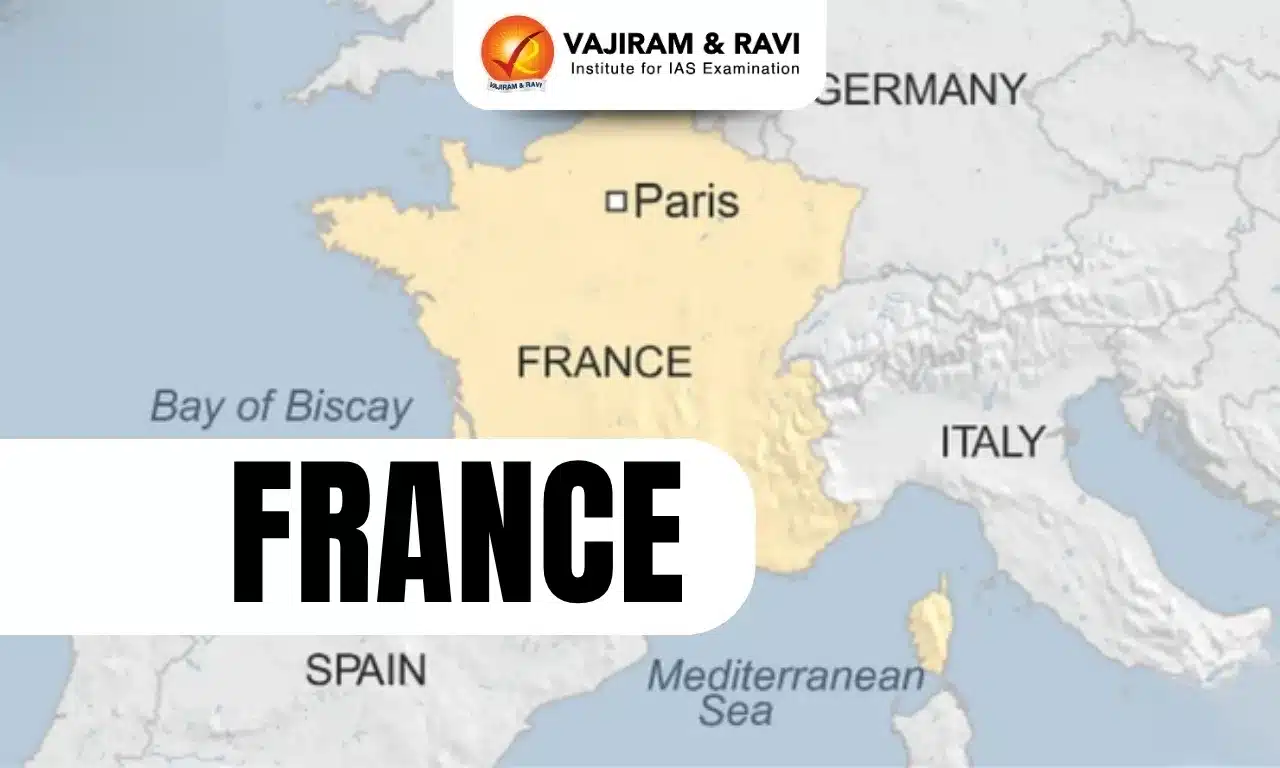
  • Location: It is a country located in North Western Europe.
  • Bordering countries: It is bordered by 7 countries: Belgium, Luxembourg, Germany, Switzerland, Italy, Spain and Andorra.
  • Water bodies: It is bounded by the Bay of Biscay (North Atlantic Ocean) in the west; by the English Channel in the northwest and by the Mediterranean Sea in the south. 
  • It has 5 overseas regions namely: Guadeloupe, Guyane (French Guiana), La Réunion (Réunion), Martinique and Mayotte.
  • Capital City: Paris.

Geographical Features of France

  • Climate: The climate in mainland France is temperate, with quite significant regional differences.
  • Major Rivers:  Loire (drains into Atlantic ocean ), Seine (drains into English channel).
  • Major Mountains:  Alps (southern France), Jura Mountains (north of Alps), Pyrenees (forms border with Spain).
  • Natural Resources: It consists of Coal, iron ore, bauxite, zinc, uranium, antimony, arsenic, potash, feldspar, fluorspar, gypsum.

Source: IT

France FAQs

Q1: Which nuclear power project in India is being built with French assistance?

Ans: Jaitapur Nuclear Power Plant, Maharashtra

Q2: What is the capital city of France?

Ans: Paris

Tapanuli Orangutan

Tapanuli Orangutan

Tapanuli Orangutan Latest News

A recent cyclone in Sumatra killed approximately 58 Tapanuli orangutans, representing about 7% of the critically endangered species.

About Tapanuli Orangutan

  • It is a species of orangutan found in the island of Sumatra in Indonesia.
  • It is one of three known species of orangutan, alongside the Sumatran orangutan, found farther northwest on the island, and the Bornean orangutan.
  • It was described as a distinct species in 2017.
  • Appearance: These species resemble Sumatran orangutans more than Bornean orangutans in body build and fur color.
  • Distribution: It lives in tropical and subtropical moist broadleaf forests that are located south of Lake Toba in Sumatra.
  • Habitat: These are exclusively arboreal and spend most of their time high up in the trees. 
  • Conservation Status: IUCN: Critically endangered.

Characteristics of Tapanuli Orangutan

  • They lead a solitary life and can be seen in pairs only when a mother is raising her young.
  • Communication: Orangutans communicate with various sounds.
  • Both sexes will try to intimidate conspecifics with a series of low guttural noises known collectively as the “rolling call”.
  • Diet: They are omnivores.
  • Reproduction: Tapanuli orangutans are one of the most slowly-maturing animals in the world.

Source: TOI

Tapanuli Orangutan FAQs

Q1: Tapanuli Orangutan is endemic to which island?

Ans: Sumatra Island, Indonesia

Q2: What is the IUCN Red List status of Tapanuli Orangutan ?

Ans: Critically Endangered

Chocolate Chip Sea Star

Chocolate Chip Sea Star

Chocolate Chip Sea Star Latest News

Scientists recently discovered a remarkable light-transmitting skeletal structure at the tips of the arms of the chocolate-chip sea star, which channels about 70% of incident light and concentrates it nearly threefold at its base.

About Chocolate Chip Sea Star

  • Chocolate Chip Sea Star, also known as the horned sea star, is a species of highly recognizable ornamental sea star.  
  • Scientific Name: Protoreaster nodosus

Chocolate Chip Sea Star Habitat and Distribution

  • They are found in the warm, shallow waters of the Indo-Pacific region, including the Red Sea, the Indian Ocean, and the western Pacific Ocean. 
  • They inhabit coral reefs, sandy lagoons, and seagrass beds, typically at depths of up to 30 meters.   

Chocolate Chip Sea Star Features

  • These sea stars can grow up to 12 inches in diameter. 
  • They have a creamy white base and dark brown projections, resembling chocolate chips. 
  • Often they are tan-colored, but they can be other shades as well. 
  • Like all sea stars, these guys can regenerate lost body parts. 
  • When threatened, they can lose one of their five limbs (a process known as autotomy) to escape predators, and the lost limb may regenerate over time. 
  • They are carnivores and typically feed on detritus, small invertebrates, and even the soft tissue of corals. 

Chocolate Chip Sea Star Recent Findings

  • On the tip of each arm, a skeletal part contains an array of cone-shaped structures that, like optic fibres, transmit 70% of incident light and concentrate it nearly 3x at the base.  
  • Overall, the array captures light from a 120° field of view and ‘brightens’ it 8x inside the arm. 
  • Scientists said engineers could use the design for lightweight sensors and displays. 

Key Facts about Sea Stars

  • Although sea stars are often called “starfish,” they’re not related to fish.
  • They are invertebrates related to sea urchins, sea cucumbers, and sand dollars, which are all echinoderms
    • ‘’Echinoderm’’ means spiny skin—a reference to their hard, calcified skin, which helps to protect them from predators. 
  • They have radial symmetry and tube feet that help them move using water pressure.  
  • There are close to 2,000 species of sea stars in the world’s oceans. Most species have five arms, but some have many more—even as many as 40. 
  • They are often found under rocks or in crevices. Their mouth, on the underside of their body, has no teeth. 
  • When feeding, sea stars wrap their arms around their prey and push their stomach out of their mouth to eat their food. 
  • They’re toxic to some predators, but if captured, sea stars can drop an arm to try to escape. 
  • They can regrow lost arms—and even an entire new body from a single arm and part of the central disc of their body.

News: TH

Chocolate Chip Sea Star FAQs

Q1: What is the scientific name of the Chocolate Chip Sea Star?

Ans: Protoreaster nodosus.

Q2: In which region is the Chocolate Chip Sea Star commonly found?

Ans: The Indo-Pacific region.

Q3: What habitats are preferred by the Chocolate Chip Sea Star?

Ans: Coral reefs, sandy lagoons, and seagrass beds.

Q4: What gives the Chocolate Chip Sea Star its common name?

Ans: Its dark brown projections that resemble chocolate chips.

Q5: Can the Chocolate Chip Sea Star regenerate lost body parts?

Ans: Yes.

AN-32 Aircraft

AN-32 Aircraft

AN-32 Aircraft Latest News

An Indian Air Force (IAF) AN-32 transport aircraft crashed and caught fire at the Air Force Station in Assam's Jorhat recently, killing five personnel.

About AN-32 Aircraft

  • The AN-32 (Antonov AN-32) is a Soviet-origin twin-engine turboprop military transport aircraft.
  • Its NATO reporting name is Cline.
  • It is designed and manufactured by the Antonov Design Bureau of Ukraine, then part of the USSR.
  • It was purchased by India from the USSR in 1984. The planes were specially customised to suit the IAF's requirements. 
  • The IAF has a fleet of around 100 AN-32 planes.
  • It is designed to excel in extreme environments, functioning perfectly in high-altitude airfields (up to 4500 m above sea level) and hot tropical climates. 

AN-32 Aircraft Features

  • It is powered by two single-shaft turboprop engines.
  • It can carry a maximum weight of 27 tons at a maximum speed of 530 km/h. 
  • It can transport up to 7.5 tons of cargo, 50 passengers, or 42 paratroopers, and it is extensively used for supply drops in remote regions. 
  • The range and service ceiling of the aircraft are 2,500 km and 9,500 m, respectively.
  • It can take off and land on rough airfields and dirt runways.
  • It also has a limited bombing role and is used for para-trooping operations.

News: NDTV

AN-32 Aircraft FAQs

Q1: What is the AN-32 aircraft?

Ans: The AN-32 is a Soviet-origin twin-engine turboprop military transport aircraft.

Q2: What is the NATO reporting name of the AN-32 aircraft?

Ans: Cline.

Q3: Which organization designed and manufactured the AN-32 aircraft?

Ans: It is designed and manufactured by the Antonov Design Bureau of Ukraine, then part of the USSR.

Q4: When did India purchase the AN-32 aircraft from the USSR?

Ans: In 1984.

Q5: How much cargo can the AN-32 transport?

Ans: Up to 7.5 tons of cargo.

Thamirabarani River

Thamirabarani River

Thamirabarani River Latest News

Researchers have expressed concern over the declining otter population in Tamil Nadu's Thamirabarani River due to the increasing destruction of their natural habitat in recent years.

About Thamirabarani River

  • The Thamirabarani River – also known as the Tamraparni River or Porunai River,  a rare perennial river in southern India flowing entirely through the Tamil Nadu state.  
  • The river’s name is derived from “Thamiram” (copper) and “Barani” (vessel) in Tamil, referring to the copper-like hue of its waters—believed to result from dissolved minerals. 
  • Porunai is its classical name in Sangam literature, where it has extensive literary references.
  • Course:
    • It originates from the Agastyarkoodam peak of the Pothigai hills of the Western Ghats.
    • It flows through the Tirunelveli and Tuticorin Districts of the Tamil Nadu state into the Gulf of Mannar of the Bay of Bengal.  
  • Total Length: Approx. 128 km
  • Major Tributaries: Gadananathi River, the Manimuthar River, and the Pachaiyar River.  
  • Prominent dams include:
    • Papanasam Dam
    • Karaiyar Dam
    • Manimuthar Dam
    • Servalar Dam
    • Gadananathi Dam
  • Major Waterfalls:
    • Banatheertham Falls (132 ft, near Kariyar reservoir)
    • Agasthiyar Falls
    • Kalyana Theertham
  • Biodiversity:
    • It is one of the richest rivers in the world with fish and is dominated by more than 16 species of native snakehead fish. 
    • It is estimated that nearly 669 fish species are found in the river. 
    • All the three species of otters in India, the Eurasian otter, the smooth-coated otter, and the Asian small-clawed otter, inhabit the Thamirabarani River. 

News: ETVB

Thamirabarani River FAQs

Q1: What is another name for the Thamirabarani River?

Ans: Tamraparni River or Porunai River.

Q2: In which state does the Thamirabarani River flow entirely?

Ans: Tamil Nadu.

Q3: The Thamirabarani River originates in which mountain range?

Ans: The Western Ghats.

Q4: Into which water body does the Thamirabarani River drain?

Ans: The Gulf of Mannar in the Bay of Bengal.

Q5: What is the approximate length of the Thamirabarani River?

Ans: About 128 km.

Jiangmen Underground Neutrino Observatory (JUNO)

Jiangmen Underground Neutrino Observatory

Jiangmen Underground Neutrino Observatory (JUNO) Latest News

The Jiangmen Underground Neutrino Observatory (JUNO) collaboration in China recently published its first results, including measurements on how often particles called neutrinos from nuclear reactors change their flavour, or type, as they travel.  

About Jiangmen Underground Neutrino Observatory (JUNO)

  • It is a large underground neutrino detector located near the city of Kaiping in the southern Guangdong province of China.
  • It is the product of an international collaboration involving 74 institutions from Asia, Europe, and America, and has some 700 members. 
  • It is led by the Chinese Academy of Sciences (CAS) via the Institute of High Energy Physics (IHEP). 
  • It is the second neutrino experiment in China, after the Daya Bay Reactor Neutrino Experiment. 
  • It is located 53 km from two nuclear power plants in Taishan and Yangjiang.
  • The primary JUNO scientific goal is the determination of the neutrino mass ordering (NMO). 
    • This can be inferred by measuring the oscillation pattern of electron anti-neutrinos emitted by nuclear power plants. 
  • To do this, the facility has an 80 m high and 50 m diameter experimental hall located 700 m underground
  • Its main feature is a 35 m radius spherical neutrino detector, containing 20,000 tonnes of liquid scintillator.  
  • It is the world's largest and highest-precision liquid scintillator detector.  
  • Juno is designed to have a scientific lifespan of up to 30 years.
  • JUNO is also one of three next-generation neutrino experiments, the other two being the Hyper-Kamiokande in Japan and the Deep Underground Neutrino Experiment in the US. 

What are Neutrinos?

  • Neutrinos, often called 'ghost particles', are elementary particles that belong to the lepton family of particles. 
  • Since neutrinos have very little interaction with matter, their detection is very difficult.  
  • They have no electrical charge and have a very small mass (less than one millionth of the mass of the electron), and their speed is nearly equal to the speed of light.  
  • First predicted in 1930, they weren’t discovered in experiments until 1956.
  • Of the four fundamental forces in the universe, neutrinos only interact with twogravity and the weak force.
  • Source: Neutrinos come from all kinds of different sources and are often the product of heavy particles turning into lighter ones, a process called “decay.”
  • They are the most common particles in the universe. 
  • Approximately 100 trillion neutrinos pass completely harmlessly through your body every second.
  • Neutrinos play crucial roles in the standard model of particle physics, in stellar physics and black holes, and even in cosmology and the nature of the Big Bang.

News: TH

Jiangmen Underground Neutrino Observatory (JUNO) FAQs

Q1: Where is the Jiangmen Underground Neutrino Observatory (JUNO) located?

Ans: It is located near the city of Kaiping in the southern Guangdong province of China.

Q2: Which organization leads the JUNO project?

Ans: The Chinese Academy of Sciences (CAS).

Q3: What is the primary scientific objective of Jiangmen Underground Neutrino Observatory (JUNO)?

Ans: Determining the neutrino mass ordering (NMO).

Q4: How does Jiangmen Underground Neutrino Observatory (JUNO) seek to determine the neutrino mass ordering?

Ans: By measuring the oscillation pattern of electron anti-neutrinos emitted by nuclear power plants.

Udanti-Sitanadi Tiger Reserve

Udanti Sitanadi Tiger Reserve

Udanti-Sitanadi Tiger Reserve Latest News

A four-year-old tigress that wandered into Chhattisgarh’s Udanti-Sitanadi Tiger Reserve (USTR) earlier this year and stayed through the scorching summer months has kindled fresh hopes for a reserve.  

About Udanti-Sitanadi Tiger Reserve

  • Location: It is located in the state of Chhattisgarh.
  • It was established by joining the regions represented by Sitanadi and Udanti wildlife sanctuaries. 
  • Rivers: The drainage system of the reserve consists of the Mahanadi as the main river, along with the Udanti, Sitanadi, Indravan, and Pairi Rivers as tributaries.
  • The location of the reserve is strategic since it also connects with the Kanker and North Kondagaon forest divisions, forming a contiguous forest corridor to Indravati Tiger Reserve in the Bastar region.
  • There are 19 named mountains in the reserve. Deo Dongri is the highest point. The most prominent mountain is Atānga Dongar.
  • Vegetation: The forest type here is predominantly tropical dry and moist deciduous.
  • Flora: The forest is dominated by Sal (Shorea robusta), which forms dense patches across the landscape. 
    • Alongside, species such as Teak (Tectona grandis), Bamboo, Tendu, Mahua, Bija, and Harra contribute to the green diversity of the region.
  • Fauna: It is home to the last few herds of the highly endangered Wild Buffalo, tiger, Indian Wolf, Leopard, Sloth Bear, and Mouse Deer etc.

Source: IE

Udanti-Sitanadi Tiger Reserve FAQs

Q1: Udanti-Sitanadi Tiger Reserve is located in which state?

Ans: Chhattisgarh

Q2: Which PVTG is found in the Udanti-Sitanadi landscape?

Ans: Kamar Tribe and Bhunjia Tribe

Naval Anti-Ship Missile–Medium Range (NASM–MR)

Naval Anti-Ship Missile–Medium Range (NASM–MR)

Naval Anti-Ship Missile–Medium Range (NASM–MR) Latest News

India recently concluded successful trials of a multi-layered Ballistic Missile Defence (BMD) system and the maiden flight-test of the Naval Anti-Ship Missile-Medium Range (NASM-MR).

About Naval Anti-Ship Missile–Medium Range (NASM–MR)

  • It is a subsonic, sea-skimming anti-ship missile. 
  • It is being developed by the Defence Research and Development Organisation (DRDO) for the Indian Navy for use against small- to medium-sized targets such as frigates, corvettes, and destroyers. 
  • It will have different versions, including ship-launched, air-launched, and submarine-launched variants. 
  • The missile complements the existing Naval Anti-Ship Missile-Short Range (NASM-SR), which was successfully tested earlier from a helicopter platform. 
  • Together, these systems provide layered strike options for the Navy, enabling both close-range and medium-range engagements against hostile warships. 
  • Features:
    • It is powered by a Small Gas Turbine Jet Engine (SGTJE).
    • This all-weather missile has a strike range of up to 350 km.  
    • It has a warhead weighing more than 200 kilograms.
    • It has an advanced guidance system, which reportedly combines an active radar seeker with an imaging infrared (IR) seeker.

Successful Trials of Multi-Layered Ballistic Missile Defence (BMD) system

  • The latest tests involved advanced interceptor systems developed under Phase II of the BMD programme, including the AD-series interceptors.  
  • These systems have been designed to engage and neutralise advanced, high-speed threats such as intermediate-range ballistic missiles (IRBMs) and ICBMs capable of travelling up to the 5,000-km class. 
  • The AD-1 endo-atmospheric interceptor has been designed to intercept targets within the Earth's atmosphere during the terminal phase of their flight. 
    • Propelled by a two-stage solid motor, it utilises advanced navigation and guidance algorithms to track and destroy fast-moving missiles as well as slower-moving aircraft.
  • Similarly, the AD-2 interceptor has been designed to intercept incoming missiles at much higher altitudes, beyond the Earth's atmosphere during their mid-course flight phase. 
    • This allows early interception in space, destroying threats before they can re-enter and target specific regions.
  • Both missiles are highly manoeuvrable and capable of hypersonic speeds ranging from Mach 6 to Mach 7, enabling them to intercept fast-moving ballistic targets.
  • These tests have put the country in the elite group of nations having BMD capability to engage up to ICBMs. 

News: REP


Naval Anti-Ship Missile–Medium Range (NASM–MR) FAQs

Q1: What does NASM–MR stand for?

Ans: Naval Anti-Ship Missile–Medium Range.

Q2: Which organization is developing Naval Anti-Ship Missile–Medium Range (NASM–MR)?

Ans: The Defence Research and Development Organisation (DRDO).

Q3: What is the primary role of Naval Anti-Ship Missile–Medium Range (NASM–MR)?

Ans: To engage and destroy enemy warships such as frigates, corvettes, and destroyers.

Q4: What is the maximum strike range of Naval Anti-Ship Missile–Medium Range (NASM–MR)?

Ans: Up to 350 km.

Recognising Unpaid Domestic Labour – SC’s Landmark Ruling on Homemakers’ Economic Value

Recognising Unpaid Domestic Labour

Recognising Unpaid Domestic Labour Latest News

  • In a significant judgment recently delivered, the Supreme Court (SC) held that unpaid domestic work performed by homemakers has an independent economic value.
  • Hence, it must be adequately recognised while determining compensation in motor accident death cases. 
  • The Court fixed a minimum notional income of ₹30,000 per month for homemakers under a newly created compensation head called “Loss of Domestic Care” and directed that this amount be increased by 10% every three years.

Background of the Case

  • The ruling arose from a motor accident compensation dispute in Punjab involving the death of a homemaker, Reshma, in 2001.
  • Course of litigation:
    • The Motor Accident Claims Tribunal (MACT) awarded a compensation of ₹2.42 lakh in 2003.
    • The Punjab and Haryana High Court enhanced compensation to ₹8.43 lakh with interest in 2024.
    • Dissatisfied with the amount, the deceased’s family approached the SC, which substantially enhanced the compensation to ₹62.78 lakh.
    • It recognised not only the deceased’s household contributions but also the loss of maternal care, spousal companionship, and assistance and support to dependent family members.

Key Directions of the SC

  • Creation of a new compensation head:
    • The Court introduced a distinct category called “Loss of Domestic Care” in motor accident compensation claims.
    • Under this,
      • Homemakers will be assigned a minimum notional monthly income of ₹30,000.
      • The amount serves as a benchmark for assessing the economic value of unpaid household labour.
      • It will be revised upward by 10% cumulatively every three years.
  • Applicability to working homemakers:
    • Where a homemaker is also engaged in paid employment, compensation under “Loss of Domestic Care” will be awarded in addition to her proven income.
    • Thus, unpaid care work and paid work will be treated as separate contributions.

Recognition of Homemakers as Economic Contributors

  • The Court emphasised that domestic work supports the functioning of the paid workforce, enables overall economic productivity, and contributes significantly to family welfare and social development.
  • Routine activities such as cooking, cleaning, childcare, elderly care, and household management, have traditionally remained invisible in economic calculations despite their substantial value.
  • The Bench described homemakers as “Nation Builders”: builders of human capital, foundational contributors to society, and essential actors in nurturing future professionals, leaders, artists and citizens.
  • The Court observed that many visible economic achievements rest upon the invisible labour performed within households.

Directions to Speed Up Motor Accident Compensation Cases

  • Concern over judicial delays: 
    • The SC noted that compensation claims often remain pending for years. For example, average pendency before MACTs is about 6 years, and  about 8 years before HCs.
    • Prolonged delays defeat the welfare-oriented objectives of the Motor Vehicles Act, 1988.
  • Court’s directives:
    • Compensation appeals should ideally not remain pending in HCs for more than four years.
    • Adjournments should be granted only for genuine reasons.
    • Chief Justices of all HCs should prioritise older motor accident compensation cases.
    • HCs should assess the need for additional benches to ensure speedy disposal.

Significance of the Judgment

  • First concrete benchmark:
    • While previous judicial decisions had recognised that homemakers’ services possess economic value, this judgment is notable because:
      • It establishes a specific minimum monetary benchmark.
      • It formally institutionalises compensation for unpaid domestic labour.
      • It moves beyond symbolic recognition towards measurable economic valuation.
  • Gender justice and social recognition:
    • The ruling advances gender justice, recognition of the care economy, valuation of unpaid household work, and greater sensitivity in compensation jurisprudence.
    • It also aligns with long-standing debates on incorporating unpaid care work into broader measures of economic well-being, beyond conventional indicators such as GDP.

Implications for India

  • Positive outcomes:
    • Strengthens legal recognition of unpaid domestic labour.
    • Enhances compensation for families of deceased homemakers.
    • Promotes a more realistic assessment of economic dependency.
    • Contributes to gender-sensitive interpretation of welfare laws.
  • Emerging questions:
    • The Court did not provide a precise empirical or mathematical basis for fixing the ₹30,000 benchmark.
    • Future debates may arise regarding regional variations, inflation adjustments, and standardisation of valuation methods.

Conclusion

  • The SC's judgment marks a transformative step in Indian compensation law by assigning tangible economic value to unpaid domestic work. 
  • This decision is likely to influence future jurisprudence on gender equality, labour valuation and welfare-oriented compensation frameworks.

Source: TH

Recognising Unpaid Domestic Labour FAQs

Q1: What is the significance of the SC's introduction of the “Loss of Domestic Care” category?

Ans: It formally recognises unpaid domestic labour as an independent economic contribution in compensation claims.

Q2: What minimum notional income has the SC fixed for homemakers in motor accident death cases?

Ans: ₹30,000 per month, subject to a 10% cumulative increase every three years.

Q3: How does the judgment contribute to gender justice?

Ans: It acknowledges and monetarily values unpaid care and household work predominantly performed by women.

Q4: Why did the SC direct High Courts to prioritise motor accident compensation appeals?

Ans: To prevent prolonged delays that undermine the welfare objective of the Motor Vehicles Act, 1988.

Q5: How does unpaid domestic labour contribute to the economy?

Ans: It supports workforce participation, creates human capital, and sustains overall economic productivity.

Assam-Nagaland Oil Deal: Reviving a 30-Year-Old Energy Opportunity

Assam-Nagaland Oil Deal

Assam-Nagaland Oil Deal Latest News

  • The Union government, Assam, and Nagaland have signed a tripartite Memorandum of Understanding (MoU) to restart oil and gas exploration along their disputed border area — something that has been stalled for three decades. 
  • The agreement was signed in the presence of Home Minister Amit Shah, Petroleum Minister Hardeep Singh Puri, Assam CM Himanta Biswa Sarma, and Nagaland CM Neiphiu Rio.

Background: Why Was This Area Off-Limits for 30 Years

  • The Northeast is called the birthplace of India's oil and gas industry. Assam, in particular, is one of India's major oil and gas producing states. 
  • However, a stretch of land along the Assam-Nagaland border — known as the Disputed Area Belt (DAB) — has remained a no-go zone for oil and gas exploration for three decades due to boundary disputes and law and order problems between the two states.
  • This area is believed to hold promising hydrocarbon reserves, but they have remained untapped simply because the two states could not agree on resolving the border dispute first.

About the New MoU

  • The MoU does not resolve the border dispute itself. Instead, it creates a practical working arrangement so that oil and gas exploration can begin despite the unresolved boundary issue. 
  • Key features include:
    • It covers more than 1,000 sq km of the disputed border area. 
    • It sets up a coordinated framework for mineral oil operations — ensuring smooth operations, safety and security of workers and equipment, and proper coordination between the Centre, Assam, and Nagaland. 
    • Importantly, both states have agreed not to let the border dispute become an obstacle to oil exploration — treating these resources as national wealth.
    • Beyond the six already-identified oil and gas fields, Nagaland has agreed to allow oil exploration across the entire state.

Significance of The New MoU: The Energy Security Angle

  • India currently depends on imports for over 88% of its crude oil needs and about half of its natural gas needs. 
  • This heavy dependence on imports creates several problems for the economy:
    • When global oil prices rise, India's import bill increases, which widens the trade deficit and puts pressure on foreign exchange reserves and the value of the rupee. 
    • It can also push up domestic inflation, since fuel prices affect the cost of almost everything else.
  • This concern has become more urgent recently because of the ongoing West Asia conflict, which has led to the effective closure of the Strait of Hormuz — a critical waterway through which much of the world's oil passes. 
  • This has caused both higher prices and supply disruptions for countries like India.
  • By boosting domestic production, India can reduce its reliance on such volatile international supply routes — making this MoU a small but meaningful step toward energy self-reliance (Atmanirbharta).

How Big Is the Potential

  • Assam alone holds nearly 22% of India's crude oil reserves and around 15% of the country's natural gas reserves. 
  • Nagaland has major untapped hydrocarbon potential in a geological formation called the Naga-Schuppen Belt, part of the larger Assam-Arakan Basin.
  • Home Minister Amit Shah noted that current oil production from the Northeast stands at just 1,000-1,500 barrels per day, but this agreement could help increase production by more than tenfold over time. 
  • He also pointed out that this would mark Nagaland's return to oil production after 31 years.

Why Does This Matter Beyond Oil

  • The government sees this MoU as more than just an energy deal — it is being framed as a model for resolving development bottlenecks caused by border disputes across the Northeast. 
  • Officials indicated that this tripartite cooperation framework could pave the way for similar mineral exploration and mining agreements across the entire Northeast region — a region known to have significant untapped mineral wealth besides oil and gas.
  • For Assam and Nagaland themselves, officials say the agreement opens up a major pathway for economic development — since unresolved disputes had kept valuable resources locked away and held back investment for decades.

Conclusion

  • For three decades, an unresolved border dispute kept valuable oil and gas reserves buried — both literally and figuratively. 
  • By choosing cooperation over confrontation, Assam and Nagaland have unlocked not just hydrocarbon potential, but a template for how India's Northeast can turn old disputes into shared development.

Source: IE | PIB

Assam-Nagaland Oil Deal FAQs

Q1: What is the Assam-Nagaland Oil Deal?

Ans: The Assam-Nagaland Oil Deal is a tripartite agreement enabling oil and gas exploration in disputed border regions after decades of inactivity.

Q2: Why was exploration halted for nearly 30 years?

Ans: Boundary disputes, security concerns and law-and-order issues in the Disputed Area Belt prevented oil and gas operations for decades.

Q3: How does the Assam-Nagaland Oil Deal support energy security?

Ans: The agreement can increase domestic hydrocarbon production and reduce India's dependence on imported crude oil and natural gas.

Q4: What is the hydrocarbon potential of the region?

Ans: The region contains significant untapped reserves, including resources in Assam and the Naga-Schuppen Belt of Nagaland.

Q5: Why is the Assam-Nagaland Oil Deal important beyond energy production?

Ans: The deal demonstrates how cooperation can overcome long-standing disputes and create opportunities for economic growth and resource development.

Anthropic AI Models: Why Foreign Access to Fable 5 and Mythos 5 Was Restricted

Anthropic AI Models

Anthropic AI Models Latest News

  • The US government has issued an export control order barring all foreign nationals — even those working inside Anthropic, a leading AI company — from accessing its two newest AI models, Fable 5 and Mythos 5
  • These were launched recently and are Anthropic's most advanced publicly available AI systems. 
  • The order cites national security concerns, but its broad scope has raised fresh questions about how governments can control access to AI technology.

What Are Export Controls, and Why Is This Different

  • Export controls are rules that stop certain goods or technologies from being sent to other countries. Normally, they apply to physical items — for example, the US restricts the sale of advanced computer chips to China.
  • This new order is different. For the first time, it controls how an AI software product can be used and by whom — not a physical product. 
  • This is being seen as a new and unusual use of export control law, applied to artificial intelligence for the first time in this manner.

Export Control Order Banning Access of AI Model

  • The order blocks all foreign nationals from using Fable 5 and Mythos 5 — whether they are located inside the US or outside it. This includes Anthropic's own foreign employees. 
  • In simple terms, only American citizens or entities can access these two models for now.
  • As per the Anthropic, the government did not give a clear, written explanation. Based on informal communication, the company believes the concern relates to a possible "jailbreak" — a method to bypass an AI model's safety restrictions.
    • This technique works by asking the AI model to read a piece of software code and identify and fix flaws in it. 
  • Anthropic has pushed back, stating that this capability is not unique to its models — other publicly available AI systems, including OpenAI's GPT-5.5, can do the same thing. 
  • In fact, this kind of capability is used daily by cybersecurity professionals to find and fix software weaknesses.

Background: Anthropic's Troubled Relationship with the US Government

  • This is not the first friction between Anthropic and US authorities. In March 2026, the Pentagon labelled Anthropic a "supply chain risk" — a designation that could limit how much US government agencies can use the company's AI products.
  • This labelling followed a disagreement over military use of Anthropic's AI (Claude). 
    • Anthropic had insisted on certain safety conditions — specifically, that its AI should not be used for mass domestic surveillance or to help build fully autonomous weapons systems. 
    • The company has reportedly indicated it may legally challenge this "supply chain risk" label.
  • This export control order comes at a sensitive time — Anthropic is preparing for a public stock market listing in the US, and was recently valued at $965 billion.

What Are Fable 5 and Mythos

  • Anthropic has launched Fable 5 and Mythos 5, its most advanced publicly available AI models. 
  • Both are built on the company's new “Mythos-class” architecture, derived from the earlier Mythos Preview model, which was not publicly released due to concerns over potential misuse.

Why Was Mythos Preview Not Released

  • Anthropic had previously claimed that Mythos Preview possessed the capability to identify severe vulnerabilities in major operating systems and web browsers, including some that reportedly remained undetected for years.
  • The company feared that such powerful capabilities could be misused, particularly against critical infrastructure worldwide. As a result, it decided against a public release.
  • Before the launch, Anthropic provided limited access to Mythos Preview through Project Glasswing. 
  • In India, the company reportedly discussed sharing the model with a small number of organizations.

Key Difference Between Mythos Preview and Fable 5/Mythos 5

  • Although Fable 5 and Mythos 5 are based on the same underlying technology as Mythos Preview, they include additional safety safeguards.
    • Requests related to sensitive cybersecurity issues or biological threats are filtered.
    • When the system detects a potentially high-risk query, it automatically redirects the user to a less capable AI model (Claude Opus 4.8) instead of allowing the full Mythos-level system to respond.
  • The company acknowledges that the safeguards may occasionally block harmless requests.

Conclusion

  • This episode highlights a growing global concern.
  • As AI models become powerful enough to find security flaws in critical software, governments are beginning to treat advanced AI itself as a controlled, sensitive technology — similar to how they treat nuclear technology, advanced weapons, or top-end semiconductor chips.
  • For India, this is a reminder that building indigenous AI capability is no longer optional but a matter of strategic necessity.

Source: IE | ToI

Anthropic AI Models FAQs

Q1: Why has the US restricted access to Anthropic AI Models?

Ans: The US government cited national security concerns and potential misuse of advanced AI capabilities while restricting access to Anthropic AI Models.

Q2: What makes this export control order unique?

Ans: Unlike traditional export controls on physical goods, this order regulates access to software-based AI technology and its users.

Q3: What are Fable 5 and Mythos 5?

Ans: Fable 5 and Mythos 5 are Anthropic's most advanced publicly available AI Models, built on its powerful Mythos-class architecture.

Q4: Why was Mythos Preview never publicly released?

Ans: Anthropic feared the model could identify critical software vulnerabilities that might be exploited against important digital infrastructure worldwide.

Q5: What does this episode mean for countries like India?

Ans: The restrictions highlight the strategic importance of developing indigenous AI capabilities and reducing dependence on foreign advanced AI technologies.

Indian Seafarer Safety – Government Steps and Challenges

Indian Seafarer Safety

Indian Seafarer Safety Latest News

  • The recent deaths of Indian seafarers Aditya Sharma, Shivanand Chaurashiya, and Patnala Suresh aboard the merchant vessel Settebello have brought urgent attention to the safety of Indian mariners operating in conflict-affected maritime corridors.

About Indian Seafarers

  • Seafarers are professional sailors who serve aboard merchant ships engaged in international and domestic trade. 
  • With over 2.5 lakh seafarers, India ranks among the top three countries supplying skilled maritime workforce globally.

Regulatory Framework

  • The Directorate General of Shipping (DGS) under the Ministry of Ports, Shipping and Waterways is the principal authority responsible for:
    • Certification and training of Indian seafarers.
    • Implementation of the Merchant Shipping Act, 1958.
    • Oversight of seafarer welfare measures.
    • Compliance with international conventions like the Standards of Training, Certification and Watchkeeping (STCW) Convention and the Maritime Labour Convention (MLC), 2006.

Government Steps for Safety and Welfare of Indian Seafarers

  • Regulatory and Institutional Measures
    • Merchant Shipping Act, 1958
      • The principal legislation governing Indian seafarers and merchant shipping.
      • Provides for certification, employment conditions, welfare, and safety standards.
      • Currently undergoing modernisation through the proposed Merchant Shipping Bill to align with international conventions.
    • Directorate General of Shipping (DGS)
      • The regulatory authority for seafarer training, certification, and welfare.
      • Issues Continuous Discharge Certificates (CDCs) to Indian seafarers.
      • Implements the Maritime Labour Convention, 2006 provisions.
      • Maintains a central database of registered seafarers.
    • National Shipping Board
      • Advisory body on matters relating to Indian shipping and merchant marine.
      • Recommends policies for maritime development and seafarer welfare.
    • Skill India Initiative
      • Specialised maritime skill development programmes.
      • Apprenticeship and pre-sea training for aspiring seafarers.
      • Recognition of prior learning (RPL) for experienced mariners.

Safety and Security Measures

  • Maritime Security Coordination
    • Information Fusion Centre - Indian Ocean Region (IFC-IOR) at Gurugram for maritime domain awareness.
    • Coordination among the Indian Navy, Coast Guard, and DGS.
    • Real-time threat assessment and dissemination to shipowners.
  • Anti-Piracy Measures
    • Indian Navy escorts in the Gulf of Aden and Western Indian Ocean.
    • Best Management Practices (BMP) for ships transiting high-risk areas.
    • Armed guards on Indian-flagged vessels in piracy-prone regions.
  • Search and Rescue Operations
    • Indian Coast Guard maintains 24/7 search and rescue capabilities.
    • Maritime Rescue Coordination Centres (MRCC) at strategic locations.
    • Rapid response for distress situations involving Indian seafarers.

News Summary

  • The deaths of three Indian seafarers, Aditya Sharma, Shivanand Chaurashiya, and Patnala Suresh, aboard the merchant vessel Settebello have sparked widespread concern within the maritime community. 
  • This incident underscores the human cost of geopolitical conflicts borne by civilian mariners navigating dangerous corridors.
  • The debate following recent attacks on merchant vessels has highlighted misunderstandings about sanctioned vessels.
  • A sanctioned vessel is one designated under an economic, trade, or security sanctions regime imposed by a government or international organisation.

Limited Universal Applicability

  • A vessel sanctioned by one country is not automatically sanctioned everywhere.
  • Unilateral sanctions generally apply only within the jurisdiction of the imposing country.
  • UN Security Council resolutions are binding globally.
  • A vessel sanctioned by the US Office of Foreign Assets Control (OFAC) does not automatically become illegal under Indian law.

Core Issue: Seafarer Safety in Conflict Zones

  • The larger concern is not the legal status of individual ships, but the safety of seafarers operating in regions where commercial shipping is entangled in geopolitical conflict.
  • Expected Indian Response
    • The maritime community expects India to adopt a stronger, more proactive posture:
    • Unequivocal condemnation of attacks on merchant shipping and civilian seafarers, regardless of nationality.
    • Continued advocacy for adherence to international maritime law and freedom of navigation.
    • Raising concerns at multilateral forums, including the UN, IMO, and regional maritime security platforms.
  • Beyond Diplomatic Engagement
    • Diplomatic engagement alone may not suffice. India must:
    • Work closely with flag states, shipowners, and operators.
    • Ensure appropriate security measures for vessels transiting high-risk areas.
    • Prevent Indian seafarers from being compelled to sail through war risk zones without full disclosure of risks and their informed consent.
  • Strengthening Maritime Security
    • There is a growing expectation that India will strengthen its maritime security posture:
    • Enhanced naval deployments in critical regions.
    • Expanded Coast Guard surveillance.
    • Rapid response capabilities.
    • Preparedness for hostage rescue and evacuation operations.
    • Timely dissemination of actionable intelligence to shipowners.
    • Regular threat assessments for operators.

The Strait of Hormuz Question

  • A recurring debate centres on whether Indian seafarers should be prohibited from serving on vessels transiting the Strait of Hormuz:
  • Why Blanket Bans Are Not the Solution
    • The Strait of Hormuz remains one of the world's most critical maritime chokepoints.
    • Handles a substantial share of global energy trade.
    • Thousands of Indian seafarers earn livelihoods aboard vessels transiting the region.
    • Comprehensive prohibition could affect: 
      • Employment opportunities for Indian mariners.
      • Global supply chains.
      • India's standing as a leading supplier of maritime manpower.
  • Preferred Approach
    • The industry seeks a calibrated, evidence-based approach:
      • Periodic risk assessments.
      • Clear advisories to shipowners and seafarers.
      • Mandatory informed consent for deployment in high-risk areas.
      • Enhanced security protocols rather than outright restrictions.
      • Temporary advisories if the threat environment deteriorates significantly.

Proposed Framework

  • India would benefit from an inter-ministerial maritime security framework capable of:
    • Escalating measures in proportion to the threat environment.
    • Bringing together maritime regulators, foreign policy officials, defence agencies, intelligence organisations, shipowners' associations, and seafarers' unions.
    • Facilitating real-time decision-making.
  • This integrated approach would ensure:
    • Comprehensive threat assessment.
    • Unified response to maritime emergencies.
    • Better coordination between stakeholders.
    • Faster decision-making in crises.

Source : TH

Indian Seafarer Safety FAQs

Q1: Which authority regulates Indian seafarers?

Ans: The Directorate General of Shipping (DGS) under the Ministry of Ports, Shipping and Waterways is the principal regulatory authority for Indian seafarers.

Q2: What is the Maritime Labour Convention, 2006?

Ans: It is an international convention providing comprehensive rights and protection to seafarers, including decent working conditions, medical care, and social security. India ratified it in 2015.

Q3: What is a sanctioned vessel?

Ans: A sanctioned vessel is one designated under economic, trade, or security sanctions imposed by a government or international organisation due to ownership, prohibited trade, or other concerns.

Q4: Why is the Strait of Hormuz important?

Ans: The Strait of Hormuz is one of the world's most critical maritime chokepoints, handling a substantial share of global energy trade, with thousands of Indian seafarers transiting the region.

Q5: What role does the Information Fusion Centre play?

Ans: The Information Fusion Centre – Indian Ocean Region (IFC-IOR) at Gurugram coordinates maritime domain awareness and provides real-time threat assessment to ships and stakeholders.

Enquire Now