Greater Tunb Island

Greater Tunb Island

Greater Tunb Island Latest News

The U.S. military’s Central Command recently said that it had launched airstrikes on Greater Tunb Island in the Strait of Hormuz, targeting Iranian defence installations and missile sites.

About Greater Tunb Island

  • It is a small island in the Persian Gulf near the entrance to the Strait of Hormuz
  • Area: Approximately 10.3 sq. km. 
  • The island, under Iranian control since 1971, is regarded as a strategically important location in the strait. 
  • Iran has established military facilities, including naval installations and an airstrip, on the island. 
  • Along with Lesser Tunb and Abu Musa, Greater Tunb overlooks the approach to the Strait of Hormuz, a vital waterway through which about one-fifth of the world’s oil supply passes. 
  • It plays an important role in monitoring and influencing traffic through one of the world’s busiest maritime trade routes. 
  • Point of contention between Iran and UAE:
    • Iran assumed control of three islands, Abu Musa, Greater Tunb and Lesser Tunb, in 1971. 
    • Since then, the United Arab Emirates has maintained its claim over them. 
    • The sovereignty of the three islands has remained a longstanding source of dispute between Tehran and Abu Dhabi.

News: TH

Greater Tunb Island FAQs

Q1: Where is Greater Tunb Island located?

Ans: It is located in the Persian Gulf near the entrance to the Strait of Hormuz.

Q2: Why is Greater Tunb Island strategically important?

Ans: It is located near the Strait of Hormuz, a major global maritime chokepoint.

Q3: Since which year has Iran controlled Greater Tunb Island?

Ans: Since 1971.

Q4: Which countries are involved in the dispute over Greater Tunb Island?

Ans: Tunb Island? Answer:

Colobus congoensis

Colobus congoensis

Colobus congoensis Latest News

A team of researchers recently confirmed the discovery of a previously unknown species of African monkey named Colobus congoensis in the rainforests of the Democratic Republic of Congo (DRC), marking one of the most significant primate discoveries in decades.

About Colobus congoensis

  • It is a new species of monkey.
  • It was discovered in the rainforest between the Lomami and Congo (Lualaba) rivers in the east-central region of the Democratic Republic of Congo (DRC).  
  • Locally known as the Likweli, it is only the fifth new monkey species identified in Africa in the past 75 years.  
  • It belongs to the genus Colobus while revealing that it diverged from its closest known relative, Colobus satanas, approximately 4 to 5 million years ago. 
  • The monkey is immediately recognizable by its glossy black coat, long cape-like fur, sweeping tail, and striking orange-cream facial markings. 
  • Weighing about 15 pounds, it is smaller than its closest relatives and possesses distinctive cranial, dental, and skeletal characteristics that separate it from every other known African colobus monkey. 
  • It also has a distinctive "roaring" call. " 
  • Given their restricted range, small population size, and the pressures of hunting and habitat loss, the researchers recommend that Colobus congoensis be classified as Endangered on the IUCN Red List. 

News: EUR

Colobus congoensis FAQs

Q1: What is Colobus congoensis?

Ans: It is a newly discovered species of monkey.

Q2: Where was Colobus congoensis discovered?

Ans: It was discovered in the rainforest between the Lomami and Congo (Lualaba) rivers in east-central Democratic Republic of the Congo (DRC

Q3: What is the coat color of Colobus congoensis?

Ans: It has a glossy black coat.

Q4: What distinctive facial feature does Colobus congoensis possess?

Ans: It has striking orange-cream facial markings.

Mobile Phone Manufacturing Scheme

Mobile Phone Manufacturing Scheme

Mobile Phone Manufacturing Scheme Latest News

Recently, the Union Cabinet chaired by the Prime Minister of India has approved the Mobile Phone Manufacturing Scheme (MPMS) with a budgetary outlay of Rs 62,500 crore.  

About Mobile Phone Manufacturing Scheme

  • It is launched by the government of India to further scale up production, deepen domestic value addition, strengthen supply chain resilience, and enhance global competitiveness.
  • Aim: It aims at building Indian brands to achieve technological sovereignty, capture large economic value and create Indian patents in design and R&D.
  • Time Period: The scheme tenure shall be 5 Years i.e. from FY 2026-27 to FY 2030-31.
  • Features
    • The scheme provides incentive support on eligible sales for manufacturing of mobile phones in India at differentiated rates ranging from 2.25% to 5%.
    • The scheme also provides additional incentive of up to 1.5% linked to domestic sourcing of key components/ sub-assemblies.
    • For building Indian brands, an additional incentive of 3% on Eligible Sales for design and R&D of the product.

Source: PIB

Mobile Phone Manufacturing Scheme FAQ's

Q1: What is the time period of Mobile Phone Manufacturing Scheme?

Ans: It shall be 5 Years i.e. from FY 2026-27 to FY 2030-31.

Q2: What is the main objective of the Mobile Phone Manufacturing Scheme?

Ans: Scale up production, deepen value addition and build Indian brands

Korku Tribe

Korku Tribe

Korku Tribe Latest News

Recently, the indigenous Korku community of Madhya Pradesh have demanded the forest department and district administration to remove encroachments from forest lands.  

About Korku Tribe

  • The Korkus belong to the Munda or Kolarian group. 
  • The Korku are mostly found in Madhya Pradesh, Chhattisgarh, and adjoining Melghat region of Maharashtra.
  • Language: A few groups have been more successful in preserving their language, especially the Potharia Korku (from the Vindhya mountains).
    • Korku is one of the 196 languages termed endangered by UNESCO.
  • Culture and Society
    • The traditional healing methods are still widely practiced by this tribe and they regard their dead as Gods.
    • To commemorate the dead, they install a memorial pillar, which is called Munda.
    • Dance: They perform a traditional Korku dance called Gadli.
      • In this dance Men wear white costumes and pagdis, while womenfolk wear red, yellow, green and blue kinari sarees with minimal jewellery.
      • The women also have an instrument called Chitkola that they use while performing.
  • Korku women are fond of tattoos. The two dots above and below the letter S on the forehead are called ‘Kapar-Godai’.
  • Economy: The Korku are primarily cultivators.
  • Self-Governance: The Korku tribe has a long-standing system of self-governance.
    • This traditional form of self-governance in the community solves all problems. 'Chavadi Swashasan' is the term for Korku's traditional form of self-governance. 

Source: DTE

Korku Tribe FAQs

Q1: Korku Tribe is primarily found in which states?

Ans: Madhya Pradesh and Maharashtra

Q2: What aer the main festival of Korku tribe?

Ans: Dandari-Gussadi festival

CapaCITIES Programme

CapaCITIES Programme

CapaCITIES Programme Latest News

Recently, an event ‘Scaling Urban Climate Resilience: The CapaCITIES Legacy and Way Forward’, celebrated the progress made over a decade of the CapaCITIES programme.

About CapaCITIES Programme

  • It was launched in 2016.
  • The Capacity Building Project on Low Carbon and Climate Resilient City Development in India (CapaCITIES) programme strengthens the capacities of Indian cities to promote low-carbon, climate-resilient urban development.
  • Funding: It is funded by the Embassy of Switzerland to India and Bhutan.
  • Implemented By: The initiative was implemented through a collaborative partnership involving ICLEI South Asia, South Pole and econcept.
  • Knowledge Partner: the National Institute of Urban Affairs
  • Phases:  First phase (2016-19) AND second phase (2019-23)
  • Key Features
    • It has equipped Indian cities with the knowledge, tools, and institutional capacities to mainstream low-carbon, climate-resilient development into urban governance.
    • City Support: It has supported cities like Coimbatore, Thiruchirappalli Tirunelveli in Tamil Nadu, Ahmedabad, Rajkot, Vadodara, Udaipur and Siliguri and the state governments of Gujarat, Tamil Nadu.
    • Institutional Governance: Established permanent Net-Zero and Climate Action Cells in six project cities to enable long-term implementation, monitoring, and climate budgeting.

Source: PIB

CapaCITIES Programme FAQs

Q1: The main objective of CapaCITIES is to?

Ans: Build capacity of cities for climate action planning and urban resilience

Q2: What is the duration of CapaCITIES Programme Phase 1?

Ans: 2019 to 2023

Nelson Mandela International Day 2026, Theme, Significance, Quotes

Nelson Mandela International Day 2026

Nelson Mandela International Day 2026 is observed on 18 July 2026 to commemorate the birth anniversary of Nelson Mandela, the former President of South Africa and a global icon of peace, equality, and human rights. Recognized by the United Nations, the day encourages people to dedicate 67 minutes to community service, symbolizing Mandela's 67 years of public service. It also inspires individuals to fight poverty, inequality, and discrimination through acts of kindness and volunteerism.

Nelson Mandela International Day 2026 Theme

The official theme for Nelson Mandela International Day 2026 is "It's Still in Our Hands to Combat Poverty and Inequity." The theme serves as a global call to action, urging individuals, communities, and governments to work together to reduce poverty, address inequality, and build more inclusive, just, and compassionate societies. It also highlights that, despite the progress made, significant efforts are still needed to achieve social justice and ensure equal opportunities for all.

Nelson Mandela International Day 2026 History

Nelson Mandela International Day commemorates Nelson Mandela's lifelong struggle for justice, equality, and human rights, while inspiring people worldwide to serve their communities.

  • 18 July was chosen as it marks Nelson Mandela's birth anniversary.
  • In November 2009, the United Nations General Assembly (UNGA) officially declared 18 July as Nelson Mandela International Day.
  • The first observance of the day took place on 18 July 2010.
  • The day honors Mandela's 67 years of public service, dedicated to promoting peace, democracy, and social justice.
  • People are encouraged to spend 67 minutes performing acts of kindness or community service, symbolizing his years of service.
  • The observance promotes the values of freedom, equality, reconciliation, and human dignity.
  • Today, Nelson Mandela International Day is celebrated globally through volunteering, charity initiatives, educational programs, environmental campaigns, and community development activities.

Also Read:- Important Days in July 2026

Why is Nelson Mandela International Day Celebrated?

Nelson Mandela International Day is celebrated to honor the life and legacy of Nelson Mandela, who dedicated himself to promoting peace, equality, justice, and human rights. The day encourages people to make a positive impact through community service and acts of kindness. It also inspires individuals to stand against poverty, discrimination, and inequality while promoting compassion and social responsibility. Through the 67 Minutes of Service campaign, people around the world continue Mandela's vision of creating a better and more inclusive society.

About Nelson Mandela

Nelson Rolihlahla Mandela (1918-2013) was a South African anti-apartheid revolutionary, lawyer, political leader, and philanthropist who devoted his life to ending racial discrimination and promoting democracy, equality, and human rights. After spending 27 years in prison for his activism, he became South Africa's first democratically elected Black President in 1994 and emerged as a global symbol of peace, reconciliation, forgiveness, and ethical leadership.

Full Name: Nelson Rolihlahla Mandela

  • Popular Name: Madiba (his clan name and a term of respect)
  • Date of Birth: 18 July 1918
  • Place of Birth: Mvezo, Eastern Cape, South Africa
  • Profession: Lawyer, Anti-Apartheid Activist, Politician, Human Rights Advocate, and Philanthropist
  • Political Party: African National Congress (ANC)
  • Education: Studied law at the University of Fort Hare and the University of the Witwatersrand, later becoming one of South Africa's first Black lawyers.
  • Role in the Anti-Apartheid Movement: Played a leading role in the struggle against the Apartheid system, which enforced racial segregation and denied basic rights to the Black majority.
  • Imprisonment: Arrested in 1962 and imprisoned for 27 years, spending much of that time on Robben Island before being released on 11 February 1990.
  • President of South Africa: Served as the first democratically elected Black President from 1994 to 1999, leading the country's peaceful transition from apartheid to democracy.
  • Nobel Peace Prize: Received the 1993 Nobel Peace Prize, jointly with F.W. de Klerk, for their efforts to end apartheid through peaceful negotiations.
  • Leadership Values: Championed democracy, equality, reconciliation, forgiveness, justice, and non-racialism, earning worldwide respect.
  • Global Humanitarian Work: After leaving office, he worked extensively in the fields of education, healthcare, children's welfare, HIV/AIDS awareness, and poverty reduction through the Nelson Mandela Foundation and other initiatives.
  • International Recognition: Honored with numerous international awards and recognized as one of the most influential leaders of the 20th century.
  • Death: Passed away on 5 December 2013 at the age of 95.
  • Legacy: Nelson Mandela's courage, resilience, and commitment to justice continue to inspire millions across the world. His life remains a powerful example of how dialogue, forgiveness, and ethical leadership can overcome oppression and build a more inclusive society.

Nelson Mandela's Inspirational Quotes for UPSC Ethics

Nelson Mandela's quotes are widely used in UPSC Ethics (GS Paper IV), Essay, and Interview because they reflect values such as integrity, compassion, courage, justice, empathy, forgiveness, and ethical leadership. These quotes can be effectively used in ethics case studies, essays, and answers to support arguments on good governance and public service.

Nelson Mandela Quote

Ethical Value for UPSC

"Education is the most powerful weapon which you can use to change the world."

Education, Empowerment, Social Justice

"It always seems impossible until it's done."

Perseverance, Determination, Resilience

"The greatest glory in living lies not in never falling, but in rising every time we fall."

Courage, Accountability, Resilience

"No one is born hating another person because of the color of his skin, or his background, or his religion."

Equality, Tolerance, Secularism, Inclusiveness

"Lead from the back — and let others believe they are in front."

Ethical Leadership, Humility, Teamwork

"Resentment is like drinking poison and then hoping it will kill your enemies."

Forgiveness, Emotional Intelligence, Reconciliation

"What counts in life is not the mere fact that we have lived. It is what difference we have made to the lives of others."

Public Service, Compassion, Empathy

"May your choices reflect your hopes, not your fears."

Positive Thinking, Courage, Decision-Making

"A good head and a good heart are always a formidable combination."

Wisdom, Compassion, Ethical Leadership

"After climbing a great hill, one only finds that there are many more hills to climb."

Continuous Improvement, Commitment, Perseverance

Nelson Mandela International Day 2026 FAQs

Q1: When is Nelson Mandela International Day 2026 observed?

Ans: Nelson Mandela International Day 2026 will be observed on 18 July 2026 (Saturday) across the world to honor the birth anniversary and legacy of Nelson Mandela.

Q2: What is the theme of Nelson Mandela International Day 2026?

Ans: The official theme for Nelson Mandela International Day 2026 is "It's Still in Our Hands to Combat Poverty and Inequity." It calls on people to work together to reduce poverty, address inequality, and build more inclusive and just societies.

Q3: Why is Nelson Mandela International Day celebrated?

Ans: The day is celebrated to honor Nelson Mandela's lifelong commitment to peace, equality, democracy, and human rights. It also encourages individuals to contribute to society through volunteer work and acts of kindness.

Q4: What is the significance of 67 Minutes of Service?

Ans: The 67 Minutes of Service campaign symbolizes the 67 years Nelson Mandela spent serving humanity. People are encouraged to dedicate at least 67 minutes to helping others and supporting their communities.

Q5: Who declared Nelson Mandela International Day?

Ans: The United Nations General Assembly (UNGA) officially declared 18 July as Nelson Mandela International Day in November 2009, with the first observance held in 2010.

National Flag Day 2026, Date, History, Significance

National Flag Day 2026

National Flag Day 2026 is observed in India on 22 July 2026 to commemorate the adoption of the Tiranga by the Constituent Assembly on 22 July 1947, just weeks before India's independence. The day honors the national flag as a symbol of the country's unity, sovereignty, freedom, and democratic values. It also pays tribute to the sacrifices of countless freedom fighters who fought for an independent India under the tricolour.

Why is National Flag Day Celebrated?

National Flag Day is observed to commemorate the adoption of the Tiranga on 22 July 1947, ahead of India's independence. It celebrates the national flag as a symbol of freedom, unity, and national pride. The day also remembers the courage and sacrifices of India's freedom fighters. It encourages every citizen to respect the National Flag and the ideals it represents.

National Flag Day History

The history of National Flag Day is closely linked to the adoption of India's present National Flag by the Constituent Assembly on 22 July 1947. The day commemorates the evolution of the Tiranga and its role in inspiring India's freedom movement before becoming the official flag of independent India.

  • 1904-1906: Sister Nivedita designed one of the earliest Indian nationalist flags featuring a lotus and Vajra.
  • 1906: The Calcutta Flag was hoisted at Parsee Bagan Square, introducing the tricolour concept.
  • 1907: Madam Bhikaji Cama unfurled the Indian flag at Stuttgart, Germany, making it the first Indian flag hoisted on foreign soil.
  • 1917: The Home Rule Movement Flag, led by Annie Besant and Bal Gangadhar Tilak, represented India's demand for self-governance.
  • 1921: Pingali Venkayya designed a new flag, later modified by Mahatma Gandhi with the addition of the white stripe and Charkha.
  • 1931: The Indian National Congress adopted the saffron, white, and green tricolour, which became the basis of today's flag.
  • 22 July 1947: The Constituent Assembly officially adopted the present National Flag with the Ashoka Chakra replacing the Charkha.
  • 15 August 1947: The Tiranga was first hoisted as the National Flag of independent India.

Role of the National Flag in India's Freedom Movement

The Indian National Flag became the most powerful symbol of India's struggle against British colonial rule. It united people across regions, religions, and communities, inspiring millions to fight for independence and national unity.

  • Symbol of National Unity: The National Flag united Indians from diverse backgrounds under one common goal of achieving Swaraj (self-rule).
  • Inspired the Freedom Movement: The Tricolour became a symbol of hope and determination, encouraging people to participate in protests, marches, and civil disobedience movements.
  • Emblem of Resistance Against British Rule: Hoisting the National Flag was considered an act of defiance against the British government and often led to arrests, imprisonment, and police action.
  • Played a Key Role in the Swadeshi Movement: The flag inspired people to boycott foreign goods and support indigenous products as part of the movement for economic self-reliance.
  • Dandi March (1930): During Mahatma Gandhi's historic Salt March, thousands of volunteers carried the Tricolour, making it a powerful symbol of peaceful resistance against unjust colonial laws.
  • Civil Disobedience Movement: Protesters proudly displayed the National Flag during demonstrations demanding equal rights and complete independence from British rule.
  • Quit India Movement (1942): The Tiranga became the rallying symbol of the Quit India Movement, motivating millions to demand an immediate end to British rule despite widespread repression.
  • Courage of Freedom Fighters: Revolutionaries, students, women, and ordinary citizens risked imprisonment and even death while protecting or hoisting the National Flag during protests.
  • Expression of National Identity: The flag gave Indians a common identity beyond regional, linguistic, or religious differences, strengthening the spirit of nationalism.
  • International Recognition: Leaders such as Madam Bhikaji Cama unfurled an early version of the Indian flag abroad, drawing international attention to India's freedom struggle.
  • Representation of Sacrifice: Every version of the evolving National Flag reflected the sacrifices made by countless freedom fighters who dedicated their lives to the cause of independence.
  • Official Adoption Before Independence: On 22 July 1947, the Constituent Assembly adopted the present Tricolour with the Ashoka Chakra, making it the official symbol of the soon-to-be independent nation.
  • First Hoisting After Independence: On 15 August 1947, the National Flag was proudly hoisted across India, marking the end of colonial rule and the birth of an independent nation.

Also Read:- Important Days in July 2026

National Flag Adoption Day 2026 Significance

National Flag Adoption Day 2026 highlights the importance of the Tiranga as the symbol of India's freedom, sovereignty, and national identity.

  • Commemorates the adoption of the Indian National Flag by the Constituent Assembly on 22 July 1947.
  • Honours the sacrifices of freedom fighters who fought under the Tiranga for India's independence.
  • Symbolizes national unity, bringing together people of diverse cultures, religions, and languages.
  • Strengthens patriotism by encouraging pride and respect for the nation.
  • Represents India's sovereignty, independence, and democratic values.
  • Promotes constitutional ideals of justice, liberty, equality, and fraternity.
  • Highlights the meaning of the flag's colours and the Ashoka Chakra.
  • Encourages citizens to follow the Flag Code of India and maintain the dignity of the National Flag.
  • Educates the younger generation about the history and evolution of the Tiranga.
  • Preserves the legacy of India's freedom movement for future generations.
  • Promotes civic responsibility and inspires citizens to contribute to nation-building.
  • Celebrates India's national identity and the values that unite the country.
  • Reinforces respect for national symbols and the Constitution.
  • Reminds citizens of the importance of unity, integrity, and harmony.

Flag Code of India

The Flag Code of India lays down the rules for the display, use, dimensions, and respectful handling of the Indian National Flag, ensuring that the Tiranga is always treated with dignity and honor.

  • Legal Framework: The Flag Code of India came into effect on 26 January 2002 and was amended in 2021 and 2022.
  • Flag Ratio: The length-to-width ratio of the National Flag must always be 3:2.
  • Colour Order: The flag consists of three equal horizontal bandsIndia Saffron (top), White (middle), and India Green (bottom).
  • Ashoka Chakra: A navy blue 24-spoke Ashoka Chakra is placed at the center of the white band.
  • Correct Hoisting: The saffron band must always remain at the top when hoisted or displayed horizontally.
  • Vertical Display: When displayed vertically, the saffron band must be on the observer's left.
  • Position of Honour: The National Flag should always occupy the highest and most prominent position among flags.
  • 24×7 Display: As per the 2022 amendment, the flag may be displayed day and night, provided it is properly illuminated during nighttime.
  • Material: The flag may be made from hand-spun, handwoven, cotton, wool, silk, khadi, polyester, or machine-made fabric.
  • Respect for the Flag: The flag must not touch the ground, floor, water, or trail from vehicles.
  • No Commercial Use: It cannot be used for advertisements, commercial branding, packaging, or trade purposes.
  • Restrictions on Use: The flag must not be used as drapery, tablecloth, costume, uniform, cushion, or clothing below the waist.

National Flag Day 2026 FAQs

Q1: When is National Flag Day 2026 celebrated?

Ans: National Flag Day 2026 is observed on 22 July 2026 (Wednesday) to commemorate the adoption of the Indian National Flag by the Constituent Assembly.

Q2: Why is National Flag Day celebrated?

Ans: It is celebrated to mark the adoption of the Tiranga on 22 July 1947 and to honor India's freedom struggle, national unity, and sovereignty.

Q3: Who designed the Indian National Flag?

Ans: The original design of the Indian National Flag was created by Pingali Venkayya. The final version with the Ashoka Chakra was adopted by the Constituent Assembly in 1947.

Q4: What do the three colours of the National Flag represent?

Ans: Saffron: Courage and sacrifice, White: Peace and truth, and Green: Faith, prosperity, and growth.

Q5: What does the Ashoka Chakra symbolize?

Ans: The 24-spoke Ashoka Chakra represents Dharma (righteousness), justice, progress, and continuous movement.

Cabinet Approves Semicon 2.0, Mobile Manufacturing, Urea Plants, and Highway Projects

Semicon

Semicon Latest News

  • The Cabinet Committee on Economic Affairs (CCEA), chaired by Prime Minister Narendra Modi, has cleared several major projects, including Semicon Mission 2.0 worth Rs. 1.27 lakh crore.

Background

  • India has been pursuing an aggressive strategy to strengthen domestic manufacturing and reduce dependence on imports across critical sectors. 
  • This aligns with the broader Atmanirbhar Bharat and Make in India initiatives. The Cabinet approvals cover four major areas:
    • Semiconductor manufacturing: critical for electronics, AI, and defence
    • Mobile phone manufacturing: a key export sector
    • Urea production: essential for agricultural self-sufficiency
    • Highway infrastructure: for improved connectivity
  • These decisions come at a time when global supply chain disruptions, memory chip shortages, and geopolitical tensions have highlighted the need for domestic capabilities.

India Semiconductor Mission 2.0

  • About the Programme
    • The Cabinet has approved Rs. 1.27 lakh crore for the second edition of the India Semiconductor Mission (ISM 2.0), aimed at developing India's semiconductor design and manufacturing ecosystem.
  • Expected Outcomes
    • Investments of around Rs. 4 lakh crore are expected to be attracted.
    • Semiconductor production worth Rs. 2 lakh crore during the scheme period.
    • Self-reliance in indigenous chip production by the end of the programme.
  • Six Pillars of Semicon 2.0
    • Design of chips
    • Development of chips
    • Production of indigenous chips
    • Support for raw material suppliers including minerals and gases
    • Meeting chip requirements for AI devices
    • Building end-to-end semiconductor value chain
  • Comparison with ISM 1.0
    • ISM 1.0 was allocated Rs. 76,000 crore
    • Under ISM 1.0, the government approved 12 projects with cumulative investments of around Rs. 1.64 lakh crore
    • Majority of investment came from Tata Electronics and its semiconductor arm
  • Strategic Timing
    • The programme comes at a critical time when:
    • The world is facing a memory chip shortage
    • Companies are working on enhancing production capacity
    • Demand for AI-related chips is rising
    • Geopolitical tensions are affecting global supply chains

Mobile Phone Manufacturing Scheme (MPMS)

  • About the Scheme
    • The Cabinet approved an outlay of Rs. 62,500 crore for the Mobile Phone Manufacturing Scheme to build Indian brands, achieve technological sovereignty, and scale up local mobile production.
  • Key Features
    • Incentive support on eligible sales at rates ranging from 2.25% to 5%
    • Additional incentive of up to 1.5% linked to domestic sourcing of key components and sub-assemblies
    • Additional incentive of 3% on eligible sales for design and R&D of the product
    • Focus on building Indian brands in the mobile phone sector
  • Expected Outcomes
    • Cumulative mobile phone production expected to reach around Rs. 39 lakh crore during the scheme tenure
    • Significant increase in exports of mobile phones
    • Generation of around 60,000 direct jobs
    • Creation of Indian patents in design and R&B

National Investment Policy for Urea (NIPU 2026)

  • About the Policy
    • The Cabinet approved the National Investment Policy for Urea (NIPU 2026) to set up nine new gas-based urea plants with a production capacity of 10 million tonnes, aiming to make India self-reliant in the most widely consumed fertiliser.
  • Current Situation
    • Annual urea demand: Rising at 5% annually
    • Domestic production: Around 30 million tonnes
    • Total requirement: 40 million tonnes
    • Imports: 10 million tonnes to meet the shortage
  • Key Changes from NIP 2012
    • Separation of fixed and variable costs for greater transparency
    • Viable Return on Equity (RoE) band with a floor at 12% and ceiling at 16%
    • Foreign exchange risk mitigation through conversion of fixed costs into rupees after four years based on prevailing exchange rates
  • Expected Savings
    • These measures are estimated to result in savings of over Rs. 250 crore for each plant established under NIPU-2026 compared with NIP-2012
  • Equal Treatment
    • Incentives under the policy will be the same for private, government, and cooperative projects
  • Historical Context
    • Under the 2012 NIP (expired in October 2019), six new urea units were set up: 
    • Four through joint ventures of nominated public sector undertakings
    • Two units by private companies

Significance of Cabinet Decisions

  • For Manufacturing Sector
    • Boost to indigenous manufacturing across critical sectors
    • Reduced import dependence for semiconductors, mobile phones, and urea
    • Job creation across multiple industries
    • Technology transfer and skill development opportunities
  • For Economic Growth
    • Massive investment inflows expected from these schemes
    • Export growth particularly in mobile phones and semiconductors
    • Multiplier effects on ancillary industries
    • Foreign exchange savings through import substitution
  • For Strategic Autonomy
    • Semiconductor self-reliance reducing geopolitical vulnerability
    • Fertiliser security critical for agricultural sector
    • Technology sovereignty in strategic sectors
    • Enhanced supply chain resilience
  • For Infrastructure
    • Improved connectivity in Varanasi with modern highway infrastructure
    • Reduced congestion and travel times
    • Alignment with PM Gati Shakti for integrated infrastructure development

Way Forward

  • For Semicon 2.0
    • Timely implementation of approved projects
    • Attracting global players and technology partners
    • Building a talent pool through education and training
    • Developing a supporting ecosystem for materials and equipment
  • For Mobile Manufacturing
    • Strengthening the domestic component ecosystem
    • Encouraging Indian brands to scale globally
    • R&D investments for innovation
    • Export market development
  • For Urea Production
    • Ensuring the timely commissioning of new plants
    • Gas supply security for the plants
    • Efficiency improvements in existing units
    • Promoting balanced fertiliser use
  • For Highway Projects
    • Adherence to timelines and quality standards
    • Environmental safeguards during construction
    • Integration with other transport modes
    • Sustainable maintenance frameworks

Source: TH | Print

Semicon FAQs

Q1: What is the total outlay approved for India Semiconductor Mission 2.0?

Ans: The Cabinet has approved Rs. 1.27 lakh crore for the second edition of India Semiconductor Mission.

Q2: What is the expected investment attraction under Semicon 2.0?

Ans: The government expects to attract investments of around Rs. 4 lakh crore, with semiconductor production worth ₹2 lakh crore during the scheme period.

Q3: What is the outlay for the Mobile Phone Manufacturing Scheme?

Ans: The Cabinet approved an outlay of Rs. 62,500 crore for the Mobile Phone Manufacturing Scheme.

Q4: How many new urea plants have been approved under NIPU 2026?

Ans: Nine new gas-based urea plants with a total production capacity of 10 million tonnes have been approved.

Q5: What is the total cost of the Varanasi highway projects approved by the Cabinet?

Ans: The two major highway projects for Varanasi have a combined cost of Rs. 25,400 crore, to be implemented under the Hybrid Annuity Model.

Mahananda Wildlife Sanctuary

Mahananda Wildlife Sanctuary

Mahananda Wildlife Sanctuary Latest News

The Bengal government recently decided to shrink the eco-sensitive zone (ESZ) around the Mahananda Wildlife Sanctuary from 5 km to 1 km. 

About Mahananda Wildlife Sanctuary

  • It is situated in the Darjeeling district of West Bengal.
  • It is located on the foothills of the Himalayas and in between the Teesta and the Mahananda rivers.
  • It was started as a game sanctuary for children in 1955. In 1959 it got the status of a sanctuary mainly to protect the Indian Bison and Royal Bengal Tiger, which were facing the threat of extinction. 
  • The altitude varies from 500 ft. at the southern area near Sukna and rises up to 4,300ft towards the northern area near a place called Latpanchar.  
  • Vegetation: It varies mainly from riverine forests to dense mixed-wet forests due to the difference in altitude. 
  • Flora:
    • It is the home of 300 different kinds of plantations, but the prominent ones are Sal, Simul, Sisco, and Khair. 
    • Some of the other trees include Lali, Jamur, Gamar, Bamboos, Fern, Orchids, Fern, Teak, Udal, and more. 
  • Fauna:
    • The important mammalian species include Royal Bengal Tiger, Indian elephants, Indian bison, spotted deer, barking deer, many species of lesser cat, Himalayan black bear, leopard including clouded leopard and many other smaller animals like rare mountain goat (Serow), porcupines, snakes, etc. 
    • In the plain areas of the lower region, you will get to see several elephants migrated from Nepal, Assam, or other forests of West Bengal. 
    • There are about 243 avian species found here, including the Himalayan pied hornbill, peacock, peafowl, fouls, king fisher, drongo, robin, fly catchers, woodpeckers and others . 
    • It is also a haven for the migratory birds, which arrive here from Central Asia.

News: TOI

Mahananda Wildlife Sanctuary FAQs

Q1: Where is the Mahananda Wildlife Sanctuary located?

Ans: It is located in the Darjeeling district of West Bengal.

Q2: The Teesta and the Mahananda rivers.

Ans: What type of vegetation is found in the Mahananda Wildlife Sanctuary?

Thukkachi Abatsahayesvar Temple

Thukkachi Abatsahayesvar Temple

Thukkachi Abatsahayesvar Temple Latest News

The oft-used phrase “rising like a phoenix from the ashes” finds its perfect expression in the story of the Abathsahayeswarar Temple at Thukkachi, near Kumbakonam in Thanjavur district.

About Thukkachi Abatsahayesvar Temple

  • The Thukkachi Abatsahayesvar Temple, also known as Abathsahayeswarar Temple, is a Hindu temple dedicated to Lord Shiva.
  • It is situated on the banks of the Arasalar River in Thukkachi village, Thanjavur district, Tamil Nadu.
  • The temple’s origins date back to the Chola dynasty period, around the 10th to 11th centuries AD. 
  • During this time, the Chola rulers played a key role in the promotion of Shaivism across southern India. 
  • The inscriptions portray that Kulothunga Cholan and Vikkirama Cholan maintained the temple in the past.  
  • Architecture:
    • The architecture of the Thukkachi Abatsahayesvar Temple reflects the typical features of Chola architecture.
    • The temple consists of a sanctum (garbhagriha) where the main deity, Shiva, is enshrined. 
    • The main entrance features a gopuram, now conserved through recent restoration, marking the eastern orientation of the entire layout, which aligns with solar symbolism prevalent in South Indian temple design.  
    • The outer walls are adorned with detailed carvings that depict various scenes from Hindu mythology.
    • The temple’s pillars are also known for their fine craftsmanship, and many of them bear inscriptions that provide insight into the cultural and religious practices of the period. 
    • These inscriptions are valuable sources for historians studying the Chola period and the development of religious traditions in South India.
  • After years of neglect leading to dilapidation, the temple underwent comprehensive restoration.
  • On December 6, 2024, it received the UNESCO Asia-Pacific Award of Distinction for Cultural Heritage Conservation in 2024 for exemplary revival of a living Hindu temple while preserving its heritage integrity.

News: TH

Thukkachi Abatsahayesvar Temple FAQs

Q1: Where is the Thukkachi Abatsahayesvar Temple located?

Ans: Thukkachi village, Thanjavur district, Tamil Nadu.

Q2: On the banks of which river is the Thukkachi Abatsahayesvar Temple situated?

Ans: The Arasalar River.

Q3: To which dynasty does the origin of the Thukkachi Abatsahayesvar Temple date back?

Ans: The Chola dynasty.

Q4: Which architectural style is reflected in the Thukkachi Abatsahayesvar Temple?

Ans: Chola architecture.

Greenland

Greenland

Greenland Latest News

An international team of scientists set sail for Greenland to investigate whether the island’s rapidly melting glaciers could disrupt a major Atlantic Ocean current system. 

About Greenland

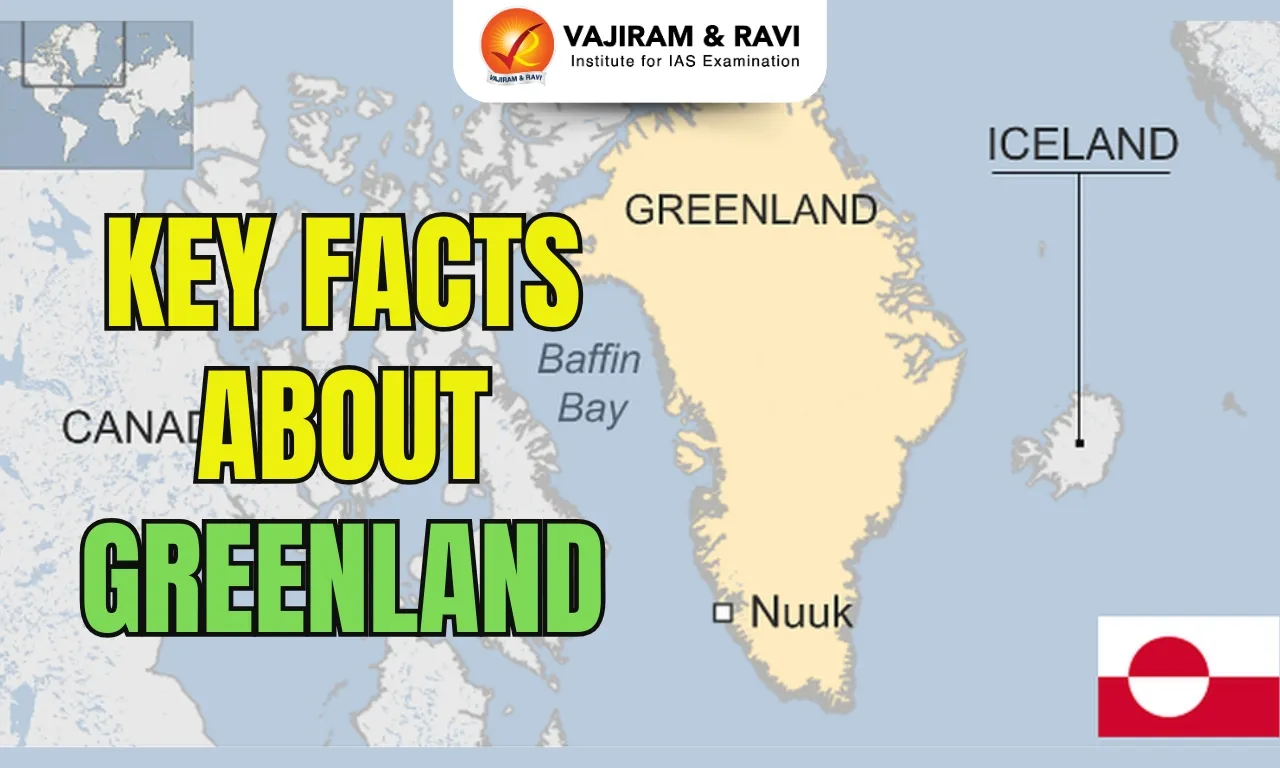
  • It is the world’s largest (non-continent) island located between the continents of North America and Europe in the North Atlantic Ocean.
  • It is geographically considered a part of the North American continent.
  • It was once a Danish colony and is now an autonomous province of Denmark.
  • Borders of Greenland: It is surrounded by the Arctic Ocean to the north; by the Greenland Sea to the east; by the North Atlantic Ocean to the southeast; Davis Strait to the southwest and Baffin Bay to the west.
  • Capital City: Nuuk

Geographical Features of Greenland

  • Climate: Greenland is in the polar zone, where winter temperatures reach as low as -50°C and summer temperatures rarely exceed 10–15°C.
  • Highest Point: Gunnbjorn’s Fjeld
  • Natural Resources: It mainly consists of Coal, iron ore, lead, zinc, molybdenum, diamonds, gold, platinum, niobium.

Source: DD News

Greenland FAQs

Q1: What is the Capital of Greenland?

Ans: Nuuk

Q2: Greenland is located between which two oceans?

Ans: Arctic Ocean and North Atlantic Ocean

India-UK CETA: How the India-UK Trade Deal Will Transform the Economy

India-UK CETA

India-UK CETA Latest News

  • The India-UK Comprehensive Economic and Trade Agreement (CETA) came into effect on July 15, 2026, a year after it was signed. 
  • Alongside it, the Double Contribution Convention (DCC) also became operational. 
  • This is India's first comprehensive trade deal with a developed country and is being called the "gold standard" of India's FTAs. It also lays the groundwork for India's ongoing negotiations with the European Union.

Scale and Coverage of the Deal

  • The CETA is notable for both its breadth and depth, covering tariff and non-tariff issues across 30 chapters, including digital trade, government procurement, MSMEs, innovation, labour, environment, and gender. 
  • It also addresses non-tariff barriers such as Sanitary and Phytosanitary Measures (SPS) and Technical Barriers to Trade (TBT).
  • Overall tariff elimination
    • India has reduced tariffs on around 90% of products.
    • The UK has eliminated tariffs on 99% of Indian exports.
    • On implementation, the UK immediately eliminated tariffs on 96.8% of its tariff lines, covering 97.7% of trade value
      • Including quota-based reductions, this rises to 98.8% of tariff lines and 99.5% of trade value.
    • India will immediately eliminate tariffs on 30.3% of trade value, with a further 47% phased out over time, and 12.1% covered under quota-based reductions. 
      • In total, this covers 89.5% of tariff lines and 89.4% of trade value.

Gains for India

  • Export boost for labour-intensive sectors: Textiles, footwear, and gems and jewellery are expected to benefit. 
    • Indian textile exports currently face UK tariffs of up to 10%; their removal could level the playing field against competitors like Bangladesh. 
    • Duties on gems and jewellery (up to 12%) and footwear (up to 16%) have been eliminated.
  • Steel exports: UK-allocated quotas are expected to push India's iron and steel exports from around $850 million to over $1 billion. UK curbs on steel imports had been a major sticking point before the deal.
  • Services sector access: The UK has granted commercial presence rights to Indian firms in computer services, consultancy, and environmental services, allowing them to set up branches or subsidiaries in the UK.
  • Non-binding labour and environment chapter: Experts view this as a win for India, since strong labour and environment norms in Western countries often act as non-tariff barriers for developing-country exporters.
  • Government procurement access: Indian suppliers get legal access to the UK's Central government procurement market, worth around £90 billion ($122 billion), while India offers reciprocal access worth about $114 billion. 
    • UK firms, however, can participate only as Class-II local suppliers, while Indian suppliers retain Class-I preference in the UK.

The Double Contribution Convention (DCC): A Major Win for Workers

  • The DCC addresses a long-standing problem: Indian workers in the UK were paying social security in both countries, even though UK benefits require 10 years of contributions, well beyond the typical 5-year stay of most Indian workers.
  • Under the DCC, Indian workers and their employers are exempted from UK social security contributions for five years, provided they continue paying in India.
  • This benefits roughly 75,000 Indian professionals and over 900 firms.
  • About 90% of Indian workers in the UK will save close to 23% of their salaries that would otherwise go toward UK social security.
  • Importantly, the DCC is not applicable to Indians who were already working in the UK before July 15, 2026.

Gains for the UK and Consumers

  • Cheaper imports for Indian consumers: Tariffs on British cars, scotch whisky, chocolates, cosmetics, and sports equipment have been reduced or removed.
  • Automobile tariffs (a first for India in any FTA): Tariffs on British cars cut from up to 110% to 30% in year one, falling to 10% by year five. Annual import quota starts at 20,000 vehicles, rising to 37,000 by year five, before tapering to 15,000 by year fifteen and beyond.
    • Separate quotas and tariffs apply to alternative fuel and commercial vehicles.
  • Alcohol concessions: Tariffs on British alcoholic beverages cut from 150% to 75% initially, falling further to 40% by year ten, a significant concession given India's large and fast-growing spirits market and the UK's position as the world's largest whisky exporter.
  • Services access for UK firms: India has opened key sectors, accounting, auditing, financial services, telecom, and environmental services, to UK firms without requiring local presence. 
    • India has also agreed to recognise UK professional qualifications in law and accounting.

Customs Reform: A Notable First

  • For the first time in an Indian FTA, exporters and producers in the UK can self-declare the origin of goods, replacing the traditional system of certificates from designated authorities. 
  • Experts believe this could set a precedent for future deals with developed economies like the EU and US, and supports India's broader push to reduce reliance on Chinese and ASEAN suppliers. 
  • Notably, tariffs on UK medical devices (up to 14%) have also been removed, addressing India's dependence on Chinese medical equipment.

Remaining Challenges

  • Despite the gains, India did not secure an exemption from the UK's proposed Carbon Border Adjustment Mechanism (CBAM), a carbon pricing framework for imported carbon-intensive goods, set to take effect from January 1, 2027. 
  • This remains a concern for India's export-oriented industries.

Conclusion

  • The India-UK CETA marks a watershed in India's trade diplomacy, its first comprehensive deal with a developed economy. 
  • While it opens new export opportunities and eases the burden on Indian workers abroad, unresolved issues like CBAM show that deeper integration with developed economies still carries unfinished business.

Source: IE | TH

India-UK CETA FAQs

Q1: Why is India-UK CETA considered a landmark trade agreement?

Ans: India-UK CETA is India's first comprehensive trade agreement with a developed economy, covering goods, services, digital trade, investment, government procurement and labour mobility.

Q2: How does India-UK CETA benefit Indian exporters?

Ans: India-UK CETA removes tariffs on most Indian exports, improving market access for textiles, gems and jewellery, footwear, steel and several labour-intensive industries.

Q3: What is the significance of the Double Contribution Convention under India-UK CETA?

Ans: The Double Contribution Convention under India-UK CETA exempts eligible Indian professionals from UK social security contributions for five years, reducing employment costs abroad.

Q4: What challenges remain despite the gains from India-UK CETA?

Ans: India-UK CETA does not exempt Indian exports from the UK's proposed Carbon Border Adjustment Mechanism, leaving concerns for carbon-intensive export sectors.

Q5: Why is India-UK CETA important for India's future trade strategy?

Ans: India-UK CETA establishes a modern template for future agreements with developed economies by addressing tariffs, services, digital trade and regulatory cooperation.

Ladakh Hill Councils: Understanding the Debate Over Seven Autonomous Councils

Ladakh Hill Councils

Ladakh Hill Councils Latest News

  • The Ladakh administration has announced the constitution of an Autonomous Hill Development Council (AHDC) in each of the Union Territory's seven districts. 
  • This has reopened debate over how political power should be distributed in the region, with civil society groups opposing the move even as they support decentralised governance.

What Has Been Announced?

  • Recently, the Ladakh administration announced an AHDC for each of its seven districts. 
  • Earlier, such councils existed only in Leh and Kargil. The move follows the creation of five new districts, Drass, Sham, Nubra, Changthang and Zanskar, in April 2026.
  • Govt officials called this a step towards democratic decentralisation
  • They also said the Centre and Ladakh had broadly agreed on a Union Territory-level representative body under a customised Article 371 framework, with legislative, executive, financial and administrative powers.
  • The administration argues both moves are complementary. Section 3 of the Ladakh Autonomous Hill Development Council Act allows a council in every district. 

Why Does Ladakh Need Decentralisation?

  • Ladakh is India's largest Union Territory by area, spread across nearly 60,000 sq km, but has barely 3 lakh people, making it one of the least densely populated regions in the country. 
  • Villages are often separated by mountain passes and long travel times, which has made decentralised administration a long-standing demand.

Opposition From Civil Society Groups

  • Two civil society groups, the Apex Body, Leh (ABL) and the Kargil Democratic Alliance (KDA), are negotiating Ladakh's political future with the Centre. 
  • Neither disputes the need for decentralised administration. Their objection is to the fragmentation of political authority while talks on a representative framework under Article 371 are still underway.
  • Key concerns raised
    • Empowering seven district councils could leave little real authority with the future Article 371 representative body.
    • The move is "maximum government and minimum governance," since even existing councils have steadily lost power.
    • Ladakh leaders say the seven-council proposal appeared in the Minutes of a May 22 Centre-Ladakh meeting, which they refused to sign. 
    • A revised version without the proposal was then signed. They allege the Centre proceeded without consulting them.
  • The broader worry is institutional overlap. Once seven hill councils, Panchayati Raj bodies, the UT administration, and a future Article 371 body all coexist, lines of accountability may blur.

Roots of the Trust Deficit

  • Opposition to the current move is embedded in a wider trust deficit between Ladakh's civil society and the Centre since Union Territory status in 2019:
    • Ladakh, unlike Jammu and Kashmir, was not given a legislature, causing early disappointment.
    • Talks on Sixth Schedule-like safeguards and an Article 371 framework have moved slowly.
    • Relations worsened after the September 2025 Leh protests, the detention of activist Sonam Wangchuk under the National Security Act, and remarks seen locally as questioning Ladakh's loyalty.
    • The emergence of the Voice of Buddhist Ladakh added to mistrust, with ABL alleging it was encouraged to split the joint Leh-Kargil movement.
    • The April creation of five new districts drew criticism from KDA, which alleged the new map favoured Buddhist-majority areas.

How Powerful Are the Hill Councils?

  • On paper, LAHDCs are among India's more powerful statutory district bodies. 
  • Under the 1997 Act, they handle district planning, budgets, development schemes, management of council land, and collection of local taxes.
  • In practice, though, elected representatives across parties say the councils have lost relevance since UT status
  • Decision-making has reportedly shifted to the Lieutenant Governor's secretariat, land recommendations are often ignored, and council budgets and staff have been reduced. 
  • This creates a paradox: the government wants to increase councils from two to seven, while representatives say the existing ones need to be made functional first.

Comparison with Similar Bodies

  • LAHDCs sit in a middle position within India's federal set-up:
    • Sixth Schedule councils (Assam, Meghalaya, Mizoram, Tripura) enjoy constitutional status, independent legislative powers, and judicial authority over customary matters, subject to the Governor's assent.
    • LAHDCs have none of these constitutional protections.
    • They are closer to statutory autonomous councils like those in Manipur, which despite having significant powers on paper, face financial dependence on the state government and limited real control.

Conclusion

  • Ladakh's seven-council plan exposes a deeper question: does democratic authority sit in multiple district bodies or a unified Article 371 framework? 
  • Until this is resolved, and existing councils are made functional, decentralisation reforms will remain entangled in an unresolved trust deficit between Ladakh and the Centre.

Source: IE

Ladakh Hill Councils FAQs

Q1: Why has the proposal for seven Ladakh Hill Councils sparked controversy?

Ans: The Ladakh Hill Councils proposal has raised concerns that creating multiple district councils may weaken the proposed Union Territory-level representative body under Article 371.

Q2: Why does Ladakh require decentralised governance through Ladakh Hill Councils?

Ans: Ladakh Hill Councils are seen as necessary because the Union Territory's vast geography, sparse population and difficult terrain require decentralised decision-making and local administration.

Q3: What concerns have civil society groups expressed about the Ladakh Hill Councils?

Ans: Civil society groups argue that the Ladakh Hill Councils proposal could fragment political authority, create institutional overlap and deepen the existing trust deficit with the Centre.

Q4: How do Ladakh Hill Councils differ from Sixth Schedule Autonomous Councils?

Ans: Ladakh Hill Councils are statutory bodies without constitutional protection, unlike Sixth Schedule councils, which enjoy legislative, judicial and administrative autonomy under the Constitution.

Q5: What is the broader governance issue highlighted by the Ladakh Hill Councils debate?

Ans: The Ladakh Hill Councils debate highlights the challenge of balancing decentralised governance, constitutional safeguards, democratic accountability and regional aspirations in Ladakh.

Gandak River

Gandak River

Gandak River Latest News

Due to heavy rainfall in Nepal’s catchment area, the water levels of the Gandak River in Bihar have been rising continuously.

About Gandak River

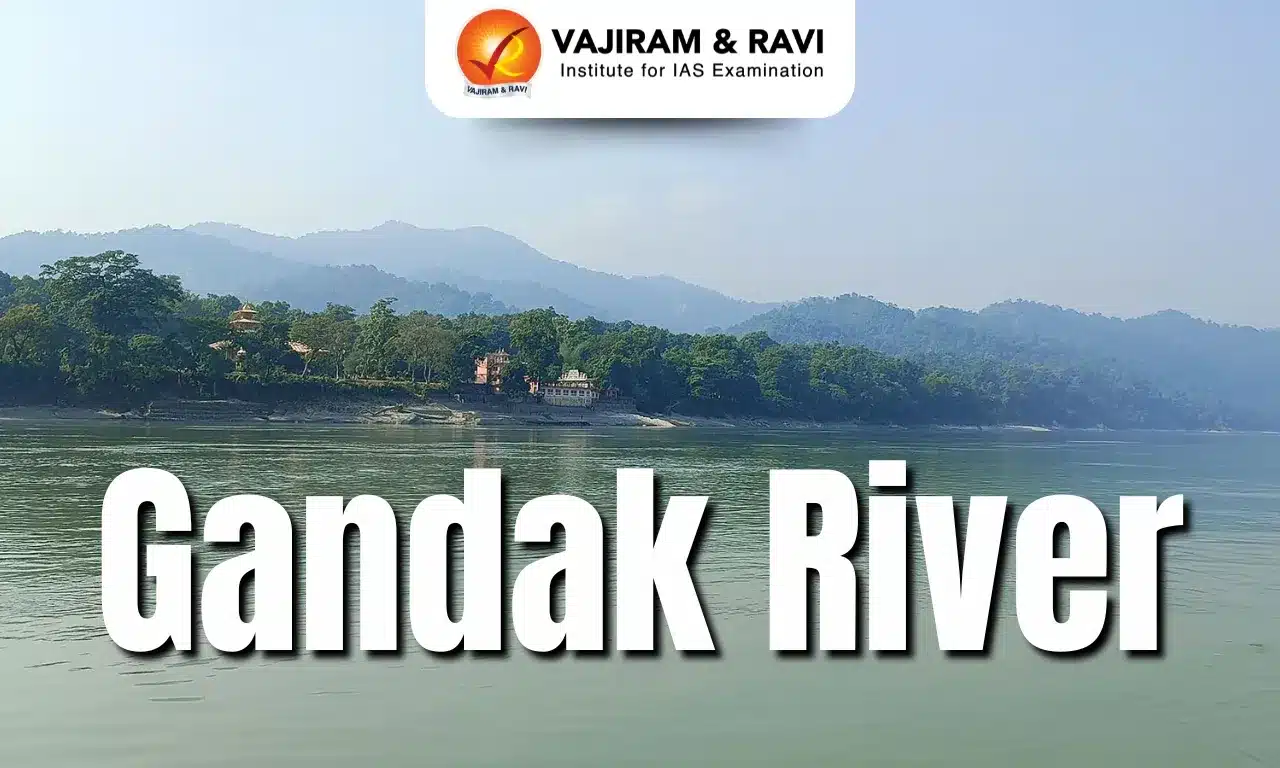
  • It is one of the major rivers of North India and a significant left-bank tributary of the Ganga River. 
  • It is mentioned in the ancient Sanskrit epic Mahabharata.
  • Course:
    • It originates at an altitude of 7620 m above msl to the north of Dhaulagiri Mountain in Tibet near the Nepal border. 
    • It is formed by the union of the Kali and Trisuli Rivers, which rise in the Great Himalayas of Nepal. 
    • From their meeting point till the Indian border, the river is known as the ‘Kali Gandaki’ and ‘Narayani’ in Nepal. 
    • It enters India near Valmikinagar in Bihar and briefly touches Uttar Pradesh, forming a small stretch of boundary.  
    • The entry point of the river is at the Indo–Nepal border and is known as Triveni.
    • After this, the river flows mainly through Bihar, covering districts like West Champaran, East Champaran, Gopalganj, and Saran. 
    • The Gandak finally joins the Ganga River opposite Patna, near Hajipur in Vaishali district, Bihar
  • It has a total length of about 630 kilometers, out of which 185 kilometers lie in Nepal and around 445 kilometers in India.  
  • The basin is bounded by the Himalayas to the north and the Ganga River to the south.
  • On the sides, it lies between the Kosi basin in the east and the Karnali (Ghaghara) basin in the west. .
  • There are about 1,710 glaciers and over 300 lakes in the upper catchment of Gandak.
  • The basin includes three peaks over 8,000 m: Dhaulagiri, Manaslu, and Annapurna Massif.
  • Due to the steep slope and loose soil in the upper catchment, Gandak carries a lot of silt and other deposits to the Indian side, resulting in a continuous shifting course of the river.
  • While flowing through the Nepal Himalayas, it forms the Kali Gandaki Gorge, one of the deepest river gorges in the world.
  • Two important protected areas, Chitwan National Park in Nepal and the adjacent Valmiki Tiger reserve in India, have been established in the basin.
  • Major Tributaries: Daraudi, Seti, Madi, Marsyandi, and Budhi Gandaki.

News: NOA

Gandak River FAQs

Q1: Which major river is the Gandak a tributary of?

Ans: The Gandak is a major left-bank tributary of the Ganga River.

Q2: Where does the Gandak River originate?

Ans: It originates north of Dhaulagiri Mountain in Tibet near the Nepal border at an altitude of about 7,620 m above mean sea level.

Q3: Near which place does the Gandak River enter India?

Ans: Near Valmikinagar in Bihar.

Q4: What is the total length of the Gandak River?

Ans: It has a total length of about 630 kilometers, out of which 185 kilometers lie in Nepal and around 445 kilometers in India.

El Nino, Meaning, Effect in India and World, Weather Conditions

El Nino

The term “El Nino” means “The Little Boy” in Spanish, as it was first noticed by fishermen near South America around Christmas time. It is part of a larger climate system called the El Nino-Southern Oscillation (ENSO), which also includes its opposite phase, La Nina. It is a natural climate phenomenon in which the surface water of the central and eastern Pacific Ocean becomes warmer than usual. This warming disrupts normal weather patterns across the world, leading to extreme events such as droughts, floods, and heatwaves. It influences agriculture, water resources, food security, energy demand and disaster risks across many regions.

What is El Nino?

El Nino is the warm phase of the ENSO which is one of the world's most important natural climate patterns. It develops when sea surface temperatures in the central and eastern equatorial Pacific Ocean become unusually warm, changing global wind systems and rainfall patterns. It normally occurs every two to seven years and lasting about nine to twelve months. Its effects depend on intensity, duration and interaction with other climate systems such as the Indian Ocean Dipole.

El Nino 2026

El Nino Weather conditions strengthened during 2026, with global agencies warning of widespread weather disruptions, higher temperatures and changing rainfall patterns.

  • WMO Forecast: The World Meteorological Organization (WMO) estimated an 80% probability of El Niño during June-August 2026, with the likelihood rising to 90% or more of continuing until at least November 2026.
  • Ocean Monitoring: Observations during late April to mid-May showed sea surface temperatures in the central-eastern equatorial Pacific approaching El Nino thresholds. Subsurface waters exceeded 6°C above average, providing a large heat reserve that continued warming the ocean surface.
  • Atmospheric Signals: The Southern Oscillation Index (SOI) also shifted towards El Niño conditions, confirming weakening atmospheric circulation. Together with warmer ocean waters, these indicators showed that El Niño development was well underway during 2026.
  • NOAA Advisory: On 11 June 2026, the National Oceanic and Atmospheric Administration (NOAA) officially issued an El Nino Advisory. It forecast a 63% probability of sea surface temperatures crossing 2°C above average, indicating the possibility of a very strong El Niño (Super El Nino).

El Nino Effects on India and World

El Nino influences rainfall, temperatures and weather systems worldwide, affecting agriculture, food security, public health, water resources and economic activity.

Effect on India

  • El Niño weakens the Southwest Monsoon by shifting the Walker Circulation eastward. During late June 2026, India's cumulative monsoon rainfall remained around 42% below normal, increasing drought risk, reducing reservoir levels and affecting agricultural production.
  • Reduced rainfall and prolonged heat increase temperatures above 45°C across many parts of India. Lower hydropower generation, combined with rising electricity demand exceeding 240 GW, places additional pressure on thermal power generation and electricity prices.
  • Nearly 45% of India's workforce depends on agriculture. Weak monsoon conditions reduce crop yields, raise food inflation, lower rural incomes, affect FMCG and automobile demand, and increase government spending on relief measures and food imports.

Global Impact

  • Rainfall Changes: El Niño generally brings heavier rainfall to southern South America, southern United States, the Horn of Africa and Central Asia, while causing drier conditions across Australia, Indonesia, Central America, northern South America, the Caribbean and parts of southern Asia.
  • Europe Heatwaves 2026: During June 2026, Europe experienced record-breaking heat, with temperatures reaching 43.8°C in France, 41.7°C in Germany, and 40.7°C in Hungary, causing severe stress on agriculture, infrastructure and public health.
  • Human Health Risks: Prolonged El Niño-driven heatwaves increase heat stress, dehydration and heat-related illnesses. WHO reported more than 1,300 excess deaths in Europe after 21 June 2026, while over 150 million people were affected by extreme heat conditions.
  • Agriculture and Food Security: Rising temperatures and changing rainfall reduce crop productivity across several regions. The 2026-27 El Niño is expected to affect agriculture in India, China, Australia, Brazil and Sub-Saharan Africa, increasing food security concerns and disrupting global agricultural markets.
  • Wildfires and Drought: El Niño raises drought risk in Australia, South-East Asia, southern Africa and Central America, while prolonged dry conditions increase the probability of forest fires, water shortages and ecosystem degradation across vulnerable regions.
  • Flood and Disaster Risk: While some regions become drier, East Africa, parts of Central and East Asia, and large areas of North and South America are expected to receive above-normal rainfall, increasing the risk of floods, landslides, soil erosion and waterlogging.
  • Urban Heat Stress: El Niño intensifies the urban heat island effect, where cities remain much hotter than surrounding areas. Warm nights prevent the human body from recovering, increasing health risks, especially for elderly people, children, outdoor workers and those with chronic illnesses.
  • Water Resource Pressure: Reduced rainfall and prolonged drought lower reservoir levels and groundwater recharge in many regions, increasing competition for drinking water, irrigation and industrial use while raising the likelihood of water scarcity.
  • Marine Ecosystems: Warmer Pacific waters alter fish migration patterns, push cold-water species into deeper waters and encourage harmful algal blooms in some coastal regions, affecting fisheries, marine biodiversity and coastal livelihoods.
  • Compound Climate Disasters: WMO highlighted that El Niño can trigger multiple hazards simultaneously, including heatwaves, droughts, floods, storms and wildfires, creating cascading impacts on food systems, water availability, public health and national economies.

El Nino Formation

El Nino develops when the normal ocean-atmosphere system of the Pacific Ocean gets disturbed due to changes in wind patterns and heat distribution, leading to large-scale climatic impacts across the globe.

  • Weakening of Trade Winds: The easterly trade winds, which normally push warm water toward the western Pacific, lose strength or may even reverse direction.
  • Eastward Movement of Warm Water: Warm surface water accumulated near Asia and Australia starts flowing back toward the central and eastern Pacific Ocean.
  • Reduction in Upwelling: The usual rise of cold, nutrient-rich water along the western coast of South America decreases significantly, affecting ocean productivity.
  • Increase in Sea Surface Temperature (SST): The central and eastern Pacific Ocean experience abnormal warming, which is the core feature of El Nino.
  • Shift in Convection Zone: The region of rising warm air and cloud formation moves eastward, changing rainfall patterns across the Pacific.
  • Disturbance in Atmospheric Circulation: The Walker Circulation weakens or shifts, disrupting the balance between ocean and atmosphere.
  • Change in Pressure Systems: The pressure difference between the eastern and western Pacific reduces, influencing global wind systems.
  • Alteration of Jet Streams: The Pacific jet stream shifts its path, affecting weather patterns in different parts of the world.

Also Read: Primary Winds

El Nino and Indian Monsoon

El Nino has a strong and often negative impact on the Indian monsoon, which is crucial for agriculture, water supply, and the overall economy. When El Nino develops, the warming of the Pacific Ocean weakens the monsoon circulation over India, leading to reduced rainfall and increased chances of drought.

  • Weak Monsoon Winds: El Nino reduces the strength of southwest monsoon winds, leading to less moisture transport toward India.
  • Deficient Rainfall: Many regions experience below-normal rainfall, especially during strong El Nino years.
  • Increased Drought Risk: Lower rainfall increases the chances of drought, particularly in central and northwestern India.
  • Rise in Temperature: Reduced cloud cover and rainfall lead to higher temperatures and heatwave conditions.
  • Agricultural Impact: Crop yields decline due to insufficient water, affecting food production and farmer income.
  • Water Scarcity: Reservoir levels, groundwater, and rivers receive less recharge, causing water shortages.
  • Regional Variability: While most areas face deficit rainfall, some regions may still receive normal or even excess rain due to local factors.

Impacts of El Nino

El Nino significantly alters global weather systems by redistributing heat and moisture across the Pacific Ocean. This leads to widespread climatic disturbances such as floods, droughts, and temperature extremes in different parts of the world.
eastern Pacific Ocean.

  • Australia and Indonesia: Face severe drought conditions and increased risk of forest fires due to reduced rainfall.
  • North America: Southern regions (like California) may receive heavy rainfall, while northern areas experience warmer winters.
  • Asia: Countries like India may face weak monsoon and drought-like conditions, while Southeast Asia also sees reduced rainfall.
  • Africa: Eastern Africa often receives above-normal rainfall causing floods, while Southern Africa may experience drought.
  • Global Temperature Rise: El Nino years are generally warmer, contributing to short-term global warming spikes.
  • Marine Ecosystem Impact: Reduced upwelling affects fish populations, especially along the South American coast.
  • Coral Bleaching: Warmer ocean temperatures lead to widespread coral bleaching events in tropical oceans.
  • Cyclone/Hurricane Patterns: Decreases Atlantic hurricanes but may increase cyclone activity in the Pacific.
  • Agriculture Impact: Crop yields decline in drought-affected regions, while floods damage crops elsewhere.
  • Water Resources: Causes water scarcity in some regions and excess water in others, disrupting supply systems.
  • Economic Losses: Leads to global economic impacts due to damage to agriculture, fisheries, and infrastructure.

El Nino Management

Early monitoring, climate planning and resilient infrastructure help governments reduce the economic and humanitarian impacts of El Nino.

  • Early Warning Systems: WMO issues global El Niño/ La Niña Updates, seasonal climate forecasts and regional outlooks to support governments, humanitarian agencies and sectors such as agriculture, water management, health and energy in timely decision-making.
  • Scientific Monitoring: Continuous monitoring through ONI, RONI, SOI, satellite observations, ocean buoys and atmospheric measurements enables earlier detection of changing Pacific Ocean conditions and improves forecast accuracy.
  • Climate-Resilient Agriculture: Promoting millets, pulses and oilseeds, expanding drip irrigation, using AI-based weather advisories and developing drought-tolerant crop varieties improve agricultural resilience against weak monsoon conditions.
  • Water and Urban Management: Rainwater harvesting, groundwater recharge, restoration of wetlands, canal-top solar projects, efficient reservoir management and urban "cool roof" programmes help reduce water shortages and heat stress.
  • International Coordination: Organizations including WMO, NOAA, IMD, IITM, ECMWF, IRI and regional climate forums regularly share forecasts, technical expertise and humanitarian guidance for coordinated preparedness across countries.

Also Check: Difference Between El Nino and La Nina

El Nino FAQs

Q1: What is El Nino?

Ans: El Nino is a climate phenomenon in which the central and eastern Pacific Ocean becomes warmer than normal, affecting global weather patterns.

Q2: What causes El Nino?

Ans: It is mainly caused by the weakening or reversal of trade winds, which allows warm water to move eastward across the Pacific Ocean.

Q3: How often does El Nino occur?

Ans: El Nino typically occurs every 2 to 7 years as part of the El Niño–Southern Oscillation (ENSO) cycle.

Q4: What is the difference between El Nino and La Nina?

Ans: El Nino involves warming of Pacific waters, while La Niña involves cooling, leading to opposite weather effects.

Q5: How does El Nino affect India?

Ans: It usually weakens the monsoon, leading to less rainfall, drought conditions, and higher temperatures.

Jagannath Rath Yatra 2026, History, Origin, Rituals, Significance

Jagannath Rath Yatra 2026

Jagannath Rath Yatra 2026 is one of the most revered Hindu festivals celebrated with great devotion in Puri, Odisha. Popularly known as the Festival of Chariots, it marks the annual journey of Lord Jagannath, Lord Balabhadra, and Goddess Subhadra from the Jagannath Temple to the Gundicha Temple. Every year, millions of devotees gather to witness the grand procession and pull the sacred chariots, believing it brings divine blessings and spiritual merit. The festival is an important symbol of India's rich religious and cultural heritage.

What is Jagannath Rath Yatra?

Jagannath Rath Yatra is an annual Hindu festival that commemorates the ceremonial journey of Lord Jagannath, Lord Balabhadra, and Goddess Subhadra from their main temple in Puri to the Gundicha Temple, located about 3 kilometres away. The festival begins on Ashadha Shukla Dwitiya (the second day of the bright fortnight of the Hindu month of Ashadha) and continues for nine days.

Jagannath Rath Yatra 2026 History and Origin

Jagannath Rath Yatra is an ancient Hindu festival that commemorates the annual journey of Lord Jagannath, Lord Balabhadra, and Goddess Subhadra from the Jagannath Temple to the Gundicha Temple in Puri, Odisha.

  • Believed to have ancient origins rooted in Hindu traditions and scriptures.
  • The present Jagannath Temple was built in the 12th century CE by King Anantavarman Chodaganga Deva.
  • The festival gained prominence after the construction of the Jagannath Temple in Puri.
  • Celebrates the annual visit of the three deities to Gundicha Temple, believed to be their aunt's abode.
  • Popularly known as the Festival of Chariots because the deities travel in three grand wooden chariots.
  • Observed every year on Ashadha Shukla Dwitiya and continues for nine days.
  • Considered one of the oldest and largest religious festivals celebrated in India.
  • Attracts millions of devotees and pilgrims from across the world every year.

Jagannath Rath Yatra 2026 Rituals

The Jagannath Rath Yatra 2026 is celebrated through a series of sacred rituals that symbolize devotion, humility, and the annual journey of Lord Jagannath, Lord Balabhadra, and Goddess Subhadra from the Jagannath Temple to the Gundicha Temple.

  • Snana Purnima: The deities are ceremonially bathed with 108 pots of sacred water before the festival.
  • Anavasara: After the ritual bath, the deities remain out of public view for about 15 days, symbolizing a period of rest.
  • Nava Jaubana Darshan: Devotees receive the first glimpse of the deities after Anavasara.
  • Pahandi Bije: The deities are carried from the temple to their respective chariots in a grand ceremonial procession.
  • Chhera Pahanra: The Gajapati King of Puri sweeps the chariots with a golden broom, signifying humility and equality before God.
  • Rath Yatra: Thousands of devotees pull the three massive wooden chariots to the Gundicha Temple using thick ropes.
  • Stay at Gundicha Temple: The deities remain at the Gundicha Temple for several days, where special rituals and worship are performed.
  • Hera Panchami: Goddess Lakshmi symbolically visits Gundicha Temple in a traditional ritual.
  • Bahuda Yatra: The deities begin their return journey to the Jagannath Temple.
  • Suna Besha: The deities are adorned with magnificent gold ornaments, one of the most awaited rituals of the festival.
  • Niladri Bijay: The deities re-enter the Jagannath Temple, marking the successful conclusion of the nine-day Rath Yatra.

Mythological Significance of Jagannath Rath Yatra

The Jagannath Rath Yatra holds deep mythological and spiritual significance, symbolizing the divine journey of Lord Jagannath, Lord Balabhadra, and Goddess Subhadra to the Gundicha Temple, which is believed to be the home of their aunt.

  • According to legend, Goddess Subhadra wished to visit her aunt's house at Gundicha Temple.
  • Lord Jagannath and Lord Balabhadra accompanied her, giving rise to the annual Rath Yatra tradition.
  • The festival represents the love, affection, and family bond among the three divine siblings.
  • It symbolizes Lord Jagannath's willingness to leave the temple and bless all devotees without distinction.
  • Pulling the sacred chariots is believed to bring spiritual merit, prosperity, and divine blessings.
  • The Rath Yatra conveys the values of equality, devotion, compassion, and inclusiveness, as people from all communities participate together.
  • The annual journey signifies the cyclical nature of life, renewal, and the connection between the divine and humanity.
  • The festival is regarded as one of the most sacred Vaishnavite traditions in India, attracting millions of devotees every year.

The Three Chariots of Jagannath Rath Yatra

A unique feature of the Jagannath Rath Yatra is the procession of three magnificent wooden chariots, each dedicated to one of the deities. These chariots are constructed anew every year using traditional methods and sacred wood, showcasing Odisha's rich craftsmanship and cultural heritage.

The Three Chariots of Jagannath Rath Yatra

Deity

Chariot Name

Canopy Colour

Lord Jagannath

Nandighosha

Red and Yellow

Lord Balabhadra

Taladhwaja

Red and Green

Goddess Subhadra

Darpadalana (Devadalana)

Red and Black

Jagannath Temple, Puri Architecture

The Jagannath Temple in Puri, Odisha, is one of India's most sacred temples and a masterpiece of Kalinga architecture, renowned for its towering structure, intricate carvings, and immense religious significance.

Key Architectural Features

  • Located in Puri, Odisha, on the eastern coast of India.
  • Built in the 12th century CE by King Anantavarman Chodaganga Deva.
  • One of the Char Dham pilgrimage sites, along with Badrinath, Dwarka, and Rameswaram.
  • Popularly known as the "White Pagoda."
  • Designed in the Kalinga style of architecture, characterized by a curvilinear Shikhara (spire), elaborate carvings, and sculptural ornamentation.
  • The temple complex is enclosed by a high fortified wall with four gateways facing the four cardinal directions.
  • The main temple consists of four principal structures:
    • Vimana (Deula): Sanctum sanctorum housing the deities.
    • Jagamohana: Assembly or prayer hall.
    • Nata Mandira: Festival and dance hall.
    • Bhoga Mandapa: Hall where offerings are prepared and presented.
  • The temple is revered as Yamanika Tirtha, where it is believed that the influence of Yama, the god of death, is nullified due to the presence of Lord Jagannath.
  • The temple's Nilachakra, an eight-spoked wheel made of Ashtadhatu (eight-metal alloy), is installed at the top of the main shrine and is considered highly sacred.
  • The temple remains one of the finest examples of medieval temple architecture and an enduring symbol of Odisha's rich cultural and spiritual heritage.

Jagannath Rath Yatra 2026 FAQs

Q1: When is Jagannath Rath Yatra 2026?

Ans: Jagannath Rath Yatra 2026 will be celebrated on 16 July 2026, beginning on Ashadha Shukla Dwitiya according to the Hindu calendar.

Q2: Why is Jagannath Rath Yatra celebrated?

Ans: The festival commemorates the annual journey of Lord Jagannath, Lord Balabhadra, and Goddess Subhadra from the Jagannath Temple to the Gundicha Temple in Puri.

Q3: Where is Jagannath Rath Yatra celebrated?

Ans: The main celebrations take place at the Jagannath Temple in Puri, Odisha, although Rath Yatras are organized in many parts of India and abroad.

Q4: How long does Jagannath Rath Yatra last?

Ans: The festival lasts for nine days, including the journey to Gundicha Temple and the return procession known as Bahuda Yatra.

Q5: What are the names of the three chariots?

Ans: The three chariots are Nandighosha (Lord Jagannath), Taladhwaja (Lord Balabhadra), and Darpadalana (Devadalana) (Goddess Subhadra).

Daily Editorial Analysis 16 July 2026

Daily-Editorial-Analysis

Iran’s Disruptive Strategy, Its Global Consequences

Context

  • Iran's recent actions in the Strait of Hormuz have intensified concerns over regional stability, global energy security, and the future of West Asian geopolitics.
  • While these actions may have delivered short-term tactical gains, they risk becoming long-term strategic failures by deepening Iran's international isolation, weakening its economy, and straining relations with neighbouring Gulf states.
  • In contrast, India's emphasis on multilateralism and diplomacy demonstrates a more sustainable approach to achieving influence in international affairs.

A Strategy of Disruption

  • Since the Iran-Iraq War, Iran has projected itself as a champion of Islamic resistance against Western influence and Israel.
  • This ideological position evolved into support for proxy organisations such as Hezbollah, Hamas, and the Houthis, collectively known as the Axis of Resistance.
  • Through these groups, Iran expanded its regional influence without engaging directly in large-scale military confrontations.
  • Although this strategy created significant operational success by challenging adversaries and maintaining pressure on the United States and Israel, it also widened Iran's diplomatic isolation.
  • Today, its closest strategic partners remain Russia, China, and North Korea , reflecting a foreign policy centred on confrontation rather than cooperation.
  • Tactical victories have therefore come at the cost of reduced international legitimacy, weaker economic integration, and limited opportunities for long-term development.

India's Approach

  • India has maintained a pragmatic relationship with Iran based on energy security, trade, and the Chabahar Port while carefully balancing its broader foreign policy interests.
  • Even during periods of Western sanctions, India protected its national interests by maintaining limited energy imports before gradually diversifying its oil sources.
  • During the recent regional crisis, India adopted a policy of strategic restraint, avoiding direct mediation while encouraging dialogue through quiet diplomacy.
  • Its support for UN Security Council Resolution 2817, which condemned attacks on Gulf Cooperation Council (GCC) countries and international shipping, reflected its commitment to international law and maritime security.
  • This balanced approach aligns with India's vision of a multipolar world, where disputes are addressed through cooperation and consensus rather than military confrontation.

Regional Consequences

  • Iran's attacks on shipping through the Strait of Hormuz and its proposal to impose preferential transit rates for selected countries represent a policy of coercive brinkmanship.
  • Such actions threaten one of the world's most important maritime trade routes, creating uncertainty for oil-importing nations and disrupting global commerce.
  • Countries such as India, whose economic growth depends heavily on uninterrupted energy supplies and secure trade corridors, are particularly vulnerable to prolonged instability in the region.
  • Domestically, Iran has emerged from recent conflicts politically hardened. The growing influence of the Islamic Revolutionary Guard Corps (IRGC) and conservative clerics suggests that future policies may continue to favour limited confrontation below the threshold of full-scale war.
  • This environment reduces prospects for moderation while increasing the risk of recurring regional tensions.

The Choice Before Iran

  • Iran possesses significant economic potential as an upper-middle-income economy with vast energy resources.
  • Opportunities such as the de-freezing of assets, expanding oil exports, and greater participation in global markets could generate sustained economic growth and improve the welfare of its citizens.
  • Achieving these goals, however, requires replacing confrontation with diplomatic engagement.
  • Continued reliance on proxy warfare, coercive tactics, and threats to international navigation will likely prolong economic isolation and discourage foreign investment.
  • Greater cooperation with the international community would strengthen regional stability while enabling Iran to benefit from expanded trade and energy partnerships.

Conclusion

  • Iran stands at a critical crossroads between continued confrontation and constructive engagement.
  • While its recent military actions have demonstrated tactical capability, they have also increased diplomatic isolation, economic uncertainty, and regional instability.
  • Lasting national progress depends not on coercion but on economic integration, international cooperation, and responsible diplomacy.
  • Compared with Iran's disruptive strategy, India's commitment to dialogue, consensus, and strategic autonomy offers a more effective model for navigating an increasingly interconnected and multipolar world.

Iran’s Disruptive Strategy, Its Global Consequences FAQs

Q1. Why is Iran's strategy considered a strategic failure?
Ans. Iran's strategy is considered a strategic failure because it has increased international isolation despite achieving short-term military gains.

Q2. What is the Axis of Resistance?
Ans. The Axis of Resistance is a network of Iran-backed groups, including Hezbollah, Hamas, and the Houthis.

Q3. How has India responded to the Iran crisis?
Ans. India has responded through strategic restraint, quiet diplomacy, and support for international law.

Q4. Why is the Strait of Hormuz important?
Ans. The Strait of Hormuz is important because it is a vital route for global oil trade and international shipping.

Q5. What should Iran do for long-term progress?
Ans. Iran should prioritise diplomatic engagement, economic integration, and peaceful cooperation with the international community.

Source: The Hindu


One Nation, One Election - Constitutional Reform or Misplaced Priority?

Context

  • The Constitution (129th Amendment) Bill seeks to implement One Nation, One Election (ONOE) by synchronising elections to the Lok Sabha and all State Legislative Assemblies.
  • This will be done through the insertion of Article 82A and amendments to Articles 83 and 172.
  • The proposal, based on the recommendations of the High-Level Committee (HLC) chaired by former President Ram Nath Kovind, requires a two-thirds majority in Parliament and ratification by at least half of the States.
  • Hence, there is the need to critically evaluate the government's rationale and highlight constitutional, political, and economic concerns.

Government's Rationale for ONOE

The HLC justifies simultaneous elections on four major grounds -

  • Reduction in election expenditure.
  • Minimising policy paralysis caused by the Model Code of Conduct (MCC).
  • Lower administrative and security burden.
  • Higher economic growth, citing research claiming that GDP growth is around 1.5 percentage points higher during simultaneous election cycles.

Questioning the Economic Growth Argument

  • Historical evidence contradicts the claim:
    • India's period of simultaneous elections (1952–1967) coincided with the "Hindu Rate of Growth" (~3.5% annually), characterised by licence raj, import substitution, and closed economy.
    • India's highest growth phase (2003–2011) occurred during staggered elections, with GDP growth of 8–9%.
  • Methodological concerns:
    • The cited research may not adequately account for major growth drivers such as 1991 economic reforms, trade liberalisation, IT revolution, global capital inflows, and financial sector development.
    • Further, the reported growth appears partly driven by higher fiscal deficits, and increased government expenditure.
    • This raises the possibility of a political business cycle rather than sustainable structural growth.

Election Expenditure - Does ONOE Reduce Costs?

  • Limited government spending: Election expenditure by the government constitutes less than 1% of the Union Budget, according to Election Commission of India (ECI) accounts.
  • The real issue - Black money:
    • Candidates officially report spending only about 50% of the permissible expenditure limit. This suggests substantial unaccounted election financing.
    • The Centre for Media Studies (CMS) estimates that the 2024 Lok Sabha election involved over ₹1 lakh crore in expenditure, much of it believed to be unaccounted.
  • Hence, ONOE merely concentrates election expenditure rather than reducing the role of black money or campaign financing.

MCC - Problem Shifted, Not Solved

  • Currently, different states remain under MCC for nearly four months annually due to staggered elections.
  • Under ONOE, the MCC would apply simultaneously across the country, and developmental announcements would be suspended nationwide during one large election period.
  • Thus, governance disruption is concentrated rather than eliminated, making the claim of ending "policy paralysis" questionable.

Constitutional and Democratic Concerns

  • Impact on parliamentary democracy:
    • The Kesavananda Bharati judgment recognised parliamentary democracy and free and fair elections as part of the Basic Structure.
    • Challenge: If a government loses its majority before the common election cycle, it cannot continue without democratic legitimacy, and frequent President's Rule would undermine federalism.
    • Constructive no-confidence motion: The HLC proposes adopting Germany's model, where a no-confidence motion must simultaneously elect an alternative government.
    • Critics argue this: Alters India's parliamentary tradition. Enables weak minority governments to remain in office.
  • Fixed synchronisation requires altering assembly tenures:
    • Achieving the first synchronised cycle would require extending some Assemblies, while curtailing others.
    • However, Articles 83 and 172 limit legislative tenure to five years. Extension without elections violates the electorate's mandate. Premature dissolution shortens the tenure voters approved.
    • Hence, both options compromise democratic legitimacy.
  • Threat to federalism and regional parties:
    • Research indicates a "wave effect" - Simultaneous elections encourage voters to support the same party at both national and state levels.
    • Potential consequences:
      • Electoral advantage for large national parties.
      • Weakening of regional parties.
      • Reduced attention to state-specific issues such as agrarian distress, coastal livelihoods, flood management, and regional development priorities.
    • This may dilute India's cooperative federal structure.

Ignoring Local Government Elections

  • The proposal excludes elections to the Panchayats, and the Urban Local Bodies.
  • These are constitutionally protected under the 73rd and 74th Constitutional Amendments.
  • Key concerns:
    • Local body elections remain under State Election Commissions, not the ECI.
    • Municipal corporations such as Mumbai, Pune, and Bengaluru manage budgets exceeding those of several states.
    • Separate local elections would continue to involve administrative deployment, security arrangements, and governance disruptions.
  • Therefore, many projected efficiency gains remain unrealised.

Reforms Needed Instead of ONOE

  • India's electoral challenges lie elsewhere and can be addressed without major constitutional amendments.
  • Reforms needed:
    • Transparent disclosure of political donations.
    • Strict enforcement of expenditure limits.
    • Disqualification of criminally tainted candidates.
    • Strengthening the independence and autonomy of the Election Commission of India.
    • Measures to curb black money, vote-buying, and misuse of state machinery.

Conclusion

  • The proposed One Nation, One Election framework primarily reorganises India's electoral calendar without addressing the structural weaknesses of the electoral system.
  • The anticipated gains remain uncertain, while the proposal raises significant concerns.
  • Hence, strengthening electoral integrity through targeted reforms would be a more effective and constitutionally sound approach than undertaking a far-reaching constitutional restructuring.

One Nation, One Election FAQs

Q1. What are the constitutional concerns associated with the ONOE proposal?

Ans. Basic Structure doctrine, parliamentary democracy, legislative tenure, federalism, and free and fair elections.

Q2. Why is the claim that ONOE will boost India's economic growth contested?

Ans. Historical evidence shows India's highest growth occurred during staggered elections.

Q3. Why may ONOE fail to substantially reduce election expenditure in India?

Ans. Because the major source of election spending is unaccounted political finance and black money.

Q4. How could simultaneous elections affect India's federal structure and regional political representation?

Ans. It may create a national wave effect, strengthening national parties while weakening regional parties.

Q5. What are the key electoral reforms that could improve India's democratic process without adopting ONOE?

Ans. Strengthening political funding transparency, enforcing expenditure limits, disqualifying criminal candidates, etc.

Source: IE


The Crisis at the Heart of Non-Proliferation

Context

  • The Iran nuclear standoff has reopened a long-standing debate on the fairness of the global non-proliferation order.
  • As talks in Doha struggle over frozen assets and verification issues, Iran is being asked to fully dismantle its enriched uranium stockpile, even though President Pezeshkian maintains that enrichment is Iran's sovereign right.
  • The five recognised nuclear powers, and Israel too, face no similar demand to disarm.
  • In this context, this article argues that the non-proliferation regime punishes compliance while rewarding defiance.
  • It examines the unequal application of the Nuclear Non-Proliferation Treaty (NPT), the collapse of the Iran nuclear deal (JCPOA), and the broader debate over fairness, disarmament and the credibility of the existing international nuclear order.

The Core Question

  • Why must Iran give up a capability that nine nuclear states already hold?
  • Analysts say the claim that Iran is "uniquely dangerous" is not backed by evidence.
  • It is a conclusion states reach first and justify later, especially states whose own record on international law is inconsistent.

Unequal Rules Under the NPT

  • The Treaty on the Non-Proliferation of Nuclear Weapons (NPT) was meant to prevent the spread of nuclear weapons. Instead, it froze an unequal hierarchy in place.
  • It split the world into nuclear "haves" and "have-nots." Have-nots must show restraint. Haves keep modernising their arsenals.
  • This double standard plays out clearly in practice:
    • India and Pakistan stay outside the NPT, hold real nuclear arsenals, and are still treated as strategic partners by major powers.
    • Israel has never allowed inspections of its widely known nuclear programme and is rarely named as a proliferation risk.
    • Iran, by contrast, enriched uranium within a legal framework, accepted the most intrusive inspections in arms control history under the JCPOA, and was still hit with sanctions after U.S. withdrawal from the deal.

Hiroshima and the Question of Moral Authority

  • As per the experts, the origin of today's nuclear order lies in the bombings of Hiroshima and Nagasaki in 1945, the only wartime use of nuclear weapons in history.
  • That act set two precedents: it showed the devastating power of these weapons, and it showed that their use could be absorbed into the language of "strategic necessity."
  • The state that used them became the very state that now polices nuclear order elsewhere. This complicates any moral claim to regulate others' nuclear ambitions.

The JCPOA's Collapse and Its Lesson

  • The Joint Comprehensive Plan of Action (JCPOA), negotiated under the Obama administration, was a genuine diplomatic achievement.
  • Its abandonment by the Trump administration in 2018 sent a clear signal to every state watching: agreements with the U.S. carry no guarantee of lasting compliance.
  • This collapse is responsible for deepening the current crisis.
  • The real issue is not whether Iran should enrich uranium. It is whether the framework judging that question is fair to begin with.
  • The call for total nuclear abolition dates back to the 1955 Einstein-Russell declaration, which warned that deterrence logic will eventually produce the catastrophe it claims to prevent.

Conclusion

  • The non-proliferation order rewards power, not principle. Iran's compliance was punished; others' defiance was tolerated.
  • Until disarmament obligations bind all states equally, the choice before the world remains stark: confront nuclear hierarchy through honest policy reform, or wait for catastrophe to force the reckoning.

The Crisis at the Heart of Non-Proliferation FAQs

Q1. Why does the article describe the global non-proliferation regime as facing a legitimacy crisis?

Ans: It argues that unequal treatment of states, selective enforcement and inconsistent disarmament obligations have weakened the credibility and fairness of the existing nuclear order.

Q2. How does the Nuclear Non-Proliferation Treaty (NPT) differentiate between states?

Ans: The NPT recognises a limited group of nuclear-weapon states while requiring non-nuclear states to forgo nuclear weapons and accept international safeguards and inspections.

Q3. Why is the collapse of the JCPOA considered significant?

Ans: The U.S. withdrawal from the JCPOA undermined confidence in diplomatic agreements, raising concerns about the durability of negotiated nuclear non-proliferation arrangements.

Q4. How does the article compare Iran's nuclear programme with those of other states?

Ans: The article argues that different standards are often applied to various nuclear-capable states, fuelling debates over consistency, equity and the legitimacy of global non-proliferation policies.

Q5. What reform does the article suggest for strengthening the non-proliferation regime?

Ans: It advocates universal application of disarmament obligations, equal treatment of all states and renewed commitment to global nuclear arms reduction and international cooperation.

Source: TH

Daily Editorial Analysis 2026 FAQs

Q1: What is editorial analysis?

Ans: Editorial analysis is the critical examination and interpretation of newspaper editorials to extract key insights, arguments, and perspectives relevant to UPSC preparation.

Q2: What is an editorial analyst?

Ans: An editorial analyst is someone who studies and breaks down editorials to highlight their relevance, structure, and usefulness for competitive exams like the UPSC.

Q3: What is an editorial for UPSC?

Ans: For UPSC, an editorial refers to opinion-based articles in reputed newspapers that provide analysis on current affairs, governance, policy, and socio-economic issues.

Q4: What are the sources of UPSC Editorial Analysis?

Ans: Key sources include editorials from The Hindu and Indian Express.

Q5: Can Editorial Analysis help in Mains Answer Writing?

Ans: Yes, editorial analysis enhances content quality, analytical depth, and structure in Mains answer writing.

Enquire Now