Gangaichthys indonepalicus

Gangaichthys indonepalicus

Gangaichthys indonepalicus Latest News

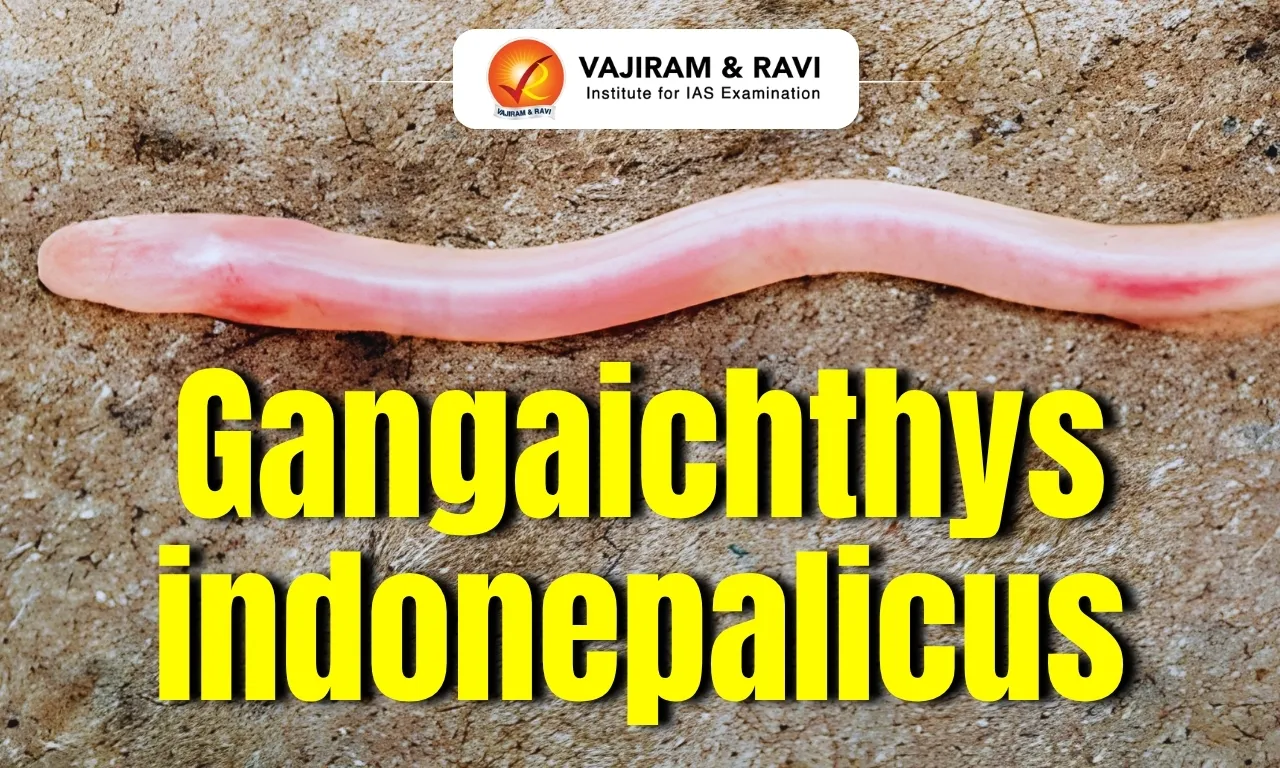
A short video posted on social media in 2024 helped scientists identify Gangaichthys indonepalicus, a tiny, colourless earthworm eel found beneath the Indo-Gangetic Plain in Bihar.

About Gangaichthys indonepalicus

  • It is a new species of earthworm eel.
  • It is a tiny, colourless underground fish found living beneath the Indo-Gangetic Plain in Bihar.  
  • It appears to have evolved several adaptations to survive in complete darkness.  
  • It is the first subterranean, or stygobitic (living underground, beneath the surface of the soil or rock), fish recorded from the Gangetic Basin. 
  • Measuring around four centimetres, Gangaichthys indonepalicus has reduced eyes covered by skin, a translucent body without pigmentation, and an apparent absence of ribs — features associated with life underground in perpetual darkness. 
  • The fish belongs to a completely distinct genus within the earthworm eel family Chaudhuriidae.

News: MD

Gangaichthys indonepalicus FAQs

Q1: What is Gangaichthys indonepalicus?

Ans: It is a newly discovered species of earthworm eel.

Q2: Where was Gangaichthys indonepalicus discovered?

Ans: It was found beneath the Indo-Gangetic Plain in Bihar.

Q3: What type of fish is Gangaichthys indonepalicus?

Ans: It is a tiny, colourless subterranean fish.

Q4: What adaptation does Gangaichthys indonepalicus have to survive in complete darkness?

Ans: It has reduced eyes covered by skin and a translucent, unpigmented body.

Indonesian babirusas

Indonesian babirusas

Indonesian babirusas Latest News

Recently, the Chester Zoo in the United Kingdom announced the birth of a critically important babirusa, when its population is threatened by the African swine fever. 

About Indonesian babirusas

  • The babirusa is a wild pig commonly known as "pig-deer", belonging to a genus called Babyrousa.
  • Since 2001, scientists have since recognized three extant species: Buru babirusa (Babyrousa babyrussa), North Sulawesi babirusa (B. celebensis), Togian babirusa (B. togeanensis).
  • Appearance: They’re much less hairy than other pigs. Males are the only pigs whose upper tusks erupt through the snout bone and curve back towards their face.
  • Habitat: They can be found in moist, swampy forests and in the lush thickets of tropical rainforests.
  • Distribution: They are found in the Indonesian islands of Sulawesi, Togian, Sula and Buru.
  • Conservation Status: IUCN Red List: Vulnerable

Characteristics of Indonesian babirusas

  • They are among the fastest runners in the pig family, able to reach 30 miles per hour.
  • They are excellent swimmers, preferring to live near bodies of water. 
  • They are well known for their lower canine tusks which are possessed by both sexes, along with the upper canine tusks that grow only on males.
  • Diet: Their diet includes fruits, plants and small animals.
  • They use their specialised hooves to dig for insect larvae and roots in the ground.
  • Reproduction: They become sexually mature after they reach one or two years of age.  Gestation in females lasts 155 to 158 days and ends with one or two piglets (which is a small litter for pigs).

Source: DTE

Indonesian babirusas FAQs

Q1: Babirusa is endemic to which country?

Ans: Indonesia

Q2: What is the Habitat of Babirus?

Ans: Tropical rainforests and swamps

Voyager 2 Mission

Voyager 2 Mission

Voyager 2 Mission Latest News

Recently, NASA’s Voyager 2 got a power-saving upgrade and its mission extended by a year. 

About Voyager 2 Mission

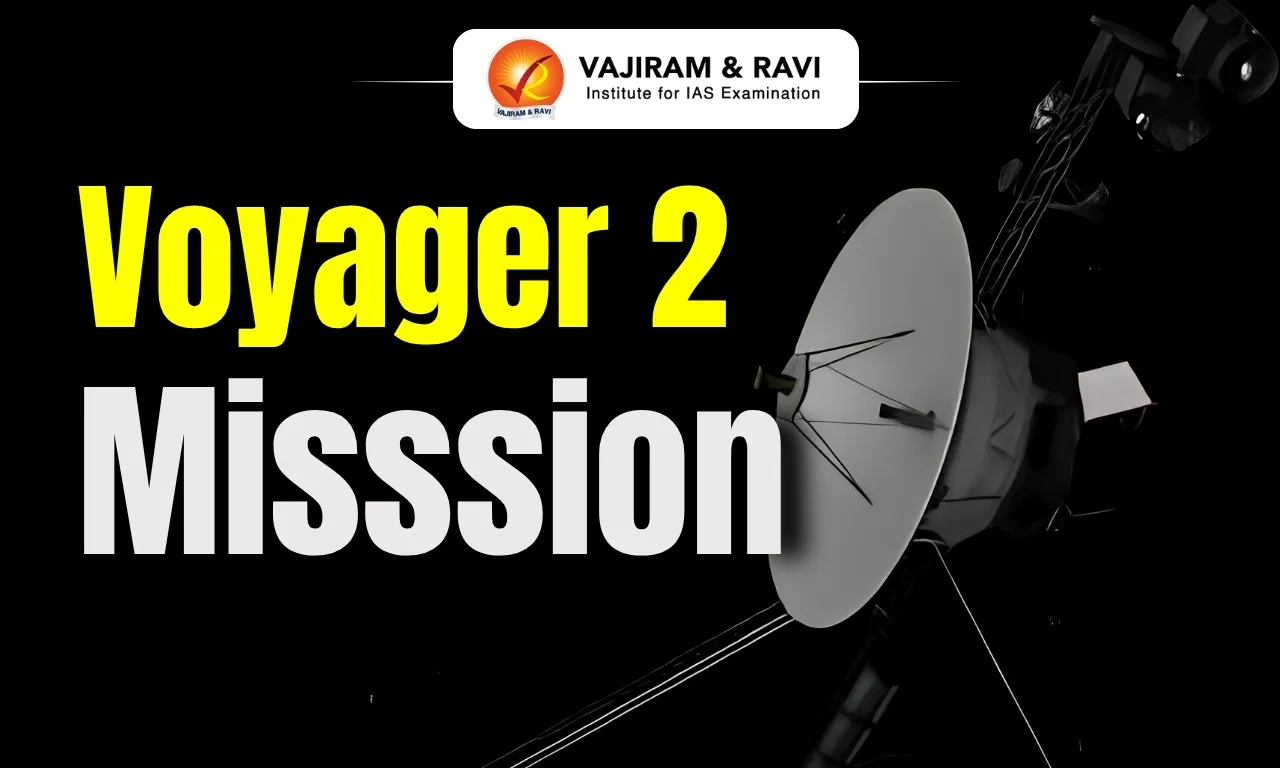
  • It is an unmanned space probe launched by NASA in 1977.
  • Primary mission: Its mission was to study the outer planets of our solar system, including Jupiter, Saturn, Uranus, and Neptune and their moons, and then continue on an interstellar mission.
  • It is the only spacecraft to have ever visited Uranus and Neptune.

Achievements by the Voyager 2 Mission

  • It is the only spacecraft to study all four of the solar system’s giant planets at close range.
  • It discovered the 14th moon of Jupiter.
  • It was the first human-made object to fly past Uranus.
  • At Uranus, Voyager 2 discovered 10 new moons and two new rings.
  • It was the first human-made object to fly by Neptune.
  • At Neptune, Voyager 2 discovered five moons, four rings, and a “Great Dark Spot.”
  • It is the second spacecraft to enter interstellar space.

Source: IE

Voyager 2 Mission FAQs

Q1: Voyager 2 was launched by which organisation?

Ans: NASA

Q2: What is the main objective of Voyager 2?

Ans: Study outer planets

Har Ghar Tiranga Campaign 2026, Certificate, Dates, & Vande Mataram

Har Ghar Tiranga Campaign 2026

The Har Ghar Tiranga Campaign 2026 is a nationwide initiative by the Government of India that encourages citizens to proudly hoist the Indian National Flag (Tiranga) at their homes, workplaces, and institutions. The fifth edition of the campaign started on 9th August and will continue until 17 August 2026 as part of the Independence Day celebrations. Dedicated to the Spirit of Vande Mataram, it aims to strengthen patriotism, national unity, and citizens' emotional connection with the Tiranga.

What is Har Ghar Tiranga Campaign 2026?

The Har Ghar Tiranga Campaign 2026 is a nationwide initiative by the Government of India that encourages citizens to proudly hoist the Indian National Flag (Tiranga) at their homes, workplaces, and institutions from 9 August to 17 August 2026. The campaign is being organized as part of the celebrations of India's 80th Independence Day, which will be observed on 15 August 2026.

Har Ghar Tiranga 2026 Theme

The theme of Har Ghar Tiranga Campaign 2026 is "Spirit of Vande Mataram." The campaign celebrates India's unity, patriotism, and national pride by encouraging every citizen to proudly hoist the National Flag. It also pays tribute to the nation's freedom struggle and inspires people to reaffirm their commitment to the values of unity, sovereignty, and nation-building through active public participation.

Download Har Ghar Tiranga Certificate 2026

The Online Link to Download the Har Ghar Tiranga Certificate 2026 is activated at the official designated portal of Har Ghar Tiranga Campaign 2026 at harghartiranga.com. To Download the Flag ID Card for Har Ghar Tiranga, citizens are required to follow the given instructions at the official website. These guidelines are also discussed below in a step by step method.

150 Years of Vande Mataram

Har Ghar Tiranga Campaign 2026 carries added significance as it coincides with the 150th anniversary of Vande Mataram, India's National Song. The Ministry of Culture is combining flag-hoisting with mass singing programmes of Vande Mataram across the country, uniting the Tiranga as the visual symbol of the nation with Vande Mataram as its national consciousness. This dual celebration is reflected in the campaign's official theme, “Spirit of Vande Mataram.”

Suryapath Tiranga - The Global Relay

A new addition to the 2026 edition is Suryapath Tiranga, an international relay that carries the spirit of Har Ghar Tiranga beyond India's borders. As the sun rises across different time zones, the Tiranga is unfurled successively at Indian missions in 54 countries, creating a continuous global chain that symbolises India's unity and its growing presence on the world stage, while connecting the Indian diaspora with the campaign.

How to Download Har Ghar Tiranga Certificate 2026?

Citizens can take part in the campaign through the official portal, harghartiranga.com, by following these steps:

  1. Visit the official campaign portal, harghartiranga.com.
  2. Hoist the National Flag at your home, workplace, or institution between 9 and 17 August 2026.
  3. Take a photograph with the Tiranga and upload it as your ‘Selfie with Tiranga’ on the portal.
  4. Register as a Har Ghar Tiranga Ambassador to encourage participation in your community.
  5. Join local Tiranga Yatras, mass Vande Mataram singing programmes, and other cultural events organised in
    your area.

Also Read: Vande Mataram to be sung at Red Fort for the First Time

Har Ghar Tiranga Campaign History

The Har Ghar Tiranga Campaign was launched by the Government of India in 2022 under the Azadi Ka Amrit Mahotsav initiative to strengthen citizens' emotional connection with the Indian National Flag and encourage mass participation in celebrating Independence Day.

  • Har Ghar Tiranga Movement was launched in 2022 as part of the Azadi Ka Amrit Mahotsav, commemorating 75 years of India's Independence.
  • Introduced to encourage every citizen to bring the Tiranga home and proudly hoist it during Independence Day celebrations.
  • Aimed to transform the National Flag from a symbol seen mainly at official institutions into a personal symbol of patriotism for every household.
  • The campaign seeks to promote awareness about the history, significance, and proper display of the Indian National Flag.
  • It is coordinated by the Ministry of Culture, Government of India, which serves as the nodal ministry.
  • The initiative has witnessed millions of participants across villages, towns, and cities through flag-hoisting drives and public events.
  • Citizens actively participate by uploading selfies with the Tiranga on the official campaign portal and becoming Har Ghar Tiranga Ambassadors.
  • Educational institutions, government offices, public sector organizations, and community groups organize awareness programmes, rallies, and cultural events during the campaign.
  • Since its launch, Har Ghar Tiranga has evolved into an annual nationwide movement, reinforcing patriotism, national unity, and citizens' commitment to nation-building.

Who Organizes Har Ghar Tiranga Campaign?

The Har Ghar Tiranga Campaign is organized by the Ministry of Culture, Government of India, which serves as the nodal ministry for its nationwide implementation. The campaign is conducted in collaboration with state governments, educational institutions, government departments, local bodies, and various public organizations.

Har Ghar Tiranga Campaign 2026 Objectives

The Har Ghar Tiranga Movement 2026 aims to strengthen every citizen's emotional connection with the Indian National Flag, promote patriotism, and encourage active public participation in celebrating India's independence.

  • Encourage every household to proudly hoist the Tiranga during the campaign period.
  • Foster a deeper sense of patriotism and national pride among citizens.
  • Strengthen the emotional bond between people and the Indian National Flag.
  • Promote awareness about the history, significance, and symbolism of the Tiranga.
  • Educate citizens about the Flag Code of India and the proper display of the National Flag.
  • Honor the sacrifices and contributions of India's freedom fighters.
  • Encourage Jan Bhagidari (people's participation) in national celebrations.
  • Promote the values of unity, integrity, and social harmony across the country.
  • Inspire young people to actively contribute to nation-building.
  • Reinforce respect for constitutional values and democratic ideals.
  • Encourage schools, colleges, government offices, and organizations to organize patriotic activities.
  • Celebrate India's cultural diversity under the shared identity of the National Flag.

Flag Code Guidelines for Har Ghar Tiranga Campaign 2026

The Indian National Flag (Tiranga) is the foremost symbol of India's sovereignty, unity, and national pride. It reflects the sacrifices of countless freedom fighters, the values of the Constitution, and the aspirations of every Indian citizen. To preserve its dignity and honor, the display and use of the National Flag are governed by the Prevention of Insults to National Honour Act, 1971 and the Flag Code of India, 2002, along with its subsequent amendments.

  • National Flag Material: Following the amendments to the Flag Code of India, 2002 (December 2021), the National Flag may be made of hand-spun, handwoven, or machine-made cotton, polyester, wool, silk, or khadi bunting.
  • Who Can Hoist the Flag: Every citizen, private organization, educational institution, and government body may hoist or display the National Flag on all days and occasions, provided it is done with dignity and respect.
  • Day and Night Display: As per the July 2022 amendment, citizens are permitted to fly the National Flag both during the day and at night, provided it is displayed in a respectful manner.
  • Correct Dimensions: The National Flag must always be rectangular in shape, with the length-to-width ratio maintained at 3:2.
  • Position of Honour: Whenever displayed, the Tiranga should always occupy the highest position of honor and be clearly visible.
  • Damaged Flags: A torn, faded, dirty, or damaged National Flag should never be hoisted or displayed.
  • No Simultaneous Hoisting: The National Flag should not be flown on the same flagpole with any other flag at the same time.
  • Display on Vehicles: The Tiranga may only be displayed on the vehicles of dignitaries authorized under the Flag Code of India, such as the President, Vice-President, Prime Minister, Governors, and other specified constitutional authorities.
  • No Flag Above the Tiranga: No other flag, banner, or decorative bunting should be placed above, higher than, or alongside the National Flag in a manner that diminishes its dignity.
  • Respectful Handling: The National Flag should never touch the ground, floor, or water, nor should it be used as clothing, table covers, drapery, packaging material, or decoration.
  • Proper Disposal: When the National Flag becomes damaged or unfit for display, it should be disposed of respectfully, preferably by private burning or another dignified method in accordance with the Flag Code.

Har Ghar Tiranga Campaign 2026 and Nation Building

The Har Ghar Tiranga Campaign 2026 encourages every citizen to actively participate in strengthening the nation by proudly hoisting the Indian National Flag. It promotes patriotism, unity, and respect for the values enshrined in the Constitution. The campaign reminds people that nation-building is a shared responsibility and that every individual has a role in India's progress. By bringing the Tiranga into every home, the initiative reinforces the spirit of unity, civic responsibility, and national pride.

Other Related Posts
Freedom Fighters of India Independence Day 2026
Vande Mataram To Be Sung at Red Fort For First Time Har Ghar Tiranga Campaign 2026
Women Freedom Fighters of India Dadabhai Naoroji
Subhash Chandra Bose Gopal Krishna Gokhale
Jawaharlal Nehru Surendranath Banerjee
Sardar Vallabhbhai Patel Rabindranath Tagore
Sarojini Naidu Bankim Chandra Chatterjee
Madam Bhikaji Cama Sarvodaya Movement
Slogans of Freedom Fighters Indian National Movements 
Important Days in 2026 Republic Day 2026
National Song National Anthem
National Flag Code of India 2002 National Flag
Indian Independence Act 1947  Revolt of 1857 
Swadeshi Movement  Home Rule Movement 
Non-Cooperation Movement Civil Disobedience Movement 
Azad Hind Fauj and INA Trials Azad Hind Fauj
Partition of India 1947 Mountbatten Plan 
Constituent Assembly of India Fundamental Duties 
Constitutional Values Preamble of the Indian
National Symbols of India Madan Mohan Malviya
Pingali Venkayya APJ Abdul Kalam 

Har Ghar Tiranga Campaign 2026 FAQs

Q1: What is the Har Ghar Tiranga Campaign 2026?

Ans: The Har Ghar Tiranga Campaign 2026 is a nationwide initiative by the Government of India that encourages citizens to hoist the Indian National Flag at their homes, workplaces, and institutions to celebrate Independence Day and promote patriotism.

Q2: When will the Har Ghar Tiranga Campaign 2026 be held?

Ans: The campaign will be observed from 9 August to 17 August 2026 across India.

Q3: What is the theme of Har Ghar Tiranga Campaign 2026?

Ans: The official theme of the campaign is "Spirit of Vande Mataram."

Q4: Which ministry organizes the Har Ghar Tiranga Campaign?

Ans: The Ministry of Culture, Government of India, is the nodal ministry responsible for organizing and coordinating the campaign.

Q5: When was the Har Ghar Tiranga Campaign first launched?

Ans: The campaign was first launched in 2022 under the Azadi Ka Amrit Mahotsav initiative to commemorate 75 years of India's Independence.

Shompen Tribe

Shompen Tribe

Shompen Tribe Latest News

Recently, tribal leaders have accused the Andaman and Nicobar island administration of seeking to drag the Shompen, an isolated indigenous community into a “modern lifestyle”. 

About Shompen Tribe

  • They are one of the most isolated tribes on Earth.
  • They are designated as Particularly Vulnerable Tribal Groups (PVTGs) in India.
  • They reside in dense tropical rain forests of the Great Nicobar Island of Andaman and Nicobar group of Islands.
  • Occupation: The Shompen are nomadic hunter-gatherers, living in small groups.
  • Diet: They collect a wide variety of rainforest plants, but their staple food is the pandanus fruit, which they call larop.
  • Language: Shompen speak their own language, which has many dialects.
  • They are of short to medium stature, have a round or nearly broad head shape, narrow nose, a broad facial profile, and distinctly exhibit Mongoloid features.
  • Society
    • They have nuclear families comprising husband, wife, and their unmarried children.
    • A Shompen family is controlled by the eldest male member, who controls all activities of the women and kids.
    • Monogamy is the general rule, although polygamy is allowed too.
    • The Shompen worship the moon, known as Houou, as their goddess, whom they believe created the universe.

Source: TH

Shompen Tribe FAQs

Q1: Shompen tribe is found in which Island?

Ans: Great Nicobar Island

Q2: What is the lifestyle of Shompen tribe?

Ans: Hunter-gatherers

80th Independence Day 2026, 15 August, Theme, History, Celebrations

80th Independence Day 2026

Independence Day 2026 will be observed on 15 August 2026 as India’s 80th Independence Day. The occasion marks 79 years of India’s independence from British rule since 15 August 1947. The 2026 celebrations will combine historical remembrance with the vision of Viksit Bharat 2047. Major focus areas include indigenous technology, green transition, Atmanirbhar Defence, youth participation and the 150 year commemoration of Vande Mataram.

15 August Independence Day 2026

India will celebrate 80th Independence Day 2026 on Saturday, 15 August. The national ceremony will be led by Prime Minister Narendra Modi at the Red Fort in New Delhi. The day will remember the freedom struggle and India’s democratic journey. It will also highlight youth, innovation, self reliance and sustainable development. The 80th Independence Day coincides with Navroz, the Parsi New Year, bringing additional cultural significance to the occasion.

Independence Day Theme 2026

The theme of Independence Day 2026 focuses on “150 Years of Vande Mataram” and “Yuva Shakti for Viksit Bharat@2047”. The themes connect India’s freedom movement with its future development goals. Vande Mataram represents the spirit of the national movement. Yuva Shakti highlights the role of young Indians in science, innovation, entrepreneurship and nation building. The celebrations also emphasise indigenous technologies, green transition and Atmanirbhar Defence.

Indian Independence Day 1947

India became independent on 15 August 1947 after a prolonged freedom struggle against British colonial rule. The transfer of power followed the Indian Independence Act 1947 and the Mountbatten Plan.

  • British political control expanded across India, beginning a long period of colonial rule that lasted nearly 200 years.
  • The Revolt of 1857 became an early major armed challenge to British authority and an important milestone in India’s freedom struggle.
  • The Indian National Congress was founded in 1885 and became a major platform for self government and independence.
  • Leaders such as Bal Gangadhar Tilak, Mahatma Gandhi, Sarojini Naidu, Subhas Chandra Bose, Bhagat Singh, Jawaharlal Nehru and Sardar Vallabhbhai Patel strengthened the national movement.
  • Mahatma Gandhi led major mass movements, including Non Cooperation, Civil Disobedience and Satyagraha, expanding public participation.
  • In 1942, the Quit India Movement demanded an immediate end to British rule, with Gandhi giving the famous “Do or Die” call.
  • On 20 February 1947, British Prime Minister Clement Attlee announced that power would be transferred to Indian hands by June 1948.
  • Lord Mountbatten then proposed the 1947 Partition Plan, accepted by the Congress and Muslim League amid growing communal tensions.
  • The Indian Independence Act 1947 was passed on 5 July and received Royal Assent on 18 July 1947.
  • The Act created India and Pakistan as two independent dominions and ended British sovereignty.
  • At midnight between 14 and 15 August 1947, power was transferred, making India independent on 15 August 1947.
  • British paramountcy over princely states ended, while Constituent Assemblies received power to frame new constitutions.
  • India’s First Independence Day 1947 was celebrated on 15 August 1947, marking the beginning of independent India.

Also Read:- 150 Years of Vande Mataram

Har Ghar Tiranga 2026

As part of the wider Independence Day observance, the Har Ghar Tiranga Campaign 2026 continues to encourage citizens to hoist the national flag at their homes, offices and public buildings, reinforcing personal participation in the 80th Independence Day celebrations beyond the official Red Fort ceremony.

Independence Day Celebrations 2026

The National 15 August Independence Day 2026 Celebrations will centre on the Red Fort and will combine ceremonial traditions with cultural, technological and youth focused programmes across India.

  • Red Fort Ceremony: Prime Minister Narendra Modi will lead the national ceremony at the Red Fort. The programme will include flag hoisting and the Prime Minister’s address.
  • National Flag: The National Flag will be hoisted at the Red Fort before the nation. The ceremony will follow established national traditions.
  • National Anthem: The National Anthem will form an important part of the ceremony following the flag hoisting proceedings.
  • Vande Mataram: Vande Mataram will be sung from the Red Fort ramparts for the first time during the Independence Day ceremony in 2026.
  • Vande Mataram Time: During the 2026 Red Fort ceremony, Vande Mataram Lyrics will be presented when Prime Minister Narendra Modi arrives, before the National Flag is hoisted and the national address begins.
  • Guard of Honour: The Prime Minister will receive a ceremonial Guard of Honour from personnel representing the armed forces.
  • 21 Gun Salute: The traditional 21 gun salute (21 topo ki salami) will accompany the national ceremony and mark the formal celebration of independence.
  • Prime Minister’s Address: The Prime Minister will discuss India’s achievements, development priorities, national unity and the future vision associated with Viksit Bharat 2047.
  • 150 Years of Vande Mataram: The 2026 celebrations coincide with the 150 year commemoration of Vande Mataram. Its composition is traced to 1875, with the commemoration running from 7 November 2025 to 7 November 2026.
  • NCC and My Bharat: Around 2,500 NCC cadets and My Bharat volunteers will form ‘वंदे मातरम्’ on Gyanpath opposite the Red Fort ramparts.
  • Mi-17 Tribute: An Indian Air Force Mi-17 helicopter will carry a banner commemorating 150 years of Vande Mataram and shower flower petals over the gathering.
  • National Bands: Military and security force bands will conduct Vande Mataram themed programmes at 343 prominent locations between 8 and 15 August 2026.
  • MyGov Independence Day Activities: MyGov will support public participation through activities such as essay writing, quizzes, photography and other Independence Day engagement campaigns.
  • My Bharat Independence Day Activities: My Bharat will involve young citizens and volunteers in national celebration activities, strengthening youth participation in public and community initiatives.

What is Special about Independence Day 2026?

Independence Day 2026 carries both historical and contemporary importance by remembering the freedom struggle while highlighting India’s development priorities for the coming decades.

  • Digital India Bhashini: Digital India Bhashini will provide real time translation of the Prime Minister’s speech into more than 22 Indian languages, supporting wider access to the national vision.
  • Young Leaders Dialogue: The Young Leaders Dialogue during Independence Week 2026 will bring Gen Z and young entrepreneurs before national leaders to present solutions related to agriculture, fitness and startups.
  • Youth Focus: Youth participation will remain central to the celebrations. Young Indians will be highlighted as contributors to innovation, entrepreneurship, technology and the Viksit Bharat 2047 vision.
  • Indigenous Technology: The celebrations will highlight 6G trials, the Semiconductor Mission and artificial intelligence as important areas of India’s technological development and self reliance.
  • Green Transition: Mission LiFE, solar powered villages and the Green Hydrogen Mission will represent the focus on cleaner energy, sustainability and environmentally responsible development.
  • Atmanirbhar Defence: For the first time, all equipment used at the Red Fort ceremony will be indigenously built in India, highlighting domestic defence capability.
  • Cultural Programmes: Students, artists and cultural groups will present patriotic songs and performances reflecting India’s cultural diversity and national heritage.
  • Public Participation: MyGov, My Bharat, NCC volunteers, young leaders, students and local communities expand Independence Day beyond the central ceremony and encourage wider civic participation.

Independence Day 2026 How Many Years?

Is it 79 or 80 Independence Day in 2026? Independence Day 2026 is the 80th Independence Day of independence from British rule. The calculation begins with 15 August 1947 as the first year.

  • 80th Independence Day 2026: India will observe its 80th Independence Day on 15 August 2026. This means the country has completed 79 years of independence.
  • 79th Independence Day 2025: India celebrated its 79th Independence Day on 15 August 2025. It marked the completion of 78 years of independence.

Difference Between Independence Day & Republic Day

Independence Day marks India’s freedom from British rule, while Republic Day celebrates the adoption of the Constitution and India becoming a republic.

Basis Independence Day Republic Day
Date 15 August 26 January
Significance Marks India’s independence from British rule in 1947 Marks the adoption of the Constitution of India in 1950
Historical Event India became independent on 15 August 1947 Constitution came into effect on 26 January 1950
Chief Guest Usually no foreign chief guest is invited for the national ceremony A foreign head of state or government is traditionally invited as chief guest
Main Ceremony Flag hoisting and address by the Prime Minister at the Red Fort Grand Republic Day Parade in New Delhi
Flag Ceremony Prime Minister hoists the national flag at the Red Fort President unfurls the national flag at Kartavya Path
Key Theme Freedom and independence Democracy, Constitution and republican values

August 15 Declared as ‘India Independence Day’

The governors of New York and New Jersey declared August 15, 2026, as “India Independence Day” across their states ahead of India’s 80th Independence Day. The proclamations recognised the important contributions of Indian-American communities to culture, business, healthcare, education, technology, public service and community life.

The declarations highlighted India’s independence journey, democratic values and self-governance, while recognising the strong India-US Relations and the role of Indian Americans in strengthening community and cultural ties.

Independence Day 2025 Summary

India celebrated its 79th Independence Day on 15 August 2025, marking 78 years of independence from British rule. The main celebration was held at the Red Fort in New Delhi, where Prime Minister Narendra Modi hoisted the National Flag, received the Guard of Honour, and delivered his 12th consecutive Independence Day speech.

The theme of the celebration was “Naya Bharat”, reflecting India’s vision of becoming a Viksit Bharat (Developed India) by 2047. The celebrations included the National Anthem, a 21-gun salute, cultural programmes, participation of the armed forces and NCC, and a ceremonial flower shower by Indian Air Force helicopters.

Thousands of special guests, including grassroots workers, women, youth, and achievers, were invited to the Red Fort to recognise their contribution to nation-building. Across the country, schools, colleges, government offices, and communities celebrated the day through flag hoisting, patriotic events, and cultural programmes.

Other Related Posts
Freedom Fighters of India 80th Independence Day 2026
Vande Mataram To Be Sung at Red Fort For First Time Har Ghar Tiranga Campaign 2026
Women Freedom Fighters of India Dadabhai Naoroji
Subhash Chandra Bose Gopal Krishna Gokhale
Jawaharlal Nehru Surendranath Banerjee
Sardar Vallabhbhai Patel Rabindranath Tagore
Sarojini Naidu Independence Day 2026
Madam Bhikaji Cama Sarvodaya Movement
Slogans of Freedom Fighters Indian National Movements 
Important Days in 2026 Republic Day 2026
National Song National Anthem
National Flag Code of India 2002 National Flag
Indian Independence Act 1947  Revolt of 1857 
Swadeshi Movement  Home Rule Movement 
Non-Cooperation Movement Civil Disobedience Movement 
Azad Hind Fauj and INA Trials Azad Hind Fauj
Partition of India 1947 Mountbatten Plan 
Constituent Assembly of India Fundamental Duties 
Constitutional Values Preamble of the Indian
National Symbols of India Madan Mohan Malviya
Pingali Venkayya APJ Abdul Kalam 

Independence Day 2026 FAQs

Q1: When is Independence Day 2026 celebrated in India?

Ans: Independence Day 2026 will be celebrated on Saturday, 15 August 2026, marking 79 years of India’s independence.

Q2: What is the theme of Independence Day 2026?

Ans: The Independence Day 2026 themes revolve around the “150 Years of Vande Mataram” and “Yuva Shakti for Viksit Bharat@2047”.

Q3: Is 2026 the 80th Independence Day of India?

Ans: Yes, 15 August 2026 will be India’s 80th Independence Day, marking 79 completed years since independence in 1947.

Q4: Where will Independence Day 2026 celebrations be held?

Ans: The main Independence Day 2026 ceremony will be held at the Red Fort in New Delhi, led by Prime Minister Narendra Modi.

Q5: Who will hoist the National Flag on Independence Day 2026?

Ans: Prime Minister Narendra Modi will hoist the National Flag at the Red Fort in New Delhi during the national Independence Day ceremony.

Kenya

Kenya

Kenya Latest News

Recently, India welcomed Kenya’s decision to recognise Persons of Indian Origin as indigenous community. 

About Kenya

  • Location: It is located in Eastern Africa.
  • Bordering Countries: It is bordered with Somalia (North East), Ethiopia (North), South Sudan (North West), Uganda (West) and Tanzania (South).
  • Maritime Border: It has a coastline on the Indian Ocean to the southeast.
  • Capital City: Nairobi
    • Nairobi hosts UNEP (United Nations Environment Programme) and UN-HABITAT headquarters.

Geographical Features of Kenya

  • Climate:  It has a tropical type of climate.
  • Major lakes: Lake Victoria (shared with Uganda & Tanzania), Lake Turkana.
  • Major Rivers: Athi/Galana, Tana (Longest river of Kenya), Mara.
  • Mountain Ranges: Aberdare, Mau Escarpment.
  • Highest Peak: Mount Kenya (second highest in Africa after Kilimanjaro).
  • Island: Lamu Island, part of the Lamu Archipelago in the Indian Ocean.
  • Natural Resources: It mainly consists of Lead, zircon, iron, titanium, mica, chaum, oil, coal, diatomite, gypsum.
  • Famous Tribes: San Bushmen, Samburu, Maasai.

Source: News On Air

Kenya FAQs

Q1: What is the Capital of Kenya?

Ans: Nairobi

Q2: Kenya lies on the coast of which ocean?

Ans: Indian Ocean

Vande Mataram, History, Evolution, Significance, Latest News

Vande Mataram

Why Vande Mataram in News?

For the first time, Vande Mataram will be sung from the Red Fort during India’s 80th Independence Day celebrations on August 15, 2026. The celebrations will also give greater representation to Gen Z and young achievers, highlighting the theme of Yuva Shakti.

150 Years of Vande Mataram

Parliament held a special discussion to mark 150 years of Vande Mataram, a song deeply woven into India’s freedom movement yet continuously debated for its religious imagery and political interpretations. Prime Minister Narendra Modi opened the Lok Sabha debate on this.

Once a patriotic hymn in Bankimchandra Chattopadhyay’s novel, Vande Mataram evolved into a rallying cry for nationalism, though concerns over its later stanzas led the Congress in 1937 to officially adopt only the first two.

In the Constituent Assembly, the song was ultimately accorded “equal honour and status” with the National Anthem.

Also Read: Independence Day 2026

Origins of Vande Mataram

  • According to a historical account cited by the PIB, Bankimchandra Chattopadhyay composed Vande Mataram around 1875. 
  • The song gained prominence when his novel Anandamath was serialized in Bangadarshan magazine in 1881.
  • Sri Aurobindo wrote in Bande Mataram (1907) that the hymn captured the spirit of patriotic devotion.

Literary Context: Anandamath

  • Anandamath tells the story of the Santanas, ascetic warriors committed to liberating the motherland from oppression. 
  • Their loyalty is to Bharat Mata, represented as a personified motherland rather than a religious deity.

Symbolism of the Three Mothers

  • In the Santanas’ temple, three forms of the Mother are depicted:
    • The Mother That Was – powerful and magnificent
    • The Mother That Is – weakened and suffering
    • The Mother That Will Be – rejuvenated and triumphant
  • These images symbolised India’s past glory, present subjugation, and envisioned future resurgence.

From song to slogan: Birth of a nationalist cry

  • By the early 20th century, Vande Mataram transformed from a literary hymn into one of the most powerful rallying cries of India’s nationalist movement.

Central Role in the Swadeshi and Anti-Partition Movement

  • After Lord Curzon’s 1905 partition of Bengal, the song became the emotional and political heartbeat of mass resistance.
  • It energised:
    • Boycott campaigns
    • Protest marches
    • Newspapers and political groups adopting its name
  • A historic moment came in 1906 at Barisal, where over 10,000 Hindus and Muslims marched together shouting Vande Mataram, demonstrating its early inclusive appeal.
  • Key leaders who popularised it included:
    • Rabindranath Tagore
    • Bipin Chandra Pal
    • Sri Aurobindo, whose writings elevated the phrase into a spiritual and political call for self-rule.

Colonial Repression Against the Slogan

  • Worried by its ability to mobilise masses, the British authorities attempted to suppress it by:
    • Fining students
    • Conducting police lathi-charges
    • Banning public marches
    • Threatening expulsion from schools and colleges
  • Across Bengal and the Bombay Presidency, chanting Vande Mataram became an act of bold nationalist defiance.

Vande Mataram on the Global Stage

  • In 1907, Madam Bhikaji Cama unfurled the first Indian tricolour at Stuttgart, with Vande Mataram written across it — marking its symbolic arrival on the international platform.

The song and the Indian National Congress

  • The Indian National Congress not only appreciated Vande Mataram culturally but also adopted it formally in its national ceremonies.

1896: Tagore’s Iconic Rendition

  • At the Calcutta Congress session, Rabindranath Tagore sang Vande Mataram, giving the song national prominence and embedding it in the Congress’s cultural identity.

1905: Formal Adoption During the Swadeshi Movement

  • In Varanasi, the Congress formally adopted Vande Mataram for all-India events.
  • This came at the height of the anti-partition protests, when the song had already become the anthem of political awakening throughout the country.

1937: Congress Working Committee Removes Later Stanzas

  • By the 1930s, debates over the song’s Hindu goddess imagery became more pronounced.
  • To maintain a broad, inclusive national movement, the Congress Working Committee (CWC) decided in 1937 to use only the first two stanzas, which were considered free of sectarian symbolism.
  • Muslim leaders had objected to the later stanzas, arguing they evoked explicitly religious imagery inappropriate for a national movement meant to represent all communities.

Constituent Assembly’s Resolution: Equal Status for Vande Mataram (1950)

  • In 1950, the Constituent Assembly faced no conflict between Jana Gana Mana and Vande Mataram when deciding national symbols.
  • On January 24, 1950, Assembly President Dr. Rajendra Prasad formally declared:
    • Jana Gana Mana would be the National Anthem. 
    • Vande Mataram, due to its historic significance in the freedom struggle, would receive equal honour and status.
  • The announcement was met with applause and no objections from any member.
  • This dual recognition balanced inclusivity with historical reverence, preserving national unity through the anthem while enshrining Vande Mataram as a pillar of India’s independence movement.
Other Related Posts
Freedom Fighters of India 80th Independence Day 2026
Vande Mataram To Be Sung at Red Fort For First Time Har Ghar Tiranga Campaign 2026
Women Freedom Fighters of India Dadabhai Naoroji
Subhash Chandra Bose Gopal Krishna Gokhale
Jawaharlal Nehru Surendranath Banerjee
Sardar Vallabhbhai Patel Rabindranath Tagore
Sarojini Naidu Independence Day 2026
Madam Bhikaji Cama Sarvodaya Movement
Slogans of Freedom Fighters Indian National Movements 
Important Days in 2026 Republic Day 2026
National Song National Anthem
National Flag Code of India 2002 National Flag
Indian Independence Act 1947  Revolt of 1857 
Swadeshi Movement  Home Rule Movement 
Non-Cooperation Movement Civil Disobedience Movement 
Azad Hind Fauj and INA Trials Azad Hind Fauj
Partition of India 1947 Mountbatten Plan 
Constituent Assembly of India Fundamental Duties 
Constitutional Values Preamble of the Indian
National Symbols of India Madan Mohan Malviya
Pingali Venkayya APJ Abdul Kalam 

Vande Mataram FAQs

Q1: What is the historical origin of Vande Mataram?

Ans: Bankimchandra Chattopadhyay composed Vande Mataram around 1875, later popularised through his novel Anandamath and embraced as a patriotic hymn during early nationalist movements.

Q2: How did Vande Mataram become a nationalist slogan?

Ans: During the Swadeshi movement after Bengal’s 1905 partition, it became a mass rallying cry, uniting communities in protest marches and inspiring millions across India.

Q3: Why did Congress adopt only the first two stanzas in 1937?

Ans: To maintain inclusivity, Congress restricted usage to two stanzas free of goddess imagery, addressing concerns from Muslim leaders over religious overtones.

Q4: What was the Constituent Assembly’s decision on Vande Mataram?

Ans: On January 24, 1950, the Assembly accorded Vande Mataram equal honour and status alongside the National Anthem, acknowledging its role in the freedom struggle.

Q5: Why does Vande Mataram remain debated today?

Ans: Its historical importance is undisputed, but debates continue regarding religious imagery in later stanzas and its suitability as an inclusive national symbol.

Vande Mataram To Be Sung at Red Fort For First Time on Independence Day 2026, Lyrics

Vande Mataram To Be Sung at Red Fort For First Time

Vande Mataram To Be Sung at Red Fort For First Time on Independence Day 2026 marks an important moment in India’s national history. The National Song, written by Bankim Chandra Chattopadhyay, has been closely associated with the freedom movement and national identity. The 2026 Independence Day ceremony will also highlight the 150 year legacy of Vande Mataram, its historical significance, meaning, national status and place in India’s patriotic tradition.

Why is Vande Mataram in News?

Vande Mataram Lyrics will be sung from the ramparts of the Red Fort for the first time during the Independence Day ceremony on August 15, 2026. Prime Minister Shri Narendra Modi will lead the 80th Independence Day celebrations in New Delhi. The decision is significant because 2026 marks the 150 year commemoration of Vande Mataram, a composition associated closely with India’s freedom movement.

Vande Mataram To Be Sung at Red Fort For First Time

The National Song will be sung when Prime Minister Shri Narendra Modi arrives at the Red Fort. The Prime Minister will then hoist the National Flag and address the Nation.

  • First Red Fort rendition: Vande Mataram will become a scheduled part of the Independence Day ceremony at the Red Fort for the first time in 2026.
  • 150 year milestone: The inclusion coincides with the 150 year commemoration of Vande Mataram, whose composition is traced to 1875. The nationwide commemoration runs from November 7, 2025, to November 7, 2026.
  • Yuva Shakti focus: The 2026 celebrations will highlight Yuva Shakti and the contribution of young Indians towards the goal of Viksit Bharat by 2047.
  • 2,500 participants: Around 2,500 NCC cadets and My Bharat volunteers will form ‘वंदे मातरम्’ on Gyanpath opposite the Red Fort ramparts.
  • Mi-17 tribute: An Indian Air Force Mi-17 helicopter will carry a banner marking 150 years of Vande Mataram and shower flower petals over the gathering.
  • National band performances: Military and security force bands are performing Vande Mataram themed programmes at 343 prominent locations from August 8 to August 15, 2026.

National Song of India Vande Mataram

Vande Mataram is India’s National Song and holds an important place in the history of the freedom movement. Its meaning is commonly understood as “I bow to thee, Mother.”

  • Author: Vande Mataram was written by Bankim Chandra Chatterjee. The composition was first published in Bangadarshan on November 7, 1875 and later appeared in Anandamath, published in 1882.
  • Language: The composition uses Sanskrit and Bengali elements. It presents the motherland through imagery of nature, prosperity, beauty and devotion.
  • First Congress rendition: Rabindranath Tagore sang Vande Mataram at the 1896 session of the Indian National Congress in Calcutta.
  • Freedom movement: Vande Mataram became a powerful patriotic expression during the freedom struggle. It was particularly associated with the Swadeshi Movement of 1905.
  • National Song status: On January 24, 1950, Dr. Rajendra Prasad announced that Vande Mataram, because of its historic role in the freedom struggle, would be honoured equally with Jana Gana Mana.
  • Difference Between Vande Mataram and National Anthem: Jana Gana Mana is India’s National Anthem, while Vande Mataram is the National Song. Both hold distinct constitutional and historical positions in India’s national symbolism.

15 August Independence Day 2026

Independence Day 2026 will mark 79 years since independence and India’s 80th Independence Day celebration on August 15, 2026. The Red Fort will remain the central venue.

  • Historical date: India became independent on August 15, 1947, following the end of British colonial rule and the transfer of power under the Indian Independence Act, 1947.
  • Celebrations: Prime Minister Shri Narendra Modi will hoist the National Flag from the Red Fort and deliver the customary address to the Nation.
  • Youth participation: Nineteen medal winning students from the International Olympiads 2026 will attend and be seated on the ramparts.
  • Special Guests: Approximately 5,000 achievers from fields including innovation, startups, skill development, farming, entrepreneurship, science, sanitation and public service have been invited.
  • Cultural diversity: More than 1,500 Delhi based people from different States and Union Territories will attend in traditional attire, representing India’s cultural diversity.
  • Public participation: Competitions and quizzes on subjects including Fundamental Rights, women in the freedom movement, space technology, nuclear technology and AI were organised before the celebrations.

Vande Mataram Song Lyrics

The following opening two stanzas are the nationally recognised portion traditionally associated with official use of Vande Mataram. The phrase “Vande Mataram” means “I bow to thee, Mother.” The Vande Mataram Lyrics in Hindi are given below:

“वन्दे मातरम्।

सुजलाम् सुफलाम् मलय़जशीतलाम्,

शस्यश्यामलाम् मातरम्। वन्दे मातरम्।

शुभ्रज्योत्स्ना पुलकितयामिनीम्,

फुल्लकुसुमित द्रुमदलशोभिनीम्,

सुहासिनीम् सुमधुरभाषिणीम्,

सुखदाम् वरदाम् मातरम्। वन्दे मातरम्।”

Vande Mataram Code of Conduct

The legal position concerning Vande Mataram differs from the National Anthem’s formal protocol. The 2026 law focuses specifically on intentional prevention or disruption of its singing.

  • Vande Mataram is accorded equal honour with Jana Gana Mana, based on the declaration made by Dr. Rajendra Prasad on January 24, 1950.
  • The legal protection against disruption does not by itself mean that every person can be compelled to sing the National Song. 
  • The Supreme Court’s Bijoe Emmanuel Judgment (1986) remains important on individual conscience. The Court held that respectful silence without singing the National Anthem cannot constitute disrespect, protecting freedom of conscience under Articles 19(1)(a) and 25.
  • The 2026 amendment extends statutory protection to Vande Mataram against intentional prevention of its singing or disturbance of an assembly engaged in singing it.
  • The full rendition is considerably longer than Jana Gana Mana. A Vande Mataram Full Version has been reported at around 3 minutes and 10 seconds, compared with about 52 seconds for the National Anthem.

Vande Mataram Bill 2026

The Prevention of Insults to National Honour (Amendment) Bill 2026, was introduced to extend statutory protection under the 1971 law to India’s National Song.

  • Introduction: The Bill was introduced in the Rajya Sabha on July 24, 2026, during the Monsoon Session of Parliament.
  • Parliamentary approval: The Rajya Sabha passed the Bill on July 29, while the Lok Sabha cleared it on July 30, 2026.
  • Presidential assent: President Droupadi Murmu gave assent on August 11, 2026, converting the amendment into law.
  • Punishable conduct: Intentionally preventing the singing of the National Song or causing disturbance to an assembly engaged in singing it can attract imprisonment up to three years, a fine, or both.
  • Repeat conviction: A second and every subsequent conviction carries a minimum imprisonment of one year under the amended provision.
  • Legal significance: The amendment brings Vande Mataram within the statutory protection already available against deliberate disruption of the National Anthem under the Prevention of Insults to National Honour Act 1971.

Vande Mataram 150 Years

The 150 year of Vande Mataram commemoration recognises the long historical journey of Vande Mataram from a literary composition to a major symbol of India’s national movement.

  • Origin year: Vande Mataram Lyrics is associated with 1875, when Bankim Chandra Chattopadhyay composed the work. Its first publication was in Bangadarshan on November 7, 1875.
  • Year long commemoration: The Government launched the nationwide 150 year commemoration on November 7, 2025, with programmes scheduled through November 7, 2026.
  • National launch: Prime Minister Shri Narendra Modi inaugurated the year long commemoration at the Indira Gandhi Indoor Stadium, New Delhi, on November 7, 2025. A commemorative stamp and coin were also released.
  • Red Fort Ceremony: The Independence Day 2026 rendition adds a major national ceremonial dimension to the 150 year commemoration. It links the song’s freedom movement legacy with the country’s 80th Independence Day. 
  • National significance: Vande Mataram continues to represent patriotism, the freedom struggle, devotion to the motherland and the historical contribution of generations who participated in India’s independence movement.
Other Related Posts
Freedom Fighters of India 80th Independence Day 2026
Vande Mataram To Be Sung at Red Fort For First Time Har Ghar Tiranga Campaign 2026
Women Freedom Fighters of India Dadabhai Naoroji
Subhash Chandra Bose Gopal Krishna Gokhale
Jawaharlal Nehru Surendranath Banerjee
Sardar Vallabhbhai Patel Rabindranath Tagore
Sarojini Naidu Independence Day 2026
Madam Bhikaji Cama Sarvodaya Movement
Slogans of Freedom Fighters Indian National Movements 
Important Days in 2026 Republic Day 2026
National Song National Anthem
National Flag Code of India 2002 National Flag
Indian Independence Act 1947  Revolt of 1857 
Swadeshi Movement  Home Rule Movement 
Non-Cooperation Movement Civil Disobedience Movement 
Azad Hind Fauj and INA Trials Azad Hind Fauj
Partition of India 1947 Mountbatten Plan 
Constituent Assembly of India Fundamental Duties 
Constitutional Values Preamble of the Indian
National Symbols of India Madan Mohan Malviya
Pingali Venkayya APJ Abdul Kalam 


Vande Mataram To Be Sung at Red Fort for the first time FAQs

Q1: When will Vande Mataram be sung at the Red Fort in 2026?

Ans: Vande Mataram will be sung at the Red Fort on August 15, 2026, during the 80th Independence Day celebrations.

Q2: What is the National Song of India?

Ans: Vande Mataram is the National Song of India, written by Bankim Chandra Chattopadhyay and recognised by the Constituent Assembly on January 24, 1950.

Q3: Who wrote Vande Mataram Lyrics?

Ans: Vande Mataram was written by Bankim Chandra Chattopadhyay and became an important patriotic song during India’s freedom movement.

Q4: When was Vande Mataram adopted as India’s National Song?

Ans: Vande Mataram was recognised as India’s National Song on January 24, 1950, by the Constituent Assembly.

Q5: What is the meaning of Vande Mataram Lyrics?

Ans: Vande Mataram means “I bow to thee, Mother,” expressing reverence and devotion towards the motherland.

NITI Aayog Report on Manufacturing Sector in India

Manufacturing Sector

Manufacturing Sector Latest  News

  • NITI Aayog has released a report titled "Key Sectors to Position India as a Global Manufacturing Hub", recommending cluster-based manufacturing, lower costs, and deeper domestic value addition across high-potential sectors.

Manufacturing Sector in India

  • The manufacturing sector is a key component of India's industrial base, encompassing activities that transform raw materials and intermediate goods into finished products. 
  • It includes sectors such as automobiles, pharmaceuticals, textiles, chemicals, electronics, machinery, food processing and metals.
  • Contribution to the Economy
    • According to the Economic Survey 2025-26, manufacturing's share in India's GVA has remained broadly stable at around 17-18% in real terms
    • The Survey notes that manufacturing's share of real GDP has remained relatively steady despite fluctuations in its nominal share, while manufacturing's gross value of output (GVO) has remained around 38%, highlighting its substantial role in overall economic activity. 
    • The latest national accounts also show that the broader secondary sector, comprising manufacturing, construction, electricity, gas, water supply and related utilities, accounted for 25.8% of India's GVA in 2024-25 and grew by 8.0% in real terms during the year. 
  • Employment and Industrial Base
    • Manufacturing is also an important source of non-farm employment. 
    • According to MoSPI's Sustainable Development Goals indicator framework, manufacturing accounted for 11.44% of total employment in 2023-24, compared with 12.13% in 2017-18.

News Summary: NITI Aayog Report

  • NITI Aayog has released the first volume of a study titled "Key Sectors to Position India as a Global Manufacturing Hub". 
  • The report uses a structured, data-driven framework to identify sectors that can drive India's ambition of becoming a global manufacturing powerhouse.

Scope of the Study

  • The study shortlisted 12 sectors in which India can aspire to global leadership by 2047:
    • Electronics, Telecommunications equipment, Solar photovoltaic, Pharmaceuticals, Chemicals, Automotive, Defence and drones, Steel, Capital goods, Textiles, Food processing, Leather and footwear
  • This opening volume examines four of these in depth: chemicals, textiles, telecom and network equipment, and solar photovoltaic.

Methodology

  • The study was structured into four phases:
    • Phase 1: Shortlisting sectors based on market size and growth prospects in domestic and global markets.
    • Phase 2: A three-pronged assessment of market potential, competitiveness, and strategic relevance.
    • Phase 3: Benchmarking best practices from top-performing manufacturing countries.
    • Phase 4: Developing sector-specific, actionable recommendations and a roadmap.
  • The assessment considered factors such as market potential, infrastructure readiness, policy support, raw material availability, technology readiness, employment potential, and India's current position in the value chain.

Sector-Wise Findings

  • Chemicals
    • The domestic chemicals industry is led by three consumption segments: petrochemicals and organic chemicals, specialty chemicals, and inorganic chemicals. 
    • Petrochemicals and organic chemicals form the largest segment.
    • The report notes significant potential to enhance domestic value addition by expanding downstream production and improving feedstock utilisation. It identifies phenol, methanol, and acetic acid as priority products for import substitution.
    • Reducing import reliance would help conserve foreign exchange, mitigate the impact of global price volatility, and ensure stable supply of essential chemicals.
  • Textiles
    • The textile and apparel sector is one of India's most important manufacturing industries:
      • Contributes approximately 2% to national GDP
      • Accounts for 11% of manufacturing GVA
      • Makes up 9% of merchandise exports
      • Second-largest employer after agriculture, supporting more than 45 million people
      • Exported textile products worth USD 37.7 billion in fiscal 2025
      • Holds 4.1% of global textile and apparel exports, making India the sixth-largest exporter
    • The report urges a strategic shift towards man-made fibre-led growth to reach $100 billion in exports by 2029-30. 
    • It flags that labour productivity in textiles remains significantly below the overall manufacturing average and calls for skilling through apprenticeships, industry-academia partnerships, safe and affordable accommodation for migrant workers near clusters, and voluntary certification for firms demonstrating ethical labour practices.
  • Telecom and Network Equipment
    • India is the world's second-largest telecommunications market with:
      • More than 1.2 billion subscribers
      • Approximately 85% telecom penetration
      • Nearly 75% internet usage
    • The National Telecom Policy 2025 targets doubling the sector's contribution to GDP, doubling exports of telecom products and services, creating one million new jobs, and significantly increasing investment and R&D expenditure by 2030.
    • Key priorities identified include deepening localisation, strengthening domestic component manufacturing, promoting joint ventures and technology transfer, developing integrated industrial clusters, and strengthening testing, certification, and skill development.
  • Solar Photovoltaic
    • India had installed 106 GW of solar capacity by March 2025 and needs to add about 174 GW to meet the 2030 target of 280 GW.
    • The domestic PV market, estimated at Rs. 32,400 crore ($3.7 billion), is expected to grow at a 17-20% CAGR between fiscal 2023 and fiscal 2030, supported by utility-scale solar, rooftop solar, open-access projects, and green hydrogen-linked demand.
    • A key concern flagged is export concentration; the US accounted for 97% of India's solar module exports between 2019-20 and 2025-26, representing heavy dependence on a single geography. 
    • The report recommends moving upstream into polysilicon and wafers and broadening the export base.

Cross-Cutting Recommendations

  • Across the sectors examined, the report recommends:
    • Cluster-based manufacturing with integrated industrial parks offering shared utilities, infrastructure, and efficient approvals to build scale and lower costs
    • Reducing import dependency through targeted incentives and viability gap funding
    • Deepening domestic value addition across the chain
    • Promoting joint ventures and technology transfer
    • Raising labour productivity through skilling and technology adoption
    • Diversifying export markets while negotiating balanced free trade agreements

Emphasis on Profitability and Private Investment

  • NITI Aayog Vice-Chairman Ashok Lahiri made a notable observation on the approach India should adopt.
  • He stated that India is not attempting to match Chinese scale directly, but that economies of scale and scope remain very important. He argued that most investment must come from the private sector, with the government's role being to remove impediments.
  • Crucially, he emphasised that investment will come only when there is profit. He added that the objective is not simply to increase manufacturing's share of GDP, but to build productive capacity and expand India's presence in global markets.
  • This marks a shift in framing, from targeting a headline GDP share to focusing on commercial viability and competitiveness as the drivers of manufacturing growth.

Significance

  • It provides a structured, evidence-based framework for prioritising manufacturing sectors rather than dispersing effort across all industries.
  • It shifts emphasis from subsidy-led growth to profit-led investment, recognising that sustainable manufacturing requires commercial viability.
  • It highlights cluster development as a practical route to scale, addressing India's long-standing fragmentation problem.
  • It flags export concentration risks, particularly in solar, where dependence on a single market creates vulnerability.
  • It links manufacturing directly to employment generation for India's young workforce.

Source: PIB | BS

Manufacturing Sector FAQs

Q1: What is the title of the NITI Aayog report on manufacturing?

Ans: The report is titled "Key Sectors to Position India as a Global Manufacturing Hub."

Q2: How many sectors has NITI Aayog shortlisted for global leadership by 2047?

Ans: The study shortlisted 12 sectors, with the first volume examining chemicals, textiles, telecom and network equipment, and solar photovoltaic in depth.

Q3: What is the contribution of the textile sector to India's economy?

Ans: Textiles contribute about 2% to GDP, 11% to manufacturing GVA, and 9% of merchandise exports, employing more than 45 million people.

Q4: What is India's current solar capacity and 2030 target?

Ans: India had 106 GW of installed solar capacity by March 2025 and needs to add about 174 GW to reach the 2030 target of 280 GW.

Q5: What is the report's main structural recommendation for manufacturing?

Ans: It recommends strengthening cluster-based manufacturing through integrated industrial parks with shared utilities, infrastructure, and efficient approvals to build scale and lower costs.

Constitutional Limits on Arrest: Protecting Personal Liberty Under Articles 21 and 22

Constitutional Limits on Arrest

Constitutional Limits on Arrest Latest News

  • The Supreme Court, in Vihaan Kumar v. State of Haryana (2025), reinforced safeguards against arbitrary arrest, holding that every arrested person must be properly and meaningfully informed of the grounds of arrest
  • This ruling reaffirms constitutional protections under Articles 21 and 22, prompting a closer look at how India's legal framework balances the state's power to arrest with an individual's right to personal liberty and dignity.

The Vihaan Kumar Judgment: Key Holdings

  • Failure to inform the arrested person of the grounds of arrest amounts to a violation of Article 22(1) and Section 50 of the CrPC (now Section 47 of the BNSS, 2023).
  • Merely informing the arrested person's relatives, or providing ambiguous records, does not satisfy the constitutional requirement — the information must be communicated directly to the arrested person in a manner they can understand.
  • If the initial arrest is unconstitutional, all subsequent remand orders are also rendered illegal.
  • The arrest memo must record the time of arrest, as required under Article 22(2) and Section 57 of the CrPC (now Section 58 of the BNSS).
  • The police must produce the arrested person before a local magistrate within 24 hours, excluding travel time.
  • The Court also condemned degrading treatment in custody, affirming the right to dignity under Article 21, and directed the state to amend procedures to prevent future violations.

Arrest vs. Detention

  • Detention: A temporary hold for investigation purposes; the person is not charged with any offence.
  • Arrest: Formal police custody based on probable cause of having committed an offence.
  • Article 22 of the Constitution governs both arrest and detention.
  • Non-cognisable offences (e.g., simple hurt, defamation): Arrest requires a warrant.
  • Cognisable offences (e.g., murder, rape): Arrest can be made without a warrant.

Judicial Guidelines Against Misuse: Arnesh Kumar Case

  • In Arnesh Kumar v. State of Bihar (2014), the Supreme Court laid down guidelines to prevent misuse of criminal law through arbitrary arrests:
    • Arrest should be an exception, not the norm, in offences punishable with less than seven years' imprisonment.
    • Police must assess the necessity of arrest under Section 41 of the CrPC (now Section 35 of the BNSS) before making one.
    • Routine arrests, made merely because the power exists, are impermissible — necessity must be demonstrably justified.
    • Allowing prosecution based on frivolous or false allegations amounts to abuse of legal process and violates principles of natural justice.

Constitutional Framework: Article 22 and Beyond

  • Article 22 provides key procedural safeguards for arrested persons:
    • The right to be informed of the grounds of arrest.
    • The right to consult and be defended by a lawyer of choice as soon as possible.
    • The right to be presented before the nearest magistrate within 24 hours.
  • Preventive Detention: Article 22 also addresses preventive detention, where these procedural safeguards do not apply. 
    • India's concept of preventive detention draws from Regulation 14-B of the British Defence of the Realm Act, 1914, under which non-punitive detentions are considered preventive. 
    • Such detention can continue for three months, beyond which an Advisory Board must approve any extension.

The 'Golden Triangle' and Natural Justice

  • The Supreme Court's landmark ruling in Maneka Gandhi v. Union of India (1978) established the "Golden Triangle" of the Constitution, linking Articles 14, 19, and 21:
    • Article 14 (equality before law) is the antithesis of arbitrariness and the source of substantive natural justice.
    • Article 19(1) incorporates procedural natural justice.
    • Article 21 (right to life and personal liberty) draws upon both.
  • Any arbitrary exercise of the power of arrest or detention, therefore, amounts to a violation of this Golden Triangle — reinforcing that personal liberty is deeply rooted in the constitutional scheme of natural justice.

Conclusion

  • Through judgments like Vihaan Kumar and Arnesh Kumar, the judiciary continues to reinforce that arrest is not a routine exercise of police power but a constitutional act demanding accountability. 
  • These safeguards, rooted in Articles 21 and 22, ensure that India's democratic promise of liberty is not eclipsed by arbitrary state action.

Source: TH | PR

Constitutional Limits on Arrest FAQs

Q1: What are the Constitutional Limits on Arrest in India?

Ans: Constitutional Limits on Arrest require authorities to inform arrested persons of arrest grounds, provide legal safeguards, ensure timely magistrate production, and protect personal dignity.

Q2: What did the Vihaan Kumar judgment establish about arrest?

Ans: The Constitutional Limits on Arrest require grounds to be communicated directly and meaningfully; failure can invalidate the arrest and subsequent remand orders.

Q3: How does Article 22 protect arrested persons?

Ans: Constitutional Limits on Arrest under Article 22 include information about arrest grounds, access to legal counsel, and production before a magistrate within 24 hours.

Q4: What did the Arnesh Kumar judgment say about arbitrary arrests?

Ans: The Constitutional Limits on Arrest require police to demonstrate necessity before arrest, particularly for offences punishable with less than seven years' imprisonment.

Q5: How does the constitutional Golden Triangle protect personal liberty?

Ans: The Constitutional Limits on Arrest are reinforced by Articles 14, 19 and 21, collectively requiring non-arbitrary state action and adherence to natural justice principles.

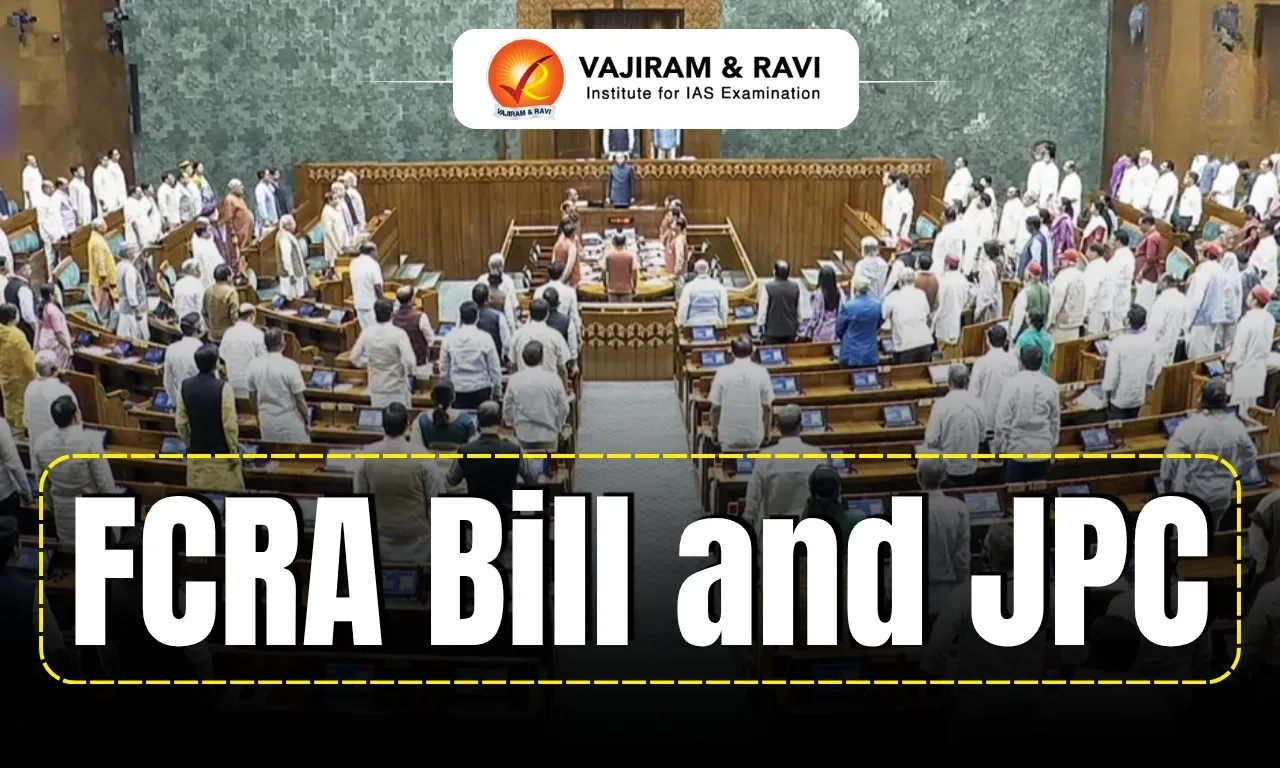
FCRA Bill and JPC: How Effective Are Parliamentary Committees in Legislative Scrutiny?

FCRA Bill and JPC

FCRA Bill and JPC Latest News

  • The Lok Sabha has referred the Foreign Contribution (Regulation) Amendment Bill, 2026 to a Joint Parliamentary Committee (JPC), amid strong objections over provisions including the retrospective vesting of foreign-funded assets in a government-designated authority. 
  • This has renewed debate on how much difference parliamentary committees actually make when the ruling party holds a majority within them.

Purpose of Parliamentary Committees

  • Parliamentary committees exist to address a basic limitation of Parliament: the two Houses have limited time to examine an increasingly complex body of legislation and policy. 
  • Smaller committees can:
    • Spend considerably more time examining a Bill
    • Question officials and hear experts/stakeholders
    • Scrutinise provisions clause by clause
  • The committee system is not meant to replicate the political contest on the House floor. 
  • As Rajya Sabha's literature describes it, the underlying philosophy is: 
    • influence, not direct control; 
    • advise, not command; 
    • criticism, not obstruction; 
    • scrutiny, not initiative; 
    • accountability, not prior approval.

Types of Parliamentary Committees

  • Department-related Standing Committees: Examine the functioning and policies of ministries on an ongoing basis.
  • Financial Committees: Scrutinise government expenditure.
  • Select Committees: Constituted by one House to examine a specific Bill.
  • Joint Parliamentary Committee (JPC): Has members from both Lok Sabha and Rajya Sabha, constituted for a specific Bill or issue.
  • Committees can call for persons, papers, and records, and take evidence — but their recommendations are not binding on the government.

The Central Limitation: Ruling Party Majority

  • JPC membership broadly reflects the strength of parties in Parliament. 
  • Since the ruling party or alliance typically has a majority in the Lok Sabha, it also holds a majority in the JPC, and the chairperson is usually from the government benches. 
  • Decisions are taken by majority vote, with the chairperson holding a casting vote in case of a tie.
  • However, this does not render the Opposition powerless. Within a committee, the Opposition can:
    • Demand specific witnesses
    • Question officials
    • Put evidence on record
    • Propose changes to the draft report
    • File a dissent note if it disagrees with the majority
  • The real question, therefore, is not whether Opposition MPs are heard, but whether they can actually change the law — and here, the record is far less encouraging.

Have JPCs Actually Changed Laws?

  • Yes — but by modification, not by overturning.
  • Stock Market Scam JPC (2001-02): Under the then NDA government, produced detailed recommendations on regulatory surveillance and coordination between SEBI and stock exchanges. The government reported action on 236 recommendations.
  • Pesticide Residues JPC (2004): Confirmed unacceptable pesticide levels in soft drinks and recommended stringent safety standards, contributing to subsequent regulatory action.
  • Multi-State Co-operative Societies (Amendment) Bill, 2022: The JPC's recommendations on the Cooperative Election Authority's composition and functioning were largely incorporated into the final law.
  • Biological Diversity (Amendment) Bill, 2021: Retained the government's broad approach but incorporated some safeguards and clarifications.
  • Financial Resolution and Deposit Insurance (FRDI) Bill, 2017: Following JPC scrutiny of controversial "bail-in" provisions and concerns over depositor protection, the government eventually withdrew the Bill altogether — though broader public and political opposition also contributed.

When Opposition Dissent Didn't Prevail

  • Personal Data Protection Bill JPC: Retained broad government exemptions despite Opposition objections on surveillance safeguards. The 2019 Bill was eventually withdrawn, and a new law was introduced in 2022 — though it too retained broad exemption powers for the government.
  • Citizenship (Amendment) Bill, 2016: The JPC retained the Bill's central objective despite Opposition concerns on the religious criterion and implications for Assam and secularism. The 2019 Act broadly followed the original approach.
  • 2G JPC: Broadly defended the government's position on telecom allocation despite Opposition dissent notes. Its conclusions had limited influence — the legal and political trajectory was shaped more directly by CAG findings and the Supreme Court's cancellation of licences.
  • This shows the partisan character of JPCs is not unique to any one government — when an issue is politically central to the ruling side, its majority tends to be decisive.

Has the Committee System Weakened Over Time?

  • Data from PRS Legislative Research shows a sharp decline in the referral of Bills to parliamentary committees generally:
    • 14th (2004-09) ~60%
    • 15th (2009-14) ~71%
    • 16th (2014-19) ~25%
    • 17th (2019-24) ~16%
  • The emerging pattern: routine scrutiny has weakened, even as JPCs are increasingly reserved for particularly contentious legislation.

Why the FCRA Referral Matters

  • The government had the numbers to push the FCRA Bill through the Lok Sabha directly. 
  • Instead, following strong objections, it opted for a JPC — giving stakeholders a formal forum to place concerns on record, while the government retains the discretion to decide which concerns it is willing to accommodate.

Conclusion

  • JPCs rarely overturn a government's core legislative intent, but they consistently force explanation, modification, and public scrutiny — a meaningful check even within majoritarian limits. 
  • The declining use of committee scrutiny overall makes the FCRA Bill's JPC referral a notable, if modest, reaffirmation of deliberative process over numerical dominance.

Source: IE

FCRA Bill and JPC FAQs

Q1: Why was the FCRA Bill referred to a JPC?

Ans: The FCRA Bill and JPC referral followed strong objections to provisions including retrospective vesting of foreign-funded assets in a government-designated authority.

Q2: What is the role of a JPC in examining legislation?

Ans: The FCRA Bill and JPC process allows MPs to scrutinise provisions, question officials, hear stakeholders, examine evidence, and recommend legislative changes.

Q3: Can parliamentary committees override the government's legislative position?

Ans: The FCRA Bill and JPC experience shows committees rarely overturn core government intent, but they can compel explanations, modifications, and greater public scrutiny.

Q4: What limits the effectiveness of parliamentary committees?

Ans: The FCRA Bill and JPC debate highlights that ruling-party majorities generally dominate committees, limiting opposition influence despite opportunities to propose changes and record dissent.

Q5: Why is the FCRA Bill's JPC referral significant?

Ans: The FCRA Bill and JPC referral provides stakeholders a formal platform to raise concerns, although the government ultimately retains discretion over which recommendations to accept.

Bankim Chandra Chatterjee, Literary Contributions, Notable Work

Bankim Chandra Chatterjee

Bankim Chandra Chatterjee stands as one of the defining figures of Bengali literature and modern Indian thought. His writings not only reshaped the literary landscape but also stirred a sense of national pride during British colonial rule. Born in 1838 at Naihati in Bengal, Bankim received both Bengali and English education, which exposed him to Western philosophy and literature while grounding him in Indian traditions.

He studied at Presidency College in Calcutta and later served in various administrative roles under the British East India Company. Through his novels, essays, and poetry, Bankim articulated the cultural spirit of India and inspired generations with a vision of freedom and selfhood, leaving an indelible mark on both literature and the nationalist movement.

Bankim Chandra Chatterjee

  • Bankim Chandra Chatterjee was not just a novelist but also a poet, journalist, and intellectual voice of his time.
  • As a member of the Brahmo Samaj, he advocated for social and religious reforms aimed at addressing issues within contemporary Hindu society.
  • Widely regarded as the father of modern Bengali literature, his writings combined literary excellence with social consciousness.
  • His philosophical works captured the socio-political environment of the era, inspiring the growth of Indian nationalism.
  • While deeply influenced by European literature and philosophy, his narratives remained rooted in Indian culture, often drawing from Hindu mythology and history.

Bankim Chandra Chatterjee Literary Contributions

Bankim Chandra Chatterjee contributions to Indian literature stand out for their originality and impact. He broke away from the classical mold and infused modern themes such as social reform, nationalism, and the conflict between colonial rule and Indian identity into his works. As one of the first to write novels in Bengali, he shaped the language into a powerful medium of modern literature. His fiction introduced realism, portraying human emotions, societal challenges, and the tension between tradition and modernity.

Beyond literature, Bankim became a voice of awakening. His writings carried the spirit of nationalism, celebrating India’s unity and heritage while inspiring self-reliance and the struggle for freedom. His legacy lies in how he used literature not just for storytelling, but as a tool to ignite collective pride and resistance against colonial domination.

Bankim Chandra Chatterjee Notable Work

  • Anandmath (1882): His most famous and influential novel, set during the Sannyasi Rebellion of the 1770s. It blends history, mythology, and patriotism, highlighting the struggle of Bengalis against British imperialism. The book is remembered above all for introducing Vande Mataram, which later became a rallying cry of India’s independence movement.
  • Durgeshnandini (1865): One of his earliest historical novels, set in 17th-century Bengal. It follows the trials of Lady Durgeshnandini as she navigates political intrigue and personal challenges.
  • Kapalkundala (1866): A powerful narrative centered on a young woman caught between love and moral duty. The novel critiques contemporary social practices while weaving in strong emotional and ethical dilemmas.
  • Rajmohan’s Wife (1864): His first novel, written in English, before he switched to Bengali. It explores human emotions, domestic strife, and societal constraints, offering a glimpse of Bankim’s early literary style.
  • Vande Mataram (1870): A patriotic poem that transcended literature to become a cultural symbol. It was first sung at the Indian National Congress session in 1896 and went on to inspire generations during the freedom struggle.

Bankim Chandra Chatterjee Death

Bankim Chandra Chatterjee passed away on 27 September 1833, leaving a legacy that continues to shape Indian literature, reform, and politics. A true pioneer of the Bengal Renaissance, Raja Ram Mohan Roy laid the foundation for India’s cultural and intellectual awakening in the 19th century. His reformist zeal challenged outdated traditions and inspired generations to dream of a modern, progressive nation.

Roy’s legacy goes beyond social reform. He helped build the political and cultural consciousness of India, creating an intellectual environment that later guided leaders like Rabindranath Tagore and Subhas Chandra Bose. Though the iconic patriotic song Vande Mataram was penned by Bankim Chandra Chattopadhyay, the spirit of national resurgence that Roy initiated made such expressions of freedom possible. His life’s work remains a cornerstone of India’s journey toward independence.

Bankim Chandra Chatterjee FAQs

Q1: Which national anthem was written by Bankim Chandra Chatterjee?

Ans: Bankim Chandra Chatterjee did not write India’s national anthem (Jana Gana Mana by Rabindranath Tagore). He wrote Vande Mataram, which became India’s national song, not anthem.

Q2: Who is the father of Vande Mataram?

Ans: Bankim Chandra Chatterjee is regarded as the author and father of Vande Mataram. He included the song in his 1882 novel Anandamath.

Q3: Are Bankim Chandra Chattopadhyay and Chatterjee the same?

Ans: Yes. “Chattopadhyay” is the original Bengali surname, while “Chatterjee” is its anglicized form. Both refer to the same person.

Q4: Which poem was written by Bankim Chandra Chatterjee?

Ans: His most famous poem is Vande Mataram. Apart from that, he wrote several works of poetry and prose, including Anandamath, Kapalkundala, and Durgeshnandini.

Q5: Why do Muslims oppose Vande Mataram?

Ans: Some Muslim groups opposed Vande Mataram because parts of it personify the nation as a Hindu goddess (Durga).

Partition Horrors Remembrance Day 2026, Date, History, Significance

Partition Horrors Remembrance Day 2026

Partition Horrors Remembrance Day 2026, also known as Vibhajan Vibhishika Smriti Diwas, will be observed on 14 August to remember the people who lost their lives, suffered violence or were displaced during the Partition of India in 1947. The day highlights the human cost of Partition and encourages future generations to learn from this painful chapter of history while promoting peace, unity, communal harmony and peaceful coexistence.

Partition Horrors Remembrance Day 2026 Meaning and Significance

  • Partition Horrors Remembrance Day is observed on 14 August to honour the people who lost their lives, were displaced or suffered violence during the Partition of 1947.
  • The Government of India declared 14 August as Partition Horrors Remembrance Day in 2021 to preserve the memories of those affected and ensure that future generations understand the human suffering associated with Partition.
  • Partition caused one of the largest mass migrations in modern history, with millions of people forced to leave their homes and move across the newly created borders.
  • The tragedy involved communal violence, killings, abductions, sexual violence, destruction of property and separation of families. Punjab and Bengal were among the worst-affected regions.
  • The day highlights the human cost of political and social divisions and reminds society of the dangers of communal hatred, violence and intolerance.
  • It also promotes national unity, communal harmony, empathy and peaceful coexistence, rather than allowing memories of Partition to become a source of further division.

Partition Horrors Remembrance Day 2026 History and Background

  • The Partition of 1947 accompanied the end of British rule and resulted in the creation of the two independent dominions of India and Pakistan under the Indian Independence Act, 1947.
  • Several factors contributed to Partition, including communal tensions, political disagreements, the demand for Pakistan and the two-nation theory, along with the wider context of British colonial rule.
  • On 3 June 1947, Viceroy Lord Mountbatten announced the Partition plan. The boundary between India and Pakistan was subsequently drawn by the Radcliffe Commission.
  • The boundaries were drawn and announced in a short period, creating uncertainty and contributing to the rapid and often unplanned movement of millions of people.
  • Punjab and Bengal experienced particularly severe disruption, as the new border divided communities, families, villages, properties and long-established social and economic relationships.
  • Partition resulted in widespread killings, communal riots, displacement and property losses, leaving a deep psychological and social impact that continued across generations.
  • The experiences of Partition have been preserved through survivor accounts, oral histories, photographs, literature and official records, helping later generations understand the personal side of the tragedy.

Also Read : Mountbatten Plan 1947

Partition Horrors Remembrance Day 2026 Observance

  • The main purpose is to remember and honour the victims and survivors of Partition and recognise the suffering caused by violence and forced migration.
  • It reminds people that while 1947 marked India's independence, it was also accompanied by immense human suffering and the displacement of millions.
  • The day encourages younger generations to learn about Partition through historical records, exhibitions, documentaries, educational programmes and survivor narratives.
  • It highlights the dangers of communal hatred, intolerance and social divisions, showing how such tensions can result in widespread human suffering.
  • The observance promotes social harmony and national unity by encouraging people to remember the past without allowing historical trauma to create new divisions.
  • Since Partition affected communities across present-day India, Pakistan and Bangladesh, a broader understanding of this shared history can help promote empathy and reconciliation.
  • The ultimate message of the day is to remember the past, learn from its mistakes and work towards a peaceful and inclusive society.

Significance of Partition Horrors Remembrance Day 2026

  • Honours the victims: The day remembers those who lost their lives, homes and livelihoods during the Partition of 1947.
  • Preserves historical memory: It ensures that the suffering, displacement and violence experienced during Partition are not forgotten by future generations.
  • Highlights the human cost: It reminds us that Partition was not merely a political division but a major humanitarian tragedy involving mass migration, violence and family separation.
  • Promotes communal harmony: The day highlights the dangers of communal hatred and intolerance and encourages peace, understanding and mutual respect.
  • Strengthens national unity: Remembering the past reinforces the importance of unity, social harmony and peaceful coexistence in a diverse society.
  • Teaches lessons for the future: It encourages younger generations to learn from the mistakes of the past and work towards a peaceful, inclusive and harmonious society.

Way Forward

  • Partition should be remembered through responsible education, historical research, oral histories and preservation of archival records.
  • Remembrance should focus on the suffering of people from all communities rather than promoting blame or hatred.
  • Social harmony requires continuous efforts to promote tolerance, dialogue, equality and respect for diversity.
  • The lessons of Partition should strengthen India's commitment to unity, peace, constitutional values and peaceful coexistence.

Partition Horrors Remembrance Day 2026 FAQs

Q1: What is Partition Horrors Remembrance Day?

Ans: Partition Horrors Remembrance Day, or Vibhajan Vibhishika Smriti Diwas, is observed on 14 August to remember the people who suffered, died or were displaced during the Partition of India in 1947.

Q2: When is Partition Horrors Remembrance Day observed?

Ans: Partition Horrors Remembrance Day is observed every year on 14 August, a day before India celebrates its Independence Day.

Q3: When was Partition Horrors Remembrance Day first observed?

Ans: The Government of India declared 14 August as Partition Horrors Remembrance Day in 2021. It was introduced to preserve the memory of those affected by the Partition.

Q4: Why is Partition Horrors Remembrance Day observed?

Ans: The day is observed to honour the victims and survivors of Partition, remember the suffering caused by violence and displacement, and promote peace, communal harmony and national unity.

Q5: What happened during the Partition of India in 1947?

Ans: The Partition divided British India into India and Pakistan and resulted in mass migration, communal violence, killings, displacement, property loss and separation of families.

PM Vishwakarma Scheme

PM Vishwakarma Scheme

PM Vishwakarma Scheme Latest News

The Government of India has invited 100 beneficiaries of PM Vishwakarma from the Delhi-NCR region as ‘Special Guests’ to witness the 80th Independence Day Ceremony at the Red Fort, Delhi. 

About PM Vishwakarma Scheme

  • It is a central sector scheme launched in 2023.
  • It is aimed at providing comprehensive support to artisans and craftspeople engaged in traditional trades.
  • Objective: Promoting the socio-economic empowerment of artisans, strengthening traditional crafts and ensuring sustainable livelihoods.
  • The scheme provides assistance through skill upgradation, modern tools, financial support, digital enablement and market linkages.
  • Nodal Ministry: Ministry of Micro, Small, and Medium Enterprises.
  • Time period: Five years (FY 2023-24 to FY 2027-28). 
  • Eligibility & coverage
    • It is available for rural and urban artisans and craftsmen across India.
    • It covers 18 traditional crafts such as Boat Maker; Armourer; Blacksmith; Hammer and Tool Kit Maker; etc.
    • Aged 18+, engaged in traditional trade, no similar loans in the past 5 years.

Key Features of PM Vishwakarma Scheme

  • Recognition: Recognition of artisans and craftspeople through PM Vishwakarma certificate and ID card.
  • Skill Upgradation: Basic Training of 5-7 days and Advanced Training of 15 days or more, with a stipend of Rs. 500 per day;
  • Toolkit Incentive: A toolkit incentive of upto Rs. 15,000 in the form of e-vouchers at the beginning of Basic Skill Training.
  • Credit Support: Collateral free ‘Enterprise Development Loans’ of upto Rs. 3 lakh in two tranches of Rs. 1 lakh and Rs. 2 lakh at a concessional rate of interest fixed at 5%

Source: PIB

PM Vishwakarma Scheme FAQ

Q1: Who are the beneficiaries of PM Vishwakarma Scheme?

Ans: Traditional artisans and craftspeople

Q2: Which is the nodal ministry of PM Vishwakarma Scheme?

Ans: Ministry of Micro, Small, and Medium Enterprises

Ebola Outbreak, Causes, Symptoms, Treatment, Latest News

What is Ebola?

Ebola Outbreak Latest News

The Ebola outbreak in the Democratic Republic of the Congo (DRC) has spread to a sixth province, Bas-Uele, raising concerns over wider transmission. The outbreak has caused more than 2,000 deaths, making it the fastest-growing Ebola outbreak recorded in the country.

About Ebola

  • It is a severe and often deadly viral disease caused by a group of viruses known as orthoebolaviruses (formerly ebolavirus).
  • It is a severe contagious disease affecting humans and non-human primates. 
  • Ebola, first identified in 1976 in southern Sudan and the Democratic Republic of Congo, primarily affects remote villages in Central and West Africa.  
  • It is known as a hemorrhagic fever virus because it can cause problems with the clotting system of the body and lead to internal bleeding as blood leaks from small blood vessels. 

Ebola Transmission

  • The virus is transmitted to people from wild animals (such as fruit bats, porcupines, and non-human primates).
  • It then spreads in the human population through direct contact with the blood, secretions, organs, or other bodily fluids of infected people and with surfaces and materials contaminated with these fluids.
  • Ebola cannot be transmitted by air. 
  • Infectious period: 
    • Infected individuals are not contagious during the incubation period and become infectious once they begin to develop symptoms. 
    • They remain infectious as long as the virus is present in the blood.  

Ebola Symptoms

  • Incubation period: Typically 5 to 15 days; range is 2 to 21 days. 
  • Symptoms include fever, diarrhea, vomiting, bleeding, and often, death.
  • The average Ebola disease case fatality rate is around 50%. Case fatality rates have varied from 25–90% in past outbreaks.

Ebola Treatment

  • There is no known cure for Ebola. 
  • There are no approved drugs or vaccines available to treat EVD, although experimental vaccines and therapeutics are being tested. 
  • Recovery seems to depend in part on how much virus a person was initially exposed to, how early treatment is started, and on the patient's age and immune response. 
  • Chances of survival can be improved with early supportive care.
  • Current therapy consists of maintenance of fluid and electrolyte balance and the administration of blood and plasma to control bleeding.

Ebola FAQs

Q1: What is Ebola?

Ans: Ebola is a severe and often deadly viral disease caused by orthoebolaviruses.

Q2: Which organisms are affected by Ebola?

Ans: Humans and non-human primates.

Q3: Which regions are mainly affected by Ebola outbreaks?

Ans: Central and West Africa.

Q4: How does Ebola spread among humans?

Ans: Through direct contact with infected blood, secretions, organs, bodily fluids, or contaminated surfaces.

Q5: Is there a known cure for Ebola?

Ans: There is no known cure for Ebola.

Daily Editorial Analysis 14 August 2026

Daily-Editorial-Analysis

Evolution of Environmental Jurisprudence in India

Context

  • India's environmental governance has evolved from limited constitutional recognition at Independence to a robust framework shaped by constitutional amendments, international commitments, and judicial activism.
  • The Supreme Court played a pivotal role in developing environmental jurisprudence while questioning its recent inconsistency in balancing environmental protection with developmental projects.

Constitutional Foundations of Environmental Protection

  • Early constitutional position:

    • The original Constitution did not explicitly mention the term "environment", though certain provisions indirectly addressed conservation.
    • A major shift occurred after India's participation in the 1972 United Nations Conference on the Human Environment (Stockholm Conference).
  • 42nd Constitutional Amendment Act, 1976:

    • Drawing inspiration from the Stockholm Declaration, Parliament introduced key constitutional provisions.
      • Article 48A (Directive Principles of State Policy): Directs the State to protect and improve the environment and safeguard forests and wildlife.
      • Article 51A(g) (Fundamental Duties): Imposes a duty on every citizen to protect and improve the natural environment.
    • Despite political opposition to the 42nd Amendment after the Emergency, these environmental provisions were retained, reflecting their enduring constitutional significance.
  • The Bhopal Gas Tragedy (1984) marked a turning point, prompting the judiciary - the architect of Indian environmental jurisprudence, to actively develop environmental law through innovative legal principles.

Innovative Legal Principles Devised by the SC

  • Doctrine of Absolute Liability:

    • Case: Union Carbide Corporation vs Union of India.
    • Enterprises engaged in hazardous or inherently dangerous activities are absolutely liable for any harm caused. Liability exists irrespective of negligence or fault.
  • Polluter Pays Principle:

    • Case: Indian Council for Enviro-Legal Action vs Union of India.
    • Adopted from international environmental law, it highlights that polluters must bear the full cost of environmental restoration and compensation.
  • Precautionary Principle:

    • Case: Vellore Citizens' Welfare Forum vs Union of India.
    • The Supreme Court held that the State must anticipate, prevent and attack environmental degradation. Preventive action should precede scientific certainty regarding environmental harm.
    • According to experts, the precautionary principle is superior to the polluter pays principle, since prevention is more effective than post-damage compensation.
  • Sustainable Development:

    • The Court recognised environmental protection and economic development are complementary rather than contradictory.
    • Precautionary Principle and Polluter Pays Principle are essential components of sustainable development, now recognised as part of customary international law.
  • Public Trust Doctrine:

    • Case: M.C. Mehta vs Kamal Nath (Span Motel Case).
    • Natural resources are held by the State in trust for the public. Governments cannot permit their misuse for private interests.
  • Inter-generational Equity:

    • The Court emphasised that present generations hold natural resources in trust for future generations. Environmental protection is an obligation across generations.

Judicial Inconsistency in Environmental Cases

  • While the Supreme Court has historically strengthened environmental protection, concerns have emerged regarding inconsistency.
  • According to Justice Gautam Patel:
    • Courts have generally supported environmental causes raised by non-governmental organisations (NGOs).
    • However, judicial scrutiny has often been less rigorous in cases involving large infrastructure and development projects.
    • This creates a contradiction between the Court's stated environmental principles and their practical application.
  • Such inconsistency weakens environmental governance and public confidence.

Environment and Development - A False Dichotomy

Experts reject the notion that environmental protection obstructs development.

Key Arguments

  • Development and ecology are not mutually exclusive.
  • Sustainable development is embedded within India's constitutional framework.
  • Infrastructure projects can proceed without compromising environmental safeguards, provided legal norms are strictly followed.

Role of constitutional courts

  • The courts should -
    • Avoid dismissing environmental challenges merely because many projects face litigation.
    • Distinguish frivolous Public Interest Litigations (PILs) from genuine environmental concerns.
    • Examine whether projects comply with statutory environmental requirements rather than presume developmental necessity.
  • The guiding judicial question should be - "Has the project complied with environmental norms?"
  • This approach reinforces both rule of law and constitutional accountability.

Conclusion

  • India's environmental jurisprudence owes much of its evolution to the Supreme Court, which transformed constitutional ideals into enforceable legal principles.
  • Going forward, consistent judicial application of the precautionary principle, sustainable development, and public trust doctrine is essential to ensure that economic growth proceeds within the constitutional framework of environmental protection.

Environmental Jurisprudence in India FAQs

Q1. How did the 42nd Constitutional Amendment strengthen environmental protection in India?

Ans. It inserted Article 48A and Article 51A(g), making environmental protection a constitutional responsibility.

Q2. What is the significance of the Precautionary Principle in Indian environmental jurisprudence?

Ans. It requires the State to anticipate and prevent environmental harm before it occurs.

Q3. What is the difference between the Precautionary Principle and the Polluter Pays Principle?

Ans. The former focuses on preventing environmental damage, whereas the later mandates compensation and restoration after damage has occurred.

Q4. What is the Public Trust Doctrine?

Ans. It holds that the State acts as a trustee of natural resources and must protect them for public use.

Q5. Why is judicial consistency important in environmental governance?

Ans. To ensure that development projects comply with constitutional and statutory safeguards.

Source: IE


Europe’s AI Rules May Become India’s Opportunity

Context

  • The Government of India is considering standalone legislation to govern Artificial Intelligence.
  • Meanwhile, the European Union's AI Act — in force since August 2024 and applicable from August 2, 2026 — is already shaping the global AI supply chain.
  • The Act follows a risk-based approach: prohibiting certain AI systems, regulating high-risk ones, and applying lighter checks for limited-risk uses.
  • While Indian firms know the Act applies whenever their AI systems produce results in Europe, the more important story lies deeper than a compliance checklist.
  • This article highlights how the European Union’s AI Act could create new opportunities for India’s technology and professional services sectors.
  • It examines the compliance challenges posed by the Act’s risk-based framework, particularly for India’s customised and adaptive IT services, while exploring opportunities in AI compliance, conformity assessment, and skilled service exports.

The Core Mismatch: How the Act Views Software

  • The Act assumes AI, once built and approved, functions like a finished, static product.
  • India's tech industry has never worked this way — it thrives on continuous, client-driven customisation.
  • This gap between the law's assumptions and India's actual business model is what companies need to watch closely.

Understanding the Compliance Process

  • Before a "high-risk" AI system (used in sensitive areas like hiring or education) enters the European market, it must clear a "conformity assessment" under Article 43 — proof of meeting standards on testing, documentation and human oversight.
  • Most providers self-assess and sign their own declaration; only a narrow category, mainly certain biometric tools, needs independent verification.
  • Once approved, the system can run freely — unless it undergoes a "substantial modification."
  • A substantial modification means an unplanned change affecting compliance or altering the system's intended purpose, which triggers a fresh assessment.

Revised Timelines

  • In June 2026, the EU eased its own deadlines: standalone high-risk AI systems now have until December 2027, and high-risk AI embedded in regulated products until August 2, 2028.
  • A grandfathering clause exempts systems already on the market before these dates — until they are substantially modified.
  • Foreseen changes examined during the original assessment don't trigger reassessment; unanticipated ones likely do.

Why This Distinction Matters for India

  • This framework favours businesses with predictable, standardised product roadmaps, since planned upgrades can be assessed upfront.
  • It disadvantages businesses offering bespoke (custom-made or built to individual specifications), adaptive services — exactly the model followed by India's IT services firms and global capability centres in Bengaluru and Hyderabad.
  • Crucially, a firm that substantially modifies someone else's high-risk AI system may be treated as the new "provider," inheriting all the original maker's regulatory obligations.
  • For an industry built on on-demand improvement, this means unplanned adaptability could trigger unexpected regulatory burden.

The Opportunity Hidden in Compliance

  • High-risk compliance is fundamentally about paperwork and proof — governance measures, technical documentation, and testing regimes carried out at scale.
  • Since most providers self-assess against harmonised technical standards (still being drafted), there will be strong demand for skilled legal and technical professionals to do this work.
  • India's professional services firms already support global clients on data protection, financial regulation and technical assurance — this expertise translates directly to AI Act compliance services.

A Longer-Term Vision: India in the EU's Conformity Ecosystem

  • The Act allows conformity assessment bodies in third countries to be recognised as "notified bodies" if the EU has an appropriate agreement with that country.
  • India's newly concluded India-EU Free Trade Agreement (January 2026) includes regulatory cooperation provisions that could serve as the treaty basis for such recognition.
  • If secured, this would let India move beyond merely offering compliance services — becoming an active participant in the EU's official conformity assessment ecosystem.

Conclusion

  • Europe's compliance-heavy AI regulation need not be a barrier for India — it could become a business opportunity.
  • By building compliance expertise and leveraging the India-EU trade agreement, India could transform Europe's regulatory burden into a source of skilled service exports and deeper strategic partnership.

Europe’s AI Rules May Become India’s Opportunity FAQs

Q1. What is the European Union’s AI Act?

Ans: The EU AI Act follows a risk-based framework, prohibiting certain systems, regulating high-risk applications, and applying lighter requirements to limited-risk AI uses.

Q2. Why could the EU AI Act create challenges for Indian IT companies?

Ans: Indian IT firms often provide customised and adaptive services, while the EU framework favours predictable product roadmaps and may require reassessment after substantial modifications.

Q3. What is a substantial modification under the EU AI Act?

Ans: A substantial modification is an unplanned change affecting compliance or altering an AI system’s intended purpose, potentially triggering a fresh conformity assessment.

Q4. How can India benefit from EU AI compliance requirements?

Ans: Indian professional services firms can provide AI compliance expertise, including governance, technical documentation, testing, legal support, and conformity assessment services for European clients.

Q5. How could the India-EU trade agreement benefit India's AI sector?

Ans: The India-EU trade agreement could support recognition of Indian conformity assessment bodies, allowing India to participate directly in the EU’s AI regulatory ecosystem.

Source: TH

Daily Editorial Analysis 2026 FAQs

Q1: What is editorial analysis?

Ans: Editorial analysis is the critical examination and interpretation of newspaper editorials to extract key insights, arguments, and perspectives relevant to UPSC preparation.

Q2: What is an editorial analyst?

Ans: An editorial analyst is someone who studies and breaks down editorials to highlight their relevance, structure, and usefulness for competitive exams like the UPSC.

Q3: What is an editorial for UPSC?

Ans: For UPSC, an editorial refers to opinion-based articles in reputed newspapers that provide analysis on current affairs, governance, policy, and socio-economic issues.

Q4: What are the sources of UPSC Editorial Analysis?

Ans: Key sources include editorials from The Hindu and Indian Express.

Q5: Can Editorial Analysis help in Mains Answer Writing?

Ans: Yes, editorial analysis enhances content quality, analytical depth, and structure in Mains answer writing.

Enquire Now