Land and Sea Breeze, Formation, Direction, Differences

Land and Sea Breeze

Land and Sea Breeze are local wind systems commonly found along coastal areas and the shores of large lakes. They develop because land and water heat and cool at different rates, creating changes in temperature, air density and atmospheric pressure. During the day, a sea breeze generally blows from water towards land, while at night, a land breeze generally blows from land towards water. 

What are Land Breezes?

  • A Land Breeze is a local wind that generally blows from the land towards the sea or a large water body, mainly during the night when the land cools faster than the nearby water.
  • After sunset, the land loses heat more quickly than the water. As a result, the air above the land becomes cooler and denser, while the water and the air above it remain comparatively warmer.
  • The cooler and denser air over the land creates relatively higher pressure, whereas warmer air over the water tends to rise and produces relatively lower pressure near the water surface.
  • Due to this pressure difference, air moves from the high-pressure area over the land towards the lower-pressure area over the water, producing a land breeze.
  • Land breezes are generally weaker and shallower than sea breezes because nighttime cooling limits vertical air movement. Buildings, vegetation and local terrain can also restrict the movement of air towards the water.

Formation of Land Brezzes

  • The formation of a land breeze begins after sunset, when the land surface starts losing heat rapidly while the nearby water retains heat for a longer period because water heats and cools more slowly.
  • As the land becomes cooler, the air immediately above it also cools and becomes denser, causing it to sink and increasing the pressure near the land surface.
  • At the same time, the water remains relatively warmer, keeping the air above it warmer and less dense. This air rises and contributes to the formation of a relatively low-pressure area over the water.
  • The resulting pressure difference causes air to move from the land towards the water, creating the land breeze.
  • A return flow can develop at higher levels from the water towards the land, completing the local circulation. Thus, the land breeze forms as part of a small-scale atmospheric circulation system.

What are Sea Breezes?

  • A Sea Breeze is a local wind that generally blows from the sea or a large water body towards the land, mainly during the day when the land becomes warmer than the nearby water.
  • During the day, the land surface heats up faster than the water. The air above the land becomes warmer, expands and becomes less dense, causing it to rise.
  • The rising warm air creates a relatively low-pressure area over the land, while the comparatively cooler and denser air over the water produces relatively higher pressure near the surface.
  • Air therefore moves from the higher-pressure area over the water towards the lower-pressure area over the land, producing a sea breeze.
  • Sea breezes are particularly noticeable on warm and sunny days and can have a cooling effect on coastal areas by bringing relatively cooler air from the water towards the land.
  • The incoming marine air can also contribute to cloud formation, convection and local showers when atmospheric conditions are favourable.

Formation of Sea Breezes

  • The formation of a sea breeze begins during the daytime, when solar radiation heats both land and water but the land surface responds to heating more quickly.
  • The air above the warmer land becomes less dense and rises, creating relatively lower pressure over the land.
  • In contrast, the water remains relatively cooler because it heats more slowly. The air above the water therefore remains comparatively cooler and denser, contributing to higher pressure near the water surface.
  • Air moves from the high-pressure area over the water towards the low-pressure area over the land, producing the sea breeze.
  • The boundary where the cooler marine air advances into the warmer air over land is called the sea breeze front. This boundary can move inland during the day.
  • The sea breeze front can lift warm and moist air over the land. Under favourable atmospheric conditions, this uplift may promote cloud formation, convection and thunderstorms or local showers.
  • A return flow can occur at higher levels, with air moving back towards the water. This completes the circulation associated with the sea breeze.

Difference Between Land and Sea Breeze

Land breeze and sea breeze differ mainly in their timing, direction, temperature and pressure conditions. The key differences between these two local wind systems are discussed below. 

Difference Between Land and Sea Breeze
Feature Land Breeze Sea Breeze

Time of occurrence

Mainly occurs at night

Mainly occurs during the day

Wind direction

Blows from land to sea

Blows from sea to land

Land temperature

Land is relatively cooler than water

Land is relatively warmer than water

Pressure over land

Relatively higher pressure

Relatively lower pressure

Pressure over water

Relatively lower pressure

Relatively higher pressure

Main cause

Faster cooling of land at night

Faster heating of land during the day

Relative strength

Generally weaker and shallower

Generally stronger and deeper

Main effect

Moves cooler land air towards the water

Brings relatively cooler marine air towards land

  • Both land breeze and sea breeze are caused by the differential heating and cooling of land and water, which creates differences in temperature, air density and pressure.
  • Land responds more quickly to changes in heating and cooling, while water generally changes temperature more slowly because of its higher heat capacity and mixing.

Importance of Land and Sea breeze

  • Temperature regulation: Sea breezes can bring relatively cooler air towards coastal areas during the day, helping to moderate daytime temperatures near the coast.
  • Influence on local weather: Sea-breeze circulation can affect cloud formation, convection and local rainfall, particularly when the incoming air interacts with warm and moist air over land.
  • Coastal climate: The regular exchange of air between land and water contributes to the distinctive weather and climate conditions of coastal regions.
  • Heat and moisture transfer: These local wind systems help redistribute heat and moisture between land and nearby water bodies, influencing local atmospheric conditions.
  • Agriculture and daily activities: Changes in temperature, humidity and wind conditions associated with these breezes can influence agriculture, fishing, outdoor activities and other activities in coastal regions.
  • Weather forecasting: Understanding the formation and movement of Land and Sea breeze helps meteorologists analyse and forecast local weather conditions, particularly in coastal areas.
  • Large water bodies: Similar local wind systems can occur around large lakes, where differences in the heating and cooling of land and water create pressure differences and local air circulation.

Land and Sea Breeze FAQs

Q1: What are Land and Sea breeze?

Ans: Land and Sea breeze are local wind systems caused by the different heating and cooling rates of land and water. Sea breezes generally occur during the day, while land breezes occur at night.

Q2: What is a Land Breeze?

Ans: A land breeze is a local wind that blows from land towards the sea or a large water body, mainly at night when land cools faster than water.

Q3: What is a Sea Breeze?

Ans: A sea breeze is a local wind that blows from the sea towards the land, mainly during the day when land heats faster than water.

Q4: How is a Land Breeze formed?

Ans: A land breeze forms when land cools faster at night, creating relatively high pressure over land. Air then moves towards the comparatively lower-pressure area over the water.

Q5: How is a Sea Breeze formed?

Ans: A sea breeze forms when land heats faster during the day, creating relatively low pressure over land. Cooler air from the higher-pressure area over the water moves towards the land.


Mango Showers, Causes, Regions, Season, Formation, Importance

Mango Showers

Mango Showers are short and localised pre-monsoon rain showers that occur in parts of India during the hot summer months, mainly before the arrival of the southwest monsoon. These rains are particularly associated with southern India and are important for agriculture, especially mango and coffee cultivation. The showers provide much-needed moisture and relief from the summer heat while marking the transition towards the monsoon season. 

What are Mango Showers?

  • Mango showers are short, intermittent pre-monsoon rain showers that occur during the transition from the hot summer season to the southwest monsoon.
  • They are mainly observed during March to May, with the phenomenon becoming more common in April and May over parts of peninsular India.
  • These showers are generally brief, localised and convectional, often occurring in the afternoon or evening.
  • They are usually accompanied by thunder, lightning and gusty winds, and may sometimes be intense despite their short duration.
  • The term “Mango Showers” comes from their agricultural importance, as the early rains provide moisture and favourable conditions for the ripening of mangoes.
  • In Karnataka and parts of Kerala, similar rains are popularly known as Coffee Showers or Cherry Blossom Showers because they help trigger flowering in coffee plantations.
  • Mango showers are part of India's broader pre-monsoon or hot-weather rainfall regime and should not be confused with the actual onset of the southwest monsoon.

Also Read : Monsoon in India

Mango Showers Causes and Formation

  • Mango showers mainly develop because of strong heating of the land surface during the hot summer months.
  • As the land heats up, warm and moist air rises rapidly. This process is known as convection.
  • The rising air cools and condenses, leading to the formation of tall cumulonimbus clouds.
  • These clouds can produce short but intense rainfall, thunderstorms, lightning and gusty winds.
  • Moisture required for this convection is supplied partly by moisture-laden air from the Arabian Sea and the Bay of Bengal.
  • Local atmospheric conditions and weak low-pressure systems over peninsular India can further support the development of these showers.
  • Their timing, intensity and distribution vary from year to year because of larger climatic factors such as ENSO and the Indian Ocean Dipole (IOD).
  • Unlike the southwest monsoon, mango showers are localised and scattered, rather than part of a large-scale and continuous rainfall system.

Mango Showers in India Regions and Season

  • Mango showers are mainly associated with southern and peninsular India, particularly Kerala, Karnataka and Tamil Nadu.
  • They generally occur during the pre-monsoon season from March to May, before the southwest monsoon arrives.
  • Kerala: The showers provide temporary relief from summer heat and support crops such as mangoes and coffee.
  • Karnataka: They are popularly called Coffee Showers or Cherry Blossom Showers, especially in coffee-growing regions such as Kodagu and Chikkamagaluru, where they help initiate coffee flowering.
  • Tamil Nadu: Pre-monsoon showers support local agriculture and are commonly described as summer showers.
  • West Bengal and Northeastern India also experience strong pre-monsoon thunderstorms known as Kalbaisakhi or Nor’westers. These are related to pre-monsoon convection but are generally more violent than the crop-friendly showers commonly called mango showers in southern India.
  • In Assam, similar storms are known as Bordoisila.
  • Mango showers should be distinguished from the southwest monsoon, which is a large-scale seasonal wind reversal and reaches Kerala around 1 June.
  • They are also different from the northeast monsoon of October-December and western disturbances, which have different seasons, causes and areas of influence.

Importance of Mango Showers for Mango Cultivation

  • Mango showers are important for mango cultivation because timely early rainfall provides moisture during the fruit-development and ripening period.
  • Moderate showers can support proper fruit development, ripening and yield quality while reducing premature fruit fall.
  • Commercial mango varieties such as Alphonso, Badami and Totapuri can benefit from well-timed pre-monsoon moisture.
  • These showers also support coffee cultivation in Karnataka and Kerala by helping initiate coffee flowering and subsequent fruit development.
  • The rains increase soil moisture before the arrival of the southwest monsoon and can support the early growth of other crops.
  • Mango showers also provide temporary relief from extreme pre-monsoon heat and stimulate vegetation growth in tropical ecosystems.
  • However, the benefits depend on the timing and intensity of rainfall. Excessive rain or hail during flowering can damage blossoms and reduce crop yields.
  • Long dry periods after the showers can also affect fruit development and agricultural productivity.
  • Changes in rainfall timing and intensity linked to increasing climate variability have made pre-monsoon rainfall less predictable in some regions.
  • Therefore, monitoring and forecasting mango showers is important for farmers to plan irrigation, fertiliser application, pest management and other agricultural activities.
  • The India Meteorological Department (IMD) monitors pre-monsoon rainfall using weather stations, satellite observations and Doppler radar, helping improve forecasts of thunderstorms and rainfall.

Mango Showers FAQs

Q1: What are Mango Showers?

Ans: Mango Showers are short, localised pre-monsoon rain showers that occur mainly in southern and peninsular India during the hot summer months. They are associated with mango ripening and provide moisture before the southwest monsoon.

Q2: When do Mango Showers occur in India?

Ans: Mango Showers generally occur from March to May, becoming more common during April and May. They occur before the arrival of the southwest monsoon.

Q3: Where do Mango Showers occur in India?

Ans: Mango Showers are mainly observed in Kerala, Karnataka and Tamil Nadu. Similar pre-monsoon rainfall and thunderstorms also occur in other parts of India.

Q4: Why are Mango Showers important for mango cultivation?

Ans: Mango Showers provide pre-monsoon moisture that can support fruit development and ripening. However, excessive rainfall or hail during flowering can damage mango blossoms.

Q5: What are Coffee Showers or Cherry Blossom Showers?

Ans: In Karnataka and parts of Kerala, Mango Showers are popularly called Coffee Showers or Cherry Blossom Showers because they help trigger flowering in coffee plantations.

Sirocco, Origin, Formation, Characteristics, Effects, Direction

Sirocco

Sirocco is a hot, dry wind that originates over the deserts of North Africa and moves northward across the Mediterranean Sea. As it travels over the sea, it absorbs moisture and can reach southern Europe as a warm, humid and sometimes dust-laden wind. It is an important regional wind associated with changes in weather conditions across the Mediterranean region. 

What is Sirocco Wind?

  • Sirocco is a warm, generally southerly to southeasterly wind that affects North Africa, the Mediterranean Sea and southern Europe.
  • It originates as hot, dry air over the Sahara and other desert areas of North Africa and moves northward towards the Mediterranean.
  • Near the North African coast, Sirocco is typically very hot, dry and dusty because the air has travelled over desert regions.
  • As the air crosses the Mediterranean Sea, it absorbs moisture from the warm sea surface. Therefore, by the time it reaches southern Europe, it can become hot, humid and uncomfortable.
  • Sirocco is therefore different from a completely dry desert wind. Its characteristics change along its route depending on how long it remains over the Mediterranean.
  • The term is used broadly for a group of related southerly winds in the Mediterranean region. Different countries and regions use different local names for similar winds.

Sirocco Wind Origin and Formation

  • Sirocco generally develops in association with low-pressure systems or depressions moving eastward across the Mediterranean or North Africa.
  • As a low-pressure system develops, it draws hot continental air from North Africa northward towards the Mediterranean.
  • The air initially remains hot, dry and dust-laden because of its passage over the Sahara and neighbouring desert regions.
  • In the Northern Hemisphere, winds circulate anticlockwise around a low-pressure system. This circulation helps transport the warm air northward and eastward towards the Mediterranean and southern Europe.
  • Some Sirocco-producing depressions develop over North Africa, while others can develop in or around the western Mediterranean, including the Gulf of Genoa.
  • As the hot desert air crosses the Mediterranean, it takes up large amounts of moisture from the sea. This explains why the same wind can be dry and dusty in North Africa but warm and humid in southern Europe.
  • The exact nature and strength of a Sirocco depend on the position and intensity of the low-pressure system, the route followed by the air and the length of its passage over the Mediterranean.

Also Read : Desert Ecosystem

Sirocco Wind Characteristics

  • Hot and dry near North Africa: The wind originates over desert areas, so it is initially characterised by high temperatures, low humidity and large amounts of dust.
  • Hot and humid over southern Europe: After crossing the Mediterranean, the air gains moisture and becomes more humid and oppressive.
  • Dust-laden: Sirocco can carry large quantities of Saharan dust. In strong events, dust can reduce visibility considerably and may cause problems for transport, aviation and equipment.
  • Strong winds: Sirocco can become gale-force or storm-force, particularly when associated with intense Mediterranean low-pressure systems. The strength varies considerably from one event to another.
  • Cloud and rain: Over the northern Mediterranean, the moist air associated with Sirocco can contribute to cloud formation, fog and rainfall.
  • Oppressive weather: In southern Europe, Sirocco can produce conditions that feel particularly hot, humid and uncomfortable.
  • Variable duration: Individual events may last for several hours and, during stronger episodes, can continue for a day or more.
  • Although Sirocco can occur throughout the year, strong events are particularly common during the spring in several parts of the Mediterranean region.

Direction and Movement of Sirocco Wind

  • Sirocco generally moves from North Africa towards the Mediterranean, with the wind reaching the Mediterranean and southern Europe from a southerly or southeasterly direction.
  • The wind begins over the Sahara and other desert regions of North Africa, where it is hot, dry and often dusty.
  • It then travels northward across the Mediterranean Sea.
  • During this journey, the warm air absorbs moisture from the Mediterranean. The longer its path over the sea, the greater the potential change in its humidity.
  • When it reaches southern European countries, the wind can therefore be hot, humid and sometimes accompanied by low clouds, fog or rain.
  • The exact direction is not identical everywhere because it depends on the position and movement of the associated low-pressure system.
  • Sirocco may affect parts of Spain, Portugal, France, Italy, Malta, Croatia and Greece, although the local characteristics and names vary from place to place.

Effects of Sirocco Wind

  • Reduced visibility: Dust and sand carried from North Africa can create hazy conditions and significantly reduce visibility.
  • Saharan dust transport: Strong Sirocco events can transport desert dust across the Mediterranean and into Europe. Satellite observations have documented major Saharan dust outbreaks associated with strong winds and Mediterranean low pressure.
  • Poor air quality: High concentrations of airborne desert dust can temporarily worsen air quality and affect sensitive individuals.
  • High temperatures: The arrival of hot continental air can cause a sharp rise in temperatures, particularly when the air reaches southern Europe before a following cold front.
  • High humidity: After crossing the Mediterranean, the wind becomes moisture-rich, producing a hot, humid and oppressive atmosphere.
  • Cloud, fog and rainfall: Moist Sirocco air can contribute to cloud formation, fog and rain over parts of the northern Mediterranean.
  • Dusty or coloured rain: When Saharan dust mixes with rainfall, it can produce dust-laden or reddish rain, leaving a layer of dust on vehicles, buildings and other surfaces.
  • Rough seas and strong winds: Strong Sirocco events can create hazardous marine conditions and affect coastal activities and transport.
  • Agricultural and environmental effects: Deposited Saharan dust can affect vegetation, soil and ecosystems, although the effects vary depending on the amount and composition of the dust.
  • Human discomfort: The combination of heat and high humidity can make weather conditions particularly uncomfortable and may contribute to sleep disturbance and other heat-related discomfort.

Sirocco Wind and the Mediterranean Region

  • The Mediterranean is the key geographical region through which the Sirocco changes from a hot, dry desert wind into a warmer and more humid Mediterranean wind.
  • Along the North African coast, it is generally hot, dry and dusty because the air comes directly from the Sahara.
  • Over the Mediterranean Sea, the air absorbs moisture because of the warm sea surface.
  • In southern Europe, the wind can therefore bring hot, humid and sometimes dusty weather. It may also be associated with clouds, fog and rainfall in northern parts of the Mediterranean.
  • The wind has different local names in different regions. In Libya, a related wind is known as Ghibli; in Tunisia, Chili is used; and in Egypt, Khamsin refers to a hot, dry southerly wind associated with eastward-moving depressions.
  • In Spain, related southerly winds include Leveche; in southern France, Marin is a humid southerly wind; while in parts of the Adriatic region, the Sirocco is known as Jugo.
  • Thus, Sirocco is best understood as a regional wind system whose characteristics change as hot North African air moves across the Mediterranean.
  • Its combination of desert heat, dust, Mediterranean moisture and strong winds makes it an important local wind of the Mediterranean climate.

Sirocco Wind FAQs

Q1: What is Sirocco Wind?

Ans: Sirocco is a hot, generally southerly or southeasterly wind that originates over the deserts of North Africa and moves across the Mediterranean towards southern Europe.

Q2: Where does Sirocco Wind originate?

Ans: Sirocco originates mainly over the Sahara Desert and other desert regions of North Africa, where the air is hot, dry and often dust-laden.

Q3: How does Sirocco Wind form?

Ans: Sirocco usually forms in association with low-pressure systems moving eastward across North Africa or the Mediterranean. These systems draw hot continental air northward from North Africa.

Q4: What happens to Sirocco as it crosses the Mediterranean Sea?

Ans: As Sirocco travels across the Mediterranean, the hot air absorbs moisture from the sea. It can therefore reach southern Europe as a warm, humid and sometimes dust-laden wind.

Q5: What are the main effects of Sirocco Wind?

Ans: Sirocco can cause high temperatures, humidity, dust, reduced visibility, poor air quality, rough seas, cloud formation, fog and rainfall in different parts of the Mediterranean region.

UPSC Daily Quiz 1 October 2026

UPSC Daily Quiz

[WpProQuiz 268]

UPSC Daily Quiz FAQs

Q1: What is the Daily UPSC Quiz?

Ans: The Daily UPSC Quiz is a set of practice questions based on current affairs, static subjects, and PYQs that help aspirants enhance retention and test conceptual clarity regularly.

Q2: How is the Daily Quiz useful for UPSC preparation?

Ans: Daily quizzes support learning, help in revision, improve time management, and boost accuracy for both UPSC Prelims and Mains through consistent practice.

Q3: Are the quiz questions based on the UPSC syllabus?

Ans: Yes, all questions are aligned with the UPSC Syllabus 2025, covering key areas like Polity, Economy, Environment, History, Geography, and Current Affairs.

Q4: Are solutions and explanations provided with the quiz?

Ans: Yes, each quiz includes detailed explanations and source references to enhance conceptual understanding and enable self-assessment.

Q5: Is the Daily UPSC Quiz suitable for both Prelims and Mains?

Ans: Primarily focused on Prelims (MCQ format), but it also indirectly helps in Mains by strengthening subject knowledge and factual clarity.

Green Energy Corridor Phase-III Scheme, Features, Benefits and Significance

Green Energy Corridor Phase-III Scheme

The Union Cabinet approved the Green Energy Corridor Phase-III scheme on September 30, 2026, to strengthen intra-state transmission, enable evacuation of up to 135 GW of renewable energy and deploy 50 GWh of Battery Energy Storage Systems by FY 2032-33.

About Green Energy Corridor Phase-III Scheme

The Green Energy Corridor Phase-III scheme aims to strengthen India’s Intra-State Transmission System (InSTS) so that increasing renewable power generation can be efficiently evacuated and integrated into the electricity grid.

The scheme combines transmission infrastructure with Battery Energy Storage Systems (BESS) to improve the flexibility and reliability of the renewable energy grid.

Key Features of Green Energy Corridor Phase-III Scheme

Green Energy Corridor Phase-III Scheme has following features: 

  • The scheme will enable evacuation of up to 135 GW of renewable energy across States and Union Territories.
  • It provides for the deployment of 50 GWh of Battery Energy Storage Systems at renewable energy developer or generator ends or at other locations important for grid flexibility.
  • The total project outlay is ₹1,86,405 crore, including ₹1,36,378 crore for Intra-State Transmission System infrastructure and ₹50,000 crore for BESS.
  • The scheme provides Central Financial Support of ₹54,082 crore to help offset intra-state transmission charges.
  • The projects are targeted for completion by FY 2032-33.

Green Energy Corridor Phase-III Scheme Need 

The expansion of renewable energy is creating new demands on India’s transmission network and electricity grid. The scheme is needed to address these challenges:

  • Evacuating more renewable power: Stronger intra-state transmission is needed to carry electricity from renewable energy projects to the grid and demand centres.
  • Managing variable generation: Solar and wind power fluctuate with weather and time, making it difficult to maintain a steady electricity supply.
  • Reducing grid congestion: Rising renewable power flows can put pressure on existing transmission networks and create bottlenecks.
  • Avoiding renewable energy wastage: Surplus renewable electricity may be curtailed when the grid cannot absorb it. Battery storage can store this excess power for later use.
  • Meeting non-solar-hour demand: Energy storage can supply stored renewable electricity when solar power is unavailable, especially during evening and night-time demand.

Green Energy Corridor Phase-III Scheme Implementation

The State Transmission Utilities (STUs) will be the overall implementing agencies for the scheme. The transmission projects will follow different implementation models depending on whether they involve new infrastructure or upgradation of existing networks.

  • New Greenfield Intra-State Transmission System projects will be implemented through Tariff Based Competitive Bidding (TBCB), under which Transmission Service Providers (TSPs) will develop, own, operate and maintain the projects through the Build-Own-Operate-Maintain (BOOM) model.
  • Brownfield projects, involving the upgradation and strengthening of existing transmission networks, will be implemented on a Cost Plus Basis (CPB).

Green Energy Corridor Phase-III Scheme Significance 

Green Energy Corridor Phase-III is significant because of following factors: 

  • Renewable energy integration: Strengthened intra-state transmission will improve the ability of States and Union Territories to integrate larger amounts of renewable electricity into the grid.
  • Greater grid flexibility: BESS will provide the flexibility needed to balance fluctuations in renewable generation and changing electricity demand.
  • Lower transmission burden: Central Financial Support can reduce the transmission charges associated with intra-state renewable power evacuation, helping contain the cost of electricity for end users.
  • Energy security: Better utilisation of domestic renewable resources can strengthen India’s long-term energy security.
  • Non-fossil capacity expansion: The scheme will support India’s target of achieving 900 GW of installed non-fossil capacity by 2035.
  • Employment generation: Expansion of transmission infrastructure and BESS can create direct and indirect employment in power, manufacturing, construction, operations and grid management.
  • Growth of energy storage industry: Deployment and manufacturing of BESS can support the development of India’s domestic energy storage ecosystem.

Green Energy Corridor Phase-III Scheme FAQs

Q1: What is the Green Energy Corridor Phase-III Scheme?

Ans: The Green Energy Corridor Phase-III Scheme aims to strengthen India’s Intra-State Transmission System to facilitate the evacuation and integration of renewable energy into the electricity grid.

Q2: What is the main objective of the Green Energy Corridor Phase-III Scheme?

Ans: The main objective of the Green Energy Corridor Phase-III Scheme is to enable the evacuation of up to 135 GW of renewable energy and improve grid flexibility through the deployment of 50 GWh of Battery Energy Storage Systems.

Q3: What is the total outlay of the Green Energy Corridor Phase-III Scheme?

Ans: The Green Energy Corridor Phase-III Scheme has a total project outlay of ₹1,86,405 crore, including ₹1,36,378 crore for Intra-State Transmission System infrastructure and ₹50,000 crore for Battery Energy Storage Systems.

Q4: How will the Green Energy Corridor Phase-III Scheme be implemented?

Ans: The Green Energy Corridor Phase-III Scheme will be implemented through State Transmission Utilities, with greenfield projects using Tariff Based Competitive Bidding and brownfield upgradation undertaken on a Cost Plus Basis.

Q5: How will the Green Energy Corridor Phase-III Scheme benefit India?

Ans: The Green Energy Corridor Phase-III Scheme will improve renewable energy integration, reduce grid congestion and renewable energy curtailment, support energy storage, strengthen energy security and contribute to India’s target of 900 GW of installed non-fossil capacity by 2035.

Swyer Syndrome

Swyer Syndrome

Swyer Syndrome Latest News

Swyer syndrome is a rare condition which is estimated to occur in about one in 80,000 people.

About Swyer Syndrome

  • It is a rare difference of sex development, medically known as 46, XY complete gonadal dysgenesis.
  • It is a rare genetic condition where individuals have one X and one Y chromosome in each cell (typically associated with males) but develop female reproductive structures.
  • It is characterized by the failure of the sex glands (i.e., testicles or ovaries) to develop.
  • It results from disruption of the genetic pathway involved in testicular development during early embryonic development.
  • This syndrome is one of many “Disorders of Sex Development”, or DSDs.
    • People with Swyer syndrome are genetically male but phenotypically female, meaning they have a female appearance and female external genitalia.
  • Symptoms
    • Swyer syndrome may not be apparent during childhood and often comes to light during adolescence, when puberty does not progress normally.
    • One of the most characteristic signs is primary amenorrhoea, meaning that menstruation does not begin. 
  • Treatment
    • There is currently no treatment that can change the 46, XY chromosome pattern or turn the streak gonads into functioning ovaries.
    • However, the effects of Swyer syndrome can be effectively managed through hormone replacement therapy.

Source: TH

Swyer Syndrome FAQs

Q1: What is Swyer Syndrome?

Ans: It is a rare difference of sex development, medically known as 46, XY complete gonadal dysgenesis.

Q2: What is the characteristics of Swyer Syndrome?

Ans: It results from disruption of the genetic pathway involved in testicular development during early embryonic development.

PM-DHARA Scheme

PM-DHARA Scheme

PM-DHARA Scheme Latest News

Recently, the Union Cabinet approved the ₹1.86 lakh crore PM-DHARA scheme. 

About PM-DHARA Scheme

  • The PM-DHARA stands for PM-Developing Harmonized and Accelerated Renewable-energy Access.
  • It will strengthen India’s Intra-State Transmission System (InSTS) to enable evacuation of up to 135 Gigawatt (GW) of renewable energy across States/ Union Territories.
  • It has provided for the deployment of 50 GWh of Battery Energy Storage Systems (BESS) at generator ends or other locations that are crucial for grid flexibility.
  • The scheme is targeted for implementation by FY 2032-33. 
  • Financial Outlay: Project outlay of Rs 1,86,405 crore, comprising Rs 1,36,378 crore for the development of Intra-State Transmission Systems (InSTS) under Green Energy Corridor Phase-III (GEC-III) and Rs 50,000 crore for 50 GWh of Battery Energy Storage Systems (BESS).
    • The Scheme involves a total Central Financial Support of Rs 54,082 crore.
  • Implementation
    • All Greenfield projects under the InSTS component will be implemented through Tariff Based Competitive Bidding (TBCB) mode,
    • Brownfield upgradation and network strengthening works will be executed under Cost Plus Basis (CPB).
    • Implementing Agency: The State Transmission Utilities will be the overall implementing agency, and Transmission Service Providers (TSPs) will participate under TBCB on a Build-Own-Operate-Maintain (BOOM) model.

Source: DD India

PM-DHARA Scheme FAQs

Q1: What is the focus of PM-DHARA Scheme?

Ans: It will strengthen India’s Intra-State Transmission System (InSTS) to enable evacuation of up to 135 Gigawatt (GW) of renewable energy across States/ Union Territories.

Q2: What is the implementing agency of PM-DHARA?

Ans: The State Transmission Utilities will be the overall implementing agency.

National Coastal Mission 2.0

National Coastal Mission 2.0

National Coastal Mission 2.0 Latest News

Recently, the Union Minister for Environment, Forest and Climate Change launched the Guidelines for implementation of National Coastal Mission (NCM 2.0), in New Delhi. 

About National Coastal Mission 2.0

  • It is a Central Sector Scheme.
    • It will subsume the previous version National Coastal Mission (NCM 1.0) which was implemented from 2021-22 to 2025-26.
  • Aim: NCM 2.0 aims at strengthening the resilience and sustainability of India’s coastal regions and unlocking the potential of the Blue economy.
  • Financial Outlay: It has an approved outlay of ₹767 crore.
  • Time Period: It would be implemented for the period from 2025-26 to 2030-31.
  • Nodal Ministry: Ministry for Environment, Forest and Climate Change
  • Geographical Coverage
    • The Mission activities will be implemented in the Coastal States and UTs.
    • 9 Coastal States: Gujarat, Maharashtra, Goa, Karnataka, Kerala, Tamil Nadu, Andhra Pradesh, Odisha, and West Bengal.
    • 4 Union Territories: Dadra and Nagar Haveli and Daman & Diu, Andaman & Nicobar Islands, Puducherry, and Lakshadweep.

Objectives of National Coastal Mission 2.0

  • Promote adaptation and mitigation measures to address climate change impacts on coastal communities and ecosystems
  • Conserve, protect, and manage fragile coastal and marine ecosystems including mangroves, brackish water wetlands, coral reefs, etc.
  • Develop Integrated Coastal Zone Management Plans (ICZMP) and Coastal Marine Spatial Plans (CMSP) to facilitate environmentally sound, climate-resilient Blue Economy development, including green and sustainable shoreline infrastructure.
  • Support the development of diversified and resilient livelihood options for coastal communities.
  • Prevent, abate, and control pollution of coastal and territorial marine waters
  • Promote the objectives of Atmanirbhar Bharat and fulfil obligations arising from international treaties and conventions related to ocean and coastal environmental management.

Source: PIB

National Coastal Mission 2.0 FAQ's

Q1: What is the nodal ministry of National Coastal Mission 2.0 ?

Ans: Ministry for Environment, Forest and Climate Change

Q2: What is the aim of National Coastal Mission 2.0 ?

Ans: It aims at strengthening the resilience and sustainability of India’s coastal regions and unlocking the potential of the Blue economy.

Draft Petroleum Amendment Bill 2026, Key Highlights, Importance

Draft Petroleum Amendment Bill 2026

Ministry of Petroleum and Natural Gas released the Draft Petroleum Amendment Bill 2026 on 30 September 2026 for public and stakeholder consultation.

The proposed Bill seeks to amend the Petroleum Act, 1934, particularly its provisions related to offences, penalties, licensing violations and legal procedures.

The government has proposed replacing the existing broad penalty framework with a graded system. Under the proposed framework, routine breaches of licence conditions would be dealt with through civil penalties, while serious offences such as unlicensed petroleum activities, fraud, pilferage, damage to petroleum facilities and threats to public safety would continue to attract criminal penalties.

Draft Petroleum Amendment Bill 2026 Key Highlights

Draft Petroleum Amendment Bill 2026 proposes a graded penalty framework under the Petroleum Act, 1934, separating routine licence violations from serious offences involving safety, infrastructure and unlicensed petroleum activities.

  • Decriminalisation of Minor Violations: Routine breaches of licence terms and conditions would move from criminal liability to civil adjudication. An authorised adjudicating officer would handle such cases following the principles of natural justice.
  • Civil Penalties for Licence Breaches: A penalty of up to ₹2.5 crore for the first breach and up to ₹5 crore for subsequent breaches is proposed. The authority may also direct corrective action or recommend suspension or revocation of the licence.
  • Penalties for Unlicensed Activities: Carrying out petroleum activities without the required licence may attract imprisonment up to 3 years or a fine up to ₹25 crore, or both. Continuing violations may attract an additional fine of up to ₹10 lakh per day.
  • Fraudulent Licensing: Obtaining a petroleum licence through fraud, dishonesty, misrepresentation or impersonation would be treated as a specific criminal offence, with imprisonment of up to 5 years, or fine, or both.
  • Infrastructure Damage, Pilferage and Safety Risks: Serious offences involving pilferage, damage to petroleum facilities or threats to public safety may attract up to 5 years’ imprisonment or ₹15 crore fine for a first offence and up to 7 years’ imprisonment or ₹25 crore fine for subsequent offences.
  • Protection of Critical Petroleum Infrastructure: The Central Government may designate certain petroleum facilities or areas as critical petroleum infrastructure. Damage to such infrastructure may attract up to 10 years’ imprisonment and a fine of up to ₹25 crore, subject to the conditions specified in the draft.
  • Stronger Enforcement and Legal Procedures: The Bill proposes specific provisions for obstruction of authorised officers, failure to report petroleum accidents, wider confiscation powers and alignment of criminal proceedings with the Bharatiya Nagarik Suraksha Sanhita, 2023.

Why is the Draft Petroleum Amendment Bill 2026 Important?

The proposed amendments are important because they seek to modernise the enforcement framework under the Petroleum Act, 1934.

The key significance includes:

  • Decriminalisation: Ordinary licence-condition violations would move towards civil penalties.
  • Graded penalties: The punishment would depend on the nature and seriousness of the violation.
  • Energy infrastructure security: Critical petroleum infrastructure would receive specific legal protection.
  • Public safety: Specific provisions address safety violations, pilferage and damage to petroleum facilities.
  • Stronger licensing enforcement: Operating without a required licence would attract significant criminal penalties.
  • Administrative efficiency: Licence-related violations could be handled through an adjudication mechanism rather than criminal prosecution in every case.

Draft Petroleum Amendment Bill 2026 FAQs

Q1: What is the Draft Petroleum Amendment Bill 2026?

Ans: The Draft Petroleum (Amendment) Bill, 2026 proposes amendments to the Petroleum Act, 1934, mainly concerning licensing, offences, penalties and legal procedures.

Q2: What is the main proposal of the Draft Petroleum Amendment Bill 2026?

Ans: The main proposal is to introduce a graded penalty framework under which routine breaches of licence conditions would be dealt with through civil penalties, while serious violations would remain criminal offences.

Q3: What is the proposed civil penalty for violating licence conditions?

Ans: The proposed maximum civil penalty is ₹2.5 crore for the first breach and ₹5 crore for the second or subsequent breach.

Q4: What is the punishment for operating without a petroleum licence?

Ans: The proposed punishment is imprisonment of up to 3 years, or a fine of up to ₹25 crore, or both.

Q5: What is critical petroleum infrastructure?

Ans: It refers to petroleum-related infrastructure or areas that may be notified by the Central Government as critical petroleum infrastructure. Damage to such infrastructure would attract stricter punishment.

CHIME Telescope

CHIME Telescope

CHIME Telescope Latest News

An international team, including researchers from the Raman Research Institute (RRI) in Bengaluru, has detected the faint radio glow of hydrogen from 9 billion years ago by using the CHIME radio telescope. 

About CHIME Telescope

  • The CHIME (Canadian Hydrogen Intensity Mapping Experiment) is a radio telescope located in British Columbia, Canada which was built in 2017.
  • Focus: It was built to map the distribution of hydrogen gas in the early universe.
  • It is capable of mapping the sky with unprecedented sensitivity and speed.
  • It delivers a snapshot of what our sky looks like at radio wavelengths every day.
  • Components
    • CHIME comprises four massive parabolic radio antennas that collect radio waves in the 400 to 800 MHz range.
    • It has no moving parts and instead uses signal processing techniques to combine the information from over a thousand antennas to focus and point the telescope digitally. 
    • The telescope receives radio signals each day from half of the sky as the Earth rotates.
  • CHIME focuses incoming signals using a correlator—a powerful digital signaling processor that can work through huge amounts of data, at a rate of about 7 terabits per second.
  • It has capability to detect and study Fast Radio Bursts (FRBs), transient flashes of radio waves originating from distant galaxies. 

Source: PIB

CHIME Telescope FAQs

Q1: What is CHIME Telescope?

Ans: It is a radio telescope located in British Columbia, Canada which was built in 2017.

Q2: What is the focus of CHIME Telescope?

Ans: It was built to map the distribution of hydrogen gas in the early universe.

ASEAN-India Maritime Exercise 2026

ASEAN-India Maritime Exercise 2026

ASEAN-India Maritime Exercise 2026 Latest News

Indian Naval Ships Sahyadri and Kulish, are participating in the second ASEAN-India Maritime Exercise (AIME) in the Philippines. 

About ASEAN-India Maritime Exercise 2026

  • It is the second edition of the ASEAN-India Maritime Exercise (AIME-2026) conducted in Subic Bay, Philippines.
  • Participating Ships: Indian Naval Ships Sahyadri and Kulish, along with maritime forces from ASEAN Member States.
  • Theme: It is conducted under the theme “Anchored in Trust, United at Sea”.
  • It is aimed at enhancing mutual understanding, cooperation and interoperability.
  • Phases
    • Harbour Phase: It will comprise a series of professional, operational and social engagements, including Subject Matter Expert Exchanges, sporting and cultural activities, community engagement and Operational Synchronisation.
    • Sea Phase: Here participating maritime forces will undertake coordinated maritime exercises and operational serials.
  • Significance
    • It will strengthen maritime partnerships and promote practical cooperation with ASEAN maritime forces.
    • The exercise is being conducted in furtherance of India’s Act East Policy and the vision of MAHASAGAR (Mutual and Holistic Advancement for Security and Growth Across Regions).

Source: PIB

ASEAN-India Maritime Exercise 2026 FAQs

Q1: Where does ASEAN-India Maritime Exercise conducted?

Ans: It is conducted in Subic Bay, Philippines.

Q2: What is the theme of ASEAN-India Maritime Exercise?

Ans: It is conducted under the theme “Anchored in Trust, United at Sea”.

Misagh-2

Misagh-2

Misagh-2 Latest News

Russian forces have begun using an Iranian Misagh-2 man-portable surface-to-air missile system to intercept Ukrainian unmanned aircraft, according to Ukrainian reporting and imagery.

About Misagh-2

  • It is an Iranian man-portable infrared-guided surface-to-air missile system. 
  • It is a variant of the Chinese QW-2 Vanguard missile system.  
  • Its main mission is to strike tactical targets such as fighters, attackers, and armed helicopters at low and very low altitudes.
  • It can also supply effective air defense for military bases, political and industrial centers, and other important facilities. 

Misagh-2 Features

  • The missile itself weighs 11.32 kg at launch, the warhead 1.42 kg, and the complete system 18 kg in the firing position. 
  • It can engage approaching targets out to 6 km and receding targets out to 5.2 km.  
  • The maximum effective altitude against jet fighters is about 2.5 km, and helicopters and subsonic aircraft about 3.5 km.  
  • It uses a passive infrared (IR) seeker and is designed as a fire-and-forget weapon. 
  • Once launched, the missile can track the infrared signature of its target without requiring continued guidance from the operator, allowing the firing team to immediately leave its position. 
  • Its dual-band passive IR seeker has strong resistance to heat flares dispensed by the target and solar/ground heat, thus improving the missile’s performance in day/night, all-weather conditions.

News: MIL

Misagh-2 FAQs

Q1: What is Misagh-2?

Ans: It is an Iranian man-portable, infrared-guided surface-to-air missile system.

Q2: What type of guidance system does Misagh-2 use?

Ans: It uses a passive infrared (IR) seeker.

Q3: What is the maximum engagement range of Misagh-2 against approaching targets?

Ans: It can engage approaching targets up to 6 km away.

Q4: How does the fire-and-forget capability of Misagh-2 work?

Ans: After launch, its missile tracks the infrared signature of the target without requiring

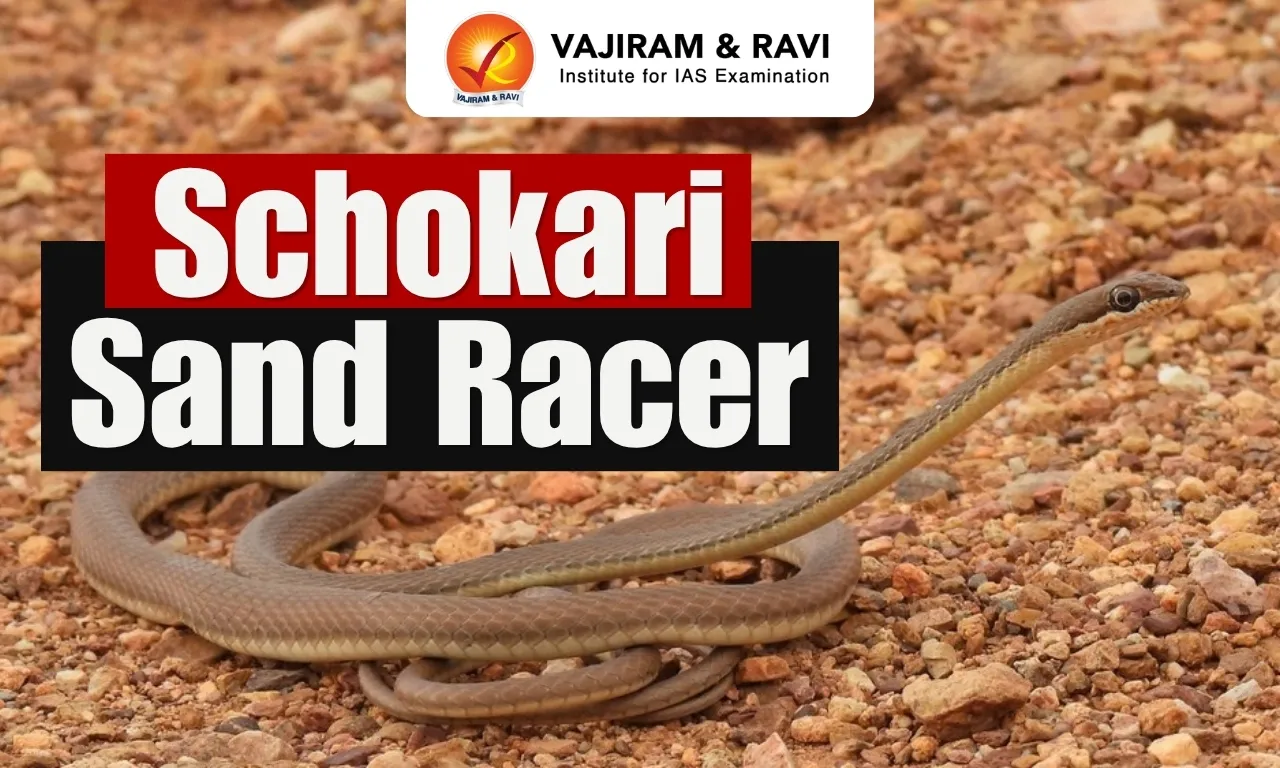
Schokari Sand Racer

Schokari Sand Racer

Schokari Sand Racer Latest News

A routine forest patrol in Gujarat's Kutch recently led to an unusual wildlife discovery: an elusive snake named Schokari Sand Racer that had not been conclusively recorded in the region for more than 150 years.

About Schokari Sand Racer

  • The Schokari Sand Racer, also known as the Afro-Asian sand snake, is an extremely fast diurnal snake well adapted to arid and desert environments.  
  • It is mildly venomous but generally poses little danger to people and feeds on small animals, including lizards and rodents. 
  • Scientific Name: Psammophis schokari  

Schokari Sand Racer Habitat and Distribution

  • It inhabits desert regions with sparse vegetation, especially sand deserts, wadis, and oasis margins.
  • Its distribution stretches from North Africa (Libya, Egypt) across the Arabian Peninsula and the Near East to Pakistan, including southern Turkmenistan and northwestern India. 
  • From India, it has been reported only from the deserts of Rajasthan and Kutch of Gujarat. 

Schokari Sand Racer Features

  • It is a medium-sized snake, typically about 100 to 120 cm long.
  • The body is long, slender, smooth, and glossy. 
  • It has an elongated head and large eyes adapted for active daytime hunting. 
  • The coloration is highly variable, usually sandy, olive, or grey-brown with longitudinal dark stripes running along the body. 
  • The belly is pale, and the scales are smooth, giving the snake a sleek appearance. 

Schokari Sand Racer Conservation Status

It is classified as 'Least Concern' under the IUCN Red List.

News: IT

Schokari Sand Racer FAQs

Q1: What is the Schokari Sand Racer?

Ans: It is an extremely fast, diurnal, mildly venomous snake adapted to arid and desert environments.

Q2: Is the Schokari Sand Racer venomous?

Ans: Yes, it is mildly venomous but generally poses little danger to humans.

Q3: What type of environments does the Schokari Sand Racer inhabit?

Ans: It inhabits arid and desert environments, including sand deserts, wadis and oasis margins.

Q4: Where is the Schokari Sand Racer distributed?

Ans: Its distribution extends from North Africa through the Arabian Peninsula and Near East to Pakistan, including southern Turkmenistan and northwestern India.

Q5: What is the conservation status of the Schokari Sand Racer according to the IUCN?

Ans: Least Concern.

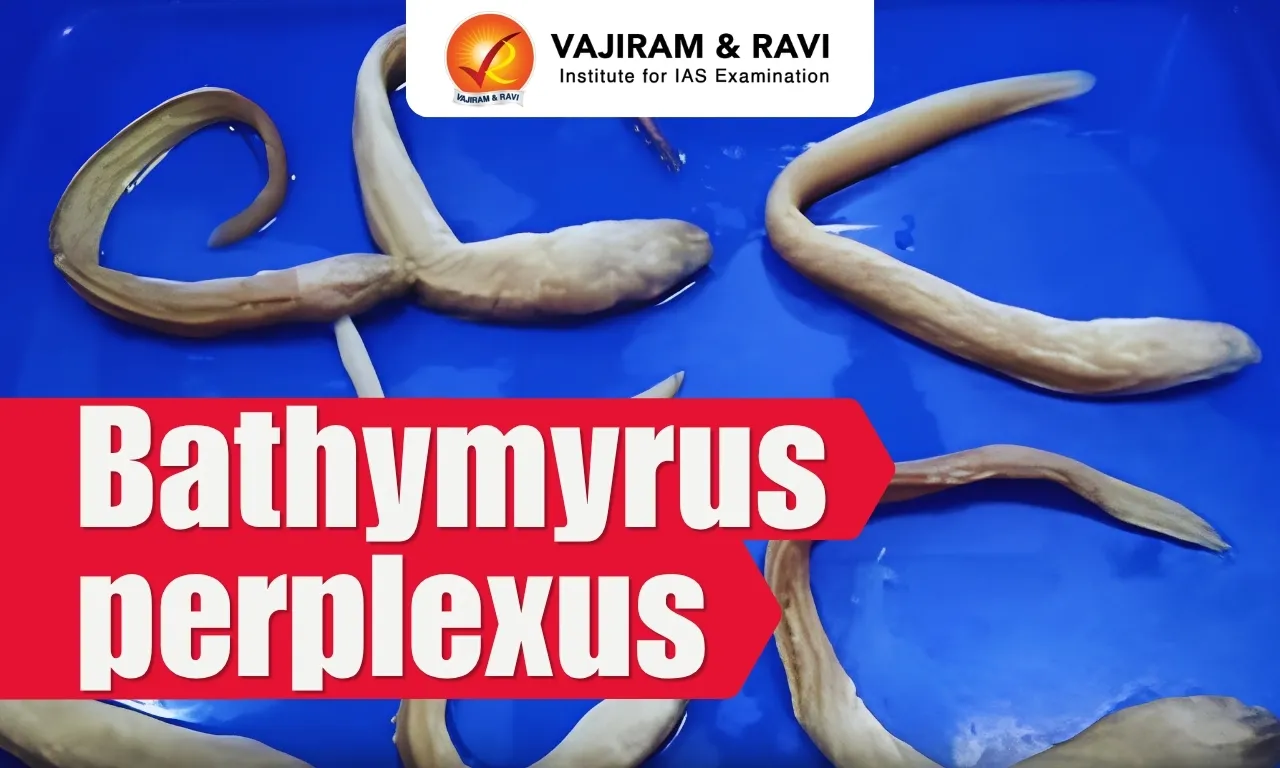
Bathymyrus perplexus

Bathymyrus perplexus

Bathymyrus perplexus Latest News

Scientists recently identified a new fish species in the Bay of Bengal, Bathymyrus Perplexus, almost four years after it was first discovered off the coast of Paradip.

About Bathymyrus perplexus

  • It is a new species of fish.
  • It was identified in the Bay of Bengal, almost four years after it was first discovered off the coast of Paradip, Odisha. 
  • Between 2021 and 2025, researchers recorded 32 specimens from Paradip, West Bengal, the Godavari region and Kakinada. 
  • It is typically found in waters ranging from 50 to 100 meters deep off the coast. 

Bathymyrus perplexus Features

  • The fish has a long, cylindrical body. It possesses a distinctive head and snout structure. 
  • Its body colour ranges from pink to a cloudy pink hue. 
  • There is heavy black pigmentation on the upper part of the head, and a black mark extends from the eye to the snout. 
  • Thin black margins line the outer edges of its dorsal and anal fins. 
  • Its mouth features teeth on both the upper and lower jaws, as well as on the head region.

News: ETVB

Bathymyrus perplexus FAQs

Q1: What is Bathymyrus perplexus?

Ans: It is a new species of fish identified in the Bay of Bengal.

Q2: Where was Bathymyrus perplexus first discovered?

Ans: It was first discovered off the coast of Paradip, Odisha.

Q3: From which regions were specimens of Bathymyrus perplexus recorded?

Ans: Paradip, West Bengal, the Godavari region and Kakinada.

Q4: What is the body shape of Bathymyrus perplexus?

Ans: It has a long, cylindrical body.

Q5: What is the body colour of Bathymyrus perplexus?

Ans: Its body colour ranges from pink to cloudy pink.

Bandhavgarh Tiger Reserve

Bandhavgarh Tiger Reserve

Bandhavgarh Tiger Reserve Latest News

A five-day Elephant Festival and Rejuvenation Camp is being held at Bandhavgarh Tiger Reserve in Umaria district of Madhya Pradesh. 

About Bandhavgarh Tiger Reserve

  • It is located between the Vindhyan and Satpura ranges in the Umaria district of Madhya Pradesh. 
  • It was declared a National Park in 1968 and a Tiger Reserve in 1972 and spreads over 1150 sq.km. 
  • It derives its name from the most prominent hillock in the area, which was said to be given by Hindu Lord Rama to his brother Lakshmana to keep a watch on Lanka. Hence the name Bandhavgarh (Sanskrit: Brother’s Fort).
  • The habitat is characterized by valleys, hills, and plains, with the Bandhavgarh fort prominently seen as a major landmark. 
  • The reserve features around 39 caves with Pali inscriptions and animal depictions.
  • It also contains ancient structures, including stupas and statues from the 1st century BCE.
  • Flora:
    • Main vegetation in the reserve consists of Sal trees along with huge expanses of grasslands and bamboo forests. 
    • Other kinds of trees which are found here are Saja, Dhauda, Tendu, Arjun, Aonla, Pals, Salai, Bhirra, Khamer, Dhaman, Mango, Jamun, Dhobin, etc. 
  • Fauna:
    • It is known to have one of the highest density of tigers in the world. It is also considered the origin of all the white tigers in the world.  
    • It also hosts other notable mammals such as leopards, Indian bison (gaur), sambar deer, spotted deer, nilgai, wild boar, sloth bears, Indian wolves, jackals, and both langur and rhesus macaque monkeys.
    • It also has over 250 bird species, including the crested serpent eagle, Malabar pied hornbill, white-rumped vulture, and Indian roller.

News: NOA

Bandhavgarh Tiger Reserve FAQs

Q1: Where is Bandhavgarh Tiger Reserve located?

Ans: It is located in Umaria district of Madhya Pradesh, between the Vindhyan and Satpura ranges.

Q2: How did Bandhavgarh Tiger Reserve get its name?

Ans: It derives its name from the prominent Bandhavgarh hillock, traditionally believed to have been given by Lord Rama to his brother Lakshmana to keep watch over Lanka.

Q3: What is the dominant vegetation of Bandhavgarh Tiger Reserve?

Ans: Sal forests, along with extensive grasslands and bamboo forests, form the main vegetation.

UPSC Centenary Celebrations 2026, 100 Years, History & PM Modi

UPSC Centenary Celebrations 2026

Union Public Service Commission (UPSC) is completing 100 years of its institutional journey in 2026. To mark this milestone, the Commission is organising its Centenary Celebrations at Bharat Mandapam, New Delhi, on October 1, 2026.

Prime Minister Narendra Modi is participating in the centenary celebrations and addressing the gathering. He is also scheduled to release a UPSC Centenary Commemorative Coin, a Commemorative Stamp and a book titled “100 Landmark Judgements – Shaping the Policies of UPSC and Public Service Commissions in India.”

The event marks 100 years since the establishment of the first Public Service Commission in India in 1926. The celebrations are also an opportunity to look at the institution's historical journey, constitutional role and future reforms.

UPSC Completes 100 Years

The first Public Service Commission in India was established on October 1, 1926. Its establishment followed the provisions of the Government of India Act, 1919 and the recommendations of the Lee Commission (1924).

What is the Union Public Service Commission?

Union Public Service Commission (UPSC) is a constitutional body established under Article 315 of the Indian Constitution. It conducts competitive examinations for recruitment to various Central Government services and posts. It also advises the government on matters related to recruitment, promotions, transfers and disciplinary actions. The Commission aims to ensure merit-based, fair and impartial recruitment to public services. 

History of UPSC

The history of the Union Public Service Commission (UPSC) is closely linked with the evolution of merit-based recruitment to public services in India. Its institutional journey began during the British period and gradually developed into an independent constitutional body after India became a Republic.

  • 1855 – Beginning of Competitive Recruitment: The system of competitive recruitment to the Indian Civil Service (ICS) was introduced in 1855, replacing the earlier system of nomination by the East India Company. Initially, the examination was conducted in London, which made it difficult for Indians to participate.
  • 1919 – Government of India Act: The Government of India Act, 1919 provided for the establishment of a Public Service Commission. Section 96C envisaged a body that would deal with matters related to the recruitment and control of public services in India. However, the Commission was not immediately established.
  • 1924 – Lee Commission: The Royal Commission on the Superior Civil Services in India, headed by Lord Lee, submitted its report in 1924. It strongly recommended the early establishment of a statutory Public Service Commission in India.
  • 1926 – First Public Service Commission: On 1 October 1926, the first Public Service Commission was established in India. Sir Ross Barker became its first Chairman. The Commission initially had limited advisory powers and was mainly consulted on matters relating to recruitment and public services.
  • 1926 – Initial Structure: The Commission consisted of a Chairman and four Members. It was initially located at Metcalfe House in Delhi. Its functions were governed by the Public Service Commission (Functions) Rules, 1926, framed under the Government of India Act, 1919.
  • 1935 – Government of India Act: The Government of India Act, 1935 provided a broader framework for public service commissions and strengthened the institutional arrangement for recruitment to public services.
  • 1937 – Federal Public Service Commission: On 1 April 1937, the Public Service Commission was renamed the Federal Public Service Commission under the Government of India Act, 1935. Its role expanded as the system of public service recruitment developed.
  • 1938 – Combined Competitive Examinations: Combined competitive examinations were introduced for several services, marking an important step towards a unified recruitment system for multiple public services.
  • 1947 – Independence: After India became independent, the Federal Public Service Commission continued its recruitment-related responsibilities during the transition to the new administrative system. H.K. Kripalani became the first Indian Chairman of the Commission. The first examination after Independence was held in December 1947, with the ICS gradually giving way to the Indian Administrative Service (IAS).
  • 1950 – Constitutional Status: With the Constitution coming into force on 26 January 1950, the Federal Public Service Commission became the Union Public Service Commission. It was given constitutional status under Part XIV of the Constitution, covering Articles 315 to 323.
  • 1950–51 – Recruitment to All-India Services: The Commission conducted regular recruitment to the newly established All-India Services. In the first recruitment under the constitutional framework, 29 candidates were recommended for the IAS and 31 for the IPS.
  • 1966–67 – Indian Forest Service: The Indian Forest Service (IFoS) became the third All India Service in 1966, with the first selection taking place in 1967.
  • 1976 – Kothari Committee: The D.S. Kothari Committee recommended changes in the examination system, including a three-stage structure. This became an important step in the later development of the Civil Services Examination.
  • 1978–79 – Modern Examination System: The Commission began using computers for processing applications, answer sheets and records in 1978. In 1979, the three-stage examination system comprising Preliminary Examination, Main Examination and Interview was introduced.
  • 2025–26 – Centenary Year: The Commission began its Centenary Year celebrations on 1 October 2025, marking 100 years since the establishment of the first Public Service Commission in 1926. The celebrations continued until 1 October 2026.
  • 2026 – Completion of 100 Years: On 1 October 2026, the Commission completes 100 years of its institutional journey. Its evolution from an advisory Public Service Commission in 1926 to an independent constitutional body reflects the development of India's public recruitment system.

Constitutional Provisions Related to UPSC

Union Public Service Commission (UPSC) is a constitutional body governed by Part XIV of the Indian Constitution, particularly Articles 315 to 323, which deal with its establishment, composition, functions, independence and reporting responsibilities.

  • Article 315 – Public Service Commissions: Provides for the establishment of a Public Service Commission for the Union and a separate commission for each State.
  • Article 316 – Appointment and Term of Office: Deals with the appointment of the Chairman and other members of the Commission and their tenure.
  • Article 317 – Removal and Suspension: Specifies the conditions and procedure for the removal or suspension of the Chairman or members of the Commission.
  • Article 318 – Regulations: Gives the President the power to determine the number of members and staff of the Commission and their conditions of service through regulations.
  • Article 319 – Restrictions on Future Employment: Places restrictions on the future employment of the Chairman and members of Public Service Commissions after completing their term.
  • Article 320 – Functions: Specifies the major functions of the Commission, including conducting examinations, recruitment and advising the government on specified service-related matters.
  • Article 321 – Extension of Functions: Allows Parliament to extend the functions of the Commission through legislation.
  • Article 322 – Expenses: Provides that the expenses of the Commission are charged on the Consolidated Fund of India, supporting its financial independence.
  • Article 323 – Annual Reports: Requires the Commission to submit an annual report to the President, who places it before Parliament along with a memorandum explaining cases where its advice was not accepted.

Major Functions of UPSC

Union Public Service Commission (UPSC) performs recruitment and advisory functions for the Union Government, helping ensure a fair, merit-based and transparent system for selecting candidates for public services.

  • Conducts Competitive Examinations: Conducts examinations for recruitment to various Central Government services and posts, including the Civil Services Examination, Engineering Services Examination, CDS, NDA & NA and Combined Medical Services Examination.
  • Direct Recruitment: Makes direct recruitment to various services through competitive examinations, interviews or selection processes as prescribed by the government.
  • Advises on Recruitment Methods: Advises the government on suitable methods and procedures for recruitment to different civil services and posts.
  • Advises on Appointments and Promotions: Provides advice on matters related to appointments, promotions and transfers from one service to another.
  • Disciplinary Matters: Advises the government on certain disciplinary cases involving civil servants, including matters related to penalties and misconduct.
  • Frames and Amends Recruitment Rules: Is consulted while framing or amending recruitment rules and service conditions for various posts and services.
  • Conducts Departmental Examinations: May conduct or assist in conducting departmental examinations for government employees.
  • Advisory Role: The Commission advises the government on matters referred to it under the Constitution, laws or regulations.

UPSC Centenary Celebrations 2026 FAQs

Q1: When was the first Public Service Commission established in India?

Ans: The first Public Service Commission in India was established on 1 October 1926. It later became the Federal Public Service Commission in 1937 and the Union Public Service Commission in 1950.

Q2: Why are UPSC Centenary Celebrations being organised in 2026?

Ans: The celebrations mark 100 years since the establishment of the first Public Service Commission in India in 1926. The year-long celebrations began on 1 October 2025 and conclude on 1 October 2026.

Q3: Where are the UPSC Centenary Celebrations 2026 being held?

Ans: The main two-day centenary programme is being held at Bharat Mandapam, New Delhi, on 30 September and 1 October 2026.

Q4: Will PM Modi address the UPSC Centenary Celebrations 2026?

Ans: Yes. Prime Minister Narendra Modi is participating in the centenary celebrations on 1 October 2026 and addressing the gathering at Bharat Mandapam.

Q5: What will PM Modi release during the UPSC Centenary Celebrations?

Ans: The Prime Minister is scheduled to release a UPSC Centenary Commemorative Coin, a Commemorative Stamp and the book “100 Landmark Judgements – Shaping the Policies of UPSC and Public Service Commissions in India.”

Permafrost

Permafrost

Permafrost Latest News

Alaska’s thawing permafrost is releasing acid and metals that turn rivers orange, changing water chemistry for dozens of miles.

About Permafrost

  • Permafrost is any ground that remains completely frozen—32°F (0°C) or colder—for at least two years straight. 
  • While two years is the minimum for permafrost consideration, some regions have had frozen ground for hundreds of thousands of years. 
  • Scientists discovered the oldest known permafrost in Siberia, which has been frozen for the past 650,000 years.
  • Where are they found?
    • These permanently frozen grounds are most common in regions with high mountains and in Earth’s higher latitudes—near the North and South Poles.
    • It can be found on land and below the ocean floor. 
    • Its thickness can range from one meter to more than 1,000 meters, covering entire regions, such as the Arctic tundra, or a single, isolated spot, such as a mountaintop of alpine permafrost.
    • Permafrost covers large regions of the Earth. Almost a quarter of the land area in the Northern Hemisphere has permafrost underneath. 
    • It occurs in 85 percent of Alaska and 55 percent of Russia and Canada, and covers probably all of Antarctica.  
  • What Is Permafrost Made Of?
    • Permafrost is made of a combination of soil, rocks, and sand that are held together by ice. 
    • The soil and ice in permafrost stay frozen all year long.
    • Although the ground is frozen, permafrost regions can be snow-free in summer. 
    • Near the surface, permafrost soils also contain large quantities of organic carbon—a material leftover from dead plants that couldn’t decompose, or rot away due to the cold.
    • Lower permafrost layers contain soils made mostly of minerals.
  • Permafrost loss, also known as permafrost thaw, is the progressive loss of ground ice in permafrost, usually due to input of heat. 
  • A layer of soil on top of permafrost does not stay frozen all year. This layer, called the active layer, thaws during the warm summer months and freezes again in the fall. 
  • In colder regions, the ground rarely thaws—even in the summer. There, the active layer is very thin—only 4 to 6 inches (10 to 15 centimeters).
  • A thawing permafrost layer can lead to severe impacts on people and the environment.
    • When permafrost melts, it raises water levels in Earth's oceans.  
    • Melting permafrost and warming global temperatures have a positive feedback loop. 
    • Organic matter currently frozen in the permafrost will start to decompose when the ground thaws, resulting in the emission of methane and carbon dioxide into the atmosphere. 
    • As ice-filled permafrost thaws, it can turn into a muddy slurry that cannot support the weight of the soil and vegetation above it. 
    • Infrastructure such as roads, buildings, and pipes could be damaged as permafrost thaws.
    • Melting permafrost also releases heavy metals, such as mercury, and other toxins. 
    • As it melts, the contaminated permafrost can pollute water sources for local people. 
    • It is even possible that thawing permafrost may release dormant, disease-causing microbes that are harmful to animals and humans.

News: EARTH

Permafrost FAQs

Q1: What is permafrost?

Ans: Permafrost is ground that remains completely frozen at 0°C (32°F) or colder for at least two consecutive years.

Q2: Where is permafrost commonly found?

Ans: It is commonly found in high-mountain regions and Earth's higher latitudes, particularly near the North and South Poles.

Q3: Can permafrost occur beneath the ocean floor?

Ans: Yes, permafrost can occur both on land and beneath the ocean floor.

Q4: What is permafrost made of?

Ans: It consists of a combination of soil, rocks and sand held together by ice.

Q5: What is permafrost thaw?

Ans: Permafrost thaw is the progressive loss of ground ice in permafrost, usually caused by the input of heat.

CAFE-III Norms – Balancing Fuel Efficiency, Emission Reduction and Technological Innovation

CAFE III Norms

CAFE III Norms Latest News

  • The Ministry of Power notified the third phase of the Corporate Average Fuel Economy (CAFE-III) norms. 
  • The regulations will be implemented from April 1, 2027, to March 31, 2032, requiring automobile manufacturers to progressively improve the fuel efficiency of their passenger vehicle fleets.
  • The new framework seeks to reduce fuel consumption and carbon dioxide (CO₂) emissions while providing flexibility through multiple technological pathways. It also resolves the contentious debate over special concessions for small cars.

Understanding CAFE Norms

  • Introduced in 2017 under the Energy Conservation Act, 2001, CAFE norms regulate the average fuel consumption and CO₂ emissions of a manufacturer's entire passenger vehicle fleet.
  • Unlike vehicle-specific emission standards, CAFE norms assess the weighted average performance of all eligible vehicles sold by a manufacturer.
  • CAFE-II came into effect in 2022, while CAFE-III will remain applicable for five years, covering M1-category passenger vehicles manufactured or imported for sale in India.
  • The framework encourages manufacturers to improve fleet-wide fuel efficiency rather than focusing exclusively on individual models.

Progressively Stricter Fuel Efficiency Targets

  • CAFE-III mandates an improvement of approximately 16.7% in fuel efficiency over five years through progressively tightening annual targets.
  • The annual fuel-consumption target is calculated using the following formula -
    • Annual average fuel consumption = a × (W − b) + c
    • Where, 
      • W: Weighted average unladen weight of a manufacturer's eligible vehicles.
      • b: Reference weight, fixed at 1,229 kg.
      • a: Weight adjustment factor.
      • c: Baseline fuel-consumption target.
  • The reference weight has increased from 1,082 kg under the existing norms to 1,229 kg under CAFE-III, reflecting changes in the passenger vehicle fleet.
  • The baseline fuel-consumption target will decline from 3.996 litres/100 km in 2027–28 to 3.3273 litres/100 km in 2031–32.
  • The revised formula also uses a flatter weight adjustment, allowing different targets based on the average weight of manufacturers' fleets.

Small Cars vs Large Cars - Resolving the Industry Debate

  • The treatment of small cars was one of the most contentious aspects of CAFE-III.
  • The September 2025 draft proposed an additional relaxation of 3 g CO₂/km for petrol cars weighing below 909 kg.
  • This proposal faced opposition from some manufacturers, including Tata Motors and Mahindra & Mahindra (M&M), who argued that it would disproportionately benefit Maruti Suzuki, which dominates the lightweight car segment.
  • The final notification has removed the separate 3 g/km concession but revised the weight-adjustment formula to provide relatively favourable targets for lighter vehicles.
  • Consequently, a small car's target, which would have been 54.1 g/km under the earlier draft, has been relaxed to 63.7 g/km under the final framework.
  • However, there is no separate regulatory category for cars weighing below 909 kg. The fuel-efficiency target depends on the manufacturer's overall fleet weight.

Incentives for Electric Vehicles and Alternative Fuels

  • CAFE-III introduces a super-credit mechanism to encourage cleaner technologies and diversify India's automotive energy mix.
  • For example, for BEVs and range-extended electric vehicles (REEVs) volume derogation factor is 3. It is 2.5 for plug-in hybrids and strong hybrids running on flex-fuel.
  • Under this mechanism, one BEV or REEV is counted as three vehicles when calculating fleet performance.
  • Additional carbon-neutrality factors (CNFs) recognise the contribution of alternative fuels. For example, 8% for E20 or higher ethanol-blended petrol vehicles, and 22.3% for flex-fuel ethanol vehicles.
  • EVs also benefit from a separate energy-consumption calculation, with electricity consumption converted into petrol-equivalent consumption using a prescribed conversion factor of 0.1028.
  • These provisions encourage electrification, hybridisation and the adoption of cleaner fuels.

Flexible Compliance Mechanism

  • CAFE-III introduces a credit-debit system to provide manufacturers with greater flexibility.
  • Manufacturers exceeding their prescribed efficiency targets earn credits, while those falling short accumulate debits.
  • Credits can be carried forward within compliance blocks and traded between manufacturers.
  • Manufacturers with outstanding deficits can purchase credits from the Bureau of Energy Efficiency (BEE).
  • The buyout price starts at ₹2,500 per g CO₂/km in 2027–28 and increases by ₹500 annually, reaching ₹4,500 in 2031–32.
  • The 3+2-year compliance block structure allows manufacturers to balance deficits across three-year and two-year periods instead of meeting every annual target independently.

Incentives for Technological Innovation

  • Manufacturers can claim efficiency improvements from specified technologies, including -
    • Start-stop systems and tyre-pressure monitoring.
    • Regenerative braking and efficient transmissions.
    • Motor-generators and efficient alternators.
    • LED lighting and advanced glazing.
    • Electric water pumps and improved air-conditioning systems.
  • Each qualifying technology can provide a claimed reduction of 1 g CO₂/km, subject to an overall cap of 9 g CO₂/km. 
  • Self-declaration is permitted during the first compliance block, while claims in the second block require validated testing.
  • Manufacturers producing or importing fewer than 1,000 eligible vehicles during a reporting period are exempt from specific CAFE targets but must report their actual fleet-average fuel consumption.

Significance and Way Forward

  • CAFE-III seeks to achieve multiple objectives - 
    • Environmental sustainability: Reduce vehicular emissions and fossil-fuel consumption.
    • Energy security: Lower dependence on imported petroleum through improved fuel efficiency and alternative energy sources.
    • Technological innovation: Encourage investment in EVs, hybrids, cleaner fuels and energy-efficient vehicle technologies.
    • Regulatory certainty: Provide a predictable framework for long-term investment and product development.
    • Consumer choice: Allow manufacturers to adopt different technological pathways according to market demand and capabilities.
  • However, manufacturers must balance compliance costs, technological investments and vehicle affordability, particularly in the price-sensitive small-car segment.

Conclusion

  • CAFE-III represents an important step towards decarbonising India's passenger vehicle sector. It seeks to promote cleaner mobility while accommodating the diverse capabilities of automobile manufacturers. 
  • Its success will depend on effective implementation, technological innovation and the affordability of cleaner vehicles.

Source: IE | IE

CAFE-III Norms FAQs

Q1: What are the key features of CAFE-III norms?

Ans: It mandates a 16.7% improvement in fuel efficiency by 2032 through stricter targets, super credits, etc.

Q2: How do CAFE-III norms balance the interests of small and large car manufacturers?

Ans: It links fuel-efficiency targets to fleet weight, providing relatively favourable targets to lighter vehicles without a separate concession for small cars.

Q3: How will CAFE-III norms promote sustainable mobility in India?

Ans: By incentivising EVs, hybrids and alternative fuels to reduce vehicular emissions, petroleum dependence, etc.

Q4: How does the credit-debit mechanism enhance flexibility under CAFE-III?

Ans: It allows manufacturers to trade credits, carry forward surpluses, purchase credits from the BEE, etc.

Q5: What is the role of technological innovation in achieving the objectives of CAFE-III?

Ans: It incentivises energy-efficient technologies, electrification and cleaner fuels, encouraging R&D and low-emission mobility solutions.

Foreign Investment in India – Regulatory Barriers and Investment Climate

Foreign Investment in India

Foreign Investment in India Latest News

  • A recent US Department of State report on India’s investment climate has highlighted regulatory restrictions, differences between foreign and domestic investors, corruption risks and import-related barriers affecting foreign investment in India. 

India’s Foreign Investment Framework

  • India permits 100% FDI through the automatic route in most sectors, although certain sectors remain subject to government approval and other conditions.
  • The US report noted that foreign investors are required to seek government approval in sectors including multi-brand retail, private banking, pharmaceuticals, defence, print and digital media, and satellites. It characterised these sector-specific requirements as creating differences in the treatment of foreign and domestic investment. 
  • Such restrictions can reflect legitimate policy considerations, particularly in sectors involving national security, strategic assets, financial stability or sensitive information. 
  • At the same time, predictable and transparent rules are important for investment decisions.

Key Concerns Highlighted by the Report

  • Regulatory Uncertainty
    • The report identifies regulatory uncertainty as a concern for foreign businesses operating in India.
    • Investment decisions generally involve long-term commitments. Frequent changes in rules, unclear procedures or uncertainty regarding approvals can increase the cost and risk of investment, particularly for capital-intensive industries.
    • The report also highlighted India's Import Management System (IMS). It said that requirements for importing specialised used equipment, including high-end servers, semiconductors and advanced testing equipment, can create difficulties because of authorisation requirements and a perceived lack of transparent guidelines. 
  • FDI-FPI Restrictions
    • The report raised concerns about restrictions on investors using both the Foreign Direct Investment (FDI) and Foreign Portfolio Investment (FPI) routes.
    • Under the existing framework described in the report, an investor entering a company through FDI before its IPO may face restrictions on acquiring additional shares through the FPI route until its pre-IPO FDI holdings are fully divested.
    • The report argues that this can create difficulties for large investment groups managing multiple independent funds. It also notes that the existing 10% FPI cap already limits the ability of foreign portfolio investors to acquire strategic stakes in listed Indian companies. 

Corruption and Regulatory Governance

  • The report also identifies actual or anticipated corruption, particularly within regulatory systems, as a barrier reported by US businesses.
  • India's Companies Act, 2013 contains several corporate governance and anti-corruption mechanisms, including provisions relating to independent directors, whistleblower protection and codes of conduct.
  • The report noted, however, that publicly available information is limited regarding the extent to which internal compliance and control mechanisms are implemented across the private sector.
  • For investors, transparent regulatory procedures and effective institutional safeguards can reduce transaction costs and uncertainty.

Taxation and Banking

  • The report highlighted a difference in the effective tax burden between foreign and domestic banks.
  • According to the report, foreign banks face an effective tax rate of 38.22%, which is 4.63 percentage points higher than that faced by domestic banks.
  • At the same time, the report noted that India maintains stable correspondent banking relationships with major global and US banks. 
  • It also recognised that India's tightly regulated banking and capital-market systems contribute to financial stability and continued access for foreign financial institutions. 

India’s FDI Performance

  • The report noted that US direct investment stock in India stood at $58.54 billion in 2024, representing a 3.37% decline from 2023. 
  • However, investment flows can fluctuate considerably from month to month. RBI data cited in the report showed that India's net FDI inflow reached $7.35 billion in July, its highest monthly level since May 2021, when it stood at $8.80 billion.
  • Therefore, a single indicator should not be interpreted as representing the entire trajectory of India's foreign investment environment.

Importance of Ease of Doing Business

  • Foreign investment contributes not only capital but can also facilitate technology transfer, managerial capabilities, employment and integration into global value chains.
  • An effective investment framework therefore requires a combination of:
    • Predictable regulations
    • Transparent approval procedures
    • Efficient dispute resolution
    • Consistent tax treatment
    • Strong corporate governance
    • Transparent import and export procedures
    • Effective anti-corruption mechanisms
  • India has also developed institutional mechanisms to facilitate investment, including the National Single Window System, which provides businesses with access to multiple Central and State approvals through a common digital platform.

Balancing Regulation and Investment

  • A major policy challenge is to balance strategic regulation with investment facilitation.
  • Certain restrictions may be justified in sensitive sectors, but excessive procedural complexity can increase compliance costs. 
  • Conversely, complete deregulation may create risks relating to national security, financial stability, strategic technologies or market concentration.
  • The investment climate therefore depends not merely on the number of restrictions but also on whether rules are transparent, predictable, proportionate and consistently implemented.

Source: IE

Foreign Investment in India FAQs

Q1: What is FDI?

Ans: Foreign Direct Investment refers to investment by a foreign entity in an enterprise in another country with the objective of establishing a lasting interest.

Q2: What is the difference between FDI and FPI?

Ans: FDI generally involves a lasting interest and greater participation in an enterprise, while FPI primarily involves investment in financial securities without the same degree of managerial involvement.

Q3: What did the US report identify as barriers to investment in India?

Ans: It highlighted regulatory restrictions, corruption risks, FDI–FPI restrictions, import-related requirements and differences in the treatment of foreign and domestic investment.

Q4: What is the Import Management System?

Ans: It is a framework through which India regulates certain imports using authorisation requirements and other measures.

Q5: Why is regulatory predictability important for FDI?

Ans: Predictable regulations reduce uncertainty and help investors make long-term investment and capital-allocation decisions.

Sea-Level Rise: UN Declaration and India’s Eroding Coast

Sea-Level Rise

Sea-Level Rise Latest News

  • Recently, the UN General Assembly adopted its first-ever declaration on rising sea levels, which pose an existential threat to populations worldwide. 
  • The declaration addresses both the loss of territory faced by vulnerable island nations and the need for countries to build sea-level rise projections into coastal infrastructure planning — the latter being an area where India has significant work to do.

The Scale of the Problem

  • Sea-level rise has been "accelerating," in the declaration's own words.
    • The global rate of rise more than doubled: from 2.1 mm/year (1993–2002) to 4.7 mm/year (2015–2024), as per the World Meteorological Organization.
    • In 2024 alone, the sea rose 6 mm — the largest annual increase on record.
  • Future projections (from 'Surging Seas in a Warming World', a 2024 UN Secretary-General's Climate Action Team brief):
    • Lowest-emissions path: Global sea level rises ~38 cm by 2100 above early-2000s levels.
    • High-emissions path: Rise could reach ~77 cm.
    • Crucially, seas will keep rising for centuries to millennia, even if the world reaches net zero.

Can a Country Survive Losing Its Territory?

  • This is the central legal question the declaration attempts to settle.
  • Under the 1933 Montevideo Convention, a state is defined by four criteria: 
    • a permanent population, 
    • a defined territory, 
    • a government, and 
    • the capacity to enter relations with other states. 
  • If rising seas swallow a state's territory or make it uninhabitable, does statehood survive? The declaration's answer: Yes.
  • It affirms a "presumption in favour of continued statehood" — such a country keeps its sovereignty, rights, and UN seat.
  • Crucially, it also keeps its nautical boundaries, even as the coastline physically retreats. These include: 
    • The Territorial Sea — extending 12 nautical miles (~22.2 km) from the coast.
    • The Exclusive Economic Zone (EEZ) — extending up to ~370 km, within which a country holds exclusive rights over natural resources.
  • On Emissions and Adaptation: The declaration calls adaptation and mitigation "essential" but leaves actual emission-cut negotiations to the UN climate convention and the Paris Agreement.
  • On Displaced People: It asks countries to respect the human rights of those who lose homes, encourages strengthened international cooperation, and supports voluntary choices and "mobility with dignity."
  • A Real Example Already Underway: By December 2025, more than a third of Tuvalu's 11,000-strong population had applied for climate visas to migrate to Australia under a bilateral treaty.

What India Gains

  • India welcomed the declaration and backed stable maritime zones and continuity of statehood. 
  • It also reaffirmed "common but differentiated responsibilities and respective capabilities" — the principle that all countries must act on climate change, but those who caused more pollution and can afford more should contribute more.

India's Direct Stake

  • A 2023–24 remeasurement counts 1,298 offshore islands/islets and a coastline of 11,098 km.
  • Lakshadweep and the Andaman and Nicobar Islands extend India's maritime boundaries deep into the Arabian Sea and Bay of Bengal.
  • A pledge to keep nautical boundaries fixed therefore protects India's own waters, not just Pacific nations'.

Diplomatic Continuity

  • The vote extends India's ongoing engagement with island nations — via the Forum for India–Pacific Islands Cooperation (set up with 14 Pacific countries in 2014) and the Infrastructure for Resilient Island States initiative (launched at the 2021 Glasgow climate summit).

Is India's Own Coast Ready?

  • The National Centre for Coastal Research tracked India's mainland shoreline from 1990 to 2016 and found about a third of it eroding.
    • Nationally, losses and gains are roughly balanced: 234 sq km lost, 231 sq km gained elsewhere.
    • But losses are concentrated: nearly 400 km of coast is retreating by more than 5 metres/year, and another 225 km by 3–5 metres/year.
    • West Bengal alone has over 170 km in the fastest-eroding category — about a third of its entire coast.

The Regulatory Gap

  • Under the 2019 Coastal Regulation Zone (CRZ) notification, the "no-build" strip is:
    • 50 metres wide in densely populated rural areas (once a state's coastal plan is approved).
    • 200 metres elsewhere.
  • Both are measured from the high-tide line — defined as where the highest spring tide reaches today.
  • The problem: On a stretch losing 5 metres/year, a house built 50 metres from today's high-tide line would reach the water's edge in about 10 years. Even the 200-metre strip would last only about 40 years.

A Better Tool Exists But isn't Fully Used

  • The Survey of India has mapped a "hazard line" incorporating sea-level rise and shoreline change, shared with coastal states. 
  • The 2019 rules use it only as a disaster management planning tool, while the actual no-build strip is still measured from today's tide line — not the projected future one.

Who the Declaration Leaves Out

  • In the Sundarbans, the loss has already happened.
    • Ghoramara island shrank from ~7.2 sq km (1972) to 3.6 sq km (2022).
    • Families who had earlier moved there from neighbouring Lohachara (which disappeared in the early 2000s) were displaced again within a decade — relocated to marginal land without secure tenure or livelihood support.
  • The Legal Gap: Indian law has no clear category for people who gradually lose land to erosion; each relocation is handled case by case. 
    • A 2025 review in Frontiers in Marine Science estimates 45 million Indians will be at risk from sea-level rise by 2050, and notes India "still lacks comprehensive legislation" on this.
  • A Model Worth Following: Fiji wrote planned relocation into its Climate Change Act (2021), backed by a trust fund.

What India Should Do Before 2030

  • Measure the no-build strip from the hazard line, or widen it by the local erosion rate, starting with fastest-retreating stretches.
  • Enact a law for slow-onset displacement, ensuring relocated families receive land title and livelihood support.
  • Keep pressing on climate finance. UNEP estimates developing countries need over $310 billion/year by 2035 for adaptation, against just $26 billion in international public adaptation finance (2023). 
    • At Baku (2024), India called the new $300 billion/year goal "too little and too distant" — a position it should press again at COP31 in Antalya.
  • The declaration schedules the next high-level meeting on sea-level rise by September 2030 — giving India four years to act.

Source: IE | DTE

Sea-Level Rise FAQs

Q1: What does the UN declaration say about statehood amid sea-level rise?

Ans: The declaration creates a presumption favouring continued statehood despite sea-level rise, allowing vulnerable countries to retain sovereignty, rights and UN membership.

Q2: How does sea-level rise affect maritime boundaries?

Ans: Despite sea-level rise and retreating coastlines, the declaration supports retaining nautical boundaries, including territorial seas and Exclusive Economic Zones.

Q3: Why is sea-level rise particularly important for India?

Ans: Sea-level rise threatens India's extensive coastline, offshore islands and coastal communities, while fixed maritime boundaries protect India's interests in surrounding waters.

Q4: How is sea-level rise affecting India's coastline?

Ans: Sea-level rise compounds coastal erosion, with around one-third of India's mainland shoreline experiencing erosion and several stretches retreating rapidly.

Q5: What measures should India adopt to address sea-level rise?

Ans: India should incorporate hazard lines into coastal regulation, enact laws for slow-onset displacement, support relocated communities and strengthen climate-finance efforts.

SC/ST Act: Calcutta HC Extends Public View to Social Media

SC/ST Act

SC/ST Act Latest News

  • The Calcutta High Court has held that casteist slurs on social media can attract provisions of the SC/ST (Prevention of Atrocities) Act, 1989, ruling that "public view" under the law is not confined to physical spaces. 
  • A single bench of Justice Uday Kumar held that the requirement of "public view" under Sections 3(1)(r) and 3(1)(s) of the Act "transcends physical space into the digital domain."
  • This ruling comes weeks after the Supreme Court reiterated that not every caste-related remark amounts to an offence under the Act, and that courts must closely examine whether its statutory requirements are met — making this an important, evolving area of law.

What the Law Says

  • Sections 3(1)(r) and 3(1)(s) of the SC/ST Act criminalise intentionally insulting, intimidating or abusing a member of a Scheduled Caste or Scheduled Tribe by caste name, "in any place within public view."
  • To establish these offences, three elements must be satisfied:
    • The accused must not be a member of an SC/ST community.
    • The act must be intended to humiliate the victim on the basis of caste.
    • The incident must occur in a place within public view.
      • Digital cases typically hinge on this third requirement.

How Courts Have Interpreted Public View So Far

  • Hitesh Verma v. State of Uttarakhand (2020) — Supreme Court. The SC held that public view means a place where members of the public can witness or hear the alleged utterance. 
    • It clarified: "If the alleged offence takes place within the four corners of the wall where members of the public are not present, then it cannot be said that it has taken place at a place within public view."
  • Ramkrishna Chauhan v. State of Uttar Pradesh (2026) — Supreme Court. Apex Court quashed proceedings against a school manager under both clauses. The bench held the requirement depends on whether the alleged utterance was made in circumstances where members of the public could witness or hear it. 
    • Crucially, it added: "the mere fact that the occurrence took place within the premises of a school does not, by itself, satisfy this requirement."
  • This shows the Supreme Court has been applying the test cautiously and narrowly in physical-space cases.

What the Calcutta High Court Held

  • The petitioner, a member of a Scheduled Caste, alleged that two men from general caste communities had "hurled foul, unparliamentary, and casteist expletives targeting his caste identity, religion, God, and family" on Facebook.
  • Police approached Facebook through the Cyber Police Station, Kolkata, but did not receive user details.
  • Police then filed a "Final Report True, No Clue" — effectively closing the case.
  • The complainant challenged this closure, but the Special Court at Alipore rejected his petition.

The HC's Intervention

  • The High Court set aside the Special Court's order.
  • The court held it "transcends physical space into the digital domain." 
  • It noted that police had seized screenshots and recorded statements during investigation, and therefore the investigating agency "cannot throw up its hands reporting 'no clue'" after a mere local cyber inquiry failed — without exhausting specialised State CID cyber-forensic or IP-log tracking protocols. 
  • This is a significant procedural direction: investigators must pursue advanced technical methods before declaring a dead end.

The Emerging Judicial Pattern

  • [my_image src="https://vajiramias.sgp1.cdn.digitaloceanspaces.com/wp/current-affairs/2026/10/01091431/Emerging-Judicial-Pattern.jpg?v=1790826270" size="full" align="none" width="auto" height="280px" alt="" title="Emerging Judicial Pattern"]
  • The pattern shows courts applying a stricter, circumstance-based test for physical spaces, while extending the concept more liberally to digital spaces — recognising that online content, by its nature, has unlimited potential viewership.

Conclusion

  • The law was written for a world without screenshots and social media feeds, yet courts are now stretching "public view" to cover exactly that. 
  • The Calcutta High Court's ruling, read alongside Kerala's 2022 judgment, signals that caste-based abuse online cannot hide behind the excuse of a closed investigation. 

Source: IE | ToI

SC/ST Act FAQs

Q1: What does the SC/ST Act say about caste-based insults in public view?

Ans: The SC/ST Act criminalises intentional caste-based insults or intimidation against SC/ST members when committed in a place within public view.

Q2: How has the SC/ST Act's public-view requirement evolved online?

Ans: The SC/ST Act's public-view requirement has expanded into digital spaces, with the Calcutta High Court recognising social media as potentially constituting public view.

Q3: What did the Calcutta High Court hold regarding the SC/ST Act?

Ans: The Calcutta High Court held that the SC/ST Act's public-view requirement transcends physical space and can apply to casteist abuse posted on social media.

Q4: What investigation direction accompanied the SC/ST Act ruling?

Ans: The SC/ST Act ruling directed investigators to pursue specialised cyber-forensic methods and IP-log tracking before declaring investigations into online abuse inconclusive.

Q5: How do courts distinguish physical and digital public view under the SC/ST Act?

Ans: Courts apply a circumstance-based test in physical spaces, while the SC/ST Act's public-view concept is interpreted more broadly for digital content.

Daily Editorial Analysis 1 October 2026

Daily-Editorial-Analysis

The India-EFTA Partnership, One Plus One Equals Three

Context

  • The Trade and Economic Partnership Agreement (TEPA) between India and the four European Free Trade Association (EFTA) states, Iceland, Liechtenstein, Norway and Switzerland, entered into force on October 1, 2025.
  • Its significance extends beyond tariff concessions to investment, employment, technology transfer and sustainable development.
  • TEPA reflects India’s evolving trade strategy, in which trade agreements increasingly serve as platforms for building long-term economic and technological partnerships.

Lasting Partnerships, an India Focus

  • TEPA provides substantial market access. EFTA has offered concessions on 2% of tariff lines, covering 99.6% of the value of Indian exports, while India has offered concessions on 82.7% of tariff lines, covering 95.3% of EFTA exports.
  • More importantly, TEPA is India’s first trade agreement with a dedicated emphasis on investment and job creation.
  • EFTA states aim to facilitate $100 billion of investment in India over 15 years and contribute to the creation of one million direct jobs.
  • This gives the agreement a long-term developmental dimension.
  • Iceland’s importance within this framework comes not from economic scale but from its specialised expertise in geothermal energy, carbon management and fisheries.

Geothermal Energy and Energy Security

  • Iceland has decades of experience in the direct use of geothermal energy for heating, agriculture and food processing.
  • This expertise is particularly relevant to India’s Himalayan geothermal belt.
  • At Tapri in Himachal Pradesh, an Indian-Icelandic venture uses geothermal heat to dry fruit, helping apple growers process and store their produce rather than selling immediately during the harvest glut.
  • Geothermal cooling can further strengthen agricultural value chains.
  • The technology also has strategic relevance for remote Himalayan communities and frontier installations that depend on fuel transported through difficult mountain routes.
  • Locally available geothermal energy could improve energy security and reduce dependence on vulnerable supply chains.

Carbon Capture, Utilisation and Storage

  • The second major area is carbon capture, utilisation and storage (CCUS), particularly important for reducing emissions from hard-to-abate industries such as steel, cement, refining, chemicals and power.
  • NITI Aayog has estimated that India could potentially capture around 750 million tonnes of carbon dioxide annually by 2050.
  • The Department of Science and Technology has developed a CCUS research roadmap, while the Union Budget has allocated ₹20,000 crore over five years to help scale the technology.
  • Iceland’s CarbFix technology provides valuable experience in geological carbon storage by dissolving carbon dioxide in water and injecting it into basalt, where it mineralises into rock.
  • India’s extensive Deccan Trap basalt formations offer scope for similar applications.
  • Iceland also possesses experience in carbon utilisation, including the conversion of captured carbon dioxide into methanol.

New Frontiers

  • Fisheries and the Blue Economy
    • Iceland has developed expertise in seafood quality, cold-chain logistics and value-added processing.
    • A particularly relevant lesson is maximum utilisation of marine resources.
    • Iceland reportedly uses around 90% of each cod landed, converting skin, liver and bones into medical products, oils and feed.
    • India can increase value addition, employment and exports by making better use of existing catches rather than depending solely on higher fishing volumes.
    • Technology transfer and seafood processing under TEPA can strengthen coastal industries and generate additional economic opportunities.
  • Technology Transfer and Industrial Cooperation
    • Cooperation can include technology licensing, feasibility studies, storage assessment, monitoring and verification, research and commercial-scale project development.
    • Such collaboration can help India move promising technologies from the pilot stage to commercial deployment, strengthening domestic technological capabilities.
  • Energy, Trade and Arctic Cooperation
    • Iceland is a founding member of the Arctic Council, while India has been an Observer since 2013 and adopted its Arctic Policy in 2022.
    • India also operates the Himadri research station in Svalbard.
    • Iceland can therefore provide India with an important bilateral channel for cooperation in Arctic governance, scientific research and environmental stewardship.
    • The convergence of trade, energy and Arctic cooperation demonstrates that modern economic partnerships increasingly involve technology, sustainability, scientific research and strategic cooperation.

Challenges and the Way Forward

  • Investment commitments must translate into actual projects, employment and technological capabilities.
  • Similarly, emerging technologies such as geothermal systems and CCUS require appropriate infrastructure, financing, regulatory frameworks and skilled manpower.
  • India must therefore focus on technology absorption, domestic capacity-building and commercially viable projects.
  • Cooperation should also encourage Indian firms and institutions to participate actively rather than remain passive recipients of foreign technology.

Conclusion

  • TEPA represents a shift from conventional trade liberalisation towards a partnership based on investment, technology, employment and sustainability.
  • India contributes its large market, industrial capacity and development opportunities, while Iceland brings specialised expertise in geothermal energy, carbon management and fisheries.
  • Its broader significance lies in demonstrating that countries of very different sizes can combine complementary capabilities to address common economic and environmental challenges.
  • TEPA can thus serve as a practical model for how India’s engagement with Europe can move beyond tariffs towards innovation, sustainable development, value addition and long-term strategic cooperation.

The India-EFTA Partnership, One Plus One Equals Three FAQs

Q1. What is TEPA?
Ans. TEPA is a Trade and Economic Partnership Agreement between India and the four EFTA states.

Q2. What is the major investment commitment under TEPA?
Ans. The EFTA states aim to facilitate $100 billion of investment in India over 15 years.

Q3. How can Iceland’s geothermal expertise benefit India?
Ans. It can support energy security, agricultural processing and heating in India’s Himalayan regions.

Q4. Why is CCUS important for India?
Ans. CCUS can help India reduce emissions from hard-to-abate industries such as steel, cement and refining.

Q5. How can TEPA strengthen India-Iceland relations?
Ans. TEPA can promote technology transfer, investment, employment and sustainable development between the two countries.

Source: The Hindu


Household Debt, Financing Today Against Tomorrow

Context

  • Household borrowing is becoming an integral part of everyday consumption in India.
  • Credit cards, personal loans, digital lending and buy-now-pay-later arrangements allow households to bring future income into the present.
  • According to the RBI, household debt increased from 2% of GDP in March 2021 to 45.5% in September 2025.
  • Although this remains moderate compared with several emerging economies, the pace and composition of household borrowing require careful attention.

The Household Savings Transition

  • From Savings to Credit
    • India's traditional household financial model was centred on savings, but this pattern is changing.
    • Household net financial savings declined from pandemic-era highs, although recent recovery is visible.
    • Government data indicate that savings increased to around 6% of GDP in 2024-25 from 5.2% in 2023-24.
    • Thus, the evidence does not suggest an across-the-board collapse in household savings.
  • Composition of Household Debt
    • The composition of debt is more important than the headline figure.
    • Housing loans create an asset and therefore differ from unsecured borrowing for consumption.
    • By contrast, personal loans, credit-card borrowing and unsecured credit can create repayment obligations without generating corresponding assets.
  • Distributional Risks
    • The risks associated with debt vary across households.
    • Salaried households with predictable incomes may service loans comfortably, whereas informal workers, casual labourers and self-employed households face greater risks because of volatile incomes.
    • Productive borrowing is therefore preferable to borrowing driven by financial distress.
  • Digitalisation of Credit
    • Instant loans, app-based credit and online consumer finance have substantially reduced barriers to borrowing.
    • While this promotes financial inclusion, easy access can also blur the distinction between what households can afford and what they can borrow.
    • When households borrow for healthcare, education, housing or old-age needs, debt can compensate for inadequate social protection.
    • Household indebtedness is consequently shaped by broader employment conditions, income security and institutional structures.

The Macroeconomic Implications

  • Credit and Economic Growth
    • In the short term, credit-financed consumption can stimulate aggregate demand and economic growth.
    • However, excessive leverage can eventually weaken consumption as debt-servicing obligations reduce disposable income.
    • A potentially damaging cycle can emerge:
      • Income stagnation → borrowing to sustain consumption → rising debt service → declining disposable income → weaker consumption → greater dependence on credit.
  • Credit-Led versus Income-Led Demand
    • This highlights the distinction between credit-led demand and income-led demand.
    • Credit can temporarily increase purchasing power, but sustainable consumption ultimately depends on stable and rising incomes.
    • An economy relying excessively on borrowing to sustain consumption may face weaker household demand when credit conditions tighten.

The Way Forward

  • Need for Balanced Regulation
    • Policy should not simply restrict household lending because formal credit is essential for financial inclusion and economic development.
    • The objective should instead be to distinguish productive credit from distress borrowing and asset-building loans from consumption financing caused by inadequate income.
    • Measures such as consumer protection, financial literacy, transparent lending practices and responsible digital-credit regulation can reduce vulnerabilities.
    • These should be accompanied by employment generation, wage growth and stronger social protection.
  • Beyond the Headline Debt Ratio
    • India's household debt story cannot be understood through the overall debt-to-GDP ratio alone.
    • The purpose, cost, distribution and repayment capacity of debt are equally important.
    • Borrowing for housing or productive investment can strengthen household balance sheets, whereas borrowing for basic consumption because current income is insufficient may merely postpone financial stress.
  • Building Income Security
    • The central challenge is to ensure that access to credit creates economic opportunity rather than dependence on future income.
    • A healthy financial system should enable households to borrow for investment and manage temporary shocks without trapping them in repayment cycles.

Conclusion

  • India does not need to eliminate household borrowing; it needs to ensure that borrowing remains responsible, productive and sustainable.
  • Credit should complement rising incomes rather than compensate for stagnant or uncertain earnings.
  • Ultimately, sustainable household financial security requires stable employment, rising wages, adequate social protection and responsible access to formal credit.
  • The true measure of financial well-being is not how much households can borrow, but whether they can meet present needs without continuously consuming their future incomes.

Household Debt, Financing Today Against Tomorrow FAQs

Q1. What is the major trend in India’s household debt?
Ans. Household debt has increased significantly, reaching 45.5% of GDP in September 2025.

Q2. Why is the composition of household debt important?
Ans. The composition matters because productive borrowing differs from borrowing for routine consumption.

Q3. What risks does excessive household borrowing create?
Ans. Excessive borrowing can reduce disposable income and household consumption through rising debt-servicing obligations.

Q4. Why is income-led demand more sustainable than credit-led demand?
Ans. Income-led demand is more sustainable because it is based on stable and rising household earnings rather than future income.

Q5. What is the key policy challenge regarding household debt?
Ans. The key challenge is to ensure that credit complements income growth rather than substitutes for it.

Source: The Hindu

Daily Editorial Analysis 2026 FAQs

Q1: What is editorial analysis?

Ans: Editorial analysis is the critical examination and interpretation of newspaper editorials to extract key insights, arguments, and perspectives relevant to UPSC preparation.

Q2: What is an editorial analyst?

Ans: An editorial analyst is someone who studies and breaks down editorials to highlight their relevance, structure, and usefulness for competitive exams like the UPSC.

Q3: What is an editorial for UPSC?

Ans: For UPSC, an editorial refers to opinion-based articles in reputed newspapers that provide analysis on current affairs, governance, policy, and socio-economic issues.

Q4: What are the sources of UPSC Editorial Analysis?

Ans: Key sources include editorials from The Hindu and Indian Express.

Q5: Can Editorial Analysis help in Mains Answer Writing?

Ans: Yes, editorial analysis enhances content quality, analytical depth, and structure in Mains answer writing.

Gandhi Jayanti 2026, History, Significance, Role in India’s Freedom Struggle

Gandhi Jayanti 2026

Gandhi Jayanti 2026 had been observed on 2 October 2026, marking the 157th birth anniversary of Mohandas Karamchand Gandhi, popularly known as Mahatma Gandhi. He was born on 2 October 1869 in Porbandar, present-day Gujarat.

Gandhi Jayanti commemorates the contribution of Mahatma Gandhi to India’s freedom struggle and his philosophy of truth, non-violence, Satyagraha and self-rule. The day also has international significance as the United Nations observes 2 October as the International Day of Non-Violence.

About Mahatma Gandhi

Mahatma Gandhi was one of the most prominent leaders of India’s freedom struggle.

  • Mohandas Karamchand Gandhi was born on 2 October 1869 in Porbandar, in the Kathiawar region of present-day Gujarat.
  • He was the youngest child of Karamchand Gandhi, who served as a Diwan in several princely states, and Putlibai, whose religious outlook influenced his emphasis on truth and self-discipline.
  • Mahatma Gandhi married Kasturba Gandhi in 1883, and they had four sons, Harilal, Manilal, Ramdas and Devdas.
  • He received his early education in Porbandar and Rajkot before travelling to England to study law.
  • In 1888, Mahatma Gandhi travelled to England to study law and was called to the Bar in 1891.
  • After returning to India, he initially attempted to practise law before travelling to South Africa in 1893 for a legal case.
  • Mahatma Gandhi spent more than two decades in South Africa, where he experienced racial discrimination and organised the Indian community against discriminatory laws. His removal from a first-class railway compartment at Pietermaritzburg became an important experience in his understanding of racial discrimination and injustice. During his years in South Africa, Mahatma Gandhi developed Satyagraha, a method of resisting injustice through truth and non-violence.
  • Mahatma Gandhi returned to India in 1915 and gradually emerged as a major leader of the Indian national movement.
  • His political and social ideas included Satyagraha, Ahimsa, Swaraj, Swadeshi, Sarvodaya and Trusteeship, connecting political freedom with social and ethical reform.
  • Mahatma Gandhi was assassinated on 30 January 1948 in New Delhi by Nathuram Godse.

Mahatma Gandhi and the National Movement

Mahatma Gandhi played a central role in transforming the Indian national movement into a mass movement. He brought ordinary people into the struggle against colonial rule and combined non-violent resistance with constructive work and social reform.

Mahatma Gandhi’s Early Movements in India

After returning to India in 1915, Mahatma Gandhi initially focused on local grievances involving peasants and workers. These campaigns helped him develop a method of connecting local economic problems with the wider struggle against colonial rule.

  • The Champaran Satyagraha of 1917 involved Mahatma Gandhi’s support for peasants facing exploitation under the indigo cultivation system.
  • The Kheda Satyagraha of 1918 involved the demand for relief from land revenue during a period of crop failure.
  • The Ahmedabad Mill Strike of 1918 involved Mahatma Gandhi’s intervention in a dispute between textile workers and mill owners.

These early campaigns established Mahatma Gandhi as a leader who could connect the national movement with the economic and social concerns of ordinary Indians.

Mahatma Gandhi’s Contribution to the National Movement

Mahatma Gandhi changed the nature of Indian politics by placing mass participation, non-violence and civil disobedience at the centre of the struggle against colonial rule.

  • Mahatma Gandhi encouraged peasants, workers, women, students and other sections of society to participate in the national movement.
  • He promoted Swadeshi, khadi and spinning as means of economic self-reliance and resistance to colonial economic policies.
  • He used Satyagraha and civil disobedience to challenge unjust colonial laws without relying on armed resistance.
  • He connected the struggle for political freedom with social reform, removal of untouchability, communal harmony and rural development.
  • He emphasised discipline and non-violence and was prepared to suspend movements when they departed from these principles.

Through this approach, Mahatma Gandhi broadened the social base of the freedom struggle and made mass mobilisation, non-violent resistance and everyday economic issues important instruments of the national movement.

Non-Cooperation Movement and Mahatma Gandhi’s Role

The Non-Cooperation Movement (1920-22) emerged in the aftermath of the Jallianwala Bagh massacre of 1919 and the Khilafat issue. Mahatma Gandhi argued that British rule depended partly on the cooperation of Indians and that withdrawing this cooperation could weaken colonial authority.

  • The movement brought together students, teachers, lawyers, peasants, workers, traders and other sections of society.
  • Mahatma Gandhi encouraged people to boycott government institutions, promote Swadeshi and khadi, and withdraw cooperation from colonial institutions.
  • The movement was withdrawn in February 1922 after the Chauri Chaura incident, in which protesters attacked a police station and killed policemen.
  • The withdrawal reflected Mahatma Gandhi’s belief that mass political action had to remain non-violent and disciplined.

The movement demonstrated the potential of nationwide mass mobilisation and brought large numbers of ordinary Indians into active participation in the freedom struggle.

Civil Disobedience Movement and the Dandi March

The Civil Disobedience Movement was launched in 1930 to challenge British laws and colonial authority through the deliberate and non-violent violation of unjust laws. Mahatma Gandhi selected the salt tax as a central issue because salt was an essential commodity affecting people across social and economic groups.

  • Mahatma Gandhi began the Dandi March on 12 March 1930 from Sabarmati Ashram with a group of volunteers.
  • After walking approximately 240 miles, Mahatma Gandhi reached Dandi and broke the colonial salt law.
  • The Salt Satyagraha turned salt into a powerful symbol of resistance and helped mobilise people against colonial rule.
  • The movement witnessed participation from peasants, women, students, workers, traders and other sections of society.
  • Women played a particularly visible role in picketing and other forms of protest during the movement.

The Civil Disobedience Movement led to widespread arrests and repression but also increased pressure on the British government. It was followed by negotiations that resulted in the Gandhi-Irwin Pact of 1931.

Mahatma Gandhi and the Round Table Conference

The Gandhi-Irwin Pact of 1931 led to the suspension of the Civil Disobedience Movement and enabled Mahatma Gandhi to attend the Second Round Table Conference in London as the sole representative of the Indian National Congress.

    • Mahatma Gandhi demanded a responsible government for India and argued that Indians should have the right to determine their own constitutional future.
    • He represented the Congress as a national organisation and opposed constitutional arrangements based on separate electorates for different communities, arguing that they could deepen political divisions.
    • The conference, however, witnessed sharp differences over the representation and political safeguards of minorities, particularly the question of separate electorates.
  • No agreement could be reached on these constitutional questions, and the conference ended without a settlement between the British Government and the Congress.
  • Mahatma Gandhi returned to India without achieving the Congress’s demands, and the Civil Disobedience Movement was resumed in 1932.

Quit India Movement and Mahatma Gandhi’s Role

The Quit India Movement was launched in August 1942 after the failure of the Cripps Mission to secure an agreement on India’s constitutional future during the Second World War.

  • Mahatma Gandhi gave the famous “Do or Die” call and demanded an immediate end to British rule.
  • Mahatma Gandhi and other national leaders were arrested soon after the movement began, but protests and resistance spread across several parts of India.
  • The movement became the final major nationwide mass movement led by Mahatma Gandhi against British colonial rule.

The Quit India Movement demonstrated the depth of popular opposition to continued British rule, although it was met with severe colonial repression.

Mahatma Gandhi as Congress President

Mahatma Gandhi presided over the Indian National Congress session at Belgaum in 1924.

The Belgaum Session of 1924 was the only Congress session over which Mahatma Gandhi presided as President. The session reflected his emphasis on khadi, spinning, communal harmony, removal of untouchability and constructive work.

Also Read:- Sabarmati Ashram

Core Ideas of Gandhian Philosophy

Gandhian thought placed ethical principles at the centre of political action. These ideas connected political freedom with personal responsibility, social justice and the welfare of society.

  • Satyagraha: Satyagraha refers to adherence to truth and resistance to injustice through non-violent means. Mahatma Gandhi regarded it as a moral approach to confronting injustice rather than merely a political technique.
  • Ahimsa: Ahimsa, or non-violence, was central to Mahatma Gandhi’s political and ethical philosophy. It required resistance to injustice without hatred or physical violence.
  • Swaraj: Swaraj means self-rule. Mahatma Gandhi understood it not only as political freedom from colonial rule but also as self-discipline, responsibility and control over one’s own conduct.
  • Sarvodaya: Sarvodaya refers to the welfare of all. Mahatma Gandhi placed particular emphasis on the welfare of the weakest and most disadvantaged sections of society.
  • Trusteeship: The Trusteeship principle held that people who possessed wealth should regard it as a social trust and use their resources for the wider welfare of society.
  • Swadeshi: Swadeshi emphasised self-reliance and the promotion of indigenous production. Mahatma Gandhi promoted khadi and the charkha as symbols of economic self-reliance and resistance to colonial economic structures.

Important Works of Mahatma Gandhi

Mahatma Gandhi expressed his political and philosophical ideas through several important writings.

  • Hind Swaraj (1909) presents Mahatma Gandhi’s views on civilisation, modernity and Swaraj.
  • The Story of My Experiments with Truth is Mahatma Gandhi’s autobiography.

Mahatma Gandhi and the International Day of Non-Violence

Mahatma Gandhi’s philosophy of non-violence received international recognition through the United Nations.

The United Nations General Assembly adopted a resolution in 2007, establishing 2 October as the International Day of Non-Violence. The observance seeks to disseminate the message of non-violence and promote a culture of peace, tolerance and understanding.

Mahatma Gandhi’s methods of non-violent resistance also influenced later movements for civil rights and political freedom across the world.

Gandhi Jayanti as a National Holiday

Gandhi Jayanti is one of India’s three national holidays, along with Republic Day and Independence Day. The Government of India’s 2026 holiday calendar lists Mahatma Gandhi’s Birthday on 2 October 2026 as a gazetted holiday.

The day is observed across the country through commemorative programmes and tributes to Mahatma Gandhi. Rajghat in New Delhi, where Mahatma Gandhi’s memorial is located, is an important site for national commemorations.

Gandhi Jayanti is also associated with restrictions on alcohol sales in several parts of India. However, specific dry-day regulations are determined by the excise laws of the concerned State or Union Territory.

Gandhi Jayanti and the Swachh Bharat Mission

Gandhi Jayanti has acquired contemporary relevance through its association with national efforts towards cleanliness and sanitation.

The Swachh Bharat Mission was launched on 2 October 2014, the birth anniversary of Mahatma Gandhi, with a focus on sanitation, cleanliness and behavioural change.

The rural component, Swachh Bharat Mission (Grameen), has focused on improving sanitation and sustaining behavioural changes in rural communities. Its second phase emphasises sustaining Open Defecation Free (ODF) status and improving solid and liquid waste management.

The association between Gandhi Jayanti and the Swachh Bharat Mission provides a contemporary context for understanding Mahatma Gandhi’s emphasis on cleanliness, self-reliance and community participation.

Also Read:- International Day of Non-Violence

Contemporary Relevance of Gandhian Thought

Gandhian ideas continue to provide an ethical framework for examining contemporary social, political and environmental concerns.

  • Non-violent conflict resolution can draw upon Mahatma Gandhi’s emphasis on dialogue, Satyagraha and resistance without physical violence.
  • Ethical governance can be linked with Mahatma Gandhi’s emphasis on self-discipline, responsibility and service to society.
  • Social justice can be examined through the idea of Sarvodaya and Mahatma Gandhi’s concern for disadvantaged sections.
  • Sustainable development can be connected with Mahatma Gandhi’s emphasis on moderation, responsible consumption and restraint in the pursuit of material wants.
  • Local development and self-reliance can be examined through the principles of Swadeshi, village industries and community participation.

Gandhi Jayanti 2026 FAQs

Q1: Why is Gandhi Jayanti celebrated on 2 October?

Ans: Gandhi Jayanti is celebrated on 2 October because it marks the birth anniversary of Mahatma Gandhi, one of the major leaders of India’s freedom struggle.

Q2: What was Mahatma Gandhi’s role in the Indian freedom struggle?

Ans: Mahatma Gandhi played a major role in transforming the Indian national movement into a mass movement through Satyagraha, non-violence, Swadeshi and civil disobedience.

Q3: What were the major movements led by Mahatma Gandhi?

Ans: The major movements associated with Mahatma Gandhi include the Non-Cooperation Movement (1920-22), Civil Disobedience Movement (1930-34) and Quit India Movement (1942).

Q4: Why is 2 October observed as the International Day of Non-Violence?

Ans: The United Nations General Assembly declared 2 October as the International Day of Non-Violence in 2007 to promote the message of non-violence, peace, tolerance and understanding.

Q5: What is the significance of Gandhi Jayanti 2026?

Ans: Gandhi Jayanti 2026 marks the 157th birth anniversary of Mahatma Gandhi. It also highlights the continuing relevance of his ideas of non-violence, Satyagraha, self-reliance and social responsibility.

Enquire Now