Vajiram and Ravi provide Current Affairs of 5 November 2026 for UPSC aspirants. We cover all relevant news and important events crucial for the exam, helping you stay updated and well prepared.
Ans: The Daily UPSC Quiz is a set of practice questions based on current affairs, static subjects, and PYQs that help aspirants enhance retention and test conceptual clarity regularly.
Q2: How is the Daily Quiz useful for UPSC preparation?
Ans: Daily quizzes support learning, help in revision, improve time management, and boost accuracy for both UPSC Prelims and Mains through consistent practice.
Q3: Are the quiz questions based on the UPSC syllabus?
Ans: Yes, all questions are aligned with the UPSC Syllabus 2025, covering key areas like Polity, Economy, Environment, History, Geography, and Current Affairs.
Q4: Are solutions and explanations provided with the quiz?
Ans: Yes, each quiz includes detailed explanations and source references to enhance conceptual understanding and enable self-assessment.
Q5: Is the Daily UPSC Quiz suitable for both Prelims and Mains?
Ans: Primarily focused on Prelims (MCQ format), but it also indirectly helps in Mains by strengthening subject knowledge and factual clarity.
The 2-Child Norm in India refers to state-level rules that restrict people with more than two children from contesting certain local body elections or accessing specific government benefits.Recently, the Supreme Court of India questioned the relevance of these restrictions, citing India’s declining Total Fertility Rate (TFR) of 1.9, which is below the replacement level of 2.1. The Court observed that changing demographic conditions and concerns over an ageing population require a fresh examination of population-control laws. 2-Child Norm and Falling Fertility Rate of India are discussed in detail in this article.
2-Child Norm and Falling Fertility Rate Latest News
Recently the Supreme Court Bench observed that laws penalising people for having more than two children had lost their relevance due to India’s declining fertility rate. The Court referred the constitutional issue to a larger Bench for reconsideration.
Supreme Court Questions the Two-Child Norm: The Court observed that the original justification for restricting family size, particularly the fear of rapid population growth, had weakened considerably because of India’s changing population trends.
Decline in Fertility Rate: The Court highlighted that India’s Total Fertility Rate declined from 3.02 in 2003 to 1.9 in 2024, according to the Sample Registration System (SRS). This is below the replacement fertility rate of 2.1 children per woman.
Reconsideration of the 2003 Judgment: The Court referred the earlier judgment in Javed v. State of Haryana (2003) to a larger Bench. That judgment had upheld the constitutional validity of a Haryana law disqualifying people with more than two children from contesting Panchayat elections.
Concern Over Reproductive Rights: The Court observed that restricting electoral participation based on family size could affect reproductive autonomy under Article 21 of the Indian Constitution. Such rules may force individuals, particularly women, to choose between having children and participating in democratic institutions.
Different Rules Across States: According to information submitted before the Court, seven states have repealed the two-child norm, while 15 states do not have such restrictions. States retaining similar provisions include Assam, Goa, Gujarat, Maharashtra, Odisha and Uttarakhand.
Need for Policy Reassessment: The Court highlighted that India must respond to changing demographic realities rather than continue population-control measures based on outdated assumptions. It also warned about the long-term challenges associated with declining fertility and an ageing population.
2-Child Norm in India Objectives
The 2-Child Norm was introduced by certain state governments to encourage smaller families, control population growth and support social and economic development. These objectives were largely based on concerns about India’s rapidly increasing population.
Control Population Growth: The main objective was to discourage large families and slow population growth, particularly when high fertility rates were considered a major challenge to economic development.
Encourage Family Planning: The policy aimed to promote awareness about family planning and encourage couples to limit family size through responsible reproductive decisions.
Reduce Pressure on Resources: A smaller population growth rate was expected to reduce pressure on essential resources such as land, water, food, housing and public infrastructure.
Improve Access to Public Services: Supporters believed that smaller families could reduce pressure on education, healthcare and welfare services, allowing governments to improve service delivery.
Promote Economic Development: The norm was intended to help governments manage the financial demands associated with population growth and allocate resources more effectively.
Encourage Smaller Families Through Public Representatives: Some states introduced electoral disqualifications for Panchayat and municipal representatives, expecting elected officials to encourage family planning practices in their communities.
2-Child Norm in India Key Provisions
The 2-Child Norm in India is not a uniform national law. Its provisions differ across states, particularly regarding eligibility for local elections and certain government-related benefits.
Two-Child Limit: Under certain state laws, individuals with more than two living children may be disqualified from contesting or holding positions in Panchayati Raj Institutions and some urban local bodies.
State-Level Implementation: The policy has mainly been implemented through state legislation rather than a nationwide population-control law. Different states have adopted, modified or repealed such restrictions over time.
Restrictions on Local Elections: Some laws prevent individuals with more than two children from becoming Sarpanches, Panchayat members or representatives of other local self-government institutions.
Maharashtra’s Two-Child Provision:Maharashtra Village Panchayats Act, 1959, introduced through an amendment effective from September 2000, provides for disqualification based on the number of children, subject to statutory conditions.
Judicial Approval in 2003: In Javed v. State of Haryana (2003), the Supreme Court upheld the relevant provision of the Haryana Panchayati Raj Act, 1994, finding that the restriction did not violate Article 14 under the legal analysis adopted at that time.
No Uniform National Restriction: There is no general nationwide law preventing Indian citizens from having more than two children. Any restrictions on government employment or welfare benefits depend on specific applicable rules.
Current Legal Reconsideration: The Supreme Court’s November 2026 judgment has raised concerns about the continuing constitutional justification for these restrictions, especially regarding equality, reproductive autonomy and political participation.
Falling Fertility Rate in India Trends
India has witnessed a steady decline in its Total Fertility Rate (TFR) over the past several decades. The country has moved from a period of high birth rates towards smaller families and slower population growth.
Total Fertility Rate refers to the average number of children a woman would have during her reproductive years, generally ages 15-49, if current age-specific fertility rates continued.
Long-Term Decline: According to SRS estimates, India’s TFR declined from approximately 5.2 in 1971 to 1.9 in 2024, reflecting major changes in family size, reproductive behaviour and socioeconomic conditions.
Latest Fertility Rate: The Sample Registration System Statistical Report 2024 recorded India’s TFR at 1.9, while the National Family Health Survey-6 (2023-24) reported a TFR of 2.0. Both estimates are below the replacement level.
Below Replacement Fertility: The replacement fertility rate is approximately 2.1 children per woman. A sustained fertility rate below this level generally means that generations may eventually become smaller in the absence of migration.
Differences Between Rural and Urban Areas: According to NFHS-6, the urban fertility rate was 1.6, compared with 2.1 in rural areas, showing that smaller families are more common in urban regions.
Regional Differences:NFHS-6 recorded Bihar’s TFR at 2.7, the highest among states, while Andaman and Nicobar Islands recorded 0.9, the lowest among states and Union Territories. Fertility rates therefore vary considerably across India.
States Below Replacement Level: NFHS-6 reported that 28 states and Union Territories had fertility rates below 2.1, while only seven had rates at or above replacement level.
Changing Population Structure: Although fertility rates have fallen, India’s total population continues to grow because a large number of people are still entering or passing through their reproductive years. This is known as population momentum.
Declining Share of Children: Population projections cited in the Economic Survey indicate that the share of people aged 0-19 years could decline from 41% in 2011 to around 25% by 2041.
Growing Elderly Population: The proportion of people aged 60 years and above is projected to increase from 8.6% in 2011 to around 16% by 2041, indicating a gradual transition towards an ageing society.
Falling Fertility Rate in India Major Causes
The decline in India’s fertility rate is linked to changing social and economic conditions, including women’s education, family planning awareness, rising living costs and changing attitudes towards marriage and parenthood.
Improvement in Women’s Education: Greater access to education has enabled more women to pursue higher studies, employment and financial independence. Educated women are also more likely to make informed decisions about marriage and family planning.
Delayed Marriage and Childbirth: Many couples are marrying later and postponing their first child because of education, career goals and financial responsibilities. This can reduce the time available for having multiple children.
Rising Cost of Living: Increasing expenses related to housing, education, healthcare and childcare have encouraged many families to have fewer children so they can provide better opportunities for them.
Greater Access to Contraception: Improved family planning services have helped couples plan pregnancies and decide when to have children.
Improved Child Survival Rates: Better maternal and child healthcare, institutional deliveries and vaccination coverage have reduced the need for families to have more children because of concerns about child survival.
Women’s Growing Participation in Decision-Making: Greater awareness of reproductive rights and increased economic independence have helped more women participate in decisions about pregnancy, childbirth and family size.
Changes in Family Structure: The gradual decline of joint-family arrangements has increased childcare responsibilities for individual parents, encouraging smaller families.
Urbanisation and Changing Lifestyles:Urban living, smaller homes, employment demands and rising educational aspirations have contributed to changing preferences about family size.
Changing Social Attitudes: Many couples increasingly prioritise financial stability and the quality of education and healthcare they can provide to their children rather than having larger families.
Impact of the 2-Child Norm and Falling Fertility Rate in India
The 2-Child Norm and declining fertility rate in India have important implications for reproductive rights, political representation, population structure, economic growth and future government policies.
Reproductive Autonomy: The norm can restrict choices about family size. The Supreme Court has raised concerns that it may interfere with reproductive autonomy under Article 21.
Political Exclusion: Disqualifying people with more than two children from local elections can bar otherwise eligible citizens from democratic participation, even though family size has no direct link to their ability to hold office.
Impact on Women:Women may be affected more severely, especially in rural communities where family or social pressures influence decisions. The Court also noted concerns about forced abortions, abandonment and denial of paternity to avoid disqualification.
Ageing Population: Sustained low fertility could raise the share of elderly people, increasing demand for pensions, healthcare, long-term care and social security.
Working-Age Population and Demographic Dividend: Fewer births may slow the growth of the working-age population, affecting labour availability, productivity and economic growth. The demographic dividend may weaken unless supported by employment generation, skill development and productivity gains.
Education and Public Services: Fewer births may reduce school enrolment in some regions, requiring changes in educational planning, while demand for elderly healthcare and social assistance rises.
Regional Differences:States with lower fertility may age earlier than others, creating different labour, migration, healthcare and development needs.
Policy Reassessment: The Court’s observations highlight the need to reassess punitive family-size restrictions and adopt policies based on current demographic conditions rather than earlier fears of overpopulation.
Family Support: Future policies may prioritise voluntary family planning, women’s reproductive rights, affordable childcare, maternal healthcare and support for families who wish to have children.
International Lessons:China and Japan have faced challenges from declining birth rates and ageing populations. China began relaxing its one-child policy in 2015 and later introduced a three-child policy, showing that reversing low fertility can be difficult.
2-Child Norm and Falling Fertility Rate FAQs
Q1: What is the 2-Child Norm in India?
Ans: The 2-Child Norm in India refers to state-level rules that restrict individuals with more than two children from contesting certain local body elections or receiving specific government benefits. There is no uniform nationwide two-child policy in India.
Q2: What is the Supreme Court's latest ruling on the 2-Child Norm in India?
Ans: In November 2026, the Supreme Court questioned the relevance of the two-child norm due to India's declining fertility rate. It referred the 2003 Javed v. State of Haryana judgment to a larger Bench for reconsideration.
Q3: What is the current fertility rate in India in 2026?
Ans: According to the Sample Registration System (SRS) 2024, India's Total Fertility Rate (TFR) is 1.9 children per woman, while NFHS-6 reported 2.0. Both figures are below the replacement fertility level of 2.1.
Q4: What are the major causes of the falling fertility rate in India?
Ans: The major causes include increasing women's education, delayed marriages, rising living costs, urbanisation, better access to contraception, improved child healthcare and changing family preferences.
Q5: Which Indian states have implemented the 2-Child Norm?
Ans: States such as Assam, Goa, Gujarat, Maharashtra, Odisha and Uttarakhand have retained certain two-child restrictions. However, their provisions and applicability differ, while several other states have repealed similar rules.
Chhattisgarh will bring back blackbucks to Gomarda Wildlife Sanctuary after more than five decades.
About Gomarda Wildlife Sanctuary
It is located in Sarangarh Tehsil, Raigarh District of Chhattisgarh.
It was notified as a wildlife sanctuary in 1975 and takes its name from Gomarda village within its boundary.
It covers an area of about 278 sq.km.
The terrain is gently undulating, with numerous boulders and rocks, unfit for cultivation.
The rivers Laat and Manai flow through the core area, providing a vital year-round water source for wildlife, especially through the dry summer months.
Flora:
The vegetation is typical Tropical Dry Deciduous forest that features tall trees, bamboo patches, and open grasslands.
It sustains a rich mosaic of Sal, Bija, Tendu, and bamboo forests.
Fauna:
One of the most common species spotted are the various species of deer, including spotted deer and Chinkara.
Wild buffalos can be found roaming near water sources.
Other animals include tigers, leopards, Nilgiri, Sambars, Gaurs, Chausingha, Muntjac, Barking Deer, Wild Boar, Sloth Bear, Dhole, or the wild dog, and the jackal.
Jungle Fowls, Hill Mynas, Wood Peacock, Green Pigeon, Quails, ParrotsStorks, Gray Partridges are popular species of avian fauna in the region.
What is Blackbuck?
It is a medium-sized antelope belonging to the family Bovidae.
Scientific Name: Antilope cervicapra
It is the sole living member of the genus Antilope.
Habitat and Distribution:
It is native to the Indian subcontinent, with approximately 90% of its population currently found in India.
It primarily inhabits open grasslands, bushlands, scrublands, and dry thorn habitats.
In India, it is widespread in the states of Rajasthan, Gujarat, Madhya Pradesh, Tamil Nadu, Odisha, and other areas throughout peninsular India.
It has been declared as the state animal by the governments of Punjab, Haryana, and Andhra Pradesh.
Features:
Blackbucks have slender and elegant bodies.
It is known for its beautiful spiraling horns. Horns are found only in males. They are ringed at the base, twisted in a spiral with up to four turns.
Males are characterised by dark coats, while females are generally lighter in colour and often lack horns.
Young males and females are lighter in color, often yellowish-brown.
They have very good eyesight and are also very fast runners, which comprise their main defense against predators.
They have pointed and delicate hooves.
They are gregarious and social animals with herds generally ranging from 5 to 50 animals.
Digi Yatra is a biometric-enabled digital passenger processing initiative of the Government of India that aims to provide a seamless, paperless and contactless airport experience. It uses Facial Recognition Technology (FRT) to verify passengers' identities at designated airport checkpoints, reducing the need for repeated manual verification of travel documents.
The initiative is being expanded to international passengers through trials launched in November 2026 at seven Indian airports. This expansion will initially cover eligible Indian citizens holding electronic passports (e-passports) travelling on selected international flights.
What is Digi Yatra?
Digi Yatra is an initiative of the Ministry of Civil Aviation that uses facial biometrics and digital identity verification to facilitate passenger movement at airports.
It enables contactless passenger identification at designated airport touchpoints.
It links a passenger's identity with flight and travel credentials through a digital platform.
It aims to reduce queues, improve passenger convenience and enhance the operational efficiency of airport infrastructure.
It is a voluntary facility and does not replace mandatory security checks or other travel procedures.
The initiative is based on the principle of biometric-enabled seamless travel, in which a passenger's face is used to verify identity at different stages of the airport journey.
How Does Digi Yatra Work?
Digi Yatra uses Facial Recognition Technology (FRT) to match a passenger's live facial image with the biometric information associated with the travel credential. The process generally involves the following steps:
Passengers register on the Digi Yatra mobile application using their identity documents.
Their facial image is captured and linked to their travel credentials.
At an enabled airport checkpoint, a camera captures the passenger's face.
The system matches the live image with the registered facial data to verify identity.
Once verified, the passenger can proceed through the designated checkpoint without repeated manual presentation of identity documents.
Digi Yatra uses a decentralised, mobile-wallet-based identity management system in which passenger credentials are stored on the user's device rather than in a central repository.
International Expansion of Digi Yatra (November 2026)
The Ministry of Civil Aviation commenced international passenger trials of Digi Yatra on 1 November 2026 at seven airports. The trials will run through November and December 2026, with passenger feedback informing a wider rollout planned for 2027. The participating airports are:
Indira Gandhi International Airport, Delhi
Kempegowda International Airport, Bengaluru
Rajiv Gandhi International Airport, Hyderabad
Cochin International Airport, Kochi
Chhatrapati Shivaji Maharaj International Airport, Mumbai
Chennai International Airport, Chennai
Sri Guru Ram Dass Jee International Airport, Amritsar
The trials cover eligible Indian nationals holding chip-enabled e-passports travelling on selected international flights operated by Air India and IndiGo. The facility is available at designated terminal entry points, Security Hold Areas and boarding gates, subject to infrastructure availability.
How Can International Passengers Use Digi Yatra?
For international travel, passengers must create an e-passport-based Verifiable Credential (VC) through the Digi Yatra mobile application.
The passenger scans the Machine Readable Zone (MRZ) of the e-passport.
The embedded electronic chip is read using Near Field Communication (NFC) on a compatible smartphone.
The passenger captures a selfie for identity verification.
After verification, the digital credential is stored in the passenger's Digi Yatra wallet and can be used at enabled airport touchpoints.
The international facility is voluntary and currently limited to eligible Indian e-passport holders on selected flights. It does not replace passport checks by airlines, immigration procedures or other mandatory travel formalities.
Technology Used in Digi Yatra
Digi Yatra combines biometric identification with digital identity and credential management.
Facial Recognition Technology (FRT): Uses facial features to verify a passenger's identity at airport checkpoints.
Biometric authentication: Helps establish that the person at the checkpoint is the same individual associated with the registered travel credential.
Verifiable Credentials (VC): Digitally verifiable identity information used in the international passenger trials.
Near Field Communication (NFC): Enables compatible smartphones to read the electronic chip embedded in e-passports.
Machine Readable Zone (MRZ): The machine-readable section of a passport containing identity and travel-document information.
Digital wallet: Stores the passenger's credentials on their device for use at participating airport touchpoints.
Data Privacy and Security Framework
Digi Yatra follows a decentralised identity management approach based on the principles of privacy by design and privacy by default. According to the Ministry of Civil Aviation:
Passenger Personally Identifiable Information (PII) is not stored in a central repository.
Passenger data is encrypted and stored in the individual's mobile wallet.
Information is shared with the airport of origin for verification when the passenger travels.
The shared data is purged from the airport's system within 24 hours of flight departure.
The system is subject to security audits and certification by agencies empanelled by the Indian Computer Emergency Response Team (CERT-In).
However, the use of facial biometrics raises concerns about informed consent, data security, unauthorised access, surveillance and accountability in the event of a data breach. NITI Aayog's 2023 white paper on responsible artificial intelligence (AI) also discusses privacy and information-security safeguards in the context of facial recognition technology.
Significance of Digi Yatra
Digi Yatra represents the use of digital technology to modernise India's civil aviation infrastructure.
Passenger convenience: Reduces repeated manual identity checks and facilitates smoother movement through airports.
Reduced congestion: Faster identity verification can help reduce queues at terminal entry points and boarding gates.
Operational efficiency: Enables airports to process passengers more efficiently using existing infrastructure.
Digital governance: Promotes the use of digital identity and paperless service delivery in the aviation sector.
International connectivity: The international trials extend digital passenger processing to selected overseas journeys.
Aviation sector modernisation: Supports the adoption of technology-driven services under the Digital India initiative.
Challenges Associated with Digi Yatra
Despite its potential benefits, the use of biometric technology in airport operations raises concerns relating to privacy, security and accessibility.
Data privacy: Facial biometrics are sensitive personal data, making their collection and processing a significant privacy concern.
Cybersecurity risks: Data breaches, unauthorised access and identity theft could undermine passenger confidence.
Informed consent: Passengers must have clear information about data collection, its purpose, storage and sharing.
Technological limitations: Facial recognition systems may produce inaccurate matches due to variations in lighting, camera quality and facial appearance.
Digital divide: Passengers without smartphones, digital literacy or access to compatible devices may face difficulties using the facility.
Accountability: Clear mechanisms are required to address complaints, technical failures and misuse of passenger information.
Digi Yatra
Q1: What is Digi Yatra?
Ans: Digi Yatra is a Ministry of Civil Aviation initiative that uses Facial Recognition Technology to enable contactless and paperless passenger verification at designated airport checkpoints.
Q2: Which technology is used in Digi Yatra?
Ans: It primarily uses Facial Recognition Technology (FRT) for biometric identity verification, supported by a digital credential and mobile-wallet-based system.
Q3: What is the purpose of the international Digi Yatra trials in 2026?
Ans: The trials aim to extend facial recognition-based passenger processing to eligible Indian nationals holding e-passports on selected international flights at seven Indian airports.
Q4: What is a Verifiable Credential in Digi Yatra?
Ans: It is a digitally verifiable identity credential created using information from an e-passport and stored in the passenger's Digi Yatra wallet for use at enabled airport touchpoints.
Q5: Does Digi Yatra replace immigration and passport verification?
Ans: No. It facilitates identity verification at designated airport touchpoints but does not replace mandatory airline document checks, immigration procedures or other travel formalities.
A new species of flowering plant named Disporum kamakhasiense has been recently discovered in the forests of Assam and Meghalaya, adding to the known biodiversity of Northeast India.
About Disporum kamakhasiense
It is a new species of flowering plant.
It was recorded at three locations: Garbhanga Reserve Forest in Assam, Laisong in Dima Hasao district, and the Barapani area of Meghalaya.
The species grows in semi-evergreen forests at elevations ranging from around 200 to 1,100 metres.
Researchers found it mainly on cliffs beneath bamboo forests, growing alongside other plant species.
Its scientific name combines references to Kamrupa, the ancient name for Assam, and the Khasi Hills of Meghalaya, reflecting the regions where the plant was first collected.
It is a perennial herb, belonging to the Colchicaceae family.
Disporum kamakhasiense Features
It has several distinguishing characteristics, including its larger size,smooth leaves, and differences in its floral structure, particularly its longer flower stalks and shorter, thicker stamens.
The plant can grow up to 180 cm, considerably taller than its closest relative, Disporum calcaratum, which generally reaches around 100 cm.
It has extensively branched stems.
Its flowers are white and star-shaped, with distinctive straight spurs.
The leaves are dark green, glossy, and marked by seven prominent parallel veins.
It flowers between June and July and is expected to bear fruit from July to August.
Recently, NASA reported that the Neil Gehrels Swift satellite Observatory tumbled out of orbit and burned up in Earth’s atmosphere over Indonesia.
About Neil Gehrels Swift Observatory
It was launched by the National Aeronautics and Space Administration (NASA) in 2004.
It was aimed to explore the universe’s most powerful explosions, called gamma-ray bursts.
It is part of NASA's medium explorer (MIDEX) program and was launched into a low-Earth orbit on a Delta 7320 rocket.
Objectives:
Determine the origin of gamma-ray bursts and how the burst evolves and interacts with the surroundings.
Classify gamma-ray bursts and search for new types.
Use gamma-ray bursts to study the early universe.
Perform the first sensitive hard X-ray survey of the sky.
It was comprised of three instruments namely
Burst Alert Telescope (BAT): It had large field-of-view and high sensitivity, the BAT detected about 100 GRBs per year, and computes burst positions onboard the satellite with arc-minute positional accuracy.
X-ray Telescope (XRT): It was able to obtain spectra of GRB afterglows during pointed follow-up observations. The images are used for higher accuracy position localizations, while light curves are used to study flaring and the long-term decay of the X-ray aferglow.
UV/Optical Telescope (UVOT): The UVOT takes images and can obtain spectra (via a grism filter) of GRB afterglows during pointed follow-up observations.
Achievements: Since its launch, Swift has also studied hundreds of supernova explosions, star-shredding black holes, stellar X-ray flares, asteroids and comets, contributing to some 7,000 published scientific papers.
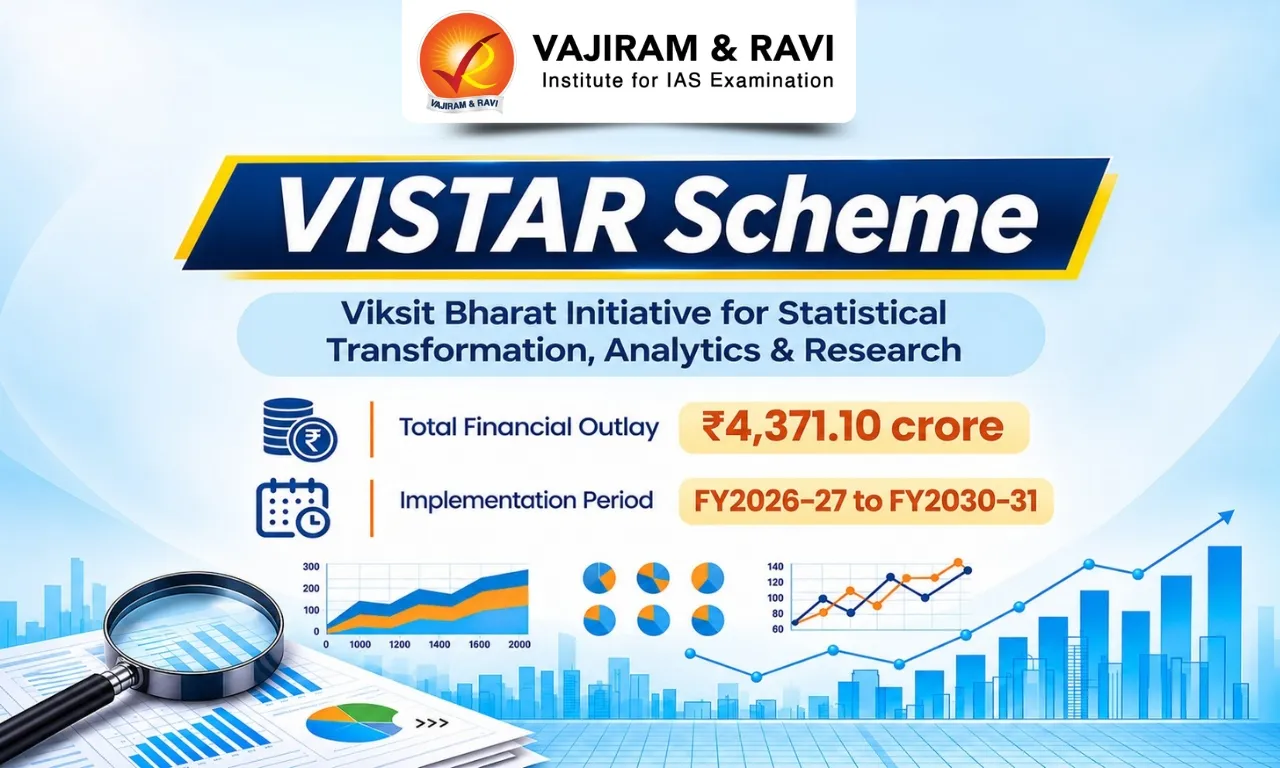
Recently, the Union Cabinet approved the ‘Viksit Bharat Initiative for Statistical Transformation, Analytics & Research (VISTAR)’ Scheme.
About VISTAR Scheme
VISTAR (Viksit Bharat Initiative for Statistical Transformation, Analytics & Research) is designed to establish a dynamic, real-time and future-ready official statistical architecture for enhanced timeliness, data granularity, interoperability with harmonised and AI ready datasets.
Time Period: FY 2026-27 to FY 2030-31
Components of the VISTAR scheme
Component 1: Comprehensive Statistical Operations and Strengthening of Ecosystem
Ministry of Statistics and Programme Implementation of India (MoSPI) proposes conducting 59 surveys during the 16th FC cycle, as compared to 43 major surveys conducted previously,
It will focus on the end-to-end digitalization of statistical processes and embedding Artificial Intelligence and Machine Learning into regular workflows.
It is planning to release new metrices, including the Headline Indexof Services Production, the Index of Unincorporated Sector Enterprises.
Component 2: Support for Statistical Strengthening (SSS)
Under this component, the Centre will provide funds to State governments to help transform the statistical capabilities of States and Union Territories through a redesigned, deliverable-linked framework.
The vision focuses on building state-level capacity to generate high-quality, granular data at the district and other disaggregated levels, developing indigenous data processing capabilities, and embedding data use cases into localized policymaking.
MoSPI will provide technical support to scale up generation of district-level estimates and million-plus city level estimates in flagship national surveys (e.g., PLFS, HCES, ASUSE) as well as in compilation of State/District level GDP and State level IIP.
Component 3: Economic Census (EC)
MoSPI will undertake the 8th Economic Census (EC) in collaboration with the States and Union Territories in order to obtain granular data and activity details of all the non-farm establishments and workers hired down to the gram panchayat and ward levels
Ans: It is designed to establish a dynamic, real-time and future-ready official statistical architecture for enhanced timeliness, data granularity, interoperability with harmonised and AI ready datasets.
Indian Navy's Anti-Piracy Operations play an important role in protecting merchant vessels, rescuing seafarers and maintaining maritime security in the Indian Ocean Region (IOR). The Navy's rescue of the Iranian fishing vessel Azini off Somalia in November 2026 highlights India's ability to conduct coordinated maritime operations far beyond its coastline.
Indian Navy's Rescue Operation: Azini (November 2026)
On 29 October 2026, the Iranian fishing vessel Azini was hijacked by armed pirates off the north-eastern coast of Somalia, between Bandar Bayla and Hafun. The Indian Navy completed a coordinated rescue operation on 2 November 2026, securing the release of all 20 crew members.
A mission-deployed naval warship and a maritime reconnaissance aircraft located and tracked the hijacked vessel through sustained surveillance.
The Navy used calibrated non-kinetic measures to restrict the vessel's movement and prevent its escape.
Marine Commandos (MARCOS) were deployed through a precision airdrop with support from an Indian Air Force (IAF) C-17 aircraft.
The operation lasted over 48 hours and concluded with the safe rescue of all 20 crew members, without casualties or injuries.
The hijacked vessel was considered a potential mother ship, which pirates could use as a mobile base to launch attacks on commercial shipping farther from the coast. The operation demonstrated the Indian Navy's long-range operational capability and coordination with the Indian Air Force.
Major Anti-Piracy Operations by the Indian Navy
The Indian Navy has maintained an anti-piracy presence in the Gulf of Aden and off the eastern coast of Africa to protect international shipping and respond to piracy incidents.
Anti-Piracy Patrols in the Gulf of Aden since 2008
The Indian Navy commenced anti-piracy patrols in the Gulf of Aden in October 2008 to protect merchant vessels from Somali pirate attacks. According to information provided by the Ministry of Defence in February 2024, Indian naval deployments since 2008 had safely escorted 3,440 ships and more than 25,000 seafarers. The Navy has also undertaken anti-piracy deployments in the Gulf of Guinea off the west coast of Africa since 2022.
Rescue of FV Iman and FV Al Naeemi by INS Sumitra (January 2024)
In January 2024, INS Sumitra rescued 17 Iranian crew members from the hijacked fishing vessel Iman off Somalia. Within 36 hours, it carried out another operation to rescue 19 Pakistani crew members aboard Al Naeemi. These operations also prevented the hijacked vessels from being used as mother ships for further pirate attacks.
Rescue of FV Omari by INS Sharda (February 2024)
In February 2024, INS Sharda intercepted the Iranian-flagged fishing vessel Omari, which had been hijacked by Somali pirates. The Navy secured the release of all 19 crew members, comprising 11 Iranians and 8 Pakistanis, through coordinated action involving its helicopter and boats.
Interception of MV Ruen by INS Kolkata (March 2024)
In March 2024, INS Kolkata intercepted the Maltese-flagged merchant vessel MV Ruen, which had been hijacked by Somali pirates in December 2023. After more than 40 hours of sustained operations involving naval warships, drones, maritime surveillance aircraft and MARCOS deployed with support from an IAF C-17 aircraft, all 35 pirates surrendered and the vessel's original 17 crew members were rescued. The captured pirates were brought to India for prosecution under the Maritime Anti-Piracy Act, 2022.
Maritime Piracy under UNCLOS, 1982
Maritime piracy involves illegal acts of violence, detention or robbery committed for private ends against another vessel on the high seas or in areas outside the jurisdiction of any State. The United Nations Convention on the Law of the Sea (UNCLOS), 1982 provides the international legal framework for combating piracy. Key provisions include:
Article 100 requires all States to cooperate in suppressing piracy on the high seas.
Article 101 defines piracy and specifies the acts that constitute piracy.
Article 105 empowers States to seize pirate ships, arrest persons involved and seize property on board on the high seas or in places outside the jurisdiction of any State.
Article 107 specifies the government vessels and aircraft authorised to carry out seizures for piracy.
Piracy on the high seas is distinct from armed robbery against ships, which occurs within a country's internal waters, archipelagic waters or territorial sea.
Maritime Anti-Piracy Act, 2022
India enacted the Maritime Anti-Piracy Act, 2022, to give effect to its obligations under UNCLOS and establish a domestic legal framework for the prosecution of piracy-related offences. The Act came into force on 22 February 2023.
Jurisdiction: The Act applies to the high seas, including the Exclusive Economic Zones (EEZs) of India and other countries.
Punishment: Piracy is punishable with imprisonment for life, a fine or both. If an act of piracy causes death or an attempt to cause death, the punishment may extend to death or life imprisonment.
Other offences: Attempting, aiding or abetting piracy is punishable with imprisonment of up to 10 years. Organising or directing others to participate in piracy is punishable with imprisonment of up to 14 years.
Enforcement: The Act empowers authorised personnel to take action against piracy-related offences, including the arrest of persons and seizure of pirate ships.
Trial: It provides for the designation of courts to conduct trials of piracy-related offences.
Significance of Indian Navy's Anti-Piracy Operations
Indian Navy's Anti-Piracy Operations strengthen maritime security in the Indian Ocean Region and help protect international shipping, seafarers and India's maritime interests.
Maritime Trade Security: Protect important Sea Lines of Communication (SLOCs) connecting Asia, Africa, Europe and the Middle East, ensuring the safe movement of commercial vessels.
Protection of Seafarers: Safeguard the lives of Indian and foreign crew members through timely rescue operations, irrespective of their nationality.
Energy Security: Help secure maritime routes used for transporting crude oil, natural gas and other essential commodities.
Regional Maritime Cooperation: Strengthen coordination with regional navies and international maritime agencies through joint patrols and information-sharing.
India's Role in the Indian Ocean: Reinforce India's position as a first responder and preferred security partner in the Indian Ocean Region through sustained naval deployments.
Indian Navy's Anti-Piracy Operations FAQs
Q1: What was the Indian Navy's Azini rescue operation?
Ans: It was an operation completed on 2 November 2026 to rescue all 20 crew members of the Iranian fishing vessel Azini, which had been hijacked by Somali pirates.
Q2: What is a mother ship in maritime piracy?
Ans: A mother ship is a vessel used by pirates as a mobile base to carry supplies and launch smaller boats for attacks on merchant vessels farther from the coast.
Q3: Which UNCLOS article defines piracy?
Ans: Article 101 of UNCLOS, 1982, defines piracy.
Q4: When did the Maritime Anti-Piracy Act, 2022 come into force?
Ans: The Act came into force on 22 February 2023 and provides a domestic legal framework for the prosecution of piracy-related offences.
Q5: What is the role of the Indian Navy's MARCOS in anti-piracy operations?
Ans: MARCOS are specialised naval commandos deployed for maritime interdiction, boarding operations and the rescue of hostages from hijacked vessels.
Viability Gap Funding Scheme for Grid-Scale Energy Storage Systems Latest News
The Union Cabinet has approved the Viability Gap Funding (VGF) Scheme for Development of Grid-Scale Energy Storage Systems, with a total financial support of Rs.14,500 crore.
About Viability Gap Funding Scheme for Grid-Scale Energy Storage Systems
The scheme aims to support the development of 92 GWh of energy storage capacity across the country.
Objective: To strengthen India's domestic energy storage manufacturing ecosystem through demand-side financial support and reduce dependence on imported components.
The scheme envisages the development of
60 GWh of Hydro Pumped Storage Plant (PSP)
30 GWh of Battery Energy Storage System (BESS)
2 GWh of capacity through alternative energy storage technologies
Time Period: FY 2026-27 to FY 2030-31.
Features of Viability Gap Funding Scheme for Grid-Scale Energy Storage Systems
Allocation Method:
Energy storage capacity will be allocated through a tariff-based competitive bidding process.
Public and private sector electricity distribution companies will be eligible for VGF support for BESS and Hydro PSP projects.
Projects based on alternative energy storage technologies will be implemented by public and private sector entities.
Domestic Content Requirement (DCR): To promote indigenous manufacturing, BESS projects will be subject to a minimum Domestic Content Requirement (DCR) of 40%.
Significance Viability Gap Funding Scheme for Grid-Scale Energy Storage Systems
It will strengthen India's power sector infrastructure, facilitating large-scale integration of renewable energy and ensuring reliable, affordable and round-the-clock power supply.
It will also provide an impetus to domestic manufacturing of battery energy storage systems, reduce import dependence and enhance the country's long-term energy security.
The VGF support will help improve the financial viability of these projects.
Recently, the Telecom Regulatory Authority of India (TRAI) launched the Network Anubhav Platform.
About Network Anubhav Platform
It is a geospatial dashboard that allows consumers to view location-specific network test results and access Do Not Disturb (DND) services through a web interface.
It was launched by the Telecom Regulatory Authority of India (TRAI).
Features of Network Anubhav Platform
It combines consumer test data with its independent drive test results to help consumers compare networks by location and telecom operators identify areas for network improvement.
User test data comprises the test results from MySpeed and MyCall apps of TRAI.
The platform delivers insights on various network parameters to consumers, service providers and TRAI.
The platform displays speed indicators based on tests conducted by users in a given area. These include median speeds and values indicating the speeds recorded at or above a specified level in 80 per cent of mobile broadband tests and 90 per cent of fixed broadband tests.
The portal also provides web access to DND facilities, allowing consumers to register preferences for commercial communications, submit complaints about unsolicited communications and track their status.
Q1: Which organisation launched the Network Anubhav Platform?
Ans: Telecom Regulatory Authority of India (TRAI)
Q2: What is Network Anubhav Platform?
Ans: It is a geospatial dashboard that allows consumers to view location-specific network test results and access Do Not Disturb (DND) services through a web interface.
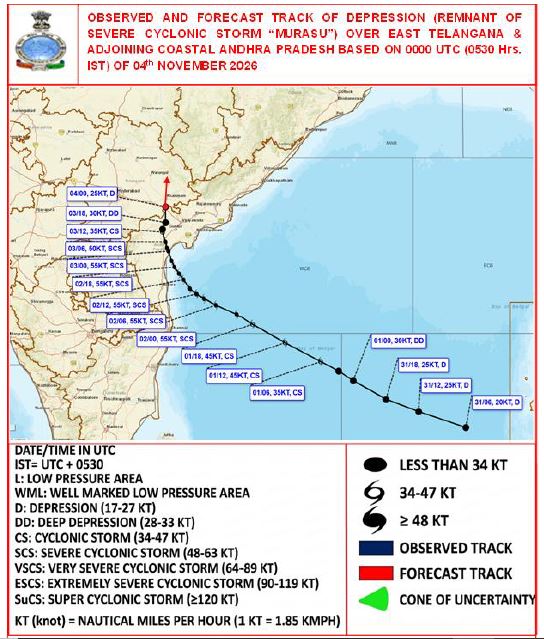
All 70 gates of the Prakasam Barrage were opened recently after heavy rain from Cyclone Murasu in the Krishna basin.
About Prakasam Barrage
It is a modern regulator and road bridge located at the southern entrance of Vijayawada, Andhra Pradesh.
It is built across the Krishna River.
Prakasam Barrage Construction
It was constructed between 1954 and 1957 and inaugurated on December 24, 1957.
It replaced the old Krishna Anicut (built by Sir Arthur Cotton between 1852 and 1855), which suffered a major breach during severe floods in September 1952.
This is one of the earliest major irrigation projects in Southern India.
It was named after the first Chief Minister of Andhra Pradesh, Tanguturi Prakasam.
Prakasam Barrage Purpose
The scheme irrigates nearly one million hectares of land, converting the Krishna delta into a rich granary in Andhra Pradesh.
This barrage also supplies water to Buckingham Canal which was constructed as an inland navigation canal initially but later used as an irrigation water supply canal.
While irrigation is a primary function, the barrage also plays a crucial role in flood control and maintaining ecological balance in the region.
Features:
The structure runs nearly 1223 m and features 68 gates that regulate the flow of water. .
Constructed primarily from locally sourced granite, the barrage exhibits significant thermal mass properties, which help in moderating temperature fluctuations in the surrounding environment.
The gates are engineered using high-strength steel, providing durability against the dynamic hydraulic forces exerted by the Krishna River.
The barrage's design incorporates a reinforced concrete structure that supports a series of sluice gates, allowing for precise control of water levels.
It has three canals (Bandar canal, Eluru canal, and Ryves canal) that run through the city of Vijayawada, giving it a Venetian look.
The famous Bhavani Island is situated amidst the backwaters of the barrage.
India’s stock markets may have extended their winning streak to five consecutive sessions, but the persistence of the volatility index (VIX) around 15 points suggests that investors remain far from reassured.
About India Volatility Index
It is a crucial metric calculated by the National Stock Exchange (NSE) to measure the market's anticipation of volatility and fluctuations in the near term.
Introduced in 2003 by the NSE, it provides insights into market volatility over the next 30 days.
It is also known as the fear index.
Unlike price indices like NIFTY, which track the market's direction based on equity price movements, India VIX focuses solely on volatility.
India VIX is not based on stock prices like Nifty or other market indices. Instead, it is derived from the order book of Nifty options contracts using the Black-Scholes model. This model considers:
Strike Price: The price at which the option can be exercised.
Market Price: The current price of the Nifty index.
Time to Expiry: Measured in minutes for precision.
Risk-Free Interest Rate: Calculated for a tenure of 30-90 days.
Volatility: The key variable representing market fluctuations.
A higher India VIX value signals higher market volatility, while a lower value indicates less volatility.
Significance Of India Volatility Index in Financial Markets
Risk Assessment: India VIX enables traders to assess market risks, adjust leverage, and set appropriate stop-loss levels.
Investment Decision Making: It aids investors in making informed decisions by providing insights into market volatility over the next 30 days.
Options Trading: Options traders use India VIX as a reliable indicator to determine whether to buy or sell options, depending on market volatility.
Portfolio Management: Portfolio and mutual fund managers utilise India VIX to optimise their portfolios, choosing between high and low-beta stocks for maximum returns.
Correlation with Market Indices: India VIX negatively correlates with indices like Nifty, providing additional insights into market movements beyond traditional indices.
Relation Between India Volatility Index and Nifty
The Nifty is a market index introduced by the National Stock Exchange (NSE).
It tracks fluctuations in stock prices. It represents the performance of the 50 largest and most actively traded stocks listed on the NSE.
On the other hand, the India VIX measures market volatility.
These two exhibit a negative correlation:
When India VIX rises, Nifty tends to fall due to increased uncertainty.
When India's VIX falls, Nifty often rises as confidence in market stability grows.
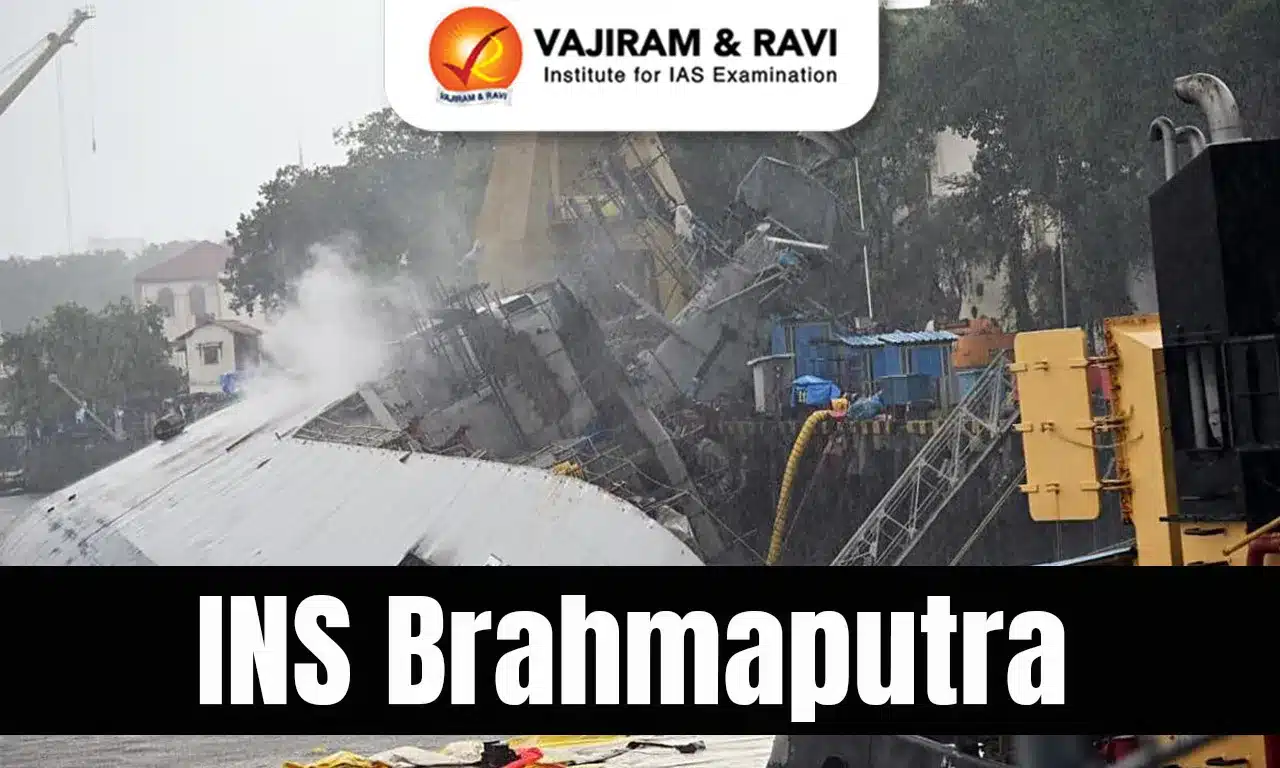
The Indian Navy recently initiated court martial proceedings against two officers for alleged negligence that led to the partial capsizing of guided-missile frigate INS Brahmaputra at the Naval Dockyard in Mumbai in July 2024.
About INS Brahmaputra
INS Brahmaputra (F31) is the first indigenously built Brahmaputra-class guided missile frigate of the Indian Navy.
It was built by Kolkata-based Garden Reach Shipbuilders and Engineers Limited (GRSE).
It was commissioned into the Indian Navy on April 14, 2000.
It takes on various roles such as coastal and offshore patrolling, monitoring sea routes, conducting maritime diplomacy, and carrying out counter-terrorism and anti-piracy missions.
INS Brahmaputra Features
Its crest features a grey, one-horned Indian rhinoceros, which is native to the Brahmaputra valley, set against a brown background with white and blue sea waves.
The ship has a displacement of 5,300 tonnes, a length of 125 metres, and is 14.4 meters wide.
Propulsion is via 2 x steam turbines producing 30,000 hp on 2 x shafts below the stern.
It can reach speeds over 27 knots (about 50 km/h).
It is equipped with medium- and close-range guns, anti-aircraft weapons, surface-to-surface and surface-to-air missiles, and torpedo launchers.
It is equipped with a range of sensors for all aspects of maritime warfare and can operate Sea King and Chetak helicopters.
The ship is manned by a crew of 40 officers and 330 sailors.
The Tamil Nadu government is taking measures towards conservation of golden jackals which are critical to ensure the ecological balance of the habitats.
About Golden Jackal
It is also known as the common jackal or reed wolf is a medium-sized wolf-like canid.
Habitat: These animals are abundant in valleys and along rivers and their tributaries, canals, lakes, and seashores, but are rare in foothills and low mountains.
Distribution: It is mainly found in North and East Africa, Southeastern Europe and South Asia to Burma.
They are quite widespread across India. Right from the Himalayan foothills, down to the Western Ghats, the Golden Jackal has a wide distribution.
Characteristics
It is strictly nocturnal in areas inhabited by humans, but may be partly diurnal elsewhere.
They dig caverns for shelter, or use crevices in rocks, or caverns that were dug by other animals.
They live in mated pairs and are strictly monogamous.
Diet: They are omnivores. These opportunistic foragers have a rather diverse diet.
The Union Cabinet has approved a major revision to the Agnipath scheme, offering 75% of Agniveers an additional two-year engagement and an opportunity to join the Armed Forces as regular soldiers, subject to eligibility and selection criteria.
Understanding the Agnipath Scheme
The Agnipath scheme was introduced in 2022 as a recruitment reform for the Indian Army, Navy and Air Force. It aims to maintain a younger, fitter and technologically equipped military workforce.
Under the original framework:
Personnel were recruited as Agniveers for an initial period of four years.
Up to 25% of each batch could be retained in the regular cadre based on merit and organisational requirements.
The remaining 75% were released after completing four years of service and received a contributory Seva Nidhi package.
The scheme represented a departure from the earlier system of regular military recruitment by introducing a fixed-term engagement model.
Major Changes in the Revised Agnipath Framework
The Union Cabinet has approved an additional two-year engagement period for Agniveers who are not selected for regular enrolment after their initial four-year tenure.
The revised arrangement introduces a two-stage pathway:
First Stage: Selection After Four Years
The top 25% of Agniveers will continue to be selected on merit for absorption into the regular cadre.
Selection will be based on performance evaluations and the requirements of the respective services.
Second Stage: Additional Two-Year Engagement
The remaining 75% of Agniveers will be offered an additional two-year engagement.
At the end of six years of service, they will be eligible for consideration for enrolment as regular soldiers.
Regular enrolment will depend on their willingness and fulfilment of objective military selection criteria.
The revised arrangement therefore provides all Agniveers with an opportunity to pursue regular military service, although enrolment is not guaranteed.
Enhanced Remuneration and Seva Nidhi Benefits
The additional engagement period will provide improved financial benefits to Agniveers.
Under the original arrangement, the Seva Nidhi package involved equal contributions from the Agniveer and the government.
Under the revised framework, the government's contribution will increase to 70% for those completing the additional engagement period and choosing to exit.
The revised arrangement also provides seniority benefits, further improving the service conditions of Agniveers.
Selection Criteria for Regular Enrolment
The opportunity to join the regular cadre after the additional two-year engagement will depend on objective performance and service requirements.
The selection process will consider:
Adaptability: Ability to adjust to military responsibilities and changing operational requirements.
Discipline: Maintenance of military discipline and professional conduct.
Performance: Overall performance during the extended service period.
Vigilance record: Absence of vigilance-related cases.
Organisational requirements: The manpower requirements and operational needs of the respective services.
The Chief of Defence Staff, General N.S. Raja Subramani, stated that a centralised database had been maintained across all three services to track Agniveers' performance, with annual reviews forming part of the assessment process.
Government's Rationale Behind the Reform
The decision follows a four-year assessment of the Agnipath scheme by the three services, incorporating performance reviews, operational requirements and organisational feedback.
According to the government, Agniveers have demonstrated strong performance in:
Physical fitness and military preparedness
Motivation, morale and competitive spirit
Technological proficiency and adaptability
Skills and educational qualifications
The assessment also highlighted wider geographical representation in recruitment, a more standardised and transparent selection process, and the opening of various branches of the Armed Forces to women.
The revised framework seeks to balance two objectives: maintaining a youthful military profile and retaining experienced personnel who have already undergone military training.
Implications for the Armed Forces
The additional engagement period is expected to have several implications for military manpower management.
Retention of Experienced Personnel
The earlier four-year exit provision limited the period for which trained Agniveers could serve before leaving the Armed Forces.
The additional two years will allow the services to retain trained personnel for a longer period.
Maintaining a Younger Military Profile
The government has clarified that the Agnipath scheme will continue in its existing form, with the initial four-year engagement unchanged.
The revised arrangement is intended to provide greater flexibility without abandoning the objective of maintaining a younger military workforce.
Competitive Performance and Merit-Based Selection
The additional opportunity to enter regular service is expected to encourage Agniveers to maintain high standards of discipline, fitness and performance throughout their engagement.
Career Continuity
The extension provides an additional period of military employment and a further opportunity for regular enrolment. Those who eventually exit will also receive an enhanced Seva Nidhi package.
Ans: The revised framework provides 75% of Agniveers who are not selected after four years with an additional two-year engagement and an opportunity to be considered for regular enrolment.
Q2: Does the two-year extension guarantee permanent military service?
Ans: No. Regular enrolment after six years will depend on willingness, objective selection criteria and the organisational requirements of the Armed Forces.
Q3: What salary will Agniveers receive during the additional engagement?
Ans: They will receive ₹43,500 per month in the first year and ₹47,500 per month in the second year of the extension.
Q4: How has the Seva Nidhi contribution changed?
Ans: The government's contribution to the enhanced Seva Nidhi package will increase to 70%, compared with the earlier 50% contribution arrangement.
Q5: Has the Agnipath scheme been discontinued?
Ans: No. The government has clarified that the original four-year engagement structure will continue, with the additional two-year period introduced as a new pathway.
The 2026 US midterm elections dealt President Donald Trump a severe setback, with Republicans losing control of both the Senate and House of Representatives.
Widely seen as a referendum on Trump’s second term, the results mark America’s course correction two years into a turbulent presidency.
How US Congress Works
House of Representatives: 435 voting members, serving 2-year terms; seats allocated based on state population.
Senate: 100 members (2 per state), serving 6-year terms; about one-third elected every 2 years.
Passing laws: Both chambers must approve legislation before the President can sign it into law or veto it.
Who does what: Revenue bills originate in the House; the Senate can amend them.
US Midterm Elections
Americans elect members of Congress — comprising the House of Representatives and the Senate.
Elections occur every two years; when held midway through a president’s four-year term, they are called midterms.
Congress’s key function is to create and pass federal laws applicable nationwide.
The outcome determines which party — Trump’s Republicans or the opposition Democrats — controls Congress, shaping how easily the president can advance his agenda.
Results also serve as a referendum on the president’s performance so far.
Who Is Being Elected Through 2026 Midterm?
House of Representatives (Lower Chamber) - All 435 members up for election.
Senate (Upper Chamber) - 35 of 100 seats contested this cycle.
Key Takeaways from the Midterms
Biggest drubbing since 2020: Unlike 2020, when his base stood by him, Trump this time lost traditionally Republican (“Red”) states, indicating erosion of his core support.
Reversal of 2024 gains: Trump’s 2024 inroads among African Americans, Hispanics and Indian Americans — driven by cost-of-living anger (eggs as the symbolic benchmark) — have evaporated.
Affordability as the core driver: Rising petrol, diesel and gas prices hurt rural Midwestern voters hardest, linked directly to the US-Israel war against Iran launched in February.
War backlash: The eight-month conflict, which made the Strait of Hormuza chokepoint for oil, betrayed MAGA voters who expected Trump to end “endless wars.”
Perceived corruption: Trump’s personal wealth grew by $2.2 billion in one year (~$6 million/day) through crypto, Gulf, and Pakistan critical-minerals deals — unprecedented for a sitting president.
Immigration backlash: ICE raids (rebranded “NICE” raids) targeting women and children alienated even Republican-leaning immigrant communities.
Tariffs as a “self-goal”: Tariffs on China, Canada, India and Mexico functioned as a domestic tax, fuelling inflation.
Institutional overreach: Trump’s attempts to dominate the judiciary and Congress unsettled voters wary of weakening checks and balances.
Implications for the World and India
Foreign Policy Pivot: Presidents constrained domestically often turn to foreign policy — raising risks of further Trump adventurism, even as a Democratic Congress can curb war funding (though not wartime executive budget powers already committed).
Economic Fallout and Investigations: A prolonged West Asia war keeps energy prices elevated, hurting India’s growth. A Democrat-controlled Congress is likely to investigate Trump’s crypto, critical-minerals and hotel deals — probes that could implicate Pakistan’s military and Indian businesses linked to the Trump family.
Tariff Powers and Trade Deal: Trump’s expanded, congressionally-delegated tariff authority undermines global economic predictability. With India’s US trade deal negotiations already stalled, Washington’s weakened post-midterm position could shift leverage toward Delhi.
Immigration and H1B: Backlash against anti-immigrant crackdowns highlights the political “veto power” of immigrant communities and big business. H1B visa restrictions, student visa and OPT curbs remain live concerns as more Indian-American and African-American lawmakers enter Congress.
China-Russia Approach: Trump’s handling of Xi Jinping and Russia over the next two years is geopolitically critical; any US dealmaking with both powers could unsettle long-standing allies like India.
AI and Technology: Washington’s focus on semiconductors and data centres, alongside its stance on Chinese state-controlled AI, remains a closely watched strategic area.
Human Rights Scrutiny: A Democrat-led Congress is expected to intensify scrutiny of India’s record on religious freedom, voter registration, and minority treatment — a diplomatic challenge for the Modi government.
2028 Race Begins: On the Republican side, VP JD Vance and Secretary of State Marco Rubio must now distance themselves from Trump’s legacy; the Democratic field will see new entrants beyond establishment names.
Conclusion
The 2026 midterms reveal that affordability, institutional overreach, and perceived corruption — not ideology — drove voters’ rebuke of Trump.
For India, the outcome is double-edged: a weakened Washington may ease trade negotiations, but prolonged West Asia tensions, tighter visa regimes, and renewed human rights scrutiny from a Democrat-controlled Congress will demand careful diplomatic navigation over the next two years.
Ans: US midterms 2026 are elections held midway through the presidential term, determining congressional control and influencing the president’s ability to advance legislation.
Q2: How many seats are contested in the US midterm elections?
Ans: US midterms 2026 involve all 435 House seats and 35 Senate seats, with the outcome determining the balance of power in Congress.
Q3: Why did Trump face a setback in the US midterms 2026?
Ans: US midterms 2026 reflected voter dissatisfaction over affordability, inflation, immigration crackdowns, perceived corruption, tariffs and concerns about institutional overreach.
Q4: How could US midterms 2026 affect India-US trade relations?
Ans: US midterms 2026 could shift trade negotiations in India’s favour, as a weakened Washington may have less leverage amid already stalled trade-deal discussions.
Q5: What are the implications of US midterms 2026 for Indian immigration and H-1B visas?
Ans: US midterms 2026 may intensify debate over H-1B restrictions, student visas and OPT, while immigrant communities gain greater political influence in Congress.
India has achieved one of the world’s fastest declines in extreme poverty, but a new World Bank framework — the prosperity gap — reveals that most Indians remain far from a genuinely comfortable standard of living.
This distinction between “poverty alleviation” and “prosperity” is critical for assessing whether India’s growth is truly inclusive.
India’s Poverty Decline: The Good News
Between 2011 and 2023, an estimated 496 million people moved out of poverty, as per the World Bank’s latest Poverty and Equity brief.
Extreme poverty ($3/day) fell to just 2.6%.
The share below the lower-middle-income line ($4.20/day) dropped from 57.7% to 16.1%.
Non-monetary poverty also declined sharply: the Multidimensional Poverty Index (OPHI) fell from 53.8% (2005-06) to 16.4% (2019-21).
The Catch: Measured Against a Higher Bar
Using the upper-middle-income country (UMIC) threshold of $8.30/day (India’s aspirational benchmark), 80% of Indians still fall below this line.
This translates to roughly ₹24,000/month — modest even by current Indian urban living standards.
Conclusion: Escaping extreme poverty does not automatically mean attaining prosperity, occupational security, or better living standards.
Understanding the Prosperity Gap
The prosperity gap is a World Bank indicator measuring how far a society’s average income is from the global benchmark of $28/person/day (2021 PPP).
India’s score: 4.9 — meaning average consumption must rise nearly five-fold to reach the prosperity standard.
Unlike per capita income, this metric is sensitive to distributional issues, emphasising that growth must benefit the least advantaged most.
Income Segmentation (2023)
Below $3/day (extreme poverty): 2.6%
Below $4.20/day: 16.1%
Below $8.30/day: 80.0%
Nearly 64% of the population falls in the $4.20–$8.30 band — just above povertybut far from prosperity, requiring incomes to rise three to sevenfold.
Why the Labour Market Is the Real Bottleneck
Escaping poverty is largely a statistical shift; building a secure economic life is a labour-market phenomenon — and India’s labour market isn’t delivering.
Youth unemployment rose from 14.6% to 15.9% (Q1 FY26 to Q1 FY27).
Informality dominates: ~90% of India’s workforce is informally employed (ILO India Employment Report 2024); self-employment accounted for 55.8% of jobs in 2022.
Regular wage work barely improved — from 22.4% (2024) to 23.6% (2025), per PLFS.
Distress-driven employment: the share of unpaid family helpers rose from 12.41% (2017-18) to 17.10% (2023-24), suggesting rising employment often reflects distress, not opportunity.
Youth are hit hardest: only 46.7% of 20–29-year-olds were employed (NCAER, Time Use Survey 2024); educated youth comprised 65.7% of all unemployed youth in 2022 — highlighting a skills-jobs mismatch.
The Human Capital Market Problem
Households investing in private education and healthcare to climb the economic ladder often cannot judge service quality.
Scholars describe these as “human capital markets” — fee-charging private providers where quality is hard to verify, and paid schooling doesn’t guarantee graduates convert investment into employment.
Stagnant Wages: The Final Barrier
Even employed Indians often don’t gain economic security, as real wages have remained broadly flat.
ILO data shows real wages for regular salaried workers stagnated or declined between 2012 and 2022.
Without wage growth adjusted for inflation, employment alone doesn’t translate into improved consumption or comfort.
Conclusion
India has proven it can combat extreme poverty — but prosperity remains elusive for the vast majority. The real bottleneck lies in the labour market: informal jobs, stagnant real wages, rising youth unemployment, and a mismatch between education and employment opportunities.
True Viksit Bharat ambitions demand more than poverty reduction; they require structural reform in job quality, human capital services, and wage growth to convert statistical escapes from poverty into genuine, durable prosperity for ordinary Indians.
Ans: India’s prosperity gap measures how far average income is from the global prosperity benchmark of $28 per person per day, adjusted for purchasing power.
Q2: How many Indians remain below the upper-middle-income poverty threshold?
Ans: India’s prosperity gap is reflected in the fact that 80% of Indians remain below the World Bank’s $8.30-per-day upper-middle-income threshold.
Q3: What is India’s prosperity gap score according to the World Bank framework?
Ans: India’s prosperity gap score is 4.9, indicating that average consumption must rise nearly five-fold to reach the global prosperity standard.
Q4: Why is the labour market a major obstacle to prosperity in India?
Ans: India’s prosperity gap persists because informal employment, youth unemployment, limited regular-wage jobs and skills mismatches prevent workers from achieving economic security.
Q5: How do stagnant wages affect India’s prosperity gap?
Ans: India’s prosperity gap widens when real wages stagnate, since employment alone cannot improve purchasing power, household consumption or living standards.
The Union Cabinet has approved the Critical Mineral Processing Scheme -a ₹2,814-crore Capital Expenditure (Capex) Support Scheme to develop domestic processing capacity for critical minerals, particularly lithium and nickel.
The initiative seeks to address India's dependence on imported refined materials, reduce strategic vulnerability arising from China's dominance and strengthen the domestic critical mineral value chain.
Key Features of the Scheme
Financial assistance and capacity targets:
Total outlay: ₹2,814 crore.
Duration: Five years, from FY 2026-27 to FY 2030-31.
Capital subsidy: 30% of eligible capital investment.
Processing facilities: Four plants — two for lithium and two for nickel.
Capacity and financial support: For Lithium, minimum capacity per plant will be 30,000 tonnes, while maximum capital support per beneficiarywill be₹500 crore (Nickel- 50,000 tonnes, ₹900 crore).
Selection and disbursement:
Beneficiaries will be selected through a two-stage process: technical qualification followed by financial bidding.
Two beneficiaries will be selected for each mineral based on the least-cost criterion, prioritising bidders seeking the lowest government support.
Incentives will be disbursed in three tranches linked to the achievement of specified milestones.
Processing objectives: The scheme aims to convert lithium and nickel ores and intermediate products into high-purity compounds. Nickel processing is also expected to facilitate the recovery of cobalt as a by-product.
Industry perspective:
Industry stakeholders have welcomed the scheme as a significant step towards addressing India's processing-capacity gap.
For example, Attero emphasised that domestic processing is as important as securing access to mineral resources.
Significance of the Scheme
Reducing import dependence:
India has limited domestic processing capacity and relies heavily on imports of refined critical minerals, including lithium, nickel, cobalt, rare earth elements (REEs) and silicon.
The scheme will -
Promote domestic beneficiation and processing infrastructure.
Reduce dependence on imported refined intermediates and high-purity materials.
Enhance domestic value addition and strengthen supply chain resilience.
Addressing China’s strategic dominance:
China controls approximately 90% of global critical mineral processing capacity and can use this dominance as leverage during trade tensions.
India's limited processing capabilities expose it to supply disruptions, price volatility and geopolitical risks.
Developing indigenous processing capacity is essential for economic security, technological self-reliance and strategic autonomy.
Supporting strategic industries: Domestic processing facilities are expected to strengthen mineral supplies for -
Electric mobility and electric vehicle batteries.
Battery Energy Storage Systems (BESS).
Electronics and semiconductor-related industries.
Defence and speciality steel.
Chemicals, catalysts and pharmaceuticals.
Overcoming structural challenges:
India's commercial-scale processing projects face several constraints -
High capital investment requirements.
Limited availability of suitable processing technologies.
Constrained access to raw materials.
Nascent domestic beneficiation and processing infrastructure.
The capital subsidy seeks to reduce investment risks and encourage private-sector participation.
Critical Mineral Processing Parks
The government is developing mineral-specific processing parks in four states to establish integrated ecosystems.
Gujarat: Availability of heavy REEs and existing processing capabilities.
Andhra Pradesh: Development of a rare earth corridor.
It seeks to strengthen India's critical mineral supply chain through exploration, mining, processing, recycling and international partnerships.
It proposes a National Critical Mineral Stockpile Programme to maintain strategic reserves and protect against supply disruptions.
National Critical Mineral Stockpile Programme:
Allocation: ₹500 crore for the development of reserves.
Mission period: 2024-25 to 2030-31.
Objective: Ensure uninterrupted availability of critical and strategic minerals during supply shocks.
Critical Mineral Recycling:
The processing scheme complements existing government support for recycling critical minerals from used batteries and electronic waste.
Together, primary mineral processing and recycling can create a more dependable domestic supply chain.
Way Forward
India must combine capital incentives with technology development, reliable raw-material access, skilled manpower, sustainable processing practices and international mineral partnerships.
Developing domestic processing capacity alongside recycling and strategic stockpiling will be crucial to reducing import dependence and ensuring long-term supply chain security.
Conclusion
The scheme represents an important step towards transforming India from a predominantly import-dependent consumer of critical mineral compounds into a competitive domestic processing and value-addition hub.
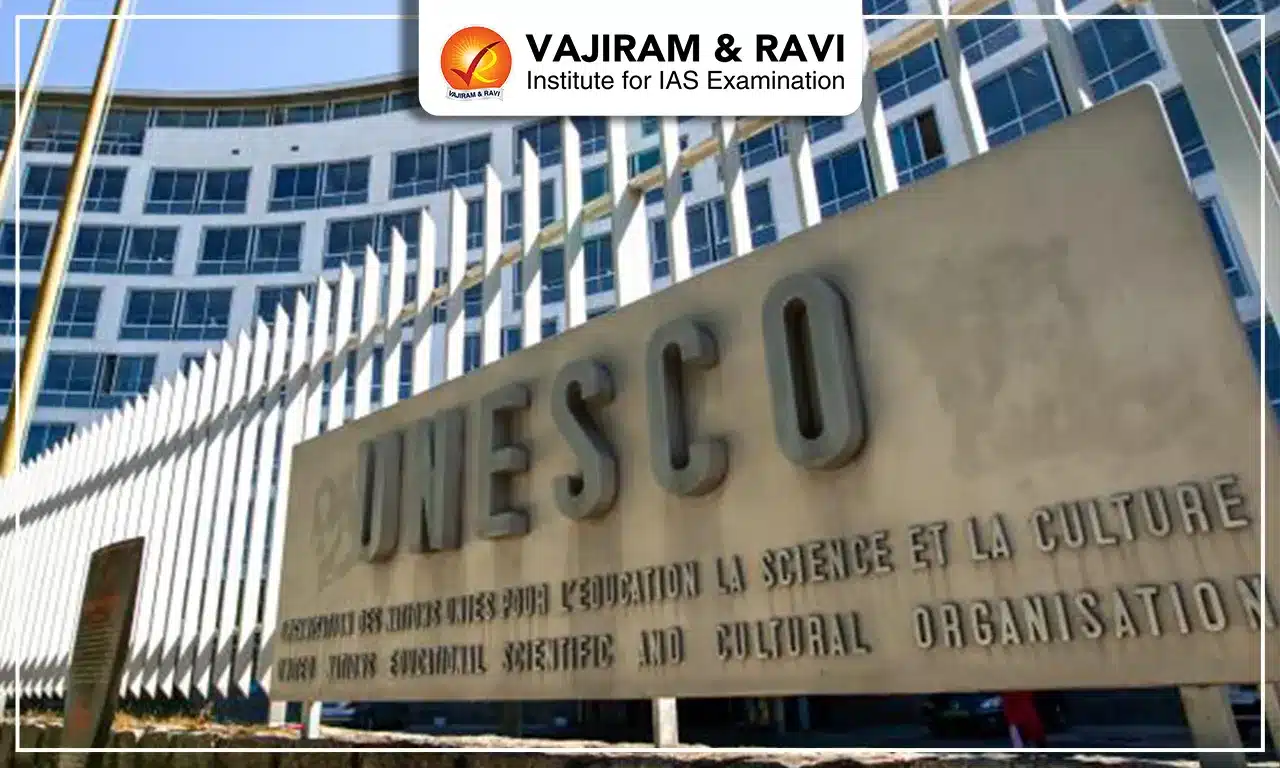
United Nations Educational Scientific and Cultural Organization (UNESCO) is a specialized agency of the United Nations that promotes international cooperation in education, science, culture, communication and information. It works to build peace, equality and sustainable development by sharing knowledge, protecting heritage, supporting quality education and addressing emerging global challenges.
UNESCO Latest News 2026
UNESCO celebrated its 80th Anniversary for the enforcement of the UNESCO Constitution on November 4, 1946. These eight decades of legacy highlights UNESCO's contribution towards promotion of international peace through education, science and cultural engagement.
United Nations Educational Scientific and Cultural Organization (UNESCO)
UNESCO stands for the United Nations Educational, Scientific and Cultural Organization. It is a specialised agency of the United Nations that promotes international cooperation in education, science, culture, communication and information.
Promoting peace and cooperation: UNESCO works to strengthen international cooperation and contribute to peace by encouraging dialogue, mutual understanding, equality and respect for cultural diversity.
Supporting sustainable development: Its work covers areas such as quality education, biodiversity, climate change, science, technology and artificial intelligence, with the aim of supporting sustainable and inclusive development.
Protecting knowledge and heritage: UNESCO plays an important role in protecting cultural and natural heritage, promoting education and preserving knowledge and traditions for future generations.
Promoting access to reliable information: It also works to strengthen freedom of expression, press freedom, media literacy and access to trustworthy information across societies.
UNESCO History and Formation
Early International Cooperation: UNESCO’s roots can be traced to the International Committee on Intellectual Cooperation established under theLeague of Nations. It worked on areas such as universities, libraries, intellectual property, arts and information.
Impact of World War II: The activities of these institutions were disrupted by the outbreak of the Second World War, creating the need for a new international organisation focused on education and culture.
Conference of Allied Ministers of Education: During the war, the Conference of Allied Ministers of Education (CAME) met in London from 1942 to discuss plans for rebuilding education after the war.
London Conference: On the proposal of CAME, the United Nations Conference for the establishment of an educational and cultural organisation was held in London in November 1945.
Foundation of UNESCO: Representatives from 40 countries participated in the conference and UNESCO was formally established on 16 November 1945.
Coming into Force: The UNESCO Constitution came into force on 4 November 1946 after ratification by 20 countries, including India, France, the United Kingdom, the United States and China.
First General Conference: The first session of the UNESCO General Conference was held in Paris from 19 November to 10 December 1946, marking the beginning of its activities.
UNESCO Governance
General Conference: It is UNESCO’s main decision-making body and consists of representatives of all Member States. It determines the organisation’s broad policies, programmes and budget.
Executive Board: The Executive Board consists of elected Member States and works to implement the decisions of the General Conference while overseeing UNESCO’s programmes and activities.
Secretariat: The Secretariat carries out the day-to-day work of UNESCO and implements the programmes and decisions approved by its governing bodies.
Director-General: The Director-General heads the Secretariat and is responsible for the overall administration and implementation of UNESCO’s activities.
National Commissions and field offices: UNESCO works through National Commissions, field offices, institutes and specialised centres to implement its programmes and strengthen cooperation among countries.
UNESCO World Heritage Sites
World Heritage List: UNESCO maintains the World Heritage List of cultural, natural and mixed properties that have Outstanding Universal Value and deserve protection for future generations.
Types of Heritage: The World Heritage List includes cultural properties, natural properties and mixed properties that represent important aspects of humanity’s cultural and natural heritage.
World Heritage Convention: The protection of these sites is guided by the World Heritage Convention, which provides an international framework for identifying and conserving heritage of outstanding universal value.
World Heritage Committee: The World Heritage Committee considers sites for inscription on the World Heritage List and monitors their conservation status.
International Assistance: UNESCO also provides international assistance to support the conservation and management of heritage properties facing different challenges.
UNESCO Intangible Cultural Heritage
Meaning: Intangible cultural heritage includes living cultural practices, traditions, knowledge and skills passed from one generation to another.
Cultural Diversity: UNESCO works to safeguard traditional performances, handicrafts, festivals, knowledge systems and other cultural practices that reflect the diversity of communities.
Safeguarding Heritage: The organisation implements the Convention for the Safeguarding of the Intangible Cultural Heritage to promote the protection and transmission of living traditions.
India’s Intangible Heritage: India has several elements recognised by UNESCO under intangible cultural heritage, reflecting the country’s rich cultural diversity and traditional knowledge.
UNESCO Objectives and Functions
Promoting quality education: UNESCO works to improve access to inclusive and quality education and supports global efforts under Education 2030 and Sustainable Development Goal 4.
Supporting science and innovation: It promotes international cooperation in scientific research, technology and innovation to address global challenges and support sustainable development.
Protecting the environment: UNESCO supports programmes related to water, oceans, biodiversity and climate change, encouraging scientific cooperation and sustainable management of natural resources.
Promoting ethical use of technology: UNESCO works on emerging areas such as artificial intelligence, with a focus on ethical, inclusive and responsible use of technology.
Preserving cultural heritage: It protects and promotes cultural and natural heritage, including World Heritage Sites, intangible cultural traditions and documentary heritage.
Supporting freedom of expression: UNESCO promotes press freedom, safety of journalists, freedom of expression, the right to information and media and information literacy.
Preserving documentary heritage: Through programmes such as Memory of the World, UNESCO works to protect important documentary heritage and make valuable knowledge accessible to future generations.
Encouraging international knowledge sharing: UNESCO provides a platform for countries and institutions to exchange knowledge, research, experiences and best practices in education, science, culture and communication.
Major UNESCO Initiatives and Programmes
Education 2030: This programme supports global efforts to achieve inclusive and equitable quality education and lifelong learning opportunities for all.
Man and the Biosphere Programme (MAB): The MAB Programme promotes the conservation of biodiversity while supporting sustainable development through the Biosphere Reserve approach.
International Hydrological Programme: It promotes international scientific cooperation in areas related to water resources, water management and hydrological research.
Intergovernmental Oceanographic Commission: The programme supports international cooperation in ocean science, marine research and sustainable management of ocean resources.
World Heritage Programme: It focuses on identifying, protecting and preserving sites of Outstanding Universal Value around the world.
Memory of the World: This initiative aims to safeguard and improve access to the world’s important documentary heritage, including valuable manuscripts, archives and historical records.
Major Reports by UNESCO
Global Reports: UNESCO publishes reports examining major global issues, challenges and policy responses across its areas of work.
Global Education Monitoring Report: The GEM Report tracks progress in education, including learning outcomes, equity, financing and educational gaps, particularly in relation to SDG 4.
UNESCO Science Report: The report examines trends in science, research, innovation and science policy across different countries and regions.
Global Report on Cultural Policies: It highlights the role of culture in sustainable development and examines developments in cultural policies.
State of the Education Report for India: This report focuses on important education-related issues in India, including areas such as climate change, artificial intelligence, teachers and vocational education.
World Heritage Reports: UNESCO also publishes information and reports concerning heritage conservation, climate risks, biodiversity and the condition of World Heritage sites.
India and UNESCO
Founding Member: India is among the founding members of UNESCO and participated in the organisation’s first General Conference in 1946.
Active Participation: India has contributed to UNESCO’s work in areas such as education, cultural diversity, science and development policies.
Permanent Delegation: India maintains a Permanent Delegation at UNESCO headquarters in Paris and participates in the organisation’s decision-making and programmes.
World Heritage: India has several UNESCO-recognised cultural and natural heritage properties, including globally important monuments, landscapes and protected areas.
Intangible Cultural Heritage: Several Indian traditions, performances, crafts, festivals and cultural practices have been recognised under UNESCO’s Intangible Cultural Heritage framework.
Biosphere Reserves: Indian biosphere reserves are also represented in UNESCO’s World Network of Biosphere Reserves under the Man and the Biosphere Programme.
Education Cooperation: UNESCO’s cooperation with India covers areas such as literacy, teacher education, ICT-enabled learning, inclusion and the Sustainable Development Goals.
Communication and Information: Cooperation also extends to media development, freedom of expression, access to information and documentary heritage.
UNESCO World Heritage Sites in India
UNESCO World Heritage Sites in India: India has 45 UNESCO World Heritage Sites recognised for their cultural, natural or mixed significance, reflecting the country’s diverse heritage and natural wealth.
Cultural sites: Out of these, 36 sites are cultural, representing India’s rich history, architecture, traditions and artistic achievements.
Natural sites:7 sites are natural, highlighting India’s ecological diversity, unique landscapes, wildlife and important natural ecosystems.
Mixed site: India also has 1 mixed World Heritage Site, recognised for both its cultural and natural significance.
Significance for India: These sites showcase India’s historical legacy, architectural brilliance and ecological diversity, while also highlighting the importance of conserving its heritage for future generations.
Global position: India ranks sixth globally in terms of the number of World Heritage Sites, reflecting its significant heritage wealth and efforts towards heritage conservation and preservation.
United Nations Educational Scientific and Cultural Organization (UNESCO) FAQs
Q1: What is UNESCO?
Ans: UNESCO is a specialised agency of the United Nations that promotes international cooperation in education, science, culture, communication and information.
Q2: When was UNESCO established?
Ans: UNESCO was formally established on 16 November 1945, and its Constitution came into force on 4 November 1946.
Q3: Where is the headquarters of UNESCO located?
Ans: The headquarters of the United Nations Educational, Scientific and Cultural Organization (UNESCO) is located in Paris, France.
Q4: What are the main functions of UNESCO?
Ans: UNESCO works to promote quality education, scientific cooperation, cultural heritage conservation, environmental sustainability, freedom of expression and access to reliable information.
Q5: What are UNESCO World Heritage Sites?
Ans: UNESCO World Heritage Sites are cultural, natural or mixed properties recognised for their Outstanding Universal Value and protected under the World Heritage Convention.
Cyclone Murasu 2026 was a severe cyclonic storm that formed over the Bay of Bengal and made landfall near Ongole, south Andhra Pradesh, on November 3, 2026, with winds of 100-110 kmph, gusting to 120 kmph, according to the IMD. It brought risks of heavy rainfall, coastal flooding, crop losses and infrastructure damage across Andhra Pradesh and neighbouring states. As of November 4, it has weakened into a Depression over east Telangana and adjoining Coastal Andhra Pradesh, moving nearly northwards. The IMD expects it to weaken further into a Well-Marked Low-Pressure Area, though heavy to very heavy rainfall, squally winds and localised flooding remain concerns.
Cyclone Murasu 2026 Latest Updates
As of November 4, 2026, Severe Cyclonic Storm Murasu has weakened into a Depression after crossing the south Andhra Pradesh coast near Ongole on November 3, 2026. According to the India Meteorological Department (IMD), the system moved nearly northwards and is currently positioned over east Telangana and adjoining Coastal Andhra Pradesh, affecting areas near Khammam, Vijayawada, Nandigama and Bhadrachalam.
The IMD has forecast that the system will continue moving northwards and is likely to weaken further into a Well-Marked Low-Pressure Area. The cyclone’s remnants remain under continuous monitoring through Doppler Weather Radars at Machilipatnam and Visakhapatnam.
What is Cyclone Murasu 2026?
Cyclone Murasu 2026 is a tropical cyclone over the Bay of Bengal that developed from a low-pressure weather system and intensified into a severe cyclonic storm. It highlights the vulnerability of India’s eastern coastal regions to post-monsoon cyclones.
Origin and Development: Cyclone Murasu developed from a depression over the southwest and adjoining west-central Bay of Bengal on October 31. It intensified into a cyclonic storm on November 1 and strengthened into a Severe Cyclonic Storm on November 2, 2026.
Cyclone Category: The IMD classified Murasu as a Severe Cyclonic Storm, a category linked to maximum sustained surface wind speeds of 89-117 kmph.
Landfall in Andhra Pradesh: Cyclone Murasu crossed the south Andhra Pradesh coast near Ongole in the early morning of November 3, 2026, bringing strong winds, heavy rainfall and dangerous sea conditions.
Cyclone Movement: Before landfall, the cyclone was moving north-northwestwards across the west-central Bay of Bengal towards the south Andhra Pradesh coast. After crossing the coast, it was expected to move inland and weaken gradually.
Affected Regions:Coastal Andhra Pradesh faced the greatest direct threat. Northern Tamil Nadu, Rayalaseema, Telangana, southern Odisha and parts of Chhattisgarh were also under heavy rainfall and strong wind warnings.
Cyclone Murasu Location: Before landfall, the cyclone was positioned close to the Andhra Pradesh coast, particularly near Kavali, Ongole and Nellore, with its outer rainbands already affecting coastal areas.
Monitoring by IMD: The cyclone was tracked using Doppler Weather Radars in Chennai and Machilipatnam, along with satellite observations, to monitor its movement, intensity and potential impacts.
The name Murasu was proposed by India under the tropical cyclone naming system followed in the North Indian Ocean. The word Murasu means “war drum”, referring to a traditional drum associated with Tamil culture.
Naming country:India proposed the name Murasu.
Meaning: Murasu means war drum.
Naming authority: The India Meteorological Department, which functions as the Regional Specialized Meteorological Centre (RSMC), New Delhi, assigns cyclone names from an agreed regional list.
Purpose of naming: Naming cyclones helps meteorological agencies, governments and the public identify storms, communicate warnings and avoid confusion when multiple weather systems develop.
Cyclone Murasu 2026 Tracker
The Cyclone Murasu 2026 tracker shows the storm’s movement across the Bay of Bengal, its strengthening into a severe cyclonic storm and its expected landfall along the Andhra Pradesh coast. The following timeline is based on IMD bulletins and forecasts available on November 4, 2026.
October 31, 2026 - Depression Develops: A depression formed over the Bay of Bengal. The IMD began monitoring its movement and warned that the system could intensify into a cyclonic storm while approaching the south Andhra Pradesh coast.
November 1, 2026 - Cyclonic Storm Murasu Forms: The depression intensified into Cyclonic Storm Murasu over the southwest and adjoining west-central Bay of Bengal. It kept moving towards the Andhra Pradesh coast while gradually gaining strength.
November 2, 2026 - Severe Cyclonic Storm: Murasu strengthened into a Severe Cyclonic Storm, bringing strong winds and dangerous sea conditions. The cyclone moved closer to the Andhra Pradesh coast, and the IMD issued a Red Message cyclone warning.
November 3, 2026 - Landfall Near Ongole: Cyclone Murasu crossed the south Andhra Pradesh coast between Nellore and Narsapur, close to Ongole, in the early morning. Maximum sustained winds reached 100-110 kmph, gusting to 120 kmph.
November 3, 2026 - Expected Weakening: After landfall, the cyclone was forecast to lose intensity gradually while moving inland. It was expected to weaken from a Severe Cyclonic Storm into a Cyclonic Storm and later into a Deep Depression.
November 4, 2026 - weakened into a Depression: Cyclone Murasu has weakened into a Depression over east Telangana and adjoining Coastal Andhra Pradesh. The IMD forecasts that the system will weaken further into a Well-Marked Low-Pressure Area, although heavy to very heavy rainfall, waterlogging and localised flooding risks may continue across affected regions.
Note: Events from early morning of November 4 onward are forecasts.
Cyclone Murasu 2026 IMD Warnings
The India Meteorological Department (IMD) has issued warnings for Cyclone Murasu, highlighting the risks of extremely heavy rainfall, strong winds, rough seas, storm surges and flooding. Coastal Andhra Pradesh faces the highest risk during landfall, while neighbouring states may also experience severe weather conditions.
Heavy Rainfall Warning:North Coastal Andhra Pradesh and east Telangana are likely to experience heavy to very heavy rainfall at isolated places on November 4. South Odisha, south Chhattisgarh and north Tamil Nadu may receive heavy rainfall at isolated places, with light to moderate rainfall across several areas.
Wind Warning:East Telangana, North Coastal Andhra Pradesh and the west-central Bay of Bengal are likely to experience squally winds of 40–50 kmph, gusting to 60 kmph. Wind speeds are expected to decrease gradually as the weakened cyclone moves inland.
Sea Condition Warning:Rough sea conditions are expected over the west-central Bay of Bengal, particularly along and off the North Andhra Pradesh coast. Marine conditions are likely to improve gradually as the system weakens.
Flash Flood Warning: The IMD has indicated a low to moderate flash flood risk in parts of Coastal Andhra Pradesh and Yanam, including Anakapalli, Bapatla, Dr. B.R. Ambedkar Konaseema, East Godavari, Guntur, Kakinada, Krishna, NTR, Visakhapatnam and West Godavari districts.
Fishermen Warning: Fishermen have been advised not to venture into the west-central Bay of Bengal along and off the Andhra Pradesh coast until noon on November 4. Fishing activities and the movement of small boats remain unsafe during the warning period.
Transport and Infrastructure Warning:Heavy rainfall, waterlogging and strong winds may damage kutcha roads, vulnerable houses, electricity poles and communication infrastructure. Localised flooding may disrupt road and rail transport, particularly in low-lying and urban areas.
Public Safety Advisory: Residents in affected areas should remain indoors, avoid unsafe structures and waterlogged roads, and follow official IMD and local administration advisories. Authorities have been advised to regulate road and rail traffic and monitor vulnerable coastal and flood-prone areas.
Cyclone Murasu 2026 Impacts
Although Cyclone Murasu has weakened into a Depression, its remnants continue to pose risks to agriculture, infrastructure, transport and coastal communities. According to the November 4 IMD advisory, heavy rainfall and strong winds may cause localised flooding and disruption across parts of Andhra Pradesh, Telangana, south Odisha, Chhattisgarh and north Tamil Nadu.
Loss of Lives and Property Damage: Cyclone Murasu claimed at least two lives in Andhra Pradesh, damaging 52,459 hectares of standing crops, 312 houses and power transmission lines. According to the Andhra Pradesh State Disaster Management Authority (APSDMA), around 12,230 people were accommodated in rehabilitation centres across Guntur, Bapatla and Palnadu, the worst-affected districts.
Heavy Rainfall and Flooding:Heavy to very heavy rainfall in North Coastal Andhra Pradesh and east Telangana may trigger urban flooding, riverine flooding and waterlogging, particularly in low-lying settlements.
Strong Winds and Structural Damage:Squally winds reaching 40-50 kmph, gusting to 60 kmph, may damage thatched houses, kutcha structures, tin roofs and vulnerable buildings. Falling tree branches and detached hoardings may create additional hazards.
Agricultural Losses: Heavy rainfall and strong winds may damage standing crops, orchards, plantations and horticultural crops, particularly banana, papaya, coconut and drumstick trees. Coastal agricultural fields and salt pans also remain vulnerable.
Electricity and Communication Disruptions: Strong winds and falling branches may cause minor damage to electricity poles and communication infrastructure, potentially affecting essential services in vulnerable areas.
Fishing and Coastal Livelihoods:Rough sea conditions and temporary fishing restrictions may disrupt fishing activities, coastal trade and marine transportation along the Andhra Pradesh coast.
Transport and Infrastructure:Waterlogging, flooded roads and damage to kutcha roads may disrupt road and rail services. Heavy rainfall could also affect railway signalling systems and overhead power lines.
Flash Flood Risk: A low to moderate flash flood risk remains in several districts of Coastal Andhra Pradesh and Yanam, potentially affecting settlements, roads and agricultural land.
Pressure on Essential Services: Flooding and infrastructure damage may disrupt access to safe drinking water, sanitation, healthcare and emergency transportation in affected communities.
These are primarily forecast or potential impacts as of November 4, 2026, rather than confirmed final damage figures.
Cyclone Murasu 2026 Preparedness
Preparedness measures following Cyclone Murasu’s landfall focus on public safety, flood prevention, transport regulation and protection of vulnerable communities. Although the cyclone has weakened, authorities and residents must remain alert to heavy rainfall, localised flooding and strong winds.
Early Warning and Monitoring: The IMD continues monitoring the weakened cyclone system through Doppler Weather Radars at Machilipatnam and Visakhapatnam, providing updated weather and rainfall warnings.
Public Safety Measures: Residents in affected areas have been advised to remain indoors, avoid vulnerable buildings and follow instructions issued by local authorities.
Fishing Restrictions: The IMD has advised the suspension of fishing operations along and off the Andhra Pradesh coast until November 4 noon, with fishermen instructed to follow subsequent marine warnings.
Transport Regulation: Authorities have been advised to regulate road and rail traffic, issue necessary travel advisories and prevent movement through flooded and waterlogged areas.
Flood Risk Management: The IMD has identified low to moderate flash flood risks in parts of Coastal Andhra Pradesh and Yanam, requiring close attention to vulnerable watersheds and low-lying areas.
Protection of Agriculture: Farmers should take precautions to protect standing crops, plantations and orchards from heavy rainfall, waterlogging and strong winds.
Marine Safety Measures: The movement of motorboats and small ships remains unsafe during the warning period. Fishing harbour authorities have been advised to alert fishermen and monitor subsequent IMD advisories.
Infrastructure Safety: Authorities should monitor vulnerable houses, electricity poles, communication systems and transport infrastructure to reduce risks from strong winds, falling branches and flooding.
Interdepartmental Coordination:District administrations, fisheries departments, transport authorities and emergency response agencies should coordinate safety measures based on updated IMD warnings.
Why is the Bay of Bengal Prone to Cyclonic Storms?
The Bay of Bengal is one of the major cyclone-prone regions of the North Indian Ocean. Cyclones such as Murasu develop under favourable oceanic and atmospheric conditions, making the eastern coast of India particularly vulnerable to tropical storms.
Warm sea surface temperatures: Warm ocean waters provide the heat and moisture necessary for cyclone formation. Sea surface temperatures of approximately 26.5°C or higher can support tropical cyclone development when other conditions are favourable.
High atmospheric moisture: Moist air over the Bay of Bengal supports the formation of deep rain-bearing clouds and thunderstorms, helping developing cyclonic systems intensify.
Post-monsoon cyclone activity:October to December is an important cyclone season in the North Indian Ocean. During this period, favourable atmospheric conditions can support the formation and strengthening of tropical cyclones.
Favourable atmospheric conditions:Low vertical wind shear, sufficient Coriolis force, atmospheric instability and an existing low-pressure disturbance can allow cyclonic circulation to develop and strengthen.
Movement towards India’s eastern coast: Large-scale atmospheric circulation influences cyclone tracks. Storms moving westwards or northwestwards across the Bay of Bengal may approach Andhra Pradesh, Odisha, Tamil Nadu and West Bengal.
Funnel-shaped northern Bay of Bengal: The narrowing shape and shallow coastal waters of the northern Bay of Bengal can amplify storm surges, increasing the risk of coastal flooding during powerful cyclones.
Cyclone Murasu 2026 FAQs
Q1: What is Cyclone Murasu 2026?
Ans: Cyclone Murasu 2026 is a severe cyclonic storm over the Bay of Bengal, moving towards the eastern coast of India, particularly Andhra Pradesh. It developed from a low-pressure system and intensified on November 2, 2026.
Q2: When will Cyclone Murasu make landfall?
Ans: According to the IMD, Cyclone Murasu made landfall near Ongole, Andhra Pradesh, in the early hours of November 3, 2026.
Q3: Which country is named Cyclone Murasu, and what does it mean?
Ans: India proposed the name Murasu, which means “war drum” and refers to a traditional drum associated with Tamil culture.
Q4: How strong is Cyclone Murasu?
Ans: The IMD classifies it as a Severe Cyclonic Storm, with winds of 100-110 kmph gusting to 120 kmph expected during landfall.
Q5: Which areas are affected by Cyclone Murasu?
Ans: Coastal Andhra Pradesh faces the greatest risk. Tamil Nadu, Odisha, Telangana, Rayalaseema and parts of Chhattisgarh may also see heavy rainfall and strong winds.
Agnipath Scheme is a military recruitment initiative introduced in 2022 to develop a younger, skilled and technologically capable armed force. It provides an opportunity for young Indians to serve in the Army, Navy and Air Force as Agniveers for four years, with provisions for permanent retention, financial benefits and employment opportunities after service.
Agnipath Scheme Latest News 2026
On November 4, 2026, Chief of Defence Staff (CDS) General NS Raja Subramani announced a two year service extension for 75% of Agniveers not selected for regular enrolment after their initial four years. Their total service will increase to six years, followed by another performance based assessment for regular recruitment. The proposal received Cabinet approval, while training, educational qualifications and skill development will remain important aspects of their service.
What is Agnipath Scheme?
The Agnipath Scheme was launched in June 2022. It is a short term military recruitment model for personnel below officer rank. It recruits young candidates aged 17.5 to 21 years as Agniveers for four years, including training. Up to 25% of each batch can be selected for permanent enrolment in the regular armed forces based on merit, willingness and organisational requirements.
Agnipath Scheme Features
The Agnipath Scheme introduces a time bound recruitment structure with provisions for military training, performance assessment, financial security and future employment.
Recruitment in Three Services: The scheme facilitates recruitment of Agniveers into the Indian Army, Indian Navy and Indian Air Force for service below officer rank.
Age Eligibility: Candidates between 17.5 and 21 years are eligible for recruitment, providing young individuals an opportunity to serve in the armed forces.
Four Year Service Period: Agniveers initially serve for four years, including six months of training, followed by deployment according to their respective service requirements.
Permanent Retention: Under the original framework, up to 25% of each batch can enter regular service based on merit, willingness, performance and organisational requirements.
Performance Based Assessment: Agniveers undergo evaluation based on professional achievements, physical fitness, adaptability and other prescribed criteria for further selection.
Skill Development: Training includes physical fitness, technological knowledge, moral values and professional skills, helping personnel prepare for military responsibilities and future employment.
Educational Opportunities: Agniveers can improve their educational qualifications through progression from Class 10 to Class 12 and from Class 12 to graduation.
Service Extension: The November 2026 announcement provides an additional two year engagement for 75% of Agniveers not initially selected for regular enrolment, followed by another assessment.
Agnipath Scheme Benefits
The Agnipath Scheme provides financial assistance, insurance protection, career opportunities and service related benefits to Agniveers during and after their military engagement.
Seva Nidhi Package: Agniveers completing their engagement receive a tax exempt Seva Nidhi package of approximately ₹11.71 lakh, comprising their contributions and matching government contributions.
Salary and Allowances: Agniveers receive a monthly package of ₹30,000 in the first year, increasing to ₹40,000 in the fourth year, with 70% paid in hand and 30% contributed to the Agniveer Corpus Fund.
Insurance Coverage: The scheme provides financial protection through compensation of up to ₹44 lakh in disability cases, depending on severity and ₹1 crore in case of death on duty.
Permanent Retention: Up to 25% of each batch can be selected for regular military service under the original framework, offering eligible Agniveers an opportunity for a longer military career.
Additional Service Opportunity: The newly announced two year extension allows 75% of initially unselected Agniveers to continue serving for six years before another assessment for regular enrolment.
Defence Sector Opportunities: The Ministry of Defence provides 10% reservation for former Agniveers in recruitment to the Indian Coast Guard and 16 Defence Public Sector Undertakings.
Merchant Navy Opportunities: Initiatives by the Ministry of Ports, Shipping and Waterways facilitate the entry of former Agniveers into the merchant navy after completing their military engagement.
Agnipath Scheme Significance
The Agnipath Scheme has implications for military preparedness, defence modernisation, manpower management and the development of skilled personnel.
Younger Armed Forces: The scheme aims to reduce the average age of military personnel from approximately 32 to 26 years, supporting a younger and more adaptable military workforce.
Reduction in Pension Expenditure: Shorter initial service periods and limited permanent enrolment are intended to control the growing pension burden and create scope for allocating resources towards military modernisation.
Improved Operational Preparedness: Retaining trained personnel helps preserve operational experience, familiarity with advanced weapon systems and specialised military knowledge required during security challenges.
Technological Modernisation: Modern military platforms require technically trained personnel and longer experience. Retention can help preserve specialised expertise, particularly in technologically advanced Army, Navy and Air Force units.
Better Unit Cohesion: Longer military engagement helps develop leadership, discipline, camaraderie and institutional knowledge, contributing to teamwork and operational efficiency within military units.
Addressing Manpower Shortages: Greater retention can help manage personnel shortages, including the estimated Army shortfall of approximately 1.8 lakh personnel, while maintaining trained manpower across military units.
Defence Reforms: The scheme reflects the challenge of balancing a younger military profile with the need for experienced, technically skilled and combat ready personnel amid changing security requirements.
Flexible Manpower Management: Differential deployment can allow specialised units requiring greater technical expertise to retain more experienced personnel while maintaining the original recruitment structure in other units.
Agnipath Scheme FAQs
Q1: When was the Agnipath Scheme launched?
Ans: The Agnipath Scheme was launched in June 2022 to recruit young personnel into the Indian Army, Navy and Air Force for an initial four year period.
Q2: What is the age limit for Agnipath Scheme?
Ans: Candidates aged 17.5 to 21 years are eligible under the Agnipath Scheme, subject to prescribed educational, physical and other recruitment requirements.
Q3: What is the Seva Nidhi package under Agnipath Scheme?
Ans: The Seva Nidhi package is a tax exempt financial benefit of approximately ₹11.71 lakh provided to Agniveers after completing their prescribed service period.
Q4: What is the retention percentage under Agnipath Scheme?
Ans: Under the original framework, up to 25% of each Agniveer batch can be selected for permanent enrolment based on merit, willingness and organisational requirements.
Q5: How long will Agniveers serve under the extended arrangement announced in November 2026?
Ans: Under the November 2026 announcement, 75% of initially unselected Agniveers can serve for an additional two years, taking their total engagement to six years.
US Midterm Elections 2026, held on November 3, 2026, elected all 435 House members and 35 of the 100 Senate seats, midway through the presidential term. As of November 5, Democrats had won 240 House seats to 147 for Republicans, passing the 218-seat majority mark and securing control of the House. They also won key battleground districts, including some that Trump won in 2024.The results mark a major political shift that could limit Trump’s legislative agenda for the rest of his term. US Midterm Elections Results 2026 is discussed in detail in this article.
US Midterm Elections Results 2026 Latest Updates
The US Midterm Elections 2026, held on November 3, 2026, witnessed a major political shift as the Democratic Party secured projected control of both the Senate and the House of Representatives, defeating the Republican Party led by President Donald Trump. The results mark a significant setback for Republicans and will reshape American politics during the remaining two years of Trump’s presidency.
Democrats Win Control of Congress: The Democratic Party secured projected majorities in both chambers of the US Congress, ending Republican control. This gives Democrats greater power to influence legislation, government spending and congressional investigations.
Major Setback for Donald Trump: The election results represent a significant political defeat for President Donald Trump and the Republican Party. Democrats gained support across several traditionally Republican states and competitive congressional districts.
Key Issues Behind Republican Defeat:Rising living costs, inflation, fuel prices, tariffs and the US-Iran conflict emerged as major election issues.
Historic Democratic Victories: Democrats achieved major victories in traditionally Republican states, including Texas, Kansas, Iowa, Ohio and South Carolina. These results demonstrated a significant shift in voter support beyond traditional Democratic strongholds.
Impact on Trump’s Remaining Presidency: Democratic control of Congress could make it harder for Trump to pass major legislation. Democrats will also gain greater influence over congressional committees, budget decisions and government oversight, although Trump will retain his presidential veto powers.
What Are US Midterm Elections?
The US Midterm Elections are held every two years, midway through the four-year term of the US President. They determine the composition of the US Congress, consisting of the House of Representatives and the Senate, and play an important role in shaping federal laws, government policies and the balance of political power.
Election Cycle: Midterms take place halfway through a President’s term. The 2026 midterms were held on November 3, 2026, during President Donald Trump’s second term.
House of Representatives Elections: All 435 voting members are elected every two years for two-year terms. A party generally needs 218 seats for a majority.
Senate Elections: About one-third of the 100 Senate seats are contested every two years. Senators serve six-year terms, so the entire Senate is never replaced at once.
State-Level Elections: Several states also elect governors, state legislatures and other public officials, making midterms important for both federal and state politics.
Role of Congress: Congress makes federal laws, approves government spending and oversees the executive. The Senate also confirms key presidential appointments and approves treaties.
Major Election Issues: The 2026 elections focused on inflation, fuel and food prices, housing costs, healthcare, immigration, trade tariffs and AI regulation. The US-Iran conflict and its economic impact were also key concerns.
Balance of Political Power: Midterms decide whether the President’s party retains control of Congress or the opposition gains a majority, which can make it harder for the President to pass legislation.
Public Opinion on the President: Midterms are often seen as an indicator of public satisfaction with the President’s performance, even though the President is not directly elected in these elections.
Significance for the 2028 Presidential Election: The results may influence political strategies, party leadership and candidate selection ahead of 2028. Under the 22nd Amendment, Donald Trump cannot be elected President for a third term.
US Midterm Elections 2026 House of Representatives Results
The Democratic Party regain control of the House, according to media projections. All 435 seats were contested, with 218 required for a majority. Democrats gained several seats previously held by Republicans.
Major Democratic Gains:Democrats flipped more than two dozen Republican-held House districts, including constituencies that Donald Trump won by double-digit margins in the 2024 presidential election. These victories helped the party regain control of the House of Representatives.
Republicans Lose Competitive Seats: Democrats made gains in Republican-held constituencies, including areas where Republicans performed strongly in the 2024 presidential election.
Shift in Representation: The results indicated growing Democratic support across voter groups, reducing Republican representation in the House.
Role of the House: The House makes federal laws, approves government spending and oversees the executive. Revenue bills must originate in the House, though they also require Senate approval.
Importance of Democratic Control: A Democratic majority would allow the party to lead House committees, propose legislation and investigate government activities. Passing laws would still need the Senate and President’s agreement, unless Congress overrides a presidential veto.
US Senate Election Results 2026 Democratic vs Republican Party Performance
The 2026 US Midterm Elections contested 35 of the 100 Senate seats, including 33 regular elections and two special elections. Before the elections, Republicans held a 53-47 majority, including two independents who caucused with Democrats. As of November 5, 2026, Democrats had secured control of the Senate, winning at least 54 seats against 44 for Republicans, with two races still uncalled.
Democrats Win Senate Control: Democrats secured at least 54 seats, crossing the 51-seat majority mark and ending Republican control of the upper chamber.
Seven Republican Seats Flipped: Democrats captured Republican-held Senate seats in Texas, Kansas, Iowa, Ohio, Maine, North Carolina and South Carolina, marking significant gains in Republican strongholds.
Key Democratic Victories: Democratic candidates James Talarico in Texas, Josh Turek in Iowa, Adam Hamilton in Kansas and Sherrod Brown in Ohio secured major victories.
Two Races Still Uncalled: Senate contests in Alaska and Mississippi remained undecided, although Democratic control of the chamber was already established.
Impact on Trump’s Presidency: Democratic control of the Senate could make it harder for President Trump to secure approval for major legislation and presidential appointments, including federal judges and senior government officials.
The United States follows a federal presidential democratic system, based on separation of powers, checks and balances, federalism and constitutional supremacy. The US Constitution (adopted 1787, effective 1789) establishes three branches of government: Legislature, Executive and Judiciary.
Federal System: The US is a federal republic of 50 states and Washington, D.C., with powers divided between the federal and state governments.
Presidential Form: The President is both Head of State and Head of Government. Unlike India, the President is not responsible to the legislature and serves a fixed four-year term.
Legislative Branch (Congress): Congress is bicameral. The House of Representatives has 435 voting members elected for two years, while the Senate has 100 members (two per state) serving six-year terms. Congress makes laws, approves federal spending and oversees the executive.
Executive Branch: The President, Vice President and Cabinet implement federal laws, direct foreign policy, serve as Commander-in-Chief and appoint senior officials, subject to Senate confirmation.
Judicial Branch: The Supreme Court (nine justices) and lower federal courts exercise judicial review, declaring laws or executive actions unconstitutional. Federal judges generally hold office during good behaviour.
Separation of Powers: Authority is distributed among the three branches to prevent concentration of power. Unlike India, Cabinet members are not members of Congress.
Checks and Balances: The President can veto legislation, Congress can override a veto with a two-thirds majority in both chambers, and courts can invalidate unconstitutional laws or executive actions.
Electoral System: The President is elected indirectly through the Electoral College, while Congress is elected by popular vote. House members face elections every two years, and about one-third of senators every two years.
Party System: The US has a two-party system dominated by the Democratic and Republican Parties, though other parties and independents can contest.
Impeachment: The House impeaches federal officials, including the President, while the Senate conducts the trial. Removal requires a two-thirds majority of senators present.
Constitutional Supremacy: The US Constitution is the supreme law, defining government powers, protecting fundamental rights and governing federal-state relations.
US Midterm Elections 2026 FAQs
Q1: Who won the US Midterm Elections 2026?
Ans: The Democratic Party was projected to win control of the House of Representatives, while the final Senate outcome remained unconfirmed in the November 4 update.
Q2: When were the US Midterm Elections 2026 held?
Ans: The US Midterm Elections 2026 were held on November 3, 2026, halfway through President Donald Trump's four-year term.
Q3: How many seats were contested in the US Midterm Elections 2026?
Ans: A total of 435 House of Representatives seats and 35 Senate seats were contested, along with several state and local elections.
Q4: How many seats are needed for a majority in the US Congress?
Ans: A party needs 218 seats in the House of Representatives and generally 51 seats in the 100-member Senate to secure a majority.
Q5: How will the US Midterm Elections 2026 affect Donald Trump?
Ans: A Democratic majority in Congress could limit Trump's legislative agenda, increase government oversight and require greater cooperation between the two political parties.
The National Family Health Survey-5 (NFHS-5) found that more than half of women and approximately two-thirds of young children are anaemic.
Double-Fortified Salt (DFS), containing iodine and iron, has been proposed as a convenient solution.
However, convenience does not guarantee effectiveness. Excessive salt consumption, risks associated with iron accumulation and the multiple causes of anaemia raise questions about the suitability of universal fortification.
The Contradiction Between Iron Fortification and Salt Reduction
The effectiveness of DFS depends on regular salt consumption.
However, Indians consume approximately twice the WHO-recommended five grams of salt per day.
Nearly one in three Indian adults suffers from hypertension, while India's National Non-Communicable Disease (NCD) action plan aims for a 30% reduction in salt intake.
DFS potentially contradicts these objectives because its delivery mechanism depends on continued salt consumption.
Moreover, salt intake varies across population groups. Adult men generally consume more salt than women and children, meaning that those with greater iron requirements may receive smaller quantities.
Thus, universal salt fortification may create an imbalance between nutritional requirements and actual iron consumption.
Iron as a Nutrient
Health Risks Associated with Excessive Iron
International studies have raised concerns about indiscriminate iron supplementation.
The 2006 Pemba trial in Tanzania associated iron and folic acid supplementation among children in a malaria-endemic setting with increased hospitalisations and deaths.
A 2015 Kenyan trial found that iron-fortified foods altered infants' gut microbiota towards pathogenic bacteria and increased diarrhoeal infections.
These findings are relevant to India because several regions face malaria and inadequate sanitation.
Haemoglobinopathies and Iron Overload
India has millions of beta-thalassaemia carriers, while sickle cell disease is concentrated in several tribal regions.
People with thalassaemia, particularly those receiving repeated blood transfusions, are vulnerable to iron overload.
Screening everyone before introducing fortified salt is impractical, especially considering that the Public Distribution System (PDS) reaches approximately 800 million people.
The Problem of Cumulative Iron Exposure
Fortified rice is already distributed through the PDS, PM POSHAN and ICDS, while iron-folic acid tablets reach several population groups.
Introducing DFS could expose children and adolescents to iron through multiple government programmes simultaneously.
The absence of comprehensive research on cumulative iron intake makes a nationwide rollout premature.
Iron Absorption and Dietary Limitations
DFS generally contains non-haem iron, whose absorption depends on dietary composition.
Phytates in cereals, millets and pulses, polyphenols in tea and coffee, and calcium in milk inhibit iron absorption.
Since fortified salt is consumed with food, much of its iron may remain unabsorbed. Furthermore, infections and inflammation increase hepcidin, a hormone that restricts iron absorption.
Consequently, fortification may be least effective among populations with high infection burdens.
Iron Deficiency Only in Half of Anaemia Cases
Multiple Causes of Anaemia
India's Comprehensive National Nutrition Survey (2016–18) also found that iron deficiency explained only part of anaemia among children and adolescents.
Chronic inflammation, recurrent infections, malaria and hookworm.
Poor sanitation and inadequate hygiene.
Haemoglobinopathies, including thalassaemia and sickle cell disease.
Protein and vitamin A deficiencies.
Early marriage, pregnancy, adolescent undernutrition and menstrual blood loss.
Therefore, treating anaemia exclusively through iron fortification risks overlooking its underlying causes.
Lessons and Policy Recommendations for India
Lessons from Peru
Peru achieved a double-digit reduction in child anaemia during the early 2010s through political prioritisation, individual tracking of children, iron supplementation, micronutrient powders and cash transfers.
However, progress reversed when COVID-19 disrupted healthcare delivery.
This demonstrates the importance of sustained public health services and institutional accountability.
Lessons from Vietnam
Vietnam reduced anaemia among women through weekly iron-folic acid supplementation, deworming and fortified fish sauce containing NaFeEDTA, an iron compound better absorbed in phytate-rich diets.
Rising incomes and greater dietary diversity complemented these interventions.
Its experience demonstrates that fortification must be adapted to local dietary patterns and supported by broader nutritional measures.
Policy Recommendations for India
India should avoid an immediate nationwide rollout of DFS and instead:
Conduct monitored district-level pilot programmes.
Measure haemoglobin, ferritin and inflammation markers.
Assess cumulative iron exposure across government programmes.
Monitor risks in malaria-endemic and haemoglobinopathy-prone regions.
Adopt better-absorbed iron forms and targeted fortification.
Strengthen diagnostics, deworming, malaria prevention and sanitation.
Improve affordable access to diverse and nutritious foods.
Conclusion
India's anaemia burden requires urgent intervention, but universal iron fortification through DFS may create health risks and conflict with salt-reduction objectives.
The experiences of Peru and Vietnam demonstrate that successful anaemia reduction requires integrated nutrition programmes, targeted supplementation and effective healthcare delivery.
India must adopt an evidence-based strategy that addresses nutritional deficiencies, infections, sanitation and socioeconomic inequalities.
Ultimately, anaemia is a multidimensional public health challenge, not merely a nutritional deficiency that can be corrected through an additive in the salt bottle.
Anaemia Burden — Iron Alone is No Solution FAQs
Q1. What is Double-Fortified Salt (DFS)?
Ans. DFS is salt fortified with iodine and iron to address nutritional deficiencies.
Q2. Why is DFS considered problematic?
Ans. DFS may conflict with salt-reduction goals and create risks of excessive iron intake.
Q3. What are the major causes of anaemia besides iron deficiency?
Ans. Other causes include vitamin B12 and folate deficiencies, infections, malaria, hookworm and haemoglobinopathies.
Q4. What lessons can India learn from Peru and Vietnam?
Ans. India can learn the importance of targeted supplementation, dietary diversity and sustained healthcare delivery.
Q5. What should India prioritise to reduce anaemia?
Ans. India should prioritise better diagnostics, affordable nutritious food, deworming, sanitation and targeted iron supplementation.
Carbon markets are important instruments for reducing greenhouse gas emissions and financing the transition towards a low-carbon economy.
However, differences in national regulations, accounting methodologies and verification standards have prevented the development of interconnected international markets.
At the 18th BRICS Summit, held in New Delhi on September 12, 2026, members reiterated their commitment to the BRICS Carbon Markets Partnership.
India should prioritise developing a common regulatory rulebook rather than immediately establishing a unified trading platform.
Growing Importance of BRICS Carbon Markets
Eight BRICS members reportedly operate voluntary carbon markets, while Brazil, China, India and Indonesia account for over one-third of registered carbon credit projects worldwide.
Their domestic compliance systems are also developing. China has expanded its Emissions Trading System (ETS) to steel, cement and aluminium.
India's Carbon Credit Trading Scheme (CCTS) has notified emission-intensity targets for 490 entities across nine sectors and introduced an offset mechanism.
Brazil established its Brazilian Greenhouse Gas Emissions Trading System (SBCE) in 2024, based on an absolute emissions cap.
Despite these developments, national markets remain disconnected because of differences in regulations, accounting procedures and eligibility criteria.
Common principles are therefore necessary to improve transparency and interoperability.
Divergence and a Common Framework
Differences in Domestic Carbon Market Structures
China and India follow output-based emissions-intensity benchmarks, whereas Brazil is establishing an absolute emissions cap.
Their offset-credit eligibility rules also differ. China accepts domestic certified credits, India restricts eligibility to projects initiated after January 1, 2025, and Brazil requires accredited methodologies.
The legal status of carbon units varies too. Brazil regulates its market through securities authorities, whereas India facilitates carbon certificate trading through power exchanges under CERC regulations.
Consequently, identical emissions reductions represent different legal instruments across jurisdictions.
Establishing Common Measurement and Verification Standards
The first priority should be harmonising Measurement, Reporting and Verification (MRV) systems.
Common standards would ensure consistent measurement, independent verification and transparent reporting of emissions reductions.
The 2025 BRICS Principles for Fair, Inclusive and Transparent Carbon Accounting provide a foundation through comparable benchmarks and interoperable systems. These principles should be operationalised using ISO 14064 standards while preserving national regulatory autonomy.
External Pressure from Carbon Border Measures
The European Union's Carbon Border Adjustment Mechanism (CBAM) entered its definitive phase in January 2026, while the United Kingdom will follow in January 2027.
These mechanisms impose carbon-related costs on imports of steel, aluminium, cement, fertilisers and hydrogen.
Recognition of carbon prices paid in exporting countries requires verified evidence.
The UK's recognition of India's CCTS in August 2026 demonstrates the importance of accredited verification.
Exporters without reliable emissions data risk punitive default values. A common BRICS framework would strengthen collective bargaining and reduce compliance costs.
Necessary Steps to Link Domestic Carbon Projects
Developing a Common Rulebook
A BRICS rulebook should prioritise three areas:
Common monitoring standards: Establish consistent emissions-monitoring and reporting procedures, particularly for industries exposed to carbon border adjustments.
Mutual recognition of verifiers: Recognise verifiers accredited by members' national accreditation bodies.
Harmonised registries: Adopt compatible data fields to facilitate information exchange and prevent duplication.
These measures would provide exporters with a common compliance pathway and strengthen BRICS' negotiating position.
Credible emissions accounting is essential to challenge unilateral carbon border measures effectively.
Introducing a Pilot Carbon Credit Exchange
The second priority should be a limited pilot exchange involving domestic carbon projects.
Article 6.2 of the Paris Agreement provides the legal basis for bilateral transfers of internationally transferred mitigation outcomes, subject to corresponding adjustments.
Two or three BRICS members could mutually recognise selected methodologies and permit capped transfers of authorised credits within domestic offset limits.
The pilot would identify practical challenges, including corresponding adjustments, financial regulations, legal classification of carbon units and prevention of double counting.
Its objective should be institutional learning rather than maximising trading volumes.
The Way Forward: Using Existing Institutions
The New Development Bank (NDB) could establish a shared registry data facility or purchasing mechanism for pilot carbon units, improving transparency and reducing transaction costs.
A portion of carbon-transfer proceeds could support climate adaptation financing, giving countries with limited mitigation potential an incentive to participate.
However, national interests diverge. China's industrial scale could make it a dominant price-setter, sanctions may complicate settlements, and competition in steel and aluminium exports could discourage integration.
Therefore, full integration of compliance markets is neither realistic nor desirable at present.
Common MRV standards and limited pilot exchanges offer a practical alternative while preserving national autonomy.
Conclusion
The BRICS Carbon Markets Partnership offers an opportunity to strengthen climate cooperation among emerging economies.
Its success requires moving beyond general commitments towards practical institutional arrangements.
Priorities should include common MRV standards, mutual recognition of verifiers, interoperable registries and pilot carbon exchanges.
Supported by the New Development Bank, these measures can strengthen domestic markets and collective bargaining capacity.
Ultimately, a common carbon market rulebook can establish BRICS as a credible force in global climate governance while advancing equitable carbon accounting, climate justice and sustainable development.
What the BRICS Carbon Market Partnership Needs FAQs
Q1. What is the main objective of the BRICS Carbon Markets Partnership?
Ans. The partnership aims to strengthen cooperation among BRICS members through common carbon market standards and capacity-building.
Q2. What is the major challenge facing BRICS carbon markets?
Ans. The major challenge is the lack of common regulations, accounting methodologies and verification standards.
Q3. What is the significance of CBAM for BRICS countries?
Ans. CBAM increases compliance costs for exporters by imposing carbon-related charges on emissions-intensive imports.
Q4. How can Article 6.2 of the Paris Agreement help BRICS?
Ans. Article 6.2 enables bilateral transfers of carbon credits between countries through internationally transferred mitigation outcomes.
Q5. What role can the New Development Bank play in carbon market cooperation?
Ans. The New Development Bank can establish shared registry facilities and support carbon credit transactions and climate adaptation financing.
Ans: Editorial analysis is the critical examination and interpretation of newspaper editorials to extract key insights, arguments, and perspectives relevant to UPSC preparation.
Q2: What is an editorial analyst?
Ans: An editorial analyst is someone who studies and breaks down editorials to highlight their relevance, structure, and usefulness for competitive exams like the UPSC.
Q3: What is an editorial for UPSC?
Ans: For UPSC, an editorial refers to opinion-based articles in reputed newspapers that provide analysis on current affairs, governance, policy, and socio-economic issues.
Q4: What are the sources of UPSC Editorial Analysis?
Ans: Key sources include editorials from The Hindu and Indian Express.
Q5: Can Editorial Analysis help in Mains Answer Writing?
Ans: Yes, editorial analysis enhances content quality, analytical depth, and structure in Mains answer writing.
Want to Enroll for UPSC CSE Courses ?
Get all your questions answered with our expert counselling!