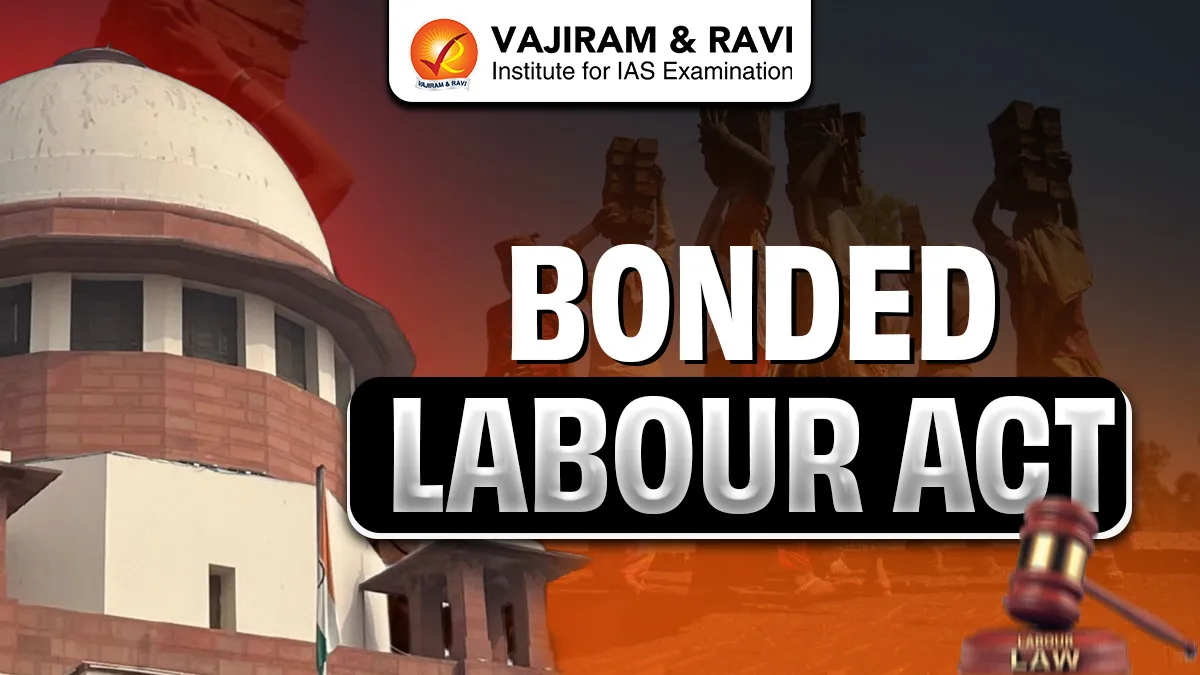
The Bonded Labour System (Abolition) Act, 1976 is a law made by the Indian government to stop bonded labour. Bonded labour is when a person has to work for someone because they owe money, often unfairly, and cannot leave until the debt is paid.
Bonded Labour Act
According to Bonded Labour (Abolition) Act, 1976, Bonded labour is a type of forced or partly forced work where a person (the bonded labourer) or their family member or any dependent person, has to work for a creditor because of a debt, social/customary obligation, inheritance, economic consideration, or their birth in a certain caste or community. The labourer may work without wages or for very little pay, lose freedom of employment, be restricted in movement, or lose rights over their property or earnings.
Bonded Labour Status in India
- According to the Global Slavery Index 2023 by the Walk Free Foundation, an international human rights organisation, about 11 million people in India were living in modern slavery.
- Modern slavery includes:
- Forced labour (working against their will)
- Debt bondage (working to pay off a loan)
- Forced marriage
- Other slavery-like practices, like forced sexual exploitation of adults and children
- Human trafficking
- India has the highest total number of people in modern slavery in the world and the sixth highest rate in the Asia Pacific region.
- Globally, India is ranked 34th out of 160 countries for the prevalence of modern slavery according to Global Slavery Index 2023, with about 8 people in every 1,000 affected.
- The population’s vulnerability to modern slavery is 56 out of 100, while the government’s response rating is 46%, which is above the regional average.
Key Constitutional, Legal, and International Frameworks Prohibiting Bonded Labour in India
India has a strong constitutional, legal framework and has ratified international framework to prohibit bonded labour and protect human dignity. These provisions ensure freedom from forced labour, safeguard children and vulnerable groups, and support rehabilitation of victims.
Constitutional Protections Against Bonded Labour in India are:
-
- Article 21: Every person has the right to life and personal liberty, which includes living with dignity.
- Article 23: Bans human trafficking, begar (forced labour without payment) and other similar forms of forced labour; such practices are illegal.
- Article 24: Children below 14 years cannot work in factories, mines, or hazardous jobs.
-
- Article 42: Ensures fair and humane working conditions.
- Article 43: Calls for decent wages and working conditions.
- Article 46: Protects Scheduled Castes, Scheduled Tribes, and weaker sections from social injustice and exploitation, including bonded labour.
India’s Legal Framework
- Bonded Labour System (Abolition) Act, 1976:
- Abolishes bonded labour.
- Frees bonded labourers and makes forcing people to work as illegal.
- Sets up vigilance committees at district, sub-division, and block levels to implement the law.
- Child and Adolescent Labour (Prohibition and Regulation) Act, 1986 (amended 2016):
- Bans children under 14 from working.
- Protects adolescents (14-18 years) from hazardous work.
- Juvenile Justice (Care and Protection of Children) Act, 2015: Protects children, provides rehabilitation and care.
- Bharatiya Nyaya Sanhita (BNS), 2023: Punishes forced labour and makes compulsory labour as illegal.
- Central Sector Scheme for Rehabilitation of Bonded Labourers, 2016:
- Provides financial help after rescue (Rs 30,000 initially; up to Rs 1-3 lakh depending on the case).
- Gives non-cash support like housing, land, and livelihood opportunities.
- Code on Wages, 2019: Ensures minimum wages and timely payment for all workers.
- Vision and Action Plans by Ministry of Labour:
- Aim to release and rehabilitate all bonded labourers.
- Deal with modern forms of bondage like forced marriage, domestic servitude, organized begging, and forced recruitment.
International Legal Frameworks
-
- United Nations Convention on the Rights of the Child (CRC), 1989: Protects children from economic exploitation and hazardous work.
-
- Convention 182 (Worst Forms of Child Labour, 1999): India has ratified it to eliminate hazardous child labour.
- Abolition of Forced Labour Convention, 1957: Seeks to end all forms of forced labour.
Other Initiatives
Reasons for Bonded Labour in India
Many families are very poor and take loans they cannot repay. This forces them or their children to work for the lender, often in unfair conditions.
Workers earning less than minimum wages may have to borrow money to survive. This can trap them in debt and bonded labour.
- Caste-Based Discrimination
Social hierarchies make marginalized communities, like Dalits and Adivasis, more likely to be exploited. The majority of bonded labourers come from these groups.
- Lack of Education and Awareness
Many workers and children do not know their rights, so they can be easily exploited.
- Migration and Informal Work
People moving from villages to cities often work in the unorganized sector, where there are no proper labour protections, making them vulnerable to forced labour.
Families fall into cycles of debt, and even children are forced to work to repay loans with high interest rates.
Police and courts often lack enough staff, training, or resources to catch offenders and enforce anti-bonded labour laws effectively.
People without land have fewer economic options and bargaining power, which increases the risk of exploitation.
- Exploitation in Agriculture and Other Sectors
Large informal sectors, like farming or domestic work, exploit cheap labour, especially children.
Girls are often more vulnerable and are forced into bonded labour because of inequality.
In some rural areas, child work is wrongly seen as normal or is disguised as “apprenticeship,” keeping children in labour instead of school.
Measures to End Bonded Labour in India
The government should strictly enforce the Bonded Labour Abolition Act, 1976. Special committees should monitor cases, track complaints digitally and punish those who force others into bonded labour.
- Identify and Rescue Workers
Regular surveys and inspections should be done in high-risk areas like brick kilns, farms, and mines. Children and adults trapped in bonded labour should be rescued quickly.
- Rehabilitation and Support
Freed workers should get financial help, skill training, and legal support. They should also be helped to reintegrate into society and find proper jobs.
Every child has the right to go to school. Education prevents children from being forced into labour and helps them build a better future. Vocational training should also be provided to adults for better employment opportunities.
- Social and Financial Support for Families
Poor families should get help through welfare schemes like the Public Distribution System (PDS) and MGNREGA. Direct cash transfers can reduce the family’s dependence on children’s income.
People should be taught about human rights and the laws that forbid bonded labour. Communities should understand that exploiting anyone is wrong and unacceptable.
- Community and NGO Involvement
Local communities and NGOs should work together to support rescued workers. Programs should focus on social and economic rehabilitation and make bonded labour socially unacceptable.
- Linking with Other Schemes
Rehabilitation programs should be connected with other government schemes to ensure freed workers get benefits like employment, education and healthcare.
Companies should include anti-bonded labour policies in their Corporate Social Responsibility (CSR) work to help prevent exploitation in workplaces.
Bonded Labour FAQs
Q1: What is Bonded Labour?
Ans: Bonded labour is when a person has to work for someone because of a debt or social obligation, often unfairly and cannot leave until the debt is repaid.
Q2: Which law protects people from bonded labour in India?
Ans: The Bonded Labour System (Abolition) Act, 1976 abolishes bonded labour, frees workers and makes forcing people to work illegal.
Q3: How many people in India are affected by modern slavery?
Ans: According to the Global Slavery Index 2021, around 11 million people in India live in modern slavery.
Q4: What are the main causes of bonded labour in India?
Ans: The main causes include poverty, debt, low wages, caste discrimination, lack of education, migration, weak law enforcement, landlessness and gender inequality.
Q5: What international laws help India fight bonded labour?
Ans: UN Convention on the Rights of the Child (CRC), 1989, ILO Convention 182 (Worst Forms of Child Labour, 1999) and ILO Abolition of Forced Labour Convention, 1957.