Vasundhara Lake

Vasundhara Lake

Vasundhara Lake Latest News

The Uttarakhand state is installing the first early-warning system at Vasundhara Tal in Chamoli to monitor it in real time. 

About Vasundhara Lake

  • Location: It is a high-altitude glacial lake located in Chamoli district of Uttarakhand.
  • It is situated at an elevation of about 4,795 meters in the Raikana valley.
  • It serves as an originating source for the Dhauliganga River, a vital tributary of the Alaknanda.
  • The lake sits at the snout of the Raikana Glacier which is the primary source of this lake.
  • It was classified as Category A, the highest-risk category lake by the National Disaster Management Authority (NDMA).

What will the Vasundhara System Monitor?

  • The system will track water level, weather, snow conditions, water flow and movement around the lake.
  • Components and Working
    • A water-level sensor will monitor fluctuations and abnormal changes.
    • An automatic weather station will record temperature, humidity, rainfall, wind speed and direction, atmospheric pressure and light intensity.
    • Snow-depth and sub-surface temperature sensors will monitor changes in snow conditions.
    • Tilt and accelerometer sensors will detect movement and vibrations at selected locations, while a water-flow sensor will monitor changes in discharge.
    • The equipment will be powered through a solar-energy system, and data will be transmitted by satellite because conventional mobile networks are unavailable in the remote high-altitude region.
    • A data logger and monitoring dashboard will record the readings and generate alerts when predetermined thresholds are crossed.

Source: IE

Vasundhara Lake FAQs

Q1: Where is Vasundhara Lake located?

Ans: Uttarakhand

Q2: Vasundhara Lake is source of which river?

Ans: Dhauliganga River

Fukutoku-Okanoba Volcano

Fukutoku-Okanoba Volcano

Fukutoku-Okanoba Volcano Latest News

Japan’s Coast Guard recently reported signs of activity at the Fukutoku-Okanoba submarine volcano. 

About Fukutoku-Okanoba Volcano

  • It is an active submarine volcano that is part of the Volcano Islands of Japan in the Pacific Ocean.  
  • It is part of the Izu-Bonin arc formed by subduction of the Pacific Plate beneath the Philippine Sea Plate. 
  • Its summit is just 14 meters (46 feet) below sea level, allowing Surtseyan eruptions to breach the surface.  
  • Composition is tholeiitic basalt, typical of arc front volcanism. 
  • It remains active with intermittent submarine eruptions and discoloured water since 2013. 
  • Eruptions are explosive with pumice rafts, discoloured water, and occasional ephemeral island formation. 
  • The 2021 eruption produced massive pumice rafts that drifted thousands of kilometres across the Pacific, impacting shipping and beaches. 
  • The volcano's frequent activity and shallow depth make it one of the most dynamic submarines, with eruptions often detected by satellite discoloration.  

What is a Surtseyan Eruption?

  • It is a type of volcanic eruption that takes place in shallow seas or lakes. 
  • It is named after the island of Surtsey off the southern coast of Iceland. 
  • When magma rises close to the surface of the water, it can come into contact with the water and cause it to flash to steam. 
  • The sudden increase in volume of the steam can cause an explosion, which can fragment the magma into small pieces. 
  • These pieces of magma, called tephra, can be ejected into the air, forming an ash column. 
  • These eruptions are commonly phreatomagmatic eruptions, representing violent explosions caused by rising basaltic or andesitic magma coming into contact with abundant, shallow groundwater or surface water. 
  • Tuff rings, pyroclastic cones of primarily ash, are built by explosive disruption of rapidly cooled magma.
  • Surtseyan eruptions are relatively common, and they can be found all over the world.  
  • Surtseyan eruptions can be very dangerous. 
    • The ash and rock fragments that are ejected into the air can travel long distances, and they can be a hazard to ships and aircraft. 
    • The sudden expansion of steam can also cause shock waves, which can damage buildings and other structures.

News: REUT

Fukutoku-Okanoba Volcano FAQs

Q1: What is Fukutoku-Okanoba?

Ans: Fukutoku-Okanoba is an active submarine volcano in the Volcano Islands of Japan in the Pacific Ocean.

Q2: Which volcanic arc is Fukutoku-Okanoba part of?

Ans: It is part of the Izu-Bonin Arc.

Q3: What type of eruptions can occur at Fukutoku-Okanoba due to its shallow depth?

Ans: It can produce Surtseyan eruptions, which can breach the ocean surface.

Q4: What is the composition of Fukutoku-Okanoba Volcano?

Ans: It is composed mainly of tholeiitic basalt.

FAO Committee on Forestry

FAO Committee on Forestry

FAO Committee on Forestry Latest News

Recently, India showcased it’s forest and landscape restoration at the Twenty-eighth Session of the FAO (Food and Agriculture Organization) Committee on Forestry (COFO 28) held in Rome. 

About FAO Committee on Forestry

  • It is FAO’s (Food and Agriculture Organization) highest global intergovernmental body on forestry.
  • It guides the organisation’s work and fostering international collaboration, policy dialogue, and technical guidance on forest-related issues.
  • It was established by the Conference at its Sixteenth Session in 1971.
  • Governance
    • COFO reports to the FAO Council on matters related to programmes and budgets, and to the FAO Conference on policy and regulatory issues.
    • Its work is informed by six Regional Forestry Commissions, which review regional forestry priorities and inform global policy discussions.
    • Meetings: It convenes biennially (every two years) at the FAO headquarters in Rome, Italy
    • It brings together 128 Members, convening ministers, heads of forest services, senior government officials and partner organizations
  • Key Functions of Committee on Forestry
    • It reviews the programmes of work of the Organization in the field of forestry and reviews forestry problems of an international nature, evaluating said problems with a view to concerted action by Member Nations and the Organization.
    • It oversees the  Working Group on Dryland Forests and Agrosilvopastoral Systems, which supports the development of a comprehensive understanding of dryland ecosystems.  

Source: PIB

FAO Committee on Forestry FAQs

Q1: When was FAO Committee on Forestry?

Ans: It was established by the Conference at its Sixteenth Session in 1971.

Q2: What is the function of FAO Committee on Forestry?

Ans: It reviews the programmes of work of the Organization in the field of forestry.

PRAMAAN Certificate

PRAMAAN Certificate

PRAMAAN Certificate Latest News

Recently, the Union Environment, Forest and Climate Change Minister handed over India’s first PRAMAAN certificates under the Indian Forest and Wood Certification Scheme (IFWCS).

About PRAMAAN Certificate

  • PRAMAAN stands for Programme for Recognition and Accreditation of sustainable Management Practices for Agroforestry And Natural forestry resources.
  • Launched by: Ministry of Environment, Forest and Climate Change (MoEFCC)
  • It is a nationally accepted framework for certification of forests, wood and non-timber forest products.
  • Standards & Accreditation
    • Under the framework, Forest Management certification is assessed against Indian Forest Management Standards derived from the National Working Plan Code 2023.
    • PRAMAAN’s accreditation architecture is benchmarked against international frameworks, ensuring recognition among domestic and global buyers and regulators.
    • Audited by: The certification is audited by certification bodies accredited by the National Accreditation Board for Certification Bodies (NABCB) under the Quality Council of India.
  • Three types of Certification under IFWCS “PRAMAAN”
    • Forest Management (FM) Certification: For recorded forest areas and forest plantations, in accordance with the Indian Forest Management Standard
    • Trees Outside Forests (TOF) Management Certification: For agroforestry systems and private plantations in accordance with the Trees Outside Forests (Management) Standard
    • Chain of Custody (CoC) Management Certification: Ensures traceability of timber and non-timber forest products at each step of production, from its source to the customer.
  • Significance: The IFWCS-PRAMAAN certificate enhances the social, and ecological values of India’s forests, agroforestry systems and the Indian wood-based industries. 

Source: PIB

PRAMAAN Certificate FAQs

Q1: What is PRAMAAN Certificate?

Ans: It is a nationally accepted framework for certification of forests, wood and non-timber forest products.

Q2: Which ministry launched the PRAMAAN Certificate?

Ans: Ministry of Environment, Forest and Climate Change (MoEFCC)

Mandar Instrument

Mandar Instrument

Mandar Instrument Latest News

The traditional musical instrument Mandar, has received official recognition with a Geographical Indication tag. 

About Mandar Instrument

  • It is a traditional double headed percussion musical instrument deeply rooted in the folk culture and tribal life of Jharkhand.
  • Key Features of Mandar Instrument
    • Structure: It is characterised by its distinctive cylindrical shape made from red clay, which slightly bulges in the middle.
    • The structure is hollow, with its openings covered by leather on both sides.
    • The right opening is smaller, while the left is larger.
    • The leather coverings are secured using braided cords.
    • A special coating, known as Kiran, is applied to the smaller opening, giving Mandar its resonant and unique sound.
  • When played, the musician often moves rhythmically, carrying the instrument using a rope slung over the shoulder.
  • It serves as the primary instrument played during festivals, crop celebrations, religious rituals, and cultural events.
  • It is deeply integrated into the lives of both tribal and non-tribal communities, having been used for centuries in various dance and song performances.

Source: News On Air

Mandar Instrument FAQs

Q1: What is Mandar Instrument?

Ans: It is a traditional double headed percussion musical instrument deeply rooted in the folk culture and tribal life of Jharkhand.

Q2: What is the structure of Mandar Instrument?

Ans: It is characterised by its distinctive cylindrical shape made from red clay, which slightly bulges in the middle.

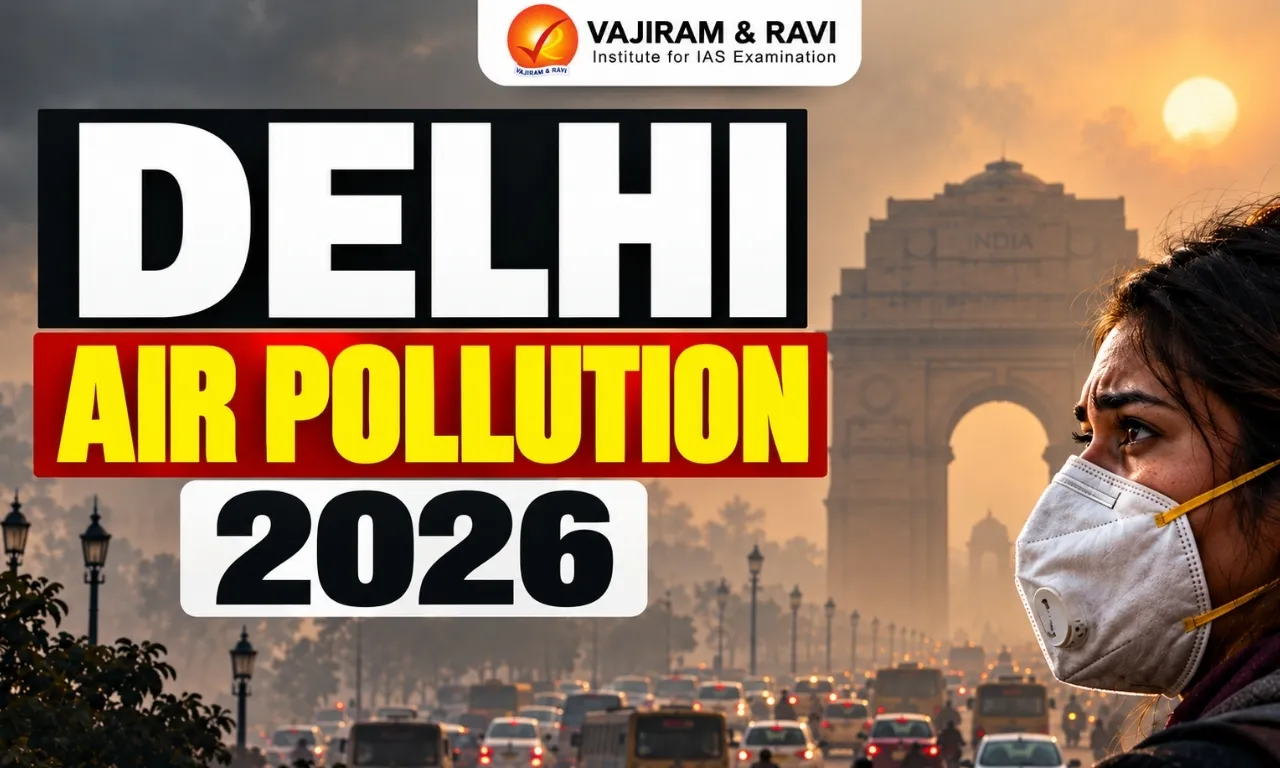
Delhi Air Pollution 2026, Causes, Government Measures, Winter Framework

Delhi Air Pollution 2026

Delhi Air Pollution remains a major environmental challenge in 2026, with pollution coming from multiple sources such as vehicles, road and construction dust, industries, waste burning, biomass burning and regional sources. The focus of air-quality management has increasingly shifted from emergency action during severe pollution episodes to advance planning, source-specific control and year-round monitoring.

In 2026, the government introduced several measures under the Proactive Winter Air Quality Management Framework and strengthened coordination among Delhi, NCR states and central agencies. The latest review held in September 2026 also outlined targeted measures for hotspots, vehicles, dust, waste burning, public transport, industries and green areas.

What is Delhi Air Pollution?

Delhi air pollution refers to the presence of harmful gases and particulate matter in the atmosphere of Delhi at concentrations that can affect human health, ecosystems and overall quality of life.

Among different pollutants, PM2.5 is particularly important because these very small particles can penetrate deep into the respiratory system.

A 2026 assessment by the Commission for Air Quality Management (CAQM) identified PM2.5 as the dominant pollutant affecting Delhi's AQI. It also highlighted that Delhi's pollution is influenced by both local emissions and pollution transported across the wider NCR airshed.

Major Sources of Air Pollution in Delhi

Delhi's air pollution cannot be attributed to a single source. Different sources become more important during different seasons.

1. Vehicular Emissions

Vehicles release PM2.5, nitrogen oxides and other pollutants, with traffic congestion and older vehicles increasing emissions.

  • Road traffic: Cars, buses, trucks and two-wheelers are major contributors.
  • Traffic congestion: Idling and slow-moving vehicles increase emissions.
  • Diesel vehicles: Heavy-duty diesel vehicles can contribute significantly to particulate and nitrogen oxide emissions.
  • Older vehicles: Vehicles with outdated emission standards generally produce higher emissions.

2. Road Dust

Dust from roads and unpaved surfaces becomes airborne due to vehicle movement, construction activity and wind.

  • Resuspended dust: Moving vehicles lift settled dust into the atmosphere.
  • Unpaved surfaces: Exposed soil and road edges generate additional dust.
  • Poorly maintained roads: Damaged surfaces can increase dust generation.
  • Mechanical sweeping: Road sweeping and dust-control measures are used to reduce resuspended particles.

3. Construction and Demolition Activities

Construction and demolition generate large quantities of dust and particulate matter, particularly when dust-control measures are inadequate.

  • Construction dust: Excavation, drilling and material handling release particles.
  • Demolition: Breaking and removing structures can generate significant dust.
  • Construction materials: Cement, sand and other loose materials can become airborne.
  • C&D waste: Poor handling and transportation of construction and demolition waste can add to particulate pollution.

4. Biomass and Crop-Residue Burning

Biomass and crop-residue burning in Delhi and surrounding regions can increase particulate pollution, particularly during the winter season.

  • Crop-residue burning: Smoke from agricultural fields can enter the NCR airshed.
  • Biomass burning: Burning of wood and other biomass releases particulate matter.
  • Seasonal impact: Its contribution can become more significant during winter pollution episodes.
  • Regional transport: Pollutants can travel across state boundaries depending on wind conditions.

5. Industrial Emissions

Industrial activities can release particulate matter, nitrogen oxides, sulphur compounds and other pollutants into the atmosphere.

  • Industrial units: Emissions depend on the type of industry and fuel used.
  • Thermal power plants: Power generation can contribute to particulate and gaseous emissions.
  • Fuel combustion: Burning coal, oil or other fuels produces air pollutants.
  • Emission-control systems: Poorly maintained or inadequate control systems can increase emissions.

6. Open Waste Burning

Burning municipal waste, garbage and other combustible materials in the open releases smoke, particulate matter and harmful gases.

  • Garbage burning: Burning mixed waste releases multiple pollutants.
  • Biomass burning: Leaves, wood and other organic waste can contribute to smoke.
  • Local hotspots: Open burning can create concentrated pollution in residential and commercial areas.
  • Enforcement: Zero-burning measures and field monitoring are used to prevent such activities.

7. Secondary Particulate Formation

Some PM2.5 is formed in the atmosphere when gases released from different sources undergo chemical reactions.

  • Precursor gases: Pollutants from vehicles, industries and combustion contribute to secondary particle formation.
  • Chemical reactions: Atmospheric gases can react to form fine particulate matter.
  • Winter conditions: Atmospheric conditions can favour the accumulation of secondary particulates.
  • Regional contribution: Secondary particles can originate from pollutants emitted across the wider NCR airshed.

Proactive Winter Air Quality Management Framework 2026-27

Proactive Winter Air Quality Management Framework 2026-27 is designed to control Delhi-NCR's winter pollution through advance planning, preventive action and coordinated enforcement rather than waiting for air quality to deteriorate severely.

  • The framework focuses on preventive measures before and during the winter pollution season, broadly covering the period from 1 November to 28 February.
  • It works alongside the Graded Response Action Plan (GRAP) to strengthen preparedness and pollution control.
  • The ‘No PUCC, No Fuel’ measure aims to prevent vehicles without a valid Pollution Under Control Certificate from purchasing fuel at designated fuel stations.
  • Restrictions are planned on the entry of certain non-BS-VI commercial vehicles registered outside Delhi from 1 November 2026, with specified exemptions.
  • Parking charges at authorised parking facilities are proposed to be doubled during the winter period to discourage excessive private vehicle use.
  • Staggered office timings and work-from-home measures can be introduced to reduce traffic and commuting-related emissions during periods of poor air quality.
  • Dust-generating demolition and outdoor civil construction activities face seasonal restrictions, along with stronger dust-control requirements at construction sites.
  • Open burning of municipal waste, garbage and biomass is targeted through zero-burning measures, field monitoring and enforcement.
  • The framework promotes public transport, electric vehicles and last-mile connectivity to reduce dependence on private vehicles.

Latest Delhi Air Pollution Measures in September 2026

In September 2026, the Centre and Delhi Government reviewed a time-bound strategy to control Delhi air pollution ahead of winter, focusing on vehicles, dust, construction, waste burning, industries and public transport.

  • The ‘No PUCC, No Fuel’ measure will be implemented across 500 ANPR-enabled fuel stations to improve vehicle emission compliance.
  • 42 pollution hotspots have been rectified, while 8 additional hotspots are targeted for completion by October 2026; 8 road stretches have also been made signal-free.
  • Around 1,193 km of roads have been redeveloped, while the number of Mechanical Road Sweeping Machines has increased from 76 to 98 to control road dust.
  • A ‘Zero Burning’ campaign will target open burning of municipal waste, garbage and biomass, supported by ward-level monitoring and enforcement.
  • Delhi's public transport fleet has reached 6,840 buses, including 5,088 electric buses, while last-mile connectivity is available at all 228 Metro stations.
  • From 1 November 2026, certain non-BS-VI commercial vehicles registered outside Delhi will face entry restrictions, with specified exemptions for CNG and electric vehicles.
  • Industrial pollution control will be strengthened through an AI-enabled Command and Control Centre, an increase in monitoring stations from 47 to 60, and 334 enforcement teams.
  • The strategy also focuses on greening, construction-dust control, EV promotion, higher parking charges, citizen participation and NCR-level coordination to reduce pollution before and during the winter season.

Delhi Air Pollution 2026 FAQs

Q1: What are the major causes of Delhi air pollution?

Ans: The major sources include vehicular emissions, road and construction dust, industrial emissions, waste and biomass burning, secondary particulate formation and regional pollution transport.

Q2: Why is Delhi air pollution worse during winter?

Ans: Winter conditions such as low wind speed, temperature inversion and poor atmospheric dispersion can trap pollutants near the ground. Regional biomass burning and local emissions can further increase pollution levels.

Q3: What is the Proactive Winter Air Quality Management Framework?

Ans: It is Delhi's advance winter pollution-control framework that generally operates from 1 November to 28 February. It includes measures related to vehicles, fuel, parking, offices, construction, waste burning and pollution monitoring.

Q4: What is the 'No PUCC, No Fuel' rule?

Ans: The measure links fuel purchase with a valid Pollution Under Control Certificate (PUCC). The latest September 2026 plan calls for its implementation across 500 ANPR-enabled fuel stations in Delhi.

Q5: What is the role of CAQM in Delhi air pollution?

Ans: CAQM coordinates air-pollution control measures across Delhi-NCR and issues directions related to vehicles, industries, construction dust, waste, crop-residue burning and GRAP.

Didymocarpus nautiyalii

Didymocarpus nautiyalii

Didymocarpus nautiyalii Latest News

Botanists recently discovered a new plant species in Arunachal Pradesh’s Shi-Yomi district, highlighting the rich botanical diversity of the Eastern Himalaya.

About Didymocarpus nautiyalii

  • It is a new plant species.
  • It was discovered in Arunachal Pradesh’s Shi-Yomi district.
  • It belongs to the Gesneriaceae, a family of flowering plants. 
  • The small herb grows on moist rock surfaces, including roadside walls and areas near waterfalls, in subtropical evergreen forests at elevations above 1,000 metres. 
  • It grows to only around 8 cm and has leathery leaves and distinctive bluish-purple flowers. 
  • The plant resembles Didymocarpus albiflorus but differs in several characteristics, including its much shorter stem, very short or absent leaf stalks, leathery leaf blades, smaller calyx, shorter bluish-purple corolla, and a hairless ovary.   
  • The researchers have currently assessed D. nautiyalii as ‘Data Deficient’ under the IUCN Red List criteria.

News: TP

Didymocarpus nautiyalii FAQs

Q1: What is Didymocarpus nautiyalii?

Ans: Didymocarpus nautiyalii is a newly discovered plant species.

Q2: Where was Didymocarpus nautiyalii discovered?

Ans: It was discovered in Shi-Yomi district of Arunachal Pradesh.

Q3: What type of habitat does Didymocarpus nautiyalii prefer?

Ans: It grows on moist rock surfaces, including roadside walls and areas near waterfalls.

Q4: What are the distinctive features of Didymocarpus nautiyalii?

Ans: What are the distinctive features of Didymocarpus nautiyalii?

International Whaling Commission

International Whaling Commission

International Whaling Commission Latest News

India has reaffirmed its commitment to the conservation of whales and other cetaceans (marine mammals) at the 70th meeting of the International Whaling Commission (IWC-70) held in Hobart, Australia, recently.

About International Whaling Commission

  • It is an intergovernmental organization established to regulate whaling and promote the conservation of whale populations.   
  • It was established under the 1946 International Convention for the Regulation of Whaling. 
  • Formed in response to the alarming decline of whale stocks in the 1930s, the IWC initially aimed to ensure sustainable whaling practices among its member nations. 
  • The Convention also applies to factory ships, land stations, and whale catchers under the jurisdiction of the contracting governments, and to all waters in which they carry out whaling.  
  • Membership: 
    • Beginning in 1979, IWC membership started to grow: 23 members in 1979, 41 by 1985. Currently, there are 88 contracting governments. 
    • Countries that do not hunt whales can also join the IWC.
    • Some of the current members include: Australia, Brazil, China, Denmark, France, Germany, Iceland, India, Japan (until 2019), Mexico, New Zealand, Norway, Russia, South Africa, Sweden, United Kingdom, and United States.  
  • The IWC's main office is in Impington, near Cambridge, England. 
  • There are generally three types of whaling that the Commission regulates:
  • Commercial Whaling:
    • In 1986, a global moratorium, or a temporary ban, on commercial whaling was adopted due to the overexploitation of whale stocks. 
    • The Commission has also designated sanctuary areas in the Indian and Southern Oceans where commercial whaling is not allowed. 
    • Although the moratorium is still in place, some countries, such as Norway and Iceland, continue to engage in commercial whaling activities.
  • Scientific Research Whaling:
    • Article VIII of the Convention allows contracting governments to issue special permits authorizing the taking of whales for purposes of scientific research. 
    • Japan’s lethal scientific research in the North Pacific and Southern Oceans under such special permits ended in 2019 with their withdrawal from the Convention.
  • Subsistence Whaling:
    • The Commission also regulates aboriginal subsistence whaling (whaling by native people to sustain themselves). 
    • Currently, the Commission permits indigenous communities in Denmark (Greenland), the Russian Federation, St. Vincent and the Grenadines, and the United States to engage in this type of whaling on certain whale stocks. 
  • Over the years, the IWC has faced significant challenges. 
    • It does not have a way to force countries to follow its rules or punish them. 
    • It often becomes a platform for member nations to negotiate over whaling quotas rather than prioritizing conservation efforts. 
  • In 2018, the IWC members made the "Florianópolis Declaration." 
    • They decided that the IWC's main purpose is to protect whales forever.  
    • They also want all whale populations to return to their numbers before large-scale whaling began. 
    • The declaration also stated that using deadly methods for research is not needed.  
    • After this, Japan announced on December 26, 2018, that it was leaving the IWC.

News: NIE

International Whaling Commission FAQs

Q1: What is the International Whaling Commission (IWC)?

Ans: It is an intergovernmental organization established to regulate whaling and promote the conservation of whale populations.

Q2: What is the main purpose of the International Whaling Commission?

Ans: Its main purpose is to regulate whaling and promote the conservation of whale populations.

Q3: Where is the main office of the International Whaling Commission located?

Ans: It's main office is in Impington, near Cambridge, England.

Q4: Can countries that do not hunt whales become members of the International Whaling Commission?

Ans: Yes, countries that do not hunt whales can also join the IWC.

Q5: When was the global moratorium on commercial whaling adopted?

Ans: The global moratorium on commercial whaling was adopted in 1986.

Edible Oil Import Duty Cut – Reasons, Impact on Consumers and Farmers

Edible Oil

Edible Oil Latest News

  • The Union Government reduced the Basic Customs Duty (BCD) on major imported edible oils from September 24, 2026, citing rising international prices and the need to moderate domestic food inflation.

Changes in Edible Oil BCD

  • Ahead of the festival season, when demand for edible oils is expected to rise, the government rationalised import duties on several crude and refined edible oils.BCD Comparison for Edible Oil
  • The government has also maintained an import duty differential of 19.25% between crude and refined edible oils, intended to preserve an incentive for domestic refining.

Reasons for Reducing the Import Duty

  • Rising International Edible Oil Prices
    • International prices have been increasing. According to the FAO Food Price Index, the vegetable oil price index averaged 196.9 points in August 2026, increasing 0.6% over July and reaching its highest level since June 2022.
    • The increase was driven particularly by higher global palm and soybean oil prices. International palm oil prices were also affected by strong global import demand and concerns over the potential impact of El Niño-related weather conditions on production in Southeast Asia.
  • Moderating Domestic Prices
    • Import duties form part of the landed cost of imported edible oils. When international prices rise, a high import duty can further increase the cost at which the commodity enters the domestic market.
    • By reducing BCD, the government expects importers to face lower landed costs, with the benefit potentially transmitted through the domestic supply chain to consumers.
    • The stated objective is therefore to provide consumer relief and contain food-price and broader inflationary pressures.
  • Ensuring Adequate Supply During the Festival Season
    • Demand for edible oils generally increases during the festival period. Apart from household consumption, demand also rises from the sweets, snacks, food-service and hospitality sectors.
    • The Indian Vegetable Oil Producers’ Association (IVPA) stated that lower duties could improve the landed cost of imported oils and support availability during the period of higher demand.

Impact on Consumers

  • Lower import duties can reduce the cost of imported edible oils by lowering the tax component of their landed price.
  • Greater flexibility to import sunflower and soybean oil could also increase the availability of alternatives to palm oil. 
  • The industry expects this to be relevant because palm oil prices may remain relatively high due to changes in Indonesia's biofuel policy and constraints on acreage expansion in major producing countries.
  • However, the extent to which lower import duties translate into lower retail prices depends on international prices, exchange rates, transportation costs, domestic margins and the transmission of savings through the supply chain.

Farmers’ Concerns

  • Domestic oilseed farmers have raised concerns that cheaper imports could reduce the competitiveness of domestically produced oilseeds.
  • Farmers growing soybean, sunflower, groundnut and oil palm have also pointed to the government's objective of achieving greater self-sufficiency in edible oil production. Their concern is that increased dependence on imported edible oils could weaken incentives for domestic production.
  • The All India Kisan Sabha has criticised the move on the grounds that it could adversely affect oilseed farmers and potentially conflict with the objective of edible-oil self-sufficiency. 
  • These are the concerns expressed by the farmers' organisation and do not represent the government's stated rationale for the measure.

The Policy Trade-off

  • The duty reduction illustrates a common policy trade-off between short-term consumer price management and long-term domestic production incentives.
  • Lower import duties can help manage inflation and ensure adequate supplies when global prices are high. However, if imported oils become substantially more competitive, domestic oilseed producers may face greater price pressure.
  • Thus, edible oil policy requires balancing:
    • Consumer affordability
    • Food inflation management
    • Adequate market supply
    • Farmer incomes
    • Domestic oilseed production
    • Long-term edible oil self-sufficiency

Conclusion

  • The reduction in edible oil import duties is primarily aimed at reducing landed costs, improving availability and moderating domestic food-price pressures amid rising international edible oil prices. 
  • At the same time, concerns from oilseed farmers highlight the need to balance short-term consumer relief with incentives for domestic production. 
  • The effectiveness of the policy will therefore depend not only on lower import duties but also on how efficiently the resulting cost reduction reaches consumers and how domestic oilseed production is supported.

Source: TH

Edible Oil FAQs

Q1: Why did the Centre reduce import duty on edible oils?

Ans: The Centre reduced import duties to lower landed costs, improve availability and moderate domestic edible oil prices.

Q2: When did the new edible oil import duties take effect?

Ans: The revised BCD rates took effect from September 24, 2026.

Q3: Which edible oil saw its crude import duty reduced to zero?

Ans: The BCD on crude sunflower oil was reduced from 10% to zero.

Q4: How can lower import duties affect consumers?

Ans: Lower duties can reduce the landed cost of imported edible oils and potentially lower retail prices.

Q5: Why are domestic farmers concerned?

Ans: Farmers fear cheaper imports could reduce the competitiveness and prices of domestically produced oilseeds.

AFSPA: Special Powers, Provisions and Areas of Application

AFSPA

AFSPA Latest News

  • The Union Ministry of Home Affairs (MHA) has extended the Armed Forces (Special Powers) Act, 1958 (AFSPA) in parts of Manipur, Nagaland and Arunachal Pradesh for another six months from October 1, 2026.
  • In Manipur, the entire state has been declared a "disturbed area" under AFSPA, barring the jurisdictions of 13 police stations in five Valley districts.
  • In Nagaland, AFSPA continues in nine districts, plus areas under 21 police stations in five other districts.
  • In Arunachal Pradesh, the Act continues in Tirap, Changlang and Longding districts, and in areas under Namsai, Mahadevpur and Chowkham police stations in Namsai district, bordering Assam.
  • This latest extension comes against the backdrop of the ethnic conflict that erupted in Manipur on May 3, 2023.

What Powers Does AFSPA Confer?

  • AFSPA was enacted in 1958 to give the armed forces special powers to operate in areas declared "disturbed" due to insurgency or serious internal security problems.
    • The law first came into effect in 1958 to deal with the uprising in the Naga Hills, followed by the insurgency in Assam.
  • Once an area is notified as disturbed under Section 3, security personnel receive powers that ordinary police do not have:
    • Authority to use force, including lethal force, against persons acting in contravention of prohibitory orders.
    • Power to arrest without a warrant.
    • Power to enter and search premises without a warrant.

Legal Protection

  • The Act also shields personnel: prosecution or any legal proceedings for actions done (or purported to be done) under AFSPA require the prior sanction of the Central government. 
  • It is precisely these extraordinary powers and this protection against prosecution that make AFSPA contentious.

Who Can Declare an Area "Disturbed"?

  • Both the Central and State governments have the power to declare an area disturbed under Section 3. This is why the geographical application of the law has historically not been determined solely by the MHA.
  • For decades, the Manipur government itself issued disturbed-area notifications, even though AFSPA had operated in the state since 1981.
    • This changed after the May 3, 2023 ethnic violence.

Current Status Across States

  • MHA currently issues periodic disturbed-area notifications only for Manipur, Nagaland, and parts of Arunachal Pradesh.
  • For Assam, the notification is issued by the State government.
  • AFSPA was removed entirely from Tripura by then state government in 2015.
  • Meghalaya was under AFSPA for 27 years, until it was revoked by the Ministry from April 1, 2018.
  • Jammu and Kashmir has a separate law — the J&K Armed Forces (Special Powers) Act, 1990.

How AFSPA Shrank in Manipur — and Then Returned

  • AFSPA's footprint in Manipur had been contracting before the current conflict:
    • 2004: Withdrawn from the Imphal municipal area.
    • April 2022 – April 2023: A much larger rollback — AFSPA withdrawn from all police station areas in the Manipur Valley, citing an improved security situation and greater public sense of security.
    • AFSPA, however, continued in the hill regions throughout, where disturbed-area notifications had been renewed periodically for decades.
    • The trend was toward gradual reduction — until the May 2023 violence reversed it.

Reimposition

  • In November 2024, the MHA reimposed AFSPA in Manipur across the jurisdictions of six police stations spread over five districts — areas from which it had earlier been withdrawn. 
  • Notably, this notification came from the MHA, not the Manipur government, marking a shift from the earlier pattern.
  • The then Manipur govt did not agree with this decision to reimpose AFSPA and it sought a reversal almost immediately.

Why AFSPA Continues in Nagaland and Arunachal Pradesh

  • Nagaland: Continuation has historically been linked to the presence and movement of armed insurgent groups and the unresolved Naga political issue. 
    • The Centre has held negotiations with the National Socialist Council of Nagaland (Isak-Muivah), or NSCN-IM, and Naga National Political Groups (NNPGs). 
    • In 2022, security officials indicated that uncertainty over the conclusion of the Naga peace process was a key reason AFSPA persisted in parts of Nagaland and neighbouring states.
  • Arunachal Pradesh: Its application has remained concentrated in districts affected by insurgent movement and areas adjoining Assam.

Conclusion

  • AFSPA's story in India's Northeast is one of contraction and reversal, not a fixed policy. Manipur's own trajectory — years of gradual rollback undone within months of the 2023 violence — shows how tightly the law's reach tracks ground realities. 
  • Even shared political governance, as seen in the Centre-Manipur disagreement, hasn't guaranteed consensus on where the line between security and civil liberty should be drawn.

Source: TH | FL

AFSPA FAQs

Q1: What is AFSPA and why was it enacted?

Ans: AFSPA was enacted in 1958 to provide armed forces special powers for operating in areas declared disturbed because of insurgency or serious security problems.

Q2: What powers does AFSPA provide in disturbed areas?

Ans: AFSPA permits security personnel to use force in specified circumstances, arrest without warrants and enter or search premises without warrants.

Q3: Who can declare an area disturbed under AFSPA?

Ans: Under Section 3, both the Central and State governments can declare an area disturbed, meaning application is not determined solely by the MHA.

Q4: How did AFSPA's application change in Manipur before 2023?

Ans: AFSPA's footprint contracted gradually, including withdrawal from Imphal in 2004 and from Manipur Valley police-station areas between April 2022 and April 2023.

Q5: Why does AFSPA continue in parts of Nagaland and Arunachal Pradesh?

Ans: AFSPA continues in parts of Nagaland because of armed insurgent groups and the unresolved Naga political issue, while Arunachal Pradesh faces insurgent movement in specific areas.

Galaxy Frog

Galaxy Frog

Galaxy Frog Latest News

The rarely sighted Galaxy frog returned to the spotlight after the Additional Chief Secretary, Environment, Climate Change and Forests Department of Tamil Nadu, shared new images of the frog, as its galaxy-like spots are being studied.

About Galaxy Frog

  • It is a small, nocturnal amphibian. 
  • It is one of the rarest amphibians in the world.
  • The species was first described in 1878 from the Anamalai Hills of Tamil Nadu, and was later rediscovered in 1997, after decades in which it was exceptionally difficult to find.
  • It belongs to the family Microhylidae and sub-family Melanobatrachinae.
  • Scientific Name: Melanobatrachus indicus
  • It is the sole member of its genus. 

Galaxy Frog Habitat and Distribution

  • It is endemic to the southern Western Ghats, with records from parts of Kerala and Tamil Nadu. 
  • The rarely-sighted creature lives in wet evergreen and other moist forest habitats, generally at elevations of about 1,000 to 1,500 metres.
  • They are typically found in dark, moist places such as under the cover of leaf litter, rotting logs and rocks. 

Galaxy Frog Features

  • It has a slender, elongated body of uniform width. 
  • It measures just 2-3.5 centimeters in length.  
  • The amphibian's dark body is covered with tiny bluish-white spots that resemble stars, while flashes of scarlet-orange appear underneath. 

Galaxy Frog Conservation Status

It is classified as 'Vulnerable' under the IUCN Red List.

News: IT

Galaxy Frog FAQs

Q1: What is the Galaxy Frog?

Ans: The Galaxy Frog is a small, nocturnal amphibian and one of the rarest amphibians in the world.

Q2: What is the scientific name of the Galaxy Frog?

Ans: Melanobatrachus indicus.

Q3: Where is the Galaxy Frog endemic?

Ans: It is endemic to the southern Western Ghats, with records from parts of Kerala and Tamil Nadu.

Q4: Why is it called the Galaxy Frog?

Ans: Its dark body is covered with tiny bluish-white spots resembling stars, giving it a galaxy-like appearance.

Q5: What is the conservation status of the Galaxy Frog according to the IUCN Red List?

Ans: It is classified as Vulnerable.

Article 370: From J&K Special Status to Statehood Demand

Article 370

Article 370 Latest News

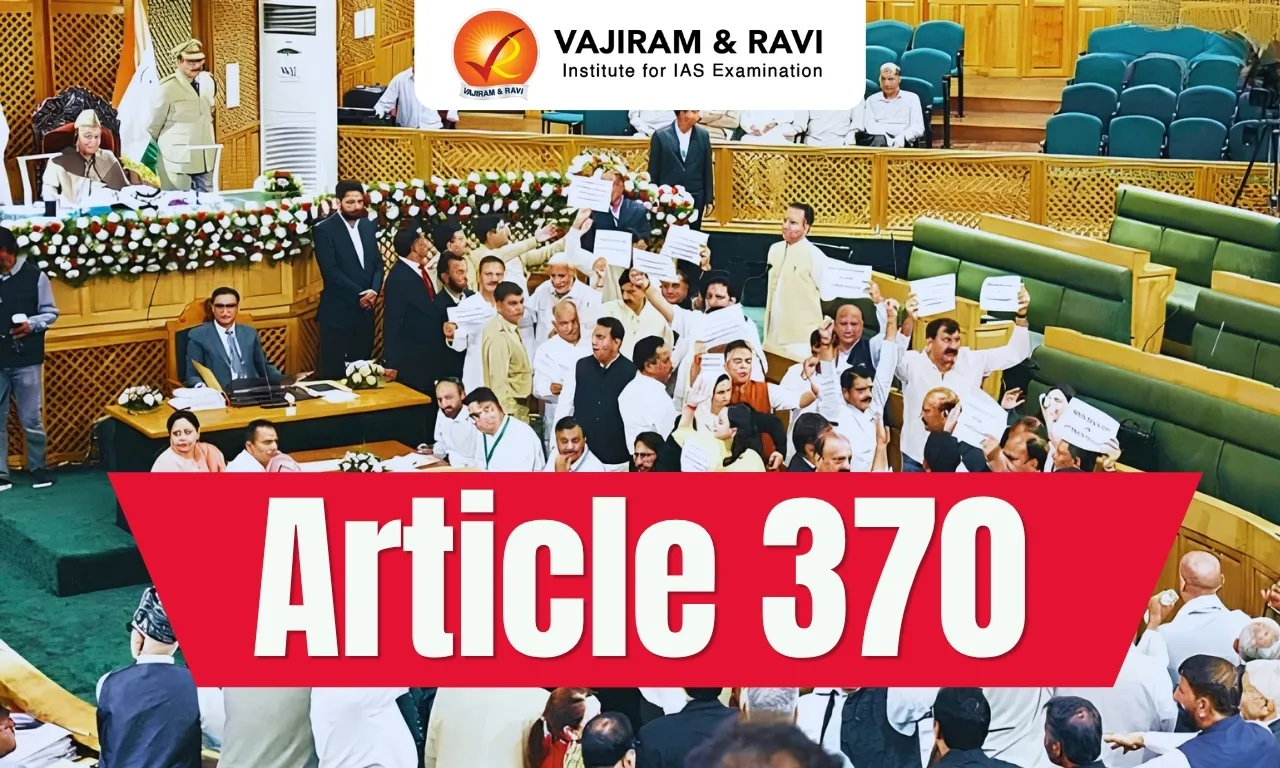
  • As Chief Minister Omar Abdullah brought a resolution seeking immediate restoration of statehood for Jammu and Kashmir in the Assembly recently, several amendments were moved — some seeking the inclusion of Articles 370 and 35A, as they existed before August 5, 2019. 
  • These amendments were later withdrawn, but they brought renewed attention to the constitutional provisions that have shaped J&K's status within India.

What Was Article 370?

  • Article 370 provided special status to Jammu and Kashmir, ensuring Parliament could legislate on only three subjects in relation to the state: Defence; Foreign relations; Communication.
  • These were the exact subjects mentioned in the Instrument of Accession that made the princely state part of India. 
  • J&K was allowed its own constitution, standing apart from other states. 
  • Only Article 1 (defining India's territory) and Article 370 itself applied to the state, beyond the extension of subjects under those three heads.

How Article 370 Came Into Being

  • The Accession Crisis (1947): After Raja Hari Singh, ruler of J&K, tried to remain independent amid Partition, Pakistan — claiming the province due to its Muslim-majority population — sent irregular troops (Kabailis) to capture Kashmir in October 1947. 
    • A worried Hari Singh signed the Instrument of Accession on October 26, 1947, after which Indian soldiers began repelling the invaders.
  • UN Involvement: India took the matter to the UN Security Council in January 1948. The UN Commission for India and Pakistan (UNCIP) mediated a ceasefire. 
    • UNSC Resolution 47 called for both sides to demilitarise so a plebiscite could determine the wishes of J&K's people. 
    • Since demilitarisation never happened, this resolution remained a dead letter.
  • Constitutional Adoption: Article 370 was adopted by the Constituent Assembly on October 17, 1949. 
    • Drafting Committee member N. Gopalaswami Ayyangar explained that the state was "not yet ripe" for full integration, citing ongoing UN entanglement and parts of the state still being "in the hands of rebels and enemies."
  • Restrictions under Article 370: Outsiders required a permit to visit the state and were barred from buying land there.

The Delhi Agreement of 1952

  • Later, the then Nehru government and the J&K government signed the Delhi Agreement in July 1952, under which the state:
    • Accepted the jurisdiction of the Supreme Court.
    • Accepted the supremacy of the Indian flag (though the state flag remained in use too).
    • Accepted the President's power to declare Emergency under Article 352 — but only with the state's concurrence, in case of internal disturbances.

What Was Article 35A?

  • A Presidential Order in 1954, issued under Article 370's authority, added Article 35A to the Constitution as an annexure (Appendix 1) to the official text.
    • Article 35A flowed from Article 370.
    • It empowered the J&K Assembly to define who qualified as a "permanent resident" of the state.
    • It extended special rights to such residents — including the right to own property and access to government jobs and scholarships.

How Article 370 Was Abrogated

  • On August 5, 2019, the government rendered Article 370 inoperative through the Constitution (Application to Jammu and Kashmir) Order, 2019, which superseded the 1954 Order.
  • This nullified J&K's separate constitution and extended all provisions of the Indian Constitution to the state.

The Legal Mechanism Used

  • The government invoked Clause 3 of Article 370, which allows the President to declare the article inoperative — but requires the "recommendation of the Constituent Assembly of the State".
  • Since J&K's constituent assembly no longer existed, the President instead used Clause 1 of Article 370, which empowers the President to modify the Constitution's application to J&K.
  • To achieve this, the phrase "Constituent Assembly of the State" in Article 367 was replaced with "Legislative Assembly of the State."
  • Since the state's Legislative Assembly was suspended at the time (the state was under President's Rule after the BJP-PDP alliance collapsed), the order specified that any reference to the Legislative Assembly would mean a reference to the Governor of Jammu and Kashmir — a central appointee.
  • Judicial Validation: The Supreme Court upheld this abrogation in 2023, holding that Article 370 was meant to enhance integration between the Indian Union and J&K, not cause disintegration.

Conclusion

  • J&K's constitutional journey has never stood still — from a special-status accession meant to be temporary, through decades of gradual integration via agreements like Delhi 1952, to complete abrogation using the very machinery Article 370 itself provided. 
  • The current statehood demand, and the withdrawn push to restore Articles 370 and 35A, shows this evolution is still being contested — now in the Assembly rather than through arms or ordinances.

Source: IE

Article 370 FAQs

Q1: What special status did Article 370 provide to Jammu and Kashmir?

Ans: Article 370 limited Parliament's legislative authority mainly to defence, foreign relations and communications, while allowing J&K to have its own Constitution.

Q2: How did Article 370 emerge in Jammu and Kashmir's constitutional framework?

Ans: Article 370 emerged after J&K's 1947 accession to India, amid the conflict, UN involvement and continuing constitutional negotiations over integration.

Q3: What was the relationship between Article 370 and Article 35A?

Ans: Article 35A was introduced through a 1954 Presidential Order under Article 370 and empowered J&K to define permanent residents and their special rights.

Q4: How was Article 370 made inoperative in 2019?

Ans: In 2019, the government used constitutional orders under Article 370 to modify its application, ultimately making Article 370 inoperative and extending the Constitution fully.

Q5: What does the current statehood demand indicate about J&K's constitutional journey?

Ans: The statehood demand shows that Jammu and Kashmir's constitutional status remains politically contested, with debate now taking place through the elected Assembly.

Italy

Italy

Italy Latest News

Recently, the 2nd India–Italy Joint Working Group (JWG) on Tourism was held and agreed to strengthen bilateral cooperation in tourism. 

About Italy

  • Location: It is located in South-central Europe on the Apennine Peninsula.
  • Bordering Countries: It shares its border with Switzerland and Austria in the north, Slovenia in the northeast and France in the northwest.  
  • Vatican City and San Marino are the two enclaved sovereign states within Italy.
  • Maritime boundaries: It is bordered by the Adriatic Sea in the east, the Sea of Sicily in the south, the Ionian Sea in the southeast, the Ligurian Sea, and the Tyrrhenian Sea in the southwest.
  • Capital City: Rome

Geographical Features of Italy

  • Climate: The coastal region of Italy has a typical Mediterranean climate with mild winters and hot and mostly dry summers.
  • Topography: It is mostly rugged and mountainous and has some plains, coastal lowlands.
  • Mountain: The Apennine Mountains run along the length of the peninsula as a separate system and the Alps run along Italy's northern border.
  • Major Rivers: Po (It is Italy’s longest river) and Adige.
  • Highest Point: Mont Blanc 
  • Volcano: Italy is volcanic in origin, and a few of its many volcanoes are active, including Sicily’s Mt. Etna, Stromboli in the Aeolian Islands.
  • Natural Resources: Coal, antimony, mercury, zinc, potash, barite, asbestos, pumice, fluorspar, feldspar, pyrite (sulfur), natural gas and crude oil reserves.

Source: PIB

Italy FAQs

Q1: Where is Italy located?

Ans: It is located in South-central Europe on the Apennine Peninsula.

Q2: Which are the major rivers of Italy?

Ans: Po (It is Italy’s longest river) and Adige.

Asian Games 2026 Medal Tally, Country-Wise Medals and Rankings

Asian Games 2026 Medal Tally

Asian Games 2026 Medal Tally is updated as athletes from across Asia compete for medals at the 20th Asian Games in Aichi-Nagoya, Japan. The Asian Games 2026 are being held from 19 September to 4 October 2026. The event features 43 sports, 71 disciplines and 469 medal events.

China, Japan, South Korea and other Asian countries are competing across multiple sports. The medal table ranks countries based primarily on the number of gold medals, followed by silver and bronze medals. 

India has won 54 medals at the Asian Games 2026, including 8 gold medal, 21 silver medals and 25 bronze medals. Indian athletes have earned these medals across events such as shooting and mixed martial arts.

Asian Games 2026 Medal Tally

The following is the Asian Games 2026 medal tally based on the latest figures provided as of 30th September 2026.

Rank Country Gold Silver Bronze Total
1 China 143 63 49 255
2 Japan 45 71 67 183
3 South Korea 24 28 46 98
4 Uzbekistan 14 17 13 44
5 Thailand 12 9 12 33
6 Bahrain 11 5 4 20
7 Iran 10 16 11 37
8 Kazakhstan 9 14 25 48
9 India 8 21 25 54
10 North Korea 7 5 6 18
11 Malaysia 6 5 9 20
12 Hong Kong, China 5 12 18 35
13 Kuwait 4 1 4 9
14 Chinese Taipei 3 10 24 37
15 Indonesia 3 7 20 30
16 Qatar 3 5 4 12
17 Philippines 3 3 12 18
18 Singapore 2 6 3 11
19 Tajikistan 2 3 2 7
20 Vietnam 2 1 17 20
21 Macao, China 1 4 1 6
22 Jordan 1 1 1 3
23 Myanmar 1 1 1 3
24 Sri Lanka 1 1 0 2
25 United Arab Emirates 1 1 0 2
26 Saudi Arabia 0 2 5 7
27 Iraq 0 2 2 4
28 Turkmenistan 0 2 0 2
29 Kyrgyzstan 0 1 4 5
30 Afghanistan 0 1 2 3
31 Lebanon 0 1 1 2
32 Oman 0 1 1 2
33 Pakistan 0 0 5 5
34 Cambodia 0 0 4 4
35 Nepal 0 0 2 2
36 Bangladesh 0 0 1 1
37 Brunei Darussalam 0 0 1 1
38 Laos 0 0 1 1
39 Mongolia 0 0 1 1
40 Syria 0 0 1 1

Note: The medal tally changes throughout the Asian Games as more events are completed. The table above reflects the figures provided for this update and should be treated as a live/ongoing tally rather than the final medal standings.

India in Asian Games 2026 Medal Tally

India has recorded 54 medals in the provided Asian Games 2026 medal tally, including 8 gold medal, 21 silver medals and 25 bronze medals.

India in Asian Games 2026 Medal Tally

Medal

Number

Gold

8

Silver

21

Bronze

25

Total

54

Indian Medallists at Asian Games 2026

India delivered a strong performance at the Asian Games 2026, winning 54 medals, 8 Gold, 21 Silver and 25 Bronze across sports including shooting, athletics, kabaddi, cricket, squash, weightlifting, badminton, rowing, wushu and table tennis.

No. Medal Winner(s) Sport Event Medal
1 Indian Women’s Cricket Team Cricket Women’s T20 Gold
2 Suruchi Singh & Kamaljeet Shooting 10m Air Pistol Mixed Team Gold
3 Indian Women’s Kabaddi Team Kabaddi Women’s Final Gold
4 Indian Men’s Kabaddi Team Kabaddi Men’s Final Gold
5 Niraj Kumar, Aishwary Pratap Singh Tomar & Rudrankksh Patil Shooting Men’s 50m Rifle 3P Team Silver
6 Mirabai Chanu Weightlifting Women’s 49kg Silver
7 Elavenil Valarivan, Sonam Maskar & Vidarsa Vinod Shooting Women’s 10m Air Rifle Team Silver
8 Elavenil Valarivan Shooting Women’s 10m Air Rifle Silver
9 Rudrankksh Patil, Parth Mane & Himanshu Dhillon Shooting Men’s 10m Air Rifle Team Silver
10 Himanshu Dhillon Shooting Men’s 10m Air Rifle Silver
11 Naorem Roshibina Devi Wushu Women’s Sanda 60kg Silver
12 Vishal T.K., M.R. Poovamma, Manu T.S. & Vithya Ramraj Athletics Mixed 4×400m Relay Silver
13 Gulveer Singh Athletics Men’s 10,000m Silver
14 Sawan Barwal Athletics Men’s Marathon Silver
15 Ashi Chouksey, Tilottama Sen & Vidarsa Kochalumkal Shooting Women’s 50m Rifle 3P Team Silver
16 Tajinderpal Singh Toor Athletics Men’s Shot Put Silver
17 Ancy Sojan Athletics Women’s Long Jump Silver
18 Sarvesh Kushare Athletics Men’s High Jump Silver
19 Abhay Singh Squash Men’s Singles Silver
20 Anahat Singh Squash Women’s Singles Silver
21 Rudrankksh Patil Shooting Men’s 10m Air Rifle Bronze
22 Suchika Tariyal MMA Women’s Traditional MMA -60kg Bronze
23 Raiza Dhillon, Maheshwari Chauhan & Parinaaz Dhaliwal Shooting Women’s Skeet Team Bronze
24 Anantjeet Singh Naruka, Mairaj Ahmad Khan & Bhavtegh Singh Gill Shooting Men’s Skeet Team Bronze
25 Jay Meena Soft Tennis Men’s Singles Bronze
26 Indian Men’s Badminton Team Badminton Men’s Team Bronze
27 Satnam Singh & Salman Khan Rowing Men’s Double Sculls Bronze
28 Anantjeet Singh Naruka & Parinaaz Dhaliwal Shooting Mixed Team Skeet Bronze
29 Seema Kumari Athletics Women’s 10,000m Bronze
30 Manush Shah & Diya Chitale Table Tennis Mixed Doubles Bronze
31 Manpreet Kaur Athletics Women’s Shot Put Bronze
32 Baranica Elangovan Athletics Women’s Pole Vault Bronze
33 Prachi Choudhary Athletics Women’s 400m Bronze
34 Harita Bhadra Athletics Women’s 200m Bronze
35 Tejaswin Shankar Athletics Men’s Decathlon Bronze
36 Parul Chaudhary Athletics Women’s 3000m Steeplechase Bronze
37 Joshna Chinappa & Velavan Senthilkumar Squash Mixed Doubles Bronze
38 Yashvir Singh Athletics Men’s Javelin Throw Silver
39 Murali Sreeshankar Athletics Men’s Long Jump Silver
40 Gulveer Singh Athletics Men’s 1500m Silver
41 Esha Singh Shooting Women’s 25m Pistol Silver
42 Rohit Yadav Athletics Men’s Javelin Throw Bronze
43 Vithya Ramraj Athletics Women’s 400m Hurdles Bronze
44 Parul Chaudhary Athletics Women’s 5000m Bronze
45 Pincky Balhara Kurash Women’s -78kg Bronze
46 Neeru Dhanda, Manisha Keer & Aashima Ahlawat Shooting Women’s Trap Team Silver
47 Neeru Dhanda Shooting Women’s Trap Gold
48 Narender Berwal Boxing Men’s +90kg Bronze
49 Gulveer Singh Athletics Men’s 5000m Bronze
50 Gurindervir Singh, Sneha SS, Animesh Kujur & Harita Bhadra Athletics Mixed 4×100m Relay Bronze
51 Pooja Singh Athletics Women’s High Jump Bronze
52 Kiran Pahal, M.R. Poovamma, Prachi Choudhary & Vithya Ramraj Athletics Women’s 4×400m Relay Gold
53 Dharmveer Choudhary, Manu T.S., Jay Kumar & Vishal T.K. Athletics Men’s 4×400m Relay Bronze
54 Chikitha Taniparthi, Prithika Pradeep & Jyothi Surekha Vennam Archery Women’s Compound Team Gold

India at Asian Games 2026 Day-Wise Medal Updates

India has won 54 medals at the Asian Games 2026 in Aichi-Nagoya, comprising 8 Gold, 21 Silver and 25 Bronze medals as of 30 September. India’s medal campaign has seen strong contributions from shooting, athletics, kabaddi, cricket, squash, weightlifting, wushu, rowing, badminton and table tennis.

30 September Update

India continued its medal-winning run on 30 September, with the archery contingent producing two gold medals in the compound team events. The latest reported tally stands at 55 medals, 8 Gold, 21 Silver and 25 Bronze.

  • Chikitha Taniparthi, Prithika Pradeep and Jyothi Surekha Vennam won the gold medal in the women’s compound team event.
  • Chikitha Taniparthi and Sahil Jadhav won another gold medal in the mixed compound team event.
  • The women’s compound team defeated China 238–234 in the final, with the score equalling the world record for the event.
  • Narender Berwal secured a bronze medal in men’s +90kg boxing, taking India’s updated bronze count to 26.
  • India’s overall tally moved to 8 gold, 21 silver and 26 bronze medals in the latest update.

29 September Update

India had a highly productive 29 September, winning eight medals, including two gold, one silver and five bronze medals. The day's medals took India's tally to 47 medals, 5 Gold, 21 Silver and 21 Bronze.

  • Neeru Dhanda, Manisha Keer and Aashima Ahlawat won the silver medal in the women's trap team event in shooting.
  • Neeru Dhanda then won the gold medal in the women's individual trap event.
  • Dhanda became the first Indian woman to win Asian Games gold in the women's individual trap event.
  • India also added medals in athletics, shooting and other events during the day, taking the total to 47 medals by the end of the day's reported tally.

28 September Update

India entered 28 September with 37 medals, 4 Gold, 16 Silver and 17 Bronze. The day features medal opportunities in athletics, shooting, boxing, squash and hockey, along with India's men's cricket quarter-final against Afghanistan. Key Indian athletes in action include Manu Bhaker, Avinash Sable and Lovlina Borgohain.

  • Athletics: Avinash Sable begins his campaign in the men's 3000m steeplechase as he looks to defend his Asian Games title.
  • Shooting: Manu Bhaker competes in the women's 25m pistol event after India's strong showing in shooting earlier in the Games.
  • Boxing: Lovlina Borgohain and other Indian boxers continue their campaigns across different weight categories.
  • Cricket: India's men's cricket team takes on Afghanistan in the quarter-final.
  • Hockey: The Indian women's hockey team continues its campaign after topping its group with five wins from five matches.
  • Medal tally: No new Indian medal had been added at the time of this update; India's latest confirmed tally remained 37 medals.

27 September Update – Seven More Medals

India added seven medals on 27 September, taking its overall tally to 37 medals. Athletics contributed five medals, while India won two silver medals in squash.

  • Ancy Sojan – Silver (Athletics): Won silver in the women's long jump.
  • Sarvesh Kushare – Silver (Athletics): Won silver in the men's high jump, clearing 2.25m.
  • Anahat Singh – Silver (Squash): Won silver in the women's singles after losing the final to Malaysia's Sivasangari Subramaniam.
  • Abhay Singh – Silver (Squash): Won silver in the men's singles after losing the final to Malaysia's Ng Eain Yow.
  • Tejaswin Shankar – Bronze (Athletics): Secured bronze in the men's decathlon with 7,934 points.
  • Harita Bhadra – Bronze (Athletics): Won bronze in the women's 200m.
  • Parul Chaudhary – Bronze (Athletics): Secured bronze in the women's 3000m steeplechase.

26 September Update – India Wins Double Kabaddi Gold

India enjoyed a highly successful day on 26 September, winning seven medals, including two gold medals in kabaddi. The men's and women's teams both defeated Iran in their respective finals, completing India's historic kabaddi double.

  • Men's Kabaddi Gold: India defeated Iran 40–34 in the final to successfully defend its Asian Games title.
  • Women's Kabaddi Gold: India defeated Iran 37–34 to win the women's kabaddi title and successfully defend its crown.
  • Sawan Barwal – Silver (Athletics): Won silver in the men's marathon, setting a national record and becoming India's first Asian Games marathon medallist since 1982.
  • Tajinderpal Singh Toor – Silver (Athletics): Secured silver in the men's shot put.
  • Ashi Chouksey, Tilottama Sen & Vidarsa Kochalumkal – Silver (Shooting): Won silver in the women's 50m rifle 3 positions team event.
  • Prachi Chaudhary – Bronze (Athletics): Won bronze in the women's 400m.
  • Joshna Chinappa & Velavan Senthilkumar – Bronze (Squash): Secured bronze in mixed doubles.

Following the day's results, India had 4 Gold, 12 Silver and 14 Bronze medals, taking its tally to 30 medals at the end of 26 September.

25 September Update

India added two medals on 25 September, including a gold medal in shooting. Kamaljeet and Suruchi Singh won the 10m Air Pistol Mixed Team event, securing India's second gold medal of the Games and India's first shooting gold.

India also won a silver medal in the Men's 50m Rifle 3 Positions Team event, with Aishwary Pratap Singh Tomar, Rudrankksh Patil and Niraj Kumar finishing second.

Athlete/Team Sport Event Medal
Kamaljeet & Suruchi Singh Shooting 10m Air Pistol Mixed Team Gold
Aishwary Pratap Singh Tomar, Rudrankksh Patil & Niraj Kumar Shooting Men's 50m Rifle 3 Positions Team Silver

Following these results, India's medal tally stands at 2 Gold, 8 Silver and 9 Bronze, 19 medals in total.

24 September Update Wushu Silver and Rowing Bronze

  • Roshibina Devi – Silver (Wushu): Won silver in the women's 60kg sanda category after losing the final to China's Zhang Xiaoyu. This is her third consecutive Asian Games medal, following bronze in 2018 and silver in 2023.
  • Satnam Singh and Salman Khan – Bronze (Rowing): Won bronze in the men's double sculls, clocking 6:13.25. It is India's first Asian Games medal in the men's double sculls.
  • Anantjeet Singh Naruka and Parinaaz Dhaliwal: Qualified for the mixed skeet team final, keeping India in contention for another shooting medal.
  • Balraj Panwar: Finished fourth in the men's single sculls after staying in medal contention for much of the race.

23 September Update India's Five-Medal Day

  • Mirabai Chanu – Silver (Weightlifting): Won silver in the women's 49kg category, ending India's 28-year wait for an Asian Games weightlifting medal since Karnam Malleswari's bronze in 1998.
  • Women's skeet team – Bronze (Shooting): Parinaaz Dhaliwal, Raiza Dhillon and Maheshwari Chauhan won bronze.
  • Men's skeet team – Bronze (Shooting): Anantjeet Singh Naruka, Bhavtegh Singh Gill and Mairaj Ahmad Khan secured bronze.
  • Jay Meena – Bronze (Soft Tennis): Won India's first-ever Asian Games medal in soft tennis in the men's singles.
  • Men's badminton team – Bronze: India secured bronze after reaching the semi-finals.
  • Women's hockey: India defeated Thailand 20-1, with Deepika Sehrawat scoring nine goals.
  • Women's kabaddi: The defending champions defeated Iran 37-23 to record their second consecutive group-stage win.

22 September Update India Wins First Gold

  • Women's cricket team – Gold: India defeated Sri Lanka by 147 runs in the final to retain the Asian Games women's cricket title.
  • Record total: India scored 216/3, the highest team total in Asian Games cricket, with Smriti Mandhana scoring 79, Shafali Verma 48 and Richa Ghosh remaining unbeaten on 49.
  • Shooting: Elavenil Valarivan and Parth Mane finished fourth in the 10m air rifle mixed team event.
  • Swimming: India's men's 4x100m medley relay team qualified for the final with the seventh-fastest time.
  • Karate: Chetan Bhatt missed a bronze medal in the men's 84kg kumite event.

Which Country is Leading the Asian Games 2026 Medal Tally?

China is at the top of the Asian Games 2026 medal tally with 105 gold medals and a total of 169 medals.

Japan is next with 30 gold medals, followed by South Korea with 13 gold medals and Kazakhstan with 8 gold medals.

The Asian Games medal table is generally arranged according to gold medals first, followed by silver and bronze medals. Therefore, the total number of medals alone does not determine the position of a country in the table.

Also Read:- Asian Games 2026 Indian Cricket Team

Asian Games 2026 Host Country

Japan is the host country of the 20th Asian Games. The event is officially called the Aichi-Nagoya 2026 Asian Games.

The Games are being organised in Aichi Prefecture and Nagoya, with competitions taking place across multiple venues. The official event programme includes 43 sports and 71 disciplines.

The Asian Games are being held from 19 September 2026 to 4 October 2026. The Opening Ceremony took place on 19 September 2026, while the Closing Ceremony is scheduled for 4 October 2026.

Also Read:- India's medals at Asian Games 2026

How is the Asian Games Medal Tally Calculated?

The Asian Games medal tally records the number of gold, silver and bronze medals won by each participating country or region.

The ranking generally follows this order:

  1. Number of gold medals
  2. Number of silver medals
  3. Number of bronze medals

For example, a country with 5 gold medals is placed above a country with 4 gold medals even if the second country has a higher overall medal count.

The Total column is calculated by adding: Gold + Silver + Bronze = Total Medals

Asian Games 2026 Key facts for UPSC Prelims

20th Asian Games, hosted by Aichi Prefecture and Nagoya, Japan, are being held from 19 September to 4 October 2026, featuring 43 sports, 71 disciplines and 469 medal events under the Olympic Council of Asia (OCA).

Parameter Details
Edition 20th Asian Games (XX Asian Games)
Host Aichi Prefecture and Nagoya, Japan
Dates 19 September – 4 October 2026
Sports / Disciplines / Events 43 / 71 / 469
Governing Body Olympic Council of Asia (OCA), headquartered in Kuwait City
Debut Sport Mixed Martial Arts (MMA)
India’s Firsts in 2026 First MMA medal – Suchika Tariyal; first soft tennis medal – Jay Meena; first wushu medals at three consecutive Games – Roshibina Devi
First Asian Games New Delhi, India – 1951
India at Hangzhou 2023 106 medals (28 Gold, 38 Silver, 40 Bronze) – 4th position; India’s first 100+ medal haul
Next Editions Doha 2030 and Riyadh 2034

Asian Games 2026 Medal Tally FAQs

Q1: What is the Asian Games 2026 Medal Tally?

Ans: The Asian Games 2026 Medal Tally is the country-wise record of gold, silver and bronze medals won at the Aichi-Nagoya 2026 Asian Games.

Q2: Which country is leading the Asian Games 2026 Medal Tally?

Ans: China is leading the medal tally with 143 gold medals and 255 total medals.

Q3: How many medals has India won in Asian Games 2026?

Ans: According to the provided update, India has won 54 medals, including 8 gold, 21 silver and 25 bronze medals.

Q4: How many gold medals has India won in Asian Games 2026?

Ans: India has won 8 gold medals in the provided medal tally.

Q5: When are the Asian Games 2026 being held?

Ans: Asian Games 2026 are being held from 19 September to 4 October 2026 in Aichi-Nagoya, Japan.

Daily Editorial Analysis 30 September 2026

Daily-Editorial-Analysis

The United Nations’ Long Road to Restoring Trust

Context

  • The United Nations (UN) was established after the Second World War to create predictability, dialogue and rules in international relations.
  • In a world historically marked by mistrust and conflict, it provided an institutional framework for diplomacy, international law and collective action.
  • However, its effectiveness increasingly depends on restoring trust among member states and global citizens.
  • The 81st UN General Assembly's theme, Restoring Trust, Managing Transformation: a UN that delivers for all, reflects concerns over the organisation's effectiveness, accountability and representativeness.

Surveys about the UN

  • A UN Foundation poll found that 52% of respondents believed the organisation was struggling to deliver results and supported deep structural reform.
  • More than half felt that the UN struggled to enforce international law and protect human rights and was dominated by powerful countries.
  • Another poll found that only 58% believed the UN could lead efforts to solve global problems.
  • Several factors explain this erosion of confidence.

Reasons Behind Erosion of Confidence

  • Security Council Deadlock
    • The deadlock has weakened faith in collective international action.
    • The frequent use of the veto by permanent members can prevent decisive responses to crises.
    • The General Assembly's requirement that permanent members explain their vetoes reflects growing dissatisfaction with this imbalance.
  • Concerns over Institutional Accountability
    • Problems involving recruitment, procurement, resource allocation and peacekeeper misconduct reveal weaknesses in oversight.
    • Punishing individuals without addressing systemic failures creates doubts about the organisation's commitment to accountability.
  • Excessive Dependence on Financially Powerful States
    • It raises concerns about the neutrality and independence of UN institutions.
    • Financial contributions can translate into disproportionate influence within the UN system. Wealthier countries may shape recruitment, programme funding and institutional priorities.
    • Heavy dependence on particular donors can create doubts about whether recommendations to developing countries are completely neutral.
    • Financial dependence may also encourage bureaucratic risk aversion, particularly when officials fear upsetting powerful contributors.
    • Greater transparency in programme expenditure is therefore essential, especially for citizens of beneficiary countries.
  • Unequal Representation
    • Developing countries constitute about 84% of the world's population but hold only 44% of UN civil-service leadership positions.
    • This creates a disconnect between where the UN delivers programmes and where institutional power is concentrated.
    • Greater participation of the Global South in leadership, decision-making and institutional locations would make the UN more representative.

The Way Forward

  • Reverse the shrinking space
    • Despite its shortcomings, the UN remains a major provider of humanitarian assistance.
    • It delivered humanitarian assistance and protection to approximately 98 million people in 2025–26, demonstrating its continuing importance.
    • However, questions remain regarding aid effectiveness and the role of local actors in programme delivery.
    • In conflicts such as Ukraine, Gaza and Iran, the UN has undertaken tactical interventions to address humanitarian and environmental risks.
    • Yet such interventions have not consistently developed into sustained peacebuilding and dialogue between belligerents.
    • One concern is the excessive centralisation of peace-making.
    • Greater authority for regional offices, field personnel and local actors could allow the UN to identify opportunities for dialogue more rapidly and develop context-specific peace initiatives.
  • Restoring Trust, Funding Arrangements, Equal Representation
    • Restoring trust requires greater transparency, stronger oversight and meaningful accountability.
    • Recruitment, procurement and resource allocation must become more open and independently scrutinised.
    • Funding arrangements should reduce excessive dependence on individual donors.
    • The UN must also address the representation deficit of the Global South and give developing countries greater influence in leadership and decision-making.
    • Local communities and organisations should receive a larger role in humanitarian and development programmes.
    • Finally, the organisation should strengthen preventive diplomacy, decentralised peacebuilding and conflict mediation.
    • Its credibility will increasingly depend on its ability to convert humanitarian interventions into sustained political dialogue.

Conclusion

  • The UN's trust deficit reflects concerns over effectiveness, accountability and representation.
  • Yet declining confidence makes institutional renewal more necessary, not less.
  • The organisation remains humanity's most important framework for replacing unilateral power politics with rules-based international cooperation.
  • The transformation envisaged by the 81st General Assembly must therefore begin with restoring institutional trust.
  • A more transparent, representative, accountable and responsive UN can better serve global citizens and strengthen the foundations of international peace and cooperation.

The United Nations’ Long Road to Restoring Trust FAQs

Q1. Why was the UN established?
Ans. The UN was established to promote international peace, dialogue and rules-based cooperation.

Q2. Why has trust in the UN declined?
Ans. Trust has declined because of Security Council deadlock, weak accountability, financial influence and unequal representation.

Q3. How does financial dependence affect the UN?
Ans. Financial dependence can create concerns about the neutrality and independence of UN institutions.

Q4. Why is Global South representation important?
Ans. Greater Global South representation can make the UN more inclusive, legitimate and representative.

Q5. How can the UN restore trust?
Ans. The UN can restore trust through greater transparency, accountability, representation and decentralised peacebuilding.

Source: The Hindu


Surveillance is Not the Only Privacy Issue

Context

  • India is entering an era in which surveillance is no longer confined to the State.
  • Facial recognition, biometric databases, private technology companies, social-media networks, deepfakes and electoral verification increasingly interact to determine how citizens are identified, monitored and treated.
  • Recent controversies involving deepfakes and doxxing, facial recognition during protests and electoral-roll revision reveal a common challenge: personal information now moves across governments, corporations, digital platforms and anonymous actors, while legal safeguards remain fragmented.

Forms of Surveillance

  • State Surveillance in Public Spaces
    • Facial recognition, drones, AI-enabled devices and command vehicles can identify individuals rapidly.
    • Allegations surrounding surveillance during protests have raised questions about biometric data collection, private-company involvement and the limits of police surveillance.
  • Digital Identification and Punishment
    • Protest participants have reportedly faced doxxing, with personal information circulated alongside threats.
    • Unlike physical hoardings used in the past, digital platforms can amplify personal information instantly and globally.
    • A photograph can become a gateway to identity, location and personal vulnerability.
  • Administrative Surveillance Through Identity Verification
    • Electoral-roll revision requires authorities to determine who qualifies to remain registered.
    • Although the Supreme Court has recognised the Election Commission's authority to examine citizenship for this limited purpose, large-scale verification can nevertheless affect democratic participation and access to voting rights.

Privacy in the Age of Interconnected Surveillance

  • India has a strong constitutional foundation for privacy.
  • In S. Puttaswamy v. Union of India (2017), a nine-judge Supreme Court Bench recognised privacy as a constitutionally protected right.
  • However, the framework largely developed around state action, whereas today's digital environment involves multiple public and private actors.
  • The Digital Personal Data Protection Act, 2023 permits the Union government to exempt state instrumentalities from its provisions through notification on specified grounds, including security of the State and public order.
  • This creates questions about the consistency of privacy protection across different surveillance activities.
  • Personal information may be collected by government agencies, processed by private contractors, stored by technology companies and circulated through online networks.
  • Consequently, the chain of responsibility becomes difficult to identify, weakening accountability.

The Pegasus Question and Accountability

  • The Pegasus controversy demonstrates the difficulties created by cross-border and privately supplied surveillance technologies.
  • A Supreme Court-appointed technical committee found malware in some examined devices but could not conclusively establish that it was Pegasus. It also noted the Union government's lack of cooperation.
  • The larger issue extends beyond one spyware controversy. When governments rely on private or foreign technology providers, accountability can become fragmented.
  • If police collect data, a private company stores it and online actors disseminate related information, responsibility cannot remain legally undefined.

A Long History of Making People Identifiable

  • The impulse to make populations identifiable predates the digital age.
  • In 1858, William Herschel began using handprints on contracts, while fingerprint classification was later developed in Bengal.
  • What has changed is the scale, speed, precision and interconnectedness of identification.
  • Aadhaar, facial recognition, electoral databases and social-media platforms represent different forms of converting individual identity into continuously processable data.

From Isolated Surveillance to a Surveillance Ecosystem

  • Modern surveillance should therefore be understood as an interconnected ecosystem rather than isolated acts.
  • Governments possess regulatory and coercive authority; private companies provide technological infrastructure; social-media platforms enable amplification; and administrative databases influence access to civic rights.
  • A citizen may be identified by a camera, linked to personal information, exposed online and subsequently threatened.
  • Thus, privacy cannot be protected merely by regulating individual technologies.
  • The entire data chain, from collection and storage to processing, sharing and dissemination, requires accountability.

The Way Forward

  • India needs a comprehensive surveillance framework based on clear legal authority, necessity and proportionality.
  • Citizens should have meaningful information about how their data is collected, processed and shared.
  • Private companies handling sensitive or state-generated information should face clear obligations concerning data security, retention and access.
  • Independent oversight should also be strengthened to ensure that surveillance powers remain subject to scrutiny.
  • Electoral and identity-verification processes require transparent criteria, accessible remedies and safeguards against wrongful exclusion.
  • Technological efficiency cannot substitute for procedural fairness.

Conclusion

  • India's surveillance challenge is no longer simply about whether the State can watch citizens.
  • It concerns how information moves between the State, corporations, digital platforms and individuals, and how these systems can reinforce one another.
  • Constitutional privacy protection remains essential, but technological change requires a broader approach to accountability.
  • Greater technological capacity to identify citizens must be matched by equally strong safeguards for dignity, autonomy, security and democratic participation.
  • Otherwise, legal protection may remain strongest where surveillance is simplest, while complex forms of watching continue to operate in institutional gaps.

Surveillance is Not the Only Privacy Issue FAQs

Q1. What are the three forms of surveillance discussed?
Ans. The three forms are State surveillance, digital identification, and administrative identity verification.

Q2. Why is Puttaswamy important?
Ans. The Puttaswamy judgment recognised privacy as a constitutionally protected right.

Q3. What makes modern surveillance different?
Ans. Modern surveillance is different because of its scale, speed, precision and interconnectedness.

Q4. Why is private-sector involvement significant?
Ans. Private-sector involvement can make responsibility and accountability for personal data difficult to determine.

Q5. What safeguards does India need?
Ans. India needs clear laws, proportional surveillance, independent oversight and effective remedies against misuse.

Source: The Hindu


CCTV Surveillance in Pharmacies - Balancing Drug Regulation and the Right to Privacy

Context

  • The Union Ministry of Health and Family Welfare has initiated a process to mandate CCTV surveillance for the sale of prescription drugs across India by early 2027.
  • While the proposal aims to curb the illegal sale and misuse of medicines, it raises concerns regarding the Right to Privacy, proportionality and regulatory accountability.

Potential Benefits of CCTV Surveillance

  • CCTV surveillance could strengthen the enforcement of prescription requirements and improve transparency in pharmaceutical sales through -
    • Evidence-basedenforcement: Video footage can establish whether a prescription was presented, which medicine was dispensed and when the transaction occurred.
    • Accountability: It can help drug inspectors investigate complaints against pharmacies repeatedly violating prescription requirements.
    • Prevention of drug diversion: Surveillance could strengthen the monitoring of Schedule H1 and Schedule X medicines, which are subject to stricter regulatory controls due to their potential for misuse.
    • Deterrence: The possibility of being monitored may discourage pharmacies from dispensing prescription medicines without valid prescriptions.
  • However, the effectiveness of this approach depends on whether surveillance addresses the actual causes of regulatory violations.

Privacy Concerns and Risks of Mass Surveillance

  • Exposure of sensitive health information:
    • Reveal intimate details: A pharmacy is not merely a retail outlet; it is a place where individuals access sensitive healthcare services like purchases of antidepressants, anti-epileptic drugs, HIV medicines, fertility treatments, abortion pills, psychiatric medicines and cancer drugs.
    • Risk of profiling: Combining a person's identity, pharmacy visits, medicines purchased and transaction timings could create a detailed record of their health-related behaviour.
    • Potential misuse: Unauthorised access, copying, sharing or integration of footage with facial-recognition systems could expose individuals to discrimination, stigma and violations of privacy.
    • Chilling effect: Fear of surveillance may discourage individuals from seeking essential medicines, particularly for sensitive health conditions.
  • Questions of data governance:
    • The proposed system raises several concerns -
      • Who will have access to the footage—drug inspectors, police or other government agencies?
      • Can the recordings be used for purposes unrelated to pharmaceutical regulation?
      • How long will the footage be retained, and what safeguards will prevent unauthorised access?
      • Will citizens be informed when their footage is accessed?
    • Without clear safeguards, CCTV surveillance could become a tool for excessive state monitoring.

Limitations of CCTV as a Regulatory Tool

  • Checking genuinity: CCTV can document a transaction but cannot independently establish whether a prescription is genuine or medically appropriate.
  • Limited verification: A camera can record the presentation of a prescription but cannot verify its authenticity or clinical validity.
  • Implementation challenges: Installing and maintaining surveillance systems across pharmacies could impose financial and administrative burdens.
  • Regulatory gaps: Greater data collection does not necessarily translate into better enforcement if inspections are inadequate or violations go unpunished.

Constitutional and Legal Dimensions

  • The Supreme Court's judgment in Justice S. Puttaswamy v. Union of India (2017) recognised privacy as a fundamental right under Article 21 of the Constitution.
  • Any restriction on privacy must satisfy the principles of -
    • Legality: Surveillance must have a clear legal basis.
    • Necessity: It must serve a legitimate state objective and be necessary to achieve it.
    • Proportionality: The intrusion into individual privacy must be proportionate to the intended objective.
    • Procedural safeguards: Adequate protections must prevent arbitrary surveillance and misuse of personal information.
  • The government must demonstrate that blanket CCTV surveillance is necessary and that less intrusive alternatives would not achieve the same regulatory objectives.

Way Forward - A Targeted and Proportionate Approach

  • Risk-based surveillance: Prioritise stricter monitoring of high-risk medicines and pharmacies with a history of violations rather than imposing blanket surveillance.
  • Strengthen existing enforcement:
    • India already has prescription requirements, pharmacy licensing conditions, inspection mechanisms and specific regulations governing Schedule H, H1 and X medicines.
    • Strengthening their implementation may address illegal sales without subjecting every prescription transaction to surveillance.
    • Improve the capacity of drug inspectors, conduct regular inspections and ensure timely action against violations.
  • Data protection safeguards: Establish clear rules on access, retention, deletion and permissible use of CCTV footage.
  • Independent oversight: Introduce accountability mechanisms to monitor access to recordings and prevent their misuse.
  • Technology with safeguards: Explore digital prescription verification and electronic audit trails as less intrusive alternatives.

Conclusion

  • The proposed CCTV mandate highlights the tension between public health regulation and the fundamental right to privacy.
  • While technology can improve pharmaceutical oversight, indiscriminate surveillance may create new risks without adequately addressing existing enforcement failures.
  • A targeted, transparent and proportionate regulatory framework is essential to ensure that public health objectives are achieved without compromising individual dignity and privacy.

CCTV Surveillance in Pharmacies FAQs

Q1. What are the objectives behind the proposal of CCTV surveillance of pharmacies in India?

Ans. It can enhance transparency, deter illegal sales, strengthen audit trails and facilitate evidence-based action.

Q2. What are the privacy concerns associated with mandatory CCTV surveillance in pharmacies?

Ans. It may expose sensitive health information, enable profiling, risk unauthorised data access, etc.

Q3. How the principles of necessity and proportionality apply to CCTV surveillance in pharmacies?

Ans. Surveillance must serve a legitimate purpose, be necessary to achieve it, and impose no more restrictions on privacy than required.

Q4. Why is CCTV surveillance alone insufficient to address the problem of illegal prescription drug sales in India?

Ans. Because CCTV cannot verify prescription authenticity or medical validity.

Q5. What measures are needed to balance pharmaceutical regulation with the fundamental right to privacy?

Ans. India should adopt risk-based surveillance, strengthen drug inspections, establish strict data protection safeguards, etc.

Source: IE

Daily Editorial Analysis 2026 FAQs

Q1: What is editorial analysis?

Ans: Editorial analysis is the critical examination and interpretation of newspaper editorials to extract key insights, arguments, and perspectives relevant to UPSC preparation.

Q2: What is an editorial analyst?

Ans: An editorial analyst is someone who studies and breaks down editorials to highlight their relevance, structure, and usefulness for competitive exams like the UPSC.

Q3: What is an editorial for UPSC?

Ans: For UPSC, an editorial refers to opinion-based articles in reputed newspapers that provide analysis on current affairs, governance, policy, and socio-economic issues.

Q4: What are the sources of UPSC Editorial Analysis?

Ans: Key sources include editorials from The Hindu and Indian Express.

Q5: Can Editorial Analysis help in Mains Answer Writing?

Ans: Yes, editorial analysis enhances content quality, analytical depth, and structure in Mains answer writing.

Unified Complex Radio Antenna

Unified Complex Radio Antenna

Unified Complex Radio Antenna Latest News

Japan recently called on India to fast-track internal official processing of the agreement on the UNICORN (Unified Complex Radio Antenna) naval radar system.

About Unified Complex Radio Antenna 

  • UNICORN, also known as NORA-50, is a shipborne integrated antenna system.
  • It is a mast with integrated communication systems that is engineered to dramatically enhance a warship's stealth and situational awareness. 
  • Developed jointly by three Japanese companies (NEC Corporation, Sampa Kogyo K.K., and The Yokohama Rubber Co., Ltd.), the system is already in service aboard Japan’s Mogami-class frigates. 
  • What does UNICORN do?
    • Conventional warships typically carry several exposed antennas – for radar, communications, and electronic warfare – bolted onto a mast. 
    • Each of these surfaces adds to a ship’s radar cross-section, making it easier for an adversary to detect.
    • UNICORN does away with that arrangement by consolidating multiple antennas into a single enclosed radome mounted on one mast, cutting down the number of reflective surfaces a hostile radar can pick up.
    • Its design stacks the antennas vertically inside a bar-shaped dome, moving components such as the tactical air navigation antenna from an exposed position at the top of the mast to a more sheltered spot lower down. 
    • A lightning diverter strip runs across the mast's surface as a safety measure, given the exposure of ships at sea to lightning strikes. 
    • Inside this unified mast are several vital subsystems, including those for tactical data links, Tactical Air Navigation Systems (TACAN), Identification Friend or Foe (IFF), Electronic Support Measures (ESM), and general communications. 
    • This innovation significantly reduces the cross-section of naval platforms, thereby enhancing their stealth characteristics and enabling them to operate with reduced electronic signatures. 
    • Beyond stealth, the system is also designed to reduce mutual interference between closely packed antennas, improve the range at which external radio signals can be detected, and simplify installation and maintenance.
  • India-Japan Agreement:
    • India and Japan signed a Memorandum of Implementation (MOI) on 15 November 2024 for the co-development of UNICORN masts. 
    • It is the first military hardware co-development pact between the two countries. 
    • Japan will provide the design and engineering support, while India will handle integration, adaptation, and co-production through Bharat Electronics Limited (BEL). 
    • The integrated mast is expected to gradually replace existing communication and sensor mast systems across the Navy's fleet.

News: TH

Unified Complex Radio Antenna FAQs

Q1: What is Unified Complex Radio Antenna (UNICORN)?

Ans: UNICORN is a shipborne integrated antenna system designed to enhance the stealth and situational awareness of warships.

Q2: What type of system is UNICORN?

Ans: It is a mast with integrated communication and sensor systems designed for naval platforms.

Q3: Which country developed the UNICORN integrated mast system?

Ans: Japan developed the UNICORN system.

Q4: What is the main stealth advantage of UNICORN?

Ans: It reduces the radar cross-section and electronic signature of naval platforms.

Q5: When did India and Japan sign the agreement for co-development of UNICORN masts?

Ans: India and Japan signed the Memorandum of Implementation (MOI) on 15 November 2024.

Enquire Now