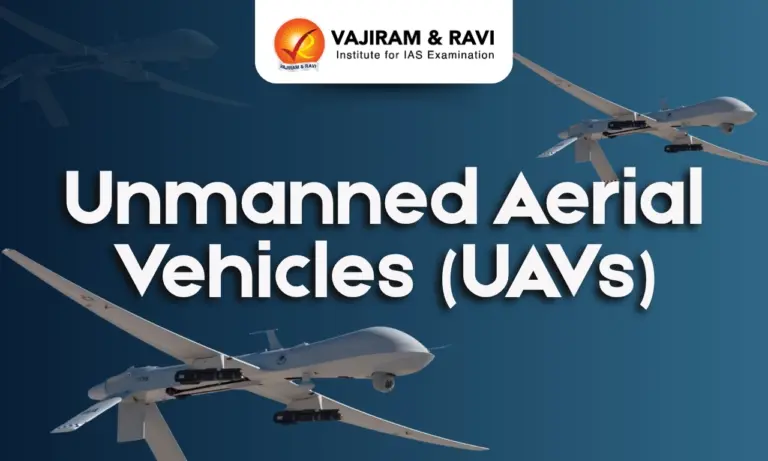
Unmanned Aerial Vehicles (UAVs), commonly known as drones, are aircraft that fly without a pilot onboard. They are controlled remotely by an operator or can fly automatically using pre-programmed software and sensors. UAVs are widely used in defense, agriculture, surveillance, disaster management, and photography. Their ability to reach difficult areas and collect real-time information makes them highly useful in many fields.
Unmanned Aerial Vehicles (UAVs) History
The history of Unmanned Aerial Vehicles (UAVs) dates back more than a century, evolving from simple pilotless aircraft into advanced drones used for military, commercial, and civilian purposes.
- 1849: One of the earliest examples of unmanned aerial warfare occurred when Austria used balloon bombs against Venice.
- 1916: During World War I, Britain developed the Aerial Target, considered one of the first pilotless aircraft.
- 1917: The United States created the Kettering Bug, an early unmanned flying bomb designed for military operations.
- 1930s: Radio-controlled aircraft were developed and used primarily as target drones for military training.
- World War II (1939–1945): Several countries experimented with unmanned aircraft for reconnaissance and attack missions.
- Vietnam War (1955–1975): The United States extensively used reconnaissance drones to collect battlefield information.
- 1980s: Advances in electronics, sensors, and communication systems significantly improved UAV capabilities.
- 1990s: Modern military drones such as the RQ-1 Predator were developed, providing real-time surveillance and intelligence.
- Early 2000s: UAVs became a key part of military operations in conflict zones, supporting reconnaissance and precision strikes.
- 2010s: Commercial drones gained popularity in agriculture, photography, mapping, infrastructure inspection, and delivery services.
- 2020s: Artificial Intelligence (AI), autonomous navigation, drone swarms, and advanced sensors have made UAVs more efficient and versatile.
- Present Day: UAVs are widely used across defense, agriculture, disaster management, environmental monitoring, logistics, healthcare, and scientific research.
Unmanned Aerial Vehicles (UAVs) Components
Unmanned Aerial Vehicles (UAVs) consist of several interconnected components that work together to ensure stable flight, navigation, communication, and mission execution.
1. Airframe
- The structural body of the UAV that holds all components together.
- Provides aerodynamic shape and stability during flight.
2. Propulsion System
- Consists of motors, engines, propellers, and power sources.
- Generates thrust required for take-off, flight, and landing.
3. Flight Controller
- Acts as the central processing unit of the UAV.
- Controls altitude, direction, speed, and flight stability.
4. Navigation System
- Uses GPS and onboard sensors to determine location.
- Helps the UAV follow planned routes and waypoints.
5. Communication System
- Transfers commands between the UAV and ground station.
- Sends real-time flight data, images, and videos.
6. Ground Control Station (GCS)
- Allows operators to monitor and control UAV operations.
- Displays flight status, navigation data, and mission information.
7. Sensors
- Collect environmental and operational data during flight.
- Support navigation, surveillance, mapping, and obstacle detection.
8. Payload
- Refers to mission-specific equipment carried by the UAV.
- May include cameras, LiDAR, thermal sensors, or delivery packages.
9. Power Supply System
- Provides energy to the propulsion and electronic systems.
- Usually consists of batteries, fuel cells, or fuel tanks.
10. Landing and Take-off System
- Enables safe take-off and landing of the UAV.
- Includes landing gear, skids, wheels, or VTOL mechanisms.


Unmanned Aerial Vehicles (UAVs) Types
Unmanned Aerial Vehicles (UAVs) can be classified into different categories based on their design, size, and operational capabilities. The five major types of UAVs are:
1. Nano UAVs
- Extremely small and lightweight drones, often weighing less than 250 grams.
- Used for surveillance, reconnaissance, and indoor operations where maneuverability is important.
2. Mini UAVs
- Small drones with moderate flight endurance and payload capacity.
- Commonly used for aerial photography, agriculture, mapping, and monitoring activities.
3. Fixed-Wing UAVs
- Designed like conventional airplanes with fixed wings for generating lift.
- Suitable for long-range missions, large-area surveillance, and environmental monitoring.
4. Rotary-Wing UAVs
- Equipped with rotating blades similar to helicopters.
- Capable of hovering, vertical take-off and landing (VTOL), and operating in confined spaces.
5. Hybrid UAVs
- Combine the features of fixed-wing and rotary-wing UAVs.
- Offer vertical take-off capability along with longer flight endurance and greater operational flexibility.
Unmanned Aerial Vehicles (UAVs) Application
Unmanned Aerial Vehicles (UAVs) are used in a wide range of sectors due to their ability to collect real-time data, access difficult locations, and perform tasks efficiently and cost-effectively.
- Defense and Security: UAVs are used for surveillance, reconnaissance, intelligence gathering, border monitoring, and target tracking. For example, India’s drone fleet is increasingly used to strengthen border security and maritime surveillance.
- Agriculture: Drones help farmers monitor crop health, assess soil conditions, and spray fertilizers and pesticides with precision, improving productivity and reducing resource wastage.
- Disaster Management: UAVs provide real-time images and damage assessments during floods, earthquakes, cyclones, and wildfires, helping authorities plan rescue and relief operations more effectively.
- Mapping and Surveying: Drones are widely used for land surveys, topographic mapping, and creating 3D models. They offer faster and more accurate data collection than traditional surveying methods.
- Infrastructure Inspection: UAVs inspect bridges, highways, railways, dams, pipelines, and power transmission lines, reducing inspection costs and improving worker safety.
- Environmental Monitoring: Drones assist in monitoring forests, wildlife populations, water bodies, air pollution, and climate-related changes. They are also used to detect forest fires and illegal deforestation.
- Logistics and Delivery Services: UAVs are increasingly being used to deliver medicines, emergency supplies, and commercial packages, particularly in remote and hard-to-reach areas.
- Media and Entertainment: Drones capture high-quality aerial photographs and videos for movies, sports events, tourism campaigns, news coverage, and documentaries.
- Scientific Research: Researchers use UAVs to collect data from glaciers, oceans, volcanoes, and other inaccessible regions for environmental and climate studies.
- Urban Planning and Smart Cities: Drones support traffic monitoring, construction management, land-use planning, and infrastructure development by providing accurate aerial data.
- Healthcare Services: UAVs help transport blood samples, vaccines, medicines, and medical equipment quickly during emergencies and in remote regions.
- Mining and Resource Exploration: Mining companies use drones for site surveys, stockpile measurements, mineral exploration, and safety inspections, improving efficiency and reducing operational risks.
Unmanned Aerial Vehicles (UAVs) in Modern Warfare
UAVs are extensively used for surveillance and reconnaissance, enabling armed forces to monitor enemy movements, troop deployments, and strategic locations in real time.
- Modern combat drones can carry precision-guided missiles and bombs, allowing military forces to conduct targeted strikes while minimizing collateral damage.
- UAVs support border security and counter-terrorism operations by tracking infiltrators, monitoring sensitive regions, and gathering intelligence in difficult terrains.
- Drones play a vital role in electronic warfare, where they can jam enemy communications, disrupt radar systems, and collect electronic intelligence.
- UAVs enhance battlefield awareness by providing commanders with continuous aerial imagery and live video feeds, improving decision-making during military operations.
- During the Russia–Ukraine War (2022–Present), drones emerged as one of the most decisive technologies on the battlefield. Both Russia and Ukraine have extensively used UAVs for reconnaissance, artillery targeting, kamikaze attacks, and long-range strikes.
- During the Nagorno-Karabakh War (2020) between Armenia and Azerbaijan, Azerbaijan’s extensive use of armed drones, particularly the Bayraktar TB2, played a decisive role.
- In the Syrian Civil War, multiple state and non-state actors used drones for reconnaissance, targeted strikes, and intelligence gathering, demonstrating the increasing accessibility of UAV technology.
- The United States has extensively employed UAVs such as the MQ-1 Predator and MQ-9 Reaper in operations across Afghanistan, Iraq, and other regions for surveillance and precision counter-terrorism strikes.
- In the Israel–Hamas conflict, UAVs have been used for surveillance, intelligence collection, target acquisition, and precision military operations in densely populated urban environments.
- Modern militaries are increasingly developing drone swarms, where multiple UAVs operate together using Artificial Intelligence (AI) to overwhelm enemy defenses and perform coordinated missions.
Future of UAV Technology
The future of Unmanned Aerial Vehicles (UAVs) is highly promising as advancements in Artificial Intelligence (AI), robotics, communication networks, and battery technology continue to expand their capabilities.
- Artificial Intelligence (AI)-Powered Drones: Future UAVs will use AI and Machine Learning (ML) to make autonomous decisions, identify targets, avoid obstacles, and analyze data with minimal human intervention.
- Drone Swarm Technology: Multiple UAVs will be able to operate together as coordinated swarms, sharing information and completing complex missions more efficiently than individual drones.
- Advanced Battery Systems: Improvements in battery technology and alternative energy sources such as hydrogen fuel cells will increase flight endurance, payload capacity, and operational range.
- Integration with 5G Networks: High-speed 5G connectivity will enable real-time communication, faster data transmission, and improved remote control capabilities for UAV operations.
- Urban Air Mobility (UAM): UAV technology is expected to contribute to the development of air taxis and autonomous passenger drones, transforming urban transportation systems.
- Autonomous Delivery Services: Future drones will play a major role in delivering packages, medicines, food, and emergency supplies with greater speed and efficiency.
- Smart Agriculture: Advanced UAVs will support precision farming through automated crop monitoring, disease detection, soil analysis, and targeted spraying operations.
- Enhanced Military Applications: Future combat UAVs will feature autonomous navigation, AI-driven targeting systems, stealth capabilities, and improved electronic warfare functions.
- Disaster Response and Emergency Services: UAVs will provide faster disaster assessment, search-and-rescue operations, and emergency medical deliveries in inaccessible areas.
- Improved Sensor Technologies: Advanced cameras, thermal imagers, LiDAR, radar, and hyperspectral sensors will enhance surveillance, mapping, and scientific research capabilities.
- Integration with the Internet of Things (IoT): UAVs will work alongside IoT devices to collect, transmit, and analyze data for smart cities, environmental monitoring, and industrial automation.

 Last updated on Oct, 2026
→ UPSC 2027 Notification will be released on 13 January 2027 at upsconline.nic.in.
→ Check Nobel Prize 2026 Winners List here.
→ Download PIB PRiSM Monthly Magazine 2026 here.
→ Check UPSC Monthly Current Affairs Magazine The Recitals here.
→ Check out the latest UPSC Syllabus here.
→ Download UPSC Model Answers for Mains 2026
→ UPSC Mains Question Paper 2026 is out now for Essay & GS Paper 1, 2, 3 & 4.
→ UPSC Calendar 2027 has been released.
→ Enroll in Vajiram & Ravi’s UPSC Mains Test Series 2027 for structured answer writing practice, expert evaluation, and exam-oriented feedback.
→ Join Vajiram & Ravi’s UPSC Mentorship Program 2027 for personalized guidance, strategy planning, and one-to-one support from experienced mentors.
→ Go through the UPSC Mains Previous Year Papers to enhance your preparation.
→ UPSC has released UPSC Toppers List 2025 with the Civil Services final result on its official website.
→ Also check Best UPSC Coaching in India
Unmanned Aerial Vehicles (UAVs) FAQs
Q1. What are Unmanned Aerial Vehicles (UAVs)?+
Q2. What is the main purpose of UAVs?+
Q3. What are UAVs commonly called?+
Q4. Where are UAVs used the most?+
Q5. How do UAVs fly without a pilot?+
Q6. What are the main advantages of UAVs?+
Tags: aerospace engineering defense studies security unmanned aerial vehicles