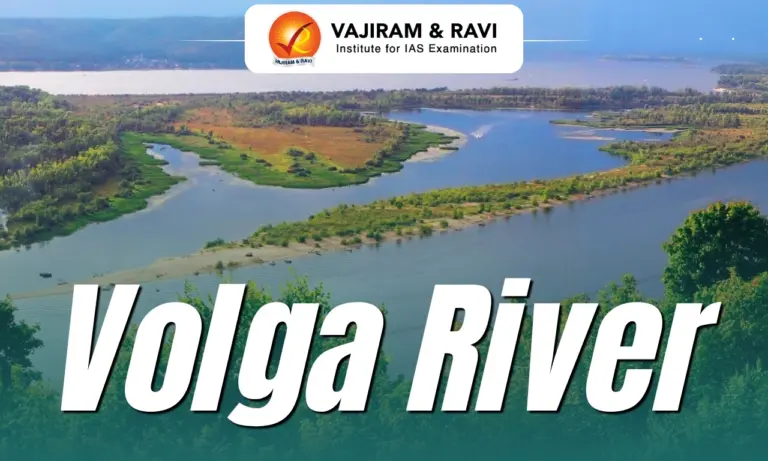
The Volga River is the longest river in Europe, stretching for about 3,530 km (2,194 miles) across western Russia. It originates in the Valdai Hills, northwest of Moscow, and flows southeast before emptying into the Caspian Sea near Astrakhan. Often called the “Mother Volga,” the river has played a crucial role in Russia’s history, economy, culture, transportation, and environmental heritage.
Volga River Origin
The Volga River originates in the Valdai Hills, located northwest of Moscow in western Russia. It begins as a small stream at an elevation of about 228 metres (748 feet) above sea level and flows southeast across European Russia. From its source, the river travels over 3,530 km before emptying into the Caspian Sea.
Volga River Drainage Basin
The Volga River Basin is one of the largest drainage basins in Europe, covering nearly 1.35 million square kilometres. Major tributaries are:
- Kama River – The largest and longest tributary of the Volga.
- Oka River – Joins the Volga at Nizhny Novgorod.
- Vetluga River – An important northern tributary.
- Sura River – Supports agriculture and settlements in central Russia.
- Sheksna River – Connects the Volga with northern waterways.
- Unzha River – Contributes to the upper Volga basin.


Major Cities Along the Volga River
The Volga River flows through several of Russia’s largest and most important cities, making it a major centre for trade, industry, transportation, and culture. These cities have developed along the river because of its abundant water resources and navigable waterways. Together, they form the industrial and agricultural heartland of Russia while contributing significantly to the country’s economy and history.
- Tver – Located in the upper course of the Volga and known for its historical importance.
- Nizhny Novgorod – A major industrial, commercial, and transportation hub.
- Kazan – Capital of Tatarstan and an important cultural and educational centre.
- Ulyanovsk – Known for manufacturing industries and historical significance.
- Samara – One of Russia’s largest industrial cities, especially for aerospace and engineering.
- Saratov – An important agricultural, educational, and industrial city.
- Volgograd – Famous for the Battle of Stalingrad during World War II.
- Astrakhan – Located near the Caspian Sea, known for fishing, shipping, and the Volga Delta.
Volga River Importance
The Volga River is the lifeline of Russia and the longest river in Europe, playing a vital role in the country’s economy, transportation, agriculture, history, and culture. It supports millions of people and connects major industrial and agricultural regions across western Russia.
- Supports nearly one-fourth of Russia’s agricultural production through irrigation and fertile plains.
- Generates significant hydroelectric power from several dams and reservoirs.
- Serves as Russia’s main inland waterway, linking the Baltic Sea, Black Sea, and Caspian Sea through canals.
- Supports major industries such as oil refining, shipbuilding, manufacturing, and fisheries.
- Flows through important cities including Kazan, Samara, Nizhny Novgorod, Volgograd, and Astrakhan.
- Played a crucial role during the Battle of Stalingrad in World War II, making it historically significant.
- Known as “Mother Volga,” symbolising Russian unity, resilience, and national identity.
- Provides habitat for 260 bird species and 70 fish species, making it an important biodiversity hotspot.
- Promotes trade, tourism, inland navigation, and regional economic development across European Russia.

 Last updated on Sep, 2026
→ UPSC 2027 Notification will be released on 13 January 2027 at upsconline.nic.in.
→ Check out the latest UPSC Syllabus here.
→ Download UPSC Model Answers for Mains 2026
→ UPSC Mains Question Paper 2026 is out now for Essay & GS Paper 1, 2, 3 & 4.
→ UPSC Calendar 2027 has been released.
→ Enroll in Vajiram & Ravi’s UPSC Mains Test Series 2027 for structured answer writing practice, expert evaluation, and exam-oriented feedback.
→ Join Vajiram & Ravi’s UPSC Mentorship Program 2027 for personalized guidance, strategy planning, and one-to-one support from experienced mentors.
→ Go through the UPSC Mains Previous Year Papers to enhance your preparation.
→ UPSC has released UPSC Toppers List 2025 with the Civil Services final result on its official website.
→ Also check Best UPSC Coaching in India
Volga River FAQs
Q1. Where does the Volga River originate?+
Q2. Into which sea does the Volga River flow?+
Q3. How long is the Volga River?+
Q4. Why is the Volga River called the "Mother Volga"?+
Q5. Which are the major tributaries of the Volga River?+
Tags: geography geography notes volga river