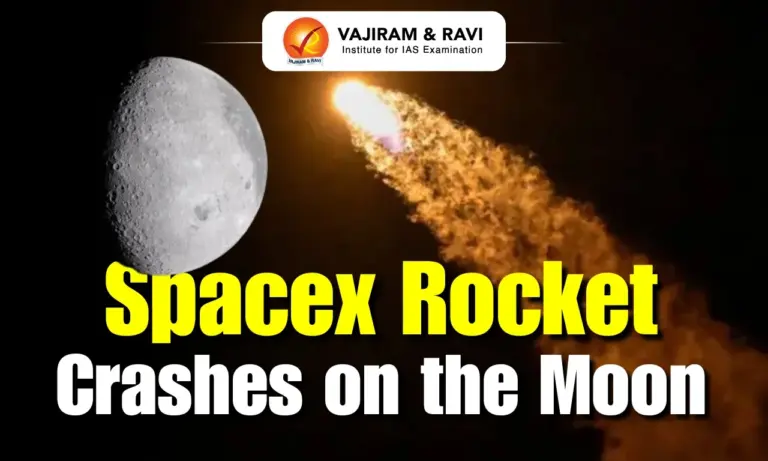
A SpaceX Falcon 9 upper stage crashed into the Moon on 5 August 2026, attracting global attention from scientists and space agencies. The rocket stage, which had been left in an uncontrolled orbit after launching a lunar mission in January 2025, impacted the Moon after drifting through space for nearly 18 months.
Scientists estimate that the impact created a crater about 18 metres (60 feet) wide and released a cloud of lunar dust and rocks.
What is SpaceX?
SpaceX (Space Exploration Technologies Corp.) is an American private aerospace company founded by Elon Musk in 2002. The company develops reusable rockets, spacecraft, and satellite systems to reduce the cost of space travel and support future human missions to the Moon, Mars, and beyond.
- Headquartered in Hawthorne, California, USA.
- Develops reusable launch vehicles, including the Falcon 9, Falcon Heavy, and Starship.
- Operates the Dragon spacecraft for transporting cargo and astronauts to the International Space Station (ISS).
- Provides Starlink satellite internet services through a large constellation of low Earth orbit satellites.
- Partners with NASA and other organizations for commercial crew, cargo, and deep-space exploration missions.
- Long-term vision is to enable human settlement on Mars and support sustainable exploration of the Moon and other celestial bodies.
What is the Falcon 9 Rocket?
Falcon 9 is a partially reusable, two-stage orbital launch vehicle developed by SpaceX for launching satellites, cargo, and astronauts into space. First launched in 2010, it is one of the world’s most reliable and frequently used rockets, known for significantly reducing launch costs through the reuse of its first-stage booster.
- Developed by SpaceX to carry satellites, cargo spacecraft, and astronauts into orbit.
- Two-stage rocket powered by Merlin engines, with a reusable first-stage booster.
- First launched in 2010 and has completed hundreds of successful missions.
- Supports missions for NASA, commercial customers, and international space agencies.
- Launches the Dragon spacecraft for cargo and crew missions to the International Space Station (ISS).
- Can place payloads into Low Earth Orbit (LEO), Geostationary Transfer Orbit (GTO), and interplanetary trajectories.
- Known for reusability, allowing the first-stage booster to land and be flown again, reducing the cost of space missions.


What is Space Debris?
Space debris, also known as space junk, refers to non-functional human-made objects left in space after completing their missions. These objects continue to orbit the Earth or travel through deep space, posing risks to satellites, spacecraft, astronauts, and future space exploration.
- Non-Functional Objects: Includes inactive satellites, discarded rocket stages, and spacecraft fragments that no longer serve any purpose.
- Sources of Debris: Created by satellite failures, rocket launches, accidental collisions, explosions, and anti-satellite (ASAT) tests.
- High-Speed Movement: Debris travels at extremely high speeds, making even small fragments capable of causing significant damage.
- Threat to Space Missions: It can collide with operational satellites, spacecraft, and the International Space Station, disrupting missions.
- Environmental Concern: Increasing debris raises the risk of Kessler Syndrome, where collisions generate even more debris.
- Need for Debris Mitigation: Controlled re-entry, end-of-life disposal plans, and active debris removal technologies help reduce space junk.
- Global Cooperation: International coordination and adherence to space debris mitigation guidelines are essential for safe and sustainable space exploration.

 Last updated on Oct, 2026
→ UPSC 2027 Notification will be released on 13 January 2027 at upsconline.nic.in.
→ Asian Games 2026 are being held in Aichi-Nagoya, Japan, from 19 September to 4 October.
→ Check Nobel Prize 2026 Winners List here.
→ Download PIB PRiSM Monthly Magazine 2026 here.
→ Check UPSC Monthly Current Affairs Magazine The Recitals here.
→ Check out the latest UPSC Syllabus here.
→ Download UPSC Model Answers for Mains 2026
→ UPSC Mains Question Paper 2026 is out now for Essay & GS Paper 1, 2, 3 & 4.
→ UPSC Calendar 2027 has been released.
→ Enroll in Vajiram & Ravi’s UPSC Mains Test Series 2027 for structured answer writing practice, expert evaluation, and exam-oriented feedback.
→ Join Vajiram & Ravi’s UPSC Mentorship Program 2027 for personalized guidance, strategy planning, and one-to-one support from experienced mentors.
→ Go through the UPSC Mains Previous Year Papers to enhance your preparation.
→ UPSC has released UPSC Toppers List 2025 with the Civil Services final result on its official website.
→ Also check Best UPSC Coaching in India
Spacex Rocket Crashes on the Moon FAQs
Q1. Why is the SpaceX Falcon 9 Moon crash in the news?+
Q2. What part of the rocket crashed into the Moon?+
Q3. Where did the impact occur?+
Q4. What is space debris?+
Q5. Why is responsible space debris management important?+
Tags: crashes on the moon spacex rocket spacex rocket crashes on the moon