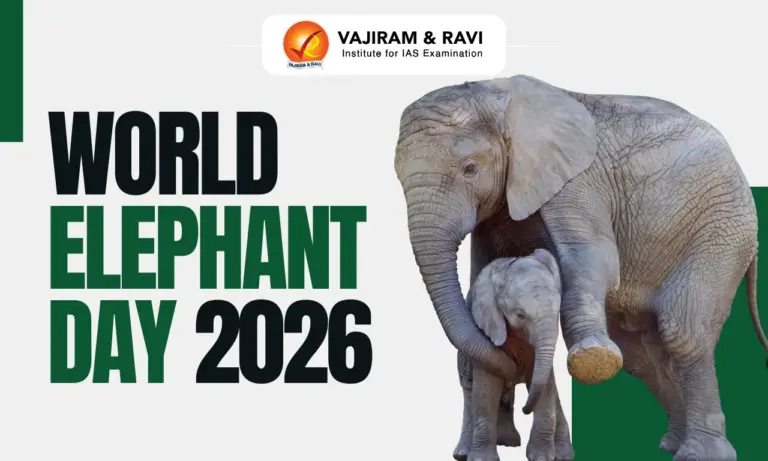
World Elephant Day is observed every year on 12th August to spread awareness about the protection and conservation of elephants across the world. It highlights the importance of elephants in maintaining ecological balance and draws attention to major threats such as habitat loss, poaching, and human-elephant conflict. The day encourages governments, organisations and individuals to come together and take steps for the survival and well-being of elephants. It also promotes the idea of peaceful coexistence between humans and elephants.
World Elephant Day 2026
- World Elephant Day is a global awareness campaign celebrated every year on August 12 to protect and support elephants across the world.
- It brings people together to raise awareness about the challenges elephants face and encourages action to help conserve them.
- The campaign was started in 2012 with the aim of spreading knowledge about elephants, their intelligence, emotional depth, and importance in ecosystems while also highlighting the serious threats to their survival.
- Over the years, World Elephant Day has reached millions of people worldwide through education programs, social media campaigns, and international events, helping build a strong global voice for elephant conservation.
- The initiative is supported by World Elephant Society, a nonprofit organization that works to manage campaigns, spread awareness, and organize events focused on elephant protection. The organization depends largely on public support and donations to continue its efforts.
- This day also recognizes the work of conservationists, wildlife organizations, and local communities who are actively working on the ground to protect elephants and their habitats.
- Elephants today face many serious threats, including poaching for ivory, habitat loss, human-wildlife conflict, and climate change. World Elephant Day helps bring attention to these issues and encourages people to take meaningful steps toward solutions.
- People celebrate this day by participating in awareness drives, educational programs, social campaigns, and conservation activities, all aimed at protecting these gentle giants for future generations.
- World Elephant Day is not just about celebration, it is a global movement that inspires individuals and communities to take responsibility and contribute to the survival and well-being of elephants.
World Elephant Day 2026 Theme
The theme of World Elephant Day 2026, “Bringing the world together to help elephants,” highlights the need for global unity in protecting these majestic animals. It emphasizes collective responsibility across countries, communities, and organizations. The theme encourages awareness, conservation efforts, and stronger action against threats like poaching and habitat loss. Overall, it calls for people worldwide to work together to ensure a safe future for elephants.
Also Read:- Elephant Corridor in India


Key Facts About Elephants
- Three Species: Elephants are of three types–African Savannah, African Forest, and Asian elephants. African elephants are larger with big ears, while Asian elephants have smaller ears.
- Largest Land Animal: Elephants are the biggest animals on land, known for their size, strength, and intelligence.
- Lifespan & Reproduction: They can live up to 60-65 years. Females have a 22-month pregnancy and reproduce slowly, making population growth difficult.
- Family Structure: Elephant groups are led by a matriarch (oldest female) and have strong family bonds.
- Tusks: Tusks are long teeth used for feeding, digging, and protection, but they also make elephants a target for ivory poaching.
- Communication: Elephants communicate through sounds, touch, and ground vibrations, showing high intelligence.
- Population Decline: Elephant numbers are rapidly decreasing due to poaching, habitat loss, and human conflict.
- Protection Status (Asian Elephants):
- IUCN Red List: Endangered
- Wildlife (Protection) Act, 1972: Schedule I
- CITES: Appendix I
Decline in Elephant Population
- Elephant populations have dropped sharply in recent years, with some reports suggesting a decline of over 60% in the past decade.
- If urgent action is not taken, elephants could face extinction in the near future.
- In Africa alone, around 100 elephants are killed every day due to illegal activities like poaching.
- Today, only about 400,000 African elephants are left in the wild.
- The growing demand for ivory products has made illegal wildlife trade highly profitable, increasing the threat to elephants.
- This alarming situation is one of the main reasons why World Elephant Day was created to spread awareness and promote conservation efforts.
Major Reasons Behind the Decline
1. Poaching
- Elephants are often killed for their ivory tusks, which are sold illegally in global markets.
- In some regions, elephants are also captured from the wild for use in tourism, zoos, and entertainment industries.
- Young elephants are sometimes separated from their families and forced into captivity, which affects their physical and emotional well-being.
2. Habitat Loss
- Rapid urbanization, farming, and infrastructure development are reducing elephant habitats.
- Forests and natural areas are being divided into smaller patches, making it difficult for elephants to move freely and find food and water.
- As their space shrinks, elephants are often forced to enter human areas, leading to conflict.
3. Human-Elephant Conflict
- When elephants enter villages or farmland in search of food, it can result in damage to crops and property.
- This creates tension between humans and elephants, sometimes leading to injuries or deaths on both sides.
- Increasing human population and development projects like roads and railways are major causes of this conflict.
- Creating wildlife corridors can help reduce these clashes by allowing elephants to move safely.
4. Mistreatment in Captivity
- Many elephants in captivity are used for tourism, rides, or entertainment, often under poor conditions.
- They are sometimes trained using harsh methods, which can cause long-term physical and mental harm.
- Studies show that elephants in captivity often have shorter lifespans and health problems.
- Supporting ethical tourism and avoiding activities like elephant rides can help reduce this cruelty.
Schemes and Conservation Efforts for Elephants in India
- Project Elephant (1992): A centrally sponsored scheme focused on protecting elephants, their habitats, and migration corridors. It supports states through funding, anti-poaching measures, and conflict mitigation strategies. Now integrated with Project Tiger for better coordination.
- Project RE-HAB (Bee Fencing Initiative): Launched by KVIC, it uses bee boxes along forest boundaries to prevent elephants from entering human settlements, helping reduce human-elephant conflict in a natural and non-harmful way.
- Elephant Reserves: India has established 33 Elephant Reserves across 14 states to provide safe habitats and ensure long-term conservation of elephant populations.
- Elephant Corridors: Around 150 corridors have been identified and protected to allow safe movement of elephants between fragmented forests, reducing conflict and maintaining genetic diversity.
- Legal Protection Measures: Elephants receive the highest protection under the Wildlife (Protection) Act, 1972 (Schedule I), along with international protection under CITES Appendix I.
- Use of Technology in Conservation: Tools like satellite monitoring and Land Use Land Cover (LULC) analysis are used to track habitat changes and identify threats.
- MIKE Programme: The Monitoring of Illegal Killing of Elephants (MIKE) programme helps in tracking poaching trends and improving conservation strategies.
- Institutional Support: The Wildlife Institute of India (Elephant Cell) provides research, training, and technical guidance to strengthen conservation efforts.
- Habitat Protection Approach: Conservation is supported through protected areas like Tiger Reserves, Wildlife Sanctuaries, and Reserved Forests, ensuring a broader ecosystem-based approach.
- Community Involvement: Increasing focus on local participation, awareness, and coexistence strategies to reduce conflict and ensure sustainable conservation.

 Last updated on Oct, 2026
→ UPSC 2027 Notification will be released on 13 January 2027 at upsconline.nic.in.
→ Asian Games 2026 are being held in Aichi-Nagoya, Japan, from 19 September to 4 October.
→ Check Nobel Prize 2026 Winners List here.
→ Download PIB PRiSM Monthly Magazine 2026 here.
→ Check UPSC Monthly Current Affairs Magazine The Recitals here.
→ Check out the latest UPSC Syllabus here.
→ Download UPSC Model Answers for Mains 2026
→ UPSC Mains Question Paper 2026 is out now for Essay & GS Paper 1, 2, 3 & 4.
→ UPSC Calendar 2027 has been released.
→ Enroll in Vajiram & Ravi’s UPSC Mains Test Series 2027 for structured answer writing practice, expert evaluation, and exam-oriented feedback.
→ Join Vajiram & Ravi’s UPSC Mentorship Program 2027 for personalized guidance, strategy planning, and one-to-one support from experienced mentors.
→ Go through the UPSC Mains Previous Year Papers to enhance your preparation.
→ UPSC has released UPSC Toppers List 2025 with the Civil Services final result on its official website.
→ Also check Best UPSC Coaching in India
World Elephant Day 2026 FAQs
Q1. What is World Elephant Day?+
Q2. Why is World Elephant Day celebrated?+
Q3. What is the theme of World Elephant Day 2026?+
Q4. When was World Elephant Day started?+
Q5. What are the major threats to elephants?+
Q6. How many species of elephants are there?+
Q7. What is the conservation status of Asian elephants?+
Q8. What is Project Elephant?+
Q9. How can people contribute to elephant conservation?+
Q10. Why are elephants important for the environment?+
Tags: environment environment notes world elephant world elephant day world elephant day 2026