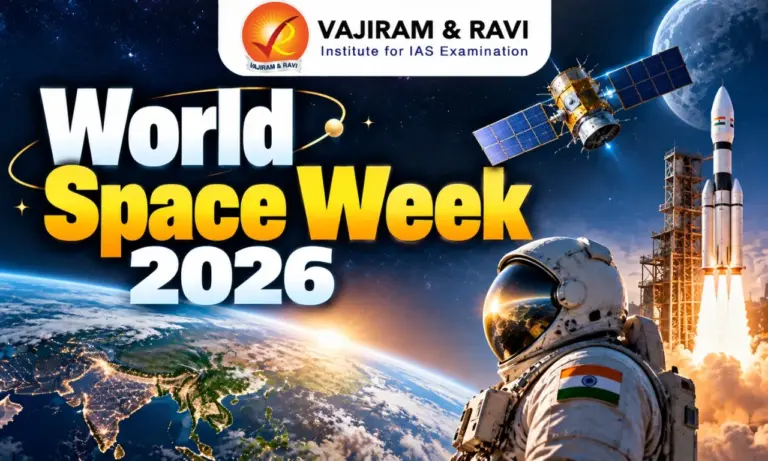
World Space Week 2026 will be observed globally from October 4 to 10. It is an annual international celebration of space science and technology and their contribution to human welfare. The United Nations General Assembly established the observance in 1999. The dates mark the launch of Sputnik 1 in 1957 and the entry into force of the Outer Space Treaty in 1967.
World Space Week 2026
World Space Week 2026 will be celebrated from October 4 to 10 across more than 95 nations. The annual observance promotes space education, public awareness, international cooperation and sustainable use of space technology. It is coordinated by the United Nations with support from the World Space Week Association. The programme also encourages students to explore science, technology, engineering and mathematics through space related Events.
World Space Week Theme 2026
The World Space Week 2026 Theme is “Rocket Revolution.” It highlights the rapid transformation of space launch systems and the growing access to space. Launch activities are no longer limited to a small number of government programmes. Commercial launch providers, reusable rockets, startups, university teams and new national space actors are expanding participation. The theme also reflects changes in launch frequency, accessibility and applications.


World Space Week 2026 History
The history of World Space Week is linked with two major milestones that shaped modern space exploration and international space governance.
- United Nations declaration: On December 6, 1999, the United Nations General Assembly adopted resolution 54/68 and declared October 4 to 10 as World Space Week.
- Sputnik 1 launch: On October 4, 1957, Sputnik 1 became the first human made Earth satellite to be launched into outer space. Its launch opened a new era of space exploration.
- Outer Space Treaty: On October 10, 1967, the Treaty on Principles Governing the Activities of States in the Exploration and Use of Outer Space, including the Moon and Other Celestial Bodies entered into force.
- United Nations’ Role: The United Nations recognised outer space as a new dimension of human activity and promoted its peaceful use. Resolution 1348 (XIII) was its first resolution related to outer space.
- International Coordination: At least 25 United Nations entities and the World Bank Group routinely use space applications. The Inter Agency Meeting on Outer Space Activities supports coordination across the UN system.
- UNOOSA Role: The United Nations Office for Outer Space Affairs promotes international cooperation in peaceful space activities. It also serves as the secretariat for COPUOS and maintains the United Nations Register of Objects Launched into Outer Space.
World Space Week 2026 Events
World Space Week 2026 Events aim to connect space activities with education, public awareness, sustainable development and international cooperation through diverse programmes worldwide.
- Educational activities: World Space Week includes school programmes, exhibitions and educational activities that introduce students to space science, technology and its benefits.
- Global participation: World Space Week is observed in more than 95 nations. In 2019, more than 8,000 events were organised across 96 countries.
- Public engagement: Government programmes, planetarium activities and public outreach programmes help demonstrate public support for space programmes and improve awareness of space applications.
- Education resources: The World Space Week Association provides educational resources. A global Calendar of Events also records activities organised by participating nations.
- Annual theme: The World Space Week Association Board of Directors selects the yearly theme in coordination with the UN Office of Outer Space Affairs. The theme gives common guidance for programmes worldwide.
- World Space Week Association: The World Space Week Association is a non governmental, non profit organisation supported by national coordinators in more than 50 nations. Its Board of Directors works on space education and outreach.
Sputnik 1
Sputnik 1 was the first human made satellite to orbit Earth, marking the beginning of the Space Age and a major milestone in space exploration.
- Launch and significance: Sputnik 1 was launched by the Soviet Union on October 4, 1957, from Gagarin’s Start at Tyuratam. Its launch began the Space Age and the Space Race.
- First artificial satellite: Officially designated Satellite 1, Sputnik 1 became the first artificial satellite to successfully enter Earth’s orbit and demonstrated that objects could be placed into orbit.
- Design and signals: Sputnik 1 was a polished aluminium alloy sphere with four external radio antennas. Its radio transmitters sent signals on two frequencies that could be monitored worldwide.
- Orbital operation: The satellite completed one Earth revolution in about 96 minutes. It continued orbiting after its radio batteries were exhausted and completed 1,440 orbits before re-entering the atmosphere on January 4, 1958.
- Scientific objectives: Sputnik 1 helped study atmospheric density, radio signal propagation and orbital tracking. Its orbital decay and radio signals provided useful information about the upper atmosphere and ionosphere.
- Global impact: The successful launch surprised the world and accelerated the Space Race. It also demonstrated the space launch potential of the R 7 rocket, supporting later Soviet lunar and human spaceflight missions.
World Space Week 2026 in India
India participates in World Space Week through space education, public outreach and programmes that highlight the country’s expanding space capabilities.
- Educational focus: Activities in India support awareness of space technology and encourage young people to develop interest in science, technology, engineering and mathematics.
- International cooperation: India’s space engagement extends beyond domestic programmes. The country has signed over 300 space cooperation agreements with 61 countries and 5 multilateral organisations.
Also Read: National Space Day 2026
Space Sector in India
India’s space sector has expanded from a government led system into a broader ecosystem involving public institutions, private companies and international partnerships.
- Early foundation: India’s space journey began with Aryabhata in 1975. The satellite was launched by the Soviet Union and marked India’s first satellite mission.
- Private participation: India opened the space sector to private participation in 2020. The Indian Space Policy 2023 further expanded private involvement across the space value chain.
- FDI reforms: Foreign investment rules were liberalised in February 2024. Up to 100% investment was permitted in satellite component manufacturing activities.
- Launch vehicles: India has operationalised PSLV, GSLV, GSLV Mk III and SSLV. These vehicles support Earth observation, communication, navigation, scientific, exploration and commercial missions.
- Launch infrastructure: Sriharikota has two operational launch pads, while a third is being established. Kulasekarapattinam is being developed as India’s second rocket launch site.
- Earth observation: The EO PPP framework is developing India’s first privately owned Earth observation satellite constellation. It has around ₹1,200 crore in private investment commitments.
- Lunar exploration: Chandrayaan 1, launched in 2008, detected water molecules and hydroxyl on the Moon. Chandrayaan 2, launched in 2019, operated an orbiter at 100 km altitude and captured images with resolution up to 30 cm.
- Mars mission: The Mars Orbiter Mission, or Mangalyaan, entered Martian orbit on September 24, 2014. It operated for more than eight years against its planned six month mission life.
- Astronomy and solar science: AstroSat is India’s first dedicated astronomy mission. Aditya L1, launched in 2023, observes the Sun from the Sun-Earth L1 point nearly 1.5 million km from Earth and has released more than 27 TB of solar data publicly.
- X ray astronomy: XPoSat was launched in January 2024. It expanded India’s capabilities in X ray polarization astronomy and studies extreme cosmic sources.
- Space docking: SPADEX conducted in January 2025 demonstrated autonomous space docking and undocking. India became the fourth nation to demonstrate this capability.
- Human spaceflight: Axiom 4 launched on June 25, 2025. Group Captain Shubhanshu Shukla became India’s first astronaut to journey to the International Space Station. The mission concluded on July 15, 2025.
- Earth monitoring: NISAR, jointly developed by ISRO and NASA, was launched on July 30, 2025. It monitors land, glaciers, forests, oceans and environmental changes.
- Upcoming missions: TRISHNA is scheduled for 2026 for high resolution thermal observations. Gaganyaan targets its first uncrewed experimental mission in Q4 2026 and a crewed mission by 2027.
- Future exploration: Chandrayaan 4 is planned for 2027 to demonstrate lunar sample collection and return. Chandrayaan 5/LUPEX will investigate lunar water and other volatiles near the south polar region.
- Venus exploration: The Venus Orbiter Mission is targeted for March 2028. It will study Venusian geology, atmosphere and ionosphere while demonstrating aerobraking and advanced thermal management technologies.
- Future space infrastructure: India is developing SPADEX 2 and SPADEX 3 for advanced docking and transfer capabilities. The NGLV is being developed as a partially reusable vehicle using LOX Methane propulsion.
- Bharatiya Antariksh Station: India’s planned space station targets the launch of its first module, BAS 01, by 2028. The station is planned to become fully operational by 2035.
- India-France Space Cooperation: In September 2026, India and France agreed to deepen cooperation in human spaceflight, advanced space technologies and private sector participation. Three new industry agreements also covered satellite launches, space surveillance and microsatellite technology.

 Last updated on Sep, 2026
→ UPSC 2027 Notification will be released on 13 January 2027 at upsconline.nic.in.
→ Asian Games 2026 are being held in Aichi-Nagoya, Japan, from 19 September to 4 October.
→ Check out the latest UPSC Syllabus here.
→ Download UPSC Model Answers for Mains 2026
→ UPSC Mains Question Paper 2026 is out now for Essay & GS Paper 1, 2, 3 & 4.
→ UPSC Calendar 2027 has been released.
→ Enroll in Vajiram & Ravi’s UPSC Mains Test Series 2027 for structured answer writing practice, expert evaluation, and exam-oriented feedback.
→ Join Vajiram & Ravi’s UPSC Mentorship Program 2027 for personalized guidance, strategy planning, and one-to-one support from experienced mentors.
→ Go through the UPSC Mains Previous Year Papers to enhance your preparation.
→ UPSC has released UPSC Toppers List 2025 with the Civil Services final result on its official website.
→ Also check Best UPSC Coaching in India
World Space Week 2026 FAQs
Q1. What is World Space Week 2026?+
Q2. What is the theme of World Space Week 2026?+
Q3. Why is World Space Week Celebrated from October 4 to 10?+
Q4. Who declared World Space Week?+
Q5. How does India celebrate World Space Week 2026?+
Q6. When is World Space Week 2026 celebrated?+
Q7. What are the events of World Space Week 2026?+
Q8. What was Sputnik 1?+
Q9. Which was the first artificial satellite to orbit Earth?+
Q10. Who organizes World Space Week each year?+
Tags: world space week world space week 2026