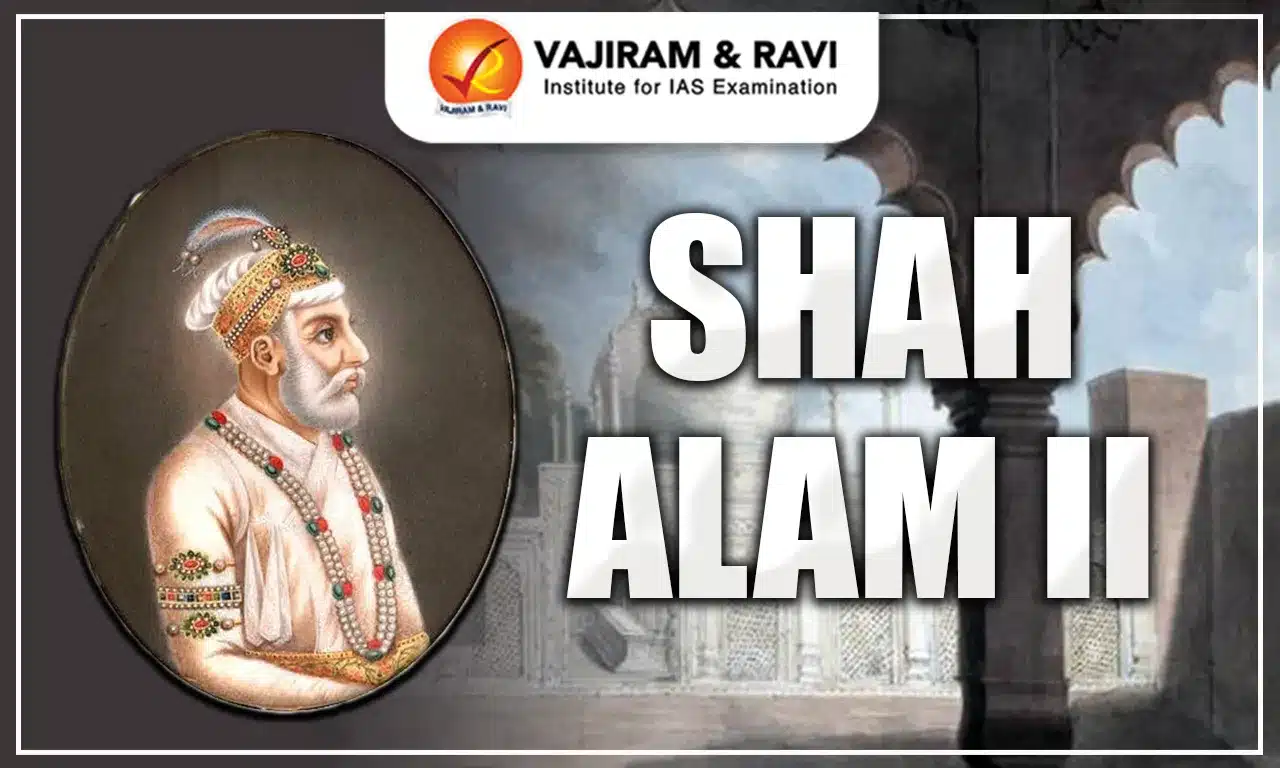
Shah Alam II, also known as Ali Gohar, was the seventeenth Mughal Emperor and the son of Alamgir II. He ruled from 1759 to 1806, a period when the Mughal Empire was in decline. His authority had weakened so much that a Persian saying emerged: “Sultanat-e-Shah Alam, Az Dilli ta Palam,” meaning “The kingdom of Shah Alam stretches from Delhi to Palam,” with Palam being just a suburb of Delhi. He is also remembered as the Mughal emperor who fought in the Battle of Buxar in 1764.
Shah Alam II Early Life
- Ali Gohar, later known as Shah Alam II, was born on June 25, 1728, to Shahzada Aziz-ud-Din, the son of the deposed Mughal Emperor Jahandar Shah.
- He spent his early years in semi-captivity within the Salatin quarters of the Red Fort alongside his father.
- Unlike many Mughal princes raised in similar conditions, he didn’t grow up indulged or idle. When his father became emperor, Ali Gohar was named Crown Prince (Waali al-Ahd) and acted as his main representative, although real power remained with the Wazir, Imad-ul-Mulk.
- Conflicts with the Wazir and fears for his own safety eventually forced him to flee Delhi in 1758.
- Though widely recognized as the legitimate emperor, Shah Alam II couldn’t return to Delhi until 1772 after gaining the protection of the Maratha leader Mahadaji Shinde.
- During this turbulent period, he also fought in the Battle of Buxar against the British East India Company.
Shah Alam II Reign
- During Shah Alam II Reign, the Mughal Empire had become a shadow of its former self, with real political authority almost entirely lost.
- Owing to rising tensions and conflicts with the powerful wazir Imad-ul-Mulk, Shah Alam fled Delhi and took refuge in Awadh between 1761 and 1764.
- When the Marathas regained control over Delhi, they extended an invitation to Shah Alam II to return, which he accepted, allowing him to be nominally restored as emperor.
- Throughout his reign, Shah Alam II had to contend with repeated invasions, particularly from Ahmad Shah Abdali, the Emir of Afghanistan, whose campaigns caused massive instability in northern India.
- One of the most significant consequences of Abdali’s invasions was the Third Battle of Panipat in 1761, fought between the Marathas who held political dominance in Delhi and Abdali’s Afghan forces.
- In 1760, the Marathas under Sadashivrao Bhau drove out Abdali’s allies and deposed Shah Jahan III, a puppet emperor installed by Imad-ul-Mulk, reinstating Shah Alam II as the legitimate Mughal sovereign (1760–1772).
- Shah Alam’s political decisions led him to join forces with Mir Qasim of Bengal and Shuja-ud-Daula of Awadh against the British East India Company in the Battle of Buxar in 1764. The alliance was defeated by British commander Hector Munro.
- Following this defeat, the Treaty of Allahabad was signed around 1765, in which Shah Alam II granted the East India Company Diwani rights permission to collect land revenue in Bengal, Bihar, and Orissa.
- This treaty effectively made Shah Alam II the first Mughal emperor to become a pensioner of the East India Company, living under their protection and relying on their financial support.
- The Bengal Famine, 1770 signaled the deepening collapse of the Mughal Empire and exposed the growing power in the Indian subcontinent.
- By the time the famine took hold, it was clear that the Mughal Empire had lost its grip not just on international affairs, but even on its own territories in South Asia. It was no longer the force it once was.
- During his attempt to regain control over the Eastern Subahs, Shah Alam II received support from Jean Law de Lauriston, a French officer, and about 200 French troops showing the complex foreign involvement in Indian politics at the time.
- He maintained contact with Hyder Ali and later with Tipu Sultan during the Anglo-Mysore Wars, sharing their concerns over British expansion and viewing the East India Company’s growing power with alarm.
- Shah Alam II died of natural causes on November 19, 1806, marking the end of one of the powerless reigns in Mughal history.
- He was buried alongside other later Mughals, including Bahadur Shah I and Akbar Shah II, in a marble enclosure near the dargah of the 13th-century Sufi saint Qutbuddin Bakhtiar Kaki in Mehrauli, Delhi.
- Despite his political failures, Shah Alam II was a poet who wrote under the pen name “Aftab” and published a collection of poetry known as a Diwan, compiled and preserved by Mirza Fakhir Makin.
- He was also the author of Ajaib-ul-Qasas, a classic of early Urdu literature that remains a significant part of the language’s literary heritage.


 Last updated on Sep, 2026
→ UPSC 2027 Notification will be released on 13 January 2027 at upsconline.nic.in.
→ Asian Games 2026 are being held in Aichi-Nagoya, Japan, from 19 September to 4 October.
→ Check out the latest UPSC Syllabus here.
→ Download UPSC Model Answers for Mains 2026
→ UPSC Mains Question Paper 2026 is out now for Essay & GS Paper 1, 2, 3 & 4.
→ UPSC Calendar 2027 has been released.
→ Enroll in Vajiram & Ravi’s UPSC Mains Test Series 2027 for structured answer writing practice, expert evaluation, and exam-oriented feedback.
→ Join Vajiram & Ravi’s UPSC Mentorship Program 2027 for personalized guidance, strategy planning, and one-to-one support from experienced mentors.
→ Go through the UPSC Mains Previous Year Papers to enhance your preparation.
→ UPSC has released UPSC Toppers List 2025 with the Civil Services final result on its official website.
→ Also check Best UPSC Coaching in India
Shah Alam II FAQs
Q1. Who was Shah Alam II?+
Q2. What was Shah Alam II’s real name?+
Q3. When did Shah Alam II rule India?+
Q4. Which major battle did Shah Alam II participate in?+
Q5. What was the result of the Battle of Buxar for Shah Alam II?+
Tags: shah alam ii