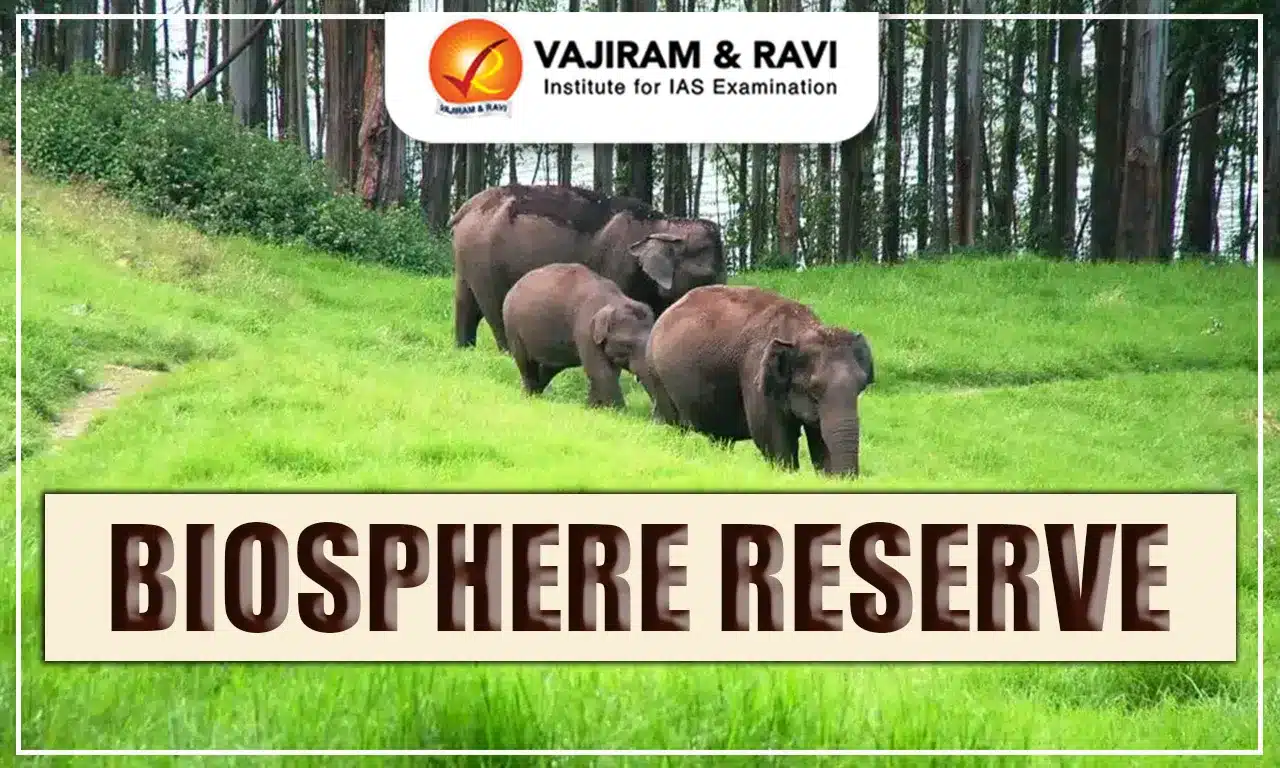
Biosphere Reserves in India 2026 are designated by UNESCO (United Nations Educational, Scientific and Cultural Organization) to protect representative parts of natural and cultural landscapes. These areas may cover large terrestrial, coastal, or marine ecosystems, or a combination of both. It protects and maintains the diversity of flora, fauna, and ecosystems and promotes economic and social development that aligns with ecological conservation. Biosphere Reserves serve as living examples of coexistence between humans and nature, demonstrating how development and conservation can progress together while respecting each other’s needs.
What are Biosphere Reserves?
Biosphere Reserves are declared by countries and recognized under UNESCO’s Man and the Biosphere (MAB) Programme. Their main goal is to promote sustainable development through local community involvement and scientific management.
- These reserves encompass terrestrial, marine, and coastal ecosystems, conserving all forms of life in situ along with their support systems. They also act as reference sites for monitoring and evaluating ecological changes over time.
- Part of UNESCO’s Man and Biosphere (MAB) framework since 1971, Biosphere Reserves are nominated by national governments. There are over 500 reserves across more than 100 countries, highlighting their importance in preserving ecosystems while supporting human development.
- The Biosphere Reserves programme was initiated by UNESCO in 1971, with the first reserve established in 1979. Since then, the network has grown to 686 reserves across 122 countries, including 20 transboundary sites.
- Biosphere Reserves are nominated by national governments and remain under the sovereign jurisdiction of the countries where they are located. Despite this, their status is internationally recognized, highlighting their global importance in biodiversity conservation and sustainable development.
Biosphere Reserves Structure
Biosphere Reserves are structured into three interconnected zones, each designed to balance conservation with sustainable use. These zones work together to protect biodiversity while supporting research, education, and local livelihoods.
| Biosphere Reserve Structure | ||
| Zone | Description | Purpose/ Function |
|
Core Area |
Strictly protected ecosystem. |
Conserves landscapes, ecosystems, species, and genetic variation. |
|
Buffer Zone |
Surrounds or adjoins the core area. |
Supports ecological practices, scientific research, monitoring, training, and education. |
|
Transition Area |
Outermost zone with human settlements and activities. |
Encourages sustainable economic and human development, blending ecological and socio-cultural needs. |


Biosphere Reserves Declaration Criteria 2026
The core area of the Biosphere Reserves should represent a typical bio-geographical unit and be large enough to sustain viable populations across all trophic levels.
- It must include an effectively protected and minimally disturbed core zone with significant value for nature conservation.
- The site should have potential for preserving traditional tribal or rural lifestyles that reflect harmonious use of the environment.
- The management authority must involve and cooperate with local communities to integrate biodiversity conservation with socio-economic development.
- Efforts should focus on managing and containing conflicts while using community knowledge and experience for sustainable outcomes.
How Many Biosphere Reserves in India 2026?
There are currently 18 Biosphere Reserves in India as of 2026. Among these, 13 Reserves are officially recognized by UNESCO under MAB (Man and the Biosphere) Programme. According to the 2025 report of FAO, India ranks 9th globally in terms of Forest Area cover and 3rd globally in terms of annual gain through forests. Several Government initiatives promote the management and functioning of the Biosphere Reserves in India, such as- Project Tiger, Project Elephant, Green India Mission, etc.
List of 18 Biosphere Reserves of India with States 2026
India is home to a rich natural heritage, with ecosystems, to preserve this biodiversity and promote sustainable development, the country has established 18 Biosphere Reserves. Below is the complete List of Biosphere Reserves in India 2026, along with their year of establishment, states covered, and key species protected.
| List of 18 Biosphere Reserves in India State Wise 2026 | |||||
| S No | Year | Biosphere Reserves | State(s) | Key Species | Area (km²) |
| 1 |
1986 |
Tamil Nadu, Karnataka, Kerala |
Nilgiri Tahr, Tiger |
5,520 |
|
| 2 |
1988 |
Nanda Devi |
Uttarakhand |
Snow Leopard, Musk Deer |
5,860 |
| 3 |
1988 |
Meghalaya |
Red Panda, Hoolock Gibbon |
820 |
|
| 4 |
1989 |
Tamil Nadu |
Dugong, Olive Ridley Turtle |
10,500 |
|
| 5 |
1989 |
West Bengal |
Royal Bengal Tiger |
9,630 |
|
| 6 |
1989 |
Manas |
Assam |
Asiatic Elephant, Golden Langur |
2,837 |
| 7 |
1989 |
Andaman & Nicobar |
Saltwater Crocodile, Nicobar Megapode |
885 |
|
| 8 |
1994 |
Odisha |
Gaur, Tiger, Elephant |
4,374 |
|
| 9 |
1998 |
Arunachal Pradesh |
Takin, Red Panda |
5,112 |
|
| 10 |
1997 |
Dibru-Saikhowa |
Assam |
Gangetic Dolphin, Bengal Tiger |
765 |
| 11 |
1999 |
Madhya Pradesh |
Indian Giant Squirrel |
4,981 |
|
| 12 |
2000 |
Sikkim |
Red Panda, Snow Leopard |
2,620 |
|
| 13 |
2001 |
Kerala, Tamil Nadu |
Nilgiri Tahr, Elephant |
3,500 |
|
| 14 |
2005 |
Achanakmar-Amarkantak |
Madhya Pradesh, Chhattisgarh |
Wild Dog, Sarus Crane |
3,835 |
| 15 |
2008 |
Gujarat |
Indian Wild Ass |
12,454 |
|
| 16 |
2009 |
Himachal Pradesh |
Snow Leopard |
7,770 |
|
| 17 |
2010 |
Andhra Pradesh |
Slender Loris |
4,755 |
|
| 18 |
2011 |
Madhya Pradesh |
Bengal Tiger, Chinkara |
2,998 |
|
UNESCO Biosphere Reserves in India 2026
There are a total 13 Biosphere Reserves in India Recognized by UNESCO under MAB. These include: Achanakmar-Amarkantak, Pachmarhi, Agasthyamala, Gulf of Mannar, Khangchendzonga, Nokrek, Cold Desert, Great Nicobar, Nilgiri, Panna, Similipal, Nanda Devi and Sunderban. These UNESCO Biosphere Reserves have been discussed in detail below:
1. Achanakmar-Amarkantak Biosphere Reserve
The Achanakmar-Amarkantak Biosphere Reserve is a biodiversity rich UNESCO Biosphere Reserve spread across Madhya Pradesh and Chhattisgarh with diverse forests and wildlife.
- Location: The biosphere reserve covers about 3,83,551 hectares at the junction of major hill ranges in Madhya Pradesh and Chhattisgarh. Its landscape includes mountains, valleys, plains and dense forests, creating diverse natural habitats.
- UNESCO Recognition: The reserve was included in the UNESCO World Network of Biosphere Reserves in 2012.
- Biodiversity: About 63% of the reserve is covered by moist deciduous forests. It supports nearly 1,498 plant species and 327 animal species, including the four horned antelope, Indian wild dog, sarus crane, Asian white backed vulture and several rare and threatened species.
- Ecological and Human Importance: The reserve has varied rocks and fertile soils that support forests, rivers and wildlife. Around 418 villages with tribal and non tribal communities depend on agriculture, medicinal plants, bamboo handicrafts and other non timber forest products for their livelihoods.
2. Pachmarhi Biosphere Reserve
Pachmarhi Biosphere Reserve is a UNESCO recognised protected area in central India, known for its rich forests, wildlife, unique landscapes and ecological importance.
- Location: Pachmarhi Biosphere Reserve is located in Madhya Pradesh within the Satpura Range of the Deccan Peninsula. It covers about 4,981.72 sq km and includes Bori Sanctuary, Satpura National Park and Pachmarhi Sanctuary, together forming the Satpura Tiger Reserve.
- UNESCO Recognition: It was recognised by UNESCO in 2009. The reserve is internationally recognised under UNESCO’s World Network of Biosphere Reserves for conserving biodiversity while promoting sustainable development.
- Biodiversity and Ecosystems: Tropical moist deciduous, tropical dry deciduous and subtropical hill forests dominate the reserve. Teak and sal are the major tree species. It also contains over 150 medicinal plant species, 50 mammal species, 254 bird species, 30 reptile species and 50 butterfly species.
- Important Ecological and Cultural Features: The reserve includes valleys, waterfalls, marshes, streams and the Pachmarhi Plateau, often called the “Queen of Satpura.” It provides habitat for gaur, tiger, leopard, giant squirrel and crested serpent eagle, while also preserving ancient rock paintings and supporting traditional tribal communities.
3. Agasthyamala Biosphere Reserve
Agasthyamala Biosphere Reserve is a UNESCO recognised biodiversity hotspot in the southern Western Ghats, known for its rich forests and endemic species.
- Location: Agasthyamala Biosphere Reserve is located at the southern end of the Western Ghats across Kerala and Tamil Nadu. It covers about 3,500 sq. km., extends through Thiruvananthapuram, Kollam, Tirunelveli and Kanniyakumari and includes Agasthyamala Peak (1,868 m).
- UNESCO Recognition: The reserve was recognised as a UNESCO Biosphere Reserve in 2016 for its exceptional biodiversity and conservation value.
- Other Protected Areas: It includes Shendurney, Peppara, Neyyar Wildlife Sanctuaries and the Kalakad Mundanthurai Tiger Reserve, strengthening ecosystem protection.
- Biodiversity: The reserve supports 2,254 higher plant species (about 405 are endemic). It is home to mammals, birds, reptiles, amphibians and fish, and plant species including cardamom, pepper, nutmeg, jamun and plantain.
- Communities and Cultural Significance: The Kani tribal community depends on forest resources for its livelihood while following traditional conservation practices.
4. Gulf of Mannar Biosphere Reserve
Gulf of Mannar is one of India’s richest marine biodiversity regions, known for coral reefs, seagrass beds, mangroves and rare marine species.
- Location: The Gulf of Mannar lies between the south-eastern coast of Tamil Nadu and Sri Lanka in the Indian Ocean. It covers about 10.5 lakh hectares and includes 21 islands, making it an important marine ecosystem and coastal conservation region.
- UNESCO Recognition: The Gulf of Mannar Biosphere Reserve was recognised under UNESCO’s Man and the Biosphere (MAB) Programme in 2001. It is India’s first marine biosphere reserve and promotes biodiversity conservation, sustainable resource use and community participation.
- Rich Marine Biodiversity: The Gulf supports over 4,200 species of plants and animals. Its coral reefs, seagrass beds and mangrove forests provide habitat for dugong (Dugong dugon), sea turtles, ornamental fishes, crustaceans, molluscs, echinoderms and the rare Balanoglossus living fossil.
- Ecological and Cultural Importance: Seagrass beds act as breeding and feeding grounds for marine life, while coral reefs protect the coastline and support fisheries. The region also includes Rameswaram on Pamban Island, an important pilgrimage centre, making the Gulf significant for both ecology and cultural heritage.
5. Khangchendzonga Biosphere Reserve
Khangchendzonga Biosphere Reserve is a UNESCO recognised Himalayan biosphere reserve in Sikkim, known for its rich biodiversity, glaciers, alpine ecosystems and rare wildlife.
- Location: Located in northern and western Sikkim along the borders of Nepal and Tibet (China), the biosphere reserve covers about 2,93,112 hectares.
- UNESCO Recognition: Khangchendzonga Biosphere Reserve was included in the UNESCO World Network of Biosphere Reserves in 2018. It lies within one of the world’s 34 global biodiversity hotspots and plays an important role in conserving the Himalayan ecosystem.
- Biodiversity and Ecological Features: The reserve contains glaciers, alpine meadows, forests, deep valleys, rocky landscapes and important lakes spread across seven watersheds.
- Cultural and Conservation Importance: The biosphere reserve has great religious significance, with many sacred mountains, lakes, caves, hot springs and pilgrimage sites. Around 44 villages are located in the transition zone, where people mainly depend on agriculture, horticulture, animal husbandry and limited tourism for their livelihood.
6. Nokrek Biosphere Reserve
Nokrek Biosphere Reserve is a UNESCO Biosphere Reserve in Meghalaya, known for its rich biodiversity, evergreen forests, rare wildlife and unique wild citrus species.
- Location: Nokrek Biosphere Reserve is located on the Tura Range of the Meghalaya Plateau in north-eastern India. It covers about 82,000 hectares and includes Nokrek Peak (1,412 m), the highest point in the Garo Hills. Major rivers such as the Simsang, Ganol and Dareng originate here.
- UNESCO Recognition: Nokrek Biosphere Reserve was included in the UNESCO World Network of Biosphere Reserves in 2009.
- Rich Biodiversity: Nearly 90% of the reserve is covered by evergreen forests. It is famous for the rare Indian wild orange (Citrus indica). Important plant species include cotton tree, hairy sterculia and golden shower tree. Wildlife includes tiger, leopard, Asian elephant, hoolock gibbon, slow loris, giant flying squirrel and pig tailed macaque.
- Conservation Importance: The reserve protects important river catchments, supports groundwater recharge and helps maintain ecological balance in the Garo Hills. Sustainable livelihood programmes, including beekeeping, horticulture and freshwater pond development, are being promoted to reduce shifting cultivation and conserve biodiversity.
7. Cold Desert Biosphere Reserve
Cold Desert Biosphere Reserve is a high altitude UNESCO Biosphere Reserve in the Trans Himalayan region of Himachal Pradesh, known for its unique cold desert ecosystem and rich biodiversity.
- Location: The Cold Desert Biosphere Reserve is located in the Lahaul and Spiti district of Himachal Pradesh. Spread over about 7.77 lakh hectares, it lies at elevations between 3,300 and 6,600 metres and includes Pin Valley National Park, Kibber Wildlife Sanctuary and Chandratal Wildlife Sanctuary.
- UNESCO Status: India nominated the Cold Desert Biosphere Reserve to the UNESCO World Network of Biosphere Reserves in 2025. It represents one of the world’s highest cold desert ecosystems.
- Biodiversity: Important flora include Himalayan birch, willow leaved sea buckthorn and Persian juniper, while key wildlife includes the snow leopard, Himalayan ibex, blue sheep, Himalayan wolf, Himalayan snowcock and golden eagle.
- People and Conservation Significance: Local communities mainly practice agro pastoralism, yak and goat rearing and cultivate barley and peas. Traditional Sowa Rigpa medicine, Buddhist culture and community based management help conserve the fragile alpine ecosystem while supporting sustainable livelihoods.
8. Great Nicobar Biosphere Reserve
Great Nicobar Biosphere Reserve is a biodiversity rich protected area in the southernmost Nicobar Islands, known for tropical forests, endemic wildlife and UNESCO recognition.
- Location: Great Nicobar Biosphere Reserve is located on Great Nicobar Island, the southernmost island of the Nicobar archipelago in the Andaman and Nicobar Islands. It covers about 104,400 hectares with Mount Thullier (642 m) as its highest peak.
- UNESCO Recognition: The reserve was included in the UNESCO World Network of Biosphere Reserves in 2013.
- Flora and Fauna: The reserve supports around 650 plant species, including rare Cyathea albosetacea (tree fern) and Phalaenopsis speciosa (orchid). It also records over 1,800 animal species, including the dugong, Nicobar megapode, saltwater crocodile, marine turtles, crab eating macaque and Nicobar tree shrew, many of which are endemic or threatened.
- Indigenous Communities and Conservation: The reserve is home to the Shompen and Nicobarese communities. The Shompen mainly depend on forests for hunting and gathering, while the Nicobarese and other settlers rely on fishing, agriculture and horticulture, making conservation and sustainable resource use important for the region.
9. Nilgiri Biosphere Reserve
Nilgiri Biosphere Reserve is India’s first biosphere reserve, located in the Western Ghats and known for its exceptional biodiversity, endemic species and diverse forest ecosystems.
- Location: The Nilgiri Biosphere Reserve is spread across Tamil Nadu, Kerala and Karnataka in the Western Ghats. It includes hills, valleys, grasslands and forests.
- UNESCO Status: India nominated the Nilgiri Biosphere Reserve under UNESCO’s Man and the Biosphere (MAB) Programme in 2000.
- Biodiversity: The reserve contains evergreen, semi evergreen, moist deciduous, dry deciduous, thorn forests, montane shola forests and grasslands.
- Flora and Fauna: The reserve protects endangered wildlife such as the Bengal tiger, Asian elephant, lion tailed macaque, Nilgiri tahr, gaur, sambar, chital and barking deer. Notable endemic plants include Rhododendron arboreum, Michelia nilagirica, Garcinia gummi gutta and Actinodaphne malabarica, making it a globally important conservation landscape.
10. Panna Biosphere Reserve
Panna Biosphere Reserve in Madhya Pradesh protects forests, wetlands, rivers and endangered wildlife, including the Bengal tiger population.
- Location: Located in the Central Highlands of Madhya Pradesh, the reserve covers about 2,99,898 hectares. It includes Panna National Park, parts of Gangau Sanctuary and surrounding reserved and protected forests, forming an important ecological landscape of north-central India.
- UNESCO status: Panna Biosphere Reserve was nominated to UNESCO’s World Network of Biosphere Reserves in 2020.
- flora and fauna: The reserve supports dry deciduous forests, seasonal vegetation, aquatic habitats and marshy ecosystems. Important animals include the Bengal tiger, caracal, jungle cat and bird species including the Indian paradise flycatcher along the Ken River.
- Conservation and human importance: Panna National Park is also a Tiger Reserve and contains a notified Critical Tiger Habitat. Nearly 300 villages depend on forest resources, while agriculture, ecotourism, medicinal plants and cultural tourism support sustainable development in the region.
11. Similipal Biosphere Reserve
Similipal Biosphere Reserve is a UNESCO recognised protected area in Odisha, known for rich biodiversity, dense sal forests, wildlife conservation and tribal heritage.
- Location: Similipal Biosphere Reserve is located in the Mayurbhanj district of Odisha within the Mahanadian East Coastal and Chhotanagpur biogeographical regions. It has volcanic sedimentary rock formations, the Khairiburu peak (1,168 m) and many waterfalls and rivers, including the Budhabalang, Baitarani and Subarnarekha.
- UNESCO Biosphere Reserve Status: Similipal was included in the UNESCO World Network of Biosphere Reserves in 2009.
- Flora and Fauna: The reserve contains India’s largest sal (Shorea robusta) forest and supports plant species including orchid and medicinal plants. It is home to Bengal tigers, Asiatic elephants and several endangered plants and animals.
- Tribal and Cultural Importance: Indigenous communities such as the Erenga Kharias, Mankirdias, Ho, Munda and Gonda maintain traditional livelihoods.
12. Nanda Devi Biosphere Reserve
Nanda Devi Biosphere Reserve is a UNESCO recognised Himalayan biosphere reserve in Uttarakhand, known for rich biodiversity, alpine ecosystems, glaciers and rare wildlife.
- Location: Nanda Devi Biosphere Reserve is located in Uttarakhand in the western Himalayas. It includes the Nanda Devi National Park and Valley of Flowers National Park as its core protected areas. The reserve lies between the Zanskar and Great Himalaya mountain ranges.
- UNESCO Recognition: The reserve was designated as a UNESCO Biosphere Reserve in 2004. Its core areas are also part of the UNESCO World Heritage Site in India.
- Biodiversity: The reserve consists of diverse habitats such as alpine meadows (bugyals), forests, glaciers and snowfields. It supports Rhododendron campanulatum, Rhododendron anthopogon and Salix denticulata, with many native and endemic Himalayan species.
- Important Wildlife and Communities: The reserve provides habitat to endangered animals such as the snow leopard, Himalayan black bear, brown bear, musk deer and bharal (blue sheep). Local communities, including the Bhotia people, depend on agriculture, medicinal plants, sheep rearing and ecotourism for their livelihoods.
13. Sunderban Biosphere Reserve
The Sunderban Biosphere Reserve is the world’s largest mangrove ecosystem and an important biodiversity hotspot located in the Ganga Delta.
- Location: The Sunderban Biosphere Reserve is situated in the Ganga Delta of West Bengal, bordering Bangladesh. It is bounded by the Muriganga River in the west and the Harinbhanga and Raimangal rivers in the east.
- UNESCO Status: It was designated as a UNESCO Biosphere Reserve in 2001. The core area of the reserve is the Sunderban National Park, which is also a UNESCO World Heritage Site.
- Biodiversity: The reserve contains mangrove plant species and several animal species. It is the largest continuous habitat of the Royal Bengal Tiger and also supports saltwater crocodiles, hawk eagles, etc.
- Significance: The Sunderban acts as a natural fish nursery, supports fisheries, protects coastal areas and helps maintain ecological balance. Local communities depend on forest products such as honey, wax, timber and fuelwood, while conservation programmes promote sustainable livelihoods.
Biosphere Reserves in India Not Recognized by UNESCO 2026
There are total 18 Biosphere Reserves in India out of which 13 have been recognized under MAB while remaining 5 Biosphere Reserves include:
1. Dihang-Dibang Biosphere Reserve
Established in 1998, Dihang-Dibang Biosphere Reserve protects one of the richest biodiversity zones of the Eastern Himalayas in Arunachal Pradesh.
- Location: Situated across Dibang Valley, Upper Siang and West Siang districts of Arunachal Pradesh, it lies in the Eastern Himalayas and Mishmi Hills, named after the Dihang (Siang) and Dibang rivers, with elevations exceeding 5,000 metres.
- Flora: Vegetation changes continuously from subtropical evergreen forests to temperate forests, conifer forests, alpine meadows and mountain tundra, supporting orchids, rhododendrons, oak, maple, fir, spruce, juniper, bamboo, medicinal plants, mosses and lichens.
- Fauna: It shelters rare species including Red Panda, Mishmi Takin, Musk Deer, Red Goral, Gongshan Muntjac, Tiger, Clouded Leopard, Snow Leopard and Asiatic Black Bear, besides important birds such as Sclater’s Monal and Blyth’s Tragopan.
- Key Features: The reserve includes Mouling National Park and Dibang Wildlife Sanctuary, forms a major ecological corridor of the Eastern Himalayas, protects Brahmaputra watershed systems and has recorded discoveries such as the Mechuka Giant Flying Squirrel.
2. Dibru-Saikhowa Biosphere Reserve
Located in Assam, Dibru-Saikhowa Biosphere Reserve protects floodplain forests, wetlands and river islands shaped by the Brahmaputra river system.
- Location: Situated in Assam, the reserve is influenced by the Dibru and Brahmaputra rivers and experiences a tropical monsoon climate, creating extensive wetlands and floodplain ecosystems.
- Flora: Major vegetation includes semi evergreen forests, tropical moist deciduous forests, swamp forests, bamboo, cane brakes and grasslands, with notable plants such as Rauvolfia (Sarpagandhi), Benteak and Livistona orchids.
- Fauna: It provides habitat for endangered species including the White winged Wood Duck, Hoolock Gibbon and Wild Buffalo, besides supporting rich wetland birds and aquatic wildlife.
- Key Features: The reserve contains Dibru-Saikhowa National Park, which was first declared a Wildlife Sanctuary in 1986 and is recognised for conserving Assam’s riverine floodplain biodiversity.
3. Great Rann of Kutch Biosphere Reserve
The Great Rann of Kutch preserves India’s vast seasonal salt desert and supports unique desert wildlife and traditional communities.
- Location: Located in Gujarat, it is a vast seasonal salt marsh that was once connected to the Arabian Sea before geological changes transformed it into an inland salt desert.
- Flora: Sparse shrub vegetation, saline grasslands and scattered wetland patches appear after the monsoon, supporting plant communities adapted to highly saline and dry conditions.
- Fauna: The nearby Little Rann of Kutch Wild Ass Sanctuary, covering about 4,953 sq km, protects the world’s last wild population of the Indian Wild Ass (Khur) along with Blackbuck, Chinkara and Nilgai.
- Key Features: During the monsoon the marsh fills with water, while summer leaves a white salt crust. Wetlands attract Pink Flamingoes and surrounding villages are renowned for Kutchi embroidery, Rogan painting, pottery and leather crafts.
4. Seshachalam Hills Biosphere Reserve
Declared in September 2010, Seshachalam Hills became Andhra Pradesh’s first Biosphere Reserve, conserving Eastern Ghats biodiversity and endemic Red Sanders forests.
- Location: Spread across Chittoor and Kadapa districts of Andhra Pradesh, the reserve covers about 4,756 sq km within the Eastern Ghats, with rugged hills, deep valleys and elevations reaching nearly 1,000 metres.
- Flora: Dominated by Tropical Southern Dry Mixed Deciduous forests, it is globally famous for the endangered Red Sanders (Pterocarpus santalinus) and also supports moist deciduous patches, semi evergreen vegetation and medicinal plants.
- Fauna: The reserve supports wildlife such as the Slender Loris, numerous reptiles, birds and several other forest species adapted to the dry hill ecosystem.
- Key Features: It includes Sri Venkateswara National Park, the Tirumala Natural Arch, seasonal streams of the Pennar basin and the culturally important seven Tirumala hills, combining ecological and religious significance.
5. Manas Biosphere Reserve
Manas Biosphere Reserve is among India’s finest grassland forest ecosystems and an internationally important conservation landscape along the India-Bhutan border.
- Location: Located in Assam at the foothills of the Eastern Himalayas, it shares a transboundary landscape with Royal Manas National Park in Bhutan, while the Manas River, a Brahmaputra tributary, shapes its fertile floodplains.
- Flora: The reserve contains semi evergreen forests, moist deciduous forests, swamp forests and alluvial grasslands, supporting diverse trees, shrubs, herbs, orchids, climbers and grasses.
- Fauna: It supports nearly 60 mammal species, over 500 bird species and more than 40 reptile species, including the Bengal Tiger, Indian Elephant, One horned Rhinoceros, Wild Water Buffalo, Clouded Leopard, Golden Langur, Pygmy Hog, Hispid Hare and Bengal Florican.
- Key Features: Declared a Wildlife Sanctuary (1950), included under Project Tiger (1973), designated a UNESCO World Heritage Site (1985), notified as a Biosphere Reserve (1989) and upgraded to a National Park (1990), it remains a vital transboundary conservation landscape.
Which is the 18th Biosphere Reserve of India 2026
In September 2025, Cold Desert Biosphere Reserve was added as the latest Biosphere Reserve. It is the 18th Biosphere Reserve in India located in Himachal Pradesh.
First Biosphere Reserve of India
The Nilgiri Biosphere Reserve, established in 1986, holds the distinction of being the First Biosphere Reserve in India. Spread across Tamil Nadu, Karnataka, and Kerala, it forms part of the Western Ghats, a global biodiversity hotspot. This reserve shelters a wide range of unique flora and fauna, including the endangered Nilgiri Tahr, the Lion-tailed Macaque, and the Malabar Giant Squirrel. Its diverse landscapes, from montane forests to grasslands, make it a vital ecological region, balancing conservation with the livelihood needs of local communities.
Smallest Biosphere Reserve in India 2026
Nokrek Biosphere Reserve in Meghalaya is known as the Smallest Biosphere Reserve in India covering only 820 km². The location provides shelter to Red Panda, Hoolock Gibbon and unique citrus plant species.
Biosphere Reserves under MAB Importance
- Conservation of Biodiversity – Protects endangered species, rare plants, animals, and ecosystems.
- Sustainable Development – Encourages eco-tourism, organic farming, and traditional practices supporting local communities.
- Climate Change Mitigation – Forests and wetlands act as carbon sinks, reducing global warming.
- Research and Education – Provides opportunities for scientific research, wildlife studies, and conservation awareness.
- Cultural Preservation – Safeguards indigenous tribes, their traditions, and sustainable lifestyles.
Biosphere Reserves Challenges
- Human Encroachment – Expansion of agriculture, grazing, and settlements disrupts natural habitats.
- Deforestation & Poaching – Illegal logging, hunting, and wildlife trade reduce biodiversity.
- Climate Change – Alters rainfall, temperature, and ecosystem balance, affecting species survival.
- Lack of Funding – Limited financial support weakens conservation and monitoring programs.
- Tourism Pressure – Unregulated tourism leads to waste generation and habitat degradation.
- Conflict with Locals – Restrictions on resource use often clash with community livelihood needs.
Difference Between Biosphere Reserves and National Parks/ Wildlife Sanctuaries
To understand conservation in India better, it’s important to know Difference Between Biosphere Reserve and National Park & Wildlife Sanctuaries. Both aim at protecting biodiversity, but their objectives, legal backing, and approach vary.
| Difference Between Biosphere Reserves and National Park & Wildlife Sanctuaries | |
|
National Park/ Wildlife Sanctuary |
Biosphere Reserves |
|
National Parks, Wildlife Sanctuaries, Conservation Reserves, Community Reserves and Tiger Reserves are established as per provisions of the Wildlife Protection Act 1972 |
There is no law as such under which these Reserves are established. |
|
No grazing or private tenurial rights land rights are allowed in National Parks. |
Biosphere reserves serve as ‘living laboratories’ for testing out and demonstrating integrated management of land, water and biodiversity. Thus, limited economic activity (sand and stone mining) is permitted |
|
Wildlife sanctuaries and national parks are set up for the protection of mammals normally |
They envisage protection of plant species, Invertebrates and biotic community as a whole |

 Last updated on Oct, 2026
→ UPSC 2027 Notification will be released on 13 January 2027 at upsconline.nic.in.
→ Check Nobel Prize 2026 Winners List here.
→ Download PIB PRiSM Monthly Magazine 2026 here.
→ Check UPSC Monthly Current Affairs Magazine The Recitals here.
→ Check out the latest UPSC Syllabus here.
→ Download UPSC Model Answers for Mains 2026
→ UPSC Mains Question Paper 2026 is out now for Essay & GS Paper 1, 2, 3 & 4.
→ UPSC Calendar 2027 has been released.
→ Enroll in Vajiram & Ravi’s UPSC Mains Test Series 2027 for structured answer writing practice, expert evaluation, and exam-oriented feedback.
→ Join Vajiram & Ravi’s UPSC Mentorship Program 2027 for personalized guidance, strategy planning, and one-to-one support from experienced mentors.
→ Go through the UPSC Mains Previous Year Papers to enhance your preparation.
→ UPSC has released UPSC Toppers List 2025 with the Civil Services final result on its official website.
→ Also check Best UPSC Coaching in India
Biosphere Reserves in India FAQs
Q1. What is the definition of Biosphere Reserve?+
Q2. How many Biosphere Reserve are in India 2026?+
Q3. How any UNESCO Biosphere Reserves in India 2026?+
Q4. What is the difference between a national park and a biosphere reserve?+
Q5. Which is the Largest Biosphere Reserve in India?+
Q6. Which is the recently added Biosphere Reserve in India 2026?+
Tags: biosphere reserve in india environment geography