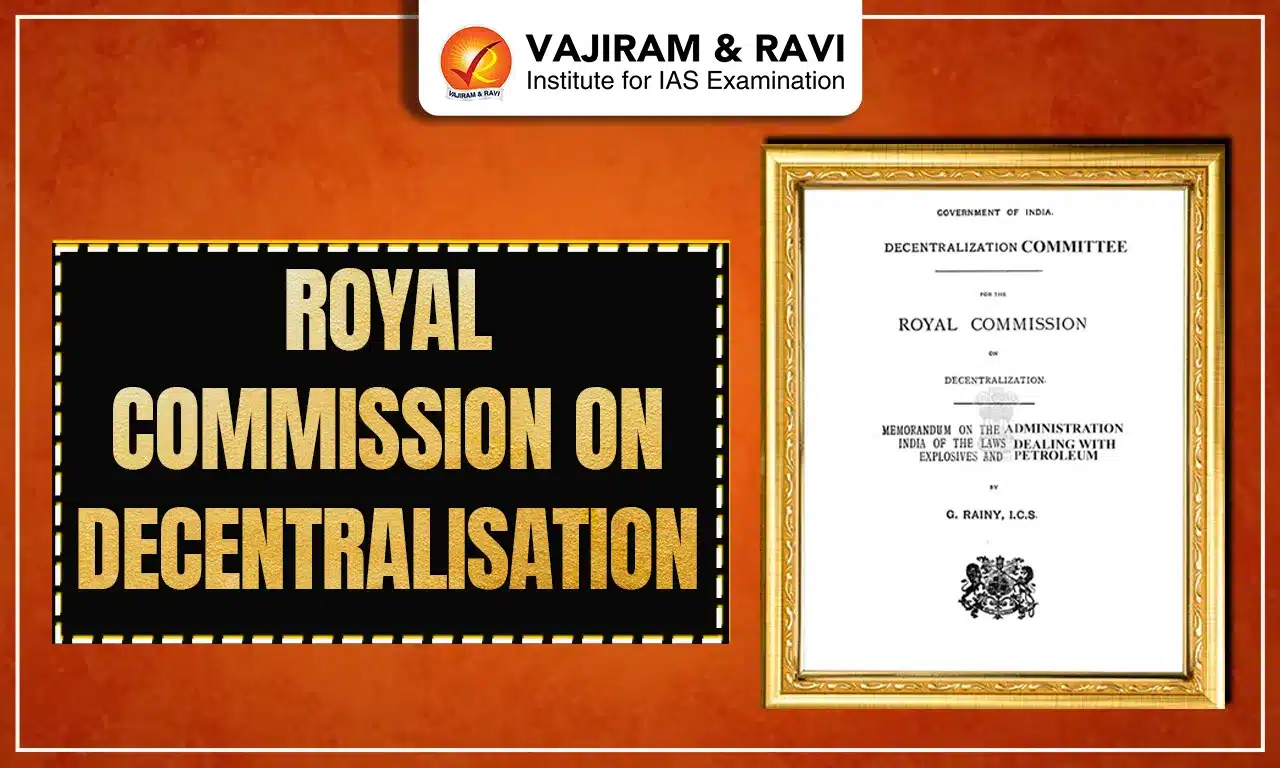
The Royal Commission on Decentralisation (RCD) was a landmark initiative taken by the British Government to evaluate and address the growing concerns over the excessive centralisation of authority in India’s colonial administration. Functioning between 1907 and 1909, the Commission aimed to propose reforms that would strengthen local governance by granting greater administrative and financial autonomy to regional and local institutions. Although the Commission’s recommendations laid a significant foundation for decentralised governance, their limited implementation revealed the colonial administration’s reluctance to share real power with local bodies. In this article, we are going to cover the Royal Commission on Decentralisation, its major findings, recommendations and resolutions.
Royal Commission on Decentralisation
The Royal Commission on Decentralisation (1907–1909) was a pioneering step towards conceptualising local self-government in India. It recognised that excessive centralisation stifled administrative efficiency and citizen participation. By advocating for empowered Village Panchayats, Sub-District Boards, and Municipalities, the Commission envisioned a governance system rooted in community initiative and local responsibility.
However, the British Government’s reluctance to implement these recommendations highlighted the inherent contradictions of colonial rule, it sought administrative efficiency without political empowerment. As a result, the Commission’s legacy remained largely theoretical until later reforms and the rise of nationalist movements renewed the call for self-governance and decentralised democracy.
The Royal Commission on Decentralisation thus remains a key milestone in India’s constitutional and administrative history, marking an early yet incomplete attempt to institutionalise local governance and participatory administration under colonial rule.
Royal Commission on Decentralisation Historical Background
By the early 20th century, British India’s governance had become increasingly centralised, especially in financial and administrative affairs. This excessive concentration of authority in the hands of central and provincial bureaucracies led to inefficiency and alienation at the local level. The government realised that such centralisation hindered the responsiveness of local institutions, weakened community participation, and slowed administrative functioning.
To address these challenges, the British Government established the Royal Commission on Decentralisation in 1907 under the chairmanship of Sir Henry William Primrose. The six-member commission was tasked with examining the relationship between the Government of India and provincial governments, as well as between the provincial authorities and local bodies such as municipalities, district boards, and village panchayats. Its main objective was to suggest ways to relax rigid central control, streamline administrative structures, and promote local initiative in governance.


Royal Commission on Decentralisation Major Findings
The Royal Commission on Decentralisation inquiry showed that one of the primary impediments to effective local administration was the lack of adequate financial resources. Local bodies, though responsible for essential public functions such as sanitation, education, and infrastructure, lacked independent sources of revenue. Their dependence on grants and approvals from higher authorities restricted their autonomy and efficiency.
The Commission also said that decentralisation was not merely a matter of transferring functions but required granting both administrative and financial freedom to local bodies. It stressed that genuine decentralisation would only succeed if local institutions had sufficient funds and authority to make independent decisions. Without financial empowerment, local governance structures would remain weak and ineffective.
Royal Commission Recommendations for Village Panchayats
Recognising the importance of rural self-governance, the Royal Commission on Decentralisation placed great emphasis on the revival and empowerment of Village Panchayats, viewing them as the cornerstone of rural administration. It recommended that these Panchayats be given both administrative and limited judicial powers to make them more effective and relevant to local needs.
The major recommendations included:
- Judicial Authority: Village Panchayats should be granted summary jurisdiction over petty civil and criminal cases. This measure aimed to reduce the burden on district courts and ensure quicker, community-based justice.
- Sanitation and Maintenance: Panchayats should manage village sanitation, including cleaning, drainage, and maintenance of minor public works. This would encourage self-reliance and improve living conditions.
- Education Management: They should oversee the construction and supervision of village schools to promote education and ensure community involvement in maintaining school standards.
- Resource Management: Panchayats were to maintain small reserves for fuel and fodder to meet the daily needs of the village population efficiently.
These recommendations sought to make the Panchayat not just a ceremonial institution but an active administrative unit capable of addressing local issues.
Royal Commission Recommendations for Sub-District Boards
The Royal Commission on Decentralisation also recognised the need for an intermediary level of administration between the district and village. It proposed the establishment of Sub-District Boards (at the taluka or tehsil level) in every region. These boards were envisioned as supervisory bodies responsible for coordinating rural administration and ensuring the smooth implementation of development programmes.
The Sub-District Boards would act as a bridge between district authorities and village Panchayats, facilitating communication, overseeing resource allocation, and resolving administrative bottlenecks. They were expected to play an important role in ensuring accountability and coordination in rural governance.
Royal Commission Recommendations for Municipalities
For urban administration, the Royal Commission on decentralisation made many forward-looking recommendations aimed at strengthening municipal governance. It recommended that the restrictions on municipal taxation powers be removed to allow towns and cities to generate their own revenue. In addition, the Commission proposed that municipalities receive regular grants-in-aid from provincial governments, ensuring they could undertake developmental works without excessive interference from higher authorities.
The Commission also suggested that:
- For large-scale projects such as water supply and drainage, provincial governments should provide direct assistance to municipalities.
- Municipalities should assume responsibility for primary education and, where feasible, middle vernacular education.
- However, they should be relieved of responsibilities such as secondary education, hospital administration, famine relief, and policing so that they could focus more effectively on local civic services.
These proposals aimed to create self-reliant urban local bodies capable of addressing citizens’ everyday needs efficiently while maintaining accountability.
Royal Commission Government of India Resolution of 1915
In 1915, the Government of India issued a formal resolution expressing its stance on the recommendations of the Royal Commission on Decentralisation. While the resolution acknowledged the importance of decentralisation and agreed in principle with several suggestions, the actual implementation remained minimal.
The reforms failed to bring any substantial change in the relationship between central, provincial, and local bodies. The structure of local governance largely remained as it had been since the reforms of Lord Ripon (1882). The British government’s unwillingness to devolve real power to local institutions meant that local self-government remained weak and heavily dependent on higher authorities.

 Last updated on Sep, 2026
→ UPSC 2027 Notification will be released on 13 January 2027 at upsconline.nic.in.
→ Asian Games 2026 are being held in Aichi-Nagoya, Japan, from 19 September to 4 October.
→ Check out the latest UPSC Syllabus here.
→ Download UPSC Model Answers for Mains 2026
→ UPSC Mains Question Paper 2026 is out now for Essay & GS Paper 1, 2, 3 & 4.
→ UPSC Calendar 2027 has been released.
→ Enroll in Vajiram & Ravi’s UPSC Mains Test Series 2027 for structured answer writing practice, expert evaluation, and exam-oriented feedback.
→ Join Vajiram & Ravi’s UPSC Mentorship Program 2027 for personalized guidance, strategy planning, and one-to-one support from experienced mentors.
→ Go through the UPSC Mains Previous Year Papers to enhance your preparation.
→ UPSC has released UPSC Toppers List 2025 with the Civil Services final result on its official website.
→ Also check Best UPSC Coaching in India
Royal Commission on Decentralisation FAQs
Q1. Who headed the Royal Commission on Decentralisation 1908?+
Q2. What was the Royal Commission on Decentralisation?+
Q3. What is the Royal Commission of India?+
Q4. Which commission is known as the Royal Commission?+
Tags: royal commission on decentralisation