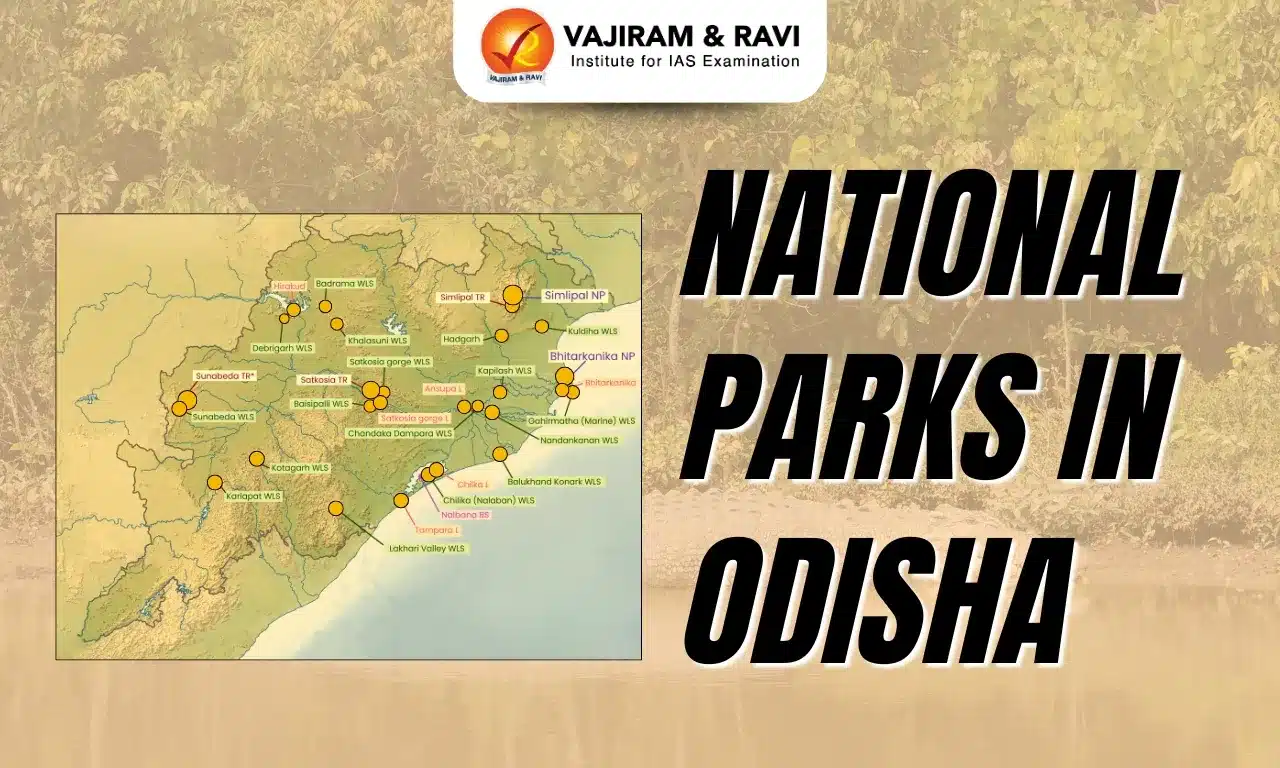
National Parks in Odisha are large, legally protected natural areas created to conserve entire ecosystems, ecological processes, and native wildlife with minimal human interference. As per the IUCN definition, protected areas are clearly defined geographical spaces managed through legal means to ensure long-term conservation of nature, ecosystem services, and cultural values. The National Parks in India support biodiversity conservation, climate regulation, water security, scientific research, education, and sustainable eco-tourism while maintaining ecological balance across landscapes and biogeographic zones.
Protected Areas in Odisha
Odisha has a well-distributed protected area network covering coastal, plateau, mangrove, riverine, and Eastern Ghats ecosystems.
- National Parks: Highest legal protection areas conserving entire ecosystems.
- Wildlife Sanctuaries: Areas allowing limited regulated human activities.
- Tiger Reserves: Landscapes prioritizing tiger and prey conservation.
- Ramsar Sites: Wetlands of international importance under Ramsar Convention.
- Biosphere Reserves: Large regions integrating conservation with livelihoods.
National Parks in Odisha
There are two officially notified National Parks in Odisha, namely- Bhitarkanika and Similipal. These represent coastal mangrove and plateau forest ecosystems respectively. These parks protect globally significant biodiversity including mangroves, estuarine crocodiles, melanistic tigers, elephants, orchids, and migratory birds. Similipal was declared Odisha’s second National Park in 2025, becoming India’s 107th National Park. Together, these parks secure key habitats, regulate hydrology, support climate resilience, and serve as biodiversity strongholds within the Eastern Ghats and coastal ecological systems.
Bhitarkanika National Park
Bhitarkanika National Park conserves India’s second-largest mangrove ecosystem within a complex estuarine river network. The key features of the Bhitarkanika National Park has been listed below:
- Location: It is located within the Kendrapara district of Odisha.
- Area: It is spread over 145 sq km covering a vast area.
- Ecosystem Type: Mangrove forests influenced by Brahmani, Baitarani, and Dhamra rivers.
- Crocodile Habitat: Largest breeding ground of saltwater crocodiles in India.
- Turtle Nesting: Adjacent Gahirmatha beach hosts world’s largest Olive Ridley rookery.
- Bird Diversity: Bagagahana heronry supports thousands of nesting waterbirds.
- Hydrology: Interlinked creeks, canals, and tidal channels shape unique estuarine ecology.
Similipal National Park
Similipal National Park protects a large plateau forest ecosystem within the Eastern Ghats landscape. The major highlights of Similipal National Park has been given below:
- Location: It is located in the Mayurbhanj district of Odisha.
- Area: It covers area of about 845.70 sq km
- Tiger Uniqueness: World’s only natural habitat of wild melanistic tigers.
- Species Richness: Home to 40 Bengal tigers and 25% of Odisha’s elephants.
- Floral Diversity: Supports 104 orchid species including several endemics.
- Geography: Surrounded by plateaus with Meghashini and Khairiburu highest peaks.
- Waterfalls: Barehipani and Joranda rank among India’s tallest waterfalls.


Tiger Reserves in Odisha
Odisha has two notified tiger reserves and one approved reserve expanding tiger conservation landscapes. The list of existing and proposed Tiger Reserves in Odisha has been given below:
- Similipal Tiger Reserve: Largest reserve protecting melanistic tigers, elephants, and Eastern Ghats forests across Mayurbhanj district.
- Satkosia Tiger Reserve: Combines Satkosia Gorge and Baisipalli sanctuaries conserving riverine forests along Mahanadi gorge.
- Debrigarh Tiger Reserve (Proposed): NTCA-approved sanctuary near Hirakud reservoir, strengthening central Indian tiger corridor connectivity.
Wildlife Sanctuaries in Odisha
Odisha hosts a diverse network of Wildlife Sanctuaries covering rivers, forests, hills, wetlands, and coastlines. There are total 19 Wildlife Sanctuaries in Odisha as listed below:
- Badrama Wildlife Sanctuary: Located near Hirakud reservoir, protecting moist deciduous forests and elephant habitats.
- Baisipalli Wildlife Sanctuary: Part of Satkosia landscape along Mahanadi gorge with rich riverine biodiversity.
- Balukhand Konark Wildlife Sanctuary: Coastal sanctuary protecting dunes, casuarina plantations, blackbucks, and spotted deer.
- Chandaka Dampara Wildlife Sanctuary: Elephant reserve near Bhubaneswar supporting migratory elephant corridors.
- Debrigarh Wildlife Sanctuary: Forested hills near Hirakud reservoir with leopard and bird diversity.
- Hadgarh Wildlife Sanctuary: Catchment of Salandi river supporting elephants and linking Similipal landscape.
- Kapilash Wildlife Sanctuary: Elephant corridor between Mahanadi and Brahmani rivers near Cuttack.
- Kothagarh Wildlife Sanctuary: Eastern Ghats forest connected with Karlapat and Satkosia landscapes.
- Lakhari Valley Wildlife Sanctuary: Eastern Ghats sanctuary drained by Rushikulya river system.
- Nandankanan Wildlife Sanctuary: Urban-proximate sanctuary known for captive breeding of lions and crocodiles.
- Satkosia Gorge Wildlife Sanctuary: River gorge ecosystem with moist deciduous and riverine forests.
- Sunabeda Wildlife Sanctuary: Proposed tiger reserve adjoining Udanti-Sitanadi landscape of Chhattisgarh.
- Karlapat Wildlife Sanctuary: Eastern Ghats sanctuary in Kalahandi supporting leopards and deciduous forests.
- Khalasuni Wildlife Sanctuary: Adjacent to Badrama, protecting forested hills and wildlife corridors.
- Kuldiha Wildlife Sanctuary: Forested hills linked to Similipal through narrow ecological corridors.
- Gahirmatha Marine Wildlife Sanctuary: World’s largest Olive Ridley turtle nesting beach along Odisha coast.
- Chilika Nalabana Wildlife Sanctuary: Core bird habitat within Chilika lagoon hosting migratory waterfowl.
- Bhitarkanika Wildlife Sanctuary: Larger mangrove landscape surrounding Bhitarkanika National Park.
- Similipal Wildlife Sanctuary: Buffer zone around national park allowing regulated human activities.
Ramsar Site in Odisha
Odisha has six Ramsar wetlands recognized for global ecological importance.
- Chilika Lake: Asia’s largest brackish lagoon supporting Irrawaddy dolphins and migratory birds.
- Bhitarkanika Mangroves: Mangrove wetland protecting saltwater crocodiles and Olive Ridley turtles.
- Ansupa Lake: Odisha’s largest freshwater lake formed by Mahanadi oxbow system.
- Hirakud Reservoir: Major flood-regulating wetland supporting fish and waterbird diversity.
- Satkosia Gorge: Riverine wetland with endangered turtles and Eastern Ghats biodiversity.
- Tampara Lake: Coastal freshwater lagoon aiding flood control and fishery resources.

 Last updated on August, 2026
→ UPSC Mains Question Paper 2026 is out now for Essay & GS Paper 1, 2, 3 & 4.
→ UPSC Mains GS Paper 1 2026 is out now.
→ UPSC Mains GS Paper 2 2026 is out now.
→ UPSC Mains GS Paper 3 2026 is out now.
→ UPSC Mains GS Paper 4 2026 is out now.
→ UPSC Mains Indian Language Paper & English Compulsory Paper are out now.
→ Check out the latest UPSC Syllabus 2026 here.
→ UPSC Mains Admit Card 2026 is now out.
→ Enroll in Vajiram & Ravi’s UPSC Mains Test Series 2027 for structured answer writing practice, expert evaluation, and exam-oriented feedback.
→ Join Vajiram & Ravi’s UPSC Mentorship Program 2027 for personalized guidance, strategy planning, and one-to-one support from experienced mentors.
→ Go through the UPSC Mains Previous Year Papers to enhance your preparation.
→ Download UPSC Mains Essay Paper 2025, UPSC Mains GS Paper-I 2025, UPSC Mains GS Paper-II 2025, UPSC Mains GS Paper-III 2025, UPSC Mains GS Paper-IV 2025, UPSC Mains English (Compulsory) Paper 2025, UPSC Mains Hindi (Qualifying) Paper 2025 here.
→ UPSC has released UPSC Toppers List 2025 with the Civil Services final result on its official website.
→ UPSC Calendar 2027 has been released.
→ Also check Best UPSC Coaching in India
National Parks in Odisha FAQs
Q1. How many National Parks are there in Odisha?+
Q2. Which National Park in Odisha is famous for melanistic tigers?+
Q3. Which ecosystem is protected by Bhitarkanika National Park?+
Q4. How many Tiger Reserves are officially notified in Odisha?+
Q5. Which Ramsar site in Odisha is the largest coastal lagoon in India?+
Tags: national parks in odisha