Board of Peace for Gaza Latest News
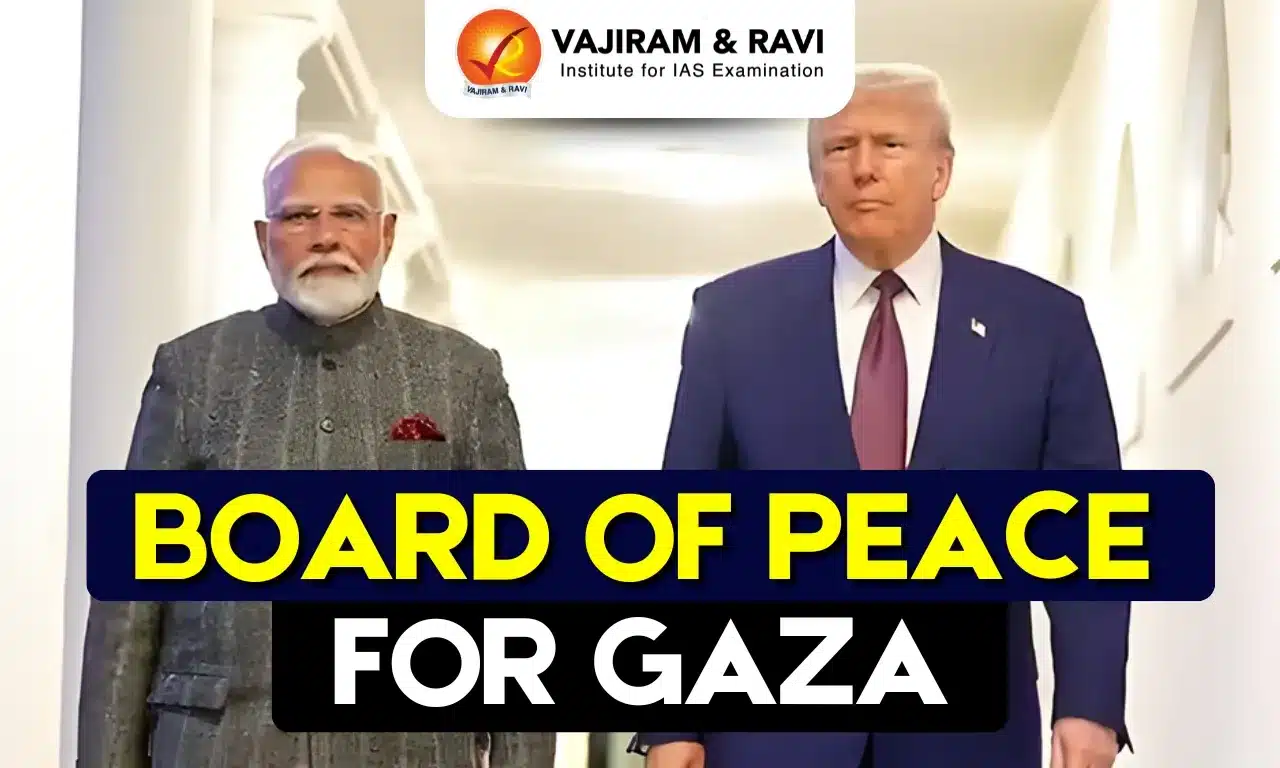
- The U.S. President Donald Trump invited India to join the proposed Board of Peace for Gaza, a new governance and conflict-management mechanism.
- The initiative emerges from a group of Islamic countries backed Trump’s peace plan for Gaza and coincides with broader U.S. efforts to restructure global governance outside traditional multilateral institutions, especially the United Nations (UN).
- The proposal has triggered a global debate on the future of the post-World War II international order, particularly the relevance and authority of the UN Security Council (UNSC).
Board of Peace for Gaza
- Purpose and mandate:
- To supervise Gaza’s transitional governance, stabilisation, and reconstruction.
- To oversee a temporary technocratic, apolitical Palestinian administration.
- To manage funding for redevelopment until the Palestinian Authority (PA) completes institutional reforms.
- Trump now seeks to expand this Gaza-specific mechanism into a global conflict-resolution template.
- Composition and leadership:
- Chaired by U.S. President Donald Trump, its members include select invited countries and global leaders (e.g., Tony Blair).
- It will operate as an invitation-only body, not based on universal membership.
- UN linkage:
- UNSC Resolution 2803 authorised a Board to supervise Gaza’s transition until 2027.
- Russia and China abstained, but the countries of the Global South voted for it.


India’s Position
- Current status: India has received the invitation but has not formally responded. Pakistan has also been invited.
- India’s stated principles:
- Consistent support for a Two-State Solution (Israel and Palestine coexisting).
- India welcomed the first phase of Trump’s peace plan, especially release of hostages, and enhanced humanitarian assistance to Gaza.
- On military involvement: The U.S. is seeking troops for a temporary International Stabilisation Force (ISF). India has clearly ruled out participation, as ISF is not a UN peacekeeping mission.
Broader Global Governance Debate
- Challenge to the UN system:
- Critics argue the Board of Peace undermines UN Charter principles, sovereign equality of states, and collective decision-making.
- It is seen as an attempt to sidestep the UNSC and concentrate authority in the U.S.-led executive body.
- Trump’s multilateral skepticism:
- Because of the continuation of Trump’s long-standing approach. For example, withdrawal from UNESCO, WHO; exit from over 60 international organisations.
- Aligned with Project 2025 (the Heritage Foundation’s blueprint for Trump’s second term), which called for sharp reductions in multilateral commitments and a preference for ad hoc coalitions where the US sets the agenda.
- From Gaza to global template:
- Trump aims to transform the Board into a general crisis-management club.
- It is framed as a solution to UNSC paralysis, especially veto politics.
- It risks diverting funds, legitimacy, and attention away from the UN if successful.
Key Challenges and Way Ahead
- For global order:
- Erosion of multilateralism and UN centrality. Rise of exclusive, power-driven governance mechanisms. Undermining rules-based international order.
- For India:
- Tension between commitment to reformed multilateralism, and pragmatic engagement with the U.S.-led initiatives.
- Risk of legitimising a system that weakens India’s long-term push for UNSC reform, and marginalises voices of the Global South.
- India’s options:
- Calibrated engagement: Engage diplomatically without endorsing erosion of UN authority. Maintain distinction between political oversight and military involvement.
- Defend UN-centric multilateralism: Reiterate support for UNSC-authorised mechanisms. Resist normalisation of extra-UN security architectures.
- Strategic autonomy: Balance ties with the U.S. while safeguarding India’s principled positions. Coordinate with like-minded countries of the Global South.
- Push for UN reform: Use the crisis to highlight urgency of UNSC reform, not its bypassing.
Conclusion
- The invitation to India to join the Board of Peace for Gaza places New Delhi at a critical crossroads in global diplomacy.
- While the initiative promises flexibility and decisiveness in conflict management, it also represents a fundamental challenge to the UN-led multilateral order that India has long defended.
- As global governance enters a phase of extraordinary flux, it tests India’s ability to balance principle with pragmatism in an evolving world order.

 Last updated on Sep, 2026
→ UPSC 2027 Notification will be released on 13 January 2027 at upsconline.nic.in.
→ Asian Games 2026 are being held in Aichi-Nagoya, Japan, from 19 September to 4 October.
→ Check out the latest UPSC Syllabus here.
→ Download UPSC Model Answers for Mains 2026
→ UPSC Mains Question Paper 2026 is out now for Essay & GS Paper 1, 2, 3 & 4.
→ UPSC Calendar 2027 has been released.
→ Enroll in Vajiram & Ravi’s UPSC Mains Test Series 2027 for structured answer writing practice, expert evaluation, and exam-oriented feedback.
→ Join Vajiram & Ravi’s UPSC Mentorship Program 2027 for personalized guidance, strategy planning, and one-to-one support from experienced mentors.
→ Go through the UPSC Mains Previous Year Papers to enhance your preparation.
→ UPSC has released UPSC Toppers List 2025 with the Civil Services final result on its official website.
→ Also check Best UPSC Coaching in India
Board of Peace for Gaza FAQs
Q1. What is the ‘Board of Peace for Gaza’?+
Q2. What is India’s dilemma in responding to the U.S. invitation to join the Board of Peace for Gaza?+
Q3. How does the Board of Peace initiative challenge the authority and relevance of the UNSC?+
Q4. Why has India ruled out participation in the proposed International Stabilisation Force (ISF) for Gaza?+
Q5. What lessons does the ‘Board of Peace’ debate hold for India’s pursuit of ‘reformed multilateralism’?+
Tags: board of peace for gaza mains articles upsc current affairs upsc mains current affairs