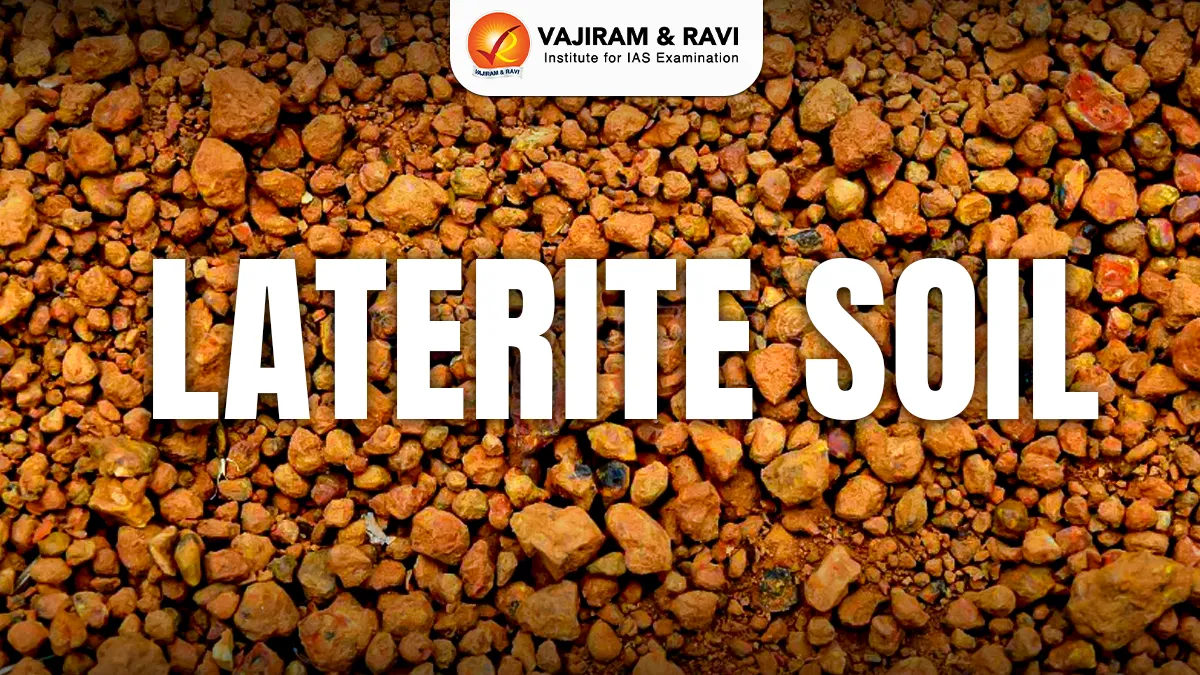
Laterite Soil is a reddish-brown tropical soil formed through intense chemical weathering and leaching under hot and humid climates. It is rich in iron and aluminium oxides but poor in essential plant nutrients. The term originates from the Latin word “Later,” meaning brick, because the soil becomes extremely hard and brick like after drying in air.
Laterite Soil Formation
The process and factors affecting the formation of Laterite Soil has been listed below:
- Laterite Soil forms through the Laterization Process. It is a process of strong chemical weathering where soluble minerals are removed from the parent rock by rainfall, leaving behind concentrated iron and aluminium oxides in the upper soil layers.
- Laterite Soils originate from various rock types including granite, basalt, sandstone, limestone, gneiss and schists. Over thousands of years, intense weathering converts these rocks into a thick lateritic soil profile.
Laterite Soil Characteristics
Laterite Soil possesses distinct chemical and physical properties. The key highlighting features of the Laterite Soil has been listed below:
- Appearance: Laterite Soil usually appears red, reddish-brown, or rusty-brown. The coloration occurs due to the presence of high quantities of iron oxide compounds such as hematite and goethite.
- Chemical Composition: The soil contains high levels of iron oxide (Fe₂O₃) and aluminium oxide (Al₂O₃) but very low concentrations of lime, silica, magnesia, potash and nitrogen because these elements are removed through leaching.
- Acidic Nature: Laterite Soils are usually acidic. This acidity restricts the growth of many staple crops unless soil treatment and fertilizers are applied.
- Humus Content: High temperatures accelerate decomposition of organic matter by bacteria. Combined with heavy rainfall washing away nutrients, this results in relatively low humus levels.
- Porosity and Drainage: Laterite Soil is highly porous and allows rapid water drainage. Because of this characteristic, it cannot retain moisture for long periods, creating challenges for water intensive crops.
- Hardening Property: When moist, laterite is soft and can be cut easily with simple tools. However, exposure to air causes it to harden significantly, forming durable brick like blocks.


Laterite Soil Crops
Laterite Soil is generally low in fertility but can support several plantation and commercial crops when fertilizers and irrigation are properly applied.
- Tea Cultivation: Tea plantations thrive in well drained Laterite Soils found in high rainfall regions.
- Coffee Production: Coffee cultivation is successful in laterite regions of Karnataka and other plateau areas.
- Cashew Nut Farming: Cashew plantations grow effectively in the Laterite Soils of Kerala, Tamil Nadu and coastal peninsular regions.
- Rubber Cultivation: With proper manure and fertilizers, soil provides suitable conditions for rubber plantations in tropical regions.
- Spice Crops: Spices such as pepper and arecanut are cultivated in lateritic soils, particularly in southern India.
- Root Crops: Crops like tapioca (cassava) and certain varieties of yam can grow in Laterite Soils.
- Fruit and Plantation Trees: Coconut, banana, pineapple and various tropical fruit trees are cultivated in improved Laterite Soils.
Laterite Soil Global Distribution
Laterite Soils are widely distributed across tropical and subtropical regions where climatic conditions favor intense weathering and leaching.
- Global Coverage: Lateritic Soils cover nearly one-third of the Earth’s continental land area, particularly in equatorial forests and tropical savanna regions.
- Tropical Belt Distribution: Laterite Soils occur mainly between the Tropic of Cancer and Tropic of Capricorn. These regions experience high temperatures and heavy rainfall necessary for laterization.
- Africa: Extensive laterite formations occur across parts of West Africa and central Africa where humid tropical climates support deep weathering of rocks.
- South America: Lateritic soil profiles are widely found across Brazil and other parts of tropical South America on stable continental shields.
- Australia: Australia contains large laterite deposits on its ancient shield regions where prolonged weathering under tropical climates has occurred for millions of years.
- Southeast Asia: Countries such as Indonesia, Philippines, Cambodia and Vietnam contain widespread Laterite Soils and laterite stone deposits used historically in construction.
Laterite Soil in India
Laterite Soils occur mainly in regions with heavy rainfall and elevated plateau surfaces across several parts of the Indian subcontinent. The map for the Distribution of Laterite Soil in India has been given below:
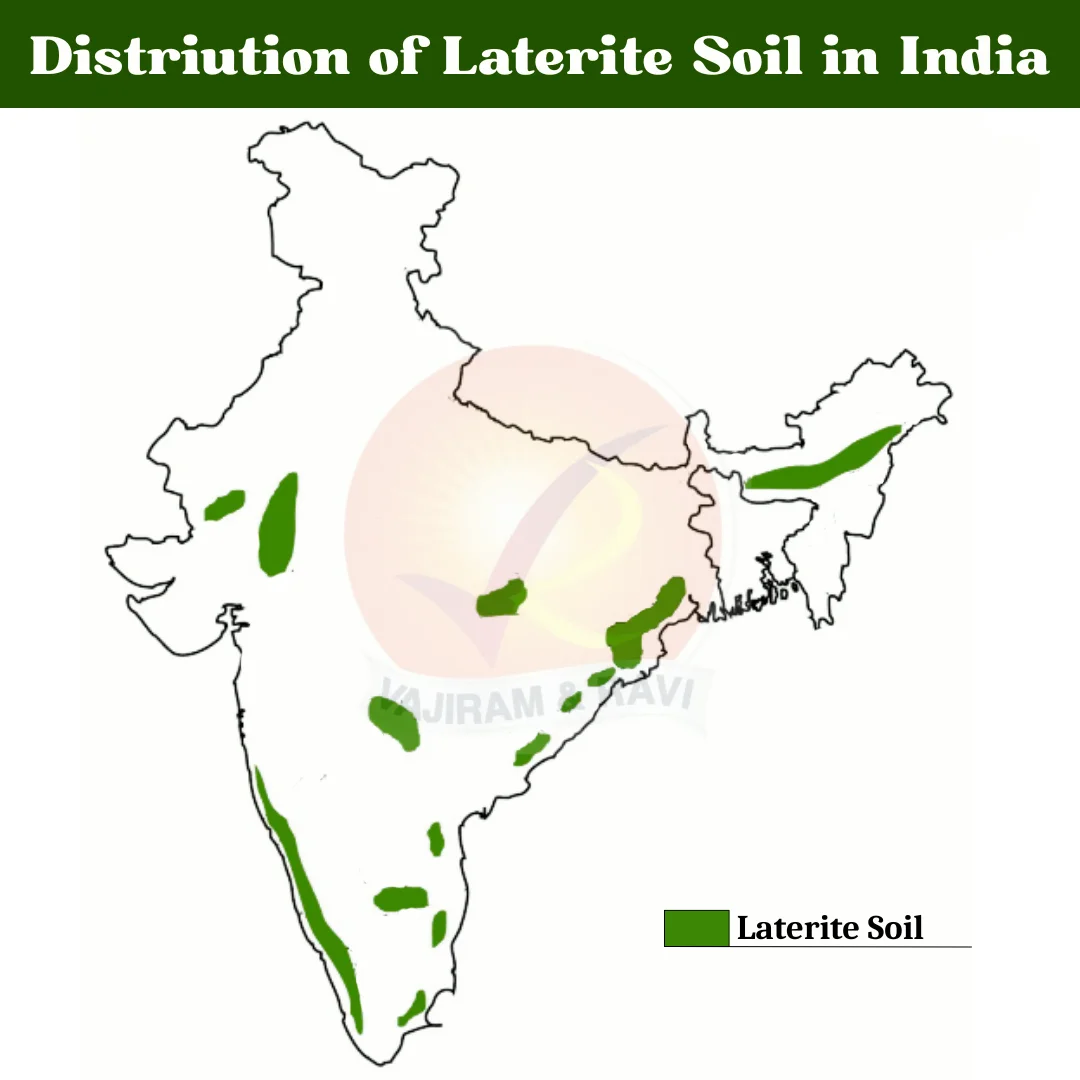
- Laterite Soils occupy approximately 2.48 lakh square kilometres in India, representing about 4.30% of the country’s total geographical area.
- Continuous stretches of Laterite Soil occur on the summits of the Western Ghats between 1000 and 1500 metres above sea level across Maharashtra, Karnataka and Kerala.
- Lateritic soils are present in the Eastern Ghats and surrounding regions of Odisha, particularly on elevated hill slopes and plateau surfaces.
- Parts of Tamil Nadu, Andhra Pradesh and Madhya Pradesh contain Laterite Soils formed through prolonged weathering of plateau rocks.
- Lateritic deposits are found in the Rajmahal Hills, Vindhyan ranges, Satpura ranges and Malwa plateau due to long term tropical weathering.
- The laterite plateau of Kerala is one of the most well developed laterite regions where the soil supports plantation crops and coconut cultivation.
- Smaller patches of Laterite Soil occur in Gujarat’s Panchmahal district and Jharkhand’s Santhal Pargana region as isolated lateritic formations.
Laterite Soil Significance
Laterite Soil holds significant agricultural, geological and economic importance due to its mineral composition and physical characteristics.
- Source of Ores: Laterite deposits contain bauxite minerals, Iron-rich laterites which contain minerals like hematite and goethite and approximately 70% of the world’s land based nickel resources occur in lateritic deposits.
- Architecture: Laterite stones were used in the construction of large monuments such as the temple complexes of Angkor between the 9th and 13th centuries in Southeast Asia.
- Road Construction: Crushed laterite has been used in road construction projects in countries such as Cambodia, Kenya and Malawi because it can serve as a durable base layer.
- Water Storage Capacity: Thick laterite layers are porous and slightly permeable, allowing them to function as natural aquifers that store groundwater in tropical rural regions.
- Environmental Applications: Laterite materials have been used in wastewater treatment systems to remove phosphorus and heavy metals due to their high iron and aluminium content.

 Last updated on Sep, 2026
→ UPSC 2027 Notification will be released on 13 January 2027 at upsconline.nic.in.
→ Check out the latest UPSC Syllabus here.
→ Download UPSC Model Answers for Mains 2026
→ UPSC Mains Question Paper 2026 is out now for Essay & GS Paper 1, 2, 3 & 4.
→ UPSC Calendar 2027 has been released.
→ Enroll in Vajiram & Ravi’s UPSC Mains Test Series 2027 for structured answer writing practice, expert evaluation, and exam-oriented feedback.
→ Join Vajiram & Ravi’s UPSC Mentorship Program 2027 for personalized guidance, strategy planning, and one-to-one support from experienced mentors.
→ Go through the UPSC Mains Previous Year Papers to enhance your preparation.
→ UPSC has released UPSC Toppers List 2025 with the Civil Services final result on its official website.
→ Also check Best UPSC Coaching in India
Laterite Soil FAQs
Q1. What is Laterite Soil? +
Q2. In which climate does Laterite Soil form? +
Q3. Which crops grow well in Laterite Soil? +
Q4. What is the distribution of Laterite Soil in India? +
Q5. Which minerals are mainly found in Laterite Soil? +
Tags: geography laterite soil