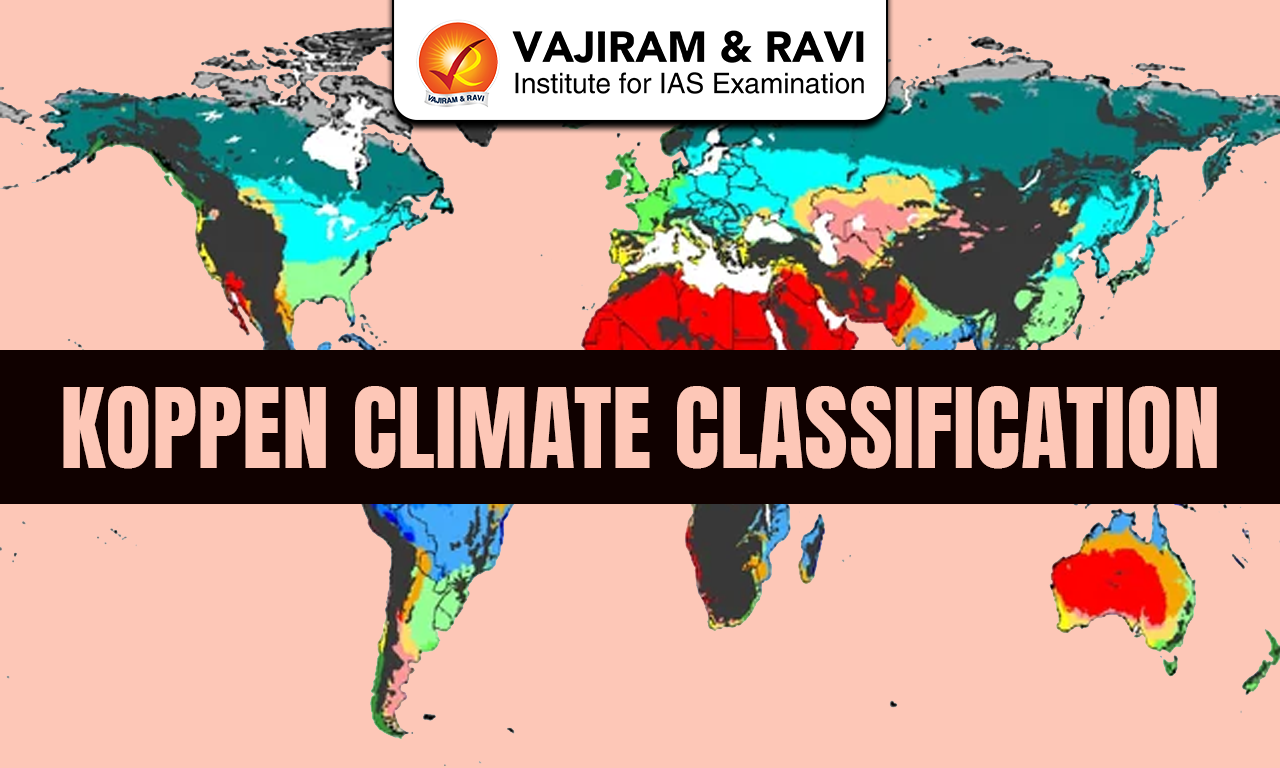
The Koppen Climate Classification system is one of the most widely used methods for classifying the climates of the world. It was developed by the German botanist and climatologist Wladimir Koppen at the end of the nineteenth century.
Basis of Koppen Climate Classification
The Koppen Climate Classification system classifies climate regions mainly on the basis of temperature, precipitation, and natural vegetation patterns. Koppen observed that vegetation is closely related to climate conditions, since the type of plants that grow in a region depends largely on the amount of rainfall and the prevailing temperature. Therefore, the distribution of vegetation provides a useful indicator for identifying different climate zones across the world.
- Regions with high rainfall and warm temperatures usually support dense forests.
- Regions with low rainfall tend to have grasslands or deserts.
- Seasonal variations in temperature and precipitation determine subtypes within each major climate group.
By analysing long-term temperature and precipitation data, Koppen divided the world into different climatic zones that correspond to major vegetation types.
Koppen Climate Classification System Major Climate Zones
The Koppen Climate Classification divides the world into five major climate zones, each represented by a capital letter.
Tropical Climate (Zone A)
This climate zone occurs mainly near the equator and is characterized by high temperatures throughout the year and abundant rainfall. Dense forests and tropical vegetation dominate these regions. On climate maps, this zone is often represented by shades of blue.
Dry Climate (Zone B)
Dry climates are characterized by low precipitation and high evaporation, which limits vegetation growth. These areas include deserts and semi-arid regions where rainfall is scarce. On maps, this zone is usually shown in shades of red, pink, or orange.
Temperate Climate (Zone C)
Temperate climates are found mainly in the middle latitudes and are characterized by moderate temperatures with distinct seasonal variations. Summers are generally warm while winters are mild. These regions support forests and grasslands and are usually represented by green colors on climate maps.
Continental Climate (Zone D)
Continental climates occur mainly in the interior parts of large continents. These regions experience large seasonal temperature variations, with warm summers and cold winters. On koppen maps, these areas are often shown using purple, violet, or light blue colors.
Polar Climate (Zone E)
Polar climates occur in the high-latitude regions near the poles. These areas experience extremely low temperatures for most of the year and have very limited vegetation. On climate maps they are typically represented by grey shades.


Subdivisions of Climate Zones
Each major climate zone in the Koppen system is further divided into smaller subcategories based on temperature patterns and seasonal rainfall distribution. For example,
Tropical Humid Climates (A)
- Af – Tropical Wet (Rainforest Climate):
- No dry season; rainfall occurs throughout the year.
- High temperatures persist all year, with minimal variation.
- Dense evergreen forests with large biodiversity dominate these regions.
- Examples: Amazon Basin (South America), Western Africa, Andaman & Nicobar Islands (India).
- Am – Tropical Monsoon Climate:
- Short dry season; heavy rainfall mainly during the summer.
- Annual temperature range is low; overall climate hot and humid.
- Found in regions influenced by the monsoon system.
- Examples: Indian subcontinent, Northeastern South America.
- Aw – Tropical Wet and Dry (Savanna Climate):
- Distinct winter dry season; summer is wet.
- High temperatures throughout the year with a longer dry season than Af or Am.
- Vegetation consists of deciduous forests and tree-shredded grasslands.
- Examples: Parts of India (Odisha, Maharashtra), Central Africa, Brazil.
Dry Climates (B)
- BSh – Subtropical Steppe:
- Semi-arid climate with low and highly variable rainfall.
- Supports sparse grasslands rather than dense forests.
- Often experiences droughts due to irregular rainfall.
- Examples: Gujarat, Haryana, interior Rajasthan (India).
- BWh – Subtropical Desert:
- Extremely low rainfall and very high temperatures.
- Soil is often sandy or rocky; vegetation is scarce.
- Receives occasional short intense thundershowers.
- Examples: Thar Desert (India), Sahara Desert (Africa).
- BSk – Mid-latitude Steppe:
- Semi-arid climate in continental interiors.
- Winters are cold, summers warm; rainfall insufficient for dense forests.
- Examples: Central Asia, Great Plains (USA).
- BWk – Mid-latitude Desert:
- Cold desert climate with very low rainfall.
- Large diurnal and seasonal temperature variations.
- Vegetation is extremely sparse.
- Examples: Ladakh (India), Gobi Desert (China/Mongolia).
Warm Temperate (Mid-latitude) Climates (C)
- Cwa – Humid Subtropical Climate:
- Hot summers, dry winters.
- Found in areas influenced by summer monsoon winds.
- Examples: North Indian plains, South China plains.
- Cfa – Humid Subtropical Climate:
- No dry season; rainfall occurs throughout the year.
- Summers are warm and humid, winters mild.
- Examples: Eastern USA, Southern China.
- Cs – Mediterranean Climate:
- Hot, dry summers and mild, rainy winters.
- Occurs in subtropical western margins of continents.
- Examples: California, Central Chile, Mediterranean coast.
- Cfb – Marine West Coast Climate:
- Mild summers and moderate winters.
- Rainfall is evenly distributed throughout the year.
- Examples: Western Europe, New Zealand.
Cold Snow-Forest (Continental) Climates (D)
- Df – Cold Climate with Humid Winters:
- Severe winters with snow; no dry season.
- Large seasonal temperature variation.
- Examples: Northern Europe, interior USA.
- Dw – Cold Climate with Dry Winters:
- Pronounced dryness in winter; monsoon-like reversal of winds in summer.
- Winters are very severe; summers moderately warm.
- Examples: Northeastern Asia.
Polar Climates (E)
- ET – Tundra Climate:
- Short summer season; permafrost present.
- Vegetation consists of low-growing mosses, lichens, and some flowering plants.
- Examples: High Arctic, very high Himalayas.
- EF – Ice Cap Climate:
- Permanent ice cover; temperatures below freezing throughout the year.
- Minimal to no vegetation; glaciers dominate the landscape.
- Examples: Greenland, Antarctica.
Highland Climate (Zone H)
Some modern revisions of the koppen system also include a sixth category known as Highland Climate (Zone H). This type of climate is found in mountainous regions where temperature and precipitation vary significantly with altitude. High mountain areas often have unique climatic conditions that differ from the surrounding lowlands.
Although Koppen first introduced his climate classification map in the early twentieth century, he continued to revise and improve it throughout his life until his death in 1940. Later climatologists, particularly Rudolf Geiger, further refined the system and updated the climate maps. Because of these improvements, the system is sometimes referred to as the Koppen-Geiger Climate Classification.
Koppen Climate Classification System Significance
The Koppen Climate Classification remains highly important in geography, climatology, and environmental studies.
- It helps scientists understand global climate patterns, study vegetation distribution, and analyse ecological systems.
- The system is also useful in agriculture, environmental planning, and climate change research.
- Due to its clear structure and strong link between climate and vegetation, the koppen system continues to be widely used by researchers and geographers around the world.

 Last updated on Oct, 2026
→ UPSC 2027 Notification will be released on 13 January 2027 at upsconline.nic.in.
→ Check Nobel Prize 2026 Winners List here.
→ Download PIB PRiSM Monthly Magazine 2026 here.
→ Check UPSC Monthly Current Affairs Magazine The Recitals here.
→ Check out the latest UPSC Syllabus here.
→ Download UPSC Model Answers for Mains 2026
→ UPSC Mains Question Paper 2026 is out now for Essay & GS Paper 1, 2, 3 & 4.
→ UPSC Calendar 2027 has been released.
→ Enroll in Vajiram & Ravi’s UPSC Mains Test Series 2027 for structured answer writing practice, expert evaluation, and exam-oriented feedback.
→ Join Vajiram & Ravi’s UPSC Mentorship Program 2027 for personalized guidance, strategy planning, and one-to-one support from experienced mentors.
→ Go through the UPSC Mains Previous Year Papers to enhance your preparation.
→ UPSC has released UPSC Toppers List 2025 with the Civil Services final result on its official website.
→ Also check Best UPSC Coaching in India
Koppen Climate Classification FAQs
Q1. What is the Koppen Climate Classification?+
Q2. What are the main groups in the Koppen Climate Classification?+
Q3. How does the Koppen Climate Classification divide subtypes?+
Q4. Why is the Koppen Climate Classification important?+
Q5. What are examples of climate types in India according to the Koppen Climate Classification?+
Tags: geography geography notes koppen climate classification