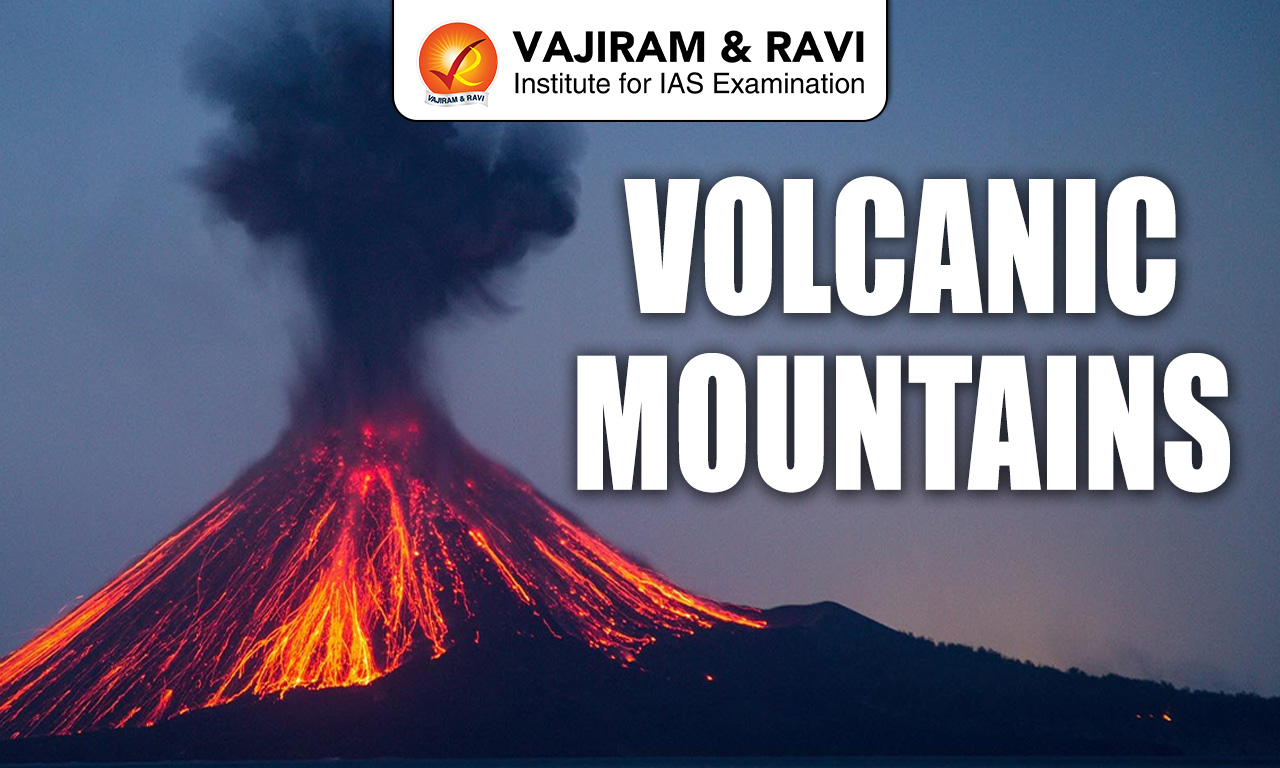
Volcanic mountains, also referred to as volcanic cones, are natural elevations formed by the accumulation of lava, ash, and other volcanic materials ejected during eruptions. Unlike fold or block mountains, which are formed by tectonic forces or crustal movements, volcanic mountains originate from internal geological processes where molten rock, or magma, rises from the Earth’s interior and solidifies on the surface.
Over time, repeated eruptions deposit layers of lava and debris, gradually building up the height and shape of the mountain. This process results in the formation of distinctive conical shapes, which is why these mountains are often called volcanic cones.
Types of Eruptions
The nature of a volcanic mountain depends largely on the type of eruption that forms it.
- Central Type of Eruption: In a central eruption, magma escapes through a main central vent and flows in all directions. This type of eruption typically forms classic volcanic cones or mountains with a pronounced peak and crater at the summit.
- Fissure Type of Eruption: In contrast, fissure eruptions occur when lava emerges through cracks or fissures in the Earth’s crust. The lava spreads over a wide area and solidifies, often forming plateaus rather than steep mountains. Fissure eruptions are common in regions with extensive tectonic activity, such as mid-ocean ridges.
Classification of Volcanic Mountains
Volcanic mountains are classified into several types based on their structure, eruption history, and lava characteristics.
Ash and Cinder Cones
Ash and cinder cones are the smallest type of volcanic mountains, formed by the accumulation of volcanic ash and cinders. They are typically weak and easily eroded by rainfall. Most ash cones are temporary features and seldom grow very tall.
Composite Cones (Stratovolcanoes)
Composite cones, or stratovolcanoes, are the highest and most resilient volcanic mountains. They are built by alternating layers of lava and solidified rock fragments. The hardened lava acts as cement, binding loose debris and making these mountains highly resistant to erosion. These volcanoes are often active, dormant, or extinct, and include some of the most famous peaks worldwide. Examples include:
- Mount Aconcagua, Peru – highest peak of the Andes (extinct)
- Mount Cotopaxi, Andes
- Mount Rainier, Mount Shasta, Mount Hood, USA
- Mount Mayon, Philippines
- Mount Fujiyama, Japan
- Mount Kilimanjaro, Africa
- Mount Agung, Indonesia
- Barren Island (active) and Narcondam (extinct), India
- Mount Stromboli, Mount Etna, Mount Vesuvius, Italy
- Mount Krakatoa, Indonesia
Parasitic Cones
Parasitic cones form on the slopes of larger composite volcanoes. Magma finds secondary cracks in the main volcano, creating smaller cones branching from the primary vent. These cones are called “parasitic” because they utilize the existing magma conduit instead of forming a new one.
- Example: Mount Shasta in the USA has several parasitic cones surrounding the main volcano.
Shield Volcanoes (Basic Lava Cones)
Shield volcanoes are formed by basaltic lava, which is fluid and spreads widely before solidifying. They have gentle slopes and broad bases resembling a warrior’s shield. Despite their low height above sea level, some shield volcanoes are extremely massive when measured from their base on the sea floor. Examples include:
- Hawaii Islands, USA – Mauna Loa and Mauna Kea
- Mauna Kea measures over 10 km from the sea floor, making it the tallest mountain on Earth from base to summit.
- It is also one of the rainiest places in the world, second only to Mawsynram and Cherrapunji in India.
- Reunion Island – hotspot volcanoes in the Indian Ocean.


 Last updated on Oct, 2026
→ UPSC 2027 Notification will be released on 13 January 2027 at upsconline.nic.in.
→ Check Nobel Prize 2026 Winners List here.
→ Download PIB PRiSM Monthly Magazine 2026 here.
→ Check UPSC Monthly Current Affairs Magazine The Recitals here.
→ Check out the latest UPSC Syllabus here.
→ Download UPSC Model Answers for Mains 2026
→ UPSC Mains Question Paper 2026 is out now for Essay & GS Paper 1, 2, 3 & 4.
→ UPSC Calendar 2027 has been released.
→ Enroll in Vajiram & Ravi’s UPSC Mains Test Series 2027 for structured answer writing practice, expert evaluation, and exam-oriented feedback.
→ Join Vajiram & Ravi’s UPSC Mentorship Program 2027 for personalized guidance, strategy planning, and one-to-one support from experienced mentors.
→ Go through the UPSC Mains Previous Year Papers to enhance your preparation.
→ UPSC has released UPSC Toppers List 2025 with the Civil Services final result on its official website.
→ Also check Best UPSC Coaching in India
Volcanic Mountains FAQs
Q1. What are volcanic mountains?+
Q2. What are the main types of volcanic eruptions?+
Q3. How are volcanic mountains classified?+
Q4. What are some famous volcanic mountains in India and the world?+
Q5. Why are volcanic mountains important?+
Tags: volcanic mountains