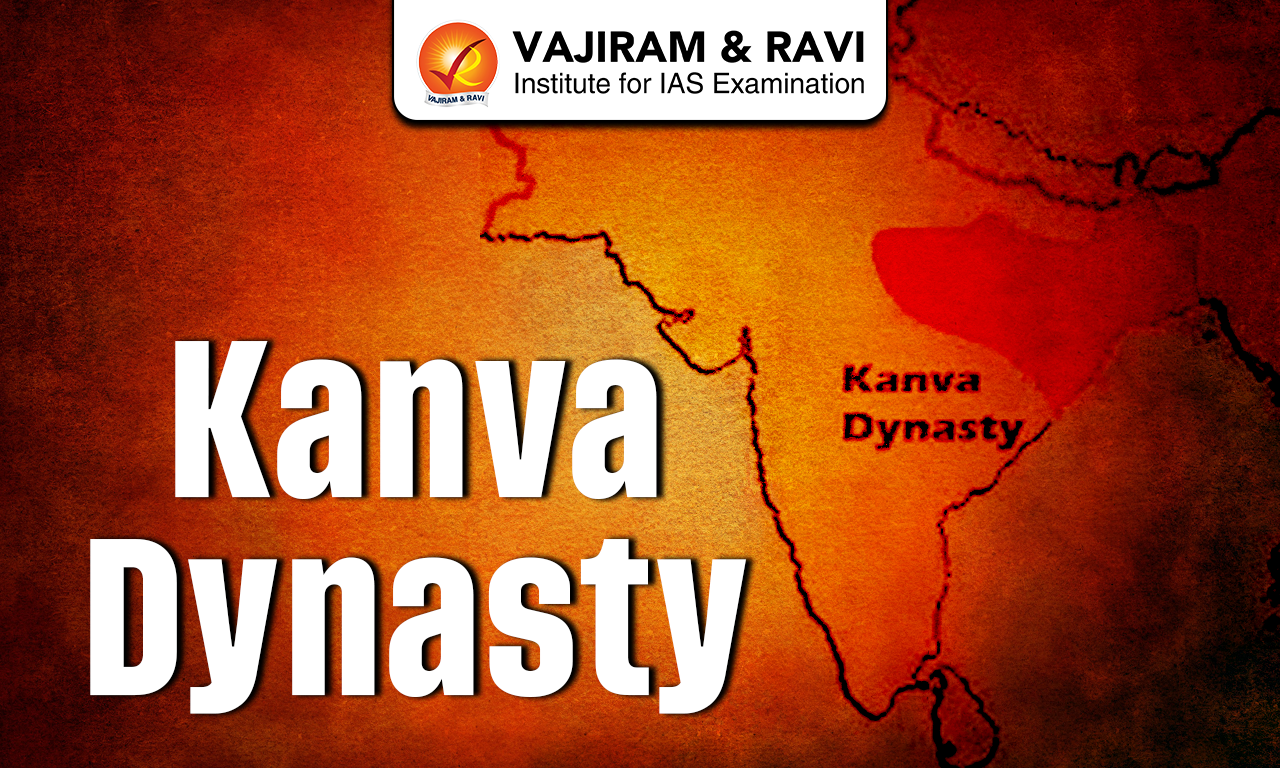
The Kanva Dynasty was a short lived but important Brahmin ruling line that governed Magadha from 73 BCE to 28 BCE after overthrowing the Shunga Dynasty. It was founded by Vasudeva Kanva. The dynasty continued Brahmanical traditions in a politically fragmented post Mauryan period. Despite ruling for only about 45 years, it played a key transitional role in ancient Indian history, especially in maintaining continuity in administration, culture and regional power structures.
Kanva Dynasty Background
The Kanva Dynasty emerged after the decline of the Shunga Dynasty and reflected political instability in post Mauryan India.
- Origin of dynasty: The Kanvas were Brahmins descended from sage Saubhari and belonged to a respected priestly lineage, which gave them social legitimacy and religious authority in governance.
- Establishment in 73 BCE: Vasudeva Kanva, originally a minister under Shunga king Devabhuti, assassinated him and seized power, marking the beginning of Kanva rule in Magadha.
- Capital and Empire: Though Puranas mention Pataliputra as the capital, most coins are found in Vidisha, indicating strong administrative presence in Central India.
- Political context: The dynasty arose during a period of weakening central authority, where multiple regional powers like Indo-Greeks and Satavahanas were emerging across the subcontinent.
- Continuation of Shungas: Kanva rulers allowed remnants of the Shunga Dynasty to rule in limited areas, showing a gradual transition rather than complete displacement of earlier rulers.
Kanva Dynasty Administration
The administrative system under the Kanva Dynasty largely continued earlier models with limited innovation due to short rule and weak territorial control.
- Monarchical governance: The Kanva rulers followed a hereditary monarchy system where power passed within the family, maintaining continuity but lacking strong institutional support.
- Capital administration: Pataliputra remained the central administrative hub, although effective control was limited to Magadha and nearby regions due to political fragmentation.
- Role of Brahmins: Being Brahmins themselves, rulers relied heavily on priestly elites for administration, reinforcing Brahmanical authority in governance and judicial matters.
- Provincial control: Local governance was managed by regional officials, but declining central power reduced effective control over distant territories.
- Policy approach: The dynasty focused more on maintaining stability and continuity rather than expansion or administrative reforms, reflecting a defensive political strategy.


Kanva Dynasty Society and Culture
The Kanva Dynasty period continued Brahmanical traditions while allowing coexistence of multiple religious and cultural practices.
- Brahmanical dominance: The rulers strongly supported Vedic traditions and rituals, reinforcing the social position of Brahmins in society and governance.
- Religious coexistence: Buddhism and Jainism continued without direct suppression, supported mainly by merchants and local communities rather than royal patronage.
- Social structure: Society remained stratified with Brahmins at the top, followed by other varnas, reflecting continuation of traditional social hierarchy.
- Rural integration: Local folk traditions and agrarian beliefs were incorporated into Brahmanical practices, strengthening rural legitimacy of the rulers.
Kanva Dynasty Art and Architecture
Art and architecture under the Kanva Dynasty largely followed earlier traditions with limited innovation due to short duration of rule.
- Artistic continuity: The Kanva period continued Shunga style art, especially in terracotta figures and decorative elements seen in earlier monuments.
- Literary patronage: Sanskrit literature received support and Brahmanical texts and Puranic traditions were preserved and transmitted during this period.
- Script usage: Brahmi script continued to be used in inscriptions and coins, indicating administrative and cultural continuity.
- Numismatic evidence: Coins bearing names like “Bhumimitra” and “Kanvasya” provide important historical evidence about rulers and regional control.
Kanva Dynasty Economy
The economy under the Kanva Dynasty remained agrarian with reliance on traditional taxation and limited expansion due to weak political control.
- Agrarian base: Agriculture formed the backbone of the economy, supported by fertile Gangetic plains and seasonal monsoon patterns.
- Revenue system: Land tax remained the primary source of income, typically collected as a share of agricultural produce.
- Trade activities: Internal trade continued through established routes, supported by coin circulation found in regions like Vidisha and Kaushambi.
- Limited expansion: Lack of territorial growth restricted economic expansion and reduced opportunities for increasing revenue sources.
- Fiscal constraints: Political instability and external pressures likely strained resources, weakening long term economic strength of the dynasty.
Kanva Dynasty Rulers and their Contributions
The Kanva Dynasty had four major rulers whose reigns collectively lasted about 45 years with limited but notable contributions. The rulers followed direct succession, but short reigns indicate weak consolidation and limited long term political stability.
- Vasudeva Kanva: He is the founder of the dynasty. He ruled from 73 BCE to 64 BCE for 9 years. He established authority after overthrowing Devabhuti and stabilised initial governance.
- Bhumimitra: He was the son of Vasudeva. He ruled from 64 BCE to 50 BCE for 14 years. He was known from coins found in Panchala, Vidisha and Kaushambi showing administrative continuity.
- Narayana: He ruled from 50 BCE to 38 BCE for 12 years. He maintained control and continued Brahmanical traditions with minimal historical records available.
- Susarman: He was the last ruler of the Kanva Dynasty. He governed from 38 BCE to 28 BCE for 10 years. He witnessed decline and eventual defeat by Satavahanas leading to the dynasty’s end.
Kanva Dynasty Contemporary Relations
Political relations under the Kanva Dynasty were shaped by regional pressures rather than active diplomatic or military expansion.
- Satavahana relations: The Satavahanas in the Deccan emerged as the strongest external force and eventually defeated the Kanvas around 28 BCE.
- Indo-Greek context: Northwestern regions were under Indo-Greek influence, limiting Kanva expansion and isolating Magadha politically.
- Regional interactions: The dynasty interacted indirectly with neighboring states through trade and political competition rather than alliances.
- Lack of expansion: No evidence suggests major military campaigns or territorial conquests, indicating a defensive and inward focused policy.
- External pressures: Continuous pressure from rising regional powers weakened Kanva authority and reduced their ability to maintain sovereignty.
Kanva Dynasty Decline
The decline of the Kanva Dynasty resulted from internal weaknesses and growing external pressures leading to its eventual fall.
- Short reign duration: The dynasty lasted only about 45 years, indicating lack of strong institutional foundations and stable governance systems.
- Weak leadership: Later rulers lacked effective control, leading to administrative inefficiency and declining authority over regions.
- Successor and External invasion: The Satavahanas defeated the last ruler Susarman, ending Kanva rule around 28 BCE.
- Magadha fragmentation: After the fall, Magadha lost its imperial status and came under regional powers like the Mitra dynasty of Kaushambi.
- Puranic accounts: Texts suggest Balipuccha killed the last king, though archaeological evidence for this claim remains insufficient.

 Last updated on Sep, 2026
→ UPSC 2027 Notification will be released on 13 January 2027 at upsconline.nic.in.
→ Asian Games 2026 are being held in Aichi-Nagoya, Japan, from 19 September to 4 October.
→ Check out the latest UPSC Syllabus here.
→ Download UPSC Model Answers for Mains 2026
→ UPSC Mains Question Paper 2026 is out now for Essay & GS Paper 1, 2, 3 & 4.
→ UPSC Calendar 2027 has been released.
→ Enroll in Vajiram & Ravi’s UPSC Mains Test Series 2027 for structured answer writing practice, expert evaluation, and exam-oriented feedback.
→ Join Vajiram & Ravi’s UPSC Mentorship Program 2027 for personalized guidance, strategy planning, and one-to-one support from experienced mentors.
→ Go through the UPSC Mains Previous Year Papers to enhance your preparation.
→ UPSC has released UPSC Toppers List 2025 with the Civil Services final result on its official website.
→ Also check Best UPSC Coaching in India
Kanva Dynasty FAQs
Q1. Who founded the Kanva Dynasty?+
Q2. How long did the Kanva Dynasty rule?+
Q3. Who were the rulers of the Kanva Dynasty?+
Q4. What was the capital of the Kanva Dynasty?+
Q5. When did the Kanva Dynasty end?+
Tags: geography geography notes kanva dynasty