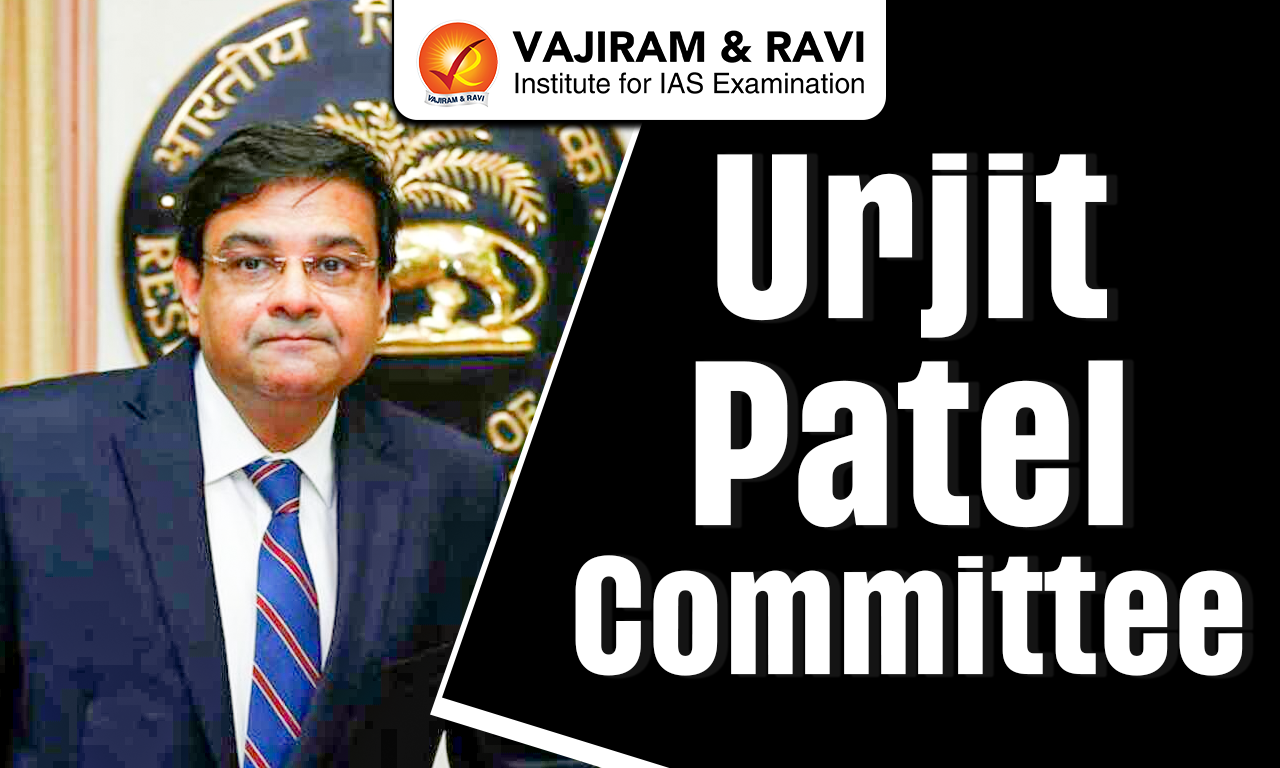
The Urjit Patel Committee is formally known as the Expert Committee to Revise and Strengthen the Monetary Policy Framework. It was constituted in 2013 to reform India’s monetary policy system. The committee was chaired by Dr. Urjit R. Patel. It aimed to improve transparency, credibility and effectiveness of policy decisions. Its recommendations led to a major shift towards inflation targeting, strengthening macroeconomic stability and aligning India’s monetary policy framework with global best practices.
Urjit Patel Committee Background
The Urjit Patel Committee was formed to address issues of policy ambiguity and high inflation in India’s economy.
- Multiple Objectives Issue: Earlier, monetary policy targeted growth, inflation and exchange rate simultaneously, causing confusion and weakening interest rate signalling, thereby reducing policy effectiveness in controlling inflation.
- High Inflation Phase: Persistent and volatile inflation during late 2000s and early 2010s highlighted the need for a clear nominal anchor to stabilise prices and ensure macroeconomic stability.
- Formation: The Reserve Bank of India, in consultation with the Government of India, constituted the committee in 2013 under Raghuram Rajan to recommend structural reforms.
- Need for Nominal Anchor: The committee emphasized the importance of a single measurable anchor to guide policy decisions and anchor inflation expectations across the economy.
- Global Alignment: It aimed to align India’s monetary policy framework with global best practices, ensuring improved transparency, credibility and institutional strength in policy making processes.
Urjit Patel Committee Recommendations
The Urjit Patel Committee proposed a comprehensive overhaul of India’s monetary policy framework with focus on inflation targeting.
- Inflation Targeting Framework: Recommended adopting flexible inflation targeting with Consumer Price Index as the nominal anchor to ensure price stability and guide policy decisions effectively.
- CPI as Primary Indicator: Suggested replacing Wholesale Price Index with CPI as it captures retail inflation and includes services, making it more relevant for policy formulation.
- Inflation Target Range: Proposed a medium term inflation target of 4% with a tolerance band of ±2%, ensuring inflation remains within 2% to 6% range.
- Monetary Policy Committee: Recommended establishment of a Monetary Policy Committee comprising RBI officials and external members to decide policy rates collectively, improving transparency and accountability.
- Single Mandate for RBI: Emphasized that RBI should focus primarily on price stability rather than multiple objectives to improve clarity and effectiveness of monetary policy.
- Repo Rate as Policy Tool: Suggested using repo rate as the primary policy instrument, maintaining it above inflation to ensure effective control over price rise.
- Transparency and Communication: Proposed publishing MPC decisions, voting patterns and rationale to enhance policy predictability and credibility among financial markets.
- Accountability Mechanism: Recommended that RBI should explain failure to meet inflation targets, suggest corrective measures and specify timelines for achieving targets.
- Institutional Independence: Highlighted the need for greater operational independence of RBI to protect monetary policy decisions from political interference.
- Supporting Fiscal Measures: Suggested government actions such as reducing administered prices, implementing fiscal consolidation and following FRBM targets to complement monetary policy efforts.


Urjit Patel Committee Impacts
The implementation of the Urjit Patel Committee’s recommendations significantly transformed India’s monetary policy and financial system.
- Adoption of Inflation Targeting: India formally adopted flexible inflation targeting in 2016, with CPI based target of 4% ±2%, improving price stability and anchoring inflation expectations.
- Establishment of MPC: Creation of Monetary Policy Committee introduced a rule based and committee driven approach, replacing discretionary decision making by RBI Governor alone.
- Improved Policy Transparency: Regular publication of MPC statements, voting patterns and reasoning enhanced transparency, accountability and public trust in monetary policy decisions.
- Better Monetary Transmission: Clear policy signals strengthened transmission of repo rate changes to lending and deposit rates, improving efficiency in banking operations and credit markets.
- Impact on Banking Sector: Predictable interest rate movements enabled banks to better manage assets and liabilities, improving risk assessment and lending decisions.
- Financial Market Stability: Reduced uncertainty led to more stable bond yields, improved functioning of interest rate derivatives and increased responsiveness of markets to policy signals.
- Macroeconomic Stability: Lower and stable inflation helped protect purchasing power, encourage savings and support long term investment planning in the economy.
- Policy Coordination: Clear division of roles improved coordination between fiscal and monetary policy, strengthening overall macroeconomic governance.
- Structural Transformation: The framework redefined India’s monetary policy architecture, making it more credible, transparent and aligned with global standards, enhancing economic resilience.

 Last updated on Oct, 2026
→ UPSC 2027 Notification will be released on 13 January 2027 at upsconline.nic.in.
→ Asian Games 2026 are being held in Aichi-Nagoya, Japan, from 19 September to 4 October.
→ Check Nobel Prize 2026 Winners List here.
→ Download PIB PRiSM Monthly Magazine 2026 here.
→ Check UPSC Monthly Current Affairs Magazine The Recitals here.
→ Check out the latest UPSC Syllabus here.
→ Download UPSC Model Answers for Mains 2026
→ UPSC Mains Question Paper 2026 is out now for Essay & GS Paper 1, 2, 3 & 4.
→ UPSC Calendar 2027 has been released.
→ Enroll in Vajiram & Ravi’s UPSC Mains Test Series 2027 for structured answer writing practice, expert evaluation, and exam-oriented feedback.
→ Join Vajiram & Ravi’s UPSC Mentorship Program 2027 for personalized guidance, strategy planning, and one-to-one support from experienced mentors.
→ Go through the UPSC Mains Previous Year Papers to enhance your preparation.
→ UPSC has released UPSC Toppers List 2025 with the Civil Services final result on its official website.
→ Also check Best UPSC Coaching in India
Urjit Patel Committee FAQs
Q1. What was the Urjit Patel Committee?+
Q2. What was the main recommendation of the Urjit Patel Committee?+
Q3. What is the Monetary Policy Committee (MPC)?+
Q4. Why did Urjit Patel Committee preferred CPI over WPI?+
Q5. What impact did the Urjit Patel Committee have on India’s economy?+
Tags: monetary policy framework urjit patel committee