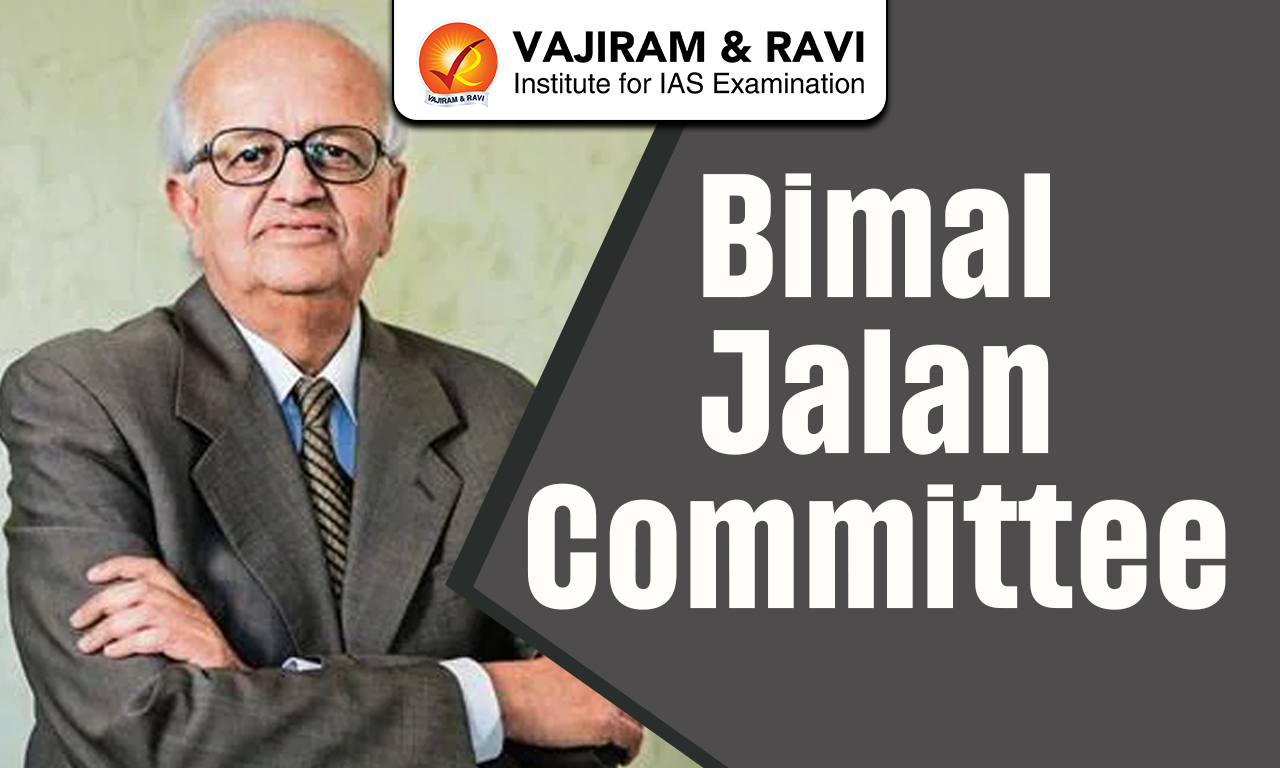
The Bimal Jalan Committee on Economic Capital Framework was set up in 2018 by the Reserve Bank of India in consultation with the Government of India. The committee was chaired by Bimal Jalan, a former RBI Governor.
The main purpose of this committee was to review how much capital the RBI should keep as reserves and how much surplus it can safely transfer to the government. The committee submitted its report in 2019, which became an important step in strengthening India’s financial stability framework.
Bimal Jalan Committee Objectives
The Bimal Jalan Committee was formed with several key objectives:
- To review the existing capital framework of the RBI
- To determine the ideal level of reserves the RBI should maintain
- To ensure financial stability and risk protection
- To create a transparent and rule-based system for surplus distribution
- To align RBI practices with global central banking standards
Bimal Jalan Committee Recommendations
- The committee recommended that the Contingency Fund (CF) should be maintained between 5.5% to 6.5% of the RBI’s balance sheet to ensure adequate risk coverage during financial crises.
- It advised that only realized profits (actual earnings) should be transferred to the government, while unrealized gains (like revaluation reserves) should not be distributed as they are not actual income.
- The committee suggested a clear surplus distribution policy, making the transfer process more transparent, rule-based, and less discretionary.
- It recommended that the Economic Capital Framework should be reviewed every five years to keep it updated with changing economic conditions and global financial risks.
- The RBI should allow interim dividends only in exceptional situations, avoiding frequent or unnecessary payouts that may weaken its financial position.
- The committee proposed aligning the RBI’s financial year with the government’s fiscal year, improving coordination in budgeting and economic planning.
- It emphasized maintaining a proper balance between risk provisioning and surplus transfer, ensuring that the RBI remains financially strong while supporting the economy.
- The recommendations also focused on strengthening the RBI’s ability to handle market risks, credit risks, operational risks, and currency fluctuations effectively.
- Overall, the committee aimed to create a robust, transparent, and internationally aligned framework for managing the RBI’s capital and reserves.


About the Economic Capital Framework (ECF)
The Economic Capital Framework (ECF) refers to the system used by the RBI to manage its capital, reserves, and risk buffers. It ensures that the central bank remains financially strong even during economic crises.
Economic capital includes:
- Realized Equity: Profits that have already been earned and can be distributed.
- Unrealized Reserves (Revaluation Balances): Gains or losses due to changes in currency value, gold prices, or foreign assets. These are not actual cash profits but accounting values.
This framework helps the RBI balance two important goals:
- Supporting the government financially
- Maintaining its own financial safety

 Last updated on Oct, 2026
→ UPSC 2027 Notification will be released on 13 January 2027 at upsconline.nic.in.
→ Check Nobel Prize 2026 Winners List here.
→ Download PIB PRiSM Monthly Magazine 2026 here.
→ Check UPSC Monthly Current Affairs Magazine The Recitals here.
→ Check out the latest UPSC Syllabus here.
→ Download UPSC Model Answers for Mains 2026
→ UPSC Mains Question Paper 2026 is out now for Essay & GS Paper 1, 2, 3 & 4.
→ UPSC Calendar 2027 has been released.
→ Enroll in Vajiram & Ravi’s UPSC Mains Test Series 2027 for structured answer writing practice, expert evaluation, and exam-oriented feedback.
→ Join Vajiram & Ravi’s UPSC Mentorship Program 2027 for personalized guidance, strategy planning, and one-to-one support from experienced mentors.
→ Go through the UPSC Mains Previous Year Papers to enhance your preparation.
→ UPSC has released UPSC Toppers List 2025 with the Civil Services final result on its official website.
→ Also check Best UPSC Coaching in India
Bimal Jalan Committee FAQs
Q1. What is the Bimal Jalan Committee?+
Q2. Who chaired the Bimal Jalan Committee?+
Q3. Why was the Bimal Jalan Committee formed?+
Q4. What is Economic Capital Framework (ECF)?+
Q5. What are realized and unrealized reserves?+
Tags: bimal jalan committee economic capital framework