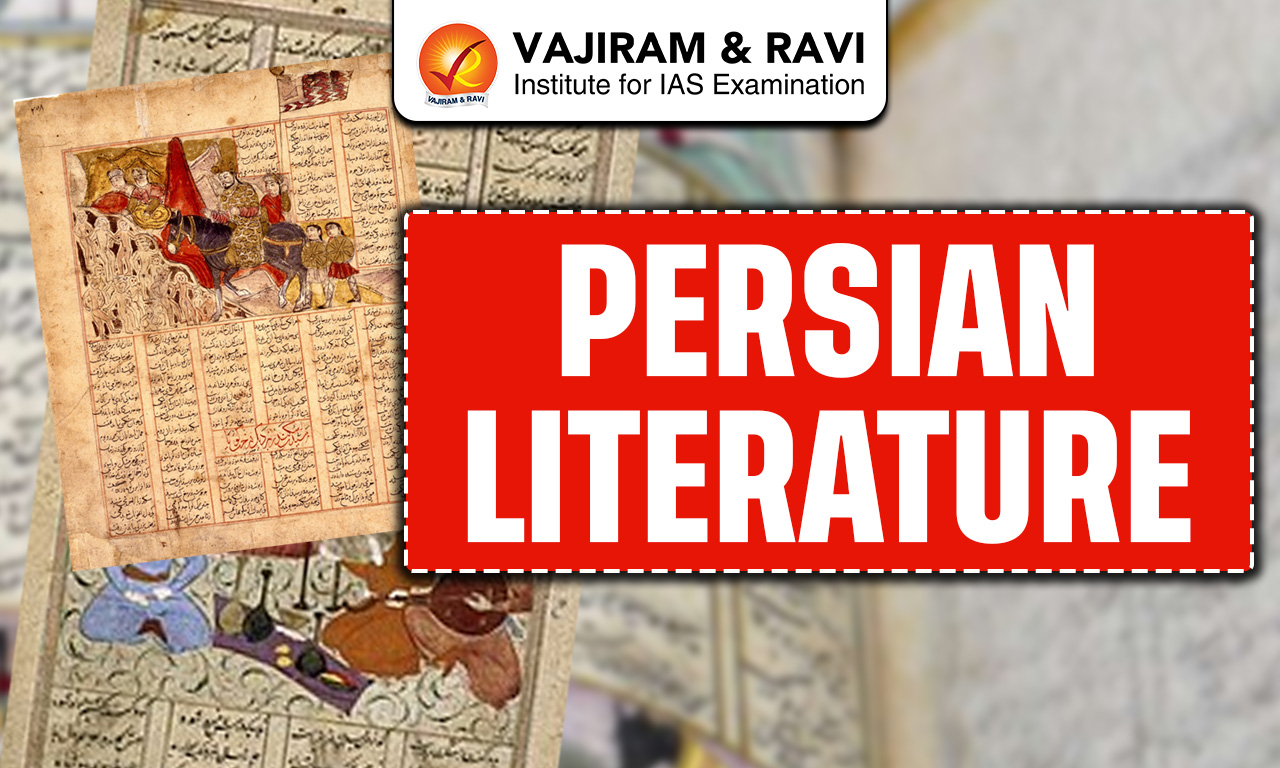
Persian literature refers to the rich body of literary works composed in the Persian language over many centuries. It includes poetry, historical writings, philosophical discussions, and mystical or Sufi literature. This tradition originated in ancient Iran and Central Asia and later spread widely into the Indian subcontinent.
Persian Literature Origin
The origin of the Persian language is traditionally associated with the Achaemenid Empire under King Darius, who ruled between 521 BCE and 485 BCE. During this early period, Persian was used mainly for royal inscriptions and administrative purposes. However, this early form of Persian was not yet developed as a refined literary language.
A major transformation in Persian literature occurred during the Sasanian Empire and later under the Samanid dynasty in Central Asia. These rulers provided strong patronage to poets, scholars, and writers. As a result, Persian gradually developed into a sophisticated literary language capable of expressing complex ideas in poetry and prose.
Major Forms of Persian Literature
Persian literature developed in several important forms, each serving a different purpose in society.
Poetry
Poetry was the most developed and widely respected form of Persian literature. It was used to express emotions, love, philosophy, spirituality, and praise of rulers. Persian poetry developed in several styles.
- The ghazal form was used for expressing love and emotional longing.
- The masnavi form was used for long narrative poems and moral stories.
- The rubaiyat form consisted of short four-line poems that expressed deep philosophical ideas about life and existence.
Poetry was not only a literary art but also an important part of court culture and Sufi spiritual practice.
Historical Writing or Chronicles
Historical writing in Persian, known as tawarikh, played a very important role in documenting the events of medieval India and the Islamic world. These writings recorded the achievements of rulers, details of battles, administrative policies, and social conditions. Most historical works were written under royal patronage, and therefore they often reflected the political ideology of ruling elites.
Sufi and Mystical Literature
Sufi literature focused on spiritual development, devotion to God, and the idea of love and unity with the divine. This form of literature used simple language and symbolic expressions to communicate deep spiritual meanings.
- A special category of Sufi literature known as malfuzat recorded the conversations, teachings, and sayings of Sufi saints. These texts played a major role in spreading ideas of tolerance, compassion, and universal brotherhood.
Translation Literature
Another important form of Persian literature was translation literature, which involved translating texts from Sanskrit and other Indian languages into Persian. This process became especially important during the Mughal period. These translations helped in creating intellectual exchange between Indian and Persian traditions and promoted cultural integration.


Advent of Persian Literature in India
Persian literature came to India through early Central Asian contacts and invasions, especially from the 11th century onwards. Over time, it became the language of the royal courts, administration, and historical writing in medieval India. Under the Delhi Sultanate and later the Mughal Empire, it developed into a rich literary tradition supported by kings, scholars, poets, and Sufi saints. Persian literature in India also mixed with local languages and ideas, creating a unique Indo-Persian culture that played an important role in shaping India’s medieval history.
Persian Literature during the Sultanate Period
The real foundation of Persian literature in India was laid during the Delhi Sultanate period.
Slave Dynasty and Early Scholars:
- The Slave Dynasty rulers such as Qutb-ud-din Aibak and Iltutmish provided patronage to Persian scholars and made Persian the official language of administration.
- As a result, Persian became the language of courts, revenue records, and historical writing.
- Scholars from regions such as Bukhara, Samarqand, and Khorasan migrated to India and contributed to the growth of literary culture. They also established madrasas and centres of learning.
Khalji and Tughlaq Period Literature:
Under Alauddin Khalji, Persian literature received strong royal support. Court poets and scholars produced works that combined poetry with Sufi and historical themes.
- Khwaja Hasan Dehlawi, also known as the “Sadi of Hindustan,” wrote lyrical poetry and Sufi-oriented compositions. His work Fawaid-ul-Fuad reflects spiritual discussions and moral teachings associated with Sufi traditions.
- During the Tughlaq period, Ziauddin Barani emerged as one of the most important historians. His work Tarikh-i-Firozshahi provides detailed accounts of political developments, administrative policies, and moral observations about rulers. However, his writings often reflect a biased aristocratic viewpoint.
- Another important historian was Isami, who wrote Futuh-us-Salatin. This work covers the history of Muslim rule in India from early invasions to the Tughlaq period and provides a regional perspective from the Deccan.
Firoz Shah Tughlaq and Later Sultanate Developments:
Firoz Shah Tughlaq was a major patron of literature and encouraged historical writing, translation activities, and lexicographical works. Important contributions include:
- Tarikh-i-Firozshahi by Shams-i-Siraj Afif, which provides a detailed account of Firoz Shah’s reign and administrative policies.
- Tarikh-i-Mubarak Shahi by Yahya bin Ahmad Sirhindi, which gives historical details of the Sayyid dynasty.
- Farhang-i-Ibrahimi, a Persian dictionary compiled by Ibrahim Qivam Faruqi, which reflects the development of Persian lexicography in India.
In the Deccan region, Persian literature developed under the Bahmani Sultanate. Khwaja Mahmud Gawan played an important role in promoting education and literary culture. He encouraged writing on administration and literary composition.
Persian Literature under the Mughal Empire
The Mughal period represents the peak of Indo-Persian literary development.
Babur and Humayun Period:
- Babur, the founder of the Mughal Empire, wrote his autobiography Tuzuk-i-Baburi in Turkish, which was later translated into Persian. This work provides valuable insights into his life and military campaigns.
- Humayun and his court also contributed to literary culture. His sister Gulbadan Begum wrote Humayun Nama, which is an important historical text written from a unique female perspective.
- Other works such as Jawahir-ul-Ulum-i-Humayuni and Badai-ul-Insha reflect scholarly and administrative interests during this period.
Akbar’s Reign: Golden Age of Persian Literature:
Akbar’s reign is considered the most significant phase in Indo-Persian literary history. He encouraged scholars, poets, and intellectuals from Persia, Central Asia, and India.Two major works define this period:
- Akbar Nama by Abul Fazl, which provides a detailed political and administrative history of Akbar’s reign.
- Ain-i-Akbari by Abul Fazl, which is an encyclopaedic work describing administration, revenue system, society, economy, and culture.
Poets like Urfi Shirazi, Faizi, Ghazali Mashhadi, and others contributed to the richness of Persian poetry during this period.
Jahangir and Shah Jahan Period:
During Jahangir’s reign, Persian literary tradition continued. Jahangir himself wrote Tuzuk-i-Jahangiri, which provides autobiographical details and insights into Mughal governance.Important historical works of this period include:
- Padshahnama by Abdul Hamid Lahori, which describes Shah Jahan’s reign in detail.
- Shah Jahan Nama by Muhammad Salih Kanbo, which also provides a historical account of the period.
Aurangzeb and Later Mughal Period:
During Aurangzeb’s reign, Persian historical writing continued, although royal patronage for literature declined compared to earlier Mughal rulers.
- Important works include Khulasat-ut-Tawarikh by Sujan Rai and Alamgir Nama by Mirza Muhammad Kazim, which document the political events of Aurangzeb’s reign.
- Dara Shikoh made a unique contribution to Indo-Persian intellectual history. He worked towards interfaith understanding between Hinduism and Islam. His major works include Majma-ul-Bahrain, which compares philosophical ideas of both traditions, and Sirr-i-Akbar, which is a Persian translation of the Upanishads.

 Last updated on Sep, 2026
→ UPSC 2027 Notification will be released on 13 January 2027 at upsconline.nic.in.
→ Asian Games 2026 are being held in Aichi-Nagoya, Japan, from 19 September to 4 October.
→ Check out the latest UPSC Syllabus here.
→ Download UPSC Model Answers for Mains 2026
→ UPSC Mains Question Paper 2026 is out now for Essay & GS Paper 1, 2, 3 & 4.
→ UPSC Calendar 2027 has been released.
→ Enroll in Vajiram & Ravi’s UPSC Mains Test Series 2027 for structured answer writing practice, expert evaluation, and exam-oriented feedback.
→ Join Vajiram & Ravi’s UPSC Mentorship Program 2027 for personalized guidance, strategy planning, and one-to-one support from experienced mentors.
→ Go through the UPSC Mains Previous Year Papers to enhance your preparation.
→ UPSC has released UPSC Toppers List 2025 with the Civil Services final result on its official website.
→ Also check Best UPSC Coaching in India
Persian Literature FAQs
Q1. Persian became the official language of administration in medieval India under which dynasty?+
Q2. Who wrote Akbarnama, and why is it important?+
Q3. Which Persian work by Abul Fazl is an encyclopaedic account of Mughal administration and society?+
Q4. Which Mughal prince translated the Upanishads into Persian?+
Q5. Who is considered the greatest Indo-Persian poet who introduced Indian elements into Persian poetry?+
Tags: persian literature