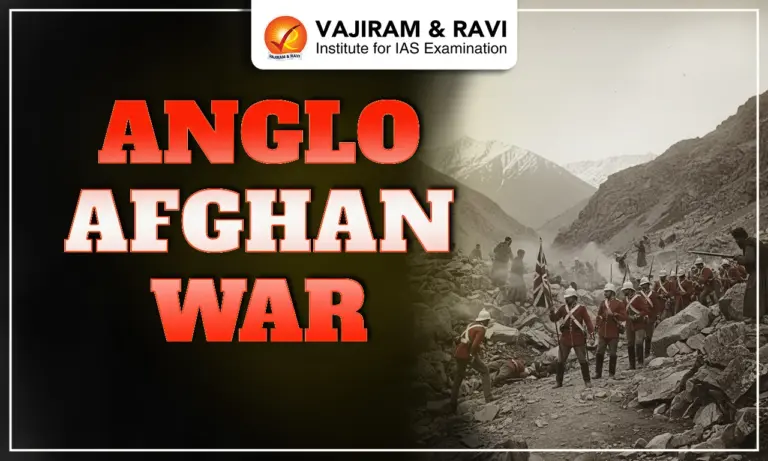
The Anglo-Afghan engagements of the nineteenth and early twentieth centuries show the complex interplay of imperial strategy, local politics, and regional geopolitics. During the early nineteenth century, the geopolitical landscape of Central and South Asia was being shaped by competing imperial ambitions, with Britain and Russia emerging as the foremost rivals. The growing influence of Russia in Persia and Central Asia began to pose a direct challenge to British strategic interests in India. Britain had envisioned securing a trade route via the Euphrates River to India, which would facilitate commercial connectivity and reinforce imperial control. However, with Russia consolidating its presence in Persia, particularly after the signing of the Treaty of Turkomanchai in 1828, British fears of a potential Russian incursion into India became acute. These anxieties highlighted the strategic importance of Afghanistan and the northwest passes, which served as natural gateways into the Indian subcontinent. Consequently, British policymakers emphasized the need for a pro-British regime in Afghanistan to serve as a buffer against potential Russian advances. In this article, we are going to cover the Anglo Afghan War.
Anglo Afghan War
The Anglo Afghan War took place because Britain’s primary objective was the protection of India from external threats, particularly Russian expansionism. Afghanistan’s strategic location made it an important buffer state, but its complex tribal and political structures posed persistent challenges.
The First Anglo-Afghan War showed the dangers of direct intervention and the high costs associated with military campaigns. John Lawrence’s policy of non-intervention exemplified the merits of restraint and diplomacy in maintaining frontier stability. By contrast, Lytton’s assertive policies showed the ongoing strategic tensions with Russia and the need for proactive safeguards. The Treaty of Gandamak and the Durand Line Agreement institutionalized British influence while attempting to accommodate Afghan sovereignty, setting the stage for enduring frontier management strategies.
Lord Auckland and the Forward Policy
In 1836, Lord William Eden, the Governor-General of India, was succeeded by Lord Auckland, whose tenure marked a shift toward proactive frontier diplomacy. Lord Auckland introduced what came to be known as the “Forward Policy,” a strategy that advocated direct intervention to safeguard British India’s northwestern borders. The essence of this policy was the prevention of Russian influence in Afghanistan and the stabilization of the region through diplomatic or military means. This approach represented a departure from previous policies of cautious observation and indirect influence.
Afghanistan’s ruler at the time, Amir Dost Mohammed, sought British assistance to regain Peshawar from the Sikhs. The British, however, were reluctant to involve themselves directly in territorial disputes with the Sikh Empire. This refusal prompted Dost Mohammed to seek support from Russia and Persia, which further alarmed British authorities. Determined to preempt Russian influence, the British embarked on a plan to install a friendly Afghan ruler, Shah Shuja, who had been dethroned in 1809 and was living under British protection in Ludhiana.





Anglo War Tripartite Treaty of 1838
To put the Forward Policy in action, the British orchestrated a Tripartite Treaty in 1838 involving the British East India Company, the Sikh Empire under Maharaja Ranjit Singh, and Shah Shuja. The treaty stipulated that Shah Shuja would be restored to the Afghan throne with military backing from the Sikhs and financial support from the British, while the British themselves would remain minimally involved in direct administration. Shah Shuja was to conduct international relations under the guidance of British and Sikh advisors, and he ceded certain rights over the Amirs of Sindh in exchange for British protection. Additionally, he recognized Maharaja Ranjit Singh’s sovereignty over territories east of the Indus River. The treaty reflected Britain’s objective of creating a stable, pro-British Afghan monarchy that would serve as a strategic buffer state against Russian expansion.
First Anglo-Afghan War (1839-1842)
In the early 19th century, British India was wary of growing Russian influence in Central Asia and Afghanistan. The British feared that Russia might advance toward India, threatening its northwest frontier. To counter this, the British adopted the Forward Policy under Governor-General Lord Auckland, aiming to establish a pro-British ruler in Afghanistan.
- Causes:
-
-
- Afghanistan’s Amir, Dost Mohammed, sought Russian support after being denied British aid to regain Peshawar from the Sikhs.
- British fears of Russian encroachment led them to support the exiled Afghan ruler Shah Shuja, who had lived under British protection since 1809.
- A Tripartite Treaty (1838) was signed between the British, Sikhs, and Shah Shuja, enabling his restoration to the throne.
-
- Course of the War:
-
-
- British forces invaded Afghanistan and captured Kabul in 1839, installing Shah Shuja as the king.
- Shah Shuja proved unpopular, while Dost Mohammed retained loyalty among the Afghan tribes.
- In 1840-41, widespread revolts and an insurrection erupted, targeting British forces.
- The British negotiated a retreat in 1841, but the withdrawal turned disastrous, with nearly 20,000 soldiers lost in the retreat from Kabul.
-
- Outcome:
-
- Afghanistan regained independence under Dost Mohammed, and the British suffered a humiliating defeat.
- The war exposed the dangers of direct interference in Afghan internal politics and the challenges of controlling the northwest frontier.
Second Anglo-Afghan War (1878-1880)
By the 1870s, British fears of Russian influence resurfaced. Amir Sher Ali Khan initially allowed Russian envoys but refused to receive a British mission in Kabul. The British interpreted this as a threat to Indian security and launched the Second Anglo-Afghan War.
- Causes:
-
-
- Sher Ali’s refusal to host a British mission.
- The British desire to secure Afghanistan as a buffer state against Russian expansion.
-
- Course of the War:
-
-
- British forces invaded in 1878, forcing Sher Ali to flee.
- Treaty of Gandamak (May 1879): Signed with Sher Ali’s son Yakub Khan, it ceded control of Afghanistan’s foreign policy to Britain and stationed a permanent British envoy in Kabul.
- Widespread resistance, including the killing of the British envoy in Kabul, triggered renewed British military action.
- British forces eventually occupied Kabul and Kandahar.
-
- Outcome:
-
- Abdur Rahman was installed as the new Amir, retaining internal sovereignty but with British control over foreign affairs.
- Afghanistan remained a buffer state, limiting Russian influence.
Third Anglo-Afghan War (1919)
After World War I and the Bolshevik Revolution, Afghanistan, under Amir Amanullah Khan, sought full control over its foreign affairs. The British were weakened by the war and the unrest in India, which emboldened Afghanistan to assert its independence.
- Causes:
- Desire of Amir Amanullah to regain full sovereignty over Afghan foreign relations.
- The British aim to maintain influence over Afghanistan as a buffer state post-WWI.
- Course of the War:
- Afghanistan launched an attack on British India in May 1919, leading to brief but intense conflict.
- The British responded militarily but did not seek prolonged occupation due to overstretched resources.
- Outcome:
- Treaty of Rawalpindi (August 1919): Afghanistan regained complete control over its foreign policy, marking its full independence from British influence.
- Amanullah Khan consolidated his power and initiated modernization efforts in Afghanistan.
John Lawrence and the Policy of Strategic Non-Intervention
The experiences of the First Anglo-Afghan War deeply influenced subsequent British frontier policy. John Lawrence, serving as the Chief Commissioner of Punjab (1864–1869), adopted a strategy of deliberate non-intervention, informed by practical considerations and confidential knowledge of the region’s socio-political dynamics. The policy focused minimal interference in Afghan internal affairs and a recognition of the Afghan desire for autonomy.
When Dost Mohammed passed away in 1863, Lawrence refrained from influencing the succession dispute, adhering to the principles of non-intervention: maintaining peace along the border and ensuring that no Afghan claimant sought external assistance. This approach facilitated the peaceful consolidation of Sher Ali Khan’s rule and fostered cordial relations between British India and Afghanistan. Lawrence’s strategy reflected a nuanced understanding that stability at the frontier was best achieved through restraint rather than aggressive intrusion.
Lord Lytton and the Policy of Proud Reserve
By the 1870s, British concerns regarding Russian expansionism persisted, prompting a more assertive stance under Lord Lytton, Viceroy of India (1876-1880). Lytton’s approach, sometimes termed “assertive aloofness,” sought to establish clearly demarcated borders and solidify British influence in Afghanistan while avoiding direct annexation. His policy aimed to safeguard India’s frontiers through preferential treaties and strategic diplomacy rather than large-scale occupation.
Lytton’s initiatives led to the Second Anglo-Afghan War (1878–1880). The British sought a preferential agreement with Sher Ali Khan, but the Afghan Amir maintained cordial relations with both Britain and Russia and refused to host a British diplomatic representative in Kabul. Lytton perceived this as a threat to British strategic interests and ordered a military expedition into Afghanistan. Sher Ali fled, and his son, Yakub Khan, signed the Treaty of Gandamak in May 1879.
Anglo Afghan War and Treaty of Gandamak
The Treaty of Gandamak formalized British influence over Afghan foreign policy. It stipulated that Afghanistan’s international relations would be advised by the British, allowed a permanent British envoy in Kabul, and ensured British assistance in the event of external threats. Yakub Khan was compelled to abdicate due to domestic opposition, prompting a British reoccupation of Kabul and Kandahar. Abdur Rahman was installed as the new Amir, marking a period of relative stability. However, proposals for further partitioning Afghanistan were abandoned, and successive administrations, including Lord Ripon’s, ultimately preserved Afghanistan as a buffer state.
British Military Presence and Frontier Administration
Throughout the late nineteenth century, British India faced continued challenges in stabilizing the northwest frontier. The occupation of Hunza and Nagar in the Gilgit Valley (1891-1892) heightened tensions with Afghan Amir Abdur Rahman. To formalize borders and secure strategic control, the Durand Line Agreement of 1893 was signed, delineating territories between British India and Afghanistan. The agreement granted Abdur Rahman control over certain districts and increased subsidies, though tribal resistance persisted.
From 1893 to 1898, British forces were stationed in key passes such as Malakand and Chitral to contain insurgencies. Viceroy Curzon, between 1899 and 1905, implemented a policy of withdrawal and concentration, wherein forward positions were handed over to local militias under British supervision. This approach created stability and reduced direct British exposure to tribal conflicts. Curzon also established the North-West Frontier Province (NWFP) under direct administration, providing a more structured governance framework. The NWFP would later become part of Pakistan following partition in 1947, maintaining relative regional stability thanks to these policies.
Anglo Afghan War UPSC
In the twentieth century, Afghanistan gradually asserted its independence over foreign relations. Following the assassination of Habibullah in 1919, Amanullah Khan launched a conflict with British India, ultimately securing Afghan autonomy with the 1921 settlement. These developments underscored the limits of imperial influence and the enduring significance of Afghanistan as a buffer state in South and Central Asia.
Overall, the history of Anglo-Afghan relations and British frontier policy highlights the delicate balance between strategic imperatives, local autonomy, and the costs of military intervention. The lessons learned shaped subsequent British engagement with the region and influenced policies that continued well into the twentieth century, leaving a lasting legacy on the geopolitical landscape of South Asia.

 Last updated on March, 2026
→ UPSC Final Result 2025 is now out.
→ UPSC has released UPSC Toppers List 2025 with the Civil Services final result on its official website.
→ Anuj Agnihotri secured AIR 1 in the UPSC Civil Services Examination 2025.
→ UPSC Marksheet 2025 is now out.
→ UPSC Notification 2026 & UPSC IFoS Notification 2026 is now out on the official website at upsconline.nic.in.
→ UPSC Calendar 2026 has been released.
→ Check out the latest UPSC Syllabus 2026 here.
→ UPSC Prelims 2026 will be conducted on 24th May, 2026 & UPSC Mains 2026 will be conducted on 21st August 2026.
→ The UPSC Selection Process is of 3 stages-Prelims, Mains and Interview.
→ Prepare effectively with Vajiram & Ravi’s UPSC Prelims Test Series 2026 featuring full-length mock tests, detailed solutions, and performance analysis.
→ Enroll in Vajiram & Ravi’s UPSC Mains Test Series 2026 for structured answer writing practice, expert evaluation, and exam-oriented feedback.
→ Join Vajiram & Ravi’s Best UPSC Mentorship Program for personalized guidance, strategy planning, and one-to-one support from experienced mentors.
→ Shakti Dubey secures AIR 1 in UPSC CSE Exam 2024.
→ Also check Best UPSC Coaching in India
Anglo Afghan War FAQs
Q1. Who won the Anglo-Afghan War?+
Q2. Who won the Second Anglo-Afghan War?+
Q3. What were the Anglo-Afghan wars?+
Q4. Why did the Anglo-Afghan War take place?+
Q5. What was the Treaty of Gandamak?+
Tags: anglo afghan war