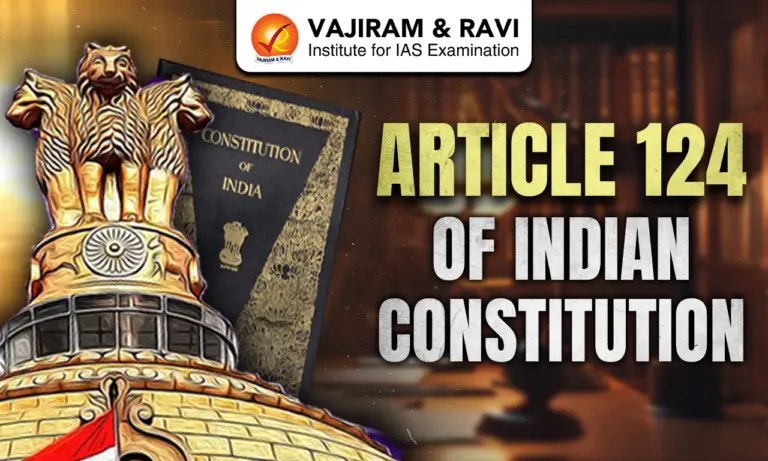
Article 124 of Indian Constitution deals with the establishment and constitution of the Supreme Court. It aims to ensure an independent, competent, and impartial judiciary, which is essential for the functioning of a constitutional democracy.
Provisions of Article 124 of Indian Constitution
Provisions of Article 124 of Indian Constitution lays down the framework for the composition, appointment, qualifications, tenure, removal, and conduct of judges of the Supreme Court of India.
Establishment and Composition of the Supreme Court
- Article 124(1) provides that there shall be a Supreme Court of India consisting of the Chief Justice of India and other judges as prescribed by Parliament.
- Initially, the Constitution limited the number of judges to a small strength, but Parliament was given the authority to increase the number of judges according to the requirements of the judicial system. This flexibility was introduced to ensure efficient disposal of cases and to manage increasing litigation.
- Over time, the number of judges has been increased through legislative action to address the rising judicial workload.
- At present, the sanctioned strength of the Supreme Court is 34 judges including the Chief Justice of India.
Appointment and Tenure of Judges
- Article 124(2) states that Supreme Court judges are appointed by the President of India through a warrant under his hand and seal.
- The provision has undergone significant interpretation through judicial decisions, which led to the development of the collegium system for judicial appointments.
- The collegium system is not mentioned in the Constitution but developed through judicial pronouncements in the Three Judges Cases.
- The provision also saw the introduction of the National Judicial Appointments Commission through the 99th Constitutional Amendment Act, 2014, which attempted to create a more participatory appointment system involving judiciary and executive. However, in 2015, the Supreme Court declared the NJAC unconstitutional on the ground that it threatened judicial independence.
- The article further provides that a Supreme Court judge shall hold office until attaining the age of sixty-five years.
- A judge may resign by writing a letter addressed to the President.
- Parliament has the authority to regulate the determination of the age of judges through legislation.
Qualifications for Appointment
- Article 124(3) prescribes the eligibility criteria for appointment as a Supreme Court judge.
- A person must be a citizen of India and must have either served as a High Court judge for at least five years, practiced as an advocate in a High Court for at least ten years, or be recognised as a distinguished jurist in the opinion of the President.
Removal of Judges
- Article 124(4) provides a procedure for the removal of Supreme Court judges.
- A judge can be removed only on the grounds of proven misbehaviour or incapacity.
- The removal process requires a parliamentary address supported by a majority of the total membership of each House and at least two-thirds of the members present and voting.
- The address must be presented to the President in the same parliamentary session for the removal to be effective.
- This rigid procedure protects judicial independence by preventing arbitrary removal of judges.
Regulation of Removal Procedure
- Article 124(5) allows Parliament to frame laws regulating the procedure for presenting the address and investigating allegations of misbehaviour or incapacity.
Oath of Office
- According to Article 124(6), every person appointed as a Supreme Court judge must take an oath or affirmation before entering office.
- The oath is administered by the President or a person authorised by the President.
- The oath requires judges to uphold the Constitution of India, perform duties without fear or favour, and discharge judicial functions faithfully.
Post-Retirement Restrictions
- Article 124(7) states that a person who has served as a Supreme Court judge cannot practice law in any court or authority within the territory of India after retirement. This provision is intended to prevent conflict of interest and maintain the dignity and neutrality of the judiciary.





Important Constitutional Amendments Related to Article 124
Constitutional amendments introduced to improve the functioning of the Supreme Court and regulate judicial appointments and service conditions include:
15th Constitutional Amendment Act, 1963
This amendment made provisions regarding the determination of the age of High Court and Supreme Court judges. It allowed Parliament to prescribe the authority and procedure for determining the age of judges.
99th Constitutional Amendment Act, 2014
This amendment attempted to replace the collegium system by establishing the National Judicial Appointments Commission (NJAC) for judicial appointments.
However, in 2015, the Supreme Court struck down the 99th Amendment as unconstitutional, holding that it violated judicial independence, which is part of the basic structure doctrine.
Judgements Related to Article 124 of Indian Constitution
The appointment of Supreme Court judges has been shaped largely by important judicial interpretations of Article 124. Over time, several landmark Supreme Court judgments have played a crucial role in defining the balance between the executive and the judiciary, especially in matters related to judicial independence and the appointment process.
First Judges Case (1981) / S.P. Gupta Case
- In the First Judges Case, a seven-judge Constitution Bench interpreted the meaning of the word “consultation” in the Constitution.
- The Supreme Court held that consultation did not mean concurrence.
- Therefore, the final authority in judicial appointments rested with the Union Government rather than the Chief Justice of India.
- This judgment strengthened executive control over judicial appointments.
- The Court also ruled that a High Court judge could be transferred to another High Court even without his consent.
Second Judges Case (1993) – Supreme Court Advocates-on-Record Association Case
- The Supreme Court overruled the First Judges Case and strengthened judicial independence.
- A nine-judge Constitution Bench established the collegium system.
- It was held that the opinion of the Chief Justice of India, formed collectively with senior Supreme Court judges, would have primacy in judicial appointments. The Chief Justice of India should form his opinion after consulting the two senior-most judges of the Supreme Court.
- In situations where differences arose between the executive and judiciary, the view of the Chief Justice of India would generally prevail.
Third Judges Case (1998)
- The Supreme Court ruled that the collegium for Supreme Court appointments would consist of the Chief Justice of India and the four senior-most judges of the Supreme Court.
- It also provided procedural guidance by stating that if two or more judges in the collegium opposed a candidate, the name would not be recommended for appointment.
Fourth Judges Case (2015)
- In the Fourth Judges Case, the Supreme Court struck down the 99th Constitutional Amendment and the NJAC Act as unconstitutional.
- The Court held that the NJAC violated judicial independence, which is part of the basic structure of the Constitution.
- The judgment was based on reasons such as inadequate judicial representation in the commission and the potential threat to judicial autonomy.

 Last updated on April, 2026
→ UPSC Final Result 2025 is now out.
→ UPSC has released UPSC Toppers List 2025 with the Civil Services final result on its official website.
→ Anuj Agnihotri secured AIR 1 in the UPSC Civil Services Examination 2025.
→ UPSC Marksheet 2025 is now out.
→ UPSC Notification 2026 & UPSC IFoS Notification 2026 is now out on the official website at upsconline.nic.in.
→ UPSC Calendar 2026 has been released.
→ Check out the latest UPSC Syllabus 2026 here.
→ UPSC Prelims 2026 will be conducted on 24th May, 2026 & UPSC Mains 2026 will be conducted on 21st August 2026.
→ The UPSC Selection Process is of 3 stages-Prelims, Mains and Interview.
→ Prepare effectively with Vajiram & Ravi’s UPSC Prelims Test Series 2026 featuring full-length mock tests, detailed solutions, and performance analysis.
→ Enroll in Vajiram & Ravi’s UPSC Mains Test Series 2026 for structured answer writing practice, expert evaluation, and exam-oriented feedback.
→ Join Vajiram & Ravi’s Best UPSC Mentorship Program for personalized guidance, strategy planning, and one-to-one support from experienced mentors.
→ Shakti Dubey secures AIR 1 in UPSC CSE Exam 2024.
→ Also check Best UPSC Coaching in India
Article 124 of the Indian Constitution FAQs
Q1. What is Article 124 of the Indian Constitution?+
Q2. How are Supreme Court judges appointed under Article 124?+
Q3. What is the retirement age of Supreme Court judges under Article 124?+
Q4. What is the collegium system related to Article 124?+
Q5. Can a Supreme Court judge practice law after retirement?+
Tags: article 124 of the indian constitution indian constitution indian polity