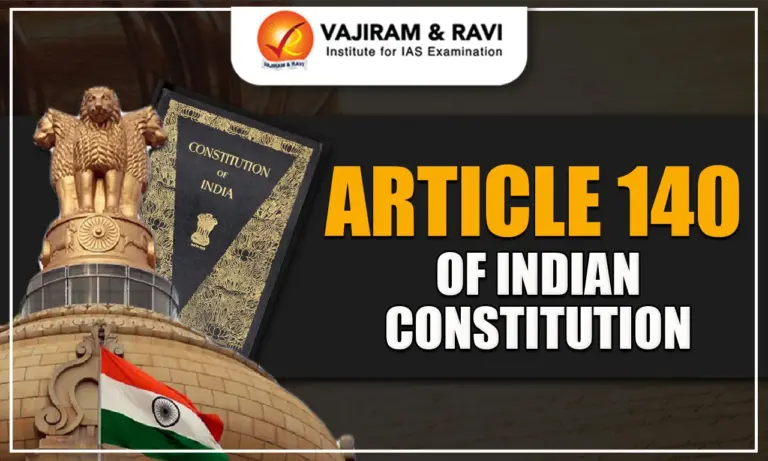
Article 140 comes under part V of the Constitution of India. The article acts like a legislative tool that empowers the Supreme Court by providing supplemental powers important for the effective exercise of its jurisdiction. The article helps the Supreme Court of India by providing the additional powers through the constitution. This aligns with the goal of the Supreme Court of India to act as a guardian and interpreter of the Constitution and uphold the rule of law and preserve the constitutional values.
Article 140 of the Constitution of India Interpretation
Article 140 of the Indian Constitution provides Parliament the authority to improve the capabilities of Supreme Court by providing them with some additional powers that are:
- Supplemental in nature (does not alter or contradict the existing constitutional powers)
- Consistent with the Constitution
- Strengthen the efficiency of the Court in performing judicial functions
Article 140 of the constitution represents the flexibility that is embedded in the constitution of India. It acknowledges that while the Supreme Court’s core powers are constitutionally enshrined, many auxiliary functions need legislative support for better enforcement of justice.
Article 140 Significance
Article 140 of the Constitution of India has the following importance:
- Improve Judicial Functionality: It empowers the Court to perform its duties more efficiently, especially in complex constitutional matters.
- Provides Constitutional Integrity: All additional powers must align with the existing provisions of the Constitution, ensuring checks and balances.
- Parliamentary Oversight: It provides room for Parliamentary legislation to adapt judicial tools as per the need of the hour without infringing on judicial independence.
- Supports Legal Adaptability: With emerging legal challenges like cyber law, privacy issues, and digital governance, supplemental powers can help the Court remain relevant and responsive.






 Last updated on March, 2026
→ UPSC Final Result 2025 is now out.
→ UPSC has released UPSC Toppers List 2025 with the Civil Services final result on its official website.
→ Anuj Agnihotri secured AIR 1 in the UPSC Civil Services Examination 2025.
→ UPSC Marksheet 2025 is now out.
→ UPSC Notification 2026 & UPSC IFoS Notification 2026 is now out on the official website at upsconline.nic.in.
→ UPSC Calendar 2026 has been released.
→ Check out the latest UPSC Syllabus 2026 here.
→ UPSC Prelims 2026 will be conducted on 24th May, 2026 & UPSC Mains 2026 will be conducted on 21st August 2026.
→ The UPSC Selection Process is of 3 stages-Prelims, Mains and Interview.
→ Prepare effectively with Vajiram & Ravi’s UPSC Prelims Test Series 2026 featuring full-length mock tests, detailed solutions, and performance analysis.
→ Enroll in Vajiram & Ravi’s UPSC Mains Test Series 2026 for structured answer writing practice, expert evaluation, and exam-oriented feedback.
→ Join Vajiram & Ravi’s Best UPSC Mentorship Program for personalized guidance, strategy planning, and one-to-one support from experienced mentors.
→ Shakti Dubey secures AIR 1 in UPSC CSE Exam 2024.
→ Also check Best UPSC Coaching in India
Article 140 of Indian Constitution FAQs
Q1. What is Article 140 of the Constitution?+
Q2. What is Article 142 of the Indian Constitution?+
Q3. What is an example of Article 140?+
Q4. What are the powers of Supreme Court?+
Q5. What is covered in Part V of the Constitution?+
Tags: article 140 of indian constitution