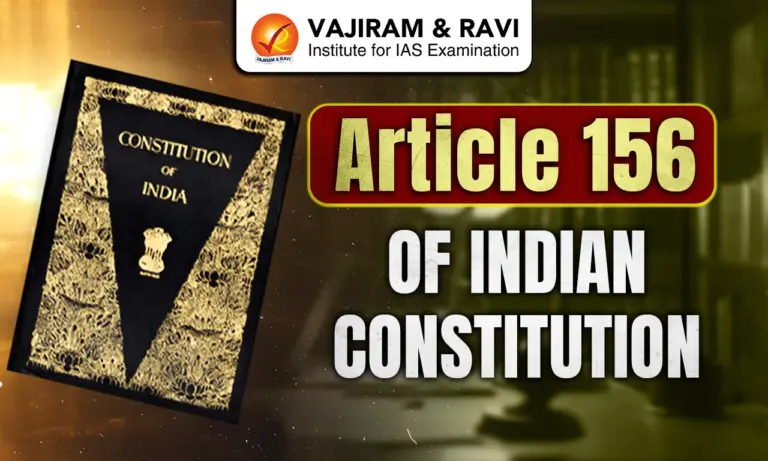
Article 156 of Indian Constitution is an important constitutional provision that governs the tenure, resignation, and removal of the Governor of a State. The Governor acts as the constitutional head of the State under Part VI of the Constitution and plays a crucial role in maintaining constitutional governance at the State level. The provision reflects India’s quasi-federal structure, where the Governor is appointed by the President but functions as a link between the Union and State governments.
Article 156 of Indian Constitution
Article 156 of Indian Constitution contains three main provisions.
Article 156(1)
It states that the Governor shall hold office during the pleasure of the President. This means the Governor can be removed by the President at any time. However, since the President acts on the advice of the Union Council of Ministers under Article 74, the Union Government effectively influences the decision regarding the Governor’s tenure.
Issues with Article 156(1)
Article 156(1) has been criticised due to following issues:
- Political misuse of the pleasure doctrine: Governors are sometimes removed due to political changes at the Centre rather than on constitutional or administrative grounds.
- Federalism concerns: Frequent removal or appointment of Governors may affect State autonomy and cooperative federalism.
- Possibility of executive dominance: As the Union Government influences the President’s decision, it may lead to centralization of power.
Article 156(2)
- A Governor may resign from office by submitting a written resignation to the President. The resignation becomes effective once accepted.
Article 156(3)
- The normal term of a Governor is five years from the date of assuming office.
- However, the Constitution provides that a Governor may continue to hold office even after completing five years until the successor takes charge.
- This provision prevents administrative uncertainty and ensures smooth functioning of the State executive.
Important Judgements Related to Article 156 of Indian Constitution
- In B.P. Singhal v. Union of India, the Supreme Court held that the President can remove a Governor without giving reasons, but such removal should not be arbitrary, mala fide, or based purely on political considerations. The Court emphasised that the doctrine of pleasure is not absolute and must be exercised in accordance with constitutional principles.
- In Shamsher Singh v. State of Punjab, the Supreme Court clarified that constitutional heads like the President and Governor are generally bound by the advice of the Council of Ministers. This judgment reinforced the parliamentary system of governance.






 Last updated on March, 2026
→ UPSC Final Result 2025 is now out.
→ UPSC has released UPSC Toppers List 2025 with the Civil Services final result on its official website.
→ Anuj Agnihotri secured AIR 1 in the UPSC Civil Services Examination 2025.
→ UPSC Marksheet 2025 is now out.
→ UPSC Notification 2026 & UPSC IFoS Notification 2026 is now out on the official website at upsconline.nic.in.
→ UPSC Calendar 2026 has been released.
→ Check out the latest UPSC Syllabus 2026 here.
→ UPSC Prelims 2026 will be conducted on 24th May, 2026 & UPSC Mains 2026 will be conducted on 21st August 2026.
→ The UPSC Selection Process is of 3 stages-Prelims, Mains and Interview.
→ Prepare effectively with Vajiram & Ravi’s UPSC Prelims Test Series 2026 featuring full-length mock tests, detailed solutions, and performance analysis.
→ Enroll in Vajiram & Ravi’s UPSC Mains Test Series 2026 for structured answer writing practice, expert evaluation, and exam-oriented feedback.
→ Join Vajiram & Ravi’s Best UPSC Mentorship Program for personalized guidance, strategy planning, and one-to-one support from experienced mentors.
→ Shakti Dubey secures AIR 1 in UPSC CSE Exam 2024.
→ Also check Best UPSC Coaching in India
Article 156 of Indian Constitution FAQs
Q1. What is Article 156 of Indian Constitution?+
Q2. Who appoints and removes the Governor under Article 156?+
Q3. What is the meaning of “pleasure of the President” in Article 156?+
Q4. What is the normal term of a Governor?+
Q5. Can courts review the removal of a Governor?+
Tags: article 156 of indian constitution