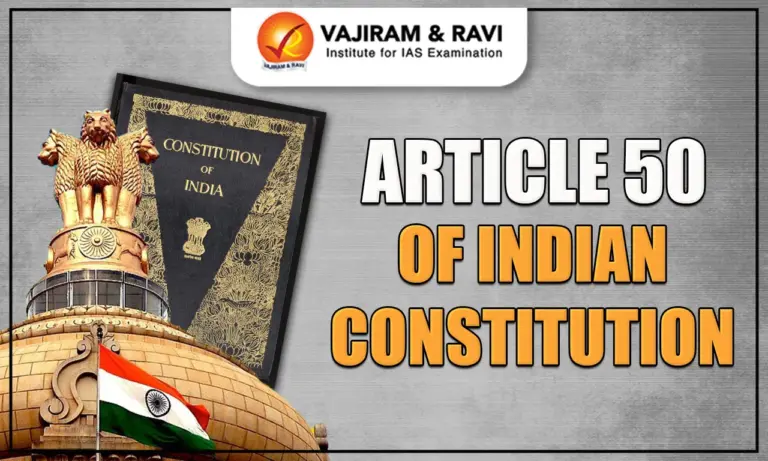
Article 50 of Indian Constitution is discussed in Part IV under the Directive Principles of State Policy, directs the State to take steps to separate the judiciary from the executive in matters relating to public services. The provision is intended to safeguard judicial independence by ensuring that the functioning of the judiciary remains free from executive influence or control. Although the Directive Principles are not legally enforceable, they serve as guiding principles for governance.
Article 50 of Indian Constitution
The State shall take steps to separate the judiciary from the executive in the public services of the State.
Article 50 of Indian Constitution Interpretation
Article 50 of Indian Constitution plays an important role in safeguarding judicial independence. It affirms that judges must decide cases solely on the basis of law and evidence, free from external influence particularly from the executive branch. By reinforcing the principle of separation of powers, Article 50 ensures that:
- Each branch of government functions within its defined sphere of authority
-
The balance of power among the branches is preserved
The provision is specifically concerned with the public services of the State, directing that judicial officers remain distinct from those serving in executive roles. This prevents overlaps that could undermine the impartiality and integrity of judicial decision-making.





Article 50 of Indian Constitution Background
Article 50 of Indian Constitution, mentioned under Part IV, directs the State to ensure a complete separation between the judiciary and the executive in the public services of the State. This provision, part of the Directive Principles of State Policy, has its roots in colonial administrative practices where the two functions were often inter related.
Colonial Era and the Fusion of Functions
After the East India Company was granted Diwani rights in 1765, it evolved from a trading organisation into a governing authority. Civil judicial functions were entrusted to Company Collectors, while criminal cases remained under Muslim officers applying Islamic law. By 1781, however, the Company began centralising criminal justice by granting magisterial powers to its own Collectors, consolidating executive and judicial authority in the same office.
Early Advocacy for Separation: Warren Hastings (1793)
Warren Hastings recognised the risks of overlapping powers and, in 1793, issued a proclamation emphasising that revenue officers should not also hold judicial responsibilities. This marked one of the earliest acknowledgements of the need for an impartial judicial system.
Regression in 1871
Despite earlier reforms, a backward step occurred in 1871 when magisterial powers were transferred from District Judges back to Collectors. This move once again concentrated administrative, prosecutorial, and judicial authority in a single position, eroding judicial independence.
Concerns Raised by the Indian Statutory Commission (1930)
The Government of India, in a memorandum to the Indian Statutory Commission, openly acknowledged the problems created by this overlap. District Magistrates acted not only as administrative heads but also as heads of the police and judicial authority, raising doubts about impartiality in legal proceedings.
Criticism in the Imperial Gazetteer (1907)
The Imperial Gazetteer of India also criticised this arrangement, noting that the merger of judicial and executive powers primarily served colonial convenience and conflicted with the standards of justice recognised in Western democracies.
Codification under the Criminal Procedure Code, 1898
The Criminal Procedure Code of 1898 formally entrenched the dual role of magistrates, placing them under the direct control of provincial administrations. This codification ensured that the separation of powers remained absent, reinforcing the colonial preference for administrative efficiency over judicial independence.
Article 50 of Indian Constitution Debates and Drafting
Recognising the problem of overlapping functions between the judiciary and the executive, Dr. B.R. Ambedkar introduced Article 39-A (later renumbered as Article 50) in the Constituent Assembly on 24 November 1948. The provision sought to ensure the separation of the judiciary from the executive in the public services of the State, thereby safeguarding judicial independence.
The proposal was accepted the following day, 25 November 1948, with certain modifications, including the explicit insertion of the phrase “public services of the State” to broaden its application and ensure its relevance across all levels of governance.
Concerns Raised in the Constituent Assembly
Debates on Article 50 reflected deep anxiety among members about the dangers of executive interference in judicial affairs. Several members stressed that judicial autonomy was essential for maintaining the rule of law in the newly independent nation.
Warning by Dr. Bakshi Tek Chand
Dr. Bakshi Tek Chand, in particular, underscored the urgency of this separation in the post-independence climate. He cautioned that political and bureaucratic influence over the judiciary was on the rise and could erode public trust in the justice system. Drawing from concrete examples, he pointed to:
-
Ministerial orders directing the suspension of ongoing criminal proceedings
-
Directives for the release of accused legislators
-
Malafide police actions targeting political opponents
These incidents, which were strongly criticised by various High Courts, revealed the judiciary’s vulnerability especially at the subordinate level, when the executive retained overlapping powers.
Article 50 of Indian Constitution Significance
Article 50 of Indian Constitution plays a vital role in safeguarding the independence of the judiciary by mandating its separation from the executive. This principle is fundamental to the democratic framework of India.
-
Preservation of Judicial Independence: Ensures that judges decide cases free from executive influence, thereby upholding the rule of law and constitutional governance.
-
Strengthening Democracy: Reinforces checks and balances by limiting the scope for undue executive control over judicial functions.
-
Professional Integrity in Public Services: Prevents the overlap of judicial and executive roles, preserving the credibility and impartiality of both institutions.
-
Framework for Judicial Reforms: Serves as a constitutional basis for structural reforms, particularly at the subordinate judiciary level.
-
Promotion of Fair Trials and Justice: Enhances public trust by guaranteeing an impartial forum for legal redressal.
Article 50 of Indian Constitution Judicial Pronouncement
Although Article 50 of Indian Constitution is non-justiciable, the judiciary has consistently recognized it as a vital directive for preserving judicial independence by mandating separation from the executive. Over the years, it has informed several landmark judgments concerning the autonomy of both subordinate and higher courts.
-
Union of India v. Sankalchand Himatlal Sheth (1977): Justice Y.V. Chandrachud emphasized that by incorporating Article 50, the Constituent Assembly gave tangible form to the ideal of an independent judiciary, specifically through its separation from the executive in public services.
-
Supreme Court Advocates-on-Record Association v. Union of India (1993) – Second Judges Case: Petitioners invoked Article 50 to reinforce the argument for judicial independence. The Supreme Court accepted the relevance of this provision, treating it as an embodiment of the separation of powers principle.
-
Supreme Court Advocates-on-Record Association v. Union of India (2016) – Fourth Judges Case: The Court examined the legislative history of Article 50 and, in Paragraph 331, reasoned that the absence of explicit reference to the independence of the superior judiciary in the Draft Constitution did not diminish its importance. The judgment concluded that the higher judiciary was either inherently independent or must be made so, much like the subordinate judiciary’s separation from the executive.
Gurdial Singh v. State (1957): The challenge to the Punjab Gram Panchayat Act, 1952 on the basis of Article 50 was rejected. The Court held that Article 50 is directory in nature and not enforceable in a court of law, thereby upholding the Act.

 Last updated on March, 2026
→ UPSC Final Result 2025 is now out.
→ UPSC has released UPSC Toppers List 2025 with the Civil Services final result on its official website.
→ Anuj Agnihotri secured AIR 1 in the UPSC Civil Services Examination 2025.
→ UPSC Marksheet 2025 is now out.
→ UPSC Notification 2026 & UPSC IFoS Notification 2026 is now out on the official website at upsconline.nic.in.
→ UPSC Calendar 2026 has been released.
→ Check out the latest UPSC Syllabus 2026 here.
→ UPSC Prelims 2026 will be conducted on 24th May, 2026 & UPSC Mains 2026 will be conducted on 21st August 2026.
→ The UPSC Selection Process is of 3 stages-Prelims, Mains and Interview.
→ Prepare effectively with Vajiram & Ravi’s UPSC Prelims Test Series 2026 featuring full-length mock tests, detailed solutions, and performance analysis.
→ Enroll in Vajiram & Ravi’s UPSC Mains Test Series 2026 for structured answer writing practice, expert evaluation, and exam-oriented feedback.
→ Join Vajiram & Ravi’s Best UPSC Mentorship Program for personalized guidance, strategy planning, and one-to-one support from experienced mentors.
→ Shakti Dubey secures AIR 1 in UPSC CSE Exam 2024.
→ Also check Best UPSC Coaching in India
Article 50 of Indian Constitution FAQs
Q1. What does Article 50 state?+
Q2. Which part of the Constitution contains Article 50?+
Q3. What is the main objective of Article 50?+
Q4. Is Article 50 legally enforceable?+
Q5. Why is separation of judiciary and executive important?+
Tags: article 50 of indian constitution