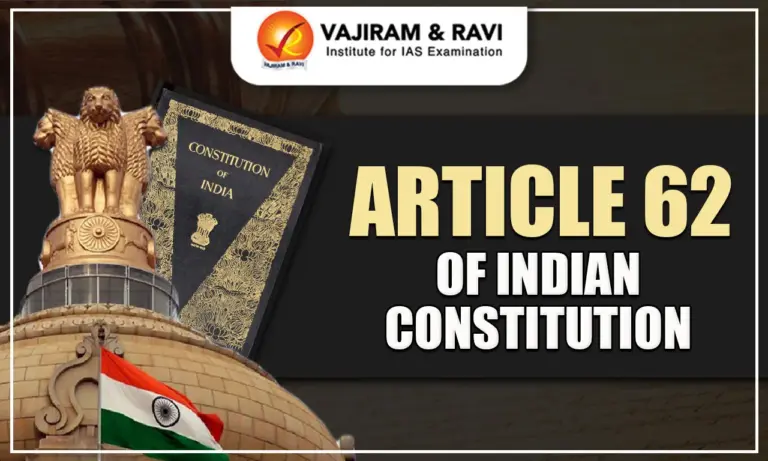
Article 62 of the Constitution of India talks about the timings of Presidential elections to make sure that the office does not stay vacant for a long period of time. The article says that the elections for the ongoing President should be completed before the term ends. In case of death, resignation or removal, elections should be held within six months and the new appointed President will serve a full five year term after taking up office. In this article, we are going to cover all about Article 62 of the Indian Constitution, its interpretation and significance.
Article 62 of the Constitution of India Interpretation
Article 62 of the Constitution of India makes sure that the office of President is never empty for a long period of time whether the vacancy is planned or sudden. This marks the difference between regular succession and unforeseen vacancies. This helps keep up the principle of a full five-year term for every new elected President.
- Article 62 says that the elections of the President must be conducted before the term gets over.
- If the present President suddenly dies, resigns or gets removed for some reason, the elections have to be held within six months.
Article 62 of the Constitution of India Importance
Article 62 comes under part V of the Constitution of India is extremely important as it helps in maintaining stability and continuity of the constitutional framework of India. The Article 62 is important because:
- Saved the office of President from becoming vacant.
- Make sure governance runs smoothly.
- Provides outlines for both scheduled and unforeseen vacancies.
- Helps conduct fair and regular electoral processes.





Article 62 of Indian Constitution Landmark Case
In the Presidential Election case, the Supreme Court clarified that under Articles 54, 55, and 62 of the Indian Constitution, the election to the office of the President must be completed before the incumbent’s term expires. The Court further interpreted Article 56(1)(c) to apply only in exceptional cases where the newly elected President is unable to assume office immediately, thereby permitting the outgoing President to continue temporarily until the successor takes charge.

 Last updated on March, 2026
→ UPSC Final Result 2025 is now out.
→ UPSC has released UPSC Toppers List 2025 with the Civil Services final result on its official website.
→ Anuj Agnihotri secured AIR 1 in the UPSC Civil Services Examination 2025.
→ UPSC Marksheet 2025 is now out.
→ UPSC Notification 2026 & UPSC IFoS Notification 2026 is now out on the official website at upsconline.nic.in.
→ UPSC Calendar 2026 has been released.
→ Check out the latest UPSC Syllabus 2026 here.
→ UPSC Prelims 2026 will be conducted on 24th May, 2026 & UPSC Mains 2026 will be conducted on 21st August 2026.
→ The UPSC Selection Process is of 3 stages-Prelims, Mains and Interview.
→ Prepare effectively with Vajiram & Ravi’s UPSC Prelims Test Series 2026 featuring full-length mock tests, detailed solutions, and performance analysis.
→ Enroll in Vajiram & Ravi’s UPSC Mains Test Series 2026 for structured answer writing practice, expert evaluation, and exam-oriented feedback.
→ Join Vajiram & Ravi’s Best UPSC Mentorship Program for personalized guidance, strategy planning, and one-to-one support from experienced mentors.
→ Shakti Dubey secures AIR 1 in UPSC CSE Exam 2024.
→ Also check Best UPSC Coaching in India
Article 62 of Indian Constitution FAQs
Q1. Under which Part of the Constitution Article 62 of Indian Constitution is mentioned?+
Q2. What is Article 62 of the Indian Constitution?+
Q3. When must elections be conducted to fill the vacancy caused by the expiration of the term of the President as per Article 62 of Indian Constitution?+
Q4. What happens if the office of the President becomes vacant due to reasons like death, resignation or removal?+
Q5. What is Article 55 of the Indian Constitution?+
Tags: article 62 of indian constitution