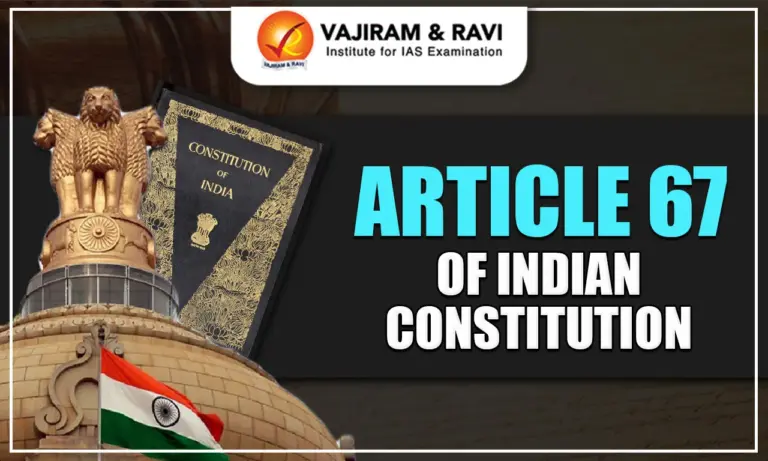
Article 67 of the Constitution of India covers the term of office of the Vice-President. The Constitution of India is the Supreme law that provides the outlines of governance and defines the rights, powers and the duties of the government and the citizens of India. Article 67 covers the following provisions about the Vice President of India–
- Tenure of the Vice-President
- Election of the Vice-President
- Removal of the Vice-President
Article 67 of the Constitution of India
Article 67 of the Constitution of India states that, “ The Vice President shall hold office for a term of five years from the date of which he enters upon his office. Provided that-
- a Vice-President may, by writing under his hand addressed to the President, resign his office
- a Vice-President may be removed from his office by a resolution of the Council of States passed by a majority of all the then members of the Council and agreed to by the House of the People; but no resolution for the purpose of this clause shall be moved unless at least fourteen days’ notice has been given of the intention to move the resolution
- a Vice-President shall, notwithstanding the expiration of his term, continue to hold office until his successor enters upon his office.”
Tenure of the Vice-President of India
The Vice-President of India holds office for a term of five years from the date of entering office. However, they can continue to hold office beyond the term until a successor assumes charge. There is no limit to the number of times a person can be re-elected to the office of the Vice-President.





Appointment of the Vice-President of India
The Vice-President is elected by an electoral college consisting of members of both Houses of Parliament (Lok Sabha and Rajya Sabha), using the proportional representation system with single transferable vote through secret ballot.
To be eligible, a candidate must:
- Be a citizen of India.
- Be at least 35 years of age.
- Be qualified for election as a member of the Rajya Sabha.
- Not hold any office of profit under the Government of India or any state government.
Resignation of the Vice-President of India
The Vice-President may resign from office at any time by submitting a written resignation to the President of India.
The resignation becomes effective once it is accepted by the President. In case of a vacancy due to resignation, fresh elections must be held as soon as possible.
Removal of the Vice-President of India
The Vice-President can be removed through impeachment from office by a resolution of the Rajya Sabha, passed by an absolute majority and agreed to by the Lok Sabha.
- However, no formal impeachment process (as in the case of the President) is required.
- A 14-day notice must be given before the resolution is taken up.
- The grounds for removal are not specified in the Constitution.

 Last updated on March, 2026
→ UPSC Final Result 2025 is now out.
→ UPSC has released UPSC Toppers List 2025 with the Civil Services final result on its official website.
→ Anuj Agnihotri secured AIR 1 in the UPSC Civil Services Examination 2025.
→ UPSC Marksheet 2025 is now out.
→ UPSC Notification 2026 & UPSC IFoS Notification 2026 is now out on the official website at upsconline.nic.in.
→ UPSC Calendar 2026 has been released.
→ Check out the latest UPSC Syllabus 2026 here.
→ UPSC Prelims 2026 will be conducted on 24th May, 2026 & UPSC Mains 2026 will be conducted on 21st August 2026.
→ The UPSC Selection Process is of 3 stages-Prelims, Mains and Interview.
→ Prepare effectively with Vajiram & Ravi’s UPSC Prelims Test Series 2026 featuring full-length mock tests, detailed solutions, and performance analysis.
→ Enroll in Vajiram & Ravi’s UPSC Mains Test Series 2026 for structured answer writing practice, expert evaluation, and exam-oriented feedback.
→ Join Vajiram & Ravi’s Best UPSC Mentorship Program for personalized guidance, strategy planning, and one-to-one support from experienced mentors.
→ Shakti Dubey secures AIR 1 in UPSC CSE Exam 2024.
→ Also check Best UPSC Coaching in India
Article 67 of Indian Constitution FAQs
Q1. What is Article 67 of the Constitution of India?+
Q2. What is Article 67B of the Constitution?+
Q3. What is the 67th Amendment of the Constitution?+
Q4. How is the Vice President of India removed?+
Q5. What are the responsibilities of a Vice President of India?+
Tags: article 67 of indian constitution