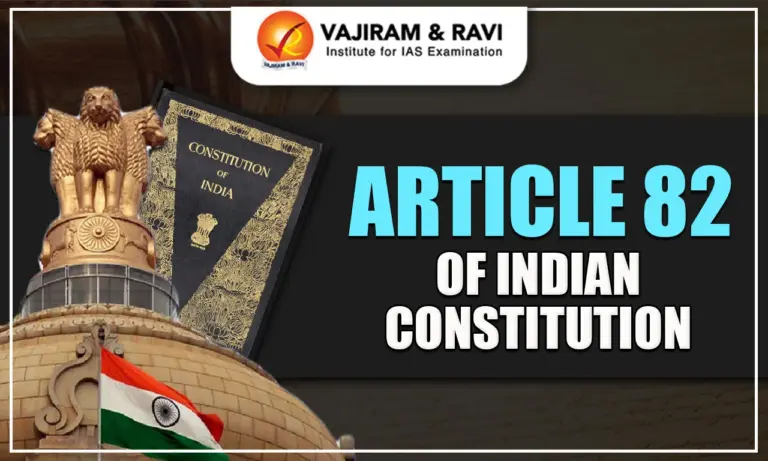
Article 82 under Part V of the Constitution of India provides a guarantee of fair and proportional representation in the Parliament in order to uphold the spirit of democracy. Article 82 of the Indian Constitution plays an important role in representing democratic fairness. It makes it necessary that the readjustment of Lok Sabha seats and the division of states into territorial constituencies after each Census reflect changing population patterns. This process, known as delimitation, ensures that representation keeps pace with demographic shifts, thereby reinforcing the principle of “one person, one vote.” In this article, we are going to cover all about Article 82, its interpretation and its significance in the Constitution of India.
Article 82 of the Constitution of India Interpretation
Article 82 of the Constitution of India provides the framework for providing equal representation in the Lok Sabha through periodic readjustment of seats. It is necessary that after every Census, the allocation of seats and the division of states into territorial constituencies must be revised to reflect population changes.
- Census-Based Readjustment: Lok Sabha seat allocation and constituency division are to be revised after each Census.
- Parliamentary Oversight: Parliament determines the process and authority for delimitation through a Delimitation Act.
- Delimitation Commission: An independent body tasked with redrawing constituency boundaries using census data.
- Proportional Representation: Ensures each state’s Lok Sabha representation aligns with its population.
- Frozen Seat Allocation: To promote population control, seat allocation has been frozen based on the 1971 Census.
- Boundary Adjustments: Though seat numbers remain static, boundaries and SC/ST reservations were redrawn using the 2001 Census and are due for revision post-2026.
Article 82 of Indian Constitution Landmark Cases
Judicial interpretations have played a key role in shaping the understanding and application of Article 82 of the Indian Constitution, particularly in the context of electoral fairness and delimitation. While not always directly focused on Article 82, several landmark cases have clarified its significance within India’s constitutional and legal framework:
- Kuldip Nayar v. Union of India (2006):
Though not directly centered on Article 82, the Supreme Court reaffirmed Parliament’s authority to regulate electoral processes, indirectly reinforcing its power under Article 82(1) to oversee delimitation through legislation. - Indira Nehru Gandhi v. Raj Narain (1975):
This pivotal case emphasized the constitutional limits on electoral laws, underlining how periodic delimitation—as mandated by Article 82—upholds the principle of equitable and representative democracy.
- Union of India v. Association for Democratic Reforms (2002):
The Court’s emphasis on transparency in electoral processes aligned with the broader goals of Article 82 in strengthening democratic participation, even though delimitation was not the core issue in the case.
- Ashok Kumar v. Election Commission of India (2000):
The judgment highlighted the Election Commission’s responsibility to ensure free and fair elections, which includes implementing delimitation exercises as per Article 82(2).






 Last updated on March, 2026
→ UPSC Final Result 2025 is now out.
→ UPSC has released UPSC Toppers List 2025 with the Civil Services final result on its official website.
→ Anuj Agnihotri secured AIR 1 in the UPSC Civil Services Examination 2025.
→ UPSC Marksheet 2025 is now out.
→ UPSC Notification 2026 & UPSC IFoS Notification 2026 is now out on the official website at upsconline.nic.in.
→ UPSC Calendar 2026 has been released.
→ Check out the latest UPSC Syllabus 2026 here.
→ UPSC Prelims 2026 will be conducted on 24th May, 2026 & UPSC Mains 2026 will be conducted on 21st August 2026.
→ The UPSC Selection Process is of 3 stages-Prelims, Mains and Interview.
→ Prepare effectively with Vajiram & Ravi’s UPSC Prelims Test Series 2026 featuring full-length mock tests, detailed solutions, and performance analysis.
→ Enroll in Vajiram & Ravi’s UPSC Mains Test Series 2026 for structured answer writing practice, expert evaluation, and exam-oriented feedback.
→ Join Vajiram & Ravi’s Best UPSC Mentorship Program for personalized guidance, strategy planning, and one-to-one support from experienced mentors.
→ Shakti Dubey secures AIR 1 in UPSC CSE Exam 2024.
→ Also check Best UPSC Coaching in India
Article 82 of Indian Constitution FAQs
Q1. What is the Article 82 of the Constitution?+
Q2. What is Article 81 and 82 of the Constitution of India?+
Q3. What is the Article 82 of the Delimitation Commission?+
Q4. What is Part V of the Constitution of India?+
Q5. How many seats are there in the Lok Sabha?+
Tags: article 82 of indian constitution