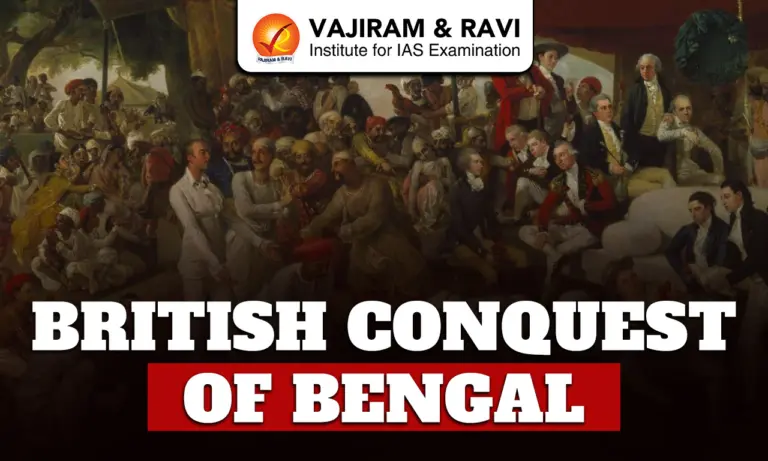
The British conquest of Bengal marked a turning point in Indian history, transforming the English East India Company from a trading enterprise into a political and military power, and laying the foundation for British colonial rule in India.
Bengal on the Eve of British Conquest
Bengal in the 18th century was the most prosperous province of the Mughal Empire. It covered present-day Bangladesh, Bengal, Bihar, Orissa. Its agricultural surplus, textile industry, and trade networks made it the most economically significant region in the subcontinent.
Bengal was a major exporter of valuable commodities such as silk, cotton textiles, saltpetre, sugar, rice, and indigo. Nearly 60% of British imports from Asia came from Bengal, making it economically indispensable for the English East India Company. The region also witnessed rapid urban growth, with cities like Murshidabad, Dacca, and Calcutta emerging as major commercial centres.
Politically, Bengal enjoyed relative stability compared to other parts of India. While much of India was affected by Maratha invasions, Jat revolts, and foreign invasions by Nadir Shah and Ahmad Shah Abdali, Bengal remained largely undisturbed. This prosperity and stability were sustained by an efficient administrative system under the Nawabs of Bengal.
Administration under the Nawabs of Bengal
Bengal under its Nawabs was marked by efficient administration, strong revenue system, and relative autonomy from the Mughal Empire. The key rulers contributed in the following ways:
Murshid Quli Khan (till 1727)
- He laid the foundation of Bengal’s administrative system by introducing strict revenue collection and financial discipline.
- He shifted the capital to Murshidabad and made Bengal economically self-sufficient.
Shujauddin (1727-1739)
- He maintained administrative stability and continued the policies of his predecessor, ensuring continuity in governance and prosperity.
Sarfaraz Khan (1739-1740)
- His brief rule was marked by administrative weakness, which led to his defeat by Alivardi Khan.
Alivardi Khan (1740-1756)
- He restored stability after overthrowing Sarfaraz Khan and successfully defended Bengal against repeated Maratha invasions.
- During his rule, Bengal remained peaceful and prosperous.
- At the same time, he gradually stopped paying tribute to the Mughal Emperor, reflecting Bengal’s growing independence.
- Towards the end of his reign, he became concerned about the increasing political ambitions of European companies, especially after witnessing their role in the Carnatic. However, no decisive action was taken.
- After his death in 1756, his grandson Siraj-ud-Daulah inherited both the throne and the growing tensions with the English.
Siraj-ud-Daulah
When Siraj-ud-Daulah ascended the throne in 1756, he faced a combination of internal instability and external threats, which weakened his authority.
Internal Challenges faced by Siraj-ud-Daulah
- Powerful nobles and bankers like Jagat Seth, Rai Durlabh, and Omichand opposed him.
- His cousin Shaukat Jang challenged his authority.
- Ghasiti Begum, elder sister of Alivardi Khan’s wife, opposed Siraj-ud-Daulah’s succession and supported rival claimants like Shaukat Jang.
- Mir Jafar, the army commander, was disloyal and later betrayed him.
- Siraj’s harsh and impulsive measures against rivals created resentment among powerful sections.
External Challenges faced by Siraj-ud-Daulah
- The English East India Company was becoming increasingly powerful in Bengal. It misused trade privileges (dastaks), causing loss of revenue to the Nawab.
- The Company also fortified Calcutta without permission and gave shelter to political enemies of Siraj.
- Siraj-ud-Daulah attacked and captured Calcutta from the English East India Company due to their fortification of the city without permission and sheltering of his enemies, which led to open conflict between the Nawab and the British.
- The Black Hole incident (1756), after the capture of Calcutta, worsened relations. After the capture of Calcutta, some English prisoners were allegedly confined in a small room in Fort William, leading to deaths due to suffocation; though debated by historians, it was used by the British to justify military action against the Nawab.





Causes of the British Conquest of Bengal
The conquest of Bengal was not a sudden event but the result of deep-rooted economic, political, and administrative conflicts between the Nawabs and the English East India Company.
Economically, the misuse of trade privileges by the Company played a crucial role. The Company had obtained the right to trade duty-free in Bengal through imperial farmans, but its officials extended this privilege to private trade, causing heavy losses to the Nawab’s revenue. The widespread abuse of dastaks (trade permits) created resentment among local merchants and the Bengal administration.
Politically, Bengal was weakened by internal divisions. Siraj-ud-Daulah faced opposition from powerful court factions, including Mir Jafar, Jagat Seth, and other influential figures. These internal rivalries made it easier for the British to interfere in Bengal’s politics.
The immediate causes of conflict further aggravated the situation. The English fortified Calcutta without the Nawab’s permission, provided asylum to political enemies of Siraj, and refused to comply with his authority. These actions led Siraj-ud-Daulah to attack and capture Calcutta, bringing the conflict into the open.
Thus, the confrontation between the Nawab and the Company was driven by a clash of interests while the Nawab sought to protect his sovereignty, the Company aimed to expand its economic and political control.
Battle of Plassey (1757)
The Battle of Plassey was fought on 23 June 1757 between the forces of the English East India Company led by Robert Clive and the army of Siraj-ud-Daulah. It marked the first major step in the British conquest of Bengal.
The conflict arose due to growing tensions between the Nawab and the Company over issues such as the fortification of Calcutta and misuse of trade privileges. However, the outcome of the battle was largely decided even before it was fought. The British entered into a secret alliance with key officials of the Nawab’s court, including Mir Jafar, Jagat Seth, and Rai Durlabh.
During the battle, a large part of the Nawab’s army remained inactive due to this conspiracy. As a result, Siraj-ud-Daulah’s much larger army was defeated by a relatively small British force. Siraj was captured and killed, and Mir Jafar was installed as the Nawab of Bengal, making him dependent on the Company.
Significance of the Battle of Plassey
The Battle of Plassey had far-reaching consequences in political, economic, and strategic terms.
- Beginning of British Rule: The battle marked the starting point of British political dominance in India, as the Company gained decisive control over Bengal.
- Establishment of Puppet Rule: Installation of Mir Jafar as Nawab reduced the Bengal administration to a puppet regime dependent on the Company.
- Economic Exploitation and Drain of Wealth: The Company gained access to Bengal’s vast resources, leading to large-scale extraction of wealth and the beginning of the drain of wealth from India.
- Transformation of the Company: The English East India Company transformed from a trading body into a political and territorial power.
- Strengthening of British Military-Strategic Position: The victory demonstrated the effectiveness of British diplomacy, conspiracy, and organisation over traditional Indian power structures.
- Decline of French Influence: The battle weakened French presence in Bengal, paving the way for British supremacy in India.
- Foundation for Further Expansion: Control over Bengal’s resources enabled the British to finance further military campaigns and territorial expansion in India.
Mir Jafar and Mir Kasim
Mir Jafar soon proved unable to satisfy the increasing demands of the Company. As a result, he was replaced by his son-in-law, Mir Kasim, in 1760. Unlike his predecessor, Mir Kasim was a capable and ambitious ruler who sought to assert his independence.
- He shifted his capital to Munger,
- Reorganised his administration, and
- Modernised his army. Most importantly.
- He attempted to end the misuse of trade privileges by abolishing internal duties altogether, thereby creating equal conditions for all traders.
However, this move directly challenged the Company’s economic interests. The British opposed his reforms and tensions soon escalated into open conflict. After suffering defeats, Mir Kasim fled and formed an alliance with the Nawab of Awadh and the Mughal Emperor. This alliance led to the Battle of Buxar (1764).
The Battle of Buxar (1764)
The Battle of Buxar was fought on 22 October 1764 between the English East India Company under Hector Munro and the combined forces of Mir Kasim, the Nawab of Awadh, and the Mughal Emperor Shah Alam II. The English forces defeated the combined army, establishing their clear military superiority.
Significance of the Battle of Buxar
Battle of Buxar was significant because of following reasons:
- Decisive British Victory: The battle firmly established the military superiority of the British over Indian powers.
- Defeat of Major Indian Powers: It marked the defeat of not only the Nawab of Bengal but also the Nawab of Awadh and the Mughal Emperor, symbolising the decline of traditional political authority.
- Established of British Supremacy in North India: The victory made the British the dominant power in northern India.
- Foundation for Territorial Expansion: It enabled the Company to expand its control beyond Bengal into other parts of India.
- Grant of Diwani (1765): The victory led to the Treaty of Allahabad, through which the Company obtained Diwani rights over Bengal, Bihar, and Odisha.
In 1765, Robert Clive concluded the Treaty of Allahabad with the Nawab of Awadh and the Mughal Emperor. Under this treaty, the Mughal Emperor granted the Diwani rights (revenue collection) of Bengal, Bihar, and Odisha to the East India Company in return for an annual payment.
After acquiring the Diwani, the Company introduced the system of Dual Government in Bengal. Under this system, power was divided between the East India Company and the Nawab of Bengal:
- The Company received Diwani rights, which meant control over revenue collection and finances.
- The Nawab retained Nizamat functions, which included administration, law and order, and justice.
However, in reality, the Company held the real power because it controlled the finances, while the Nawab had responsibility without resources. Further, the Nawab of Awadh was turned into a buffer state, while the Mughal Emperor became dependent on the Company. This arrangement gave the Company legal authority over Bengal’s revenues, marking the beginning of its territorial rule.
Thus, between 1757 and 1765, the English East India Company transformed itself from a mere trading body into a territorial and political power. The conquest of Bengal not only provided economic resources but also laid the administrative and institutional foundations of British colonial rule in India.

 Last updated on April, 2026
→ UPSC Final Result 2025 is now out.
→ UPSC has released UPSC Toppers List 2025 with the Civil Services final result on its official website.
→ Anuj Agnihotri secured AIR 1 in the UPSC Civil Services Examination 2025.
→ UPSC Marksheet 2025 is now out.
→ UPSC Notification 2026 & UPSC IFoS Notification 2026 is now out on the official website at upsconline.nic.in.
→ UPSC Calendar 2026 has been released.
→ Check out the latest UPSC Syllabus 2026 here.
→ UPSC Prelims 2026 will be conducted on 24th May, 2026 & UPSC Mains 2026 will be conducted on 21st August 2026.
→ The UPSC Selection Process is of 3 stages-Prelims, Mains and Interview.
→ Prepare effectively with Vajiram & Ravi’s UPSC Prelims Test Series 2026 featuring full-length mock tests, detailed solutions, and performance analysis.
→ Enroll in Vajiram & Ravi’s UPSC Mains Test Series 2026 for structured answer writing practice, expert evaluation, and exam-oriented feedback.
→ Join Vajiram & Ravi’s Best UPSC Mentorship Program for personalized guidance, strategy planning, and one-to-one support from experienced mentors.
→ Shakti Dubey secures AIR 1 in UPSC CSE Exam 2024.
→ Also check Best UPSC Coaching in India
British Conquest of Bengal FAQs
Q1. Why was Bengal important for the English East India Company?+
Q2. What were the main causes of the British conquest of Bengal?+
Q3. What role did the Battle of Plassey play in the British Conquest of Bengal?+
Q4. How did the Battle of Buxar contribute to the British Conquest of Bengal?+
Q5. Why is the British Conquest of Bengal considered a turning point in Indian history?+
Tags: british conquest of bengal