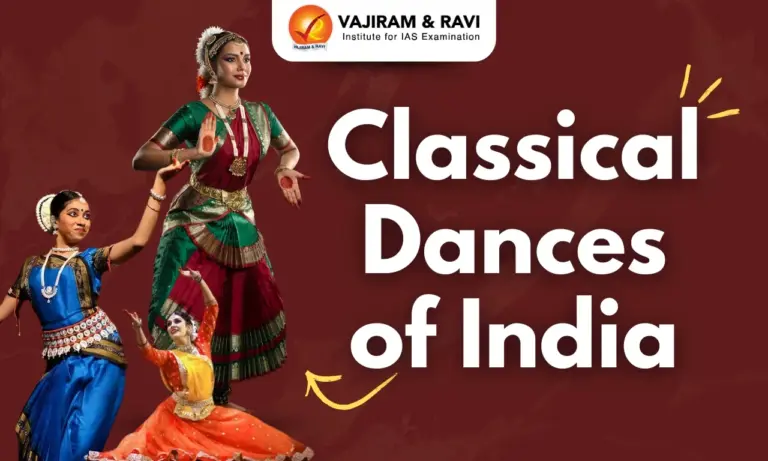
India’s classical dances are a rich embodiment of the country’s cultural, spiritual, and artistic heritage. Rooted in ancient texts like the Natyashastra and Abhinaya Darpana, these dance forms combine rhythm, expression, and storytelling to convey emotions, mythology, and devotion. Each dance is recognized for its codified technique, expressive gestures, music, and regional identity.
This article discusses the Classical Dances of India along with the criteria for recognition as a classical dance form and the elements of classical dance forms.
8 Classical Dances of India with States list
India has eight recognized classical dance forms, each deeply rooted in the cultural, spiritual, and artistic traditions of its region. These dances evolved through temple rituals, royal patronage, and codified training systems.
| 8 Classical Dances of India with States list | ||
| S.No. | Classical Dance | State |
|
1 |
Bharatanatyam |
Tamil Nadu |
|
2 |
Kathak |
Uttar Pradesh |
|
3 |
Kathakali |
Kerala |
|
4 |
Mohiniyattam |
Kerala |
|
5 |
Odissi |
Odisha |
|
6 |
Kuchipudi |
Andhra Pradesh |
|
7 |
Manipuri |
Manipur |
|
8 |
Sattriya |
Assam |
Also Read: Folk Dances of India
Criteria for Recognition of Classical Dance in India
The recognition of a dance form as classical is based on well-established artistic, theoretical, and cultural parameters that distinguish it from folk or contemporary styles. These criteria ensure that the dance form possesses depth, continuity, and a codified structure.
- Textual Foundation: Rooted in Bharata Muni’s Natyashastra or allied classical dance treatises.
- Threefold Structure: Presence of Nritta (pure dance), Nritya (expressive dance), and Natya (dramatic narration).
- Rasa-Bhava Framework: Ability to evoke prescribed rasas through controlled emotional expression (bhava).
- Lasya-Tandava Balance: Integration of graceful (Lasya) and vigorous (Tandava) movement styles.
- Codified Technique: Fixed grammar of postures, footwork, gestures, and body movements.
- Abhinaya System: Structured use of facial expressions, eye movements, and hand gestures (mudras).
- Guru-Shishya Parampara: Transmission through an established teacher-disciple lineage.
- Spiritual/Thematic Depth: Themes drawn from mythology, epics, or philosophical traditions.
- Regional Character: Distinct identity reflected in music, costume, makeup, and instruments.
- Historical Continuity: Sustained practice and evolution over a long period.
- Institutional Recognition: Official acknowledgment by the Sangeet Natak Akademi.





Major Classical Dance Forms of India
India has eight classical dance forms, each reflecting a unique regional, cultural, and spiritual tradition. Though diverse in form and expression, all classical dances share a common foundation in ancient aesthetic principles, codified techniques, and devotional themes.
1. Bharatanatyam (Tamil Nadu)
- One of the oldest surviving classical dance forms, with origins in temple traditions of South India.
- Based on the Natyashastra and Abhinaya Darpana of Nandikesvara, which define body movements, gestures, and expressions.
- An Ekaharya style where a single dancer portrays multiple characters in one performance.
- Strong emphasis on geometric precision, symmetry, and rhythmic footwork (adavus).
- Uses expressive eye movements (drishti bheda) and codified hand gestures (hasta mudras).
- Aims to evoke all Navarasas, with special emphasis on Shringara and Bhakti.
- Accompanied by a Carnatic orchestra consisting of vocalist, mridangam, violin or veena, flute, and cymbals, led by the Nattuvanar.
- The traditional margam includes Alarippu, Jatiswaram, Shabdam, Varnam, Padam, Tillana, and Sloka.
- Sculptural evidence of Bharatanatyam poses is found on the gopurams of the Chidambaram Temple.
- Revived and institutionalized in the modern period by E. Krishna Iyer and Rukmini Devi Arundale.
- Important Personalities: Balasaraswati, Yamini Krishnamurthy, and Padma Subrahmanyam
2. Kathak (Uttar Pradesh)
- The name Kathak is derived from Katha (story), reflecting its narrative foundation.
- Originated as a temple and village performance where storytellers narrated episodes from epics and Puranas.
- Evolved into a classical form during the Bhakti movement of the 15th-16th centuries.
- Legends of Radha and Krishna were performed through Rasa Lila, blending folk and classical elements.
- Received strong court patronage under Mughal rulers, leading to refinement in technique, costume, and musical accompaniment.
- Reached artistic maturity under Wajid Ali Shah, the last Nawab of Awadh.
- Characterized by intricate footwork (tatkar), rapid spins (chakkars), and rhythmic complexity.
- Dancers wear heavy ankle bells (ghungroos) and perform with straight legs and controlled movements.
- Unique among classical dances for its close association with Hindustani classical music.
- Revived in the 20th century by Lady Leela Sokhey (Menaka); eminent exponents include Birju Maharaj, Sitara Devi, and Shambhu Maharaj.
3. Kathakali (Kerala)
- Developed in Kerala under the influence of ritual theatre forms such as Chakiarkoothu, Koodiyattam, Krishnattam, and Ramanattam.
- A highly stylized dance-drama combining dance, music, acting, and elaborate visual design.
- Themes are primarily drawn from the Ramayana, Mahabharata, and Puranic legends.
- Noted for its elaborate costumes, massive skirts, ornate headgear, and dramatic facial makeup.
- Facial colors symbolize character traits: green for virtue and heroism, red for aggression, and black for evil.
- Communication relies heavily on codified hand gestures, facial expressions, and intense eye movements.
- The body posture places weight on the outer edges of bent feet, creating a powerful and grounded stance.
- Musical accompaniment includes chenda, maddalam, cymbals, and vocal narration.
- Renowned exponents include Ramankutty Nair and Kalamandalam Gopi.
4. Mohiniyattam (Kerala)
- A classical solo dance form of Kerala named after Mohini, the enchanting female avatar of Vishnu.
- Literary references appear in Vyavaharamala (1709) and Ghoshayatra by Kunjan Nambiar.
- Received royal patronage and formal structuring under Maharaja Kartika Tirunal and Maharaja Swati Tirunal.
- Characterized by gentle, circular movements, soft footwork, and subtle facial expressions.
- Movements draw influence from Nangiar Koothu and folk dances like Kaikottikali and Tiruvatirakali.
- Combines the grace of Bharatanatyam with the vigor of Kathakali, yet remains predominantly Lasya-oriented.
- Costume consists of the traditional white and gold Kasavu saree with minimal ornaments.
- Lyrics are composed in Manipravala, blending Tamil-Malayalam and Sanskrit.
- Notable exponents include Sunanda Nair, Kalamandalam Kalyanikutty Amma, and Pallavi Krishnan.
5. Odissi (Odisha)
- One of the oldest classical dance traditions, with origins in temple rituals of Odisha.
- Themes focus on Vaishnavism, especially stories of Lord Krishna and verses from Jayadeva’s Gita Govinda.
- A lyrical and graceful dance style supported by Odissi classical music.
- Known as a “mobile sculpture” due to its sculptural poses and fluid torso movements.
- Characterized by the Tribhanga posture and the Chowk stance.
- Shares similarities with Bharatanatyam in mudras and expressive techniques but retains a distinct regional identity.
- Emphasizes devotional storytelling and emotional depth.
- Eminent performers include Kelucharan Mohapatra, Sanjukta Panigrahi, and Sonal Mansingh.
6. Kuchipudi (Andhra Pradesh)
- Originated in Kuchipudi village of Krishna district and was earlier known as Yakshagaana.
- Systematized in the 17th century by Siddhendra Yogi as a devotional dance-drama tradition.
- Inspired by literary works such as Krishna-Leelatarangini by Tirtha Narayana Yogi.
- Performed both as group dance-dramas and as solo presentations.
- Known for brisk movements, expressive abhinaya, and dramatic storytelling.
- Costumes are colorful and light, allowing flexibility and fast footwork.
- Unique solo items include Manduka Shabdam, Balgopala Taranga, and Tala Chitra Nritya.
- Musical accompaniment follows the Carnatic tradition.
- Prominent dancers include Yamini Krishnamurthy, Raja Reddy, and Radha Reddy.
7. Manipuri (Manipur)
- One of the most ancient dance traditions, with origins predating recorded history.
- Closely associated with rituals, festivals, and mythological narratives of Manipur.
- Lai Haraoba is the earliest form, symbolizing the creation of the universe through dance.
- Performed by Maibas and Maibis, who reenact cosmic creation myths.
- Ras Leela was systematized under King Bhagyachandra in the 18th century.
- Major forms include Ras, Sankirtana, and Thang-Ta.
- Sankirtana combines dance with devotional congregational singing.
- Male dancers perform while playing the Pung (drum) and Kartal (cymbals).
- Ankle bells are avoided to preserve the softness, fluidity, and delicacy of movements.
8. Sattriya (Assam)
- Introduced in the 15th century by the Vaishnava saint and reformer Srimanta Sankaradeva.
- Developed as a medium for propagating Vaishnavism through dance and drama.
- Evolved within Sattras (Vaishnava monasteries), giving the dance its name.
- Governed by strictly codified principles related to mudras, footwork, costume, and music.
- Features two major streams: Bhaona-based dance-dramas and independent dance numbers.
- Chali emphasizes grace and lyrical beauty, while Jhumura highlights vigor and majesty.
- Music and rhythm play a central role in performance.
- Recognized as a classical dance form in the modern period.
Elements of Classical Dance
- Natyashastra-Based Framework: Classical dances follow the principles of Bharata Muni’s Natyashastra, which codifies technique, expression, rhythm, and aesthetics.
- Trinity of Nritta-Nritya-Natya: Nritta focuses on pure rhythmic movement, Nritya on expressive interpretation through gestures and emotions, and Natya on dramatic storytelling.
- Abhinaya (Modes of Expression): Expression is conveyed through Angika (body), Vachika (music/recitation), Aharya (costume and makeup), and Sattvika (inner emotion).
- Rasa-Bhava Theory: Dancers express bhavas (emotions) to evoke rasas (aesthetic experience) in the audience, which is the ultimate goal of performance.
- Rhythm and Musical Structure: Dance movements are synchronized with tala (rhythm) and raga (melody), integrating closely with Indian classical music traditions.
- Lasya-Tandava and Codified Technique: Classical dance balances graceful (Lasya) and vigorous (Tandava) movements using structured postures, mudras, and footwork.
Role of Sangeet Natak Akademi in Promoting Classical Dances
- Preservation and Recognition: Identifies and preserves classical dance forms and traditional techniques.
- Training and Education: Conducts workshops, masterclasses, and supports the Guru-Shishya parampara.
- Financial Support: Provides scholarships, grants, and fellowships to dancers and institutions.
- Promotion of Performances: Organizes national and international festivals and dance tours.
- Research and Documentation: Archives performances, publishes books, and supports scholarly research.
- Awards and Incentives: Honors outstanding artists with awards and fellowships to encourage excellence.

 Last updated on March, 2026
→ UPSC Final Result 2025 is now out.
→ UPSC has released UPSC Toppers List 2025 with the Civil Services final result on its official website.
→ Anuj Agnihotri secured AIR 1 in the UPSC Civil Services Examination 2025.
→ UPSC Marksheet 2025 is now out.
→ UPSC Notification 2026 & UPSC IFoS Notification 2026 is now out on the official website at upsconline.nic.in.
→ UPSC Calendar 2026 has been released.
→ Check out the latest UPSC Syllabus 2026 here.
→ UPSC Prelims 2026 will be conducted on 24th May, 2026 & UPSC Mains 2026 will be conducted on 21st August 2026.
→ The UPSC Selection Process is of 3 stages-Prelims, Mains and Interview.
→ Prepare effectively with Vajiram & Ravi’s UPSC Prelims Test Series 2026 featuring full-length mock tests, detailed solutions, and performance analysis.
→ Enroll in Vajiram & Ravi’s UPSC Mains Test Series 2026 for structured answer writing practice, expert evaluation, and exam-oriented feedback.
→ Join Vajiram & Ravi’s Best UPSC Mentorship Program for personalized guidance, strategy planning, and one-to-one support from experienced mentors.
→ Shakti Dubey secures AIR 1 in UPSC CSE Exam 2024.
→ Also check Best UPSC Coaching in India
Classical Dances of India FAQs
Q1. How many classical dances are recognized in India?+
Q2. Which is the oldest classical dance of India?+
Q3. Are classical dances only religious in nature?+
Q4. What is the importance of Natya Shastra in classical dance?+
Q5. Can classical dances be performed on modern themes?+
Tags: classical dances of india