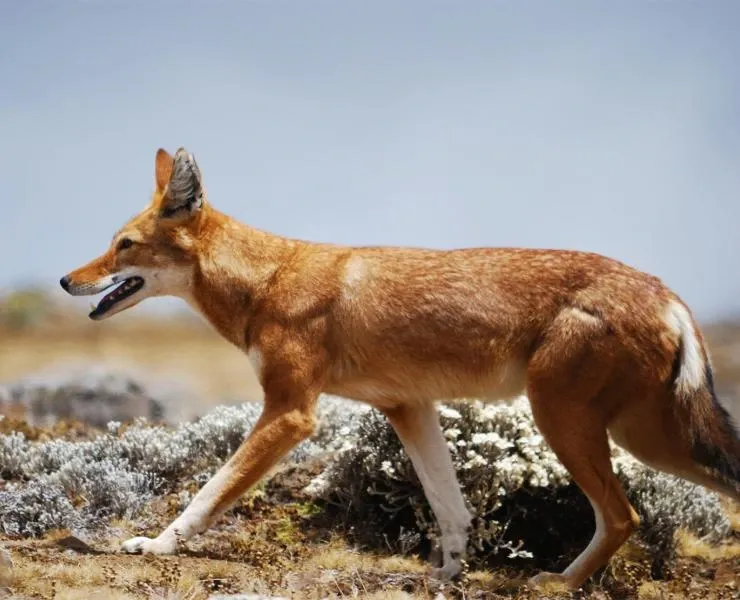
Key Features of the Ethiopian Wolf
- Specialized habitat and role: The Ethiopian wolf is a specialized rodent hunter in Afroalpine ecosystems and unique African high-altitude regions.
- These ecosystems, located mainly in the Ethiopian Highlands, exist at altitudes of 3,200 meters above sea level and are characterized by cold and harsh climates.
- Physical characteristics: The wolf is about the size of a large dog, with a reddish coat, white throat and chest markings, and a bushy black tail.
- Population status: With fewer than 500 individuals remaining, the Ethiopian wolf is Africa’s most endangered carnivore.
- Habitat specificity: It resides in isolated “sky islands”, high-altitude regions above tropical forests, surrounded by drastically different lowland environments.
Ethiopian Wolf’s Role as a Pollinator
- Interaction with Ethiopian red hot poker flower: The wolf feeds on the nectar of the red and yellow Ethiopian red hot poker flower, a plant that produces sweet nectar attracting multiple pollinators.
- As the wolf moves between flowers, pollen dusts its muzzle, potentially aiding in pollination.
- Behavioural observations: Researchers observed wolves spending significant time in flower fields, with one wolf visiting 30 flower heads in 1.5 hours.
- This behaviour indicates that the wolf actively seeks nectar, a rare trait for large carnivores.
Q1: What is pollination?
Pollination is the transfer of pollen grains from the male part (anther) of a flower to the female part (stigma) of the same or another flower, enabling fertilization and the production of seeds. It is essential for plant reproduction, biodiversity, and the production of fruits, vegetables, and seeds that sustain ecosystems and agriculture.
Source: DTE






 Last updated on April, 2026
→ UPSC Final Result 2025 is now out.
→ UPSC has released UPSC Toppers List 2025 with the Civil Services final result on its official website.
→ Anuj Agnihotri secured AIR 1 in the UPSC Civil Services Examination 2025.
→ UPSC Marksheet 2025 is now out.
→ UPSC Notification 2026 & UPSC IFoS Notification 2026 is now out on the official website at upsconline.nic.in.
→ UPSC Calendar 2026 has been released.
→ Check out the latest UPSC Syllabus 2026 here.
→ UPSC Prelims 2026 will be conducted on 24th May, 2026 & UPSC Mains 2026 will be conducted on 21st August 2026.
→ The UPSC Selection Process is of 3 stages-Prelims, Mains and Interview.
→ Prepare effectively with Vajiram & Ravi’s UPSC Prelims Test Series 2026 featuring full-length mock tests, detailed solutions, and performance analysis.
→ Enroll in Vajiram & Ravi’s UPSC Mains Test Series 2026 for structured answer writing practice, expert evaluation, and exam-oriented feedback.
→ Join Vajiram & Ravi’s Best UPSC Mentorship Program for personalized guidance, strategy planning, and one-to-one support from experienced mentors.
→ Shakti Dubey secures AIR 1 in UPSC CSE Exam 2024.
→ Also check Best UPSC Coaching in India
Tags: ethiopian wolf prelims pointers upsc current affairs upsc prelims current affairs